The Vector Space
Model
…and applications in
Information Retrieval
Part 1
Introduction to the Vector
Space Model
Overview
 The Vector Space Model (VSM) is a
way of representing documents through
the words that they contain
 It is a standard technique in Information
Retrieval
 The VSM allows decisions to be made
about which documents are similar to
each other and to keyword queries
How it works: Overview
 Each document is broken down into a
word frequency table
 The tables are called vectors and can
be stored as arrays
 A vocabulary is built from all the words
in all documents in the system
 Each document is represented as a
vector based against the vocabulary
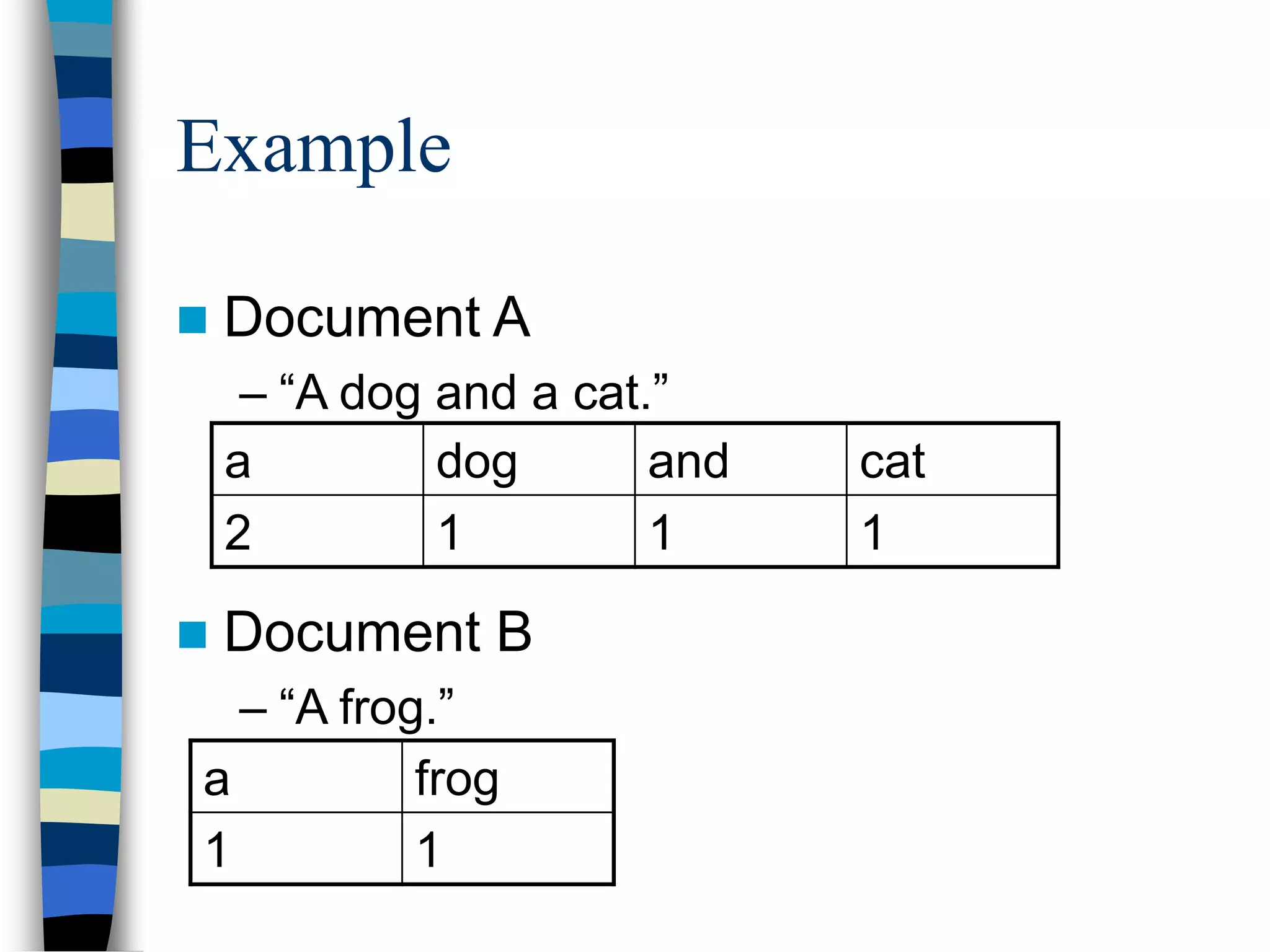
Example
 Document A
– “A dog and a cat.”
 Document B
– “A frog.”
a dog and cat
2 1 1 1
a frog
1 1
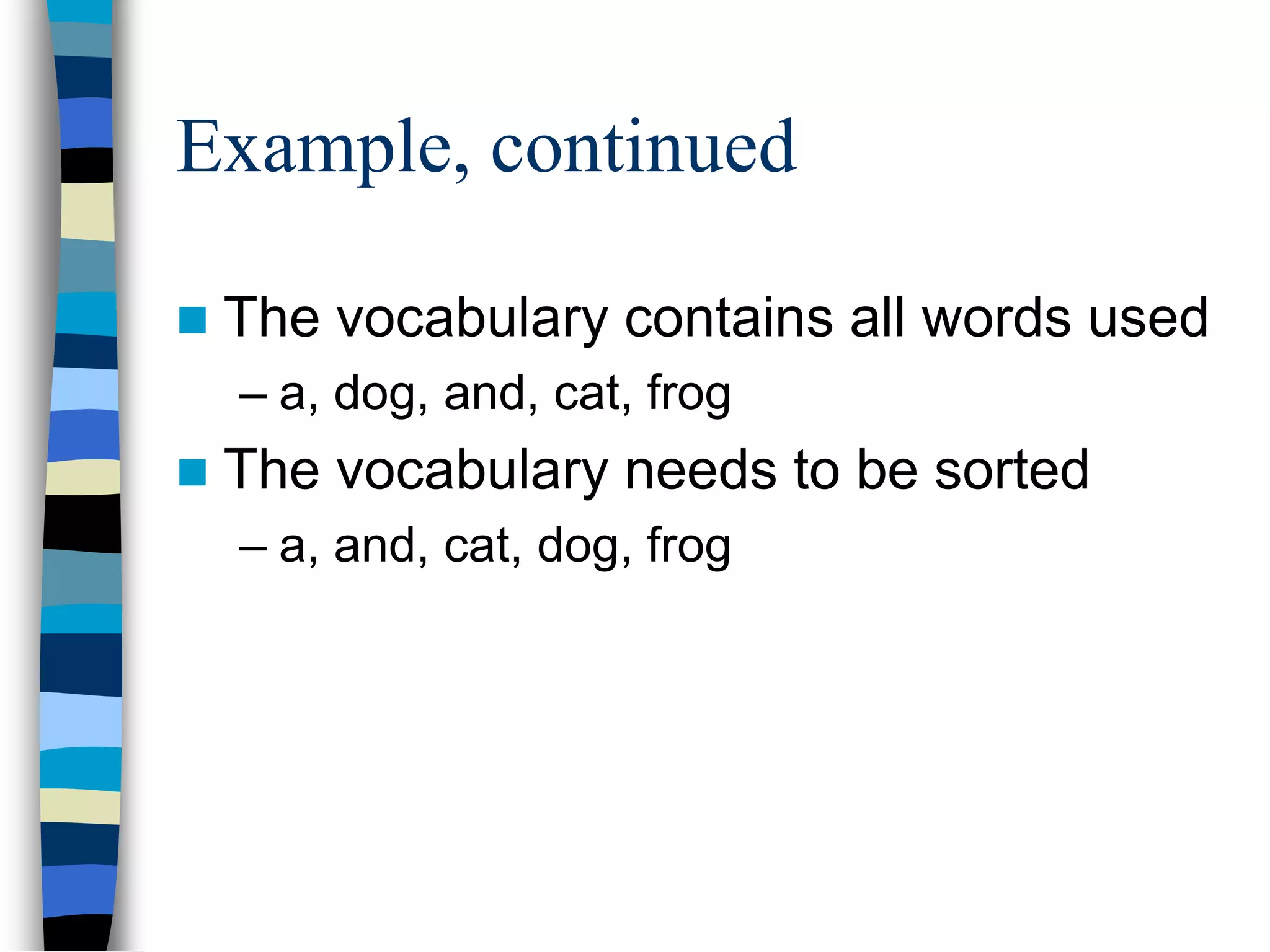
Example, continued
 The vocabulary contains all words used
– a, dog, and, cat, frog
 The vocabulary needs to be sorted
– a, and, cat, dog, frog
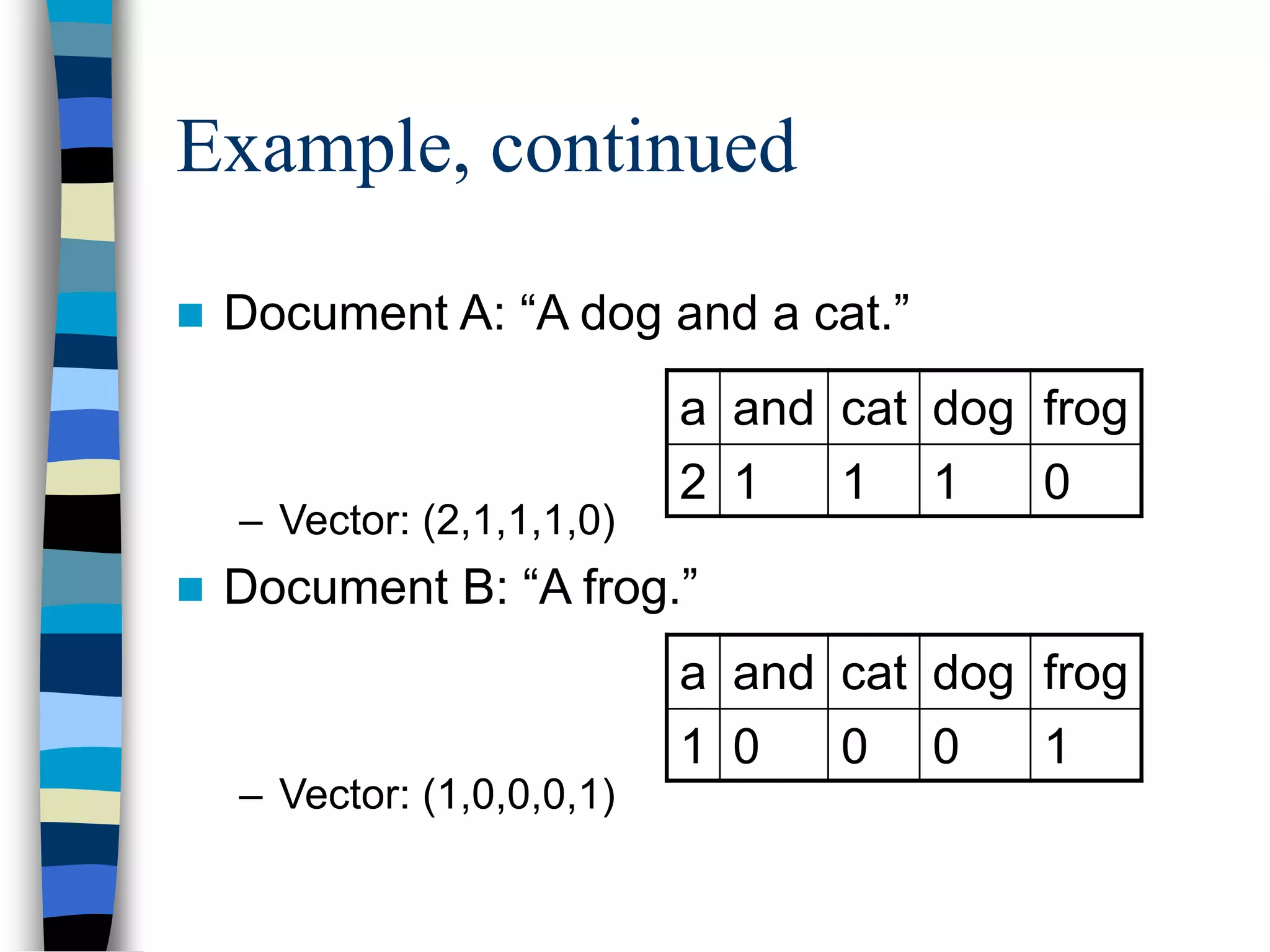
Example, continued
 Document A: “A dog and a cat.”
– Vector: (2,1,1,1,0)
 Document B: “A frog.”
– Vector: (1,0,0,0,1)
a and cat dog frog
2 1 1 1 0
a and cat dog frog
1 0 0 0 1
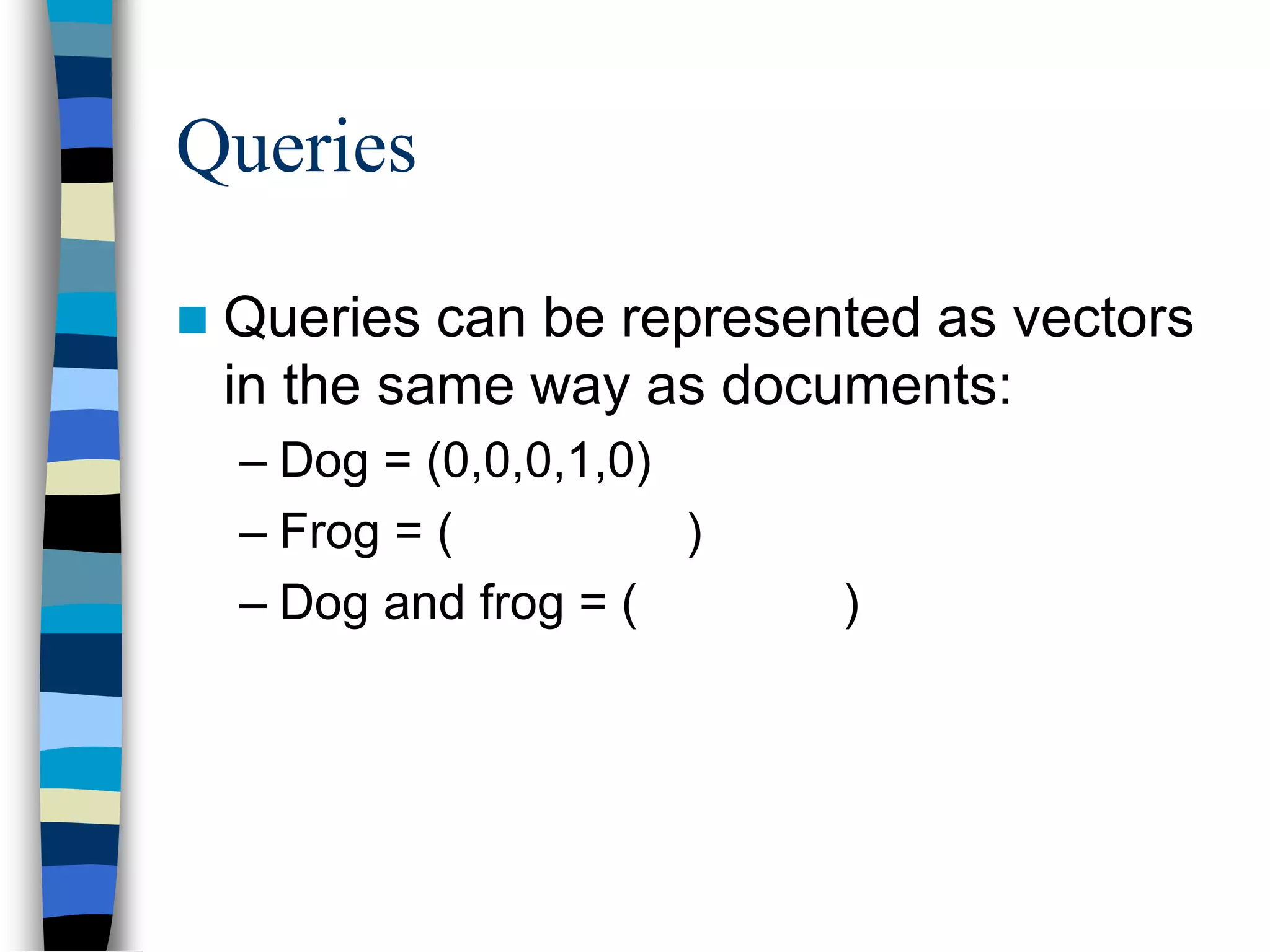
Queries
 Queries can be represented as vectors
in the same way as documents:
– Dog = (0,0,0,1,0)
– Frog = ( )
– Dog and frog = ( )
Similarity measures
 There are many different ways to measure
how similar two documents are, or how
similar a document is to a query
 The cosine measure is a very common
similarity measure
 Using a similarity measure, a set of
documents can be compared to a query and
the most similar document returned
The cosine measure
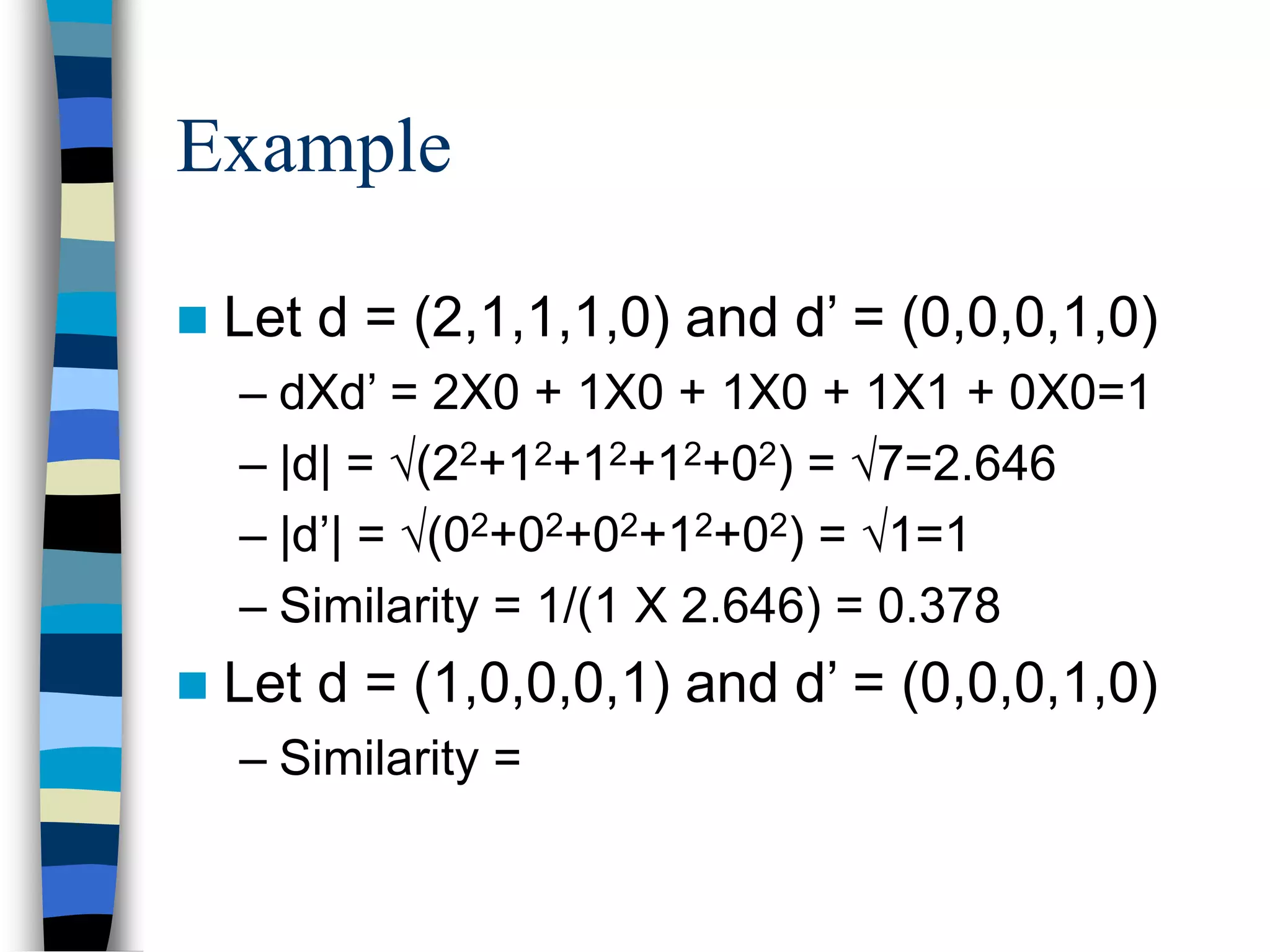
 For two vectors d and d’ the cosine similarity
between d and d’ is given by:
 Here d X d’ is the vector product of d and d’,
calculated by multiplying corresponding
frequencies together
 The cosine measure calculates the angle
between the vectors in a high-dimensional
virtual space
'
'
d
d
d
d 
Example
 Let d = (2,1,1,1,0) and d’ = (0,0,0,1,0)
– dXd’ = 2X0 + 1X0 + 1X0 + 1X1 + 0X0=1
– |d| = (22+12+12+12+02) = 7=2.646
– |d’| = (02+02+02+12+02) = 1=1
– Similarity = 1/(1 X 2.646) = 0.378
 Let d = (1,0,0,0,1) and d’ = (0,0,0,1,0)
– Similarity =
Ranking documents
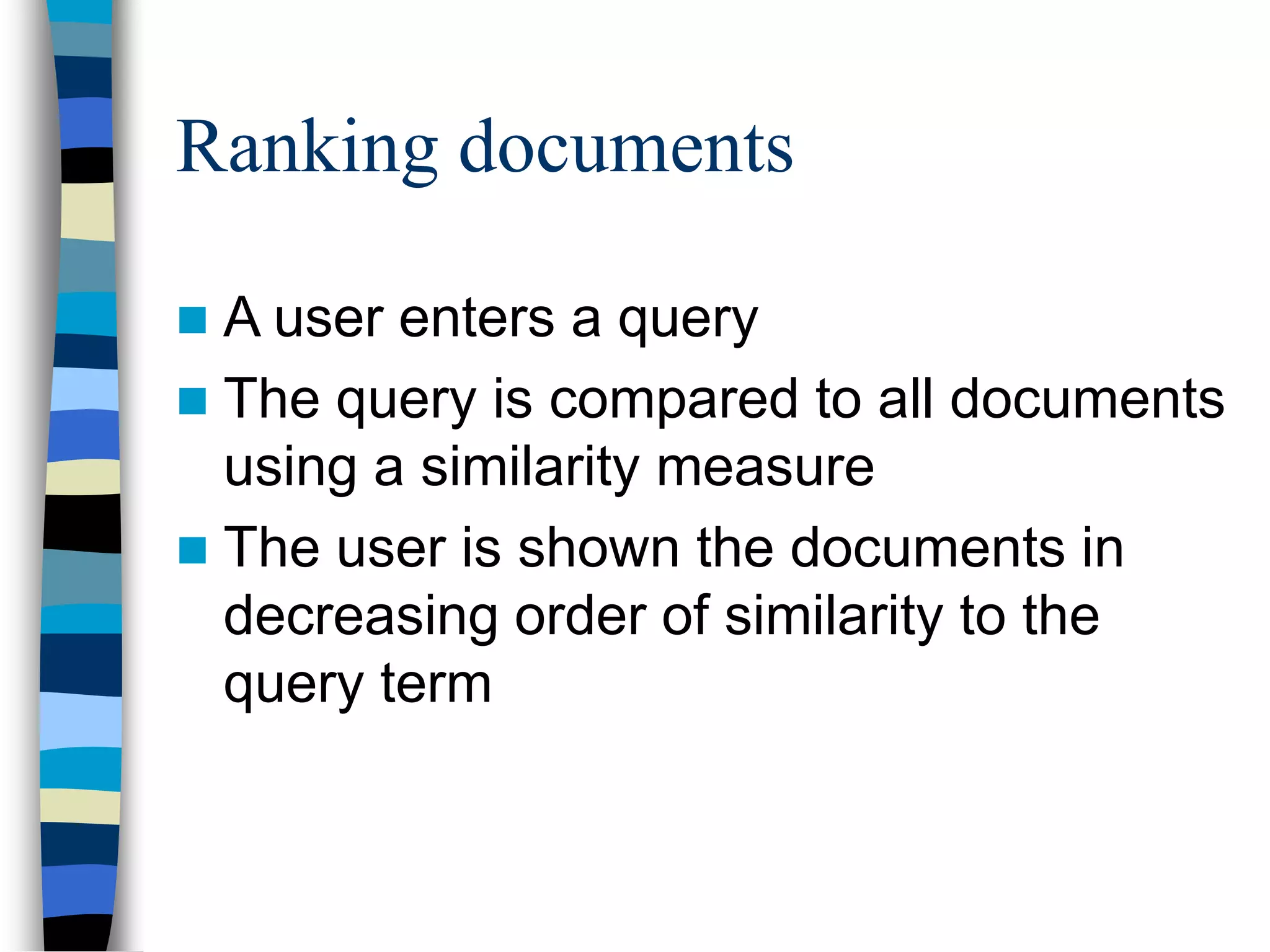
 A user enters a query
 The query is compared to all documents
using a similarity measure
 The user is shown the documents in
decreasing order of similarity to the
query term
VSM variations
Vocabulary
 Stopword lists
– Commonly occurring words are unlikely to
give useful information and may be
removed from the vocabulary to speed
processing
– Stopword lists contain frequent words to be
excluded
– Stopword lists need to be used carefully
• E.g. “to be or not to be”
Term weighting
 Not all words are equally useful
 A word is most likely to be highly
relevant to document A if it is:
– Infrequent in other documents
– Frequent in document A
 The cosine measure needs to be
modified to reflect this
Normalised term frequency (tf)
 A normalised measure of the importance of a
word to a document is its frequency, divided
by the maximum frequency of any term in the
document
 This is known as the tf factor.
 Document A: raw frequency vector:
(2,1,1,1,0), tf vector: ( )
 This stops large documents from scoring
higher
Inverse document frequency (idf)
 A calculation designed to make rare
words more important than common
words
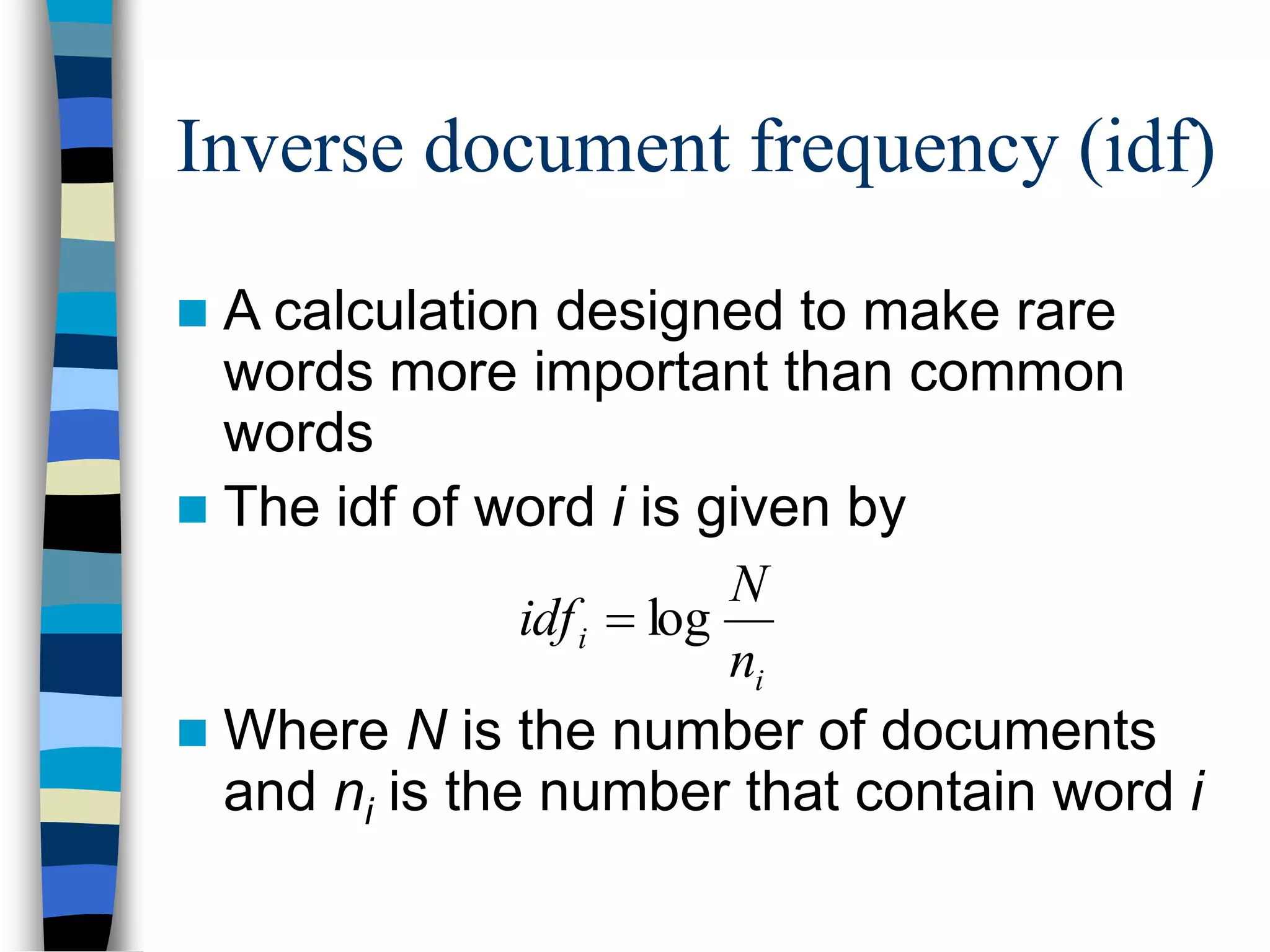
 The idf of word i is given by
 Where N is the number of documents
and ni is the number that contain word i
i
i
n
N
idf log

tf-idf
 The tf-idf weighting scheme is to
multiply each word in each document by
its tf factor and idf factor
 Different schemes are usually used for
query vectors
 Different variants of tf-idf are also used

vectorSpaceModelPeterBurden.ppt

  • 1.
    The Vector Space Model …andapplications in Information Retrieval
  • 2.
    Part 1 Introduction tothe Vector Space Model
  • 3.
    Overview  The VectorSpace Model (VSM) is a way of representing documents through the words that they contain  It is a standard technique in Information Retrieval  The VSM allows decisions to be made about which documents are similar to each other and to keyword queries
  • 4.
    How it works:Overview  Each document is broken down into a word frequency table  The tables are called vectors and can be stored as arrays  A vocabulary is built from all the words in all documents in the system  Each document is represented as a vector based against the vocabulary
  • 5.
    Example  Document A –“A dog and a cat.”  Document B – “A frog.” a dog and cat 2 1 1 1 a frog 1 1
  • 6.
    Example, continued  Thevocabulary contains all words used – a, dog, and, cat, frog  The vocabulary needs to be sorted – a, and, cat, dog, frog
  • 7.
    Example, continued  DocumentA: “A dog and a cat.” – Vector: (2,1,1,1,0)  Document B: “A frog.” – Vector: (1,0,0,0,1) a and cat dog frog 2 1 1 1 0 a and cat dog frog 1 0 0 0 1
  • 8.
    Queries  Queries canbe represented as vectors in the same way as documents: – Dog = (0,0,0,1,0) – Frog = ( ) – Dog and frog = ( )
  • 9.
    Similarity measures  Thereare many different ways to measure how similar two documents are, or how similar a document is to a query  The cosine measure is a very common similarity measure  Using a similarity measure, a set of documents can be compared to a query and the most similar document returned
  • 10.
    The cosine measure For two vectors d and d’ the cosine similarity between d and d’ is given by:  Here d X d’ is the vector product of d and d’, calculated by multiplying corresponding frequencies together  The cosine measure calculates the angle between the vectors in a high-dimensional virtual space ' ' d d d d 
  • 11.
    Example  Let d= (2,1,1,1,0) and d’ = (0,0,0,1,0) – dXd’ = 2X0 + 1X0 + 1X0 + 1X1 + 0X0=1 – |d| = (22+12+12+12+02) = 7=2.646 – |d’| = (02+02+02+12+02) = 1=1 – Similarity = 1/(1 X 2.646) = 0.378  Let d = (1,0,0,0,1) and d’ = (0,0,0,1,0) – Similarity =
  • 12.
    Ranking documents  Auser enters a query  The query is compared to all documents using a similarity measure  The user is shown the documents in decreasing order of similarity to the query term
  • 13.
  • 14.
    Vocabulary  Stopword lists –Commonly occurring words are unlikely to give useful information and may be removed from the vocabulary to speed processing – Stopword lists contain frequent words to be excluded – Stopword lists need to be used carefully • E.g. “to be or not to be”
  • 15.
    Term weighting  Notall words are equally useful  A word is most likely to be highly relevant to document A if it is: – Infrequent in other documents – Frequent in document A  The cosine measure needs to be modified to reflect this
  • 16.
    Normalised term frequency(tf)  A normalised measure of the importance of a word to a document is its frequency, divided by the maximum frequency of any term in the document  This is known as the tf factor.  Document A: raw frequency vector: (2,1,1,1,0), tf vector: ( )  This stops large documents from scoring higher
  • 17.
    Inverse document frequency(idf)  A calculation designed to make rare words more important than common words  The idf of word i is given by  Where N is the number of documents and ni is the number that contain word i i i n N idf log 
  • 18.
    tf-idf  The tf-idfweighting scheme is to multiply each word in each document by its tf factor and idf factor  Different schemes are usually used for query vectors  Different variants of tf-idf are also used