The Potential for
Recirculation Aquaculture
             Dr Mark Burdass
Recirculation Systems

• Systems used worldwide
• Production capacity depends on treatment
  system
• Defining Recirculation Systems:
  – System that recycles and renovates water for
    the culture of aquatic organisms!
Global Perspective

• Successful large scale recirculation
  aquaculture facilities in UK, Norway,
  Europe, US, Canada & Australia.
• Highly intensive recirculation facilities used
  in Scotland to produce salmon smolts
Definition

• Original definition 95% recycle (based on
  flow), means 5% exchange per pass
• More recent systems defined by daily
  volumetric exchange rates (10% per day)
• Lots of challenges with systems
  recirculating water at < 5% per day
Advantages
• Controlled Environment
  – Controlled temperature environment
  – Allows controlled product growth rates
  – More efficient food conversion
  – Predictable harvest routines
  – Allows production all year round
  – Biosecurity advantages
  – Enclosed environment means production free of
    predators and other damaging wildlife
  – Allows efficient inventory control
• The systems designed to conserves heat and
  water through water reuse
  – Reconditions the water through filtration processes
• Allows effective economies of scale
  – This results in high production per unit area
  – Save on handling equipment as used more
    intensively.
Advantages
• Environmentally sustainable
  – Use up to 99% less water than a conventional
    aquaculture facility
  – Less than 1% of the land area
  – Allows waste to be managed in an
    environmentally safe manner
  – Allows waste to be further processed or used
    for hydroponics
  – Producing tropical fish locally has low carbon
    footprint because of low food foodmiles in
    production
Advantages
• Not restricted to traditional aquaculture
  production locations
• Not restricted to traditional UK aquaculture
  species
  – Species such as barramundi, tilapia and
    catfish possible in UK
• Allows production to be placed near to
  market
Why Recirculation Systems
• Challenges
  – High Initial Investment
     • Compared to other production methods
  – Financing can be an issue because investors often
    want fast returns
  – Technology is not well known
     • Getting better
  – Very short response time
  – Reliability of electricity supply critical
  – Lack of track record
     • Failures common
     • Hard to finance
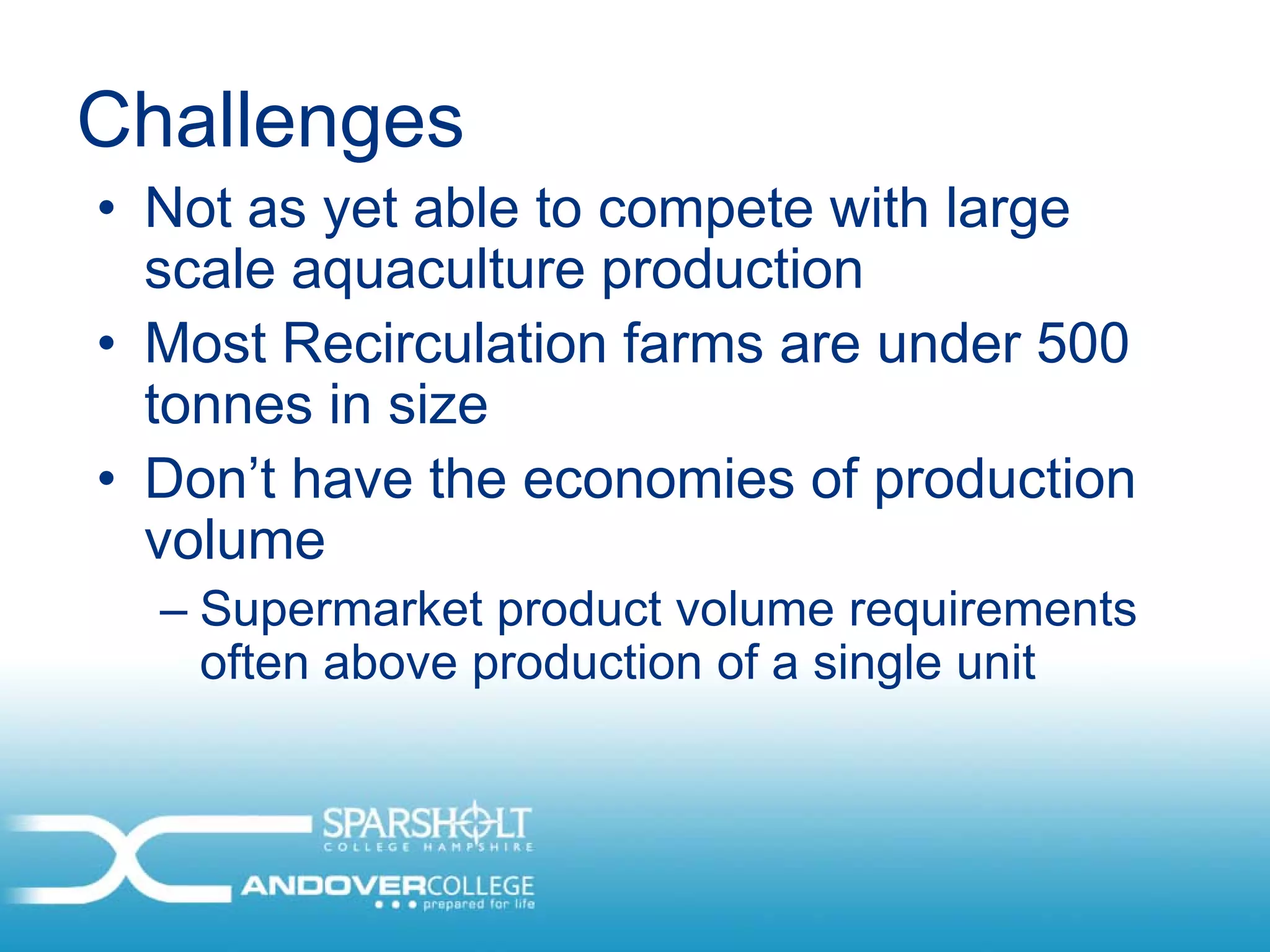
Challenges
• Not as yet able to compete with large
  scale aquaculture production
• Most Recirculation farms are under 500
  tonnes in size
• Don’t have the economies of production
  volume
  – Supermarket product volume requirements
    often above production of a single unit
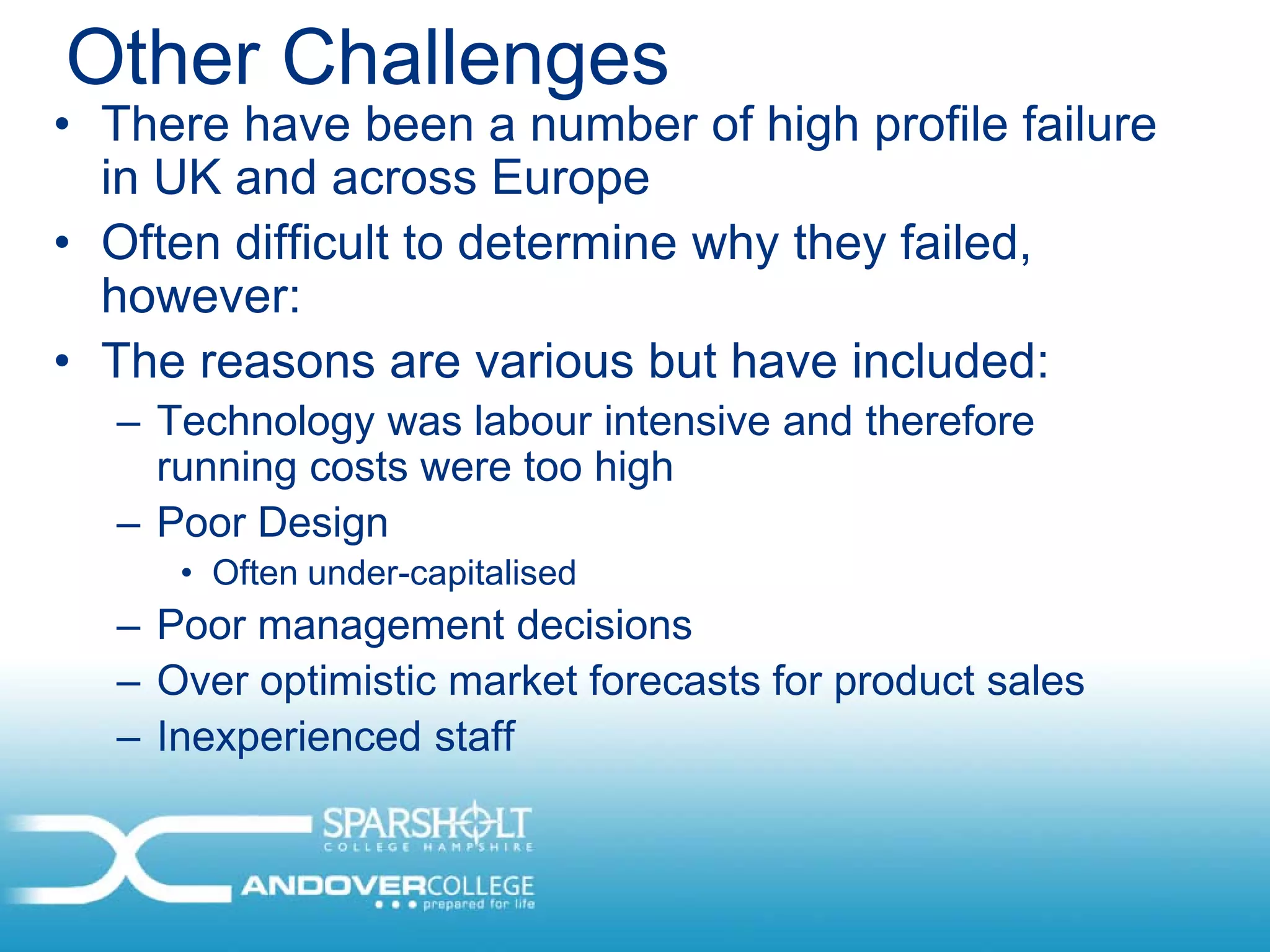
Other Challenges
• There have been a number of high profile failure
  in UK and across Europe
• Often difficult to determine why they failed,
  however:
• The reasons are various but have included:
  – Technology was labour intensive and therefore
    running costs were too high
  – Poor Design
     • Often under-capitalised
  – Poor management decisions
  – Over optimistic market forecasts for product sales
  – Inexperienced staff
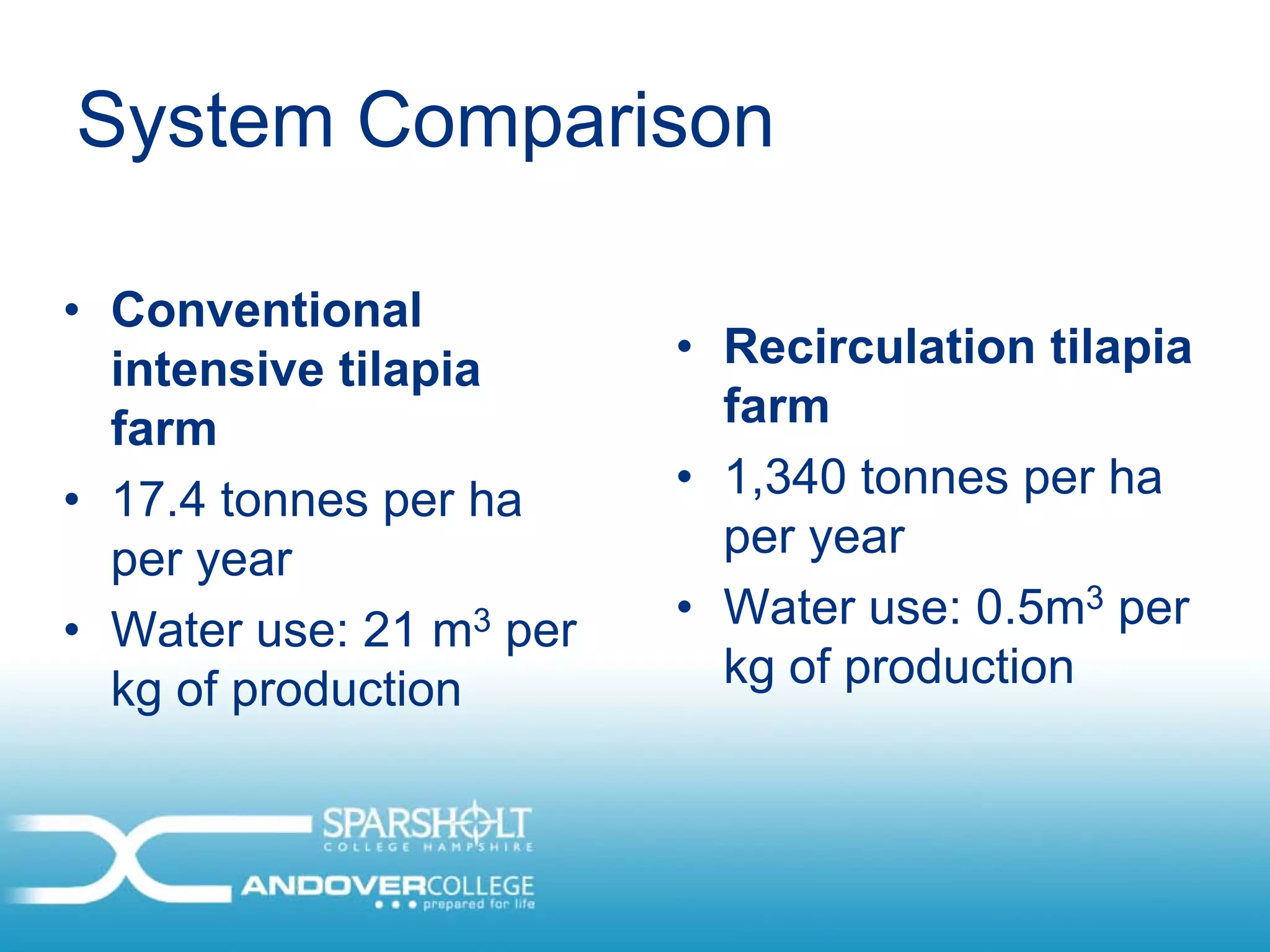
System Comparison

• Conventional
  intensive tilapia      • Recirculation tilapia
  farm                     farm
• 17.4 tonnes per ha     • 1,340 tonnes per ha
  per year                 per year
• Water use: 21 m3 per   • Water use: 0.5m3 per
  kg of production         kg of production
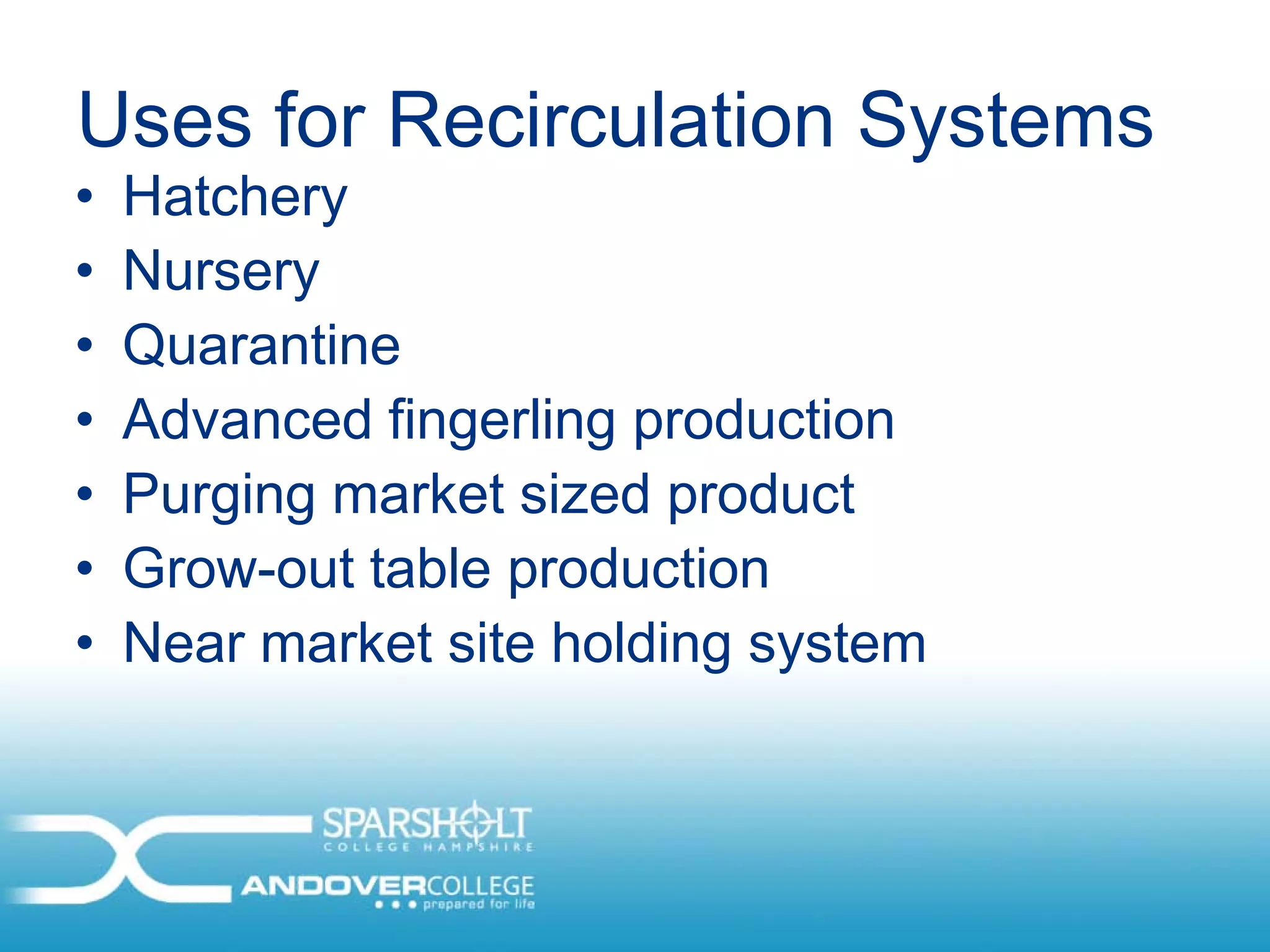
Uses for Recirculation Systems
•   Hatchery
•   Nursery
•   Quarantine
•   Advanced fingerling production
•   Purging market sized product
•   Grow-out table production
•   Near market site holding system
Running Costs
• Food and labour are the still the two main
  costs
• Heating and pumping often amount to less
  than ¼ of the above
• Initial capitalisation is a very significant
  cost compared to conventional
  aquaculture
• Possibility for large units of using
  renewable energy supplies thereby
  reducing costs in the long term
Systems
• High Stocking densities do not constitute
  an efficient recirculation system!
• High feed rates per day do!
• It takes feed to grow fish!
• Food is the main consideration when
  designing and predicting the capacity of a
  system.
• An intensive recirculation system has a
  high capacity to grow fish rather than hold
  them
Technology
• The technology has been available for
  over 30 years
• Reliable
• Efficient
• Most failures are down to mismanagement
  of systems or producing inappropriate
  species
Filtration System must:
• Remove solid wastes
    – Settleable, suspended and dissolved
•   Convert ammonia and nitrite to nitrate
•   Remove CO2
•   Add oxygen
•   Maintain acceptable pH
•   Control Pathogens
•   Keep up with the generation of waste
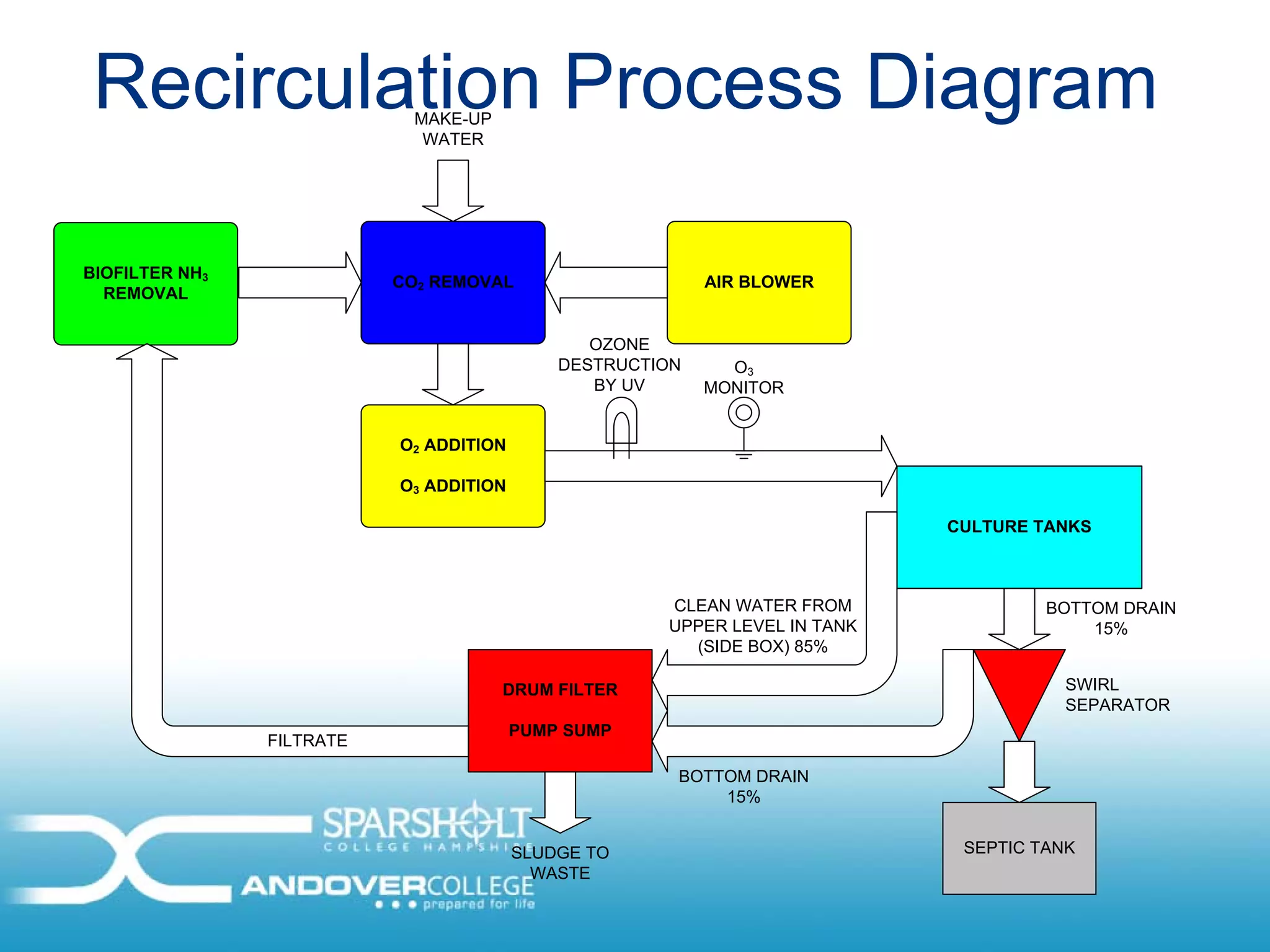
Recirculation Process Diagram
                            MAKE-UP
                             WATER


BIOFILTER NH3
                           CO2 REMOVAL                     AIR BLOWER
  REMOVAL


                                                OZONE
                                             DESTRUCTION     O3
                                                BY UV      MONITOR


                           O2 ADDITION

                           O3 ADDITION

                                                                            CULTURE TANKS


                                                      CLEAN WATER FROM               BOTTOM DRAIN
                                                      UPPER LEVEL IN TANK                15%
                                                        (SIDE BOX) 85%

                                      DRUM FILTER                                      SWIRL
                                                                                       SEPARATOR
                                         PUMP SUMP
                FILTRATE

                                                       BOTTOM DRAIN
                                                           15%


                                         SLUDGE TO                           SEPTIC TANK
                                           WASTE
Key Water Quality Parameters

•   Dissolved Oxygen
                               +
•   Ammonia-Nitrogen (NH3 & NH4 )
                         -
•   Nitrite-Nitrogen (NO2 )
•   pH
•   Alkalinity
•   Carbon dioxide (CO2)
                           -
•   Nitrate-Nitrogen ( NO3 )
Misperceptions

•   Overly complicated
•   Prone to catastrophic failure
•   Only suitable for high value species
•   Needs highly educated staff to run
Key Issues for success
• Use proven technology in system
  construction
• Ensure system has effective monitoring
  systems
• Build in back up systems to key processes
• Most success has come from small units
  which have scaled up
• Use species with a track record in
  recirculation systems
• Be sure of the market
Key Issues for success
• Business plan assumes market prices will
  drop once production starts
• Grow species with a short production time
  to improve cash flow
• Ensure product is fit for market
• Ensure have the trained staff to operate
  the systems

Large scale intensive recirculation systems and their potential development within England

  • 1.
    The Potential for RecirculationAquaculture Dr Mark Burdass
  • 2.
    Recirculation Systems • Systemsused worldwide • Production capacity depends on treatment system • Defining Recirculation Systems: – System that recycles and renovates water for the culture of aquatic organisms!
  • 3.
    Global Perspective • Successfullarge scale recirculation aquaculture facilities in UK, Norway, Europe, US, Canada & Australia. • Highly intensive recirculation facilities used in Scotland to produce salmon smolts
  • 4.
    Definition • Original definition95% recycle (based on flow), means 5% exchange per pass • More recent systems defined by daily volumetric exchange rates (10% per day) • Lots of challenges with systems recirculating water at < 5% per day
  • 5.
    Advantages • Controlled Environment – Controlled temperature environment – Allows controlled product growth rates – More efficient food conversion – Predictable harvest routines – Allows production all year round – Biosecurity advantages – Enclosed environment means production free of predators and other damaging wildlife – Allows efficient inventory control • The systems designed to conserves heat and water through water reuse – Reconditions the water through filtration processes • Allows effective economies of scale – This results in high production per unit area – Save on handling equipment as used more intensively.
  • 6.
    Advantages • Environmentally sustainable – Use up to 99% less water than a conventional aquaculture facility – Less than 1% of the land area – Allows waste to be managed in an environmentally safe manner – Allows waste to be further processed or used for hydroponics – Producing tropical fish locally has low carbon footprint because of low food foodmiles in production
  • 7.
    Advantages • Not restrictedto traditional aquaculture production locations • Not restricted to traditional UK aquaculture species – Species such as barramundi, tilapia and catfish possible in UK • Allows production to be placed near to market
  • 8.
    Why Recirculation Systems •Challenges – High Initial Investment • Compared to other production methods – Financing can be an issue because investors often want fast returns – Technology is not well known • Getting better – Very short response time – Reliability of electricity supply critical – Lack of track record • Failures common • Hard to finance
  • 9.
    Challenges • Not asyet able to compete with large scale aquaculture production • Most Recirculation farms are under 500 tonnes in size • Don’t have the economies of production volume – Supermarket product volume requirements often above production of a single unit
  • 10.
    Other Challenges • Therehave been a number of high profile failure in UK and across Europe • Often difficult to determine why they failed, however: • The reasons are various but have included: – Technology was labour intensive and therefore running costs were too high – Poor Design • Often under-capitalised – Poor management decisions – Over optimistic market forecasts for product sales – Inexperienced staff
  • 11.
    System Comparison • Conventional intensive tilapia • Recirculation tilapia farm farm • 17.4 tonnes per ha • 1,340 tonnes per ha per year per year • Water use: 21 m3 per • Water use: 0.5m3 per kg of production kg of production
  • 12.
    Uses for RecirculationSystems • Hatchery • Nursery • Quarantine • Advanced fingerling production • Purging market sized product • Grow-out table production • Near market site holding system
  • 13.
    Running Costs • Foodand labour are the still the two main costs • Heating and pumping often amount to less than ¼ of the above • Initial capitalisation is a very significant cost compared to conventional aquaculture • Possibility for large units of using renewable energy supplies thereby reducing costs in the long term
  • 14.
    Systems • High Stockingdensities do not constitute an efficient recirculation system! • High feed rates per day do! • It takes feed to grow fish! • Food is the main consideration when designing and predicting the capacity of a system. • An intensive recirculation system has a high capacity to grow fish rather than hold them
  • 15.
    Technology • The technologyhas been available for over 30 years • Reliable • Efficient • Most failures are down to mismanagement of systems or producing inappropriate species
  • 16.
    Filtration System must: •Remove solid wastes – Settleable, suspended and dissolved • Convert ammonia and nitrite to nitrate • Remove CO2 • Add oxygen • Maintain acceptable pH • Control Pathogens • Keep up with the generation of waste
  • 17.
    Recirculation Process Diagram MAKE-UP WATER BIOFILTER NH3 CO2 REMOVAL AIR BLOWER REMOVAL OZONE DESTRUCTION O3 BY UV MONITOR O2 ADDITION O3 ADDITION CULTURE TANKS CLEAN WATER FROM BOTTOM DRAIN UPPER LEVEL IN TANK 15% (SIDE BOX) 85% DRUM FILTER SWIRL SEPARATOR PUMP SUMP FILTRATE BOTTOM DRAIN 15% SLUDGE TO SEPTIC TANK WASTE
  • 19.
    Key Water QualityParameters • Dissolved Oxygen + • Ammonia-Nitrogen (NH3 & NH4 ) - • Nitrite-Nitrogen (NO2 ) • pH • Alkalinity • Carbon dioxide (CO2) - • Nitrate-Nitrogen ( NO3 )
  • 20.
    Misperceptions • Overly complicated • Prone to catastrophic failure • Only suitable for high value species • Needs highly educated staff to run
  • 21.
    Key Issues forsuccess • Use proven technology in system construction • Ensure system has effective monitoring systems • Build in back up systems to key processes • Most success has come from small units which have scaled up • Use species with a track record in recirculation systems • Be sure of the market
  • 22.
    Key Issues forsuccess • Business plan assumes market prices will drop once production starts • Grow species with a short production time to improve cash flow • Ensure product is fit for market • Ensure have the trained staff to operate the systems