Pathogen management
    and modelling

                 Nick Taylor
                   Population
            Ecologist/Epidemiological
                    Modeller
Disease monitoring and emergence
• Fish Health Inspectorate:
   – 10 field inspectors
   – Visit 700+ APB’s per annum
   – Early identification of
     problems
   – Big picture perspective

• Epidemiology and risk
  assessment:
   – ID potential threats
   – Assess the risk posed
   – Suggest mitigation measures
Emerging diseases
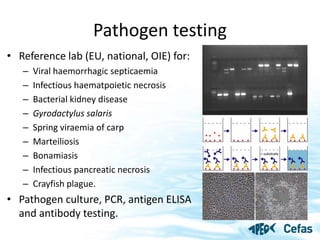
Pathogen testing
• Reference lab (EU, national, OIE) for:
   –   Viral haemorrhagic septicaemia
   –   Infectious haematpoietic necrosis
   –   Bacterial kidney disease
   –   Gyrodactylus salaris
   –   Spring viraemia of carp
   –   Marteiliosis
   –   Bonamiasis
   –   Infectious pancreatic necrosis
   –   Crayfish plague.
• Pathogen culture, PCR, antigen ELISA
  and antibody testing.
Field studies
• Assess distribution and
  scale.
• Study pathogen life-cycles
  and dynamics in the real
  world.
• Conduct classical
  epidemiological studies:
    Cross-sectional
    Cohort
    Case-control
• Identify risk factors.
Complex data and statistical tools
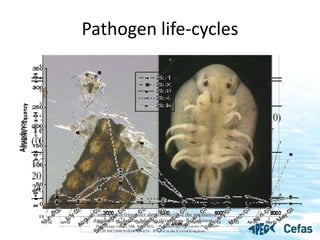
Pathogen life-cycles
                        1        2          3               4             5                                                6
              4.7


              4.4


              4.1


              3.8


              3.5


              3.2
Length (mm)


              2.9


              2.6                                                                                                                       7

              2.3


               2


              1.7


              1.4
                                                                                                                                        8

              1.1


              0.8
               May-02   Jun-02   Jul-02   Aug-02   Sep-02       Oct-02   Nov-02   Dec-02   Jan-03   Feb-03   Mar-03   Apr-03   May-03
Experimental studies
Pathogen challenge studies
Efficacy against pathogen
            600
                                                  c1
            550
                                                  c2
            500                                   c3
                                                  t1
            450                                   t2
                                                  t3
            400

            350
Abundance


            300

            250

            200

            150

            100

             50

              0
                  1    2   3    4   5    6    7
Benefit to host
Environmental impact
Disease modelling
Optimal application and control
           policies


                      10°C   15°C   20°C   25°C
               pH 6.1 1      1      1      1
               pH 6.4 1      1      1      2
               pH 6.7 1      1      2      2
               pH 7.0 1      2      2      3
               pH 7.3 1      1      2      2
               pH 7.6 1      1      1      2
               pH 7.9 1      1      1      1
Summary
•   What’s the problems.
•   Extent and severity.
•   How to test for it.
•   What drives it.
•   What’s its life-cycle.
•   Effective treatments.
•   How to manage.

Pathogen Management Modelling - APEG

  • 1.
    Pathogen management and modelling Nick Taylor Population Ecologist/Epidemiological Modeller
  • 2.
    Disease monitoring andemergence • Fish Health Inspectorate: – 10 field inspectors – Visit 700+ APB’s per annum – Early identification of problems – Big picture perspective • Epidemiology and risk assessment: – ID potential threats – Assess the risk posed – Suggest mitigation measures
  • 3.
  • 4.
    Pathogen testing • Referencelab (EU, national, OIE) for: – Viral haemorrhagic septicaemia – Infectious haematpoietic necrosis – Bacterial kidney disease – Gyrodactylus salaris – Spring viraemia of carp – Marteiliosis – Bonamiasis – Infectious pancreatic necrosis – Crayfish plague. • Pathogen culture, PCR, antigen ELISA and antibody testing.
  • 5.
    Field studies • Assessdistribution and scale. • Study pathogen life-cycles and dynamics in the real world. • Conduct classical epidemiological studies:  Cross-sectional  Cohort  Case-control • Identify risk factors.
  • 6.
    Complex data andstatistical tools
  • 7.
    Pathogen life-cycles 1 2 3 4 5 6 4.7 4.4 4.1 3.8 3.5 3.2 Length (mm) 2.9 2.6 7 2.3 2 1.7 1.4 8 1.1 0.8 May-02 Jun-02 Jul-02 Aug-02 Sep-02 Oct-02 Nov-02 Dec-02 Jan-03 Feb-03 Mar-03 Apr-03 May-03
  • 8.
  • 9.
  • 10.
    Efficacy against pathogen 600 c1 550 c2 500 c3 t1 450 t2 t3 400 350 Abundance 300 250 200 150 100 50 0 1 2 3 4 5 6 7
  • 11.
  • 12.
  • 13.
  • 14.
    Optimal application andcontrol policies 10°C 15°C 20°C 25°C pH 6.1 1 1 1 1 pH 6.4 1 1 1 2 pH 6.7 1 1 2 2 pH 7.0 1 2 2 3 pH 7.3 1 1 2 2 pH 7.6 1 1 1 2 pH 7.9 1 1 1 1
  • 15.
    Summary • What’s the problems. • Extent and severity. • How to test for it. • What drives it. • What’s its life-cycle. • Effective treatments. • How to manage.