PROJECT REPORT PRESENTATION
TOPIC:A RECIRCULATING AQUACULTURE SYSTEM
PRESENTED BY:
ANDREW O. AYUKA
F21/1711/2010
SUPERVISOR: DR. OMUTO C. THINE
INTRODUCTION
• Re-circulating aquaculture systems are indoor,
tank-based systems in which fish are grown at high
density under controlled environmental
conditions.
•These systems can be used where suitable land or
water is limited, or where environmental
conditions are not ideal for the species being
cultured.
•This type of aquaculture production system can
also be practiced in marine environments
PROBLEM STATEMENT AND PROBLEM ANALYSIS
 A tremendous increase in the Kenyan population with a direct proportion in
demand for protein-rich food.
 The higher cost of protein-rich food in the country due to higher demand and
limited supply
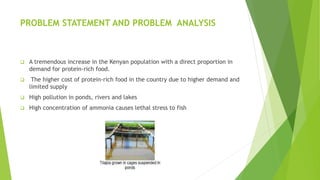
 High pollution in ponds, rivers and lakes
 High concentration of ammonia causes lethal stress to fish
OBJECTIVES
OVERALL OBJECTIVE
 To design a re-circulating aquaculture system.
SPECIFIC OBJECTIVES
 To apply principles of design of fish pond aerators in a re-circulating
aquaculture systems
 design of RAS components
Statement of scope
 The scope of the project is limited to engineering design and functions of
aquaculture system
 The design can also be done for both marine and fresh water
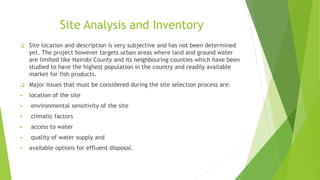
Site Analysis and Inventory
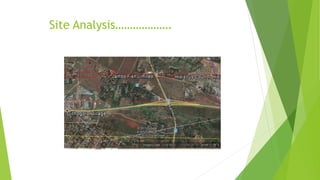
 Site location and description is very subjective and has not been determined
yet. The project however targets urban areas where land and ground water
are limited like Nairobi County and its neighbouring counties which have been
studied to have the highest population in the country and readily available
market for fish products.
 Major issues that must be considered during the site selection process are:
 location of the site
 environmental sensitivity of the site
 climatic factors
 access to water
 quality of water supply and
 available options for effluent disposal.
Site Analysis……………….
Literature Review
 Development of RAS started in the 1950s in Japan and was later introduced in
Europe in the 1970s. Its commercial utilization was also introduced
Netherlands, Denmark and Germany and Egypt in 1980s.
 Aquaculture in Kenya is a new technology striving to satisfy a growing market
for protein-rich food (fish) and reduce poverty in rural areas.
 RAS has not yet been fully embraced compared to other countries and this has
been attributed to the lack of the awareness by the citizens, lack of
necessary skills and lack of sufficient or reliable fish feed just but to mention
a few
 Why recirculate?
 Conserves water
 Permits high stocking density culture in locations where space and or
water are limited
 Minimizes volume of effluent, facilitating waste recovery
 Allows for increased control over the culture environment, especially
indoors
 Improved biosecurity
 Environmentally sustainable
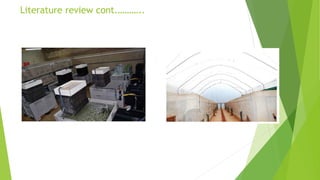
Literature review cont.………..
Theoretical framework
Design and Production
Based on the client’s specific
requirements, production levels and
geographic locations, a design is set
up which suits perfectly. All systems
are built from scratch using suitable
materials, such as polyester, stainless
steel, PVC, poly-propylene etc. which
have a very long life span
 For each stage of fish species
specialised systems are needed.
Some examples include:
 Hatching systems
 Broodstock system
 Fry systems
 Juvenile systems
 Incubation systems
Recirculation Components
 Site and components
 Building
 Pump House
 Three phase electricity
 Emergency generator
 Bulk feed storage
 Purging and packing facilities
System components
 Biofilters
 UV Disinfectants
 Culture Tanks
 Connecting pipes
theoretical framework cont.…..
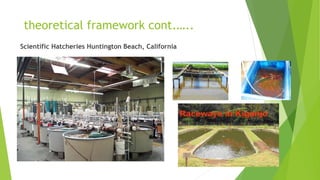
Scientific Hatcheries Huntington Beach, California
Recirculating System Applications and its advantages
Applications of RAS
 Larval rearing systems
 Nursery systems
 Nutrition and health
research systems
 Short-term holding
systems
 Ornamental and display
tanks
 High density grow-out of
food fish
Advantages of RAS
 RAS offers a variety of benefits
to the fish producers in
comparison to open pond
culture. These include the
following method:
 it maximizes production on a
limited supply of water
 low land requirements,
 ability to control water
temperature
 independence from adverse
weather conditions
 nearly complete environmental
Challenges associated with RAS
 They are a bit expensive in terms of their development
and operation
 They require skilled technical assistants to manage and
supervise complex systems
 However the disadvantages should not be a point of
concern as with a careful observation the precautions, all
the disadvantages can be avoided
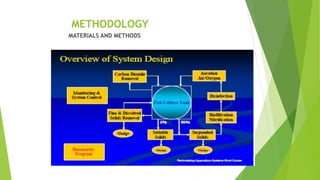
METHODOLOGY
MATERIALS AND METHODS
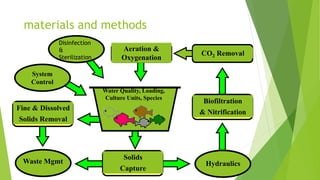
materials and methods
Fine & Dissolved
Solids Removal
Solids
Capture
Waste Mgmt
Biofiltration
& Nitrification
Hydraulics
CO2 Removal
Water Quality, Loading,
Culture Units, Species
Aeration &
Oxygenation
System
Control
Disinfection
&
Sterilization
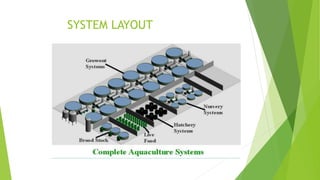
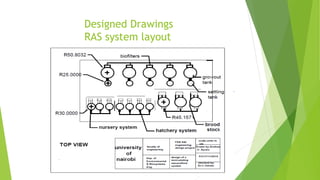
SYSTEM LAYOUT
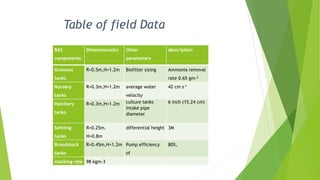
Table of field Data
RAS
components
Dimensions(m) Other
parameters
description
Growout
tanks
R=0.5m,H=1.2m Biofilter sizing Ammonia removal
rate 0.65 gm-2
Nursery
tanks
R=0.3m,H=1.2m average water
velocity
42 cm s-1
Hatchery
tanks
R=0.3m,H=1.2m culture tanks
intake pipe
diameter
6 inch (15.24 cm)
Settling
tanks
R=0.25m.
H=0.8m
differential height 3M
Broodstock
tanks
R=0.45m,H=1.2m Pump efficiency
of
80%,
stocking rate 98 kgm-3
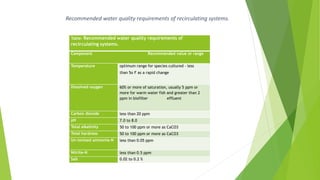
Table: Recommended water quality requirements of
recirculating systems.
Component Recommended value or range
Temperature optimum range for species cultured - less
than 5o F as a rapid change
Dissolved oxygen 60% or more of saturation, usually 5 ppm or
more for warm water fish and greater than 2
ppm in biofilter effluent
Carbon dioxide less than 20 ppm
pH 7.0 to 8.0
Total alkalinity 50 to 100 ppm or more as CaCO3
Total hardness 50 to 100 ppm or more as CaCO3
Un-ionized ammonia-N less than 0.05 ppm
Nitrite-N less than 0.5 ppm
Salt 0.02 to 0.2 %
Recommended water quality requirements of recirculating systems.
CALCULATION, ANALYSIS AND DESIGN
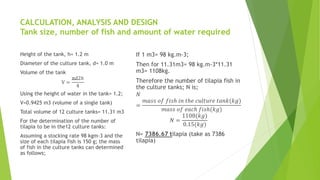
Tank size, number of fish and amount of water required
Height of the tank, h= 1.2 m
Diameter of the culture tank, d= 1.0 m
Volume of the tank
V =
πd2ℎ
4
Using the height of water in the tank= 1.2;
V=0.9425 m3 (volume of a single tank)
Total volume of 12 culture tanks= 11.31 m3
For the determination of the number of
tilapia to be in the12 culture tanks:
Assuming a stocking rate 98 kgm-3 and the
size of each tilapia fish is 150 g; the mass
of fish in the culture tanks can determined
as follows;
If 1 m3= 98 kg.m-3;
Then for 11.31m3= 98 kg.m-3*11.31
m3= 1108kg.
Therefore the number of tilapia fish in
the culture tanks; N is;
𝑁
=
𝑚𝑎𝑠𝑠 𝑜𝑓 𝑓𝑖𝑠ℎ 𝑖𝑛 𝑡ℎ𝑒 𝑐𝑢𝑙𝑡𝑢𝑟𝑒 𝑡𝑎𝑛𝑘(𝑘𝑔)
𝑚𝑎𝑠𝑠 𝑜𝑓 𝑒𝑎𝑐ℎ 𝑓𝑖𝑠ℎ(𝑘𝑔)
𝑁 =
1108(𝑘𝑔)
0.15(𝑘𝑔)
N= 7386.67 tilapia (take as 7386
tilapia)
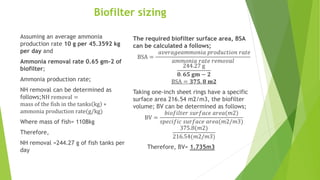
Biofilter sizing
Assuming an average ammonia
production rate 10 g per 45.3592 kg
per day and
Ammonia removal rate 0.65 gm-2 of
biofilter;
Ammonia production rate;
NH removal can be determined as
follows;NH removal =
mass of the fish in the tanks kg ∗
ammonia production rate(g/kg)
Where mass of fish= 1108kg
Therefore,
NH removal =244.27 g of fish tanks per
day
The required biofilter surface area, BSA
can be calculated a follows;
BSA =
𝑎𝑣𝑒𝑟𝑎𝑔𝑒𝑎𝑚𝑚𝑜𝑛𝑖𝑎 𝑝𝑟𝑜𝑑𝑢𝑐𝑡𝑖𝑜𝑛 𝑟𝑎𝑡𝑒
𝑎𝑚𝑚𝑜𝑛𝑖𝑎 𝑟𝑎𝑡𝑒 𝑟𝑒𝑚𝑜𝑣𝑎𝑙
244.27 g
𝟎. 𝟔𝟓 𝐠𝐦 − 𝟐
BSA = 𝟑𝟕𝟓. 𝟖 𝐦𝟐
Taking one-inch sheet rings have a specific
surface area 216.54 m2/m3, the biofilter
volume; BV can be determined as follows;
BV =
𝑏𝑖𝑜𝑓𝑖𝑙𝑡𝑒𝑟 𝑠𝑢𝑟𝑓𝑎𝑐𝑒 𝑎𝑟𝑒𝑎(𝑚2)
𝑠𝑝𝑒𝑐𝑖𝑓𝑖𝑐 𝑠𝑢𝑟𝑓𝑎𝑐𝑒 𝑎𝑟𝑒𝑎(𝑚2/𝑚3)
375.8(𝑚2)
216.54(𝑚2/𝑚3)
Therefore, BV= 1.735m3
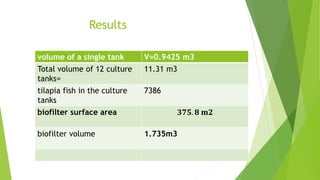
Results
volume of a single tank V=0.9425 m3
Total volume of 12 culture
tanks=
11.31 m3
tilapia fish in the culture
tanks
7386
biofilter surface area 𝟑𝟕𝟓. 𝟖 𝐦𝟐
biofilter volume 1.735m3
Designed Drawings
RAS system layout
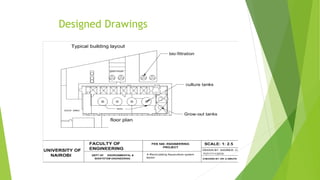
Designed Drawings
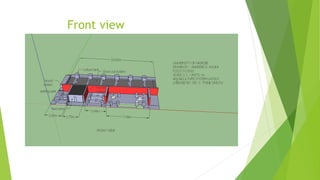
Front view
CONCLUSION
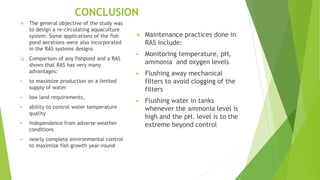
 The general objective of the study was
to design a re-circulating aquaculture
system. Some applications of the fish
pond aerations were also incorporated
in the RAS systems designs
 Comparison of any fishpond and a RAS
shows that RAS has very many
advantages:
 to maximize production on a limited
supply of water
 low land requirements,
 ability to control water temperature
quality
 independence from adverse weather
conditions
 nearly complete environmental control
to maximize fish growth year-round
 Maintenance practices done in
RAS include:
 Monitoring temperature, pH,
ammonia and oxygen levels
 Flushing away mechanical
filters to avoid clogging of the
filters
 Flushing water in tanks
whenever the ammonia level is
high and the pH. level is to the
extreme beyond control
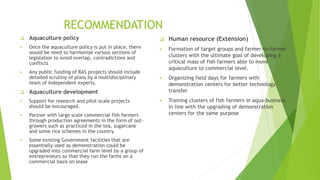
RECOMMENDATION
 Aquaculture policy
 Once the aquaculture policy is put in place, there
would be need to harmonize various sections of
legislation to avoid overlap, contradictions and
conflicts
 Any public funding of RAS projects should include
detailed scrutiny of plans by a multidisciplinary
team of independent experts.
 Aquaculture development
 Support for research and pilot-scale projects
should be encouraged.
 Partner with large scale commercial fish farmers
through production agreements in the form of out-
growers such as practiced in the tea, sugarcane
and some rice schemes in the country
 Some existing Government facilities that are
essentially used as demonstration could be
upgraded into commercial farm level by a group of
entrepreneurs so that they run the farms on a
commercial basis on lease
 Human resource (Extension)
 Formation of target groups and farmer-to-farmer
clusters with the ultimate goal of developing a
critical mass of fish farmers able to move
aquaculture to commercial level.
 Organizing field days for farmers with
demonstration centers for better technology
transfer
 Training clusters of fish farmers in aqua-business
in line with the upgrading of demonstration
centers for the same purpose
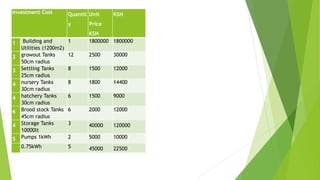
Investment Cost Quantit
y
Unit
Price
KSH
KSH
1 Building and
Utilities (1200m2)
1 1800000 1800000
2 growout Tanks
50cm radius
12 2500 30000
3 Settling Tanks
25cm radius
8 1500 12000
4 nursery Tanks
30cm radius
8 1800 14400
4 hatchery Tanks
30cm radius
6 1500 9000
6 Brood stock Tanks
45cm radius
6 2000 12000
4 Storage Tanks
10000lt
3 40000 120000
5 Pumps 1kWh 2 5000 10000
0.75kWh 5 45000 22500
0.5kWh 1 3500 3500
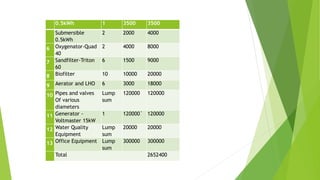
Submersible
0.5kWh
2 2000 4000
6 Oxygenator-Quad
40
2 4000 8000
7 Sandfilter-Triton
60
6 1500 9000
8 Biofilter 10 10000 20000
9 Aerator and LHO 6 3000 18000
10 Pipes and valves
Of various
diameters
Lump
sum
120000 120000
11 Generator -
Voltmaster 15kW
1 120000` 120000
12 Water Quality
Equipment
Lump
sum
20000 20000
13 Office Equipment Lump
sum
300000 300000
Total 2652400
REFERENCES
 1.Buck, P. D. (2014). Land based recirculation systems. Retrieved hmarc 9,
2014, from
(http://www.awi.de/de/forschung/neue_technologien/marine_aquaculture_
maritime_technologies_and_iczm/research_themes/marine_aquaculture/land
_based_recirculation_systems/la
 2. Illora, I. M. (2008). Hydrodynamic characterization of aquaculture tanks
and design criteria for improving self-cleaning properties. Castelldefels:
technical university of Catalonia.
 3. Inc, D. A. (2012). UV Size chart. Retrieved March 21, 2014, from http://
definitive-aquarium.com/tools/uv_size_chart.html
 4. Industries, D. O. (2008). Best practice environmental management
guidelines of primary industries. Victoria: Department of Primary Industries.
 5. Leschen, I. A. (2011). Case study on developing financially viable
Recirculation Aquaculture Systems (RAS) for tilapia production in Egypt:
Technology transfer from the Netherlands. Alexandria: Egyptian Aquaculture
Centre and Institute of Aquaculture, University of Stirling.
 6. Libey, H. a. (2007). Fish farming in recirculating aquaculture systems
(RAS). Virginia: department of fisheries and wildlife sciences, Virginia
technology.
Thank you