Introduction
• A Recirculation/Flow-throughsystem is an enclosed system for fish
farming where the water replacement is only to the extent of loss to
evaporation and cleaning.
• It is an intensive approach (higher densities and more rigorous
management) than other aquaculture production systems.
• This system rears fish in indoor tanks within a “controlled”
environment.
• There is no influence of environmental variables so literally any fish can
be cultured anywhere.
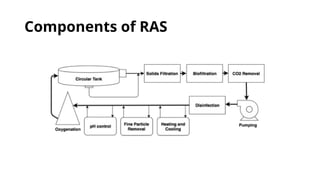
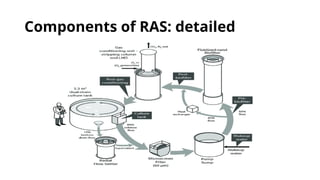
• The technology is based on the use of mechanical and biological filters
3.
• Traditional methodsof fish farming in India
• Production: 2-10 million Ton/Ha of land
• Water use: 20 litres of water per kg of fish.
• Re-circulatory Aquaculture System needs
• 1/8th of a hectare
• 1/6th of water
• 60 MT of fish per year.
4.
Advantages of RAS
Theflexibility to choose the scale and module.
Wide range of design and site as per geo-climatic conditions and
investment capabilities.
Very low requirement of land and water.
Independence from a land based large water source.
Reduction in wastewater effluent volume.
Increased bio-security
High output fish from minimal area (50-100 kg/m3
).
5.
Constraints of RAS
Highinitial investment (materials and infrastructure).
Intensive technical monitoring of operations.
Assured but limited supply of energy for operations
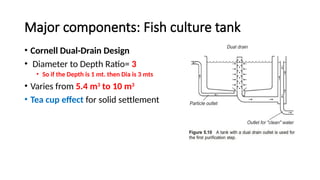
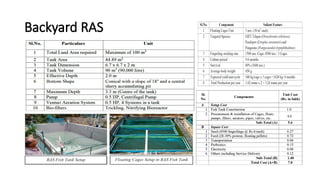
Major components: Fishculture tank
• Cornell Dual-Drain Design
• Diameter to Depth Ratio= 3
• So if the Depth is 1 mt. then Dia is 3 mts
• Varies from 5.4 m3
to 10 m3
• Tea cup effect for solid settlement
9.
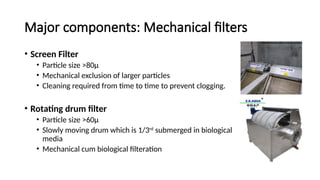
Major components: Mechanicalfilters
• Screen Filter
• Particle size >80µ
• Mechanical exclusion of larger particles
• Cleaning required from time to time to prevent clogging.
• Rotating drum filter
• Particle size >60µ
• Slowly moving drum which is 1/3rd
submerged in biological
media
• Mechanical cum biological filteration
10.
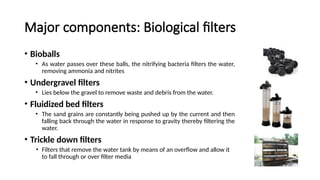
Major components: Biologicalfilters
• Bioballs
• As water passes over these balls, the nitrifying bacteria filters the water,
removing ammonia and nitrites
• Undergravel filters
• Lies below the gravel to remove waste and debris from the water.
• Fluidized bed filters
• The sand grains are constantly being pushed up by the current and then
falling back through the water in response to gravity thereby filtering the
water.
• Trickle down filters
• Filters that remove the water tank by means of an overflow and allow it
to fall through or over filter media
11.
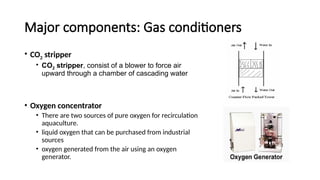
Major components: Gasconditioners
• CO2 stripper
• CO2 stripper, consist of a blower to force air
upward through a chamber of cascading water
• Oxygen concentrator
• There are two sources of pure oxygen for recirculation
aquaculture.
• liquid oxygen that can be purchased from industrial
sources
• oxygen generated from the air using an oxygen
generator.
12.
RAS in India
•Our country ranks good on fresh water fish production.
• Traditional methods of fish farming in India are able to produce just between 2 - 10
MT of fish per hectare of land.
• Recirculating Aquaculture System may produce up to 500 MT of fish per year in same
area.
• There is deficit of proper knowledge, expertise in technical management of
Recirculatory systems and entrepreneurial attitude for commercial scale units.
• The high investment costs may have kept RAS away from our country until now.
• But there is an amazing potential for it in India specially in North East States.
• Pangasius and Tilapia both are ideally suited for culture in RAS.
• In the next 5 years, RAS would be the next big thing in Inland Fisheries sector.
Economics (Tank size7.65x7.65x1.5 m, Area of one Tank 87.55 cum, Volume capacity of water 87550 L)
• Average Fish production (Pangasius sp.) in tanks: 4000 kg x 8 tank =32000 kg or 320 qt or 32 ton
• Fish production cost in one tank for 4000 kg:
• Fish seed value of 8000 nos. seed for one tank @ Rs. 4.00/nos.= Rs. 32000
• Fish feed value of 4850 kg @Rs 35.00 /kg = Rs. 169750
• Other expenses (electricity, labour, equipment etc) = Rs. 38000
• Total for one tank = Rs. 239750
• Total Fish production cost: Rs 239750 x 8 = Rs. 1918000
• Fish sale proceed for one Tank: Rs. 380000
• Total sale proceed from 8 tanks (384600 x8) = Rs. 3040000
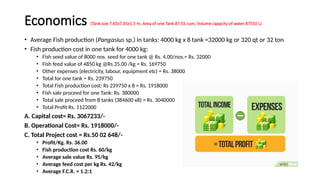
• Total Profit Rs. 1122000
A. Capital cost= Rs. 3067233/-
B. Operational Cost= Rs. 1918000/-
C. Total Project cost = Rs.50 02 648/-
• Profit/Kg. Rs. 36.00
• Fish production cost Rs. 60/kg
• Average sale value Rs. 95/kg
• Average feed cost per kg Rs. 42/kg
• Average F.C.R. = 1.2:1
 Most read
 Most read
 Most read