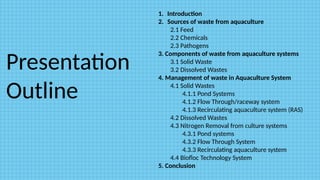
Presentation
Outline
1. Introduction
2. Sourcesof waste from aquaculture
2.1 Feed
2.2 Chemicals
2.3 Pathogens
3. Components of waste from aquaculture systems
3.1 Solid Waste
3.2 Dissolved Wastes
4. Management of waste in Aquaculture System
4.1 Solid Wastes
4.1.1 Pond Systems
4.1.2 Flow Through/raceway system
4.1.3 Recirculating aquaculture system (RAS)
4.2 Dissolved Wastes
4.3 Nitrogen Removal from culture systems
4.3.1 Pond systems
4.3.2 Flow Through System
4.3.3 Recirculating aquaculture system
4.4 Biofloc Technology System
5. Conclusion
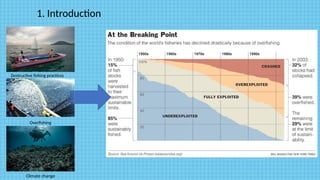
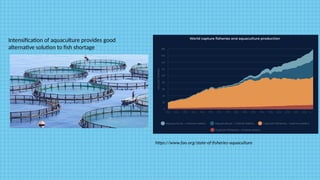
Intensification of aquacultureprovides good
alternative solution to fish shortage
https://www.fao.org/state-of-fisheries-aquaculture
5.
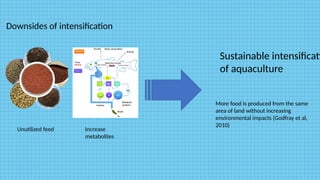
Downsides of intensification
Unutilizedfeed Increase
metabolites
Sustainable intensificati
of aquaculture
More food is produced from the same
area of land without increasing
environmental impacts (Godfray et al,
2010)
6.
2. Sources ofwaste from aquaculture
Feed
-Feed has been reported to be the
major source of waste in
aquaculture systems
(Akinwole, Dauda, & Ololade, 2016)
Martines et al., 2010)
-Factor affecting waste production:
nutrient composition, method of
production (extruded vs pelleted),
ratio of feed size to fish size,
quantity of feed per unit time,
feeding method and storage time
Chemicals
-The use of chemicals are strictly
limited but some are used as
medications, disinfectants, and
antifoulants: anaesthetics,
ectoparasiticides, endoparasiticides,
vaccines, salts, lime
-Effects of chemical on the
environment depends on:
concentrations of chemicals used,
farm size, size of the receiving water
bodies
Pathogens
-Natural waters have their own
pathogenic load and receiving
additional load might cause death
or outright death aquatic organisms
-The use of organic fertilizers such
as blood cow waste, cow manure,
pig manure contribute to high level
of fecal streptococci
7.
3. Component ofwastes from aquaculture systems
Solid Wastes
-Derived from the uneaten feed and fecal droppings
-Two types: suspended solids and settled solids
-Most dangerous waste in the system
-Can decompose and deplete oxygen within culture
column
- ≈30% of feed will become solid wastes
Dissolved Wastes
-Products of food metabolism or decomposed, uneaten
feed
-Two major components: Nitrogen (N) and Phosphorous
(P)
-25%-50% crude dietary requirement
-Only 25-30% of Nitrogen is consumed (Boyd, 2003) to
17-40% for Phosphorus (Piedrahita, 2003)
-Potential to become industrial waste
-Ammonia exists in two forms: NH3 and NH4
+
-Should be below 1mg/L in culture tanks
-5 mg/L inn the aquaculture effluents as part part of the
guidelines for aquaculture fisheries management
8.
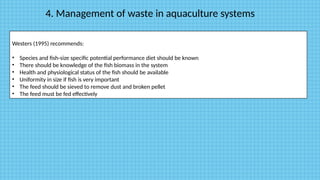
4. Management ofwaste in aquaculture systems
Westers (1995) recommends:
• Species and fish-size specific potential performance diet should be known
• There should be knowledge of the fish biomass in the system
• Health and physiological status of the fish should be available
• Uniformity in size if fish is very important
• The feed should be sieved to remove dust and broken pellet
• The feed must be fed effectively
9.
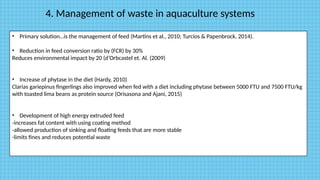
4. Management ofwaste in aquaculture systems
• Primary solution…is the management of feed (Martins et al., 2010; Turcios & Papenbrock, 2014).
• Reduction in feed conversion ratio by (FCR) by 30%
Reduces environmental impact by 20 (d’Orbcastel et. Al. (2009)
• Increase of phytase in the diet (Hardy, 2010)
Clarias gariepinus fingerlings also improved when fed with a diet including phytase between 5000 FTU and 7500 FTU/kg
with toasted lima beans as protein source (Orisasona and Ajani, 2015)
• Development of high energy extruded feed
-increases fat content with using coating method
-allowed production of sinking and floating feeds that are more stable
-limits fines and reduces potential waste
10.
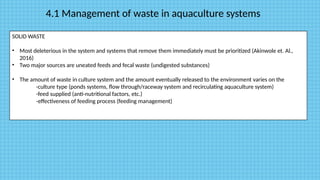
4.1 Management ofwaste in aquaculture systems
SOLID WASTE
• Most deleterious in the system and systems that remove them immediately must be prioritized (Akinwole et. Al.,
2016)
• Two major sources are uneated feeds and fecal waste (undigested substances)
• The amount of waste in culture system and the amount eventually released to the environment varies on the
-culture type (ponds systems, flow through/raceway system and recirculating aquaculture system)
-feed supplied (anti-nutritional factors, etc.)
-effectiveness of feeding process (feeding management)
11.
4.1. Management ofwaste in aquaculture systems
Pond systems
• static with no special means of
water treatment
• solid wastes settle on the bottom
but can be disturbed by natural
events and cause algal blooms
• Waste removal is achieved by
desilting
• Lack of waste management
techniques has limited this to
semi-intensive production
Flowthrough/
Raceway Systems
• water retention time is less than
an hour
• proper design can collect waste
effectively
• a round tank with dual effluent
areas can be designed to
containing a high exit and center
exit
Recirculating
aquaculture system
(RAS)
• allows re-use of fish culture
water
• better at reducing environmental
impacts than flowthrough
system
• Uses sedimentation and filters to
remove waste
• No difference in water quality
but higher make-up water
volume in non-filter system
12.
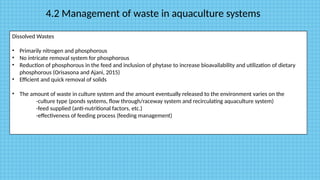
4.2 Management ofwaste in aquaculture systems
Dissolved Wastes
• Primarily nitrogen and phosphorous
• No intricate removal system for phosphorous
• Reduction of phosphorous in the feed and inclusion of phytase to increase bioavailability and utilization of dietary
phosphorous (Orisasona and Ajani, 2015)
• Efficient and quick removal of solids
• The amount of waste in culture system and the amount eventually released to the environment varies on the
-culture type (ponds systems, flow through/raceway system and recirculating aquaculture system)
-feed supplied (anti-nutritional factors, etc.)
-effectiveness of feeding process (feeding management)
13.
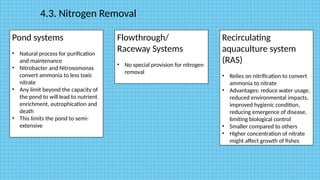
4.3. Nitrogen Removal
Pondsystems
• Natural process for purification
and maintenance
• Nitrobacter and Nitrosomonas
convert ammonia to less toxic
nitrate
• Any limit beyond the capacity of
the pond to will lead to nutrient
enrichment, eutrophication and
death
• This limits the pond to semi-
extensive
Flowthrough/
Raceway Systems
• No special provision for nitrogen
removal
Recirculating
aquaculture system
(RAS)
• Relies on nitrification to convert
ammonia to nitrate
• Advantages: reduce water usage,
reduced environmental impacts,
improved hygienic condition,
reducing emergence of disease,
limiting biological control
• Smaller compared to others
• Higher concentration of nitrate
might affect growth of fishes
14.
4.4. Biofloc technologysystem
• Unlike RAS where the water treatment is done outside the culture column; biofloc technology
is an in-situ water treatment method (Vinatea et al., 2018)
• carbon source is supplied to the culture system to stimulate the growth of heterotrophic
bacteria that converts toxic ammonia to nitrogen gas instead of nitrates that accumulate in
conventional RAS
• This saves aquaculturists from the high costs of initial investment associated with
denitrification systems (Luo et al., 2014).
15.
5. Conclusion
• Theuse of pond systems can still be continued for extensive and semi-intensive aquaculture
of farming.
• However, the output from extensive and semi-intensive systems cannot substantially help to
achieve the output needed from aquaculture.
• Intensified systems, using conventional RAS and denitrification-incorporated RAS systems,
may be able to serve the purpose of producing highly priced fish because of the cost of
installation and operation and, if well-maintained, may put the environment at a lesser risk.
• It is, therefore, important to intensify research on BFT for different species of fish (fin and
shellfish) and ascertain all the necessary requirements for its success to simplify it and
encourage its usage by fish farmers.
16.
references
Avnimelech, Y., &Lacher, M. (1979). A tentative nutrient balance for fish ponds. Israeli Journal of Aquaculture Bamidgeh, 31, 3–8.
Baker, R. T., Smith-Lemmon, L. L., & Cousins, B. (2001). Phytase unlocks plant potential in aquafeeds. Global Aquaculture Advocate, 4(Issue 2) April 2001.
Bender, J., Lee, R., Sheppard, M., Brinkley, K., Philips, P., Yeboah, Y., et al. (2004).A waste effluent treatment system based on microbial mats for black sea bass Centropristis striata recycled water mariculture. Aquacultural Engineering, 31(1–2), 73–82.
Bergheim, A., & Asgard, T. (1996). Waste production in aquaculture. In D. J. Baird, M. C. M. Beveridge, L. A. Kelly, & J. F. Muir (Eds.). Aquaculture and water resource man- agement (pp. 50–80). Oxford: Blackwell Science.
Beveridge, M. C. M., Phillips, M. J., & Clarke, R. M. (1991). A quantitative and qualitative assessment of wastes from aquatic animal production. In D. E. Brune, & J. R. Tomasso (Eds.). Aquaculture and water quality (pp. 506–533). Baton Rouge, LA: World
Aquaculture Society.
Biswas, G., Jena, J. K., Singh, S. K., & Muduli, H. K. (2006). Effect of feeding frequency on growth, survival and feed utilization in fingerlings of Catla catla (Hamilton), Labeo rohia (Hamilton) and Cirrhinus (Hamilton) in outdoor rearing systems. Aquaculture
Research, 37, 410–414.
Blancheton, J. P., Piedrahita, R., Eding, E. H., Lemarie, G., Bergheim, A., Fivelstad, S., et al. (2007). Intensification of landbased aquaculture production in single pass and reuse systems. Aquacultural engineering and environment (pp. 21–47). .
Bossier, P., & Ekasari, J. (2017). Biofloc technology application in aquaculture to support sustainable development goals. Microb Biotechnol, 10, 1012–1016.
Boyd, C. E. (1985). Chemical budgets for channel catfish ponds. Transactions of the American Fisheries Society, 11, 291–298.
Boyd, C. E. (2003). Guidelines for aquaculture effluent management at the farm-level. Aquaculture, 226, 101–112.
Boyd, C. E., & Massaut, L. (1999). Risks associated with the use of chemicals in pond aquaculture. Aquacultural Engineering, 20, 113–132.
Boyd, C. E., & McNevin, A. A. (2015). Chemical in aquaculture. Aquaculture, resource use, and the environment (pp. 172–210). (1st ed.). John Wiley & Sons, Inc.
Boyd, C. E., Queiroz, J., Lee, J., Rowan, M., Whitis, G. N., & Gross, A. (2000). Environmental assessment of channel catfish, Ictalurus punctatus, farming in Alabama. Journal of the World Aquaculture Society, 31(4), 511–544.
Bureau, D. P., & Cho, C. Y. (1999). Phosphorus utilization by rainbow trout (Oncorhynchus mykiss): Estimation of dissolved phosphorus waste output. Aquaculture, 179, 127–140.
Buschmann, A. H., Riquelme, V. A., Hernández-González, M. C., Varela, D., Jiménez, J. E., Henríquez, L. A., et al. (2006). A review of the impacts of salmonid farming on marine coastal ecosystems in the southeast Pacific. ICES Journal of Marine Science, 63(7),
1338–1345.
Costello, M. J., Grant, A., Davies, I. M., Cecchini, S., Papoutsoglou, S., Quigley, D., et al. (2001). The control of chemicals used in aquaculture in Europe. Journal of Applied Ichthyology, 17(4), 173–180.
Crab, R., Avnimelech, Y., & Defoirdt, T. (2007). Nitrogen removal techniques in aqua- culture for a sustainable production. Aquaculture, 270, 1–14.
Crab, R., Defoirdt, T., Bossier, P., & Verstraete, W. (2012). Biofloc technology in aqua- culture: Beneficial effects and future challenges. Aquaculture, 356, 351–356.
Cripps, S. J., & Bergheim, A. (2000). Solids management and removal for intensive land- based aquaculture production systems. Aquacultural Engineering, 22, 33–56.
d'Orbcastel, E. R., Blancheton, J.-P., & Aubin, J. (2009). Towards environmentally sus- tainable aquaculture: Comparison between two trout farming systems using Life Cycle assessment. Aquacultural Engineering, 40(3), 113–119.
Abeysinghe, D. H., Shanableh, A., & Rigden, B. (1996). Biofilters for water reuse in aquaculture. Water Science and Technology, 34, 253–260.
Ajadi, A., Sabri, M. Y., Dauda, A. B., Ina-Salwany, M. Y., & Hasliza, A. H. (2016). Immunoprophylaxis: A better alternative protective measure against shrimp vibriosis –a review. PJSSR, 2(2), 58–69.
Ajani, E. K., Akinwole, A. O., & Ayodele, I. A. (2011). Fundamentals of fish farming in Nigeria. Nigeria: Walecrown publishers Ibadan.
Akinwole, A. O., Bankole, A. F., Dauda, A. B., & Ayanlere, S. V. (2014). Fish farming facilities, and operation in Ibarapa area of Oyo State. EIJAST, 1(2), 85–94.
Akinwole, A. O., Dauda, A. B., & Ololade, A. O. (2016). Haematological response of Clarias gariepinus juveniles reared in treated wastewater after waste solids removal using alum or Moringa oleifera seed powder. International Journal of Acarology, 6(11), 1–8.
Ampofo, J. A., & Clerk, G. C. (2003). Bacterial flora of fish feeds and organic fertilizers for fish culture ponds in Ghana. Aquaculture Research, 34(8), 677–680.
Ansah, Y. B. (2010). Characterization of pond effluents and biological and physicochemical assessment of receiving waters in Ghana. MSc thesisUSA: Virginia polytechnic institute
17.
references
Dauda, A. B.,& Akinwole, A. O. (2014). Interrelationships among water quality para- meters in recirculating aquaculture system. NJRED, 8(4), 20–25.
Dauda, A. B., & Akinwole, A. O. (2015). Evaluation of polypropylene and palm kernel shell as biofilter media for denitrification of fish culture wastewater. NSUK JST, 5, 207–213.
Dauda, A. B., Akinwole, A. O., & Olatinwo, L. K. (2014). Biodenitrification of aquaculture wastewater at different drying times in water reuse system. JAFT, 4(2), 6–12.
Dauda, A. B., Folorunso, L. A., & Dasuki, A. (2013). Use of probiotics for sustainable aquaculture production in Nigeria. JASR, 13(2), 35–45.
Dauda, A. B., Ibrahim, H. I., Bichi, A. H., & Tola-Fabunmi, A. S. (2017a). Assessment of fish farming practices, operations, water resource management and profitability in Katsina state, Nigeria. Journal of Northeast Agricultural University, 24(4), 89–96.
Dauda, A. B., Romano, N., Ebrahimi, M., Karim, M., Natrah, I., Kamarudin, M. S., et al. (2017b). Different carbon sources affected biofloc volume, water quality and the survival and physiology of African Catfish Clarias gariepinus fingerlings reared in intensive
biofloc technology system. Fisheries Science, 83, 1037–1048.
Dauda, A. B., Romano, N., Ebrahimi, M., Teh, J. C., Ajadi, A., Chong, C. M., et al. (2018). Influence of carbon/nitrogen ratios on biofloc production and biochemical compo- sition and subsequent effects on the growth, physiological status and disease re-
sistance of African catfish (Clarias gariepinus) cultured in glycerol-based biofloc system. Aquaculture, 483, 120–130.
Ebeling, J. M., & Timmons, M. B. (2012). Recirculating aquaculture systems. In J. H. Tidwell (Ed.). Aquaculture production systems (pp. 245–278). A publication of World Aquaculture Society. John Willey & Sons, Inc.
Ekasari, J., Crab, R., & Verstraete, W. (2010). Primary nutritional content of bio-flocs cultured with different organic carbon sources and salinity. HAYATI J Biosci, 17(3), 125–130.
Emerenciano, M., Gaxiola, G., & Cuzon, G. (2013). Biofloc technology (BFT): A review for aquaculture application and animal food industry. Biomass now – cultivation and uti- lization (pp. 1–28). INTECH. https://doi.org/10.5772/53902.
FAO (2016). The state of world fisheries and aquaculture-contributing to food security and nutrition for all. Fisheries and aquaculture department. Rome: Food and Agriculture Organization of the United Nations.
FAO (Food and Agriculture Organisation) (2009). National aquaculture sector overview: Ghana. FAO fisheries and aquaculture Department. Rome. Italy.
Gaona, C. A. P., Almeida, M. S., Viau, V.,, Poersch, L. H., & Wasielesky, W. (2017). Effect of different total suspended solids levels on a Litopenaeus vannamei (Boone, 1931) BFT culture system during biofloc formation. Aquaculture Research, 48(3), 1070–1079.
Godfray, C. H. J., Beddington, J. R., Crute, I. R., Haddad, L., Lawrence, D., Muir, J. F., et al. (2010). Food security: The challenge of feeding 9 billion people. Science, 327, 812–818.
Goldburg, R., & Triplett, T. (1997). Murky waters: Environmental effects of aquaculture in the United States. Washington, DC: Environmental Defense Fund.
Good, C., Davidson, J., Welsh, C., Brazil, B., Snekvik, K., & Summerfelt, S. (2009). The impact of water exchange rate on the health and performance of rainbow trout Oncorhynchus mykiss in water recirculation aquaculture systems. Aquaculture, 294(1–2), 80–
85.
Hakanson, L. (1988). Basic concepts concerning assessments of environmental effects of marine fish farms. Copenhagen: Nordic Council of Ministers.
Hardy, R. W. (2010). Utilization of plant proteins in fish diets effects of global demand and supplies of fishmeal. Aquaculture Research, 41, 770–776.
Hargreaves, J. A. (2006). Photosynthetic suspended-growth systems in aquaculture. Aquacultural Engineering, 34, 344–363.
Henriksson, P. J. G., Belton, B., Murshed-e-Jahan, K., & Rico, A. (2018). Measuring the potential for sustainable intensification of aquaculture in Bangladesh using life cycle assessment. Proceedings of the National Academy of Sciences. www.pnas.org/cgi/doi/
10.1073/pnas.1716530115.
Holby, O., & Hall, P. O. J. (1994). Chemical fluxes and mass balances in a marine fish cage farm. III. Silicon. Aquaculture, 120(3–4), 305–318.
Johnsen, F., Hillestad, M., & Austreng, E. (1993). High energy diets for Atlantic salmon. Effect on pollution. In S. J. Kaushik, & P. Luquet (Eds.). Fish nutrition in practice (pp. 391–401). Paris: INRA.
Kamstra, A., Van Der Heul, J. W., & Nijhof, M. (1998). Performance and optimisation of trickling filters on eel farms. Aquacultural Engineering, 17, 175–192.
Krom, M. D., Ellner, S., van Rijn, J., & Neori, A. (1995). Nitrogen and phosphorus Cycling and transformations in a prototype ‘‘non-polluting’’ integrated mariculture system, Eilat, Israel. Marine Ecology Progress Series, 118, 25–36.
Kumar, S., Anand, P. S. S., De, D., Deo, A. D., Ghoshal, T. K., Sundaray, J. K., et al. (2017). Effects of biofloc under different carbon sources and protein levels on water quality, growth performance and immune responses in black tiger shrimp Penaeus monodon
(Fabricius, 1978). Aquaculture Research, 48, 1168–1182.
Lazzari, R., & Baldisserotto, B. (2008). Nitrogen and phosphorus waste in fish farming, Vol. 34, Boletim do Instituto de Pesca591–600.
18.
references
Lemarie, G., Martin,J. L. M., Dutto, G., & Garidou, C. (1998). Nitrogenous and phos- phorous waste production in a flow-through land-based farm of European seabass (Dicentrarchus zubrux). Aquatic Living Resources, 11(4), 247–254.
Luo, G., Gao, Q., Wang, C., Liu, W., Sun, D., Li, L., et al. (2014). Growth, digestive ac- tivity, welfare and partial cost-effectiveness of genetically improved farmed tilapia (Oreochromis niloticus) in recirculating aquaculture system and an indoor biofloc systems. Aquaculture, 422–
423, 1–7.
Malone, R. F., & Pfeiffer, T. J. (2006). Rating fixed film nitrifying biofilters used in re- circulating quaculture systems. Aquacultural Engineering, 34, 389–402.
Martins, C. I. M., Eding, E. H., Verdegem, M. C. J., Heinsbroek, L. T. N., Schneider, O., Blancheton, J. P., et al. (2010). New developments in recirculating aquaculture systems in Europe: A perspective on environmental sustainability.Aquacultural Engineering, 43(3), 83–93.
Martins, C. I. M., Ochola, D., Ende, S. S. W., Eding, E. H., & Verreth, J. A. J. (2009). Is growth retardation present in Nile tilapia Oreochromis niloticus cultured in low water exchange recirculating aquaculture systems. Aquaculture, 291, 65–73.
Miller, D., & Semmens, K. (2002). Waste management in aquaculture. Aquaculture Information Series1–10 #AQ02-1(January).
Orisasona, O., & Ajani, E. K. (2015). The growth and mineral utilization of Clarias gar- iepinus fingerlings fed phytase-supplemented toasted lima bean (Phaseolus lunatus) diets. Journal of Aquaculture Research & Development, 361.
Papatryphon, E., Howell, R. A., & Soares, J. H. (1999). Growth and mineral absorption by striped bass Morone saxatih fed a plant feedstuff based diet supplemented with phytase. Journal of the World Aquaculture Society, 30(2), 161–173.
Patterson, R. N., Watts, K. C., & Timmons, M. B. (1999). The power of law in particle size analysis for aquacultural facilities. Aquacultural Engineering, 19, 259–273.
Pedersen, P. B., Svendsen, L. M., Sortkjær, O., Ovesen, N. B., Skriver, J., Larsen, S. E., et al. (2008). Environmental benefits achieved by applying recirculation technology at Danish trout farms (Model trout farm).Proceedings of the aquacultural engineering society's fourth Issues
forum (pp. 139). .
Piedrahita, R. H. (2003). Reducing the potential environmental impact of tank aqua- culture effluents through intensification and recirculation. Aquaculture, 226, 35–44.
Pillay, T. V. R. (1992). Aquaculture and the environment. New York: Wiley.
Porter, C. P., Krom, M. D., Robbins, M. G., Bricknell, L., & Davidson, A. (1987). Ammonia excretion and total N budget for gilthead seabreamSparus aurata in marine fish-ponds and its effect on water quality conditions. Aquaculture, 66(3–4), 287–297.
Rakocy, J. E., Bailey, D. S., Thoman, E. S., & Shultz, R. C. (2004). Intensive tank culture of
tilapia with a suspended, bacterial-based treatment process. in: New dimensions in farmed tilapia. In R. B. Bolivar (Ed.). Proceedings of the 6th international symposium on Tilapia in aquaculture, Manila, Philippines (pp. 584–596). .
Read, P., & Fernandes, T. (2003). Management of environmental impacts of marine aquaculture in Europe. Aquaculture, 226, 139–163.
van Rijn, J. (1996). The potential for integrated biological treatment systems in re- circulating fish culture-A review. Aquaculture, 139, 18–201.
van Rijn, J., Tal, Y., & Schreier, H. J. (2006). Denitrification in recirculating systems: Theory and applications. Aquacultural Engineering, 34(3), 364–376.
Rodehutscord, M., & Pfeffer, E. (1995). Effects of supplemental microbial phytase on phosphorus digestibility and utilization in rainbow trout. Water Science and Technology, 31(10), 141–147.
Romano, N., & Zeng, C. (2013). Toxic effects of ammonia, nitrite, and nitrate to decapod crustaceans: A review on factors influencing their toxicity, physiological con- sequences, and coping mechanisms.Reviews in Fisheries Science, 21(1), 1–21.
Schneider, O., Blancheton, J. P., Varadi, L., Eding, E. H., & Verreth, J. A. J. (2006). Cost price and production strategies in european recirculation systems. Linking Tradition and Technology Highest Quality for the Consumer. Firenze, Italy: WAS.
Schram, E., Person-Le Ruyet, J., Blancheton, J. P., Vinçon, B., Verniau, B., Jansen, J., et al. (2009). Long-term effects of water refreshment rate on turbot growth. "new research frontiers", novel approaches for evolving needs, Trondheim, Norway. EAS.
Sgnaulin, T., Lemos de Mello, G., Cristina Thomas, M., Ramon Esquivel Garcia, J., Rodriguez Montes de Oca, G., & Gustavo Coelho Emerenciano, M. (2018). Biofloc technology (BFT): An alternative aquaculture system for piracanjuba Brycon or- bignyanus ?Aquaculture, 485, 119–
123.
Siddiqui, A. B., & Al-Harbi, A. H. (1999). Nutrient budgets in tanks with different stocking densities of hybrid tilapia. Aquaculture, 170, 245–252.
Singh, S., Ebeling, J. M., & Wheaton, F. (1999). Water quality trials in four recirculating aquaculture system configurations. Aquacultural Engineering, 20, 75–84.
Stephens, W. W., & Farris, J. L. (2004). A biomonitoring approach to aquaculture effluent characterization in channel catfish fingerling production. Aquaculture, 241, 319–330. Sugiura, S. H., Raboy, V., Young, K. A., Dong, F. M., & Hardy, R. W. (1999). Availability of phosphorus and
trace elements in low-phytate varieties of barley and corn for rainbow trout (Oncorhynchus mykiss). Aquaculture, 170, 285–296.
Summerfelt, S. T., Sharrer, M. J., Tsukuda, S. M., & Gearheart, M. (2009). Process requirements for achieving full-flow disinfection of recirculating water using ozonationand UV irradiation.Aquacultural Engineering, 40, 17–27.
Summerfelt, S. T., & Timmons, M. B. (2000). Hydrodynamics in the "Cornell-Type" dual- drain tank. Third international conference of recirculating aquaculture, july 19-21, 2000
19.
references
Roanoke, VA.
Suzuki, Y.,Maruyama, T., Numata, H., Sato, H., & Asakawa, M. (2003). Performance of a closed recirculating system with foam separation, nitrification and denitrification units for intensive culture of eel:
Towards zero emission. Aquacultural Engineering, 29, 165–182.
Tal, Y., Schreier, H. J., Sowers, K. R., Stubblefield, J. D., Place, A. R., & Zohar, Y. (2009). Environmentally sustainable land-based marine aquaculture. Aquaculture, 286, 28–35.
Teichert-Coddington, D. R., Rouse, D. B., Potts, A., & Boyd, C. E. (1999). Treatment of harvest discharge from intensive shrimp ponds by settling. Aquacultural Engineering, 19, 147–161.
Timmons, M. B., Ebeling, J. M., Wheaton, F. W., Summerfelt, S. T., & Vinci, B. J. (2002). Recirculating aquaculture systems (2nd ed.). Ithaca, NY 14850, USA: Cayuga Aqua Ventures.
Timmons, M. B., & Lorsodo, T. M. (1994). Aquaculture water reuse systems, engineering design and management. New York, USA: Elsevier science B.V.
Timmons, M. B., & Summerfelt, S. T. (1997). Advances in circular culture tanks engineering hydraulics, solids removal and fish management. Recent advances in aqua-cultural en- gineering. Ithaca, New York:
North east regional Agricultural Engineering.
Tucker, C. S., Hargreaves, J. A., & Boyd, C. E. (2001). Manangement of effluents from catfish ponds. West Virginia: Aquacultural Engineering Society Issues Forum, Shepardstown. Turcios, A. E., & Papenbrock,
J. (2014). Sustainable treatment of aquaculture effluents- what can we learn from the past for the future. Sustaianbility, 6, 836–856. 87 A.B. Dauda et al. Aquaculture and Fisheries 4 (2019) 81–88
USDA (2000). 1997 census of agriculture. AC97-SP-3. Census of aquaculture (1998) vol. 3, part 3. Special Studies. Washington, DC: National Agricultural Statistics Service.
Verdegem, M. C. J., Bosma, R. H., & Verreth, J. A. J. (2006). Reducing water use for animal production through aquaculture. International Journal of Water Resources Development, 22, 101–113.
Vinatea, L., Malpartidaa, J., Carbób, R., Andreeb, K. B., Gisbertb, E., & Estévezb, A. (2018). A comparison of recirculation aquaculture systems versus biofloc technology culture system for on-growing of fry of
Tinca tinca (Cyprinidae) and fry of grey Mugil cephalus (Mugilidae). Aquaculture, 482(2018), 155–161.
Waller, U. (2001). Tank culture and recirculating systems. In K. D. Black (Ed.). Environmental impacts of aquaculture (pp. 99–127). Sheffield, UK: Sheffield AcademicPress.
Wasielesky, W., Atwood, H., Stokes, A., & Browdy, C. L. (2006). Effect of natural
production in a zero exchange suspended microbial floc based super-intensive culture
system for white shrimp Litopenaeus vannamei. Aquaculture, 258, 396–403. Westers, H. (1995). Feed and feeding strategies to reduce aquaculture waste. In M. B.
Timmons (Ed.). Aquacultural engineering and waste Management. NRAES-90 (pp. 365–
376). Ithaca, New York: Northeast Regional Agricultural Engineering Service. Wong, K. B. (2001). Enhanced solids removal for aquacultural racewaysPhD Dissertation.
Davis: University of California.
Yeo, S. E., Binkowski, F. P., & Morris, J. E. (2004). Aquaculture effluents and waste by- products: Characteristics, potential recovery, and beneficial reuse. USA: NCRAC. Zohar, Y., Tal, Y., Schreier, H. J., Steven, C.,
Stubblefield, J., & Place, A. (2005). Commercially feasible urban recirculated aquaculture: Addressing the marine sector. In B. Costa-Pierce (Ed.). Urban aquaculture (pp. 159–171). Cambridge, MA: CABI
Publishing.
 Most read
 Most read

 Most read