Chris Weeks
Aquaculture Extension Specialist
MSUE/NCRAC
Recirculating Aquaculture
Systems (RAS)
2016 Michigan Seafood Summit
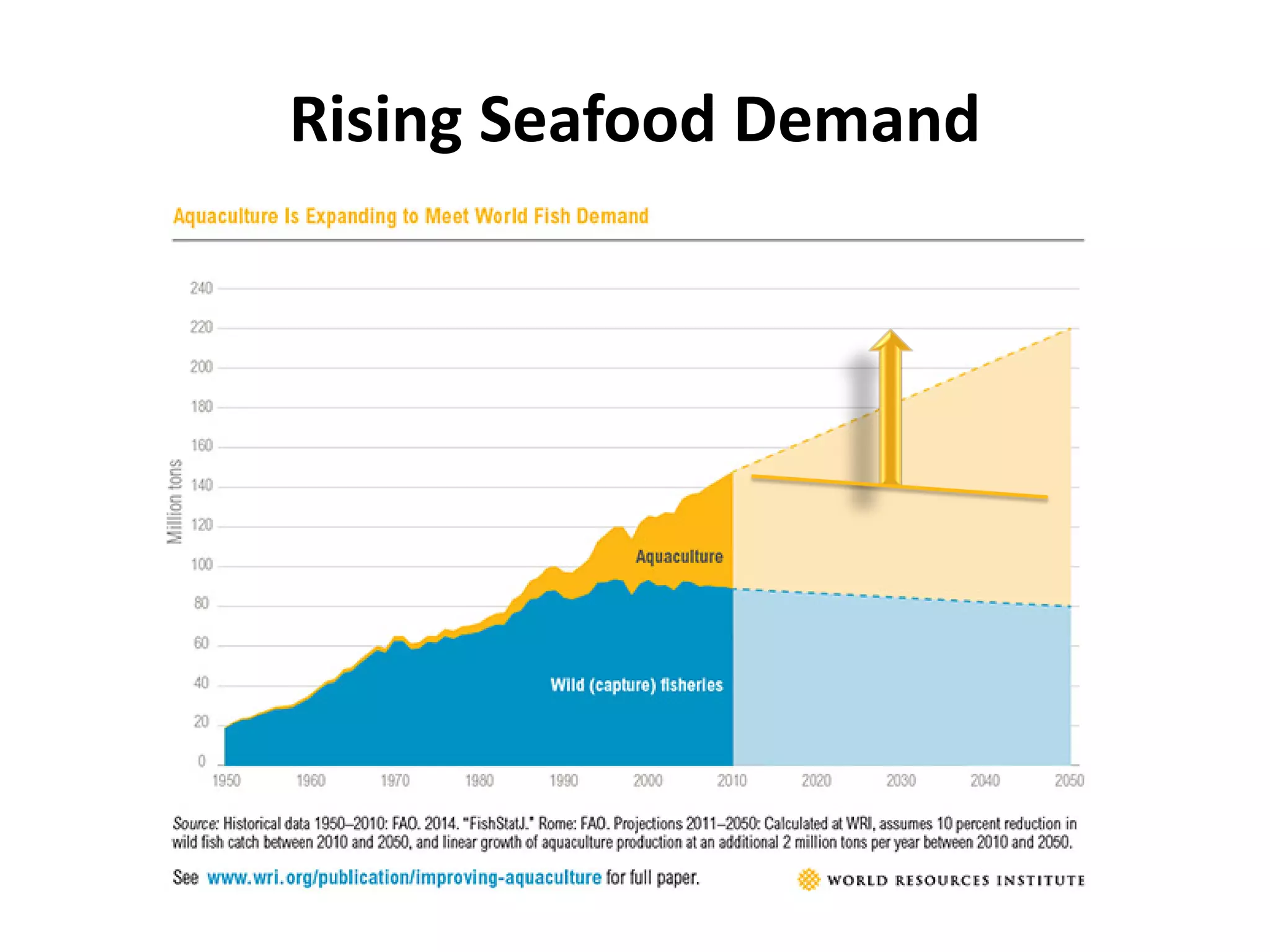
Rising Seafood Demand
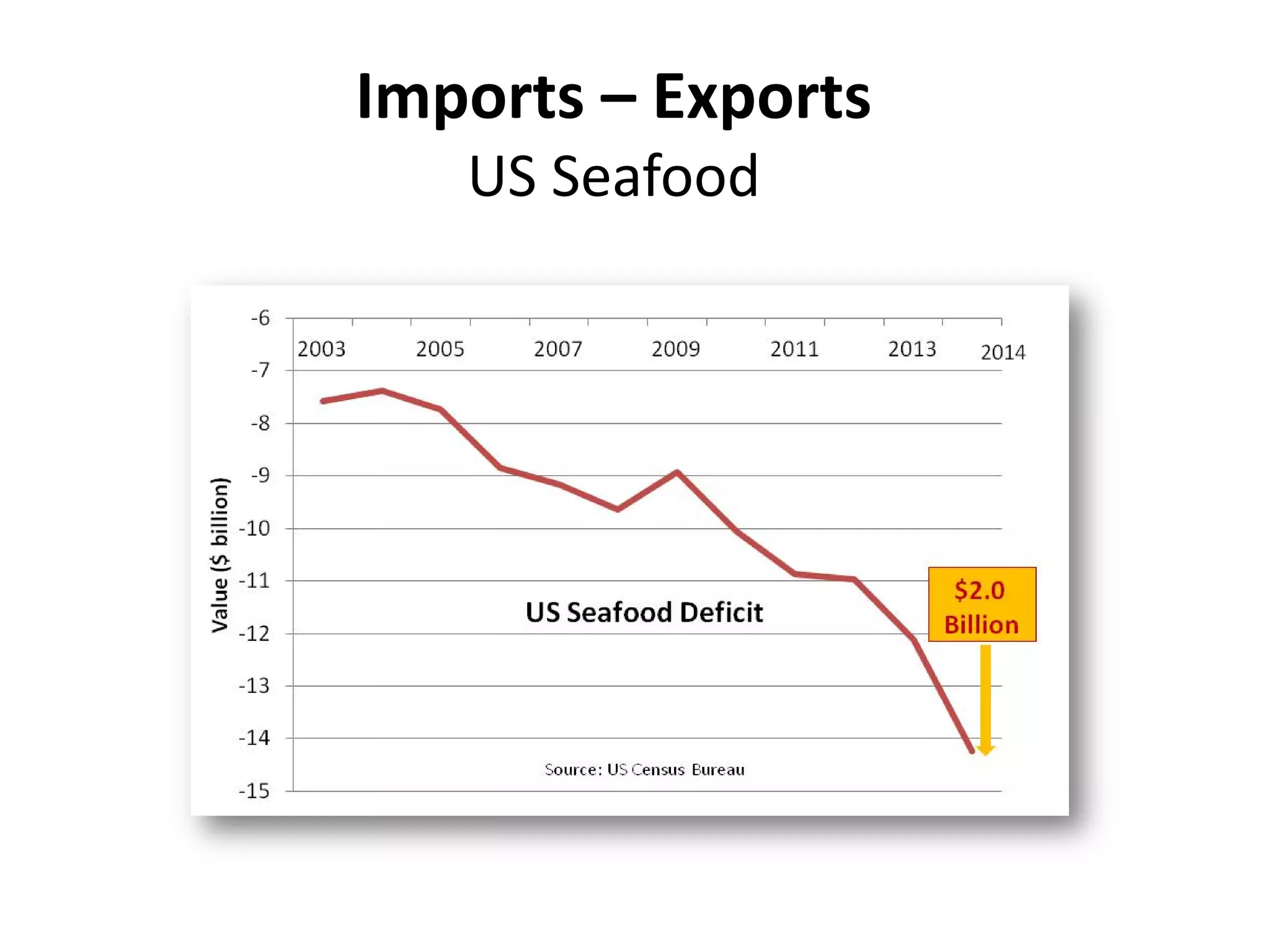
Imports – Exports
US Seafood
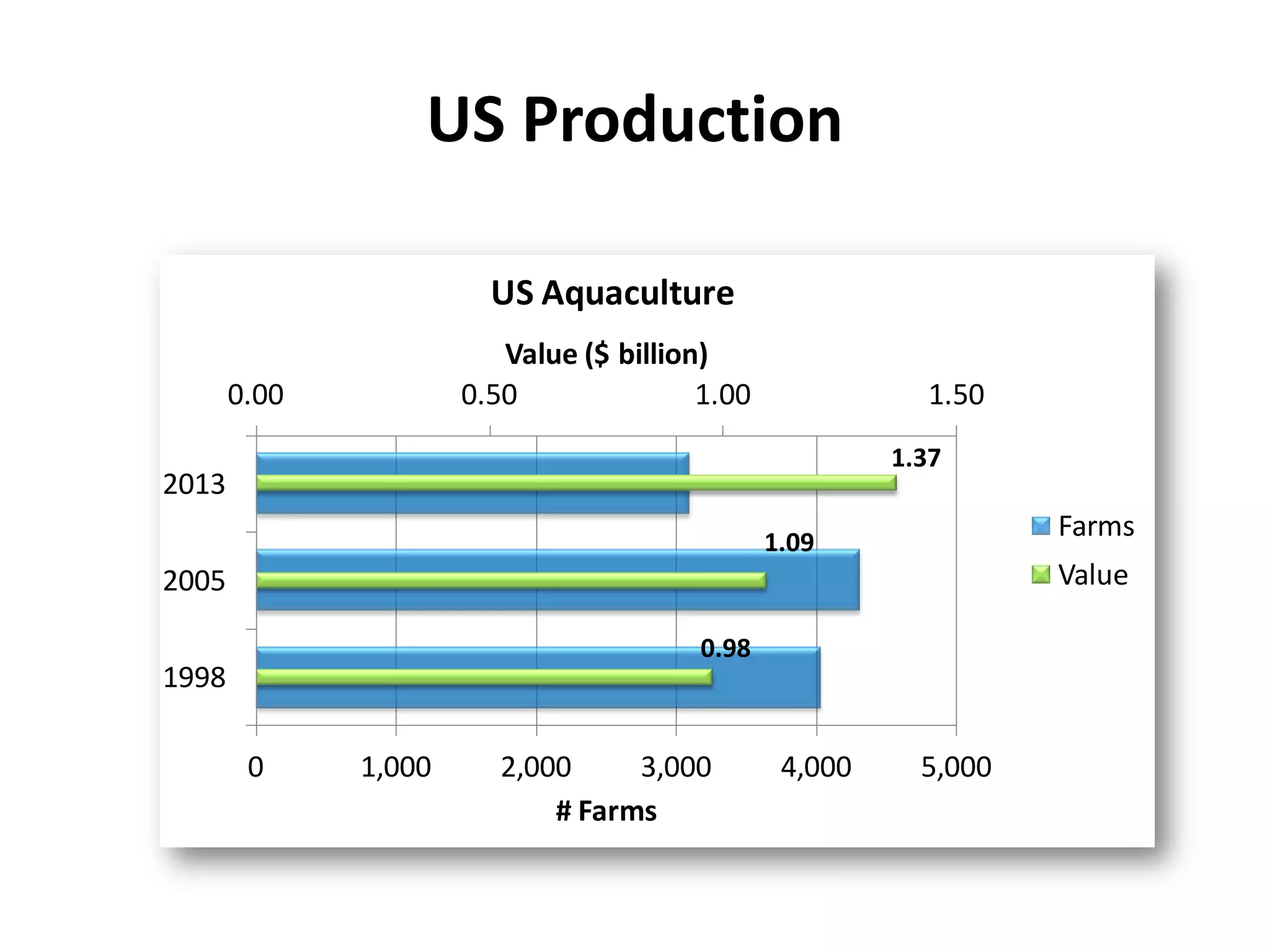
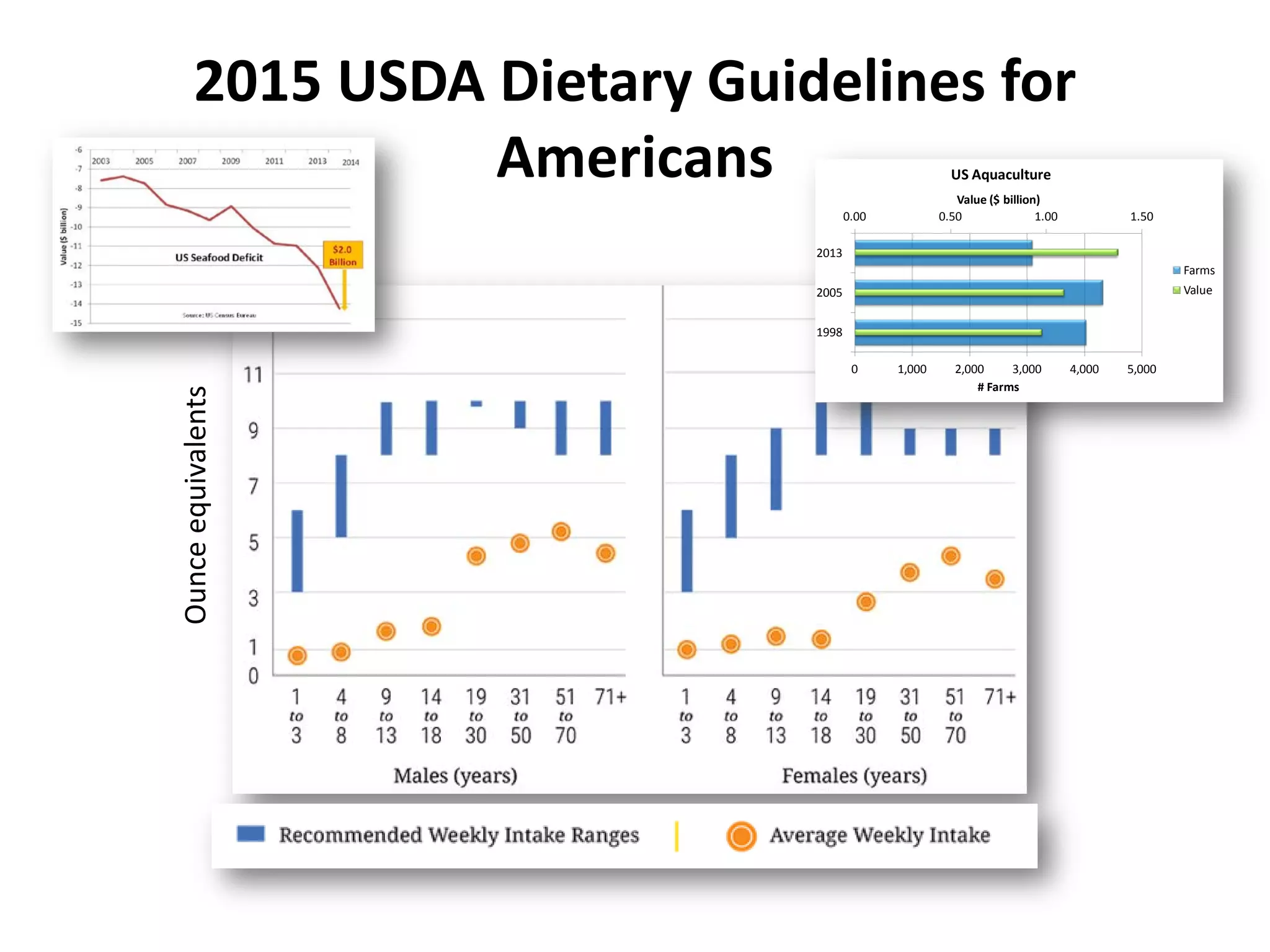
0.00 0.50 1.00 1.50
0 1,000 2,000 3,000 4,000 5,000
1998
2005
2013
Value ($ billion)
# Farms
US Aquaculture
Farms
Value
1.37
1.09
0.98
US Production
Ounceequivalents
2015 USDA Dietary Guidelines for
Americans
0.00 0.50 1.00 1.50
0 1,000 2,000 3,000 4,000 5,000
1998
2005
2013
Value ($ billion)
# Farms
US Aquaculture
Farms
Value
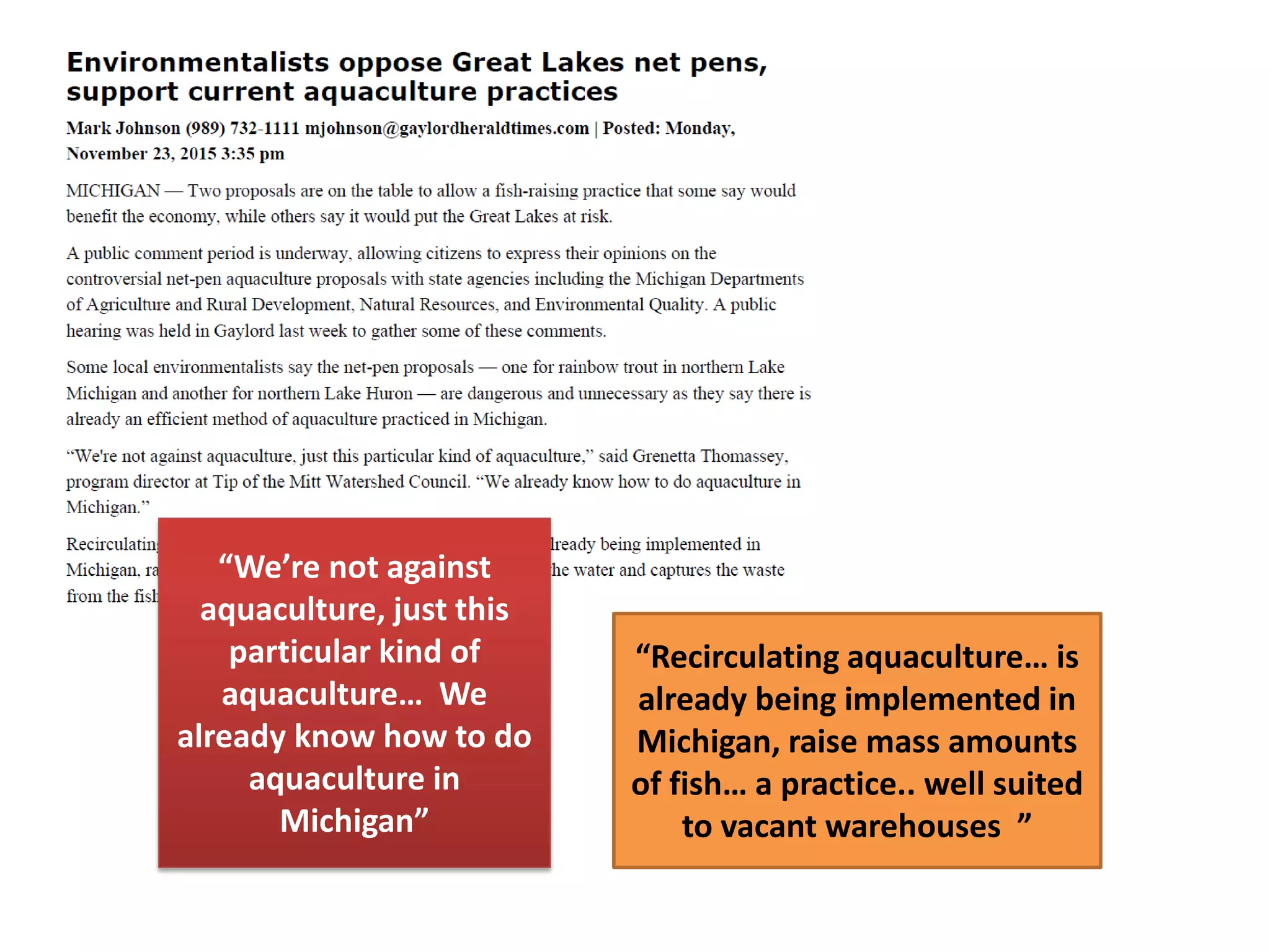
“We’re not against
aquaculture, just this
particular kind of
aquaculture… We
already know how to do
aquaculture in
Michigan”
“Recirculating aquaculture… is
already being implemented in
Michigan, raise mass amounts
of fish… a practice.. well suited
to vacant warehouses ”
IN URBAN
AREAS
IT CAN BE DONE
SUSTAINABLY
INDOORS
AQUACULTURE
IS
IMPORTANT
THROUGH
RECIRCULATING
AQUACULTURE
SYSTEMS
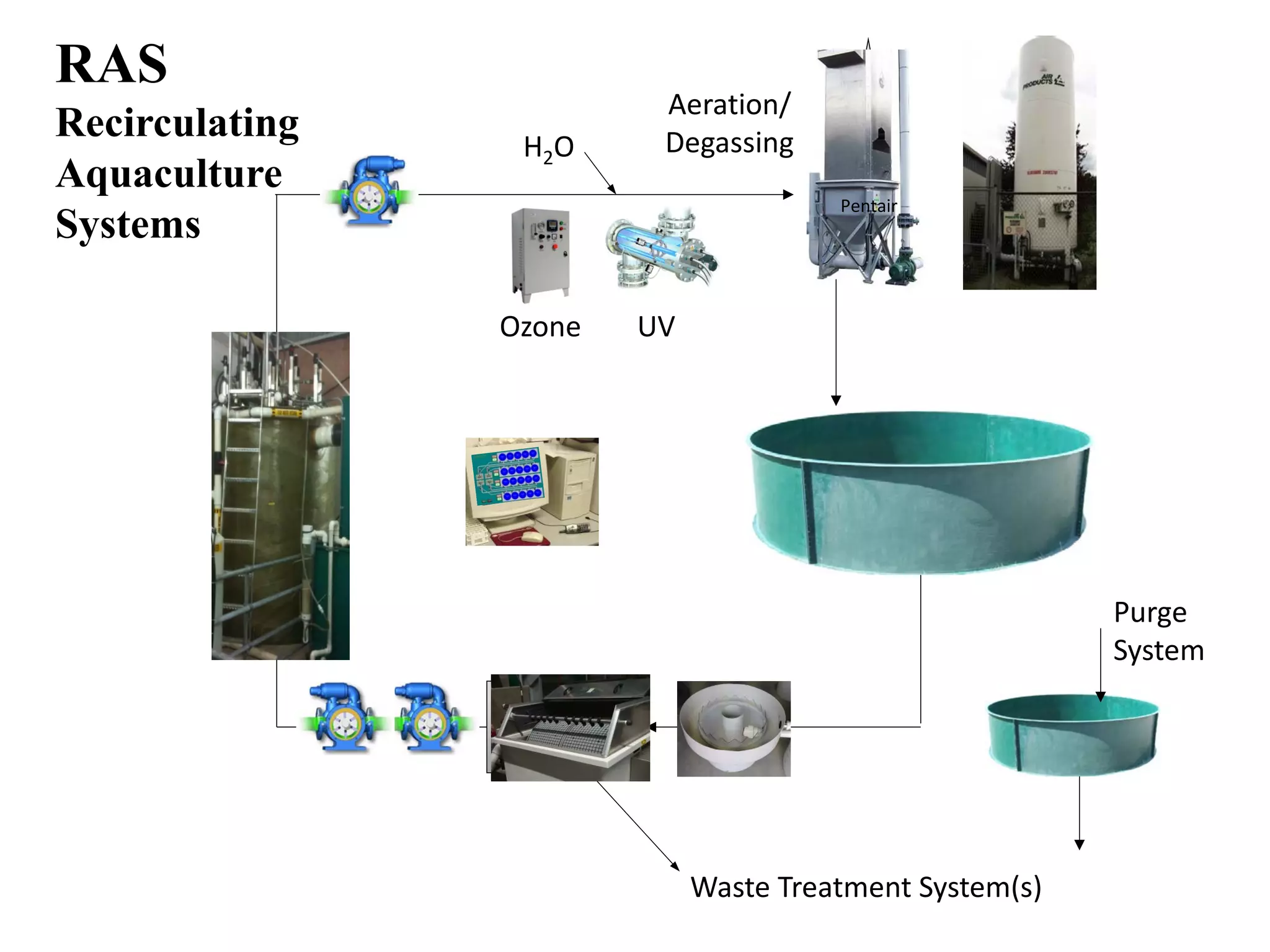
RAS
Recirculating
Aquaculture
Systems
Rearing unit
Biofilter
Clarifier
Pentair
Waste Treatment System(s)
Purge
System
Ozone UV
H2O
Aeration/
Degassing
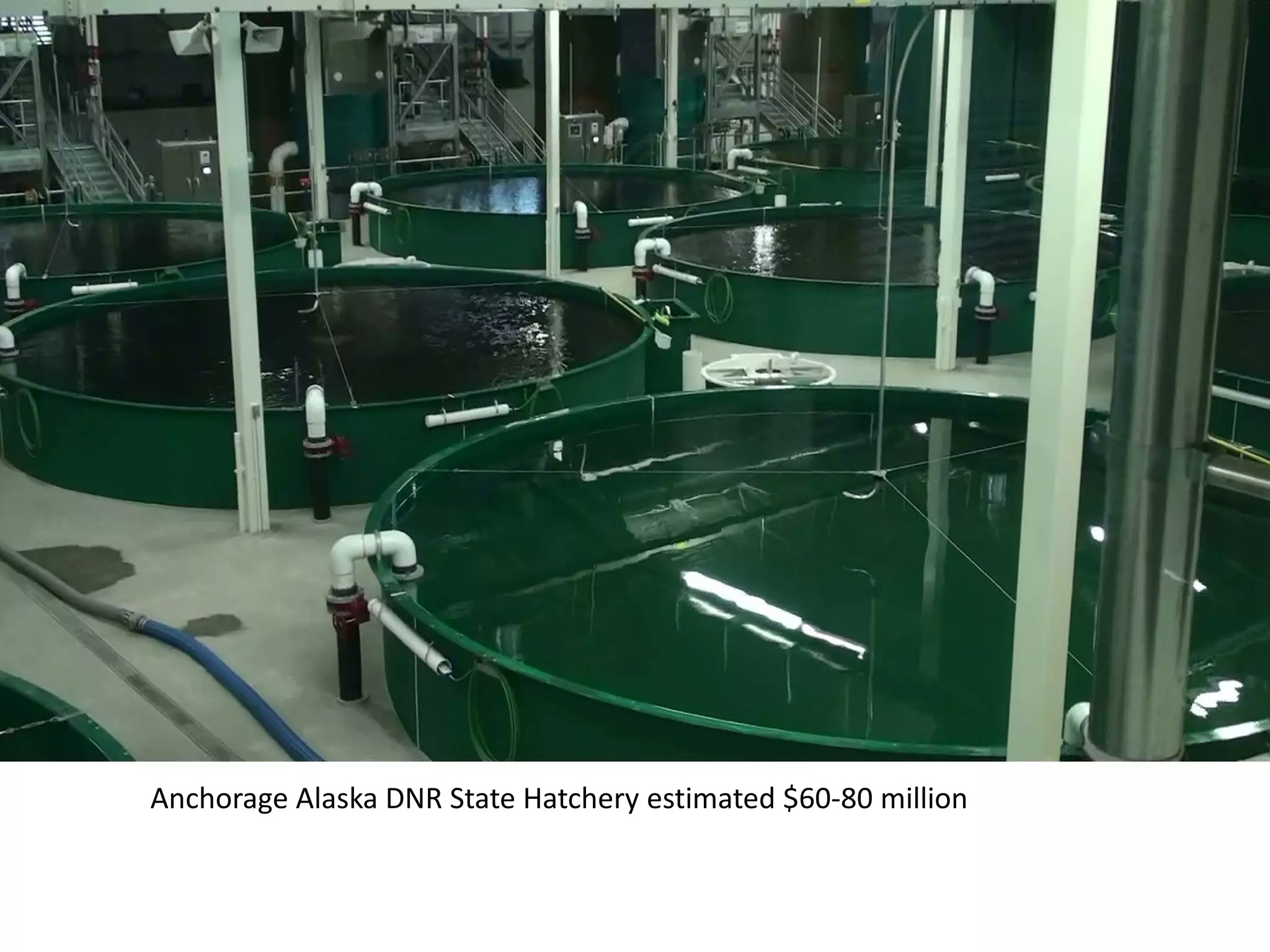
Anchorage Alaska DNR State Hatchery estimated $60-80 million
US Aquaculture Problem?
Production of Seafood
• Food
• Water
• Energy
• Environment
Business of Food
• How do consumers see it?
• Retailers?
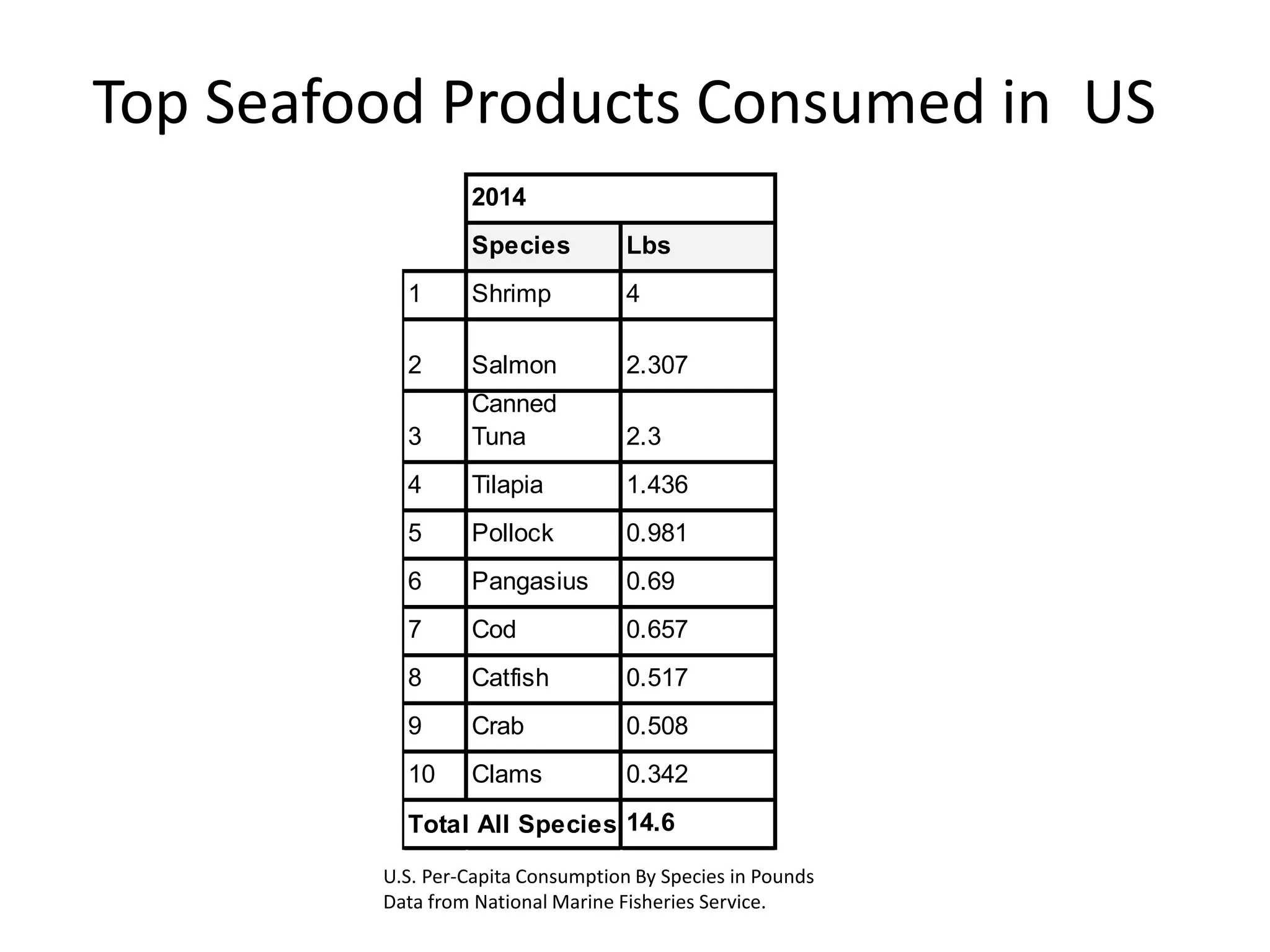
2014
Species Lbs
1 Shrimp 4
2 Salmon 2.307
3
Canned
Tuna 2.3
4 Tilapia 1.436
5 Pollock 0.981
6 Pangasius 0.69
7 Cod 0.657
8 Catfish 0.517
9 Crab 0.508
10 Clams 0.342
14.6Total All Species
U.S. Per-Capita Consumption By Species in Pounds
Data from National Marine Fisheries Service.
Top Seafood Products Consumed in US
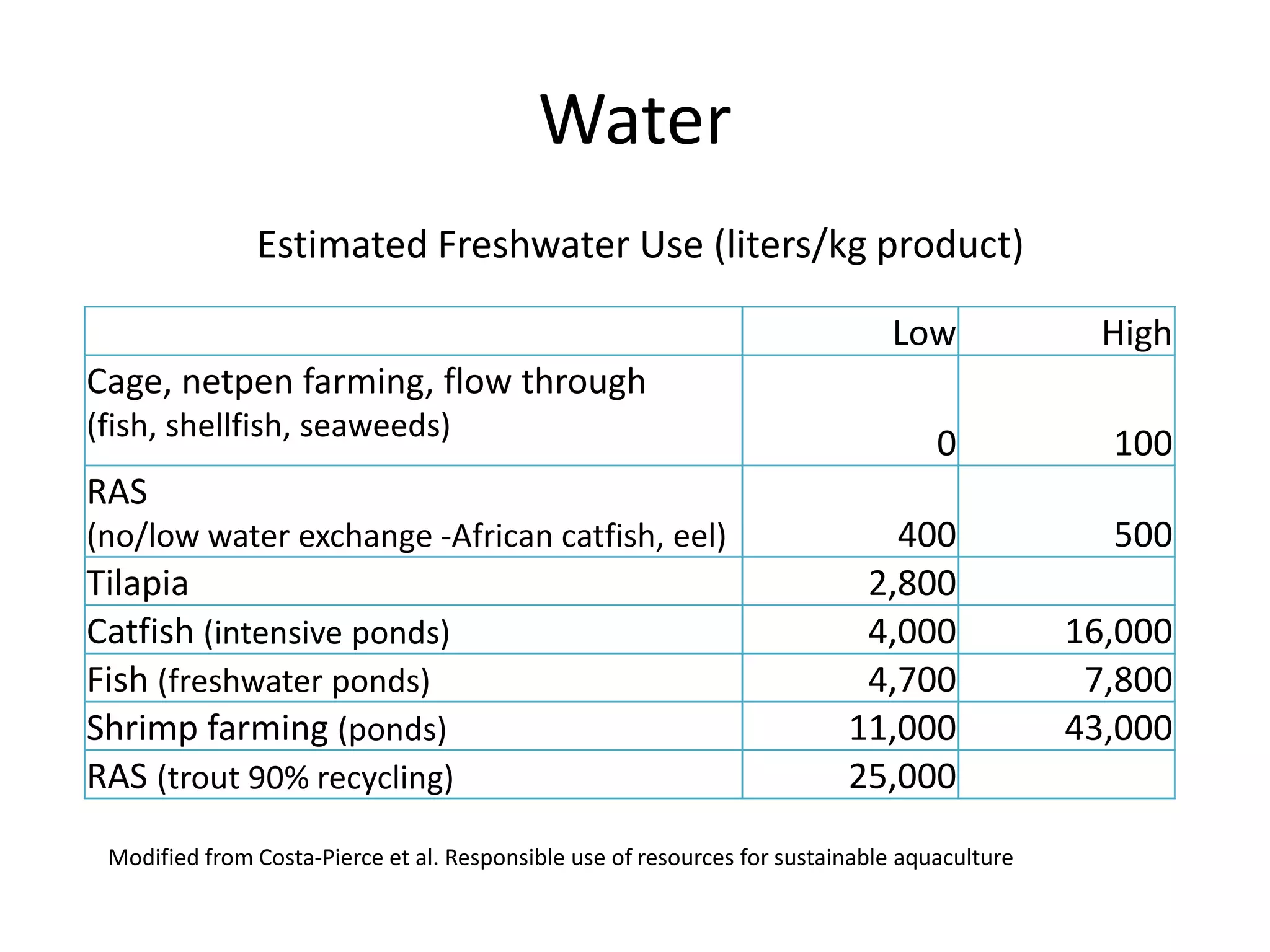
Water
Low High
Cage, netpen farming, flow through
(fish, shellfish, seaweeds)
0 100
RAS
(no/low water exchange -African catfish, eel) 400 500
Tilapia 2,800
Catfish (intensive ponds) 4,000 16,000
Fish (freshwater ponds) 4,700 7,800
Shrimp farming (ponds) 11,000 43,000
RAS (trout 90% recycling) 25,000
Estimated Freshwater Use (liters/kg product)
Modified from Costa-Pierce et al. Responsible use of resources for sustainable aquaculture
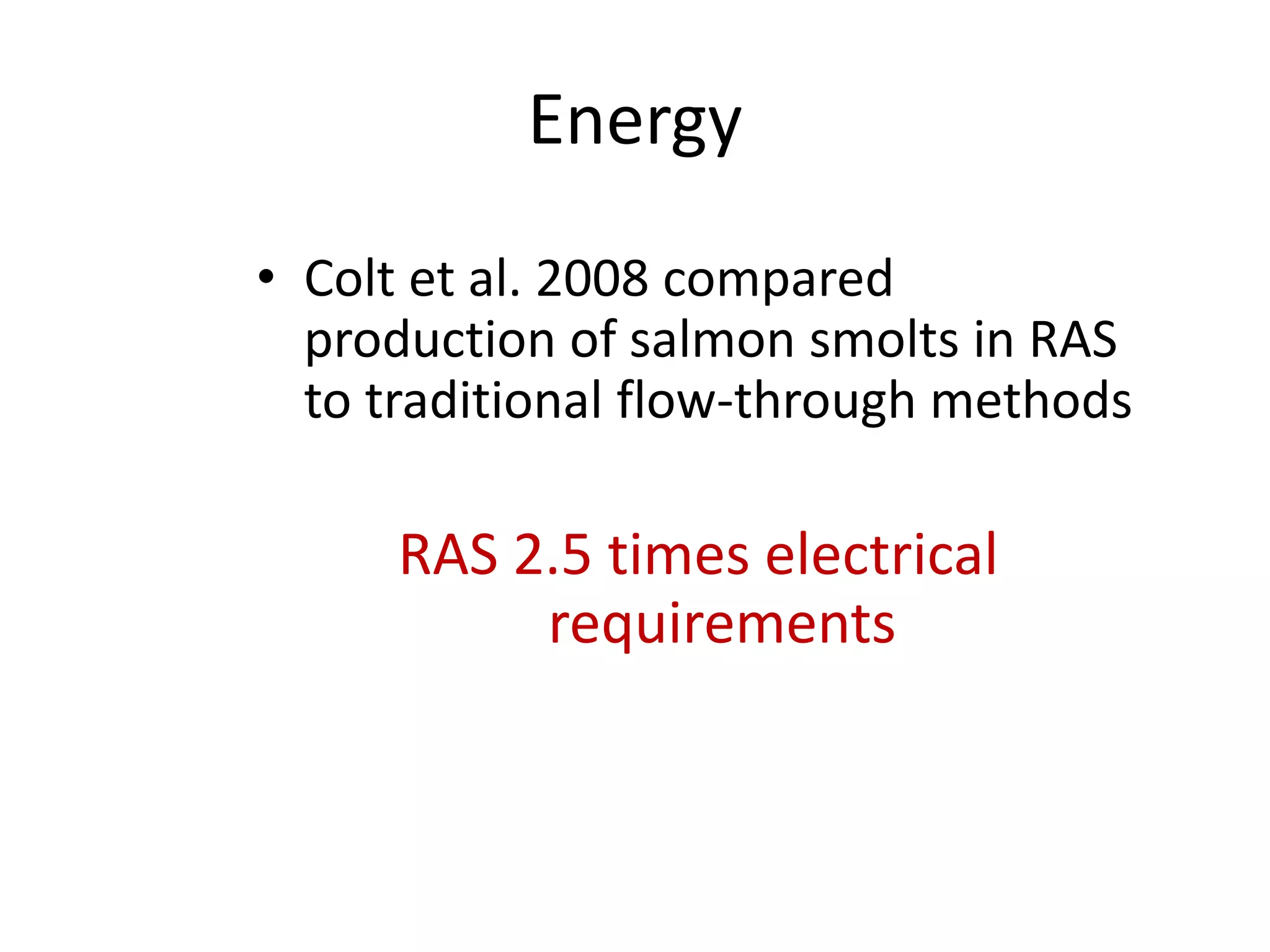
Energy
• Colt et al. 2008 compared
production of salmon smolts in RAS
to traditional flow-through methods
RAS 2.5 times electrical
requirements
Environment
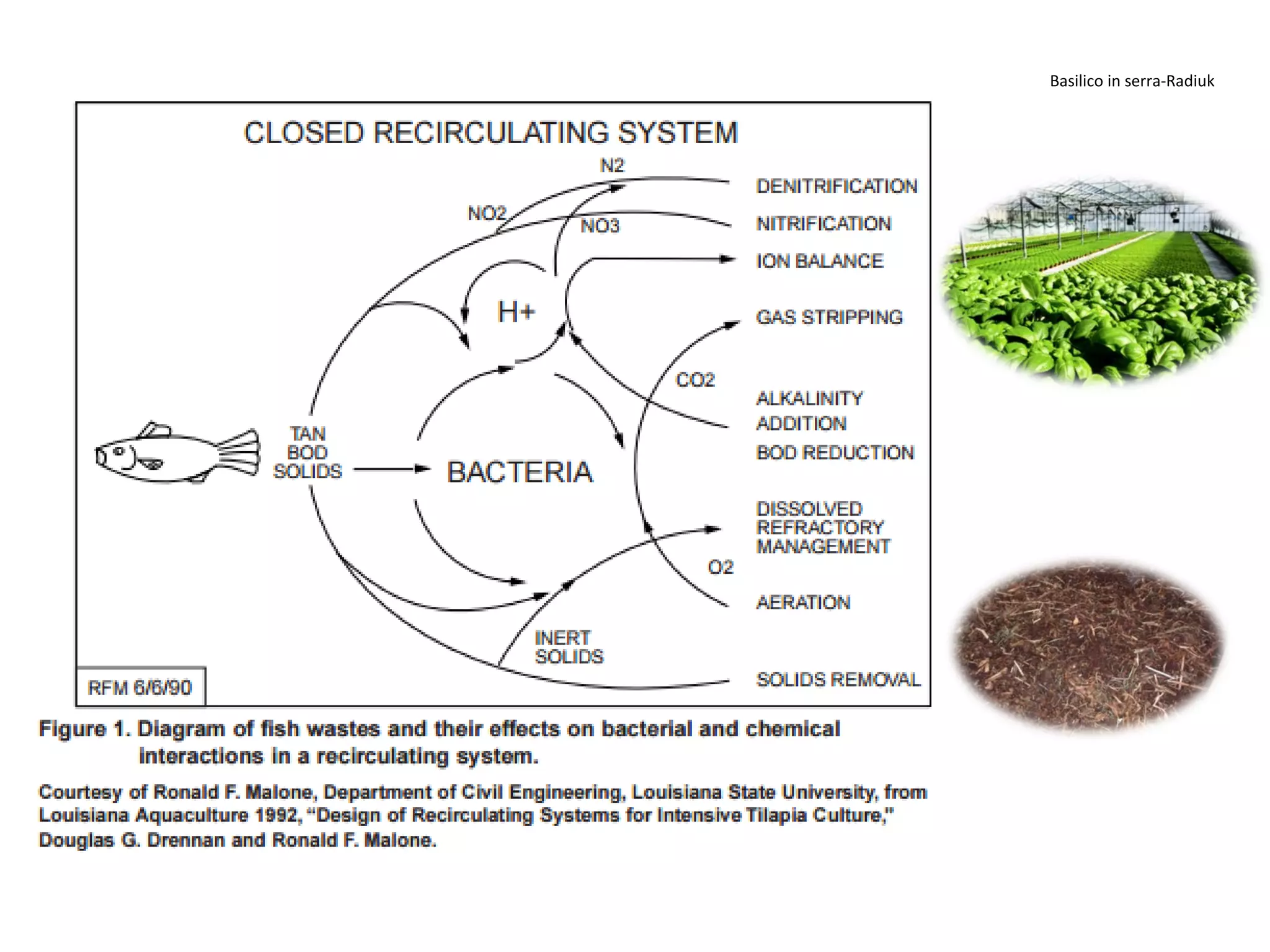
Basilico in serra-Radiuk
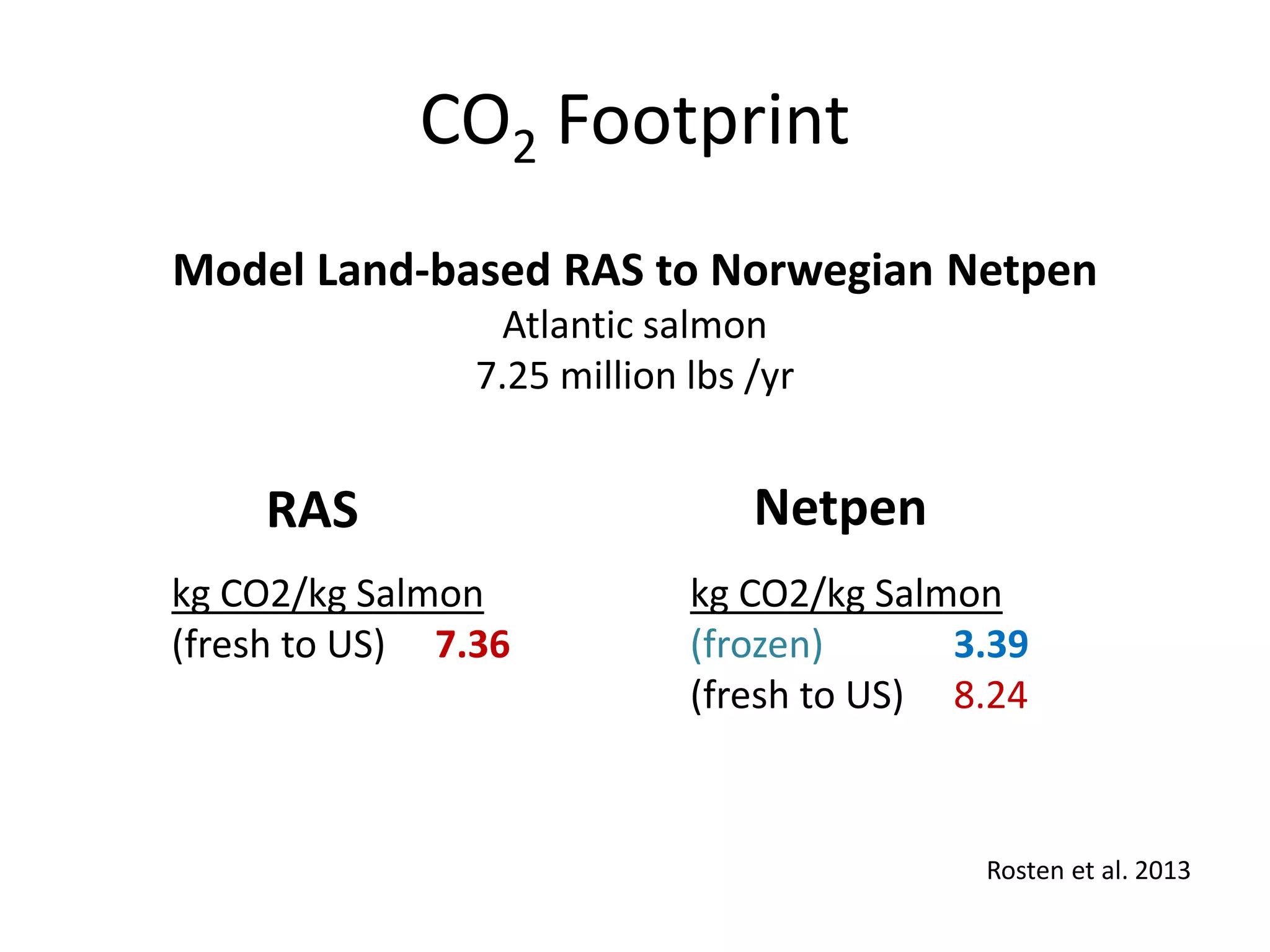
kg CO2/kg Salmon
(fresh to US) 7.36
kg CO2/kg Salmon
(frozen) 3.39
(fresh to US) 8.24
Model Land-based RAS to Norwegian Netpen
Atlantic salmon
7.25 million lbs /yr
Rosten et al. 2013
RAS Netpen
CO2 Footprint
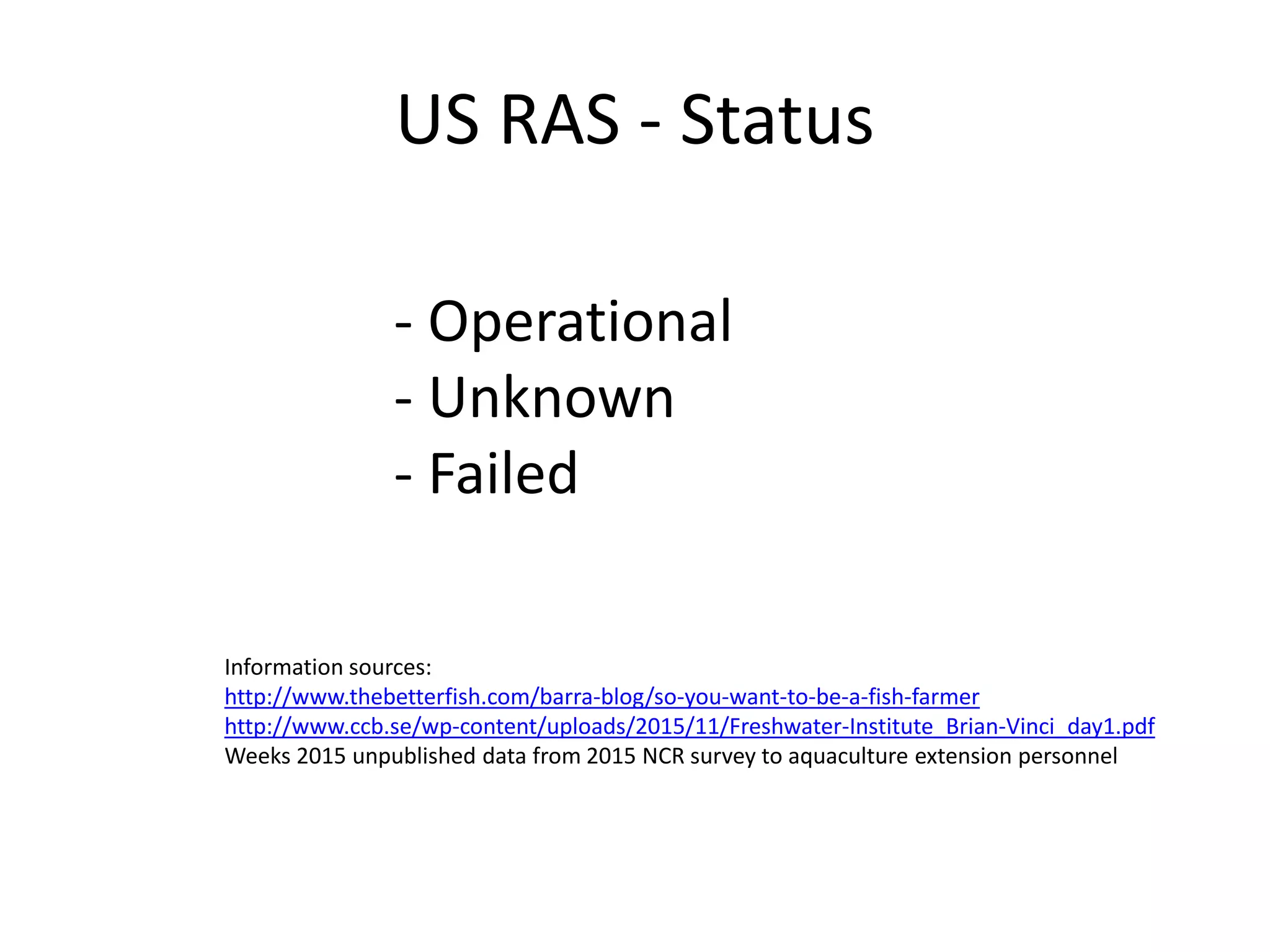
US RAS - Status
- Operational
- Unknown
- Failed
Information sources:
http://www.thebetterfish.com/barra-blog/so-you-want-to-be-a-fish-farmer
http://www.ccb.se/wp-content/uploads/2015/11/Freshwater-Institute_Brian-Vinci_day1.pdf
Weeks 2015 unpublished data from 2015 NCR survey to aquaculture extension personnel
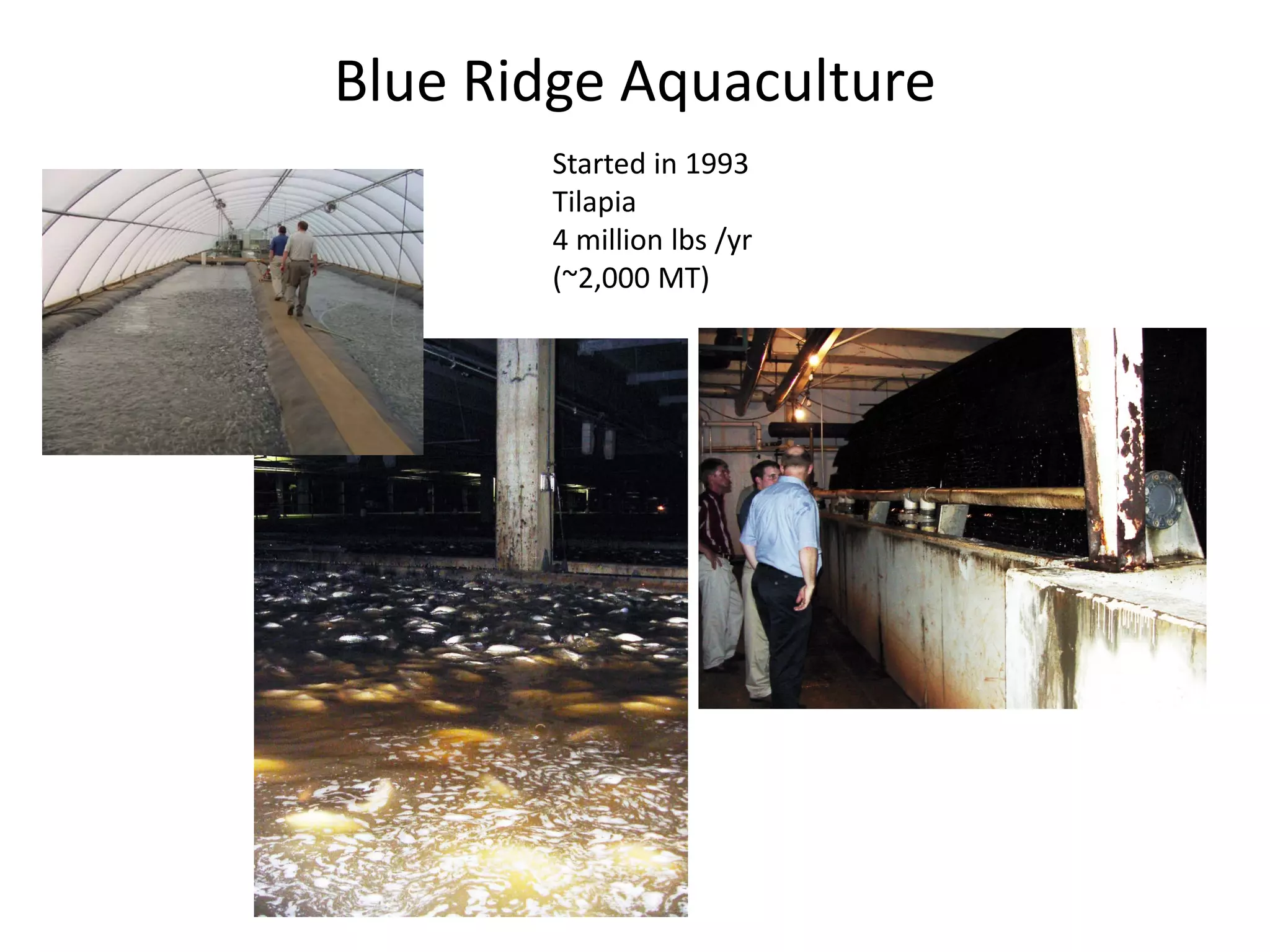
Blue Ridge Aquaculture
Started in 1993
Tilapia
4 million lbs /yr
(~2,000 MT)
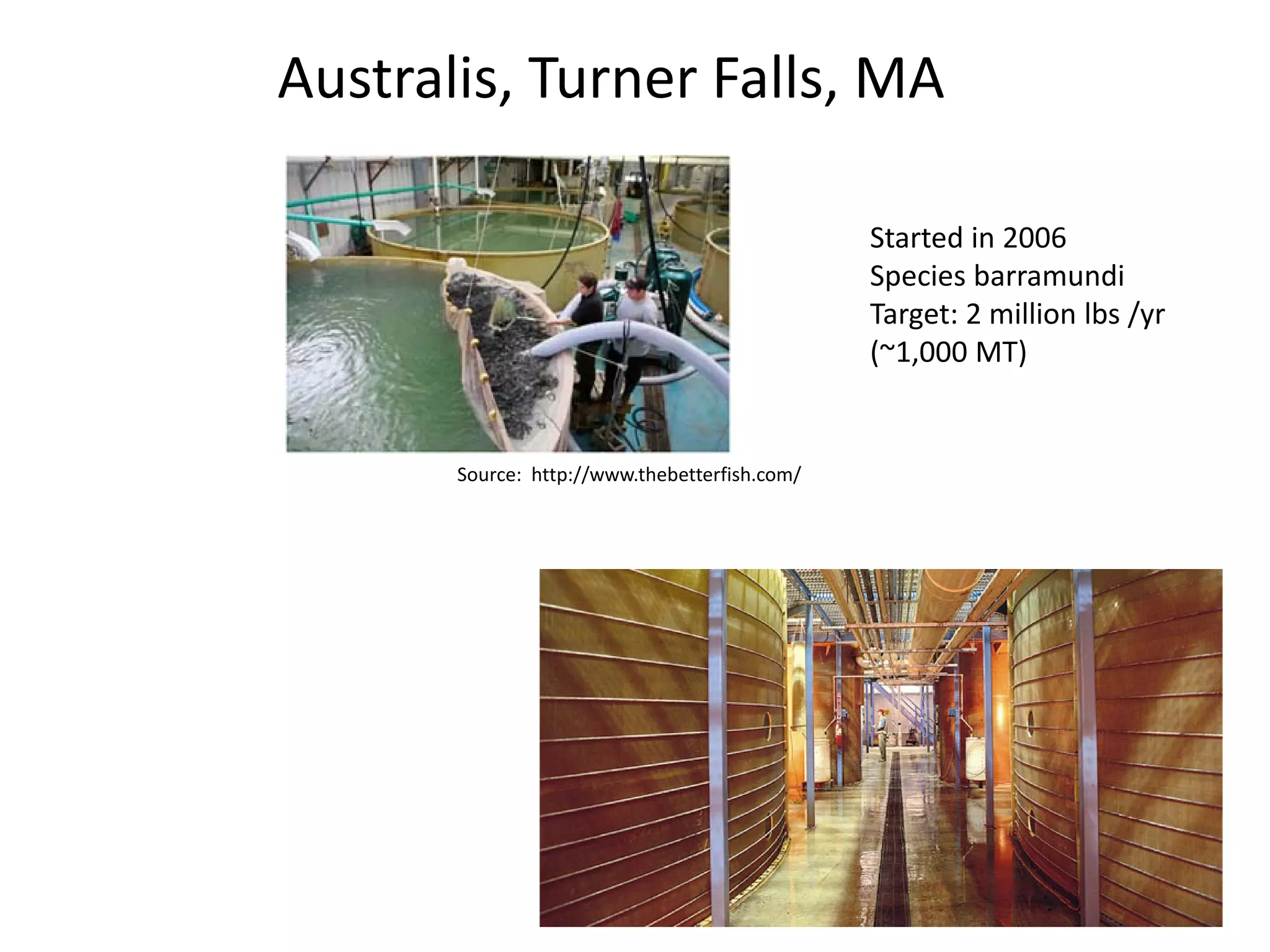
Source: http://www.thebetterfish.com/
Started in 2006
Species barramundi
Target: 2 million lbs /yr
(~1,000 MT)
Australis, Turner Falls, MA
Operational RAS in US
Company State Start Species Production
Vero Blue IA 2011 Barramundi 600,000
Australis Aquaculture MA 2004 Barramundi 1,500,000
Hunting Creek Fisheries MD Goldfish, Koi
Mt. Parnell Fisheries PA 1999 Goldfish, Koi
Desert Springs AZ 2005 Tilapia 1,000,000
Colorado correctional CO Tilapia
Tippco IN 2011 Tilapia 125,000
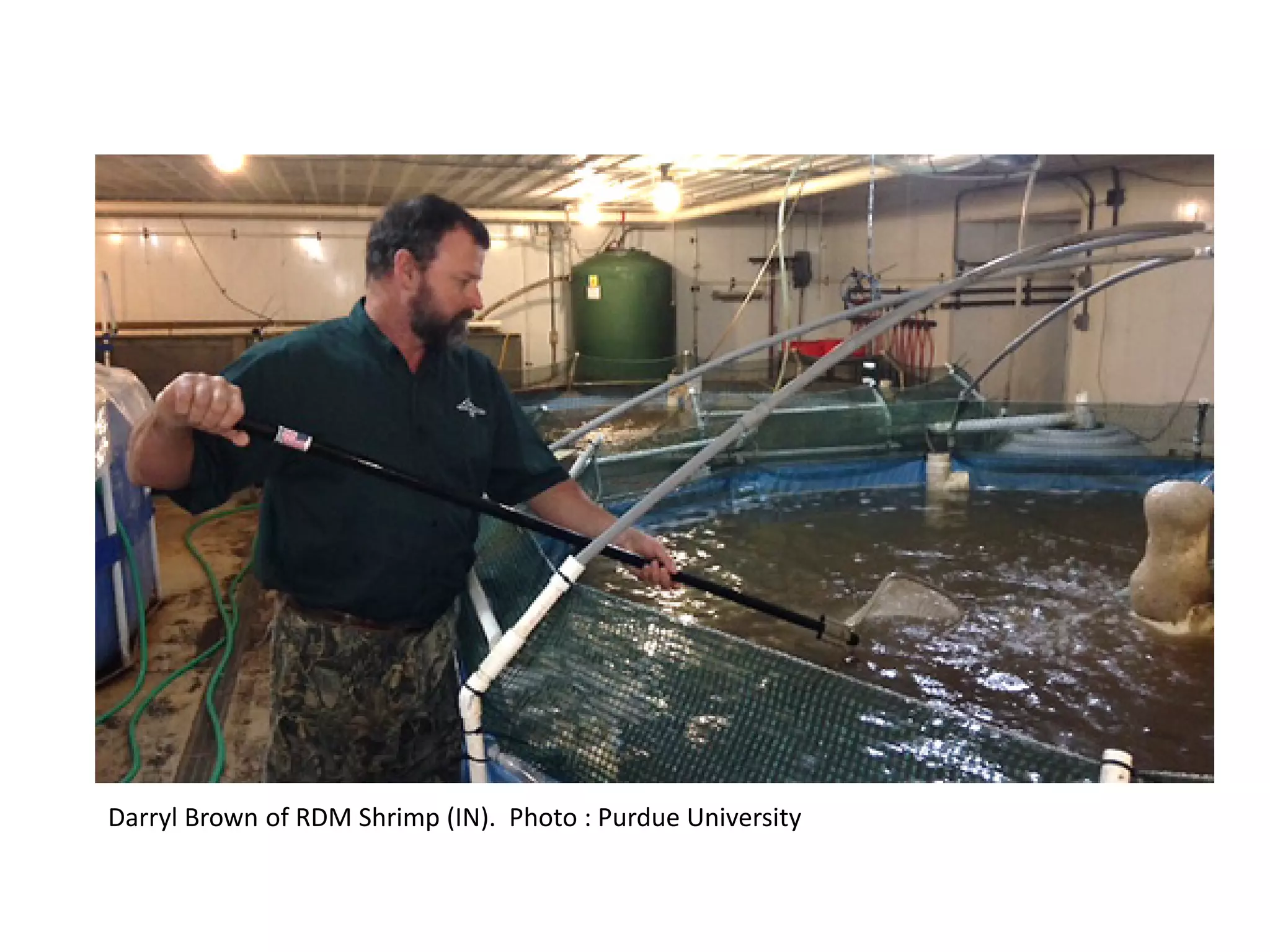
RDM Shrimp IN 2010 Marine shrimp
Indiana RAS 1 IN Pond stocking
Illinois 1 IL LMB
Aqua Green LA 2006 Tilapia 500,000
Astor Farms NC 2009 Tilapia 400,000
Brock Farms NC 2001 Tilapia 150,000
Circle G Farms NC 2001 Tilapia 300,000
DPK NC 2001 Tilapia 300,000
Farmers Catch NC 2001 Tilapia 150,000
Southern Farm Tilapia 1 NC 1998 Tilapia 250,000
Sutton Farms NC 2001 Tilapia 300,000
Taylor Fish Farm NC 2009 Tilapia 250,000
Triple M aquaculture NC Tilapia
Freshwater Farms OH Trout, Y. Perch 100,000
Ohio Tilapia 1 OH Tilapia
CA sturgeon CA Sturgeon / caviar
Blue Ridge Aquaculture VA 1993 Tilapia 4,000,000
4+ yrs
operating
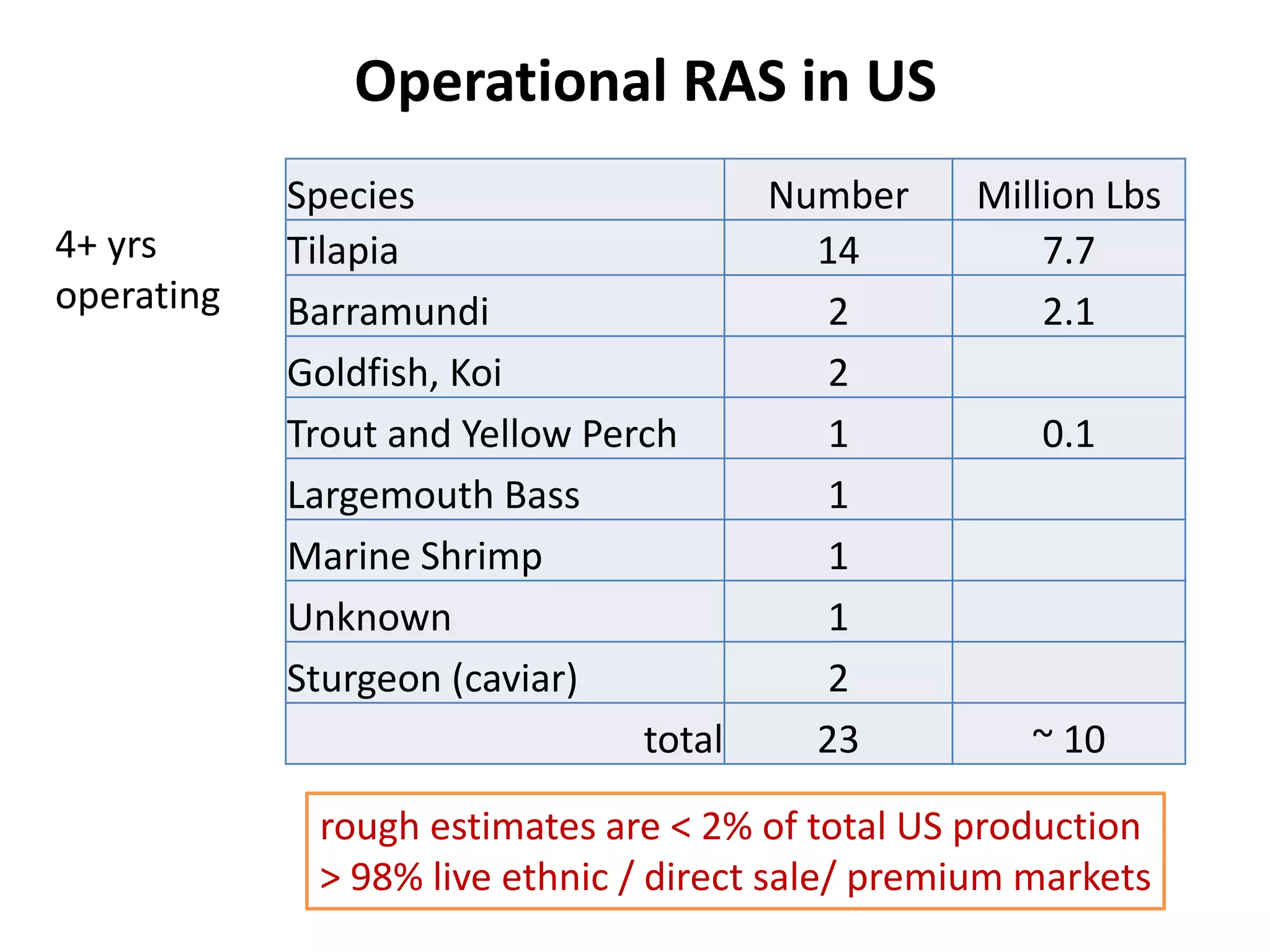
Species Number Million Lbs
Tilapia 14 7.7
Barramundi 2 2.1
Goldfish, Koi 2
Trout and Yellow Perch 1 0.1
Largemouth Bass 1
Marine Shrimp 1
Unknown 1
Sturgeon (caviar) 2
total 23 ~ 10
4+ yrs
operating
Operational RAS in US
rough estimates are < 2% of total US production
> 98% live ethnic / direct sale/ premium markets
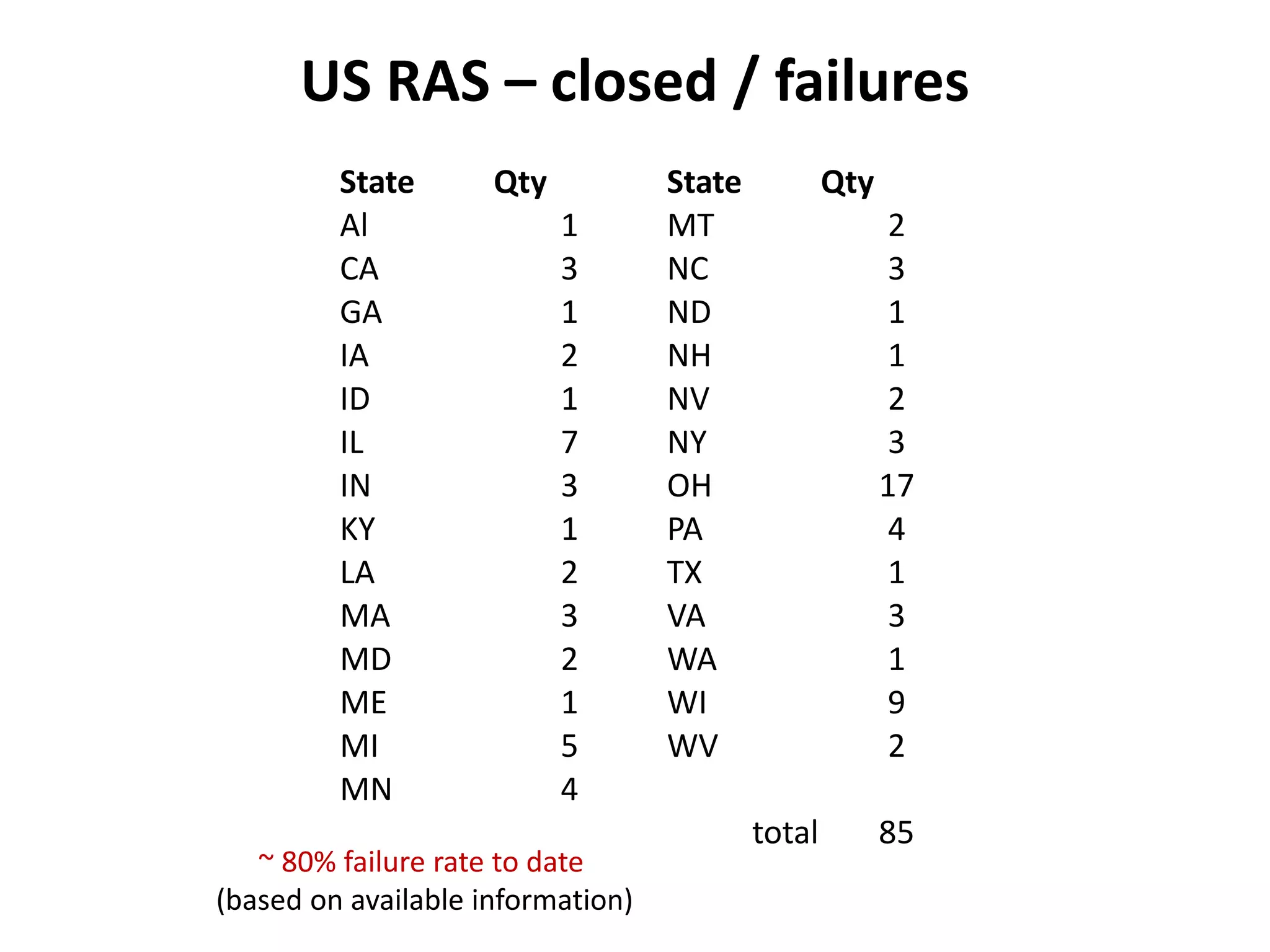
US RAS – closed / failures
State Qty State Qty
Al 1 MT 2
CA 3 NC 3
GA 1 ND 1
IA 2 NH 1
ID 1 NV 2
IL 7 NY 3
IN 3 OH 17
KY 1 PA 4
LA 2 TX 1
MA 3 VA 3
MD 2 WA 1
ME 1 WI 9
MI 5 WV 2
MN 4
total 85
~ 80% failure rate to date
(based on available information)
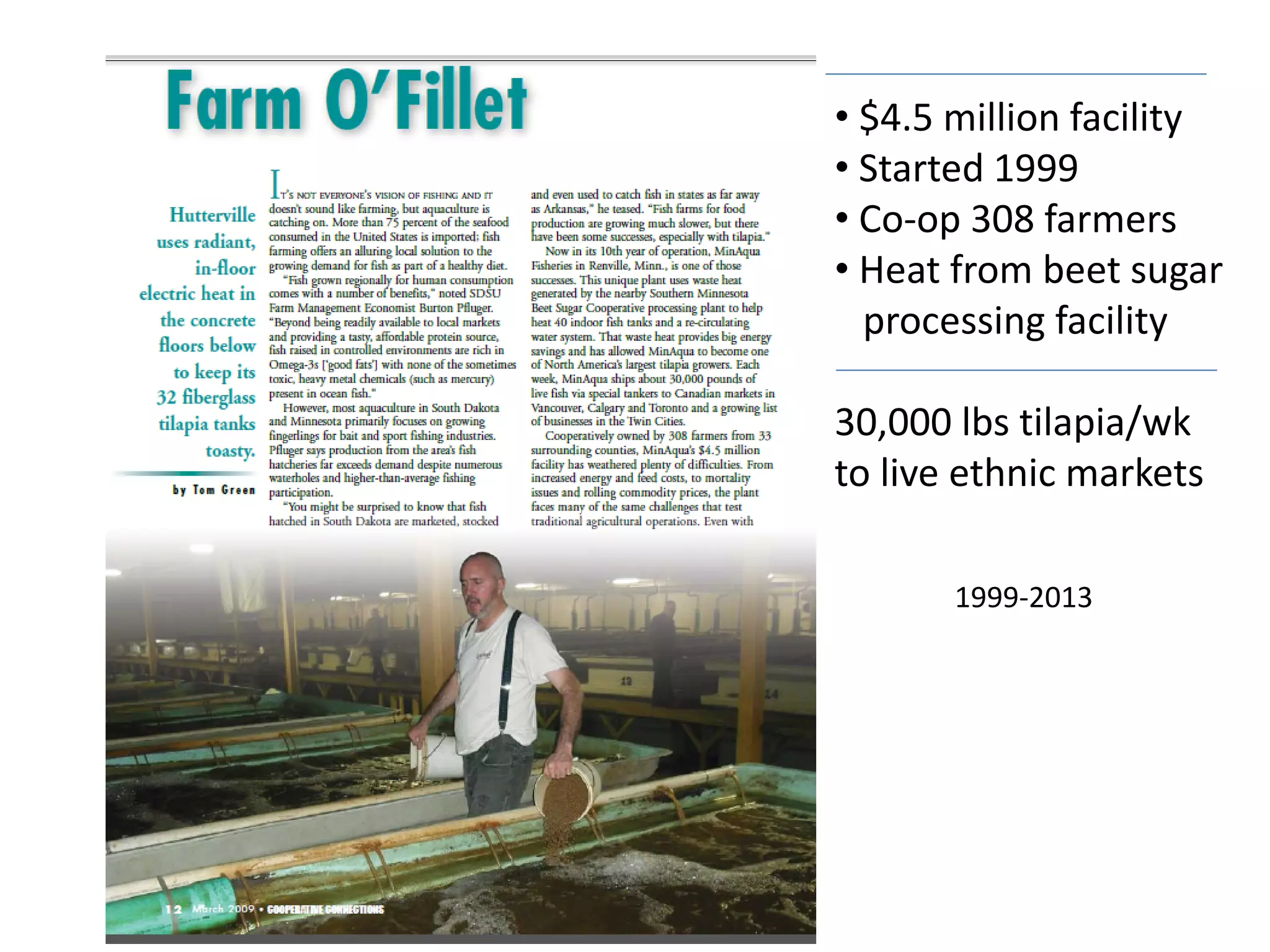
1999-2013
• $4.5 million facility
• Started 1999
• Co-op 308 farmers
• Heat from beet sugar
processing facility
30,000 lbs tilapia/wk
to live ethnic markets
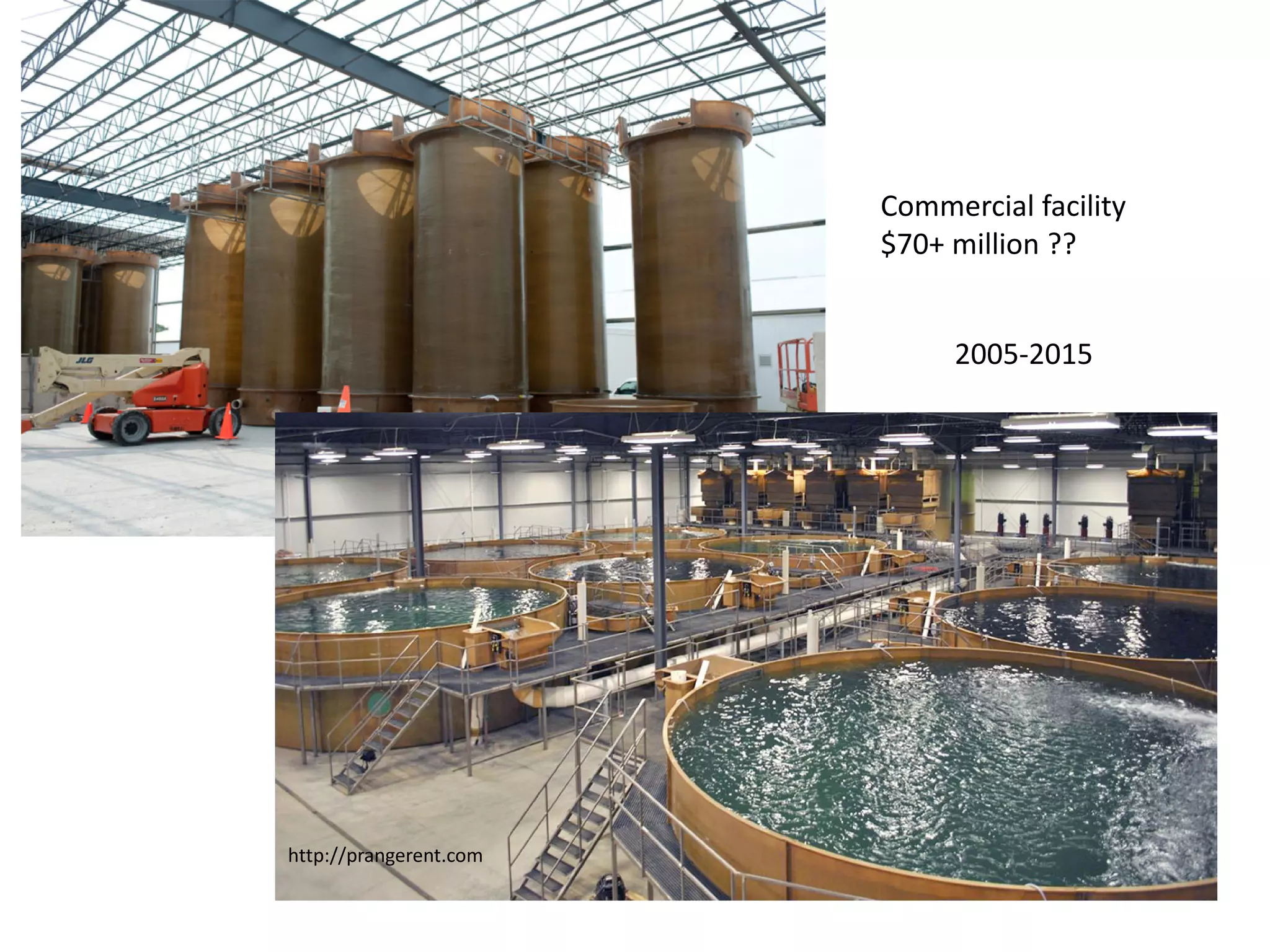
http://prangerent.com
Commercial facility
$70+ million ??
2005-2015
RAS in the NCR
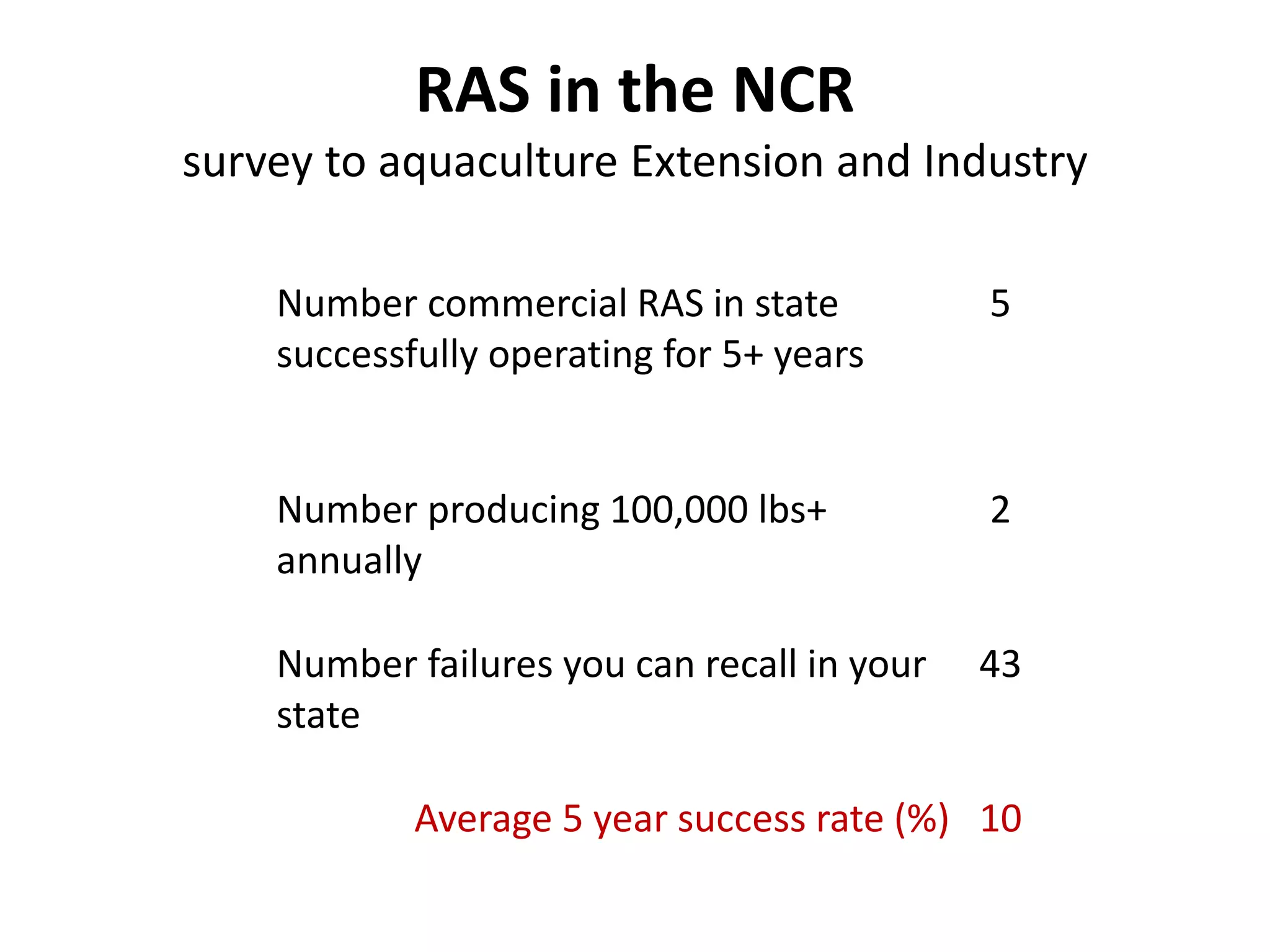
survey to aquaculture Extension and Industry
Number commercial RAS in state
successfully operating for 5+ years
5
Number producing 100,000 lbs+
annually
2
Number failures you can recall in your
state
43
Average 5 year success rate (%) 10
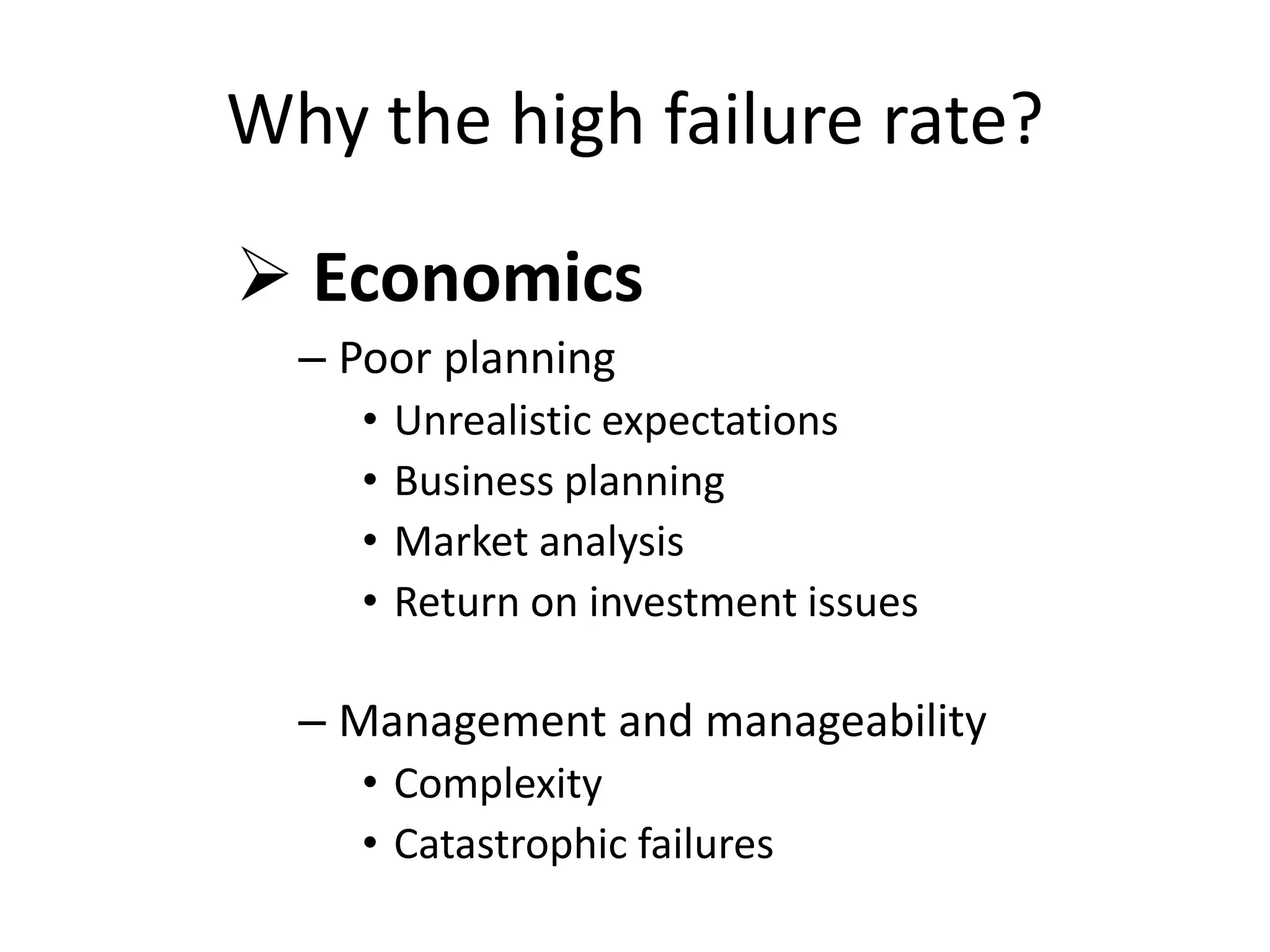
Why the high failure rate?
 Economics
– Poor planning
• Unrealistic expectations
• Business planning
• Market analysis
• Return on investment issues
– Management and manageability
• Complexity
• Catastrophic failures
Where does RAS appear to be
working?
• Tilapia (live ethnic markets)
• Hatchery systems for marine netpens
13.5 million smolts to 200-300 grams for netpen grow out
Where does RAS appear to be
working?
• Tilapia (live ethnic markets)
• Hatchery systems for marine netpens
• Barramundi (relatively new, mostly live
markets)
• Sturgeon (caviar)
• Smaller scale DIRECT SALES?
Smaller scale DIRECT SALES
• Local farm markets and community supported
agriculture (CSA’s)
– CAN YOU COMPETE WITH THE TERRESTIAL CROP
STAND /CSA CLOSE TO YOU?
– IF NOT, WHY IS YOUR PRODUCT BETTER?
• Live market
– IS THERE A NEW MARKET WITHIN DESIRED RADIUS?
– IS THERE ROOM FOR ADDITIONAL PRODUCT?
• Premium fish markets
– ARE THERE ENOUGH RESTAURANTS CLOSE BY THAT
WOULD PAY MORE FOR A FRESH PRODUCT?
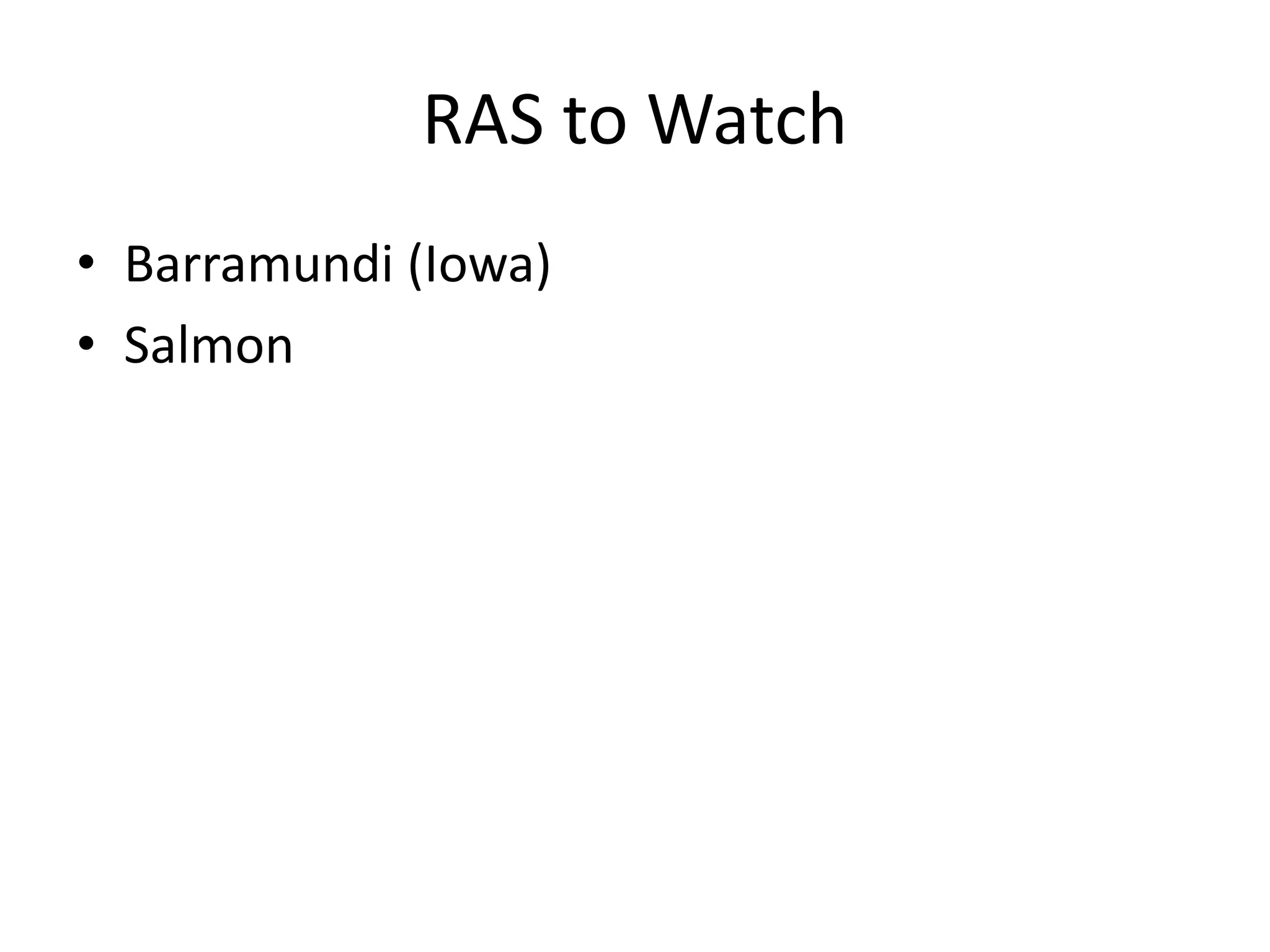
RAS to Watch
• Barramundi (Iowa)
• Salmon
Target 7.2 million lbs /yr
barramundi spoke and hub operation
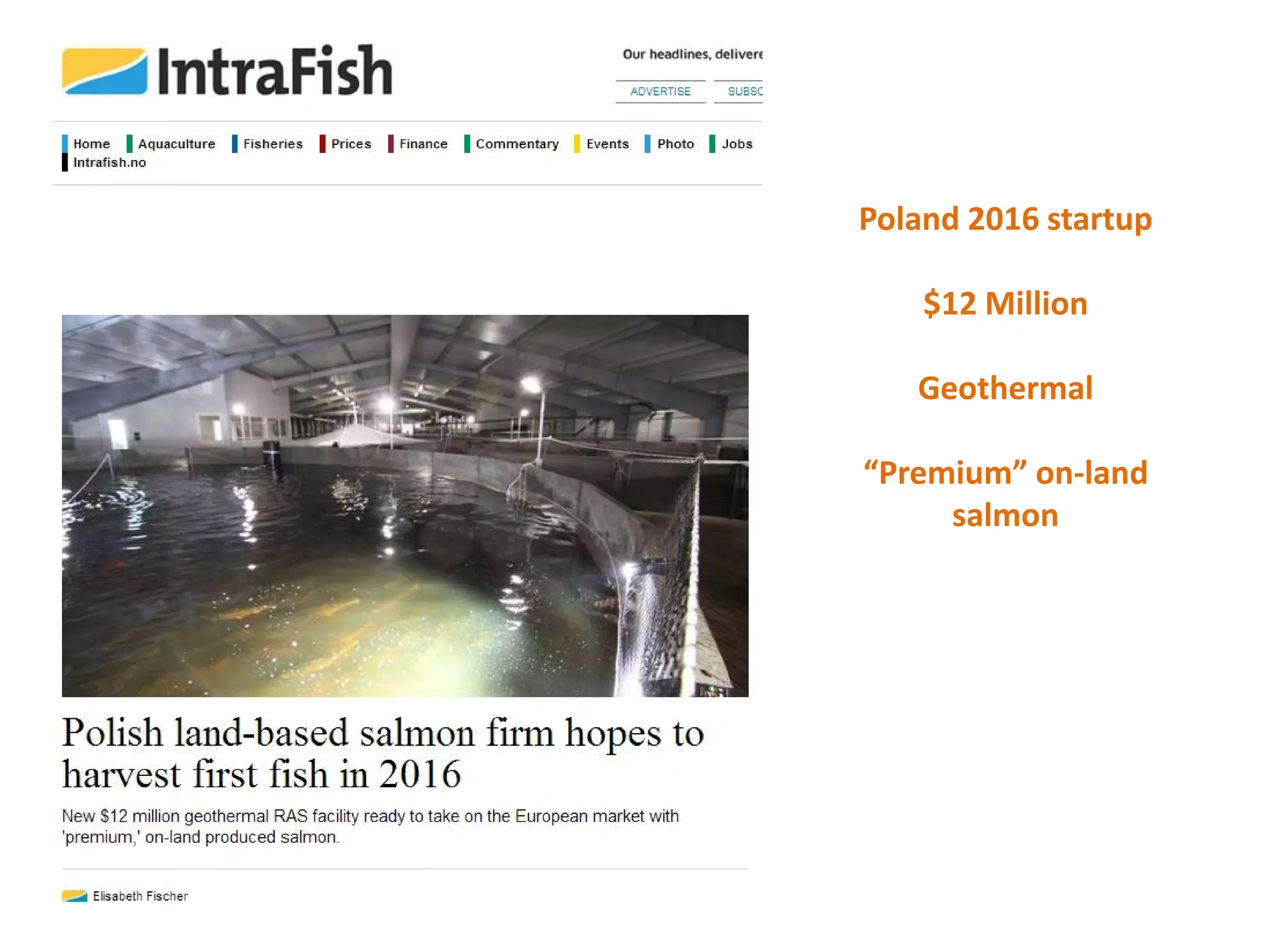
Poland 2016 startup
$12 Million
Geothermal
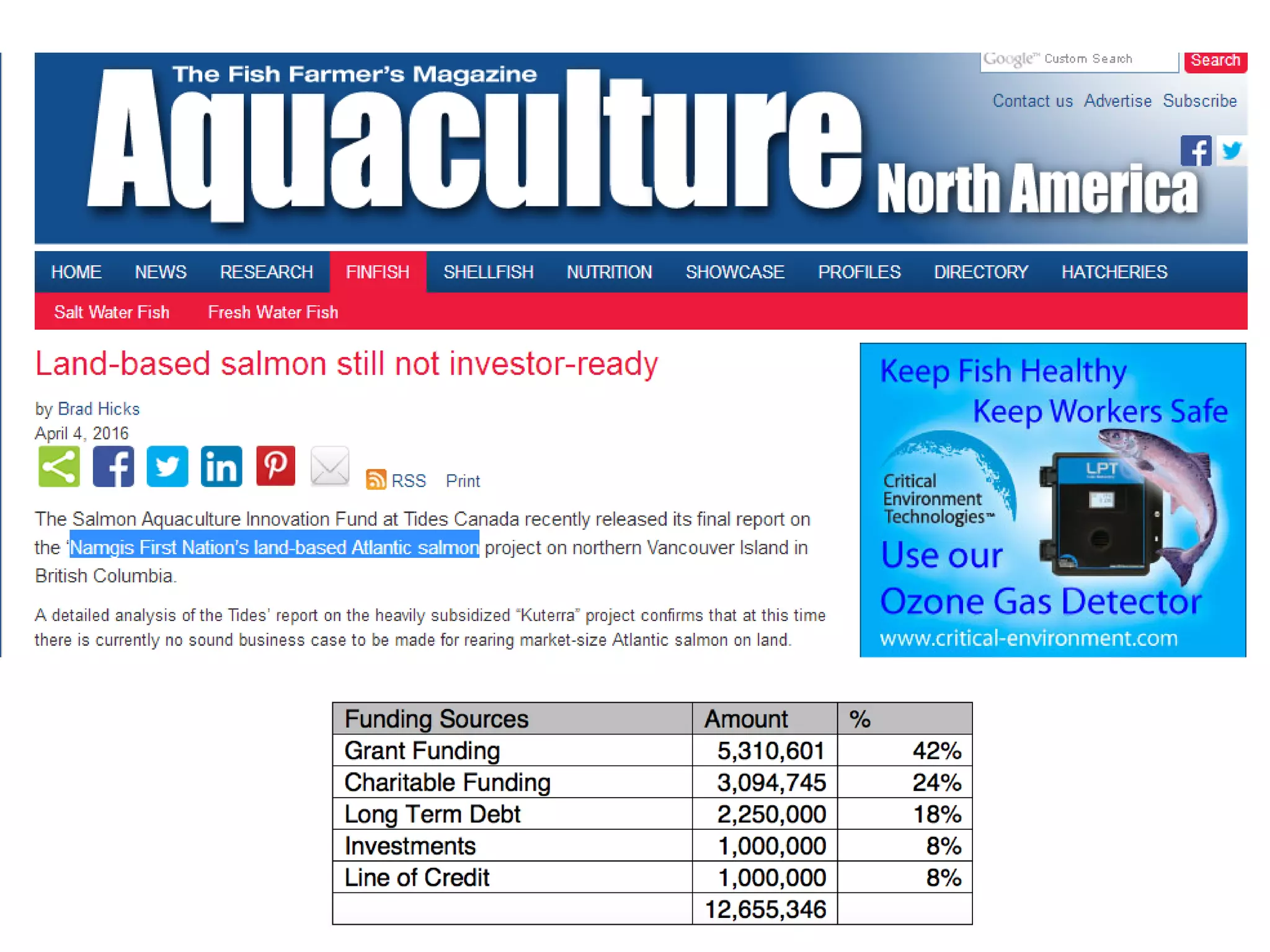
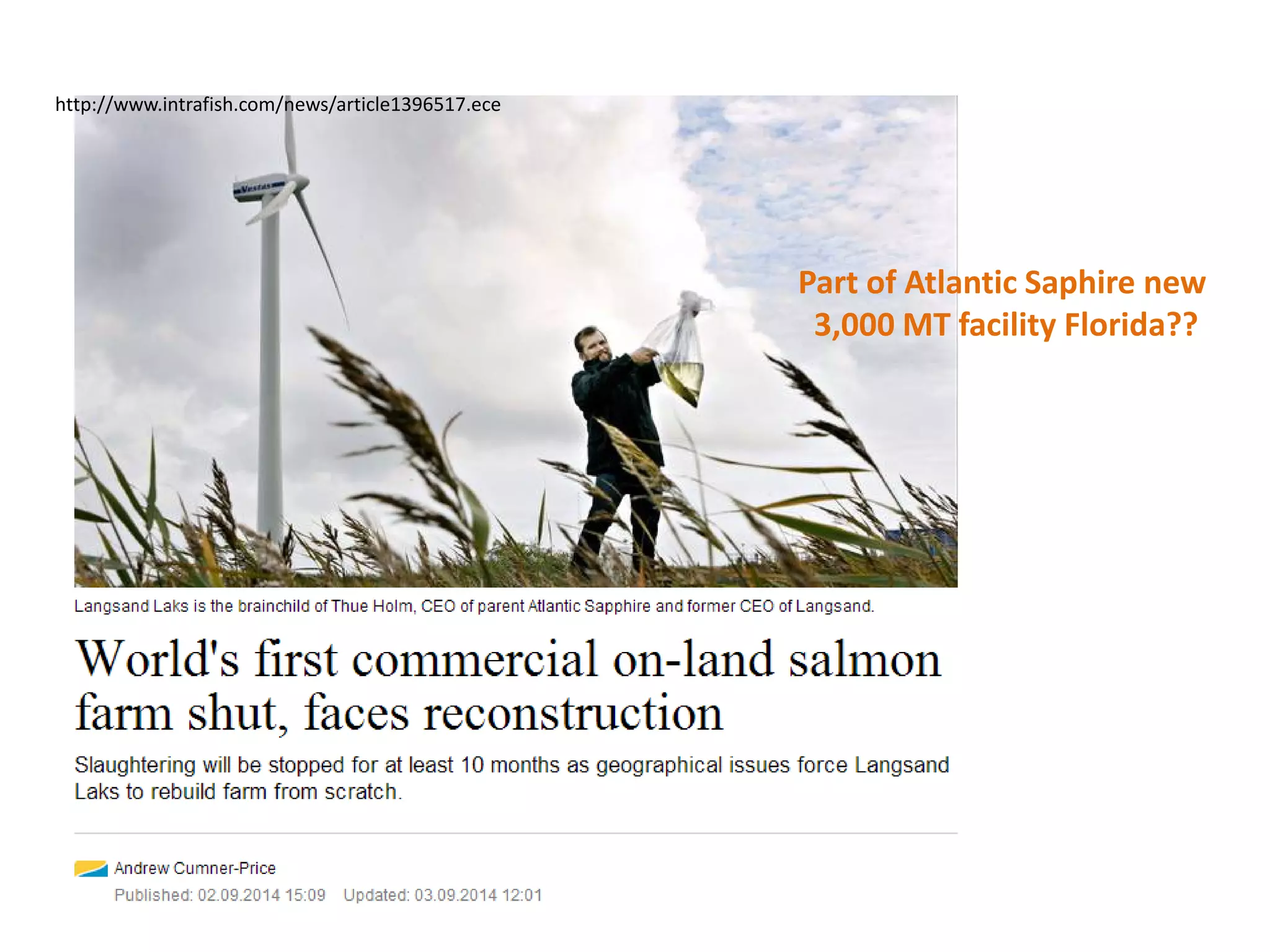
“Premium” on-land
salmon
http://www.intrafish.com/news/article1396517.ece
Part of Atlantic Saphire new
3,000 MT facility Florida??
RAS to Watch
• Barramundi (Iowa)
• Salmon
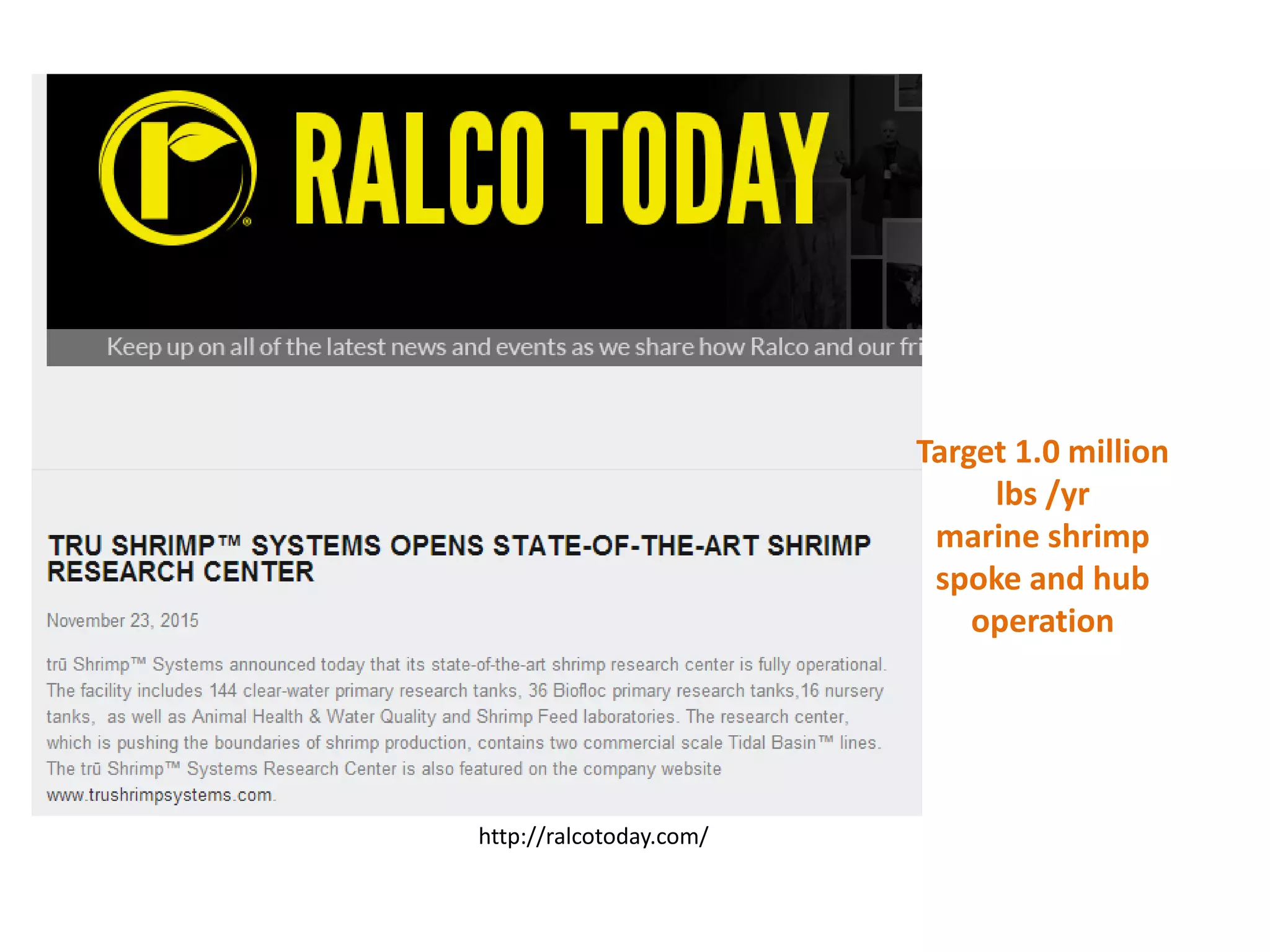
• Shrimp?
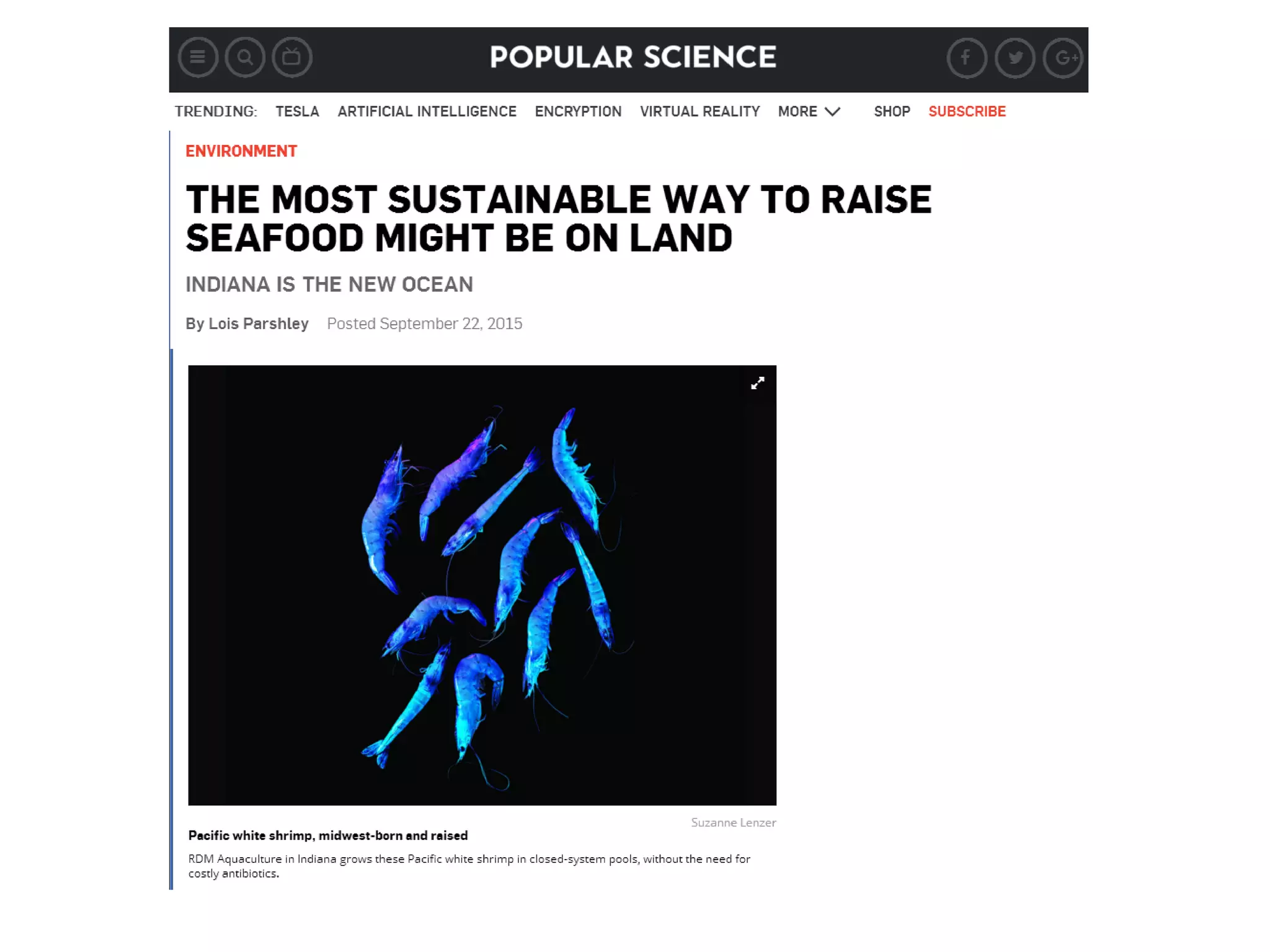
Darryl Brown of RDM Shrimp (IN). Photo : Purdue University
http://ralcotoday.com/
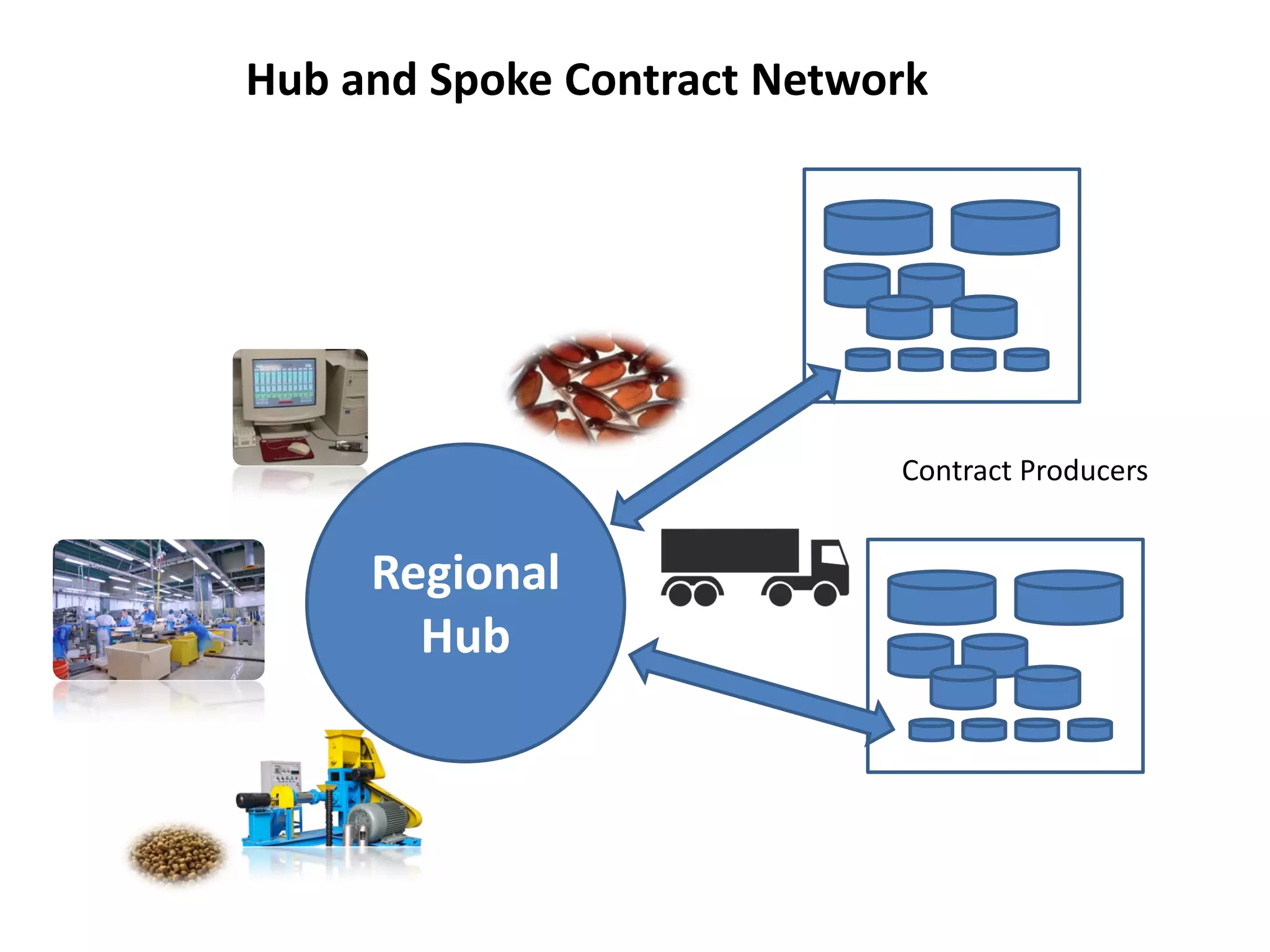
Target 1.0 million
lbs /yr
marine shrimp
spoke and hub
operation
Hub and Spoke Contract Network
Contract Producers
Regional
Hub
Why RAS needs serious discussion:
• US is falling behind in seafood production
• Higher failure rates
– Caused by economic viability
– High risk factor for aquaculture investment
• Controversial
– Perception vs reality?
• Short and long term sustainability issues

Recirculating Aquaculture Systems (RAS)

  • 1.
    Chris Weeks Aquaculture ExtensionSpecialist MSUE/NCRAC Recirculating Aquaculture Systems (RAS) 2016 Michigan Seafood Summit
  • 2.
  • 3.
  • 4.
    0.00 0.50 1.001.50 0 1,000 2,000 3,000 4,000 5,000 1998 2005 2013 Value ($ billion) # Farms US Aquaculture Farms Value 1.37 1.09 0.98 US Production
  • 5.
    Ounceequivalents 2015 USDA DietaryGuidelines for Americans 0.00 0.50 1.00 1.50 0 1,000 2,000 3,000 4,000 5,000 1998 2005 2013 Value ($ billion) # Farms US Aquaculture Farms Value
  • 6.
    “We’re not against aquaculture,just this particular kind of aquaculture… We already know how to do aquaculture in Michigan” “Recirculating aquaculture… is already being implemented in Michigan, raise mass amounts of fish… a practice.. well suited to vacant warehouses ”
  • 7.
    IN URBAN AREAS IT CANBE DONE SUSTAINABLY INDOORS AQUACULTURE IS IMPORTANT THROUGH RECIRCULATING AQUACULTURE SYSTEMS
  • 8.
  • 9.
    Anchorage Alaska DNRState Hatchery estimated $60-80 million
  • 10.
    US Aquaculture Problem? Productionof Seafood • Food • Water • Energy • Environment
  • 11.
    Business of Food •How do consumers see it? • Retailers?
  • 12.
    2014 Species Lbs 1 Shrimp4 2 Salmon 2.307 3 Canned Tuna 2.3 4 Tilapia 1.436 5 Pollock 0.981 6 Pangasius 0.69 7 Cod 0.657 8 Catfish 0.517 9 Crab 0.508 10 Clams 0.342 14.6Total All Species U.S. Per-Capita Consumption By Species in Pounds Data from National Marine Fisheries Service. Top Seafood Products Consumed in US
  • 13.
    Water Low High Cage, netpenfarming, flow through (fish, shellfish, seaweeds) 0 100 RAS (no/low water exchange -African catfish, eel) 400 500 Tilapia 2,800 Catfish (intensive ponds) 4,000 16,000 Fish (freshwater ponds) 4,700 7,800 Shrimp farming (ponds) 11,000 43,000 RAS (trout 90% recycling) 25,000 Estimated Freshwater Use (liters/kg product) Modified from Costa-Pierce et al. Responsible use of resources for sustainable aquaculture
  • 14.
    Energy • Colt etal. 2008 compared production of salmon smolts in RAS to traditional flow-through methods RAS 2.5 times electrical requirements
  • 15.
  • 16.
  • 17.
    kg CO2/kg Salmon (freshto US) 7.36 kg CO2/kg Salmon (frozen) 3.39 (fresh to US) 8.24 Model Land-based RAS to Norwegian Netpen Atlantic salmon 7.25 million lbs /yr Rosten et al. 2013 RAS Netpen CO2 Footprint
  • 18.
    US RAS -Status - Operational - Unknown - Failed Information sources: http://www.thebetterfish.com/barra-blog/so-you-want-to-be-a-fish-farmer http://www.ccb.se/wp-content/uploads/2015/11/Freshwater-Institute_Brian-Vinci_day1.pdf Weeks 2015 unpublished data from 2015 NCR survey to aquaculture extension personnel
  • 19.
    Blue Ridge Aquaculture Startedin 1993 Tilapia 4 million lbs /yr (~2,000 MT)
  • 20.
    Source: http://www.thebetterfish.com/ Started in2006 Species barramundi Target: 2 million lbs /yr (~1,000 MT) Australis, Turner Falls, MA
  • 21.
    Operational RAS inUS Company State Start Species Production Vero Blue IA 2011 Barramundi 600,000 Australis Aquaculture MA 2004 Barramundi 1,500,000 Hunting Creek Fisheries MD Goldfish, Koi Mt. Parnell Fisheries PA 1999 Goldfish, Koi Desert Springs AZ 2005 Tilapia 1,000,000 Colorado correctional CO Tilapia Tippco IN 2011 Tilapia 125,000 RDM Shrimp IN 2010 Marine shrimp Indiana RAS 1 IN Pond stocking Illinois 1 IL LMB Aqua Green LA 2006 Tilapia 500,000 Astor Farms NC 2009 Tilapia 400,000 Brock Farms NC 2001 Tilapia 150,000 Circle G Farms NC 2001 Tilapia 300,000 DPK NC 2001 Tilapia 300,000 Farmers Catch NC 2001 Tilapia 150,000 Southern Farm Tilapia 1 NC 1998 Tilapia 250,000 Sutton Farms NC 2001 Tilapia 300,000 Taylor Fish Farm NC 2009 Tilapia 250,000 Triple M aquaculture NC Tilapia Freshwater Farms OH Trout, Y. Perch 100,000 Ohio Tilapia 1 OH Tilapia CA sturgeon CA Sturgeon / caviar Blue Ridge Aquaculture VA 1993 Tilapia 4,000,000 4+ yrs operating
  • 22.
    Species Number MillionLbs Tilapia 14 7.7 Barramundi 2 2.1 Goldfish, Koi 2 Trout and Yellow Perch 1 0.1 Largemouth Bass 1 Marine Shrimp 1 Unknown 1 Sturgeon (caviar) 2 total 23 ~ 10 4+ yrs operating Operational RAS in US rough estimates are < 2% of total US production > 98% live ethnic / direct sale/ premium markets
  • 23.
    US RAS –closed / failures State Qty State Qty Al 1 MT 2 CA 3 NC 3 GA 1 ND 1 IA 2 NH 1 ID 1 NV 2 IL 7 NY 3 IN 3 OH 17 KY 1 PA 4 LA 2 TX 1 MA 3 VA 3 MD 2 WA 1 ME 1 WI 9 MI 5 WV 2 MN 4 total 85 ~ 80% failure rate to date (based on available information)
  • 24.
    1999-2013 • $4.5 millionfacility • Started 1999 • Co-op 308 farmers • Heat from beet sugar processing facility 30,000 lbs tilapia/wk to live ethnic markets
  • 25.
  • 26.
    RAS in theNCR survey to aquaculture Extension and Industry Number commercial RAS in state successfully operating for 5+ years 5 Number producing 100,000 lbs+ annually 2 Number failures you can recall in your state 43 Average 5 year success rate (%) 10
  • 27.
    Why the highfailure rate?  Economics – Poor planning • Unrealistic expectations • Business planning • Market analysis • Return on investment issues – Management and manageability • Complexity • Catastrophic failures
  • 28.
    Where does RASappear to be working? • Tilapia (live ethnic markets) • Hatchery systems for marine netpens
  • 29.
    13.5 million smoltsto 200-300 grams for netpen grow out
  • 30.
    Where does RASappear to be working? • Tilapia (live ethnic markets) • Hatchery systems for marine netpens • Barramundi (relatively new, mostly live markets) • Sturgeon (caviar) • Smaller scale DIRECT SALES?
  • 31.
    Smaller scale DIRECTSALES • Local farm markets and community supported agriculture (CSA’s) – CAN YOU COMPETE WITH THE TERRESTIAL CROP STAND /CSA CLOSE TO YOU? – IF NOT, WHY IS YOUR PRODUCT BETTER? • Live market – IS THERE A NEW MARKET WITHIN DESIRED RADIUS? – IS THERE ROOM FOR ADDITIONAL PRODUCT? • Premium fish markets – ARE THERE ENOUGH RESTAURANTS CLOSE BY THAT WOULD PAY MORE FOR A FRESH PRODUCT?
  • 32.
    RAS to Watch •Barramundi (Iowa) • Salmon
  • 33.
    Target 7.2 millionlbs /yr barramundi spoke and hub operation
  • 34.
    Poland 2016 startup $12Million Geothermal “Premium” on-land salmon
  • 35.
  • 38.
    RAS to Watch •Barramundi (Iowa) • Salmon • Shrimp?
  • 40.
    Darryl Brown ofRDM Shrimp (IN). Photo : Purdue University
  • 41.
    http://ralcotoday.com/ Target 1.0 million lbs/yr marine shrimp spoke and hub operation
  • 42.
    Hub and SpokeContract Network Contract Producers Regional Hub
  • 43.
    Why RAS needsserious discussion: • US is falling behind in seafood production • Higher failure rates – Caused by economic viability – High risk factor for aquaculture investment • Controversial – Perception vs reality? • Short and long term sustainability issues