Double Recirculation Aquaponics System
Sangita Aba Khatal
Roll No. 20642
Division of Agricultural Engineering,
Indian Agricultural Research Institute, New Delhi.
Population Soil degradation
Food security Water scarcity
Source – (Simon et al., 2015)
By 2050 global population is expected to reach 9.6
billion with more than 75% living in urban areas
Degraded land in lakh hectare
204.25 144.05
140.95
97.26
91.94
80.93
Total
geographical
area is 328.7
million hectare
Degraded
land area is
120.4 million
hectare
Source- Department of
Agriculture and Cooperation,
Ministry of Agriculture
By 2030 almost half of the world will live under
high water stress condition
(FAO, 2014)
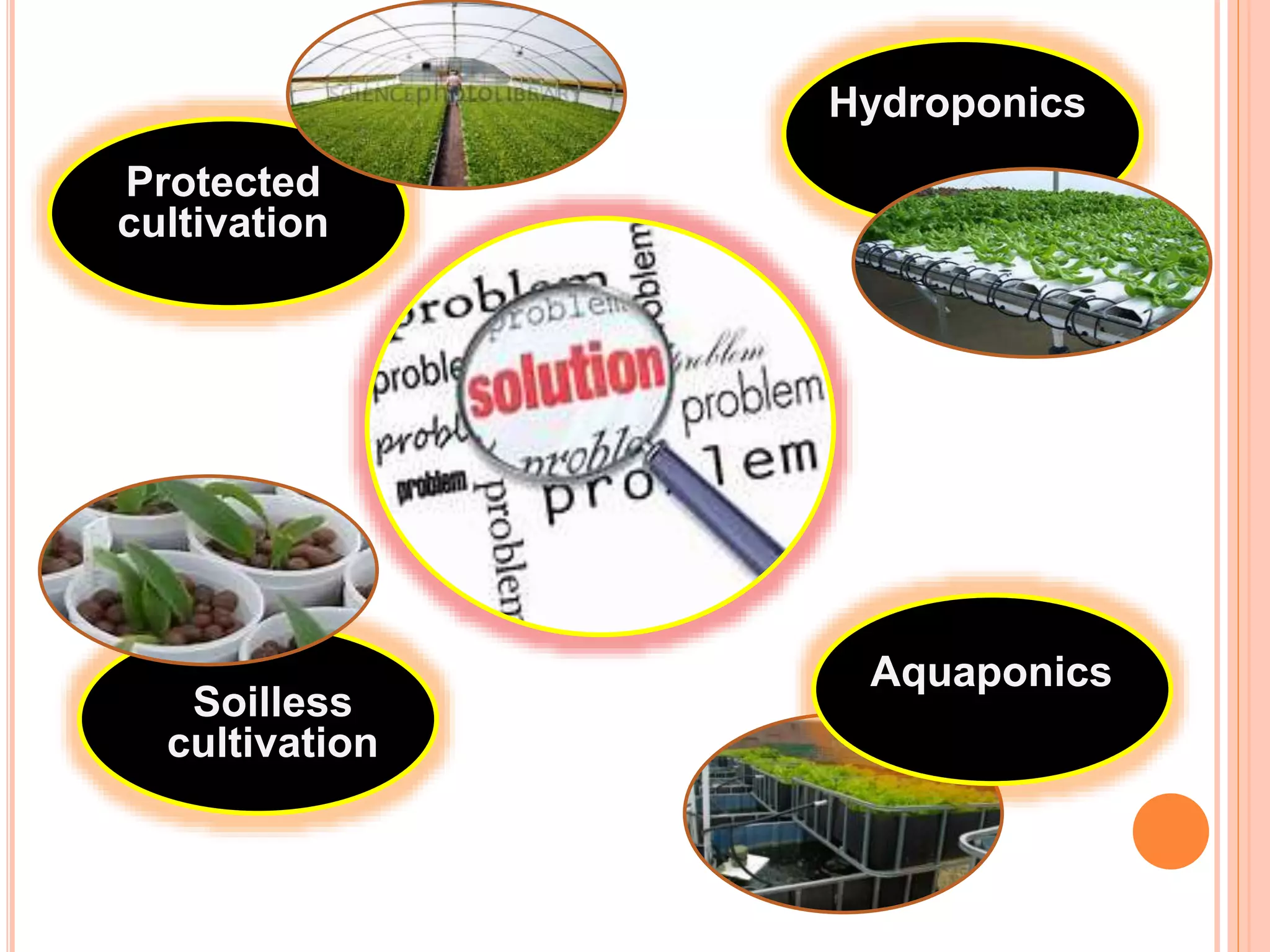
Protected
cultivation
Soilless
cultivation
Hydroponics
Aquaponics
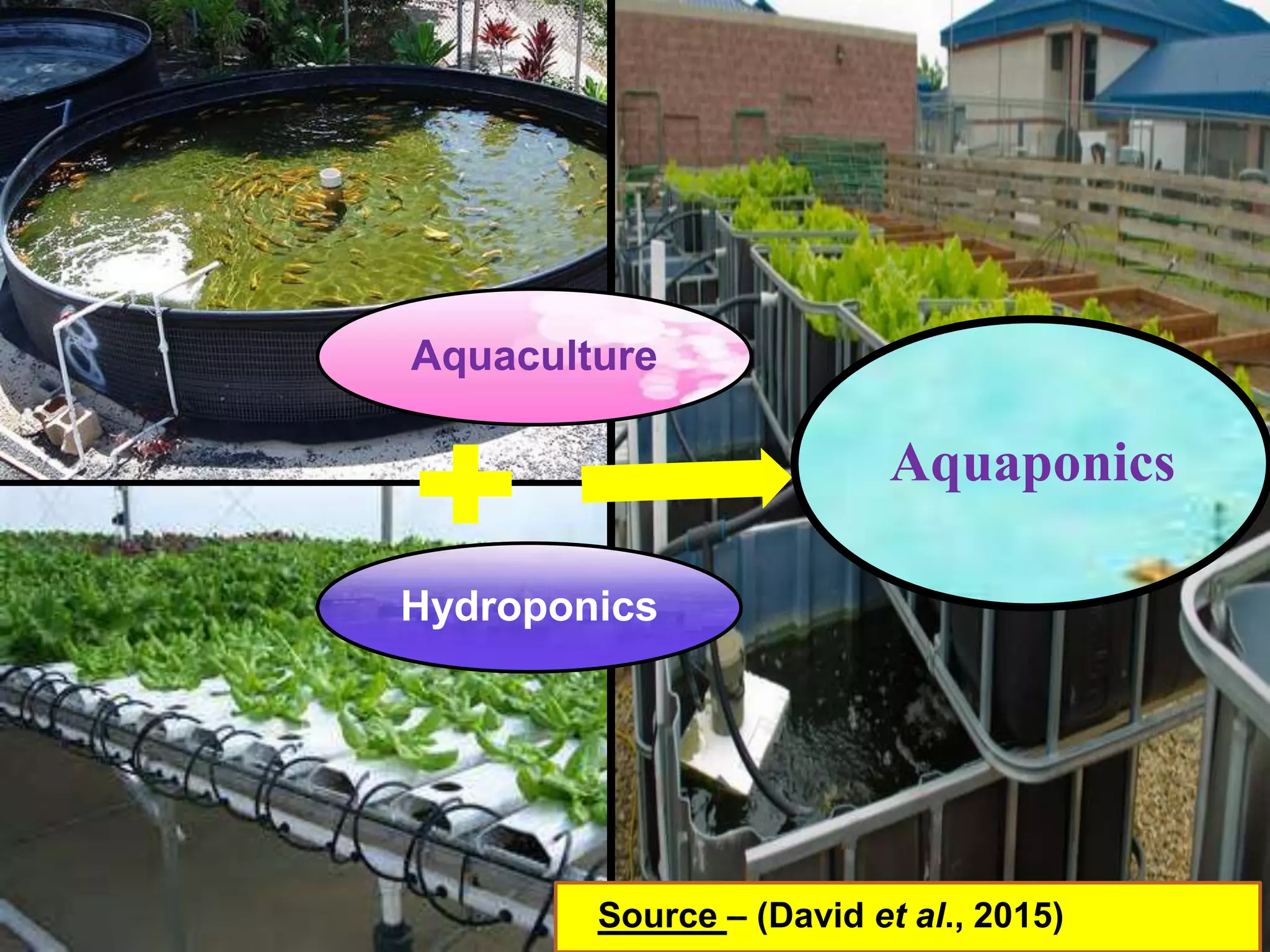
Aquaculture
Hydroponics
Aquaponics
Source – (David et al., 2015)
Indian scenario in aquaculture
Current fish production of India – 9.58 mtonnes
Second largest in fish production
Average annual growth – 5.96% (marine-3.67 and inland-7.29)
Contributes 0.83% to national GDP and 4.75% to agricultural
GDP
Source-The handbook of fisheries statistics, 2014
Current status of protected cultivation
Country Total Greenhouse Area (Ha)
China 27,60,000
Korea 57,444
Spain 52,170
Japan 49,049
Turkey 33,515
Italy 26,500
Mexico 11,759
Netherlands 10,370
France 9,620
United
States
8,425
Crop Area (mha)
1. Total Area under
Horticultural
Crops
19.24
2. Total area under
Vegetables
7.49
3.
4.
Area under
Floriculture Crops
Area under Fruit
Crops
0.15
5.5
5. Area under
Protected
Cultivation
<.02
India
Source –Kacira, (2011)
Kacira (2011)
Hydroponics
Growing plants
either on a
substrate or in
an aqueous
medium with
bare roots
Source - Food and Agriculture
Organization of United Nations, 2014
No soil-borne diseases and pathogens because of sterile
conditions
We can give optimal plant requirements leading to
increased yields
 Increased water- and fertilizer-use efficiency
 Area efficient technology
Why hydroponics ?
Captive rearing and production of fish and other aquatic
animal and plant species under controlled conditions
Methods:
open water systems
pond culture
flow-through raceways
 Recirculation Aquaculture System (RAS)
Aquaculture
Source – FAO,2014
Recirculating Aquaculture System (RAS)
The most efficient and
water-saving technology in
fish farming
Source – FAO,2014
Expensive waste -water treatment
It can lead to eutrophication and hypoxia
in the watershed and localized coastal
areas
Overgrowth of coral reefs and other
ecological and economical disturbances
Problems of RAS
Source – FAO,2014
An effluent from aquaculture system is a
sustainable, cost-effective and non-chemical source
of fertilizer for plants
 Organic food production
Sustainable agricultural practice
Why hydroponics should integrate with
aquaculture ?
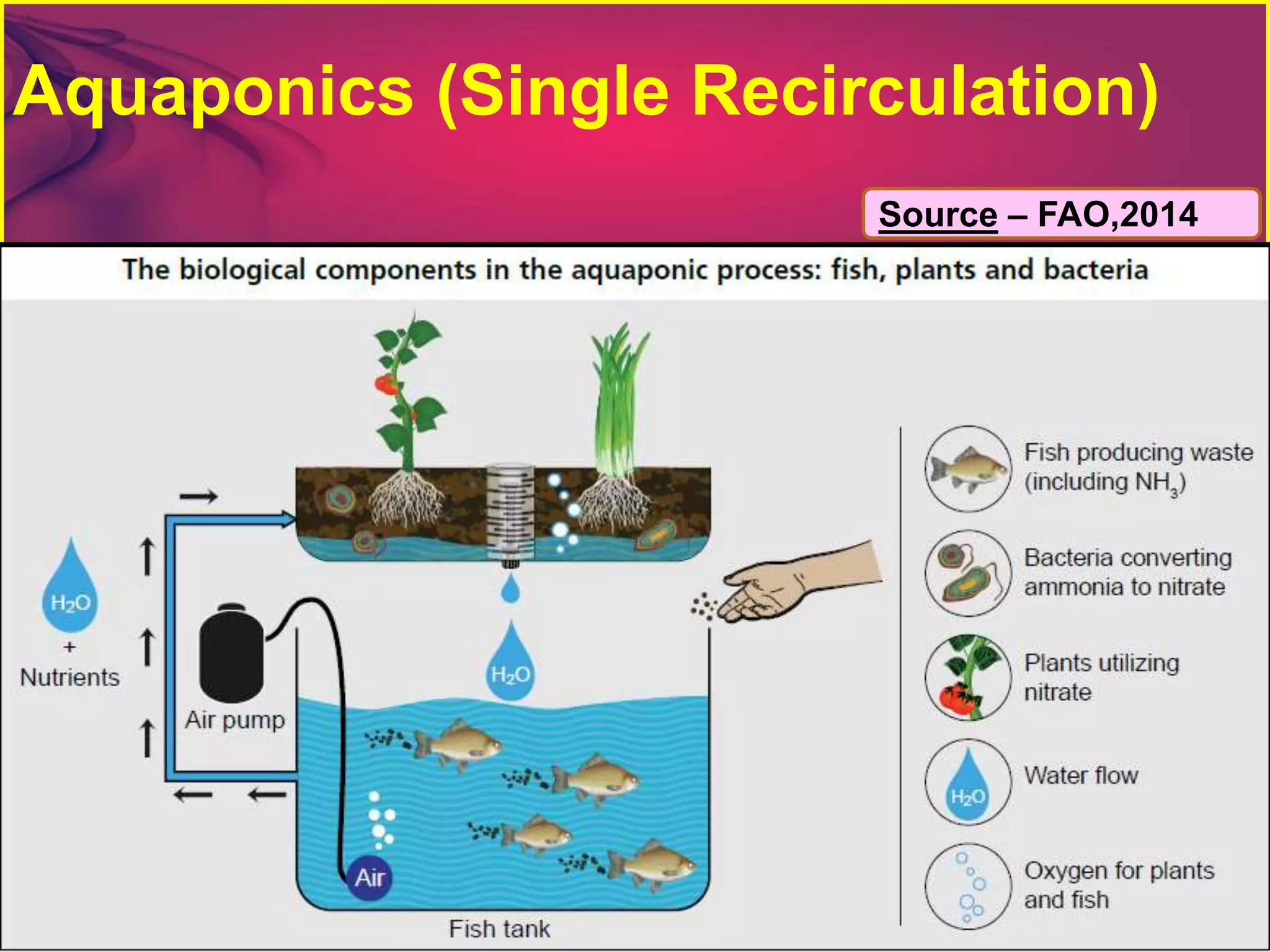
Aquaponics (Single Recirculation)
Source – FAO,2014
Source – FAO,2014
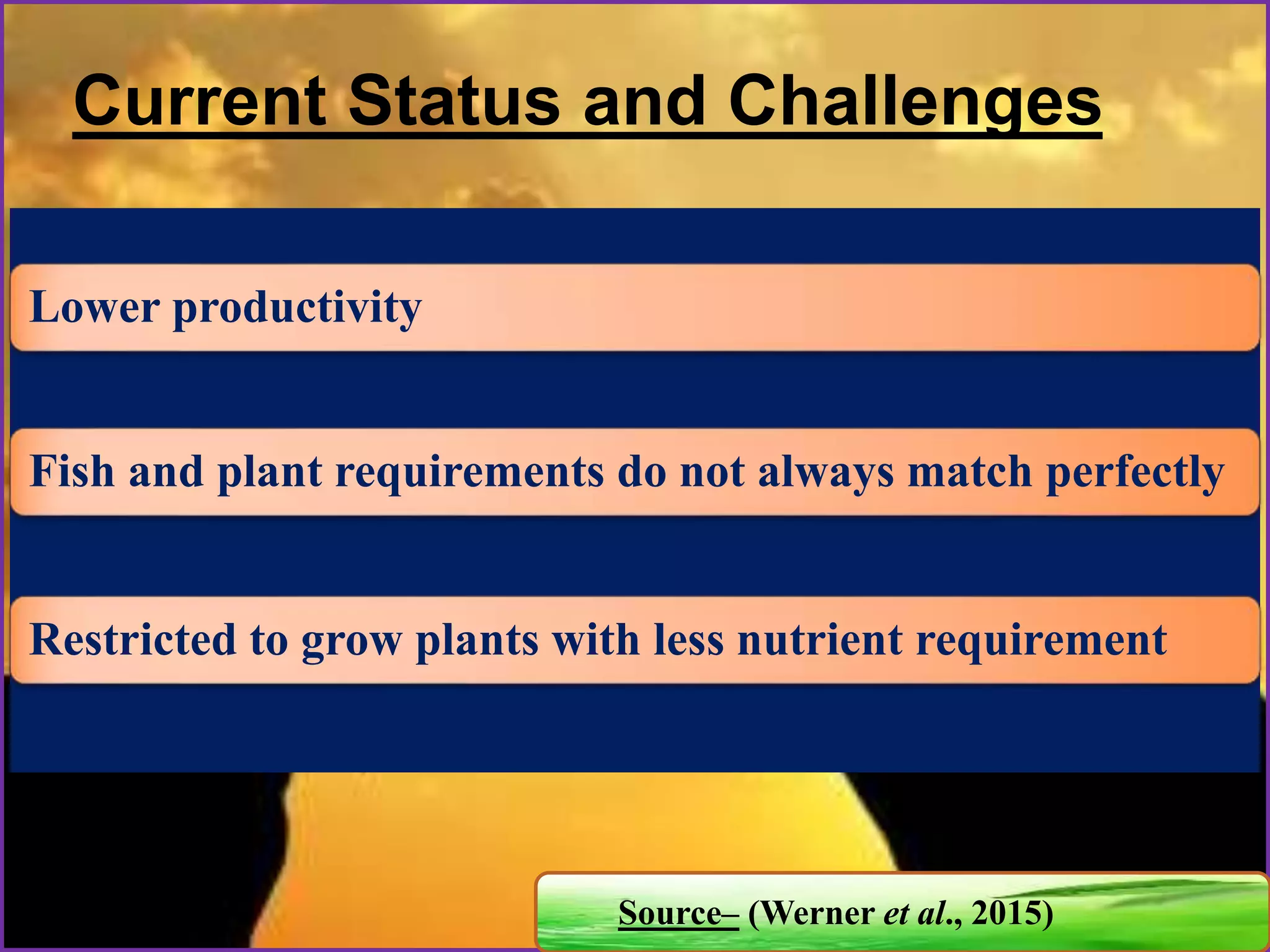
Current Status and Challenges
Lower productivity
Fish and plant requirements do not always match perfectly
Restricted to grow plants with less nutrient requirement
Source– (Werner et al., 2015)
Double Recirculation Aquaponic
System (DRAS)
Source – (Werner et al., 2015)
Material and methods
They selected combination of Nile tilapia fish and Tomato plant
Used 1280 tilapia with total weight of 202kg
Stocking density ranging from 32.5-65.1 kg/cu.m
116 tomato plants were introduced after 3 days latter
Used nutrient film technology of hydroponics
Whole testing duration lasted from 6 march to 26 november
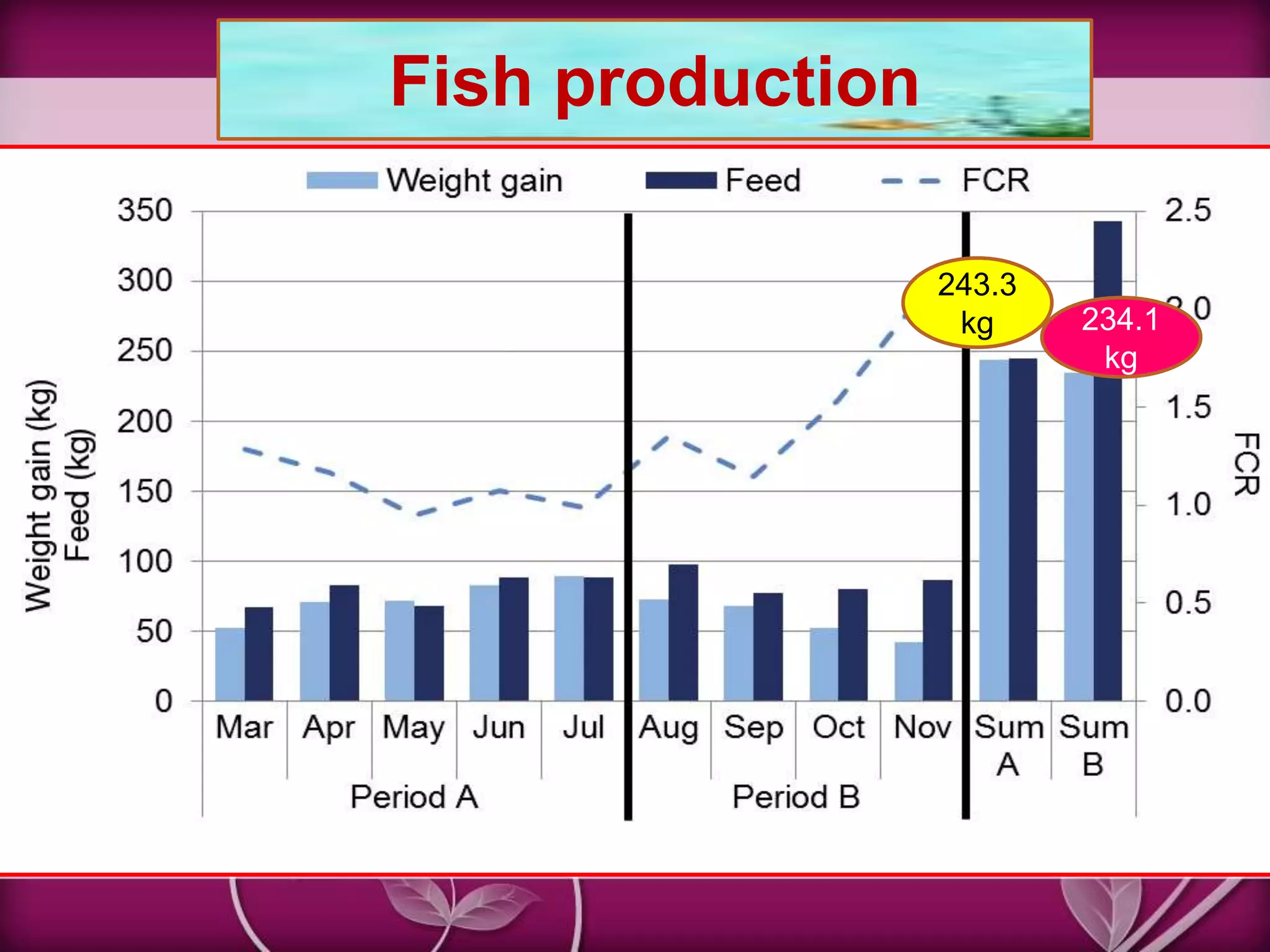
Fish production
243.3
kg 234.1
kg
Tomato production
Average tomato yield =8.89 kg/plant
1005.62 kg
Water use
220.6 l of water is used for 1 kg of Tilapia and 1.67 kg of
tomatoes
Total fresh water added = 132400 l (tap water = 94000 l and
condensate gained water=38400 l)
Daily water used = 3.83 % of the total volume
Thus the net introduction of tap water = 2.72 %
Cumulative water use is 34059 l
Daily water use is more in the month of june
Total nutrient load from RAS to hydroponic system = 25.66 kg
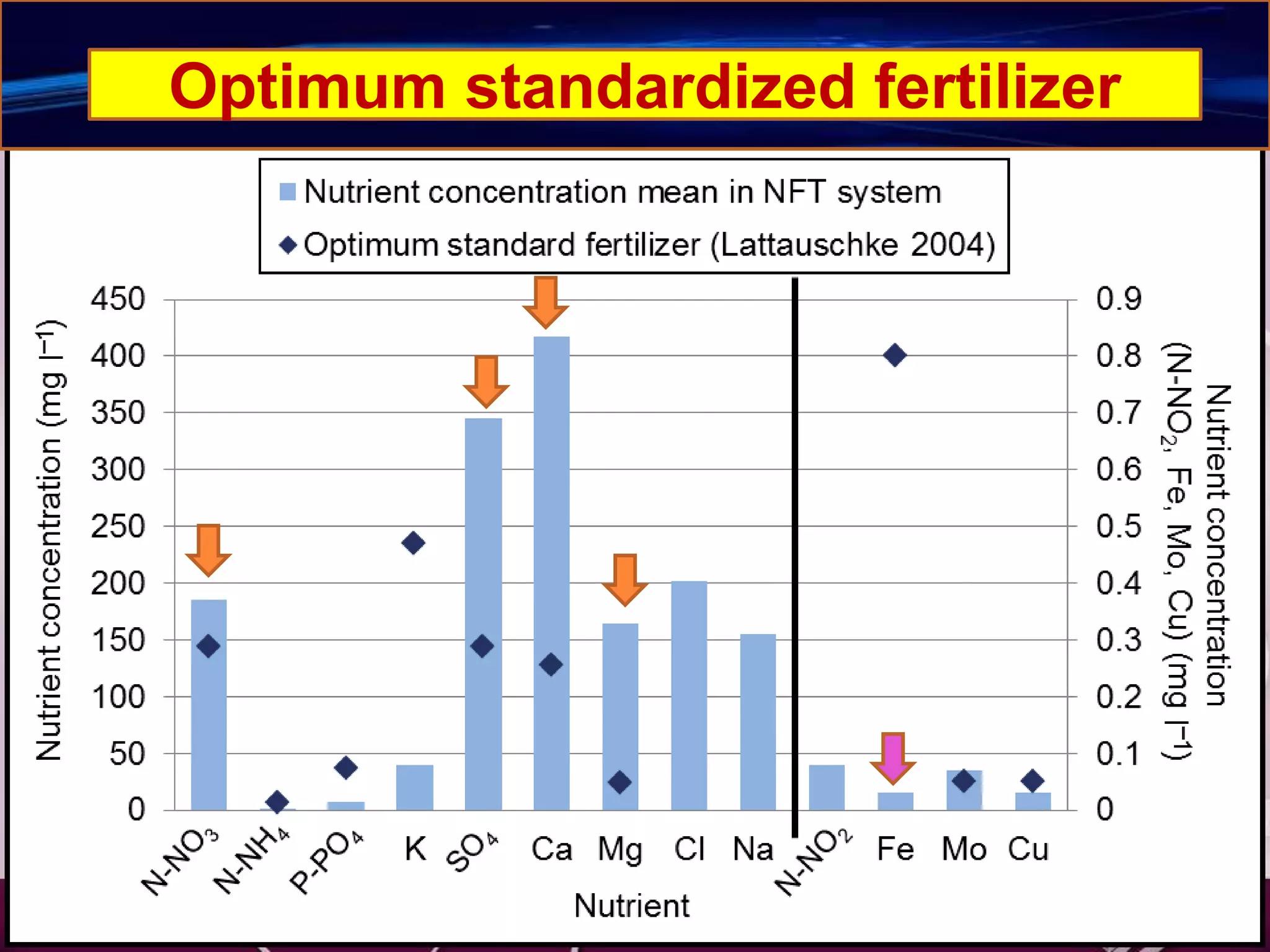
To optimize growth conditions some mineral fertilizers were
introduced to hydroponic unit
Fertilizer Quantity
(kg)
Kristalon Spezial 0.80
CalciNit 0.75
KHCO3 0.08
K2HPO4 2.80
Optimum standardized fertilizer
All the CO2 released by the metabolism of fish is fixed
by the tomato plants
Overall CO2 released = 778.4 kg
 Tomato plant can fix 1339 Kg CO2
 Net sink of 560.6 Kg CO2
Hence fostering sustainability
CO2 Balance
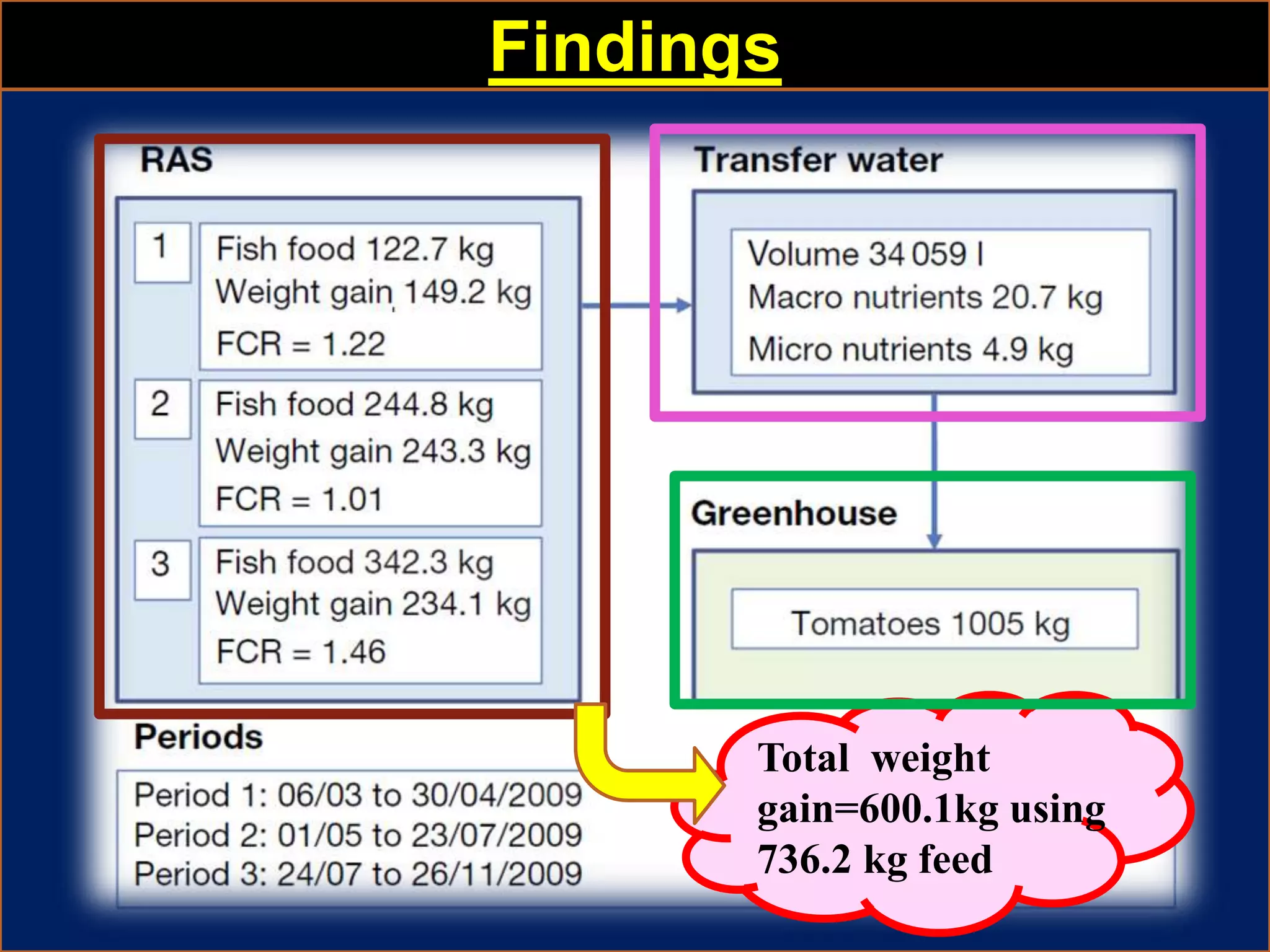
Findings
Total weight
gain=600.1kg using
736.2 kg feed
Benefits
Fish feed provides most of the nutrients for plant grow
Two agricultural products (fish and vegetables) are
produced from one nitrogen source (fish food)
Optimum use of fertilizers or chemical pesticides
Labour-saving
Area efficient technology
Sustainable and intensive food production system
Limitations
Expensive initial start-up.
 Knowledge of fish, bacteria and plant production is needed.
Mistakes or accidents can cause collapse of system.
 Daily management is mandatory.
Requires reliable access to electricity, fish seed and plant
seeds.
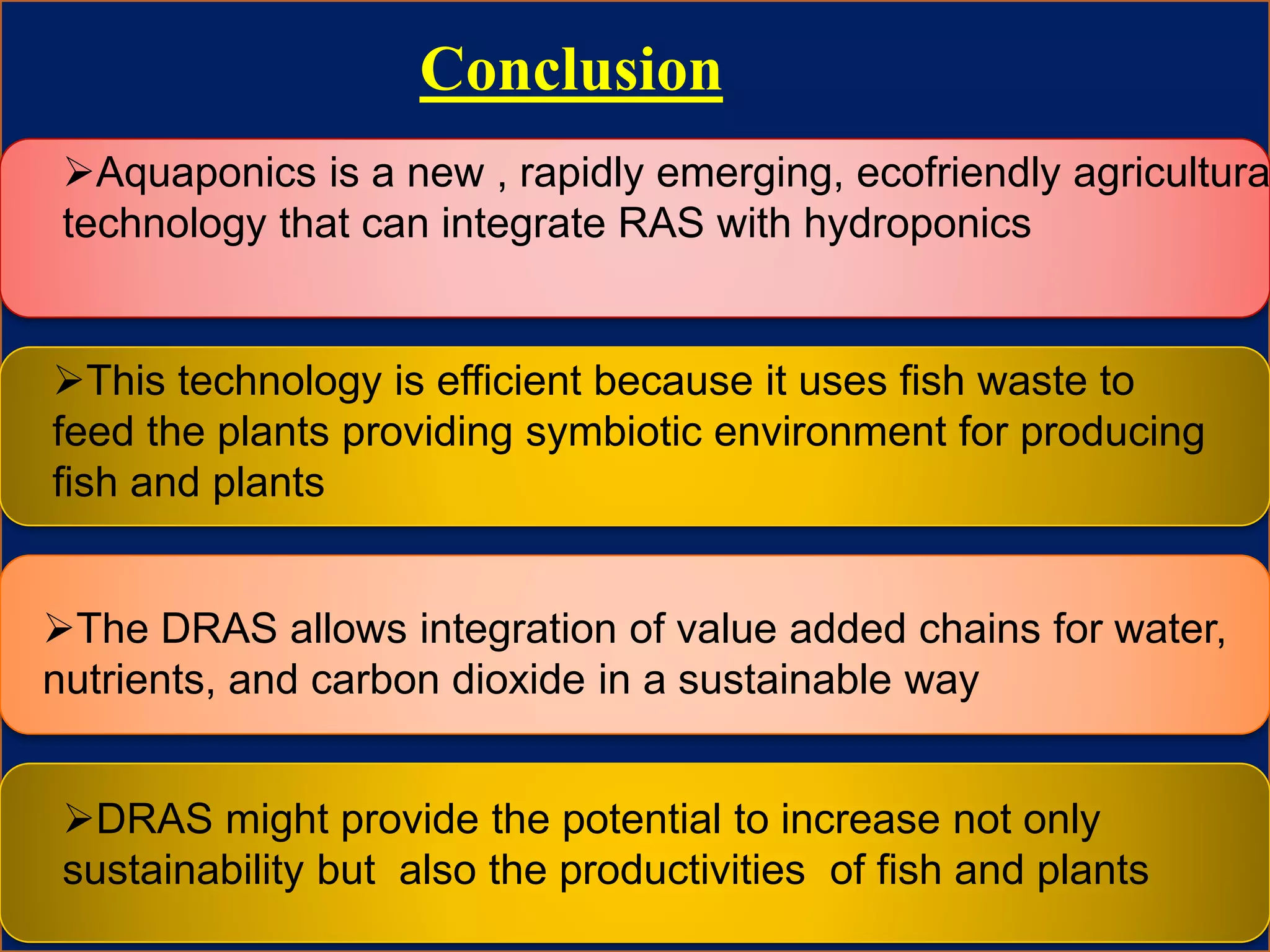
Conclusion
Aquaponics is a new , rapidly emerging, ecofriendly agricultura
technology that can integrate RAS with hydroponics
This technology is efficient because it uses fish waste to
feed the plants providing symbiotic environment for producing
fish and plants
The DRAS allows integration of value added chains for water,
nutrients, and carbon dioxide in a sustainable way
DRAS might provide the potential to increase not only
sustainability but also the productivities of fish and plants
Double recirculation aquaponics system

Double recirculation aquaponics system

  • 2.
    Double Recirculation AquaponicsSystem Sangita Aba Khatal Roll No. 20642 Division of Agricultural Engineering, Indian Agricultural Research Institute, New Delhi.
  • 3.
    Population Soil degradation Foodsecurity Water scarcity Source – (Simon et al., 2015) By 2050 global population is expected to reach 9.6 billion with more than 75% living in urban areas
  • 4.
    Degraded land inlakh hectare 204.25 144.05 140.95 97.26 91.94 80.93 Total geographical area is 328.7 million hectare Degraded land area is 120.4 million hectare Source- Department of Agriculture and Cooperation, Ministry of Agriculture By 2030 almost half of the world will live under high water stress condition (FAO, 2014)
  • 5.
  • 6.
  • 7.
    Indian scenario inaquaculture Current fish production of India – 9.58 mtonnes Second largest in fish production Average annual growth – 5.96% (marine-3.67 and inland-7.29) Contributes 0.83% to national GDP and 4.75% to agricultural GDP Source-The handbook of fisheries statistics, 2014
  • 8.
    Current status ofprotected cultivation Country Total Greenhouse Area (Ha) China 27,60,000 Korea 57,444 Spain 52,170 Japan 49,049 Turkey 33,515 Italy 26,500 Mexico 11,759 Netherlands 10,370 France 9,620 United States 8,425 Crop Area (mha) 1. Total Area under Horticultural Crops 19.24 2. Total area under Vegetables 7.49 3. 4. Area under Floriculture Crops Area under Fruit Crops 0.15 5.5 5. Area under Protected Cultivation <.02 India Source –Kacira, (2011) Kacira (2011)
  • 9.
    Hydroponics Growing plants either ona substrate or in an aqueous medium with bare roots Source - Food and Agriculture Organization of United Nations, 2014 No soil-borne diseases and pathogens because of sterile conditions We can give optimal plant requirements leading to increased yields  Increased water- and fertilizer-use efficiency  Area efficient technology Why hydroponics ?
  • 10.
    Captive rearing andproduction of fish and other aquatic animal and plant species under controlled conditions Methods: open water systems pond culture flow-through raceways  Recirculation Aquaculture System (RAS) Aquaculture Source – FAO,2014
  • 11.
    Recirculating Aquaculture System(RAS) The most efficient and water-saving technology in fish farming Source – FAO,2014
  • 12.
    Expensive waste -watertreatment It can lead to eutrophication and hypoxia in the watershed and localized coastal areas Overgrowth of coral reefs and other ecological and economical disturbances Problems of RAS Source – FAO,2014
  • 13.
    An effluent fromaquaculture system is a sustainable, cost-effective and non-chemical source of fertilizer for plants  Organic food production Sustainable agricultural practice Why hydroponics should integrate with aquaculture ?
  • 14.
  • 15.
  • 16.
    Current Status andChallenges Lower productivity Fish and plant requirements do not always match perfectly Restricted to grow plants with less nutrient requirement Source– (Werner et al., 2015)
  • 17.
    Double Recirculation Aquaponic System(DRAS) Source – (Werner et al., 2015)
  • 18.
    Material and methods Theyselected combination of Nile tilapia fish and Tomato plant Used 1280 tilapia with total weight of 202kg Stocking density ranging from 32.5-65.1 kg/cu.m 116 tomato plants were introduced after 3 days latter Used nutrient film technology of hydroponics Whole testing duration lasted from 6 march to 26 november
  • 19.
  • 20.
    Tomato production Average tomatoyield =8.89 kg/plant 1005.62 kg
  • 21.
    Water use 220.6 lof water is used for 1 kg of Tilapia and 1.67 kg of tomatoes Total fresh water added = 132400 l (tap water = 94000 l and condensate gained water=38400 l) Daily water used = 3.83 % of the total volume Thus the net introduction of tap water = 2.72 % Cumulative water use is 34059 l Daily water use is more in the month of june
  • 22.
    Total nutrient loadfrom RAS to hydroponic system = 25.66 kg To optimize growth conditions some mineral fertilizers were introduced to hydroponic unit Fertilizer Quantity (kg) Kristalon Spezial 0.80 CalciNit 0.75 KHCO3 0.08 K2HPO4 2.80
  • 23.
  • 24.
    All the CO2released by the metabolism of fish is fixed by the tomato plants Overall CO2 released = 778.4 kg  Tomato plant can fix 1339 Kg CO2  Net sink of 560.6 Kg CO2 Hence fostering sustainability CO2 Balance
  • 25.
  • 26.
    Benefits Fish feed providesmost of the nutrients for plant grow Two agricultural products (fish and vegetables) are produced from one nitrogen source (fish food) Optimum use of fertilizers or chemical pesticides Labour-saving Area efficient technology Sustainable and intensive food production system
  • 27.
    Limitations Expensive initial start-up. Knowledge of fish, bacteria and plant production is needed. Mistakes or accidents can cause collapse of system.  Daily management is mandatory. Requires reliable access to electricity, fish seed and plant seeds.
  • 28.
    Conclusion Aquaponics is anew , rapidly emerging, ecofriendly agricultura technology that can integrate RAS with hydroponics This technology is efficient because it uses fish waste to feed the plants providing symbiotic environment for producing fish and plants The DRAS allows integration of value added chains for water, nutrients, and carbon dioxide in a sustainable way DRAS might provide the potential to increase not only sustainability but also the productivities of fish and plants