MS. NIRUPAMA MAHANTA, FOOD SCIENCE AND NUTRITION
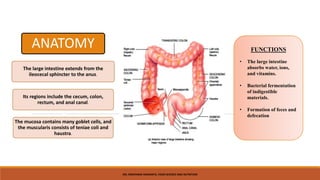
ANATOMY
The large intestine extends from the
ileocecal sphincter to the anus.
Its regions include the cecum, colon,
rectum, and anal canal.
The mucosa contains many goblet cells, and
the muscularis consists of teniae coli and
haustra.
FUNCTIONS
• The large intestine
absorbs water, ions,
and vitamins.
• Bacterial fermentation
of indigestible
materials.
• Formation of feces and
defecation
MS. NIRUPAMA MAHANTA, FOOD SCIENCE AND NUTRITION
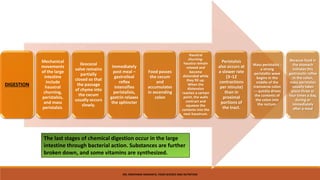
DIGESTION
Mechanical
movements
of the large
intestine
include
haustral
churning,
peristalsis,
and mass
peristalsis.
Ileocecal
valve remains
partially
closed so that
the passage
of chyme into
the cecum
usually occurs
slowly.
Immediately
post meal –
gastroileal
reflex
intensifies
peristalisis,
gastrin relaxes
the sphincter
Food passes
the cecum
and
accumulates
in ascending
colon
Haustral
churning-
haustra remain
relaxed and
become
distended while
they fill up.
When the
distension
reaches a certain
point, the walls
contract and
squeeze the
contents into the
next haustrum.
Peristalsis
also occurs at
a slower rate
(3–12
contractions
per minute)
than in
proximal
portions of
the tract.
Mass peristalsis -
a strong
peristaltic wave
begins in the
middle of the
transverse colon
--- quickly drives
the contents of
the colon into
the rectum.
Because food in
the stomach
initiates this
gastrocolic reflex
in the colon,
mass peristalsis
usually takes
place three or
four times a day,
during or
immediately
after a meal
The last stages of chemical digestion occur in the large
intestine through bacterial action. Substances are further
broken down, and some vitamins are synthesized.
MS. NIRUPAMA MAHANTA, FOOD SCIENCE AND NUTRITION
• Bacteria ferments any remaining carbohydrates and release H,
CO2 and CH4 gases which contributes to flatulence when in
excess.
• It also converts the remaining proteins to a.a and break down
the a.a into simpler substances like indole, skatole, hygrogen
sulphide and fatty acid.
• Also decompose bilirubin to simpler pigments including
stercobilin which give faeces their brown colour.
• Bacterial products that are absorbed in the colon includes B
vitamins and vitamin K.
• Defecation is a reflex action aided by voluntary contractions
of the diaphragm and abdominal muscles and relaxation of the
external anal sphincter.
ROLE OF
BACTERIA
MS. NIRUPAMA MAHANTA, FOOD SCIENCE AND NUTRITION
ULCERATIVE COLITIS CROHN’S DISEASE CONSTIPATION
SYMPTOMS
Bloating, cramping, Nausea,
Vomiting, severe diarrhoea, Bloody
stool, abdominal pain, weight loss,
fatigue.
Bloating, cramping, Nausea,
Vomiting, severe diarrhoea, Bloody
stool, abdominal pain, weight loss,
fatigue, higher likelihood of fistulae.
Passage of firm or hard pellet
like stools at infrequent and
long intervals with difficulty to
expel.
DIAGNOSIS
Ulcer formation on interior wall of
large intestine are visible via
colonoscopy. Biopsy will also show
signs of disease.
Attacks the interior wall & inner
layers of the intestinal wall.
Ulceration is less likely, but intestine
will show inflammation. Biopsy will
show signs of disease.
Medical history, physical
examination, Blood tests, x ray,
colonoscopy.
CAUSES
Autoimmune system of the body
attacks the gut, causing
inflammation & ulcers on interior
wall of large intestine. Genetics,
bacterial infection or overuse of
antibiotics may also play a part.
Autoimmune system of the body
attacks the gut, causing deep
inflammation in the large intestine
and possibly small intestine.
Genetics, bacterial infection and/or
overuse of antibiotics may also play a
part.
Lifestyle and diet, lack of fiber
or fluid intake, lack of exercise,
metabolic and endocrine
abnormalities like diabetes,
pelvic floor disorders like
pregnancy, GI disorders.
COMMON
TREATMENTS
Diet, antibiotics, anti-
inflammatories, corticosteroids,
immunosuppressive drugs, surgery
Diet, antibiotics, anti-inflammatories,
corticosteroids, immunosuppressive
drugs, surgery
Diet, exercise, laxatives,
enemas etc
MS. NIRUPAMA MAHANTA, FOOD SCIENCE AND NUTRITION
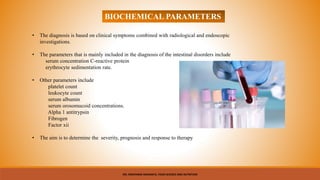
BIOCHEMICAL PARAMETERS
• The diagnosis is based on clinical symptoms combined with radiological and endoscopic
investigations.
• The parameters that is mainly included in the diagnosis of the intestinal disorders include
serum concentration C-reactive protein
erythrocyte sedimentation rate.
• Other parameters include
platelet count
leukocyte count
serum albumin
serum orosomucoid concentrations.
Alpha 1 antitrypsin
Fibrogen
Factor xii
• The aim is to determine the severity, prognosis and response to therapy
MS. NIRUPAMA MAHANTA, FOOD SCIENCE AND NUTRITION
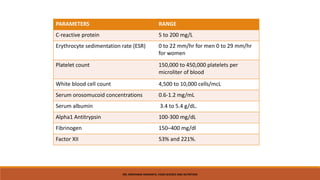
PARAMETERS RANGE
C-reactive protein 5 to 200 mg/L
Erythrocyte sedimentation rate (ESR) 0 to 22 mm/hr for men 0 to 29 mm/hr
for women
Platelet count 150,000 to 450,000 platelets per
microliter of blood
White blood cell count 4,500 to 10,000 cells/mcL
Serum orosomucoid concentrations 0.6-1.2 mg/mL
Serum albumin 3.4 to 5.4 g/dL.
Alpha1 Antitrypsin 100-300 mg/dL
Fibrinogen 150–400 mg/dl
Factor XII 53% and 221%.
MS. NIRUPAMA MAHANTA, FOOD SCIENCE AND NUTRITION
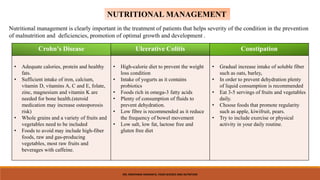
NUTRITIONAL MANAGEMENT
Nutritional management is clearly important in the treatment of patients that helps severity of the condition in the prevention
of malnutrition and deficiencies, promotion of optimal growth and development .
Crohn’s Disease Ulcerative Colitis Constipation
• Adequate calories, protein and healthy
fats.
• Sufficient intake of iron, calcium,
vitamin D, vitamins A, C and E, folate,
zinc, magnesium and vitamin K are
needed for bone health.(steroid
medication may increase osteoporosis
risk)
• Whole grains and a variety of fruits and
vegetables need to be included
• Foods to avoid may include high-fiber
foods, raw and gas-producing
vegetables, most raw fruits and
beverages with caffeine.
• High-calorie diet to prevent the weight
loss condition
• Intake of yogurts as it contains
probiotics
• Foods rich in omega-3 fatty acids
• Plenty of consumption of fluids to
prevent dehydration.
• Low fibre is recommended as it reduce
the frequency of bowel movement
• Low salt, low fat, lactose free and
gluten free diet
• Gradual increase intake of soluble fiber
such as oats, barley,
• In order to prevent dehydration plenty
of liquid consumption is recommended
• Eat 3-5 servings of fruits and vegetables
daily.
• Choose foods that promote regularity
such as apple, kiwifruit, pears.
• Try to include exercise or physical
activity in your daily routine.
MS. NIRUPAMA MAHANTA, FOOD SCIENCE AND NUTRITION
http://www.dieteticpocketguide.com/case-study-crohns-disease/
Treatment plan
Diet: Energy and protein enriched and low(er) fat diet
Supplementation: start retinol 25.000-50.000 IE/d for
short period and colecalciferol 25.000-50.000 IE/wk
Medication: Start anti diarrheal medication and
maximal dose bile salt binders
Treatment goals
Weight gain of 1-2 kg/month until normal weight (83 kg) with a
positive energy balance
Energy goal including gaining weight and compensation for
malabsorption: 3000-3500 kcal/d.
Protein goal 1.5 g/kg/ actual bodyweight:110-115 g/d
Normalizing stools and GI complaints to acceptable and
manageable levels
MS. NIRUPAMA MAHANTA, FOOD SCIENCE AND NUTRITION

Large intestine

  • 1.
    MS. NIRUPAMA MAHANTA,FOOD SCIENCE AND NUTRITION
  • 2.
    ANATOMY The large intestineextends from the ileocecal sphincter to the anus. Its regions include the cecum, colon, rectum, and anal canal. The mucosa contains many goblet cells, and the muscularis consists of teniae coli and haustra. FUNCTIONS • The large intestine absorbs water, ions, and vitamins. • Bacterial fermentation of indigestible materials. • Formation of feces and defecation MS. NIRUPAMA MAHANTA, FOOD SCIENCE AND NUTRITION
  • 3.
    DIGESTION Mechanical movements of the large intestine include haustral churning, peristalsis, andmass peristalsis. Ileocecal valve remains partially closed so that the passage of chyme into the cecum usually occurs slowly. Immediately post meal – gastroileal reflex intensifies peristalisis, gastrin relaxes the sphincter Food passes the cecum and accumulates in ascending colon Haustral churning- haustra remain relaxed and become distended while they fill up. When the distension reaches a certain point, the walls contract and squeeze the contents into the next haustrum. Peristalsis also occurs at a slower rate (3–12 contractions per minute) than in proximal portions of the tract. Mass peristalsis - a strong peristaltic wave begins in the middle of the transverse colon --- quickly drives the contents of the colon into the rectum. Because food in the stomach initiates this gastrocolic reflex in the colon, mass peristalsis usually takes place three or four times a day, during or immediately after a meal The last stages of chemical digestion occur in the large intestine through bacterial action. Substances are further broken down, and some vitamins are synthesized. MS. NIRUPAMA MAHANTA, FOOD SCIENCE AND NUTRITION
  • 4.
    • Bacteria fermentsany remaining carbohydrates and release H, CO2 and CH4 gases which contributes to flatulence when in excess. • It also converts the remaining proteins to a.a and break down the a.a into simpler substances like indole, skatole, hygrogen sulphide and fatty acid. • Also decompose bilirubin to simpler pigments including stercobilin which give faeces their brown colour. • Bacterial products that are absorbed in the colon includes B vitamins and vitamin K. • Defecation is a reflex action aided by voluntary contractions of the diaphragm and abdominal muscles and relaxation of the external anal sphincter. ROLE OF BACTERIA MS. NIRUPAMA MAHANTA, FOOD SCIENCE AND NUTRITION
  • 5.
    MS. NIRUPAMA MAHANTA,FOOD SCIENCE AND NUTRITION
  • 6.
    ULCERATIVE COLITIS CROHN’SDISEASE CONSTIPATION SYMPTOMS Bloating, cramping, Nausea, Vomiting, severe diarrhoea, Bloody stool, abdominal pain, weight loss, fatigue. Bloating, cramping, Nausea, Vomiting, severe diarrhoea, Bloody stool, abdominal pain, weight loss, fatigue, higher likelihood of fistulae. Passage of firm or hard pellet like stools at infrequent and long intervals with difficulty to expel. DIAGNOSIS Ulcer formation on interior wall of large intestine are visible via colonoscopy. Biopsy will also show signs of disease. Attacks the interior wall & inner layers of the intestinal wall. Ulceration is less likely, but intestine will show inflammation. Biopsy will show signs of disease. Medical history, physical examination, Blood tests, x ray, colonoscopy. CAUSES Autoimmune system of the body attacks the gut, causing inflammation & ulcers on interior wall of large intestine. Genetics, bacterial infection or overuse of antibiotics may also play a part. Autoimmune system of the body attacks the gut, causing deep inflammation in the large intestine and possibly small intestine. Genetics, bacterial infection and/or overuse of antibiotics may also play a part. Lifestyle and diet, lack of fiber or fluid intake, lack of exercise, metabolic and endocrine abnormalities like diabetes, pelvic floor disorders like pregnancy, GI disorders. COMMON TREATMENTS Diet, antibiotics, anti- inflammatories, corticosteroids, immunosuppressive drugs, surgery Diet, antibiotics, anti-inflammatories, corticosteroids, immunosuppressive drugs, surgery Diet, exercise, laxatives, enemas etc MS. NIRUPAMA MAHANTA, FOOD SCIENCE AND NUTRITION
  • 7.
    BIOCHEMICAL PARAMETERS • Thediagnosis is based on clinical symptoms combined with radiological and endoscopic investigations. • The parameters that is mainly included in the diagnosis of the intestinal disorders include serum concentration C-reactive protein erythrocyte sedimentation rate. • Other parameters include platelet count leukocyte count serum albumin serum orosomucoid concentrations. Alpha 1 antitrypsin Fibrogen Factor xii • The aim is to determine the severity, prognosis and response to therapy MS. NIRUPAMA MAHANTA, FOOD SCIENCE AND NUTRITION
  • 8.
    PARAMETERS RANGE C-reactive protein5 to 200 mg/L Erythrocyte sedimentation rate (ESR) 0 to 22 mm/hr for men 0 to 29 mm/hr for women Platelet count 150,000 to 450,000 platelets per microliter of blood White blood cell count 4,500 to 10,000 cells/mcL Serum orosomucoid concentrations 0.6-1.2 mg/mL Serum albumin 3.4 to 5.4 g/dL. Alpha1 Antitrypsin 100-300 mg/dL Fibrinogen 150–400 mg/dl Factor XII 53% and 221%. MS. NIRUPAMA MAHANTA, FOOD SCIENCE AND NUTRITION
  • 9.
    NUTRITIONAL MANAGEMENT Nutritional managementis clearly important in the treatment of patients that helps severity of the condition in the prevention of malnutrition and deficiencies, promotion of optimal growth and development . Crohn’s Disease Ulcerative Colitis Constipation • Adequate calories, protein and healthy fats. • Sufficient intake of iron, calcium, vitamin D, vitamins A, C and E, folate, zinc, magnesium and vitamin K are needed for bone health.(steroid medication may increase osteoporosis risk) • Whole grains and a variety of fruits and vegetables need to be included • Foods to avoid may include high-fiber foods, raw and gas-producing vegetables, most raw fruits and beverages with caffeine. • High-calorie diet to prevent the weight loss condition • Intake of yogurts as it contains probiotics • Foods rich in omega-3 fatty acids • Plenty of consumption of fluids to prevent dehydration. • Low fibre is recommended as it reduce the frequency of bowel movement • Low salt, low fat, lactose free and gluten free diet • Gradual increase intake of soluble fiber such as oats, barley, • In order to prevent dehydration plenty of liquid consumption is recommended • Eat 3-5 servings of fruits and vegetables daily. • Choose foods that promote regularity such as apple, kiwifruit, pears. • Try to include exercise or physical activity in your daily routine. MS. NIRUPAMA MAHANTA, FOOD SCIENCE AND NUTRITION
  • 10.
    http://www.dieteticpocketguide.com/case-study-crohns-disease/ Treatment plan Diet: Energyand protein enriched and low(er) fat diet Supplementation: start retinol 25.000-50.000 IE/d for short period and colecalciferol 25.000-50.000 IE/wk Medication: Start anti diarrheal medication and maximal dose bile salt binders Treatment goals Weight gain of 1-2 kg/month until normal weight (83 kg) with a positive energy balance Energy goal including gaining weight and compensation for malabsorption: 3000-3500 kcal/d. Protein goal 1.5 g/kg/ actual bodyweight:110-115 g/d Normalizing stools and GI complaints to acceptable and manageable levels MS. NIRUPAMA MAHANTA, FOOD SCIENCE AND NUTRITION
  • 11.
    MS. NIRUPAMA MAHANTA,FOOD SCIENCE AND NUTRITION