ARTIFICIAL
SWEETENERS- YES
OR NO?
Ms. NIRUPAMA MAHANTA
M19FN11
MOUNT CARMEL COLLEGE, Bangalore
DEPT OF FOOD SCIENCE AND NUTRITION
WHATARE ARTFICIAL SWEETENERS?
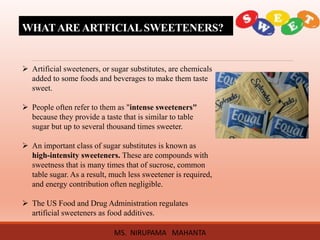
 Artificial sweeteners, or sugar substitutes, are chemicals
added to some foods and beverages to make them taste
sweet.
 People often refer to them as "intense sweeteners"
because they provide a taste that is similar to table
sugar but up to several thousand times sweeter.
 An important class of sugar substitutes is known as
high-intensity sweeteners. These are compounds with
sweetness that is many times that of sucrose, common
table sugar. As a result, much less sweetener is required,
and energy contribution often negligible.
 The US Food and Drug Administration regulates
artificial sweeteners as food additives.
MS. NIRUPAMA MAHANTA
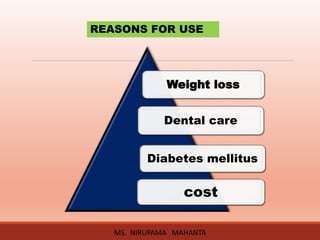
Weight loss
Dental care
Diabetes mellitus
cost
REASONS FOR USE
MS. NIRUPAMA MAHANTA
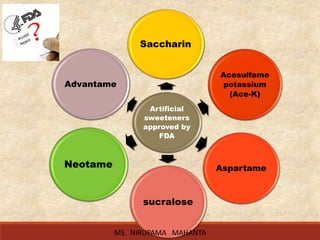
Artificial
sweeteners
approved by
FDA
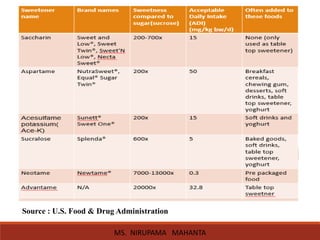
Saccharin
Acesulfame
potassium
(Ace-K)
Aspartame
sucralose
Neotame
Advantame
MS. NIRUPAMA MAHANTA
Source : U.S. Food & Drug Administration
MS. NIRUPAMA MAHANTA
HEALTH EFFECTS
AND
ASSOCIATED
STUDIES
MS. NIRUPAMA MAHANTA
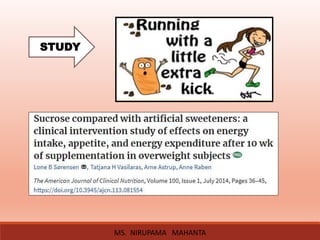
STUDY
MS. NIRUPAMA MAHANTA
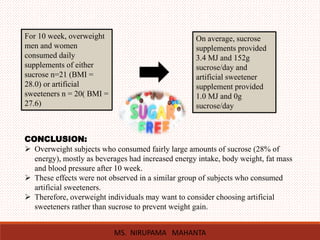
For 10 week, overweight
men and women
consumed daily
supplements of either
sucrose n=21 (BMI =
28.0) or artificial
sweeteners n = 20( BMI =
27.6)
On average, sucrose
supplements provided
3.4 MJ and 152g
sucrose/day and
artificial sweetener
supplement provided
1.0 MJ and 0g
sucrose/day
CONCLUSION:
 Overweight subjects who consumed fairly large amounts of sucrose (28% of
energy), mostly as beverages had increased energy intake, body weight, fat mass
and blood pressure after 10 week.
 These effects were not observed in a similar group of subjects who consumed
artificial sweeteners.
 Therefore, overweight individuals may want to consider choosing artificial
sweeteners rather than sucrose to prevent weight gain.
MS. NIRUPAMA MAHANTA
ASPARTAME MYTH
Aspartame is one of the most thoroughly studied food ingredients ever, with more than
200 scientific studies supporting its safety.
MYTH – weight gain
FACT - In numerous studies that compare diets with and without low-calorie sweeteners, results
consistently show that low-calorie sweeteners decrease calorie intake and promote weight loss.
The Position Paper of The Academy of Nutrition and Dietetics: Use of Nutritive and Nonnutritive
Sweeteners states, “Use of aspartame and aspartame-sweetened products as part of a
comprehensive weight loss or maintenance program by individuals may be associated with greater
weight loss and may assist individuals with weight maintenance over time.”
MS. NIRUPAMA MAHANTA
MYTH – Blood and brain cancer
FACT - Studies in humans find do not support
the myth that aspartame causes cancer
including one that concluded “findings do not
support the hypothesis that aspartame increases
hematopoietic or brain cancer risk.”
Another review of nearly 50 studies looking at
low-calorie sweeteners and cancer stated that
“despite some rather unscientific assumptions,
there is no evidence that aspartame is
carcinogenic.” The National Cancer
Institute states that low-calorie sweetener and
cancer studies have not provided clear evidence
of an association with cancer in humans. Based
on evaluations from the US Food and Drug
Administration and the European Food Safety
Authority, The American Cancer Society says
studies done so far have not found a link
between aspartame and cancer.
MS. NIRUPAMA MAHANTA
MYTH: Individuals with diabetes have to eliminate sweet foods and beverages,
including those sweetened with low-calorie sweeteners like aspartame, from their diet.
FACT: A 2013 paper published in US Endocrinology concluded, “Low-calorie
sweeteners can serve an important role in diabetes prevention and management.
Substituting sugars with low-calorie sweeteners provides patients with type 2 diabetes
considerable flexibility in their health goals and personal dietary preferences.”
According to the Joslin Diabetes Center, “The safety of aspartame has been well
established. The results of these scientific studies have shown that eating products
sweetened with aspartame is no different from eating other foods and is not associated
with adverse health effects.”
MS. NIRUPAMA MAHANTA
MYTH: While research does not support this claim, some think aspartame can
cause seizures in people with epilepsy.
FACT: In another study, adults and children given capsules with aspartame or a
placebo experienced no seizures or other adverse effects from consuming
aspartame.
(Aspartame and Seizure Susceptibility: Results of a Clinical Study in
Reportedly Sensitive Individuals, 1995)
MS. NIRUPAMA MAHANTA
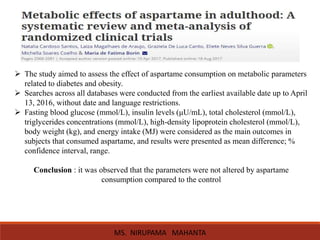
 The study aimed to assess the effect of aspartame consumption on metabolic parameters
related to diabetes and obesity.
 Searches across all databases were conducted from the earliest available date up to April
13, 2016, without date and language restrictions.
 Fasting blood glucose (mmol/L), insulin levels (μU/mL), total cholesterol (mmol/L),
triglycerides concentrations (mmol/L), high-density lipoprotein cholesterol (mmol/L),
body weight (kg), and energy intake (MJ) were considered as the main outcomes in
subjects that consumed aspartame, and results were presented as mean difference; %
confidence interval, range.
Conclusion : it was observed that the parameters were not altered by aspartame
consumption compared to the control
MS. NIRUPAMA MAHANTA
CONCLUSION:
 Artificial sweeteners have been linked to a long list of
serious health concerns such as cancer, strokes and high
blood pressure.
 But, according to the UK’s Food Standards Agency, the
European Food Safety Authority(EFSA), the NHS and
Cancer Research UK they are safe to consume.
 All sweeteners approved for use in the UK have passed
rigorous testing and were found not to be harmful to
humans.
MS. NIRUPAMA MAHANTA
REFERENCES:
1. Weihrauch M. Diehl V. (2004). Artificial sweeteners—do they bear a carcinogenic
risk?. Annals of Oncology.15(10).1460–1465. Retrieved from
https://academic.oup.com/annonc/article/15/10/1460/170200
2. B Sørensen, Tatjana H, Arne Astrup, Anne R. (2014). Sucrose compared with artificial
sweeteners: a clinical intervention study of effects on energy intake, appetite, and energy
expenditure after 10 wk of supplementation in overweight subjects. The American Journal of
Clinical Nutrition.100(1).36–45. Retrieved from
https://academic.oup.com/ajcn/article/100/1/36/4576621
3. Christopher Gardner, Judith Wylie-Rosett, Samuel S. (2012). Nonnutritive Sweeteners:
Current Use and Health Perspectives. Diabetes care. 35(8): 1798-1808. Retrieved from
https://care.diabetesjournals.org/content/35/8/1798
4. How Sweet It Is: All About Sugar Substitutes. (May 19,2014). U.S. Food & Drug
Administration. Retrieved from https://www.fda.gov/consumers/consumer-updates/how-
sweet-it-all-about-sugar-substitutes
5. High intensity sweeteners. (May 19,2014). U.S. Food & Drug Administration. Retrieved
from https://www.fda.gov/food/food-additives-petitions/high-intensity-sweeteners
MS. NIRUPAMA MAHANTA
6. Artificial sweetener debate: is it really bad for you?. (September 18, 2014). The week.
Retrieved from https://www.theweek.co.uk/health-science/60478/artificial-sweetener-
debate-is-it-really-bad-for-you
7. Additional Information about High-Intensity Sweeteners Permitted for Use in Food in the
United States. (February 8,2018). U.S. Food & Drug Administration. Retrieved from
https://www.fda.gov/food/food-additives-petitions/additional-information-about-high-
intensity-sweeteners-permitted-use-food-united-states
MS. NIRUPAMA MAHANTA

Artificial sweeteners - yes or no?

  • 1.
    ARTIFICIAL SWEETENERS- YES OR NO? Ms.NIRUPAMA MAHANTA M19FN11 MOUNT CARMEL COLLEGE, Bangalore DEPT OF FOOD SCIENCE AND NUTRITION
  • 2.
    WHATARE ARTFICIAL SWEETENERS? Artificial sweeteners, or sugar substitutes, are chemicals added to some foods and beverages to make them taste sweet.  People often refer to them as "intense sweeteners" because they provide a taste that is similar to table sugar but up to several thousand times sweeter.  An important class of sugar substitutes is known as high-intensity sweeteners. These are compounds with sweetness that is many times that of sucrose, common table sugar. As a result, much less sweetener is required, and energy contribution often negligible.  The US Food and Drug Administration regulates artificial sweeteners as food additives. MS. NIRUPAMA MAHANTA
  • 3.
    Weight loss Dental care Diabetesmellitus cost REASONS FOR USE MS. NIRUPAMA MAHANTA
  • 4.
  • 5.
    Source : U.S.Food & Drug Administration MS. NIRUPAMA MAHANTA
  • 6.
  • 7.
  • 8.
    For 10 week,overweight men and women consumed daily supplements of either sucrose n=21 (BMI = 28.0) or artificial sweeteners n = 20( BMI = 27.6) On average, sucrose supplements provided 3.4 MJ and 152g sucrose/day and artificial sweetener supplement provided 1.0 MJ and 0g sucrose/day CONCLUSION:  Overweight subjects who consumed fairly large amounts of sucrose (28% of energy), mostly as beverages had increased energy intake, body weight, fat mass and blood pressure after 10 week.  These effects were not observed in a similar group of subjects who consumed artificial sweeteners.  Therefore, overweight individuals may want to consider choosing artificial sweeteners rather than sucrose to prevent weight gain. MS. NIRUPAMA MAHANTA
  • 9.
    ASPARTAME MYTH Aspartame isone of the most thoroughly studied food ingredients ever, with more than 200 scientific studies supporting its safety. MYTH – weight gain FACT - In numerous studies that compare diets with and without low-calorie sweeteners, results consistently show that low-calorie sweeteners decrease calorie intake and promote weight loss. The Position Paper of The Academy of Nutrition and Dietetics: Use of Nutritive and Nonnutritive Sweeteners states, “Use of aspartame and aspartame-sweetened products as part of a comprehensive weight loss or maintenance program by individuals may be associated with greater weight loss and may assist individuals with weight maintenance over time.” MS. NIRUPAMA MAHANTA
  • 10.
    MYTH – Bloodand brain cancer FACT - Studies in humans find do not support the myth that aspartame causes cancer including one that concluded “findings do not support the hypothesis that aspartame increases hematopoietic or brain cancer risk.” Another review of nearly 50 studies looking at low-calorie sweeteners and cancer stated that “despite some rather unscientific assumptions, there is no evidence that aspartame is carcinogenic.” The National Cancer Institute states that low-calorie sweetener and cancer studies have not provided clear evidence of an association with cancer in humans. Based on evaluations from the US Food and Drug Administration and the European Food Safety Authority, The American Cancer Society says studies done so far have not found a link between aspartame and cancer. MS. NIRUPAMA MAHANTA
  • 11.
    MYTH: Individuals withdiabetes have to eliminate sweet foods and beverages, including those sweetened with low-calorie sweeteners like aspartame, from their diet. FACT: A 2013 paper published in US Endocrinology concluded, “Low-calorie sweeteners can serve an important role in diabetes prevention and management. Substituting sugars with low-calorie sweeteners provides patients with type 2 diabetes considerable flexibility in their health goals and personal dietary preferences.” According to the Joslin Diabetes Center, “The safety of aspartame has been well established. The results of these scientific studies have shown that eating products sweetened with aspartame is no different from eating other foods and is not associated with adverse health effects.” MS. NIRUPAMA MAHANTA
  • 12.
    MYTH: While researchdoes not support this claim, some think aspartame can cause seizures in people with epilepsy. FACT: In another study, adults and children given capsules with aspartame or a placebo experienced no seizures or other adverse effects from consuming aspartame. (Aspartame and Seizure Susceptibility: Results of a Clinical Study in Reportedly Sensitive Individuals, 1995) MS. NIRUPAMA MAHANTA
  • 13.
     The studyaimed to assess the effect of aspartame consumption on metabolic parameters related to diabetes and obesity.  Searches across all databases were conducted from the earliest available date up to April 13, 2016, without date and language restrictions.  Fasting blood glucose (mmol/L), insulin levels (μU/mL), total cholesterol (mmol/L), triglycerides concentrations (mmol/L), high-density lipoprotein cholesterol (mmol/L), body weight (kg), and energy intake (MJ) were considered as the main outcomes in subjects that consumed aspartame, and results were presented as mean difference; % confidence interval, range. Conclusion : it was observed that the parameters were not altered by aspartame consumption compared to the control MS. NIRUPAMA MAHANTA
  • 14.
    CONCLUSION:  Artificial sweetenershave been linked to a long list of serious health concerns such as cancer, strokes and high blood pressure.  But, according to the UK’s Food Standards Agency, the European Food Safety Authority(EFSA), the NHS and Cancer Research UK they are safe to consume.  All sweeteners approved for use in the UK have passed rigorous testing and were found not to be harmful to humans. MS. NIRUPAMA MAHANTA
  • 15.
    REFERENCES: 1. Weihrauch M.Diehl V. (2004). Artificial sweeteners—do they bear a carcinogenic risk?. Annals of Oncology.15(10).1460–1465. Retrieved from https://academic.oup.com/annonc/article/15/10/1460/170200 2. B Sørensen, Tatjana H, Arne Astrup, Anne R. (2014). Sucrose compared with artificial sweeteners: a clinical intervention study of effects on energy intake, appetite, and energy expenditure after 10 wk of supplementation in overweight subjects. The American Journal of Clinical Nutrition.100(1).36–45. Retrieved from https://academic.oup.com/ajcn/article/100/1/36/4576621 3. Christopher Gardner, Judith Wylie-Rosett, Samuel S. (2012). Nonnutritive Sweeteners: Current Use and Health Perspectives. Diabetes care. 35(8): 1798-1808. Retrieved from https://care.diabetesjournals.org/content/35/8/1798 4. How Sweet It Is: All About Sugar Substitutes. (May 19,2014). U.S. Food & Drug Administration. Retrieved from https://www.fda.gov/consumers/consumer-updates/how- sweet-it-all-about-sugar-substitutes 5. High intensity sweeteners. (May 19,2014). U.S. Food & Drug Administration. Retrieved from https://www.fda.gov/food/food-additives-petitions/high-intensity-sweeteners MS. NIRUPAMA MAHANTA
  • 16.
    6. Artificial sweetenerdebate: is it really bad for you?. (September 18, 2014). The week. Retrieved from https://www.theweek.co.uk/health-science/60478/artificial-sweetener- debate-is-it-really-bad-for-you 7. Additional Information about High-Intensity Sweeteners Permitted for Use in Food in the United States. (February 8,2018). U.S. Food & Drug Administration. Retrieved from https://www.fda.gov/food/food-additives-petitions/additional-information-about-high- intensity-sweeteners-permitted-use-food-united-states MS. NIRUPAMA MAHANTA
  • 17.