Table of Contents
Introduction of leaf
Structure of leaf
Types of leaf
Arrangement of Leaf
Modification of the leaf
Function of the leaf
Vegetative propagation of leaf
Leaves are greenish organs of plants
distributed on the upper parts of the trunk.
They are green due to the presence of a
pigment called chlorophyll. Leaves are
typically comprised of a distinct upper and
lower surface, stomata for gas exchange,
waxy coating, hairs, and venation.
Introduction of Leaf
Leaf
• A leaf is part of a plant that's usually green and attached to it by a
stem or stalk. In the fall, the leaves of many trees turn various
bright colors before falling to the ground. In the spring, trees
grow new leaves. A plant's leaves are the organs that take part in
photosynthesis, which brings it needed nutrients.
• Leaves are important because they are the primary source of
photosynthesis, which is how plants feed themselves.
Photosynthesis is the process of turning light energy into sugars,
which plants need to survive, so leaves are very important to a
plant's overall health and survival.
• Leaves are important to humans because Plants absorb carbon
dioxide and release oxygen from their leaves, which humans and
other animals need to breathe. Living things need plants to live -
they eat them and live in them.
Colourful leaf……… Why?
• The green color of the leaf disappears, when the
chlorophyll breaks down, and the yellow to orange
colors become visible and give the leaves part of their
fall splendor.
• All these colors are due to the mixing of varying
amounts of the chlorophyll residue and other pigments
in the leaf during the fall season.
The three pigments that color the leaves are:
 chlorophyll (green)
 carotenoid (yellow, orange, and
brown)
 anthocyanin (red)
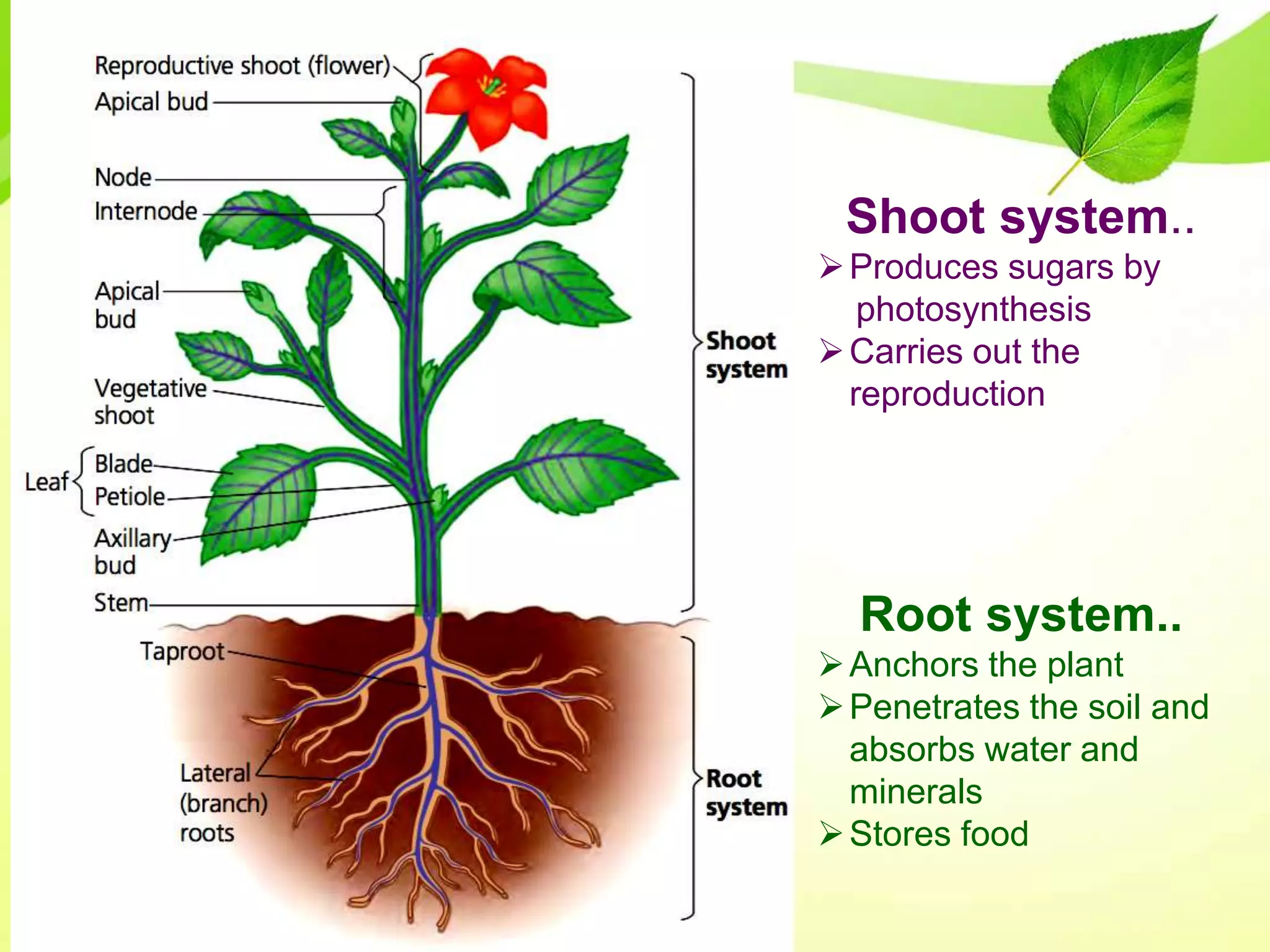
Shoot system..
Produces sugars by
photosynthesis
Carries out the
reproduction
Root system..
Anchors the plant
Penetrates the soil and
absorbs water and
minerals
Stores food
Distinguish between root system and
shoot system
Root system
• Parts of the plant that generally grow
beneath the ground absorbing water
and minerals
• Occurs beneath the ground
• Grows into the ground
• Composed of roots, tubers and
rhizomes
• Main functions are absorbing water
and minerals from the soil while
providing support to the plants on the
ground
• Does not undergo photosynthesis
• Does not undergo sexual reproduction
• Cannot be used as timber
Shoot system
• Aerial and erect parts of the plant
body which grows upwards
• Occurs above the ground
• Grows upwards
• Composed of leaves, buds,
flowers and fruit
• Main functions are
photosynthesis, transport and
reproduction
• Undergoes photosynthesis
• Undergoes sexual reproduction by
means of flowers
• Can be used as timber
What is Root System?
 Root system represents the
underground part of the plant.
It includes roots, tubers, and
rhizoids
 The major part of the root
system is the roots.
 Two types of root systems can
be identified based on the type
of plant. They are
 tap roots and
 fibrous roots
 Tap roots occur in dicots while
fibrous roots occur in monocots.
The four main functions of the root system are
 absorption of water,
 fastening of the plant body to the
ground,
 storage of food and nutrients,
 prevention of soil corrosion.
Main functions of the root system
Difference between taproot and
fibrous root
Tap Root
• Tap root consist of only one main
and long root. The smaller roots
that grow from the main root are
called lateral roots
• Tap root grows vertically deep
into the soil
• A taproot is the differentiated
primary root of the plant
• In the tap root system the primary
root is not eliminated
• The tap root does not developed
from the stem
Fibrous Root
• Fibrous roots do not have a main
root. All roots are similar
• Fibrous roots are short, swallow
and most of them grow
horizontally in the soil
• the fibrous root is not the
differentiated primary root of the
plant.
• In the fibrous root system the
primary root is eliminated
• The fibrous root develops from
the stem
Tap roots
• The taproot has a few lateral
roots that develop from the
taproot
• Taproot is found in dicots
• taproot is not found in most
grasses
• Taproot occurs in
gymnosperms
• A taproot can sometimes act
as a storage organ for food
• Tap root can not hold any soil
particles together at the
surface of the soil
Fibrous roots
• no lateral roots has develop
from the fibrous root
• fibrous root is found in
monocots.
• Fibrous root is found in most
grasses
• fibrous root does not occur in
the gymnosperms.
• fibrous roots cannot store food
• Fibrous root holds many soil
particles together at the
surface of the soil
Tap roots
• Tap roots are found in
plants which have
reticulate venation in their
leaves
• Tap root is much longer
and has extremely large
surface area
• A single plant has only
one tap root
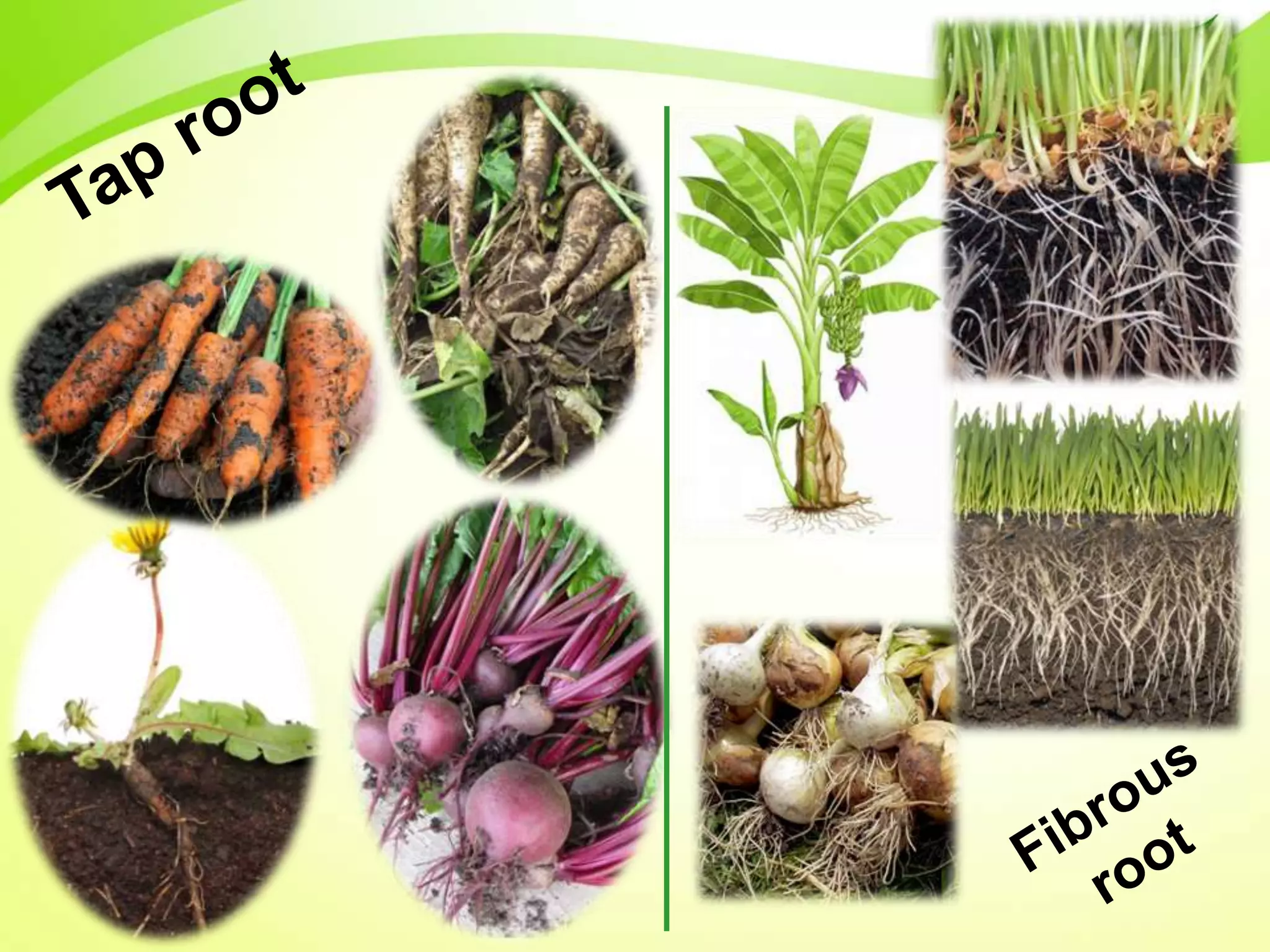
• Ex : Carrots , Dandelions,
Parsnip and Beetroot
Fibrous roots
• Fibrous roots are found in
plants which have parallel
venation in their leaves
• Fibrous roots are short
and have small surface
area
• A single plant can have
hundreds of fibrous roots
• Ex : Grass , Wheat ,
Banana and Onion
Special Features Of Taproot
• A taproot is when there is one main root that grows straight down
deep into the soil. It only has very few lateral roots that develop
and grow off this main root.
• The taproot is a feature of plants that are known as dicotyledons
and it is also found in the plants known as gymnosperms.
• The taproot is further differentiation of the primary root. The
primary root is formed from the radicle of the seedling during
development of the seed.
• In the taproot system the main root is the largest and longest, and
lateral roots are smaller and shorter. A few side roots that are
known as lateral roots form from the main root.
Contd…….
• A taproot penetrates deep into the soil and in some cases can
form a storage organ for food, for instance: carrots, radish,
beetroot and turnips.
• Advantages of a taproot include the fact that they do penetrate
deep into the soil and so can locate water and minerals deep
underground, the mesquite plant for instance has roots that can
penetrate up to 150 ft. deep in search of water. It is thus very
drought tolerant.
• The taproot is also good at anchoring the plant into the soil so
preventing them from being blown over in windy environments.
• Certain weeds such as Dandelion are difficult to pull out because
of the taproot.
• A further advantage is that they can form, in some cases, storage
organs, storing food such as starch or sugars, for the plant.
Special Features Of Fibrous root
• A fibrous root is a root that consists of groups of roots of similar size and
length. They do not penetrate as deeply into the soil as does a taproot.
• The fibrous root is a feature of plants that are monocotyledons. Unlike the
tap root, the primary root produced during development does not remain,
and instead roots, known as adventitious roots, are produced from
the stem of the plant.
• All these roots forming the fibrous root collectively are of equal size and
length.
• A fibrous root system does not penetrate deeply into the soil but rather
creates a thick network of roots that are good at holding the soil together.
• Many types of grasses have fibrous roots, including plants related to grass
such as corn.
• Advantages of fibrous root systems include that they allow the plant to
absorb water and minerals over a large surface area closer to the surface of
the soil.
• They are also useful in helping prevent or reduce soil erosion since these
root systems help hold the soil particles together.
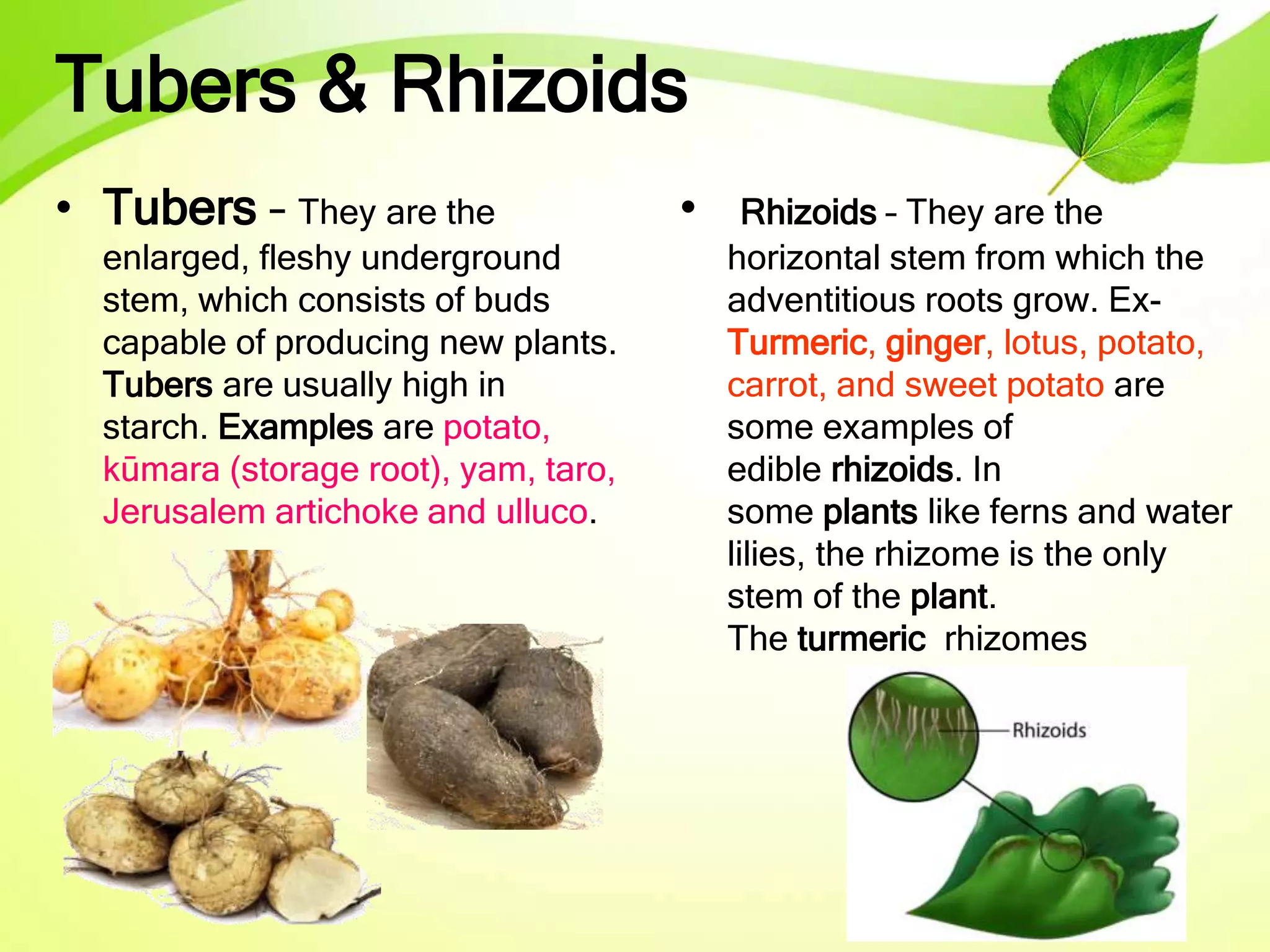
Tubers & Rhizoids
• Tubers – They are the
enlarged, fleshy underground
stem, which consists of buds
capable of producing new plants.
Tubers are usually high in
starch. Examples are potato,
kūmara (storage root), yam, taro,
Jerusalem artichoke and ulluco.
• Rhizoids – They are the
horizontal stem from which the
adventitious roots grow. Ex-
Turmeric, ginger, lotus, potato,
carrot, and sweet potato are
some examples of
edible rhizoids. In
some plants like ferns and water
lilies, the rhizome is the only
stem of the plant.
The turmeric rhizomes
Shoot System
• Shoot system refers to the
components of a plant, which grows
above the ground.
• It includes:
 stems,
 leaves,
 flowers,
 seeds,
 Fruit,
 buds.
Stem – The main part of the shoot system is the stem. It supports the
plant while conducting water and nutrients throughout the
plant. There are two types of stems in a plant; herbaceous
stem and woody stem. The herbaceous stem is bendable
and the woody stem does not easily bend as it is hard.
Leaves – Leaves are the photosynthetic structures of a plant. The
cells in the leaf contain chlorophyll that capture sunlight,
which is the source of energy for the production of
glucose.
Flower – Flower helps in the sexual reproduction of angiosperms.
Seed – Both angiosperms and gymnosperms produce seeds, which
are the reproductive structures.
Fruit – Fruit contains seeds inside it.
Bud – Buds only occur in dicots, developing into a flower or a leaf.
The two types of buds are apical bud and auxiliary bud.
Structure of Leaf
 Leaves are thin, flat organs responsible
for photosynthesis in the plants.
 It is called the kitchen of plant body as it
prepares food.
 It develops laterally at the node.
 It is an important part of the shoot
system and
 it originates from shoot apical meristems.
Generally, leaf base, petiole, and lamina, together
form the main parts of a leaf.
Leaf Base: This is the part where a leaf attaches to the stem.
Leaf base has two small leaf-like structure called stipules. In
plants like paddy, wheat, and other monocotyledons, this leaf
base is wide and masks the stem.
Petiole: Petiole is the long, thin, stalk that links the leaf blade
to the stem.
Lamina/ leaf blade: it is also known as leaf blade. It is the
green, flat surface of the leaves. It consists of a small branched
vein and veinlets. The vein that runs along the middle of the
lamina is called midrib. Midrib divides the surface of the lamina
into two. These veins and veinlets give rigidity to the leaf blade
and help in the transportation of water and other substances
Venation
• Venation is defined as the arrangement of
veins and the vein lets in the leaves. Different
plants show different types of venation.
• There are two types of venation:
 Reticulate Venation
 Parallel venation
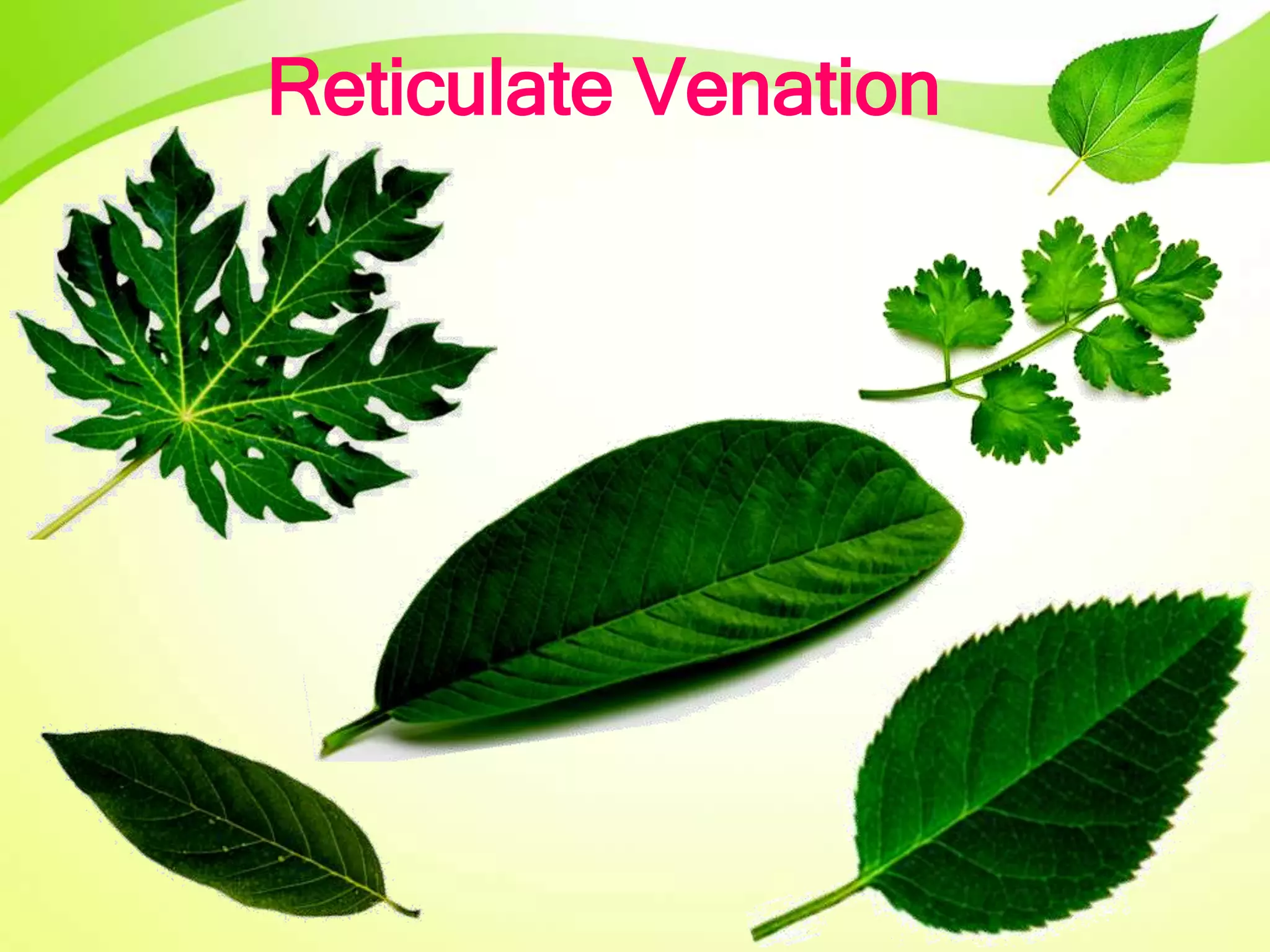
Reticulate Venation
When the veins are
arranged in either web-
like or network-like all over
the lamina, it is known as
reticulate venation.
Reticulate Venation
• The examples of some plants having
reticulate venation are as follows:
• Examples :
• Rose Papaya
• Mangifera Bastard teak
• China rose Coriander
• Custard apple Guava
• Holy basil/ Tulsi Physic nut
• Pongam Teak
• White teak
Reticulate Venation
Parallel venation means the veins
present with in the leaves are
arranged parallel to each other. the
veins never join any other veins. No
branching is seen in parallel venation.
All the monocots are parallel venated
Parallel venation
The examples of some plants having Parallel
venation are as follows :
Examples :
• Banana Bamboo
• Wheat Grasses
• Maize Mango
• Hibiscus Ficus
Parallel Venation
Parallel Venation
Types of Leaves
 They are classified into different
groups based on their shape,
size, their arrangements on the
stem and leaves.
 There are two types of leaf-
 Simple Leaf
 Compound Leaf
Simple Leaf
• A leaf whose blade is not divided to the midrib even
though lobed.
• Examples : Black gum trees, Black cherry trees,
Guava, Mangoes
Compound Leaf
• A leaf in which the blade is divided to the midrib,
forming two or more distinct blades or leaflets on a
common axis, the leaflets themselves occasionally
being compound
• Examples : Oaks, Rose, Neem, Shameplant,
Buckeye
Simple Leaf Compound Leaf
• Such leaf in which the leaf blade or
lamina is undivided into lobes is
called simple leaf, and the
arrangement of such leaves are in
acropeta l succession.
• They have single blades.
• Bud is placed in the axil (near the
petiole and stem).
• There is no division of lamina.
• The base of a leaf contains stipules.
• Black gum trees, Black cherry trees,
Guava, Mangoes, various types of
Oaks.
COMPOUND LEAVES
• The leaf which properly shows the
division of leaf blade or lamina into
leaflets is called as compound leaves.
These leaves do not make acropetal
succession arrangments of the leaflets.
• They have smaller and separate leaf
blades called leaflets.
• Each leaflet does not have axil, though
buds are placed in the axil of the leaf.
• The lamina is divided into more than
two leaflets, arising on the side of a
rachis or at the tip of the petiole.
• The stipules are found at the base of
the leaf, but other additional structures
are absent.
• Rose, Neem, Shame plant, Buckeye.
Differentiate between simple and
compound leaf
SIMPLE LEAVES
Arrangements of leaves
• The arrangement of leaves on the
stem is called phollotaxy
• There are three types of arrangement
of leaf
 Alternate
 Opposite
 Whorled
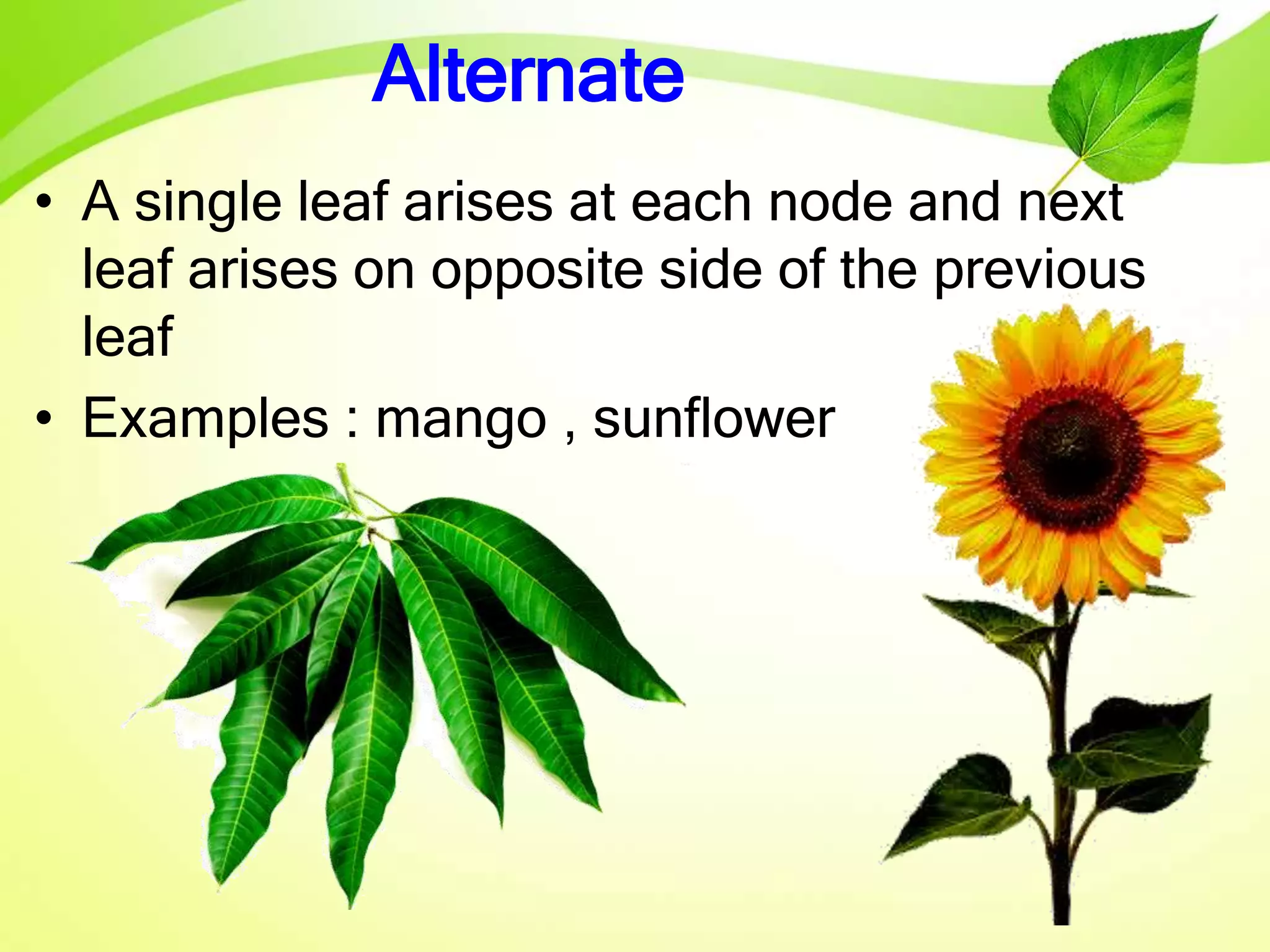
Alternate
• A single leaf arises at each node and next
leaf arises on opposite side of the previous
leaf
• Examples : mango , sunflower
Opposite
• Two leaf arise at each node opposite to each
other
• Examples : calotropis , guava
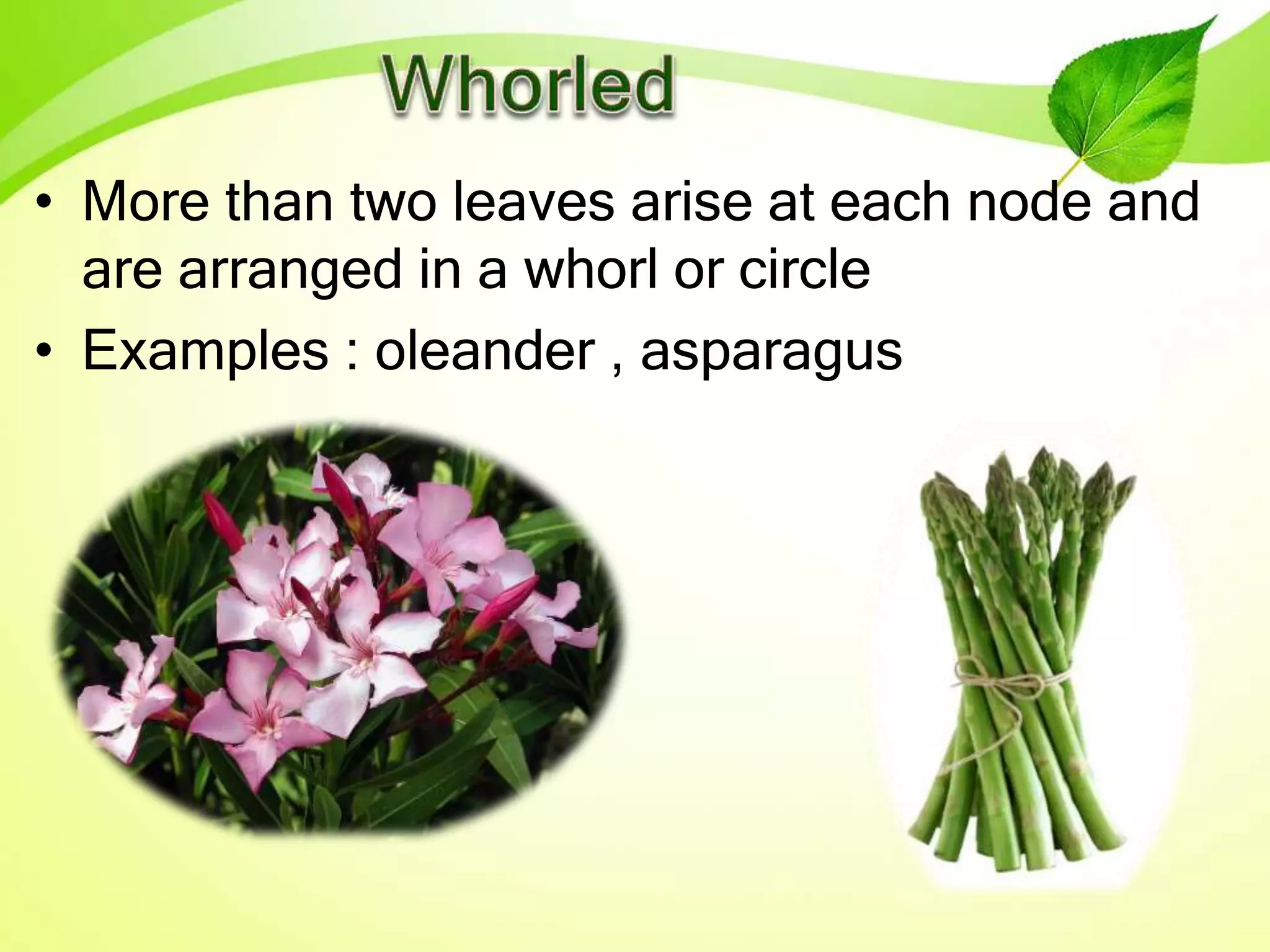
• More than two leaves arise at each node and
are arranged in a whorl or circle
• Examples : oleander , asparagus
Whole leaves or parts of leaves are often
modified for special functions, such as
for climbing and substrate attachment,
storage, protection against predation or
climatic conditions, or trapping and
digesting insect prey.
Modification Of Leaf
 Storage Leaves
 Leaf Tendrils
 Leaf-spines
 Scale-leaves
 Leaflet Hooks
 Leaf Roots
 Phyllode
 Insect Catching Leaves
Some plants of xerophytic habitats and
members of the family Crassulaceae
generally have highly thickened and
succulent leaves with water storage
tissue. These leaves have large
parenchymatous cells with big central
vacuole filled with hydrophilic colloid.
This kind of adaptation helps plants to
conserve very limited supply of water
and resist desiccation (drying up).
A tendril is a specialized stem, leaves or petiole with a
threadlike shape that is used by climbing plants for
support, attachment and cellular invasion by parasitic
plants, generally by twining around suitable hosts found
by touch. They do not have a lamina or blade, but they
can photosynthesize.
In weak- stemmed plants, leaf or a part of leaf gets
modified into green threadlike structures called tendrils
which help in climbing around the support.
Entire Leaf is Modified into
Tendril, e.g., Lathyrus aphaca
(wild pea).
Upper Leaflets Modified into
Tendrils, e.g, Pisum sativum
(pea) Lathyrus odoratus
(sweet pea).
Terminal leaflets Modified into
Tendrils, e.g., Naravelia.
The parts of leaf which get modified into
tendrils are as follows:
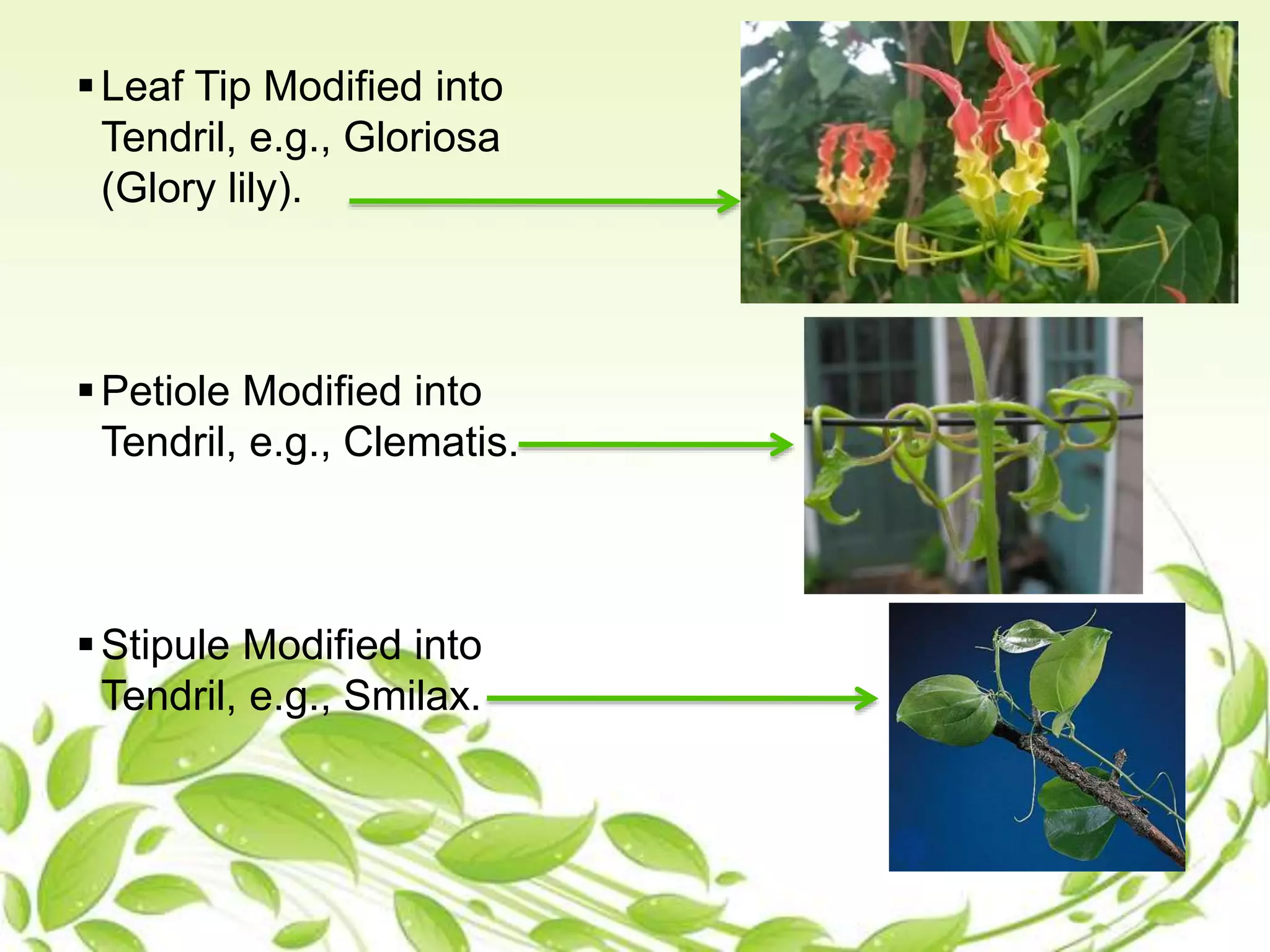
Leaf Tip Modified into
Tendril, e.g., Gloriosa
(Glory lily).
Petiole Modified into
Tendril, e.g., Clematis.
Stipule Modified into
Tendril, e.g., Smilax.
Leaf-spines
Leaves of certain plants become wholly or partially
modified for defensive purpose into sharp, pointed
structures known as spines.
Thus, in prickly pear such as Opuntia; the minute
leaves of the axillary bud are modified into spines.
The leaf-apex in date-palm, dagger plant (Yucca) etc.,
is so modified,
while in plants like prickly or Mexican poppy
(Argemone), Amercian aloe (Agave), Indian aloe
(Aloe), etc., spines develop on the margin as well as at
the apex.
In barberry the leaf itself becomes modified into a
spine; while the leaves of the axillary bud are normal.
Scale-leaves
Typically these are thin, dry, stalkless, membranous
structures, usually brownish in colour or sometimes
colourless.
Their function is to protect the axillary bud that they bear in
their axil.
Sometimes scale-leaves are thick and fleshy, as in onion;
then their function is to store up water and food.
Scale-leaves are common in parasites, saprophytes,
underground stems, etc.
They are also found in Casuarina, Asparagus etc.
Leaflet Hooks
In Bignonia unguiscati the three
terminal leaflets of leaf get modified
into claw like hooks which help in
climbing
Leaf Roots
 In case of Salvinia three leaves are
present at one node. Out of these two
leaves are normal and third gets
modified into adventitious roots which
help in floating over the surface of
water
Phyllode
In Australian Acacia the petiole or any part of the rachis becomes
flattened or winged taking the shape of the leaf and turning green in
colour. This flattened or winged petiole or rachis is known as the
phyllode.
The normal leaf which is pinnately compound in nature develops in the
seedling stage, but it soon falls off. The phyllode then performs the
functions of the leaf. In some species, however, young or even adult
plants are seen to bear the normal compound leaves together with the
phyllodes.
There are about 300 species of Australian Acacia (Acacia moniliformis),
all showing the phyllodes.
 In lerusalem thorn (Parkinsonia; a small prickly tree, the primary rachis of
the bipinnate leaf ends in a sharp spine, while each secondary rachis is a
phyllode being green and flattened.
 The leaflets are small and fall off soon. The phyllode then performs the
functions of the leaflets.
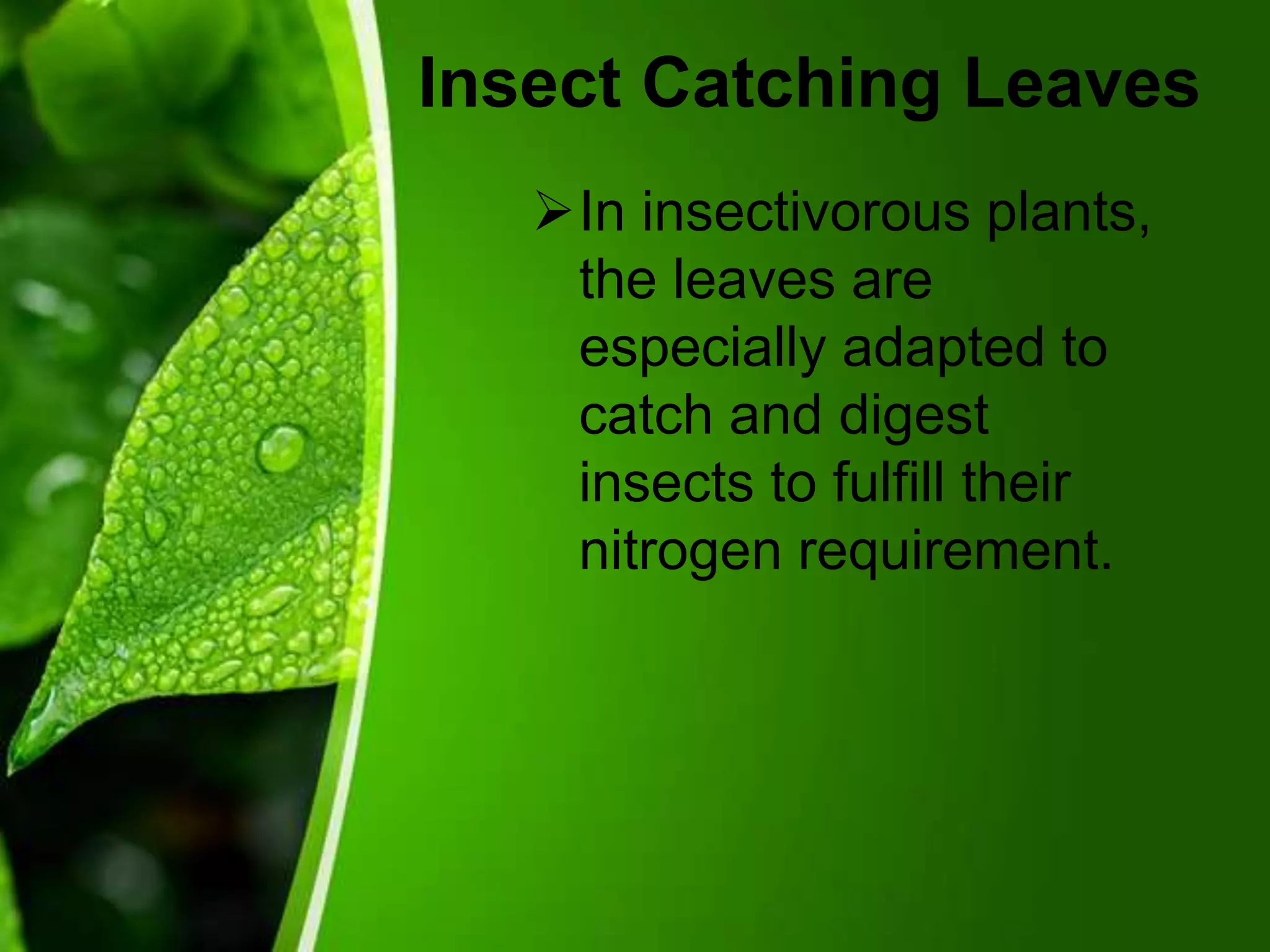
Insect Catching Leaves
In insectivorous plants,
the leaves are
especially adapted to
catch and digest
insects to fulfill their
nitrogen requirement.
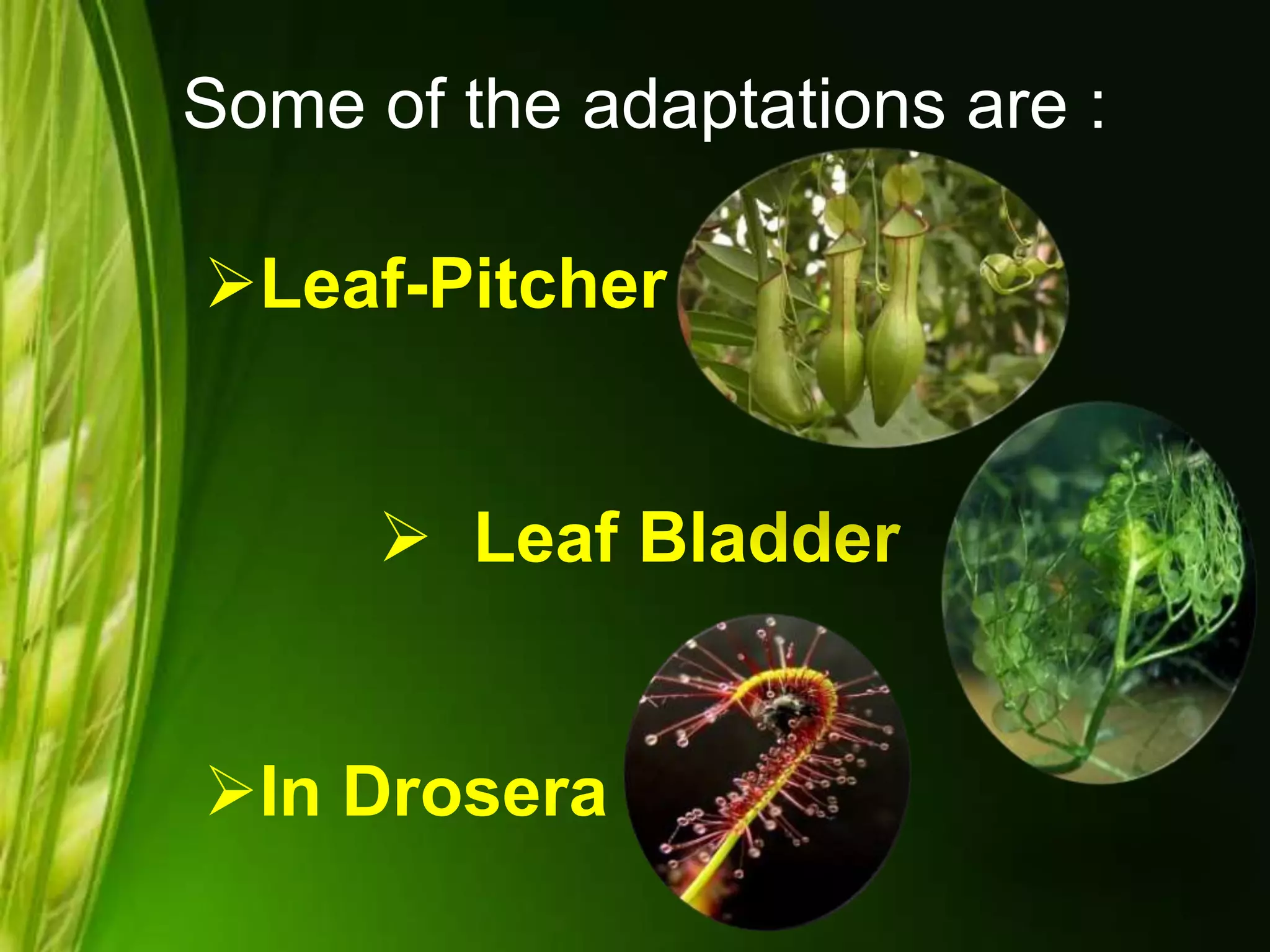
Some of the adaptations are :
Leaf-Pitcher
 Leaf Bladder
In Drosera
Leaf-Pitcher
This is a device to catch insects for fulfilling the deficiency of nitrogen in
the medium where plant is growing. In case of Nepenthes, Dischidia
and Sarracenia leaf-lamina is modified into pitcher-like structure called
leaf-pitcher.
Nepenthes also called pitcher-plant bears special type of leaves. Leaf-
base is winged, petiole is tendrillar and lamina is modified into pitcher-
like structure having a coloured lid which attracts the insects and keeps
the pitchei closed during immaturity. The rim of the pitcher is internally
lined by backwardly directed hair and a large number of minute scales
due to which the insect slips and is captured.
The inner walls of the pitcher have glands which secrete a digestive
fluid into the cavity of the pitcher. The insect is digested here and waste
material settles down at the bottom. Sarracenia has pitchers in the from
of rosetts. The pitchers are similar to those of Nepenthes but are
sessile.
Pitchers are also found in Dischidia, an epiphytic climber. Rain water
and debris accumulate inside the pitchers. The roots from the nodes of
the stem grow into the cavity of the pitcher and absorb water.
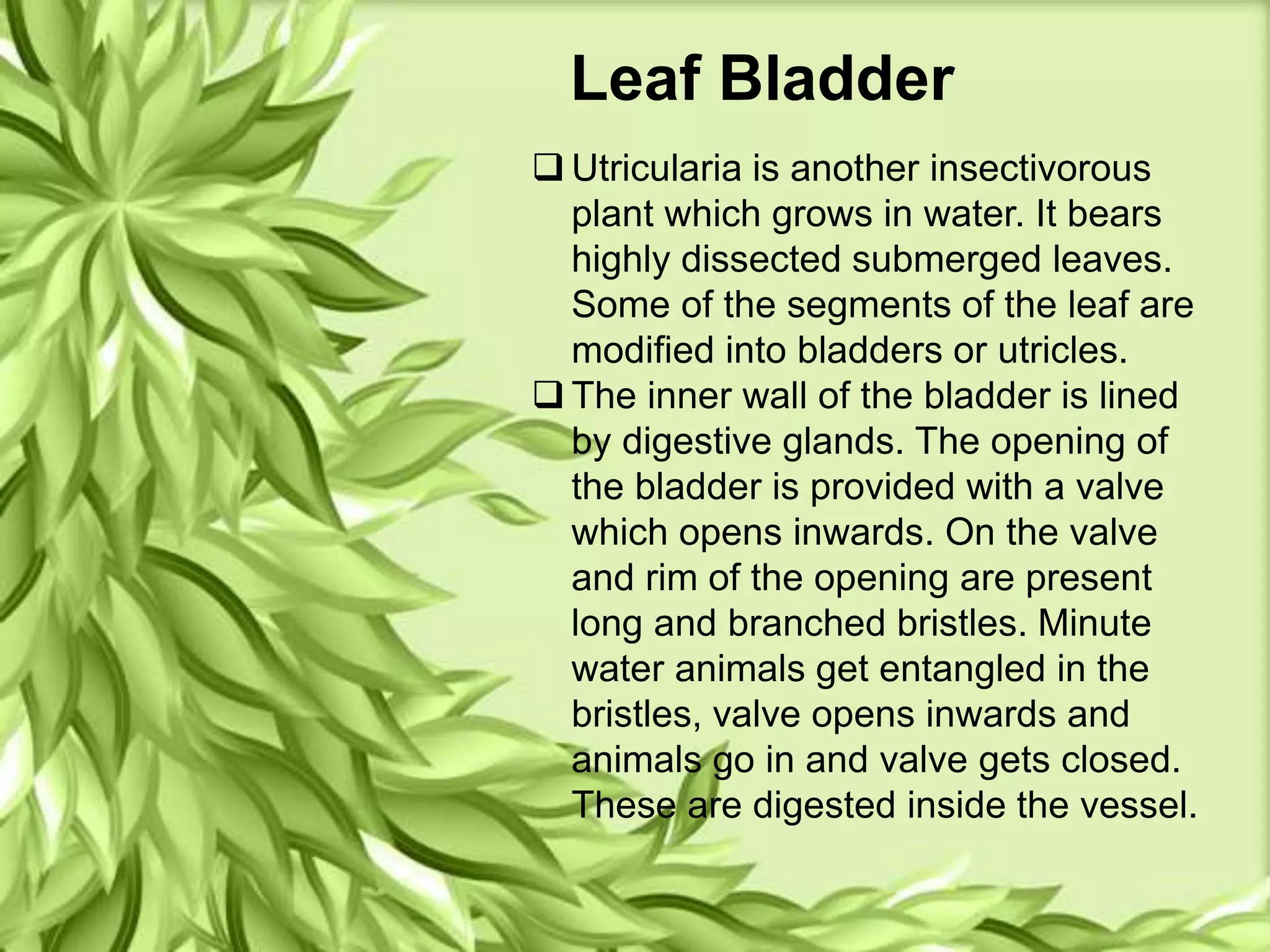
Leaf Bladder
 Utricularia is another insectivorous
plant which grows in water. It bears
highly dissected submerged leaves.
Some of the segments of the leaf are
modified into bladders or utricles.
 The inner wall of the bladder is lined
by digestive glands. The opening of
the bladder is provided with a valve
which opens inwards. On the valve
and rim of the opening are present
long and branched bristles. Minute
water animals get entangled in the
bristles, valve opens inwards and
animals go in and valve gets closed.
These are digested inside the vessel.
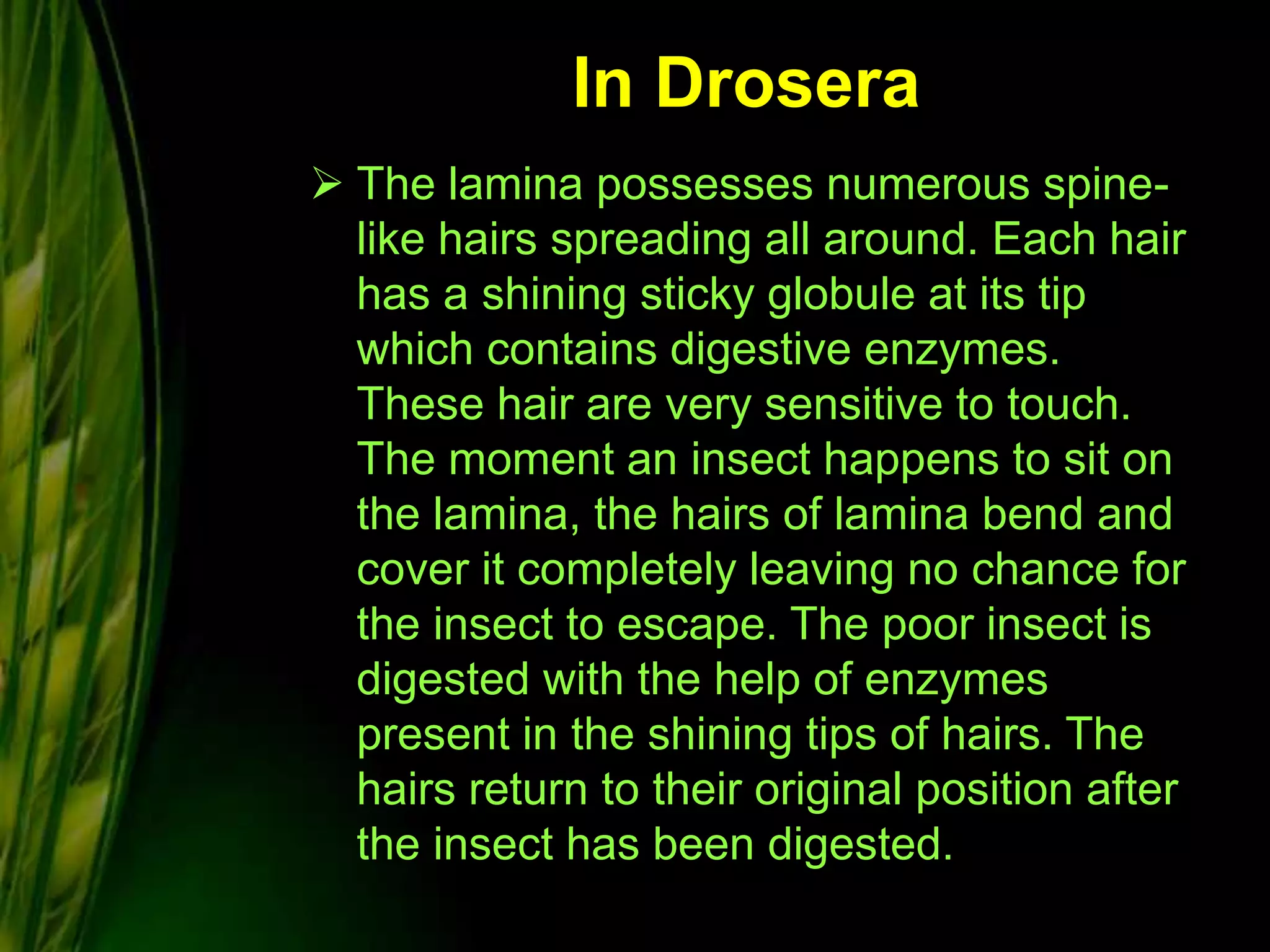
In Drosera
 The lamina possesses numerous spine-
like hairs spreading all around. Each hair
has a shining sticky globule at its tip
which contains digestive enzymes.
These hair are very sensitive to touch.
The moment an insect happens to sit on
the lamina, the hairs of lamina bend and
cover it completely leaving no chance for
the insect to escape. The poor insect is
digested with the help of enzymes
present in the shining tips of hairs. The
hairs return to their original position after
the insect has been digested.
Function of the Leaf
Photosynthesis
Transpiration
Guttation
Storage
Defense
 The primary function of the leaf is the conversion of carbon dioxide, water, and
UV light into sugar (e.g., glucose) via photosynthesis (shown below). The
simple sugars formed via photosynthesis are later processed into various
macromolecules (e.g., cellulose) required for the formation of the plant cell wall
and other structures.
 Therefore, the leaf must be highly specialized to combine the carbon dioxide,
water, and UV light for this process. Carbon dioxide is diffused from the
atmosphere through specialized pores, termed stomata, in the outer layer of
the leaf.
 Water is directed to the leaves via the plant’s vascular conducting system,
termed the xylem.
 Leaves are orientated to ensure maximal exposure to sunlight, and are
typically thin and flat in shape to allow sunlight to penetrate the leaf to reach
the chloroplasts, which are specialized organelles that perform photosynthesis.
 Once sugar is formed from photosynthesis, the leaves function to transport it
down the plant via specialized structures called the phloem, which run in
parallel to the xylem.
 The sugar is typically transported to the roots and shoots of the plant, to
support growth.
Photosynthesis
Transpiration
Transpiration refers to the movement of water
through the plant, and subsequent
evaporation via the leaves. When the stomata
open to accommodate the diffusion of carbon
dioxide into the plant for photosynthesis, water
flows out. This process also serves to cool the
plant via evaporation of the water from the
leaf, as well as regulate the plant’s osmotic
pressure.
Guttation
 Guttation refers to the excretion of xylem
from the edges of leaves and other vascular
plants due to increased levels of water in
the soil at night, when the stomata are
closed.
 The pressure caused at the roots results in
the leakage of water from the xylem out of
specialized water glands at the edges of
leaves.
Storage
Leaves are a primary site of water and
energy storage since they provide the
site of photosynthesis.
Succulents are particularly adept at
water storage, as evidenced by the
thick leaves.
Due to the high levels of nutrients and
water, many animal species ingest the
leaves of plants as a source of food.
Defense
Some leaves have also evolved defense
mechanisms to avoid being eaten or
damaged. Some examples include the
spines of cacti, cones of gymnosperms,
respectively.
In addition, hairs found on leaves prevent
water loss in dry climates and sting
animals that detour herbivores
(e.g., Urticaceae).
Moreover, the waxy coatings found on
leaves serve to protect against water loss,
rain, and forms of contamination.
Oils and other secreted substances also
detract from being consumed by
herbivores.
Vegetative propagation of leaf
• Vegetative propagation by leaves is
when a leaf roots in water or soil.
Either when a branch or stem is
covered in soil or water or when
a leaf is broken or cut off and
deposited/planted in water or soil
and allowed to root.
• A common example is with house
plants like the green pathos
Types of vegetative propagation
 Vegetative Propagation by Roots
 Vegetative Propagation by Stems
 Vegetative Propagation by Leaf
 Cutting
 Grafting
 Budding
 New plants grow out of the modified roots
called tubers. In fact, in some plant species,
roots develop adventitious buds.
 These buds grow and form new
plants/sprouts under the right conditions.
 For example, Sweet potato and Dahlia.
These sprouts can be separated from the
parent plant and when planted in
other areas, new plants are formed.
 Vegetative propagation occurs through stems when
new plants arise from the nodes. This is where buds
are formed, which grow into new plants. Stems that
grow horizontally on the ground are called runners.
 As these runners grow, buds form at the nodes, which
later develop the roots and shoots, resulting in the
formation of a new plant. Example – Cyanodon; Mint
etc.
 The bulb is the round, swollen part of the underground
stem. Within the bulb lies the organ for vegetative
propagation such as the central shoot that grows into a
new plant.
 Bulbs have a bud surrounded by layers of fleshy
leaves. A few examples include Onions, Garlic, and
Tulips etc.
 We can find stem tubers in plants like potatoes. This
part is the swollen apical part containing many nodes or
eyes. Every eye has buds. New plants originate from
these buds.
Vegetative Propagation by Leaf
Plants like Bryophyllum, Begonia etc., have
adventitious buds coming out from the
notches of the leaves.
 These buds develop into new plants.
Cutting
 Cuttings are the most common method
employed by gardeners to grow new plants.
 A portion of the stem is cut and planted in
the soil, which develops roots and further
grows into a new plant.
Grafting
 In grafting, we use two closely related plants to
produce a new plant that has the desired, combined
traits of both the parent plants.
 One plant is the stock, of which we take the root
system and the other is the Scion (section), of
which we use the shoot system.
 In this method of artificial vegetative propagation,
we attach the scion to the stock of the second plant.
 In general, we use grafting for a variety of plants
such as roses, apples, avocado etc.
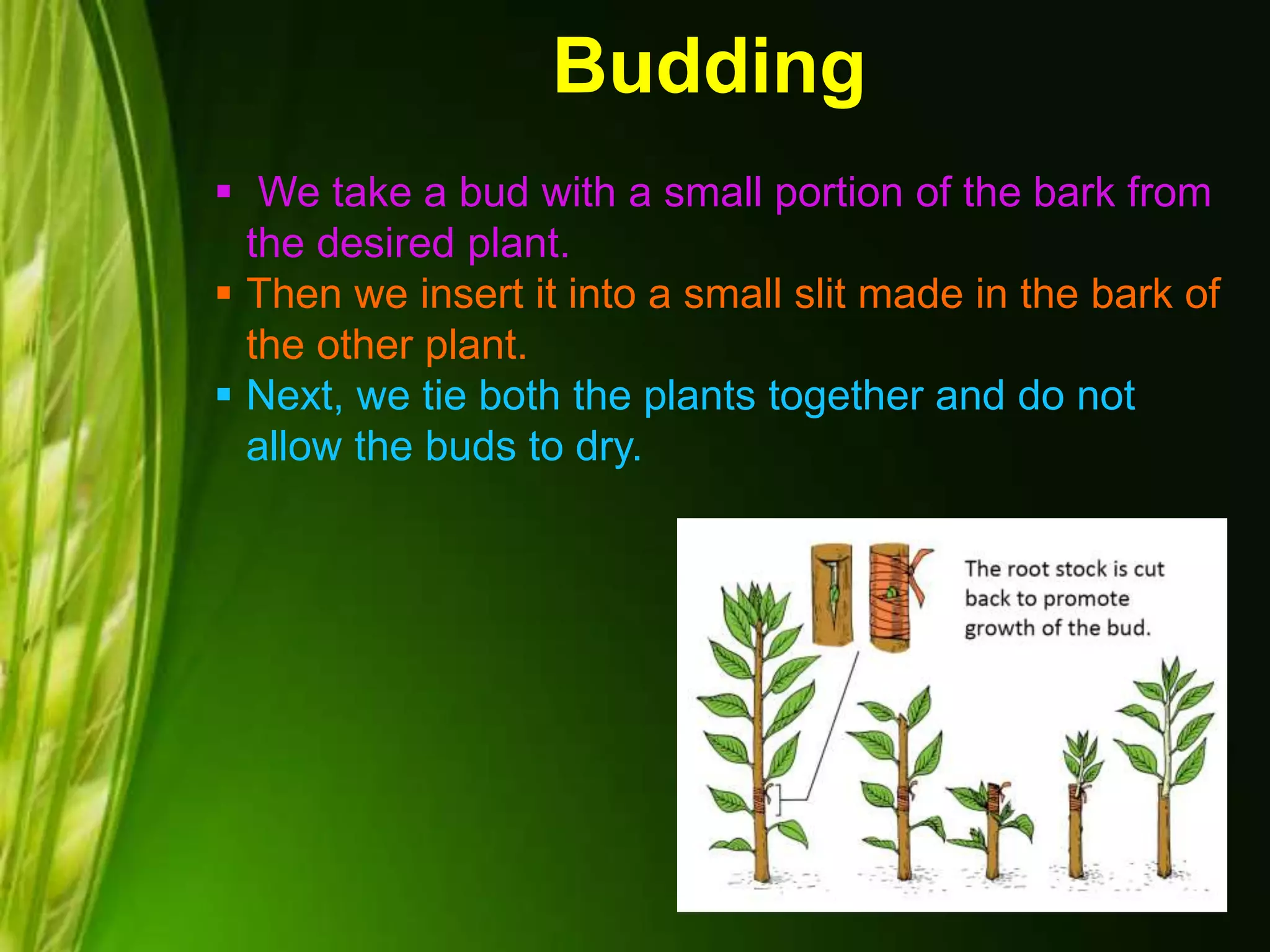
Budding
 We take a bud with a small portion of the bark from
the desired plant.
 Then we insert it into a small slit made in the bark of
the other plant.
 Next, we tie both the plants together and do not
allow the buds to dry.
Six Major Types of Leaf
• In general, the types of leaf can be divided
into six major types, although there are
also plants with highly specialized leaves:
• Conifer Leaf
• Microphyll Leaf
• Megaphyll Leaf
• Angiosperm Leaf
• Fronds
• Sheath Leaf
 Conifer leaves are needle-shaped or in the form of scales.
Conifer leaves are typically heavily waxed and highly
adapted to colder climates, arranged to dispel snow and
resist freezing temperatures. Some examples include
Douglas firs and spruce trees.
Conifer Leaf
 Microphyll leaves are characterized by a single vein that is
unbranched. Although this type of leaf is abundant in
the fossil record, few plants exhibit this type of leaf today.
Some examples include horsetails and clubmosses.
Microphyll Leaf
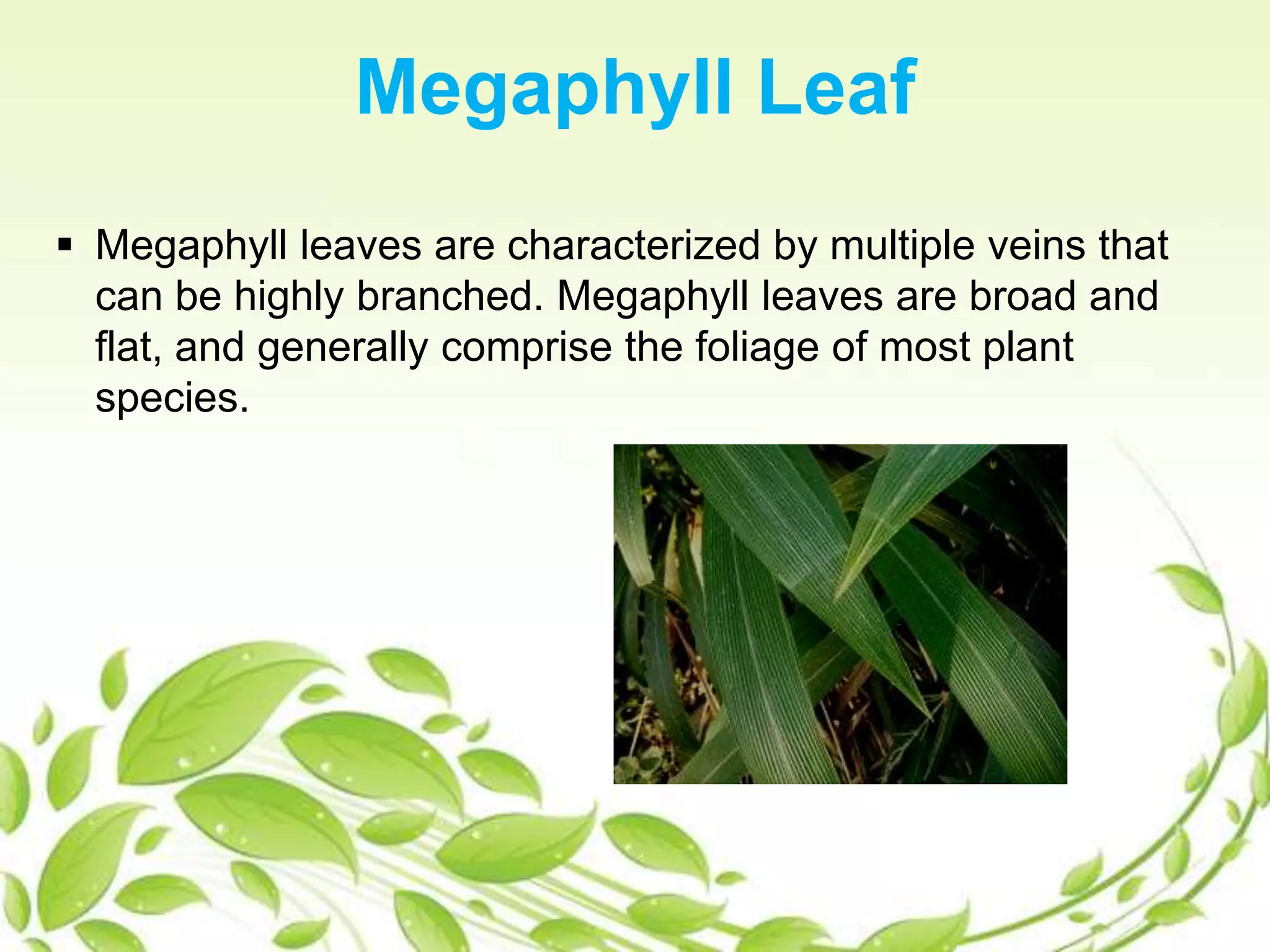
 Megaphyll leaves are characterized by multiple veins that
can be highly branched. Megaphyll leaves are broad and
flat, and generally comprise the foliage of most plant
species.
Megaphyll Leaf
 Angiosperm leaves are those found on flowering plants.
These leaves are characterized by stipules, a lamina, and
a petiole.
Angiosperm Leaf
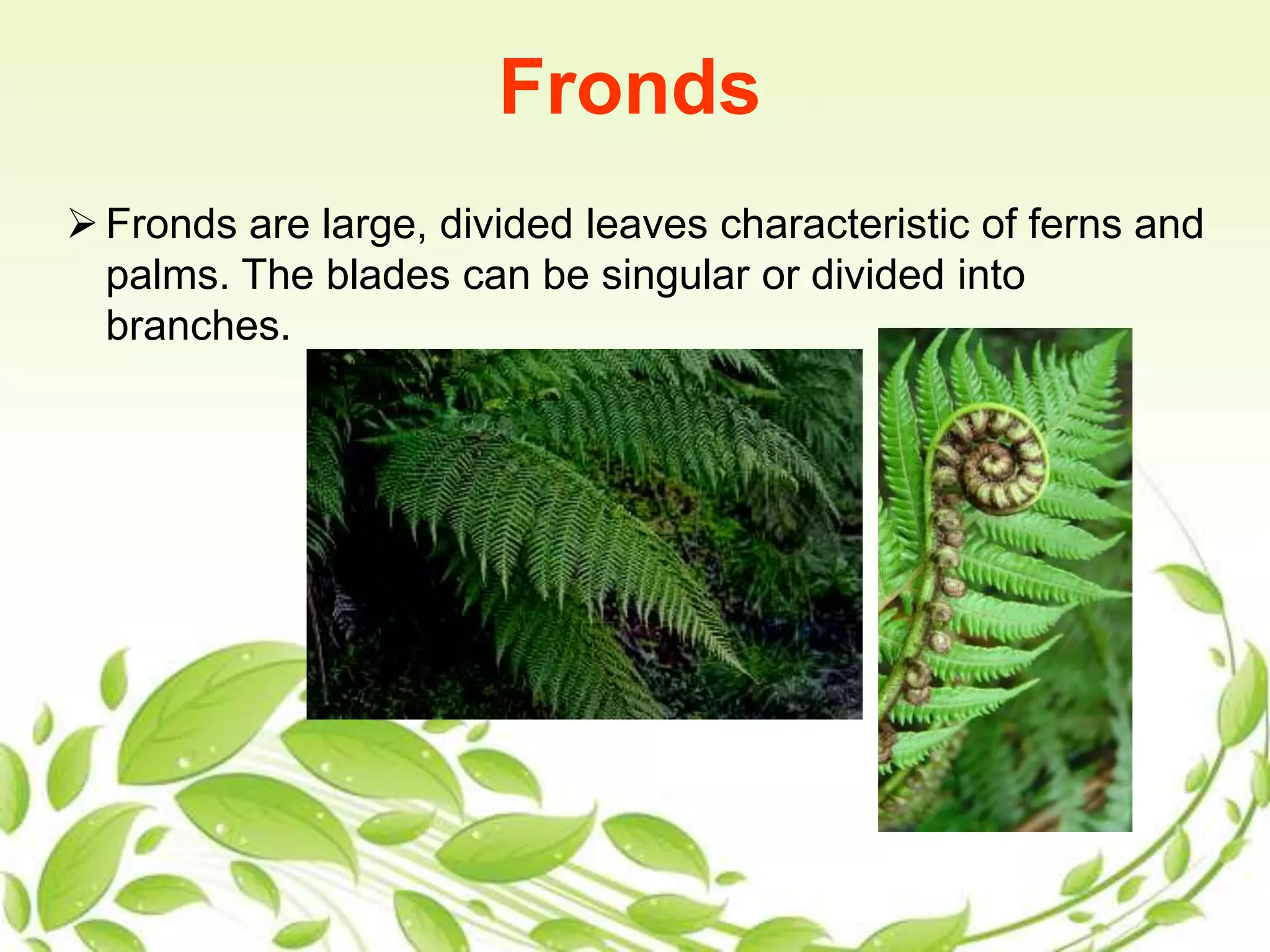
Fronds
 Fronds are large, divided leaves characteristic of ferns and
palms. The blades can be singular or divided into
branches.
Sheath Leaf
 Sheath leaves are typical of grass species and monocots.
Thus, the leaves are long and narrow, with a sheathing
surrounding the stem at the base. Moreover, the vein
structure is striated and each node contains only one leaf.
Thank you
2020
Shatakshee Sagun
Guide: Ms. Bandana

Leaf- Parts of plant - part-1

  • 2.
    Table of Contents Introductionof leaf Structure of leaf Types of leaf Arrangement of Leaf Modification of the leaf Function of the leaf Vegetative propagation of leaf
  • 3.
    Leaves are greenishorgans of plants distributed on the upper parts of the trunk. They are green due to the presence of a pigment called chlorophyll. Leaves are typically comprised of a distinct upper and lower surface, stomata for gas exchange, waxy coating, hairs, and venation. Introduction of Leaf
  • 4.
    Leaf • A leafis part of a plant that's usually green and attached to it by a stem or stalk. In the fall, the leaves of many trees turn various bright colors before falling to the ground. In the spring, trees grow new leaves. A plant's leaves are the organs that take part in photosynthesis, which brings it needed nutrients. • Leaves are important because they are the primary source of photosynthesis, which is how plants feed themselves. Photosynthesis is the process of turning light energy into sugars, which plants need to survive, so leaves are very important to a plant's overall health and survival. • Leaves are important to humans because Plants absorb carbon dioxide and release oxygen from their leaves, which humans and other animals need to breathe. Living things need plants to live - they eat them and live in them.
  • 5.
    Colourful leaf……… Why? •The green color of the leaf disappears, when the chlorophyll breaks down, and the yellow to orange colors become visible and give the leaves part of their fall splendor. • All these colors are due to the mixing of varying amounts of the chlorophyll residue and other pigments in the leaf during the fall season. The three pigments that color the leaves are:  chlorophyll (green)  carotenoid (yellow, orange, and brown)  anthocyanin (red)
  • 6.
    Shoot system.. Produces sugarsby photosynthesis Carries out the reproduction Root system.. Anchors the plant Penetrates the soil and absorbs water and minerals Stores food
  • 7.
    Distinguish between rootsystem and shoot system Root system • Parts of the plant that generally grow beneath the ground absorbing water and minerals • Occurs beneath the ground • Grows into the ground • Composed of roots, tubers and rhizomes • Main functions are absorbing water and minerals from the soil while providing support to the plants on the ground • Does not undergo photosynthesis • Does not undergo sexual reproduction • Cannot be used as timber Shoot system • Aerial and erect parts of the plant body which grows upwards • Occurs above the ground • Grows upwards • Composed of leaves, buds, flowers and fruit • Main functions are photosynthesis, transport and reproduction • Undergoes photosynthesis • Undergoes sexual reproduction by means of flowers • Can be used as timber
  • 8.
    What is RootSystem?  Root system represents the underground part of the plant. It includes roots, tubers, and rhizoids  The major part of the root system is the roots.  Two types of root systems can be identified based on the type of plant. They are  tap roots and  fibrous roots  Tap roots occur in dicots while fibrous roots occur in monocots.
  • 9.
    The four mainfunctions of the root system are  absorption of water,  fastening of the plant body to the ground,  storage of food and nutrients,  prevention of soil corrosion. Main functions of the root system
  • 10.
    Difference between taprootand fibrous root Tap Root • Tap root consist of only one main and long root. The smaller roots that grow from the main root are called lateral roots • Tap root grows vertically deep into the soil • A taproot is the differentiated primary root of the plant • In the tap root system the primary root is not eliminated • The tap root does not developed from the stem Fibrous Root • Fibrous roots do not have a main root. All roots are similar • Fibrous roots are short, swallow and most of them grow horizontally in the soil • the fibrous root is not the differentiated primary root of the plant. • In the fibrous root system the primary root is eliminated • The fibrous root develops from the stem
  • 11.
    Tap roots • Thetaproot has a few lateral roots that develop from the taproot • Taproot is found in dicots • taproot is not found in most grasses • Taproot occurs in gymnosperms • A taproot can sometimes act as a storage organ for food • Tap root can not hold any soil particles together at the surface of the soil Fibrous roots • no lateral roots has develop from the fibrous root • fibrous root is found in monocots. • Fibrous root is found in most grasses • fibrous root does not occur in the gymnosperms. • fibrous roots cannot store food • Fibrous root holds many soil particles together at the surface of the soil
  • 12.
    Tap roots • Taproots are found in plants which have reticulate venation in their leaves • Tap root is much longer and has extremely large surface area • A single plant has only one tap root • Ex : Carrots , Dandelions, Parsnip and Beetroot Fibrous roots • Fibrous roots are found in plants which have parallel venation in their leaves • Fibrous roots are short and have small surface area • A single plant can have hundreds of fibrous roots • Ex : Grass , Wheat , Banana and Onion
  • 14.
    Special Features OfTaproot • A taproot is when there is one main root that grows straight down deep into the soil. It only has very few lateral roots that develop and grow off this main root. • The taproot is a feature of plants that are known as dicotyledons and it is also found in the plants known as gymnosperms. • The taproot is further differentiation of the primary root. The primary root is formed from the radicle of the seedling during development of the seed. • In the taproot system the main root is the largest and longest, and lateral roots are smaller and shorter. A few side roots that are known as lateral roots form from the main root. Contd…….
  • 15.
    • A taprootpenetrates deep into the soil and in some cases can form a storage organ for food, for instance: carrots, radish, beetroot and turnips. • Advantages of a taproot include the fact that they do penetrate deep into the soil and so can locate water and minerals deep underground, the mesquite plant for instance has roots that can penetrate up to 150 ft. deep in search of water. It is thus very drought tolerant. • The taproot is also good at anchoring the plant into the soil so preventing them from being blown over in windy environments. • Certain weeds such as Dandelion are difficult to pull out because of the taproot. • A further advantage is that they can form, in some cases, storage organs, storing food such as starch or sugars, for the plant.
  • 16.
    Special Features OfFibrous root • A fibrous root is a root that consists of groups of roots of similar size and length. They do not penetrate as deeply into the soil as does a taproot. • The fibrous root is a feature of plants that are monocotyledons. Unlike the tap root, the primary root produced during development does not remain, and instead roots, known as adventitious roots, are produced from the stem of the plant. • All these roots forming the fibrous root collectively are of equal size and length. • A fibrous root system does not penetrate deeply into the soil but rather creates a thick network of roots that are good at holding the soil together. • Many types of grasses have fibrous roots, including plants related to grass such as corn. • Advantages of fibrous root systems include that they allow the plant to absorb water and minerals over a large surface area closer to the surface of the soil. • They are also useful in helping prevent or reduce soil erosion since these root systems help hold the soil particles together.
  • 17.
    Tubers & Rhizoids •Tubers – They are the enlarged, fleshy underground stem, which consists of buds capable of producing new plants. Tubers are usually high in starch. Examples are potato, kūmara (storage root), yam, taro, Jerusalem artichoke and ulluco. • Rhizoids – They are the horizontal stem from which the adventitious roots grow. Ex- Turmeric, ginger, lotus, potato, carrot, and sweet potato are some examples of edible rhizoids. In some plants like ferns and water lilies, the rhizome is the only stem of the plant. The turmeric rhizomes
  • 18.
    Shoot System • Shootsystem refers to the components of a plant, which grows above the ground. • It includes:  stems,  leaves,  flowers,  seeds,  Fruit,  buds.
  • 19.
    Stem – Themain part of the shoot system is the stem. It supports the plant while conducting water and nutrients throughout the plant. There are two types of stems in a plant; herbaceous stem and woody stem. The herbaceous stem is bendable and the woody stem does not easily bend as it is hard. Leaves – Leaves are the photosynthetic structures of a plant. The cells in the leaf contain chlorophyll that capture sunlight, which is the source of energy for the production of glucose. Flower – Flower helps in the sexual reproduction of angiosperms. Seed – Both angiosperms and gymnosperms produce seeds, which are the reproductive structures. Fruit – Fruit contains seeds inside it. Bud – Buds only occur in dicots, developing into a flower or a leaf. The two types of buds are apical bud and auxiliary bud.
  • 21.
    Structure of Leaf Leaves are thin, flat organs responsible for photosynthesis in the plants.  It is called the kitchen of plant body as it prepares food.  It develops laterally at the node.  It is an important part of the shoot system and  it originates from shoot apical meristems.
  • 22.
    Generally, leaf base,petiole, and lamina, together form the main parts of a leaf.
  • 23.
    Leaf Base: Thisis the part where a leaf attaches to the stem. Leaf base has two small leaf-like structure called stipules. In plants like paddy, wheat, and other monocotyledons, this leaf base is wide and masks the stem. Petiole: Petiole is the long, thin, stalk that links the leaf blade to the stem. Lamina/ leaf blade: it is also known as leaf blade. It is the green, flat surface of the leaves. It consists of a small branched vein and veinlets. The vein that runs along the middle of the lamina is called midrib. Midrib divides the surface of the lamina into two. These veins and veinlets give rigidity to the leaf blade and help in the transportation of water and other substances
  • 24.
    Venation • Venation isdefined as the arrangement of veins and the vein lets in the leaves. Different plants show different types of venation. • There are two types of venation:  Reticulate Venation  Parallel venation
  • 25.
    Reticulate Venation When theveins are arranged in either web- like or network-like all over the lamina, it is known as reticulate venation.
  • 26.
    Reticulate Venation • Theexamples of some plants having reticulate venation are as follows: • Examples : • Rose Papaya • Mangifera Bastard teak • China rose Coriander • Custard apple Guava • Holy basil/ Tulsi Physic nut • Pongam Teak • White teak
  • 27.
  • 28.
    Parallel venation meansthe veins present with in the leaves are arranged parallel to each other. the veins never join any other veins. No branching is seen in parallel venation. All the monocots are parallel venated Parallel venation
  • 29.
    The examples ofsome plants having Parallel venation are as follows : Examples : • Banana Bamboo • Wheat Grasses • Maize Mango • Hibiscus Ficus Parallel Venation
  • 30.
  • 31.
    Types of Leaves They are classified into different groups based on their shape, size, their arrangements on the stem and leaves.  There are two types of leaf-  Simple Leaf  Compound Leaf
  • 32.
    Simple Leaf • Aleaf whose blade is not divided to the midrib even though lobed. • Examples : Black gum trees, Black cherry trees, Guava, Mangoes Compound Leaf • A leaf in which the blade is divided to the midrib, forming two or more distinct blades or leaflets on a common axis, the leaflets themselves occasionally being compound • Examples : Oaks, Rose, Neem, Shameplant, Buckeye
  • 33.
  • 34.
    • Such leafin which the leaf blade or lamina is undivided into lobes is called simple leaf, and the arrangement of such leaves are in acropeta l succession. • They have single blades. • Bud is placed in the axil (near the petiole and stem). • There is no division of lamina. • The base of a leaf contains stipules. • Black gum trees, Black cherry trees, Guava, Mangoes, various types of Oaks. COMPOUND LEAVES • The leaf which properly shows the division of leaf blade or lamina into leaflets is called as compound leaves. These leaves do not make acropetal succession arrangments of the leaflets. • They have smaller and separate leaf blades called leaflets. • Each leaflet does not have axil, though buds are placed in the axil of the leaf. • The lamina is divided into more than two leaflets, arising on the side of a rachis or at the tip of the petiole. • The stipules are found at the base of the leaf, but other additional structures are absent. • Rose, Neem, Shame plant, Buckeye. Differentiate between simple and compound leaf SIMPLE LEAVES
  • 35.
    Arrangements of leaves •The arrangement of leaves on the stem is called phollotaxy • There are three types of arrangement of leaf  Alternate  Opposite  Whorled
  • 36.
    Alternate • A singleleaf arises at each node and next leaf arises on opposite side of the previous leaf • Examples : mango , sunflower
  • 37.
    Opposite • Two leafarise at each node opposite to each other • Examples : calotropis , guava
  • 38.
    • More thantwo leaves arise at each node and are arranged in a whorl or circle • Examples : oleander , asparagus
  • 39.
    Whole leaves orparts of leaves are often modified for special functions, such as for climbing and substrate attachment, storage, protection against predation or climatic conditions, or trapping and digesting insect prey. Modification Of Leaf
  • 40.
     Storage Leaves Leaf Tendrils  Leaf-spines  Scale-leaves  Leaflet Hooks  Leaf Roots  Phyllode  Insect Catching Leaves
  • 41.
    Some plants ofxerophytic habitats and members of the family Crassulaceae generally have highly thickened and succulent leaves with water storage tissue. These leaves have large parenchymatous cells with big central vacuole filled with hydrophilic colloid. This kind of adaptation helps plants to conserve very limited supply of water and resist desiccation (drying up).
  • 42.
    A tendril isa specialized stem, leaves or petiole with a threadlike shape that is used by climbing plants for support, attachment and cellular invasion by parasitic plants, generally by twining around suitable hosts found by touch. They do not have a lamina or blade, but they can photosynthesize. In weak- stemmed plants, leaf or a part of leaf gets modified into green threadlike structures called tendrils which help in climbing around the support.
  • 43.
    Entire Leaf isModified into Tendril, e.g., Lathyrus aphaca (wild pea). Upper Leaflets Modified into Tendrils, e.g, Pisum sativum (pea) Lathyrus odoratus (sweet pea). Terminal leaflets Modified into Tendrils, e.g., Naravelia. The parts of leaf which get modified into tendrils are as follows:
  • 44.
    Leaf Tip Modifiedinto Tendril, e.g., Gloriosa (Glory lily). Petiole Modified into Tendril, e.g., Clematis. Stipule Modified into Tendril, e.g., Smilax.
  • 45.
    Leaf-spines Leaves of certainplants become wholly or partially modified for defensive purpose into sharp, pointed structures known as spines. Thus, in prickly pear such as Opuntia; the minute leaves of the axillary bud are modified into spines. The leaf-apex in date-palm, dagger plant (Yucca) etc., is so modified, while in plants like prickly or Mexican poppy (Argemone), Amercian aloe (Agave), Indian aloe (Aloe), etc., spines develop on the margin as well as at the apex. In barberry the leaf itself becomes modified into a spine; while the leaves of the axillary bud are normal.
  • 46.
    Scale-leaves Typically these arethin, dry, stalkless, membranous structures, usually brownish in colour or sometimes colourless. Their function is to protect the axillary bud that they bear in their axil. Sometimes scale-leaves are thick and fleshy, as in onion; then their function is to store up water and food. Scale-leaves are common in parasites, saprophytes, underground stems, etc. They are also found in Casuarina, Asparagus etc.
  • 47.
    Leaflet Hooks In Bignoniaunguiscati the three terminal leaflets of leaf get modified into claw like hooks which help in climbing
  • 48.
    Leaf Roots  Incase of Salvinia three leaves are present at one node. Out of these two leaves are normal and third gets modified into adventitious roots which help in floating over the surface of water
  • 49.
    Phyllode In Australian Acaciathe petiole or any part of the rachis becomes flattened or winged taking the shape of the leaf and turning green in colour. This flattened or winged petiole or rachis is known as the phyllode. The normal leaf which is pinnately compound in nature develops in the seedling stage, but it soon falls off. The phyllode then performs the functions of the leaf. In some species, however, young or even adult plants are seen to bear the normal compound leaves together with the phyllodes. There are about 300 species of Australian Acacia (Acacia moniliformis), all showing the phyllodes.  In lerusalem thorn (Parkinsonia; a small prickly tree, the primary rachis of the bipinnate leaf ends in a sharp spine, while each secondary rachis is a phyllode being green and flattened.  The leaflets are small and fall off soon. The phyllode then performs the functions of the leaflets.
  • 50.
    Insect Catching Leaves Ininsectivorous plants, the leaves are especially adapted to catch and digest insects to fulfill their nitrogen requirement.
  • 51.
    Some of theadaptations are : Leaf-Pitcher  Leaf Bladder In Drosera
  • 52.
    Leaf-Pitcher This is adevice to catch insects for fulfilling the deficiency of nitrogen in the medium where plant is growing. In case of Nepenthes, Dischidia and Sarracenia leaf-lamina is modified into pitcher-like structure called leaf-pitcher. Nepenthes also called pitcher-plant bears special type of leaves. Leaf- base is winged, petiole is tendrillar and lamina is modified into pitcher- like structure having a coloured lid which attracts the insects and keeps the pitchei closed during immaturity. The rim of the pitcher is internally lined by backwardly directed hair and a large number of minute scales due to which the insect slips and is captured. The inner walls of the pitcher have glands which secrete a digestive fluid into the cavity of the pitcher. The insect is digested here and waste material settles down at the bottom. Sarracenia has pitchers in the from of rosetts. The pitchers are similar to those of Nepenthes but are sessile. Pitchers are also found in Dischidia, an epiphytic climber. Rain water and debris accumulate inside the pitchers. The roots from the nodes of the stem grow into the cavity of the pitcher and absorb water.
  • 53.
    Leaf Bladder  Utriculariais another insectivorous plant which grows in water. It bears highly dissected submerged leaves. Some of the segments of the leaf are modified into bladders or utricles.  The inner wall of the bladder is lined by digestive glands. The opening of the bladder is provided with a valve which opens inwards. On the valve and rim of the opening are present long and branched bristles. Minute water animals get entangled in the bristles, valve opens inwards and animals go in and valve gets closed. These are digested inside the vessel.
  • 54.
    In Drosera  Thelamina possesses numerous spine- like hairs spreading all around. Each hair has a shining sticky globule at its tip which contains digestive enzymes. These hair are very sensitive to touch. The moment an insect happens to sit on the lamina, the hairs of lamina bend and cover it completely leaving no chance for the insect to escape. The poor insect is digested with the help of enzymes present in the shining tips of hairs. The hairs return to their original position after the insect has been digested.
  • 55.
    Function of theLeaf Photosynthesis Transpiration Guttation Storage Defense
  • 56.
     The primaryfunction of the leaf is the conversion of carbon dioxide, water, and UV light into sugar (e.g., glucose) via photosynthesis (shown below). The simple sugars formed via photosynthesis are later processed into various macromolecules (e.g., cellulose) required for the formation of the plant cell wall and other structures.  Therefore, the leaf must be highly specialized to combine the carbon dioxide, water, and UV light for this process. Carbon dioxide is diffused from the atmosphere through specialized pores, termed stomata, in the outer layer of the leaf.  Water is directed to the leaves via the plant’s vascular conducting system, termed the xylem.  Leaves are orientated to ensure maximal exposure to sunlight, and are typically thin and flat in shape to allow sunlight to penetrate the leaf to reach the chloroplasts, which are specialized organelles that perform photosynthesis.  Once sugar is formed from photosynthesis, the leaves function to transport it down the plant via specialized structures called the phloem, which run in parallel to the xylem.  The sugar is typically transported to the roots and shoots of the plant, to support growth. Photosynthesis
  • 57.
    Transpiration Transpiration refers tothe movement of water through the plant, and subsequent evaporation via the leaves. When the stomata open to accommodate the diffusion of carbon dioxide into the plant for photosynthesis, water flows out. This process also serves to cool the plant via evaporation of the water from the leaf, as well as regulate the plant’s osmotic pressure.
  • 58.
    Guttation  Guttation refersto the excretion of xylem from the edges of leaves and other vascular plants due to increased levels of water in the soil at night, when the stomata are closed.  The pressure caused at the roots results in the leakage of water from the xylem out of specialized water glands at the edges of leaves.
  • 59.
    Storage Leaves are aprimary site of water and energy storage since they provide the site of photosynthesis. Succulents are particularly adept at water storage, as evidenced by the thick leaves. Due to the high levels of nutrients and water, many animal species ingest the leaves of plants as a source of food.
  • 60.
    Defense Some leaves havealso evolved defense mechanisms to avoid being eaten or damaged. Some examples include the spines of cacti, cones of gymnosperms, respectively. In addition, hairs found on leaves prevent water loss in dry climates and sting animals that detour herbivores (e.g., Urticaceae). Moreover, the waxy coatings found on leaves serve to protect against water loss, rain, and forms of contamination. Oils and other secreted substances also detract from being consumed by herbivores.
  • 61.
    Vegetative propagation ofleaf • Vegetative propagation by leaves is when a leaf roots in water or soil. Either when a branch or stem is covered in soil or water or when a leaf is broken or cut off and deposited/planted in water or soil and allowed to root. • A common example is with house plants like the green pathos
  • 62.
    Types of vegetativepropagation  Vegetative Propagation by Roots  Vegetative Propagation by Stems  Vegetative Propagation by Leaf  Cutting  Grafting  Budding
  • 63.
     New plantsgrow out of the modified roots called tubers. In fact, in some plant species, roots develop adventitious buds.  These buds grow and form new plants/sprouts under the right conditions.  For example, Sweet potato and Dahlia. These sprouts can be separated from the parent plant and when planted in other areas, new plants are formed.
  • 64.
     Vegetative propagationoccurs through stems when new plants arise from the nodes. This is where buds are formed, which grow into new plants. Stems that grow horizontally on the ground are called runners.  As these runners grow, buds form at the nodes, which later develop the roots and shoots, resulting in the formation of a new plant. Example – Cyanodon; Mint etc.  The bulb is the round, swollen part of the underground stem. Within the bulb lies the organ for vegetative propagation such as the central shoot that grows into a new plant.  Bulbs have a bud surrounded by layers of fleshy leaves. A few examples include Onions, Garlic, and Tulips etc.  We can find stem tubers in plants like potatoes. This part is the swollen apical part containing many nodes or eyes. Every eye has buds. New plants originate from these buds.
  • 65.
    Vegetative Propagation byLeaf Plants like Bryophyllum, Begonia etc., have adventitious buds coming out from the notches of the leaves.  These buds develop into new plants.
  • 66.
    Cutting  Cuttings arethe most common method employed by gardeners to grow new plants.  A portion of the stem is cut and planted in the soil, which develops roots and further grows into a new plant.
  • 67.
    Grafting  In grafting,we use two closely related plants to produce a new plant that has the desired, combined traits of both the parent plants.  One plant is the stock, of which we take the root system and the other is the Scion (section), of which we use the shoot system.  In this method of artificial vegetative propagation, we attach the scion to the stock of the second plant.  In general, we use grafting for a variety of plants such as roses, apples, avocado etc.
  • 68.
    Budding  We takea bud with a small portion of the bark from the desired plant.  Then we insert it into a small slit made in the bark of the other plant.  Next, we tie both the plants together and do not allow the buds to dry.
  • 69.
    Six Major Typesof Leaf • In general, the types of leaf can be divided into six major types, although there are also plants with highly specialized leaves: • Conifer Leaf • Microphyll Leaf • Megaphyll Leaf • Angiosperm Leaf • Fronds • Sheath Leaf
  • 70.
     Conifer leavesare needle-shaped or in the form of scales. Conifer leaves are typically heavily waxed and highly adapted to colder climates, arranged to dispel snow and resist freezing temperatures. Some examples include Douglas firs and spruce trees. Conifer Leaf
  • 71.
     Microphyll leavesare characterized by a single vein that is unbranched. Although this type of leaf is abundant in the fossil record, few plants exhibit this type of leaf today. Some examples include horsetails and clubmosses. Microphyll Leaf
  • 72.
     Megaphyll leavesare characterized by multiple veins that can be highly branched. Megaphyll leaves are broad and flat, and generally comprise the foliage of most plant species. Megaphyll Leaf
  • 73.
     Angiosperm leavesare those found on flowering plants. These leaves are characterized by stipules, a lamina, and a petiole. Angiosperm Leaf
  • 74.
    Fronds  Fronds arelarge, divided leaves characteristic of ferns and palms. The blades can be singular or divided into branches.
  • 75.
    Sheath Leaf  Sheathleaves are typical of grass species and monocots. Thus, the leaves are long and narrow, with a sheathing surrounding the stem at the base. Moreover, the vein structure is striated and each node contains only one leaf.
  • 76.
  • 77.