Blood
S Naghma Rizvi
March, 2015.
Acknowledgement :Muhammad Nisar
Objectives
 Define blood, its general properties and function.
 Explain the composition.
 Describe the formation of Blood cells
 Discuss the structure and functions of blood cells
 RBC (Erythrocytes)
 WBC (Leukocytes)
 Platelets (thrombocytes
 Discuss the composition of plasma
 Describe the three mechanism that contribute towards
hemostasis
 Briefly discuss the ABO blood groups and Rh factor.
Blood
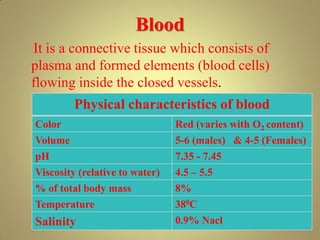
It is a connective tissue which consists of
plasma and formed elements (blood cells)
flowing inside the closed vessels.
Physical characteristics of blood
Color Red (varies with O2 content)
Volume 5-6 (males) & 4-5 (Females)
pH 7.35 - 7.45
Viscosity (relative to water) 4.5 – 5.5
% of total body mass 8%
Temperature 380C
Salinity 0.9% Nacl
Functions of Blood
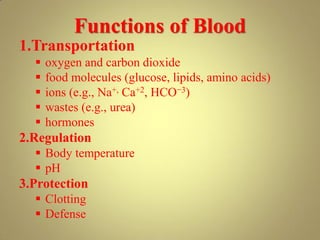
1.Transportation
 oxygen and carbon dioxide
 food molecules (glucose, lipids, amino acids)
 ions (e.g., Na+, Ca+2, HCO−3)
 wastes (e.g., urea)
 hormones
2.Regulation
 Body temperature
 pH
3.Protection
 Clotting
 Defense
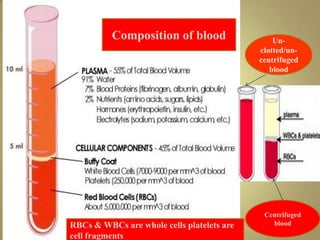
Composition of blood
Centrifuged
bloodRBCs & WBCs are whole cells platelets are
cell fragments
Un-
clotted/un-
centrifuged
blood
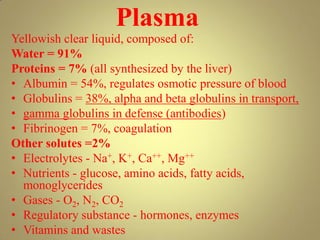
Plasma
Yellowish clear liquid, composed of:
Water = 91%
Proteins = 7% (all synthesized by the liver)
• Albumin = 54%, regulates osmotic pressure of blood
• Globulins = 38%, alpha and beta globulins in transport,
• gamma globulins in defense (antibodies)
• Fibrinogen = 7%, coagulation
Other solutes =2%
• Electrolytes - Na+, K+, Ca++, Mg++
• Nutrients - glucose, amino acids, fatty acids,
monoglycerides
• Gases - O2, N2, CO2
• Regulatory substance - hormones, enzymes
• Vitamins and wastes
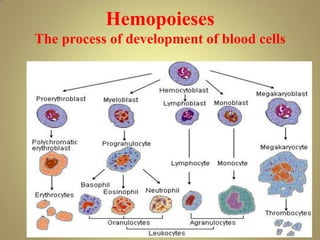
Hemopoieses
The process of development of blood cells
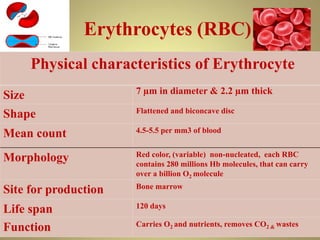
Erythrocytes (RBC)
Physical characteristics of Erythrocyte
Size 7 µm in diameter & 2.2 µm thick
Shape Flattened and biconcave disc
Mean count 4.5-5.5 per mm3 of blood
Morphology Red color, (variable) non-nucleated, each RBC
contains 280 millions Hb molecules, that can carry
over a billion O2 molecule
Site for production Bone marrow
Life span 120 days
Function Carries O2 and nutrients, removes CO2 & wastes
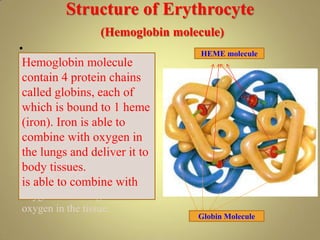
Structure of Erythrocyte
(Hemoglobin molecule)
• HEME molecule
Globin Molecule
Hemoglobin molecule
contain 4 protein chains
called globins, each of
which is bound to 1 heme
(iron). Iron is able to
combine with oxygen in
the lungs and deliver it to
body tissues.
is able to combine with
oxygen in the lung and release
oxygen in the tissue.
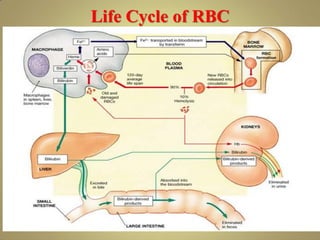
Life Cycle of RBC
• http://highered.mheducation.com/sites/007250
7470/student_view0/chapter19/animation__he
moglobin_breakdown.html
Life Cycle of RBC
• Macrophage in spleen & liver, phagocytize RBC &
split heme & globin
• Globin broken into amino acids to be reused
• Fe removed from heme & attaches to transferrin
• Fe-transferrin → red marrow → Hb synthesis
• Erythropoiesis in red marrow
• Fe removed from heme → non-Fe portion →
biliverdin →bilirubin →bile → GI tract
• Bilirubin →urobilinogen in large intestine →some
urobilinogen →blood → urobilin → yellow pigment in
urine
• Most urobilinogen → feces → as brown pigment
stercobilin
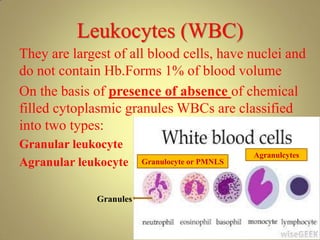
Leukocytes (WBC)
They are largest of all blood cells, have nuclei and
do not contain Hb.Forms 1% of blood volume
On the basis of presence of absence of chemical
filled cytoplasmic granules WBCs are classified
into two types:
Granular leukocyte
Agranular leukocyte
Granules
Granulocyte or PMNLS
Agranulcytes
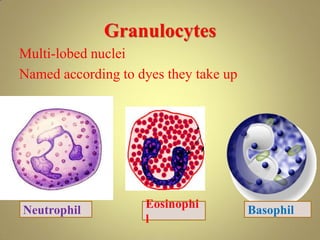
Granulocytes
Multi-lobed nuclei
Named according to dyes they take up
BasophilNeutrophil Eosinophi
l
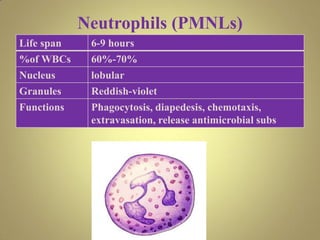
Neutrophils (PMNLs)
Life span 6-9 hours
%of WBCs 60%-70%
Nucleus lobular
Granules Reddish-violet
Functions Phagocytosis, diapedesis, chemotaxis,
extravasation, release antimicrobial subs
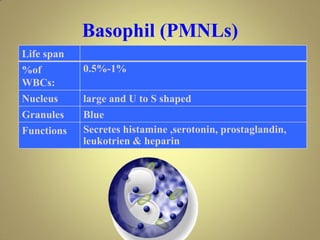
Basophil (PMNLs)
Life span
%of
WBCs:
0.5%-1%
Nucleus large and U to S shaped
Granules Blue
Functions Secretes histamine ,serotonin, prostaglandin,
leukotrien & heparin
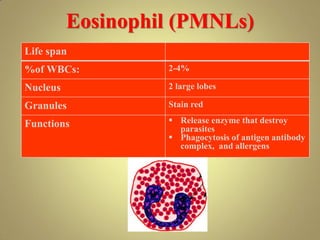
Eosinophil (PMNLs)
Life span
%of WBCs: 2-4%
Nucleus 2 large lobes
Granules Stain red
Functions  Release enzyme that destroy
parasites
 Phagocytosis of antigen antibody
complex, and allergens
Agranulocytes
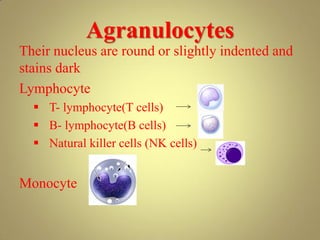
Their nucleus are round or slightly indented and
stains dark
Lymphocyte
 T- lymphocyte(T cells)
 B- lymphocyte(B cells)
 Natural killer cells (NK cells)
Monocyte
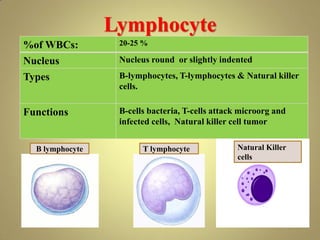
Lymphocyte
%of WBCs: 20-25 %
Nucleus Nucleus round or slightly indented
Types B-lymphocytes, T-lymphocytes & Natural killer
cells.
Functions B-cells bacteria, T-cells attack microorg and
infected cells, Natural killer cell tumor
B lymphocyte T lymphocyte Natural Killer
cells
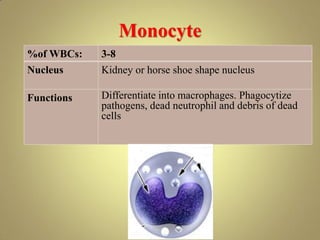
Monocyte
%of WBCs: 3-8
Nucleus Kidney or horse shoe shape nucleus
Functions Differentiate into macrophages. Phagocytize
pathogens, dead neutrophil and debris of dead
cells
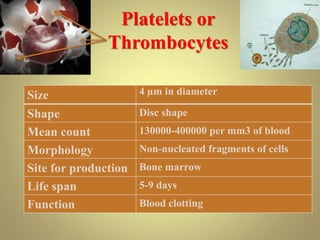
Platelets or
Thrombocytes
Size 4 µm in diameter
Shape Disc shape
Mean count 130000-400000 per mm3 of blood
Morphology Non-nucleated fragments of cells
Site for production Bone marrow
Life span 5-9 days
Function Blood clotting
Hemostasis/Haemostasis
Heamostasis or cessation of bleeding takes
place through a series of responses, these
include.
• Vasospasm
• Platelet plug formation:
• Coagulation
Follow the sequence to events initiated
when platelets come into contact with an
injured surface
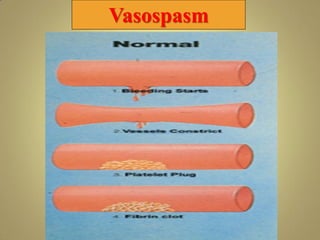
Vasospasm
• Vessel wall constricts for a short period
• Platelets (sticky) adhere to the injured wall
• Platelets change their shape
• Platelets (activated) release serotonin that constrict
the vessel
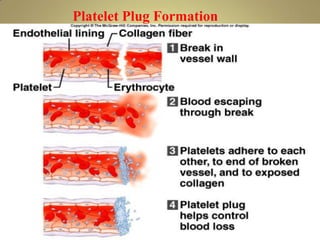
Platelet Plug formation
• Passing platelets stick to the site and release
chemicals that attract more platelets.
• More platelets move leading to platelets
aggregation (positive feedback.
• Platelets form a plug or a temporary seal
within six minutes.
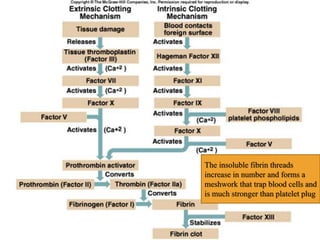
Coagulation
• Thromboplastin (TP) or tissue factor released
by damaged tissue cells.
• TP activates (through series of chemical
reactions) the inactive clotting factors already
present in the blood.
• Prothrombin activato, first step in final
common pathway.
This final common pathway can be initiated by
two processes usually occurring together…
The insoluble fibrin threads
increase in number and forms a
meshwork that trap blood cells and
is much stronger than platelet plug
Vasospasm
Platelet Plug Formation
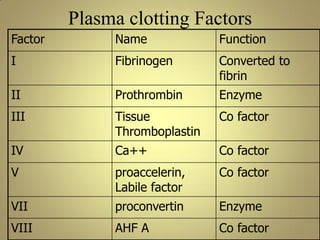
Plasma clotting Factors
Factor Name Function
I Fibrinogen Converted to
fibrin
II Prothrombin Enzyme
III Tissue
Thromboplastin
Co factor
IV Ca++ Co factor
V proaccelerin,
Labile factor
Co factor
VII proconvertin Enzyme
VIII AHF A Co factor
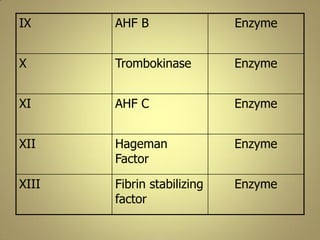
IX AHF B Enzyme
X Trombokinase Enzyme
XI AHF C Enzyme
XII Hageman
Factor
Enzyme
XIII Fibrin stabilizing
factor
Enzyme
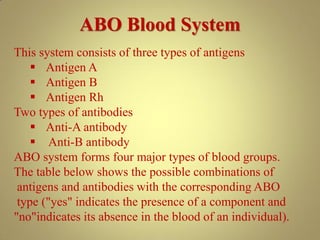
ABO Blood System
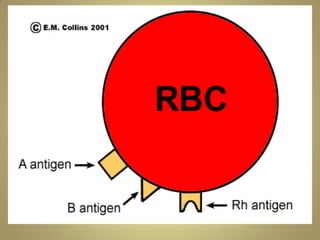
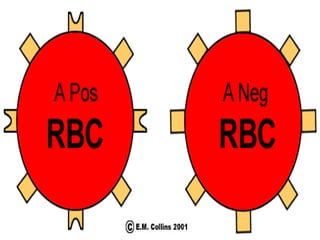
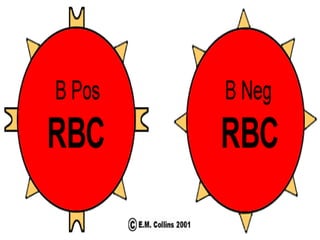
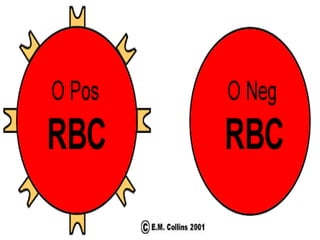
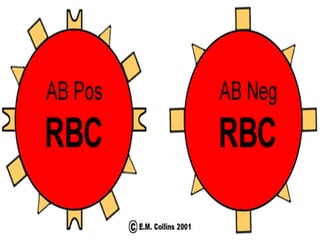
This system consists of three types of antigens
 Antigen A
 Antigen B
 Antigen Rh
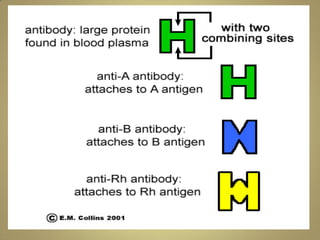
Two types of antibodies
 Anti-A antibody
 Anti-B antibody
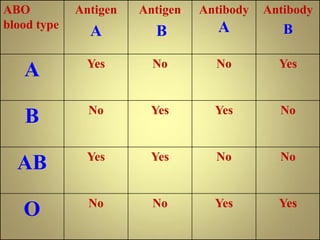
ABO system forms four major types of blood groups.
The table below shows the possible combinations of
antigens and antibodies with the corresponding ABO
type ("yes" indicates the presence of a component and
"no"indicates its absence in the blood of an individual).
ABO
blood type
Antigen
A
Antigen
B
Antibody
A
Antibody
B
A Yes No No Yes
B No Yes Yes No
AB Yes Yes No No
O No No Yes Yes
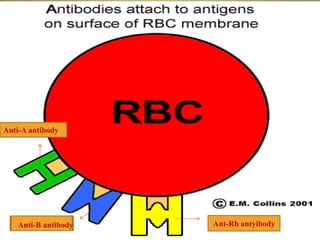
Anti-A antibody
Anti-B antibody Ant-Rh antyibody
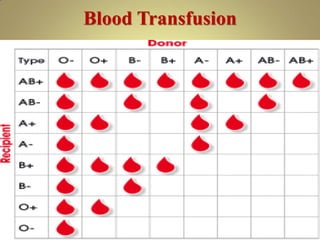
Blood Transfusion
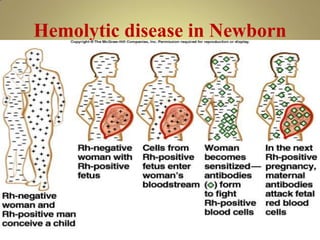
Hemolytic disease in Newborn
Blood ppt for students 2015

Blood ppt for students 2015

  • 1.
    Blood S Naghma Rizvi March,2015. Acknowledgement :Muhammad Nisar
  • 2.
    Objectives  Define blood,its general properties and function.  Explain the composition.  Describe the formation of Blood cells  Discuss the structure and functions of blood cells  RBC (Erythrocytes)  WBC (Leukocytes)  Platelets (thrombocytes  Discuss the composition of plasma  Describe the three mechanism that contribute towards hemostasis  Briefly discuss the ABO blood groups and Rh factor.
  • 3.
    Blood It is aconnective tissue which consists of plasma and formed elements (blood cells) flowing inside the closed vessels. Physical characteristics of blood Color Red (varies with O2 content) Volume 5-6 (males) & 4-5 (Females) pH 7.35 - 7.45 Viscosity (relative to water) 4.5 – 5.5 % of total body mass 8% Temperature 380C Salinity 0.9% Nacl
  • 4.
    Functions of Blood 1.Transportation oxygen and carbon dioxide  food molecules (glucose, lipids, amino acids)  ions (e.g., Na+, Ca+2, HCO−3)  wastes (e.g., urea)  hormones 2.Regulation  Body temperature  pH 3.Protection  Clotting  Defense
  • 5.
    Composition of blood Centrifuged bloodRBCs& WBCs are whole cells platelets are cell fragments Un- clotted/un- centrifuged blood
  • 6.
    Plasma Yellowish clear liquid,composed of: Water = 91% Proteins = 7% (all synthesized by the liver) • Albumin = 54%, regulates osmotic pressure of blood • Globulins = 38%, alpha and beta globulins in transport, • gamma globulins in defense (antibodies) • Fibrinogen = 7%, coagulation Other solutes =2% • Electrolytes - Na+, K+, Ca++, Mg++ • Nutrients - glucose, amino acids, fatty acids, monoglycerides • Gases - O2, N2, CO2 • Regulatory substance - hormones, enzymes • Vitamins and wastes
  • 7.
    Hemopoieses The process ofdevelopment of blood cells
  • 8.
    Erythrocytes (RBC) Physical characteristicsof Erythrocyte Size 7 µm in diameter & 2.2 µm thick Shape Flattened and biconcave disc Mean count 4.5-5.5 per mm3 of blood Morphology Red color, (variable) non-nucleated, each RBC contains 280 millions Hb molecules, that can carry over a billion O2 molecule Site for production Bone marrow Life span 120 days Function Carries O2 and nutrients, removes CO2 & wastes
  • 9.
    Structure of Erythrocyte (Hemoglobinmolecule) • HEME molecule Globin Molecule Hemoglobin molecule contain 4 protein chains called globins, each of which is bound to 1 heme (iron). Iron is able to combine with oxygen in the lungs and deliver it to body tissues. is able to combine with oxygen in the lung and release oxygen in the tissue.
  • 10.
  • 11.
  • 12.
    Life Cycle ofRBC • Macrophage in spleen & liver, phagocytize RBC & split heme & globin • Globin broken into amino acids to be reused • Fe removed from heme & attaches to transferrin • Fe-transferrin → red marrow → Hb synthesis • Erythropoiesis in red marrow • Fe removed from heme → non-Fe portion → biliverdin →bilirubin →bile → GI tract • Bilirubin →urobilinogen in large intestine →some urobilinogen →blood → urobilin → yellow pigment in urine • Most urobilinogen → feces → as brown pigment stercobilin
  • 13.
    Leukocytes (WBC) They arelargest of all blood cells, have nuclei and do not contain Hb.Forms 1% of blood volume On the basis of presence of absence of chemical filled cytoplasmic granules WBCs are classified into two types: Granular leukocyte Agranular leukocyte Granules Granulocyte or PMNLS Agranulcytes
  • 14.
    Granulocytes Multi-lobed nuclei Named accordingto dyes they take up BasophilNeutrophil Eosinophi l
  • 15.
    Neutrophils (PMNLs) Life span6-9 hours %of WBCs 60%-70% Nucleus lobular Granules Reddish-violet Functions Phagocytosis, diapedesis, chemotaxis, extravasation, release antimicrobial subs
  • 16.
    Basophil (PMNLs) Life span %of WBCs: 0.5%-1% Nucleuslarge and U to S shaped Granules Blue Functions Secretes histamine ,serotonin, prostaglandin, leukotrien & heparin
  • 17.
    Eosinophil (PMNLs) Life span %ofWBCs: 2-4% Nucleus 2 large lobes Granules Stain red Functions  Release enzyme that destroy parasites  Phagocytosis of antigen antibody complex, and allergens
  • 18.
    Agranulocytes Their nucleus areround or slightly indented and stains dark Lymphocyte  T- lymphocyte(T cells)  B- lymphocyte(B cells)  Natural killer cells (NK cells) Monocyte
  • 19.
    Lymphocyte %of WBCs: 20-25% Nucleus Nucleus round or slightly indented Types B-lymphocytes, T-lymphocytes & Natural killer cells. Functions B-cells bacteria, T-cells attack microorg and infected cells, Natural killer cell tumor B lymphocyte T lymphocyte Natural Killer cells
  • 20.
    Monocyte %of WBCs: 3-8 NucleusKidney or horse shoe shape nucleus Functions Differentiate into macrophages. Phagocytize pathogens, dead neutrophil and debris of dead cells
  • 21.
    Platelets or Thrombocytes Size 4µm in diameter Shape Disc shape Mean count 130000-400000 per mm3 of blood Morphology Non-nucleated fragments of cells Site for production Bone marrow Life span 5-9 days Function Blood clotting
  • 22.
    Hemostasis/Haemostasis Heamostasis or cessationof bleeding takes place through a series of responses, these include. • Vasospasm • Platelet plug formation: • Coagulation Follow the sequence to events initiated when platelets come into contact with an injured surface
  • 23.
    Vasospasm • Vessel wallconstricts for a short period • Platelets (sticky) adhere to the injured wall • Platelets change their shape • Platelets (activated) release serotonin that constrict the vessel
  • 24.
    Platelet Plug formation •Passing platelets stick to the site and release chemicals that attract more platelets. • More platelets move leading to platelets aggregation (positive feedback. • Platelets form a plug or a temporary seal within six minutes.
  • 25.
    Coagulation • Thromboplastin (TP)or tissue factor released by damaged tissue cells. • TP activates (through series of chemical reactions) the inactive clotting factors already present in the blood. • Prothrombin activato, first step in final common pathway. This final common pathway can be initiated by two processes usually occurring together…
  • 26.
    The insoluble fibrinthreads increase in number and forms a meshwork that trap blood cells and is much stronger than platelet plug
  • 27.
  • 28.
  • 29.
    Plasma clotting Factors FactorName Function I Fibrinogen Converted to fibrin II Prothrombin Enzyme III Tissue Thromboplastin Co factor IV Ca++ Co factor V proaccelerin, Labile factor Co factor VII proconvertin Enzyme VIII AHF A Co factor
  • 30.
    IX AHF BEnzyme X Trombokinase Enzyme XI AHF C Enzyme XII Hageman Factor Enzyme XIII Fibrin stabilizing factor Enzyme
  • 31.
    ABO Blood System Thissystem consists of three types of antigens  Antigen A  Antigen B  Antigen Rh Two types of antibodies  Anti-A antibody  Anti-B antibody ABO system forms four major types of blood groups. The table below shows the possible combinations of antigens and antibodies with the corresponding ABO type ("yes" indicates the presence of a component and "no"indicates its absence in the blood of an individual).
  • 32.
    ABO blood type Antigen A Antigen B Antibody A Antibody B A YesNo No Yes B No Yes Yes No AB Yes Yes No No O No No Yes Yes
  • 35.
  • 40.
  • 41.