Success is a journey.
It is a direction not a destination
Good
“Nobody want to lose the power
of the sun in their mind, Because
we all like Sunshine”
21st century Innovative Pedagogy
Its importance in Teacher
Education
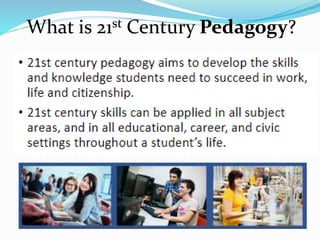
What is 21st Century Pedagogy?
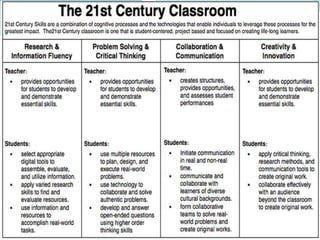
21St Century Skills
 Critical thinking, problem solving, reasoning
 Research skills and practices
 Creativity, curiosity, Imagination, Innovation
 Perseverance, Self- direction, planning
 Oral and Written communication, public speaking and
presenting, listening
 Leadership, teamwork, collaboration
 Information and Communication Technology(ICT), media
and Internet literacy, data interpretation and analysis,
programming
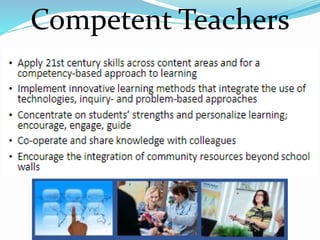
Competent Teachers
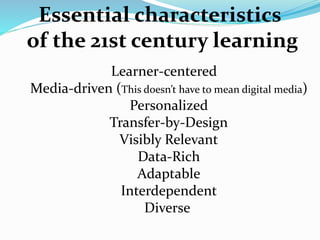
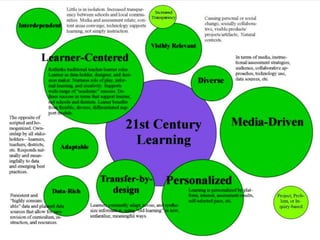
Essential characteristics
of the 21st century learning
Learner-centered
Media-driven (This doesn’t have to mean digital media)
Personalized
Transfer-by-Design
Visibly Relevant
Data-Rich
Adaptable
Interdependent
Diverse
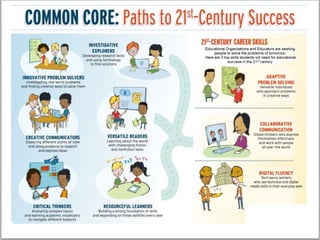
The Key Skills that lead to 21st
century success.
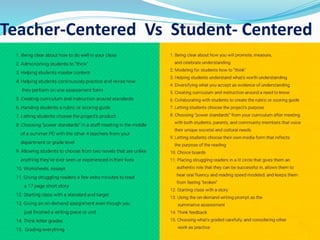
Teacher-Centered Vs Student- Centered
Language Teaching
 As a basis for all communication, language in the educational
set-up is of vital importance in putting across developmental
thoughts, information and data. ... A common language not only
helps develop one's linguistic skills, but also expands the
cognitive (thinking) abilities of an individual.
 Teaching Language Skills:
There are different ways of teaching the 4 language skills, which
are Reading, Listening, Writing and Speaking. Students can
encounter various difficulties in these different skills. They will
make mistakes in English pronunciation, grammar, syntax,
vocabulary usage, and spelling.
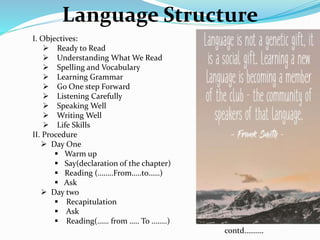
Language Structure
I. Objectives:
 Ready to Read
 Understanding What We Read
 Spelling and Vocabulary
 Learning Grammar
 Go One step Forward
 Listening Carefully
 Speaking Well
 Writing Well
 Life Skills
II. Procedure
 Day One
 Warm up
 Say(declaration of the chapter)
 Reading (……..From…..to……)
 Ask
 Day two
 Recapitulation
 Ask
 Reading(…… from ….. To ……..)
contd……….
 Day Three
 Spelling and Vocabulary
 Day Four
 Learning Grammar
 Day Five
 Learning Grammar
 Day Six
 Listening carefully
 Day seven
 Speaking well
 Writing Well
 Day Eight
 Life skills
Basically, the language of curriculum is used to attain the goals set by
the language of education. Inside a classroom, language is mainly
used to share ideas between the teacher and the students. Teacher
uses language to give the students knowledge and students
use language to earn knowledge.
Mathematics Teaching
 Our daily tasks include planning lessons, creating sample
problems, giving assignments, and writing tests.
 Without math, you may not have enough food (or have too
much food) to feed your guests.
 Math helps us have better problem-solving skills.
 Math helps us think analytically and have better reasoning
abilities. Analytical and reasoning skills are important because
they help us solve problems and look for solutions.
 Math is difficult because :
 it is a very abstract subject. For students, learning usually happens best
when they can relate it to real life. As math becomes more advanced and
challenging, that can be difficult to do. As a result, many students find
themselves needing to work harder and practice longer to understand more
abstract math concepts.
 We teach mathematics because :
 it provides opportunities for developing important intel- lectual skills in
problem solving, deductive and inductive reasoning, creative thinking and
communication.
 Mathematics is a part of the school curriculum :
 Mathematics provides an effective way of building mental discipline and
encourages logical reasoning and mental rigor.
 In addition, mathematical knowledge plays a crucial role in understanding
the contents of other school subjects such as science, social studies, and even
music and art.
Mathematics Structure
Learning Objectives(Factors And Multiples)
Vocabulary
Teaching Ideas
 Group activity (factor Game / making factor tree)
 Individual project
 Pair activity( Divisibility Test)
Common error (Errors & Correction)
Science Teaching
 It helps to Teach scientific ways of thinking.
 Actively involve students in their own learning.
 Help students to develop a conceptual framework as
well as to develop problem solving skills.
 Promote student discussion and group activities.
 Help students experience science in varied, interesting,
and enjoyable ways.
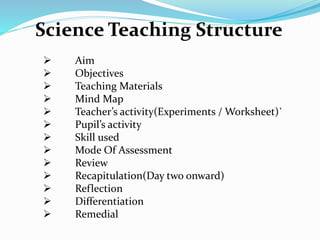
Science Teaching Structure
 Aim
 Objectives
 Teaching Materials
 Mind Map
 Teacher’s activity(Experiments / Worksheet)`
 Pupil’s activity
 Skill used
 Mode Of Assessment
 Review
 Recapitulation(Day two onward)
 Reflection
 Differentiation
 Remedial
Who are We?
• Facilitator (Nursery to Std. 7)
• Guide (Std. 8 – Std. 10)
• Mentor ( Std. 11 & Std. 12)
Books are the Media, We
are the Facilitators to
Impart the Knowledge.
A Wonderful
Day!
Unavoidable and Most Essential Tool of a Teacher
Neuroscience Psychologist
&
Brain Science Facilitator
Memory expert Trainer.
www.imaginativebrainscience.in
Ms. Bandana Pradhan
M.Sc-Physics(National Institute Of Technology- Jamshedpur)
MFA(Chandigarh University)
M.Ed(Gulbarga University)
MA- English (Dr B.R. Ambedkar University)
Pedagogy for effective use of ICT for school teachers- IIT BombayX
Advance English Diploma – World English Institute (United States
of America)

21st century innovative pedagogy

  • 1.
    Success is ajourney. It is a direction not a destination Good
  • 3.
    “Nobody want tolose the power of the sun in their mind, Because we all like Sunshine”
  • 4.
    21st century InnovativePedagogy Its importance in Teacher Education
  • 5.
    What is 21stCentury Pedagogy?
  • 7.
    21St Century Skills Critical thinking, problem solving, reasoning  Research skills and practices  Creativity, curiosity, Imagination, Innovation  Perseverance, Self- direction, planning  Oral and Written communication, public speaking and presenting, listening  Leadership, teamwork, collaboration  Information and Communication Technology(ICT), media and Internet literacy, data interpretation and analysis, programming
  • 8.
  • 10.
    Essential characteristics of the21st century learning Learner-centered Media-driven (This doesn’t have to mean digital media) Personalized Transfer-by-Design Visibly Relevant Data-Rich Adaptable Interdependent Diverse
  • 12.
    The Key Skillsthat lead to 21st century success.
  • 14.
  • 15.
    Language Teaching  Asa basis for all communication, language in the educational set-up is of vital importance in putting across developmental thoughts, information and data. ... A common language not only helps develop one's linguistic skills, but also expands the cognitive (thinking) abilities of an individual.  Teaching Language Skills: There are different ways of teaching the 4 language skills, which are Reading, Listening, Writing and Speaking. Students can encounter various difficulties in these different skills. They will make mistakes in English pronunciation, grammar, syntax, vocabulary usage, and spelling.
  • 16.
    Language Structure I. Objectives: Ready to Read  Understanding What We Read  Spelling and Vocabulary  Learning Grammar  Go One step Forward  Listening Carefully  Speaking Well  Writing Well  Life Skills II. Procedure  Day One  Warm up  Say(declaration of the chapter)  Reading (……..From…..to……)  Ask  Day two  Recapitulation  Ask  Reading(…… from ….. To ……..) contd……….
  • 17.
     Day Three Spelling and Vocabulary  Day Four  Learning Grammar  Day Five  Learning Grammar  Day Six  Listening carefully  Day seven  Speaking well  Writing Well  Day Eight  Life skills Basically, the language of curriculum is used to attain the goals set by the language of education. Inside a classroom, language is mainly used to share ideas between the teacher and the students. Teacher uses language to give the students knowledge and students use language to earn knowledge.
  • 19.
    Mathematics Teaching  Ourdaily tasks include planning lessons, creating sample problems, giving assignments, and writing tests.  Without math, you may not have enough food (or have too much food) to feed your guests.  Math helps us have better problem-solving skills.  Math helps us think analytically and have better reasoning abilities. Analytical and reasoning skills are important because they help us solve problems and look for solutions.
  • 20.
     Math isdifficult because :  it is a very abstract subject. For students, learning usually happens best when they can relate it to real life. As math becomes more advanced and challenging, that can be difficult to do. As a result, many students find themselves needing to work harder and practice longer to understand more abstract math concepts.  We teach mathematics because :  it provides opportunities for developing important intel- lectual skills in problem solving, deductive and inductive reasoning, creative thinking and communication.  Mathematics is a part of the school curriculum :  Mathematics provides an effective way of building mental discipline and encourages logical reasoning and mental rigor.  In addition, mathematical knowledge plays a crucial role in understanding the contents of other school subjects such as science, social studies, and even music and art.
  • 21.
    Mathematics Structure Learning Objectives(FactorsAnd Multiples) Vocabulary Teaching Ideas  Group activity (factor Game / making factor tree)  Individual project  Pair activity( Divisibility Test) Common error (Errors & Correction)
  • 22.
    Science Teaching  Ithelps to Teach scientific ways of thinking.  Actively involve students in their own learning.  Help students to develop a conceptual framework as well as to develop problem solving skills.  Promote student discussion and group activities.  Help students experience science in varied, interesting, and enjoyable ways.
  • 24.
    Science Teaching Structure Aim  Objectives  Teaching Materials  Mind Map  Teacher’s activity(Experiments / Worksheet)`  Pupil’s activity  Skill used  Mode Of Assessment  Review  Recapitulation(Day two onward)  Reflection  Differentiation  Remedial
  • 26.
  • 27.
    • Facilitator (Nurseryto Std. 7) • Guide (Std. 8 – Std. 10) • Mentor ( Std. 11 & Std. 12)
  • 28.
    Books are theMedia, We are the Facilitators to Impart the Knowledge.
  • 32.
  • 34.
    Unavoidable and MostEssential Tool of a Teacher
  • 37.
    Neuroscience Psychologist & Brain ScienceFacilitator Memory expert Trainer. www.imaginativebrainscience.in Ms. Bandana Pradhan M.Sc-Physics(National Institute Of Technology- Jamshedpur) MFA(Chandigarh University) M.Ed(Gulbarga University) MA- English (Dr B.R. Ambedkar University) Pedagogy for effective use of ICT for school teachers- IIT BombayX Advance English Diploma – World English Institute (United States of America)