R. T. Patil
Central Institute of Agricultural Engineering,
Bhopal (MP)
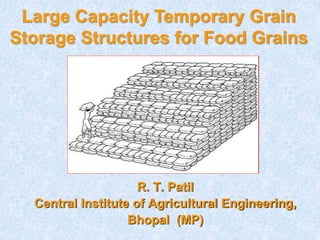
Large Capacity Temporary Grain
Storage Structures for Food Grains
Temporary Grain Storage in India
•FCI and state agencies stored 23.08 lakh
tonnes and 144.97 lakh tonnes, respectively in
2010 and the damaged grain in CAP was 716
metric tonne in 2010
•Storage gap (deficit) to the tune of 12-14
MMT.
•The efficient alternative to CAP is necessary
to meet the growing demand for storage and
reduction of storage losses
Grain Quality in Storage
•Optimum storage conditions of moistures less than
12% mc and temperatures less than 30°C will not
deteriorate during storage over a season.
Higher temperature problems are:
1) Development of hot-spots,
2) Moisture migration from warmer to cooler grain
causing caking,
3) Mould development in over-moisture grain
4) Decrease in seed germination
5) Decrease in malting quality of barley,
6) Decrease in baking and milling quality of wheat,
7) Colour deterioration of pulses and
8) Rancidity in oilseeds
Conditions in Temporary Storage
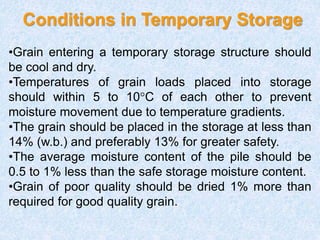
•Grain entering a temporary storage structure should
be cool and dry.
•Temperatures of grain loads placed into storage
should within 5 to 10°C of each other to prevent
moisture movement due to temperature gradients.
•The grain should be placed in the storage at less than
14% (w.b.) and preferably 13% for greater safety.
•The average moisture content of the pile should be
0.5 to 1% less than the safe storage moisture content.
•Grain of poor quality should be dried 1% more than
required for good quality grain.
Grain Aeration
•Aeration is necessary, if more than 50 MT grain is
stored for longer than 2 months.
•Aeration rates of at least 0.04 m3 per minute per MT
should be provided.
•Provide two or three smaller fans and ducts to obtain
proper air distribution in flat storage structures.
•Aeration ducts of 30 cm or larger dia. corrugated drain
pipes are used in temporary structures.
•The drainpipe is covered with cloth to prevent grain from
plugging the openings.
•The number of fans and aeration ducts depends on the
grain type and dimensions of the grain pile.
Temporary Storage Structures used
Worldwide
•The CAP storage
•Grain Storage Rings
•Flexible silos
•Underground storage/Bunker storage
•Prefabricated relocatable warehouses
•Cocoons
•Airwarehouses
•lat Grain Storage
•Large Plastic Membrane Bags
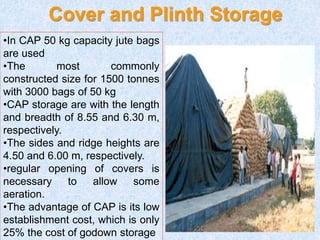
•In CAP 50 kg capacity jute bags
are used
•The most commonly
constructed size for 1500 tonnes
with 3000 bags of 50 kg
•CAP storage are with the length
and breadth of 8.55 and 6.30 m,
respectively.
•The sides and ridge heights are
4.50 and 6.00 m, respectively.
•regular opening of covers is
necessary to allow some
aeration.
•The advantage of CAP is its low
establishment cost, which is only
25% the cost of godown storage
Cover and Plinth Storage
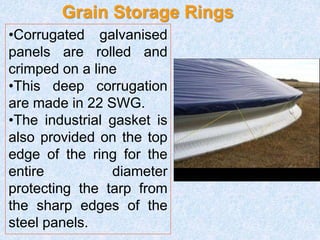
Grain Storage Rings
•Corrugated galvanised
panels are rolled and
crimped on a line
•This deep corrugation
are made in 22 SWG.
•The industrial gasket is
also provided on the top
edge of the ring for the
entire diameter
protecting the tarp from
the sharp edges of the
steel panels.
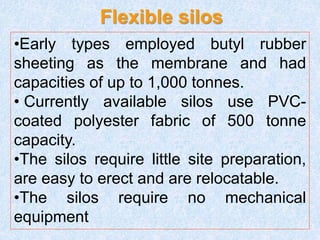
Flexible silos
•Early types employed butyl rubber
sheeting as the membrane and had
capacities of up to 1,000 tonnes.
• Currently available silos use PVC-
coated polyester fabric of 500 tonne
capacity.
•The silos require little site preparation,
are easy to erect and are relocatable.
•The silos require no mechanical
equipment
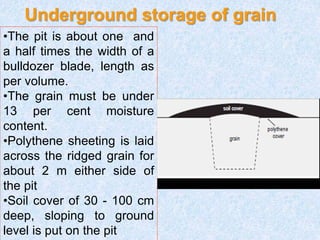
Underground storage of grain
•The pit is about one and
a half times the width of a
bulldozer blade, length as
per volume.
•The grain must be under
13 per cent moisture
content.
•Polythene sheeting is laid
across the ridged grain for
about 2 m either side of
the pit
•Soil cover of 30 - 100 cm
deep, sloping to ground
level is put on the pit
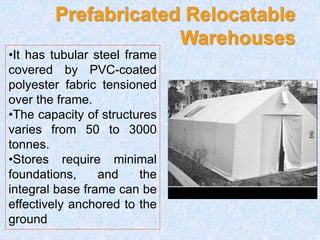
Prefabricated Relocatable
Warehouses
•It has tubular steel frame
covered by PVC-coated
polyester fabric tensioned
over the frame.
•The capacity of structures
varies from 50 to 3000
tonnes.
•Stores require minimal
foundations, and the
integral base frame can be
effectively anchored to the
ground
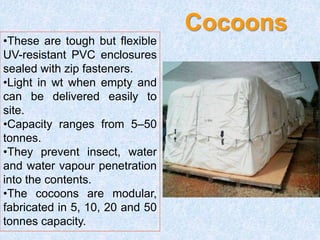
Cocoons
•These are tough but flexible
UV-resistant PVC enclosures
sealed with zip fasteners.
•Light in wt when empty and
can be delivered easily to
site.
•Capacity ranges from 5–50
tonnes.
•They prevent insect, water
and water vapour penetration
into the contents.
•The cocoons are modular,
fabricated in 5, 10, 20 and 50
tonnes capacity.
Airwarehouses
•Airwarehouses are kept erect by pressure of
forced ventilation.
•Once erected and working satisfactorily, bagged
produce can be moved in and out of the buildings
easily.
•Each warehouse typically has a capacity of 2000–
5000 tonnes.
•Constant flow of air keeps the interior free of
condensation and moisture and the structure's
coated fabric provides protection from ultraviolet
radiation.
•Constant power supply is necessary to keep the
structure inflated and erect.
Flat Grain Storage
•These are modular flat grain storage bunkers.
•These grain bunkers come in up to 5 million
bushels capacity and are very economical for
storage of corn, wheat, canola and other grains.
•Precast exterior concrete walls are erected
from 1.5 m to 6.5 m height.
•The optional aeration system having Z shaped
tubes is connected through the wall flushed with
the floor.
Large Plastic Membrane Bags
•The system is very cost
competitive in
comparison to other
storage options.
•This system of storage
offers a low investment
storage system that can
be quite effective on farm
in several scenarios.
• The polymer bag is
described as a hermetic
type of storage system.
Major Recommendations
•The color of the polyethylene used in
traditional CAP storage should be changed to
white.
•The prefabricated relocatable warehouses
may be installed on the railway platforms
where the grain need to kept for transit
•In grain mandies the harvest bags and rings
may be explored to avoid the damage to the
grain due to sudden rain during harvest
season.
•Investigations may be undertaken to test the
suitability of structures for Indian conditions
Modern Technologies for Food
Storage are essential for
reducing the post harvest
losses and increasing the
profitability of farmers

Large capacity temporary grain storage structures for food grains

  • 1.
    R. T. Patil CentralInstitute of Agricultural Engineering, Bhopal (MP) Large Capacity Temporary Grain Storage Structures for Food Grains
  • 2.
    Temporary Grain Storagein India •FCI and state agencies stored 23.08 lakh tonnes and 144.97 lakh tonnes, respectively in 2010 and the damaged grain in CAP was 716 metric tonne in 2010 •Storage gap (deficit) to the tune of 12-14 MMT. •The efficient alternative to CAP is necessary to meet the growing demand for storage and reduction of storage losses
  • 3.
    Grain Quality inStorage •Optimum storage conditions of moistures less than 12% mc and temperatures less than 30°C will not deteriorate during storage over a season. Higher temperature problems are: 1) Development of hot-spots, 2) Moisture migration from warmer to cooler grain causing caking, 3) Mould development in over-moisture grain 4) Decrease in seed germination 5) Decrease in malting quality of barley, 6) Decrease in baking and milling quality of wheat, 7) Colour deterioration of pulses and 8) Rancidity in oilseeds
  • 4.
    Conditions in TemporaryStorage •Grain entering a temporary storage structure should be cool and dry. •Temperatures of grain loads placed into storage should within 5 to 10°C of each other to prevent moisture movement due to temperature gradients. •The grain should be placed in the storage at less than 14% (w.b.) and preferably 13% for greater safety. •The average moisture content of the pile should be 0.5 to 1% less than the safe storage moisture content. •Grain of poor quality should be dried 1% more than required for good quality grain.
  • 5.
    Grain Aeration •Aeration isnecessary, if more than 50 MT grain is stored for longer than 2 months. •Aeration rates of at least 0.04 m3 per minute per MT should be provided. •Provide two or three smaller fans and ducts to obtain proper air distribution in flat storage structures. •Aeration ducts of 30 cm or larger dia. corrugated drain pipes are used in temporary structures. •The drainpipe is covered with cloth to prevent grain from plugging the openings. •The number of fans and aeration ducts depends on the grain type and dimensions of the grain pile.
  • 6.
    Temporary Storage Structuresused Worldwide •The CAP storage •Grain Storage Rings •Flexible silos •Underground storage/Bunker storage •Prefabricated relocatable warehouses •Cocoons •Airwarehouses •lat Grain Storage •Large Plastic Membrane Bags
  • 7.
    •In CAP 50kg capacity jute bags are used •The most commonly constructed size for 1500 tonnes with 3000 bags of 50 kg •CAP storage are with the length and breadth of 8.55 and 6.30 m, respectively. •The sides and ridge heights are 4.50 and 6.00 m, respectively. •regular opening of covers is necessary to allow some aeration. •The advantage of CAP is its low establishment cost, which is only 25% the cost of godown storage Cover and Plinth Storage
  • 8.
    Grain Storage Rings •Corrugatedgalvanised panels are rolled and crimped on a line •This deep corrugation are made in 22 SWG. •The industrial gasket is also provided on the top edge of the ring for the entire diameter protecting the tarp from the sharp edges of the steel panels.
  • 9.
    Flexible silos •Early typesemployed butyl rubber sheeting as the membrane and had capacities of up to 1,000 tonnes. • Currently available silos use PVC- coated polyester fabric of 500 tonne capacity. •The silos require little site preparation, are easy to erect and are relocatable. •The silos require no mechanical equipment
  • 10.
    Underground storage ofgrain •The pit is about one and a half times the width of a bulldozer blade, length as per volume. •The grain must be under 13 per cent moisture content. •Polythene sheeting is laid across the ridged grain for about 2 m either side of the pit •Soil cover of 30 - 100 cm deep, sloping to ground level is put on the pit
  • 11.
    Prefabricated Relocatable Warehouses •It hastubular steel frame covered by PVC-coated polyester fabric tensioned over the frame. •The capacity of structures varies from 50 to 3000 tonnes. •Stores require minimal foundations, and the integral base frame can be effectively anchored to the ground
  • 12.
    Cocoons •These are toughbut flexible UV-resistant PVC enclosures sealed with zip fasteners. •Light in wt when empty and can be delivered easily to site. •Capacity ranges from 5–50 tonnes. •They prevent insect, water and water vapour penetration into the contents. •The cocoons are modular, fabricated in 5, 10, 20 and 50 tonnes capacity.
  • 13.
    Airwarehouses •Airwarehouses are kepterect by pressure of forced ventilation. •Once erected and working satisfactorily, bagged produce can be moved in and out of the buildings easily. •Each warehouse typically has a capacity of 2000– 5000 tonnes. •Constant flow of air keeps the interior free of condensation and moisture and the structure's coated fabric provides protection from ultraviolet radiation. •Constant power supply is necessary to keep the structure inflated and erect.
  • 14.
    Flat Grain Storage •Theseare modular flat grain storage bunkers. •These grain bunkers come in up to 5 million bushels capacity and are very economical for storage of corn, wheat, canola and other grains. •Precast exterior concrete walls are erected from 1.5 m to 6.5 m height. •The optional aeration system having Z shaped tubes is connected through the wall flushed with the floor.
  • 15.
    Large Plastic MembraneBags •The system is very cost competitive in comparison to other storage options. •This system of storage offers a low investment storage system that can be quite effective on farm in several scenarios. • The polymer bag is described as a hermetic type of storage system.
  • 16.
    Major Recommendations •The colorof the polyethylene used in traditional CAP storage should be changed to white. •The prefabricated relocatable warehouses may be installed on the railway platforms where the grain need to kept for transit •In grain mandies the harvest bags and rings may be explored to avoid the damage to the grain due to sudden rain during harvest season. •Investigations may be undertaken to test the suitability of structures for Indian conditions
  • 17.
    Modern Technologies forFood Storage are essential for reducing the post harvest losses and increasing the profitability of farmers