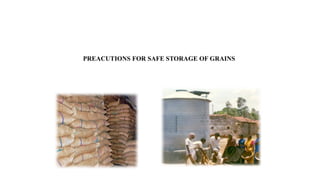
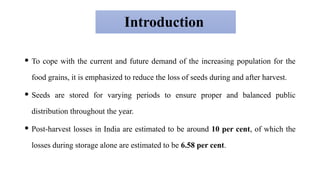
PREACUTIONS FOR SAFE STORAGE OF GRAINS
Introduction
 To cope with the current and future demand of the increasing population for the
food grains, it is emphasized to reduce the loss of seeds during and after harvest.
 Seeds are stored for varying periods to ensure proper and balanced public
distribution throughout the year.
 Post-harvest losses in India are estimated to be around 10 per cent, of which the
losses during storage alone are estimated to be 6.58 per cent.
Best storage performance
1. The produce must be thoroughly cleaned and graded.
2. Dried to the safe storage moisture level of 10-12 % for cereals and
7-9% for oilseeds (on wet basis) for a safe storage period of 6-12
months.
3. Storage structures should to be properly repaired, cleaned and
disinfected.
4. Structures should bear the load of seeds stored and do not permit
contact/ exchange with outside humid air.
5. Structures should be constructed in the coolest part of the house/ farm.
Ideal storage facility should satisfy the
following requirements
1. It should provide maximum possible protection from ground moisture, rain, insect
pests, moulds, rodents, birds, fire etc.,
2. It should provide the necessary facility for inspection, disinfection, loading,
unloading, cleaning and reconditioning.
3. It should protect grain from excessive moisture and temperature favourable to
both insect and mould development.
4. It should be economical and suitable for a particular situation.
STORAGE STRUCTURES
Different types storage structures
1. Conventional storage structures
2. Improved rural - level storage structures
3. Community storage structures
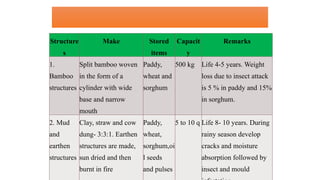
Co nve nti ona l sto rag e st ruc tur es
Structure
s
Make Stored
items
Capacit
y
Remarks
1.
Bamboo
structures
Split bamboo woven
in the form of a
cylinder with wide
base and narrow
mouth
Paddy,
wheat and
sorghum
500 kg Life 4-5 years. Weight
loss due to insect attack
is 5 % in paddy and 15%
in sorghum.
2. Mud
and
earthen
structures
Clay, straw and cow
dung- 3:3:1. Earthen
structures are made,
sun dried and then
burnt in fire
Paddy,
wheat,
sorghum,oi
l seeds
and pulses
5 to 10 q Life 8- 10 years. During
rainy season develop
cracks and moisture
absorption followed by
insect and mould
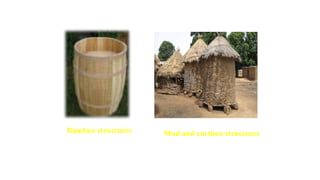
Bamboo structures Mud and earthen structures
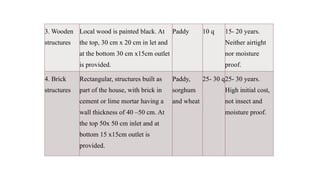
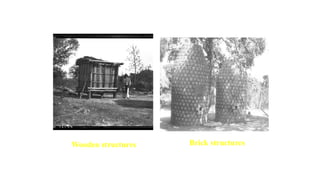
3. Wooden
structures
Local wood is painted black. At
the top, 30 cm x 20 cm in let and
at the bottom 30 cm x15cm outlet
is provided.
Paddy 10 q 15- 20 years.
Neither airtight
nor moisture
proof.
4. Brick
structures
Rectangular, structures built as
part of the house, with brick in
cement or lime mortar having a
wall thickness of 40 –50 cm. At
the top 50x 50 cm inlet and at
bottom 15 x15cm outlet is
provided.
Paddy,
sorghum
and wheat
25- 30 q25- 30 years.
High initial cost,
not insect and
moisture proof.
Wooden structures Brick structures
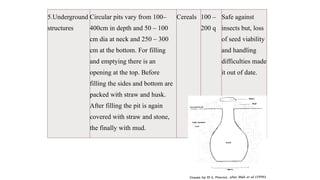
5.Underground
structures
Circular pits vary from 100–
400cm in depth and 50 – 100
cm dia at neck and 250 – 300
cm at the bottom. For filling
and emptying there is an
opening at the top. Before
filling the sides and bottom are
packed with straw and husk.
After filling the pit is again
covered with straw and stone,
the finally with mud.
Cereals 100 –
200 q
Safe against
insects but, loss
of seed viability
and handling
difficulties made
it out of date.
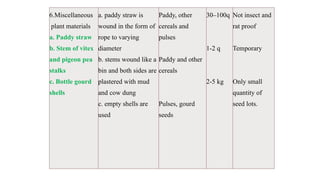
6.Miscellaneous
plant materials
a. Paddy straw
b. Stem of vitex
and pigeon pea
stalks
c. Bottle gourd
shells
a. paddy straw is
wound in the form of
rope to varying
diameter
b. stems wound like a
bin and both sides are
plastered with mud
and cow dung
c. empty shells are
used
Paddy, other
cereals and
pulses
Paddy and other
cereals
Pulses, gourd
seeds
30–100q
1-2 q
2-5 kg
Not insect and
rat proof
Temporary
Only small
quantity of
seed lots.
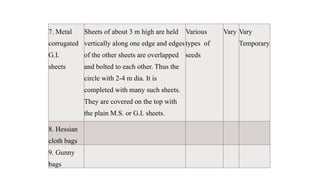
7. Metal
corrugated
G.I.
sheets
Sheets of about 3 m high are held
vertically along one edge and edges
of the other sheets are overlapped
and bolted to each other. Thus the
circle with 2-4 m dia. It is
completed with many such sheets.
They are covered on the top with
the plain M.S. or G.I. sheets.
Various
types of
seeds
Vary Vary
Temporary
8. Hessian
cloth bags
9. Gunny
bags
THANK YOU

practice and precautions-on-seed-storage-1.pptx

  • 2.
    PREACUTIONS FOR SAFESTORAGE OF GRAINS
  • 3.
    Introduction  To copewith the current and future demand of the increasing population for the food grains, it is emphasized to reduce the loss of seeds during and after harvest.  Seeds are stored for varying periods to ensure proper and balanced public distribution throughout the year.  Post-harvest losses in India are estimated to be around 10 per cent, of which the losses during storage alone are estimated to be 6.58 per cent.
  • 4.
    Best storage performance 1.The produce must be thoroughly cleaned and graded. 2. Dried to the safe storage moisture level of 10-12 % for cereals and 7-9% for oilseeds (on wet basis) for a safe storage period of 6-12 months. 3. Storage structures should to be properly repaired, cleaned and disinfected. 4. Structures should bear the load of seeds stored and do not permit contact/ exchange with outside humid air. 5. Structures should be constructed in the coolest part of the house/ farm.
  • 5.
    Ideal storage facilityshould satisfy the following requirements 1. It should provide maximum possible protection from ground moisture, rain, insect pests, moulds, rodents, birds, fire etc., 2. It should provide the necessary facility for inspection, disinfection, loading, unloading, cleaning and reconditioning. 3. It should protect grain from excessive moisture and temperature favourable to both insect and mould development. 4. It should be economical and suitable for a particular situation.
  • 6.
    STORAGE STRUCTURES Different typesstorage structures 1. Conventional storage structures 2. Improved rural - level storage structures 3. Community storage structures
  • 7.
    Co nve ntiona l sto rag e st ruc tur es Structure s Make Stored items Capacit y Remarks 1. Bamboo structures Split bamboo woven in the form of a cylinder with wide base and narrow mouth Paddy, wheat and sorghum 500 kg Life 4-5 years. Weight loss due to insect attack is 5 % in paddy and 15% in sorghum. 2. Mud and earthen structures Clay, straw and cow dung- 3:3:1. Earthen structures are made, sun dried and then burnt in fire Paddy, wheat, sorghum,oi l seeds and pulses 5 to 10 q Life 8- 10 years. During rainy season develop cracks and moisture absorption followed by insect and mould
  • 8.
    Bamboo structures Mudand earthen structures
  • 9.
    3. Wooden structures Local woodis painted black. At the top, 30 cm x 20 cm in let and at the bottom 30 cm x15cm outlet is provided. Paddy 10 q 15- 20 years. Neither airtight nor moisture proof. 4. Brick structures Rectangular, structures built as part of the house, with brick in cement or lime mortar having a wall thickness of 40 –50 cm. At the top 50x 50 cm inlet and at bottom 15 x15cm outlet is provided. Paddy, sorghum and wheat 25- 30 q25- 30 years. High initial cost, not insect and moisture proof.
  • 10.
  • 11.
    5.Underground structures Circular pits varyfrom 100– 400cm in depth and 50 – 100 cm dia at neck and 250 – 300 cm at the bottom. For filling and emptying there is an opening at the top. Before filling the sides and bottom are packed with straw and husk. After filling the pit is again covered with straw and stone, the finally with mud. Cereals 100 – 200 q Safe against insects but, loss of seed viability and handling difficulties made it out of date.
  • 12.
    6.Miscellaneous plant materials a. Paddystraw b. Stem of vitex and pigeon pea stalks c. Bottle gourd shells a. paddy straw is wound in the form of rope to varying diameter b. stems wound like a bin and both sides are plastered with mud and cow dung c. empty shells are used Paddy, other cereals and pulses Paddy and other cereals Pulses, gourd seeds 30–100q 1-2 q 2-5 kg Not insect and rat proof Temporary Only small quantity of seed lots.
  • 13.
    7. Metal corrugated G.I. sheets Sheets ofabout 3 m high are held vertically along one edge and edges of the other sheets are overlapped and bolted to each other. Thus the circle with 2-4 m dia. It is completed with many such sheets. They are covered on the top with the plain M.S. or G.I. sheets. Various types of seeds Vary Vary Temporary 8. Hessian cloth bags 9. Gunny bags
  • 14.