ILCA Training Manual 
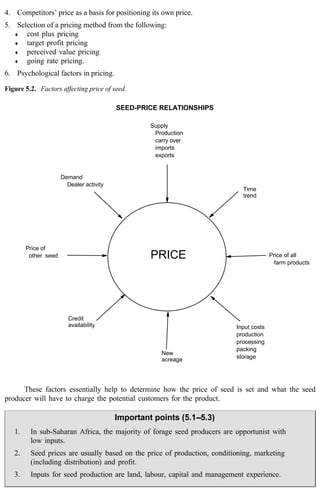
Forage Seed 
Production 
International Livestock Centre for Africa
Correct citation: HSU (Herbage Seed Unit). 1994. Forage Seed Production. ILCA Training Manual. ILCA 
(International Livestock Centre for Africa), Addis Ababa, Ethiopia. 70 pp. 
ISBN 92--9053--293--9
Table of Contents 
Preface 
Chapter 1: Field multiplication 
1.0 Performance objectives 
1.1 Introduction to seed production 
1.2 Seed production systems 
1.3 Site selection 
1.4 Matching the forage to the site 
1.5 The forage plant 
1.6 Crop establishment 
1.7 Crop management 
1.8 Seed harvesting 
1.9 Feedback exercises 
1.10 References/suggested reading 
Chapter 2: Post-harvest seed conditioning 
2.0 Performance objectives 
2.1 Introduction to post-harvest seed conditioning 
2.2 Threshing and winnowing 
2.3 Seed drying 
2.4 Seed cleaning 
2.5 Seed packaging 
2.6 Seed storage 
2.7 Feedback exercises 
2.8 References/suggested reading 
Chapter 3: Seed quality control concepts 
3.0 Performance objectives 
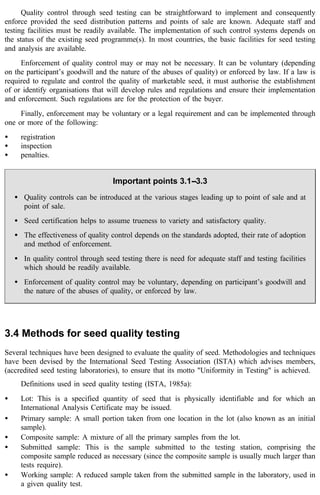
3.1 Introduction to evaluation of seed quality 
3.2 Components of seed quality 
3.3 Seed quality assurance 
3.4 Methods for seed quality testing 
3.5 Introduction to seed certification 
3.6 Introduction to seed legislation 
3.7 Feedback exercises 
3.8 References/suggested reading
Chapter 4: Seed marketing 
4.0 Performance objectives 
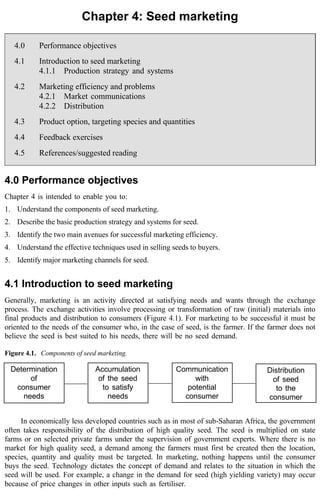
4.1 Introduction to seed marketing 
4.2 Marketing efficiency and problems 
4.3 Product option, targeting species and quantities 
4.4 Feedback exercises 
4.5 References/suggested reading 
Chapter 5: Economics of forage seed production 
5.0 Performance objectives 
5.1 Introduction to seed production economics 
5.2 Inputs for seed production 
5.3 Risks and uncertainty in defining seed demand 
5.4 Feedback exercises 
5.5 References/suggested reading
Preface 
This training manual has been prepared for use by trainees and trainers of forage seed production. 
It is intended as a practical guide to cover some of the basic principles of production of quality 
forage seeds. The manual is our first attempt to bring together the knowledge both within and outside 
ILCA in forage seed production. 
The manual has been developed with input from many ILCA staff and consultants and we 
thank all contributors for their efforts that have allowed us to put together this document. We hope 
that you find it useful and we would be pleased to receive comments and suggestions to improve 
and revise it. 
Director, Training and Information Head, Herbage Seed Unit 
International Livestock Centre for Africa
Chapter 1: Field multiplication 
1.0 Performance objectives 
1.1 Introduction to seed production 
1.2 Seed production systems 
1.2.1. Opportunist systems 
1.2.2. Specialist systems 
1.3 Site selection 
1.3.1 Factors influencing site selection 
1.4 Matching the forage to the site 
1.4.1 Grasses 
1.4.2 Legumes 
1.4.3 Fodder trees 
1.5 The forage plant 
1.5.1 Definition of grass plant parts 
1.5.2 Definition of herbaceous and fodder tree legume plant parts 
1.5.3 The plant life cycle 
1.5.4 Effect of plant type, growth form and perenniality on seed production 
and management 
1.6 Crop establishment 
1.6.1 Establishing a pasture seed crop 
1.6.2 Establishment problems 
1.7 Crop management 
1.7.1 Management of grasses 
1.7.2 Management of forage legumes 
1.8 Seed harvesting 
1.8.1 Harvesting methods 
1.9 Feedback exercises 
1.10 References/suggested reading 
1.0 Performance objectives 
Chapter 1 is intended to enable you to: 
1. Describe the four major systems of seed production in sub-Saharan Africa. 
2. List the important factors for establishing a pasture seed crop and understand the principles of forage 
seed production. 
3. Explain the factors that influence site selection in pasture seed crop production. 
4. State the types of cultivation practices necessary when establishing a pasture seed crop. 
5. Explain why seed production must compete for resources of land, labour and inputs.
6. List the types of seed establishment problems. 
7. Describe the factors to consider in grass and legume seed crop management. 
8. Distinguish the differences between annuals and perennials, shrubs and herbaceous plants and 
determinate versus indeterminate growth forms. 
9. List the major categories of harvesting methods presently available. 
1.1 Introduction to seed production 
Feed shortages and the poor quality of available feed are the major constraints to increased livestock 
productivity in sub-Saharan Africa. Sowing a new pasture or improving an existing natural pasture 
requires a reliable source of seed or vegetative material of species recommended and adapted for the 
area. 
The objective of a forage seed programme is to make available quality seed or vegetative material 
that is suited to farmers’ needs for livestock production. Farmers’ needs are variable depending on 
the environment, type and class of grazing animal and the animal product required. These needs may 
also include forage use for conservation (hay or silage), site stabilisation (erosion) and amenity uses 
(turf). It is therefore necessary to ensure positive consumer reaction to new materials and 
accompanying production techniques to help farmer adoption of these materials. 
In this chapter, the factors in field multiplication are discussed, namely seed production systems, 
site selection, the plant and its growth forms, crop establishment, crop management and harvesting. 
1.2 Seed production systems 
In sub-Saharan Africa (SSA), no single system of seed production is suited to the varying social or 
environmental situations. Current seed production systems can be formal, well developed commercial 
activities involving both the public and private sector. In these systems, the focus is on commercial 
large-scale seed production and marketing. However, forages are not widely sown as crops in 
sub-Saharan Africa and market demand for high quality uniform seeds is very low. This has resulted 
in very few seed companies dealing with forages in the region. Much of the forage seed production 
is in the informal or traditional seed sector where farmers do their own selection and seed production 
to meet their own needs and may also sell or exchange excess seeds within the local community. 
Seed production systems may be categorised as opportunist or specialised with varying degrees of 
mechanisation (Humphreys, 1978). Within these two categories are four major systems of seed 
production. These are: 
· opportunist -- labour intensive 
-- mechanised 
· specialist -- labour intensive 
-- mechanised 
1.2.1 Opportunist systems 
Labour intensive 
This method often involves hand harvesting seed from existing pastures at roadsides, in plantations 
or from other areas and is often part of the informal seed production sector. The method operates 
well in good seasons with plenty of rain that may lead to excellent flowering and seed formation. 
The farmer may gather the seed or hire labour to do the collection. In this system, grass seed may 
be hand stripped into containers or the flowering stems may be cut with a reaping hook or sickle. 
The seed heads are then dried and threshed. Often, farmers may also sweep or rake seeds from the
ground, a method that leads to a high inert matter content (non-seed material), especially if seeds 
are in short supply and have a high market value. 
Although it is possible through the opportunist system to produce seed of high quality at low 
cost, it may have a low germination percentage due to a range of seed maturity caused by differences 
in tiller maturity at harvest. Quality depends on the skill of the grower and timeliness of operations. 
Mechanised 
This system may or may not involve sophisticated or expensive equipment and has been used as an 
alternative source of income by large-scale livestock producers. It does require some degree of grazing 
management. Pastures are not grazed from early summer growth until seed harvest time. However, 
before closure to animals, the pastures are heavily grazed or burnt to encourage profuse tillering. 
Since there is usually plenty of seed and no prior costs of production, the criterion for successful 
harvesting will be the yield of seed harvested per day rather than per hectare especially if the method 
used is contract harvesting, or weather conditions are unfavourable. 
1.2.2 Specialist systems 
Labour intensive 
In this system, the crop is planted for seed production by the farmer. The system works satisfactorily 
only when farmers are offered adequate technical guidance by extension agents to grow the crop and 
are assured of reasonable prices for their produce. Generally, one to three hectares of farmland are 
used by farmers in this system. The system is used for high yields of high quality seed. 
Mechanised 
Farmers practising this system must be highly skilled and knowledgeable about seed crops and their 
management from establishment through to harvest. Such farmers may also process and package their 
seed for distribution although many farmers in this category work on a contract basis to a seed 
organisation or company that has specialised equipment and resources. Seed harvesting, processing 
and sales require a highly organised drying, cleaning and packaging system and the ability to promote 
and market seeds. This system is not advisable for use by smallholder farmers because of the resources 
required. Moreover, the production unit must be larger than usually applied to smallholder farming 
and a greater level of efficiency is required to enjoy a minimum economic return. 
1.3 Site selection 
An important requirement in seed production is for the grower to plant in areas or sites which are 
most likely to support high seed yields. 
Experience has shown that shoot density, the number of seeds formed per flower and the 
percentage harvest recovery of the seed are three of the most important factors contributing to seed 
yield. They are also the most influenced by weather and farming practices. It is not surprising therefore 
that most seed production programme failures are caused by poor choice of site and grower selection 
than any other factor. 
The best forage seed crops are produced in environments with sufficient radiation, temperature 
and rainfall for vegetative growth, favourable photoperiods and higher temperature for floral induction 
and calm, dry weather during maturation and harvest. Material for multiplication must be chosen to 
match the prevailing conditions for climate, day length and soils. 
Many pasture seed production interests in sub-Saharan Africa have failed to mature mainly 
because of an unsuitable choice of site.
1.3.1 Factors influencing site selection 
Climate 
Although soils are important, the location of the site for seed crops depends primarily on the climate. 
The weather, unlike nutrient and soil supply, may only be marginally modified by the grower. 
Seed production is generally encouraged by sunny weather. Areas with abundant radiation 
especially in the later stages of crop development are expected to have high seed production by 
encouraging rapid growth rates, flower opening and increased bee activity. 
Temperature affects vegetative growth, floral induction, inflorescence growth and differentiation, 
flower opening, pollen germination and subsequent seed set and maturation. The effect may vary 
within and between species. It is difficult to give a generalised temperature range for seed growth 
and flowering. However, optimum temperature and temperature response for growth is different for 
each phase and varies between and within species. For example, the maximum growth of Paspalum 
dilatatum occurs between 27°C/22°C (day/night) and 30°C/25°C, but maximum seed production occurs 
at 21°C/16°C. 
Day length 
Day length is the main environmental factor controlling flowering in many plants. It provides the 
measure of seasonal change and promotes flowering in many species. Day length sensitivity enables 
flowering to be initiated before adverse conditions occur and facilitates outcrossing by synchronising 
flowering. 
There are three basic categories of day length response. 
· Short-day: flowering stimulated by day length shorter than the critical length. 
· Long-day: flowering stimulated by day length longer than the critical length. 
· Day-neutral: flowers in days of any length (flowering unaffected by day length). 
Day-neutral plants such as Chloris gayana cv Pioneer (Pioneer Rhodes) can flower throughout 
the growing season because day length has no effect on them. However, short-day grasses like Chloris 
gayana cv Callide (Callide Rhodes), legumes such as the tropical Stylosanthes spp. and the Desmodium 
spp. can only flower when the days are short enough. Most grasses and legumes grown in the tropics 
and subtropics are either day-neutral or short-day plants. Long-day plants are rare outside temperate 
latitudes, but Stylosanthes guianensis (fine-stem stylo) and Paspalum notatum (Bahia grass) are 
examples of tropical long-day plants which flower during the long days of summer and early autumn. 
Physiological control of flowering 
Some species must complete a long vegetative juvenile phase before any flowering occurs, even 
when environmental conditions are suitable. The mechanism of juvenility is not clearly understood. 
A long juvenile phase may make the time of sowing critical in some species (Pearson and Ison, 
1987) and may constitute a hazard in short growing seasons. If present, the phase must pass before 
the plant can respond to any stimulus for flowering. 
Soil 
The soil requirements of forage crops vary significantly. Some crops prefer deep soils with a good 
moisture-holding capacity while others, such as the non-competitive legumes, can grow well on less 
fertile sandy soils. In general, a soil with good moisture-holding capacity is an advantage, especially 
with grasses, against unreliable rainfall and inefficient irrigation. The problems of acidity and 
alkalinity also require attention while selecting a site. Several important forage species are adapted 
to acid soils and grow poorly on alkaline or neutral soils. Fertile soils of suitable pH are preferred. 
Care should be taken with densely textured soils which present a high resistance to seedling elongation 
and decrease speed of emergence. If on-site operations are to be mechanical, the land should be 
reasonably level and well drained.
1.4 Matching the forage to the site 
Forages are very varied. They include a wide range of genera and species, which are adapted to 
grow and produce seeds under varying environmental conditions as outlined above. It is essential to 
match the forage species to the site to obtain good seed production. Grasses, legumes and fodder 
trees differ in their adaptation and requirements. 
1.4.1 Grasses 
Seed crops can be produced in a wider range of climates than legumes. 
Rainfall is the major factor for consideration. Depending on flowering behaviour and species 
adaptation, grasses can grow within a rainfall range of 600 to 1500 mm. 
Where species prefer tropical as opposed to cooler subtropical conditions, temperature becomes 
very important. Most tropical grass species are extremely frost-sensitive. 
A wide range of well-drained soils can be used, but mineral deficiencies should be corrected. 
Several species are day neutral and therefore have a potential for several crops each year. 
1.4.2 Legumes 
Short days and stress often control flowering. Reduction in rainfall or irrigation frequency is useful 
to stimulate synchronised flowering. Poor drainage conditions can delay flowering and reduce 
flowering vigour. Such conditions also delay mechanical operations. 
Most of the true tropical legumes show some kind of short-day response and require a frost-free 
environment. A four- to six-month wet season with an average rainfall of 800--2000 mm is ideal. 
Species from the cool tropics are adapted to lower temperatures and longer wet seasons. 
Some subtropical species can be grown in areas subject to frost. Moisture stress has little effect 
on flowering and rainfall can be of less than four months duration, but is still required early in the 
growing season for good vegetative growth. 
1.4.3 Fodder trees 
Many species can tolerate low amounts of rainfall owing to their deep rooting habit, but must have 
sufficient water during seedling stages. 
Moisture stress often controls flowering. This is important to synchronise seed production. Other 
species flower continuously. Coppicing also often induces flowering at a suitable height for harvesting 
and is recommended to avoid difficulties of harvesting from tall trees. 
Most tropical species cannot tolerate frost. Subtropical species grown in the tropics rarely show 
deciduous behaviour and cannot then tolerate frost. 
Many fodder tree species are outbreeding. This implies the need for isolation and appropriate 
insect pollinators in many cases. 
1.5 The forage plant 
Forages comprise many different plant types including trees, shrubs and herbaceous plants. These 
plants differ in their growth forms which could be either determinate or indeterminate. They may 
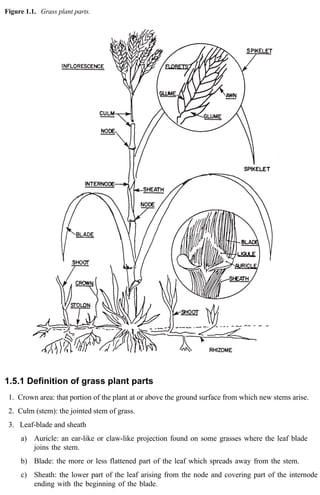
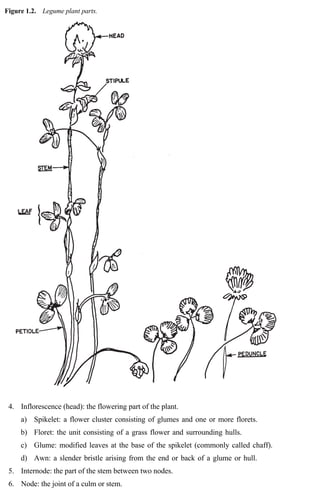
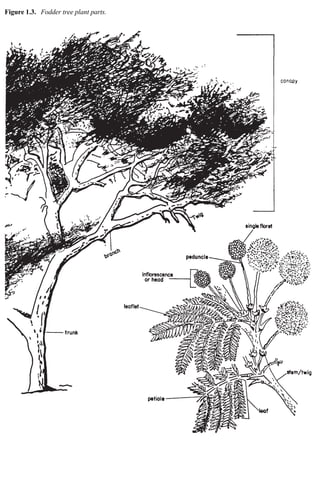
also be annual or perennial in their persistence. A typical grass plant is shown in Figure 1.1, a typical 
legume in Figure 1.2 and a typical fodder tree legume in Figure 1.3.
Figure 1.1. Grass plant parts. 
1.5.1 Definition of grass plant parts 
1. Crown area: that portion of the plant at or above the ground surface from which new stems arise. 
2. Culm (stem): the jointed stem of grass. 
3. Leaf-blade and sheath 
a) Auricle: an ear-like or claw-like projection found on some grasses where the leaf blade 
joins the stem. 
b) Blade: the more or less flattened part of the leaf which spreads away from the stem. 
c) Sheath: the lower part of the leaf arising from the node and covering part of the internode 
ending with the beginning of the blade.
Figure 1.2. Legume plant parts. 
4. Inflorescence (head): the flowering part of the plant. 
a) Spikelet: a flower cluster consisting of glumes and one or more florets. 
b) Floret: the unit consisting of a grass flower and surrounding hulls. 
c) Glume: modified leaves at the base of the spikelet (commonly called chaff). 
d) Awn: a slender bristle arising from the end or back of a glume or hull. 
5. Internode: the part of the stem between two nodes. 
6. Node: the joint of a culm or stem.
Figure 1.3. Fodder tree plant parts.
7. Rhizome (root stock): a creeping underground stem. 
8. Root: the below-ground portion of the grass plant. 
9. Shoot: a new stem. 
10. Stolon: a horizontal stem creeping on the surface of the ground. 
1.5.2 Definition of herbaceous and fodder tree legume plant parts 
1. Head: cluster or group of flowers. 
2. Leaflet: individual blades of a leaf. 
3. Peduncle or rachis: the stem supporting a head. 
4. Petiole: the stalk of the leaflet. 
5. Stipule: leaf-like plant part at the junction of the petiole and main stem. 
6. Stolon (runners): an above ground rooting system. 
7. Trifoliate: legumes with three leaflets. 
1.5.3 The plant life cycle 
There are generally four different plant life cycles: 
Annuals: These are generated from seed and resown each year. The plant usually dies after seeds 
are produced. Examples of annual forages are Vigna unguiculata (cowpea) and Vicia spp (vetch). 
Biennials: The parent plants live for two seasons and careful management is needed to ensure seed 
production, e.g. Lolium multiflorum. 
Short-lived perennials: These can regenerate vegetatively as well as from seed and do not usually 
survive longer than three to five years. They include Sesbania sesban and Medicago sativa in some 
areas. 
Perennials: These may survive from 5--20 years through maintenance of the original plant. Examples 
are Brachiara decumbens (signal grass), legumes such as the stylos and most of the fodder tree 
species. 
The perenniality of a species may also vary with environment. Some annual species will behave 
as short-lived perennials in favourable environments, whilst some herbaceous perennials may act as 
annuals in dry areas. 
The following points should be considered when selecting annual or perennial forage for seed 
production: 
· Annual legumes may be grown in drier climates than perennial pasture legumes provided the 
wet season is sufficiently long and reliable to complete seeding in this period. 
· In an environment with a defined reliable dry season, seed production of annual legumes may 
be more reliable. 
· Annuals are easy to manage and harvest since seeding is usually synchronised. 
· Annuals are suitable for environments where only part of the year is suitable for plant growth. 
· Annuals cannot respond to light or out of season precipitation since rainfall must be sufficient 
for the entire cycle of germination and growth to produce seeds. 
· Perennials give a longer sequence of seed production than annuals. 
· Perennials cannot survive in drier climates with short growing seasons.
1.5.4 Effect of plant type, growth form and perenniality on seed 
production and management 
Plant type 
In determinate forages where the main apex produces the flowers and growth stops, there is usually 
a distinct change from the vegetative to the reproductive stage. This causes fewer leaves to be initiated 
on the tiller and results in variation of leaf appearance. Although this is compensated for by an 
increase in the rate of leaf elongation and the growth rate of the remaining leaves, it generally slows 
down the rate of seed production. With indeterminate plant habit, where flowers are produced on 
axillary buds, the main apex often stays vegetative. Inflorescence development has an effect on seed 
production as it slows both the rate of leaf production and shoot growth merely by diverting 
photosynthate from the lamina to the inflorescence. If there is a strong flowering response to day 
length such as in S. guianensis, then flowering will be synchronised. If, however, seasonal events 
are predictable, management is then directed to synchronising flowering by promoting a closed canopy 
of shoots which are ripe to flower by the time of the first floral initiation. 
Growth form 
The growth type of a plant (erect, sprawling, twining or creeping habit) usually has implications for 
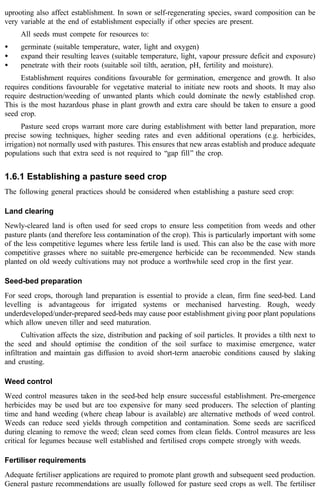
seed production and crop management. Six distinct morphological types of pasture legumes are 
recognised (Figure 1.4). 
In erect determinate plants such as Stylosanthes guianensis, the production of seed depends on 
the development of spikes. This can be described in terms of the proportion of florets and the extent 
to which these florets form seeds. The effect is that 60--85% of flowers set seeds and a single-seeded 
pod is formed from each floret. 
With creeping or twining indeterminate plants, such as Macroptilium atropurpureum (Siratro), 
floral and vegetative growing points continue to develop. Thus both flowers and leaves continue to 
develop on the same plant, so that vegetative growth continues. 
Important points 1.1--1.5 
· The main objective of a forage seed programme is to make available quality seed or 
vegetative material that is suited to farmers’ needs. 
· Although seed production systems are usually categorised as opportunist or specialised, in 
sub-Saharan Africa there is no single system of seed production that is suited to the varying 
social and environmental situations. 
· Many pasture seed production initiatives have failed in sub-Saharan Africa because of an 
unsuitable choice of site. 
· A major requirement in seed production is for the growers to plant in areas that are most 
likely to give high seed yields. 
· Although requirements for a suitable site for seed production cut across a broad range of 
grasses and legumes, species do differ in their requirements. 
· The different forage life cycles are annuals, biennials, short-lived perennials and perennials. 
· Grasses have a determinate growth habit and produce seeds on the terminal apices of the 
shoots or tillers. 
· The commonest growth types of forage legumes are the determinate erect type and the 
indeterminate twining habit.
Figure 1.4. Morphological types of pasture legumes. 
Source: Hopkinson (1981, cited in Humphreys and Riveros, 1986). 
1.6 Crop establishment 
Successful establishment occurs when the radicle becomes anchored in the soil, absorbing moisture 
and nutrients for the growing shoot. This shoot emerges through the soil surface to display a leaf 
that photosynthesises sufficient energy to make the seedling independent of its seed energy reserves. 
Seedling emergence depends on a complex interaction involving seed placement, size, 
hardseededness, genotype and the micro-environment (the seed-bed). Grazing, trampling and
uprooting also affect establishment. In sown or self-regenerating species, sward composition can be 
very variable at the end of establishment especially if other species are present. 
All seeds must compete for resources to: 
· germinate (suitable temperature, water, light and oxygen) 
· expand their resulting leaves (suitable temperature, light, vapour pressure deficit and exposure) 
· penetrate with their roots (suitable soil tilth, aeration, pH, fertility and moisture). 
Establishment requires conditions favourable for germination, emergence and growth. It also 
requires conditions favourable for vegetative material to initiate new roots and shoots. It may also 
require destruction/weeding of unwanted plants which could dominate the newly established crop. 
This is the most hazardous phase in plant growth and extra care should be taken to ensure a good 
seed crop. 
Pasture seed crops warrant more care during establishment with better land preparation, more 
precise sowing techniques, higher seeding rates and even additional operations (e.g. herbicides, 
irrigation) not normally used with pastures. This ensures that new areas establish and produce adequate 
populations such that extra seed is not required to ‘‘gap fill’’ the crop. 
1.6.1 Establishing a pasture seed crop 
The following general practices should be considered when establishing a pasture seed crop: 
Land clearing 
Newly-cleared land is often used for seed crops to ensure less competition from weeds and other 
pasture plants (and therefore less contamination of the crop). This is particularly important with some 
of the less competitive legumes where less fertile land is used. This can also be the case with more 
competitive grasses where no suitable pre-emergence herbicide can be recommended. New stands 
planted on old weedy cultivations may not produce a worthwhile seed crop in the first year. 
Seed-bed preparation 
For seed crops, thorough land preparation is essential to provide a clean, firm fine seed-bed. Land 
levelling is advantageous for irrigated systems or mechanised harvesting. Rough, weedy 
underdeveloped/under-prepared seed-beds may cause poor establishment giving poor plant populations 
which allow uneven tiller and seed maturation. 
Cultivation affects the size, distribution and packing of soil particles. It provides a tilth next to 
the seed and should optimise the condition of the soil surface to maximise emergence, water 
infiltration and maintain gas diffusion to avoid short-term anaerobic conditions caused by slaking 
and crusting. 
Weed control 
Weed control measures taken in the seed-bed help ensure successful establishment. Pre-emergence 
herbicides may be used but are too expensive for many seed producers. The selection of planting 
time and hand weeding (where cheap labour is available) are alternative methods of weed control. 
Weeds can reduce seed yields through competition and contamination. Some seeds are sacrificed 
during cleaning to remove the weed; clean seed comes from clean fields. Control measures are less 
critical for legumes because well established and fertilised crops compete strongly with weeds. 
Fertiliser requirements 
Adequate fertiliser applications are required to promote plant growth and subsequent seed production. 
General pasture recommendations are usually followed for pasture seed crops as well. The fertiliser
should be evenly distributed. On less fertile soils, 50 kg N/ha should be applied to grasses at 
establishment but this dressing can be reduced or eliminated when the soils are considered fertile. 
Mixing fertiliser with seed at time of sowing can result in an interaction which reduces germination 
and inoculant effectiveness. 
Time of sowing 
Planting time depends largely on the reliability of rainfall and potential evapotranspiration. Early 
sowings have the best chance of producing a good harvest. Within given areas, small niches may 
exist which allow for different timetables to take advantage of rainfall extremes, irrigation and weed 
control patterns. 
Choice of vegetative material or seed 
Vegetative material may be in the form of rhizomes, stolons, stem pieces or cuttings (splits). Such 
materials are genetically identical to the parent plant. 
Whether seed is sown by hand or machine good quality seed must be used. If the resultant crop 
is to be certified, seed of the appropriate status or generation must be used. 
Inoculation 
Certain legumes are very specific in their rhizobium requirements and failure to inoculate such seeds 
before sowing could lead to poor nodulation and subsequent poor plant growth. Other legumes are 
known to nodulate readily and successfully with native strains of rhizobia; but even here, inoculation 
is a cheap precaution against failure especially where legumes have not been sown before. 
Seeding rate 
As an approximate guide, seeding rates for forage seed crops should generally be at least twice those 
recommended for normal pasture sowings. In the first season of production, growth of pasture, weed 
suppression, avoidance of erosion, amount of nitrogen fixed by sown legumes and the grazing returns 
are greater for high sowing rates (Humphreys, 1978). With higher sowing rates, the need for later 
‘‘thickening up’’ of the seed stand should be minimal. Lower seeding rates are recommended for row 
planting compared with broadcast sowing. However, the temptation to save too much should be 
resisted as it could lead to a sparse, weedy stand producing low seed yields in the early years. If 
low quality seed has to be used, e.g. seed of good genetic quality but of low germination percentage 
and low purity, the sowing rate should be increased. 
Spatial arrangement and plant density 
Row planting is often recommended to facilitate rogueing (weeding out) of off-types and to allow 
inter-row cultivation for weed control during early establishment. This is of value to tussock grasses 
and vigorous sprawling legumes but serves little or no useful purpose to stoloniferous grasses and 
to weakly competitive and/or creeping legumes. For the latter groups, broadcast sowing is usually 
preferable. In all cases, however, seed should be evenly distributed within the limits of the spatial 
arrangement chosen. 
Proximity to already established materials may result in growth being retarded by shading and 
drying out because of root mass. Annual plants must re-establish every year and some control of 
plant density may be necessary if seed production is not to be reduced. Similar considerations also 
apply to perennial plants which lack vigour. Seed areas should be renovated and re-established when 
seed production starts to decline.
Depth of sowing 
One of the commonest causes of failure in establishment of small-seeded species is sowing too deeply. 
Maximum sowing depth is constrained by endosperm reserves which must be adequate to support 
hypocotyl or epicotyl elongation until seedlings emerge above the soil and begin photosynthesising. 
The elongation rate is a function of genotype, temperature and soil water. Thus, the timing, rate and 
depth of sowing is critical. Since most pasture plant seeds are relatively small, they are generally 
sown on the surface of the soil or incorporated to not more than 1 cm depth. The use of sowing 
machinery that enables control of depth of sowing is desirable although many small farmers are able 
to establish the crop successfully by hand broadcasting. 
1.6.2 Establishment problems 
Several problems relating to establishment are often faced by farmers involved in seed production. 
These problems generally fall into four types. These are: 
· physical loss of seed due to predators (eaten or removed) 
· loss of seed viability due to environmental stress 
· failure of germinated seed to emerge from the soil due to environmental stresses or mechanical 
impediments in the soil 
· mortality of emerged seedlings due to environmental stresses, plant competition or pathogen or 
pest attacks. 
1.7 Crop management 
The overall aim of management, whether for grasses or legumes, is to produce high yielding seed 
crops. Pasture species have been bred for their forage potential (i.e. production of leaf and stem) not 
for seed yield. Consequently, the harvest index (i.e. seed to shoot ratio) may be very low and yields 
are seldom more than one tonne per hectare. The local environment sets the broad growing conditions 
which are then manipulated through management to meet the needs of particular crops. The 
management of grasses and legumes differ markedly. 
1.7.1 Management of grasses 
The aim is to promote the development of large numbers of seed heads in as short a time span as 
possible for synchronisation. The major practices to promote this strategy are defoliation by cutting 
or grazing and application of nitrogen fertiliser. This combination encourages the production of many 
new tillers or shoots in the first few weeks of regrowth, providing the basis for a synchronised flush 
of heads. Many other factors such as irrigation, pests and diseases and crop perenniality also affect 
the development of seed heads. 
Defoliation 
A cleaning cut is usually made at the beginning of each cropping cycle. This cut removes/reduces 
old vegetation and, with the aid of nitrogen, encourages the development of the tillers on which the 
seed heads will eventually be produced. There are generally two main aspects of defoliation to 
consider, namely severity and timing. 
To reduce severity, the bulk of stubble from the previous crop should be removed by cutting 
or grazing at the beginning of season, which enables the final cleaning cut to be lenient or less severe 
and results in faster regrowth and tiller development in some species. Heavy or severe defoliation 
of Callide Rhodes restricts crop growth resulting in slower and more prolonged head emergence. The 
final number of heads is lower than from a lenient cleaning cut (Table 1.1).
Table 1.1. Effect of defoliation on head development of Callide Rhodes grass. 
Cleaning cut 
Seed heads 
No. emerging/m2 
per day Days to emerge Final no./m2 
Lenient 8 30 240 
Severe <5 40 290 
In cases where grasses are not affected by day length, cleaning cuts are timed so that crops, 
especially in rain-fed areas, make the best use of good growing conditions. For others the cut must 
be timed to enable the plant to receive maximum photoperiodic stimulus. 
Day length 
Due to changing day length throughout the year, tropical short-day grasses such as Callide and 
Samford Rhodes, Bothriocloa insculpta (creeping blue) and Andropogon spp (Gamba grass) will not 
flower strongly during warm, sunny periods no matter how much it rains at the time. Because the 
flowering behaviour of such grasses is inflexible, cleaning cuts must be carefully timed to ensure 
that the developing crop can flower properly. It should be noted that the latest safe dates for cleaning 
cuts vary from one environment to another and the important factor, therefore, is to determine the 
safe date for each environment. 
If cleaning cuts are carried out too early, short-day grasses will not flower earlier but will simply 
grow taller and bulkier with more risk of lodging, thereby making them difficult to harvest. If, on 
the other hand, they are delayed plants may flower later because of longer days. 
Nitrogen fertiliser 
Nitrogen is the most important nutrient for grass seed production. To the farmer, the amount of 
nitrogen to apply and when to apply it constitute an important decision. This decision depends on 
many factors including the age of the crop, the time of year and the climatic conditions at the time 
of application. The main effect of the application of fertiliser is to increase seed yield by producing 
more seed heads. To achieve this, nitrogenous fertiliser should be applied as a single dressing as 
soon as possible after the cleaning cut. This must be spread evenly to avoid alternating yellowish 
and dark green strips indicating under- and over-fertilisation. 
The optimum rate of fertiliser nitrogen varies depending on the species or even the variety 
grown. A recommended ‘‘safe’’ level for a typical crop such as Panicum maximum is 100 kg elemental 
nitrogen per hectare, equivalent to 220 kg urea per hectare, applied at the beginning of the crop cycle 
(Humphreys and Riveros, 1986). 
Irrigation 
Irrigation ensures good seed yields in areas with unpredictable or low rainfall. Drought is known to 
reduce seed production but with good moisture availability, drought stress is often eliminated. In 
some cases, however, moisture stress can be used to stimulate the reproductive phase. 
Pests and diseases 
Various caterpillars can affect grass seed crops. Rats and mice can also cause considerable damage 
by cutting ripe heads off and birds damage inflorescences. Ergots, smuts and virus infections are 
important diseases of forage grasses.
1.7.2 Management of forage legumes 
The first objective in developing a legume seed crop is to close the crop canopy as soon as possible, 
certainly before flowering is initiated. This provides the necessary vegetative structure to maximise 
seed production. There are generally three groups of legumes available, namely warm tropical, cool 
tropical and subtropical legumes. Seed management differs within these groups as a result of their 
temperature adaptation. 
Warm tropical legumes 
Most of the ‘‘true’’ warm tropical legumes need a frost-free site for seed production. In others, such 
as Macroptilium atropurpureum cv Siratro and Centrosema pubescens, moisture stress is used to 
promote vigorous reproductive growth. There is therefore the need for a climate with reliable and 
well-defined wet and dry seasons. A four- to six-month wet season allows most tropical legumes to 
produce the necessary strong vegetative framework for a heavy seed crop. An average annual rainfall 
of at least 800 mm generally provides sufficient moisture, with an upper limit of 1500--2000 mm. 
Cool tropical legumes 
Some forage legumes such as Greenleaf and Silverleaf Desmodium (intortum and uncinatum), 
Macrotyloma axillare, Neonotonia and Vigna maranguensis (creeping vigna) are adapted to cooler 
conditions and need a longer wet season than the ‘‘true’’ tropicals. 
Subtropical legumes 
Some seed crops such as Trifolium semipilosum (Kenya white clover), Lotononis, fine-stem stylo and 
Aeschynomene falcata cv Bargoo (Bargoo jointvetch) are grown in the subtropics or in high tropical 
areas. These legumes are adapted to subtropical temperatures and do not flower during winter so that 
seed crops can escape frost. Strongly defined wet and dry seasons are less important because moisture 
stress has little or no beneficial effects on flowering. 
Such subtropical legumes need a period of adequate moisture, either from rainfall or irrigation, 
to provide the necessary vegetative framework for a seed crop, but this is usually shorter than the 
minimum four-month period often suggested for warm tropical legumes. 
Management of forage legumes for optimum seed production should consider: 
· Defoliation. Legume crops are usually cut back at harvest and then allowed to build up gradually 
through the growing season without any further cutting or grazing. Excessive growth, however, 
can be a problem if they are allowed to grow unchecked for the full growing season, for example, 
stylo ---- a vigorous short-day legume ---- produces a tangled mass of stems more than two metres 
long. Such crops gradually subside into a compact mat of stems below an undulating crop 
canopy with seed heads at varying heights so that more material has to be harvested than in an 
even crop. Cutting the compacted mass of stems is also extremely difficult and possibly 
damaging for even the most powerful harvesting machines. For these reasons, stylo crops need 
to be cut back during the vegetative phase to control their growth. To avoid any reduction in 
yield, defoliation must be done early enough to allow complete recovery of the canopy before 
the first flowers are initiated. 
· Day length. Many legumes are known to be more sensitive to day length than grasses. For 
these legumes, the aim is to produce a closed but not excessive leaf canopy with a high density 
of shoots which are ready to flower when stimulated by the correct day length/temperature. 
· Irrigation. Irrigation strategies vary in different legume crops. In Siratro and Centro, for 
example, flushes of seeding can be induced by alternating periods of irrigation and moisture 
stress in areas with a reliable dry season. Care should be taken not to leach out soil nutrients 
by overwatering.
· Pest and diseases. Pests and diseases are generally more severe with legumes than with grasses. 
Insect pests include moth caterpillars, sucking bugs and butterflies that are seen feeding on pods 
and flowers. The Leucaena psyllid is a well known small sucking insect, which is devastating 
Leucaena leucocephala plantings. A wide range of diseases can affect different legumes. The 
more important ones are rhizoctonia leaf blight, anthracnose in stylos, rust on Siratro and viruses 
on many species. In practice, it is advisable to grow susceptible crops where the disease risk 
is low. 
· Weed control. Legume seed crops are particularly vulnerable to weed invasion. Weeding is 
comparatively easy in these crops, particularly if they also form a vigorous smothering canopy. 
In other leguminous crops where a dense smothering canopy is difficult to form, weed control 
is obviously more difficult. 
1.8 Seed harvesting 
In tropical pasture seed crops, the choice of harvest time is a complicated decision because some 
immature seeds will always be present. Even the most closely synchronised crops comprise 
inflorescences in various stages of maturity and there is further variation in flowering time within 
individual inflorescences. For a particular crop, the period in which high yields of ripe seed can be 
harvested depends on the species or cultivar involved, weather conditions and harvest method. In 
practice approximately 25--50% of the potential yield is available because of continuing production 
and loss. 
The decision to harvest the crop depends on what the head looks like. All indicators for harvest 
are somewhat subjective; therefore, for accurate assessment there is no substitute for experience aided 
by keen observation. Seed moisture content, endosperm hardness or seed weight can be monitored, 
but for all practical purposes appearance of the crop is the best factor. 
Grasses: A number of visual indicators have been proposed for grass seed crops to fix the 
optimum harvesting time more closely. Timing also depends on weather conditions, because wind 
and rain can strip seeds from the inflorescence. When harvesting large areas, start earlier to avoid 
losses. 
Crops should generally be harvested when the bulk of seed is not far from shedding. At this 
stage, ripening seed can be readily removed by gentle rubbing or by stroking from the base to the 
apex of an inflorescence. Samples should be checked to ensure that the florets contain seeds by biting 
individual seeds, or by rubbing in the palm of the hand to remove seeds. 
Crop colour depends on changes in the pigmentation of individual seeds during maturation, and 
these do not occur in all crops e.g. Brachiaria decumbens (signal grass). When a large number of 
ripening seeds are present, any colour changes in individual seeds are reflected in the overall 
appearance of the crop e.g. Chloris gayana. This method is more useful when crops are reasonably 
well synchronised. 
Legumes: Where plants are of a determinate nature it is possible to deduce optimum harvest 
dates by examining the head from emergence through to seed shedding/shattering. It is more difficult 
to determine the optimum harvest dates for indeterminate plants because of the longer flowering 
period. Where seed is very scarce, hand picking can take place whenever sufficient have changed 
colour and environmental conditions allow, but the cost is often prohibitive. 
For mechanised harvesting, random samples of pods or inflorescences should be collected 
regularly and checked until the desired proportions of shattered mature and immature seeds are 
obtained. At this stage, few flowers should be obvious, especially in relatively non-shattering crops 
such as Trifolium semipilosum. Additional criteria are also used for particular crops: e.g. there should 
be an audible patter of falling seed when a crop of a short-day Stylosanthes guianensis is struck with 
the hand; ripe seed should be protruding obviously from the inflorescences; and stickiness of the 
crop should be diminishing.
Where suction harvesting or hand sweeping of fallen seed is to be used, the crop is not ready 
for harvest until most of the seed has fallen and there is little likelihood of further significant 
production. 
1.8.1 Harvesting methods 
Various techniques have been used to harvest tropical pasture seed. In all cases, however, care should 
be taken to ensure that the harvested sample can later be cleaned to the required standard of purity 
with minimum loss of seed and time. 
Over the years the method of harvesting and equipment has remained basically the same. One 
can still find traditional farmers using such equipment as knives, sickles and scythes to harvest their 
crops. 
Manual harvesting 
The principle tools still used by small-scale farmers in sub-Saharan Africa are the knives, sickles, 
scythes and reaping hooks. These tools can either be used to harvest the entire plant or, if necessary, 
selectively remove seed heads. The cost of these tools is minimal, they are easy to maintain or repair, 
dependable and are also familiar to farmers. 
Although using manual harvesting equipment is very labour-intensive, it provides a source of 
employment. With knives, losses incurred from shattering are low, but labour requirements are higher 
than for sickle harvesting. It is estimated that 75% more labour is required when using knives than 
when using sickles. Labour requirements of 100--175 man hours per hectare for sickle harvesting are 
common but may vary with yield, species, moisture content etc. 
Scythes have a basic design of a 70--100 cm long curved blade connected to a two handled 
shaft. Their use requires training to be effective but they are known to reduce sickle labour 
requirements by 25--30%. 
Hand-harvesting is the simplest method and, where labour is cheap and plentiful, it is the most 
sensible to use. Grass seed heads may be cut with sickles, bound and stooked in the field, then 
collected for threshing some two weeks later. Heads may be beaten with sticks, roughly sieved and 
then sun dried. Only light threshing is required to detach most of the remaining useful seeds and to 
separate detached seeds from the bulk. 
Sweating is useful as all spikelets undergo abscission enabling the producer to recover a higher 
proportion of this standing seed. It generally gives about twice the yield of direct-heading. Seed is 
also of very high quality because maturation can be completed in the moist conditions inside the 
stack. Similar results can be achieved with direct-headed seed if it is also dried properly (to 10% 
moisture or less); sweated seed also stores very well. It should be spread thinly to dissipate heat and 
even if it gets lumpy, mouldy and grey the seed should not be damaged. 
Mechanised harvesting 
Engine powered machines are good for harvesting. However, their high cost and low field capacity 
make justification of their purchase difficult and hence, their use is limited. These machines include 
mowers, reapers and combine harvesters. There are many other types of specialised equipment for 
harvesting which are not common to smallholders in sub-Saharan Africa. These include beaters, 
strippers, brush and suction harvesters. 
The reaper and binder is a natural progression from hand-harvesting for grass seeds; and provided 
dry, still weather prevails, high yields of fair to good quality seed can be recovered because maturation 
continues in the slowly curing stooks. 
Windrowing is an alternative in which grass or legume crops are mown and cured in the field 
for a few days before being picked up by a header. Higher yields of better quality seed are possible
if dry weather prevails, but losses can be heavy if adverse conditions occur whilst the crop is curing 
in windrows. 
Studies have been carried out by researchers to investigate the comparative advantage of each 
of these harvesting techniques. For example, Roe (1972) compared four different harvesting methods 
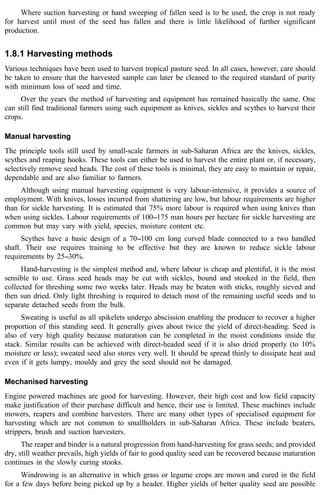
on Panicum maximum to select a suitable harvesting technique. The results of the study (Table 1.2) 
revealed that near total collection was achieved with a yield estimate of 410 kg/ha of good quality 
seed. A single cut and subsequent drying of the plants in the field gave 104 kg/ha of lower quality 
seed. Hand shaking the mature seed from the panicles directly into the bin on seven occasions over 
15 days gave a yield of 256 kg/ha of good quality seed. 
Table 1.2. Harvest method and seed yield of Panicum maximum. 
Method Seed size 
Seed yield recovered 
(kg/ha) 
Germination 
(%) 
Total collection 0.98 410 54 
Cutting and field drying 0.96 104 39 
Hand shaking 1.03 256 53 
Reaper and binder 0.76 31 29 
Direct heading 0.74 123 35 
Source: Roe (1972). 
The method that involved reaping the crop and binding it into small bundles for curing before 
threshing led to greater shattering losses than with simple cutting and field drying. Finally, with a 
single direct heading and threshing, a yield of 123 kg/ha of lower quality seed was recovered. 
This study illustrates the problems encountered while trying to recover a high proportion of 
seed in Panicum maximum. Repeated hand harvesting gave the best results and the added labour and 
risks associated with cutting and curing before threshing were not justified relative to direct heading. 
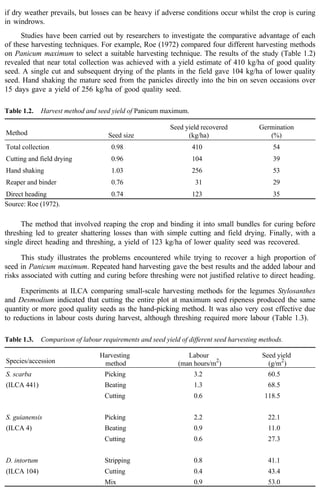
Experiments at ILCA comparing small-scale harvesting methods for the legumes Stylosanthes 
and Desmodium indicated that cutting the entire plot at maximum seed ripeness produced the same 
quantity or more good quality seeds as the hand-picking method. It was also very cost effective due 
to reductions in labour costs during harvest, although threshing required more labour (Table 1.3). 
Table 1.3. Comparison of labour requirements and seed yield of different seed harvesting methods. 
Species/accession 
Harvesting 
method 
Labour 
(man hours/m2) 
Seed yield 
(g/m2) 
S. scarba Picking 3.2 60.5 
(ILCA 441) Beating 1.3 68.5 
Cutting 0.6 118.5 
S. guianensis Picking 2.2 22.1 
(ILCA 4) Beating 0.9 11.0 
Cutting 0.6 27.3 
D. intortum Stripping 0.8 41.1 
(ILCA 104) Cutting 0.4 43.4 
Mix 0.9 53.0
Important points 1.6--1.8 
· Important factors for establishing a pasture seed crop are land clearing, seed-bed preparation, 
weed control, fertiliser application, time of sowing, source of seed inoculation, seeding rate, 
spatial arrangement and plant density, depth of sowing and management of established 
stands. 
· Establishment requires conditions favourable for germination, emergence and growth. 
· The overall aim of management, whether it is for grasses or legumes, is to produce high 
yielding seed crops. 
· Generally, it is advisable for growers to begin weed control from the time of seed-bed 
preparation. 
· The main factors to consider in grass seed crop management are defoliation, day length, 
nitrogen fertiliser, irrigation, pests and diseases. 
· The main factors to consider in legume seed crop management are defoliation, day length, 
irrigation, weed control, pests and diseases. 
· When and how seeds are harvested often determines the amount and quality of seed 
recovered. 
· The harvesting method selected will be determined by the crop. 
1.9 Feedback exercises 
All answers can be found in the text of Chapter 1. 
1. The following statements relate to seed production. Circle T for true statements or F for 
false ones. 
i) The main objective of a forage seed programme is to make available quality seed or 
vegetative material that is suited to farmers’ needs. 
T F 
ii) In sub-Saharan Africa, there is no single system of seed production that is suited to 
the varying social or environmental conditions. 
T F 
iii) The main classification of seed production systems are labour intensive, opportunist 
and specialist. 
T F 
iv) Land clearing and seed-bed preparation are the only major factors for establishing a 
pasture seed crop. 
T F 
v) Selecting an adequate site is not that important a requirement for seed production. 
T F 
2. Provide brief answers to the following questions: 
i) How is a pasture seed crop established? 
ii) Why is management of grasses and legumes essential after establishment?
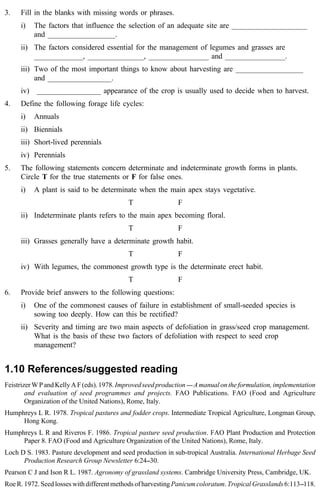
3. Fill in the blanks with missing words or phrases. 
i) The factors that influence the selection of an adequate site are ____________________ 
and __________________. 
ii) The factors considered essential for the management of legumes and grasses are 
_____________, _______________, ________________ and ________________. 
iii) Two of the most important things to know about harvesting are __________________ 
and _________________. 
iv) _________________ appearance of the crop is usually used to decide when to harvest. 
4. Define the following forage life cycles: 
i) Annuals 
ii) Biennials 
iii) Short-lived perennials 
iv) Perennials 
5. The following statements concern determinate and indeterminate growth forms in plants. 
Circle T for the true statements or F for false ones. 
i) A plant is said to be determinate when the main apex stays vegetative. 
T F 
ii) Indeterminate plants refers to the main apex becoming floral. 
T F 
iii) Grasses generally have a determinate growth habit. 
T F 
iv) With legumes, the commonest growth type is the determinate erect habit. 
T F 
6. Provide brief answers to the following questions: 
i) One of the commonest causes of failure in establishment of small-seeded species is 
sowing too deeply. How can this be rectified? 
ii) Severity and timing are two main aspects of defoliation in grass/seed crop management. 
What is the basis of these two factors of defoliation with respect to seed crop 
management? 
1.10 References/suggested reading 
Feistrizer W P and Kelly A F (eds). 1978. Improved seed production ---- A manual on the formulation, implementation 
and evaluation of seed programmes and projects. FAO Publications. FAO (Food and Agriculture 
Organization of the United Nations), Rome, Italy. 
Humphreys L R. 1978. Tropical pastures and fodder crops. Intermediate Tropical Agriculture, Longman Group, 
Hong Kong. 
Humphreys L R and Riveros F. 1986. Tropical pasture seed production. FAO Plant Production and Protection 
Paper 8. FAO (Food and Agriculture Organization of the United Nations), Rome, Italy. 
Loch D S. 1983. Pasture development and seed production in sub-tropical Australia. International Herbage Seed 
Production Research Group Newsletter 6:24--30. 
Pearson C J and Ison R L. 1987. Agronomy of grassland systems. Cambridge University Press, Cambridge, UK. 
Roe R. 1972. Seed losses with different methods of harvesting Panicum coloratum. Tropical Grasslands 6:113--118.
Chapter 2: Post-harvest seed conditioning 
2.0 Performance objectives 
2.1 Introduction to seed conditioning 
2.2 Threshing and winnowing 
2.2.1 Threshing methods 
2.3 Seed drying 
2.3.1 Seed-drying methods 
2.3.2 Designing drying facilities 
2.4 Seed cleaning 
2.4.1 Practical seed cleaning 
2.5 Seed packaging 
2.6 Seed storage 
2.6.1 Storage facilities 
2.7 Feedback exercises 
2.8 References/suggested reading 
2.0 Performance objectives 
Chapter 2 is intended to enable you to: 
1. Define the stages involved in the process of post-harvest seed conditioning. 
2. Describe the basic principles of seed threshing. 
3. List advantages and disadvantages of seed-drying methods. 
4. Describe the major characteristics of seeds used for cleaning. 
5. State the working principles of seed-cleaning machines. 
6. Understand the purpose of storing seed. 
7. Enumerate the differences between the main types of storage facilities. 
2.1 Introduction to post-harvest seed conditioning 
After harvest, seeds must be threshed, cleaned and dried ready for storage. Newly harvested seeds 
contain husks, straw, soil particles and other unwanted seeds. These must be removed through the 
threshing and cleaning process to obtain good quality seeds of the required cultivar. Seeds are often 
harvested at higher moisture contents than those recommended for storage. Moist seeds are more 
susceptible to damage during cleaning because they are relatively soft. Drying reduces seed moisture 
to a safe level for both cleaning and later storage. This module examines, in detail, each of these 
seed operations.
2.2 Threshing and winnowing 
Threshing involves separating the seeds from panicles and straw, and winnowing the chaff from the 
seeds. The process of separating the seed from the chaff or pod often requires considerable energy 
but sorting the seed from the straw is a relatively easy process. This process is followed by winnowing. 
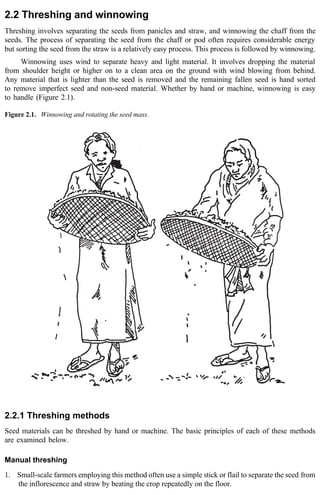
Winnowing uses wind to separate heavy and light material. It involves dropping the material 
from shoulder height or higher on to a clean area on the ground with wind blowing from behind. 
Any material that is lighter than the seed is removed and the remaining fallen seed is hand sorted 
to remove imperfect seed and non-seed material. Whether by hand or machine, winnowing is easy 
to handle (Figure 2.1). 
Figure 2.1. Winnowing and rotating the seed mass. 
2.2.1 Threshing methods 
Seed materials can be threshed by hand or machine. The basic principles of each of these methods 
are examined below. 
Manual threshing 
1. Small-scale farmers employing this method often use a simple stick or flail to separate the seed from 
the inflorescence and straw by beating the crop repeatedly on the floor.
2. The crop or plant parts bearing the seed may also be beaten against stones to release the seeds. 
3. Hand collection by rubbing or shaking ripe seeds into a container can provide seed of excellent quality 
especially when labour is effectively supervised. 
Animal-powered threshing 
1. Animals are used to trample on plant parts bearing the seed. 
2. Weights are added behind the animals to increase threshing productivity. 
3. This method is considered relatively cheap but is slow. 
Engine-powered threshing 
1. Where whole undamaged straw is valuable, machines can be used to strip seed from the panicle 
without damaging the straw. These can be stationary and powered by an engine or mounted on a 
tractor and taken to the field. 
2. This method is considered the most expensive and usually used only in large-scale operations. 
In all the techniques care must be taken to minimise physical damage which can affect germi-nation 
or allow disease infestation. In legumes, abrasion can reduce the degree of hardseededness. 
2.3 Seed drying 
Newly harvested seed of all tropical grasses and some legumes is quite moist. Freshly harvested 
grass seeds can have a moisture content of 40--70%. The seeds must therefore be dried to a safe 
moisture content (8--12%) to prevent loss of germination, heating and infestation during storage. Even 
seeds harvested from stooks or by windrowing require further drying. 
Leaving the seed to dry on the mother plant is best since the seeds continue to mature and are 
shed naturally. However, if the crop remains in the field for too long, yields may be lowered through 
lodging and seed shatter, especially in wet windy areas. Increases in diseases and pests may also 
lower quality and remain a problem during storage. 
Successful seed drying requires an appreciation of the differences between the physical (size, 
shape and covering) and chemical composition of the seed. 
During drying seed moisture evaporates into the surrounding air. Evaporation, using heat from 
the seed, occurs until the amount of water in the seed is equivalent to or in equilibrium with the 
amount in the air (relative humidity). This is termed the equilibrium moisture content of seeds and 
varies from crop to crop. 
The rate at which a seed dries is a function of how fast the moisture evaporates from its surface. 
This in turn depends on the temperature and relative humidity (rh) of the drying air, and the rate at 
which moisture moves from inside the seed to the seed surface (i.e. permeability of the seed to 
moisture). 
There is a relationship between safe drying temperature and initial seed moisture content. The 
general recommendation for field crops is to dry the seed at temperatures of no more than 32, 37 
and 43°C for moisture contents of more than 18%, 10 to 18%, and less than 10% moisture, 
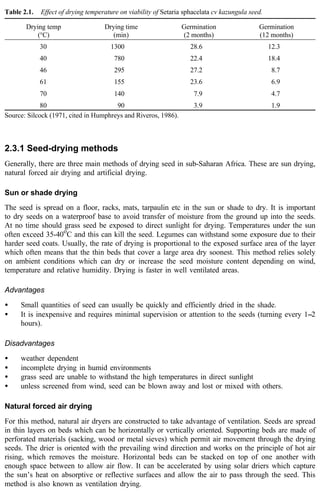
respectively. Seed viability is decreased by drying at temperatures above 40°C (Table 2.1). If drying 
is too rapid there is a tendency for the seed coat to split or harden which may prevent the interior 
of the seed from drying.
Table 2.1. Effect of drying temperature on viability of Setaria sphacelata cv kazungula seed. 
Drying temp 
(°C) 
Drying time 
(min) 
Germination 
(2 months) 
Germination 
(12 months) 
30 1300 28.6 12.3 
40 780 22.4 18.4 
46 295 27.2 8.7 
61 155 23.6 6.9 
70 140 7.9 4.7 
80 90 3.9 1.9 
Source: Silcock (1971, cited in Humphreys and Riveros, 1986). 
2.3.1 Seed-drying methods 
Generally, there are three main methods of drying seed in sub-Saharan Africa. These are sun drying, 
natural forced air drying and artificial drying. 
Sun or shade drying 
The seed is spread on a floor, racks, mats, tarpaulin etc in the sun or shade to dry. It is important 
to dry seeds on a waterproof base to avoid transfer of moisture from the ground up into the seeds. 
At no time should grass seed be exposed to direct sunlight for drying. Temperatures under the sun 
often exceed 35-40oC and this can kill the seed. Legumes can withstand some exposure due to their 
harder seed coats. Usually, the rate of drying is proportional to the exposed surface area of the layer 
which often means that the thin beds that cover a large area dry soonest. This method relies solely 
on ambient conditions which can dry or increase the seed moisture content depending on wind, 
temperature and relative humidity. Drying is faster in well ventilated areas. 
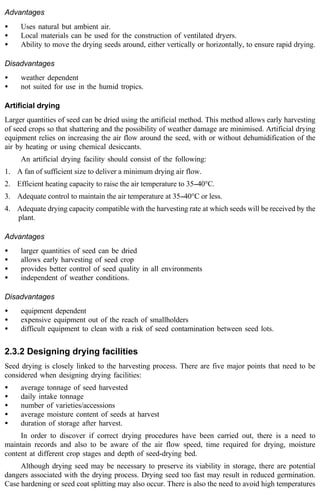
Advantages 
· Small quantities of seed can usually be quickly and efficiently dried in the shade. 
· It is inexpensive and requires minimal supervision or attention to the seeds (turning every 1--2 
hours). 
Disadvantages 
· weather dependent 
· incomplete drying in humid environments 
· grass seed are unable to withstand the high temperatures in direct sunlight 
· unless screened from wind, seed can be blown away and lost or mixed with others. 
Natural forced air drying 
For this method, natural air dryers are constructed to take advantage of ventilation. Seeds are spread 
in thin layers on beds which can be horizontally or vertically oriented. Supporting beds are made of 
perforated materials (sacking, wood or metal sieves) which permit air movement through the drying 
seeds. The drier is oriented with the prevailing wind direction and works on the principle of hot air 
rising, which removes the moisture. Horizontal beds can be stacked on top of one another with 
enough space between to allow air flow. It can be accelerated by using solar driers which capture 
the sun’s heat on absorptive or reflective surfaces and allow the air to pass through the seed. This 
method is also known as ventilation drying.
Advantages 
· Uses natural but ambient air. 
· Local materials can be used for the construction of ventilated dryers. 
· Ability to move the drying seeds around, either vertically or horizontally, to ensure rapid drying. 
Disadvantages 
· weather dependent 
· not suited for use in the humid tropics. 
Artificial drying 
Larger quantities of seed can be dried using the artificial method. This method allows early harvesting 
of seed crops so that shattering and the possibility of weather damage are minimised. Artificial drying 
equipment relies on increasing the air flow around the seed, with or without dehumidification of the 
air by heating or using chemical desiccants. 
An artificial drying facility should consist of the following: 
1. A fan of sufficient size to deliver a minimum drying air flow. 
2. Efficient heating capacity to raise the air temperature to 35--40°C. 
3. Adequate control to maintain the air temperature at 35--40°C or less. 
4. Adequate drying capacity compatible with the harvesting rate at which seeds will be received by the 
plant. 
Advantages 
· larger quantities of seed can be dried 
· allows early harvesting of seed crop 
· provides better control of seed quality in all environments 
· independent of weather conditions. 
Disadvantages 
· equipment dependent 
· expensive equipment out of the reach of smallholders 
· difficult equipment to clean with a risk of seed contamination between seed lots. 
2.3.2 Designing drying facilities 
Seed drying is closely linked to the harvesting process. There are five major points that need to be 
considered when designing drying facilities: 
· average tonnage of seed harvested 
· daily intake tonnage 
· number of varieties/accessions 
· average moisture content of seeds at harvest 
· duration of storage after harvest. 
In order to discover if correct drying procedures have been carried out, there is a need to 
maintain records and also to be aware of the air flow speed, time required for drying, moisture 
content at different crop stages and depth of seed-drying bed. 
Although drying seed may be necessary to preserve its viability in storage, there are potential 
dangers associated with the drying process. Drying seed too fast may result in reduced germination. 
Case hardening or seed coat splitting may also occur. There is also the need to avoid high temperatures
(>40°C), low relative humidity and air flow rates, to prevent over drying which usually results in 
seed death. 
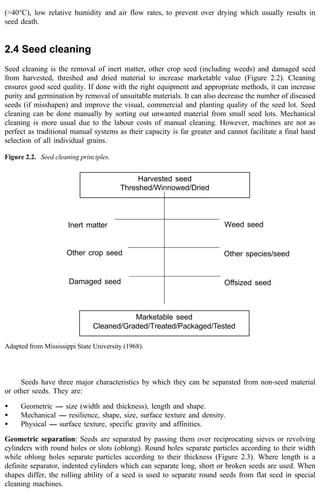
2.4 Seed cleaning 
Seed cleaning is the removal of inert matter, other crop seed (including weeds) and damaged seed 
from harvested, threshed and dried material to increase marketable value (Figure 2.2). Cleaning 
ensures good seed quality. If done with the right equipment and appropriate methods, it can increase 
purity and germination by removal of unsuitable materials. It can also decrease the number of diseased 
seeds (if misshapen) and improve the visual, commercial and planting quality of the seed lot. Seed 
cleaning can be done manually by sorting out unwanted material from small seed lots. Mechanical 
cleaning is more usual due to the labour costs of manual cleaning. However, machines are not as 
perfect as traditional manual systems as their capacity is far greater and cannot facilitate a final hand 
selection of all individual grains. 
Harvested seed 
Threshed/Winnowed/Dried 
Marketable seed 
Figure 2.2. Seed cleaning principles. 
Inert matter 
Other crop seed 
Damaged seed 
Weed seed 
Other species/seed 
Offsized seed 
Cleaned/Graded/Treated/Packaged/Tested 
Adapted from Mississippi State University (1968). 
Seeds have three major characteristics by which they can be separated from non-seed material 
or other seeds. They are: 
· Geometric ---- size (width and thickness), length and shape. 
· Mechanical ---- resilience, shape, size, surface texture and density. 
· Physical ---- surface texture, specific gravity and affinities. 
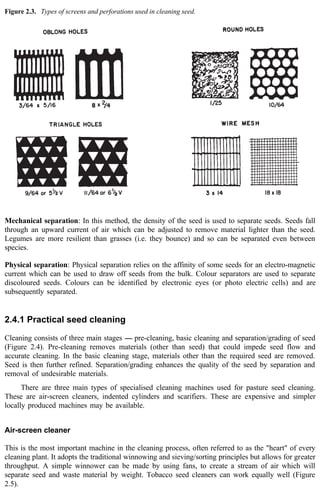
Geometric separation: Seeds are separated by passing them over reciprocating sieves or revolving 
cylinders with round holes or slots (oblong). Round holes separate particles according to their width 
while oblong holes separate particles according to their thickness (Figure 2.3). Where length is a 
definite separator, indented cylinders which can separate long, short or broken seeds are used. When 
shapes differ, the rolling ability of a seed is used to separate round seeds from flat seed in special 
cleaning machines.
Figure 2.3. Types of screens and perforations used in cleaning seed. 
Mechanical separation: In this method, the density of the seed is used to separate seeds. Seeds fall 
through an upward current of air which can be adjusted to remove material lighter than the seed. 
Legumes are more resilient than grasses (i.e. they bounce) and so can be separated even between 
species. 
Physical separation: Physical separation relies on the affinity of some seeds for an electro-magnetic 
current which can be used to draw off seeds from the bulk. Colour separators are used to separate 
discoloured seeds. Colours can be identified by electronic eyes (or photo electric cells) and are 
subsequently separated. 
2.4.1 Practical seed cleaning 
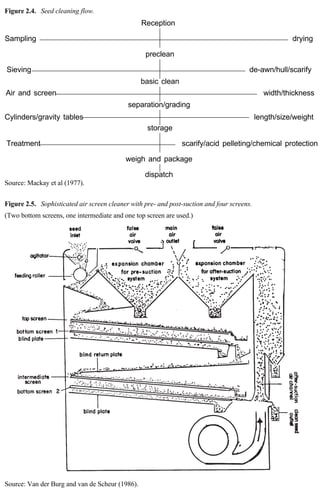
Cleaning consists of three main stages ---- pre-cleaning, basic cleaning and separation/grading of seed 
(Figure 2.4). Pre-cleaning removes materials (other than seed) that could impede seed flow and 
accurate cleaning. In the basic cleaning stage, materials other than the required seed are removed. 
Seed is then further refined. Separation/grading enhances the quality of the seed by separation and 
removal of undesirable materials. 
There are three main types of specialised cleaning machines used for pasture seed cleaning. 
These are air-screen cleaners, indented cylinders and scarifiers. These are expensive and simpler 
locally produced machines may be available. 
Air-screen cleaner 
This is the most important machine in the cleaning process, often referred to as the "heart" of every 
cleaning plant. It adopts the traditional winnowing and sieving/sorting principles but allows for greater 
throughput. A simple winnower can be made by using fans, to create a stream of air which will 
separate seed and waste material by weight. Tobacco seed cleaners can work equally well (Figure 
2.5).
Figure 2.4. Seed cleaning flow. 
Cylinders/gravity tables length/size/weight 
Treatment scarify/acid pelleting/chemical protection 
Source: Mackay et al (1977). 
Reception 
Sampling drying 
preclean 
Sieving de-awn/hull/scarify 
basic clean 
Air and screen width/thickness 
separation/grading 
storage 
weigh and package 
dispatch 
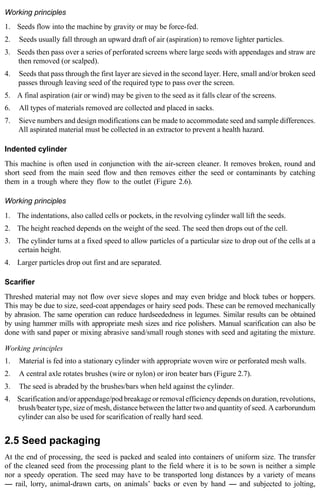
Figure 2.5. Sophisticated air screen cleaner with pre- and post-suction and four screens. 
(Two bottom screens, one intermediate and one top screen are used.) 
Source: Van der Burg and van de Scheur (1986).
Working principles 
1. Seeds flow into the machine by gravity or may be force-fed. 
2. Seeds usually fall through an upward draft of air (aspiration) to remove lighter particles. 
3. Seeds then pass over a series of perforated screens where large seeds with appendages and straw are 
then removed (or scalped). 
4. Seeds that pass through the first layer are sieved in the second layer. Here, small and/or broken seed 
passes through leaving seed of the required type to pass over the screen. 
5. A final aspiration (air or wind) may be given to the seed as it falls clear of the screens. 
6. All types of materials removed are collected and placed in sacks. 
7. Sieve numbers and design modifications can be made to accommodate seed and sample differences. 
All aspirated material must be collected in an extractor to prevent a health hazard. 
Indented cylinder 
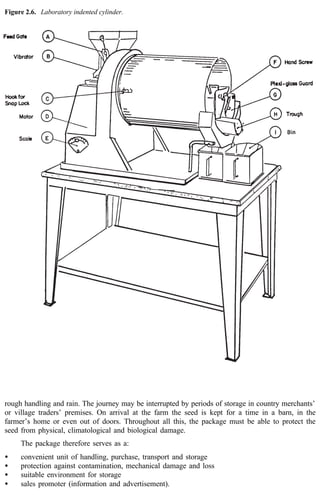
This machine is often used in conjunction with the air-screen cleaner. It removes broken, round and 
short seed from the main seed flow and then removes either the seed or contaminants by catching 
them in a trough where they flow to the outlet (Figure 2.6). 
Working principles 
1. The indentations, also called cells or pockets, in the revolving cylinder wall lift the seeds. 
2. The height reached depends on the weight of the seed. The seed then drops out of the cell. 
3. The cylinder turns at a fixed speed to allow particles of a particular size to drop out of the cells at a 
certain height. 
4. Larger particles drop out first and are separated. 
Scarifier 
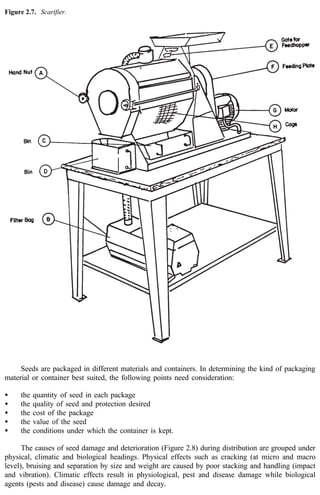
Threshed material may not flow over sieve slopes and may even bridge and block tubes or hoppers. 
This may be due to size, seed-coat appendages or hairy seed pods. These can be removed mechanically 
by abrasion. The same operation can reduce hardseededness in legumes. Similar results can be obtained 
by using hammer mills with appropriate mesh sizes and rice polishers. Manual scarification can also be 
done with sand paper or mixing abrasive sand/small rough stones with seed and agitating the mixture. 
Working principles 
1. Material is fed into a stationary cylinder with appropriate woven wire or perforated mesh walls. 
2. A central axle rotates brushes (wire or nylon) or iron beater bars (Figure 2.7). 
3. The seed is abraded by the brushes/bars when held against the cylinder. 
4. Scarification and/or appendage/pod breakage or removal efficiency depends on duration, revolutions, 
brush/beater type, size of mesh, distance between the latter two and quantity of seed. A carborundum 
cylinder can also be used for scarification of really hard seed. 
2.5 Seed packaging 
At the end of processing, the seed is packed and sealed into containers of uniform size. The transfer 
of the cleaned seed from the processing plant to the field where it is to be sown is neither a simple 
nor a speedy operation. The seed may have to be transported long distances by a variety of means 
---- rail, lorry, animal-drawn carts, on animals’ backs or even by hand ---- and subjected to jolting,
Figure 2.6. Laboratory indented cylinder. 
rough handling and rain. The journey may be interrupted by periods of storage in country merchants’ 
or village traders’ premises. On arrival at the farm the seed is kept for a time in a barn, in the 
farmer’s home or even out of doors. Throughout all this, the package must be able to protect the 
seed from physical, climatological and biological damage. 
The package therefore serves as a: 
· convenient unit of handling, purchase, transport and storage 
· protection against contamination, mechanical damage and loss 
· suitable environment for storage 
· sales promoter (information and advertisement).
Figure 2.7. Scarifier. 
Seeds are packaged in different materials and containers. In determining the kind of packaging 
material or container best suited, the following points need consideration: 
· the quantity of seed in each package 
· the quality of seed and protection desired 
· the cost of the package 
· the value of the seed 
· the conditions under which the container is kept. 
The causes of seed damage and deterioration (Figure 2.8) during distribution are grouped under 
physical, climatic and biological headings. Physical effects such as cracking (at micro and macro 
level), bruising and separation by size and weight are caused by poor stacking and handling (impact 
and vibration). Climatic effects result in physiological, pest and disease damage while biological 
agents (pests and disease) cause damage and decay.
Figure 2.8. Damage and deterioration during post-harvest seed handling. 
PHYSICAL 
STORAGE 
STACKING 
HANDLING 
TRANSPORT 
SYSTEMS 
IMPACT 
VIBRATION 
DAMAGE AND DETERIORATION 
CONDENSATION 
PHYSIOLOGICAL 
DAMAGE 
PEST/DIEASE 
A.CAUSES 
B.EFFECTS 
MICRO 
MACRO 
BRUISING 
SEPARATION - SIZE/WEIGHT 
CLIMATIC 
RAINFALL 
HUMIDITY 
SOLAR 
RADIATION 
BIOLOGICAL 
PESTS 
FUNGI 
MOULDS 
BACTERIA 
DECAY DAMAGE 
TEMP 
LIGHT 
FLOOD 
CRACKING
Packaging can minimise the seed damage depending on the material used. The following range 
of material to suit different seed weights is commonly available: 
Seed weight Packaging material 
1 g--0.5 kg Paper, cotton, polythene, foil or tin 
100 g--5 kg Tin, rigid paper or plastic 
1--50 kg Cotton, jute, polythene or paper 
10--100 kg Jute, hemp, kenaf or sisal 
100 kg--5 t Jute, metal or wood 
Jute, hemp, kenaf, sisal, cotton and paper are porous, polythene is moisture resistant and foil, 
tin and laminated fibre can be moisture proof. 
Polyvinyl chloride is often used to line packaging material. It is permeable and under tropical 
conditions 480 micron thickness of regular PVC or 180 micron high density polythene is impervious. 
Seeds should be dried to 8--10% moisture content and packed in sealed containers for longer-term storage. 
Some information about the contents of a package must be displayed. This could include at 
least the name of the species, the cultivar, the grade and the lot reference number, but the law may 
require more details. This information may be printed on the package or bag itself, or on a label or 
tag firmly attached as part of the stitching or sealing operation. 
The package could, to some extent, serve as a promotional tool. A bold distinctive design with 
a logo which a customer could easily recognize, together with the name of the producer or a brand 
name, could be put on packages. 
2.6 Seed storage 
Seed is stored from harvest to the next planting, which may be in the next season or after several 
seasons. A number of factors influence the viability and maintenance of seed quality during storage. 
The most important are seed moisture and temperature. 
If seed is to be stored for any length of time, it must be at a safe moisture content. High 
moisture contents allow insect and micro-organism activity, which cause heating. Maintenance of 
seed viability depends on the conditions experienced before and during storage. Damage during 
harvesting, inadequate or improper drying, rough handling and poor physical storage should be avoided. 
Relative humidity (rh) and temperature (T) of the storage environment affect maintenance of 
seed quality. Relative humidity (rh) has the most influence on seed longevity because it affects seed 
moisture content (mc). Moist seeds are also more susceptible to attack by insect pests and diseases. 
It is therefore most important to control seed moisture content during storage. 
The moisture content of seed is in equilibrium with the ambient relative humidity during storage. 
To maintain low seed moisture content, the storage facilities must be located in an area/locality where 
the relative humidity is low or have artificially controlled relative humidity. 
The maximum relative humidity for successful storage will depend on the kind of seed, length 
of storage period and ambient temperature. 
Storage periods generally fall into three categories: 
· for harvest to next planting season (1--9 months) 
· for carry over of early generation stocks (18--24 months) 
· for long-term planting material (3--10 years). 
To minimise seed deterioration, the following storage indices have been identified: 
· for 6 months, T°C + rh% must not exceed 80 
· for 18 months, T°C + rh% must not exceed 70 
· for 5 years, T°C + rh% must not exceed 55
2.6.1 Storage facilities 
Generally, there are two major types of storage facilities: 
· open naturally ventilated (or unconditioned) storage 
· conditioned storage. 
Open naturally ventilated/unconditioned storage 
Seeds may be kept in traditional stores or rooms for short periods. They may be threshed or 
unthreshed. If unthreshed, they require ventilation at the base and must be stacked or suspended to 
facilitate lateral and top ventilation. Storing threshed seeds is recommended. 
Re-absorption of moisture takes place in high relative humidities with temperature stratification 
and increased moisture migration in the seed mass. This can lead to localised "wet" spots and increased 
temperature. These are easily detected with a thermometer or by hand. Similar wet spot incidents 
can occur with packaged seed where materials are not water-proofed. 
Conditioned storage 
The relative humidity and temperature of the store are controlled by mechanical means. This is usually 
used for processed, packaged and high value seed because of the high cost of controlling the 
environment. 
Conditioned stores are required in humid tropical conditions if ambient temperatures exceed 
30°C and relative humidity is 70% or more. 
Where several species or cultivars are to be stored, the store is divided into several rooms each 
with its own conditioning plant. A small to medium 12--23 KW power plant can control the 
temperature by refrigeration. Seed moisture content is then controlled using dehumidifiers. Vigilant 
aeration and maintenance of equipment is required to ensure that seed is kept at the recommended 
conditions. 
All seed stores should be located in the coolest driest climate, bearing in mind economic 
marketing considerations of proximity to producers and consumers. Small changes in location can 
benefit from considerable changes in climate. Several basic precautions can facilitate later storage. 
These include an east--west orientation (to minimise solar radiation effects), insulated ceilings/roofs, 
damp proof courses in floors and walls, tight fitting doors, windows etc. Ideal "safe" storage conditions 
are those that maintain seed quality without loss of vigour for three years. These are often 
economically unrealistic except for valuable or early generation seed stocks. 
Important points (2.4--2.6) 
· Cleaning seed is important for good seed quality. 
· The three main stages of cleaning in order of flow are pre-cleaning, basic cleaning and 
separation/grading of seed. 
· The main types of cleaning machines used for pasture seed cleaning are air-screen cleaners, 
indented cylinders and scarifiers. 
· Seed moisture and storage temperature influence seed viability during storage. 
· Storage facilities are generally of two main types, namely open naturally ventilated (or 
unconditioned) storage and conditioned storage. 
· It is preferable to have seed stores in a cool dry climate, bearing in mind economic 
consideration of proximity to producers and consumers.
2.7 Feedback exercises 
All answers can be found in the text of Chapter 2. 
1. Complete the blank in the statements below with the appropriate response(s). 
i) The five stages of seed conditioning are: 
a) _______________________ 
b) _______________________ 
c) _______________________ 
d) _______________________ 
e) _______________________ 
ii) The process of beating, rubbing or trampling to separate seed from its inflorescence 
(chaff) and straw is known as _______________________ 
iii)______________ utilises wind to separate heavy and light material. 
iv) The process of threshing is followed by _______________________ 
2. Circle A for agree and DA for disagree in the statements that follow below: 
i) In manual threshing, small-scale farmers often use a simple implement to separate 
the seed from the inflorescence and straw. 
A DA 
ii) In animal-powered threshing, tractors are driven round and round on seeds spread on the floor. 
A DA 
iii) Animal-powered threshing is usually considered expensive but efficient. 
A DA 
iv) It is possible to use machines to strip seed from panicles without damaging the straw. 
A DA 
v) Weights are often added behind the animals and sleds to increase its threshing productivity. 
A DA 
3. A. Which drying process is being described here. 
i) The grain or seed is spread on a floor, rocks or mats and the heat of the sun is used 
to achieve drying. _______________________ 
ii) This method is inexpensive with minimum supervision or attention to the seeds 
undergoing drying. _______________________ 
iii) Air dryers are constructed to take advantage of ventilation. 
_______________________ 
iv) Local materials can be used for the construction of ventilated dryers. 
_______________________ 
v) Not suited for use in the humid tropics. 
_______________________ 
B. Circle T for true and F for false against the following statements. 
i) Drying seed too fast may result in reduced germination. 
T F
ii) Case hardening is a preventive mechanism against excessive drying. 
T F 
iii) Avoiding high temperature (>40°C) and low humidity may prevent over drying. 
T F 
iv) Over drying usually results in seed death. 
T F 
4. Complete the blank spaces with the correct response(s). 
i) Seed cleaning is the removal of ________________, ________________ 
and _______________ from harvested, threshed and dried material to increase its 
marketable value. 
ii) Three major characteristics by which seeds can be separated from non-seed material 
or other seeds are: 
a) _______________________ 
b) _______________________ 
c) _______________________ 
5. A. Two most important factors of the storage environment for seed quality 
are ____________ and _______________. 
B. Ideal "safe" storage conditions are those _____________________________ 
C. Storage periods generally fall into three categories, namely 
Category i) ___________________ 
ii) ___________________ 
iii) ___________________ 
D. Storage facilities are of two major types, namely 
i) ____________________ 
ii) ____________________ 
2.8 References/suggested reading 
CIAT (Centro Internacional de Agricultura Tropical). 1983. Essential elements for successful seed programs. CIAT 
study guide. CIAT, Cali, Colombia. 
FAO (Food and Agriculture Organization of the United Nations). 1978. Agricultural and horticultural seeds. FAO 
Agriculture Studies. FAO, Rome, Italy. 
Humphreys L R. 1978. Tropical pastures and fodder crops. Intermediate Tropical Agricultural Series. Longman 
Group Ltd., London, UK. 
Humphreys L R and Riveros F. 1986. Tropical pasture seed production. FAO Plant Production and Protection 
Paper 8. FAO (Food and Agriculture Organization of the United Nations), Rome, Italy. 
Mackay D B, Ader F, Gordon A G and Hutin C (eds). 1977. Seed cleaning and processing. Seed Science and 
Technology 5(2). 
Mississippi State University. 1986. Seed processing and handling hand book. Seed Technology Laboratory, 
Mississippi State University, Mississippi, USA. 
Pearson C J and Ison R L. 1987. Agronomy of grassland systems. Cambridge University Press, Cambridge, UK. 
Van der Burg W J and van de Scheur H. 1986. An introduction to seed cleaning. In: Srivastava J P and Simarski L 
T (eds), Seed production technology. ICARDA (International Center for Agricultural Research in the Dry 
Areas), Aleppo, Syria. pp 107--126.
Chapter 3: Seed quality control concepts 
3.0 Performance objectives 
3.1 Introduction to evaluation of seed quality 
3.2 Components of seed quality 
3.3 Seed quality assurance 
3.4 Methods for seed quality testing 
3.4.1 Seed sampling 
3.4.2 Moisture content determination 
3.4.3 Purity analysis 
3.4.4 Germination testing 
3.4.5 Biochemical test for viability 
3.5 Introduction to seed certification 
3.6 Introduction to seed legislation 
3.7 Feedback exercises 
3.8 References/suggested reading 
3.0 Performance objectives 
Chapter 3 is intended to enable you to: 
1. Identify the characteristics known to determine seed quality. 
2. Describe the stages involved in quality control. 
3. Describe the various preparation methods and techniques of seed testing. 
4. Understand the basic working principles of the seed analysis and testing methods. 
5. Discuss the basis of seed certification and the concept of a certified seed. 
6. Understand the advantages and disadvantages of seed certification. 
7. Explain the importance of seed legislation. 
3.1 Introduction to evaluation of seed quality 
Farmers have used aspects of seed quality to protect the next cropping season’s investment for many 
years. The intention is not to raise doubts about the supplier’s reputation but to ensure seed 
performance after planting. The advent of laboratory research on seeds resulted in simple testing and 
analytical techniques being devised from the late 19th century onwards. However, due to movement 
of seeds within and between countries, discrepancies in test results became evident in seeds of the 
same lots when they were tested by different interested parties. These discrepancies were due to 
differences in the definitions, methods, equipment and materials employed. To ensure uniformity in 
testing, the International Seed Testing Association (ISTA) was established in 1924. Through 
accreditation to ISTA, certificates may be issued by approved laboratories for seed sold for import 
and export. In sub-Saharan Africa, many laboratories do not qualify for accreditation or membership
due to inadequate facilities, lack of trained personnel or financial constraints. Most are adequate for 
national seed testing requirements, although currently skills and experience relate to food-crop seeds. 
Quality is a relative term meaning a degree of excellence expressed as a rating when compared 
with an acceptable standard. It may be better, equal or worse in comparison depending on the criteria 
and wording used. 
There are 11 major characteristics which can be considered as measurements of seed quality. 
Sometimes, these characteristics are referred to as attributes of seed quality. They are: 
· analytical purity (physical) 
· cultivar or genetic purity 
· germination 
· vigour 
· moisture content 
· health 
· seed density (weight per number) 
· origin or provenance 
· incidence of noxious weed seed 
· homogeneity 
· appearance 
Not all of these listed attributes are evaluated routinely. In most seed-testing laboratories, only 
three of them, namely analytical purity, incidence of noxious weed seed and germination are evaluated. 
To evaluate these characteristics many countries have established "official" seed- testing stations 
recognised by law. 
3.2 Components of seed quality 
The currently recognised components of seed quality can be classed in two major divisions: 
i) those that are able to assess the potential of the seed to establish in an ideal bed 
producing normal healthy seedlings; and 
ii) those that minimise genetic variation affecting crop production potential. 
Seed-bed potential is usually measured: 
· physiologically by germination, viability, vigour, moisture content, mechanical or treatment injury 
· physically by purity, appearance and thousand grain weight 
· pathologically by seed health. 
Genetic purity cannot always be identified in the course of laboratory activity, hence post- and 
pre-check field plot controls that are able to monitor the effectiveness of control during seed 
production processes are required. 
3.3 Seed quality assurance 
There are two common ways to introduce quality controls: 
· at the various steps leading up to the point of sale (pre-marketing control) 
· at the point of sale (marketing control). 
The first step concentrates on maintaining the identity of the variety through production, 
procurement, conditioning and storage in the formal seed system. In such a system, it is necessary 
to ensure that the variety comes from an approved source. Such control systems are referred to as 
certification and are often recommended where reassurance is required as to the genetic identity and 
quality, aspects that are not easily verifiable by visually examining the seed. Seed certification, 
therefore, helps to assure trueness-to-variety and satisfactory quality of a select portion of the seed
that may be available in a country (Figure 3.1). A seed certification (pre-marketing control) programme 
in a quality control system (Figure 3.1) involves determining eligibility of varieties, verification of 
seed source, field inspection, sampling processed seed, seed testing and evaluation against quality 
standards (in laboratory), producing and fixing certified seed labels, conducting variety control tests 
and information and education. In the marketing control programme emphasis is often on seed 
sampling, laboratory evaluation and appropriate follow-up that will minimise the chance of inferior 
seed being sold. If all of the described takes place, farmers are assured of good quality seed. 
The effectiveness of quality control depends on the standards adopted, their rate of adoption 
and the method of enforcement. 
The adoption of the most appropriate level of standards depends on the: 
· ability and resources available 
· extent (range of) and type of seed activities 
· organisations involved and their responsibilities 
· cause and effect of reported seed quality abuse 
· educational level of participants and benefactors 
· government agricultural policy. 
It is advisable to have a gradual rate of adoption to allow activities to accommodate increasing 
quantities of seed. In some cases, it may be necessary to zone the activities for the area rather than 
have a centralised operation. 
Figure 3.1. Quality control system. 
Pre-marketing control 
(Seed certification) 
Variety eligibility 
Seed sources verified 
Field inspection 
Seed sampling 
Laboratory evaluation 
Certified seed labels 
Marketing control 
(Seed law enforcement) 
Seed sampling 
Laboratory evaluation 
Appropriate follow-up 
Source: CIAT (1983). 
SEED PRODUCTION 
NO OR LIMITED 
OFFICIAL 
FREE-MARKETING 
CONTROL 
Quality control 
within seed 
enterprises 
PROCESSING 
STORAGE 
LABELING 
SEED MARKETING 
Good quality seed 
for farmers
Quality control through seed testing can be straightforward to implement and consequently 
enforce provided the seed distribution patterns and points of sale are known. Adequate staff and 
testing facilities must be readily available. The implementation of such control systems depends on 
the status of the existing seed programme(s). In most countries, the basic facilities for seed testing 
and analysis are available. 
Enforcement of quality control may or may not be necessary. It can be voluntary (depending 
on the participant’s goodwill and the nature of the abuses of quality) or enforced by law. If a law is 
required to regulate and control the quality of marketable seed, it must authorise the establishment 
of or identify organisations that will develop rules and regulations and ensure their implementation 
and enforcement. Such regulations are for the protection of the buyer. 
Finally, enforcement may be voluntary or a legal requirement and can be implemented through 
one or more of the following: 
· registration 
· inspection 
· penalties. 
3.4 Methods for seed quality testing 
Several techniques have been designed to evaluate the quality of seed. Methodologies and techniques 
have been devised by the International Seed Testing Association (ISTA) which advises members, 
(accredited seed testing laboratories), to ensure that its motto "Uniformity in Testing" is achieved. 
Definitions used in seed quality testing (ISTA, 1985a): 
· Lot: This is a specified quantity of seed that is physically identifiable and for which an 
International Analysis Certificate may be issued. 
· Primary sample: A small portion taken from one location in the lot (also known as an initial 
sample). 
· Composite sample: A mixture of all the primary samples from the lot. 
· Submitted sample: This is the sample submitted to the testing station, comprising the 
composite sample reduced as necessary (since the composite sample is usually much larger than 
tests require). 
· Working sample: A reduced sample taken from the submitted sample in the laboratory, used in 
a given quality test. 
Important points 3.1--3.3 
· Quality controls can be introduced at the various stages leading up to point of sale and at 
point of sale. 
· Seed certification helps to assume trueness to variety and satisfactory quality. 
· The effectiveness of quality control depends on the standards adopted, their rate of adoption 
and method of enforcement. 
· In quality control through seed testing there is need for adequate staff and testing facilities 
which should be readily available. 
· Enforcement of quality control may be voluntary, depending on participant’s goodwill and 
the nature of the abuses of quality, or enforced by law.
· Sealed container: A sealed container for both lots and samples is one that is closed in such a 
way that it cannot be opened and closed again without either destroying the seal or leaving 
evidence of tampering. 
3.4.1 Seed sampling 
Since it is physically and financially impossible to examine large numbers of seeds, a representative 
portion of the population is taken and examined; the portion is called a sample. Collecting the sample 
is called sampling and conclusions about the population are based on tests using the sample. The 
more representative the sample, the more accurate the conclusion. The objective of seed sampling, 
therefore, is to obtain a sample of a size that is suitable for tests with the same constituents in the 
same proportions as in the entire seed lot. If the population has a uniform distribution of characteristics 
(homogeneous) then a sample from any point would be identical with others from other points when 
analysed. However, this homogeneity rarely occurs because of variation between and within fields 
or plots, position on the inflorescence etc. Samples must therefore be taken from several locations 
in the seed lot. 
Principles of seed sampling 
1. The basic technique is to sample randomly a quantity of seed using a method where every seed in 
the population has the same chance of being chosen. 
2. Where there are only a few containers or sacks, samples can be taken from the top, middle and bottom 
of each sack. Samples are taken using special spears designed to take seeds of different sizes from 
a specific area within the seed mass. The following formula can be used to calculate how many bags 
should be sampled if more than one is present: 
Up to 5 sacks : each one but not less than 5 primary samples. 
From 6--30 sacks : every third sack but not less than 5. 
From 31--400 sacks : every fifth sack but not less than 10. 
More than 400 sacks : sample 80 containers or at least 1 in every 7. 
3. Where seed stocks are depleted by taking samples of recommended size, a sequential sample is taken. 
This involves taking a smaller initial sample, which is then compared to predetermined criteria for 
acceptance or rejection. If the initial sample meets the criteria, it can be used for tests. If not, other 
sequential samples are taken until the combined sample meets the criteria for acceptance. 
4. When seeds are stored for a long time a further sample may be required to determine the extent of 
deterioration of the seed. 
5. The frequency of sampling is determined by environmental conditions and the age of the seed. 
Sampling should be more frequent in hot humid areas or in seed lots stored for long periods. It may 
also be a legal requirement based on national experience as to how long seed remains viable, e.g. six 
months or one year. 
6. Sampling may be done from the farmer, from cleaning equipment and from the various stores in the 
distribution system. 
The primary samples are mixed to form the composite sample from which the submitted sample, 
which is sent for analysis, is taken. It has to be larger than the actual quantity to be analysed as the 
analysis depends on homogeneity. 
Submitted samples can be taken by hand, spear or sophisticated automatic devices. The hand 
sample must be taken from the surface and as deep as possible in the seed. Spears of different lengths 
and diameters, depending on the seed and container size, are inserted in the container and angled so 
as to draw off the seed. Double tube spears are inserted in the container, agitated and then carefully
closed (to avoid cutting seed) and withdrawn. They are then emptied into a tray long enough to take 
the length of the spear. 
For certain species, especially those that are chaffy and non-free flowing (such as many of the 
grasses), hand sampling is sometimes the most satisfactory sampling method, although it is difficult 
to sample deeper than about 40 cm and therefore impossible to obtain samples from the lower layer 
of open bags and bins. Some of the bags may be partly or completely emptied to facilitate sampling. 
When sampling by hand the fingers should be tightly closed around the seeds to prevent any of the 
seeds from dropping out. 
Submitted samples are identified by their lot designation. Usually, it is advisable to pack samples 
to prevent damage during transit. Bags made of cotton, linen, or very tough paper are suitable. Seeds 
for moisture content determination should be packed in moisture-proof containers. Packed samples 
are sent quickly to the seed-testing station. It is usually not advisable to leave samples with the owner 
or applicant or anyone not authorised by the sampling agency or the seed-testing station. 
The submitted sample is thoroughly mixed to overcome settling after transport and storage. 
Weeds, pests and other seeds are removed before the sample size is reduced by 90% to give the bulk 
weight. This reduced sample is called a working sample. 
This whole process is known as subsampling and can be done mechanically or manually. 
Mechanical divider method 
In this method, three machines can be used: the conical divider (Boerner type), the soil divider (Riffle 
type) and the centrifugal divider (Gamet type). All three machines are made to divide a given quantity 
of seed into two approximately equal portions. 
1. Mix the sample by passing it through the divider then recombine the two portions. 
2. Pass the whole sample through the divider a second or third time, if necessary. 
3. Reduce the sample by repeatedly passing the seed through the divider and removing half on each 
run. 
4. Continue the process of successive halving to obtain a working sample of approximately (but not less 
than) the required size. 
Manual spoon method 
This method requires a tray, a spatula and a spoon with a straight front edge. It is only permitted 
for small-seeded species. 
1. After the initial mixing pour the seed evenly over a tray and shake. 
2. Use a spatula and spoon to remove small portions of the seed from not less than five random places. 
A small number of seeds are realised from this method. 
3.4.2 Moisture content determination 
Seeds are usually stored for periods ranging from a few months to more than a year. It is important 
that they retain their germination at the highest possible level during storage. The moisture content 
of the seed and the storage temperature have the greatest effect on seed viability. 
A sample has to be carefully handled to conserve its initial moisture content for testing. Such 
ways include packing in a moisture-proof container (metal or plastic), submitting to the seed-testing 
station without delay and analysing as soon as the sample arrives.
Air-oven method 
This is a common standard method of measuring moisture content. The method involves removing 
water from the seed by drying to constant weight under controlled conditions. Seed moisture content 
is expressed on a wet weight basis. Most non-oily species are dried for one hour at 130°C, except 
for cereals (2 hours) and maize (4 hours). Seeds containing oil are dried for 17 hours at 103--105°C. 
Grinding may also be necessary for some species. For more detailed specifications see ISTA Rules 
(ISTA, 1985b). 
Before the determination all apparatus must be correctly adjusted and the oven set to the right 
temperature. Ensure that the sample is never exposed to the air for more than a few seconds at a 
time at any stage of the test to prevent moisture uptake or loss. 
The moisture content is the difference in weight before and after drying. It is expressed as a 
percentage of the original wet weight of the seeds. 
Moisture content = 
loss of weight 
initial weight of seed 
x 100% 
Quick methods 
There are other methods that offer very quick, if not instant, results in the determination of moisture 
content, but are less accurate. 
Several brands and equipment types are available. The quick test method should be calibrated 
and checked frequently against the standard air-oven method. Calibrated meters are only suitable for 
approximate determinations of moisture content. 
3.4.3 Purity analysis 
The objectives of this test are to determine the composition by weight of the variety and contaminants 
in the sample. The analysis separates the working sample into three components: 
1. Pure seed refers to the kind or kind and variety under consideration. It also refers to the species stated 
by the sender or found to predominate in the test. 
2. Other seeds refers to other kinds of crop seed or varieties or weed seeds. 
3. Inert matter refers to seed-like structures, from both crop and weed plants, and other matter that is 
not seed. 
The purity analysis is done on a working sample of prescribed weight taken from the submitted 
sample. If the species is not mentioned, the sample should be of a weight estimated to have at least 
2500 seeds, subject to a minimum of 0.5 g and a maximum of 1000 g. The sample is inspected and 
separated into the three components which are then identified and weighed to calculate percentage. 
A seed reference collection can be used to help identify other seeds. 
3.4.4 Germination testing 
The ISTA Rules define "germination" of seed as: 
the emergence and development of the seedling to a stage where the aspect of its essential 
structures indicates whether or not it is able to develop further into a satisfactory plant under 
favorable conditions in soil. (ISTA, 1985a:322) 
Testing in the field does not give uniform results because of the wide range of soil types and 
other environmental conditions. The conditions for germination in the laboratory must be suitable for 
seedling development in as short a time as possible. It should be noted that these are ideal or 
"minimum stress" conditions. The ability to germinate under less-than-ideal conditions is not explored
in the routine laboratory germination test. However, the germination test is the most commonly 
accepted measure of seed viability currently available. Seeds of different species have different 
requirements for light, temperature and moisture during germination. 
Method 
1. Randomly select seeds from the pure seed component of the purity test. 
2. Place replicates (usually containing 100, 50 or 25 seeds) on or roll them in moistened paper or in 
compost. 
3. Germinate the seeds in incubators and count germination at regular intervals during the test period. 
The number of seedlings in each replicate is interpreted as falling into one of the following 
categories: 
a) Normal seedlings: Seedlings which conform to the ISTA definition of germination. 
b) Abnormal seedlings: Those which do not show a capacity for continued development into 
"normal" plants. 
c) Hard seed: Seed which has not absorbed water (some species only). 
d) Fresh ungerminated seed: Dormant seed which absorbed water and maintained its fresh 
condition, i.e. is not discoloured or mouldy and has a firm turgid texture. 
e) Dead seed: Seed which has absorbed water and has a soft, non-turgid texture, is 
discoloured, squashes readily and is often mouldy. 
Moistened paper and the rolled towel method should be used because they are relatively cheap 
and easy to prepare. Using covered trays or Petridishes is especially useful for small seeds. 
Before the percentage of all components of the germination test are reported the extent of 
variation between the number of normal seedlings in each replication is checked. If the variation 
exceeds established tolerances a retest is required. Retesting is also necessary if the results of a test 
are considered unreliable due to an inaccuracy in test procedures or where dormancy, phytotoxicity 
or disease pathogens appear to make the results unreliable. 
The germination test shows good results on high or low quality seed but is less accurate at 
intermediate seed viability. It does not indicate what proportion of the seed will emerge under field 
conditions. 
Evaluation of seedlings is done when all essential seedling structures are visible and have grown 
or developed to such an extent that their characteristics can be clearly seen. Differences in stage of 
development of seedlings in the test should not be used to assess seedlings that are slow in 
development as abnormal without appropriate investigation. Factors such as dormancy, seed-coat 
structure with respect to water uptake, moisture, light and temperature may influence rate of 
development of individual seedlings. These slow developers must be distinguished from the inherently 
weak seedlings. When there is doubt, tests should be repeated in sand or soil. 
Normal seedlings 
Normal seedlings by definition are those which show a capacity for continued development into a 
normal plant when grown in good quality soil under favourable conditions of moisture, temperature 
and light. There are three categories of normal seedlings: 
· intact seedlings (no visible signs of defects) 
· seedlings with slight defects (e.g. of primary root, hypocotyl or epicotyl with signs of necrotic 
spots, splits) 
· seedlings with secondary infection, e.g. those affected by disease or decay from an external 
source.
The assessment of normal seedlings is made on the following criteria: 
Root systems: the primary root should be intact with root hairs or show only slight defects. 
Shoot systems: the hypocotyl, coleoptile, terminal buds and cotyledons should be intact with only 
slight defects such as discoloured or necrotic spots. At least 50% of the area of the primary leaf 
should be functional for some species. 
Abnormal seedlings 
An abnormal seedling is unable to develop into a normal plant when it is grown under favourable 
conditions in good quality soil. The three major classes of abnormal seedlings as listed by Van Geffen 
(1986:176) are: 
· "Damaged seedlings, in which any essential structure is missing or badly damaged." 
· "Deformed or unbalanced seedlings with an abnormality often caused by internal disturbances 
of a physiological biochemical nature, for example, chlorophyll deficiency." 
· "Decayed seedlings in which any essential structure is diseased or decayed from primary fungal 
or bacterial infection to the extent that normal development is prevented." 
3.4.5 Biochemical test for viability 
Viability is an important parameter particularly since dormant seed and seed with impermeable seed-coats 
are able to contribute to field establishment in specific circumstances. Many techniques are 
used in routine seed testing to overcome dormancy or to reduce the level of hardseededness. However, 
in some instances, these procedures are not completely successful and a biochemical test for viability 
may be used. 
The most widely used of the viability tests is the "tetrazolium test" (TZ test). It is also useful 
in detecting mechanical damage in seed produced by exposure to physical forces during harvesting 
and processing. Such damage may have serious consequences for subsequent crop growth. 
The theory involves an indicator (a colourless solution of a tetrazolium salt) being reduced 
by respiration processes of living cells. The hydrogen from the respiration processes of living cells 
combines with the absorbed tetrazolium solution to form a red, stable and non-diffusible substance, 
making it possible to distinguish living parts of the seed from the colourless dead parts. The seeds 
require soaking in water to enable piercing or removal of the seed-coat to allow the chemical to 
come into contact with the embryo. Various tetrazolium concentrations and seed exposure times are 
used for different species. Details are given in the ISTA test method but experience is required to 
interpret the significance of various staining patterns. The location and size of the necrotic areas are 
used to classify whether the seeds are viable. The intensity of the colour can be used to distinguish 
sound, healthy, weak, aged, damaged, diseased or dead tissue. 
3.5 Introduction to seed certification 
The farmer has to contend with many factors such as droughts, floods, frosts, hurricanes, hail, weeds, 
pests, diseases and adverse soil condition. The degree of success in crop or animal production depends 
on how effectively those factors over which the farmer has some control are manipulated. One factor 
of basic importance to success in crop and pasture production where the farmer very often has 
complete control is the selection of seed for sowing. 
The cost of seed is usually only a small fraction of the total cost of producing a crop relative 
to land rent, cultivation, fertilisers, pesticides, labour and all the other component costs of production. 
In practically all cases it is more profitable for the farmer to pay slightly more for the best seed 
available than to accept cheaper seed of doubtful origin or inferior performance.
Assuming the basic requirements of live seed free from mechanical damage, the components 
of seed quality may be listed in order of importance as below: 
· genetic quality and purity, embracing all inherent factors which in a particular environment give 
high growing vigour, high yield, superior market quality or high feed value, resistance to diseases 
and pests, hardiness, reliability, uniformity of maturity, ease of harvesting etc 
· freedom from seed-borne diseases and pests 
· freedom from weed seeds or undesirable crop seed impurities 
· high germination and seedling vigour. 
The last three components can be determined with reasonable accuracy by examining and testing 
samples of the seed in a seed-testing laboratory. However, genetic quality or varietal purity cannot 
usually be assessed by examining the seed. A knowledge of the pedigree, or seed origin for each 
generation since release by the plant breeder, together with careful and close field inspection during 
the growth of the crop which produces the seed, is necessary. 
Certified seed carries a label certifying it to be of the particular cultivar which conforms to 
minimum standards of varietal purity and other quality criteria, which are set for different grades of 
seeds. The labels also clearly identify the seed lot and are issued by a certifying authority independent 
of the grower or seller of the seed. The certifying authority is usually the department of agriculture 
of the government of the state or country producing the seed. The certifying authority keeps records 
of the seed origins, inspects seed crops in the field, supervises harvesting and cleaning, draws and 
tests samples and only allows attachment of final certification labels when the seed lot is known to 
comply with certification standards. Certification ensures the quality of the seed sold to the farmer. 
3.6 Introduction to seed legislation 
Both the seed trade and farming communities require protection against fraud, negligence or accident 
regarding seed quality. Laws can regulate the quality and marketing of seed, and can authorise the 
establishment of an organisation with powers to develop rules for enforcement and implementation 
of the law. The ultimate aim is to ensure good quality standards and protect both consumer and 
producer from inferior seed. Legislation also allows advantage to be taken of the work of plant 
breeders and various crop improvement agencies. 
It is possible to place restrictions on all or some of the stages of seed production through to 
point of sale. This can be enforced by penal sanction. Some aspects may already be covered by 
statute, e.g. plant quarantine. 
Before formulating any law it will be necessary to evaluate the prevailing situation, e.g. the 
extent and type of seed trade, the degree of organisation, principle abuses, government political 
aspirations regarding social and economic aims (including private sector participation) and the 
educational level of benefactors and participants. Questions such as whether an organisation should 
be established to enforce the law and if resources are available should be considered together with 
whether improvements are possible with better varieties and seed quality. 
If legislation is required it is necessary to decide when and where to control and regulate seed 
marketing. Two basic approaches or a combination of both can be adopted. In both, the specific 
intent of the law needs to be defined and the activities over which government chooses to exercise 
authority specified. In addition, the organisation that will develop and adopt rules and regulations for 
implementation has to be created or identified. It is not always necessary to have legislation; rules 
and regulation can be adopted voluntarily. Should the quality of seed decline then legislation can be 
designed to cover pre-marketing control, thereby excluding low quality through control of all stages. 
It must ensure quick access to improved seed of good quality. Quality should be established by local 
tests, easily determined and valid for a given practical length of time. 
Legislation can also cover a market control system where the finished product is sampled at 
random from any site (processor, wholesaler, retailer or consumer). In this system poor seed quality
can still occur but the costs of implementation are low. In reality a mixture of the two systems often 
occurs depending on the national seed industry’s stage of development. 
Two systems are recognised in advising consumers as to quality of seed: minimum standards 
and truth in labelling. The former allows seed to be sold and as long as it reaches an agreed minimum 
germination and purity standard, it may exceed this standard. The latter states actual standard achieved 
by the seed. Depending on the consumer’s educational level, the seed sowing rate can be adjusted 
accordingly. Legislation should be straightforward, i.e. meet standards based on prescribed techniques. 
Most seed legislation is divided into several categories consisting of: 
· definitions of terms used 
· registration of crops and weeds 
· quality details to be labelled on the seed container 
· creation of an agency for enforcement, responsibilities, facilities and powers of operatives 
· registration of producers and sellers 
· testing techniques for field and laboratories, record keeping 
· exemptions or penalties. 
Legislation may also allow for the creation of boards or agencies to advise on the overall national 
seed programme. Various subcommittees may be convened to provide technical advice. 
Important points (3.4--3.6) 
· The purity test analysis separates the working sample into three components, namely pure 
seed, other seeds and inert matter. 
· The germination test gives good results on high or low quality seed. 
· The most widely used of the rapid viability tests is the "tetrazolium test". 
· It is more profitable for the farmer to pay slightly more for the best seed available than to 
accept cheaper seed of doubtful origin or inferior performance. 
· Certified seed is seed which carries a label certifying it to be seed of the particular cultivar 
which conforms to set minimum standards of variety, purity and other quality criteria. 
· Laws can be used to regulate the quality and marketing of seeds. 
3.7 Feedback exercises 
All answers can be found in the text of Chapter 3. 
1. Indicate the correct responses by completing the blank spaces in the following statements. 
A. Name six of the attributes of seed quality. 
i) ___________________________ 
ii) ___________________________ 
iii) ___________________________ 
iv) ___________________________ 
v) ___________________________ 
vi) ___________________________ 
B. Seed quality components are grouped into two major divisions, namely 
i) ___________________________ 
ii) ___________________________
C. Two common ways to introduce quality controls are: 
i) ________________________ 
ii) ________________________ 
2. Indicate (by circling T for true or F for false) whether the following are true or false. 
a) In most seed testing laboratories, only three of the attributes of seed quality are 
evaluated. 
T F 
b) The only way to measure seed-bed potential is pathologically by health. 
T F 
c) Quality control that involves the point of sale usually concerns any seed that is to 
be planted. 
T F 
d) The effectiveness of quality control depends on three factors, namely the standards, 
the use and adoption rate. 
T F 
e) Enforcement for quality control may or may not be necessary. 
T F 
f) Quality control enforcement, if necessary, can be implemented through inspection only. 
T F 
g) Quality control enforcement may be voluntary or via legal requirement. 
T F 
3. Circle the correct choice in the multiple choice questions below. 
i) Which of these methods is NOT a seed-testing method. 
A. Seed sampling 
B. Purity analysis 
C. Moisture content determination 
D. Biochemical test for viability 
E. None of the above 
ii) In this method, the basic technique is to sample randomly a quantity of seed with 
every seed in the population having the same chance of being chosen: 
A. Biochemical test for viability 
B. Purity analysis 
C. Seed sampling 
D. Moisture content 
iii) This method is considered a simple and accurate method with its major limitation 
being the length of time it takes to make measurement. 
A. Electric meter 
B. High constant oven method 
C. Purity analysis 
D. Seed sampling
4. Indicate whether you agree (A) or disagree (DA) with the following statements. 
a) Samples may be taken from the farmer, from cleaning equipment and from the various 
stores in the distribution system. 
A DA 
b) In purity analysis, the sample is prepared from a sampler’s submitted sample. 
A DA 
c) The germination test requires some 300--400 seeds to germinate. 
A DA 
d) The theory behind the biochemical test for viability is the presence of a colourless 
solution of a tetrazolium salt. 
A DA 
5. Fill in the blank spaces with the appropriate response(s). 
a) In purity analysis, the three components after separation are: 
i) __________________________ 
ii) __________________________ 
iii) __________________________ 
b) The most widely used of the rapid viability tests is the ______________ 
c) Seedlings which do not show capacity for continued development into normal 
plants are called ___________________ 
d) Seed-like structures from both crop and weed plants and other matter are referred to 
as _________________ 
e) The standard method of measuring moisture content is ____________________ 
6. Indicate whether you agree (A) or disagree (DA) with the following statements. 
a) It is not necessary to have legislation as rules and regulations can be adopted. 
A DA 
b) Before formulating any law it is necessary to evaluate the prevailing situation. 
A DA 
c) Legislation can cover a market control system where the finished product is sampled 
at random from any site. 
A DA 
d) Legislation should meet standards based on prescribed techniques. 
A DA 
e) Legislation should allow for the creation of boards or agencies to advise on overall 
national seed programmes. 
A DA 
3.8 References/suggested reading 
CIAT (Centro Internacional de Agricultura Tropical). 1983. Essential elements for successful seed programmes. 
Audio-Tutorial Unit-Study Guide. Series 04 Ese-04.01. CIAT, Cali, Colombia. 
Douglas J E. 1980. Successful seed programs: A planning and management guide. Westview Press, Boulder, 
Colorado, USA.
ISTA (International Seed Testing Association). 1985a. International rules for seed testing. Seed Science and 
Technology 13(2):307--355. 
ISTA (International Seed Testing Association). 1985b. International rules for seed testing. Annexes 1985. Seed 
Science and Technology 13(2):356--513. 
Van Geffen A. 1986. An introduction to germination testing. In: Srivastava J P and Simarski L T (eds), Seed 
production technology. ICARDA (International Center for Agricultural Research in the Dry Areas), Aleppo, 
Syria. pp 160--183.
Chapter 4: Seed marketing 
4.0 Performance objectives 
4.1 Introduction to seed marketing 
4.1.1 Production strategy and systems 
4.2 Marketing efficiency and problems 
4.2.1 Market communications 
4.2.2 Distribution 
4.3 Product option, targeting species and quantities 
4.4 Feedback exercises 
4.5 References/suggested reading 
4.0 Performance objectives 
Chapter 4 is intended to enable you to: 
1. Understand the components of seed marketing. 
2. Describe the basic production strategy and systems for seed. 
3. Identify the two main avenues for successful marketing efficiency. 
4. Understand the effective techniques used in selling seeds to buyers. 
5. Identify major marketing channels for seed. 
4.1 Introduction to seed marketing 
Generally, marketing is an activity directed at satisfying needs and wants through the exchange 
process. The exchange activities involve processing or transformation of raw (initial) materials into 
final products and distribution to consumers (Figure 4.1). For marketing to be successful it must be 
oriented to the needs of the consumer who, in the case of seed, is the farmer. If the farmer does not 
believe the seed is best suited to his needs, there will be no seed demand. 
Figure 4.1. Components of seed marketing. 
Determination 
of 
consumer 
needs 
Accumulation 
of the seed 
to satisfy 
needs 
Communication 
with 
potential 
consumer 
Distribution 
of seed 
to the 
consumer 
In economically less developed countries such as in most of sub-Saharan Africa, the government 
often takes responsibility of the distribution of high quality seed. The seed is multiplied on state 
farms or on selected private farms under the supervision of government experts. Where there is no 
market for high quality seed, a demand among the farmers must first be created then the location, 
species, quantity and quality must be targeted. In marketing, nothing happens until the consumer 
buys the seed. Technology dictates the concept of demand and relates to the situation in which the 
seed will be used. For example, a change in the demand for seed (high yielding variety) may occur 
because of price changes in other inputs such as fertiliser.
Marketing effort recognises that demand can be influenced by promotional campaigns, 
distribution efforts and price. Farmers will only buy a particular variety of seed when they know it 
exists, when seed is available, when they have the resources to pay for it and when they believe use 
of the variety will benefit their operations. 
During the first 5--10 years of seed operations, demand forecasts are most accurately determined 
by what people say. People selling seed informally often survey the consumers’ buying intentions 
and accumulate stock to supply their needs. Such independent seed sellers who have several sources 
of information can be effective by forecasting their needs a few days or weeks ahead of the actual 
sale. However, seed marketing groups and individuals that are closely linked to seed production 
aspects must decide how much to grow long enough in advance, in order to increase seed supplies 
which can take several seasons to meet estimated demands. 
4.1.1 Production strategy and systems 
A major function of seed marketing is to facilitate the flow of seeds from the point of production to 
the consumer (farmer). Seed may be produced by or for the seed enterprise to which a marketing 
unit belongs or by suppliers not associated with the marketing group. 
In seed enterprises that have both seed production and marketing units, the accumulation of 
stock rests primarily with the production section. However, the marketing section communicates 
anticipated requirements (kind, variety, quantity and quality of seed needed) to the production section 
far enough in advance of the growing season to permit the seed to be produced and prepared for 
marketing. As the seed is prepared, the production section informs the marketing section of the exact 
quantity and quality of each variety available. 
Successful marketing involves the production section of the organisation providing accurate 
information on yield, quality, disease resistance, production and processing costs and agronomic practices 
to the marketing unit. To ensure that this system is functioning, the seed manager must make sure 
that there is effective internal communication between the production, processing and marketing 
sections. This is a particularly difficult task when seed is being grown and stored at different locations. 
Where seed marketers are independent of production organisations, they may obtain seed from 
private seed growers, government farms or wholesale seed enterprises. In a free marketing system, 
various formal and informal links often develop between production and marketing groups. This 
stimulates suppliers to produce seed efficiently and marketing groups to purchase and sell at prices 
attractive to a buyer. However, coordinating the requirements of the marketer with those of the 
producer is a difficult task. 
4.2 Marketing efficiency and problems 
The concept of marketing efficiency and the problems associated with it are quite broad. However, 
the concept could be defined as the process of ensuring that the product, effectively promoted, will 
have the power to produce the intended result. For example, an efficient internal information system 
that allows consumer orders to be anticipated and filled promptly can help lower the logistical costs. 
Marketing efficiency can be realised through two main avenues, namely market communication and 
distribution. 
4.2.1 Market communications 
Market communications include: 
· developing promotional materials 
· using public relations to create a favourable image of the seed supplying organisation 
· using effective techniques to sell seed to buyers 
· properly selecting and using dealers.
There is need for the seed marketer to be in touch with the seed consumer. High quality seed 
of a superior variety may be priced correctly and distributed properly but may fail to sell well because 
communication with potential buyers was ineffective. To be efficient, seed enterprises and seed 
marketing groups must establish their credentials with buyers. Thereafter, communication is essential 
to stimulate sales. The promotional and public relations aspects of market communications allow for 
complete marketing efficiency. 
Promotion 
Specialised personnel are often needed to translate technical information into practical terms for 
potential customers to encourage them to buy seeds. The creative use of promotional material and 
publicity is vital to successful marketing. Communication material must be tested before it is printed 
in large numbers or broadcast widely. To reach the farmer appropriate channels of communication 
should be chosen. Radio can be useful and effective in creating an awareness of the potential of new 
seed and how and when to get it. Radio is also low in cost and available to farmers. Moreover, short 
messages can be repeated frequently. Promotional techniques such as minikits and production kits 
for field use are also applicable in seed marketing. Efforts to attract buyers should include information 
about what seed is available, where it can be purchased and, usually, why it is best purchased from 
a particular seed seller. 
Public relations 
With public relations, activities are designed to create a favourable impression of the product, the 
organisation and the individuals who work for it. Evidence from some studies show that more than 
80% of an organisation’s total sales are attributable to its reputation, employee morale and public 
confidence. Technical attributes account for the remaining 20%. Administrative personnel play a 
critical role in building and maintaining good public relations. Employees should play their part by 
being friendly, honest and courteous. 
Using effective techniques to sell seeds 
Essentials of selling seed: Selling seeds needs careful planning because of unpredictable factors such 
as the weather. A good seed sales person should be well informed as to supplies, crop conditions 
and new developments. He/she should be able to apply the six essential characteristics of selling 
seed: 
· attract potential seed buyers 
· have the right varieties of seed available 
· establish direct contact with the buyer 
· use knowledge of seed to make the sale 
· help buyer recognise the value of good seed of improved varieties 
· give the buyer as much service as possible. 
The manner in which the seed sales person introduces the product to the buyer determines the 
decision to buy or not to buy. 
Properly selecting and using dealers 
Properly selecting and using effective dealers entails a knowledge of the seed industry. The retail 
dealer is usually the last link in the chain of seed distribution but in no way is he/she the least 
important one. The retail dealer is the individual who is most directly concerned with having a 
satisfied customer. 
We therefore need to select dealers who will help answer complaints and safeguard the 
buyer/seller relationship. For example, during periods of bad weather, a lack of demand may cause
a sharp drop in prices. At this point, a good dealer has to sell at a lower price or carry the seed to 
the next growing season, which may result in germination loss and lower value. 
4.2.2 Distribution 
The second major consideration in assessing seed marketing efficiency is the distribution network. 
Distribution completes the process that converts the physical and biological properties of seed 
produced to economic value for the seller. Distribution needs to be considered in terms of marketing 
channels and logistic functions. 
Seed passes from the producer to the user through a marketing channel (Figure 4.2). Since 
producers can sell directly to final customers, they must feel that they gain certain advantages by 
following the marketing channels. 
Figure 4.2. Marketing channels for seed. 
Seed 
grower-seller 
Accumulator 
wholesaler 
Intermediate 
wholesaler 
Retail 
dealer 
Seed 
consumer 
When many outlets are necessary, producers often find it advantageous to market seed through 
a chain of intermediaries rather than directly. This is because intermediaries carry some of the financial 
load of distribution and they expand the skills, experience, efficiency and consumer contacts that are 
needed in marketing. 
Intermediaries, or "middle men" as they are often called, may market seed more economically 
than the producer because of their scale of operations, knowledge of local needs and consumer 
contacts. A widespread use of seeds is most often achieved by using multi-tiered distribution channels. 
The channel used is determined by such factors as quantity, value and characteristics of the seed, the 
distance from the production area to the consumer, the financial investment required and the services 
needed before and after the sale. Because of their proximity to the consumer, wholesalers and retailers 
are in the best position to determine consumer reaction to the seeds and services offered. They can 
render service to the customer before and after the seed is sold and also pass on valuable information 
to the seed producer. Other characteristics such as total volume, perishability, bulk, unit value and 
customer service requirements have an important bearing on the marketing channel used. 
It should be noted that formal seed systems with centralised production and distribution have 
been found to supply only 20% of national needs when dealing with food crops (Douglas, 1980). 
The role of the informal (traditional) seed system where seed is exchanged between neighbours and 
villages on a sale or barter basis continues to generate interest. Such a system ensures seed supply 
in normal circumstances, i.e. without environmental disasters. Since forages often represent perennial 
material, such a system could be encouraged by development agents. 
4.3 Product option, targeting species and quantities 
The decision to choose certified or uncertified seed, especially where seeds are produced under either 
enforced (legal) or voluntary rules and regulations for quality assurance, forms the basis of a product 
option. Such opportunities must be studied in terms of the relevant industries’ market size and market 
structure so that choices can be narrowed down. 
When targeting species and quantities, we have to determine which segment of the total seed 
market we are interested in and the quantity required. Marketing research, demand measurement and 
forecasting must be done. Seed marketing research at national and private enterprise levels is necessary 
for determining actual demand for seed at a given time.
Important points (4.1--4.3) 
· The most fundamental concept underlying marketing is that of satisfying demand. 
· For seed marketing to be successful, it must be oriented to the needs of the farmer. 
· People selling seed informally survey the consumers’ buying intentions and accumulate 
stock to supply their needs. 
· Marketing efficiency can be realised through market communications and distribution. 
· The manner in which the seed sales person introduces the product to the buyer determines 
the decision to buy or not. 
· Because of their proximity to the consumer, wholesalers and retailers are in the best position 
to determine consumer reaction to the seeds and services offered. 
4.4 Feedback exercises 
All answers can be found in the text of Chapter 4. 
1. Indicate (circle) whether the following statements are true (T) or false (F). 
a) The most fundamental concept underlying marketing is that of demand. 
T F 
b) For marketing to be successful it must be oriented to the needs of the consumer who, 
in the case of seed, is the cultivator. 
T F 
c) In marketing nothing happens until the consumer buys the seed. 
T F 
d) Marketing efforts recognise that demand can only be influenced by promotional 
campaigns. 
T F 
e) A change in demand for a particular seed variety may occur because of price changes in 
other inputs. 
T F 
2. Complete the missing link in this figure for the component of seed marketing. 
Determination 
of consumer 
needs 
Accumulation 
of the seed 
to satisfy 
3. Complete the blanks in the following statements. 
i) A major function of seed marketing is to determine how to get enough seed to meet 
the __________________ 
ii) In seed enterprises that have both seed production and marketing units, the accumulation 
of stock rests primarily with the ______________ section. 
iii) Two sections are mainly involved in production strategy and systems of seed. These 
are the ________________ and _________________ sections. 
Distribution 
of seed to 
consumer 
?
iv) The processing section of the organisation is mainly involved in providing information 
on ______________, _______________, ______________ and _______________. 
v) In a free marketing system, various formal and informal links often develop between 
________________ and ________________ groups. 
4. a) Marketing efficiency can be realised through two main avenues, namely 
i) __________________________ 
ii) __________________________ 
b) The aspect of marketing efficiency that deals with developing promotional materials, 
public relations etc is known as ________________. 
c) Public relations activities in marketing are designed to create a favourable impression of 
the ____________________, _________________ and ______________. 
d) Some studies have indicated that ____% of an organisation’s total sales are attributable 
to the organisation’s reputation. 
e) Technical attributes account for the remaining ______________%. 
4.5 References/suggested reading 
CIAT (Centro Internacional de Agricultura Tropical). 1983. Essential elements for successful seed programs. CIAT 
study guide. CIAT, Cali, Colombia. 
Douglas J E. 1980. Successful seed programs: A planning and management guide. Westview Press, Boulder, 
Colorado, USA. 
FAO (Food and Agriculture Organization of the United Nations). 1961. Agricultural and horticultural seeds: Their 
production, control and distribution. Plant Production and Protection Series 12. Agricultural Studies 55. 
FAO, Rome, Italy.
Chapter 5: Economics of forage seed production 
5.0 Performance objectives 
5.1 Introduction to seed production economics 
5.2 Inputs for seed production 
5.3 Risks and uncertainty in defining seed demand 
5.3.1 Costs incurred in seed production 
5.3.2 Seed--price relationships 
5.4 Feedback exercises 
5.5 References/suggested reading 
5.0 Performance objectives 
Chapter 5 is intended to enable you to: 
1. Understand the basis of seed production economics. 
2. Describe each of the inputs necessary for seed production. 
3. Understand the risks and uncertainties in defining seed demand. 
4. Estimate the types of costs incurred in seed production and setting the prices for seeds. 
5.1 Introduction to seed production economics 
In sub-Saharan Africa, the majority of forage seed producers are opportunists using favourable seasons 
to allow the second or third forage cut for seed. Seed production by such methods provides good 
yields in good years but often results in shortages in bad years. This is probably the main reason for 
the extreme price variation that farmers face in different years. 
Commodity prices are naturally affected by supply and demand. They may also be government 
controlled, in which case such market forces have no influence. Supply naturally depends on the area 
available for harvest, the range of species, yield and storage times. As an opportunist crop, these 
aspects may be compounded by less than ideal resources in terms of choice of fields and expertise, 
especially when considering yields of 20--1500 kg/ha and not the 2--10 t/ha obtained from cereal 
crops. 
Demand is even more variable and depends on farmers’ income, the price of the seed and that 
of other seeds, the price of the final goods (e.g. meat, milk) and farmers’ household and demographic 
characteristics. Domestic markets depend on dairy and beef industry incentives, farmers’ adoption 
and seed replacement rates, extension, promotion and availability in terms of quantity, location and 
price. All such aspects are dependent on the national economic status. Export possibilities depend on 
the availability of funding, exchange rates and the economic status of client countries. 
Seed prices are usually based on the cost of production, conditioning, marketing (including 
distribution) and profit. Ex-farm prices are usually based on variable and not fixed costs (depreciation 
on machinery and buildings, repair and maintenance, salaries, loan, interests, taxes and development 
costs which would be incurred whether a seed crop was grown or not). Variable costs cover the 
materials, labour and/or user cost of any equipment needed such as for land preparation, fertiliser
application, planting, irrigation, crop protection, harvesting, security, transport and storage. Specialist 
fees for seed certification could also be included. An indication of variable costs is given in Table 
5.1. This shows the per cent allocation of cost to different operations during seed production at Debre 
Zeit in Ethiopia during establishment and post-establishment, including harvesting. Harvesting costs 
are higher for seed production on trellis than with sward but seed yield is also higher. 
Table 5.1. Per cent cost of different operations for field multiplication of seed at Debre Zeit, Ethiopia. 
Establishment Post-establishment/Crop raising 
Seed Equipment Fertiliser Sprays Fertiliser Spray Other 
Legumes 
Desmodium --Sward 17 21 44 17 80 20 -- 
--Trellis -- 100 -- -- 2 13 85 
Macrotyloma --Sward 3 25 52 20 35 63 2 
--Trellis -- 100 -- -- 2 12 86 
Neonotonia --Sward 12 22 47 18 80 -- 20 
--Trellis -- 100 -- -- 1 3 92 
Macroptilium --Sward 42 15 31 12 26 63 11 
--Trellis -- 100 -- -- 3 29 68 
Stylosanthes --Sward 20 20 43 17 54 30 16 
Trifolium --Sward 43 10 36 10 38 20 42 
Grasses 
Brachiaria -- 51 26 23 7 68 25 
Chloris gayana -- 29 -- 7 17 23 -- 
Panicum -- 29 -- -- -- 90 10 
Setaria 100 -- -- -- 11 53 36 
Urochloa -- -- 13 -- -- -- -- 
Similar calculations can be done for conditioning, marketing and quality control. An overall 
approximate allocation of costs from field through to point of sale in Ethiopia would be as follows: 
· field costs 30--40% 
· conditioning 7--17% 
· storage 7% 
· sales commission 10% 
· overheads 15--25% 
· profit 15--30% 
In summary net income would be gross income less variable costs. Consequently, any yield 
increases (plus or minus quality bonuses) with reduced costs will ensure satisfactory returns. 
5.2 Inputs for seed production 
Land is a major input for seed production. The main considerations with respect to this variable are: 
· availability (owned/rented) 
· quality 
· size. 
Small-scale seed producers who own land obviously have more flexibility in its use. Those who 
rent it may face an additional constraint of having to produce seed while incurring costs through rent 
payment.
The quality of land available for seed production determines the scale of inputs especially as 
good, viable seeds are produced on more productive land. Farm size determines how much of the 
farmers’ crop will be produced primarily for seed production. Since farmers’ emphasis is usually on 
profit maximisation, the opportunity cost of using land for forage seed production as against an 
alternative usage is of critical importance. 
Labour is another important factor in the economics of forage seed production. In smallholder 
farming, most farmers use family labour which is a major resource especially as hired labour on the 
farm is often very costly and sometimes difficult to get at the right time. The size and composition 
of the family or household is also an important consideration as it relates to division of labour. The 
benefits that accrue in terms of savings from the use of family labour can be taken as an additional 
income from the seed produced on the farm. 
Many small-scale seed producers enter into the production system with very little capital. The 
commonest source of capital amongst these farmers is usually another farmer or, rarely, government 
incentive loans. However, it is generally known that small-scale farmers have difficulty in securing 
loans to produce forage seed in sub-Saharan Africa. The scale of production is usually small with a 
low level of intensification. Smallholders find it difficult to sustain large-scale seed production as 
they often lack the resources and other manpower related to larger-scale production of seed. 
The management potential of forage seed production enterprises requires experience to allow a 
high level of success. However, success is partly dependent on how seed producers go about trying 
to solve or tackle problems or issues related to seed production. 
5.3 Risks and uncertainty in defining seed demand 
Farmers entering the seed enterprise do it for economic reasons and therefore expect economic returns. 
If the crop fails, a farmer may be less inclined to start again in the next season. There is therefore 
an element of risk and uncertainty in forage seed production. 
The risks begin right from the planning stage where funds are needed for capital inputs such 
as building, machinery, transport and equipment, working capital for running expenses and for the 
purchase of seed and other raw materials. 
Several factors are known to influence the overall demand for seed in a given year as well as 
over the long term. Over-production occurs when actual demand is found to be lower than estimated. 
This can result from several problems such as seed distribution, movement of farmers to other crops 
that are known to be more profitable, marketing problems and unrealistic estimates. Over-production 
may lead to price collapse thus bringing about a lower farm income. A seed organisation management 
must be alert to changes in the trend of demand. Attempting to define future demand is a problematic 
issue in any seed enterprise. Demand can be estimated as minimum, medium or maximum. Defining 
demand is more difficult for a new seed enterprise than one that has been in operation for many 
years. 
Demand forecasting can be based on buyer and seller comments or on surveys conducted in a 
well organised system. Demand has to be met by adequate seed production and it is essential that 
advance pre-planting season notice of demand be given. Estimates of future demand should be able 
to take into account factors such as basic seed reserves, unreliable rainfall, available storage and seed 
characteristics. 
5.3.1 Costs incurred in seed production 
Field costs include costs due to land preparation, ridging, greater crop care, input costs, mechanisation 
costs etc. The field cost structure in specialist seed production is high and often needs extra funds. 
This is mainly due to the increased manpower needed to achieve higher standards of land preparation. 
Opportunistic systems of seed production have much lower costs.
The overall cost structure depends on the level of mechanisation. The cost comparison of the 
use of machine versus hand is illustrated in Figure 5.1. Often a decision is required on whether to 
buy a machine to replace hand labour. Normally, it does not pay to use a machine on a very small 
area. The more work the machine is given the lower the cost per hectare, because of the spreading 
of the fixed costs. At some point, the cost must become less than using hand labour. The area at 
which the costs are equal is the "break-even" point. 
Figure 5.1. Cost comparisons of machine and manual labour 
If land development is needed for the establishment of seed farms, this will also be a field cost. 
160 
For production on existing farms converted to seed production, the opportunity cost of land should 
be included in the annual cost of production. 
Activities that take place in the warehouse include drying, processing and storage. These three 
processes are usually mechanised and costly; drying and processing are capital intensive. Investment 
costs for buildings, equipment and seed stores are high while the cost of labour is relatively minor. 
It may be economically better for smallholder farmers to sell seeds direct from the field or produce 
them under contract rather than to invest in this costly equipment. 
5.3.2 Seed--price relationships 
There are several factors that need consideration when setting the price for seed (Figure 5.2). These 
factors are: 
1. Marketing objectives: 
¨ survival 
¨ current profit maximisation 
¨ market share leadership 
¨ product quality leadership. 
2. Price sensitivity of product. 
3. How costs vary at different output levels. 
. 
140 
120 
100 
80 
60 
4 5 6 7 8 9 10 
Hectares 
Machine 
Labour 
Dollars 
Break-even points
4. Competitors’ price as a basis for positioning its own price. 
5. Selection of a pricing method from the following: 
¨ cost plus pricing 
¨ target profit pricing 
¨ perceived value pricing 
¨ going rate pricing. 
6. Psychological factors in pricing. 
Figure 5.2. Factors affecting price of seed. 
Demand 
Dealer activity 
Price of 
other seed 
Credit 
availability 
SEED-PRICE RELATIONSHIPS 
Supply 
Production 
carry over 
imports 
exports 
PRICE 
New 
acreage 
Time 
trend 
Input costs 
production 
processing 
packing 
storage 
Price of all 
farm products 
These factors essentially help to determine how the price of seed is set and what the seed 
producer will have to charge the potential customers for the product. 
Important points (5.1--5.3) 
1. In sub-Saharan Africa, the majority of forage seed producers are opportunist with 
low inputs. 
2. Seed prices are usually based on the price of production, conditioning, marketing 
(including distribution) and profit. 
3. Inputs for seed production are land, labour, capital and management experience.
5.4 Feedback exercises 
All answers can be found in the text of Chapter 5. 
1. Indicate (circle) whether the following statements are true (T) or false (F). 
a) Successful seed production entails economically maximising seed yield/vegetative 
propagating material of good quality. 
T F 
b) In sub-Saharan Africa, the majority of forage seed producers are opportunistic using 
favourable seasons. 
T F 
c) Commodity prices are not naturally affected by supply and demand. 
T F 
d) Supply will naturally depend on the area available for harvest, the range of species, 
yield and storage times. 
T F 
e) Seed prices are usually based on the price of the commercial equivalent. 
T F 
2. Indicate which of the inputs of seed production the following statements relate to: 
a) Farm size will determine how much of the farmer’s crop will be produced primarily for 
seed production. ( ) 
b) With a large farming household, work on the seed production farm is easily managed 
through shared division. ( ) 
c) The management potential of forage seed production enterprise requires experience to 
allow a high level of success. ( ) 
d) Small-scale farmers in sub-Saharan Africa have difficulty in sourcing loans to produce 
forage seed. ( ) 
3. Multiple choice ---- Indicate which of the choice of answers provided is the most correct 
response to the following questions. 
i) Any farmer entering the seed enterprise engages in it for: 
A. Economic reasons (profit) 
B. Social reason (acceptance) 
C. To help community 
D. To help government call 
ii) In engaging in forage seed production, there is always an element of: 
A. Trust 
B. Risk 
C. Uncertainty 
D. A & C only 
iii) Two factors that are known to influence the overall demand for seed production are: 
A. Overproduction 
B. Movement of farmers
C. Under-utilisation 
D. Future demand 
E. A & D only 
iv) When actual demand is found to be lower than that estimated, there is: 
A. Under-production 
B. Forecasting demand 
C. Overproduction 
D. Estimated demand 
v) That which can be based on buyer and seller comments or on surveys conducted in 
well organised systems is known as: 
A. Demand forecasting 
B. Supply analysis 
C. Supply forecasting 
D. Demand analysis 
4. A. Name the three types of major costs usually incurred in seed production. 
i) ___________________________ 
ii) ___________________________ 
iii) ___________________________ 
B. The five most important factors to consider when setting seed price are: 
i) ___________________________ 
ii) ___________________________ 
iii) ___________________________ 
iv) ___________________________ 
v) ___________________________ 
5.5 References/suggested reading 
Douglas J E. 1980. Successful seed programs: A planning and management guide. Westview Press, Boulder, 
Colorado, USA. 
Feistrizer W P and Kelley A F (eds). 1978. A manual on the formulation, implementation and evaluation of seed 
programmes and projects. FAO Publications. FAO (Food and Agriculture Organization of the United 
Nations), Rome, Italy. 
Srivastava J P and Simarski L T (eds). 1986. Seed production technology. ICARDA (International Center for 
Agricultural Research in the Dry Areas), Aleppo, Syria.

Forage Seed Production Training Manual, Africa

  • 1.
    ILCA Training Manual Forage Seed Production International Livestock Centre for Africa
  • 2.
    Correct citation: HSU(Herbage Seed Unit). 1994. Forage Seed Production. ILCA Training Manual. ILCA (International Livestock Centre for Africa), Addis Ababa, Ethiopia. 70 pp. ISBN 92--9053--293--9
  • 3.
    Table of Contents Preface Chapter 1: Field multiplication 1.0 Performance objectives 1.1 Introduction to seed production 1.2 Seed production systems 1.3 Site selection 1.4 Matching the forage to the site 1.5 The forage plant 1.6 Crop establishment 1.7 Crop management 1.8 Seed harvesting 1.9 Feedback exercises 1.10 References/suggested reading Chapter 2: Post-harvest seed conditioning 2.0 Performance objectives 2.1 Introduction to post-harvest seed conditioning 2.2 Threshing and winnowing 2.3 Seed drying 2.4 Seed cleaning 2.5 Seed packaging 2.6 Seed storage 2.7 Feedback exercises 2.8 References/suggested reading Chapter 3: Seed quality control concepts 3.0 Performance objectives 3.1 Introduction to evaluation of seed quality 3.2 Components of seed quality 3.3 Seed quality assurance 3.4 Methods for seed quality testing 3.5 Introduction to seed certification 3.6 Introduction to seed legislation 3.7 Feedback exercises 3.8 References/suggested reading
  • 4.
    Chapter 4: Seedmarketing 4.0 Performance objectives 4.1 Introduction to seed marketing 4.2 Marketing efficiency and problems 4.3 Product option, targeting species and quantities 4.4 Feedback exercises 4.5 References/suggested reading Chapter 5: Economics of forage seed production 5.0 Performance objectives 5.1 Introduction to seed production economics 5.2 Inputs for seed production 5.3 Risks and uncertainty in defining seed demand 5.4 Feedback exercises 5.5 References/suggested reading
  • 5.
    Preface This trainingmanual has been prepared for use by trainees and trainers of forage seed production. It is intended as a practical guide to cover some of the basic principles of production of quality forage seeds. The manual is our first attempt to bring together the knowledge both within and outside ILCA in forage seed production. The manual has been developed with input from many ILCA staff and consultants and we thank all contributors for their efforts that have allowed us to put together this document. We hope that you find it useful and we would be pleased to receive comments and suggestions to improve and revise it. Director, Training and Information Head, Herbage Seed Unit International Livestock Centre for Africa
  • 6.
    Chapter 1: Fieldmultiplication 1.0 Performance objectives 1.1 Introduction to seed production 1.2 Seed production systems 1.2.1. Opportunist systems 1.2.2. Specialist systems 1.3 Site selection 1.3.1 Factors influencing site selection 1.4 Matching the forage to the site 1.4.1 Grasses 1.4.2 Legumes 1.4.3 Fodder trees 1.5 The forage plant 1.5.1 Definition of grass plant parts 1.5.2 Definition of herbaceous and fodder tree legume plant parts 1.5.3 The plant life cycle 1.5.4 Effect of plant type, growth form and perenniality on seed production and management 1.6 Crop establishment 1.6.1 Establishing a pasture seed crop 1.6.2 Establishment problems 1.7 Crop management 1.7.1 Management of grasses 1.7.2 Management of forage legumes 1.8 Seed harvesting 1.8.1 Harvesting methods 1.9 Feedback exercises 1.10 References/suggested reading 1.0 Performance objectives Chapter 1 is intended to enable you to: 1. Describe the four major systems of seed production in sub-Saharan Africa. 2. List the important factors for establishing a pasture seed crop and understand the principles of forage seed production. 3. Explain the factors that influence site selection in pasture seed crop production. 4. State the types of cultivation practices necessary when establishing a pasture seed crop. 5. Explain why seed production must compete for resources of land, labour and inputs.
  • 7.
    6. List thetypes of seed establishment problems. 7. Describe the factors to consider in grass and legume seed crop management. 8. Distinguish the differences between annuals and perennials, shrubs and herbaceous plants and determinate versus indeterminate growth forms. 9. List the major categories of harvesting methods presently available. 1.1 Introduction to seed production Feed shortages and the poor quality of available feed are the major constraints to increased livestock productivity in sub-Saharan Africa. Sowing a new pasture or improving an existing natural pasture requires a reliable source of seed or vegetative material of species recommended and adapted for the area. The objective of a forage seed programme is to make available quality seed or vegetative material that is suited to farmers’ needs for livestock production. Farmers’ needs are variable depending on the environment, type and class of grazing animal and the animal product required. These needs may also include forage use for conservation (hay or silage), site stabilisation (erosion) and amenity uses (turf). It is therefore necessary to ensure positive consumer reaction to new materials and accompanying production techniques to help farmer adoption of these materials. In this chapter, the factors in field multiplication are discussed, namely seed production systems, site selection, the plant and its growth forms, crop establishment, crop management and harvesting. 1.2 Seed production systems In sub-Saharan Africa (SSA), no single system of seed production is suited to the varying social or environmental situations. Current seed production systems can be formal, well developed commercial activities involving both the public and private sector. In these systems, the focus is on commercial large-scale seed production and marketing. However, forages are not widely sown as crops in sub-Saharan Africa and market demand for high quality uniform seeds is very low. This has resulted in very few seed companies dealing with forages in the region. Much of the forage seed production is in the informal or traditional seed sector where farmers do their own selection and seed production to meet their own needs and may also sell or exchange excess seeds within the local community. Seed production systems may be categorised as opportunist or specialised with varying degrees of mechanisation (Humphreys, 1978). Within these two categories are four major systems of seed production. These are: · opportunist -- labour intensive -- mechanised · specialist -- labour intensive -- mechanised 1.2.1 Opportunist systems Labour intensive This method often involves hand harvesting seed from existing pastures at roadsides, in plantations or from other areas and is often part of the informal seed production sector. The method operates well in good seasons with plenty of rain that may lead to excellent flowering and seed formation. The farmer may gather the seed or hire labour to do the collection. In this system, grass seed may be hand stripped into containers or the flowering stems may be cut with a reaping hook or sickle. The seed heads are then dried and threshed. Often, farmers may also sweep or rake seeds from the
  • 8.
    ground, a methodthat leads to a high inert matter content (non-seed material), especially if seeds are in short supply and have a high market value. Although it is possible through the opportunist system to produce seed of high quality at low cost, it may have a low germination percentage due to a range of seed maturity caused by differences in tiller maturity at harvest. Quality depends on the skill of the grower and timeliness of operations. Mechanised This system may or may not involve sophisticated or expensive equipment and has been used as an alternative source of income by large-scale livestock producers. It does require some degree of grazing management. Pastures are not grazed from early summer growth until seed harvest time. However, before closure to animals, the pastures are heavily grazed or burnt to encourage profuse tillering. Since there is usually plenty of seed and no prior costs of production, the criterion for successful harvesting will be the yield of seed harvested per day rather than per hectare especially if the method used is contract harvesting, or weather conditions are unfavourable. 1.2.2 Specialist systems Labour intensive In this system, the crop is planted for seed production by the farmer. The system works satisfactorily only when farmers are offered adequate technical guidance by extension agents to grow the crop and are assured of reasonable prices for their produce. Generally, one to three hectares of farmland are used by farmers in this system. The system is used for high yields of high quality seed. Mechanised Farmers practising this system must be highly skilled and knowledgeable about seed crops and their management from establishment through to harvest. Such farmers may also process and package their seed for distribution although many farmers in this category work on a contract basis to a seed organisation or company that has specialised equipment and resources. Seed harvesting, processing and sales require a highly organised drying, cleaning and packaging system and the ability to promote and market seeds. This system is not advisable for use by smallholder farmers because of the resources required. Moreover, the production unit must be larger than usually applied to smallholder farming and a greater level of efficiency is required to enjoy a minimum economic return. 1.3 Site selection An important requirement in seed production is for the grower to plant in areas or sites which are most likely to support high seed yields. Experience has shown that shoot density, the number of seeds formed per flower and the percentage harvest recovery of the seed are three of the most important factors contributing to seed yield. They are also the most influenced by weather and farming practices. It is not surprising therefore that most seed production programme failures are caused by poor choice of site and grower selection than any other factor. The best forage seed crops are produced in environments with sufficient radiation, temperature and rainfall for vegetative growth, favourable photoperiods and higher temperature for floral induction and calm, dry weather during maturation and harvest. Material for multiplication must be chosen to match the prevailing conditions for climate, day length and soils. Many pasture seed production interests in sub-Saharan Africa have failed to mature mainly because of an unsuitable choice of site.
  • 9.
    1.3.1 Factors influencingsite selection Climate Although soils are important, the location of the site for seed crops depends primarily on the climate. The weather, unlike nutrient and soil supply, may only be marginally modified by the grower. Seed production is generally encouraged by sunny weather. Areas with abundant radiation especially in the later stages of crop development are expected to have high seed production by encouraging rapid growth rates, flower opening and increased bee activity. Temperature affects vegetative growth, floral induction, inflorescence growth and differentiation, flower opening, pollen germination and subsequent seed set and maturation. The effect may vary within and between species. It is difficult to give a generalised temperature range for seed growth and flowering. However, optimum temperature and temperature response for growth is different for each phase and varies between and within species. For example, the maximum growth of Paspalum dilatatum occurs between 27°C/22°C (day/night) and 30°C/25°C, but maximum seed production occurs at 21°C/16°C. Day length Day length is the main environmental factor controlling flowering in many plants. It provides the measure of seasonal change and promotes flowering in many species. Day length sensitivity enables flowering to be initiated before adverse conditions occur and facilitates outcrossing by synchronising flowering. There are three basic categories of day length response. · Short-day: flowering stimulated by day length shorter than the critical length. · Long-day: flowering stimulated by day length longer than the critical length. · Day-neutral: flowers in days of any length (flowering unaffected by day length). Day-neutral plants such as Chloris gayana cv Pioneer (Pioneer Rhodes) can flower throughout the growing season because day length has no effect on them. However, short-day grasses like Chloris gayana cv Callide (Callide Rhodes), legumes such as the tropical Stylosanthes spp. and the Desmodium spp. can only flower when the days are short enough. Most grasses and legumes grown in the tropics and subtropics are either day-neutral or short-day plants. Long-day plants are rare outside temperate latitudes, but Stylosanthes guianensis (fine-stem stylo) and Paspalum notatum (Bahia grass) are examples of tropical long-day plants which flower during the long days of summer and early autumn. Physiological control of flowering Some species must complete a long vegetative juvenile phase before any flowering occurs, even when environmental conditions are suitable. The mechanism of juvenility is not clearly understood. A long juvenile phase may make the time of sowing critical in some species (Pearson and Ison, 1987) and may constitute a hazard in short growing seasons. If present, the phase must pass before the plant can respond to any stimulus for flowering. Soil The soil requirements of forage crops vary significantly. Some crops prefer deep soils with a good moisture-holding capacity while others, such as the non-competitive legumes, can grow well on less fertile sandy soils. In general, a soil with good moisture-holding capacity is an advantage, especially with grasses, against unreliable rainfall and inefficient irrigation. The problems of acidity and alkalinity also require attention while selecting a site. Several important forage species are adapted to acid soils and grow poorly on alkaline or neutral soils. Fertile soils of suitable pH are preferred. Care should be taken with densely textured soils which present a high resistance to seedling elongation and decrease speed of emergence. If on-site operations are to be mechanical, the land should be reasonably level and well drained.
  • 10.
    1.4 Matching theforage to the site Forages are very varied. They include a wide range of genera and species, which are adapted to grow and produce seeds under varying environmental conditions as outlined above. It is essential to match the forage species to the site to obtain good seed production. Grasses, legumes and fodder trees differ in their adaptation and requirements. 1.4.1 Grasses Seed crops can be produced in a wider range of climates than legumes. Rainfall is the major factor for consideration. Depending on flowering behaviour and species adaptation, grasses can grow within a rainfall range of 600 to 1500 mm. Where species prefer tropical as opposed to cooler subtropical conditions, temperature becomes very important. Most tropical grass species are extremely frost-sensitive. A wide range of well-drained soils can be used, but mineral deficiencies should be corrected. Several species are day neutral and therefore have a potential for several crops each year. 1.4.2 Legumes Short days and stress often control flowering. Reduction in rainfall or irrigation frequency is useful to stimulate synchronised flowering. Poor drainage conditions can delay flowering and reduce flowering vigour. Such conditions also delay mechanical operations. Most of the true tropical legumes show some kind of short-day response and require a frost-free environment. A four- to six-month wet season with an average rainfall of 800--2000 mm is ideal. Species from the cool tropics are adapted to lower temperatures and longer wet seasons. Some subtropical species can be grown in areas subject to frost. Moisture stress has little effect on flowering and rainfall can be of less than four months duration, but is still required early in the growing season for good vegetative growth. 1.4.3 Fodder trees Many species can tolerate low amounts of rainfall owing to their deep rooting habit, but must have sufficient water during seedling stages. Moisture stress often controls flowering. This is important to synchronise seed production. Other species flower continuously. Coppicing also often induces flowering at a suitable height for harvesting and is recommended to avoid difficulties of harvesting from tall trees. Most tropical species cannot tolerate frost. Subtropical species grown in the tropics rarely show deciduous behaviour and cannot then tolerate frost. Many fodder tree species are outbreeding. This implies the need for isolation and appropriate insect pollinators in many cases. 1.5 The forage plant Forages comprise many different plant types including trees, shrubs and herbaceous plants. These plants differ in their growth forms which could be either determinate or indeterminate. They may also be annual or perennial in their persistence. A typical grass plant is shown in Figure 1.1, a typical legume in Figure 1.2 and a typical fodder tree legume in Figure 1.3.
  • 11.
    Figure 1.1. Grassplant parts. 1.5.1 Definition of grass plant parts 1. Crown area: that portion of the plant at or above the ground surface from which new stems arise. 2. Culm (stem): the jointed stem of grass. 3. Leaf-blade and sheath a) Auricle: an ear-like or claw-like projection found on some grasses where the leaf blade joins the stem. b) Blade: the more or less flattened part of the leaf which spreads away from the stem. c) Sheath: the lower part of the leaf arising from the node and covering part of the internode ending with the beginning of the blade.
  • 12.
    Figure 1.2. Legumeplant parts. 4. Inflorescence (head): the flowering part of the plant. a) Spikelet: a flower cluster consisting of glumes and one or more florets. b) Floret: the unit consisting of a grass flower and surrounding hulls. c) Glume: modified leaves at the base of the spikelet (commonly called chaff). d) Awn: a slender bristle arising from the end or back of a glume or hull. 5. Internode: the part of the stem between two nodes. 6. Node: the joint of a culm or stem.
  • 13.
    Figure 1.3. Foddertree plant parts.
  • 14.
    Figure 1.3. Foddertree plant parts.
  • 15.
    7. Rhizome (rootstock): a creeping underground stem. 8. Root: the below-ground portion of the grass plant. 9. Shoot: a new stem. 10. Stolon: a horizontal stem creeping on the surface of the ground. 1.5.2 Definition of herbaceous and fodder tree legume plant parts 1. Head: cluster or group of flowers. 2. Leaflet: individual blades of a leaf. 3. Peduncle or rachis: the stem supporting a head. 4. Petiole: the stalk of the leaflet. 5. Stipule: leaf-like plant part at the junction of the petiole and main stem. 6. Stolon (runners): an above ground rooting system. 7. Trifoliate: legumes with three leaflets. 1.5.3 The plant life cycle There are generally four different plant life cycles: Annuals: These are generated from seed and resown each year. The plant usually dies after seeds are produced. Examples of annual forages are Vigna unguiculata (cowpea) and Vicia spp (vetch). Biennials: The parent plants live for two seasons and careful management is needed to ensure seed production, e.g. Lolium multiflorum. Short-lived perennials: These can regenerate vegetatively as well as from seed and do not usually survive longer than three to five years. They include Sesbania sesban and Medicago sativa in some areas. Perennials: These may survive from 5--20 years through maintenance of the original plant. Examples are Brachiara decumbens (signal grass), legumes such as the stylos and most of the fodder tree species. The perenniality of a species may also vary with environment. Some annual species will behave as short-lived perennials in favourable environments, whilst some herbaceous perennials may act as annuals in dry areas. The following points should be considered when selecting annual or perennial forage for seed production: · Annual legumes may be grown in drier climates than perennial pasture legumes provided the wet season is sufficiently long and reliable to complete seeding in this period. · In an environment with a defined reliable dry season, seed production of annual legumes may be more reliable. · Annuals are easy to manage and harvest since seeding is usually synchronised. · Annuals are suitable for environments where only part of the year is suitable for plant growth. · Annuals cannot respond to light or out of season precipitation since rainfall must be sufficient for the entire cycle of germination and growth to produce seeds. · Perennials give a longer sequence of seed production than annuals. · Perennials cannot survive in drier climates with short growing seasons.
  • 16.
    1.5.4 Effect ofplant type, growth form and perenniality on seed production and management Plant type In determinate forages where the main apex produces the flowers and growth stops, there is usually a distinct change from the vegetative to the reproductive stage. This causes fewer leaves to be initiated on the tiller and results in variation of leaf appearance. Although this is compensated for by an increase in the rate of leaf elongation and the growth rate of the remaining leaves, it generally slows down the rate of seed production. With indeterminate plant habit, where flowers are produced on axillary buds, the main apex often stays vegetative. Inflorescence development has an effect on seed production as it slows both the rate of leaf production and shoot growth merely by diverting photosynthate from the lamina to the inflorescence. If there is a strong flowering response to day length such as in S. guianensis, then flowering will be synchronised. If, however, seasonal events are predictable, management is then directed to synchronising flowering by promoting a closed canopy of shoots which are ripe to flower by the time of the first floral initiation. Growth form The growth type of a plant (erect, sprawling, twining or creeping habit) usually has implications for seed production and crop management. Six distinct morphological types of pasture legumes are recognised (Figure 1.4). In erect determinate plants such as Stylosanthes guianensis, the production of seed depends on the development of spikes. This can be described in terms of the proportion of florets and the extent to which these florets form seeds. The effect is that 60--85% of flowers set seeds and a single-seeded pod is formed from each floret. With creeping or twining indeterminate plants, such as Macroptilium atropurpureum (Siratro), floral and vegetative growing points continue to develop. Thus both flowers and leaves continue to develop on the same plant, so that vegetative growth continues. Important points 1.1--1.5 · The main objective of a forage seed programme is to make available quality seed or vegetative material that is suited to farmers’ needs. · Although seed production systems are usually categorised as opportunist or specialised, in sub-Saharan Africa there is no single system of seed production that is suited to the varying social and environmental situations. · Many pasture seed production initiatives have failed in sub-Saharan Africa because of an unsuitable choice of site. · A major requirement in seed production is for the growers to plant in areas that are most likely to give high seed yields. · Although requirements for a suitable site for seed production cut across a broad range of grasses and legumes, species do differ in their requirements. · The different forage life cycles are annuals, biennials, short-lived perennials and perennials. · Grasses have a determinate growth habit and produce seeds on the terminal apices of the shoots or tillers. · The commonest growth types of forage legumes are the determinate erect type and the indeterminate twining habit.
  • 17.
    Figure 1.4. Morphologicaltypes of pasture legumes. Source: Hopkinson (1981, cited in Humphreys and Riveros, 1986). 1.6 Crop establishment Successful establishment occurs when the radicle becomes anchored in the soil, absorbing moisture and nutrients for the growing shoot. This shoot emerges through the soil surface to display a leaf that photosynthesises sufficient energy to make the seedling independent of its seed energy reserves. Seedling emergence depends on a complex interaction involving seed placement, size, hardseededness, genotype and the micro-environment (the seed-bed). Grazing, trampling and
  • 18.
    uprooting also affectestablishment. In sown or self-regenerating species, sward composition can be very variable at the end of establishment especially if other species are present. All seeds must compete for resources to: · germinate (suitable temperature, water, light and oxygen) · expand their resulting leaves (suitable temperature, light, vapour pressure deficit and exposure) · penetrate with their roots (suitable soil tilth, aeration, pH, fertility and moisture). Establishment requires conditions favourable for germination, emergence and growth. It also requires conditions favourable for vegetative material to initiate new roots and shoots. It may also require destruction/weeding of unwanted plants which could dominate the newly established crop. This is the most hazardous phase in plant growth and extra care should be taken to ensure a good seed crop. Pasture seed crops warrant more care during establishment with better land preparation, more precise sowing techniques, higher seeding rates and even additional operations (e.g. herbicides, irrigation) not normally used with pastures. This ensures that new areas establish and produce adequate populations such that extra seed is not required to ‘‘gap fill’’ the crop. 1.6.1 Establishing a pasture seed crop The following general practices should be considered when establishing a pasture seed crop: Land clearing Newly-cleared land is often used for seed crops to ensure less competition from weeds and other pasture plants (and therefore less contamination of the crop). This is particularly important with some of the less competitive legumes where less fertile land is used. This can also be the case with more competitive grasses where no suitable pre-emergence herbicide can be recommended. New stands planted on old weedy cultivations may not produce a worthwhile seed crop in the first year. Seed-bed preparation For seed crops, thorough land preparation is essential to provide a clean, firm fine seed-bed. Land levelling is advantageous for irrigated systems or mechanised harvesting. Rough, weedy underdeveloped/under-prepared seed-beds may cause poor establishment giving poor plant populations which allow uneven tiller and seed maturation. Cultivation affects the size, distribution and packing of soil particles. It provides a tilth next to the seed and should optimise the condition of the soil surface to maximise emergence, water infiltration and maintain gas diffusion to avoid short-term anaerobic conditions caused by slaking and crusting. Weed control Weed control measures taken in the seed-bed help ensure successful establishment. Pre-emergence herbicides may be used but are too expensive for many seed producers. The selection of planting time and hand weeding (where cheap labour is available) are alternative methods of weed control. Weeds can reduce seed yields through competition and contamination. Some seeds are sacrificed during cleaning to remove the weed; clean seed comes from clean fields. Control measures are less critical for legumes because well established and fertilised crops compete strongly with weeds. Fertiliser requirements Adequate fertiliser applications are required to promote plant growth and subsequent seed production. General pasture recommendations are usually followed for pasture seed crops as well. The fertiliser
  • 19.
    should be evenlydistributed. On less fertile soils, 50 kg N/ha should be applied to grasses at establishment but this dressing can be reduced or eliminated when the soils are considered fertile. Mixing fertiliser with seed at time of sowing can result in an interaction which reduces germination and inoculant effectiveness. Time of sowing Planting time depends largely on the reliability of rainfall and potential evapotranspiration. Early sowings have the best chance of producing a good harvest. Within given areas, small niches may exist which allow for different timetables to take advantage of rainfall extremes, irrigation and weed control patterns. Choice of vegetative material or seed Vegetative material may be in the form of rhizomes, stolons, stem pieces or cuttings (splits). Such materials are genetically identical to the parent plant. Whether seed is sown by hand or machine good quality seed must be used. If the resultant crop is to be certified, seed of the appropriate status or generation must be used. Inoculation Certain legumes are very specific in their rhizobium requirements and failure to inoculate such seeds before sowing could lead to poor nodulation and subsequent poor plant growth. Other legumes are known to nodulate readily and successfully with native strains of rhizobia; but even here, inoculation is a cheap precaution against failure especially where legumes have not been sown before. Seeding rate As an approximate guide, seeding rates for forage seed crops should generally be at least twice those recommended for normal pasture sowings. In the first season of production, growth of pasture, weed suppression, avoidance of erosion, amount of nitrogen fixed by sown legumes and the grazing returns are greater for high sowing rates (Humphreys, 1978). With higher sowing rates, the need for later ‘‘thickening up’’ of the seed stand should be minimal. Lower seeding rates are recommended for row planting compared with broadcast sowing. However, the temptation to save too much should be resisted as it could lead to a sparse, weedy stand producing low seed yields in the early years. If low quality seed has to be used, e.g. seed of good genetic quality but of low germination percentage and low purity, the sowing rate should be increased. Spatial arrangement and plant density Row planting is often recommended to facilitate rogueing (weeding out) of off-types and to allow inter-row cultivation for weed control during early establishment. This is of value to tussock grasses and vigorous sprawling legumes but serves little or no useful purpose to stoloniferous grasses and to weakly competitive and/or creeping legumes. For the latter groups, broadcast sowing is usually preferable. In all cases, however, seed should be evenly distributed within the limits of the spatial arrangement chosen. Proximity to already established materials may result in growth being retarded by shading and drying out because of root mass. Annual plants must re-establish every year and some control of plant density may be necessary if seed production is not to be reduced. Similar considerations also apply to perennial plants which lack vigour. Seed areas should be renovated and re-established when seed production starts to decline.
  • 20.
    Depth of sowing One of the commonest causes of failure in establishment of small-seeded species is sowing too deeply. Maximum sowing depth is constrained by endosperm reserves which must be adequate to support hypocotyl or epicotyl elongation until seedlings emerge above the soil and begin photosynthesising. The elongation rate is a function of genotype, temperature and soil water. Thus, the timing, rate and depth of sowing is critical. Since most pasture plant seeds are relatively small, they are generally sown on the surface of the soil or incorporated to not more than 1 cm depth. The use of sowing machinery that enables control of depth of sowing is desirable although many small farmers are able to establish the crop successfully by hand broadcasting. 1.6.2 Establishment problems Several problems relating to establishment are often faced by farmers involved in seed production. These problems generally fall into four types. These are: · physical loss of seed due to predators (eaten or removed) · loss of seed viability due to environmental stress · failure of germinated seed to emerge from the soil due to environmental stresses or mechanical impediments in the soil · mortality of emerged seedlings due to environmental stresses, plant competition or pathogen or pest attacks. 1.7 Crop management The overall aim of management, whether for grasses or legumes, is to produce high yielding seed crops. Pasture species have been bred for their forage potential (i.e. production of leaf and stem) not for seed yield. Consequently, the harvest index (i.e. seed to shoot ratio) may be very low and yields are seldom more than one tonne per hectare. The local environment sets the broad growing conditions which are then manipulated through management to meet the needs of particular crops. The management of grasses and legumes differ markedly. 1.7.1 Management of grasses The aim is to promote the development of large numbers of seed heads in as short a time span as possible for synchronisation. The major practices to promote this strategy are defoliation by cutting or grazing and application of nitrogen fertiliser. This combination encourages the production of many new tillers or shoots in the first few weeks of regrowth, providing the basis for a synchronised flush of heads. Many other factors such as irrigation, pests and diseases and crop perenniality also affect the development of seed heads. Defoliation A cleaning cut is usually made at the beginning of each cropping cycle. This cut removes/reduces old vegetation and, with the aid of nitrogen, encourages the development of the tillers on which the seed heads will eventually be produced. There are generally two main aspects of defoliation to consider, namely severity and timing. To reduce severity, the bulk of stubble from the previous crop should be removed by cutting or grazing at the beginning of season, which enables the final cleaning cut to be lenient or less severe and results in faster regrowth and tiller development in some species. Heavy or severe defoliation of Callide Rhodes restricts crop growth resulting in slower and more prolonged head emergence. The final number of heads is lower than from a lenient cleaning cut (Table 1.1).
  • 21.
    Table 1.1. Effectof defoliation on head development of Callide Rhodes grass. Cleaning cut Seed heads No. emerging/m2 per day Days to emerge Final no./m2 Lenient 8 30 240 Severe <5 40 290 In cases where grasses are not affected by day length, cleaning cuts are timed so that crops, especially in rain-fed areas, make the best use of good growing conditions. For others the cut must be timed to enable the plant to receive maximum photoperiodic stimulus. Day length Due to changing day length throughout the year, tropical short-day grasses such as Callide and Samford Rhodes, Bothriocloa insculpta (creeping blue) and Andropogon spp (Gamba grass) will not flower strongly during warm, sunny periods no matter how much it rains at the time. Because the flowering behaviour of such grasses is inflexible, cleaning cuts must be carefully timed to ensure that the developing crop can flower properly. It should be noted that the latest safe dates for cleaning cuts vary from one environment to another and the important factor, therefore, is to determine the safe date for each environment. If cleaning cuts are carried out too early, short-day grasses will not flower earlier but will simply grow taller and bulkier with more risk of lodging, thereby making them difficult to harvest. If, on the other hand, they are delayed plants may flower later because of longer days. Nitrogen fertiliser Nitrogen is the most important nutrient for grass seed production. To the farmer, the amount of nitrogen to apply and when to apply it constitute an important decision. This decision depends on many factors including the age of the crop, the time of year and the climatic conditions at the time of application. The main effect of the application of fertiliser is to increase seed yield by producing more seed heads. To achieve this, nitrogenous fertiliser should be applied as a single dressing as soon as possible after the cleaning cut. This must be spread evenly to avoid alternating yellowish and dark green strips indicating under- and over-fertilisation. The optimum rate of fertiliser nitrogen varies depending on the species or even the variety grown. A recommended ‘‘safe’’ level for a typical crop such as Panicum maximum is 100 kg elemental nitrogen per hectare, equivalent to 220 kg urea per hectare, applied at the beginning of the crop cycle (Humphreys and Riveros, 1986). Irrigation Irrigation ensures good seed yields in areas with unpredictable or low rainfall. Drought is known to reduce seed production but with good moisture availability, drought stress is often eliminated. In some cases, however, moisture stress can be used to stimulate the reproductive phase. Pests and diseases Various caterpillars can affect grass seed crops. Rats and mice can also cause considerable damage by cutting ripe heads off and birds damage inflorescences. Ergots, smuts and virus infections are important diseases of forage grasses.
  • 22.
    1.7.2 Management offorage legumes The first objective in developing a legume seed crop is to close the crop canopy as soon as possible, certainly before flowering is initiated. This provides the necessary vegetative structure to maximise seed production. There are generally three groups of legumes available, namely warm tropical, cool tropical and subtropical legumes. Seed management differs within these groups as a result of their temperature adaptation. Warm tropical legumes Most of the ‘‘true’’ warm tropical legumes need a frost-free site for seed production. In others, such as Macroptilium atropurpureum cv Siratro and Centrosema pubescens, moisture stress is used to promote vigorous reproductive growth. There is therefore the need for a climate with reliable and well-defined wet and dry seasons. A four- to six-month wet season allows most tropical legumes to produce the necessary strong vegetative framework for a heavy seed crop. An average annual rainfall of at least 800 mm generally provides sufficient moisture, with an upper limit of 1500--2000 mm. Cool tropical legumes Some forage legumes such as Greenleaf and Silverleaf Desmodium (intortum and uncinatum), Macrotyloma axillare, Neonotonia and Vigna maranguensis (creeping vigna) are adapted to cooler conditions and need a longer wet season than the ‘‘true’’ tropicals. Subtropical legumes Some seed crops such as Trifolium semipilosum (Kenya white clover), Lotononis, fine-stem stylo and Aeschynomene falcata cv Bargoo (Bargoo jointvetch) are grown in the subtropics or in high tropical areas. These legumes are adapted to subtropical temperatures and do not flower during winter so that seed crops can escape frost. Strongly defined wet and dry seasons are less important because moisture stress has little or no beneficial effects on flowering. Such subtropical legumes need a period of adequate moisture, either from rainfall or irrigation, to provide the necessary vegetative framework for a seed crop, but this is usually shorter than the minimum four-month period often suggested for warm tropical legumes. Management of forage legumes for optimum seed production should consider: · Defoliation. Legume crops are usually cut back at harvest and then allowed to build up gradually through the growing season without any further cutting or grazing. Excessive growth, however, can be a problem if they are allowed to grow unchecked for the full growing season, for example, stylo ---- a vigorous short-day legume ---- produces a tangled mass of stems more than two metres long. Such crops gradually subside into a compact mat of stems below an undulating crop canopy with seed heads at varying heights so that more material has to be harvested than in an even crop. Cutting the compacted mass of stems is also extremely difficult and possibly damaging for even the most powerful harvesting machines. For these reasons, stylo crops need to be cut back during the vegetative phase to control their growth. To avoid any reduction in yield, defoliation must be done early enough to allow complete recovery of the canopy before the first flowers are initiated. · Day length. Many legumes are known to be more sensitive to day length than grasses. For these legumes, the aim is to produce a closed but not excessive leaf canopy with a high density of shoots which are ready to flower when stimulated by the correct day length/temperature. · Irrigation. Irrigation strategies vary in different legume crops. In Siratro and Centro, for example, flushes of seeding can be induced by alternating periods of irrigation and moisture stress in areas with a reliable dry season. Care should be taken not to leach out soil nutrients by overwatering.
  • 23.
    · Pest anddiseases. Pests and diseases are generally more severe with legumes than with grasses. Insect pests include moth caterpillars, sucking bugs and butterflies that are seen feeding on pods and flowers. The Leucaena psyllid is a well known small sucking insect, which is devastating Leucaena leucocephala plantings. A wide range of diseases can affect different legumes. The more important ones are rhizoctonia leaf blight, anthracnose in stylos, rust on Siratro and viruses on many species. In practice, it is advisable to grow susceptible crops where the disease risk is low. · Weed control. Legume seed crops are particularly vulnerable to weed invasion. Weeding is comparatively easy in these crops, particularly if they also form a vigorous smothering canopy. In other leguminous crops where a dense smothering canopy is difficult to form, weed control is obviously more difficult. 1.8 Seed harvesting In tropical pasture seed crops, the choice of harvest time is a complicated decision because some immature seeds will always be present. Even the most closely synchronised crops comprise inflorescences in various stages of maturity and there is further variation in flowering time within individual inflorescences. For a particular crop, the period in which high yields of ripe seed can be harvested depends on the species or cultivar involved, weather conditions and harvest method. In practice approximately 25--50% of the potential yield is available because of continuing production and loss. The decision to harvest the crop depends on what the head looks like. All indicators for harvest are somewhat subjective; therefore, for accurate assessment there is no substitute for experience aided by keen observation. Seed moisture content, endosperm hardness or seed weight can be monitored, but for all practical purposes appearance of the crop is the best factor. Grasses: A number of visual indicators have been proposed for grass seed crops to fix the optimum harvesting time more closely. Timing also depends on weather conditions, because wind and rain can strip seeds from the inflorescence. When harvesting large areas, start earlier to avoid losses. Crops should generally be harvested when the bulk of seed is not far from shedding. At this stage, ripening seed can be readily removed by gentle rubbing or by stroking from the base to the apex of an inflorescence. Samples should be checked to ensure that the florets contain seeds by biting individual seeds, or by rubbing in the palm of the hand to remove seeds. Crop colour depends on changes in the pigmentation of individual seeds during maturation, and these do not occur in all crops e.g. Brachiaria decumbens (signal grass). When a large number of ripening seeds are present, any colour changes in individual seeds are reflected in the overall appearance of the crop e.g. Chloris gayana. This method is more useful when crops are reasonably well synchronised. Legumes: Where plants are of a determinate nature it is possible to deduce optimum harvest dates by examining the head from emergence through to seed shedding/shattering. It is more difficult to determine the optimum harvest dates for indeterminate plants because of the longer flowering period. Where seed is very scarce, hand picking can take place whenever sufficient have changed colour and environmental conditions allow, but the cost is often prohibitive. For mechanised harvesting, random samples of pods or inflorescences should be collected regularly and checked until the desired proportions of shattered mature and immature seeds are obtained. At this stage, few flowers should be obvious, especially in relatively non-shattering crops such as Trifolium semipilosum. Additional criteria are also used for particular crops: e.g. there should be an audible patter of falling seed when a crop of a short-day Stylosanthes guianensis is struck with the hand; ripe seed should be protruding obviously from the inflorescences; and stickiness of the crop should be diminishing.
  • 24.
    Where suction harvestingor hand sweeping of fallen seed is to be used, the crop is not ready for harvest until most of the seed has fallen and there is little likelihood of further significant production. 1.8.1 Harvesting methods Various techniques have been used to harvest tropical pasture seed. In all cases, however, care should be taken to ensure that the harvested sample can later be cleaned to the required standard of purity with minimum loss of seed and time. Over the years the method of harvesting and equipment has remained basically the same. One can still find traditional farmers using such equipment as knives, sickles and scythes to harvest their crops. Manual harvesting The principle tools still used by small-scale farmers in sub-Saharan Africa are the knives, sickles, scythes and reaping hooks. These tools can either be used to harvest the entire plant or, if necessary, selectively remove seed heads. The cost of these tools is minimal, they are easy to maintain or repair, dependable and are also familiar to farmers. Although using manual harvesting equipment is very labour-intensive, it provides a source of employment. With knives, losses incurred from shattering are low, but labour requirements are higher than for sickle harvesting. It is estimated that 75% more labour is required when using knives than when using sickles. Labour requirements of 100--175 man hours per hectare for sickle harvesting are common but may vary with yield, species, moisture content etc. Scythes have a basic design of a 70--100 cm long curved blade connected to a two handled shaft. Their use requires training to be effective but they are known to reduce sickle labour requirements by 25--30%. Hand-harvesting is the simplest method and, where labour is cheap and plentiful, it is the most sensible to use. Grass seed heads may be cut with sickles, bound and stooked in the field, then collected for threshing some two weeks later. Heads may be beaten with sticks, roughly sieved and then sun dried. Only light threshing is required to detach most of the remaining useful seeds and to separate detached seeds from the bulk. Sweating is useful as all spikelets undergo abscission enabling the producer to recover a higher proportion of this standing seed. It generally gives about twice the yield of direct-heading. Seed is also of very high quality because maturation can be completed in the moist conditions inside the stack. Similar results can be achieved with direct-headed seed if it is also dried properly (to 10% moisture or less); sweated seed also stores very well. It should be spread thinly to dissipate heat and even if it gets lumpy, mouldy and grey the seed should not be damaged. Mechanised harvesting Engine powered machines are good for harvesting. However, their high cost and low field capacity make justification of their purchase difficult and hence, their use is limited. These machines include mowers, reapers and combine harvesters. There are many other types of specialised equipment for harvesting which are not common to smallholders in sub-Saharan Africa. These include beaters, strippers, brush and suction harvesters. The reaper and binder is a natural progression from hand-harvesting for grass seeds; and provided dry, still weather prevails, high yields of fair to good quality seed can be recovered because maturation continues in the slowly curing stooks. Windrowing is an alternative in which grass or legume crops are mown and cured in the field for a few days before being picked up by a header. Higher yields of better quality seed are possible
  • 25.
    if dry weatherprevails, but losses can be heavy if adverse conditions occur whilst the crop is curing in windrows. Studies have been carried out by researchers to investigate the comparative advantage of each of these harvesting techniques. For example, Roe (1972) compared four different harvesting methods on Panicum maximum to select a suitable harvesting technique. The results of the study (Table 1.2) revealed that near total collection was achieved with a yield estimate of 410 kg/ha of good quality seed. A single cut and subsequent drying of the plants in the field gave 104 kg/ha of lower quality seed. Hand shaking the mature seed from the panicles directly into the bin on seven occasions over 15 days gave a yield of 256 kg/ha of good quality seed. Table 1.2. Harvest method and seed yield of Panicum maximum. Method Seed size Seed yield recovered (kg/ha) Germination (%) Total collection 0.98 410 54 Cutting and field drying 0.96 104 39 Hand shaking 1.03 256 53 Reaper and binder 0.76 31 29 Direct heading 0.74 123 35 Source: Roe (1972). The method that involved reaping the crop and binding it into small bundles for curing before threshing led to greater shattering losses than with simple cutting and field drying. Finally, with a single direct heading and threshing, a yield of 123 kg/ha of lower quality seed was recovered. This study illustrates the problems encountered while trying to recover a high proportion of seed in Panicum maximum. Repeated hand harvesting gave the best results and the added labour and risks associated with cutting and curing before threshing were not justified relative to direct heading. Experiments at ILCA comparing small-scale harvesting methods for the legumes Stylosanthes and Desmodium indicated that cutting the entire plot at maximum seed ripeness produced the same quantity or more good quality seeds as the hand-picking method. It was also very cost effective due to reductions in labour costs during harvest, although threshing required more labour (Table 1.3). Table 1.3. Comparison of labour requirements and seed yield of different seed harvesting methods. Species/accession Harvesting method Labour (man hours/m2) Seed yield (g/m2) S. scarba Picking 3.2 60.5 (ILCA 441) Beating 1.3 68.5 Cutting 0.6 118.5 S. guianensis Picking 2.2 22.1 (ILCA 4) Beating 0.9 11.0 Cutting 0.6 27.3 D. intortum Stripping 0.8 41.1 (ILCA 104) Cutting 0.4 43.4 Mix 0.9 53.0
  • 26.
    Important points 1.6--1.8 · Important factors for establishing a pasture seed crop are land clearing, seed-bed preparation, weed control, fertiliser application, time of sowing, source of seed inoculation, seeding rate, spatial arrangement and plant density, depth of sowing and management of established stands. · Establishment requires conditions favourable for germination, emergence and growth. · The overall aim of management, whether it is for grasses or legumes, is to produce high yielding seed crops. · Generally, it is advisable for growers to begin weed control from the time of seed-bed preparation. · The main factors to consider in grass seed crop management are defoliation, day length, nitrogen fertiliser, irrigation, pests and diseases. · The main factors to consider in legume seed crop management are defoliation, day length, irrigation, weed control, pests and diseases. · When and how seeds are harvested often determines the amount and quality of seed recovered. · The harvesting method selected will be determined by the crop. 1.9 Feedback exercises All answers can be found in the text of Chapter 1. 1. The following statements relate to seed production. Circle T for true statements or F for false ones. i) The main objective of a forage seed programme is to make available quality seed or vegetative material that is suited to farmers’ needs. T F ii) In sub-Saharan Africa, there is no single system of seed production that is suited to the varying social or environmental conditions. T F iii) The main classification of seed production systems are labour intensive, opportunist and specialist. T F iv) Land clearing and seed-bed preparation are the only major factors for establishing a pasture seed crop. T F v) Selecting an adequate site is not that important a requirement for seed production. T F 2. Provide brief answers to the following questions: i) How is a pasture seed crop established? ii) Why is management of grasses and legumes essential after establishment?
  • 27.
    3. Fill inthe blanks with missing words or phrases. i) The factors that influence the selection of an adequate site are ____________________ and __________________. ii) The factors considered essential for the management of legumes and grasses are _____________, _______________, ________________ and ________________. iii) Two of the most important things to know about harvesting are __________________ and _________________. iv) _________________ appearance of the crop is usually used to decide when to harvest. 4. Define the following forage life cycles: i) Annuals ii) Biennials iii) Short-lived perennials iv) Perennials 5. The following statements concern determinate and indeterminate growth forms in plants. Circle T for the true statements or F for false ones. i) A plant is said to be determinate when the main apex stays vegetative. T F ii) Indeterminate plants refers to the main apex becoming floral. T F iii) Grasses generally have a determinate growth habit. T F iv) With legumes, the commonest growth type is the determinate erect habit. T F 6. Provide brief answers to the following questions: i) One of the commonest causes of failure in establishment of small-seeded species is sowing too deeply. How can this be rectified? ii) Severity and timing are two main aspects of defoliation in grass/seed crop management. What is the basis of these two factors of defoliation with respect to seed crop management? 1.10 References/suggested reading Feistrizer W P and Kelly A F (eds). 1978. Improved seed production ---- A manual on the formulation, implementation and evaluation of seed programmes and projects. FAO Publications. FAO (Food and Agriculture Organization of the United Nations), Rome, Italy. Humphreys L R. 1978. Tropical pastures and fodder crops. Intermediate Tropical Agriculture, Longman Group, Hong Kong. Humphreys L R and Riveros F. 1986. Tropical pasture seed production. FAO Plant Production and Protection Paper 8. FAO (Food and Agriculture Organization of the United Nations), Rome, Italy. Loch D S. 1983. Pasture development and seed production in sub-tropical Australia. International Herbage Seed Production Research Group Newsletter 6:24--30. Pearson C J and Ison R L. 1987. Agronomy of grassland systems. Cambridge University Press, Cambridge, UK. Roe R. 1972. Seed losses with different methods of harvesting Panicum coloratum. Tropical Grasslands 6:113--118.
  • 28.
    Chapter 2: Post-harvestseed conditioning 2.0 Performance objectives 2.1 Introduction to seed conditioning 2.2 Threshing and winnowing 2.2.1 Threshing methods 2.3 Seed drying 2.3.1 Seed-drying methods 2.3.2 Designing drying facilities 2.4 Seed cleaning 2.4.1 Practical seed cleaning 2.5 Seed packaging 2.6 Seed storage 2.6.1 Storage facilities 2.7 Feedback exercises 2.8 References/suggested reading 2.0 Performance objectives Chapter 2 is intended to enable you to: 1. Define the stages involved in the process of post-harvest seed conditioning. 2. Describe the basic principles of seed threshing. 3. List advantages and disadvantages of seed-drying methods. 4. Describe the major characteristics of seeds used for cleaning. 5. State the working principles of seed-cleaning machines. 6. Understand the purpose of storing seed. 7. Enumerate the differences between the main types of storage facilities. 2.1 Introduction to post-harvest seed conditioning After harvest, seeds must be threshed, cleaned and dried ready for storage. Newly harvested seeds contain husks, straw, soil particles and other unwanted seeds. These must be removed through the threshing and cleaning process to obtain good quality seeds of the required cultivar. Seeds are often harvested at higher moisture contents than those recommended for storage. Moist seeds are more susceptible to damage during cleaning because they are relatively soft. Drying reduces seed moisture to a safe level for both cleaning and later storage. This module examines, in detail, each of these seed operations.
  • 29.
    2.2 Threshing andwinnowing Threshing involves separating the seeds from panicles and straw, and winnowing the chaff from the seeds. The process of separating the seed from the chaff or pod often requires considerable energy but sorting the seed from the straw is a relatively easy process. This process is followed by winnowing. Winnowing uses wind to separate heavy and light material. It involves dropping the material from shoulder height or higher on to a clean area on the ground with wind blowing from behind. Any material that is lighter than the seed is removed and the remaining fallen seed is hand sorted to remove imperfect seed and non-seed material. Whether by hand or machine, winnowing is easy to handle (Figure 2.1). Figure 2.1. Winnowing and rotating the seed mass. 2.2.1 Threshing methods Seed materials can be threshed by hand or machine. The basic principles of each of these methods are examined below. Manual threshing 1. Small-scale farmers employing this method often use a simple stick or flail to separate the seed from the inflorescence and straw by beating the crop repeatedly on the floor.
  • 30.
    2. The cropor plant parts bearing the seed may also be beaten against stones to release the seeds. 3. Hand collection by rubbing or shaking ripe seeds into a container can provide seed of excellent quality especially when labour is effectively supervised. Animal-powered threshing 1. Animals are used to trample on plant parts bearing the seed. 2. Weights are added behind the animals to increase threshing productivity. 3. This method is considered relatively cheap but is slow. Engine-powered threshing 1. Where whole undamaged straw is valuable, machines can be used to strip seed from the panicle without damaging the straw. These can be stationary and powered by an engine or mounted on a tractor and taken to the field. 2. This method is considered the most expensive and usually used only in large-scale operations. In all the techniques care must be taken to minimise physical damage which can affect germi-nation or allow disease infestation. In legumes, abrasion can reduce the degree of hardseededness. 2.3 Seed drying Newly harvested seed of all tropical grasses and some legumes is quite moist. Freshly harvested grass seeds can have a moisture content of 40--70%. The seeds must therefore be dried to a safe moisture content (8--12%) to prevent loss of germination, heating and infestation during storage. Even seeds harvested from stooks or by windrowing require further drying. Leaving the seed to dry on the mother plant is best since the seeds continue to mature and are shed naturally. However, if the crop remains in the field for too long, yields may be lowered through lodging and seed shatter, especially in wet windy areas. Increases in diseases and pests may also lower quality and remain a problem during storage. Successful seed drying requires an appreciation of the differences between the physical (size, shape and covering) and chemical composition of the seed. During drying seed moisture evaporates into the surrounding air. Evaporation, using heat from the seed, occurs until the amount of water in the seed is equivalent to or in equilibrium with the amount in the air (relative humidity). This is termed the equilibrium moisture content of seeds and varies from crop to crop. The rate at which a seed dries is a function of how fast the moisture evaporates from its surface. This in turn depends on the temperature and relative humidity (rh) of the drying air, and the rate at which moisture moves from inside the seed to the seed surface (i.e. permeability of the seed to moisture). There is a relationship between safe drying temperature and initial seed moisture content. The general recommendation for field crops is to dry the seed at temperatures of no more than 32, 37 and 43°C for moisture contents of more than 18%, 10 to 18%, and less than 10% moisture, respectively. Seed viability is decreased by drying at temperatures above 40°C (Table 2.1). If drying is too rapid there is a tendency for the seed coat to split or harden which may prevent the interior of the seed from drying.
  • 31.
    Table 2.1. Effectof drying temperature on viability of Setaria sphacelata cv kazungula seed. Drying temp (°C) Drying time (min) Germination (2 months) Germination (12 months) 30 1300 28.6 12.3 40 780 22.4 18.4 46 295 27.2 8.7 61 155 23.6 6.9 70 140 7.9 4.7 80 90 3.9 1.9 Source: Silcock (1971, cited in Humphreys and Riveros, 1986). 2.3.1 Seed-drying methods Generally, there are three main methods of drying seed in sub-Saharan Africa. These are sun drying, natural forced air drying and artificial drying. Sun or shade drying The seed is spread on a floor, racks, mats, tarpaulin etc in the sun or shade to dry. It is important to dry seeds on a waterproof base to avoid transfer of moisture from the ground up into the seeds. At no time should grass seed be exposed to direct sunlight for drying. Temperatures under the sun often exceed 35-40oC and this can kill the seed. Legumes can withstand some exposure due to their harder seed coats. Usually, the rate of drying is proportional to the exposed surface area of the layer which often means that the thin beds that cover a large area dry soonest. This method relies solely on ambient conditions which can dry or increase the seed moisture content depending on wind, temperature and relative humidity. Drying is faster in well ventilated areas. Advantages · Small quantities of seed can usually be quickly and efficiently dried in the shade. · It is inexpensive and requires minimal supervision or attention to the seeds (turning every 1--2 hours). Disadvantages · weather dependent · incomplete drying in humid environments · grass seed are unable to withstand the high temperatures in direct sunlight · unless screened from wind, seed can be blown away and lost or mixed with others. Natural forced air drying For this method, natural air dryers are constructed to take advantage of ventilation. Seeds are spread in thin layers on beds which can be horizontally or vertically oriented. Supporting beds are made of perforated materials (sacking, wood or metal sieves) which permit air movement through the drying seeds. The drier is oriented with the prevailing wind direction and works on the principle of hot air rising, which removes the moisture. Horizontal beds can be stacked on top of one another with enough space between to allow air flow. It can be accelerated by using solar driers which capture the sun’s heat on absorptive or reflective surfaces and allow the air to pass through the seed. This method is also known as ventilation drying.
  • 32.
    Advantages · Usesnatural but ambient air. · Local materials can be used for the construction of ventilated dryers. · Ability to move the drying seeds around, either vertically or horizontally, to ensure rapid drying. Disadvantages · weather dependent · not suited for use in the humid tropics. Artificial drying Larger quantities of seed can be dried using the artificial method. This method allows early harvesting of seed crops so that shattering and the possibility of weather damage are minimised. Artificial drying equipment relies on increasing the air flow around the seed, with or without dehumidification of the air by heating or using chemical desiccants. An artificial drying facility should consist of the following: 1. A fan of sufficient size to deliver a minimum drying air flow. 2. Efficient heating capacity to raise the air temperature to 35--40°C. 3. Adequate control to maintain the air temperature at 35--40°C or less. 4. Adequate drying capacity compatible with the harvesting rate at which seeds will be received by the plant. Advantages · larger quantities of seed can be dried · allows early harvesting of seed crop · provides better control of seed quality in all environments · independent of weather conditions. Disadvantages · equipment dependent · expensive equipment out of the reach of smallholders · difficult equipment to clean with a risk of seed contamination between seed lots. 2.3.2 Designing drying facilities Seed drying is closely linked to the harvesting process. There are five major points that need to be considered when designing drying facilities: · average tonnage of seed harvested · daily intake tonnage · number of varieties/accessions · average moisture content of seeds at harvest · duration of storage after harvest. In order to discover if correct drying procedures have been carried out, there is a need to maintain records and also to be aware of the air flow speed, time required for drying, moisture content at different crop stages and depth of seed-drying bed. Although drying seed may be necessary to preserve its viability in storage, there are potential dangers associated with the drying process. Drying seed too fast may result in reduced germination. Case hardening or seed coat splitting may also occur. There is also the need to avoid high temperatures
  • 33.
    (>40°C), low relativehumidity and air flow rates, to prevent over drying which usually results in seed death. 2.4 Seed cleaning Seed cleaning is the removal of inert matter, other crop seed (including weeds) and damaged seed from harvested, threshed and dried material to increase marketable value (Figure 2.2). Cleaning ensures good seed quality. If done with the right equipment and appropriate methods, it can increase purity and germination by removal of unsuitable materials. It can also decrease the number of diseased seeds (if misshapen) and improve the visual, commercial and planting quality of the seed lot. Seed cleaning can be done manually by sorting out unwanted material from small seed lots. Mechanical cleaning is more usual due to the labour costs of manual cleaning. However, machines are not as perfect as traditional manual systems as their capacity is far greater and cannot facilitate a final hand selection of all individual grains. Harvested seed Threshed/Winnowed/Dried Marketable seed Figure 2.2. Seed cleaning principles. Inert matter Other crop seed Damaged seed Weed seed Other species/seed Offsized seed Cleaned/Graded/Treated/Packaged/Tested Adapted from Mississippi State University (1968). Seeds have three major characteristics by which they can be separated from non-seed material or other seeds. They are: · Geometric ---- size (width and thickness), length and shape. · Mechanical ---- resilience, shape, size, surface texture and density. · Physical ---- surface texture, specific gravity and affinities. Geometric separation: Seeds are separated by passing them over reciprocating sieves or revolving cylinders with round holes or slots (oblong). Round holes separate particles according to their width while oblong holes separate particles according to their thickness (Figure 2.3). Where length is a definite separator, indented cylinders which can separate long, short or broken seeds are used. When shapes differ, the rolling ability of a seed is used to separate round seeds from flat seed in special cleaning machines.
  • 34.
    Figure 2.3. Typesof screens and perforations used in cleaning seed. Mechanical separation: In this method, the density of the seed is used to separate seeds. Seeds fall through an upward current of air which can be adjusted to remove material lighter than the seed. Legumes are more resilient than grasses (i.e. they bounce) and so can be separated even between species. Physical separation: Physical separation relies on the affinity of some seeds for an electro-magnetic current which can be used to draw off seeds from the bulk. Colour separators are used to separate discoloured seeds. Colours can be identified by electronic eyes (or photo electric cells) and are subsequently separated. 2.4.1 Practical seed cleaning Cleaning consists of three main stages ---- pre-cleaning, basic cleaning and separation/grading of seed (Figure 2.4). Pre-cleaning removes materials (other than seed) that could impede seed flow and accurate cleaning. In the basic cleaning stage, materials other than the required seed are removed. Seed is then further refined. Separation/grading enhances the quality of the seed by separation and removal of undesirable materials. There are three main types of specialised cleaning machines used for pasture seed cleaning. These are air-screen cleaners, indented cylinders and scarifiers. These are expensive and simpler locally produced machines may be available. Air-screen cleaner This is the most important machine in the cleaning process, often referred to as the "heart" of every cleaning plant. It adopts the traditional winnowing and sieving/sorting principles but allows for greater throughput. A simple winnower can be made by using fans, to create a stream of air which will separate seed and waste material by weight. Tobacco seed cleaners can work equally well (Figure 2.5).
  • 35.
    Figure 2.4. Seedcleaning flow. Cylinders/gravity tables length/size/weight Treatment scarify/acid pelleting/chemical protection Source: Mackay et al (1977). Reception Sampling drying preclean Sieving de-awn/hull/scarify basic clean Air and screen width/thickness separation/grading storage weigh and package dispatch Figure 2.5. Sophisticated air screen cleaner with pre- and post-suction and four screens. (Two bottom screens, one intermediate and one top screen are used.) Source: Van der Burg and van de Scheur (1986).
  • 36.
    Working principles 1.Seeds flow into the machine by gravity or may be force-fed. 2. Seeds usually fall through an upward draft of air (aspiration) to remove lighter particles. 3. Seeds then pass over a series of perforated screens where large seeds with appendages and straw are then removed (or scalped). 4. Seeds that pass through the first layer are sieved in the second layer. Here, small and/or broken seed passes through leaving seed of the required type to pass over the screen. 5. A final aspiration (air or wind) may be given to the seed as it falls clear of the screens. 6. All types of materials removed are collected and placed in sacks. 7. Sieve numbers and design modifications can be made to accommodate seed and sample differences. All aspirated material must be collected in an extractor to prevent a health hazard. Indented cylinder This machine is often used in conjunction with the air-screen cleaner. It removes broken, round and short seed from the main seed flow and then removes either the seed or contaminants by catching them in a trough where they flow to the outlet (Figure 2.6). Working principles 1. The indentations, also called cells or pockets, in the revolving cylinder wall lift the seeds. 2. The height reached depends on the weight of the seed. The seed then drops out of the cell. 3. The cylinder turns at a fixed speed to allow particles of a particular size to drop out of the cells at a certain height. 4. Larger particles drop out first and are separated. Scarifier Threshed material may not flow over sieve slopes and may even bridge and block tubes or hoppers. This may be due to size, seed-coat appendages or hairy seed pods. These can be removed mechanically by abrasion. The same operation can reduce hardseededness in legumes. Similar results can be obtained by using hammer mills with appropriate mesh sizes and rice polishers. Manual scarification can also be done with sand paper or mixing abrasive sand/small rough stones with seed and agitating the mixture. Working principles 1. Material is fed into a stationary cylinder with appropriate woven wire or perforated mesh walls. 2. A central axle rotates brushes (wire or nylon) or iron beater bars (Figure 2.7). 3. The seed is abraded by the brushes/bars when held against the cylinder. 4. Scarification and/or appendage/pod breakage or removal efficiency depends on duration, revolutions, brush/beater type, size of mesh, distance between the latter two and quantity of seed. A carborundum cylinder can also be used for scarification of really hard seed. 2.5 Seed packaging At the end of processing, the seed is packed and sealed into containers of uniform size. The transfer of the cleaned seed from the processing plant to the field where it is to be sown is neither a simple nor a speedy operation. The seed may have to be transported long distances by a variety of means ---- rail, lorry, animal-drawn carts, on animals’ backs or even by hand ---- and subjected to jolting,
  • 37.
    Figure 2.6. Laboratoryindented cylinder. rough handling and rain. The journey may be interrupted by periods of storage in country merchants’ or village traders’ premises. On arrival at the farm the seed is kept for a time in a barn, in the farmer’s home or even out of doors. Throughout all this, the package must be able to protect the seed from physical, climatological and biological damage. The package therefore serves as a: · convenient unit of handling, purchase, transport and storage · protection against contamination, mechanical damage and loss · suitable environment for storage · sales promoter (information and advertisement).
  • 38.
    Figure 2.7. Scarifier. Seeds are packaged in different materials and containers. In determining the kind of packaging material or container best suited, the following points need consideration: · the quantity of seed in each package · the quality of seed and protection desired · the cost of the package · the value of the seed · the conditions under which the container is kept. The causes of seed damage and deterioration (Figure 2.8) during distribution are grouped under physical, climatic and biological headings. Physical effects such as cracking (at micro and macro level), bruising and separation by size and weight are caused by poor stacking and handling (impact and vibration). Climatic effects result in physiological, pest and disease damage while biological agents (pests and disease) cause damage and decay.
  • 39.
    Figure 2.8. Damageand deterioration during post-harvest seed handling. PHYSICAL STORAGE STACKING HANDLING TRANSPORT SYSTEMS IMPACT VIBRATION DAMAGE AND DETERIORATION CONDENSATION PHYSIOLOGICAL DAMAGE PEST/DIEASE A.CAUSES B.EFFECTS MICRO MACRO BRUISING SEPARATION - SIZE/WEIGHT CLIMATIC RAINFALL HUMIDITY SOLAR RADIATION BIOLOGICAL PESTS FUNGI MOULDS BACTERIA DECAY DAMAGE TEMP LIGHT FLOOD CRACKING
  • 40.
    Packaging can minimisethe seed damage depending on the material used. The following range of material to suit different seed weights is commonly available: Seed weight Packaging material 1 g--0.5 kg Paper, cotton, polythene, foil or tin 100 g--5 kg Tin, rigid paper or plastic 1--50 kg Cotton, jute, polythene or paper 10--100 kg Jute, hemp, kenaf or sisal 100 kg--5 t Jute, metal or wood Jute, hemp, kenaf, sisal, cotton and paper are porous, polythene is moisture resistant and foil, tin and laminated fibre can be moisture proof. Polyvinyl chloride is often used to line packaging material. It is permeable and under tropical conditions 480 micron thickness of regular PVC or 180 micron high density polythene is impervious. Seeds should be dried to 8--10% moisture content and packed in sealed containers for longer-term storage. Some information about the contents of a package must be displayed. This could include at least the name of the species, the cultivar, the grade and the lot reference number, but the law may require more details. This information may be printed on the package or bag itself, or on a label or tag firmly attached as part of the stitching or sealing operation. The package could, to some extent, serve as a promotional tool. A bold distinctive design with a logo which a customer could easily recognize, together with the name of the producer or a brand name, could be put on packages. 2.6 Seed storage Seed is stored from harvest to the next planting, which may be in the next season or after several seasons. A number of factors influence the viability and maintenance of seed quality during storage. The most important are seed moisture and temperature. If seed is to be stored for any length of time, it must be at a safe moisture content. High moisture contents allow insect and micro-organism activity, which cause heating. Maintenance of seed viability depends on the conditions experienced before and during storage. Damage during harvesting, inadequate or improper drying, rough handling and poor physical storage should be avoided. Relative humidity (rh) and temperature (T) of the storage environment affect maintenance of seed quality. Relative humidity (rh) has the most influence on seed longevity because it affects seed moisture content (mc). Moist seeds are also more susceptible to attack by insect pests and diseases. It is therefore most important to control seed moisture content during storage. The moisture content of seed is in equilibrium with the ambient relative humidity during storage. To maintain low seed moisture content, the storage facilities must be located in an area/locality where the relative humidity is low or have artificially controlled relative humidity. The maximum relative humidity for successful storage will depend on the kind of seed, length of storage period and ambient temperature. Storage periods generally fall into three categories: · for harvest to next planting season (1--9 months) · for carry over of early generation stocks (18--24 months) · for long-term planting material (3--10 years). To minimise seed deterioration, the following storage indices have been identified: · for 6 months, T°C + rh% must not exceed 80 · for 18 months, T°C + rh% must not exceed 70 · for 5 years, T°C + rh% must not exceed 55
  • 41.
    2.6.1 Storage facilities Generally, there are two major types of storage facilities: · open naturally ventilated (or unconditioned) storage · conditioned storage. Open naturally ventilated/unconditioned storage Seeds may be kept in traditional stores or rooms for short periods. They may be threshed or unthreshed. If unthreshed, they require ventilation at the base and must be stacked or suspended to facilitate lateral and top ventilation. Storing threshed seeds is recommended. Re-absorption of moisture takes place in high relative humidities with temperature stratification and increased moisture migration in the seed mass. This can lead to localised "wet" spots and increased temperature. These are easily detected with a thermometer or by hand. Similar wet spot incidents can occur with packaged seed where materials are not water-proofed. Conditioned storage The relative humidity and temperature of the store are controlled by mechanical means. This is usually used for processed, packaged and high value seed because of the high cost of controlling the environment. Conditioned stores are required in humid tropical conditions if ambient temperatures exceed 30°C and relative humidity is 70% or more. Where several species or cultivars are to be stored, the store is divided into several rooms each with its own conditioning plant. A small to medium 12--23 KW power plant can control the temperature by refrigeration. Seed moisture content is then controlled using dehumidifiers. Vigilant aeration and maintenance of equipment is required to ensure that seed is kept at the recommended conditions. All seed stores should be located in the coolest driest climate, bearing in mind economic marketing considerations of proximity to producers and consumers. Small changes in location can benefit from considerable changes in climate. Several basic precautions can facilitate later storage. These include an east--west orientation (to minimise solar radiation effects), insulated ceilings/roofs, damp proof courses in floors and walls, tight fitting doors, windows etc. Ideal "safe" storage conditions are those that maintain seed quality without loss of vigour for three years. These are often economically unrealistic except for valuable or early generation seed stocks. Important points (2.4--2.6) · Cleaning seed is important for good seed quality. · The three main stages of cleaning in order of flow are pre-cleaning, basic cleaning and separation/grading of seed. · The main types of cleaning machines used for pasture seed cleaning are air-screen cleaners, indented cylinders and scarifiers. · Seed moisture and storage temperature influence seed viability during storage. · Storage facilities are generally of two main types, namely open naturally ventilated (or unconditioned) storage and conditioned storage. · It is preferable to have seed stores in a cool dry climate, bearing in mind economic consideration of proximity to producers and consumers.
  • 42.
    2.7 Feedback exercises All answers can be found in the text of Chapter 2. 1. Complete the blank in the statements below with the appropriate response(s). i) The five stages of seed conditioning are: a) _______________________ b) _______________________ c) _______________________ d) _______________________ e) _______________________ ii) The process of beating, rubbing or trampling to separate seed from its inflorescence (chaff) and straw is known as _______________________ iii)______________ utilises wind to separate heavy and light material. iv) The process of threshing is followed by _______________________ 2. Circle A for agree and DA for disagree in the statements that follow below: i) In manual threshing, small-scale farmers often use a simple implement to separate the seed from the inflorescence and straw. A DA ii) In animal-powered threshing, tractors are driven round and round on seeds spread on the floor. A DA iii) Animal-powered threshing is usually considered expensive but efficient. A DA iv) It is possible to use machines to strip seed from panicles without damaging the straw. A DA v) Weights are often added behind the animals and sleds to increase its threshing productivity. A DA 3. A. Which drying process is being described here. i) The grain or seed is spread on a floor, rocks or mats and the heat of the sun is used to achieve drying. _______________________ ii) This method is inexpensive with minimum supervision or attention to the seeds undergoing drying. _______________________ iii) Air dryers are constructed to take advantage of ventilation. _______________________ iv) Local materials can be used for the construction of ventilated dryers. _______________________ v) Not suited for use in the humid tropics. _______________________ B. Circle T for true and F for false against the following statements. i) Drying seed too fast may result in reduced germination. T F
  • 43.
    ii) Case hardeningis a preventive mechanism against excessive drying. T F iii) Avoiding high temperature (>40°C) and low humidity may prevent over drying. T F iv) Over drying usually results in seed death. T F 4. Complete the blank spaces with the correct response(s). i) Seed cleaning is the removal of ________________, ________________ and _______________ from harvested, threshed and dried material to increase its marketable value. ii) Three major characteristics by which seeds can be separated from non-seed material or other seeds are: a) _______________________ b) _______________________ c) _______________________ 5. A. Two most important factors of the storage environment for seed quality are ____________ and _______________. B. Ideal "safe" storage conditions are those _____________________________ C. Storage periods generally fall into three categories, namely Category i) ___________________ ii) ___________________ iii) ___________________ D. Storage facilities are of two major types, namely i) ____________________ ii) ____________________ 2.8 References/suggested reading CIAT (Centro Internacional de Agricultura Tropical). 1983. Essential elements for successful seed programs. CIAT study guide. CIAT, Cali, Colombia. FAO (Food and Agriculture Organization of the United Nations). 1978. Agricultural and horticultural seeds. FAO Agriculture Studies. FAO, Rome, Italy. Humphreys L R. 1978. Tropical pastures and fodder crops. Intermediate Tropical Agricultural Series. Longman Group Ltd., London, UK. Humphreys L R and Riveros F. 1986. Tropical pasture seed production. FAO Plant Production and Protection Paper 8. FAO (Food and Agriculture Organization of the United Nations), Rome, Italy. Mackay D B, Ader F, Gordon A G and Hutin C (eds). 1977. Seed cleaning and processing. Seed Science and Technology 5(2). Mississippi State University. 1986. Seed processing and handling hand book. Seed Technology Laboratory, Mississippi State University, Mississippi, USA. Pearson C J and Ison R L. 1987. Agronomy of grassland systems. Cambridge University Press, Cambridge, UK. Van der Burg W J and van de Scheur H. 1986. An introduction to seed cleaning. In: Srivastava J P and Simarski L T (eds), Seed production technology. ICARDA (International Center for Agricultural Research in the Dry Areas), Aleppo, Syria. pp 107--126.
  • 44.
    Chapter 3: Seedquality control concepts 3.0 Performance objectives 3.1 Introduction to evaluation of seed quality 3.2 Components of seed quality 3.3 Seed quality assurance 3.4 Methods for seed quality testing 3.4.1 Seed sampling 3.4.2 Moisture content determination 3.4.3 Purity analysis 3.4.4 Germination testing 3.4.5 Biochemical test for viability 3.5 Introduction to seed certification 3.6 Introduction to seed legislation 3.7 Feedback exercises 3.8 References/suggested reading 3.0 Performance objectives Chapter 3 is intended to enable you to: 1. Identify the characteristics known to determine seed quality. 2. Describe the stages involved in quality control. 3. Describe the various preparation methods and techniques of seed testing. 4. Understand the basic working principles of the seed analysis and testing methods. 5. Discuss the basis of seed certification and the concept of a certified seed. 6. Understand the advantages and disadvantages of seed certification. 7. Explain the importance of seed legislation. 3.1 Introduction to evaluation of seed quality Farmers have used aspects of seed quality to protect the next cropping season’s investment for many years. The intention is not to raise doubts about the supplier’s reputation but to ensure seed performance after planting. The advent of laboratory research on seeds resulted in simple testing and analytical techniques being devised from the late 19th century onwards. However, due to movement of seeds within and between countries, discrepancies in test results became evident in seeds of the same lots when they were tested by different interested parties. These discrepancies were due to differences in the definitions, methods, equipment and materials employed. To ensure uniformity in testing, the International Seed Testing Association (ISTA) was established in 1924. Through accreditation to ISTA, certificates may be issued by approved laboratories for seed sold for import and export. In sub-Saharan Africa, many laboratories do not qualify for accreditation or membership
  • 45.
    due to inadequatefacilities, lack of trained personnel or financial constraints. Most are adequate for national seed testing requirements, although currently skills and experience relate to food-crop seeds. Quality is a relative term meaning a degree of excellence expressed as a rating when compared with an acceptable standard. It may be better, equal or worse in comparison depending on the criteria and wording used. There are 11 major characteristics which can be considered as measurements of seed quality. Sometimes, these characteristics are referred to as attributes of seed quality. They are: · analytical purity (physical) · cultivar or genetic purity · germination · vigour · moisture content · health · seed density (weight per number) · origin or provenance · incidence of noxious weed seed · homogeneity · appearance Not all of these listed attributes are evaluated routinely. In most seed-testing laboratories, only three of them, namely analytical purity, incidence of noxious weed seed and germination are evaluated. To evaluate these characteristics many countries have established "official" seed- testing stations recognised by law. 3.2 Components of seed quality The currently recognised components of seed quality can be classed in two major divisions: i) those that are able to assess the potential of the seed to establish in an ideal bed producing normal healthy seedlings; and ii) those that minimise genetic variation affecting crop production potential. Seed-bed potential is usually measured: · physiologically by germination, viability, vigour, moisture content, mechanical or treatment injury · physically by purity, appearance and thousand grain weight · pathologically by seed health. Genetic purity cannot always be identified in the course of laboratory activity, hence post- and pre-check field plot controls that are able to monitor the effectiveness of control during seed production processes are required. 3.3 Seed quality assurance There are two common ways to introduce quality controls: · at the various steps leading up to the point of sale (pre-marketing control) · at the point of sale (marketing control). The first step concentrates on maintaining the identity of the variety through production, procurement, conditioning and storage in the formal seed system. In such a system, it is necessary to ensure that the variety comes from an approved source. Such control systems are referred to as certification and are often recommended where reassurance is required as to the genetic identity and quality, aspects that are not easily verifiable by visually examining the seed. Seed certification, therefore, helps to assure trueness-to-variety and satisfactory quality of a select portion of the seed
  • 46.
    that may beavailable in a country (Figure 3.1). A seed certification (pre-marketing control) programme in a quality control system (Figure 3.1) involves determining eligibility of varieties, verification of seed source, field inspection, sampling processed seed, seed testing and evaluation against quality standards (in laboratory), producing and fixing certified seed labels, conducting variety control tests and information and education. In the marketing control programme emphasis is often on seed sampling, laboratory evaluation and appropriate follow-up that will minimise the chance of inferior seed being sold. If all of the described takes place, farmers are assured of good quality seed. The effectiveness of quality control depends on the standards adopted, their rate of adoption and the method of enforcement. The adoption of the most appropriate level of standards depends on the: · ability and resources available · extent (range of) and type of seed activities · organisations involved and their responsibilities · cause and effect of reported seed quality abuse · educational level of participants and benefactors · government agricultural policy. It is advisable to have a gradual rate of adoption to allow activities to accommodate increasing quantities of seed. In some cases, it may be necessary to zone the activities for the area rather than have a centralised operation. Figure 3.1. Quality control system. Pre-marketing control (Seed certification) Variety eligibility Seed sources verified Field inspection Seed sampling Laboratory evaluation Certified seed labels Marketing control (Seed law enforcement) Seed sampling Laboratory evaluation Appropriate follow-up Source: CIAT (1983). SEED PRODUCTION NO OR LIMITED OFFICIAL FREE-MARKETING CONTROL Quality control within seed enterprises PROCESSING STORAGE LABELING SEED MARKETING Good quality seed for farmers
  • 47.
    Quality control throughseed testing can be straightforward to implement and consequently enforce provided the seed distribution patterns and points of sale are known. Adequate staff and testing facilities must be readily available. The implementation of such control systems depends on the status of the existing seed programme(s). In most countries, the basic facilities for seed testing and analysis are available. Enforcement of quality control may or may not be necessary. It can be voluntary (depending on the participant’s goodwill and the nature of the abuses of quality) or enforced by law. If a law is required to regulate and control the quality of marketable seed, it must authorise the establishment of or identify organisations that will develop rules and regulations and ensure their implementation and enforcement. Such regulations are for the protection of the buyer. Finally, enforcement may be voluntary or a legal requirement and can be implemented through one or more of the following: · registration · inspection · penalties. 3.4 Methods for seed quality testing Several techniques have been designed to evaluate the quality of seed. Methodologies and techniques have been devised by the International Seed Testing Association (ISTA) which advises members, (accredited seed testing laboratories), to ensure that its motto "Uniformity in Testing" is achieved. Definitions used in seed quality testing (ISTA, 1985a): · Lot: This is a specified quantity of seed that is physically identifiable and for which an International Analysis Certificate may be issued. · Primary sample: A small portion taken from one location in the lot (also known as an initial sample). · Composite sample: A mixture of all the primary samples from the lot. · Submitted sample: This is the sample submitted to the testing station, comprising the composite sample reduced as necessary (since the composite sample is usually much larger than tests require). · Working sample: A reduced sample taken from the submitted sample in the laboratory, used in a given quality test. Important points 3.1--3.3 · Quality controls can be introduced at the various stages leading up to point of sale and at point of sale. · Seed certification helps to assume trueness to variety and satisfactory quality. · The effectiveness of quality control depends on the standards adopted, their rate of adoption and method of enforcement. · In quality control through seed testing there is need for adequate staff and testing facilities which should be readily available. · Enforcement of quality control may be voluntary, depending on participant’s goodwill and the nature of the abuses of quality, or enforced by law.
  • 48.
    · Sealed container:A sealed container for both lots and samples is one that is closed in such a way that it cannot be opened and closed again without either destroying the seal or leaving evidence of tampering. 3.4.1 Seed sampling Since it is physically and financially impossible to examine large numbers of seeds, a representative portion of the population is taken and examined; the portion is called a sample. Collecting the sample is called sampling and conclusions about the population are based on tests using the sample. The more representative the sample, the more accurate the conclusion. The objective of seed sampling, therefore, is to obtain a sample of a size that is suitable for tests with the same constituents in the same proportions as in the entire seed lot. If the population has a uniform distribution of characteristics (homogeneous) then a sample from any point would be identical with others from other points when analysed. However, this homogeneity rarely occurs because of variation between and within fields or plots, position on the inflorescence etc. Samples must therefore be taken from several locations in the seed lot. Principles of seed sampling 1. The basic technique is to sample randomly a quantity of seed using a method where every seed in the population has the same chance of being chosen. 2. Where there are only a few containers or sacks, samples can be taken from the top, middle and bottom of each sack. Samples are taken using special spears designed to take seeds of different sizes from a specific area within the seed mass. The following formula can be used to calculate how many bags should be sampled if more than one is present: Up to 5 sacks : each one but not less than 5 primary samples. From 6--30 sacks : every third sack but not less than 5. From 31--400 sacks : every fifth sack but not less than 10. More than 400 sacks : sample 80 containers or at least 1 in every 7. 3. Where seed stocks are depleted by taking samples of recommended size, a sequential sample is taken. This involves taking a smaller initial sample, which is then compared to predetermined criteria for acceptance or rejection. If the initial sample meets the criteria, it can be used for tests. If not, other sequential samples are taken until the combined sample meets the criteria for acceptance. 4. When seeds are stored for a long time a further sample may be required to determine the extent of deterioration of the seed. 5. The frequency of sampling is determined by environmental conditions and the age of the seed. Sampling should be more frequent in hot humid areas or in seed lots stored for long periods. It may also be a legal requirement based on national experience as to how long seed remains viable, e.g. six months or one year. 6. Sampling may be done from the farmer, from cleaning equipment and from the various stores in the distribution system. The primary samples are mixed to form the composite sample from which the submitted sample, which is sent for analysis, is taken. It has to be larger than the actual quantity to be analysed as the analysis depends on homogeneity. Submitted samples can be taken by hand, spear or sophisticated automatic devices. The hand sample must be taken from the surface and as deep as possible in the seed. Spears of different lengths and diameters, depending on the seed and container size, are inserted in the container and angled so as to draw off the seed. Double tube spears are inserted in the container, agitated and then carefully
  • 49.
    closed (to avoidcutting seed) and withdrawn. They are then emptied into a tray long enough to take the length of the spear. For certain species, especially those that are chaffy and non-free flowing (such as many of the grasses), hand sampling is sometimes the most satisfactory sampling method, although it is difficult to sample deeper than about 40 cm and therefore impossible to obtain samples from the lower layer of open bags and bins. Some of the bags may be partly or completely emptied to facilitate sampling. When sampling by hand the fingers should be tightly closed around the seeds to prevent any of the seeds from dropping out. Submitted samples are identified by their lot designation. Usually, it is advisable to pack samples to prevent damage during transit. Bags made of cotton, linen, or very tough paper are suitable. Seeds for moisture content determination should be packed in moisture-proof containers. Packed samples are sent quickly to the seed-testing station. It is usually not advisable to leave samples with the owner or applicant or anyone not authorised by the sampling agency or the seed-testing station. The submitted sample is thoroughly mixed to overcome settling after transport and storage. Weeds, pests and other seeds are removed before the sample size is reduced by 90% to give the bulk weight. This reduced sample is called a working sample. This whole process is known as subsampling and can be done mechanically or manually. Mechanical divider method In this method, three machines can be used: the conical divider (Boerner type), the soil divider (Riffle type) and the centrifugal divider (Gamet type). All three machines are made to divide a given quantity of seed into two approximately equal portions. 1. Mix the sample by passing it through the divider then recombine the two portions. 2. Pass the whole sample through the divider a second or third time, if necessary. 3. Reduce the sample by repeatedly passing the seed through the divider and removing half on each run. 4. Continue the process of successive halving to obtain a working sample of approximately (but not less than) the required size. Manual spoon method This method requires a tray, a spatula and a spoon with a straight front edge. It is only permitted for small-seeded species. 1. After the initial mixing pour the seed evenly over a tray and shake. 2. Use a spatula and spoon to remove small portions of the seed from not less than five random places. A small number of seeds are realised from this method. 3.4.2 Moisture content determination Seeds are usually stored for periods ranging from a few months to more than a year. It is important that they retain their germination at the highest possible level during storage. The moisture content of the seed and the storage temperature have the greatest effect on seed viability. A sample has to be carefully handled to conserve its initial moisture content for testing. Such ways include packing in a moisture-proof container (metal or plastic), submitting to the seed-testing station without delay and analysing as soon as the sample arrives.
  • 50.
    Air-oven method Thisis a common standard method of measuring moisture content. The method involves removing water from the seed by drying to constant weight under controlled conditions. Seed moisture content is expressed on a wet weight basis. Most non-oily species are dried for one hour at 130°C, except for cereals (2 hours) and maize (4 hours). Seeds containing oil are dried for 17 hours at 103--105°C. Grinding may also be necessary for some species. For more detailed specifications see ISTA Rules (ISTA, 1985b). Before the determination all apparatus must be correctly adjusted and the oven set to the right temperature. Ensure that the sample is never exposed to the air for more than a few seconds at a time at any stage of the test to prevent moisture uptake or loss. The moisture content is the difference in weight before and after drying. It is expressed as a percentage of the original wet weight of the seeds. Moisture content = loss of weight initial weight of seed x 100% Quick methods There are other methods that offer very quick, if not instant, results in the determination of moisture content, but are less accurate. Several brands and equipment types are available. The quick test method should be calibrated and checked frequently against the standard air-oven method. Calibrated meters are only suitable for approximate determinations of moisture content. 3.4.3 Purity analysis The objectives of this test are to determine the composition by weight of the variety and contaminants in the sample. The analysis separates the working sample into three components: 1. Pure seed refers to the kind or kind and variety under consideration. It also refers to the species stated by the sender or found to predominate in the test. 2. Other seeds refers to other kinds of crop seed or varieties or weed seeds. 3. Inert matter refers to seed-like structures, from both crop and weed plants, and other matter that is not seed. The purity analysis is done on a working sample of prescribed weight taken from the submitted sample. If the species is not mentioned, the sample should be of a weight estimated to have at least 2500 seeds, subject to a minimum of 0.5 g and a maximum of 1000 g. The sample is inspected and separated into the three components which are then identified and weighed to calculate percentage. A seed reference collection can be used to help identify other seeds. 3.4.4 Germination testing The ISTA Rules define "germination" of seed as: the emergence and development of the seedling to a stage where the aspect of its essential structures indicates whether or not it is able to develop further into a satisfactory plant under favorable conditions in soil. (ISTA, 1985a:322) Testing in the field does not give uniform results because of the wide range of soil types and other environmental conditions. The conditions for germination in the laboratory must be suitable for seedling development in as short a time as possible. It should be noted that these are ideal or "minimum stress" conditions. The ability to germinate under less-than-ideal conditions is not explored
  • 51.
    in the routinelaboratory germination test. However, the germination test is the most commonly accepted measure of seed viability currently available. Seeds of different species have different requirements for light, temperature and moisture during germination. Method 1. Randomly select seeds from the pure seed component of the purity test. 2. Place replicates (usually containing 100, 50 or 25 seeds) on or roll them in moistened paper or in compost. 3. Germinate the seeds in incubators and count germination at regular intervals during the test period. The number of seedlings in each replicate is interpreted as falling into one of the following categories: a) Normal seedlings: Seedlings which conform to the ISTA definition of germination. b) Abnormal seedlings: Those which do not show a capacity for continued development into "normal" plants. c) Hard seed: Seed which has not absorbed water (some species only). d) Fresh ungerminated seed: Dormant seed which absorbed water and maintained its fresh condition, i.e. is not discoloured or mouldy and has a firm turgid texture. e) Dead seed: Seed which has absorbed water and has a soft, non-turgid texture, is discoloured, squashes readily and is often mouldy. Moistened paper and the rolled towel method should be used because they are relatively cheap and easy to prepare. Using covered trays or Petridishes is especially useful for small seeds. Before the percentage of all components of the germination test are reported the extent of variation between the number of normal seedlings in each replication is checked. If the variation exceeds established tolerances a retest is required. Retesting is also necessary if the results of a test are considered unreliable due to an inaccuracy in test procedures or where dormancy, phytotoxicity or disease pathogens appear to make the results unreliable. The germination test shows good results on high or low quality seed but is less accurate at intermediate seed viability. It does not indicate what proportion of the seed will emerge under field conditions. Evaluation of seedlings is done when all essential seedling structures are visible and have grown or developed to such an extent that their characteristics can be clearly seen. Differences in stage of development of seedlings in the test should not be used to assess seedlings that are slow in development as abnormal without appropriate investigation. Factors such as dormancy, seed-coat structure with respect to water uptake, moisture, light and temperature may influence rate of development of individual seedlings. These slow developers must be distinguished from the inherently weak seedlings. When there is doubt, tests should be repeated in sand or soil. Normal seedlings Normal seedlings by definition are those which show a capacity for continued development into a normal plant when grown in good quality soil under favourable conditions of moisture, temperature and light. There are three categories of normal seedlings: · intact seedlings (no visible signs of defects) · seedlings with slight defects (e.g. of primary root, hypocotyl or epicotyl with signs of necrotic spots, splits) · seedlings with secondary infection, e.g. those affected by disease or decay from an external source.
  • 52.
    The assessment ofnormal seedlings is made on the following criteria: Root systems: the primary root should be intact with root hairs or show only slight defects. Shoot systems: the hypocotyl, coleoptile, terminal buds and cotyledons should be intact with only slight defects such as discoloured or necrotic spots. At least 50% of the area of the primary leaf should be functional for some species. Abnormal seedlings An abnormal seedling is unable to develop into a normal plant when it is grown under favourable conditions in good quality soil. The three major classes of abnormal seedlings as listed by Van Geffen (1986:176) are: · "Damaged seedlings, in which any essential structure is missing or badly damaged." · "Deformed or unbalanced seedlings with an abnormality often caused by internal disturbances of a physiological biochemical nature, for example, chlorophyll deficiency." · "Decayed seedlings in which any essential structure is diseased or decayed from primary fungal or bacterial infection to the extent that normal development is prevented." 3.4.5 Biochemical test for viability Viability is an important parameter particularly since dormant seed and seed with impermeable seed-coats are able to contribute to field establishment in specific circumstances. Many techniques are used in routine seed testing to overcome dormancy or to reduce the level of hardseededness. However, in some instances, these procedures are not completely successful and a biochemical test for viability may be used. The most widely used of the viability tests is the "tetrazolium test" (TZ test). It is also useful in detecting mechanical damage in seed produced by exposure to physical forces during harvesting and processing. Such damage may have serious consequences for subsequent crop growth. The theory involves an indicator (a colourless solution of a tetrazolium salt) being reduced by respiration processes of living cells. The hydrogen from the respiration processes of living cells combines with the absorbed tetrazolium solution to form a red, stable and non-diffusible substance, making it possible to distinguish living parts of the seed from the colourless dead parts. The seeds require soaking in water to enable piercing or removal of the seed-coat to allow the chemical to come into contact with the embryo. Various tetrazolium concentrations and seed exposure times are used for different species. Details are given in the ISTA test method but experience is required to interpret the significance of various staining patterns. The location and size of the necrotic areas are used to classify whether the seeds are viable. The intensity of the colour can be used to distinguish sound, healthy, weak, aged, damaged, diseased or dead tissue. 3.5 Introduction to seed certification The farmer has to contend with many factors such as droughts, floods, frosts, hurricanes, hail, weeds, pests, diseases and adverse soil condition. The degree of success in crop or animal production depends on how effectively those factors over which the farmer has some control are manipulated. One factor of basic importance to success in crop and pasture production where the farmer very often has complete control is the selection of seed for sowing. The cost of seed is usually only a small fraction of the total cost of producing a crop relative to land rent, cultivation, fertilisers, pesticides, labour and all the other component costs of production. In practically all cases it is more profitable for the farmer to pay slightly more for the best seed available than to accept cheaper seed of doubtful origin or inferior performance.
  • 53.
    Assuming the basicrequirements of live seed free from mechanical damage, the components of seed quality may be listed in order of importance as below: · genetic quality and purity, embracing all inherent factors which in a particular environment give high growing vigour, high yield, superior market quality or high feed value, resistance to diseases and pests, hardiness, reliability, uniformity of maturity, ease of harvesting etc · freedom from seed-borne diseases and pests · freedom from weed seeds or undesirable crop seed impurities · high germination and seedling vigour. The last three components can be determined with reasonable accuracy by examining and testing samples of the seed in a seed-testing laboratory. However, genetic quality or varietal purity cannot usually be assessed by examining the seed. A knowledge of the pedigree, or seed origin for each generation since release by the plant breeder, together with careful and close field inspection during the growth of the crop which produces the seed, is necessary. Certified seed carries a label certifying it to be of the particular cultivar which conforms to minimum standards of varietal purity and other quality criteria, which are set for different grades of seeds. The labels also clearly identify the seed lot and are issued by a certifying authority independent of the grower or seller of the seed. The certifying authority is usually the department of agriculture of the government of the state or country producing the seed. The certifying authority keeps records of the seed origins, inspects seed crops in the field, supervises harvesting and cleaning, draws and tests samples and only allows attachment of final certification labels when the seed lot is known to comply with certification standards. Certification ensures the quality of the seed sold to the farmer. 3.6 Introduction to seed legislation Both the seed trade and farming communities require protection against fraud, negligence or accident regarding seed quality. Laws can regulate the quality and marketing of seed, and can authorise the establishment of an organisation with powers to develop rules for enforcement and implementation of the law. The ultimate aim is to ensure good quality standards and protect both consumer and producer from inferior seed. Legislation also allows advantage to be taken of the work of plant breeders and various crop improvement agencies. It is possible to place restrictions on all or some of the stages of seed production through to point of sale. This can be enforced by penal sanction. Some aspects may already be covered by statute, e.g. plant quarantine. Before formulating any law it will be necessary to evaluate the prevailing situation, e.g. the extent and type of seed trade, the degree of organisation, principle abuses, government political aspirations regarding social and economic aims (including private sector participation) and the educational level of benefactors and participants. Questions such as whether an organisation should be established to enforce the law and if resources are available should be considered together with whether improvements are possible with better varieties and seed quality. If legislation is required it is necessary to decide when and where to control and regulate seed marketing. Two basic approaches or a combination of both can be adopted. In both, the specific intent of the law needs to be defined and the activities over which government chooses to exercise authority specified. In addition, the organisation that will develop and adopt rules and regulations for implementation has to be created or identified. It is not always necessary to have legislation; rules and regulation can be adopted voluntarily. Should the quality of seed decline then legislation can be designed to cover pre-marketing control, thereby excluding low quality through control of all stages. It must ensure quick access to improved seed of good quality. Quality should be established by local tests, easily determined and valid for a given practical length of time. Legislation can also cover a market control system where the finished product is sampled at random from any site (processor, wholesaler, retailer or consumer). In this system poor seed quality
  • 54.
    can still occurbut the costs of implementation are low. In reality a mixture of the two systems often occurs depending on the national seed industry’s stage of development. Two systems are recognised in advising consumers as to quality of seed: minimum standards and truth in labelling. The former allows seed to be sold and as long as it reaches an agreed minimum germination and purity standard, it may exceed this standard. The latter states actual standard achieved by the seed. Depending on the consumer’s educational level, the seed sowing rate can be adjusted accordingly. Legislation should be straightforward, i.e. meet standards based on prescribed techniques. Most seed legislation is divided into several categories consisting of: · definitions of terms used · registration of crops and weeds · quality details to be labelled on the seed container · creation of an agency for enforcement, responsibilities, facilities and powers of operatives · registration of producers and sellers · testing techniques for field and laboratories, record keeping · exemptions or penalties. Legislation may also allow for the creation of boards or agencies to advise on the overall national seed programme. Various subcommittees may be convened to provide technical advice. Important points (3.4--3.6) · The purity test analysis separates the working sample into three components, namely pure seed, other seeds and inert matter. · The germination test gives good results on high or low quality seed. · The most widely used of the rapid viability tests is the "tetrazolium test". · It is more profitable for the farmer to pay slightly more for the best seed available than to accept cheaper seed of doubtful origin or inferior performance. · Certified seed is seed which carries a label certifying it to be seed of the particular cultivar which conforms to set minimum standards of variety, purity and other quality criteria. · Laws can be used to regulate the quality and marketing of seeds. 3.7 Feedback exercises All answers can be found in the text of Chapter 3. 1. Indicate the correct responses by completing the blank spaces in the following statements. A. Name six of the attributes of seed quality. i) ___________________________ ii) ___________________________ iii) ___________________________ iv) ___________________________ v) ___________________________ vi) ___________________________ B. Seed quality components are grouped into two major divisions, namely i) ___________________________ ii) ___________________________
  • 55.
    C. Two commonways to introduce quality controls are: i) ________________________ ii) ________________________ 2. Indicate (by circling T for true or F for false) whether the following are true or false. a) In most seed testing laboratories, only three of the attributes of seed quality are evaluated. T F b) The only way to measure seed-bed potential is pathologically by health. T F c) Quality control that involves the point of sale usually concerns any seed that is to be planted. T F d) The effectiveness of quality control depends on three factors, namely the standards, the use and adoption rate. T F e) Enforcement for quality control may or may not be necessary. T F f) Quality control enforcement, if necessary, can be implemented through inspection only. T F g) Quality control enforcement may be voluntary or via legal requirement. T F 3. Circle the correct choice in the multiple choice questions below. i) Which of these methods is NOT a seed-testing method. A. Seed sampling B. Purity analysis C. Moisture content determination D. Biochemical test for viability E. None of the above ii) In this method, the basic technique is to sample randomly a quantity of seed with every seed in the population having the same chance of being chosen: A. Biochemical test for viability B. Purity analysis C. Seed sampling D. Moisture content iii) This method is considered a simple and accurate method with its major limitation being the length of time it takes to make measurement. A. Electric meter B. High constant oven method C. Purity analysis D. Seed sampling
  • 56.
    4. Indicate whetheryou agree (A) or disagree (DA) with the following statements. a) Samples may be taken from the farmer, from cleaning equipment and from the various stores in the distribution system. A DA b) In purity analysis, the sample is prepared from a sampler’s submitted sample. A DA c) The germination test requires some 300--400 seeds to germinate. A DA d) The theory behind the biochemical test for viability is the presence of a colourless solution of a tetrazolium salt. A DA 5. Fill in the blank spaces with the appropriate response(s). a) In purity analysis, the three components after separation are: i) __________________________ ii) __________________________ iii) __________________________ b) The most widely used of the rapid viability tests is the ______________ c) Seedlings which do not show capacity for continued development into normal plants are called ___________________ d) Seed-like structures from both crop and weed plants and other matter are referred to as _________________ e) The standard method of measuring moisture content is ____________________ 6. Indicate whether you agree (A) or disagree (DA) with the following statements. a) It is not necessary to have legislation as rules and regulations can be adopted. A DA b) Before formulating any law it is necessary to evaluate the prevailing situation. A DA c) Legislation can cover a market control system where the finished product is sampled at random from any site. A DA d) Legislation should meet standards based on prescribed techniques. A DA e) Legislation should allow for the creation of boards or agencies to advise on overall national seed programmes. A DA 3.8 References/suggested reading CIAT (Centro Internacional de Agricultura Tropical). 1983. Essential elements for successful seed programmes. Audio-Tutorial Unit-Study Guide. Series 04 Ese-04.01. CIAT, Cali, Colombia. Douglas J E. 1980. Successful seed programs: A planning and management guide. Westview Press, Boulder, Colorado, USA.
  • 57.
    ISTA (International SeedTesting Association). 1985a. International rules for seed testing. Seed Science and Technology 13(2):307--355. ISTA (International Seed Testing Association). 1985b. International rules for seed testing. Annexes 1985. Seed Science and Technology 13(2):356--513. Van Geffen A. 1986. An introduction to germination testing. In: Srivastava J P and Simarski L T (eds), Seed production technology. ICARDA (International Center for Agricultural Research in the Dry Areas), Aleppo, Syria. pp 160--183.
  • 58.
    Chapter 4: Seedmarketing 4.0 Performance objectives 4.1 Introduction to seed marketing 4.1.1 Production strategy and systems 4.2 Marketing efficiency and problems 4.2.1 Market communications 4.2.2 Distribution 4.3 Product option, targeting species and quantities 4.4 Feedback exercises 4.5 References/suggested reading 4.0 Performance objectives Chapter 4 is intended to enable you to: 1. Understand the components of seed marketing. 2. Describe the basic production strategy and systems for seed. 3. Identify the two main avenues for successful marketing efficiency. 4. Understand the effective techniques used in selling seeds to buyers. 5. Identify major marketing channels for seed. 4.1 Introduction to seed marketing Generally, marketing is an activity directed at satisfying needs and wants through the exchange process. The exchange activities involve processing or transformation of raw (initial) materials into final products and distribution to consumers (Figure 4.1). For marketing to be successful it must be oriented to the needs of the consumer who, in the case of seed, is the farmer. If the farmer does not believe the seed is best suited to his needs, there will be no seed demand. Figure 4.1. Components of seed marketing. Determination of consumer needs Accumulation of the seed to satisfy needs Communication with potential consumer Distribution of seed to the consumer In economically less developed countries such as in most of sub-Saharan Africa, the government often takes responsibility of the distribution of high quality seed. The seed is multiplied on state farms or on selected private farms under the supervision of government experts. Where there is no market for high quality seed, a demand among the farmers must first be created then the location, species, quantity and quality must be targeted. In marketing, nothing happens until the consumer buys the seed. Technology dictates the concept of demand and relates to the situation in which the seed will be used. For example, a change in the demand for seed (high yielding variety) may occur because of price changes in other inputs such as fertiliser.
  • 59.
    Marketing effort recognisesthat demand can be influenced by promotional campaigns, distribution efforts and price. Farmers will only buy a particular variety of seed when they know it exists, when seed is available, when they have the resources to pay for it and when they believe use of the variety will benefit their operations. During the first 5--10 years of seed operations, demand forecasts are most accurately determined by what people say. People selling seed informally often survey the consumers’ buying intentions and accumulate stock to supply their needs. Such independent seed sellers who have several sources of information can be effective by forecasting their needs a few days or weeks ahead of the actual sale. However, seed marketing groups and individuals that are closely linked to seed production aspects must decide how much to grow long enough in advance, in order to increase seed supplies which can take several seasons to meet estimated demands. 4.1.1 Production strategy and systems A major function of seed marketing is to facilitate the flow of seeds from the point of production to the consumer (farmer). Seed may be produced by or for the seed enterprise to which a marketing unit belongs or by suppliers not associated with the marketing group. In seed enterprises that have both seed production and marketing units, the accumulation of stock rests primarily with the production section. However, the marketing section communicates anticipated requirements (kind, variety, quantity and quality of seed needed) to the production section far enough in advance of the growing season to permit the seed to be produced and prepared for marketing. As the seed is prepared, the production section informs the marketing section of the exact quantity and quality of each variety available. Successful marketing involves the production section of the organisation providing accurate information on yield, quality, disease resistance, production and processing costs and agronomic practices to the marketing unit. To ensure that this system is functioning, the seed manager must make sure that there is effective internal communication between the production, processing and marketing sections. This is a particularly difficult task when seed is being grown and stored at different locations. Where seed marketers are independent of production organisations, they may obtain seed from private seed growers, government farms or wholesale seed enterprises. In a free marketing system, various formal and informal links often develop between production and marketing groups. This stimulates suppliers to produce seed efficiently and marketing groups to purchase and sell at prices attractive to a buyer. However, coordinating the requirements of the marketer with those of the producer is a difficult task. 4.2 Marketing efficiency and problems The concept of marketing efficiency and the problems associated with it are quite broad. However, the concept could be defined as the process of ensuring that the product, effectively promoted, will have the power to produce the intended result. For example, an efficient internal information system that allows consumer orders to be anticipated and filled promptly can help lower the logistical costs. Marketing efficiency can be realised through two main avenues, namely market communication and distribution. 4.2.1 Market communications Market communications include: · developing promotional materials · using public relations to create a favourable image of the seed supplying organisation · using effective techniques to sell seed to buyers · properly selecting and using dealers.
  • 60.
    There is needfor the seed marketer to be in touch with the seed consumer. High quality seed of a superior variety may be priced correctly and distributed properly but may fail to sell well because communication with potential buyers was ineffective. To be efficient, seed enterprises and seed marketing groups must establish their credentials with buyers. Thereafter, communication is essential to stimulate sales. The promotional and public relations aspects of market communications allow for complete marketing efficiency. Promotion Specialised personnel are often needed to translate technical information into practical terms for potential customers to encourage them to buy seeds. The creative use of promotional material and publicity is vital to successful marketing. Communication material must be tested before it is printed in large numbers or broadcast widely. To reach the farmer appropriate channels of communication should be chosen. Radio can be useful and effective in creating an awareness of the potential of new seed and how and when to get it. Radio is also low in cost and available to farmers. Moreover, short messages can be repeated frequently. Promotional techniques such as minikits and production kits for field use are also applicable in seed marketing. Efforts to attract buyers should include information about what seed is available, where it can be purchased and, usually, why it is best purchased from a particular seed seller. Public relations With public relations, activities are designed to create a favourable impression of the product, the organisation and the individuals who work for it. Evidence from some studies show that more than 80% of an organisation’s total sales are attributable to its reputation, employee morale and public confidence. Technical attributes account for the remaining 20%. Administrative personnel play a critical role in building and maintaining good public relations. Employees should play their part by being friendly, honest and courteous. Using effective techniques to sell seeds Essentials of selling seed: Selling seeds needs careful planning because of unpredictable factors such as the weather. A good seed sales person should be well informed as to supplies, crop conditions and new developments. He/she should be able to apply the six essential characteristics of selling seed: · attract potential seed buyers · have the right varieties of seed available · establish direct contact with the buyer · use knowledge of seed to make the sale · help buyer recognise the value of good seed of improved varieties · give the buyer as much service as possible. The manner in which the seed sales person introduces the product to the buyer determines the decision to buy or not to buy. Properly selecting and using dealers Properly selecting and using effective dealers entails a knowledge of the seed industry. The retail dealer is usually the last link in the chain of seed distribution but in no way is he/she the least important one. The retail dealer is the individual who is most directly concerned with having a satisfied customer. We therefore need to select dealers who will help answer complaints and safeguard the buyer/seller relationship. For example, during periods of bad weather, a lack of demand may cause
  • 61.
    a sharp dropin prices. At this point, a good dealer has to sell at a lower price or carry the seed to the next growing season, which may result in germination loss and lower value. 4.2.2 Distribution The second major consideration in assessing seed marketing efficiency is the distribution network. Distribution completes the process that converts the physical and biological properties of seed produced to economic value for the seller. Distribution needs to be considered in terms of marketing channels and logistic functions. Seed passes from the producer to the user through a marketing channel (Figure 4.2). Since producers can sell directly to final customers, they must feel that they gain certain advantages by following the marketing channels. Figure 4.2. Marketing channels for seed. Seed grower-seller Accumulator wholesaler Intermediate wholesaler Retail dealer Seed consumer When many outlets are necessary, producers often find it advantageous to market seed through a chain of intermediaries rather than directly. This is because intermediaries carry some of the financial load of distribution and they expand the skills, experience, efficiency and consumer contacts that are needed in marketing. Intermediaries, or "middle men" as they are often called, may market seed more economically than the producer because of their scale of operations, knowledge of local needs and consumer contacts. A widespread use of seeds is most often achieved by using multi-tiered distribution channels. The channel used is determined by such factors as quantity, value and characteristics of the seed, the distance from the production area to the consumer, the financial investment required and the services needed before and after the sale. Because of their proximity to the consumer, wholesalers and retailers are in the best position to determine consumer reaction to the seeds and services offered. They can render service to the customer before and after the seed is sold and also pass on valuable information to the seed producer. Other characteristics such as total volume, perishability, bulk, unit value and customer service requirements have an important bearing on the marketing channel used. It should be noted that formal seed systems with centralised production and distribution have been found to supply only 20% of national needs when dealing with food crops (Douglas, 1980). The role of the informal (traditional) seed system where seed is exchanged between neighbours and villages on a sale or barter basis continues to generate interest. Such a system ensures seed supply in normal circumstances, i.e. without environmental disasters. Since forages often represent perennial material, such a system could be encouraged by development agents. 4.3 Product option, targeting species and quantities The decision to choose certified or uncertified seed, especially where seeds are produced under either enforced (legal) or voluntary rules and regulations for quality assurance, forms the basis of a product option. Such opportunities must be studied in terms of the relevant industries’ market size and market structure so that choices can be narrowed down. When targeting species and quantities, we have to determine which segment of the total seed market we are interested in and the quantity required. Marketing research, demand measurement and forecasting must be done. Seed marketing research at national and private enterprise levels is necessary for determining actual demand for seed at a given time.
  • 62.
    Important points (4.1--4.3) · The most fundamental concept underlying marketing is that of satisfying demand. · For seed marketing to be successful, it must be oriented to the needs of the farmer. · People selling seed informally survey the consumers’ buying intentions and accumulate stock to supply their needs. · Marketing efficiency can be realised through market communications and distribution. · The manner in which the seed sales person introduces the product to the buyer determines the decision to buy or not. · Because of their proximity to the consumer, wholesalers and retailers are in the best position to determine consumer reaction to the seeds and services offered. 4.4 Feedback exercises All answers can be found in the text of Chapter 4. 1. Indicate (circle) whether the following statements are true (T) or false (F). a) The most fundamental concept underlying marketing is that of demand. T F b) For marketing to be successful it must be oriented to the needs of the consumer who, in the case of seed, is the cultivator. T F c) In marketing nothing happens until the consumer buys the seed. T F d) Marketing efforts recognise that demand can only be influenced by promotional campaigns. T F e) A change in demand for a particular seed variety may occur because of price changes in other inputs. T F 2. Complete the missing link in this figure for the component of seed marketing. Determination of consumer needs Accumulation of the seed to satisfy 3. Complete the blanks in the following statements. i) A major function of seed marketing is to determine how to get enough seed to meet the __________________ ii) In seed enterprises that have both seed production and marketing units, the accumulation of stock rests primarily with the ______________ section. iii) Two sections are mainly involved in production strategy and systems of seed. These are the ________________ and _________________ sections. Distribution of seed to consumer ?
  • 63.
    iv) The processingsection of the organisation is mainly involved in providing information on ______________, _______________, ______________ and _______________. v) In a free marketing system, various formal and informal links often develop between ________________ and ________________ groups. 4. a) Marketing efficiency can be realised through two main avenues, namely i) __________________________ ii) __________________________ b) The aspect of marketing efficiency that deals with developing promotional materials, public relations etc is known as ________________. c) Public relations activities in marketing are designed to create a favourable impression of the ____________________, _________________ and ______________. d) Some studies have indicated that ____% of an organisation’s total sales are attributable to the organisation’s reputation. e) Technical attributes account for the remaining ______________%. 4.5 References/suggested reading CIAT (Centro Internacional de Agricultura Tropical). 1983. Essential elements for successful seed programs. CIAT study guide. CIAT, Cali, Colombia. Douglas J E. 1980. Successful seed programs: A planning and management guide. Westview Press, Boulder, Colorado, USA. FAO (Food and Agriculture Organization of the United Nations). 1961. Agricultural and horticultural seeds: Their production, control and distribution. Plant Production and Protection Series 12. Agricultural Studies 55. FAO, Rome, Italy.
  • 64.
    Chapter 5: Economicsof forage seed production 5.0 Performance objectives 5.1 Introduction to seed production economics 5.2 Inputs for seed production 5.3 Risks and uncertainty in defining seed demand 5.3.1 Costs incurred in seed production 5.3.2 Seed--price relationships 5.4 Feedback exercises 5.5 References/suggested reading 5.0 Performance objectives Chapter 5 is intended to enable you to: 1. Understand the basis of seed production economics. 2. Describe each of the inputs necessary for seed production. 3. Understand the risks and uncertainties in defining seed demand. 4. Estimate the types of costs incurred in seed production and setting the prices for seeds. 5.1 Introduction to seed production economics In sub-Saharan Africa, the majority of forage seed producers are opportunists using favourable seasons to allow the second or third forage cut for seed. Seed production by such methods provides good yields in good years but often results in shortages in bad years. This is probably the main reason for the extreme price variation that farmers face in different years. Commodity prices are naturally affected by supply and demand. They may also be government controlled, in which case such market forces have no influence. Supply naturally depends on the area available for harvest, the range of species, yield and storage times. As an opportunist crop, these aspects may be compounded by less than ideal resources in terms of choice of fields and expertise, especially when considering yields of 20--1500 kg/ha and not the 2--10 t/ha obtained from cereal crops. Demand is even more variable and depends on farmers’ income, the price of the seed and that of other seeds, the price of the final goods (e.g. meat, milk) and farmers’ household and demographic characteristics. Domestic markets depend on dairy and beef industry incentives, farmers’ adoption and seed replacement rates, extension, promotion and availability in terms of quantity, location and price. All such aspects are dependent on the national economic status. Export possibilities depend on the availability of funding, exchange rates and the economic status of client countries. Seed prices are usually based on the cost of production, conditioning, marketing (including distribution) and profit. Ex-farm prices are usually based on variable and not fixed costs (depreciation on machinery and buildings, repair and maintenance, salaries, loan, interests, taxes and development costs which would be incurred whether a seed crop was grown or not). Variable costs cover the materials, labour and/or user cost of any equipment needed such as for land preparation, fertiliser
  • 65.
    application, planting, irrigation,crop protection, harvesting, security, transport and storage. Specialist fees for seed certification could also be included. An indication of variable costs is given in Table 5.1. This shows the per cent allocation of cost to different operations during seed production at Debre Zeit in Ethiopia during establishment and post-establishment, including harvesting. Harvesting costs are higher for seed production on trellis than with sward but seed yield is also higher. Table 5.1. Per cent cost of different operations for field multiplication of seed at Debre Zeit, Ethiopia. Establishment Post-establishment/Crop raising Seed Equipment Fertiliser Sprays Fertiliser Spray Other Legumes Desmodium --Sward 17 21 44 17 80 20 -- --Trellis -- 100 -- -- 2 13 85 Macrotyloma --Sward 3 25 52 20 35 63 2 --Trellis -- 100 -- -- 2 12 86 Neonotonia --Sward 12 22 47 18 80 -- 20 --Trellis -- 100 -- -- 1 3 92 Macroptilium --Sward 42 15 31 12 26 63 11 --Trellis -- 100 -- -- 3 29 68 Stylosanthes --Sward 20 20 43 17 54 30 16 Trifolium --Sward 43 10 36 10 38 20 42 Grasses Brachiaria -- 51 26 23 7 68 25 Chloris gayana -- 29 -- 7 17 23 -- Panicum -- 29 -- -- -- 90 10 Setaria 100 -- -- -- 11 53 36 Urochloa -- -- 13 -- -- -- -- Similar calculations can be done for conditioning, marketing and quality control. An overall approximate allocation of costs from field through to point of sale in Ethiopia would be as follows: · field costs 30--40% · conditioning 7--17% · storage 7% · sales commission 10% · overheads 15--25% · profit 15--30% In summary net income would be gross income less variable costs. Consequently, any yield increases (plus or minus quality bonuses) with reduced costs will ensure satisfactory returns. 5.2 Inputs for seed production Land is a major input for seed production. The main considerations with respect to this variable are: · availability (owned/rented) · quality · size. Small-scale seed producers who own land obviously have more flexibility in its use. Those who rent it may face an additional constraint of having to produce seed while incurring costs through rent payment.
  • 66.
    The quality ofland available for seed production determines the scale of inputs especially as good, viable seeds are produced on more productive land. Farm size determines how much of the farmers’ crop will be produced primarily for seed production. Since farmers’ emphasis is usually on profit maximisation, the opportunity cost of using land for forage seed production as against an alternative usage is of critical importance. Labour is another important factor in the economics of forage seed production. In smallholder farming, most farmers use family labour which is a major resource especially as hired labour on the farm is often very costly and sometimes difficult to get at the right time. The size and composition of the family or household is also an important consideration as it relates to division of labour. The benefits that accrue in terms of savings from the use of family labour can be taken as an additional income from the seed produced on the farm. Many small-scale seed producers enter into the production system with very little capital. The commonest source of capital amongst these farmers is usually another farmer or, rarely, government incentive loans. However, it is generally known that small-scale farmers have difficulty in securing loans to produce forage seed in sub-Saharan Africa. The scale of production is usually small with a low level of intensification. Smallholders find it difficult to sustain large-scale seed production as they often lack the resources and other manpower related to larger-scale production of seed. The management potential of forage seed production enterprises requires experience to allow a high level of success. However, success is partly dependent on how seed producers go about trying to solve or tackle problems or issues related to seed production. 5.3 Risks and uncertainty in defining seed demand Farmers entering the seed enterprise do it for economic reasons and therefore expect economic returns. If the crop fails, a farmer may be less inclined to start again in the next season. There is therefore an element of risk and uncertainty in forage seed production. The risks begin right from the planning stage where funds are needed for capital inputs such as building, machinery, transport and equipment, working capital for running expenses and for the purchase of seed and other raw materials. Several factors are known to influence the overall demand for seed in a given year as well as over the long term. Over-production occurs when actual demand is found to be lower than estimated. This can result from several problems such as seed distribution, movement of farmers to other crops that are known to be more profitable, marketing problems and unrealistic estimates. Over-production may lead to price collapse thus bringing about a lower farm income. A seed organisation management must be alert to changes in the trend of demand. Attempting to define future demand is a problematic issue in any seed enterprise. Demand can be estimated as minimum, medium or maximum. Defining demand is more difficult for a new seed enterprise than one that has been in operation for many years. Demand forecasting can be based on buyer and seller comments or on surveys conducted in a well organised system. Demand has to be met by adequate seed production and it is essential that advance pre-planting season notice of demand be given. Estimates of future demand should be able to take into account factors such as basic seed reserves, unreliable rainfall, available storage and seed characteristics. 5.3.1 Costs incurred in seed production Field costs include costs due to land preparation, ridging, greater crop care, input costs, mechanisation costs etc. The field cost structure in specialist seed production is high and often needs extra funds. This is mainly due to the increased manpower needed to achieve higher standards of land preparation. Opportunistic systems of seed production have much lower costs.
  • 67.
    The overall coststructure depends on the level of mechanisation. The cost comparison of the use of machine versus hand is illustrated in Figure 5.1. Often a decision is required on whether to buy a machine to replace hand labour. Normally, it does not pay to use a machine on a very small area. The more work the machine is given the lower the cost per hectare, because of the spreading of the fixed costs. At some point, the cost must become less than using hand labour. The area at which the costs are equal is the "break-even" point. Figure 5.1. Cost comparisons of machine and manual labour If land development is needed for the establishment of seed farms, this will also be a field cost. 160 For production on existing farms converted to seed production, the opportunity cost of land should be included in the annual cost of production. Activities that take place in the warehouse include drying, processing and storage. These three processes are usually mechanised and costly; drying and processing are capital intensive. Investment costs for buildings, equipment and seed stores are high while the cost of labour is relatively minor. It may be economically better for smallholder farmers to sell seeds direct from the field or produce them under contract rather than to invest in this costly equipment. 5.3.2 Seed--price relationships There are several factors that need consideration when setting the price for seed (Figure 5.2). These factors are: 1. Marketing objectives: ¨ survival ¨ current profit maximisation ¨ market share leadership ¨ product quality leadership. 2. Price sensitivity of product. 3. How costs vary at different output levels. . 140 120 100 80 60 4 5 6 7 8 9 10 Hectares Machine Labour Dollars Break-even points
  • 68.
    4. Competitors’ priceas a basis for positioning its own price. 5. Selection of a pricing method from the following: ¨ cost plus pricing ¨ target profit pricing ¨ perceived value pricing ¨ going rate pricing. 6. Psychological factors in pricing. Figure 5.2. Factors affecting price of seed. Demand Dealer activity Price of other seed Credit availability SEED-PRICE RELATIONSHIPS Supply Production carry over imports exports PRICE New acreage Time trend Input costs production processing packing storage Price of all farm products These factors essentially help to determine how the price of seed is set and what the seed producer will have to charge the potential customers for the product. Important points (5.1--5.3) 1. In sub-Saharan Africa, the majority of forage seed producers are opportunist with low inputs. 2. Seed prices are usually based on the price of production, conditioning, marketing (including distribution) and profit. 3. Inputs for seed production are land, labour, capital and management experience.
  • 69.
    5.4 Feedback exercises All answers can be found in the text of Chapter 5. 1. Indicate (circle) whether the following statements are true (T) or false (F). a) Successful seed production entails economically maximising seed yield/vegetative propagating material of good quality. T F b) In sub-Saharan Africa, the majority of forage seed producers are opportunistic using favourable seasons. T F c) Commodity prices are not naturally affected by supply and demand. T F d) Supply will naturally depend on the area available for harvest, the range of species, yield and storage times. T F e) Seed prices are usually based on the price of the commercial equivalent. T F 2. Indicate which of the inputs of seed production the following statements relate to: a) Farm size will determine how much of the farmer’s crop will be produced primarily for seed production. ( ) b) With a large farming household, work on the seed production farm is easily managed through shared division. ( ) c) The management potential of forage seed production enterprise requires experience to allow a high level of success. ( ) d) Small-scale farmers in sub-Saharan Africa have difficulty in sourcing loans to produce forage seed. ( ) 3. Multiple choice ---- Indicate which of the choice of answers provided is the most correct response to the following questions. i) Any farmer entering the seed enterprise engages in it for: A. Economic reasons (profit) B. Social reason (acceptance) C. To help community D. To help government call ii) In engaging in forage seed production, there is always an element of: A. Trust B. Risk C. Uncertainty D. A & C only iii) Two factors that are known to influence the overall demand for seed production are: A. Overproduction B. Movement of farmers
  • 70.
    C. Under-utilisation D.Future demand E. A & D only iv) When actual demand is found to be lower than that estimated, there is: A. Under-production B. Forecasting demand C. Overproduction D. Estimated demand v) That which can be based on buyer and seller comments or on surveys conducted in well organised systems is known as: A. Demand forecasting B. Supply analysis C. Supply forecasting D. Demand analysis 4. A. Name the three types of major costs usually incurred in seed production. i) ___________________________ ii) ___________________________ iii) ___________________________ B. The five most important factors to consider when setting seed price are: i) ___________________________ ii) ___________________________ iii) ___________________________ iv) ___________________________ v) ___________________________ 5.5 References/suggested reading Douglas J E. 1980. Successful seed programs: A planning and management guide. Westview Press, Boulder, Colorado, USA. Feistrizer W P and Kelley A F (eds). 1978. A manual on the formulation, implementation and evaluation of seed programmes and projects. FAO Publications. FAO (Food and Agriculture Organization of the United Nations), Rome, Italy. Srivastava J P and Simarski L T (eds). 1986. Seed production technology. ICARDA (International Center for Agricultural Research in the Dry Areas), Aleppo, Syria.