
CLEANING AND
GRADING
-Post Harvest Technology
For Agricultural Engineers
PRESENTED BY
ARUL.S
MRT22PGMAT001
AGRICULTURAL TECHNOLOGY
SHOBHIT UNIVERSITY
MEERUT, UP.
OUTLINE
1. Principles
2. Air Screen Cleaners, adjustments
3. Cylinder Separator
4. Spiral Separator
5. Magnetic Separator
6. Colour Sorter
7. Inclined Belt Separator
8. Length Separators
9. Effectiveness Of Separation And Performance Index.
PRINCIPLES OF CLEANING AND GRADEING
 Grading refers to the classification of cleaned products into various
quality fractions depending upon the various commercial values and
other usage.
 Sorting refers to the separation of cleaned product into various quality
fractions that may be defined on the basis of size, shape, density,texture
and colour.
AIR SCREEN CLEANERS
The screens used in combination with air blast performs satisfactory
cleaning and separation operations for most of the granular materials.
The air-screen cleaner uses three cleaning systems: blowing or
aspiration, scalping screens and grading lower screens. The air-screen
grain cleaner can be classified in two distinct types:
(i) vibratory screen,
(ii) rotary screen,
based on movement of the screening surface.
VIBRATORY AIR-SCREEN CLEANER
The screening unit is composed of double or multiple (up to 8 number) screens.
 These screens are tightened together and suspended by hangers in such a manner
that these have horizontal oscillating motion and slightly vertical motion.
These two motions in combination move the grain down the screen and at the
same time toss sufficiently above the screen so that the bed of grain is properly
stirred.
The slope of the screen is adjustable to control the rate of downward travel of the
grain.
The screens are available in various shapes like; round, triangular or slotted holes
as discussed earlier. Sometimes the holes of the screen are clogged when the
machine makes fine degree of sorting.
To avoid the clogging, the screens are generally fitted with a brush which moves
under the screen and pushes the clogged material back through the screen. Other
such devices can also be used for this purpose.
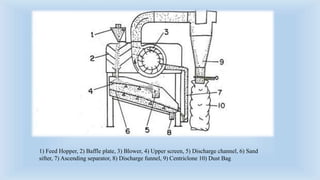
1) Feed Hopper, 2) Baffle plate, 3) Blower, 4) Upper screen, 5) Discharge channel, 6) Sand
sifter, 7) Ascending separator, 8) Discharge funnel, 9) Centriclone 10) Dust Bag
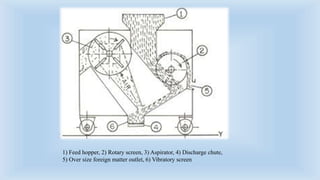
ROTARY SCREEN CLEANER
The rotary screen cleaner has normally circular decks. Their motion is
circular in horizontal plane. These have either single or double drum.
The machine consists of a rotary screen, aspirator and hopper and equipped
with an electric motor, which gives drive to the rotary screen and the
aspirator. The mixture is fed into the hopper.
The sound grains pass through the screen perforation into the centre of the
screen drum, whereas oversized material is retained above and pass out
though an outlet.
The sound grains come out at the centre side of the screen drum rotating at
low speed and fall onto the vibratory screen which remove the dirt particles.
The light particles like straw and dust are sucked away by the aspirator and
discharged through the aspirator outlet.
The cleaned grains are delivered through the discharge chute.
1) Feed hopper, 2) Rotary screen, 3) Aspirator, 4) Discharge chute,
5) Over size foreign matter outlet, 6) Vibratory screen
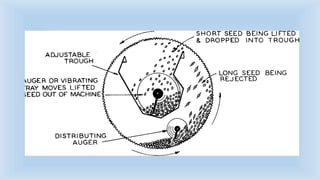
CYLINDER SEPARATOR
The indented cylinder separator is used for grading by length of all
granular materials such as wheat, oats, fine seeds, lentils, for
separating stalks from sunflower and beet seeds and for separating
unwanted long or short product impurities.
The size of grains can vary between 1.0 mm and 24 mm.
Depending on the required grading, the incoming product is sorted
according to roundness or length
SPIRAL SEPARATOR
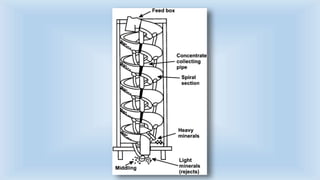
The spiral separator separates the grain as per their roundness.
The main component of the separator is a stationary, open screw
conveyor standing on one end.
The mixture is fed at the top of the writ.
The round materials of the mixture pick up speed as they slide or roll
down the inclined surface until their centrifugal force becomes
sufficient enough to throw them in the outer helix, the non-round-
materials are caught in, the inner helix and are discharged tlrrough a
separate spout.
There is no moving part in the spiral separator.
The rate of feeding is the only adjustable component. The feeding
should be Such that each grain rolls independently for effective
separation.
The main limitation of the spiral separato is lack of flexibility.
Separation of mustard, rapeseed, soybean, wild peas or other round
seeds can be performed from wheat, flax, oats etc.
by this device. It is less versatile ,as compared to other mechanical
cleaners, but is simple, inexpensive and quite useful for seed cleaning
purposes.
MAGNETIC SEPARATOR
The magnetic separator performs separation on the basis of surface
texture and stickiness properties of the grain.
Since the grains do not contain any free iron, therefore, are not
attracted by the magnet.
selective pre-treatment of mixing finely ground iron powder to feed
mass is given.
The grain mixture is fed to a screw conveyor or other mixing device
that tumbles and mixes the grain with a proportioned amount of water.
Due to moisture, iron powder adheres to rough, cracked, broken and
sticky seed coats.
Moisture does not remain on smooth grains so no iron powder adheres
to smooth surfaced grains.
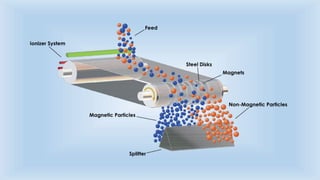
The grain mixture is fed onto the top of a horizontal revolving
magnetic drum, the smooth grains that are relatively free of powder fall
along the drum simply by gravity.
The materials with iron powder are attracted by the magnetic drum and
stick to it and are removed by rotary brush or break in the magnetic
field.
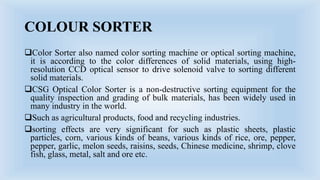
COLOUR SORTER
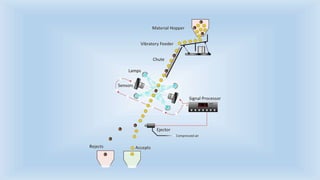
Color Sorter also named color sorting machine or optical sorting machine,
it is according to the color differences of solid materials, using high-
resolution CCD optical sensor to drive solenoid valve to sorting different
solid materials.
CSG Optical Color Sorter is a non-destructive sorting equipment for the
quality inspection and grading of bulk materials, has been widely used in
many industry in the world.
Such as agricultural products, food and recycling industries.
sorting effects are very significant for such as plastic sheets, plastic
particles, corn, various kinds of beans, various kinds of rice, ore, pepper,
pepper, garlic, melon seeds, raisins, seeds, Chinese medicine, shrimp, clove
fish, glass, metal, salt and ore etc.
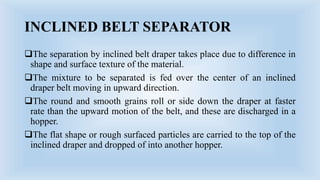
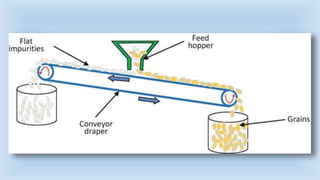
INCLINED BELT SEPARATOR
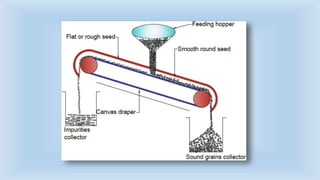
The separation by inclined belt draper takes place due to difference in
shape and surface texture of the material.
The mixture to be separated is fed over the center of an inclined
draper belt moving in upward direction.
The round and smooth grains roll or side down the draper at faster
rate than the upward motion of the belt, and these are discharged in a
hopper.
The flat shape or rough surfaced particles are carried to the top of the
inclined draper and dropped of into another hopper.
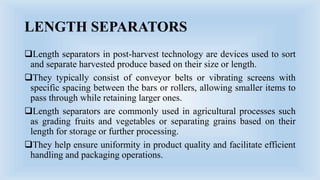
LENGTH SEPARATORS
Length separators in post-harvest technology are devices used to sort
and separate harvested produce based on their size or length.
They typically consist of conveyor belts or vibrating screens with
specific spacing between the bars or rollers, allowing smaller items to
pass through while retaining larger ones.
Length separators are commonly used in agricultural processes such
as grading fruits and vegetables or separating grains based on their
length for storage or further processing.
They help ensure uniformity in product quality and facilitate efficient
handling and packaging operations.
EFFECTIVENESS OF SEPARATION
The screen effectiveness may be defined as the ability of a screen in closely
separating the feed into overflow and underflow according to its size. If the
screen functions properly, all material 'O' would be in the overflow, while all
the material 'U' would be in the underflow. The material balance in a
screening operation can be derived as follows:
F = mass flow rate of feed, kg/hr.
O = mass flow rate of oversize, kg/hr.
U = mass flow rate of undersize, kg/hr.
mf = mass fraction of material in feed.
mo = mass fraction of material in overflow.
mu = mass fraction of material in underflow.
ANY QURIES :
arulsivakumar489@gmail.com
6374120823

CLEANING AND GRADING POST HARVEST TECHNOLOGY

  • 1.
    CLEANING AND GRADING -Post HarvestTechnology For Agricultural Engineers
  • 2.
  • 3.
    OUTLINE 1. Principles 2. AirScreen Cleaners, adjustments 3. Cylinder Separator 4. Spiral Separator 5. Magnetic Separator 6. Colour Sorter 7. Inclined Belt Separator 8. Length Separators 9. Effectiveness Of Separation And Performance Index.
  • 4.
    PRINCIPLES OF CLEANINGAND GRADEING  Grading refers to the classification of cleaned products into various quality fractions depending upon the various commercial values and other usage.  Sorting refers to the separation of cleaned product into various quality fractions that may be defined on the basis of size, shape, density,texture and colour.
  • 5.
    AIR SCREEN CLEANERS Thescreens used in combination with air blast performs satisfactory cleaning and separation operations for most of the granular materials. The air-screen cleaner uses three cleaning systems: blowing or aspiration, scalping screens and grading lower screens. The air-screen grain cleaner can be classified in two distinct types: (i) vibratory screen, (ii) rotary screen, based on movement of the screening surface.
  • 6.
    VIBRATORY AIR-SCREEN CLEANER Thescreening unit is composed of double or multiple (up to 8 number) screens.  These screens are tightened together and suspended by hangers in such a manner that these have horizontal oscillating motion and slightly vertical motion. These two motions in combination move the grain down the screen and at the same time toss sufficiently above the screen so that the bed of grain is properly stirred. The slope of the screen is adjustable to control the rate of downward travel of the grain. The screens are available in various shapes like; round, triangular or slotted holes as discussed earlier. Sometimes the holes of the screen are clogged when the machine makes fine degree of sorting. To avoid the clogging, the screens are generally fitted with a brush which moves under the screen and pushes the clogged material back through the screen. Other such devices can also be used for this purpose.
  • 7.
    1) Feed Hopper,2) Baffle plate, 3) Blower, 4) Upper screen, 5) Discharge channel, 6) Sand sifter, 7) Ascending separator, 8) Discharge funnel, 9) Centriclone 10) Dust Bag
  • 8.
    ROTARY SCREEN CLEANER Therotary screen cleaner has normally circular decks. Their motion is circular in horizontal plane. These have either single or double drum. The machine consists of a rotary screen, aspirator and hopper and equipped with an electric motor, which gives drive to the rotary screen and the aspirator. The mixture is fed into the hopper. The sound grains pass through the screen perforation into the centre of the screen drum, whereas oversized material is retained above and pass out though an outlet. The sound grains come out at the centre side of the screen drum rotating at low speed and fall onto the vibratory screen which remove the dirt particles. The light particles like straw and dust are sucked away by the aspirator and discharged through the aspirator outlet. The cleaned grains are delivered through the discharge chute.
  • 9.
    1) Feed hopper,2) Rotary screen, 3) Aspirator, 4) Discharge chute, 5) Over size foreign matter outlet, 6) Vibratory screen
  • 10.
    CYLINDER SEPARATOR The indentedcylinder separator is used for grading by length of all granular materials such as wheat, oats, fine seeds, lentils, for separating stalks from sunflower and beet seeds and for separating unwanted long or short product impurities. The size of grains can vary between 1.0 mm and 24 mm. Depending on the required grading, the incoming product is sorted according to roundness or length
  • 12.
    SPIRAL SEPARATOR The spiralseparator separates the grain as per their roundness. The main component of the separator is a stationary, open screw conveyor standing on one end. The mixture is fed at the top of the writ. The round materials of the mixture pick up speed as they slide or roll down the inclined surface until their centrifugal force becomes sufficient enough to throw them in the outer helix, the non-round- materials are caught in, the inner helix and are discharged tlrrough a separate spout. There is no moving part in the spiral separator.
  • 13.
    The rate offeeding is the only adjustable component. The feeding should be Such that each grain rolls independently for effective separation. The main limitation of the spiral separato is lack of flexibility. Separation of mustard, rapeseed, soybean, wild peas or other round seeds can be performed from wheat, flax, oats etc. by this device. It is less versatile ,as compared to other mechanical cleaners, but is simple, inexpensive and quite useful for seed cleaning purposes.
  • 15.
    MAGNETIC SEPARATOR The magneticseparator performs separation on the basis of surface texture and stickiness properties of the grain. Since the grains do not contain any free iron, therefore, are not attracted by the magnet. selective pre-treatment of mixing finely ground iron powder to feed mass is given. The grain mixture is fed to a screw conveyor or other mixing device that tumbles and mixes the grain with a proportioned amount of water. Due to moisture, iron powder adheres to rough, cracked, broken and sticky seed coats.
  • 16.
    Moisture does notremain on smooth grains so no iron powder adheres to smooth surfaced grains. The grain mixture is fed onto the top of a horizontal revolving magnetic drum, the smooth grains that are relatively free of powder fall along the drum simply by gravity. The materials with iron powder are attracted by the magnetic drum and stick to it and are removed by rotary brush or break in the magnetic field.
  • 18.
    COLOUR SORTER Color Sorteralso named color sorting machine or optical sorting machine, it is according to the color differences of solid materials, using high- resolution CCD optical sensor to drive solenoid valve to sorting different solid materials. CSG Optical Color Sorter is a non-destructive sorting equipment for the quality inspection and grading of bulk materials, has been widely used in many industry in the world. Such as agricultural products, food and recycling industries. sorting effects are very significant for such as plastic sheets, plastic particles, corn, various kinds of beans, various kinds of rice, ore, pepper, pepper, garlic, melon seeds, raisins, seeds, Chinese medicine, shrimp, clove fish, glass, metal, salt and ore etc.
  • 20.
    INCLINED BELT SEPARATOR Theseparation by inclined belt draper takes place due to difference in shape and surface texture of the material. The mixture to be separated is fed over the center of an inclined draper belt moving in upward direction. The round and smooth grains roll or side down the draper at faster rate than the upward motion of the belt, and these are discharged in a hopper. The flat shape or rough surfaced particles are carried to the top of the inclined draper and dropped of into another hopper.
  • 22.
    LENGTH SEPARATORS Length separatorsin post-harvest technology are devices used to sort and separate harvested produce based on their size or length. They typically consist of conveyor belts or vibrating screens with specific spacing between the bars or rollers, allowing smaller items to pass through while retaining larger ones. Length separators are commonly used in agricultural processes such as grading fruits and vegetables or separating grains based on their length for storage or further processing. They help ensure uniformity in product quality and facilitate efficient handling and packaging operations.
  • 24.
    EFFECTIVENESS OF SEPARATION Thescreen effectiveness may be defined as the ability of a screen in closely separating the feed into overflow and underflow according to its size. If the screen functions properly, all material 'O' would be in the overflow, while all the material 'U' would be in the underflow. The material balance in a screening operation can be derived as follows: F = mass flow rate of feed, kg/hr. O = mass flow rate of oversize, kg/hr. U = mass flow rate of undersize, kg/hr. mf = mass fraction of material in feed. mo = mass fraction of material in overflow. mu = mass fraction of material in underflow.
  • 25.