The French Newton
Pierre-Simon
Laplace
Developed mathematics
in astronomy, physics, and
statistics
Began work in calculus
which led to the Laplace
Transform
Focused later on celestial
mechanics
One of the first scientists
to suggest the existence of
black holes
History of the Transform
 Euler began looking at integrals as solutions to differential equations in
the mid 1700’s:
 Lagrange took this a step further while working on probability density
functions and looked at forms of the following equation:
 Finally, in 1785, Laplace began using a transformation to solve
equations of finite differences which eventually lead to the current
transform
Definition
 The Laplace transform is a linear operator that
switched a function f(t) to F(s).
 Specifically:
where:
 Go from time argument with real input to a complex
angular frequency input which is complex.
Restrictions
 There are two governing factors that determine
whether Laplace transforms can be used:
 f(t) must be at least piecewise continuous for t ≥ 0
 |f(t)| ≤ Meγt where M and γ are constants
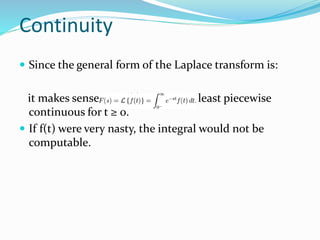
 Since the general form of the Laplace transform is:
it makes sense that f(t) must be at least piecewise
continuous for t ≥ 0.
 If f(t) were very nasty, the integral would not be
computable.
Continuity
Boundedness
 This criterion also follows directly from the general
definition:
 If f(t) is not bounded by Meγt then the integral will not
converge.
Laplace Transform Theory
•General Theory
•Example
•Convergence
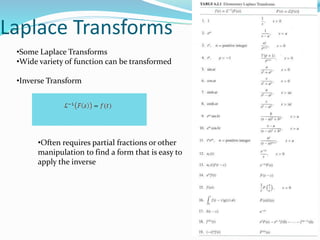
Laplace Transforms
•Some Laplace Transforms
•Wide variety of function can be transformed
•Inverse Transform
•Often requires partial fractions or other
manipulation to find a form that is easy to
apply the inverse
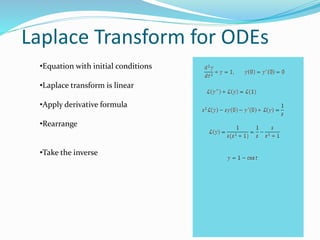
Laplace Transform for ODEs
•Equation with initial conditions
•Laplace transform is linear
•Apply derivative formula
•Rearrange
•Take the inverse
Laplace Transform in PDEs
Laplace transform in two variables (always taken
with respect to time variable, t):
Inverse laplace of a 2 dimensional PDE:
Can be used for any dimension PDE:
•ODEs reduce to algebraic equations
•PDEs reduce to either an ODE (if original equation dimension 2) or
another PDE (if original equation dimension >2)
The Transform reduces dimension by “1”:
Consider the case where:
ux+ut=t with u(x,0)=0 and u(0,t)=t2 and
Taking the Laplace of the initial equation leaves Ux+ U=1/s2 (note that the
partials with respect to “x” do not disappear) with boundary condition
U(0,s)=2/s3
Solving this as an ODE of variable x, U(x,s)=c(s)e-x + 1/s2
Plugging in B.C., 2/s3=c(s) + 1/s2 so c(s)=2/s3 - 1/s2
U(x,s)=(2/s3 - 1/s2) e-x + 1/s2
Now, we can use the inverse Laplace Transform with respect to s to find
u(x,t)=t2e-x - te-x + t
Example
Solutions
Diffusion Equation
ut = kuxx in (0,l)
Initial Conditions:
u(0,t) = u(l,t) = 1, u(x,0) = 1 + sin(πx/l)
Using af(t) + bg(t)  aF(s) + bG(s)
and df/dt  sF(s) – f(0)
and noting that the partials with respect to x commute with the transforms with
respect to t, the Laplace transform U(x,s) satisfies
sU(x,s) – u(x,0) = kUxx(x,s)
With eat  1/(s-a) and a=0,
the boundary conditions become U(0,s) = U(l,s) = 1/s.
So we have an ODE in the variable x together with some boundary conditions.
The solution is then:
U(x,s) = 1/s + (1/(s+kπ2/l2))sin(πx/l)
Therefore, when we invert the transform, using the Laplace table:
u(x,t) = 1 + e-kπ2t/l2
sin(πx/l)
Wave Equation
utt = c2uxx in 0 < x < ∞
Initial Conditions:
u(0,t) = f(t), u(x,0) = ut(x,0) = 0
For x  ∞, we assume that u(x,t)  0. Because the initial conditions
vanish, the Laplace transform satisfies
s2U = c2Uxx
U(0,s) = F(s)
Solving this ODE, we get
U(x,s) = a(s)e-sx/c + b(s)esx/c
Where a(s) and b(s) are to be determined.
From the assumed property of u, we expect that U(x,s)  0 as x  ∞.
Therefore, b(s) = 0. Hence, U(x,s) = F(s) e-sx/c. Now we use
H(t-b)f(t-b)  e-bsF(s)
To get
u(x,t) = H(t – x/c)f(t – x/c).
Real-Life Applications
Semiconductor
mobility
Call completion in
wireless networks
Vehicle vibrations on
compressed rails
Behavior of magnetic
and electric fields
above the
atmosphere
Ex. Semiconductor Mobility
Motivation
 semiconductors are commonly
made with superlattices having
layers of differing compositions
 need to determine properties of
carriers in each layer
concentration of electrons and
holes
mobility of electrons and holes
 conductivity tensor can be related
to Laplace transform of electron
and hole densities
Notation
R = ratio of induced electric field to the product of
the current density and the applied magnetic field
ρ = electrical resistance
H = magnetic field
J = current density
E = applied electric field
n = concentration of electrons
u = mobility
Equation Manipulation
and
Assuming a continuous mobility
distribution and that ,
, it follows:
Applying the Laplace Transform
Johnson, William B. Transform method for
semiconductor mobility, Journal of Applied
Physics 99 (2006).
Source

presentation_laplace_transform_1553598871_41306.pptx

  • 2.
    The French Newton Pierre-Simon Laplace Developedmathematics in astronomy, physics, and statistics Began work in calculus which led to the Laplace Transform Focused later on celestial mechanics One of the first scientists to suggest the existence of black holes
  • 3.
    History of theTransform  Euler began looking at integrals as solutions to differential equations in the mid 1700’s:  Lagrange took this a step further while working on probability density functions and looked at forms of the following equation:  Finally, in 1785, Laplace began using a transformation to solve equations of finite differences which eventually lead to the current transform
  • 4.
    Definition  The Laplacetransform is a linear operator that switched a function f(t) to F(s).  Specifically: where:  Go from time argument with real input to a complex angular frequency input which is complex.
  • 5.
    Restrictions  There aretwo governing factors that determine whether Laplace transforms can be used:  f(t) must be at least piecewise continuous for t ≥ 0  |f(t)| ≤ Meγt where M and γ are constants
  • 6.
     Since thegeneral form of the Laplace transform is: it makes sense that f(t) must be at least piecewise continuous for t ≥ 0.  If f(t) were very nasty, the integral would not be computable. Continuity
  • 7.
    Boundedness  This criterionalso follows directly from the general definition:  If f(t) is not bounded by Meγt then the integral will not converge.
  • 8.
    Laplace Transform Theory •GeneralTheory •Example •Convergence
  • 9.
    Laplace Transforms •Some LaplaceTransforms •Wide variety of function can be transformed •Inverse Transform •Often requires partial fractions or other manipulation to find a form that is easy to apply the inverse
  • 10.
    Laplace Transform forODEs •Equation with initial conditions •Laplace transform is linear •Apply derivative formula •Rearrange •Take the inverse
  • 11.
    Laplace Transform inPDEs Laplace transform in two variables (always taken with respect to time variable, t): Inverse laplace of a 2 dimensional PDE: Can be used for any dimension PDE: •ODEs reduce to algebraic equations •PDEs reduce to either an ODE (if original equation dimension 2) or another PDE (if original equation dimension >2) The Transform reduces dimension by “1”:
  • 12.
    Consider the casewhere: ux+ut=t with u(x,0)=0 and u(0,t)=t2 and Taking the Laplace of the initial equation leaves Ux+ U=1/s2 (note that the partials with respect to “x” do not disappear) with boundary condition U(0,s)=2/s3 Solving this as an ODE of variable x, U(x,s)=c(s)e-x + 1/s2 Plugging in B.C., 2/s3=c(s) + 1/s2 so c(s)=2/s3 - 1/s2 U(x,s)=(2/s3 - 1/s2) e-x + 1/s2 Now, we can use the inverse Laplace Transform with respect to s to find u(x,t)=t2e-x - te-x + t
  • 13.
  • 14.
    Diffusion Equation ut =kuxx in (0,l) Initial Conditions: u(0,t) = u(l,t) = 1, u(x,0) = 1 + sin(πx/l) Using af(t) + bg(t)  aF(s) + bG(s) and df/dt  sF(s) – f(0) and noting that the partials with respect to x commute with the transforms with respect to t, the Laplace transform U(x,s) satisfies sU(x,s) – u(x,0) = kUxx(x,s) With eat  1/(s-a) and a=0, the boundary conditions become U(0,s) = U(l,s) = 1/s. So we have an ODE in the variable x together with some boundary conditions. The solution is then: U(x,s) = 1/s + (1/(s+kπ2/l2))sin(πx/l) Therefore, when we invert the transform, using the Laplace table: u(x,t) = 1 + e-kπ2t/l2 sin(πx/l)
  • 15.
    Wave Equation utt =c2uxx in 0 < x < ∞ Initial Conditions: u(0,t) = f(t), u(x,0) = ut(x,0) = 0 For x  ∞, we assume that u(x,t)  0. Because the initial conditions vanish, the Laplace transform satisfies s2U = c2Uxx U(0,s) = F(s) Solving this ODE, we get U(x,s) = a(s)e-sx/c + b(s)esx/c Where a(s) and b(s) are to be determined. From the assumed property of u, we expect that U(x,s)  0 as x  ∞. Therefore, b(s) = 0. Hence, U(x,s) = F(s) e-sx/c. Now we use H(t-b)f(t-b)  e-bsF(s) To get u(x,t) = H(t – x/c)f(t – x/c).
  • 16.
    Real-Life Applications Semiconductor mobility Call completionin wireless networks Vehicle vibrations on compressed rails Behavior of magnetic and electric fields above the atmosphere
  • 17.
    Ex. Semiconductor Mobility Motivation semiconductors are commonly made with superlattices having layers of differing compositions  need to determine properties of carriers in each layer concentration of electrons and holes mobility of electrons and holes  conductivity tensor can be related to Laplace transform of electron and hole densities
  • 18.
    Notation R = ratioof induced electric field to the product of the current density and the applied magnetic field ρ = electrical resistance H = magnetic field J = current density E = applied electric field n = concentration of electrons u = mobility
  • 19.
  • 20.
    Assuming a continuousmobility distribution and that , , it follows:
  • 21.
  • 22.
    Johnson, William B.Transform method for semiconductor mobility, Journal of Applied Physics 99 (2006). Source