M.R. Odekunle, A.O. Adesanya, J. Sunday / International Journal of Engineering Research and
                  Applications (IJERA) ISSN: 2248-9622 www.ijera.com
                   Vol. 2, Issue 5, September-October 2012, pp.1182-1187
     4-Point Block Method for Direct Integration of First-Order
                  Ordinary Differential Equations

                     M.R. Odekunle*, A.O. Adesanya*, J. Sunday**
          *(Department of Mathematics, Modibbo Adama University of Technology, Yola, Nigeria)
            **(Department of Mathematical Sciences, Adamawa State University, Mubi, Nigeria)


ABSTRACT
         This research paper examines the                development and application of block methods.
derivation and implementation of a new 4-point           More recently, authors like [9], [10], [11], [12],
block method for direct integration of first-order       [13], [14], [15], [16], have all proposed LMMs to
ordinary     differential    equations       using       generate numerical solution to (1). These authors
interpolation and collocation techniques. The            proposed methods in which the approximate
approximate solution is a combination of power           solution ranges from power series, Chebychev’s,
series and exponential function. The paper               Lagrange’s and Laguerre’s polynomials.          The
further investigates the properties of the new           advantages of LMMs over single step methods have
integrator and found it to be zero-stable,               been extensively discussed by [17].
consistent and convergent. The new integrator                        In this paper, we propose a new
was tested on some numerical examples and                Continuous Linear Multistep Method (CLMM), in
found to perform better than some existing ones.         which the approximate solution is the combination
                                                         of power series and exponential function. This work
Keywords: Approximate Solution, Block Method,            is an improvement on [4].
Exponential Function, Order, Power Series
AMS Subject Classification: 65L05, 65L06, 65D30          2. METHODOLOGY: CONSTRUCTION
                                                            OF THE NEW BLOCK METHOD
1. INTRODUCTION                                                   Interpolation and collocation procedures
          Nowadays, the integration of Ordinary          are used by choosing interpolation point s at a grid
Differential Equations (ODEs) is carried out using       point and collocation points r at all points giving
some kinds of block methods. Therefore, in this          rise to   s  r  1 system of equations whose
paper, we propose a new 4-point block method for
                                                         coefficients are determined by using appropriate
the solution of first-order ODEs of the form:
                                                         procedures. The approximate solution to (1) is taken
 y '  f ( x, y), y(a)    a  x  b        (1)        to be a combination of power series and exponential
where     f is continuous within the interval of         function given by:
                                                                      4            5
                                                                                          jxj
                                                         y( x)   a j x j  a5 
integration [a, b] . We assume that f satisfies
                                                                                                                    (3)
Lipchitz condition which guarantees the existence                 j 0            j 0        j!
and uniqueness of solution of (1). The problem (1)
                                                         with the first derivative given by:
occurs mainly in the study of dynamical systems
                                                                       4                  5
                                                                                                 j x j 1
and electrical networks. According to [1] and [2],
                                                         y '( x)   ja j x j 1  a5                              (4)
equation (1) is used in simulating the growth of
                                                                      j 0       ( j  1)!
                                                                                         j 1
populations, trajectory of a particle, simple
                                                         where a j ,   for j  0(1)5 and y ( x) is
                                                                      j
harmonic motion, deflection of a beam etc.
Development of Linear Multistep Methods (LMMs)           continuously differentiable. Let the solution of (1)
for solving ODEs can be generated using methods
such as Taylor’s series, numerical integration and       be sought on the partition  N : a  x0 < x1 < x 2 < .
collocation method, which are restricted by an           . . < x n < xn 1 < . . .< x N =        b , of the integration
assumed order of convergence, [3]. In this work, we
will follow suite from the previous paper of [4] by                         
                                                         interval a, b , with a constant step-size h , given
deriving a new 4-point block method in a multistep       by, h  xn 1  xn , n  0,1,..., N .
collocation technique introduced by [5].
            Block methods for solving ODEs have          Then, substituting (4) in (1) gives:
initially been proposed by [6], who used them as                             4                  5
                                                                                                        j x j 1
starting values for predictor-corrector algorithm, [7]    f ( x, y)   ja j x j 1  a5                           (5)
developed Milne’s method in form of implicit                               j 0                 j 1   ( j  1)!
methods, and [8] also contributed greatly to the


                                                                                                           1182 | P a g e
M.R. Odekunle, A.O. Adesanya, J. Sunday / International Journal of Engineering Research and
                  Applications (IJERA) ISSN: 2248-9622 www.ijera.com
                   Vol. 2, Issue 5, September-October 2012, pp.1182-1187
Now, interpolating (3) at point xn  s , s  0 and                         A  [a0 , a1 , a2 , a3 , a4 , a5 ]T
collocating (5) at points xn  r , r  0(1)4 , leads to                    U  [ yn , f n , f n 1 , f n  2 , f n 3 , f n  4 ]T
the following system of equations:                                        and
          AX  U                                (6)
where
                                                                      2 xn  3 xn  4 xn  5 xn 
                                                                            2       3        4        5
                                                                                                               
   1             xn    2
                       xn              3
                                      xn         4
                                                xn         1   xn                                      
                                                                       2        6       24       120        
                                                                       3 xn  4 xn  5 xn 
                                                                              2       3        4               
   0             1 2 xn                2
                                      3xn          3
                                                4 xn          xn 
                                                                   2
                                                                                                            
                                                                          2       6      24                 
                                                                                                              
   0                                                                       3 xn 1  4 xn 1  5 xn 1  
                                                                                  2        3          4

                                                              xn 1                        
                                       2       3                  2
                 1 2 xn 1         3 xn 1 4 xn 1                                                        
                                                                              2         6          24  
X                                                                                                            
                                                                           3 xn  2  4 xn  2  5 xn  2  
                                                                                   2         3          4

   0                                                         xn  2                                  
                                         2        3               2
                  1 2 xn  2          3 xn  2 4 xn  2
                                                                               2         6         24  
   
   0                                                                       3 xn 3  4 xn 3  5 xn 3  
                                                                                  2         3          4
                                                               2 xn 3                                
                                         2       3
                  1 2 xn 3           3 xn 3 4 xn 3     
                                                                              2         6          24  
                                                                                                              
                                                                           3 xn  4  4 xn  4  5 xn  4  
                                                                                   2         3          4

                                                              xn  4                        
                                         2        3               2
   0             1 2 xn  4          3 xn  4 4 xn  4                                                      
                                                                               2         6         24      
Solving (6), for a j ' s, j  0(1)5 and substituting                        Ym   yn1 , yn 2 , yn3 , yn 4 
                                                                                                                          T

back into (3) gives a continuous linear multistep
                                                                             y n   yn 3 , yn 2 , yn 1 , yn 
                                                                                                                      T
method of the form:
                                                                            F(Ym )   f n 1 , f n  2 , f n 3 , f n  4 
                                4
y ( x )   0 ( x ) yn  h   j ( x ) f n  j
                                                                                                                               T
                                                           (7)
                               j 0
                                                                             f (y n )   f n3 , f n2 , f n1 , f n 
                                                                                                                          T

where         0  1 and              the      coefficients       of
 f n  j gives:
                                                                                     1      0 0 0       0                  0 0 1
                                                                                     0           
                                                                                             1 0 0       0                  0 0 1
       1                                                                    A(0)                 , E                          ,
0        (6t 5  75t 4  350t 3  750t 2  720t )                                 0      0 1 0       0                  0 0 1
     720
                                                                                                                               
                                                                                     0      0 0 1       0                  0 0 1
            (12t  135t  520t  720t ) 
         1
1              5        4        3        2

       360                                                                                          251                     
                                                                              0            0 0                              
      1                                                                       
                                                                                                      720
                                                                                                                              
 2  (3t 5  30t 4  95t 3  90t 2 )               
     60                                                                       0            0 0
                                                                                                      29                      
         1                                                                                          90                      
3         (12t 5  105t 4  280t 3  240t 2 )                           d                                               
       360                                                                     0                     27                      
                                                                                            0 0
       1                                                                                            80                      
4        (6t  45t  110t  90t )
               5       4        3      2
                                                                                                                             
     720                                            
                                                                                                     14
                                                                               0            0 0                              
                                                             (8)                                     45                      
where    t  ( x  xn ) h . Evaluating                    (7) at
t  1(1)4 gives a block scheme of the form:
A(0) Ym  Ey n  hdf (y n )  hbF (Ym )                          (9)
where


                                                                                                                                1183 | P a g e
M.R. Odekunle, A.O. Adesanya, J. Sunday / International Journal of Engineering Research and
                  Applications (IJERA) ISSN: 2248-9622 www.ijera.com
                   Vol. 2, Issue 5, September-October 2012, pp.1182-1187
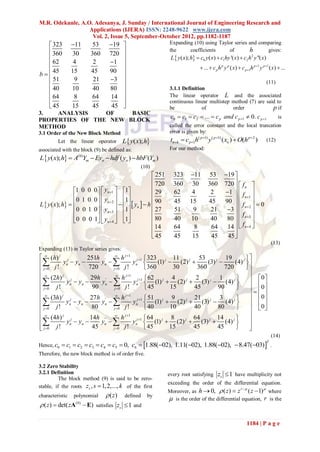
   323          11        53         19                            Expanding (10) using Taylor series and comparing
   360           30       360         720                            the     coefficients     of        h      gives:
                                                                      L  y ( x); h  c0 y ( x)  c1hy '( x)  c2 h 2 y ''( x)
   62            4         2          1     
   45                                                                                   ...  c p h p y p ( x)  c p 1h p 1 y p 1 ( x)  ...
                 15        45          90
b                                           
   51            9         21         3                                                                        (11)
   40           10         40         80                             3.1.1 Definition
   64            8         64         14                             The linear operator L and the associated
                                                                     continuous linear multistep method (7) are said to
   45           15         45          45                            be             of           order             p if
3.   ANALYSIS    OF    BASIC
                                                                        c0  c1  c2  ...  c p and c p 1  0. c p 1                       is
PROPERTIES OF THE NEW BLOCK
METHOD                                                                 called the error constant and the local truncation
3.1 Order of the New Block Method                                      error is given by:
         Let the linear operator              L  y( x); h             tnk  cp1h( p1) y( p1) ( xn )  O(h p2 )                  (12)
associated with the block (9) be defined as:                           For our method:
L y( x); h  A(0)Ym  Eyn  hdf ( yn )  hbF (Ym )
                                                         (10)
                                                                251     323       11         53        19 
                                                                720     360        30        360        720   f n 
                 1            0   yn 1  1                                                            
                       0   0
                                                                29      62         4          2         1   f 
                 0                        
                       1   0   0   yn  2  1               90                                      90  
                                                                                                                n 1 
L  y ( x); h                                 yn   h 
                                                                         45        15         45
                                                                                                              f n2   0
                 0    0   1   0   yn 3  1                27      51         9          21         3           
                                          
                                                                80                                       80   f n 3 
                 0    0   0   1  yn  4  1                         40        10          40
                                                                                                                        
                                                                14      64          8         64         14   f n  4 
                                                                                                            
                                                                45      45         15         45         45 
                                                                                                                                           (13)
Expanding (13) in Taylor series gives:
  ( h) j j          251h '  h j 1 j 1  323 j 11                     53         19        
 j !      yn  yn        yn              yn          (1)  (2) j      (3) j      (4) j 
 j 0                 720       j 0 j !             360       30      360         720       
 (2h) j
          j
                        29h '      
                                      h  j 1
                                                      62        4       2         1        0
           yn  yn       yn              ynj 1  (1) j  (2) j  (3) j  (4) j    
 j 0 j !               90       j 0 j !            45       15      45        90        0
  (3h) j             27 h '  h j 1 j 1  51 j 9                                              0
                                                                        21 j 3           j
           yn  yn 
               j
                            yn              yn  (1)  (2)  (3)  (4) 
                                                                    j
                                                                                                  
 j 0 j !              80       j 0   j!            40       10      40        80            0
                                     j 1                                                    
 (4h) y j  y  14h y '  h y j 1  64 (1) j  8 (2) j  64 (3) j  14 (4) j 
           j
                                                                                                
 j ! n
 j 0
                    n
                        45
                             n    j ! n  45
                                 j 0                         15      45         45
                                                                                          
                                                                                               
                                                                                                
                                                                                                                                           (14)
             c1  c2  c3  c4  c5  0, c6  1.88(02), 1.11(02), 1.88(02),  8.47(03)  .
                                                                                                                                       T
Hence, c0
Therefore, the new block method is of order five.

3.2 Zero Stability
3.2.1 Definition                                                       every root satisfying zs  1 have multiplicity not
          The block method (9) is said to be zero-
                                                                       exceeding the order of the differential equation.
stable, if the roots zs , s  1, 2,..., k of the first
                                                                       Moreover, as h  0,  ( z )  z ( z  1) where
                                                                                                                    r            
characteristic   polynomial           ( z)    defined     by
                                                                        is the order of the differential equation, r is the
 ( z )  det( zA (0)  E) satisfies zs  1 and

                                                                                                                        1184 | P a g e
M.R. Odekunle, A.O. Adesanya, J. Sunday / International Journal of Engineering Research and
                  Applications (IJERA) ISSN: 2248-9622 www.ijera.com
                   Vol. 2, Issue 5, September-October 2012, pp.1182-1187
                                                                   ( z , h)   ( z )  h ( z )  0 satisfies
                                (0)
order of the matrices A               and E (see [11] for
details).                                                         zs  1, s  1, 2,..., n                             where
For our new integrator,
                                                                                        f
             1 0 0 0 0 0 0 1                                  h   h and   .
             0 1 0 0 0 0 0 1                                                        y
 ( z)  z                           0 (15)                 We shall adopt the boundary locus method for the
             0 0 1 0 0 0 0 1                                  region of absolute stability of the block method.
                                                              Substituting the test equation y '   y into the
             0 0 0 1 0 0 0 1
                                                                  block formula gives,
 ( z )  z 3 ( z  1)  0,  z1  z2  z3  0, z4  1            A (0) Ym (r )  Ey n (r )  h Dyn (r )  h BYm (r )
. Hence, the new block method is zero-stable.
                                                                           (16)
3.3 Convergence
                                                                  Thus:
        The new block method is convergent by
consequence of Dahlquist theorem below.                                          A(0)Ym (r )  Eyn (r ) 
                                                                  h( r , h)                                      (17)
3.3.1 Theorem [18]                                                               Dyn (r )  BYm (r ) 
         The necessary and sufficient conditions                  Writing (17) in trigonometric ratios gives:
that a continuous LMM be convergent are that it be                              A(0)Ym ( )  Eyn ( ) 
consistent and zero-stable.                                       h( , h)                                       (18)
                                                                                Dyn ( )  BYm ( ) 
3.4 Region of Absolute Stability                                  where     r  ei . Equation (18)           is   our
3.4.1 Definition
                                                                  characteristic/stability polynomial. Applying (18) to
         The method (9) is said to be absolutely
                                                                  our method, we have:
stable if for a given h , all the roots z s of the
characteristic                         polynomial
               (cos 2 )(cos 3 )(cos  )  (cos 2 )(cos 3 )(cos 4 )(cos )
h( , h)                                                                                                     (19)
             1                              1
               (cos 2 )(cos 3 )(cos  )  (cos 2 )(cos 3 )(cos 4 )(cos )
             5                              5
which gives the stability region shown in fig. 1 below.

                                                             5
                                                         y
                                                             4

                                                             3

                                                             2

                                                             1


                  -5       -4           -3    -2    -1               1        2        3       4        5
                                                             -1                                        x
                                                             -2

                                                             -3

                                                             -4

                                                             -5


                       Fig. 1: Region of Absolute Stability of the 4-Point Block Method

4. NUMERICAL IMPLEMENTATIONS                                      EOAS- Error in [4]
We shall use the following notations in the tables                EBM- Error in [13]
below;                                                            EMY- Error in [12]
ERR- |Exact Solution-Computed Result|


                                                                                                            1185 | P a g e
M.R. Odekunle, A.O. Adesanya, J. Sunday / International Journal of Engineering Research and
                  Applications (IJERA) ISSN: 2248-9622 www.ijera.com
                   Vol. 2, Issue 5, September-October 2012, pp.1182-1187
Problem 1                                                                          This problem was solved by [12] and [4].
Consider a linear first order IVP:                                       They adopted block methods of order four to solve
y '   y, y(0)  1, 0  x  2, h  0.1 (20)                             the problem (20). We compare the result of our
with the exact solution:                                                 new block method (9) (which is of order five) with
                                                                         their results as shown in table 1 below.
y ( x)  e x                                         (21)

Table 1: Performance of the New Block Method on y '   y, y(0)  1, 0  x  1, h  0.1
_____________________________________________________________________________________
 x            Exact solution              Computed Solution                     ERR                  EOAS              EMY
---------------------------------------------------------------------------------------------------------------------------------------
0.1000 0.9048374180359595                  0.9048374025462963 1.5490(-08)                    2.3231(-07) 2.5292(-06)
0.2000 0.8187307530779818                  0.8187307437037037 9.3743(-09)                    1.0067(-07) 2.0937(-06)
0.3000 0.7408182206817178                  0.7408182037500000 1.6932(-08)                    3.2505(-07) 2.0079(-06)
0.4000 0.6703200460356393                  0.6703200296296297 1.6406(-08)                    4.6622(-07) 1.6198(-06)
0.5000 0.6065306597126334                  0.6065306344848305 2.5228(-08)                    3.4071(-07) 3.1608(-06)
0.6000 0.5488116360940264                  0.5488116163781553 1.9716(-08)                    4.8161(-07) 2.7294(-06)
0.7000 0.4965853037914095                  0.4965852802878691 2.3504(-08)                    5.6328(-07) 2.5457(-06)
0.8000 0.4493289641172216                  0.4493289421226676 2.1995(-08)                    4.4956(-07) 2.1713(-06)
0.9000 0.4065696597405991                  0.4065696328791496 2.6862(-08)                    5.3518(-07) 3.1008(-06)
1.0000 0.3678794411714423                  0.3678794189516900 2.2220(-08)                    5.7870(-07) 2.7182(-06)
---------------------------------------------------------------------------------------------------------------------------------------
Problem 2                                                                           This problem was solved by [13] and [4].
Consider a linear first order IVP:                                       They adopted a self-starting block method of order
 y '  xy, y(0)  1, 0  x  2, h  0.1 (22)                             six and four respectively to solve the problem (22).
with the exact solution:                                                 We compare the result of our new block method (9)
                                                                         (which is of order five) with their results as shown
             x2
                                                                         in table 2.
 y ( x)  e 2                                         (23)
Table 2: Performance of the New Block Method on y '  xy, y(0)  1, 0  x  1, h  0.1
_____________________________________________________________________________________
    x         Exact solution                   Computed Solution                 ERR                  EOAS             EBM
---------------------------------------------------------------------------------------------------------------------------------------
0.1000 1.0050125208594010                  1.0050122069965277             3.1386(-07)         5.2398(-07) 5.29(-07)
0.2000 1.0202013400267558                  1.0202011563888889             1.3364(-07)         1.6913(-07) 1.77(-07)
0.3000 1.0460278599087169                  1.0460275417187499             3.1819(-07)         8.7243(-07) 8.99(-07)
0.4000 1.0832870676749586                  1.0832870577777778             9.8972(-09)         3.0098(-06) 3.09(-06)
0.5000 1.1331484530668263                  1.1331477578536935             6.9521(-07)         1.7466(-06) 1.91(-06)
0.6000 1.1972173631218102                  1.1972169551828156             4.0794(-07)         4.1710(-06) 4.48(-06)
0.7000 1.2776213132048868                  1.2776205400192113             7.7319(-07)         9.6465(-06) 1.02(-05)
0.8000 1.3771277643359572                  1.3771270561253053             7.0821(-07)         6.7989(-06) 7.74(-05)
0.9000 1.4993025000567668                  1.4992996318515335             2.8682(-06)         1.2913(-05) 1.44(-05)
1.0000 1.6487212707001282                  1.6487192043043850             2.0664(-06)         2.6575(-05) 2.93(-05)
---------------------------------------------------------------------------------------------------------------------------------------

5. CONCLUSION                                                                    natural laws of growth and decay. Pacific
          In this paper, we have proposed a new 4-                               Journal of Science and Technology, 12(1),
point block numerical method for the solution of                                 237-243, 2011.
first-order ordinary differential equations. The block                   [2]      P. Kandasamy, K. Thilagavathy and K.
integrator proposed was found to be zero-stable,                                 Gunavathy, Numerical methods (S. Chand
consistent and convergent. The new method was also                               and Company, New Delhi-110 055, 2005).
found to perform better than some existing methods.                      [3]     J. O. Ehigie, S. A. Okunugo, and A. B.
                                                                                 Sofoluwe, A generalized 2-step continuous
                                                                                 implicit linear multistep method of hybrid
                                                                                 type. Journal of Institute of Mathematics
References                                                                       and Computer Science, 2(6), 362-372, 2010.
  [1]     J. Sunday, On Adomian decomposition                            [4]     M. R. Odekunle, A. O. Adesanya and J.
          method for numerical solution of ordinary                              Sunday, A new block integrator for the
          differential equations arising from the                                solution of initial value problems of first-


                                                                                                                    1186 | P a g e
M.R. Odekunle, A.O. Adesanya, J. Sunday / International Journal of Engineering Research and
                  Applications (IJERA) ISSN: 2248-9622 www.ijera.com
                   Vol. 2, Issue 5, September-October 2012, pp.1182-1187
        order ordinary differential equations,                       differential equation, Intern. J. Comp. Math,
        International Journal of Pure and Applied                    77, 117-124, 2001.
        Science and Technology, 11(2), 92-100,                [18]   G. G. Dahlquist, Numerical integration of
        2012.                                                        ordinary differential equations, Math.
 [5]    P. Onumanyi, D. O. Awoyemi, S. N. Jator                      Scand., 4(1), 33-50, 1956.
        and U. W. Sirisena, New linear multistep
        methods with continuous coefficients for
        first Order IVPS, Journal of the Nigerian
        Mathematical Society, 13, 37-51, 1994.
 [6]    W. E. Milne, Numerical solution of
        differential equations (New York, Willey,
        1953).
 [7]    J. B. Rosser, A Runge-Kutta method for all
        Seasons. SIAM Review, 9, 417-452, 1967.           .
 [8]    L. F. Shampine and H. A. Watts, Block
        implicit one-step Methods, Mathematics of
        Computation, 23(108), 731-740, 1969.
 [9]      J. C. Butcher, Numerical Methods for
        Ordinary Differential Equation (West
        Sussex: John Wiley & Sons, 2003).
 [10]    Zarina, B. I., Mohammed, S., Kharil, I. and
        Zanariah, M, Block Method for Generalized
        Multistep Adams Method and Backward
        Differentiation Formula in solving first-
        order ODEs, Mathematika, 25-33, 2005.
 [11]   D. O. Awoyemi, R. A. Ademiluyi and E.
        Amuseghan, Off-grids exploitation in the
        development of more accurate method for
        the solution of ODEs, Journal of
        Mathematical Physics, 12, 379-386, 2007.
 [12]   U. Mohammed, and Y. A. Yahaya, Fully
        implicit four point block backward
        difference formula for solving first-order
        initial value problems, Leonardo Journal of
        Sciences, 16(1) ,21-30, 2010.
 [13]    A. M. Badmus and D. W. Mishelia, Some
        uniform order block method for the solution
        of first-order ordinary differential equations,
        Journal of Nigerian Association of
        Mathematical Physics, 19 ,149-154, 2011.
 [14]   E. A. Areo, R. A. Ademiluyi, and P.O.
        Babatola, Three steps hybrid linear multistep
        method for the solution of first-order initial
        value problems in ordinary differential
        equations, Journal of Mathematical Physics,
        19, 261-266, 2011.
 [15]   E. A. Ibijola, Y. Skwame and G. Kumleng,
        Formulation of hybrid method of higher
        step-sizes through the continuous multistep
        collocation, American Journal of Scientific
        and Industrial Research, 2, 161-173, 2011.
 [16]   J. P. Chollom, I. O. Olatunbosun, and S. A.
        Omagu, A class of A-stable block explicit
        methods for the solution of ordinary
        differential equations. Research Journal of
        Mathematics and Statistics, 4(2), 52-56,
        2012.
 [17]   D. O. Awoyemi, A new sixth-order
        algorithm for general second-order ordinary


                                                                                                 1187 | P a g e

Gm2511821187

  • 1.
    M.R. Odekunle, A.O.Adesanya, J. Sunday / International Journal of Engineering Research and Applications (IJERA) ISSN: 2248-9622 www.ijera.com Vol. 2, Issue 5, September-October 2012, pp.1182-1187 4-Point Block Method for Direct Integration of First-Order Ordinary Differential Equations M.R. Odekunle*, A.O. Adesanya*, J. Sunday** *(Department of Mathematics, Modibbo Adama University of Technology, Yola, Nigeria) **(Department of Mathematical Sciences, Adamawa State University, Mubi, Nigeria) ABSTRACT This research paper examines the development and application of block methods. derivation and implementation of a new 4-point More recently, authors like [9], [10], [11], [12], block method for direct integration of first-order [13], [14], [15], [16], have all proposed LMMs to ordinary differential equations using generate numerical solution to (1). These authors interpolation and collocation techniques. The proposed methods in which the approximate approximate solution is a combination of power solution ranges from power series, Chebychev’s, series and exponential function. The paper Lagrange’s and Laguerre’s polynomials. The further investigates the properties of the new advantages of LMMs over single step methods have integrator and found it to be zero-stable, been extensively discussed by [17]. consistent and convergent. The new integrator In this paper, we propose a new was tested on some numerical examples and Continuous Linear Multistep Method (CLMM), in found to perform better than some existing ones. which the approximate solution is the combination of power series and exponential function. This work Keywords: Approximate Solution, Block Method, is an improvement on [4]. Exponential Function, Order, Power Series AMS Subject Classification: 65L05, 65L06, 65D30 2. METHODOLOGY: CONSTRUCTION OF THE NEW BLOCK METHOD 1. INTRODUCTION Interpolation and collocation procedures Nowadays, the integration of Ordinary are used by choosing interpolation point s at a grid Differential Equations (ODEs) is carried out using point and collocation points r at all points giving some kinds of block methods. Therefore, in this rise to   s  r  1 system of equations whose paper, we propose a new 4-point block method for coefficients are determined by using appropriate the solution of first-order ODEs of the form: procedures. The approximate solution to (1) is taken y '  f ( x, y), y(a)    a  x  b (1) to be a combination of power series and exponential where f is continuous within the interval of function given by: 4 5  jxj y( x)   a j x j  a5  integration [a, b] . We assume that f satisfies (3) Lipchitz condition which guarantees the existence j 0 j 0 j! and uniqueness of solution of (1). The problem (1) with the first derivative given by: occurs mainly in the study of dynamical systems 4 5  j x j 1 and electrical networks. According to [1] and [2], y '( x)   ja j x j 1  a5  (4) equation (1) is used in simulating the growth of j 0 ( j  1)! j 1 populations, trajectory of a particle, simple where a j ,   for j  0(1)5 and y ( x) is j harmonic motion, deflection of a beam etc. Development of Linear Multistep Methods (LMMs) continuously differentiable. Let the solution of (1) for solving ODEs can be generated using methods such as Taylor’s series, numerical integration and be sought on the partition  N : a  x0 < x1 < x 2 < . collocation method, which are restricted by an . . < x n < xn 1 < . . .< x N = b , of the integration assumed order of convergence, [3]. In this work, we will follow suite from the previous paper of [4] by   interval a, b , with a constant step-size h , given deriving a new 4-point block method in a multistep by, h  xn 1  xn , n  0,1,..., N . collocation technique introduced by [5]. Block methods for solving ODEs have Then, substituting (4) in (1) gives: initially been proposed by [6], who used them as 4 5  j x j 1 starting values for predictor-corrector algorithm, [7] f ( x, y)   ja j x j 1  a5  (5) developed Milne’s method in form of implicit j 0 j 1 ( j  1)! methods, and [8] also contributed greatly to the 1182 | P a g e
  • 2.
    M.R. Odekunle, A.O.Adesanya, J. Sunday / International Journal of Engineering Research and Applications (IJERA) ISSN: 2248-9622 www.ijera.com Vol. 2, Issue 5, September-October 2012, pp.1182-1187 Now, interpolating (3) at point xn  s , s  0 and A  [a0 , a1 , a2 , a3 , a4 , a5 ]T collocating (5) at points xn  r , r  0(1)4 , leads to U  [ yn , f n , f n 1 , f n  2 , f n 3 , f n  4 ]T the following system of equations: and AX  U (6) where    2 xn  3 xn  4 xn  5 xn  2 3 4 5  1 xn 2 xn 3 xn 4 xn  1   xn         2 6 24 120      3 xn  4 xn  5 xn  2 3 4  0 1 2 xn 2 3xn 3 4 xn     xn  2       2 6 24     0   3 xn 1  4 xn 1  5 xn 1   2 3 4     xn 1    2 3 2  1 2 xn 1 3 xn 1 4 xn 1   2 6 24   X      3 xn  2  4 xn  2  5 xn  2   2 3 4 0     xn  2     2 3 2 1 2 xn  2 3 xn  2 4 xn  2   2 6 24    0   3 xn 3  4 xn 3  5 xn 3   2 3 4    2 xn 3     2 3 1 2 xn 3 3 xn 3 4 xn 3    2 6 24        3 xn  4  4 xn  4  5 xn  4   2 3 4     xn  4    2 3 2 0 1 2 xn  4 3 xn  4 4 xn  4    2 6 24    Solving (6), for a j ' s, j  0(1)5 and substituting Ym   yn1 , yn 2 , yn3 , yn 4  T back into (3) gives a continuous linear multistep y n   yn 3 , yn 2 , yn 1 , yn  T method of the form: F(Ym )   f n 1 , f n  2 , f n 3 , f n  4  4 y ( x )   0 ( x ) yn  h   j ( x ) f n  j T (7) j 0 f (y n )   f n3 , f n2 , f n1 , f n  T where  0  1 and the coefficients of f n  j gives: 1 0 0 0 0 0 0 1 0  1 0 0 0 0 0 1 1  A(0)  , E , 0  (6t 5  75t 4  350t 3  750t 2  720t )  0 0 1 0 0 0 0 1 720      0 0 0 1 0 0 0 1 (12t  135t  520t  720t )  1 1   5 4 3 2 360   251   0 0 0  1   720   2  (3t 5  30t 4  95t 3  90t 2 )  60  0 0 0 29  1   90  3   (12t 5  105t 4  280t 3  240t 2 )  d   360 0 27   0 0 1   80  4  (6t  45t  110t  90t ) 5 4 3 2   720   14 0 0 0  (8)  45  where t  ( x  xn ) h . Evaluating (7) at t  1(1)4 gives a block scheme of the form: A(0) Ym  Ey n  hdf (y n )  hbF (Ym ) (9) where 1183 | P a g e
  • 3.
    M.R. Odekunle, A.O.Adesanya, J. Sunday / International Journal of Engineering Research and Applications (IJERA) ISSN: 2248-9622 www.ijera.com Vol. 2, Issue 5, September-October 2012, pp.1182-1187  323 11 53 19  Expanding (10) using Taylor series and comparing  360 30 360 720  the coefficients of h gives:   L  y ( x); h  c0 y ( x)  c1hy '( x)  c2 h 2 y ''( x)  62 4 2 1   45   ...  c p h p y p ( x)  c p 1h p 1 y p 1 ( x)  ... 15 45 90 b   51 9 21 3  (11)  40 10 40 80  3.1.1 Definition  64 8 64 14  The linear operator L and the associated   continuous linear multistep method (7) are said to  45 15 45 45  be of order p if 3. ANALYSIS OF BASIC c0  c1  c2  ...  c p and c p 1  0. c p 1 is PROPERTIES OF THE NEW BLOCK METHOD called the error constant and the local truncation 3.1 Order of the New Block Method error is given by: Let the linear operator L  y( x); h tnk  cp1h( p1) y( p1) ( xn )  O(h p2 ) (12) associated with the block (9) be defined as: For our method: L y( x); h  A(0)Ym  Eyn  hdf ( yn )  hbF (Ym ) (10)  251 323 11 53 19   720 360 30 360 720   f n  1 0   yn 1  1   0 0  29 62 4 2 1   f  0   1 0 0   yn  2  1  90 90    n 1  L  y ( x); h        yn   h  45 15 45  f n2   0 0 0 1 0   yn 3  1  27 51 9 21 3         80 80   f n 3  0 0 0 1  yn  4  1 40 10 40    14 64 8 64 14   f n  4     45 45 15 45 45  (13) Expanding (13) in Taylor series gives:   ( h) j j 251h '  h j 1 j 1  323 j 11 53 19   j ! yn  yn  yn   yn  (1)  (2) j  (3) j  (4) j   j 0 720 j 0 j !  360 30 360 720   (2h) j  j 29h '  h j 1  62 4 2 1   0  yn  yn  yn   ynj 1  (1) j  (2) j  (3) j  (4) j      j 0 j ! 90 j 0 j !  45 15 45 90   0   (3h) j 27 h '  h j 1 j 1  51 j 9   0 21 j 3 j  yn  yn  j yn   yn  (1)  (2)  (3)  (4)  j     j 0 j ! 80 j 0 j!  40 10 40 80   0   j 1   (4h) y j  y  14h y '  h y j 1  64 (1) j  8 (2) j  64 (3) j  14 (4) j  j   j ! n  j 0 n 45 n  j ! n  45 j 0  15 45 45     (14)  c1  c2  c3  c4  c5  0, c6  1.88(02), 1.11(02), 1.88(02),  8.47(03)  . T Hence, c0 Therefore, the new block method is of order five. 3.2 Zero Stability 3.2.1 Definition every root satisfying zs  1 have multiplicity not The block method (9) is said to be zero- exceeding the order of the differential equation. stable, if the roots zs , s  1, 2,..., k of the first Moreover, as h  0,  ( z )  z ( z  1) where r   characteristic polynomial  ( z) defined by  is the order of the differential equation, r is the  ( z )  det( zA (0)  E) satisfies zs  1 and 1184 | P a g e
  • 4.
    M.R. Odekunle, A.O.Adesanya, J. Sunday / International Journal of Engineering Research and Applications (IJERA) ISSN: 2248-9622 www.ijera.com Vol. 2, Issue 5, September-October 2012, pp.1182-1187  ( z , h)   ( z )  h ( z )  0 satisfies (0) order of the matrices A and E (see [11] for details). zs  1, s  1, 2,..., n where For our new integrator, f 1 0 0 0 0 0 0 1 h   h and   . 0 1 0 0 0 0 0 1 y  ( z)  z     0 (15) We shall adopt the boundary locus method for the 0 0 1 0 0 0 0 1 region of absolute stability of the block method.     Substituting the test equation y '   y into the 0 0 0 1 0 0 0 1 block formula gives,  ( z )  z 3 ( z  1)  0,  z1  z2  z3  0, z4  1 A (0) Ym (r )  Ey n (r )  h Dyn (r )  h BYm (r ) . Hence, the new block method is zero-stable. (16) 3.3 Convergence Thus: The new block method is convergent by consequence of Dahlquist theorem below.  A(0)Ym (r )  Eyn (r )  h( r , h)     (17) 3.3.1 Theorem [18]  Dyn (r )  BYm (r )  The necessary and sufficient conditions Writing (17) in trigonometric ratios gives: that a continuous LMM be convergent are that it be  A(0)Ym ( )  Eyn ( )  consistent and zero-stable. h( , h)     (18)  Dyn ( )  BYm ( )  3.4 Region of Absolute Stability where r  ei . Equation (18) is our 3.4.1 Definition characteristic/stability polynomial. Applying (18) to The method (9) is said to be absolutely our method, we have: stable if for a given h , all the roots z s of the characteristic polynomial (cos 2 )(cos 3 )(cos  )  (cos 2 )(cos 3 )(cos 4 )(cos ) h( , h)  (19) 1 1 (cos 2 )(cos 3 )(cos  )  (cos 2 )(cos 3 )(cos 4 )(cos ) 5 5 which gives the stability region shown in fig. 1 below. 5 y 4 3 2 1 -5 -4 -3 -2 -1 1 2 3 4 5 -1 x -2 -3 -4 -5 Fig. 1: Region of Absolute Stability of the 4-Point Block Method 4. NUMERICAL IMPLEMENTATIONS EOAS- Error in [4] We shall use the following notations in the tables EBM- Error in [13] below; EMY- Error in [12] ERR- |Exact Solution-Computed Result| 1185 | P a g e
  • 5.
    M.R. Odekunle, A.O.Adesanya, J. Sunday / International Journal of Engineering Research and Applications (IJERA) ISSN: 2248-9622 www.ijera.com Vol. 2, Issue 5, September-October 2012, pp.1182-1187 Problem 1 This problem was solved by [12] and [4]. Consider a linear first order IVP: They adopted block methods of order four to solve y '   y, y(0)  1, 0  x  2, h  0.1 (20) the problem (20). We compare the result of our with the exact solution: new block method (9) (which is of order five) with their results as shown in table 1 below. y ( x)  e x (21) Table 1: Performance of the New Block Method on y '   y, y(0)  1, 0  x  1, h  0.1 _____________________________________________________________________________________ x Exact solution Computed Solution ERR EOAS EMY --------------------------------------------------------------------------------------------------------------------------------------- 0.1000 0.9048374180359595 0.9048374025462963 1.5490(-08) 2.3231(-07) 2.5292(-06) 0.2000 0.8187307530779818 0.8187307437037037 9.3743(-09) 1.0067(-07) 2.0937(-06) 0.3000 0.7408182206817178 0.7408182037500000 1.6932(-08) 3.2505(-07) 2.0079(-06) 0.4000 0.6703200460356393 0.6703200296296297 1.6406(-08) 4.6622(-07) 1.6198(-06) 0.5000 0.6065306597126334 0.6065306344848305 2.5228(-08) 3.4071(-07) 3.1608(-06) 0.6000 0.5488116360940264 0.5488116163781553 1.9716(-08) 4.8161(-07) 2.7294(-06) 0.7000 0.4965853037914095 0.4965852802878691 2.3504(-08) 5.6328(-07) 2.5457(-06) 0.8000 0.4493289641172216 0.4493289421226676 2.1995(-08) 4.4956(-07) 2.1713(-06) 0.9000 0.4065696597405991 0.4065696328791496 2.6862(-08) 5.3518(-07) 3.1008(-06) 1.0000 0.3678794411714423 0.3678794189516900 2.2220(-08) 5.7870(-07) 2.7182(-06) --------------------------------------------------------------------------------------------------------------------------------------- Problem 2 This problem was solved by [13] and [4]. Consider a linear first order IVP: They adopted a self-starting block method of order y '  xy, y(0)  1, 0  x  2, h  0.1 (22) six and four respectively to solve the problem (22). with the exact solution: We compare the result of our new block method (9) (which is of order five) with their results as shown x2 in table 2. y ( x)  e 2 (23) Table 2: Performance of the New Block Method on y '  xy, y(0)  1, 0  x  1, h  0.1 _____________________________________________________________________________________ x Exact solution Computed Solution ERR EOAS EBM --------------------------------------------------------------------------------------------------------------------------------------- 0.1000 1.0050125208594010 1.0050122069965277 3.1386(-07) 5.2398(-07) 5.29(-07) 0.2000 1.0202013400267558 1.0202011563888889 1.3364(-07) 1.6913(-07) 1.77(-07) 0.3000 1.0460278599087169 1.0460275417187499 3.1819(-07) 8.7243(-07) 8.99(-07) 0.4000 1.0832870676749586 1.0832870577777778 9.8972(-09) 3.0098(-06) 3.09(-06) 0.5000 1.1331484530668263 1.1331477578536935 6.9521(-07) 1.7466(-06) 1.91(-06) 0.6000 1.1972173631218102 1.1972169551828156 4.0794(-07) 4.1710(-06) 4.48(-06) 0.7000 1.2776213132048868 1.2776205400192113 7.7319(-07) 9.6465(-06) 1.02(-05) 0.8000 1.3771277643359572 1.3771270561253053 7.0821(-07) 6.7989(-06) 7.74(-05) 0.9000 1.4993025000567668 1.4992996318515335 2.8682(-06) 1.2913(-05) 1.44(-05) 1.0000 1.6487212707001282 1.6487192043043850 2.0664(-06) 2.6575(-05) 2.93(-05) --------------------------------------------------------------------------------------------------------------------------------------- 5. CONCLUSION natural laws of growth and decay. Pacific In this paper, we have proposed a new 4- Journal of Science and Technology, 12(1), point block numerical method for the solution of 237-243, 2011. first-order ordinary differential equations. The block [2] P. Kandasamy, K. Thilagavathy and K. integrator proposed was found to be zero-stable, Gunavathy, Numerical methods (S. Chand consistent and convergent. The new method was also and Company, New Delhi-110 055, 2005). found to perform better than some existing methods. [3] J. O. Ehigie, S. A. Okunugo, and A. B. Sofoluwe, A generalized 2-step continuous implicit linear multistep method of hybrid type. Journal of Institute of Mathematics References and Computer Science, 2(6), 362-372, 2010. [1] J. Sunday, On Adomian decomposition [4] M. R. Odekunle, A. O. Adesanya and J. method for numerical solution of ordinary Sunday, A new block integrator for the differential equations arising from the solution of initial value problems of first- 1186 | P a g e
  • 6.
    M.R. Odekunle, A.O.Adesanya, J. Sunday / International Journal of Engineering Research and Applications (IJERA) ISSN: 2248-9622 www.ijera.com Vol. 2, Issue 5, September-October 2012, pp.1182-1187 order ordinary differential equations, differential equation, Intern. J. Comp. Math, International Journal of Pure and Applied 77, 117-124, 2001. Science and Technology, 11(2), 92-100, [18] G. G. Dahlquist, Numerical integration of 2012. ordinary differential equations, Math. [5] P. Onumanyi, D. O. Awoyemi, S. N. Jator Scand., 4(1), 33-50, 1956. and U. W. Sirisena, New linear multistep methods with continuous coefficients for first Order IVPS, Journal of the Nigerian Mathematical Society, 13, 37-51, 1994. [6] W. E. Milne, Numerical solution of differential equations (New York, Willey, 1953). [7] J. B. Rosser, A Runge-Kutta method for all Seasons. SIAM Review, 9, 417-452, 1967. . [8] L. F. Shampine and H. A. Watts, Block implicit one-step Methods, Mathematics of Computation, 23(108), 731-740, 1969. [9] J. C. Butcher, Numerical Methods for Ordinary Differential Equation (West Sussex: John Wiley & Sons, 2003). [10] Zarina, B. I., Mohammed, S., Kharil, I. and Zanariah, M, Block Method for Generalized Multistep Adams Method and Backward Differentiation Formula in solving first- order ODEs, Mathematika, 25-33, 2005. [11] D. O. Awoyemi, R. A. Ademiluyi and E. Amuseghan, Off-grids exploitation in the development of more accurate method for the solution of ODEs, Journal of Mathematical Physics, 12, 379-386, 2007. [12] U. Mohammed, and Y. A. Yahaya, Fully implicit four point block backward difference formula for solving first-order initial value problems, Leonardo Journal of Sciences, 16(1) ,21-30, 2010. [13] A. M. Badmus and D. W. Mishelia, Some uniform order block method for the solution of first-order ordinary differential equations, Journal of Nigerian Association of Mathematical Physics, 19 ,149-154, 2011. [14] E. A. Areo, R. A. Ademiluyi, and P.O. Babatola, Three steps hybrid linear multistep method for the solution of first-order initial value problems in ordinary differential equations, Journal of Mathematical Physics, 19, 261-266, 2011. [15] E. A. Ibijola, Y. Skwame and G. Kumleng, Formulation of hybrid method of higher step-sizes through the continuous multistep collocation, American Journal of Scientific and Industrial Research, 2, 161-173, 2011. [16] J. P. Chollom, I. O. Olatunbosun, and S. A. Omagu, A class of A-stable block explicit methods for the solution of ordinary differential equations. Research Journal of Mathematics and Statistics, 4(2), 52-56, 2012. [17] D. O. Awoyemi, A new sixth-order algorithm for general second-order ordinary 1187 | P a g e