Tahir Rafique (191670356)
Gulraiz Noman (191670366)
Arslan Abbas (191670371)
Rabia (191670358)
Esha Areesh (191670319)
Esha Malik(191670328)
Rida Zaheer (191670355)
Socio-linguistics
Tahir Rafique (191670356)
 It is the macro-branch of linguistics which deals
with the study of relationship between language
and society.
 Effects of language on society and vice versa.
Tahir Rafique (191670356)
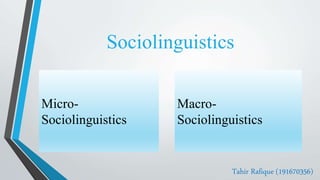
Sociolinguistics
Micro-
Sociolinguistics
Macro-
Sociolinguistics
Tahir Rafique (191670356)
• Study of language process in small social groups.
• How the people talk to each other.
Tahir Rafique (191670356)
Micro-Sociolinguistics
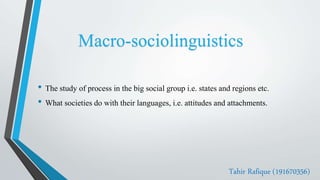
• The study of process in the big social group i.e. states and regions etc.
• What societies do with their languages, i.e. attitudes and attachments.
Tahir Rafique (191670356)
Macro-sociolinguistics
Language Contact
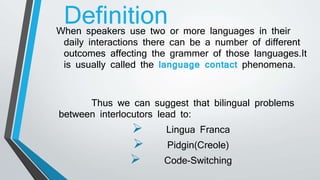
DefinitionWhen speakers use two or more languages in their
daily interactions there can be a number of different
outcomes affecting the grammer of those languages.It
is usually called the language contact phenomena.
Thus we can suggest that bilingual problems
between interlocutors lead to:
 Lingua Franca
 Pidgin(Creole)
 Code-Switching
Lingua Franca
It is a language used as common
means of communication among people whose
native languages are unintelligible.
Many languages throughout the
history served as lingua franca:

Chinese

French
 Arabic

Turkish

Pidgi
nPidgin is a sociolinguistics phenomena where two
people whose languages are different, attempt to
communicate using elements from both of their languages
in a mixed manner.
(Creole)
It is a language that developed historically from
Pidgin and came into existence at a fairly precise point
in time.Creole differ from Pidgin in that Creole have been
nativized by children as their primary language.
Code-
SwitchingIt is a language alternation which is occurs when
a speaker alternates between two or more
languages in the context of a single
conversation .
Gulraiz Noman(191670366)
Language Attitude
Arsalan Abbas
Definitions
•Inferences about people the way they talk.
•People have attitude ,feelings ,believes about language in
general ,their language and the language of other people.
•Attitudes demonstrated through actual behavior.
Main Concepts in
Sociolinguistics
Rabia Arshad
Speech Community
• Discrete group of people who use language in a unique and
mutually accepted way among themselves.
High/Low Prestige Varieties
• Speech habits are assigned a positive or a negative value which is
than applied to the speaker .
Social Network
• A particular speech community in terms of relations between individual
members in a community.
I-Language and E-Language
• Internal language applies to the study of syntax and semantics in
language on abstract level; External language applies in social contexts,
i.e. behavioral habits shared by community.
IMPORTANCE OF SOCIOLINGUISTICS
RIDA
Sociolinguistics is very important for the
one who is an average language learner as
there are little things which can lead
someone to embarrassment.
EXAMPLE
• For example, a person pointing out to some object or another person is
considered an indecent act in Italy. In America, it is acceptable, until and
unless someone is not pointing to any other person. According to David
Broersma, this kind of attitude or mistakes can lead people to think that you
are ill-mannered, non-serious and dishonest (Piller, 2016).
WHAT IS LANGUAGE CHANGE IN
SOCIOLINGUISTICS
• Language change is the phenomenon whereby phonetic ,
morphological , semantic , synatactic , and other features of language vary
over time .
• Language is always changing pronunciations evolve , new words are
borrowed are invented , the meaning of old words drifts and morphology
develops or decays .
Sociolinguistics and teaching
Esha
• Sociolinguistics and teaching is a relationship between language teaching and
society.
• Language as conventional system acquired by individuals in social contact or
a social phenomenon or verbal interaction.
• Language is a distinctive element of communication presenting linguistics
varieties, which are geographical, historical, social and culturally determined.
• Language variation according to gender, age, ethnicity, status, and so on.
• relevant in the process of teaching foreign language as a social adjustment
factor.
• Main emphasis on communication and intelligibility.
Methodology in Sociolinguistics
ESHA AREESH
As introduced byWilliam Labov ,the method used in sociolinguistics is the
quantitative study of language variation and change.There are five different
styles, ranging from formal tocasual, namely
• Minimal pair reading:
Minimal pairs are pairs of words that differ in
only one phenome, such as Cat and Bat
• Word list reading:
Having the subject read a word list will elicit a
formal register, but generally not as formal as MP.
• Reading Passage Style:
This style is next down on the formal register.
• Interview Style:
It’s when an interview can finally get into eliciting a more
casual speech from the subject.
• Casual style:
This type of speech is difficult if not impossible to elicit
because of the Observer’s Paradox.

Presentation of sociolinguistics

  • 1.
    Tahir Rafique (191670356) GulraizNoman (191670366) Arslan Abbas (191670371) Rabia (191670358) Esha Areesh (191670319) Esha Malik(191670328) Rida Zaheer (191670355)
  • 2.
  • 3.
     It isthe macro-branch of linguistics which deals with the study of relationship between language and society.  Effects of language on society and vice versa. Tahir Rafique (191670356)
  • 4.
  • 5.
    • Study oflanguage process in small social groups. • How the people talk to each other. Tahir Rafique (191670356) Micro-Sociolinguistics
  • 6.
    • The studyof process in the big social group i.e. states and regions etc. • What societies do with their languages, i.e. attitudes and attachments. Tahir Rafique (191670356) Macro-sociolinguistics
  • 7.
  • 8.
    DefinitionWhen speakers usetwo or more languages in their daily interactions there can be a number of different outcomes affecting the grammer of those languages.It is usually called the language contact phenomena. Thus we can suggest that bilingual problems between interlocutors lead to:  Lingua Franca  Pidgin(Creole)  Code-Switching
  • 9.
    Lingua Franca It isa language used as common means of communication among people whose native languages are unintelligible. Many languages throughout the history served as lingua franca:  Chinese  French  Arabic  Turkish 
  • 10.
    Pidgi nPidgin is asociolinguistics phenomena where two people whose languages are different, attempt to communicate using elements from both of their languages in a mixed manner. (Creole) It is a language that developed historically from Pidgin and came into existence at a fairly precise point in time.Creole differ from Pidgin in that Creole have been nativized by children as their primary language.
  • 11.
    Code- SwitchingIt is alanguage alternation which is occurs when a speaker alternates between two or more languages in the context of a single conversation . Gulraiz Noman(191670366)
  • 12.
  • 13.
  • 14.
    •People have attitude,feelings ,believes about language in general ,their language and the language of other people. •Attitudes demonstrated through actual behavior.
  • 15.
  • 16.
    Speech Community • Discretegroup of people who use language in a unique and mutually accepted way among themselves.
  • 17.
    High/Low Prestige Varieties •Speech habits are assigned a positive or a negative value which is than applied to the speaker .
  • 18.
    Social Network • Aparticular speech community in terms of relations between individual members in a community.
  • 19.
    I-Language and E-Language •Internal language applies to the study of syntax and semantics in language on abstract level; External language applies in social contexts, i.e. behavioral habits shared by community.
  • 20.
  • 21.
    Sociolinguistics is veryimportant for the one who is an average language learner as there are little things which can lead someone to embarrassment.
  • 22.
    EXAMPLE • For example,a person pointing out to some object or another person is considered an indecent act in Italy. In America, it is acceptable, until and unless someone is not pointing to any other person. According to David Broersma, this kind of attitude or mistakes can lead people to think that you are ill-mannered, non-serious and dishonest (Piller, 2016).
  • 23.
    WHAT IS LANGUAGECHANGE IN SOCIOLINGUISTICS • Language change is the phenomenon whereby phonetic , morphological , semantic , synatactic , and other features of language vary over time . • Language is always changing pronunciations evolve , new words are borrowed are invented , the meaning of old words drifts and morphology develops or decays .
  • 24.
  • 25.
    • Sociolinguistics andteaching is a relationship between language teaching and society. • Language as conventional system acquired by individuals in social contact or a social phenomenon or verbal interaction. • Language is a distinctive element of communication presenting linguistics varieties, which are geographical, historical, social and culturally determined.
  • 26.
    • Language variationaccording to gender, age, ethnicity, status, and so on. • relevant in the process of teaching foreign language as a social adjustment factor. • Main emphasis on communication and intelligibility.
  • 27.
  • 28.
    As introduced byWilliamLabov ,the method used in sociolinguistics is the quantitative study of language variation and change.There are five different styles, ranging from formal tocasual, namely • Minimal pair reading: Minimal pairs are pairs of words that differ in only one phenome, such as Cat and Bat • Word list reading: Having the subject read a word list will elicit a formal register, but generally not as formal as MP.
  • 29.
    • Reading PassageStyle: This style is next down on the formal register. • Interview Style: It’s when an interview can finally get into eliciting a more casual speech from the subject.
  • 30.
    • Casual style: Thistype of speech is difficult if not impossible to elicit because of the Observer’s Paradox.