THE LANGUAGE 
ANALYSIS 
Presenter: Mrs. Schaaffe - McFarlane
What is the Language Analysis? 
 The language analysis is an assessment of a 
piece of communication for the use of 
language conventions. 
 For the purpose of your I.A. the specified 
pieces of communication are: 
 A short story 
 A poem 
 A drama piece/play
What is the Language Analysis? 
 The specified pieces of communication 
which will be written by you the candidate 
will be assessed for: 
 Language Registers 
 Dialectal Variations 
 Attitudes to Language 
 Communicative Behaviours
Requirements 
 The analysis should not exceed 350 words. 
 The sample of work must be original. 
 The analysis should address two (2) of the 
language conventions. 
 A second copy of the reflective piece should 
be placed in the appendix of the portfolio. 
Additionally, the sections used in the analysis 
should be colour coded and a key provided at 
the bottom of the page.
Marking Criteria 
 The language analysis is assessed by the 
examiner for: 
 Content: the analysis of the two elements 
selected. 
(8 marks) 
 Expression: clarity and fluency of the analysis 
with control of grammar and syntax (5 
marks) 
 Organization: contains an introduction, proper 
development, conclusion and coherence (5 
marks)
The Language Conventions 
Language Registers 
Dialectal Variations 
Attitudes to Language 
Communicative Behaviours
Language Registers 
 Refer to the kind of English appropriate to a 
particular purpose or situation. 
 They refer to the formality/informality and tone 
that are correct for a specific context. 
 The suitability of a register is dependent on: 
 The audience 
 The subject-matter 
 The medium 
 The writer’s attitude toward the content
Types of Registers 
 Formal – used in formal social settings, almost 
always involves the use of S.E. 
 Casual – used in non-formal settings, usually 
marked by slangs and ellipses. 
 Intimate – used between people who are very 
close, has minimal sentence structure, ellipsis, 
non-verbal elements, specialized words and 
phrases.
Types of Registers 
 Consultative – used in situations where the 
listener is required to give some form of 
continuous feedback based on info provided 
by the speaker. 
 Frozen – for use in print and public speeches 
where no direct response is expected from the 
reader or listener.
Dialectal Variation 
 This refers to the spoken and written 
differences in the use of language within a 
speech community. 
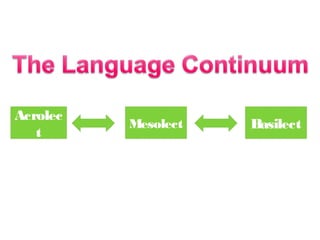
 Speech related variation within the Caribbean 
may all be located on the Creole continuum.
Acrolec 
t 
Mesolect Basilect
Dialectal Variation 
 In commenting on dialectal variation the 
student needs to be aware of the different 
types of English used and spoken in the 
Caribbean. These include: 
 Foreign English 
 Radio & Television English 
 Erudite English 
 Colloquial English 
 Rasta English 
 Profane English
Attitudes to Language 
 Attitudes to the varieties of English spoken in 
the Caribbean result from a number of factors 
including historical and social ones. 
 Crucial to the attitude one adopts are two 
considerations: 
 The association of Education 
 Formality and good taste with Standard English 
and the question as to whether Creole English is 
fitting and appropriate for certain uses.
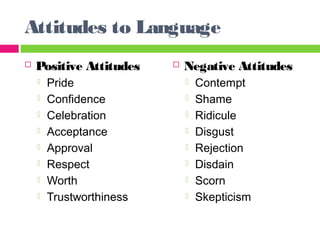
Attitudes to Language 
 Positive Attitudes 
 Pride 
 Confidence 
 Celebration 
 Acceptance 
 Approval 
 Respect 
 Worth 
 Trustworthiness 
 Negative Attitudes 
 Contempt 
 Shame 
 Ridicule 
 Disgust 
 Rejection 
 Disdain 
 Scorn 
 Skepticism
Communicative Behaviours 
 This refers to communicating impressions to 
others without being aware of doing so 
(unconscious) and without even wishing to do 
so (inevitable).
Communicative Behaviours 
 The elements are: 
 Vocalics 
 Proxemix 
 Artifacts 
 Movement 
 Chronemics 
 Our Five Senses
Analyzing a Piece 
A Short Story Extract
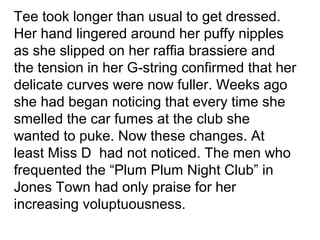
Tee took longer than usual to get dressed. 
Her hand lingered around her puffy nipples 
as she slipped on her raffia brassiere and 
the tension in her G-string confirmed that her 
delicate curves were now fuller. Weeks ago 
she had began noticing that every time she 
smelled the car fumes at the club she 
wanted to puke. Now these changes. At 
least Miss D had not noticed. The men who 
frequented the “Plum Plum Night Club” in 
Jones Town had only praise for her 
increasing voluptuousness.
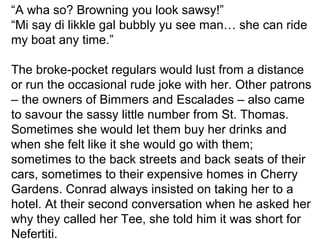
“A wha so? Browning you look sawsy!” 
“Mi say di likkle gal bubbly yu see man… she can ride 
my boat any time.” 
The broke-pocket regulars would lust from a distance 
or run the occasional rude joke with her. Other patrons 
– the owners of Bimmers and Escalades – also came 
to savour the sassy little number from St. Thomas. 
Sometimes she would let them buy her drinks and 
when she felt like it she would go with them; 
sometimes to the back streets and back seats of their 
cars, sometimes to their expensive homes in Cherry 
Gardens. Conrad always insisted on taking her to a 
hotel. At their second conversation when he asked her 
why they called her Tee, she told him it was short for 
Nefertiti.
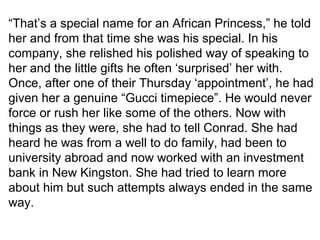
“That’s a special name for an African Princess,” he told 
her and from that time she was his special. In his 
company, she relished his polished way of speaking to 
her and the little gifts he often ‘surprised’ her with. 
Once, after one of their Thursday ‘appointment’, he had 
given her a genuine “Gucci timepiece”. He would never 
force or rush her like some of the others. Now with 
things as they were, she had to tell Conrad. She had 
heard he was from a well to do family, had been to 
university abroad and now worked with an investment 
bank in New Kingston. She had tried to learn more 
about him but such attempts always ended in the same 
way.
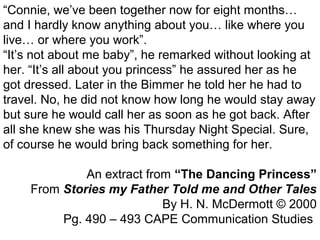
“Connie, we’ve been together now for eight months… 
and I hardly know anything about you… like where you 
live… or where you work”. 
“It’s not about me baby”, he remarked without looking at 
her. “It’s all about you princess” he assured her as he 
got dressed. Later in the Bimmer he told her he had to 
travel. No, he did not know how long he would stay away 
but sure he would call her as soon as he got back. After 
all she knew she was his Thursday Night Special. Sure, 
of course he would bring back something for her. 
An extract from “The Dancing Princess” 
From Stories my Father Told me and Other Tales 
By H. N. McDermott © 2000 
Pg. 490 – 493 CAPE Communication Studies
Writing the analysis 
 Organize your essay by having 
 An introduction: this can contain a synopsis of 
the written piece as well as the two language 
conventions to be analyzed. 
 The body: this should be two paragraphs at least; 
one for each convention 
 The conclusion: this should say how the 
conventions identified functioned in the overall 
piece.
Writing the Analysis 
 When analyzing your piece of communication, you can 
follow this simple three step process. 
1. State the Convention and the specific element 
within it that you will be analyzing E.g. Language 
Registers – Intimate Register 
2. Give an example of the element E.g. ‘Alright Pookie 
Poo’ 
3. Analyze the element, by looking at its function, the 
effect it had, the information it gave etc. E.g. The 
use of the specialized term ‘Pookie Poo’ serves to 
highlight the closeness of the relationship between 
Ricardo and Sandy.
Analyzing Registers 
 In the extract from “The Dancing Princess” the writer 
utilizes a number of Language Registers. One such 
register is the c a s ua l re g is te r. Evidence of this is seen 
when the patrons said “A wha so? Browning you look 
sawsy!” 
“Mi say di likkle gal bubbly yu see man… she can ride my 
boat any time.” The patrons use Jamaican Creole and 
speak in a casual tone to Tee because of the type of job 
she does. Because she is an exotic dancer, the patrons 
did not feel that it was necessary to speak to her in a 
formal or respectful manner. Also, the fact that they are 
likely from the area, which is an inner city community, 
means that they are more likely to speak in Creole.
Analyzing Dialectal Variation 
 Throughout the extract, different characters use 
a variety of language forms. The a c ro le c ta l 
variety is used by Conrad when he speaks to 
Tee. “It’s not about me baby” and “It’s all 
about you princess”. This variety is expected as 
Conrad is from a well to do family and is 
educated. He uses the a c ro le c t as he is also 
trying to impress and assuage Tee and this type 
of variation makes him seem more sincere. It is 
also in stark contrast to the crude language of 
the other men; hence, Tee is led to believe that 
she and Conrad are in a relationship.
Analyzing Attitudes to 
Language 
 A positive attitude towards Standard English is 
shown by Tee. This is seen where Tee says 
about Conrad’s language that she “relished 
his polished way of speaking to her”. This 
shows that Tee takes pleasure in hearing 
Conrad speak the Standard English and 
prefers this type of language which she 
associates with his superior status. This is in 
contrast to the other patrons who speak creole 
and who she refer to as “broke-pocket”.
Analyzing Communicative 
Behaviours 
 The writer of the extract utilizes the 
Communicative behaviours artifacts, movement 
and our five senses in the piece. The use of 
artifacts is seen in Tee’s description of the gifts 
given to her by Conrad as well as the things he 
owns. He gives her a genuine “Gucci 
timepiece” and he drives a ‘Bimmer’. He can 
also afford to take her to a hotel whenever they 
meet. These artifacts serve to strengthen the 
idea of Conrad as a rich/well to do man who has 
some amount of influence over Tee.

CAPE Communication Studies - The language analysis

  • 1.
    THE LANGUAGE ANALYSIS Presenter: Mrs. Schaaffe - McFarlane
  • 2.
    What is theLanguage Analysis?  The language analysis is an assessment of a piece of communication for the use of language conventions.  For the purpose of your I.A. the specified pieces of communication are:  A short story  A poem  A drama piece/play
  • 3.
    What is theLanguage Analysis?  The specified pieces of communication which will be written by you the candidate will be assessed for:  Language Registers  Dialectal Variations  Attitudes to Language  Communicative Behaviours
  • 4.
    Requirements  Theanalysis should not exceed 350 words.  The sample of work must be original.  The analysis should address two (2) of the language conventions.  A second copy of the reflective piece should be placed in the appendix of the portfolio. Additionally, the sections used in the analysis should be colour coded and a key provided at the bottom of the page.
  • 5.
    Marking Criteria The language analysis is assessed by the examiner for:  Content: the analysis of the two elements selected. (8 marks)  Expression: clarity and fluency of the analysis with control of grammar and syntax (5 marks)  Organization: contains an introduction, proper development, conclusion and coherence (5 marks)
  • 6.
    The Language Conventions Language Registers Dialectal Variations Attitudes to Language Communicative Behaviours
  • 7.
    Language Registers Refer to the kind of English appropriate to a particular purpose or situation.  They refer to the formality/informality and tone that are correct for a specific context.  The suitability of a register is dependent on:  The audience  The subject-matter  The medium  The writer’s attitude toward the content
  • 8.
    Types of Registers  Formal – used in formal social settings, almost always involves the use of S.E.  Casual – used in non-formal settings, usually marked by slangs and ellipses.  Intimate – used between people who are very close, has minimal sentence structure, ellipsis, non-verbal elements, specialized words and phrases.
  • 9.
    Types of Registers  Consultative – used in situations where the listener is required to give some form of continuous feedback based on info provided by the speaker.  Frozen – for use in print and public speeches where no direct response is expected from the reader or listener.
  • 10.
    Dialectal Variation This refers to the spoken and written differences in the use of language within a speech community.  Speech related variation within the Caribbean may all be located on the Creole continuum.
  • 11.
  • 12.
    Dialectal Variation In commenting on dialectal variation the student needs to be aware of the different types of English used and spoken in the Caribbean. These include:  Foreign English  Radio & Television English  Erudite English  Colloquial English  Rasta English  Profane English
  • 13.
    Attitudes to Language  Attitudes to the varieties of English spoken in the Caribbean result from a number of factors including historical and social ones.  Crucial to the attitude one adopts are two considerations:  The association of Education  Formality and good taste with Standard English and the question as to whether Creole English is fitting and appropriate for certain uses.
  • 14.
    Attitudes to Language  Positive Attitudes  Pride  Confidence  Celebration  Acceptance  Approval  Respect  Worth  Trustworthiness  Negative Attitudes  Contempt  Shame  Ridicule  Disgust  Rejection  Disdain  Scorn  Skepticism
  • 15.
    Communicative Behaviours This refers to communicating impressions to others without being aware of doing so (unconscious) and without even wishing to do so (inevitable).
  • 16.
    Communicative Behaviours The elements are:  Vocalics  Proxemix  Artifacts  Movement  Chronemics  Our Five Senses
  • 17.
    Analyzing a Piece A Short Story Extract
  • 18.
    Tee took longerthan usual to get dressed. Her hand lingered around her puffy nipples as she slipped on her raffia brassiere and the tension in her G-string confirmed that her delicate curves were now fuller. Weeks ago she had began noticing that every time she smelled the car fumes at the club she wanted to puke. Now these changes. At least Miss D had not noticed. The men who frequented the “Plum Plum Night Club” in Jones Town had only praise for her increasing voluptuousness.
  • 19.
    “A wha so?Browning you look sawsy!” “Mi say di likkle gal bubbly yu see man… she can ride my boat any time.” The broke-pocket regulars would lust from a distance or run the occasional rude joke with her. Other patrons – the owners of Bimmers and Escalades – also came to savour the sassy little number from St. Thomas. Sometimes she would let them buy her drinks and when she felt like it she would go with them; sometimes to the back streets and back seats of their cars, sometimes to their expensive homes in Cherry Gardens. Conrad always insisted on taking her to a hotel. At their second conversation when he asked her why they called her Tee, she told him it was short for Nefertiti.
  • 20.
    “That’s a specialname for an African Princess,” he told her and from that time she was his special. In his company, she relished his polished way of speaking to her and the little gifts he often ‘surprised’ her with. Once, after one of their Thursday ‘appointment’, he had given her a genuine “Gucci timepiece”. He would never force or rush her like some of the others. Now with things as they were, she had to tell Conrad. She had heard he was from a well to do family, had been to university abroad and now worked with an investment bank in New Kingston. She had tried to learn more about him but such attempts always ended in the same way.
  • 21.
    “Connie, we’ve beentogether now for eight months… and I hardly know anything about you… like where you live… or where you work”. “It’s not about me baby”, he remarked without looking at her. “It’s all about you princess” he assured her as he got dressed. Later in the Bimmer he told her he had to travel. No, he did not know how long he would stay away but sure he would call her as soon as he got back. After all she knew she was his Thursday Night Special. Sure, of course he would bring back something for her. An extract from “The Dancing Princess” From Stories my Father Told me and Other Tales By H. N. McDermott © 2000 Pg. 490 – 493 CAPE Communication Studies
  • 22.
    Writing the analysis  Organize your essay by having  An introduction: this can contain a synopsis of the written piece as well as the two language conventions to be analyzed.  The body: this should be two paragraphs at least; one for each convention  The conclusion: this should say how the conventions identified functioned in the overall piece.
  • 23.
    Writing the Analysis  When analyzing your piece of communication, you can follow this simple three step process. 1. State the Convention and the specific element within it that you will be analyzing E.g. Language Registers – Intimate Register 2. Give an example of the element E.g. ‘Alright Pookie Poo’ 3. Analyze the element, by looking at its function, the effect it had, the information it gave etc. E.g. The use of the specialized term ‘Pookie Poo’ serves to highlight the closeness of the relationship between Ricardo and Sandy.
  • 24.
    Analyzing Registers In the extract from “The Dancing Princess” the writer utilizes a number of Language Registers. One such register is the c a s ua l re g is te r. Evidence of this is seen when the patrons said “A wha so? Browning you look sawsy!” “Mi say di likkle gal bubbly yu see man… she can ride my boat any time.” The patrons use Jamaican Creole and speak in a casual tone to Tee because of the type of job she does. Because she is an exotic dancer, the patrons did not feel that it was necessary to speak to her in a formal or respectful manner. Also, the fact that they are likely from the area, which is an inner city community, means that they are more likely to speak in Creole.
  • 25.
    Analyzing Dialectal Variation  Throughout the extract, different characters use a variety of language forms. The a c ro le c ta l variety is used by Conrad when he speaks to Tee. “It’s not about me baby” and “It’s all about you princess”. This variety is expected as Conrad is from a well to do family and is educated. He uses the a c ro le c t as he is also trying to impress and assuage Tee and this type of variation makes him seem more sincere. It is also in stark contrast to the crude language of the other men; hence, Tee is led to believe that she and Conrad are in a relationship.
  • 26.
    Analyzing Attitudes to Language  A positive attitude towards Standard English is shown by Tee. This is seen where Tee says about Conrad’s language that she “relished his polished way of speaking to her”. This shows that Tee takes pleasure in hearing Conrad speak the Standard English and prefers this type of language which she associates with his superior status. This is in contrast to the other patrons who speak creole and who she refer to as “broke-pocket”.
  • 27.
    Analyzing Communicative Behaviours  The writer of the extract utilizes the Communicative behaviours artifacts, movement and our five senses in the piece. The use of artifacts is seen in Tee’s description of the gifts given to her by Conrad as well as the things he owns. He gives her a genuine “Gucci timepiece” and he drives a ‘Bimmer’. He can also afford to take her to a hotel whenever they meet. These artifacts serve to strengthen the idea of Conrad as a rich/well to do man who has some amount of influence over Tee.