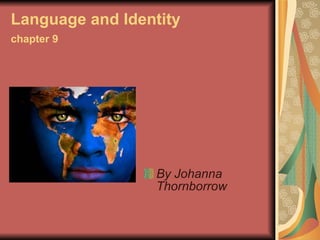
Language and Identity chapter 9 By Johanna Thornborrow
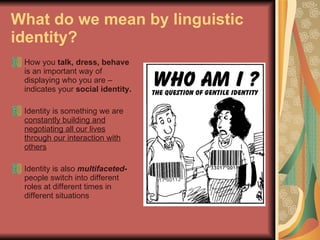
What do we mean by linguistic identity?   How you  talk, dress, behave  is an important way of displaying who you are – indicates your  social identity.   Identity is something we are  constantly building and negotiating all our lives through our interaction with others Identity is also  multifaceted -   people switch into different roles at different times in different situations
.. What do we mean by linguistic identity? On the individual level:  where we grew up, went to school, wealthy (or not) your family were, will be displayed through the  variety  of the language you use.  Accent  can indicate regional origin, social class and to some extend, the kind of education they had.  http://www.youtube.com/watch?v=3UgpfSp2t6k&feature=related Accent as a label of identity :  language speakers most frequently change, either to disguise their membership of, or distance themselves from, a particular social group, or to move closer to a group they want to belong to. Example
Names and naming practices   Western cultures:  first name (given) and last name= family name (traditionally the father’s family name). Some cultures, f. ex Russia people are identified as “son of x” or “daughter of y”( patronymics ).  In Iceland, the  patronymic name  is used as the family name  (f. ex. Hildur Jansdottir or Ragnar Jansson). Names can sometimes carry important meanings for individual identity  Example:  Felly Nkweto Simmonds
…  Names and naming practices   Once you have a name, how people use it becomes very important. Introductions can be  symmetrical =  the same type and status or belonging to the same group: Example: Jim, this is Alice. Or as  asymmetrical,  Jim, this is Dr. Jones This choice of names by the person doing the introduction can have an effect on how the rest of the conversation proceeds.
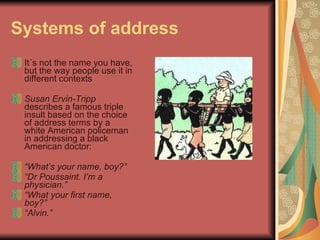
Systems of address It´s not the name you have, but the way people use it in different contexts Susan Ervin-Tripp  describes a famous triple insult based on the choice of address terms by a white American policeman in addressing a black American doctor: “ What’s your name, boy?” “ Dr Poussaint. I’m a physician.” “ What your first name, boy?” “ Alvin.”
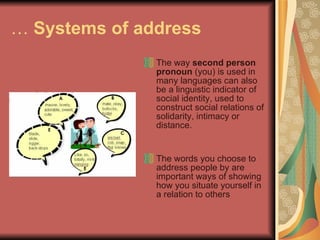
…  Systems of address The way  second person pronoun  (you) is used in many languages can also be a linguistic indicator of social identity, used to construct social relations of solidarity, intimacy or distance.  The words you choose to address people by are important ways of showing how you situate yourself in a relation to others
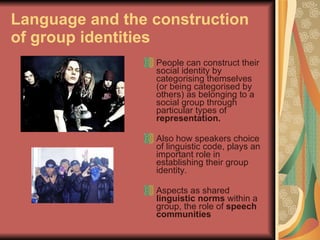
Language and the construction of group identities People can construct their social identity by categorising themselves (or being categorised by others) as belonging to a social group through particular types of  representation.  Also how speakers choice of linguistic code, plays an important role in establishing their group identity.  Aspects as shared  linguistic norms  within a group, the role of  speech communities
Identity and representation Sacks   (1995)  is making the point that social categories, or labels of identity, are frequently imposed on some groups by others, who may be in a more social judgement about them.  Example: teenage group in America 1960 who used the term  “  hotrodders ”  to describe themselves, and not teenager because it’s a category owned by adults  (one way of establishing independence from adults).
Ingroups and Outgroups   Often, language use fits in with other indicators of social identity and group membership, such as  style of clothes, types of haircut and taste in music. The process can also work the other way: speakers adopt the speech patterns of a group they do not belong to, but which they see as prestigious , or they aspire to belong to. Short-term strategy  (crossing by Ben Rampton) vs. Long time strategy http://www.youtube.com/watch?v=k4Uaf3P_K5c&feature=related
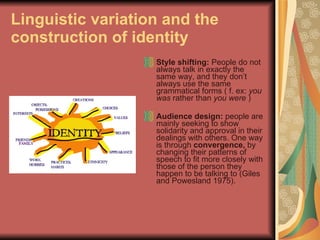
Linguistic variation and the construction of identity Style shifting:  People do not always talk in exactly the same way, and they don’t always use the same grammatical forms ( f. ex:  you was  rather than  you were  ) Audience design:  people are mainly seeking to show solidarity and approval in their dealings with others. One way is through  convergence,  by changing their patterns of speech to fit more closely with those of the person they happen to be talking to (Giles and Powesland 1975).
..  Linguistic variation and the construction of identity In some situations, speakers may choose not to converge, but instead either to maintain their own variety ( linguistic maintenance),  or move to a more extreme variety of their dialect  (linguistic divergence ). The question of group affiliation and identity can determine the choices a speaker makes out how to speak, and for the  bilinguals or multilinguals,  which language to use.  Quebec
Power and linguistic imperialism   Language rights and recognition are often important issues in socio-political conflicts all around the world.  Maintenance of a minority language within a majority culture (such as Spanish in United States) is often associated with the maintenance of a minority’s values and with the continuation of its unique cultural identity.
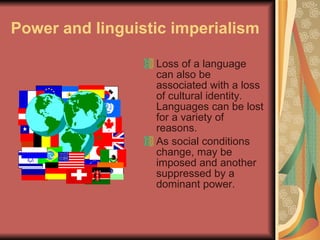
Power and linguistic imperialism Loss of a language can also be associated with a loss of cultural identity. Languages can be lost for a variety of reasons. As social conditions change, may be imposed and another suppressed by a dominant power.
Summary The relationship between language and identity will always involve a complex mix of individual, social and political factors which work to construct people as belonging to a social group, or to exclude them from it.
Discuss  What kind of identity does your name give you? How do you feel if someone uses it wrongly? Think of all the different ways people can name you; nickname, pet name, title+name etc.  Think of any ”in” words or phrases which are used in your own peer group. How would you feel if someone else uses them?
Thank you for your attention!

Language and identity[1]

  • 1.
    Language and Identitychapter 9 By Johanna Thornborrow
  • 2.
    What do wemean by linguistic identity? How you talk, dress, behave is an important way of displaying who you are – indicates your social identity. Identity is something we are constantly building and negotiating all our lives through our interaction with others Identity is also multifaceted - people switch into different roles at different times in different situations
  • 3.
    .. What dowe mean by linguistic identity? On the individual level: where we grew up, went to school, wealthy (or not) your family were, will be displayed through the variety of the language you use. Accent can indicate regional origin, social class and to some extend, the kind of education they had. http://www.youtube.com/watch?v=3UgpfSp2t6k&feature=related Accent as a label of identity : language speakers most frequently change, either to disguise their membership of, or distance themselves from, a particular social group, or to move closer to a group they want to belong to. Example
  • 4.
    Names and namingpractices Western cultures: first name (given) and last name= family name (traditionally the father’s family name). Some cultures, f. ex Russia people are identified as “son of x” or “daughter of y”( patronymics ). In Iceland, the patronymic name is used as the family name (f. ex. Hildur Jansdottir or Ragnar Jansson). Names can sometimes carry important meanings for individual identity Example: Felly Nkweto Simmonds
  • 5.
    … Namesand naming practices Once you have a name, how people use it becomes very important. Introductions can be symmetrical = the same type and status or belonging to the same group: Example: Jim, this is Alice. Or as asymmetrical, Jim, this is Dr. Jones This choice of names by the person doing the introduction can have an effect on how the rest of the conversation proceeds.
  • 6.
    Systems of addressIt´s not the name you have, but the way people use it in different contexts Susan Ervin-Tripp describes a famous triple insult based on the choice of address terms by a white American policeman in addressing a black American doctor: “ What’s your name, boy?” “ Dr Poussaint. I’m a physician.” “ What your first name, boy?” “ Alvin.”
  • 7.
    … Systemsof address The way second person pronoun (you) is used in many languages can also be a linguistic indicator of social identity, used to construct social relations of solidarity, intimacy or distance. The words you choose to address people by are important ways of showing how you situate yourself in a relation to others
  • 8.
    Language and theconstruction of group identities People can construct their social identity by categorising themselves (or being categorised by others) as belonging to a social group through particular types of representation. Also how speakers choice of linguistic code, plays an important role in establishing their group identity. Aspects as shared linguistic norms within a group, the role of speech communities
  • 9.
    Identity and representationSacks (1995) is making the point that social categories, or labels of identity, are frequently imposed on some groups by others, who may be in a more social judgement about them. Example: teenage group in America 1960 who used the term “ hotrodders ” to describe themselves, and not teenager because it’s a category owned by adults (one way of establishing independence from adults).
  • 10.
    Ingroups and Outgroups Often, language use fits in with other indicators of social identity and group membership, such as style of clothes, types of haircut and taste in music. The process can also work the other way: speakers adopt the speech patterns of a group they do not belong to, but which they see as prestigious , or they aspire to belong to. Short-term strategy (crossing by Ben Rampton) vs. Long time strategy http://www.youtube.com/watch?v=k4Uaf3P_K5c&feature=related
  • 11.
    Linguistic variation andthe construction of identity Style shifting: People do not always talk in exactly the same way, and they don’t always use the same grammatical forms ( f. ex: you was rather than you were ) Audience design: people are mainly seeking to show solidarity and approval in their dealings with others. One way is through convergence, by changing their patterns of speech to fit more closely with those of the person they happen to be talking to (Giles and Powesland 1975).
  • 12.
    .. Linguisticvariation and the construction of identity In some situations, speakers may choose not to converge, but instead either to maintain their own variety ( linguistic maintenance), or move to a more extreme variety of their dialect (linguistic divergence ). The question of group affiliation and identity can determine the choices a speaker makes out how to speak, and for the bilinguals or multilinguals, which language to use. Quebec
  • 13.
    Power and linguisticimperialism Language rights and recognition are often important issues in socio-political conflicts all around the world. Maintenance of a minority language within a majority culture (such as Spanish in United States) is often associated with the maintenance of a minority’s values and with the continuation of its unique cultural identity.
  • 14.
    Power and linguisticimperialism Loss of a language can also be associated with a loss of cultural identity. Languages can be lost for a variety of reasons. As social conditions change, may be imposed and another suppressed by a dominant power.
  • 15.
    Summary The relationshipbetween language and identity will always involve a complex mix of individual, social and political factors which work to construct people as belonging to a social group, or to exclude them from it.
  • 16.
    Discuss Whatkind of identity does your name give you? How do you feel if someone uses it wrongly? Think of all the different ways people can name you; nickname, pet name, title+name etc. Think of any ”in” words or phrases which are used in your own peer group. How would you feel if someone else uses them?
  • 17.
    Thank you foryour attention!