Project Work
Group- I
Harshin Kamal
TEAM
 Bishal Sen
 Abhijit Roy
 Pritam Kr. Debnath
 Bikash Das
 Suparna Das
Description about Flowmeter
A flow meter is a device used to measure the volume or
mass of a gas or liquid. Flow meters are referred to
by many names, such as flow gauge, flow indicator,
liquid meter, flow rate sensor, etc. depending on the
particular industry. However, they all measure
flow. Open channels, like rivers or streams, may be
measured with flow meters. Or more frequently, the
most utility from a flow meter and the greatest
variety of flow meters focus on measuring gasses and
liquids in a pipe. Improving the precision, accuracy,
and resolution of fluid measurement are the greatest
benefits of the best flow meters.
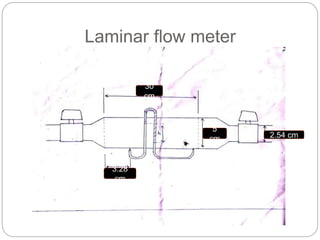
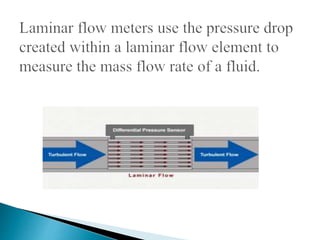
Laminar flow meter
30
cm
5
cm
3.28
cm
2.54 cm
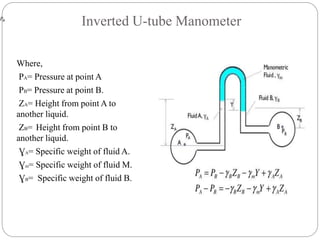
Inverted U-tube Manometer
Where,
PA= Pressure at point A
PB= Pressure at point B.
ZA= Height from point A to
another liquid.
ZB= Height from point B to
another liquid.
ƔA= Specific weight of fluid A.
Ɣm= Specific weight of fluid M.
ƔB= Specific weight of fluid B.
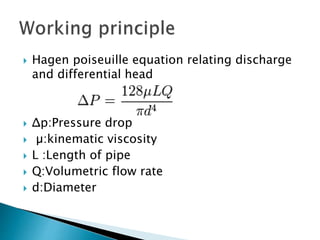
 Hagen poiseuille equation relating discharge
and differential head
 Δp:Pressure drop
 µ:kinematic viscosity
 L :Length of pipe
 Q:Volumetric flow rate
 d:Diameter
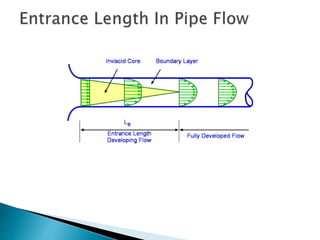
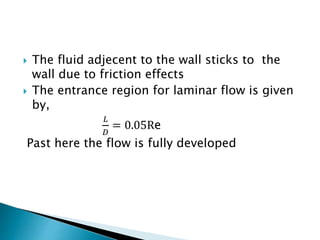
 The fluid adjecent to the wall sticks to the
wall due to friction effects
 The entrance region for laminar flow is given
by,
𝐿
𝐷
= 0.05Re
Past here the flow is fully developed
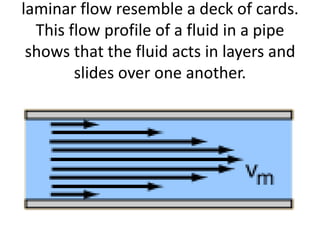
laminar flow resemble a deck of cards.
This flow profile of a fluid in a pipe
shows that the fluid acts in layers and
slides over one another.
 Extremely small flow can be measured.
 Accurate measurement in pulsating flow.
 Ease of integrating Δp elements into total
flow.
 Flow direction can be reversed easily.
 Clogging from dirty fluids
 High cost
 Large size
 Pressure loss(all the measured Δp is lost)
 It is use in small industries where
requirement of volume flow rate is very small.
 Fluid mechanics, R K Benzal
 Batchelor, G. (2000). Introduction to Fluid
Mechanics.
 Noakes, Cath & Sleigh, Andrew (January
2009). "Real Fluids". An Introduction to Fluid
Mechanics.
 Rogers, D.F. (1992). Laminar flow analysis
Laminar flow meter design

Laminar flow meter design

  • 1.
  • 3.
  • 4.
    TEAM  Bishal Sen Abhijit Roy  Pritam Kr. Debnath  Bikash Das  Suparna Das
  • 5.
    Description about Flowmeter Aflow meter is a device used to measure the volume or mass of a gas or liquid. Flow meters are referred to by many names, such as flow gauge, flow indicator, liquid meter, flow rate sensor, etc. depending on the particular industry. However, they all measure flow. Open channels, like rivers or streams, may be measured with flow meters. Or more frequently, the most utility from a flow meter and the greatest variety of flow meters focus on measuring gasses and liquids in a pipe. Improving the precision, accuracy, and resolution of fluid measurement are the greatest benefits of the best flow meters.
  • 6.
  • 7.
    Inverted U-tube Manometer Where, PA=Pressure at point A PB= Pressure at point B. ZA= Height from point A to another liquid. ZB= Height from point B to another liquid. ƔA= Specific weight of fluid A. Ɣm= Specific weight of fluid M. ƔB= Specific weight of fluid B.
  • 8.
     Hagen poiseuilleequation relating discharge and differential head  Δp:Pressure drop  µ:kinematic viscosity  L :Length of pipe  Q:Volumetric flow rate  d:Diameter
  • 11.
     The fluidadjecent to the wall sticks to the wall due to friction effects  The entrance region for laminar flow is given by, 𝐿 𝐷 = 0.05Re Past here the flow is fully developed
  • 12.
    laminar flow resemblea deck of cards. This flow profile of a fluid in a pipe shows that the fluid acts in layers and slides over one another.
  • 13.
     Extremely smallflow can be measured.  Accurate measurement in pulsating flow.  Ease of integrating Δp elements into total flow.  Flow direction can be reversed easily.
  • 14.
     Clogging fromdirty fluids  High cost  Large size  Pressure loss(all the measured Δp is lost)
  • 15.
     It isuse in small industries where requirement of volume flow rate is very small.
  • 16.
     Fluid mechanics,R K Benzal  Batchelor, G. (2000). Introduction to Fluid Mechanics.  Noakes, Cath & Sleigh, Andrew (January 2009). "Real Fluids". An Introduction to Fluid Mechanics.  Rogers, D.F. (1992). Laminar flow analysis