Lecture Notes / PPT
V.J Suryawanshi
Flow Measurement
Sanjivani Rural Education Socetie,s
Sanjivani College OF Engineering,Kopargaon
Flow Measurement:-
Flow is defined as the quantity of fluid (gas, liquid, vapour or
sublimate) that passes a point per unit time
 It can be presented by a simple equation: Flow (Q) =
quantity/time
 It is the rate of change of a quantity. It is either volumetric
or mass flow rate..
Properties Affecting Fluid
Flow
Velocity of Fluid – the fluid speed in the direction of flow.
The fluid velocity depends on the head pressure that is forcing
the fluid through the pipe.The greater head pressure, the
faster fluid will flow.
 Pipe size – the larger the pipe, the greater the potential
flow rate
 Pipe friction – reduces the flow rate through the pipe.
Flow rate of the fluid is slower near walls of the pipe that at
the center.
 Fluid viscosity – its physical resistance to flow.The specific
gravity of fluid – at any given operating condition, the higher
fluid’s specific gravity, the lower its flow rate and production.
• Fluid condition – the condition of fluid (clear or dirty)
is one of the limitations in flow measurement, some
measuring devices blocked/plugged or eroded
if dirty fluids are used.
• Velocity Profiles – it has major effect on the accuracy of
most flow meters. It can be laminar, transitional or turbulent
flow.
Measuring flow is one of the most important aspects of
process control
• The most diverse substances are transported and
distributed in piping system
• The fluid flowing through pipes have different properties,
so different flow measuring devices are used
• The maintenance of definite rates of flow is important for
maximum efficiency
ULTRASONIC FLOW METER
A type of flow meter that measures the velocity of a fluid
with ultrasound to calculate volume flow.
MEASURING PRINCIPLE:-
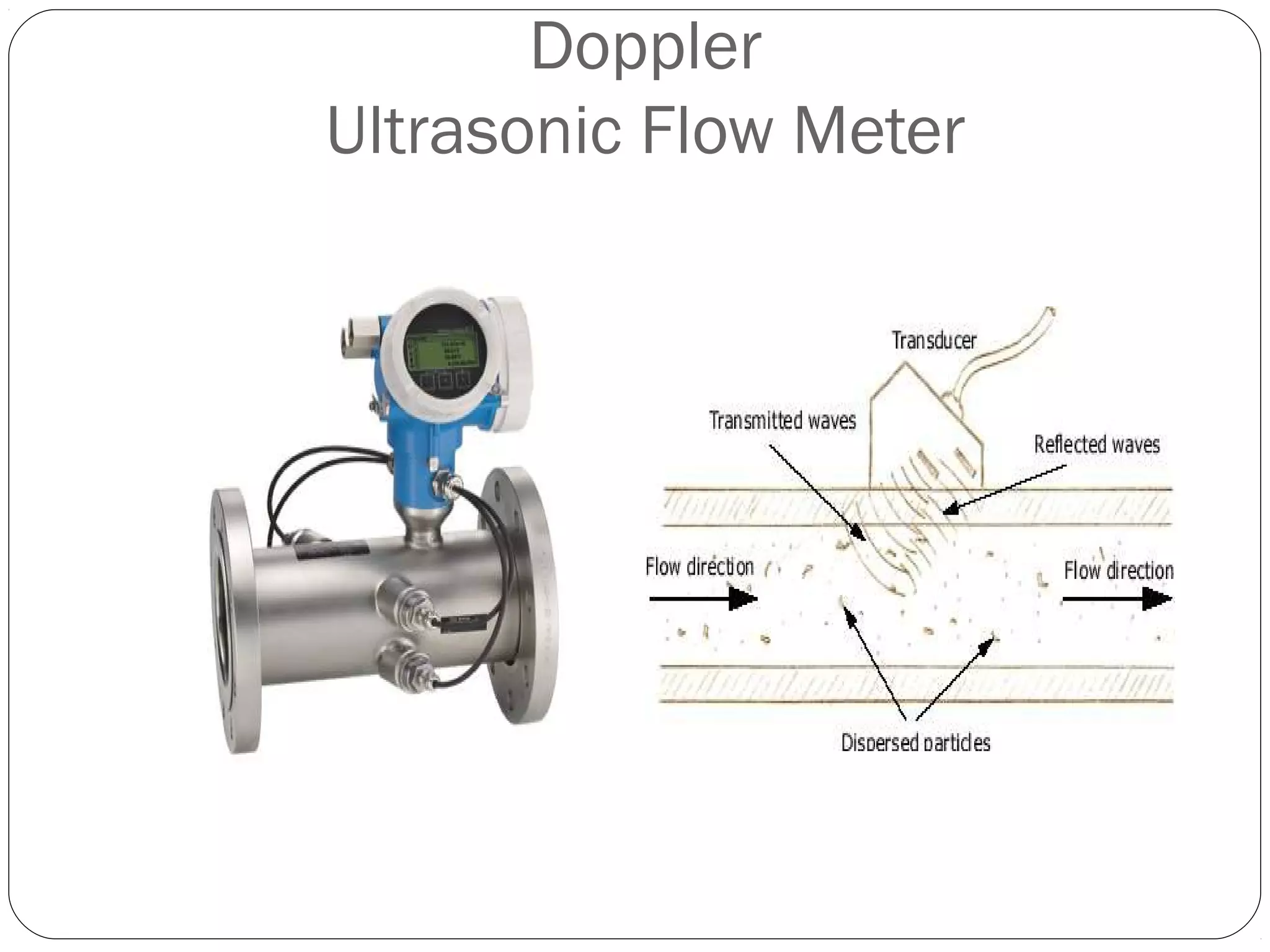
The flow meter can measure the average velocity along the
path of an emitted beam of ultrasound, by averaging the
difference in measured transit time between the pulses of
ultrasound propagating into andagainst the direction of the
flow (TransitTimeType) or by measuring the frequency shift
from the Doppler Effect (Doppler ShiftType).
Doppler
Ultrasonic Flow Meter
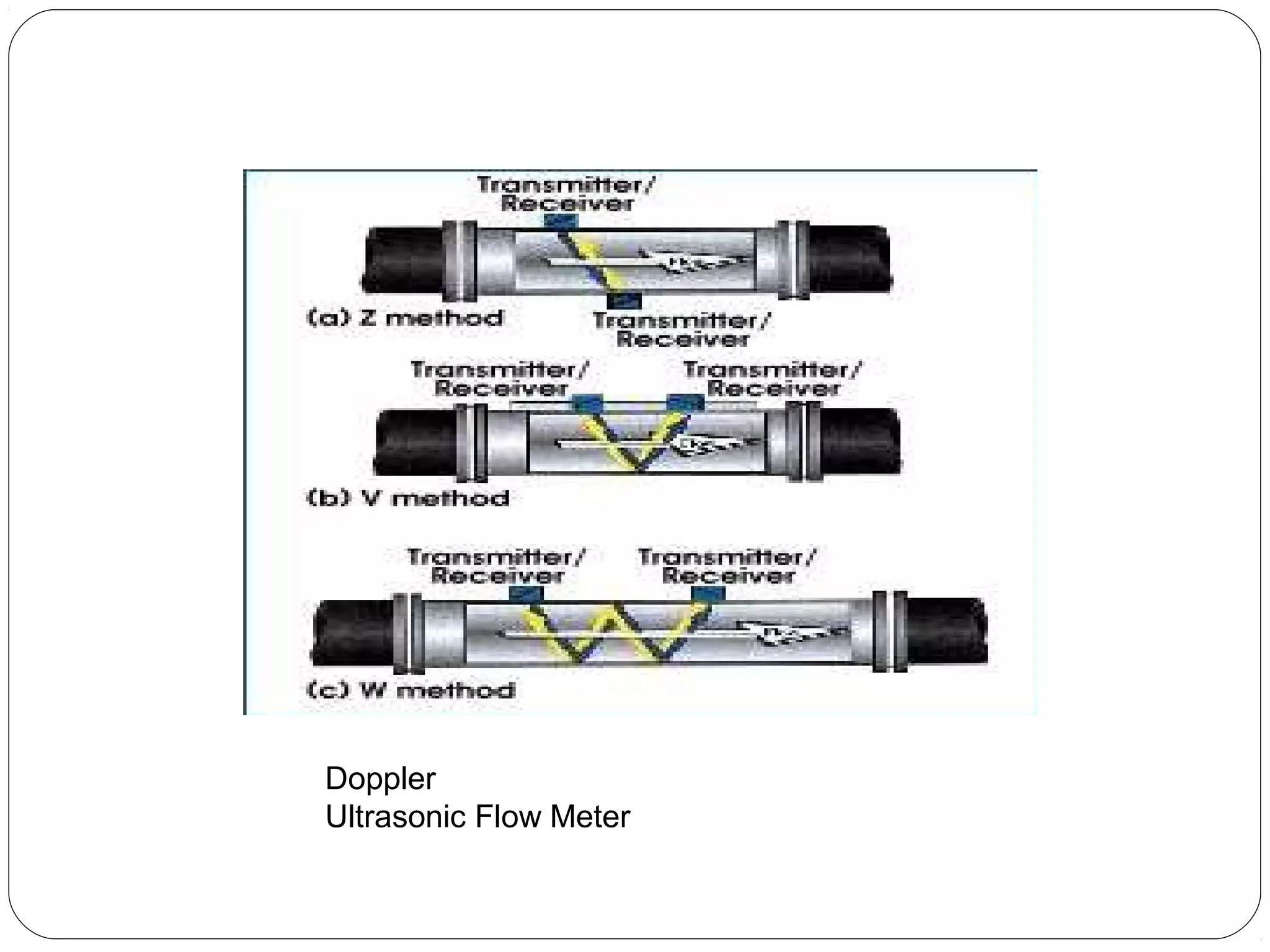
Doppler
Ultrasonic Flow Meter
Common Uses:-
TransitTime flow meters work with clean liquids like water,
oils and chemicals.
Advantages
• Obstruction less flow
• Unaffected by changes in temperature, density or viscosity
• Bi-directional flow capability
• Low flow cutoff
• Corrosion-resistant
• Relative low power consumption.
Advantages
• Obstruction less flow
• Unaffected by changes in temperature, density or viscosity
• Bi-directional flow capability
• Low flow cutoff
• Corrosion-resistant
• Relative low power consumption.
Disadvantages
• This type of meters are highly dependent on the Reynolds
number (the velocity profile)
• It requires nonporous pipe material (cast iron, cement and
fiberglass should be avoided)
• It requires periodic re-calibration
• Liquids with entrained gases cannot be measured reliably.
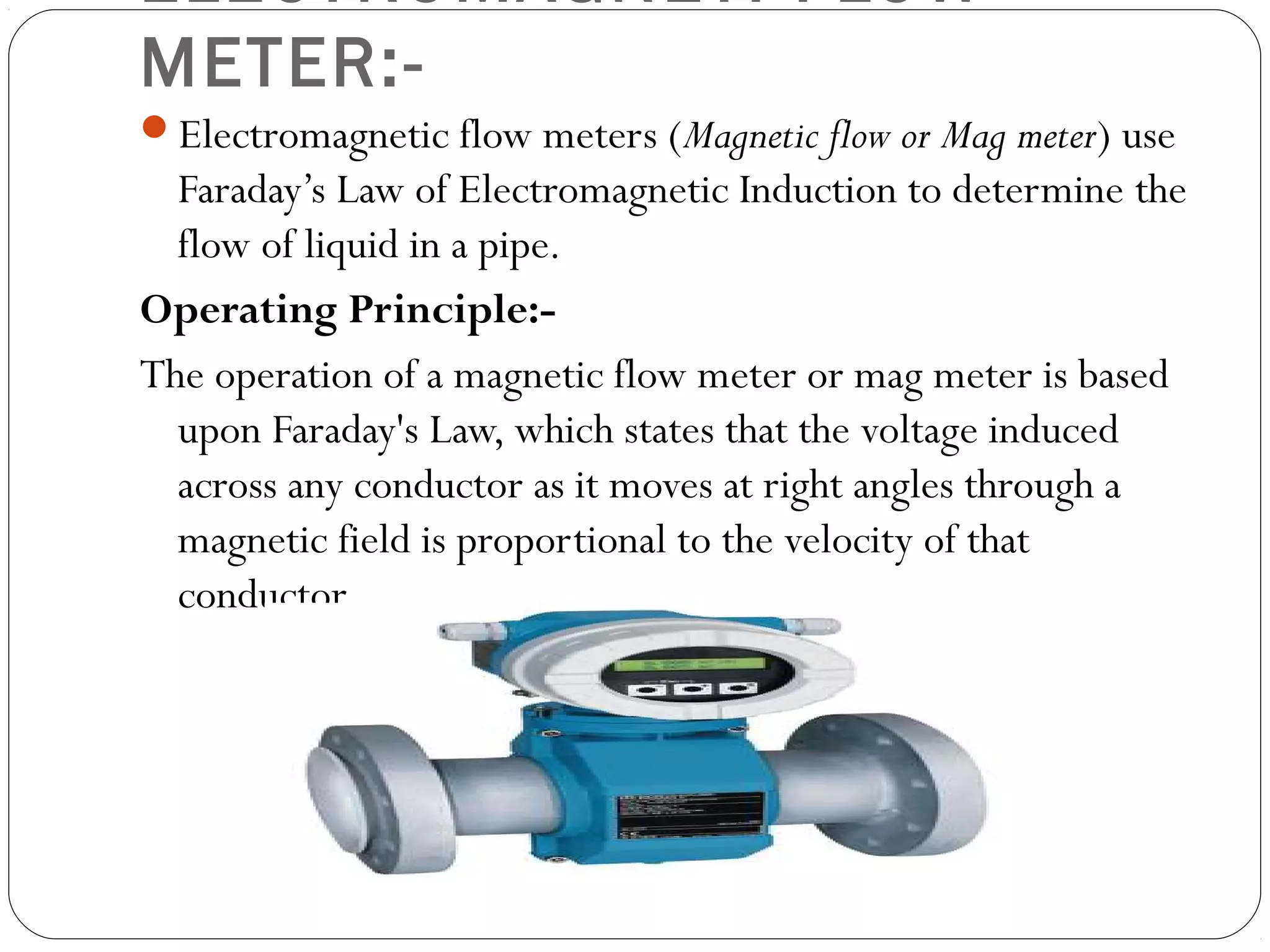
ELECTROMAGNETI FLOW
METER:-
Electromagnetic flow meters (Magnetic flow or Mag meter) use
Faraday’s Law of Electromagnetic Induction to determine the
flow of liquid in a pipe.
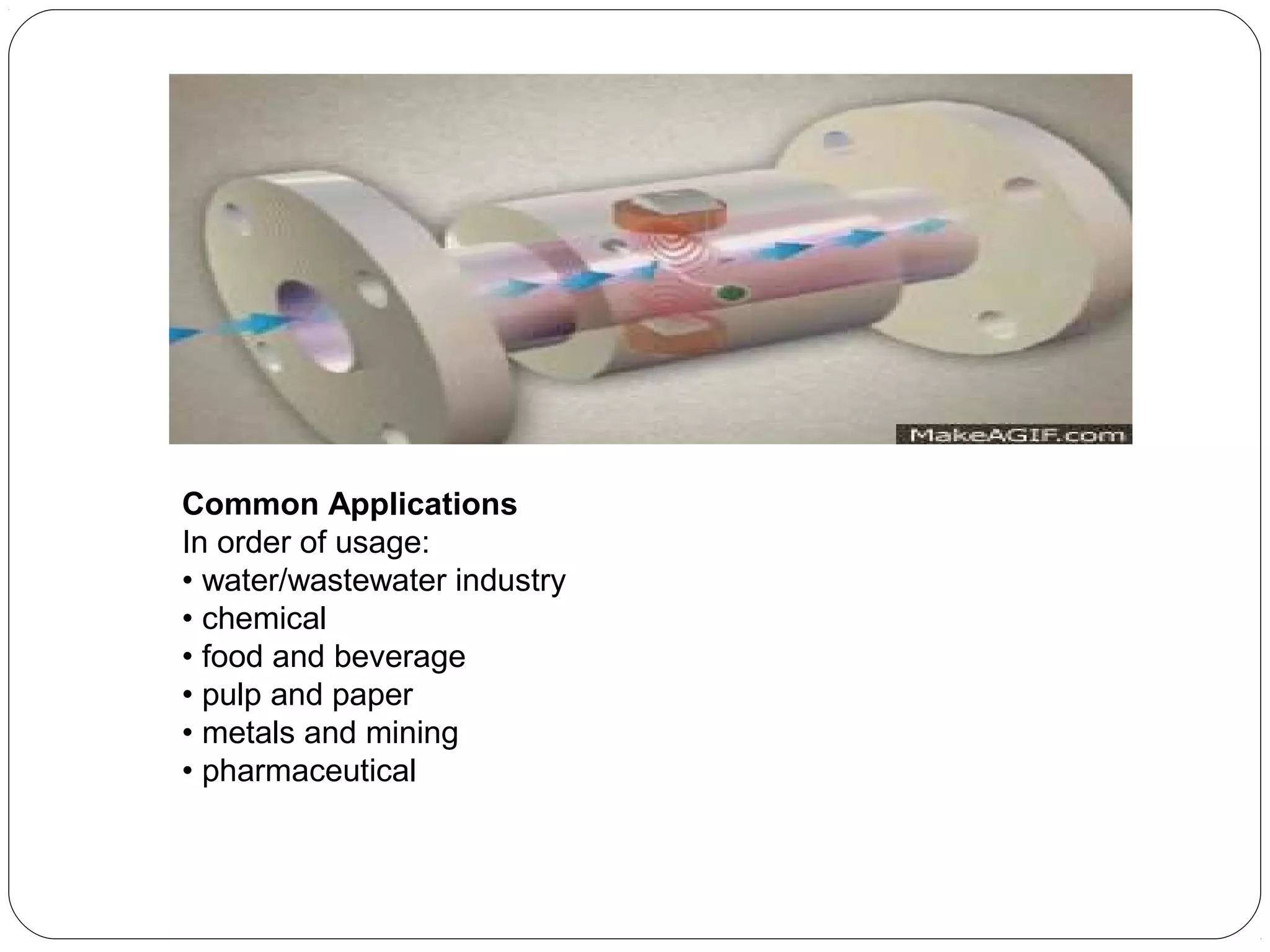
Operating Principle:-
The operation of a magnetic flow meter or mag meter is based
upon Faraday's Law, which states that the voltage induced
across any conductor as it moves at right angles through a
magnetic field is proportional to the velocity of that
conductor.
Common Applications
In order of usage:
• water/wastewater industry
• chemical
• food and beverage
• pulp and paper
• metals and mining
• pharmaceutical
Advantages
• Are bi-directional
• Have no flow obstruction
• Are available with DC or AC power
• It can measure multiphase; however, all components should
be moving at the same speed
• It can install vertically or horizontally (the line must be full,
however)
• Can be used with fluids with conductivity greater than 200
umhos/cm.
• Changes in conductivity value do not, affect the instrument
performance.
Disadvantages
• It's above average cost
• It's large size
• Its need for a minimum electrical conductivity of 5 to 20
mhos / cmμ
• Its accuracy is affected by slurries containing magnetic
solids.
• The line must be full and have no air Bubbles (air and gas
bubbles entrained in the liquid will be metered as liquid,
causing a measurement error).
• In some applications, appropriate Mechanical protection
for the electrodes must be provided.
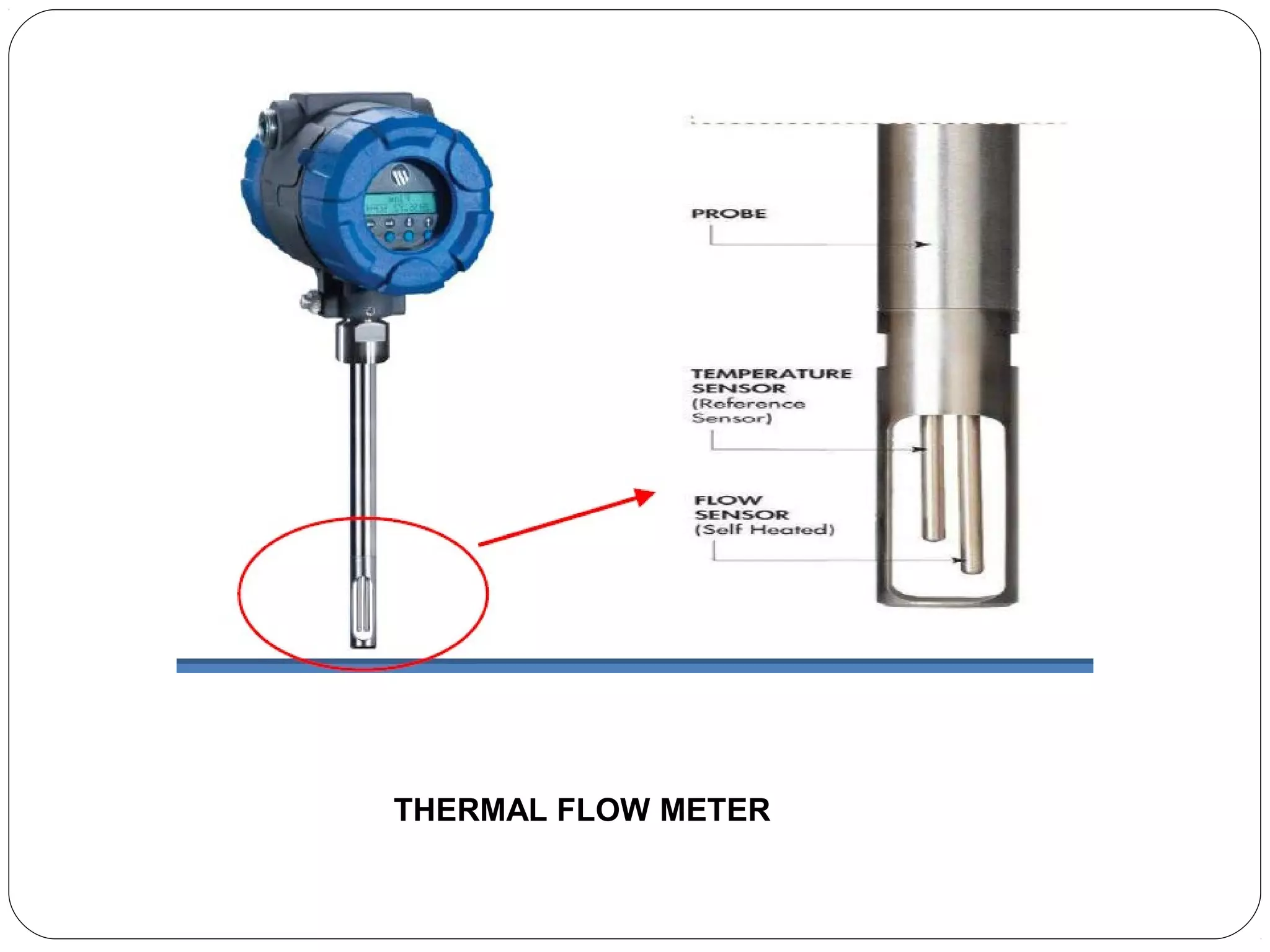
THERMAL FLOW METER:-
Operating Principle
The operation of thermal dispersion mass flow meters is
based King's Law that reveals how a heated wire immersed in
a fluid flow measures the mass velocity at a point in the flow.
It is based on the principle of conductive and convective heat
transfer.
THERMAL FLOW METER
Common Applications
Thermal flow meters are used almost entirely for gas flow
applications.
Advantages
• Thermal flow meters can measure the flow of some low
pressure Gases that are not dense
 enough for Coriolis meters to measure.
 
Disadvantages:-
• Practical for gas flows only
• Subject to blockage by foreign particles or precipitated
deposits due to small openings in flow meter
• Power requirements excessive in larger pipe sizes
• Has to be taken out of process line for servicing
• Accurate field calibration is difficult

Flow measurement

  • 1.
    Lecture Notes /PPT V.J Suryawanshi Flow Measurement Sanjivani Rural Education Socetie,s Sanjivani College OF Engineering,Kopargaon
  • 2.
    Flow Measurement:- Flow isdefined as the quantity of fluid (gas, liquid, vapour or sublimate) that passes a point per unit time  It can be presented by a simple equation: Flow (Q) = quantity/time  It is the rate of change of a quantity. It is either volumetric or mass flow rate..
  • 3.
    Properties Affecting Fluid Flow Velocityof Fluid – the fluid speed in the direction of flow. The fluid velocity depends on the head pressure that is forcing the fluid through the pipe.The greater head pressure, the faster fluid will flow.  Pipe size – the larger the pipe, the greater the potential flow rate  Pipe friction – reduces the flow rate through the pipe. Flow rate of the fluid is slower near walls of the pipe that at the center.  Fluid viscosity – its physical resistance to flow.The specific gravity of fluid – at any given operating condition, the higher fluid’s specific gravity, the lower its flow rate and production.
  • 4.
    • Fluid condition– the condition of fluid (clear or dirty) is one of the limitations in flow measurement, some measuring devices blocked/plugged or eroded if dirty fluids are used. • Velocity Profiles – it has major effect on the accuracy of most flow meters. It can be laminar, transitional or turbulent flow. Measuring flow is one of the most important aspects of process control • The most diverse substances are transported and distributed in piping system • The fluid flowing through pipes have different properties, so different flow measuring devices are used • The maintenance of definite rates of flow is important for maximum efficiency
  • 5.
    ULTRASONIC FLOW METER Atype of flow meter that measures the velocity of a fluid with ultrasound to calculate volume flow. MEASURING PRINCIPLE:- The flow meter can measure the average velocity along the path of an emitted beam of ultrasound, by averaging the difference in measured transit time between the pulses of ultrasound propagating into andagainst the direction of the flow (TransitTimeType) or by measuring the frequency shift from the Doppler Effect (Doppler ShiftType).
  • 6.
  • 7.
  • 8.
    Common Uses:- TransitTime flowmeters work with clean liquids like water, oils and chemicals. Advantages • Obstruction less flow • Unaffected by changes in temperature, density or viscosity • Bi-directional flow capability • Low flow cutoff • Corrosion-resistant • Relative low power consumption.
  • 9.
    Advantages • Obstruction lessflow • Unaffected by changes in temperature, density or viscosity • Bi-directional flow capability • Low flow cutoff • Corrosion-resistant • Relative low power consumption. Disadvantages • This type of meters are highly dependent on the Reynolds number (the velocity profile) • It requires nonporous pipe material (cast iron, cement and fiberglass should be avoided) • It requires periodic re-calibration • Liquids with entrained gases cannot be measured reliably.
  • 10.
    ELECTROMAGNETI FLOW METER:- Electromagnetic flowmeters (Magnetic flow or Mag meter) use Faraday’s Law of Electromagnetic Induction to determine the flow of liquid in a pipe. Operating Principle:- The operation of a magnetic flow meter or mag meter is based upon Faraday's Law, which states that the voltage induced across any conductor as it moves at right angles through a magnetic field is proportional to the velocity of that conductor.
  • 11.
    Common Applications In orderof usage: • water/wastewater industry • chemical • food and beverage • pulp and paper • metals and mining • pharmaceutical
  • 12.
    Advantages • Are bi-directional •Have no flow obstruction • Are available with DC or AC power • It can measure multiphase; however, all components should be moving at the same speed • It can install vertically or horizontally (the line must be full, however) • Can be used with fluids with conductivity greater than 200 umhos/cm. • Changes in conductivity value do not, affect the instrument performance.
  • 13.
    Disadvantages • It's aboveaverage cost • It's large size • Its need for a minimum electrical conductivity of 5 to 20 mhos / cmμ • Its accuracy is affected by slurries containing magnetic solids. • The line must be full and have no air Bubbles (air and gas bubbles entrained in the liquid will be metered as liquid, causing a measurement error). • In some applications, appropriate Mechanical protection for the electrodes must be provided.
  • 14.
    THERMAL FLOW METER:- OperatingPrinciple The operation of thermal dispersion mass flow meters is based King's Law that reveals how a heated wire immersed in a fluid flow measures the mass velocity at a point in the flow. It is based on the principle of conductive and convective heat transfer.
  • 15.
  • 16.
    Common Applications Thermal flowmeters are used almost entirely for gas flow applications. Advantages • Thermal flow meters can measure the flow of some low pressure Gases that are not dense  enough for Coriolis meters to measure.   Disadvantages:- • Practical for gas flows only • Subject to blockage by foreign particles or precipitated deposits due to small openings in flow meter • Power requirements excessive in larger pipe sizes • Has to be taken out of process line for servicing • Accurate field calibration is difficult