FUNDAMENTALS
OF
DISTRIBUTED CONTROL
SYSTEM(DCS)
ALOK SAIKIA (GAU-C-12/L-201)
JURI BARMAN (GAU-C-12/L-199)
CENTRAL INSTITUTE OF TECHNOLOGY (C.I.T.), KOKRAJHAR
(A centrally funded institute under MHRD, Govt. Of India)
INTRODUCTION
 A Distributed Control System (DCS) refers to a control system usually of a manufacturing system,
process or any kind of dynamic system, in which the controller elements are not central in location
but are distributed throughout the system with each component sub-system controlled by one or
more controllers.
 A DCS typically uses custom designed processor as controllers and uses both proprietary
interconnections and communication protocols for communication.
 DCSs use multi-tasking operating systems, so user can download and run applications aside from
the real-time control functions and still do fractional-second control.
 DCSs have user-friendly configuration tools, including structured English, control block libraries,
SFC (sequential function chart), and even RLL (relay ladder logic).
BASIC CONCEPT
 Input and output modules form component parts of the DCS. The processor receives information
from input modules and sends information to output modules.
 The input modules receive information from input instruments in the process and transmit
instructions to the output instruments in the field.
 Computer buses or electrical buses connect the processor and modules through multiplexer or de-
multiplexers. Buses also connect the distributed controllers with the central controller and finally to
the human-machine interface (HMI) or control consoles.
 DCS allow centralized configuration from the operator or engineering console in the control room.
User can change programming offline, and download without restarting the system for the change
to be effective.
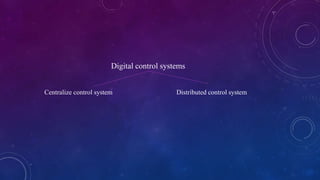
Digital control systems
Centralize control system Distributed control system
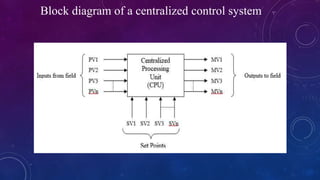
Block diagram of a centralized control system
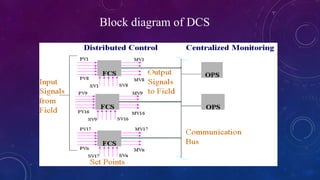
Block diagram of DCS
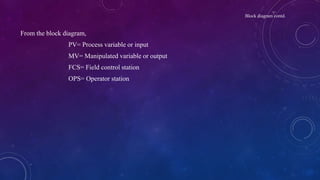
Block diagram contd.
From the block diagram,
PV= Process variable or input
MV= Manipulated variable or output
FCS= Field control station
OPS= Operator station
Basic components of DCS
 FCS (field control station):
It is used to control the process. All the instruments and interlocks created by software reside
in the memory of the FCS. All the field instruments like transmitters and control valves are wired to the
FCS.
 OPS (operator station):
It is used to monitor the process and to operate various instruments
 Communication bus:
It is used to communicate between the FCS and the OPS
Types of controller mode
There are four types of modes-
a) MAN(manual mode)
b) AUT(auto mode)
c) CAS (cascade mode)
d) PRD(primary direct mode)
Types of controller mode contd.
 Manual Mode(MAN):
In manual mode, the MV pointer appears in red colour and the SV pointer appears in yellow
colour. MV of the instrument can be changed by increment/decrement keys or through data entry box.
The SV of the instrument can be changed either by set point change key or using ITEM and DATA in
the data entry box.
 Auto Mode(AUT):
In auto mode, the SV pointer appears in red colour and the MV pointer appears in yellow
colour. SV of the instrument can be changed by increment/decrement keys or through data entry box.
The MV of the instrument cannot be changed by any method.
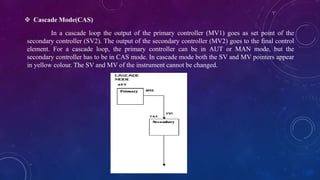
 Cascade Mode(CAS)
In a cascade loop the output of the primary controller (MV1) goes as set point of the
secondary controller (SV2). The output of the secondary controller (MV2) goes to the final control
element. For a cascade loop, the primary controller can be in AUT or MAN mode, but the
secondary controller has to be in CAS mode. In cascade mode both the SV and MV pointers appear
in yellow colour. The SV and MV of the instrument cannot be changed.
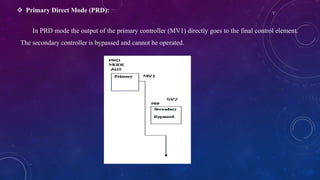
 Primary Direct Mode (PRD):
In PRD mode the output of the primary controller (MV1) directly goes to the final control element.
The secondary controller is bypassed and cannot be operated.
What is Human Interface Station(HIS)
 It is one if the most important part of the DCS system. It is the point of interconnection between
the field instrumentation and human being. From this station the startup and shutdown the
operation and monitoring is controlled.
 The HIS is provided with a number of useful functions that can be used with other general-
purpose Windows applications.
a) Calling a general-purpose windows application while monitoring the plant
b) Calling the operation and monitoring window while using a general-purpose windows
application
c) Display multiple windows always in the same format
 Moreover, in order to improve operability, the following functions are prepared in HIS.
• Setup for using the shortcut keys
• Setup for using the context menus in graphic window
What is Engineering Station(ENG)
 Engineering station is used to do the engineering builder for all the stations like HIS, FCS, CGW,
BCV etc. ENG is a PC loaded with engineering software.
 The HIS can be loaded with engineering software so that it can be used as his as well as ENG.
• CGW:
Communication gateway unit used to communicate with supervisory computers.
• BCV:
Bus converter is used to link two domains.
Advantages
 Control function is distributed among multiple CPUs (field control stations). Hence failure of one
FCS does not affect the entire plant.
 Redundancy is available at various levels.
 Instruments and interlocks are created by software.
 Generation and modifications of the interlocks are very flexible and simple.
 Information regarding the process is presented to the user in various formats.
 Field wiring is considerably less.
 Maintenance and troubleshooting becomes very easy.
 Cost effective in the long run.

DCS fundamentals

  • 1.
    FUNDAMENTALS OF DISTRIBUTED CONTROL SYSTEM(DCS) ALOK SAIKIA(GAU-C-12/L-201) JURI BARMAN (GAU-C-12/L-199) CENTRAL INSTITUTE OF TECHNOLOGY (C.I.T.), KOKRAJHAR (A centrally funded institute under MHRD, Govt. Of India)
  • 2.
    INTRODUCTION  A DistributedControl System (DCS) refers to a control system usually of a manufacturing system, process or any kind of dynamic system, in which the controller elements are not central in location but are distributed throughout the system with each component sub-system controlled by one or more controllers.  A DCS typically uses custom designed processor as controllers and uses both proprietary interconnections and communication protocols for communication.  DCSs use multi-tasking operating systems, so user can download and run applications aside from the real-time control functions and still do fractional-second control.  DCSs have user-friendly configuration tools, including structured English, control block libraries, SFC (sequential function chart), and even RLL (relay ladder logic).
  • 3.
    BASIC CONCEPT  Inputand output modules form component parts of the DCS. The processor receives information from input modules and sends information to output modules.  The input modules receive information from input instruments in the process and transmit instructions to the output instruments in the field.  Computer buses or electrical buses connect the processor and modules through multiplexer or de- multiplexers. Buses also connect the distributed controllers with the central controller and finally to the human-machine interface (HMI) or control consoles.  DCS allow centralized configuration from the operator or engineering console in the control room. User can change programming offline, and download without restarting the system for the change to be effective.
  • 4.
    Digital control systems Centralizecontrol system Distributed control system
  • 5.
    Block diagram ofa centralized control system
  • 6.
  • 7.
    Block diagram contd. Fromthe block diagram, PV= Process variable or input MV= Manipulated variable or output FCS= Field control station OPS= Operator station
  • 8.
    Basic components ofDCS  FCS (field control station): It is used to control the process. All the instruments and interlocks created by software reside in the memory of the FCS. All the field instruments like transmitters and control valves are wired to the FCS.  OPS (operator station): It is used to monitor the process and to operate various instruments  Communication bus: It is used to communicate between the FCS and the OPS
  • 9.
    Types of controllermode There are four types of modes- a) MAN(manual mode) b) AUT(auto mode) c) CAS (cascade mode) d) PRD(primary direct mode)
  • 10.
    Types of controllermode contd.  Manual Mode(MAN): In manual mode, the MV pointer appears in red colour and the SV pointer appears in yellow colour. MV of the instrument can be changed by increment/decrement keys or through data entry box. The SV of the instrument can be changed either by set point change key or using ITEM and DATA in the data entry box.  Auto Mode(AUT): In auto mode, the SV pointer appears in red colour and the MV pointer appears in yellow colour. SV of the instrument can be changed by increment/decrement keys or through data entry box. The MV of the instrument cannot be changed by any method.
  • 11.
     Cascade Mode(CAS) Ina cascade loop the output of the primary controller (MV1) goes as set point of the secondary controller (SV2). The output of the secondary controller (MV2) goes to the final control element. For a cascade loop, the primary controller can be in AUT or MAN mode, but the secondary controller has to be in CAS mode. In cascade mode both the SV and MV pointers appear in yellow colour. The SV and MV of the instrument cannot be changed.
  • 12.
     Primary DirectMode (PRD): In PRD mode the output of the primary controller (MV1) directly goes to the final control element. The secondary controller is bypassed and cannot be operated.
  • 13.
    What is HumanInterface Station(HIS)  It is one if the most important part of the DCS system. It is the point of interconnection between the field instrumentation and human being. From this station the startup and shutdown the operation and monitoring is controlled.  The HIS is provided with a number of useful functions that can be used with other general- purpose Windows applications. a) Calling a general-purpose windows application while monitoring the plant b) Calling the operation and monitoring window while using a general-purpose windows application c) Display multiple windows always in the same format  Moreover, in order to improve operability, the following functions are prepared in HIS. • Setup for using the shortcut keys • Setup for using the context menus in graphic window
  • 14.
    What is EngineeringStation(ENG)  Engineering station is used to do the engineering builder for all the stations like HIS, FCS, CGW, BCV etc. ENG is a PC loaded with engineering software.  The HIS can be loaded with engineering software so that it can be used as his as well as ENG. • CGW: Communication gateway unit used to communicate with supervisory computers. • BCV: Bus converter is used to link two domains.
  • 15.
    Advantages  Control functionis distributed among multiple CPUs (field control stations). Hence failure of one FCS does not affect the entire plant.  Redundancy is available at various levels.  Instruments and interlocks are created by software.  Generation and modifications of the interlocks are very flexible and simple.  Information regarding the process is presented to the user in various formats.  Field wiring is considerably less.  Maintenance and troubleshooting becomes very easy.  Cost effective in the long run.