Principles of Fluid Flow Measuremnt
o Measurement is a technique in which the properties of an object are determined by
comparing them to a standard quantity.
§ Measurement is the essential metric to express any quantity of objects, things and
events.
o Fluid flow measurement: the measurement of smoothly moving particles that fill and
conform to the piping in an uninterrupted stream to determine the quantity flowing.
§ Flow measurement involves using flow meters that measure the flow rate of steam,
liquid, or gas flowing through a pipe.
Definition
o Flow rate is the volume of fluid that passes through a given cross-sectional area
per unit time.
Principles of Fluid Flow Measurement
o Fluid flow is a part of fluid mechanics and deals with fluid dynamics
§ It involves the motion of a fluid subjected to unbalance forces
§ This motion continues as lone as unbalanced forces are applied
Flow Meter
o A flow meter is a device used to measure the volume or mass of a
gas or liquid.
§ The purpose of a flow meter is basically to measure the flow of
gas or liquid between two points in a process.
Fluid Flow
Principles of Fluid Flow Measurement
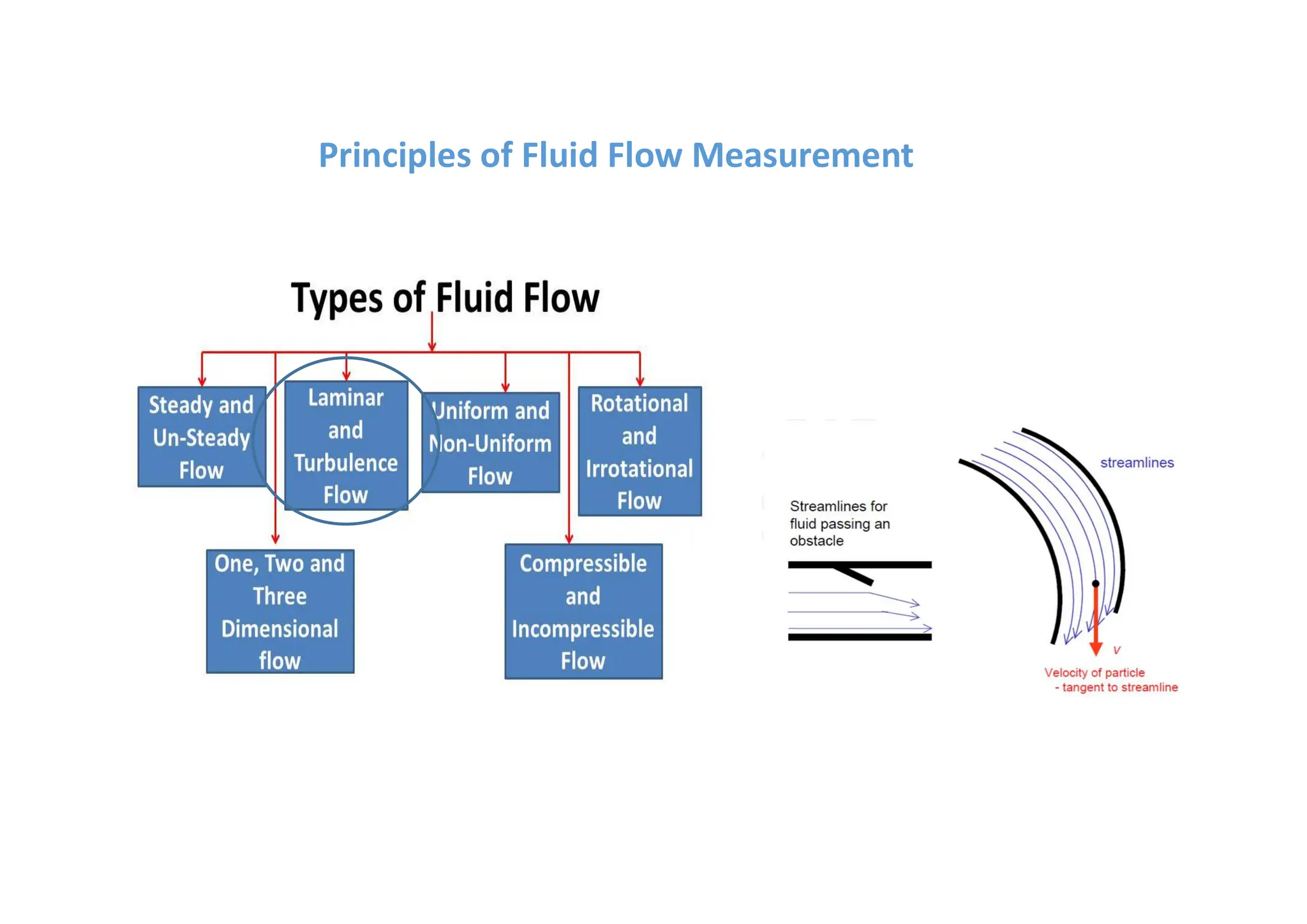
Types of Fluid Flow
Principles of Fluid Flow Measurement
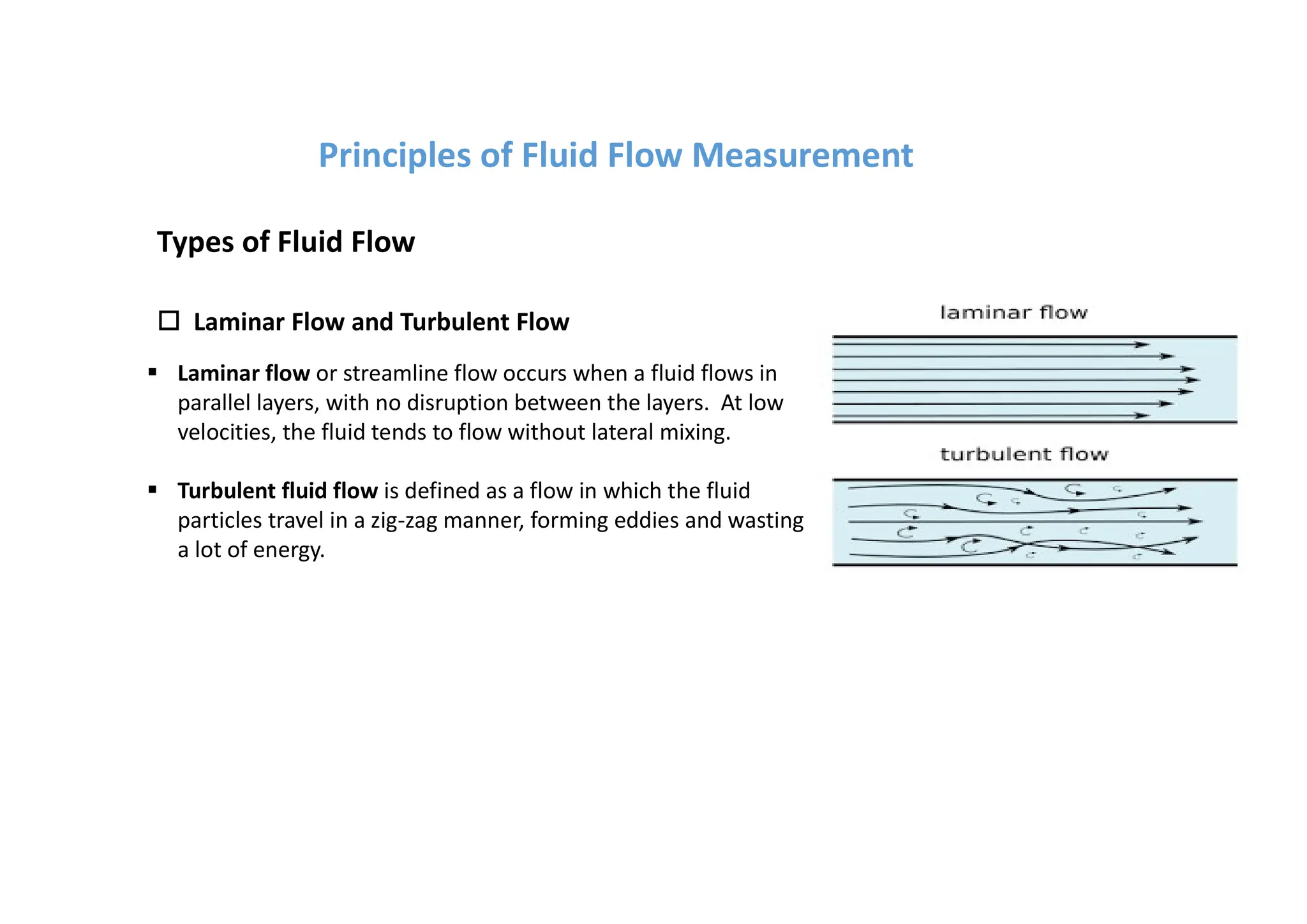
§ Laminar flow or streamline flow occurs when a fluid flows in
parallel layers, with no disruption between the layers. At low
velocities, the fluid tends to flow without lateral mixing.
§ Turbulent fluid flow is defined as a flow in which the fluid
particles travel in a zig-zag manner, forming eddies and wasting
a lot of energy.
o Laminar Flow and Turbulent Flow
Reynolds’s number
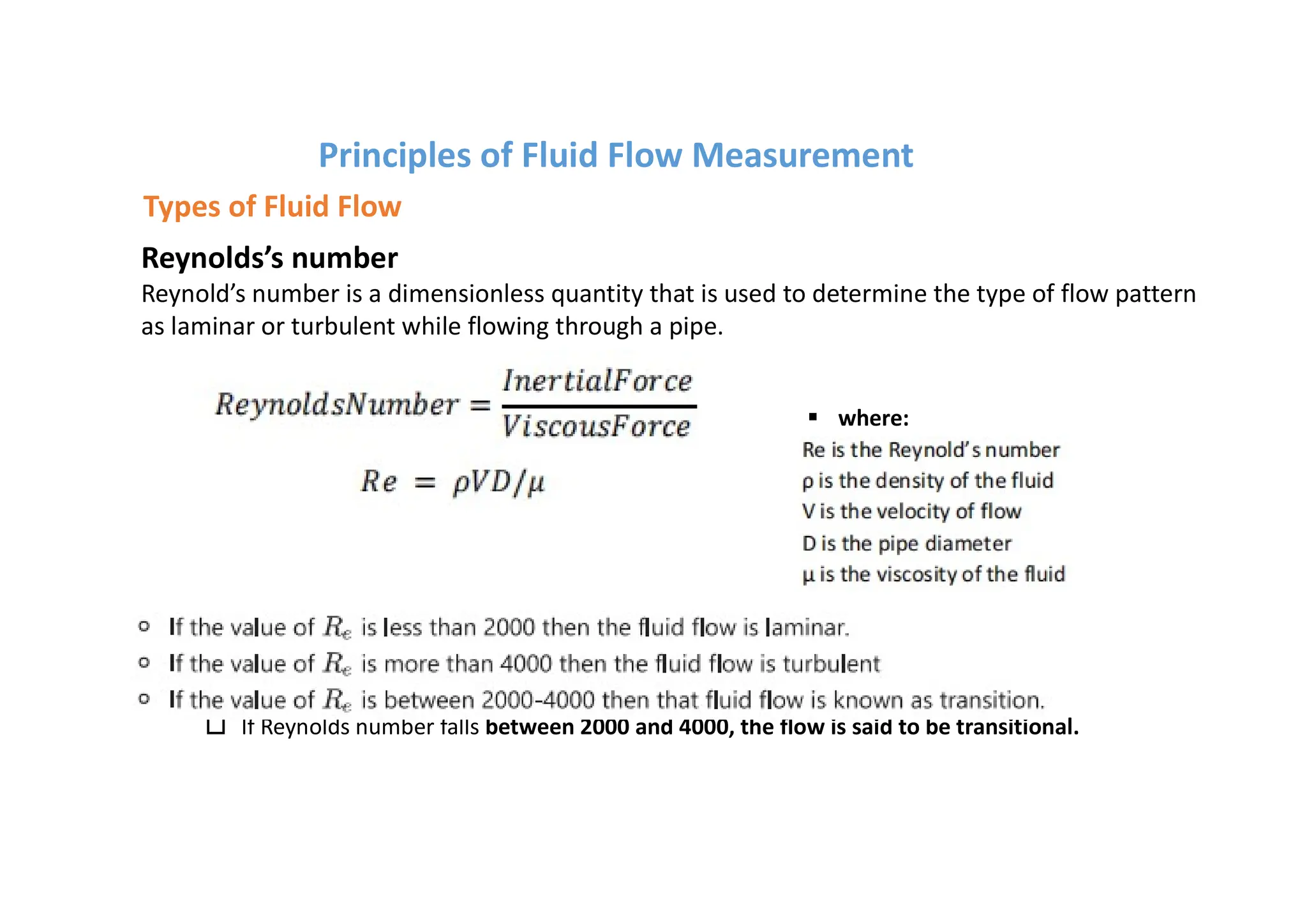
Reynold’s number is a dimensionless quantity that is used to determine the type of flow pattern
as laminar or turbulent while flowing through a pipe.
o If Reynold’s number is less than 2000, the flow is said to be laminar.
o If Reynold’s number calculated is greater than 4000, the is said to be turbulent.
o If Reynolds number falls between 2000 and 4000, the flow is said to be transitional.
§ where:
Principles of Fluid Flow Measurement
Types of Fluid Flow
o Continuty Equation
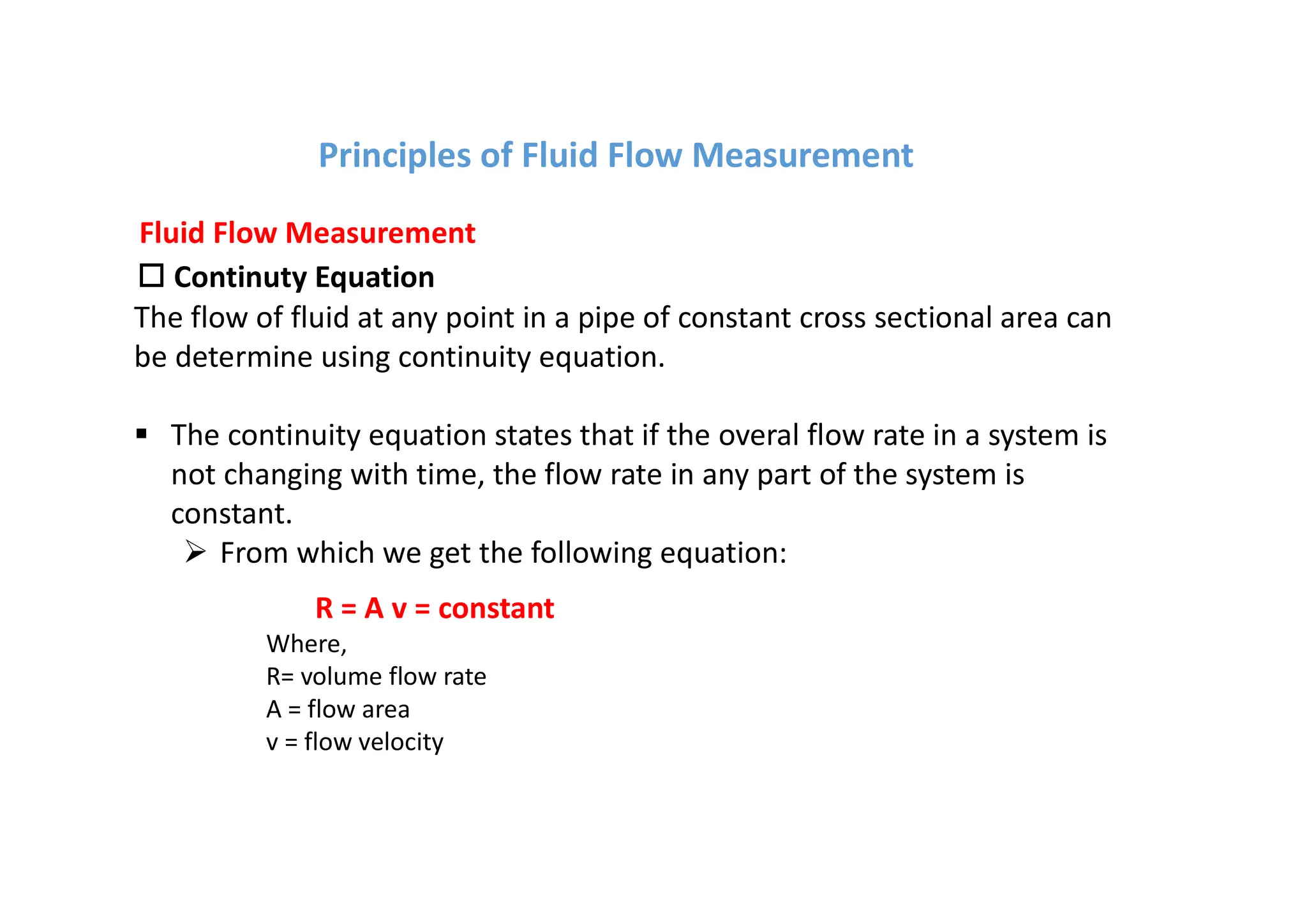
The flow of fluid at any point in a pipe of constant cross sectional area can
be determine using continuity equation.
§ The continuity equation states that if the overal flow rate in a system is
not changing with time, the flow rate in any part of the system is
constant.
Ø From which we get the following equation:
Fluid Flow Measurement
R = A v = constant
Where,
R= volume flow rate
A = flow area
v = flow velocity
Principles of Fluid Flow Measurement
o Continuty Equation
Fluid Flow Measurement
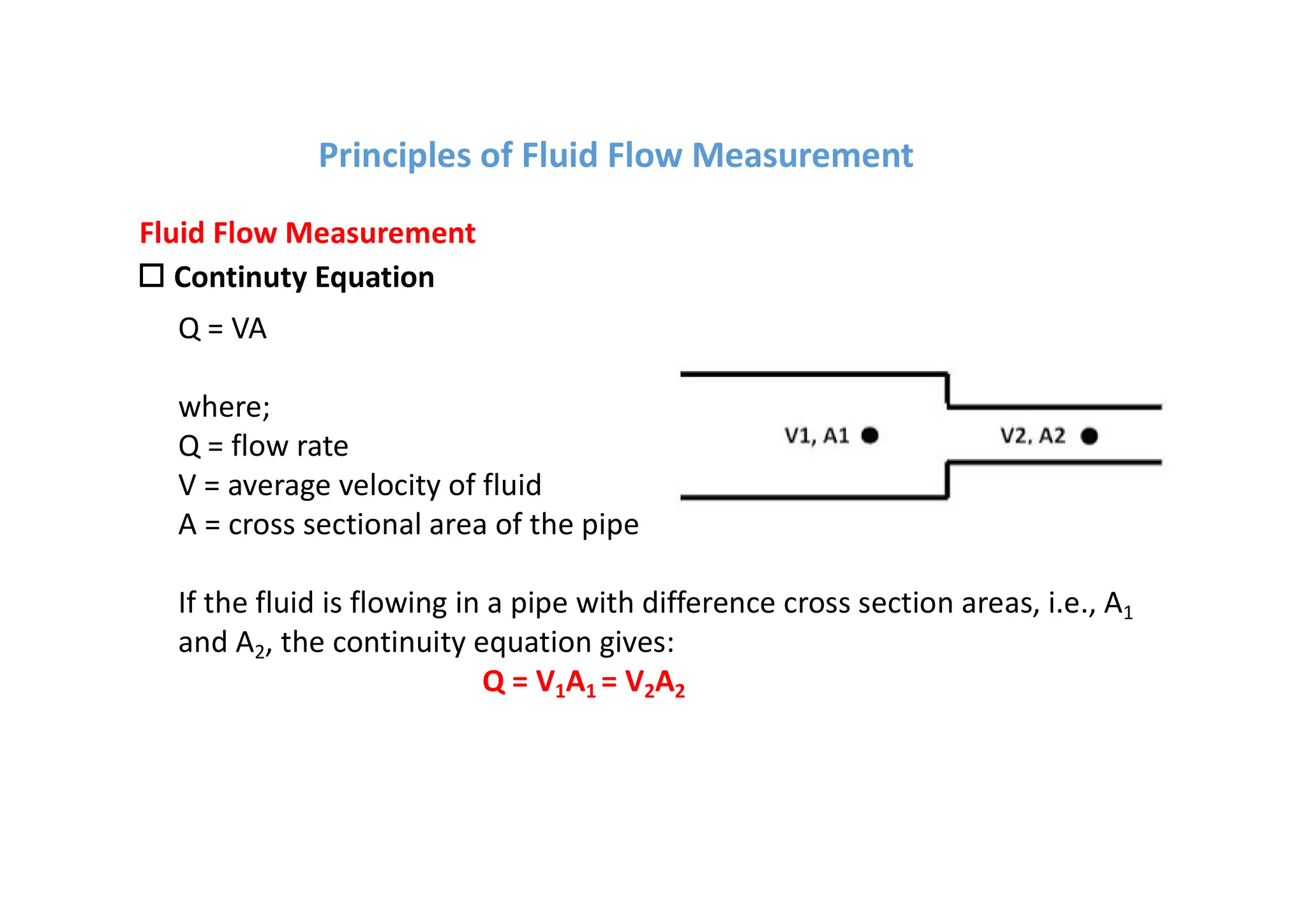
Q = VA
where;
Q = flow rate
V = average velocity of fluid
A = cross sectional area of the pipe
If the fluid is flowing in a pipe with difference cross section areas, i.e., A1
and A2, the continuity equation gives:
Q = V1A1 = V2A2
Principles of Fluid Flow Measurement
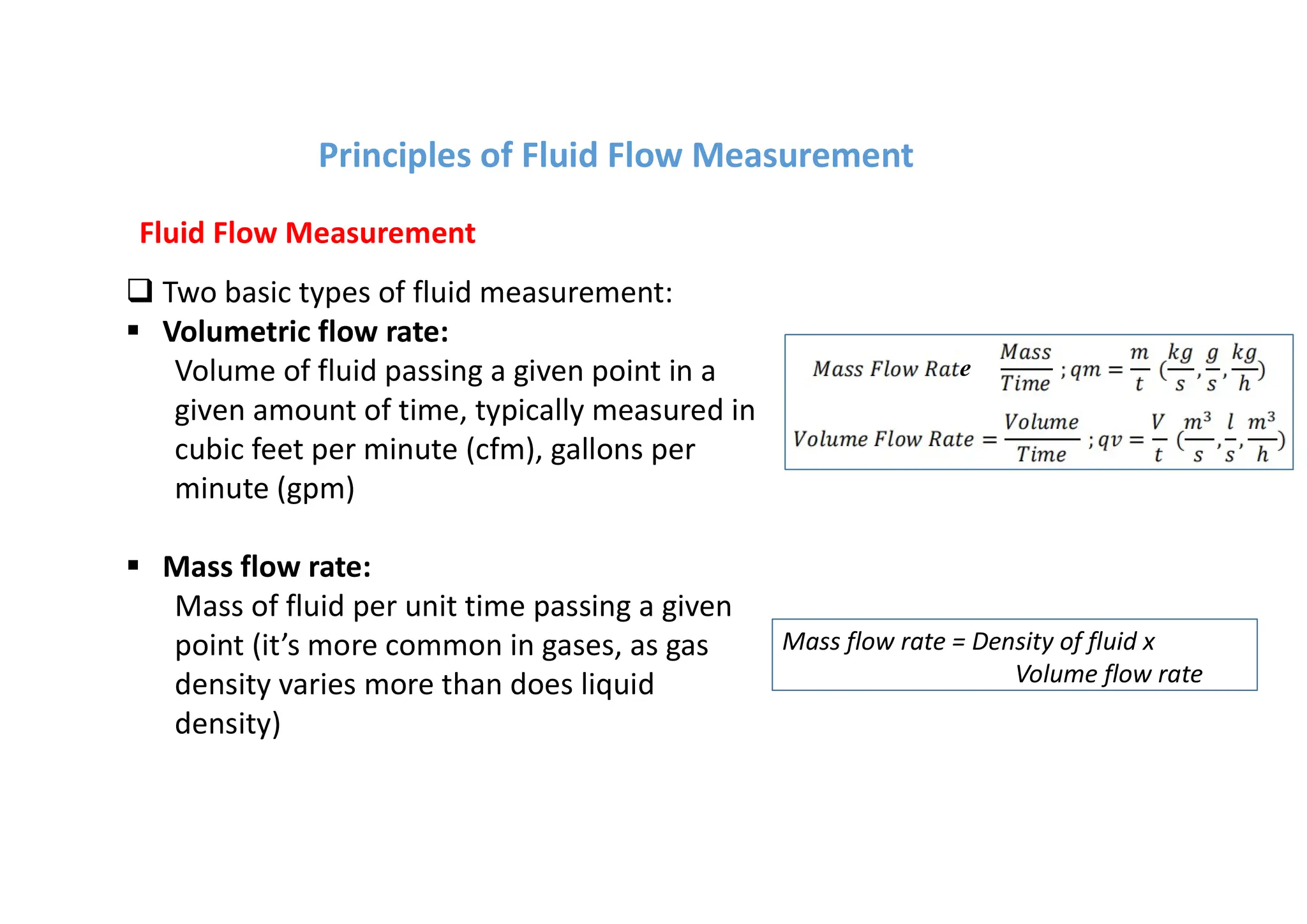
q Two basic types of fluid measurement:
§ Volumetric flow rate:
Volume of fluid passing a given point in a
given amount of time, typically measured in
cubic feet per minute (cfm), gallons per
minute (gpm)
§ Mass flow rate:
Mass of fluid per unit time passing a given
point (it’s more common in gases, as gas
density varies more than does liquid
density)
Fluid Flow Measurement
e
Mass flow rate = Density of fluid x
Volume flow rate
Principles of Fluid Flow Measurement
o Mass flow measuring principles
• Coriolis measuring principle
• Thermal measuring principle:
o Volume flow measuring principles
• Ultrasonic flow measurement
• Vortex
• Magnetic inductive
• Differential Pressure
• Positive displacement
Metering Technology Principles
Principles of Fluid Flow Measurement
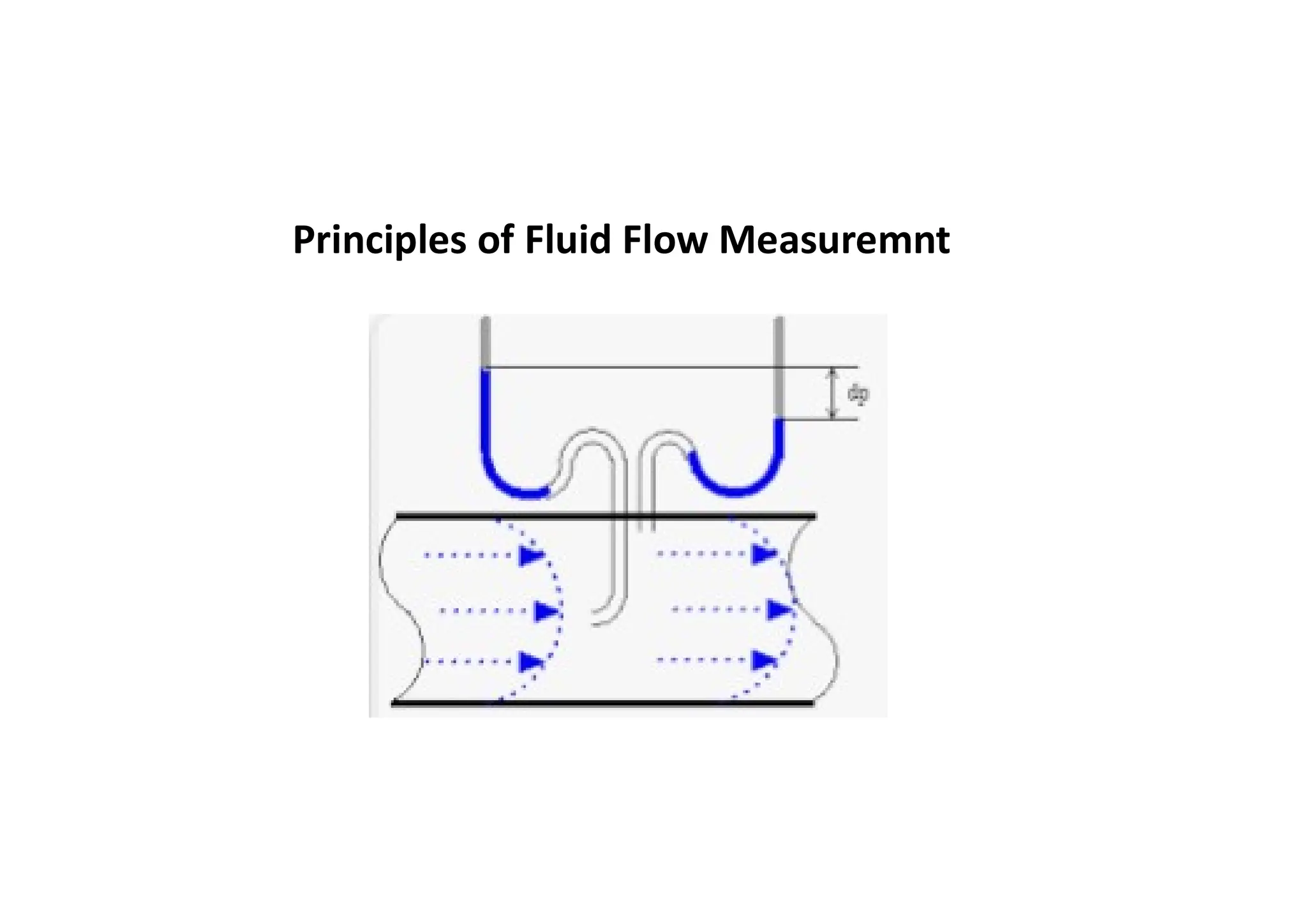
o The primary flow sensing element based on Bernoulli principle are as follows:
i. Orifice plate
ii. Flow nozzle
iii. Venturi tube
iv. Pitot tube
Flow Measument Sensing Elements
Principles of Fluid Flow Measurement
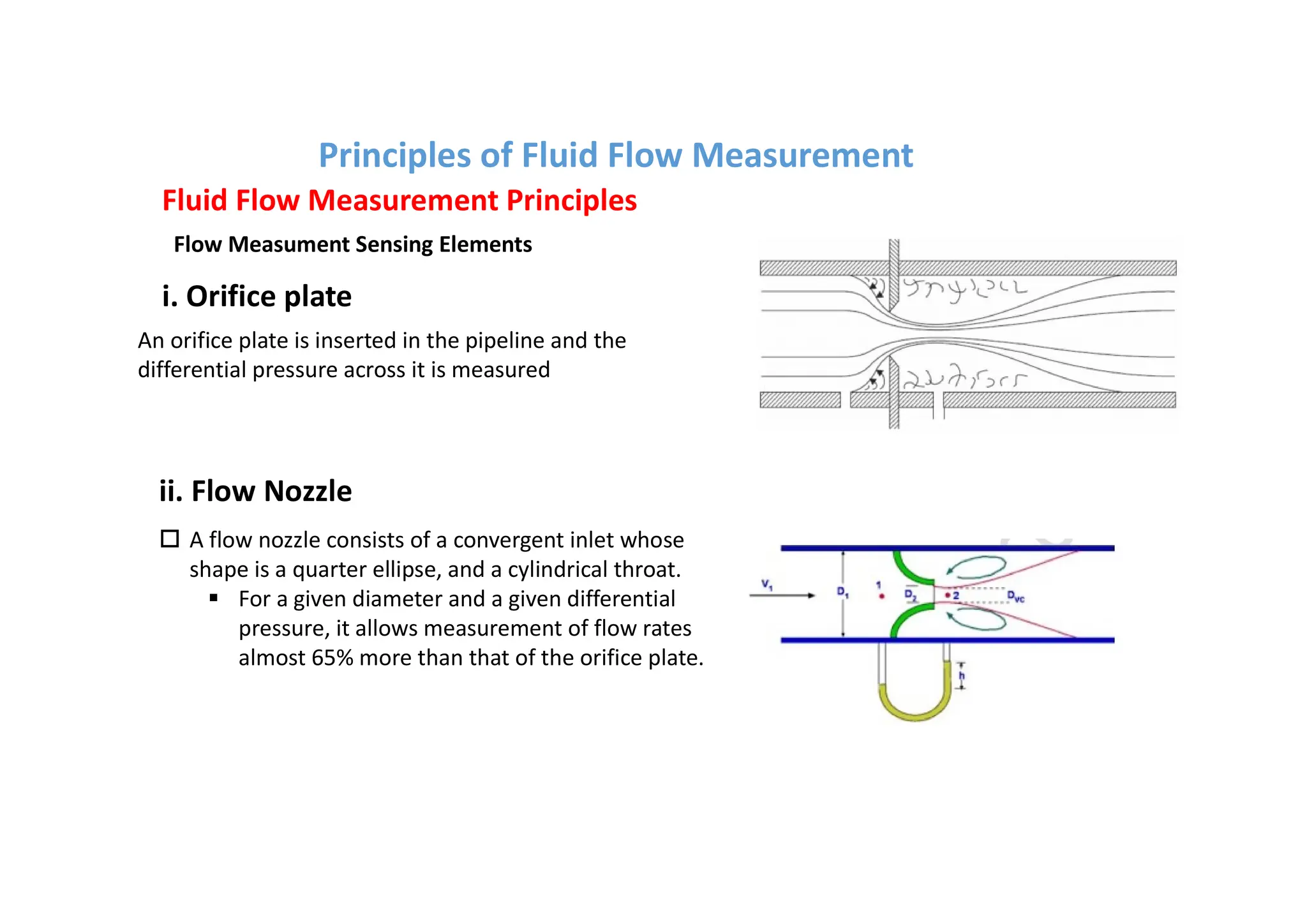
i. Orifice plate
An orifice plate is inserted in the pipeline and the
differential pressure across it is measured
Fluid Flow Measurement Principles
Flow Measument Sensing Elements
ii. Flow Nozzle
o A flow nozzle consists of a convergent inlet whose
shape is a quarter ellipse, and a cylindrical throat.
§ For a given diameter and a given differential
pressure, it allows measurement of flow rates
almost 65% more than that of the orifice plate.
Principles of Fluid Flow Measurement
iii. Venturi Tube
Flow Measument Sensing Elements
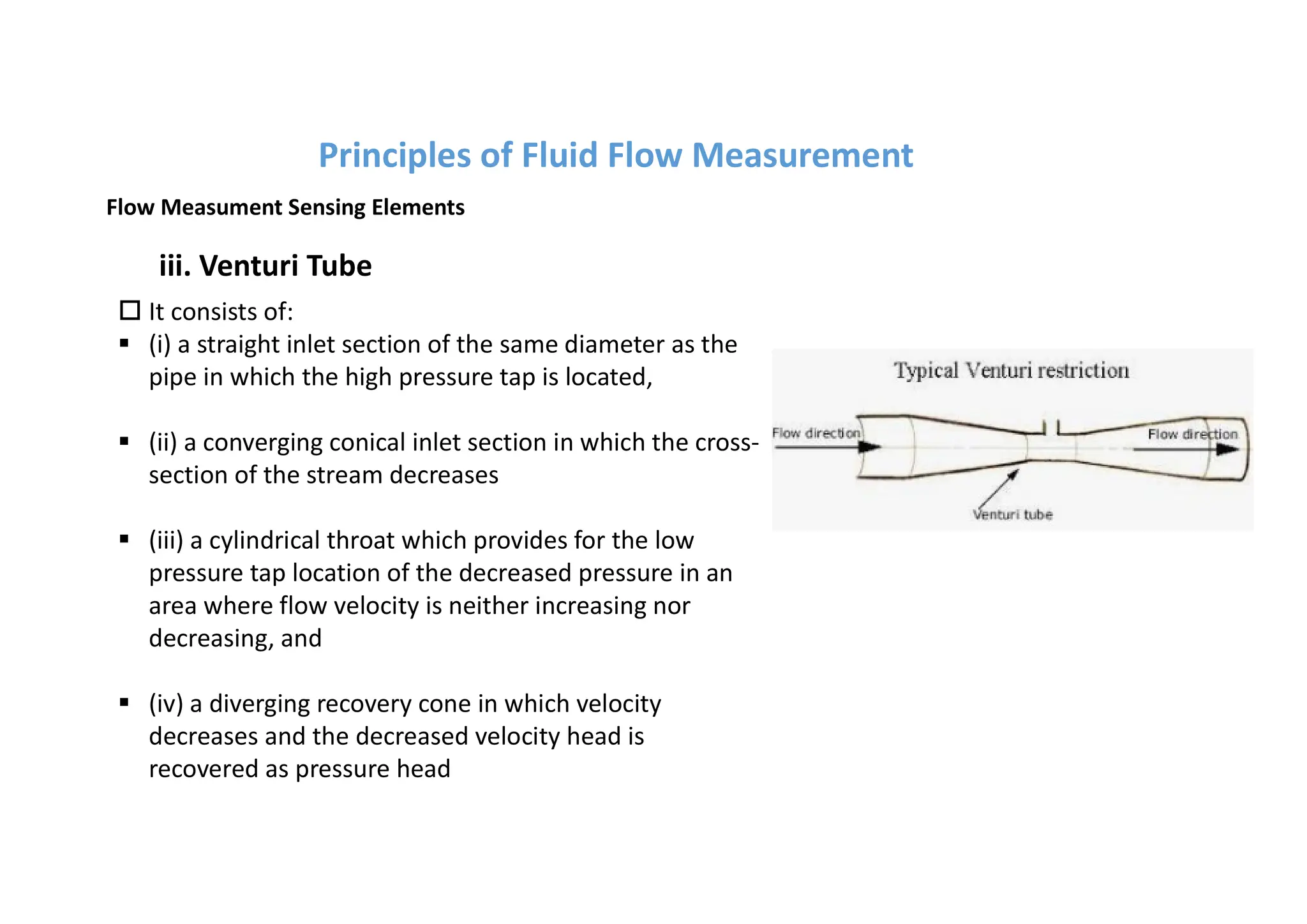
o It consists of:
§ (i) a straight inlet section of the same diameter as the
pipe in which the high pressure tap is located,
§ (ii) a converging conical inlet section in which the cross-
section of the stream decreases
§ (iii) a cylindrical throat which provides for the low
pressure tap location of the decreased pressure in an
area where flow velocity is neither increasing nor
decreasing, and
§ (iv) a diverging recovery cone in which velocity
decreases and the decreased velocity head is
recovered as pressure head
Principles of Fluid Flow Measurement
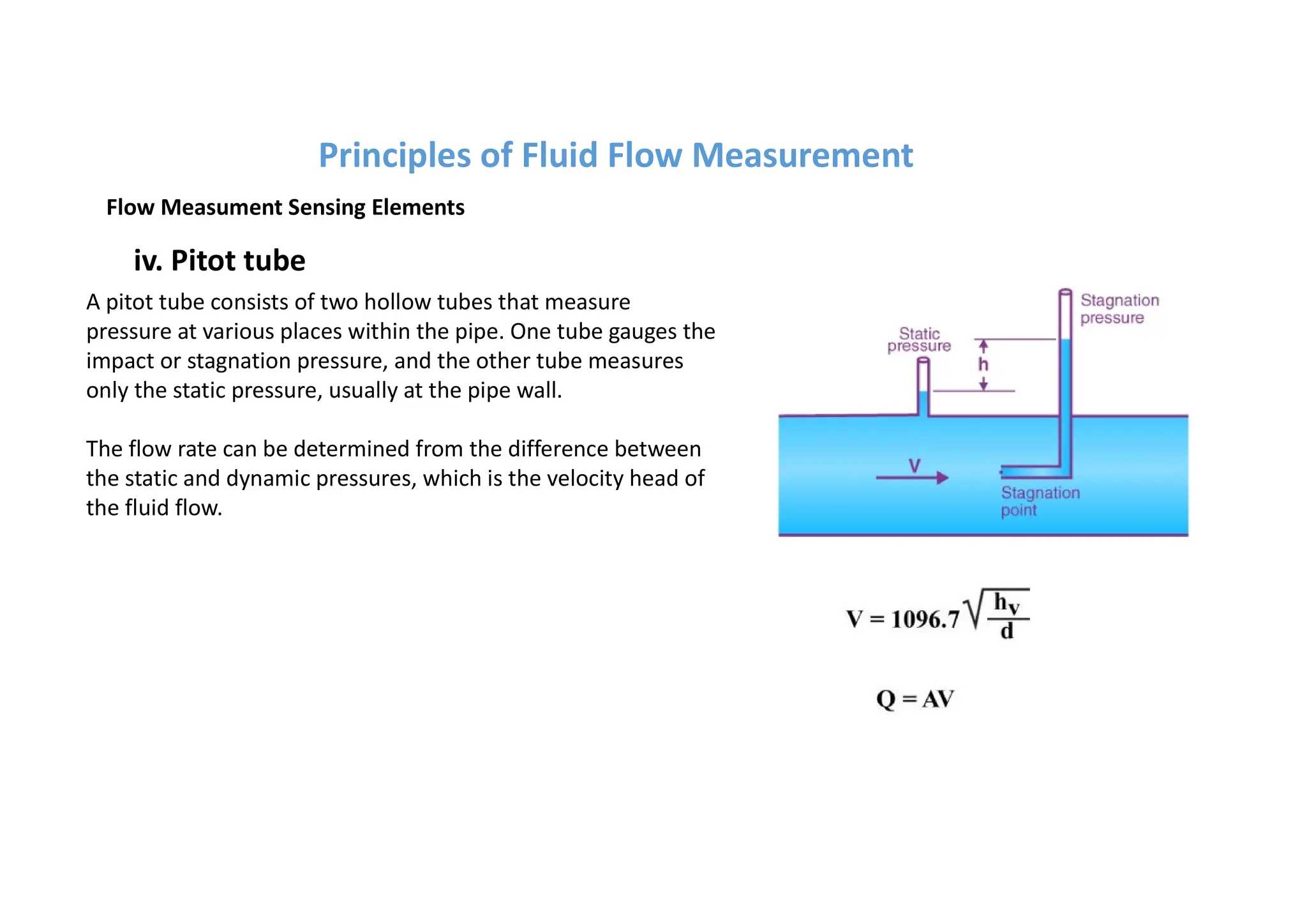
A pitot tube consists of two hollow tubes that measure
pressure at various places within the pipe. One tube gauges the
impact or stagnation pressure, and the other tube measures
only the static pressure, usually at the pipe wall.
The flow rate can be determined from the difference between
the static and dynamic pressures, which is the velocity head of
the fluid flow.
iv. Pitot tube
Flow Measument Sensing Elements
Principles of Fluid Flow Measurement

Principles of Fluid Flow Measurement.pdf

  • 1.
    Principles of FluidFlow Measuremnt
  • 2.
    o Measurement isa technique in which the properties of an object are determined by comparing them to a standard quantity. § Measurement is the essential metric to express any quantity of objects, things and events. o Fluid flow measurement: the measurement of smoothly moving particles that fill and conform to the piping in an uninterrupted stream to determine the quantity flowing. § Flow measurement involves using flow meters that measure the flow rate of steam, liquid, or gas flowing through a pipe. Definition o Flow rate is the volume of fluid that passes through a given cross-sectional area per unit time. Principles of Fluid Flow Measurement
  • 3.
    o Fluid flowis a part of fluid mechanics and deals with fluid dynamics § It involves the motion of a fluid subjected to unbalance forces § This motion continues as lone as unbalanced forces are applied Flow Meter o A flow meter is a device used to measure the volume or mass of a gas or liquid. § The purpose of a flow meter is basically to measure the flow of gas or liquid between two points in a process. Fluid Flow Principles of Fluid Flow Measurement
  • 4.
    Principles of FluidFlow Measurement
  • 5.
    Types of FluidFlow Principles of Fluid Flow Measurement § Laminar flow or streamline flow occurs when a fluid flows in parallel layers, with no disruption between the layers. At low velocities, the fluid tends to flow without lateral mixing. § Turbulent fluid flow is defined as a flow in which the fluid particles travel in a zig-zag manner, forming eddies and wasting a lot of energy. o Laminar Flow and Turbulent Flow
  • 6.
    Reynolds’s number Reynold’s numberis a dimensionless quantity that is used to determine the type of flow pattern as laminar or turbulent while flowing through a pipe. o If Reynold’s number is less than 2000, the flow is said to be laminar. o If Reynold’s number calculated is greater than 4000, the is said to be turbulent. o If Reynolds number falls between 2000 and 4000, the flow is said to be transitional. § where: Principles of Fluid Flow Measurement Types of Fluid Flow
  • 7.
    o Continuty Equation Theflow of fluid at any point in a pipe of constant cross sectional area can be determine using continuity equation. § The continuity equation states that if the overal flow rate in a system is not changing with time, the flow rate in any part of the system is constant. Ø From which we get the following equation: Fluid Flow Measurement R = A v = constant Where, R= volume flow rate A = flow area v = flow velocity Principles of Fluid Flow Measurement
  • 8.
    o Continuty Equation FluidFlow Measurement Q = VA where; Q = flow rate V = average velocity of fluid A = cross sectional area of the pipe If the fluid is flowing in a pipe with difference cross section areas, i.e., A1 and A2, the continuity equation gives: Q = V1A1 = V2A2 Principles of Fluid Flow Measurement
  • 9.
    q Two basictypes of fluid measurement: § Volumetric flow rate: Volume of fluid passing a given point in a given amount of time, typically measured in cubic feet per minute (cfm), gallons per minute (gpm) § Mass flow rate: Mass of fluid per unit time passing a given point (it’s more common in gases, as gas density varies more than does liquid density) Fluid Flow Measurement e Mass flow rate = Density of fluid x Volume flow rate Principles of Fluid Flow Measurement
  • 10.
    o Mass flowmeasuring principles • Coriolis measuring principle • Thermal measuring principle: o Volume flow measuring principles • Ultrasonic flow measurement • Vortex • Magnetic inductive • Differential Pressure • Positive displacement Metering Technology Principles Principles of Fluid Flow Measurement
  • 11.
    o The primaryflow sensing element based on Bernoulli principle are as follows: i. Orifice plate ii. Flow nozzle iii. Venturi tube iv. Pitot tube Flow Measument Sensing Elements Principles of Fluid Flow Measurement
  • 12.
    i. Orifice plate Anorifice plate is inserted in the pipeline and the differential pressure across it is measured Fluid Flow Measurement Principles Flow Measument Sensing Elements ii. Flow Nozzle o A flow nozzle consists of a convergent inlet whose shape is a quarter ellipse, and a cylindrical throat. § For a given diameter and a given differential pressure, it allows measurement of flow rates almost 65% more than that of the orifice plate. Principles of Fluid Flow Measurement
  • 13.
    iii. Venturi Tube FlowMeasument Sensing Elements o It consists of: § (i) a straight inlet section of the same diameter as the pipe in which the high pressure tap is located, § (ii) a converging conical inlet section in which the cross- section of the stream decreases § (iii) a cylindrical throat which provides for the low pressure tap location of the decreased pressure in an area where flow velocity is neither increasing nor decreasing, and § (iv) a diverging recovery cone in which velocity decreases and the decreased velocity head is recovered as pressure head Principles of Fluid Flow Measurement
  • 14.
    A pitot tubeconsists of two hollow tubes that measure pressure at various places within the pipe. One tube gauges the impact or stagnation pressure, and the other tube measures only the static pressure, usually at the pipe wall. The flow rate can be determined from the difference between the static and dynamic pressures, which is the velocity head of the fluid flow. iv. Pitot tube Flow Measument Sensing Elements Principles of Fluid Flow Measurement