





Irrigation & Flood Control
Faruque Abdullah
Lecturer
Dept. of Civil Engineering
Dhaka International University
Reference Books
 Irrigation Water Resources and Water Power Engineering – Dr. P. N. Modi.
 Irrigation and Water Power Engineering – Dr. B. C. Punmia.
 Irrigation Engineering – R. K. Sharma & T. K. Sharma.
 Irrigation Engineering – S. K. Garg.
 Irrigation Engineering – N. N. Bashak.
 Irrigation Theory and Practice – A. M. Michael
 Hydrology – H. M. Ragunath
Introduction
Irrigation
Irrigation: Irrigation can be defined as the process of artificially supplying
water to soil for raising crops. It is a science of planning and designing an
efficient, low-cost, economic irrigation system tailored to fit natural
conditions. It is the engineering of controlling and harnessing the various
natural resource of water by the construction of dams and reservoirs, canals
and finally distributing the water to the agricultural fields.
Necessity: The necessity of irrigation can be summarized in the following
points:
 Less rainfall: When the total rainfall is less than needed for the crop, artificial
supply is necessary. In such a case irrigation works may be constructed at a
place where more water is available and then to convey the water to the area
where there is deficiency of water.
 Non uniform rainfall: The rainfall in a particular area may not be uniform
over the crop period. During the early periods of the crop, rains may be there,
but no rain water may be at the end, with the result that either the yield may
be less or the crop may die altogether. By the collection of water during the
excess rainfall period water may be supplied to the crop during the period
when there may be no rainfall.
 Commercial crops with additional water: The rainfall in a particular area may
be sufficient to raise the usual crops but more water may be necessary for
raising commercial and cash crops.
 Controlled water supply: By the construction of proper distribution system,
the yield of the crop may be increased because of controlled supply of water.
Purpose of irrigation water:
 Adds water to the soil to supply the moisture essential for the plant growth.
 Saves the crops from drying during short duration drought.
 Cools the soil and the atmosphere and thus makes more favorable
environment for healthy growth.
 Washes out or dilutes salts in the soil.
 Reduce the hazard of soil piping.
 Softens the tillage pans.
Benefits of irrigation:
 Increase in food production.
 Protection from famine.
 Cultivation of cash crops.
 Elimination of mixed cropping.
 Addition of wealth of the country.
 Increase in prosperity of people.
 Generation of hydro-electric power.
 Domestic and industrial water supply.
 Inland navigation.
 Improvement of communication.
 General development of the country.
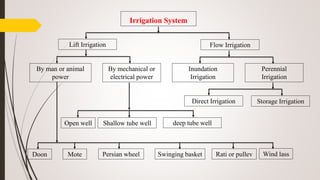
Irrigation System
Flow Irrigation
Perennial
Irrigation
Inundation
Irrigation
Storage IrrigationDirect Irrigation
Lift Irrigation
By mechanical or
electrical power
By man or animal
power
Shallow tube wellOpen well deep tube well
MoteDoon Persian wheel Rati or pullevSwinging basket Wind lass
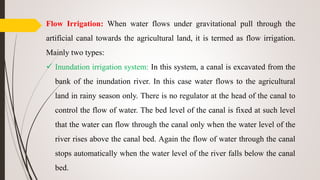
Flow Irrigation: When water flows under gravitational pull through the
artificial canal towards the agricultural land, it is termed as flow irrigation.
Mainly two types:
 Inundation irrigation system: In this system, a canal is excavated from the
bank of the inundation river. In this case water flows to the agricultural
land in rainy season only. There is no regulator at the head of the canal to
control the flow of water. The bed level of the canal is fixed at such level
that the water can flow through the canal only when the water level of the
river rises above the canal bed. Again the flow of water through the canal
stops automatically when the water level of the river falls below the canal
bed.
River
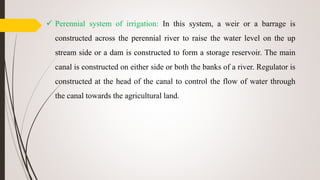
 Perennial system of irrigation: In this system, a weir or a barrage is
constructed across the perennial river to raise the water level on the up
stream side or a dam is constructed to form a storage reservoir. The main
canal is constructed on either side or both the banks of a river. Regulator is
constructed at the head of the canal to control the flow of water through
the canal towards the agricultural land.
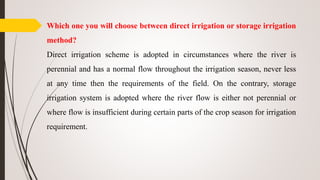
Which one you will choose between direct irrigation or storage irrigation
method?
Direct irrigation scheme is adopted in circumstances where the river is
perennial and has a normal flow throughout the irrigation season, never less
at any time then the requirements of the field. On the contrary, storage
irrigation system is adopted where the river flow is either not perennial or
where flow is insufficient during certain parts of the crop season for irrigation
requirement.
Lift Irrigation: When water is lifted from surface sources or underground
sources by man or animal, mechanical or electrical power and directly
supplied to the agricultural land, then it is known as lift irrigation.
Advantages:
 The farmers can supply water to their fields according to the requirement.
 Reducing the chance of water logging.
 No water loss due to conveyance.
 Initial cost is low.
 The duty of water is high.
 The maintenance cost is low.
 More than one crop can be grown in a year on the same land.
Disadvantages:
 In the summer the surface water may be dried up and the water table may
go down below the suction head. Hence, lift irrigation from the surface
source and from the shallow tube well may fail in summer.
 If the lifting mechanism fails due to mechanical or electrical failure, then
water cannot be supplied until the mechanism is restored.
 The well water has no silt content. The yield of crop therefore depends on
chemical fertilizer, which is costly.
 The lift irrigation in consideration with the yield of crop is not cost
effective.
Soil-Water-Plant Relationship
Aim of Irrigation: The aim of irrigation practice is to ensure that plants have
an adequate supply of water in their root zone for achieving optimum yield of
crops without damaging the quality of soil.
Soil Texture: Soil texture refers to the composition of the soil and it is
reflected by the particle size, shape and gradation. Generally the soils
occurring in nature are a combination of sand, silt and clay. The relative
proportion of sand, silt and clay in a soil mass determines the soil texture.
According to textural gradations the soil may be broadly classified as
 ‘Open’ or ‘Light’ textural soils.
 ‘Medium’ textural soils.
 ‘Tight’ or ‘Heavy’ textural soils
The ‘Open’ or ‘Light’ textural soils contain very low content of silt and clay
and hence these soils are course or sandy. The ‘medium’ textured soils
contain sand, silt and clay in sizable proportions. In general loam is a soil
which has all the three major size fractions in sizable proportions and hence
the loams are medium textured soils. The ‘Tight’ or ‘Heavy’ textured soil
contain high content of clay.
Water Holding Capacity of Soil: Water holding capacity of the' soil is one of the dominant
factors influencing irrigation. The water holding capacity of a soil mainly depends on its
porosity. The porosity of a soil is defined as the ratio of the volume of pores in the soil mass
to its total volume, and it is expressed as percentage. In general there are two types of soil
pores viz., (i) capillary or small pores, and (it) non-capillary or large pores. The capillary
pores hold tightly by capillarity a large amount of water held by the soil at saturation and
prevent it from being drained off under gravity. On the other hand the non-capillary pores do
not hold water tightly and hence a large amount of water held by the soil sat saturation is
drained off under gravity. Thus capillary pores induce greater water holding capacity while
non-capillary pores induce drainage and aeration. The relative magnitudes of these types of
pores in a soil depend on its texture and structure. Thus a sandy soil has more non-capillary
pores which result in better drainage and aeration but low water holding capacity. On the
other hand a clayey soil has more capillary pores which result in better water holding
capacity but poor drainage and aeration.
The water held by the soil is extracted by the roots of the plants for being used by the plants.
In general the extraction of water from the soil by the roots of the plants is resisted by some
forces, but the resisting forces are more in clayey soils than in sandy soils. Thus water cannot
be easily extracted by the roots of the plants in clayey soils although large amount of water is
held by these soils. On the other hand relatively less amount of water is held by sandy soils,
but water can be easily extracted from these soils by the roots of the plants.
Thus an ideal soil for irrigation is that which has its pore space almost equally divided
between capillary and non-capillary pores. Such a soil has enough small pores to provide
adequate water holding capacity and also enough large pores to permit adequate drainage and
aeration, and easy extraction of water by the roots of the plants. The loams are therefore ideal
soils as they possess good water holding capacity, have good drainage and aeration, and
allow extraction of water by the roots of the plants without much resistance.
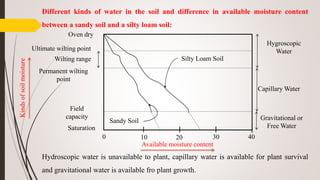
Different kinds of water in the soil and difference in available moisture content
between a sandy soil and a silty loam soil:
Hydroscopic water is unavailable to plant, capillary water is available for plant survival
and gravitational water is available fro plant growth.
0 10 20 30 40
Oven dry
Ultimate wilting point
Permanent wilting
point
Field
capacity
Saturation
Wilting range
Hygroscopic
Water
Capillary Water
Gravitational or
Free Water
Silty Loam Soil
Sandy Soil
Kindsofsoilmoisture
Available moisture content
Soil Moisture Constants:
 Saturation capacity.
 Field capacity
 Moisture equivalent
 Permanent wilting point
 Temporary wilting point
 Ultimate wilting
 Available moisture
 Readily available moisture.
Depth of water (or moisture) held by soil in root zone and available to
plants:
The water held by soil in root zone may be expressed in terms of depth of
water which may be determined as indicated below:
Let, d be the depth of root zone, 𝑤𝑠 be the specific weight of soil and w be
the specific weight of water. If unit area of soil is considered then the weight
of soil per unit area and depth d is equal to (𝑤𝑠 x 1 x d).
Further the weight of water held by the soil per unit area is equal to [w x 1 x
depth of water]
Field capacity =
𝑊𝑒𝑖𝑔ℎ𝑡 𝑜𝑓 𝑤𝑎𝑡𝑒𝑟 ℎ𝑒𝑙𝑑 𝑏𝑦 𝑠𝑜𝑖𝑙 𝑝𝑒𝑟 𝑢𝑛𝑖𝑡 𝑎𝑟𝑒𝑎
𝑊𝑒𝑖𝑔ℎ𝑡 𝑜𝑓 𝑠𝑜𝑖𝑙 𝑝𝑒𝑟 𝑢𝑛𝑖𝑡 𝑎𝑟𝑒𝑎
Field capacity =
𝑊𝑒𝑖𝑔ℎ𝑡 𝑜𝑓 𝑤𝑎𝑡𝑒𝑟 ℎ𝑒𝑙𝑑 𝑏𝑦 𝑠𝑜𝑖𝑙 𝑝𝑒𝑟 𝑢𝑛𝑖𝑡 𝑎𝑟𝑒𝑎
𝑊𝑒𝑖𝑔ℎ𝑡 𝑜𝑓 𝑠𝑜𝑖𝑙 𝑝𝑒𝑟 𝑢𝑛𝑖𝑡 𝑎𝑟𝑒𝑎
=
w x 1 x depth of water
𝑤 𝑠 x 1 x d
∴ Depth of water held by soil at field capacity =
𝑤 𝑠
𝑤
x d x [Field capacity]
= S x d x [Field capacity]
Where, S is the specific gravity of soil.
∴ Depth of water held by soil at permanent wilting point
=
𝑤 𝑠
𝑤
x d x [permanent wilting point]
= S x d x [permanent wilting point]
∴ Depth of available water =
𝑤 𝑠
𝑤
x d x [Field capacity - permanent wilting point]
= S x d x [Field capacity - permanent wilting point]
∴ Further depth of available water per meter depth of soil
=
𝑤 𝑠
𝑤
x [Field capacity - permanent wilting point]
= S x [Field capacity - permanent wilting point]
Problem-1: The root zone of a certain soil has a field capacity of 30% and
permanent wilting percentage is 10%.
a) What is the depth of moisture in the root zone at field capacity and
permanent wilting point?
b) How much water is available if the root zone depth is 1.2 m. The dry
weight of soil is 13.73 kN/𝑚3
[1400kg/𝑚3
].
Solution:
a) The depth of moisture in root zone at field capacity per meter depth of
soil = S x Field capacity =
1400
1000
x
30
100
= 0.42 m/m
The depth of moisture in root zone at permanent wilting point per meter
depth of soil = S x Permanent wilting point =
1400
1000
x
10
100
= 0.14 m/m
b) The depth of water available per meter depth of soil
= S x [Field capacity - Permanent wilting point ]
=
1400
1000
x (
30
100
-
10
100
) = 0.28 m/m
∴ Total water available in the root zone = 0.28 x 1.2 m = 0.336 m = 336 mm.
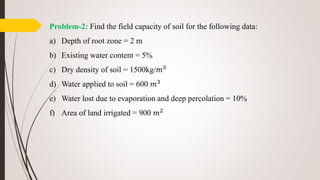
Problem-2: Find the field capacity of soil for the following data:
a) Depth of root zone = 2 m
b) Existing water content = 5%
c) Dry density of soil = 1500kg/𝑚3
d) Water applied to soil = 600 𝑚3
e) Water lost due to evaporation and deep percolation = 10%
f) Area of land irrigated = 900 𝑚2
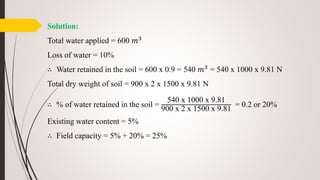
Solution:
Total water applied = 600 𝑚3
Loss of water = 10%
∴ Water retained in the soil = 600 x 0.9 = 540 𝑚3 = 540 x 1000 x 9.81 N
Total dry weight of soil = 900 x 2 x 1500 x 9.81 N
∴ % of water retained in the soil =
540 x 1000 x 9.81
900 x 2 x 1500 x 9.81
= 0.2 or 20%
Existing water content = 5%
∴ Field capacity = 5% + 20% = 25%
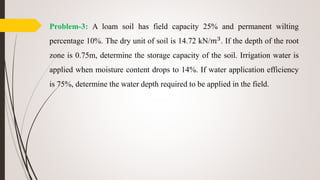
Problem-3: A loam soil has field capacity 25% and permanent wilting
percentage 10%. The dry unit of soil is 14.72 kN/𝑚3
. If the depth of the root
zone is 0.75m, determine the storage capacity of the soil. Irrigation water is
applied when moisture content drops to 14%. If water application efficiency
is 75%, determine the water depth required to be applied in the field.
Solution: Maximum storage capacity of soil = Available moisture
= S x d x [Field capacity - Permanent wilting point]
=
14.72
9.81
x 0.75 x [0.25 – 0.10]
= 0.169 m = 169 mm.
Depth of irrigation water = S x d x [Field capacity – Minimum moisture content at
which irrigation is required]
=
14.72
9.81
x 0.75 x [0.25 – 0.14]
= 0.124 m = 124 mm.
Depth of irrigation water to be applied in the field =
124
0.75
mm = 165 mm.
Problem-4: The field capacity of a certain soils is 18.3% and specific gravity
is 1.25. A wet sample of soil taken before irrigation weighs 153 gm and its
weight after drying in the oven is 138 gm. What depth of water must be
applied to irrigate the soil to a depth of 1.2 m?
Solution:
The moisture content before irrigation =
153−138
138
x 100 = 10.9%
Depth of water required to be applied to bring the moisture up to its field
capacity = 1.25 x 1.2 x [
18.3
100
-
10.9
100
] = 0.111 m = 111mm.
Problem-5: The field capacity of a certain soils is 12.6% and specific gravity is 1.42.
If the moisture content present in the soil before irrigation is 8.2%, how deep the soil
profile will be welted with an application of 50 mm of irrigation water?
Solution:
Depth of irrigation water = S x d x [Field capacity –Moisture content before irrigation]
or,
50
100
= 1.42 x d x [
12.6
100
-
8.2
100
]
or, d =
50
100
1.42 𝑥 [
12.6
100
− 8.2
100
]
= 0.80 m = 800 mm.
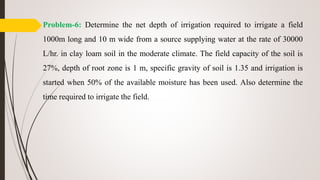
Problem-6: Determine the net depth of irrigation required to irrigate a field
1000m long and 10 m wide from a source supplying water at the rate of 30000
L/hr. in clay loam soil in the moderate climate. The field capacity of the soil is
27%, depth of root zone is 1 m, specific gravity of soil is 1.35 and irrigation is
started when 50% of the available moisture has been used. Also determine the
time required to irrigate the field.
Solution:
Depth of irrigation water to be applied, 𝑑′ = S x d x [Field capacity –Moisture
content before irrigation]
= 1.35 x 1 x [
27
100
-
0.5 𝑥 27
100
]
= 0.182 m = 182 mm.
If the irrigation water is applied at the rate of q cubic meter per hour for t hours over area
of a hectare and 𝑑′ is the depth of water required to be applied in meter, then we have
q x t = a x 104 x 0.182
or,
30000
1000
x t =
1000 𝑥 10
104 x 104 x 0.182
∴ t = 60.7 hours.
Function of irrigation water:
 Triggers activity in a sheet setting a chain of biochemical reaction.
 Dissolves mineral nutrients for their rise from the soil in the plants.
 Promotes chemical action within the plant for its growth.
 Promotes and supports life of bacteria beneficial to the plant growth.
 Requires for temperature control of the soil to minimizes the effect of frost.
 At the end of the life cycle of plant water is also a constituents of product
which may be sheet, stem, leaves, flowers or foods.
Consumptive use or Evapotranspiration: Consumptive use or evapotranspiration
may be defined as the total quantity of water used by the vegetative growth of a given
area in transpiration and building of plant tissue and that evaporated from adjacent soil
in the area, in any specified time. It is therefore includes the water removed from the
soil by transpiration and evaporation.
Transpiration: Transpiration is the process in which water that enters the plant roots
and is used in building plant tissues and finally passes into the atmosphere in the
vaporous from through the leaves of the plant.
Evaporation: Evaporation is the process in which water from the adjacent soil passes
into the atmosphere in the vaporous from.
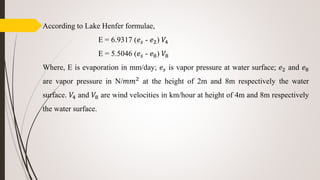
According to Lake Henfer formulae,
E = 6.9317 (𝑒𝑠 - 𝑒2) 𝑉4
E = 5.5046 (𝑒𝑠 - 𝑒8) 𝑉8
Where, E is evaporation in mm/day; 𝑒𝑠 is vapor pressure at water surface; 𝑒2 and 𝑒8
are vapor pressure in N/𝑚𝑚2 at the height of 2m and 8m respectively the water
surface. 𝑉4 and 𝑉8 are wind velocities in km/hour at height of 4m and 8m respectively
the water surface.
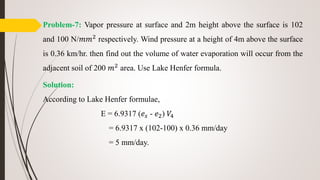
Problem-7: Vapor pressure at surface and 2m height above the surface is 102
and 100 N/𝑚𝑚2 respectively. Wind pressure at a height of 4m above the surface
is 0.36 km/hr. then find out the volume of water evaporation will occur from the
adjacent soil of 200 𝑚2 area. Use Lake Henfer formula.
Solution:
According to Lake Henfer formulae,
E = 6.9317 (𝑒𝑠 - 𝑒2) 𝑉4
= 6.9317 x (102-100) x 0.36 mm/day
= 5 mm/day.
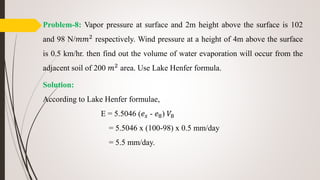
Problem-8: Vapor pressure at surface and 2m height above the surface is 102
and 98 N/𝑚𝑚2 respectively. Wind pressure at a height of 4m above the surface
is 0.5 km/hr. then find out the volume of water evaporation will occur from the
adjacent soil of 200 𝑚2 area. Use Lake Henfer formula.
Solution:
According to Lake Henfer formulae,
E = 5.5046 (𝑒𝑠 - 𝑒8) 𝑉8
= 5.5046 x (100-98) x 0.5 mm/day
= 5.5 mm/day.
Water Requirements of Crops
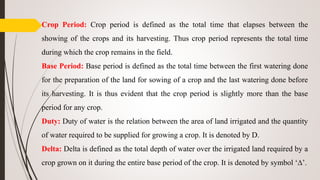
Crop Period: Crop period is defined as the total time that elapses between the
showing of the crops and its harvesting. Thus crop period represents the total time
during which the crop remains in the field.
Base Period: Base period is defined as the total time between the first watering done
for the preparation of the land for sowing of a crop and the last watering done before
its harvesting. It is thus evident that the crop period is slightly more than the base
period for any crop.
Duty: Duty of water is the relation between the area of land irrigated and the quantity
of water required to be supplied for growing a crop. It is denoted by D.
Delta: Delta is defined as the total depth of water over the irrigated land required by a
crop grown on it during the entire base period of the crop. It is denoted by symbol ‘∆’.
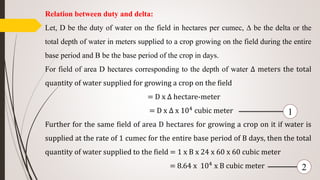
Relation between duty and delta:
Let, D be the duty of water on the field in hectares per cumec, ∆ be the delta or the
total depth of water in meters supplied to a crop growing on the field during the entire
base period and B be the base period of the crop in days.
For field of area D hectares corresponding to the depth of water ∆ meters the total
quantity of water supplied for growing a crop on the field
= D x ∆ hectare-meter
= D x ∆ x 104
cubic meter
Further for the same field of area D hectares for growing a crop on it if water is
supplied at the rate of 1 cumec for the entire base period of B days, then the total
quantity of water supplied to the field = 1 x B x 24 x 60 x 60 cubic meter
= 8.64 x 10⁴
x B cubic meter
1
2
Equating equation 1 and 2 we get,
D x ∆ x 104 = 8.64 x 10⁴ x B
∴ D =
8.64 𝑥 𝐵
∆
Where, D in hectares/cumec; B in days and ∆ in meter.
Methods of improving duty of water:
 Canal lining.
 Crop rotation.
 Proper method of supplying of water such as flooding, furrow, basin and
contour method.
 Proper ploughing.
 Transmission loss.
 Implementation of tax.
Kor Watering: The first watering which is given to a crop, when the crop is few
centimeters high is called kor period.
Kor Depth: The depth of water applied during kor watering is called kor depth.
Kor Period: The portion of the base period in which kor watering is applied is called
kor period.
Crop Rotation: The process of changing the type of crop for the cultivation on the
same land is known as crop rotation. It is found by experiment that if the principle of
crop rotation is practiced fertility of soil can be restored.
Kharif Crop: Kharif crops are sawn at the beginning of southwest monsoon and are
harvested in autumn.
Rabi Crop : Rabi Crops are sawn in autumn and are harvested in spring.
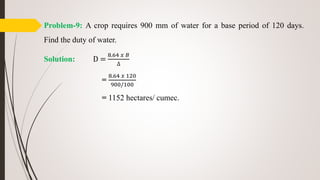
Problem-9: A crop requires 900 mm of water for a base period of 120 days.
Find the duty of water.
Solution: D =
8.64 𝑥 𝐵
∆
=
8.64 𝑥 120
900/100
= 1152 hectares/ cumec.
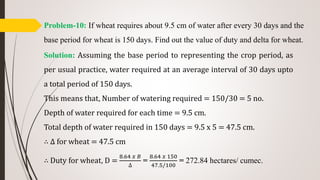
Problem-10: If wheat requires about 9.5 cm of water after every 30 days and the
base period for wheat is 150 days. Find out the value of duty and delta for wheat.
Solution: Assuming the base period to representing the crop period, as
per usual practice, water required at an average interval of 30 days upto
a total period of 150 days.
This means that, Number of watering required = 150/30 = 5 no.
Depth of water required for each time = 9.5 cm.
Total depth of water required in 150 days = 9.5 x 5 = 47.5 cm.
∴ ∆ for wheat = 47.5 cm
∴ Duty for wheat, D =
8.64 𝑥 𝐵
∆
=
8.64 𝑥 150
47.5/100
= 272.84 hectares/ cumec.
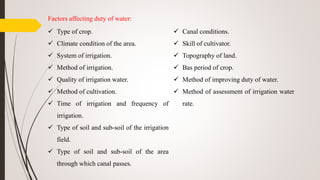
Factors affecting duty of water:
 Type of crop.
 Climate condition of the area.
 System of irrigation.
 Method of irrigation.
 Quality of irrigation water.
 Method of cultivation.
 Time of irrigation and frequency of
irrigation.
 Type of soil and sub-soil of the irrigation
field.
 Type of soil and sub-soil of the area
through which canal passes.
 Canal conditions.
 Skill of cultivator.
 Topography of land.
 Bas period of crop.
 Method of improving duty of water.
 Method of assessment of irrigation water
rate.
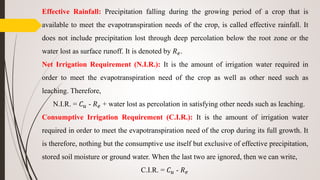
Effective Rainfall: Precipitation falling during the growing period of a crop that is
available to meet the evapotranspiration needs of the crop, is called effective rainfall. It
does not include precipitation lost through deep percolation below the root zone or the
water lost as surface runoff. It is denoted by 𝑅 𝑒.
Net Irrigation Requirement (N.I.R.): It is the amount of irrigation water required in
order to meet the evapotranspiration need of the crop as well as other need such as
leaching. Therefore,
N.I.R. = 𝐶 𝑢 - 𝑅 𝑒 + water lost as percolation in satisfying other needs such as leaching.
Consumptive Irrigation Requirement (C.I.R.): It is the amount of irrigation water
required in order to meet the evapotranspiration need of the crop during its full growth. It
is therefore, nothing but the consumptive use itself but exclusive of effective precipitation,
stored soil moisture or ground water. When the last two are ignored, then we can write,
C.I.R. = 𝐶 𝑢 - 𝑅 𝑒
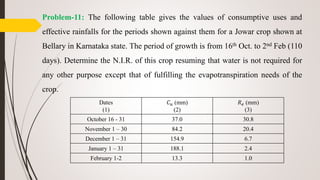
Problem-11: The following table gives the values of consumptive uses and
effective rainfalls for the periods shown against them for a Jowar crop shown at
Bellary in Karnataka state. The period of growth is from 16th Oct. to 2nd Feb (110
days). Determine the N.I.R. of this crop resuming that water is not required for
any other purpose except that of fulfilling the evapotranspiration needs of the
crop.
Dates
(1)
𝐶 𝑢 (mm)
(2)
𝑅 𝑒 (mm)
(3)
October 16 - 31 37.0 30.8
November 1 – 30 84.2 20.4
December 1 – 31 154.9 6.7
January 1 – 31 188.1 2.4
February 1-2 13.3 1.0
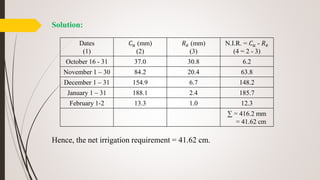
Solution:
Hence, the net irrigation requirement = 41.62 cm.
Dates
(1)
𝐶 𝑢 (mm)
(2)
𝑅 𝑒 (mm)
(3)
N.I.R. = 𝐶 𝑢 - 𝑅 𝑒
(4 = 2 - 3)
October 16 - 31 37.0 30.8 6.2
November 1 – 30 84.2 20.4 63.8
December 1 – 31 154.9 6.7 148.2
January 1 – 31 188.1 2.4 185.7
February 1-2 13.3 1.0 12.3
∑ = 416.2 mm
= 41.62 cm
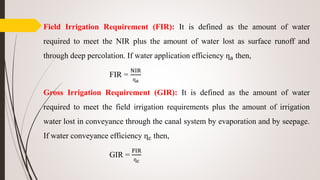
Field Irrigation Requirement (FIR): It is defined as the amount of water
required to meet the NIR plus the amount of water lost as surface runoff and
through deep percolation. If water application efficiency ղa then,
FIR =
NIR
ղa
Gross Irrigation Requirement (GIR): It is defined as the amount of water
required to meet the field irrigation requirements plus the amount of irrigation
water lost in conveyance through the canal system by evaporation and by seepage.
If water conveyance efficiency ղc then,
GIR =
FIR
ղc
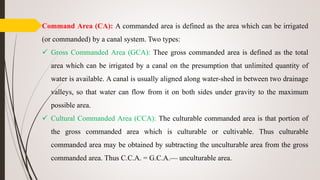
Command Area (CA): A commanded area is defined as the area which can be irrigated
(or commanded) by a canal system. Two types:
 Gross Commanded Area (GCA): Thee gross commanded area is defined as the total
area which can be irrigated by a canal on the presumption that unlimited quantity of
water is available. A canal is usually aligned along water-shed in between two drainage
valleys, so that water can flow from it on both sides under gravity to the maximum
possible area.
 Cultural Commanded Area (CCA): The culturable commanded area is that portion of
the gross commanded area which is culturable or cultivable. Thus culturable
commanded area may be obtained by subtracting the unculturable area from the gross
commanded area. Thus C.C.A. = G.C.A.— unculturable area.
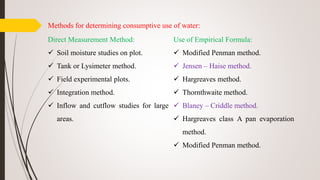
Methods for determining consumptive use of water:
Direct Measurement Method:
 Soil moisture studies on plot.
 Tank or Lysimeter method.
 Field experimental plots.
 Integration method.
 Inflow and cutflow studies for large
areas.
Use of Empirical Formula:
 Modified Penman method.
 Jensen – Haise method.
 Hargreaves method.
 Thornthwaite method.
 Blaney – Criddle method.
 Hargreaves class A pan evaporation
method.
 Modified Penman method.
Jensen-Haise Method: Jensen-Hasie used observation of consumptive use from the western
United states and developed the following linear relationship for estimating the potential
evapotranspiration.
𝐸𝑡 𝑝
= 𝐶𝑡(t - 𝑡 𝑥) 𝑅 𝑠
𝐸𝑡 𝑝
= potential evapotranspiration for reference crop in mm/day.
𝐶𝑡 = A temperature co-efficient =
1
𝐶1+𝐶2 𝐶 𝐻
𝐶1 = 38 – (20
C x
𝐸𝐿
305
) [EL = Altitude of the place in meters]
𝐶2 = 7.60
C
𝐶 𝐻 =
50 𝑚𝑏𝑎𝑟
𝑒2 −𝑒1
𝑒2 and 𝑒1 are saturation vapour pressures of water in mbar at the mean daily maximum and
minimum temperatures respectively, for the warmest month of the year in a given area.
𝑡 𝑥 = - 2.5 – 0.14 (𝑒2 − 𝑒1)0
C/m bar -
𝐸𝐿
550
𝑅 𝑠 = 𝑅 𝑎 (a + b
𝑛
𝑁
)
t = mean daily temperature
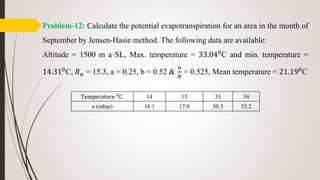
Problem-12: Calculate the potential evapotranspiration for an area in the month of
September by Jensen-Hasie method. The following data are available:
Altitude = 1500 m a SL, Max. temperature = 33.040C and min. temperature =
14.310C, 𝑅 𝑎 = 15.3, a = 0.25, b = 0.52 &
𝑛
𝑁
= 0.525, Mean temperature = 21.190C
Temperature 0
C 14 15 33 34
e (mbar) 16.1 17.0 50.3 53.2
Solution:
For 33.040
C 𝑒2 = 50.3 +
53.02 −50.3
1
x 0.04 = 50.416 mbar
For 14.310
C 𝑒2 = 16.1 +
17 −16.1
1
x 0.31 = 16.379 mbar
𝐶1 = 38 – (20
C x
𝐸𝐿
305
) = 38 – (2 x
1500
305
) = 28.164
𝐶2 = 7.6
𝐶 𝐻 =
50 𝑚𝑏𝑎𝑟
𝑒2 −𝑒1
=
50
50.416 −16.379
= 1.469
𝐶𝑡 =
1
𝐶1+𝐶2 𝐶 𝐻
=
1
28.164+7.6 𝑥 1.469
= 0.0254
𝐸𝑡 𝑝
= 𝐶𝑡(t - 𝑡 𝑥) 𝑅 𝑠
= 0.025 x [21.19 – (-9.992)] x 8.002 = 6.338 mm/day
𝑡 𝑥 = - 2.5 – 0.14 (𝑒2 − 𝑒1) -
𝐸𝐿
550
= - 2.5 – 0.14 (50.416 – 16.379) -
1500
550
=−9.992 0
C
𝑅 𝑠 = 𝑅 𝑎 (a + b
𝑛
𝑁
)
= 15.3 (0.25 + 0.52 x 0.525) = 8.002
Blaney-Criddle Method: Blaney and Criddle (1950) developed a simplified
formula in the consumptive use of water is correlated with the temperature and
daytime hours. By multiplying the mean monthly temperature t by the mean monthly
percentage p of the maximum possible daytime hours of the year, a monthly
consumptive use factor f is obtained as f =
𝑝𝑡
100
. The value of p depends on the
latitude of the place and the period of the year and it may be obtained from Table.
u = kf = k (
𝑝𝑡
100
) [ k is the monthly consumptive use coefficient]
Here, u in inch unit and temperature in degree Fahrenheit.
For SI/metric system,
u = kf = kp (0.46t + 8.13)
Here, u in millimeter and t in degree Celsius.
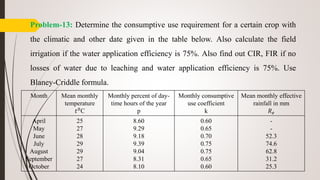
Problem-13: Determine the consumptive use requirement for a certain crop with
the climatic and other date given in the table below. Also calculate the field
irrigation if the water application efficiency is 75%. Also find out CIR, FIR if no
losses of water due to leaching and water application efficiency is 75%. Use
Blaney-Criddle formula.
Month Mean monthly
temperature
𝑡0
C
Monthly percent of day-
time hours of the year
p
Monthly consumptive
use coefficient
k
Mean monthly effective
rainfall in mm
𝑅 𝑒
April
May
June
July
August
September
October
25
27
28
29
29
27
24
8.60
9.29
9.18
9.39
9.04
8.31
8.10
0.60
0.65
0.70
0.75
0.75
0.65
0.60
-
-
52.3
74.6
62.8
31.2
25.3
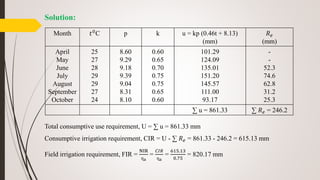
Solution:
Total consumptive use requirement, U = ∑ u = 861.33 mm
Consumptive irrigation requirement, CIR = U - ∑ 𝑅 𝑒 = 861.33 - 246.2 = 615.13 mm
Field irrigation requirement, FIR =
NIR
ղa
=
𝐶𝐼𝑅
ղa
=
615.13
0.75
= 820.17 mm
Month 𝑡0C p k u = kp (0.46t + 8.13)
(mm)
𝑅 𝑒
(mm)
April
May
June
July
August
September
October
25
27
28
29
29
27
24
8.60
9.29
9.18
9.39
9.04
8.31
8.10
0.60
0.65
0.70
0.75
0.75
0.65
0.60
101.29
124.09
135.01
151.20
145.57
111.00
93.17
-
-
52.3
74.6
62.8
31.2
25.3
∑ u = 861.33 ∑ 𝑅 𝑒 = 246.2
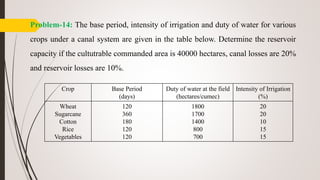
Problem-14: The base period, intensity of irrigation and duty of water for various
crops under a canal system are given in the table below. Determine the reservoir
capacity if the cultutrable commanded area is 40000 hectares, canal losses are 20%
and reservoir losses are 10%.
Crop Base Period
(days)
Duty of water at the field
(hectares/cumec)
Intensity of Irrigation
(%)
Wheat
Sugarcane
Cotton
Rice
Vegetables
120
360
180
120
120
1800
1700
1400
800
700
20
20
10
15
15
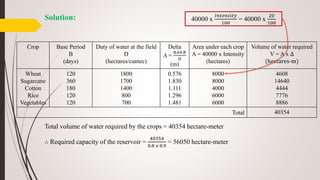
Solution:
Total volume of water required by the crops = 40354 hectare-meter
∴ Required capacity of the reservoir =
40354
0.8 𝑥 0.9
= 56050 hectare-meter
Crop Base Period
B
(days)
Duty of water at the field
D
(hectares/cumec)
Delta
∆ =
8.64 𝐵
𝐷
(m)
Area under each crop
A = 40000 x Intensity
(hectares)
Volume of water required
V = A x ∆
(hectares-m)
Wheat
Sugarcane
Cotton
Rice
Vegetables
120
360
180
120
120
1800
1700
1400
800
700
0.576
1.830
1.111
1.296
1.481
8000
8000
4000
6000
6000
4608
14640
4444
7776
8886
Total 40354
40000 x
𝐼𝑛𝑡𝑒𝑛𝑠𝑖𝑡𝑦
100
= 40000 x
20
100
Methods of Irrigation
Factors affecting the choice of irrigation:
 Soil characteristics of the land to be irrigated.
 Topography of the country.
 Size of the stream supplying irrigation water to the land to be irrigated.
 Available water supplies and the rate of advance of irrigation water.
 length of run and time required for wetting the total area of land to be irrigated.
 The water requirements of the crops grown and the growth habits of the plants.
 Rate of infiltration of the soil.
 Depth of the root zone of the plants.
 Depth of the water table.
 Possible erosion hazard.
 Amount of water to be applied during each irrigation.
Objectives for choosing the method of irrigation:
 Adequate amount of water is stored in the root zone of the plants.
 Uniform application of water is made possible.
 As far as possible minimum soil erosion takes place.
 There is minimum wastage of water.
 Reuse of water is made possible.
 Minimum land is utilized for field channels, borders, etc. So that as far as possible
maximum land is made available for cultivation.
 The method properly fits to the boundaries of the land to be irrigated.
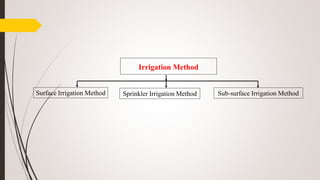
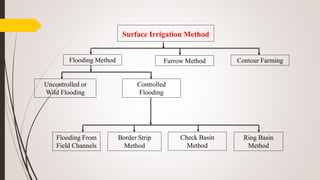
Irrigation Method
Sub-surface Irrigation MethodSprinkler Irrigation MethodSurface Irrigation Method
Surface Irrigation Method
Contour Farming
Ring Basin
Method
Furrow MethodFlooding Method
Controlled
Flooding
Uncontrolled or
Wild Flooding
Border Strip
Method
Flooding From
Field Channels
Check Basin
Method
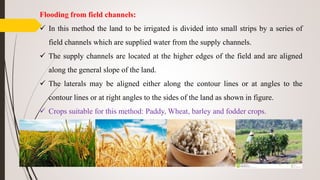
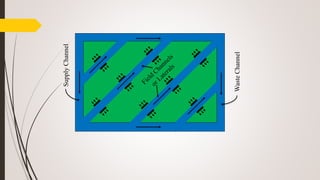
Flooding from field channels:
 In this method the land to be irrigated is divided into small strips by a series of
field channels which are supplied water from the supply channels.
 The supply channels are located at the higher edges of the field and are aligned
along the general slope of the land.
 The laterals may be aligned either along the contour lines or at angles to the
contour lines or at right angles to the sides of the land as shown in figure.
 Crops suitable for this method: Paddy, Wheat, barley and fodder crops.
SupplyChannel
WasteChannel
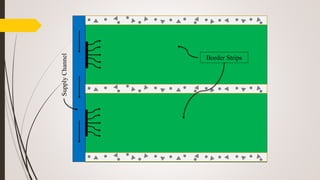
Border Strip Method:
 In the border strip method the land to be irrigated is divided into a series of long
narrow strips separated from each other by low levees or borders.
 Each strip is irrigated independently by supplying water at its upper end from a
supply channel or an underground pipe.
 This strips have a uniform gentle slope in the longitudinal direction but have no
cross slope, so that the irrigation water applied to each strip is uniformly spread
over its entire width without getting accumulated on either side as it flows down
the slope.
 This method is cost effective compared to flooding method from channels.
 Crops suitable for this method: Paddy, Wheat, barley and fodder crops.
SupplyChannel
Border Strips
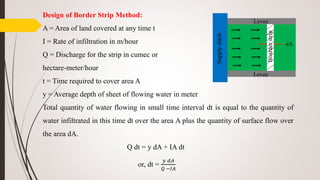
Design of Border Strip Method:
A = Area of land covered at any time t
I = Rate of infiltration in m/hour
Q = Discharge for the strip in cumec or
hectare-meter/hour
t = Time required to cover area A
y = Average depth of sheet of flowing water in meter
Total quantity of water flowing in small time interval dt is equal to the quantity of
water infiltrated in this time dt over the area A plus the quantity of surface flow over
the area dA.
Q dt = y dA + IA dt
or, dt =
𝑦 𝑑𝐴
𝑄 −𝐼𝐴
Levee
Levee
dA
Supplyditch
Boarderstrip
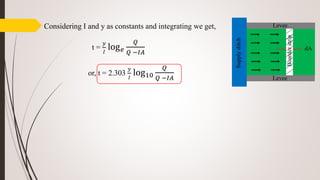
Considering I and y as constants and integrating we get,
t =
𝑦
𝐼
log 𝑒
𝑄
𝑄 −𝐼𝐴
or, t = 2.303
𝑦
𝐼
log10
𝑄
𝑄 −𝐼𝐴
Levee
Levee
dA
Supplyditch
Boarderstrip
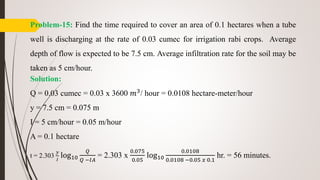
Problem-15: Find the time required to cover an area of 0.1 hectares when a tube
well is discharging at the rate of 0.03 cumec for irrigation rabi crops. Average
depth of flow is expected to be 7.5 cm. Average infiltration rate for the soil may be
taken as 5 cm/hour.
Solution:
Q = 0.03 cumec = 0.03 x 3600 𝑚3
/ hour = 0.0108 hectare-meter/hour
y = 7.5 cm = 0.075 m
I = 5 cm/hour = 0.05 m/hour
A = 0.1 hectare
t = 2.303
𝑦
𝐼
log10
𝑄
𝑄 −𝐼𝐴
= 2.303 x
0.075
0.05
log10
0.0108
0.0108 −0.05 𝑥 0.1
hr. = 56 minutes.
Check Basin Method:
 Most common method of irrigation used in India as well as in many other
countries of the world.
 This method is also known as method of irrigation by plots.
 In this method the land to be irrigated is divided into small plots or check basins
surrounded by checks or levees.
 Each plot or basin has a nearly level surface.
 The irrigation water is applied by filling the plots with water upto the desired
depth without overtopping the levees and the water is retained there to allow it to
infiltrated into the soil.
 The levees may be temporary for a single irrigation or may be for a cropping
season.
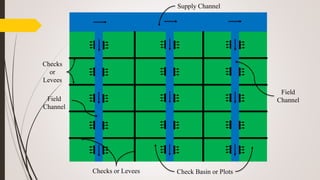
 Water is conveyed to the land to be irrigated by a system of supply channels and
lateral field channels.
 The supply channel is aligned on the upper side of the field and there is usually
one lateral field channel for every two rows of plots.
 Water from the lateral field channel is supplied to the plots and the supply is cut
off when sufficient quantity of water has been admitted to the plots.
 Water is retained in the basin until it soaks into the soil.
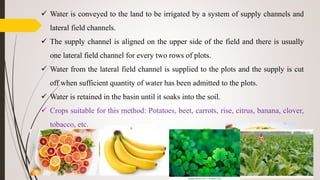
 Crops suitable for this method: Potatoes, beet, carrots, rise, citrus, banana, clover,
tobacco, etc.
Supply Channel
Checks
or
Levees
Field
Channel
Field
Channel
Checks or Levees Check Basin or Plots
Ring Basin Method:
 The ring basin method of irrigation is a special form of check basin method of
irrigation, which is used for the irrigation of orchard (enclosures with fruit trees).
 In this method generally for each tree a separate basin is made which is usually
circular in shape and hence it is known as ring basin.
 However, in some cases basins of larger size are made to include two to five or
more trees in one basin.
 In some cases all the basins are interconnected so that from the supply channel
water is covered to one of the basins and by flowing from one basin into another
the water is supplied to all the basins.
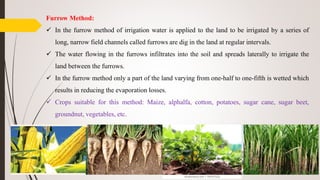
Furrow Method:
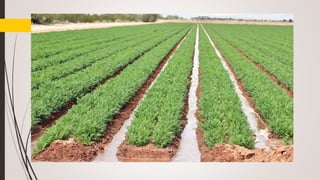
 In the furrow method of irrigation water is applied to the land to be irrigated by a series of
long, narrow field channels called furrows are dig in the land at regular intervals.
 The water flowing in the furrows infiltrates into the soil and spreads laterally to irrigate the
land between the furrows.
 In the furrow method only a part of the land varying from one-half to one-fifth is wetted which
results in reducing the evaporation losses.
 Crops suitable for this method: Maize, alphalfa, cotton, potatoes, sugar cane, sugar beet,
groundnut, vegetables, etc.
Advantages:
 In this method of irrigation only a part of the land is wetted, which results in
reducing evaporation losses.
 It is suitable for row crops such as maize, cotton, potatoes, sugar cane, sugar beet,
groundnut, tobacco, etc.
 It is specially suitable for crops such as maize, which is subject to injury if
allowed to come in contact with water ponded on the land in any of the methods
of irrigation by flooding.
 In this method the requirements of labour for land preparation and irrigation are
very much reduced as compared to the various methods of irrigation by flooding.
 In the furrow method there is no wastage of land in field channels as compared to
the checks or levees method of irrigation.
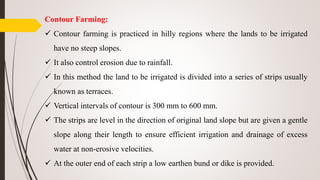
Contour Farming:
 Contour farming is practiced in hilly regions where the lands to be irrigated
have no steep slopes.
 It also control erosion due to rainfall.
 In this method the land to be irrigated is divided into a series of strips usually
known as terraces.
 Vertical intervals of contour is 300 mm to 600 mm.
 The strips are level in the direction of original land slope but are given a gentle
slope along their length to ensure efficient irrigation and drainage of excess
water at non-erosive velocities.
 At the outer end of each strip a low earthen bund or dike is provided.
Sprinkler Method of Irrigation:
 In the sprinkler method the irrigation water is applied to the land in the form of
spray, somewhat as in ordinary rain.
 It is also known as overhead irrigation.
 The sprinkler irrigation can be used for all the crops except rice and jute and
almost all the soils except very heavy soils with very low infiltration rates.
 This method is very suited for very light soils as deep percolation losses are
avoided.
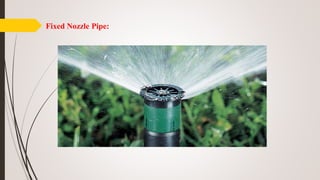
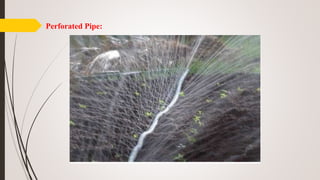
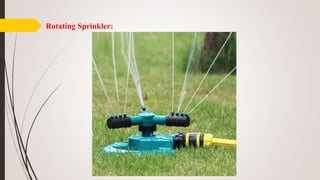
 Three kinds: a) Fixed nozzle pipe; b) Perforated pipe; c) Rotating sprinkler.
Fixed Nozzle Pipe:
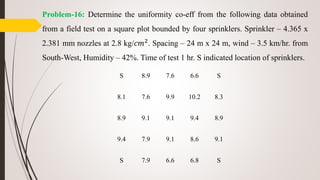
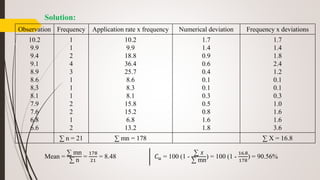
Problem-16: Determine the uniformity co-eff from the following data obtained
from a field test on a square plot bounded by four sprinklers. Sprinkler – 4.365 x
2.381 mm nozzles at 2.8 kg/𝑐𝑚2. Spacing – 24 m x 24 m, wind – 3.5 km/hr. from
South-West, Humidity – 42%. Time of test 1 hr. S indicated location of sprinklers.
S 8.9 7.6 6.6 S
8.1 7.6 9.9 10.2 8.3
8.9 9.1 9.1 9.4 8.9
9.4 7.9 9.1 8.6 9.1
S 7.9 6.6 6.8 S
Solution:
Mean =
∑ mn
∑ n
=
178
21
= 8.48 𝐶 𝑢 = 100 (1 -
∑ 𝑋
∑ mn
) = 100 (1 -
16.8
178
) = 90.56%
Observation Frequency Application rate x frequency Numerical deviation Frequency x deviations
10.2
9.9
9.4
9.1
8.9
8.6
8.3
8.1
7.9
7.6
6.8
6.6
1
1
2
4
3
1
1
1
2
2
1
2
10.2
9.9
18.8
36.4
25.7
8.6
8.3
8.1
15.8
15.2
6.8
13.2
1.7
1.4
0.9
0.6
0.4
0.1
0.1
0.3
0.5
0.8
1.6
1.8
1.7
1.4
1.8
2.4
1.2
0.1
0.1
0.3
1.0
1.6
1.6
3.6
∑ n = 21 ∑ mn = 178 ∑ X = 16.8
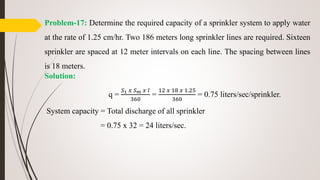
Problem-17: Determine the required capacity of a sprinkler system to apply water
at the rate of 1.25 cm/hr. Two 186 meters long sprinkler lines are required. Sixteen
sprinkler are spaced at 12 meter intervals on each line. The spacing between lines
is 18 meters.
Solution:
q =
𝑆1 𝑥 𝑆 𝑚 𝑥 𝐼
360
=
12 𝑥 18 𝑥 1.25
360
= 0.75 liters/sec/sprinkler.
System capacity = Total discharge of all sprinkler
= 0.75 x 32 = 24 liters/sec.
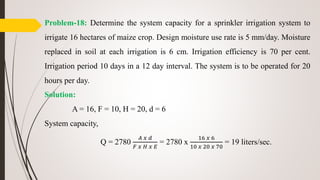
Problem-18: Determine the system capacity for a sprinkler irrigation system to
irrigate 16 hectares of maize crop. Design moisture use rate is 5 mm/day. Moisture
replaced in soil at each irrigation is 6 cm. Irrigation efficiency is 70 per cent.
Irrigation period 10 days in a 12 day interval. The system is to be operated for 20
hours per day.
Solution:
A = 16, F = 10, H = 20, d = 6
System capacity,
Q = 2780
𝐴 𝑥 𝑑
𝐹 𝑥 𝐻 𝑥 𝐸
= 2780 x
16 𝑥 6
10 𝑥 20 𝑥 70
= 19 liters/sec.
Perforated Pipe:
Rotating Sprinkler:
Sub-surface irrigation:
 In the sub-surface methods water is applied below the ground surface so that it
is supplied directly to the root zone of the plants.
 The main advantages of these methods of irrigation are that the evaporation
losses are considerably reduced and the hindrance caused to cultivation by the
presence of borders, pipes and field channels in the other methods of irrigation
is eliminated.
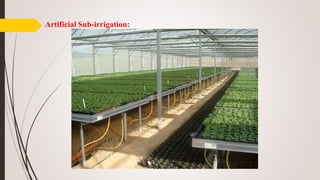
 Three kinds: a) Natural sub-irrigation; b) Artificial sub-irrigation; c) Dip or
trickle irrigation.
Artificial Sub-irrigation:
Drip or Trickle Irrigation:
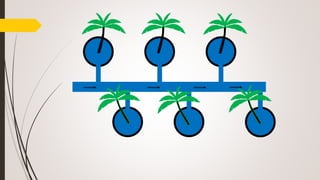
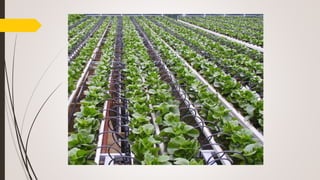
 Drip or trickle irrigation is one of the latest methods of irrigation which is
becoming increasingly popular in areas with water scarcity and salt problems.
 In this method irrigation is accomplished by using small diameter plastic pipes
with drip nozzles commonly called emitters or drippers to deliver water to the
land surface near the base of the plants.
 In this case water is applied at a very low rate varying from about 2 to 10 liters
per hour to keep the soil moisture within the desired range for plat growth.
Quality of Irrigation Water
Sodium Absorption Ration (SAR):
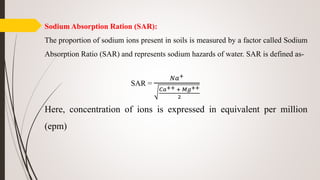
The proportion of sodium ions present in soils is measured by a factor called Sodium
Absorption Ratio (SAR) and represents sodium hazards of water. SAR is defined as-
SAR =
𝑁𝑎+
𝐶𝑎++ + 𝑀𝑔++
2
Here, concentration of ions is expressed in equivalent per million
(epm)
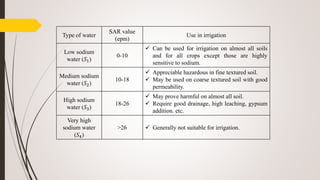
Type of water
SAR value
(epm)
Use in irrigation
Low sodium
water (𝑆1)
0-10
 Can be used for irrigation on almost all soils
and for all crops except those are highly
sensitive to sodium.
Medium sodium
water (𝑆2)
10-18
 Appreciable hazardous in fine textured soil.
 May be used on coarse textured soil with good
permeability.
High sodium
water (𝑆3)
18-26
 May prove harmful on almost all soil.
 Require good drainage, high leaching, gypsum
addition. etc.
Very high
sodium water
(𝑆4)
>26  Generally not suitable for irrigation.
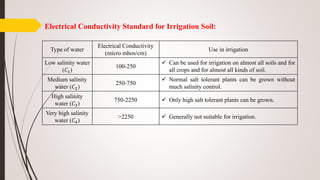
Electrical Conductivity Standard for Irrigation Soil:
Type of water
Electrical Conductivity
(micro mhos/cm)
Use in irrigation
Low salinity water
(𝐶1)
100-250
 Can be used for irrigation on almost all soils and for
all crops and for almost all kinds of soil.
Medium salinity
water (𝐶2)
250-750
 Normal salt tolerant plants can be grown without
much salinity control.
High salinity
water (𝐶3)
750-2250  Only high salt tolerant plants can be grown.
Very high salinity
water (𝐶4)
>2250  Generally not suitable for irrigation.
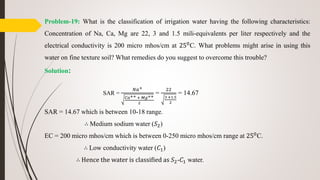
Problem-19: What is the classification of irrigation water having the following characteristics:
Concentration of Na, Ca, Mg are 22, 3 and 1.5 mili-equivalents per liter respectively and the
electrical conductivity is 200 micro mhos/cm at 250C. What problems might arise in using this
water on fine texture soil? What remedies do you suggest to overcome this trouble?
Solution:
SAR =
𝑁𝑎+
𝐶𝑎++ + 𝑀𝑔++
2
=
22
3 +1.5
2
= 14.67
SAR = 14.67 which is between 10-18 range.
∴ Medium sodium water (𝑆2)
EC = 200 micro mhos/cm which is between 0-250 micro mhos/cm range at 250C.
∴ Low conductivity water (𝐶1)
∴ Hence the water is classified as 𝑆2-𝐶1 water.
Problems might arise:
 Soil becomes less permeable.
 It starts crushing when dry.
 It becomes plastic and sticky when wet.
 Its pH increase towards that of alkaline soil.
Remedies:
Gypsum addition, either to soil or to water is suggested to overcome sodium hazards.
“All the waters are not fit for irrigating crops”-Criticize according to your
opinion.
Every water is not fit for plant life. The water containing impurities which are
injurious to plat growth is not satisfactory for irrigation. The various impurities
which made water unfit for irrigation are classified as,
 Sediment concentration in water.
 Total concentration of soluble salts in water.
 Proportion of sodium ions to other cations.
 Bicarbonate concentration.
 Bacterial contamination.
 Concentration of potentially toxic element present in water.
Water containing any of these impurities is unfit for irrigation.
Water Logging
Water Logging:
In agricultural land, when soil pores within the root zone of crops gets saturated with subsoil
water, the air circulation within the soil pores gets totally stopped. This phenomenon is termed as
water logging.
Effects of Water Logging:
 Inhibiting activity of soil bacteria.
 Decrease in available capillary water.
 Fall in soil temperature.
 Defective air circulation.
 Raise of salt.
 Delay in cultivation operation.
 Growth of wild flora.
 Adverse effect on community health.
Causes of Water Logging:
 Inadequate surface drainage.
 Seepage from canal system.
 Over-irrigation of field.
 Obstruction of natural drainage.
 Obliteration of natural drainage.
 Inadequate capacity for arterial drainage.
 Construction of a water reservoir.
 Natural obstruction to the flow of ground water.
Remedial measures of Water Logging:
 Effective surface drainage.
 Under drainage by tile drains.
 Reducing percolation from canals.
 Restriction of irrigation.
 lining of water closure.
 Removing obstruction in natural drainage.
 Prevention of seepage from water reservoir.
 Depletion of ground water storage by pumping.
 Changes in crop pattern.
 Adoption of sprinkler method for irrigation.
Land Reclamation:
The process of making a land culturable after it gets converted to unculturable
area due to bad effects of water logging is called land reclamation.
Methods for Land Reclamation:
 Addition of chemical agent – Gypsum.
 Addition of waste products – Nutshell, saw dust.
 Surface drainage.
 Sub-surface drainage.
 Leaching.
 Excavation of ponds.
 Pumping of water from tube well.
Leaching:
The process of reclamation of saline soil is called leaching.
Process of Leaching:
 The agricultural land is flooded with water of about 20-30 cm.
 The salt deposits on the surface are dissolved.
 Some portion of salt is then drained off through sub-surface drainage system.
 Some portion of salt is removed by surface drainage system.
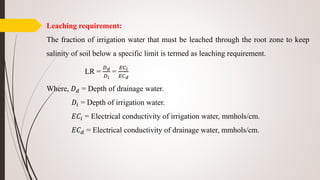
Leaching requirement:
The fraction of irrigation water that must be leached through the root zone to keep
salinity of soil below a specific limit is termed as leaching requirement.
LR =
𝐷 𝑑
𝐷 𝑖
=
𝐸𝐶 𝑖
𝐸𝐶 𝑑
Where, 𝐷 𝑑 = Depth of drainage water.
𝐷𝑖 = Depth of irrigation water.
𝐸𝐶𝑖 = Electrical conductivity of irrigation water, mmhols/cm.
𝐸𝐶 𝑑 = Electrical conductivity of drainage water, mmhols/cm.
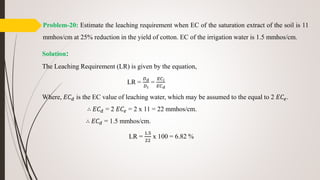
Problem-20: Estimate the leaching requirement when EC of the saturation extract of the soil is 11
mmhos/cm at 25% reduction in the yield of cotton. EC of the irrigation water is 1.5 mmhos/cm.
Solution:
The Leaching Requirement (LR) is given by the equation,
LR =
𝐷 𝑑
𝐷 𝑖
=
𝐸𝐶 𝑖
𝐸𝐶 𝑑
Where, 𝐸𝐶 𝑑 is the EC value of leaching water, which may be assumed to the equal to 2 𝐸𝐶𝑒.
∴ 𝐸𝐶 𝑑 = 2 𝐸𝐶𝑒 = 2 x 11 = 22 mmhos/cm.
∴ 𝐸𝐶 𝑑 = 1.5 mmhos/cm.
LR =
1.5
22
x 100 = 6.82 %
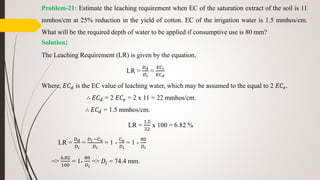
Problem-21: Estimate the leaching requirement when EC of the saturation extract of the soil is 11
mmhos/cm at 25% reduction in the yield of cotton. EC of the irrigation water is 1.5 mmhos/cm.
What will be the required depth of water to be applied if consumptive use is 80 mm?
Solution:
The Leaching Requirement (LR) is given by the equation,
LR =
𝐷 𝑑
𝐷 𝑖
=
𝐸𝐶 𝑖
𝐸𝐶 𝑑
Where, 𝐸𝐶 𝑑 is the EC value of leaching water, which may be assumed to the equal to 2 𝐸𝐶𝑒.
∴ 𝐸𝐶 𝑑 = 2 𝐸𝐶𝑒 = 2 x 11 = 22 mmhos/cm.
∴ 𝐸𝐶 𝑑 = 1.5 mmhos/cm.
LR =
1.5
22
x 100 = 6.82 %
LR =
𝐷 𝑑
𝐷 𝑖
=
𝐷 𝑖 −𝐶 𝑢
𝐷 𝑖
= 1 -
𝐶 𝑢
𝐷 𝑖
= 1 -
80
𝐷 𝑖
=>
6.82
100
= 1-
80
𝐷 𝑖
=> 𝐷𝑖 = 74.4 mm.
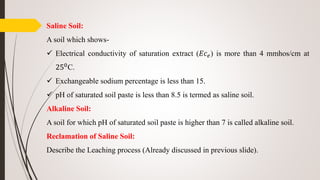
Saline Soil:
A soil which shows-
 Electrical conductivity of saturation extract (𝐸𝑐 𝑒) is more than 4 mmhos/cm at
250C.
 Exchangeable sodium percentage is less than 15.
 pH of saturated soil paste is less than 8.5 is termed as saline soil.
Alkaline Soil:
A soil for which pH of saturated soil paste is higher than 7 is called alkaline soil.
Reclamation of Saline Soil:
Describe the Leaching process (Already discussed in previous slide).
Flood & It’s Causes
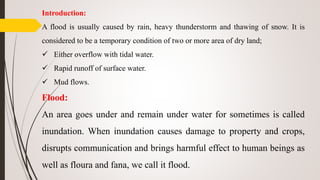
Introduction:
A flood is usually caused by rain, heavy thunderstorm and thawing of snow. It is
considered to be a temporary condition of two or more area of dry land;
 Either overflow with tidal water.
 Rapid runoff of surface water.
 Mud flows.
Flood:
An area goes under and remain under water for sometimes is called
inundation. When inundation causes damage to property and crops,
disrupts communication and brings harmful effect to human beings as
well as floura and fana, we call it flood.
Where does flood occur?
Several floods are caused by mainly three factors:
 Local intense rainfall.
 Huge trans boundary inflows and
 Cyclones induced surges.
Coastal flooding occur in April-May & October-November.
 Flooding is the most worldwide hazardous disaster. It occurs in every country
and wherever there is rainfall and coastal hazard.
 They are most likely to happen in tropical countries.
 Most common floods happen around the world largest rivers.
 Most flooding occur during the period of spring.
Types of Flood:
 Riverine Flooding:
a) In riverine flooding, relative high water levels over top the natural or artificial banks of a river.
b) The nature of riverine flooding can vary significantly in terms of timing and depth between
location.
 Flash Flooding: Flash flooding occurs when soil absorption, runoff or drainage can’t adequately
disperse in case of rainfall and is usually caused by slow moving thunder storm.
 Storm Surge: Storm surge is an abnormal rise in water level in costal areas, over and above the
usual tide limit, caused by forces generated from a severe storm wind, waves and low atmospheric
pressure. Storm surge is extremely dangerous, because it is capable of flooding large costal areas.
Along the coast, storm surge is often the greatest threat to live and property from thunder.
 Dam Failure: Although dam failure are rare, their effect can sufficient. Sub-standard constructive
materials or technologies and spillway design are mainly responsible for dam failure.
Causes of Flood in Bangladesh:
Two types of causes are responsible for floods in Bangladesh:
a) Natural Causes:
 Most of the country consists of huge flood plain and delta.
 10% of the total area is made of lakes and rivers.
 70% of the total area is less than 1 m above the sea level.
 Snow melt from Himalayas take spring and summer.
 Bangladesh experiences heavy monsoon rain, specially over high lands.
 Tropical storms bring heavy rain and coastal flooding.
 The main cause is the long period of rain which causes all the rivers to have their
peak flow at the same time.
b) Human Related Causes:
 Deforestation in Nepal and the Himalayas increase runoff adds to deposition and
flooding downstream.
 Urbanization of flood plain is increasing magnitude an frequency of flood.
 Building of dams in India has increased the problems of sedimentation in
Bangladesh.
 Global warming rises sea level due to increasing of snow melt and rainfall in the
region of Bangladesh.
 Poorly maintained embankment leak and collapse at the time of high discharge.
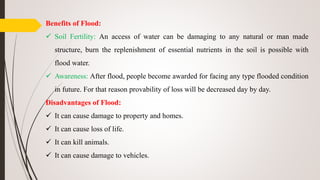
Benefits of Flood:
 Soil Fertility: An access of water can be damaging to any natural or man made
structure, burn the replenishment of essential nutrients in the soil is possible with
flood water.
 Awareness: After flood, people become awarded for facing any type flooded condition
in future. For that reason provability of loss will be decreased day by day.
Disadvantages of Flood:
 It can cause damage to property and homes.
 It can cause loss of life.
 It can kill animals.
 It can cause damage to vehicles.
Flood Management
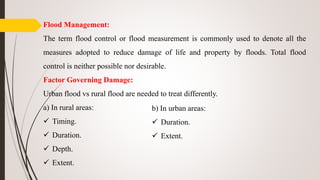
Flood Management:
The term flood control or flood measurement is commonly used to denote all the
measures adopted to reduce damage of life and property by floods. Total flood
control is neither possible nor desirable.
Factor Governing Damage:
Urban flood vs rural flood are needed to treat differently.
a) In rural areas:
 Timing.
 Duration.
 Depth.
 Extent.
b) In urban areas:
 Duration.
 Extent.
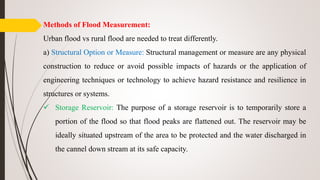
Methods of Flood Measurement:
Urban flood vs rural flood are needed to treat differently.
a) Structural Option or Measure: Structural management or measure are any physical
construction to reduce or avoid possible impacts of hazards or the application of
engineering techniques or technology to achieve hazard resistance and resilience in
structures or systems.
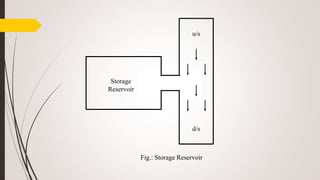
 Storage Reservoir: The purpose of a storage reservoir is to temporarily store a
portion of the flood so that flood peaks are flattened out. The reservoir may be
ideally situated upstream of the area to be protected and the water discharged in
the cannel down stream at its safe capacity.
Storage
Reservoir
u/s
d/s
Fig.: Storage Reservoir
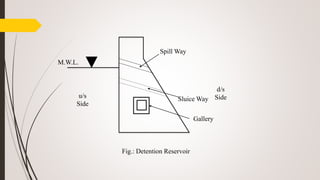
 Detention Reservoir: A detention consists of an obstruction to a river we then
uncontrolled outlet. These are essentially structure and operate to reduce the
flood peak by providing temporary storage and restriction of the outflow rate. It
is similar to a storage reservoir but it is provided with a large spillway and
sluiceway to permit flexibility of operation.
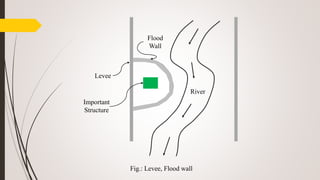
 Levees: Levees or dikes or flood embankment are earthen banks, constructed
parallel to the course of river to confined it to a fixed course. The levees being
earthen embankment required considerable care and maintenance.
 Flood Wall: Concrete or masonry structures to confine the river in a fixed manner
similar to levees are known as flood wall. These are used to protect important
structure against flood.
M.W.L.
u/s
Side
d/s
SideSluice Way
Spill Way
Gallery
Fig.: Detention Reservoir
River
Flood
Wall
Levee
Important
Structure
Fig.: Levee, Flood wall
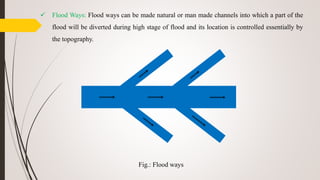
 Flood Ways: Flood ways can be made natural or man made channels into which a part of the
flood will be diverted during high stage of flood and its location is controlled essentially by
the topography.
Fig.: Flood ways
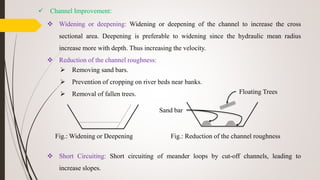
 Channel Improvement:
 Widening or deepening: Widening or deepening of the channel to increase the cross
sectional area. Deepening is preferable to widening since the hydraulic mean radius
increase more with depth. Thus increasing the velocity.
 Reduction of the channel roughness:
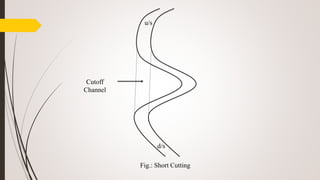
 Short Circuiting: Short circuiting of meander loops by cut-off channels, leading to
increase slopes.
 Removing sand bars.
 Prevention of cropping on river beds near banks.
 Removal of fallen trees.
Fig.: Widening or Deepening Fig.: Reduction of the channel roughness
Sand bar
Floating Trees
Fig.: Short Cutting
u/s
d/s
Cutoff
Channel
b) Non-structural Measure: These are measures not involving physical construction
which use knowledge practice or agreement to reduce disaster risk and impacts in
particular through policies and laws, public awareness rising, training and education.
Non-structural measures:
 Flood plain zoning.
 Flood forecasting and warning.
 Evacuation and re-location.
 Flood insurance.
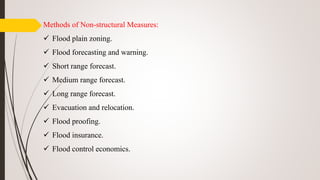
Methods of Non-structural Measures:
 Flood plain zoning.
 Flood forecasting and warning.
 Short range forecast.
 Medium range forecast.
 Long range forecast.
 Evacuation and relocation.
 Flood proofing.
 Flood insurance.
 Flood control economics.
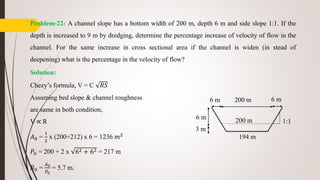
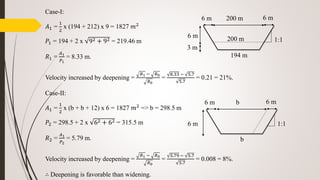
Problem-22: A channel slope has a bottom width of 200 m, depth 6 m and side slope 1:1. If the
depth is increased to 9 m by dredging, determine the percentage increase of velocity of flow in the
channel. For the same increase in cross sectional area if the channel is widen (in stead of
deepening) what is the percentage in the velocity of flow?
Solution:
Chezy’s formula, V = C 𝑅𝑆
Assuming bed slope & channel roughness
are same in both condition,
V ∝ R
𝐴0 =
1
2
x (200+212) x 6 = 1236 𝑚2
𝑃0 = 200 + 2 x 62 + 62 = 217 m
𝑅0 =
𝐴0
𝑃0
= 5.7 m.
6 m 200 m
194 m
6 m
1:1
6 m
3 m
200 m
Case-I:
𝐴1 =
1
2
x (194 + 212) x 9 = 1827 𝑚2
𝑃1 = 194 + 2 x 92 + 92 = 219.46 m
𝑅1 =
𝐴1
𝑃1
= 8.33 m.
Velocity increased by deepening =
𝑅1 − 𝑅0
𝑅0
=
8.33 − 5.7
5.7
= 0.21 = 21%.
Case-II:
𝐴1 =
1
2
x (b + b + 12) x 6 = 1827 𝑚2
=> b = 298.5 m
𝑃2 = 298.5 + 2 x 62 + 62 = 315.5 m
𝑅2 =
𝐴1
𝑃2
= 5.79 m.
Velocity increased by deepening =
𝑅1 − 𝑅0
𝑅0
=
5.79 − 5.7
5.7
= 0.008 = 8%.
∴ Deepening is favorable than widening.
6 m 200 m
194 m
6 m
1:1
6 m
3 m
200 m
6 m b
b
6 m
1:16 m
Flood Control Economics:
Generally the flood stage for which the ration annual benefit to cost is a maximum is
adopted for the design of flood protection works. Protection against floods of rare
occurrence is uneconomical because of the large investment (for a small increase in
the benefit) and hence there is always a certain amount of flood risk involved.
Total benefit (2)
Total cost (1)
Benefit
Cost
= 1
Max. benefit
Design stage of flood
Max. feasible peak
(1)Totalcost[incrores]
(2)Totalbenefit[incrores]
Reduction in flood peak, Q (cumec)
Flood Control Cost Include:
 Capital cost involved in the construction of the structure.
 Interest cost on capital expenditure.
 Sinking fund, depreciation and taxes.
 Operational expenses and maintenance cost.
Benefits of Flood Control Economics:
Direct Benefit:
 Prevention on damages to d/s structures.
 Reduction of losses arising from
disruption of communication.
 Prevention of loss of life and property.
 Prevention of damages to crops.
Indirect Benefit:
 Money saved under insurance.
 Higher yield from intensive cultivation
from protective land.
 Reduction in flood prone epidemic
disease.
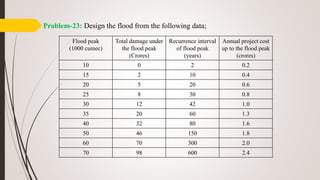
Problem-23: Design the flood from the following data;
Flood peak
(1000 cumec)
Total damage under
the flood peak
(Crores)
Recurrence interval
of flood peak
(years)
Annual project cost
up to the flood peak
(crores)
10 0 2 0.2
15 2 10 0.4
20 5 20 0.6
25 8 30 0.8
30 12 42 1.0
35 20 60 1.3
40 32 80 1.6
50 46 150 1.8
60 70 300 2.0
70 98 600 2.4
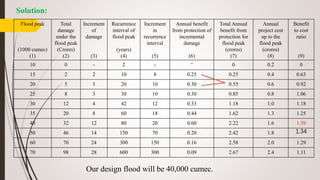
Solution:
Our design flood will be 40,000 cumec.
Flood peak
(1000 cumec)
(1)
Total
damage
under the
flood peak
(Crores)
(2)
Increment
of
damage
(3)
Recurrence
interval of
flood peak
(years)
(4)
Increment
in
recurrence
interval
(5)
Annual benefit
from protection of
incremental
damage
(6)
Total Annual
benefit from
protection for
flood peak
(crores)
(7)
Annual
project cost
up to the
flood peak
(crores)
(8)
Benefit
to cost
ratio
(9)
10 0 - 2 - - 0 0.2 0
15 2 2 10 8 0.25 0.25 0.4 0.63
20 5 3 20 10 0.30 0.55 0.6 0.92
25 8 3 30 10 0.30 0.85 0.8 1.06
30 12 4 42 12 0.33 1.18 1.0 1.18
35 20 8 60 18 0.44 1.62 1.3 1.25
40 32 12 80 20 0.60 2.22 1.6 1.39
50 46 14 150 70 0.20 2.42 1.8 1.34
60 70 24 300 150 0.16 2.58 2.0 1.29
70 98 28 600 300 0.09 2.67 2.4 1.11
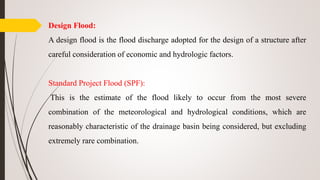
Design Flood
Design Flood:
A design flood is the flood discharge adopted for the design of a structure after
careful consideration of economic and hydrologic factors.
Standard Project Flood (SPF):
This is the estimate of the flood likely to occur from the most severe
combination of the meteorological and hydrological conditions, which are
reasonably characteristic of the drainage basin being considered, but excluding
extremely rare combination.
Problem-24: A coffer dam is designed for a 25 year flood and constructed. If it takes 5
years to complete the construction of main dam, what is the risk that the coffer dam may
before the end of the construction period? What return period in the design of coffer dam
would have reduced the risk to 10%?
Solution:
The risk of failure is given by,
R = 1 – (1−
1
T
)
N
Here, T = 25 years and N = 5 years. Therefore,
R = 1 – (1−
1
25
)
5
= 0.1846 = 18.46 %
If the risk is to be reduced to 10%, we have
0.1 = 1 – (1−
1
T
)
5
, which gives
T = 47.96 years say 50 years.
Problem-25: The analysis of a 30 year flood data at a point on a river yielded x =
1200 m3/s and Sx = 650 m3/s. For what discharge would you design the structure
at this point to provide 95% assurance that the structure would not fail in the next
50 years? For N= 30 years, yn = 0.53622 and σn = 1.11238.
Solution:
Assurance = 95%
Risk = 100-95 = 5% = 0.05
R = 1 – (1−
1
T
)
N
=> 0.05 = 1 – (1−
1
T
)
50
=> T = 975.3 years.
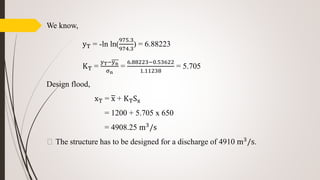
We know,
yT = -ln ln(
975.3
974.3
) = 6.88223
KT =
yT−yn
σn
=
6.88223−0.53622
1.11238
= 5.705
Design flood,
xT = x + KTSx
= 1200 + 5.705 x 650
= 4908.25 m3/s
⸫ The structure has to be designed for a discharge of 4910 m3
/s.
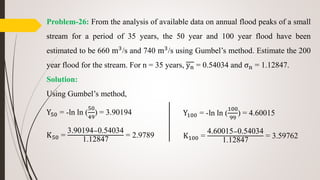
Problem-26: From the analysis of available data on annual flood peaks of a small
stream for a period of 35 years, the 50 year and 100 year flood have been
estimated to be 660 m3/s and 740 m3/s using Gumbel’s method. Estimate the 200
year flood for the stream. For n = 35 years, yn = 0.54034 and σn = 1.12847.
Solution:
Using Gumbel’s method,
Y50 = -ln ln (
50
49
) = 3.90194
K50 =
3.90194−0.54034
1.12847
= 2.9789
Y100 = -ln ln (
100
99
) = 4.60015
K100 =
4.60015−0.54034
1.12847
= 3.59762
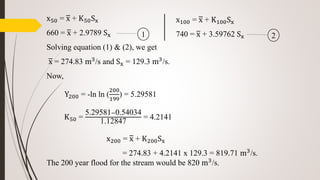
x50 = x + K50Sx
660 = x + 2.9789 Sx
Solving equation (1) & (2), we get
x = 274.83 m3/s and Sx = 129.3 m3/s.
Now,
Y200 = -ln ln (
200
199
) = 5.29581
K50 =
5.29581−0.54034
1.12847
= 4.2141
The 200 year flood for the stream would be 820 m3
/s.
x100 = x + K100Sx
740 = x + 3.59762 Sx1 2
x200 = x + K200Sx
= 274.83 + 4.2141 x 129.3 = 819.71 m3/s.
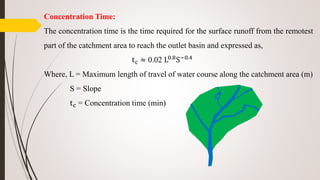
Concentration Time:
The concentration time is the time required for the surface runoff from the remotest
part of the catchment area to reach the outlet basin and expressed as,
tc ≈ 0.02 L0.8S−0.4
Where, L = Maximum length of travel of water course along the catchment area (m)
S = Slope
tc = Concentration time (min)
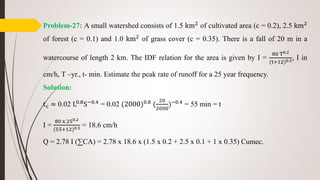
Problem-27: A small watershed consists of 1.5 km2
of cultivated area (c = 0.2), 2.5 km2
of forest (c = 0.1) and 1.0 km2
of grass cover (c = 0.35). There is a fall of 20 m in a
watercourse of length 2 km. The IDF relation for the area is given by I =
80 T0.2
(t+12)0.5, I in
cm/h, T –yr., t- min. Estimate the peak rate of runoff for a 25 year frequency.
Solution:
tc ≈ 0.02 L0.8S−0.4 = 0.02 (2000)0.8 (
20
2000
)−0.4 = 55 min = t
I =
80 x 250.2
(55+12)0.5 = 18.6 cm/h
Q = 2.78 I (∑CA) = 2.78 x 18.6 x (1.5 x 0.2 + 2.5 x 0.1 + 1 x 0.35) Cumec.
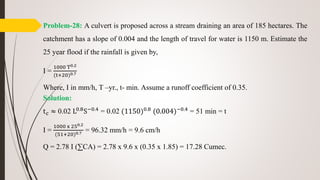
Problem-28: A culvert is proposed across a stream draining an area of 185 hectares. The
catchment has a slope of 0.004 and the length of travel for water is 1150 m. Estimate the
25 year flood if the rainfall is given by,
I =
1000 T0.2
(t+20)0.7
Where, I in mm/h, T –yr., t- min. Assume a runoff coefficient of 0.35.
Solution:
tc ≈ 0.02 L0.8
S−0.4
= 0.02 (1150)0.8
(0.004)−0.4
= 51 min = t
I =
1000 x 250.2
(51+20)0.7 = 96.32 mm/h = 9.6 cm/h
Q = 2.78 I (∑CA) = 2.78 x 9.6 x (0.35 x 1.85) = 17.28 Cumec.
Sediment Transport
&
Design of Irrigation Channels
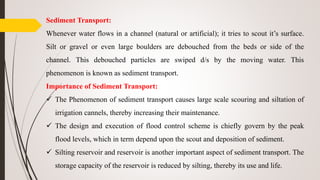
Sediment Transport:
Whenever water flows in a channel (natural or artificial); it tries to scout it’s surface.
Silt or gravel or even large boulders are debouched from the beds or side of the
channel. This debouched particles are swiped d/s by the moving water. This
phenomenon is known as sediment transport.
Importance of Sediment Transport:
 The Phenomenon of sediment transport causes large scale scouring and siltation of
irrigation cannels, thereby increasing their maintenance.
 The design and execution of flood control scheme is chiefly govern by the peak
flood levels, which in term depend upon the scout and deposition of sediment.
 Silting reservoir and reservoir is another important aspect of sediment transport. The
storage capacity of the reservoir is reduced by silting, thereby its use and life.
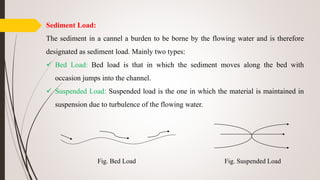
Sediment Load:
The sediment in a cannel a burden to be borne by the flowing water and is therefore
designated as sediment load. Mainly two types:
 Bed Load: Bed load is that in which the sediment moves along the bed with
occasion jumps into the channel.
 Suspended Load: Suspended load is the one in which the material is maintained in
suspension due to turbulence of the flowing water.
Fig. Bed Load Fig. Suspended Load
Rigid Boundary Channel:
When the velocity of flow through a channel is very small, the channel bed does not
move at all which is known as rigid boundary channel.
Design of Regime Channel:
The basis for designing such an ideal, non silting, non scouring channel is that,
whatever silt has entered the channel at its head is kept in suspension, so that it does not
settle down and deposit at any point of the channel. Moreover, the velocity of the
velocity of the water should be such that it does not should be such that it does not
produce local silt by erosion of channel bed slope.
 kennedy’s Theory.
 Lacey’s Theory.
kennedy’s Theory:
The silt supporting power in a channel erosion was mainly dependent upon the
generation of eddies, raising to the surface. The eddies are generated due to the friction
of flowing water with the channel surface. The vertical component of these eddies try
to move the sediment up, where the weight of the sediment tries to bring it down. Thus
keeping the sediment in suspension. so, if the velocity is sufficient to generate these
eddies, so as to keep the sediment just in suspension, silting will be avoided. Based
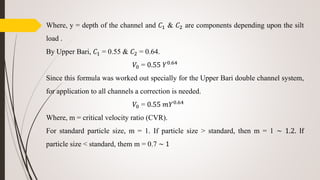
upon this concept, he defined the critical velocity, 𝑉0 in a channel as a mean velocity
which will just keep the channel free from silting or scouring and related it to the depth
of flow by the equation,
𝑉0 = 𝐶1 𝑌 𝐶2
Where, y = depth of the channel and 𝐶1 & 𝐶2 are components depending upon the silt
load .
By Upper Bari, 𝐶1 = 0.55 & 𝐶2 = 0.64.
𝑉0 = 0.55 𝑌0.64
Since this formula was worked out specially for the Upper Bari double channel system,
for application to all channels a correction is needed.
𝑉0 = 0.55 𝑚𝑌0.64
Where, m = critical velocity ratio (CVR).
For standard particle size, m = 1. If particle size > standard, then m = 1 ~ 1.2. If
particle size < standard, them m = 0.7 ~ 1
Chezy's Formula:
V = C 𝑅𝑆 [C = Chezy’s Co-efficient]
Manning’s Formula:
V =
1
𝑛
𝑅
2
3 𝑆
1
2 [n = Manning’s Co-efficient]
Kutter’s Formula:
V = [
1
𝑛
+(23+
0.00155
𝑆
)
1+ 23+
0.00155
𝑆
∗
𝑛
𝑅
] x 𝑅𝑆 [n = Rugosity Co-efficient]
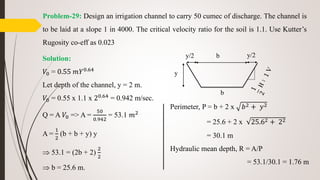
Problem-29: Design an irrigation channel to carry 50 cumec of discharge. The channel is
to be laid at a slope 1 in 4000. The critical velocity ratio for the soil is 1.1. Use Kutter’s
Rugosity co-eff as 0.023
Solution:
𝑉0 = 0.55 𝑚𝑌0.64
Let depth of the channel, y = 2 m.
𝑉0 = 0.55 x 1.1 x 20.64
= 0.942 m/sec.
Q = A 𝑉0 => A =
50
0.942
= 53.1 𝑚2
A =
1
2
(b + b + y) y
 53.1 = (2b + 2)
2
2
 b = 25.6 m.
y/2 b
b
y/2
y
Perimeter, P = b + 2 x 𝑏2 + 𝑦2
= 25.6 + 2 x 25.62 + 22
= 30.1 m
Hydraulic mean depth, R = A/P
= 53.1/30.1 = 1.76 m
According to Kutter’s formula,
V = [
1
0.023
+(23+
0.00155
1/4000
)
1+ 23+
0.00155
1/4000
∗
0.023
1.76
] x 1.76 𝑥 (
1
4000
)
= 1.016 m/sec >> 𝑉0 [Not Ok]
In order to increase the velocity 𝑉0 we have to increase the depth.
Let, y = 2.7
𝑉0 =1.142 m/sec
A = 43.78 𝑚2
V = 1.140 m/sec ≈ 𝑉0 [Ok]
Hence use the depth = 2.7 and base width 14.86 m with slope
1
2
H : 1 V and the
section will be trapezoidal.
b = 14.86 m
P = 20.9 m
R = 2.09 m
Lacey’s Regime Theory:
Silt is kept in suspension by the vertical component of eddies generated at all points of
forces normal to the wetted perimeter. Lacey came out with the statement that even a
channel showing no silting, no scouring may not be in regime. Therefore, he classified
regime channel into three parts:
 True Regime: A channel shall be in true regime if the following conditions are
satisfied:
 Discharging is constant.
 Flow is uniform.
 Silt charge is constant.
 Silt grade is constant that the type and size of silt is always same.
 Channel is flowing through a material, which can be scoured as it can be deposited.
But in practice all these conditions can never be satisfied. Therefore artificial channel
can never be in true regime channel. They can be in initial regime or final regime.
 Initial Regime: When water flow through an excavated channel with somewhat
narrow dimensioned and defective slopes, the silt carried by water may get dropped
in the upper reaches. Thereby increasing their bed slope and consequently the
velocity is increasing and non-silting equilibrium is established. Such as channel is
called initial regime channel.
 Final Regime: If there is no resistance from the sides and all the variables such as
perimeters, depth, slope, etc. are equally free to vary and finally get adjusted
accordingly to discharge and silt grade, then the channel is said to be achieved
permanent stability called final regime channel.
Design Procedure of Lacey’s Regime Channel:
 Design velocity, V = [
𝑄𝑓2
140
]
1
6
Where, Q = Discharge in cumec.
V = Velocity in m/sec.
f = Silt factor = 1.76 𝑑 𝑚𝑚
𝑑 𝑚𝑚 = Average particle size in mm
 Hydraulic mean depth, R =
5
2
x
𝑉2
𝑓
 Area, A =
𝑄
𝑉
 Perimeter, P = 4.75 𝑄
 Bed slope, S =
𝑓
5
3
3340 𝑥 𝑄
1
6
Problem-30: Design a regime channel for a discharge of 50 cumec and silt factor 1.1
using Lacey’s theory.
Solution:
V = [
𝑄𝑓2
140
]
1
6 = 0.87 m/sec
R =
5
2
x
𝑉2
𝑓
= 1.72 m.
A =
𝑄
𝑉
= 57.5 𝑚2
P = 4.75 𝑄 = 33.6 m
S =
𝑓
5
3
3340 𝑥 𝑄
1
6
=
1
5469
Consider a trapezoidal channel section
with depth y, bed b and slope
1
2
H : 1 V.
y/2 b
b
y/2
y
Perimeter, P = b + 2 x 𝑦2 + (
𝑦
2
)2= b + 5 y
=> b = 33.6 - 5 y
A =
1
2
(b + b +
𝑦
2
+
𝑦
2
) * y = by +
𝑦2
2
 57.5 = (33.6 - 5 y) y +
𝑦2
2
 y = 1.89 m.
 b = 29.37 m
Berm:
Horizontal distance left at ground level between the toe of the bank and top edge of the cutting.
Free Board:
The margin or vertical distance between full supply level and bank level is known as free board.
Bank:
The primary purpose of bank is to retain water. They can be used as the means of
communication and inspection purposes.
Bank
NSL Berm
Cutting
BorrowPit
FSL (Full Supply Level)
Free Board
Purpose of Providing Berm:
 The silt deposited on the site is very fine and impervious. If therefore, serves as a
good lining for reducing losses, leakage, consequent breaches.
 They help the channel to attain regime condition, as they help in providing a wider
way in a fluctuation or discharge don't produce much fluctuation in depth because of
wider water way.
 They give additional strength to the banks and provide protection against erosion
and breaches.
 the possibility of breaches gets reduced because the saturation line comes more in
the body of the embankment.
 They protect the bank from erosion due to wave action.
 Berms can be used as borrow pit for excavation soil to be used for filling.
Service Road & Doula:
Service roads are provided on canals for inspection purposed and serve as the means of
communications in remote areas. To protect accident due to erroneous driving doula is
provided. They are provided 0.4 ~ 1 m from full supply level.
FSL (Full Supply Level)
Bank
Service Road
Back Berm:
Even after providing sufficient section for bank embankment, the saturation gradient
line may cut the down stream end of the bank. In such a case the saturation line can be
kept covered by 0.5 m with the help covered by 0.5 m with the help of counter berm or
back berm as shown in figure.
FSL (Full Supply Level)
Bank
Berm
Spoil Bank:
When the earth work is excavation exceeds the earth working filling even after
providing maximum width of the bank embankment, the extra earth has to be deposited
economically. To depose of these earth by mechanical transport may become very
costly and economical mode of its disposal may be found in the form of collecting
these soil on the edge of the bank embankment it self. The soil is therefore deposited in
such a case in the form of heaps is termed as spoil bank.
Borrow Pits:
When earthwork in filling exceeds the earthwork in excavation the pits are dug for
bringing earth, which are known as borrow pits. If such pits are excavated outside the
channel, they are known as external borrow pits and if they are excavated somewhere
with in the channel, they are known as internal borrow pits.
Balancing Depth:
For achieving maximum economy and for a given cross section there can be only one
depth for which a balance between cutting & filling will occur. This depth is known as
balancing depth.
Problem-31: Calculate the balancing depth for a channel section having a bed width equal to 18 m
and side slope 1 H : 1 V in cutting and 2 H : 1 V in filling. The embankment are kept 3 m higher
then the ground level and crest width of the bank is kept as 2 m.
Solution:
Area of filling =
1
2
x (14 +2) x 3 x 2 𝑚2
= 48 𝑚2
Area of cutting =
1
2
x (18 + 18 + 2d) x d
= (18 + d) d = 18d + 𝑑2
d 18 m
18 m
d
d
2 m
3 m
6 m 6 m
Now, For balance depth,
Area of filling = Area of cutting
=> 48 = 18d + 𝑑2
=> d = 2.35 m
Thank you
For
Taking the Stress

Irrigation & Flood Control

  • 1.
    Irrigation & FloodControl Faruque Abdullah Lecturer Dept. of Civil Engineering Dhaka International University
  • 2.
    Reference Books  IrrigationWater Resources and Water Power Engineering – Dr. P. N. Modi.  Irrigation and Water Power Engineering – Dr. B. C. Punmia.  Irrigation Engineering – R. K. Sharma & T. K. Sharma.  Irrigation Engineering – S. K. Garg.  Irrigation Engineering – N. N. Bashak.  Irrigation Theory and Practice – A. M. Michael  Hydrology – H. M. Ragunath
  • 3.
  • 4.
    Irrigation Irrigation: Irrigation canbe defined as the process of artificially supplying water to soil for raising crops. It is a science of planning and designing an efficient, low-cost, economic irrigation system tailored to fit natural conditions. It is the engineering of controlling and harnessing the various natural resource of water by the construction of dams and reservoirs, canals and finally distributing the water to the agricultural fields.
  • 5.
    Necessity: The necessityof irrigation can be summarized in the following points:  Less rainfall: When the total rainfall is less than needed for the crop, artificial supply is necessary. In such a case irrigation works may be constructed at a place where more water is available and then to convey the water to the area where there is deficiency of water.  Non uniform rainfall: The rainfall in a particular area may not be uniform over the crop period. During the early periods of the crop, rains may be there, but no rain water may be at the end, with the result that either the yield may be less or the crop may die altogether. By the collection of water during the excess rainfall period water may be supplied to the crop during the period when there may be no rainfall.
  • 6.
     Commercial cropswith additional water: The rainfall in a particular area may be sufficient to raise the usual crops but more water may be necessary for raising commercial and cash crops.  Controlled water supply: By the construction of proper distribution system, the yield of the crop may be increased because of controlled supply of water.
  • 7.
    Purpose of irrigationwater:  Adds water to the soil to supply the moisture essential for the plant growth.  Saves the crops from drying during short duration drought.  Cools the soil and the atmosphere and thus makes more favorable environment for healthy growth.  Washes out or dilutes salts in the soil.  Reduce the hazard of soil piping.  Softens the tillage pans.
  • 8.
    Benefits of irrigation: Increase in food production.  Protection from famine.  Cultivation of cash crops.  Elimination of mixed cropping.  Addition of wealth of the country.  Increase in prosperity of people.  Generation of hydro-electric power.  Domestic and industrial water supply.  Inland navigation.  Improvement of communication.  General development of the country.
  • 9.
    Irrigation System Flow Irrigation Perennial Irrigation Inundation Irrigation StorageIrrigationDirect Irrigation Lift Irrigation By mechanical or electrical power By man or animal power Shallow tube wellOpen well deep tube well MoteDoon Persian wheel Rati or pullevSwinging basket Wind lass
  • 10.
    Flow Irrigation: Whenwater flows under gravitational pull through the artificial canal towards the agricultural land, it is termed as flow irrigation. Mainly two types:  Inundation irrigation system: In this system, a canal is excavated from the bank of the inundation river. In this case water flows to the agricultural land in rainy season only. There is no regulator at the head of the canal to control the flow of water. The bed level of the canal is fixed at such level that the water can flow through the canal only when the water level of the river rises above the canal bed. Again the flow of water through the canal stops automatically when the water level of the river falls below the canal bed.
  • 11.
  • 12.
     Perennial systemof irrigation: In this system, a weir or a barrage is constructed across the perennial river to raise the water level on the up stream side or a dam is constructed to form a storage reservoir. The main canal is constructed on either side or both the banks of a river. Regulator is constructed at the head of the canal to control the flow of water through the canal towards the agricultural land.
  • 13.
    Which one youwill choose between direct irrigation or storage irrigation method? Direct irrigation scheme is adopted in circumstances where the river is perennial and has a normal flow throughout the irrigation season, never less at any time then the requirements of the field. On the contrary, storage irrigation system is adopted where the river flow is either not perennial or where flow is insufficient during certain parts of the crop season for irrigation requirement.
  • 14.
    Lift Irrigation: Whenwater is lifted from surface sources or underground sources by man or animal, mechanical or electrical power and directly supplied to the agricultural land, then it is known as lift irrigation. Advantages:  The farmers can supply water to their fields according to the requirement.  Reducing the chance of water logging.  No water loss due to conveyance.  Initial cost is low.  The duty of water is high.  The maintenance cost is low.  More than one crop can be grown in a year on the same land.
  • 15.
    Disadvantages:  In thesummer the surface water may be dried up and the water table may go down below the suction head. Hence, lift irrigation from the surface source and from the shallow tube well may fail in summer.  If the lifting mechanism fails due to mechanical or electrical failure, then water cannot be supplied until the mechanism is restored.  The well water has no silt content. The yield of crop therefore depends on chemical fertilizer, which is costly.  The lift irrigation in consideration with the yield of crop is not cost effective.
  • 16.
  • 17.
    Aim of Irrigation:The aim of irrigation practice is to ensure that plants have an adequate supply of water in their root zone for achieving optimum yield of crops without damaging the quality of soil. Soil Texture: Soil texture refers to the composition of the soil and it is reflected by the particle size, shape and gradation. Generally the soils occurring in nature are a combination of sand, silt and clay. The relative proportion of sand, silt and clay in a soil mass determines the soil texture. According to textural gradations the soil may be broadly classified as  ‘Open’ or ‘Light’ textural soils.  ‘Medium’ textural soils.  ‘Tight’ or ‘Heavy’ textural soils
  • 18.
    The ‘Open’ or‘Light’ textural soils contain very low content of silt and clay and hence these soils are course or sandy. The ‘medium’ textured soils contain sand, silt and clay in sizable proportions. In general loam is a soil which has all the three major size fractions in sizable proportions and hence the loams are medium textured soils. The ‘Tight’ or ‘Heavy’ textured soil contain high content of clay.
  • 19.
    Water Holding Capacityof Soil: Water holding capacity of the' soil is one of the dominant factors influencing irrigation. The water holding capacity of a soil mainly depends on its porosity. The porosity of a soil is defined as the ratio of the volume of pores in the soil mass to its total volume, and it is expressed as percentage. In general there are two types of soil pores viz., (i) capillary or small pores, and (it) non-capillary or large pores. The capillary pores hold tightly by capillarity a large amount of water held by the soil at saturation and prevent it from being drained off under gravity. On the other hand the non-capillary pores do not hold water tightly and hence a large amount of water held by the soil sat saturation is drained off under gravity. Thus capillary pores induce greater water holding capacity while non-capillary pores induce drainage and aeration. The relative magnitudes of these types of pores in a soil depend on its texture and structure. Thus a sandy soil has more non-capillary pores which result in better drainage and aeration but low water holding capacity. On the other hand a clayey soil has more capillary pores which result in better water holding capacity but poor drainage and aeration.
  • 20.
    The water heldby the soil is extracted by the roots of the plants for being used by the plants. In general the extraction of water from the soil by the roots of the plants is resisted by some forces, but the resisting forces are more in clayey soils than in sandy soils. Thus water cannot be easily extracted by the roots of the plants in clayey soils although large amount of water is held by these soils. On the other hand relatively less amount of water is held by sandy soils, but water can be easily extracted from these soils by the roots of the plants. Thus an ideal soil for irrigation is that which has its pore space almost equally divided between capillary and non-capillary pores. Such a soil has enough small pores to provide adequate water holding capacity and also enough large pores to permit adequate drainage and aeration, and easy extraction of water by the roots of the plants. The loams are therefore ideal soils as they possess good water holding capacity, have good drainage and aeration, and allow extraction of water by the roots of the plants without much resistance.
  • 21.
    Different kinds ofwater in the soil and difference in available moisture content between a sandy soil and a silty loam soil: Hydroscopic water is unavailable to plant, capillary water is available for plant survival and gravitational water is available fro plant growth. 0 10 20 30 40 Oven dry Ultimate wilting point Permanent wilting point Field capacity Saturation Wilting range Hygroscopic Water Capillary Water Gravitational or Free Water Silty Loam Soil Sandy Soil Kindsofsoilmoisture Available moisture content
  • 22.
    Soil Moisture Constants: Saturation capacity.  Field capacity  Moisture equivalent  Permanent wilting point  Temporary wilting point  Ultimate wilting  Available moisture  Readily available moisture.
  • 23.
    Depth of water(or moisture) held by soil in root zone and available to plants: The water held by soil in root zone may be expressed in terms of depth of water which may be determined as indicated below: Let, d be the depth of root zone, 𝑤𝑠 be the specific weight of soil and w be the specific weight of water. If unit area of soil is considered then the weight of soil per unit area and depth d is equal to (𝑤𝑠 x 1 x d). Further the weight of water held by the soil per unit area is equal to [w x 1 x depth of water] Field capacity = 𝑊𝑒𝑖𝑔ℎ𝑡 𝑜𝑓 𝑤𝑎𝑡𝑒𝑟 ℎ𝑒𝑙𝑑 𝑏𝑦 𝑠𝑜𝑖𝑙 𝑝𝑒𝑟 𝑢𝑛𝑖𝑡 𝑎𝑟𝑒𝑎 𝑊𝑒𝑖𝑔ℎ𝑡 𝑜𝑓 𝑠𝑜𝑖𝑙 𝑝𝑒𝑟 𝑢𝑛𝑖𝑡 𝑎𝑟𝑒𝑎
  • 24.
    Field capacity = 𝑊𝑒𝑖𝑔ℎ𝑡𝑜𝑓 𝑤𝑎𝑡𝑒𝑟 ℎ𝑒𝑙𝑑 𝑏𝑦 𝑠𝑜𝑖𝑙 𝑝𝑒𝑟 𝑢𝑛𝑖𝑡 𝑎𝑟𝑒𝑎 𝑊𝑒𝑖𝑔ℎ𝑡 𝑜𝑓 𝑠𝑜𝑖𝑙 𝑝𝑒𝑟 𝑢𝑛𝑖𝑡 𝑎𝑟𝑒𝑎 = w x 1 x depth of water 𝑤 𝑠 x 1 x d ∴ Depth of water held by soil at field capacity = 𝑤 𝑠 𝑤 x d x [Field capacity] = S x d x [Field capacity] Where, S is the specific gravity of soil. ∴ Depth of water held by soil at permanent wilting point = 𝑤 𝑠 𝑤 x d x [permanent wilting point] = S x d x [permanent wilting point]
  • 25.
    ∴ Depth ofavailable water = 𝑤 𝑠 𝑤 x d x [Field capacity - permanent wilting point] = S x d x [Field capacity - permanent wilting point] ∴ Further depth of available water per meter depth of soil = 𝑤 𝑠 𝑤 x [Field capacity - permanent wilting point] = S x [Field capacity - permanent wilting point]
  • 26.
    Problem-1: The rootzone of a certain soil has a field capacity of 30% and permanent wilting percentage is 10%. a) What is the depth of moisture in the root zone at field capacity and permanent wilting point? b) How much water is available if the root zone depth is 1.2 m. The dry weight of soil is 13.73 kN/𝑚3 [1400kg/𝑚3 ].
  • 27.
    Solution: a) The depthof moisture in root zone at field capacity per meter depth of soil = S x Field capacity = 1400 1000 x 30 100 = 0.42 m/m The depth of moisture in root zone at permanent wilting point per meter depth of soil = S x Permanent wilting point = 1400 1000 x 10 100 = 0.14 m/m b) The depth of water available per meter depth of soil = S x [Field capacity - Permanent wilting point ] = 1400 1000 x ( 30 100 - 10 100 ) = 0.28 m/m ∴ Total water available in the root zone = 0.28 x 1.2 m = 0.336 m = 336 mm.
  • 28.
    Problem-2: Find thefield capacity of soil for the following data: a) Depth of root zone = 2 m b) Existing water content = 5% c) Dry density of soil = 1500kg/𝑚3 d) Water applied to soil = 600 𝑚3 e) Water lost due to evaporation and deep percolation = 10% f) Area of land irrigated = 900 𝑚2
  • 29.
    Solution: Total water applied= 600 𝑚3 Loss of water = 10% ∴ Water retained in the soil = 600 x 0.9 = 540 𝑚3 = 540 x 1000 x 9.81 N Total dry weight of soil = 900 x 2 x 1500 x 9.81 N ∴ % of water retained in the soil = 540 x 1000 x 9.81 900 x 2 x 1500 x 9.81 = 0.2 or 20% Existing water content = 5% ∴ Field capacity = 5% + 20% = 25%
  • 30.
    Problem-3: A loamsoil has field capacity 25% and permanent wilting percentage 10%. The dry unit of soil is 14.72 kN/𝑚3 . If the depth of the root zone is 0.75m, determine the storage capacity of the soil. Irrigation water is applied when moisture content drops to 14%. If water application efficiency is 75%, determine the water depth required to be applied in the field.
  • 31.
    Solution: Maximum storagecapacity of soil = Available moisture = S x d x [Field capacity - Permanent wilting point] = 14.72 9.81 x 0.75 x [0.25 – 0.10] = 0.169 m = 169 mm. Depth of irrigation water = S x d x [Field capacity – Minimum moisture content at which irrigation is required] = 14.72 9.81 x 0.75 x [0.25 – 0.14] = 0.124 m = 124 mm. Depth of irrigation water to be applied in the field = 124 0.75 mm = 165 mm.
  • 32.
    Problem-4: The fieldcapacity of a certain soils is 18.3% and specific gravity is 1.25. A wet sample of soil taken before irrigation weighs 153 gm and its weight after drying in the oven is 138 gm. What depth of water must be applied to irrigate the soil to a depth of 1.2 m? Solution: The moisture content before irrigation = 153−138 138 x 100 = 10.9% Depth of water required to be applied to bring the moisture up to its field capacity = 1.25 x 1.2 x [ 18.3 100 - 10.9 100 ] = 0.111 m = 111mm.
  • 33.
    Problem-5: The fieldcapacity of a certain soils is 12.6% and specific gravity is 1.42. If the moisture content present in the soil before irrigation is 8.2%, how deep the soil profile will be welted with an application of 50 mm of irrigation water? Solution: Depth of irrigation water = S x d x [Field capacity –Moisture content before irrigation] or, 50 100 = 1.42 x d x [ 12.6 100 - 8.2 100 ] or, d = 50 100 1.42 𝑥 [ 12.6 100 − 8.2 100 ] = 0.80 m = 800 mm.
  • 34.
    Problem-6: Determine thenet depth of irrigation required to irrigate a field 1000m long and 10 m wide from a source supplying water at the rate of 30000 L/hr. in clay loam soil in the moderate climate. The field capacity of the soil is 27%, depth of root zone is 1 m, specific gravity of soil is 1.35 and irrigation is started when 50% of the available moisture has been used. Also determine the time required to irrigate the field.
  • 35.
    Solution: Depth of irrigationwater to be applied, 𝑑′ = S x d x [Field capacity –Moisture content before irrigation] = 1.35 x 1 x [ 27 100 - 0.5 𝑥 27 100 ] = 0.182 m = 182 mm. If the irrigation water is applied at the rate of q cubic meter per hour for t hours over area of a hectare and 𝑑′ is the depth of water required to be applied in meter, then we have q x t = a x 104 x 0.182 or, 30000 1000 x t = 1000 𝑥 10 104 x 104 x 0.182 ∴ t = 60.7 hours.
  • 36.
    Function of irrigationwater:  Triggers activity in a sheet setting a chain of biochemical reaction.  Dissolves mineral nutrients for their rise from the soil in the plants.  Promotes chemical action within the plant for its growth.  Promotes and supports life of bacteria beneficial to the plant growth.  Requires for temperature control of the soil to minimizes the effect of frost.  At the end of the life cycle of plant water is also a constituents of product which may be sheet, stem, leaves, flowers or foods.
  • 37.
    Consumptive use orEvapotranspiration: Consumptive use or evapotranspiration may be defined as the total quantity of water used by the vegetative growth of a given area in transpiration and building of plant tissue and that evaporated from adjacent soil in the area, in any specified time. It is therefore includes the water removed from the soil by transpiration and evaporation. Transpiration: Transpiration is the process in which water that enters the plant roots and is used in building plant tissues and finally passes into the atmosphere in the vaporous from through the leaves of the plant. Evaporation: Evaporation is the process in which water from the adjacent soil passes into the atmosphere in the vaporous from.
  • 38.
    According to LakeHenfer formulae, E = 6.9317 (𝑒𝑠 - 𝑒2) 𝑉4 E = 5.5046 (𝑒𝑠 - 𝑒8) 𝑉8 Where, E is evaporation in mm/day; 𝑒𝑠 is vapor pressure at water surface; 𝑒2 and 𝑒8 are vapor pressure in N/𝑚𝑚2 at the height of 2m and 8m respectively the water surface. 𝑉4 and 𝑉8 are wind velocities in km/hour at height of 4m and 8m respectively the water surface.
  • 39.
    Problem-7: Vapor pressureat surface and 2m height above the surface is 102 and 100 N/𝑚𝑚2 respectively. Wind pressure at a height of 4m above the surface is 0.36 km/hr. then find out the volume of water evaporation will occur from the adjacent soil of 200 𝑚2 area. Use Lake Henfer formula. Solution: According to Lake Henfer formulae, E = 6.9317 (𝑒𝑠 - 𝑒2) 𝑉4 = 6.9317 x (102-100) x 0.36 mm/day = 5 mm/day.
  • 40.
    Problem-8: Vapor pressureat surface and 2m height above the surface is 102 and 98 N/𝑚𝑚2 respectively. Wind pressure at a height of 4m above the surface is 0.5 km/hr. then find out the volume of water evaporation will occur from the adjacent soil of 200 𝑚2 area. Use Lake Henfer formula. Solution: According to Lake Henfer formulae, E = 5.5046 (𝑒𝑠 - 𝑒8) 𝑉8 = 5.5046 x (100-98) x 0.5 mm/day = 5.5 mm/day.
  • 41.
  • 42.
    Crop Period: Cropperiod is defined as the total time that elapses between the showing of the crops and its harvesting. Thus crop period represents the total time during which the crop remains in the field. Base Period: Base period is defined as the total time between the first watering done for the preparation of the land for sowing of a crop and the last watering done before its harvesting. It is thus evident that the crop period is slightly more than the base period for any crop. Duty: Duty of water is the relation between the area of land irrigated and the quantity of water required to be supplied for growing a crop. It is denoted by D. Delta: Delta is defined as the total depth of water over the irrigated land required by a crop grown on it during the entire base period of the crop. It is denoted by symbol ‘∆’.
  • 43.
    Relation between dutyand delta: Let, D be the duty of water on the field in hectares per cumec, ∆ be the delta or the total depth of water in meters supplied to a crop growing on the field during the entire base period and B be the base period of the crop in days. For field of area D hectares corresponding to the depth of water ∆ meters the total quantity of water supplied for growing a crop on the field = D x ∆ hectare-meter = D x ∆ x 104 cubic meter Further for the same field of area D hectares for growing a crop on it if water is supplied at the rate of 1 cumec for the entire base period of B days, then the total quantity of water supplied to the field = 1 x B x 24 x 60 x 60 cubic meter = 8.64 x 10⁴ x B cubic meter 1 2
  • 44.
    Equating equation 1and 2 we get, D x ∆ x 104 = 8.64 x 10⁴ x B ∴ D = 8.64 𝑥 𝐵 ∆ Where, D in hectares/cumec; B in days and ∆ in meter.
  • 45.
    Methods of improvingduty of water:  Canal lining.  Crop rotation.  Proper method of supplying of water such as flooding, furrow, basin and contour method.  Proper ploughing.  Transmission loss.  Implementation of tax.
  • 46.
    Kor Watering: Thefirst watering which is given to a crop, when the crop is few centimeters high is called kor period. Kor Depth: The depth of water applied during kor watering is called kor depth. Kor Period: The portion of the base period in which kor watering is applied is called kor period. Crop Rotation: The process of changing the type of crop for the cultivation on the same land is known as crop rotation. It is found by experiment that if the principle of crop rotation is practiced fertility of soil can be restored. Kharif Crop: Kharif crops are sawn at the beginning of southwest monsoon and are harvested in autumn. Rabi Crop : Rabi Crops are sawn in autumn and are harvested in spring.
  • 47.
    Problem-9: A croprequires 900 mm of water for a base period of 120 days. Find the duty of water. Solution: D = 8.64 𝑥 𝐵 ∆ = 8.64 𝑥 120 900/100 = 1152 hectares/ cumec.
  • 48.
    Problem-10: If wheatrequires about 9.5 cm of water after every 30 days and the base period for wheat is 150 days. Find out the value of duty and delta for wheat. Solution: Assuming the base period to representing the crop period, as per usual practice, water required at an average interval of 30 days upto a total period of 150 days. This means that, Number of watering required = 150/30 = 5 no. Depth of water required for each time = 9.5 cm. Total depth of water required in 150 days = 9.5 x 5 = 47.5 cm. ∴ ∆ for wheat = 47.5 cm ∴ Duty for wheat, D = 8.64 𝑥 𝐵 ∆ = 8.64 𝑥 150 47.5/100 = 272.84 hectares/ cumec.
  • 49.
    Factors affecting dutyof water:  Type of crop.  Climate condition of the area.  System of irrigation.  Method of irrigation.  Quality of irrigation water.  Method of cultivation.  Time of irrigation and frequency of irrigation.  Type of soil and sub-soil of the irrigation field.  Type of soil and sub-soil of the area through which canal passes.  Canal conditions.  Skill of cultivator.  Topography of land.  Bas period of crop.  Method of improving duty of water.  Method of assessment of irrigation water rate.
  • 50.
    Effective Rainfall: Precipitationfalling during the growing period of a crop that is available to meet the evapotranspiration needs of the crop, is called effective rainfall. It does not include precipitation lost through deep percolation below the root zone or the water lost as surface runoff. It is denoted by 𝑅 𝑒. Net Irrigation Requirement (N.I.R.): It is the amount of irrigation water required in order to meet the evapotranspiration need of the crop as well as other need such as leaching. Therefore, N.I.R. = 𝐶 𝑢 - 𝑅 𝑒 + water lost as percolation in satisfying other needs such as leaching. Consumptive Irrigation Requirement (C.I.R.): It is the amount of irrigation water required in order to meet the evapotranspiration need of the crop during its full growth. It is therefore, nothing but the consumptive use itself but exclusive of effective precipitation, stored soil moisture or ground water. When the last two are ignored, then we can write, C.I.R. = 𝐶 𝑢 - 𝑅 𝑒
  • 51.
    Problem-11: The followingtable gives the values of consumptive uses and effective rainfalls for the periods shown against them for a Jowar crop shown at Bellary in Karnataka state. The period of growth is from 16th Oct. to 2nd Feb (110 days). Determine the N.I.R. of this crop resuming that water is not required for any other purpose except that of fulfilling the evapotranspiration needs of the crop. Dates (1) 𝐶 𝑢 (mm) (2) 𝑅 𝑒 (mm) (3) October 16 - 31 37.0 30.8 November 1 – 30 84.2 20.4 December 1 – 31 154.9 6.7 January 1 – 31 188.1 2.4 February 1-2 13.3 1.0
  • 52.
    Solution: Hence, the netirrigation requirement = 41.62 cm. Dates (1) 𝐶 𝑢 (mm) (2) 𝑅 𝑒 (mm) (3) N.I.R. = 𝐶 𝑢 - 𝑅 𝑒 (4 = 2 - 3) October 16 - 31 37.0 30.8 6.2 November 1 – 30 84.2 20.4 63.8 December 1 – 31 154.9 6.7 148.2 January 1 – 31 188.1 2.4 185.7 February 1-2 13.3 1.0 12.3 ∑ = 416.2 mm = 41.62 cm
  • 53.
    Field Irrigation Requirement(FIR): It is defined as the amount of water required to meet the NIR plus the amount of water lost as surface runoff and through deep percolation. If water application efficiency ղa then, FIR = NIR ղa Gross Irrigation Requirement (GIR): It is defined as the amount of water required to meet the field irrigation requirements plus the amount of irrigation water lost in conveyance through the canal system by evaporation and by seepage. If water conveyance efficiency ղc then, GIR = FIR ղc
  • 54.
    Command Area (CA):A commanded area is defined as the area which can be irrigated (or commanded) by a canal system. Two types:  Gross Commanded Area (GCA): Thee gross commanded area is defined as the total area which can be irrigated by a canal on the presumption that unlimited quantity of water is available. A canal is usually aligned along water-shed in between two drainage valleys, so that water can flow from it on both sides under gravity to the maximum possible area.  Cultural Commanded Area (CCA): The culturable commanded area is that portion of the gross commanded area which is culturable or cultivable. Thus culturable commanded area may be obtained by subtracting the unculturable area from the gross commanded area. Thus C.C.A. = G.C.A.— unculturable area.
  • 55.
    Methods for determiningconsumptive use of water: Direct Measurement Method:  Soil moisture studies on plot.  Tank or Lysimeter method.  Field experimental plots.  Integration method.  Inflow and cutflow studies for large areas. Use of Empirical Formula:  Modified Penman method.  Jensen – Haise method.  Hargreaves method.  Thornthwaite method.  Blaney – Criddle method.  Hargreaves class A pan evaporation method.  Modified Penman method.
  • 56.
    Jensen-Haise Method: Jensen-Hasieused observation of consumptive use from the western United states and developed the following linear relationship for estimating the potential evapotranspiration. 𝐸𝑡 𝑝 = 𝐶𝑡(t - 𝑡 𝑥) 𝑅 𝑠 𝐸𝑡 𝑝 = potential evapotranspiration for reference crop in mm/day. 𝐶𝑡 = A temperature co-efficient = 1 𝐶1+𝐶2 𝐶 𝐻 𝐶1 = 38 – (20 C x 𝐸𝐿 305 ) [EL = Altitude of the place in meters] 𝐶2 = 7.60 C 𝐶 𝐻 = 50 𝑚𝑏𝑎𝑟 𝑒2 −𝑒1 𝑒2 and 𝑒1 are saturation vapour pressures of water in mbar at the mean daily maximum and minimum temperatures respectively, for the warmest month of the year in a given area. 𝑡 𝑥 = - 2.5 – 0.14 (𝑒2 − 𝑒1)0 C/m bar - 𝐸𝐿 550 𝑅 𝑠 = 𝑅 𝑎 (a + b 𝑛 𝑁 ) t = mean daily temperature
  • 57.
    Problem-12: Calculate thepotential evapotranspiration for an area in the month of September by Jensen-Hasie method. The following data are available: Altitude = 1500 m a SL, Max. temperature = 33.040C and min. temperature = 14.310C, 𝑅 𝑎 = 15.3, a = 0.25, b = 0.52 & 𝑛 𝑁 = 0.525, Mean temperature = 21.190C Temperature 0 C 14 15 33 34 e (mbar) 16.1 17.0 50.3 53.2
  • 58.
    Solution: For 33.040 C 𝑒2= 50.3 + 53.02 −50.3 1 x 0.04 = 50.416 mbar For 14.310 C 𝑒2 = 16.1 + 17 −16.1 1 x 0.31 = 16.379 mbar 𝐶1 = 38 – (20 C x 𝐸𝐿 305 ) = 38 – (2 x 1500 305 ) = 28.164 𝐶2 = 7.6 𝐶 𝐻 = 50 𝑚𝑏𝑎𝑟 𝑒2 −𝑒1 = 50 50.416 −16.379 = 1.469 𝐶𝑡 = 1 𝐶1+𝐶2 𝐶 𝐻 = 1 28.164+7.6 𝑥 1.469 = 0.0254 𝐸𝑡 𝑝 = 𝐶𝑡(t - 𝑡 𝑥) 𝑅 𝑠 = 0.025 x [21.19 – (-9.992)] x 8.002 = 6.338 mm/day 𝑡 𝑥 = - 2.5 – 0.14 (𝑒2 − 𝑒1) - 𝐸𝐿 550 = - 2.5 – 0.14 (50.416 – 16.379) - 1500 550 =−9.992 0 C 𝑅 𝑠 = 𝑅 𝑎 (a + b 𝑛 𝑁 ) = 15.3 (0.25 + 0.52 x 0.525) = 8.002
  • 59.
    Blaney-Criddle Method: Blaneyand Criddle (1950) developed a simplified formula in the consumptive use of water is correlated with the temperature and daytime hours. By multiplying the mean monthly temperature t by the mean monthly percentage p of the maximum possible daytime hours of the year, a monthly consumptive use factor f is obtained as f = 𝑝𝑡 100 . The value of p depends on the latitude of the place and the period of the year and it may be obtained from Table. u = kf = k ( 𝑝𝑡 100 ) [ k is the monthly consumptive use coefficient] Here, u in inch unit and temperature in degree Fahrenheit. For SI/metric system, u = kf = kp (0.46t + 8.13) Here, u in millimeter and t in degree Celsius.
  • 60.
    Problem-13: Determine theconsumptive use requirement for a certain crop with the climatic and other date given in the table below. Also calculate the field irrigation if the water application efficiency is 75%. Also find out CIR, FIR if no losses of water due to leaching and water application efficiency is 75%. Use Blaney-Criddle formula. Month Mean monthly temperature 𝑡0 C Monthly percent of day- time hours of the year p Monthly consumptive use coefficient k Mean monthly effective rainfall in mm 𝑅 𝑒 April May June July August September October 25 27 28 29 29 27 24 8.60 9.29 9.18 9.39 9.04 8.31 8.10 0.60 0.65 0.70 0.75 0.75 0.65 0.60 - - 52.3 74.6 62.8 31.2 25.3
  • 61.
    Solution: Total consumptive userequirement, U = ∑ u = 861.33 mm Consumptive irrigation requirement, CIR = U - ∑ 𝑅 𝑒 = 861.33 - 246.2 = 615.13 mm Field irrigation requirement, FIR = NIR ղa = 𝐶𝐼𝑅 ղa = 615.13 0.75 = 820.17 mm Month 𝑡0C p k u = kp (0.46t + 8.13) (mm) 𝑅 𝑒 (mm) April May June July August September October 25 27 28 29 29 27 24 8.60 9.29 9.18 9.39 9.04 8.31 8.10 0.60 0.65 0.70 0.75 0.75 0.65 0.60 101.29 124.09 135.01 151.20 145.57 111.00 93.17 - - 52.3 74.6 62.8 31.2 25.3 ∑ u = 861.33 ∑ 𝑅 𝑒 = 246.2
  • 62.
    Problem-14: The baseperiod, intensity of irrigation and duty of water for various crops under a canal system are given in the table below. Determine the reservoir capacity if the cultutrable commanded area is 40000 hectares, canal losses are 20% and reservoir losses are 10%. Crop Base Period (days) Duty of water at the field (hectares/cumec) Intensity of Irrigation (%) Wheat Sugarcane Cotton Rice Vegetables 120 360 180 120 120 1800 1700 1400 800 700 20 20 10 15 15
  • 63.
    Solution: Total volume ofwater required by the crops = 40354 hectare-meter ∴ Required capacity of the reservoir = 40354 0.8 𝑥 0.9 = 56050 hectare-meter Crop Base Period B (days) Duty of water at the field D (hectares/cumec) Delta ∆ = 8.64 𝐵 𝐷 (m) Area under each crop A = 40000 x Intensity (hectares) Volume of water required V = A x ∆ (hectares-m) Wheat Sugarcane Cotton Rice Vegetables 120 360 180 120 120 1800 1700 1400 800 700 0.576 1.830 1.111 1.296 1.481 8000 8000 4000 6000 6000 4608 14640 4444 7776 8886 Total 40354 40000 x 𝐼𝑛𝑡𝑒𝑛𝑠𝑖𝑡𝑦 100 = 40000 x 20 100
  • 64.
  • 65.
    Factors affecting thechoice of irrigation:  Soil characteristics of the land to be irrigated.  Topography of the country.  Size of the stream supplying irrigation water to the land to be irrigated.  Available water supplies and the rate of advance of irrigation water.  length of run and time required for wetting the total area of land to be irrigated.  The water requirements of the crops grown and the growth habits of the plants.  Rate of infiltration of the soil.  Depth of the root zone of the plants.  Depth of the water table.  Possible erosion hazard.  Amount of water to be applied during each irrigation.
  • 66.
    Objectives for choosingthe method of irrigation:  Adequate amount of water is stored in the root zone of the plants.  Uniform application of water is made possible.  As far as possible minimum soil erosion takes place.  There is minimum wastage of water.  Reuse of water is made possible.  Minimum land is utilized for field channels, borders, etc. So that as far as possible maximum land is made available for cultivation.  The method properly fits to the boundaries of the land to be irrigated.
  • 67.
    Irrigation Method Sub-surface IrrigationMethodSprinkler Irrigation MethodSurface Irrigation Method
  • 68.
    Surface Irrigation Method ContourFarming Ring Basin Method Furrow MethodFlooding Method Controlled Flooding Uncontrolled or Wild Flooding Border Strip Method Flooding From Field Channels Check Basin Method
  • 69.
    Flooding from fieldchannels:  In this method the land to be irrigated is divided into small strips by a series of field channels which are supplied water from the supply channels.  The supply channels are located at the higher edges of the field and are aligned along the general slope of the land.  The laterals may be aligned either along the contour lines or at angles to the contour lines or at right angles to the sides of the land as shown in figure.  Crops suitable for this method: Paddy, Wheat, barley and fodder crops.
  • 70.
  • 71.
    Border Strip Method: In the border strip method the land to be irrigated is divided into a series of long narrow strips separated from each other by low levees or borders.  Each strip is irrigated independently by supplying water at its upper end from a supply channel or an underground pipe.  This strips have a uniform gentle slope in the longitudinal direction but have no cross slope, so that the irrigation water applied to each strip is uniformly spread over its entire width without getting accumulated on either side as it flows down the slope.  This method is cost effective compared to flooding method from channels.  Crops suitable for this method: Paddy, Wheat, barley and fodder crops.
  • 72.
  • 73.
    Design of BorderStrip Method: A = Area of land covered at any time t I = Rate of infiltration in m/hour Q = Discharge for the strip in cumec or hectare-meter/hour t = Time required to cover area A y = Average depth of sheet of flowing water in meter Total quantity of water flowing in small time interval dt is equal to the quantity of water infiltrated in this time dt over the area A plus the quantity of surface flow over the area dA. Q dt = y dA + IA dt or, dt = 𝑦 𝑑𝐴 𝑄 −𝐼𝐴 Levee Levee dA Supplyditch Boarderstrip
  • 74.
    Considering I andy as constants and integrating we get, t = 𝑦 𝐼 log 𝑒 𝑄 𝑄 −𝐼𝐴 or, t = 2.303 𝑦 𝐼 log10 𝑄 𝑄 −𝐼𝐴 Levee Levee dA Supplyditch Boarderstrip
  • 75.
    Problem-15: Find thetime required to cover an area of 0.1 hectares when a tube well is discharging at the rate of 0.03 cumec for irrigation rabi crops. Average depth of flow is expected to be 7.5 cm. Average infiltration rate for the soil may be taken as 5 cm/hour. Solution: Q = 0.03 cumec = 0.03 x 3600 𝑚3 / hour = 0.0108 hectare-meter/hour y = 7.5 cm = 0.075 m I = 5 cm/hour = 0.05 m/hour A = 0.1 hectare t = 2.303 𝑦 𝐼 log10 𝑄 𝑄 −𝐼𝐴 = 2.303 x 0.075 0.05 log10 0.0108 0.0108 −0.05 𝑥 0.1 hr. = 56 minutes.
  • 76.
    Check Basin Method: Most common method of irrigation used in India as well as in many other countries of the world.  This method is also known as method of irrigation by plots.  In this method the land to be irrigated is divided into small plots or check basins surrounded by checks or levees.  Each plot or basin has a nearly level surface.  The irrigation water is applied by filling the plots with water upto the desired depth without overtopping the levees and the water is retained there to allow it to infiltrated into the soil.  The levees may be temporary for a single irrigation or may be for a cropping season.
  • 77.
     Water isconveyed to the land to be irrigated by a system of supply channels and lateral field channels.  The supply channel is aligned on the upper side of the field and there is usually one lateral field channel for every two rows of plots.  Water from the lateral field channel is supplied to the plots and the supply is cut off when sufficient quantity of water has been admitted to the plots.  Water is retained in the basin until it soaks into the soil.  Crops suitable for this method: Potatoes, beet, carrots, rise, citrus, banana, clover, tobacco, etc.
  • 78.
  • 79.
    Ring Basin Method: The ring basin method of irrigation is a special form of check basin method of irrigation, which is used for the irrigation of orchard (enclosures with fruit trees).  In this method generally for each tree a separate basin is made which is usually circular in shape and hence it is known as ring basin.  However, in some cases basins of larger size are made to include two to five or more trees in one basin.  In some cases all the basins are interconnected so that from the supply channel water is covered to one of the basins and by flowing from one basin into another the water is supplied to all the basins.
  • 81.
    Furrow Method:  Inthe furrow method of irrigation water is applied to the land to be irrigated by a series of long, narrow field channels called furrows are dig in the land at regular intervals.  The water flowing in the furrows infiltrates into the soil and spreads laterally to irrigate the land between the furrows.  In the furrow method only a part of the land varying from one-half to one-fifth is wetted which results in reducing the evaporation losses.  Crops suitable for this method: Maize, alphalfa, cotton, potatoes, sugar cane, sugar beet, groundnut, vegetables, etc.
  • 83.
    Advantages:  In thismethod of irrigation only a part of the land is wetted, which results in reducing evaporation losses.  It is suitable for row crops such as maize, cotton, potatoes, sugar cane, sugar beet, groundnut, tobacco, etc.  It is specially suitable for crops such as maize, which is subject to injury if allowed to come in contact with water ponded on the land in any of the methods of irrigation by flooding.  In this method the requirements of labour for land preparation and irrigation are very much reduced as compared to the various methods of irrigation by flooding.  In the furrow method there is no wastage of land in field channels as compared to the checks or levees method of irrigation.
  • 84.
    Contour Farming:  Contourfarming is practiced in hilly regions where the lands to be irrigated have no steep slopes.  It also control erosion due to rainfall.  In this method the land to be irrigated is divided into a series of strips usually known as terraces.  Vertical intervals of contour is 300 mm to 600 mm.  The strips are level in the direction of original land slope but are given a gentle slope along their length to ensure efficient irrigation and drainage of excess water at non-erosive velocities.  At the outer end of each strip a low earthen bund or dike is provided.
  • 86.
    Sprinkler Method ofIrrigation:  In the sprinkler method the irrigation water is applied to the land in the form of spray, somewhat as in ordinary rain.  It is also known as overhead irrigation.  The sprinkler irrigation can be used for all the crops except rice and jute and almost all the soils except very heavy soils with very low infiltration rates.  This method is very suited for very light soils as deep percolation losses are avoided.  Three kinds: a) Fixed nozzle pipe; b) Perforated pipe; c) Rotating sprinkler.
  • 87.
  • 88.
    Problem-16: Determine theuniformity co-eff from the following data obtained from a field test on a square plot bounded by four sprinklers. Sprinkler – 4.365 x 2.381 mm nozzles at 2.8 kg/𝑐𝑚2. Spacing – 24 m x 24 m, wind – 3.5 km/hr. from South-West, Humidity – 42%. Time of test 1 hr. S indicated location of sprinklers. S 8.9 7.6 6.6 S 8.1 7.6 9.9 10.2 8.3 8.9 9.1 9.1 9.4 8.9 9.4 7.9 9.1 8.6 9.1 S 7.9 6.6 6.8 S
  • 89.
    Solution: Mean = ∑ mn ∑n = 178 21 = 8.48 𝐶 𝑢 = 100 (1 - ∑ 𝑋 ∑ mn ) = 100 (1 - 16.8 178 ) = 90.56% Observation Frequency Application rate x frequency Numerical deviation Frequency x deviations 10.2 9.9 9.4 9.1 8.9 8.6 8.3 8.1 7.9 7.6 6.8 6.6 1 1 2 4 3 1 1 1 2 2 1 2 10.2 9.9 18.8 36.4 25.7 8.6 8.3 8.1 15.8 15.2 6.8 13.2 1.7 1.4 0.9 0.6 0.4 0.1 0.1 0.3 0.5 0.8 1.6 1.8 1.7 1.4 1.8 2.4 1.2 0.1 0.1 0.3 1.0 1.6 1.6 3.6 ∑ n = 21 ∑ mn = 178 ∑ X = 16.8
  • 90.
    Problem-17: Determine therequired capacity of a sprinkler system to apply water at the rate of 1.25 cm/hr. Two 186 meters long sprinkler lines are required. Sixteen sprinkler are spaced at 12 meter intervals on each line. The spacing between lines is 18 meters. Solution: q = 𝑆1 𝑥 𝑆 𝑚 𝑥 𝐼 360 = 12 𝑥 18 𝑥 1.25 360 = 0.75 liters/sec/sprinkler. System capacity = Total discharge of all sprinkler = 0.75 x 32 = 24 liters/sec.
  • 91.
    Problem-18: Determine thesystem capacity for a sprinkler irrigation system to irrigate 16 hectares of maize crop. Design moisture use rate is 5 mm/day. Moisture replaced in soil at each irrigation is 6 cm. Irrigation efficiency is 70 per cent. Irrigation period 10 days in a 12 day interval. The system is to be operated for 20 hours per day. Solution: A = 16, F = 10, H = 20, d = 6 System capacity, Q = 2780 𝐴 𝑥 𝑑 𝐹 𝑥 𝐻 𝑥 𝐸 = 2780 x 16 𝑥 6 10 𝑥 20 𝑥 70 = 19 liters/sec.
  • 92.
  • 93.
  • 94.
    Sub-surface irrigation:  Inthe sub-surface methods water is applied below the ground surface so that it is supplied directly to the root zone of the plants.  The main advantages of these methods of irrigation are that the evaporation losses are considerably reduced and the hindrance caused to cultivation by the presence of borders, pipes and field channels in the other methods of irrigation is eliminated.  Three kinds: a) Natural sub-irrigation; b) Artificial sub-irrigation; c) Dip or trickle irrigation.
  • 95.
  • 96.
    Drip or TrickleIrrigation:  Drip or trickle irrigation is one of the latest methods of irrigation which is becoming increasingly popular in areas with water scarcity and salt problems.  In this method irrigation is accomplished by using small diameter plastic pipes with drip nozzles commonly called emitters or drippers to deliver water to the land surface near the base of the plants.  In this case water is applied at a very low rate varying from about 2 to 10 liters per hour to keep the soil moisture within the desired range for plat growth.
  • 98.
  • 99.
    Sodium Absorption Ration(SAR): The proportion of sodium ions present in soils is measured by a factor called Sodium Absorption Ratio (SAR) and represents sodium hazards of water. SAR is defined as- SAR = 𝑁𝑎+ 𝐶𝑎++ + 𝑀𝑔++ 2 Here, concentration of ions is expressed in equivalent per million (epm)
  • 100.
    Type of water SARvalue (epm) Use in irrigation Low sodium water (𝑆1) 0-10  Can be used for irrigation on almost all soils and for all crops except those are highly sensitive to sodium. Medium sodium water (𝑆2) 10-18  Appreciable hazardous in fine textured soil.  May be used on coarse textured soil with good permeability. High sodium water (𝑆3) 18-26  May prove harmful on almost all soil.  Require good drainage, high leaching, gypsum addition. etc. Very high sodium water (𝑆4) >26  Generally not suitable for irrigation.
  • 101.
    Electrical Conductivity Standardfor Irrigation Soil: Type of water Electrical Conductivity (micro mhos/cm) Use in irrigation Low salinity water (𝐶1) 100-250  Can be used for irrigation on almost all soils and for all crops and for almost all kinds of soil. Medium salinity water (𝐶2) 250-750  Normal salt tolerant plants can be grown without much salinity control. High salinity water (𝐶3) 750-2250  Only high salt tolerant plants can be grown. Very high salinity water (𝐶4) >2250  Generally not suitable for irrigation.
  • 102.
    Problem-19: What isthe classification of irrigation water having the following characteristics: Concentration of Na, Ca, Mg are 22, 3 and 1.5 mili-equivalents per liter respectively and the electrical conductivity is 200 micro mhos/cm at 250C. What problems might arise in using this water on fine texture soil? What remedies do you suggest to overcome this trouble? Solution: SAR = 𝑁𝑎+ 𝐶𝑎++ + 𝑀𝑔++ 2 = 22 3 +1.5 2 = 14.67 SAR = 14.67 which is between 10-18 range. ∴ Medium sodium water (𝑆2) EC = 200 micro mhos/cm which is between 0-250 micro mhos/cm range at 250C. ∴ Low conductivity water (𝐶1) ∴ Hence the water is classified as 𝑆2-𝐶1 water.
  • 103.
    Problems might arise: Soil becomes less permeable.  It starts crushing when dry.  It becomes plastic and sticky when wet.  Its pH increase towards that of alkaline soil. Remedies: Gypsum addition, either to soil or to water is suggested to overcome sodium hazards.
  • 104.
    “All the watersare not fit for irrigating crops”-Criticize according to your opinion. Every water is not fit for plant life. The water containing impurities which are injurious to plat growth is not satisfactory for irrigation. The various impurities which made water unfit for irrigation are classified as,  Sediment concentration in water.  Total concentration of soluble salts in water.  Proportion of sodium ions to other cations.  Bicarbonate concentration.  Bacterial contamination.  Concentration of potentially toxic element present in water. Water containing any of these impurities is unfit for irrigation.
  • 105.
  • 106.
    Water Logging: In agriculturalland, when soil pores within the root zone of crops gets saturated with subsoil water, the air circulation within the soil pores gets totally stopped. This phenomenon is termed as water logging. Effects of Water Logging:  Inhibiting activity of soil bacteria.  Decrease in available capillary water.  Fall in soil temperature.  Defective air circulation.  Raise of salt.  Delay in cultivation operation.  Growth of wild flora.  Adverse effect on community health.
  • 107.
    Causes of WaterLogging:  Inadequate surface drainage.  Seepage from canal system.  Over-irrigation of field.  Obstruction of natural drainage.  Obliteration of natural drainage.  Inadequate capacity for arterial drainage.  Construction of a water reservoir.  Natural obstruction to the flow of ground water.
  • 108.
    Remedial measures ofWater Logging:  Effective surface drainage.  Under drainage by tile drains.  Reducing percolation from canals.  Restriction of irrigation.  lining of water closure.  Removing obstruction in natural drainage.  Prevention of seepage from water reservoir.  Depletion of ground water storage by pumping.  Changes in crop pattern.  Adoption of sprinkler method for irrigation.
  • 109.
    Land Reclamation: The processof making a land culturable after it gets converted to unculturable area due to bad effects of water logging is called land reclamation. Methods for Land Reclamation:  Addition of chemical agent – Gypsum.  Addition of waste products – Nutshell, saw dust.  Surface drainage.  Sub-surface drainage.  Leaching.  Excavation of ponds.  Pumping of water from tube well.
  • 110.
    Leaching: The process ofreclamation of saline soil is called leaching. Process of Leaching:  The agricultural land is flooded with water of about 20-30 cm.  The salt deposits on the surface are dissolved.  Some portion of salt is then drained off through sub-surface drainage system.  Some portion of salt is removed by surface drainage system.
  • 111.
    Leaching requirement: The fractionof irrigation water that must be leached through the root zone to keep salinity of soil below a specific limit is termed as leaching requirement. LR = 𝐷 𝑑 𝐷 𝑖 = 𝐸𝐶 𝑖 𝐸𝐶 𝑑 Where, 𝐷 𝑑 = Depth of drainage water. 𝐷𝑖 = Depth of irrigation water. 𝐸𝐶𝑖 = Electrical conductivity of irrigation water, mmhols/cm. 𝐸𝐶 𝑑 = Electrical conductivity of drainage water, mmhols/cm.
  • 112.
    Problem-20: Estimate theleaching requirement when EC of the saturation extract of the soil is 11 mmhos/cm at 25% reduction in the yield of cotton. EC of the irrigation water is 1.5 mmhos/cm. Solution: The Leaching Requirement (LR) is given by the equation, LR = 𝐷 𝑑 𝐷 𝑖 = 𝐸𝐶 𝑖 𝐸𝐶 𝑑 Where, 𝐸𝐶 𝑑 is the EC value of leaching water, which may be assumed to the equal to 2 𝐸𝐶𝑒. ∴ 𝐸𝐶 𝑑 = 2 𝐸𝐶𝑒 = 2 x 11 = 22 mmhos/cm. ∴ 𝐸𝐶 𝑑 = 1.5 mmhos/cm. LR = 1.5 22 x 100 = 6.82 %
  • 113.
    Problem-21: Estimate theleaching requirement when EC of the saturation extract of the soil is 11 mmhos/cm at 25% reduction in the yield of cotton. EC of the irrigation water is 1.5 mmhos/cm. What will be the required depth of water to be applied if consumptive use is 80 mm? Solution: The Leaching Requirement (LR) is given by the equation, LR = 𝐷 𝑑 𝐷 𝑖 = 𝐸𝐶 𝑖 𝐸𝐶 𝑑 Where, 𝐸𝐶 𝑑 is the EC value of leaching water, which may be assumed to the equal to 2 𝐸𝐶𝑒. ∴ 𝐸𝐶 𝑑 = 2 𝐸𝐶𝑒 = 2 x 11 = 22 mmhos/cm. ∴ 𝐸𝐶 𝑑 = 1.5 mmhos/cm. LR = 1.5 22 x 100 = 6.82 % LR = 𝐷 𝑑 𝐷 𝑖 = 𝐷 𝑖 −𝐶 𝑢 𝐷 𝑖 = 1 - 𝐶 𝑢 𝐷 𝑖 = 1 - 80 𝐷 𝑖 => 6.82 100 = 1- 80 𝐷 𝑖 => 𝐷𝑖 = 74.4 mm.
  • 114.
    Saline Soil: A soilwhich shows-  Electrical conductivity of saturation extract (𝐸𝑐 𝑒) is more than 4 mmhos/cm at 250C.  Exchangeable sodium percentage is less than 15.  pH of saturated soil paste is less than 8.5 is termed as saline soil. Alkaline Soil: A soil for which pH of saturated soil paste is higher than 7 is called alkaline soil. Reclamation of Saline Soil: Describe the Leaching process (Already discussed in previous slide).
  • 115.
  • 116.
    Introduction: A flood isusually caused by rain, heavy thunderstorm and thawing of snow. It is considered to be a temporary condition of two or more area of dry land;  Either overflow with tidal water.  Rapid runoff of surface water.  Mud flows. Flood: An area goes under and remain under water for sometimes is called inundation. When inundation causes damage to property and crops, disrupts communication and brings harmful effect to human beings as well as floura and fana, we call it flood.
  • 117.
    Where does floodoccur? Several floods are caused by mainly three factors:  Local intense rainfall.  Huge trans boundary inflows and  Cyclones induced surges. Coastal flooding occur in April-May & October-November.  Flooding is the most worldwide hazardous disaster. It occurs in every country and wherever there is rainfall and coastal hazard.  They are most likely to happen in tropical countries.  Most common floods happen around the world largest rivers.  Most flooding occur during the period of spring.
  • 118.
    Types of Flood: Riverine Flooding: a) In riverine flooding, relative high water levels over top the natural or artificial banks of a river. b) The nature of riverine flooding can vary significantly in terms of timing and depth between location.  Flash Flooding: Flash flooding occurs when soil absorption, runoff or drainage can’t adequately disperse in case of rainfall and is usually caused by slow moving thunder storm.  Storm Surge: Storm surge is an abnormal rise in water level in costal areas, over and above the usual tide limit, caused by forces generated from a severe storm wind, waves and low atmospheric pressure. Storm surge is extremely dangerous, because it is capable of flooding large costal areas. Along the coast, storm surge is often the greatest threat to live and property from thunder.  Dam Failure: Although dam failure are rare, their effect can sufficient. Sub-standard constructive materials or technologies and spillway design are mainly responsible for dam failure.
  • 119.
    Causes of Floodin Bangladesh: Two types of causes are responsible for floods in Bangladesh: a) Natural Causes:  Most of the country consists of huge flood plain and delta.  10% of the total area is made of lakes and rivers.  70% of the total area is less than 1 m above the sea level.  Snow melt from Himalayas take spring and summer.  Bangladesh experiences heavy monsoon rain, specially over high lands.  Tropical storms bring heavy rain and coastal flooding.  The main cause is the long period of rain which causes all the rivers to have their peak flow at the same time.
  • 120.
    b) Human RelatedCauses:  Deforestation in Nepal and the Himalayas increase runoff adds to deposition and flooding downstream.  Urbanization of flood plain is increasing magnitude an frequency of flood.  Building of dams in India has increased the problems of sedimentation in Bangladesh.  Global warming rises sea level due to increasing of snow melt and rainfall in the region of Bangladesh.  Poorly maintained embankment leak and collapse at the time of high discharge.
  • 121.
    Benefits of Flood: Soil Fertility: An access of water can be damaging to any natural or man made structure, burn the replenishment of essential nutrients in the soil is possible with flood water.  Awareness: After flood, people become awarded for facing any type flooded condition in future. For that reason provability of loss will be decreased day by day. Disadvantages of Flood:  It can cause damage to property and homes.  It can cause loss of life.  It can kill animals.  It can cause damage to vehicles.
  • 122.
  • 123.
    Flood Management: The termflood control or flood measurement is commonly used to denote all the measures adopted to reduce damage of life and property by floods. Total flood control is neither possible nor desirable. Factor Governing Damage: Urban flood vs rural flood are needed to treat differently. a) In rural areas:  Timing.  Duration.  Depth.  Extent. b) In urban areas:  Duration.  Extent.
  • 124.
    Methods of FloodMeasurement: Urban flood vs rural flood are needed to treat differently. a) Structural Option or Measure: Structural management or measure are any physical construction to reduce or avoid possible impacts of hazards or the application of engineering techniques or technology to achieve hazard resistance and resilience in structures or systems.  Storage Reservoir: The purpose of a storage reservoir is to temporarily store a portion of the flood so that flood peaks are flattened out. The reservoir may be ideally situated upstream of the area to be protected and the water discharged in the cannel down stream at its safe capacity.
  • 125.
  • 126.
     Detention Reservoir:A detention consists of an obstruction to a river we then uncontrolled outlet. These are essentially structure and operate to reduce the flood peak by providing temporary storage and restriction of the outflow rate. It is similar to a storage reservoir but it is provided with a large spillway and sluiceway to permit flexibility of operation.  Levees: Levees or dikes or flood embankment are earthen banks, constructed parallel to the course of river to confined it to a fixed course. The levees being earthen embankment required considerable care and maintenance.  Flood Wall: Concrete or masonry structures to confine the river in a fixed manner similar to levees are known as flood wall. These are used to protect important structure against flood.
  • 127.
  • 128.
  • 129.
     Flood Ways:Flood ways can be made natural or man made channels into which a part of the flood will be diverted during high stage of flood and its location is controlled essentially by the topography. Fig.: Flood ways
  • 130.
     Channel Improvement: Widening or deepening: Widening or deepening of the channel to increase the cross sectional area. Deepening is preferable to widening since the hydraulic mean radius increase more with depth. Thus increasing the velocity.  Reduction of the channel roughness:  Short Circuiting: Short circuiting of meander loops by cut-off channels, leading to increase slopes.  Removing sand bars.  Prevention of cropping on river beds near banks.  Removal of fallen trees. Fig.: Widening or Deepening Fig.: Reduction of the channel roughness Sand bar Floating Trees
  • 131.
  • 132.
    b) Non-structural Measure:These are measures not involving physical construction which use knowledge practice or agreement to reduce disaster risk and impacts in particular through policies and laws, public awareness rising, training and education. Non-structural measures:  Flood plain zoning.  Flood forecasting and warning.  Evacuation and re-location.  Flood insurance.
  • 133.
    Methods of Non-structuralMeasures:  Flood plain zoning.  Flood forecasting and warning.  Short range forecast.  Medium range forecast.  Long range forecast.  Evacuation and relocation.  Flood proofing.  Flood insurance.  Flood control economics.
  • 134.
    Problem-22: A channelslope has a bottom width of 200 m, depth 6 m and side slope 1:1. If the depth is increased to 9 m by dredging, determine the percentage increase of velocity of flow in the channel. For the same increase in cross sectional area if the channel is widen (in stead of deepening) what is the percentage in the velocity of flow? Solution: Chezy’s formula, V = C 𝑅𝑆 Assuming bed slope & channel roughness are same in both condition, V ∝ R 𝐴0 = 1 2 x (200+212) x 6 = 1236 𝑚2 𝑃0 = 200 + 2 x 62 + 62 = 217 m 𝑅0 = 𝐴0 𝑃0 = 5.7 m. 6 m 200 m 194 m 6 m 1:1 6 m 3 m 200 m
  • 135.
    Case-I: 𝐴1 = 1 2 x (194+ 212) x 9 = 1827 𝑚2 𝑃1 = 194 + 2 x 92 + 92 = 219.46 m 𝑅1 = 𝐴1 𝑃1 = 8.33 m. Velocity increased by deepening = 𝑅1 − 𝑅0 𝑅0 = 8.33 − 5.7 5.7 = 0.21 = 21%. Case-II: 𝐴1 = 1 2 x (b + b + 12) x 6 = 1827 𝑚2 => b = 298.5 m 𝑃2 = 298.5 + 2 x 62 + 62 = 315.5 m 𝑅2 = 𝐴1 𝑃2 = 5.79 m. Velocity increased by deepening = 𝑅1 − 𝑅0 𝑅0 = 5.79 − 5.7 5.7 = 0.008 = 8%. ∴ Deepening is favorable than widening. 6 m 200 m 194 m 6 m 1:1 6 m 3 m 200 m 6 m b b 6 m 1:16 m
  • 136.
    Flood Control Economics: Generallythe flood stage for which the ration annual benefit to cost is a maximum is adopted for the design of flood protection works. Protection against floods of rare occurrence is uneconomical because of the large investment (for a small increase in the benefit) and hence there is always a certain amount of flood risk involved. Total benefit (2) Total cost (1) Benefit Cost = 1 Max. benefit Design stage of flood Max. feasible peak (1)Totalcost[incrores] (2)Totalbenefit[incrores] Reduction in flood peak, Q (cumec)
  • 137.
    Flood Control CostInclude:  Capital cost involved in the construction of the structure.  Interest cost on capital expenditure.  Sinking fund, depreciation and taxes.  Operational expenses and maintenance cost. Benefits of Flood Control Economics: Direct Benefit:  Prevention on damages to d/s structures.  Reduction of losses arising from disruption of communication.  Prevention of loss of life and property.  Prevention of damages to crops. Indirect Benefit:  Money saved under insurance.  Higher yield from intensive cultivation from protective land.  Reduction in flood prone epidemic disease.
  • 138.
    Problem-23: Design theflood from the following data; Flood peak (1000 cumec) Total damage under the flood peak (Crores) Recurrence interval of flood peak (years) Annual project cost up to the flood peak (crores) 10 0 2 0.2 15 2 10 0.4 20 5 20 0.6 25 8 30 0.8 30 12 42 1.0 35 20 60 1.3 40 32 80 1.6 50 46 150 1.8 60 70 300 2.0 70 98 600 2.4
  • 139.
    Solution: Our design floodwill be 40,000 cumec. Flood peak (1000 cumec) (1) Total damage under the flood peak (Crores) (2) Increment of damage (3) Recurrence interval of flood peak (years) (4) Increment in recurrence interval (5) Annual benefit from protection of incremental damage (6) Total Annual benefit from protection for flood peak (crores) (7) Annual project cost up to the flood peak (crores) (8) Benefit to cost ratio (9) 10 0 - 2 - - 0 0.2 0 15 2 2 10 8 0.25 0.25 0.4 0.63 20 5 3 20 10 0.30 0.55 0.6 0.92 25 8 3 30 10 0.30 0.85 0.8 1.06 30 12 4 42 12 0.33 1.18 1.0 1.18 35 20 8 60 18 0.44 1.62 1.3 1.25 40 32 12 80 20 0.60 2.22 1.6 1.39 50 46 14 150 70 0.20 2.42 1.8 1.34 60 70 24 300 150 0.16 2.58 2.0 1.29 70 98 28 600 300 0.09 2.67 2.4 1.11
  • 140.
  • 141.
    Design Flood: A designflood is the flood discharge adopted for the design of a structure after careful consideration of economic and hydrologic factors. Standard Project Flood (SPF): This is the estimate of the flood likely to occur from the most severe combination of the meteorological and hydrological conditions, which are reasonably characteristic of the drainage basin being considered, but excluding extremely rare combination.
  • 142.
    Problem-24: A cofferdam is designed for a 25 year flood and constructed. If it takes 5 years to complete the construction of main dam, what is the risk that the coffer dam may before the end of the construction period? What return period in the design of coffer dam would have reduced the risk to 10%? Solution: The risk of failure is given by, R = 1 – (1− 1 T ) N Here, T = 25 years and N = 5 years. Therefore, R = 1 – (1− 1 25 ) 5 = 0.1846 = 18.46 % If the risk is to be reduced to 10%, we have 0.1 = 1 – (1− 1 T ) 5 , which gives T = 47.96 years say 50 years.
  • 143.
    Problem-25: The analysisof a 30 year flood data at a point on a river yielded x = 1200 m3/s and Sx = 650 m3/s. For what discharge would you design the structure at this point to provide 95% assurance that the structure would not fail in the next 50 years? For N= 30 years, yn = 0.53622 and σn = 1.11238. Solution: Assurance = 95% Risk = 100-95 = 5% = 0.05 R = 1 – (1− 1 T ) N => 0.05 = 1 – (1− 1 T ) 50 => T = 975.3 years.
  • 144.
    We know, yT =-ln ln( 975.3 974.3 ) = 6.88223 KT = yT−yn σn = 6.88223−0.53622 1.11238 = 5.705 Design flood, xT = x + KTSx = 1200 + 5.705 x 650 = 4908.25 m3/s ⸫ The structure has to be designed for a discharge of 4910 m3 /s.
  • 145.
    Problem-26: From theanalysis of available data on annual flood peaks of a small stream for a period of 35 years, the 50 year and 100 year flood have been estimated to be 660 m3/s and 740 m3/s using Gumbel’s method. Estimate the 200 year flood for the stream. For n = 35 years, yn = 0.54034 and σn = 1.12847. Solution: Using Gumbel’s method, Y50 = -ln ln ( 50 49 ) = 3.90194 K50 = 3.90194−0.54034 1.12847 = 2.9789 Y100 = -ln ln ( 100 99 ) = 4.60015 K100 = 4.60015−0.54034 1.12847 = 3.59762
  • 146.
    x50 = x+ K50Sx 660 = x + 2.9789 Sx Solving equation (1) & (2), we get x = 274.83 m3/s and Sx = 129.3 m3/s. Now, Y200 = -ln ln ( 200 199 ) = 5.29581 K50 = 5.29581−0.54034 1.12847 = 4.2141 The 200 year flood for the stream would be 820 m3 /s. x100 = x + K100Sx 740 = x + 3.59762 Sx1 2 x200 = x + K200Sx = 274.83 + 4.2141 x 129.3 = 819.71 m3/s.
  • 147.
    Concentration Time: The concentrationtime is the time required for the surface runoff from the remotest part of the catchment area to reach the outlet basin and expressed as, tc ≈ 0.02 L0.8S−0.4 Where, L = Maximum length of travel of water course along the catchment area (m) S = Slope tc = Concentration time (min)
  • 148.
    Problem-27: A smallwatershed consists of 1.5 km2 of cultivated area (c = 0.2), 2.5 km2 of forest (c = 0.1) and 1.0 km2 of grass cover (c = 0.35). There is a fall of 20 m in a watercourse of length 2 km. The IDF relation for the area is given by I = 80 T0.2 (t+12)0.5, I in cm/h, T –yr., t- min. Estimate the peak rate of runoff for a 25 year frequency. Solution: tc ≈ 0.02 L0.8S−0.4 = 0.02 (2000)0.8 ( 20 2000 )−0.4 = 55 min = t I = 80 x 250.2 (55+12)0.5 = 18.6 cm/h Q = 2.78 I (∑CA) = 2.78 x 18.6 x (1.5 x 0.2 + 2.5 x 0.1 + 1 x 0.35) Cumec.
  • 149.
    Problem-28: A culvertis proposed across a stream draining an area of 185 hectares. The catchment has a slope of 0.004 and the length of travel for water is 1150 m. Estimate the 25 year flood if the rainfall is given by, I = 1000 T0.2 (t+20)0.7 Where, I in mm/h, T –yr., t- min. Assume a runoff coefficient of 0.35. Solution: tc ≈ 0.02 L0.8 S−0.4 = 0.02 (1150)0.8 (0.004)−0.4 = 51 min = t I = 1000 x 250.2 (51+20)0.7 = 96.32 mm/h = 9.6 cm/h Q = 2.78 I (∑CA) = 2.78 x 9.6 x (0.35 x 1.85) = 17.28 Cumec.
  • 150.
    Sediment Transport & Design ofIrrigation Channels
  • 151.
    Sediment Transport: Whenever waterflows in a channel (natural or artificial); it tries to scout it’s surface. Silt or gravel or even large boulders are debouched from the beds or side of the channel. This debouched particles are swiped d/s by the moving water. This phenomenon is known as sediment transport. Importance of Sediment Transport:  The Phenomenon of sediment transport causes large scale scouring and siltation of irrigation cannels, thereby increasing their maintenance.  The design and execution of flood control scheme is chiefly govern by the peak flood levels, which in term depend upon the scout and deposition of sediment.  Silting reservoir and reservoir is another important aspect of sediment transport. The storage capacity of the reservoir is reduced by silting, thereby its use and life.
  • 152.
    Sediment Load: The sedimentin a cannel a burden to be borne by the flowing water and is therefore designated as sediment load. Mainly two types:  Bed Load: Bed load is that in which the sediment moves along the bed with occasion jumps into the channel.  Suspended Load: Suspended load is the one in which the material is maintained in suspension due to turbulence of the flowing water. Fig. Bed Load Fig. Suspended Load
  • 153.
    Rigid Boundary Channel: Whenthe velocity of flow through a channel is very small, the channel bed does not move at all which is known as rigid boundary channel. Design of Regime Channel: The basis for designing such an ideal, non silting, non scouring channel is that, whatever silt has entered the channel at its head is kept in suspension, so that it does not settle down and deposit at any point of the channel. Moreover, the velocity of the velocity of the water should be such that it does not should be such that it does not produce local silt by erosion of channel bed slope.  kennedy’s Theory.  Lacey’s Theory.
  • 154.
    kennedy’s Theory: The siltsupporting power in a channel erosion was mainly dependent upon the generation of eddies, raising to the surface. The eddies are generated due to the friction of flowing water with the channel surface. The vertical component of these eddies try to move the sediment up, where the weight of the sediment tries to bring it down. Thus keeping the sediment in suspension. so, if the velocity is sufficient to generate these eddies, so as to keep the sediment just in suspension, silting will be avoided. Based upon this concept, he defined the critical velocity, 𝑉0 in a channel as a mean velocity which will just keep the channel free from silting or scouring and related it to the depth of flow by the equation, 𝑉0 = 𝐶1 𝑌 𝐶2
  • 155.
    Where, y =depth of the channel and 𝐶1 & 𝐶2 are components depending upon the silt load . By Upper Bari, 𝐶1 = 0.55 & 𝐶2 = 0.64. 𝑉0 = 0.55 𝑌0.64 Since this formula was worked out specially for the Upper Bari double channel system, for application to all channels a correction is needed. 𝑉0 = 0.55 𝑚𝑌0.64 Where, m = critical velocity ratio (CVR). For standard particle size, m = 1. If particle size > standard, then m = 1 ~ 1.2. If particle size < standard, them m = 0.7 ~ 1
  • 156.
    Chezy's Formula: V =C 𝑅𝑆 [C = Chezy’s Co-efficient] Manning’s Formula: V = 1 𝑛 𝑅 2 3 𝑆 1 2 [n = Manning’s Co-efficient] Kutter’s Formula: V = [ 1 𝑛 +(23+ 0.00155 𝑆 ) 1+ 23+ 0.00155 𝑆 ∗ 𝑛 𝑅 ] x 𝑅𝑆 [n = Rugosity Co-efficient]
  • 157.
    Problem-29: Design anirrigation channel to carry 50 cumec of discharge. The channel is to be laid at a slope 1 in 4000. The critical velocity ratio for the soil is 1.1. Use Kutter’s Rugosity co-eff as 0.023 Solution: 𝑉0 = 0.55 𝑚𝑌0.64 Let depth of the channel, y = 2 m. 𝑉0 = 0.55 x 1.1 x 20.64 = 0.942 m/sec. Q = A 𝑉0 => A = 50 0.942 = 53.1 𝑚2 A = 1 2 (b + b + y) y  53.1 = (2b + 2) 2 2  b = 25.6 m. y/2 b b y/2 y Perimeter, P = b + 2 x 𝑏2 + 𝑦2 = 25.6 + 2 x 25.62 + 22 = 30.1 m Hydraulic mean depth, R = A/P = 53.1/30.1 = 1.76 m
  • 158.
    According to Kutter’sformula, V = [ 1 0.023 +(23+ 0.00155 1/4000 ) 1+ 23+ 0.00155 1/4000 ∗ 0.023 1.76 ] x 1.76 𝑥 ( 1 4000 ) = 1.016 m/sec >> 𝑉0 [Not Ok] In order to increase the velocity 𝑉0 we have to increase the depth. Let, y = 2.7 𝑉0 =1.142 m/sec A = 43.78 𝑚2 V = 1.140 m/sec ≈ 𝑉0 [Ok] Hence use the depth = 2.7 and base width 14.86 m with slope 1 2 H : 1 V and the section will be trapezoidal. b = 14.86 m P = 20.9 m R = 2.09 m
  • 159.
    Lacey’s Regime Theory: Siltis kept in suspension by the vertical component of eddies generated at all points of forces normal to the wetted perimeter. Lacey came out with the statement that even a channel showing no silting, no scouring may not be in regime. Therefore, he classified regime channel into three parts:  True Regime: A channel shall be in true regime if the following conditions are satisfied:  Discharging is constant.  Flow is uniform.  Silt charge is constant.  Silt grade is constant that the type and size of silt is always same.  Channel is flowing through a material, which can be scoured as it can be deposited.
  • 160.
    But in practiceall these conditions can never be satisfied. Therefore artificial channel can never be in true regime channel. They can be in initial regime or final regime.  Initial Regime: When water flow through an excavated channel with somewhat narrow dimensioned and defective slopes, the silt carried by water may get dropped in the upper reaches. Thereby increasing their bed slope and consequently the velocity is increasing and non-silting equilibrium is established. Such as channel is called initial regime channel.  Final Regime: If there is no resistance from the sides and all the variables such as perimeters, depth, slope, etc. are equally free to vary and finally get adjusted accordingly to discharge and silt grade, then the channel is said to be achieved permanent stability called final regime channel.
  • 161.
    Design Procedure ofLacey’s Regime Channel:  Design velocity, V = [ 𝑄𝑓2 140 ] 1 6 Where, Q = Discharge in cumec. V = Velocity in m/sec. f = Silt factor = 1.76 𝑑 𝑚𝑚 𝑑 𝑚𝑚 = Average particle size in mm  Hydraulic mean depth, R = 5 2 x 𝑉2 𝑓  Area, A = 𝑄 𝑉  Perimeter, P = 4.75 𝑄  Bed slope, S = 𝑓 5 3 3340 𝑥 𝑄 1 6
  • 162.
    Problem-30: Design aregime channel for a discharge of 50 cumec and silt factor 1.1 using Lacey’s theory. Solution: V = [ 𝑄𝑓2 140 ] 1 6 = 0.87 m/sec R = 5 2 x 𝑉2 𝑓 = 1.72 m. A = 𝑄 𝑉 = 57.5 𝑚2 P = 4.75 𝑄 = 33.6 m S = 𝑓 5 3 3340 𝑥 𝑄 1 6 = 1 5469 Consider a trapezoidal channel section with depth y, bed b and slope 1 2 H : 1 V. y/2 b b y/2 y Perimeter, P = b + 2 x 𝑦2 + ( 𝑦 2 )2= b + 5 y => b = 33.6 - 5 y A = 1 2 (b + b + 𝑦 2 + 𝑦 2 ) * y = by + 𝑦2 2  57.5 = (33.6 - 5 y) y + 𝑦2 2  y = 1.89 m.  b = 29.37 m
  • 163.
    Berm: Horizontal distance leftat ground level between the toe of the bank and top edge of the cutting. Free Board: The margin or vertical distance between full supply level and bank level is known as free board. Bank: The primary purpose of bank is to retain water. They can be used as the means of communication and inspection purposes. Bank NSL Berm Cutting BorrowPit FSL (Full Supply Level) Free Board
  • 164.
    Purpose of ProvidingBerm:  The silt deposited on the site is very fine and impervious. If therefore, serves as a good lining for reducing losses, leakage, consequent breaches.  They help the channel to attain regime condition, as they help in providing a wider way in a fluctuation or discharge don't produce much fluctuation in depth because of wider water way.  They give additional strength to the banks and provide protection against erosion and breaches.  the possibility of breaches gets reduced because the saturation line comes more in the body of the embankment.  They protect the bank from erosion due to wave action.  Berms can be used as borrow pit for excavation soil to be used for filling.
  • 165.
    Service Road &Doula: Service roads are provided on canals for inspection purposed and serve as the means of communications in remote areas. To protect accident due to erroneous driving doula is provided. They are provided 0.4 ~ 1 m from full supply level. FSL (Full Supply Level) Bank Service Road
  • 166.
    Back Berm: Even afterproviding sufficient section for bank embankment, the saturation gradient line may cut the down stream end of the bank. In such a case the saturation line can be kept covered by 0.5 m with the help covered by 0.5 m with the help of counter berm or back berm as shown in figure. FSL (Full Supply Level) Bank Berm
  • 167.
    Spoil Bank: When theearth work is excavation exceeds the earth working filling even after providing maximum width of the bank embankment, the extra earth has to be deposited economically. To depose of these earth by mechanical transport may become very costly and economical mode of its disposal may be found in the form of collecting these soil on the edge of the bank embankment it self. The soil is therefore deposited in such a case in the form of heaps is termed as spoil bank. Borrow Pits: When earthwork in filling exceeds the earthwork in excavation the pits are dug for bringing earth, which are known as borrow pits. If such pits are excavated outside the channel, they are known as external borrow pits and if they are excavated somewhere with in the channel, they are known as internal borrow pits.
  • 168.
    Balancing Depth: For achievingmaximum economy and for a given cross section there can be only one depth for which a balance between cutting & filling will occur. This depth is known as balancing depth.
  • 169.
    Problem-31: Calculate thebalancing depth for a channel section having a bed width equal to 18 m and side slope 1 H : 1 V in cutting and 2 H : 1 V in filling. The embankment are kept 3 m higher then the ground level and crest width of the bank is kept as 2 m. Solution: Area of filling = 1 2 x (14 +2) x 3 x 2 𝑚2 = 48 𝑚2 Area of cutting = 1 2 x (18 + 18 + 2d) x d = (18 + d) d = 18d + 𝑑2 d 18 m 18 m d d 2 m 3 m 6 m 6 m Now, For balance depth, Area of filling = Area of cutting => 48 = 18d + 𝑑2 => d = 2.35 m
  • 170.