LAGRANGE’S MULTIPLIERS
METHOD
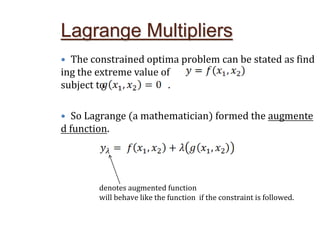
Lagrange Multipliers
 The constrained optima problem can be stated as find
ing the extreme value of
subject to .
 So Lagrange (a mathematician) formed the augmente
d function.
denotes augmented function
will behave like the function if the constraint is followed.
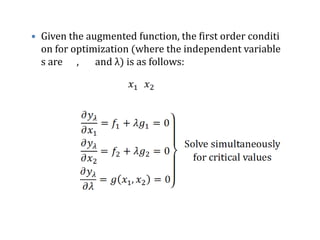
 Given the augmented function, the first order conditi
on for optimization (where the independent variable
s are , and λ) is as follows:
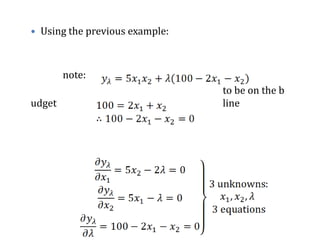
 Using the previous example:
note:
to be on the b
udget line
Lagrange Multipliers
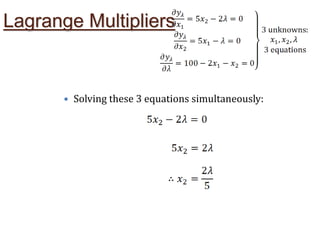
 Solving these 3 equations simultaneously:
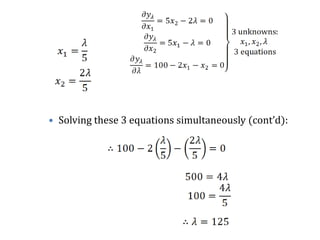
 Solving these 3 equations simultaneously (cont’d):
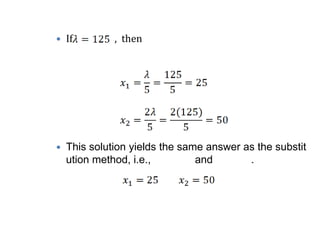
 If , then
 This solution yields the same answer as the substit
ution method, i.e., and .

Lagrange's method

  • 1.
  • 2.
    Lagrange Multipliers  Theconstrained optima problem can be stated as find ing the extreme value of subject to .  So Lagrange (a mathematician) formed the augmente d function. denotes augmented function will behave like the function if the constraint is followed.
  • 3.
     Given theaugmented function, the first order conditi on for optimization (where the independent variable s are , and λ) is as follows:
  • 4.
     Using theprevious example: note: to be on the b udget line
  • 5.
    Lagrange Multipliers  Solvingthese 3 equations simultaneously:
  • 6.
     Solving these3 equations simultaneously (cont’d):
  • 7.
     Solving these3 equations simultaneously (cont’d):
  • 8.
     If ,then  This solution yields the same answer as the substit ution method, i.e., and .