Lagrange Multiplier
Dr. Anjali Devi J S
Guest Faculty
School of Chemical Sciences
M G University
1
Opimisation of a function
Find maxima and minima of the function
To find maxima/minima of a function f(x):
d[f(x)]/dx= f’(x) =0
at x=a
f’’(a)>0 , a is minimum point
f’’(a)< 0 , a maximum point
2
Identify the absolute extrema and relative extrema for the following
function.
f(x)=x2 on[−1,2]
Question
Relative and absolute minimum of
zero at x=0 and an absolute
maximum of four at x=2
Answer
3
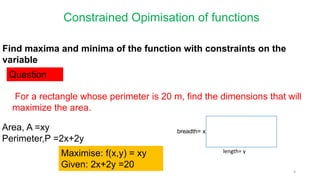
Constrained Opimisation of functions
Find maxima and minima of the function with constraints on the
variable
For a rectangle whose perimeter is 20 m, find the dimensions that will
maximize the area.
Question
breadth= x
length= y
Area, A =xy
Perimeter,P =2x+2y
Maximise: f(x,y) = xy
Given: 2x+2y =20
4
Find maxima and minima of the function with constraints on the
variable
For a rectangle whose perimeter is 20 m, find the dimensions that will
maximize the area.
Question
Constrained Opimisation of functions
f (x,y) =xy (1)
2x+2y =20 (2)
From (2), y=10-x
Substituting y,
f(x,y) = 10x-x2
On the interval [0,10]
f’(x) =10-2x=0
x=5
f’’(5)=-2<0
breadth= x=5
length= y=5
X=y=5 is a
maximum point
5
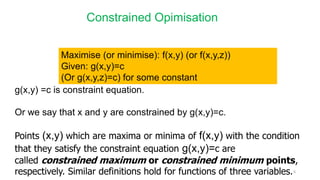
Constrained Opimisation
Maximise (or minimise): f(x,y) (or f(x,y,z))
Given: g(x,y)=c
(Or g(x,y,z)=c) for some constant
g(x,y) =c is constraint equation.
Or we say that x and y are constrained by g(x,y)=c.
Points (x,y) which are maxima or minima of f(x,y) with the condition
that they satisfy the constraint equation g(x,y)=c are
called constrained maximum or constrained minimum points,
respectively. Similar definitions hold for functions of three variables.6
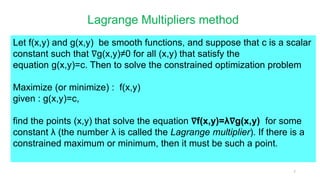
Lagrange Multipliers method
Let f(x,y) and g(x,y) be smooth functions, and suppose that c is a scalar
constant such that ∇g(x,y)≠0 for all (x,y) that satisfy the
equation g(x,y)=c. Then to solve the constrained optimization problem
Maximize (or minimize) : f(x,y)
given : g(x,y)=c,
find the points (x,y) that solve the equation ∇f(x,y)=λ∇g(x,y) for some
constant λ (the number λ is called the Lagrange multiplier). If there is a
constrained maximum or minimum, then it must be such a point.
7
For a rectangle whose perimeter is 20 m, find the dimensions that will
maximize the area.
Question
length= y
breadth= x
Area ,A=xy
Perimeter,P =2x+2y
Maximise: f(x,y) = xy
Given: 2x+2y =20
∇f(x,y)=λ∇g(x,y)
∂f/∂x=λ∂g/∂x and ∂f/∂y=λ∂g/∂y
y=2λ,
x=2λ i.e., x=y
Substitute either of the
expressions for x or y into
the constraint equation
20=g(x,y)=2x+2y=2x+2x=4x
⇒x=5
⇒y=5
∴ The maximum area occurs for a rectangle whose width and height both
are 5 m. 8
Maximixe (Minimise): f(x,y) =(𝑥 − 1)2+(𝑦 − 2)2
Given: g(x,y) = 𝑥2 +𝑦2= 80
Answer
Distance, d, between points (x,y) and
(1,2) == (𝑥 − 1)2+(𝑦 − 2)2
∇f(x,y)=λ∇g(x,y)
∂f/∂x=λ∂g/∂x and ∂f/∂y=λ∂g/∂y
2 (x-1) =2λx,
2 (y-2)=2λy
i.e., y=2x
Substitute this into
g(x,y) = 𝑥2
+𝑦2
= 80
5𝑥2= 80
𝑥 = ∓4
x
y
(4,8)
(1,2)
(-4,-8)
f(4,8)=45 ,
f(-4,-8) = 125 9
Question
Find the points on the circle x2+y2=80 which are closest to and farthest
from the point (1,2).
10
Question (Continued)
Find the points on the circle x2+y2=80 which are closest to and farthest
from the point (1,2).
∴ The two critical points are
(4,8) and (-4,-8).
f(4.8)< f(-4,-8)
Constrained Maximum point: (-4,-8)
Constrained Minimum point: (4,8)
Maximize (and minimize) : f(x,y,z)=x+z
given :g(x,y,z)=x2+y2+z2=1
Answer
Question
∇f(x,y)=λ∇g(x,y)
∂f/∂x=λ∂g/∂x and ∂f/∂y=λ∂g/∂y
1=2λx
0=2λy
1=2λz
y=0
x=
1
2λ
=z
Substitute this into constraint
equation g(x,y,z)=x2+y2+z2=1
Critical points: (
1
2
, 0,
1
2
)
and (
−1
2
, 0,
−1
2
)
f (
1
2
, 0,
1
2
) > f (
−1
2
, 0,
−1
2
)
Constrained Maximum point: (
1
2
, 0,
1
2
)
Constrained Minimum point : (
−1
2
, 0,
−1
2
)
11

Lagrange multiplier

  • 1.
    Lagrange Multiplier Dr. AnjaliDevi J S Guest Faculty School of Chemical Sciences M G University 1
  • 2.
    Opimisation of afunction Find maxima and minima of the function To find maxima/minima of a function f(x): d[f(x)]/dx= f’(x) =0 at x=a f’’(a)>0 , a is minimum point f’’(a)< 0 , a maximum point 2
  • 3.
    Identify the absoluteextrema and relative extrema for the following function. f(x)=x2 on[−1,2] Question Relative and absolute minimum of zero at x=0 and an absolute maximum of four at x=2 Answer 3
  • 4.
    Constrained Opimisation offunctions Find maxima and minima of the function with constraints on the variable For a rectangle whose perimeter is 20 m, find the dimensions that will maximize the area. Question breadth= x length= y Area, A =xy Perimeter,P =2x+2y Maximise: f(x,y) = xy Given: 2x+2y =20 4
  • 5.
    Find maxima andminima of the function with constraints on the variable For a rectangle whose perimeter is 20 m, find the dimensions that will maximize the area. Question Constrained Opimisation of functions f (x,y) =xy (1) 2x+2y =20 (2) From (2), y=10-x Substituting y, f(x,y) = 10x-x2 On the interval [0,10] f’(x) =10-2x=0 x=5 f’’(5)=-2<0 breadth= x=5 length= y=5 X=y=5 is a maximum point 5
  • 6.
    Constrained Opimisation Maximise (orminimise): f(x,y) (or f(x,y,z)) Given: g(x,y)=c (Or g(x,y,z)=c) for some constant g(x,y) =c is constraint equation. Or we say that x and y are constrained by g(x,y)=c. Points (x,y) which are maxima or minima of f(x,y) with the condition that they satisfy the constraint equation g(x,y)=c are called constrained maximum or constrained minimum points, respectively. Similar definitions hold for functions of three variables.6
  • 7.
    Lagrange Multipliers method Letf(x,y) and g(x,y) be smooth functions, and suppose that c is a scalar constant such that ∇g(x,y)≠0 for all (x,y) that satisfy the equation g(x,y)=c. Then to solve the constrained optimization problem Maximize (or minimize) : f(x,y) given : g(x,y)=c, find the points (x,y) that solve the equation ∇f(x,y)=λ∇g(x,y) for some constant λ (the number λ is called the Lagrange multiplier). If there is a constrained maximum or minimum, then it must be such a point. 7
  • 8.
    For a rectanglewhose perimeter is 20 m, find the dimensions that will maximize the area. Question length= y breadth= x Area ,A=xy Perimeter,P =2x+2y Maximise: f(x,y) = xy Given: 2x+2y =20 ∇f(x,y)=λ∇g(x,y) ∂f/∂x=λ∂g/∂x and ∂f/∂y=λ∂g/∂y y=2λ, x=2λ i.e., x=y Substitute either of the expressions for x or y into the constraint equation 20=g(x,y)=2x+2y=2x+2x=4x ⇒x=5 ⇒y=5 ∴ The maximum area occurs for a rectangle whose width and height both are 5 m. 8
  • 9.
    Maximixe (Minimise): f(x,y)=(𝑥 − 1)2+(𝑦 − 2)2 Given: g(x,y) = 𝑥2 +𝑦2= 80 Answer Distance, d, between points (x,y) and (1,2) == (𝑥 − 1)2+(𝑦 − 2)2 ∇f(x,y)=λ∇g(x,y) ∂f/∂x=λ∂g/∂x and ∂f/∂y=λ∂g/∂y 2 (x-1) =2λx, 2 (y-2)=2λy i.e., y=2x Substitute this into g(x,y) = 𝑥2 +𝑦2 = 80 5𝑥2= 80 𝑥 = ∓4 x y (4,8) (1,2) (-4,-8) f(4,8)=45 , f(-4,-8) = 125 9 Question Find the points on the circle x2+y2=80 which are closest to and farthest from the point (1,2).
  • 10.
    10 Question (Continued) Find thepoints on the circle x2+y2=80 which are closest to and farthest from the point (1,2). ∴ The two critical points are (4,8) and (-4,-8). f(4.8)< f(-4,-8) Constrained Maximum point: (-4,-8) Constrained Minimum point: (4,8)
  • 11.
    Maximize (and minimize): f(x,y,z)=x+z given :g(x,y,z)=x2+y2+z2=1 Answer Question ∇f(x,y)=λ∇g(x,y) ∂f/∂x=λ∂g/∂x and ∂f/∂y=λ∂g/∂y 1=2λx 0=2λy 1=2λz y=0 x= 1 2λ =z Substitute this into constraint equation g(x,y,z)=x2+y2+z2=1 Critical points: ( 1 2 , 0, 1 2 ) and ( −1 2 , 0, −1 2 ) f ( 1 2 , 0, 1 2 ) > f ( −1 2 , 0, −1 2 ) Constrained Maximum point: ( 1 2 , 0, 1 2 ) Constrained Minimum point : ( −1 2 , 0, −1 2 ) 11