COOLING TOWER SEMINAR
AGENDA
AGENDA
1.
1. Types Of Cooling Systems.
Types Of Cooling Systems.
2.
2. Types Of Cooling Towers
Types Of Cooling Towers
3.
3. Cooling Towers Definitions & Calculation.
Cooling Towers Definitions & Calculation.
4.
4. Basic Cooling Water Treatment principles.
Basic Cooling Water Treatment principles.
5.
5. Microbiological Contamination.
Microbiological Contamination.
6.
6. Veolia Water Approach To Control Legionella.
Veolia Water Approach To Control Legionella.
1. TYPES OF COOLING SYSTEM
X 3 kinds of cooling systems..
9 Once-Through.
9 Closed Loop.
9 Cooling Towers ( Open Circuit).
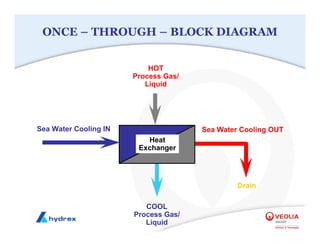
ONCE – THROUGH – BLOCK DIAGRAM
Sea Water Cooling IN Sea Water Cooling OUT
Drain
HOT
Process Gas/
Liquid
COOL
Process Gas/
Liquid
Heat
Exchanger
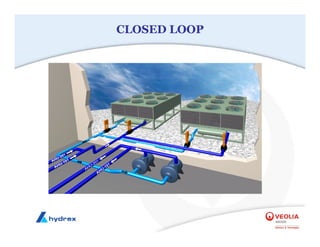
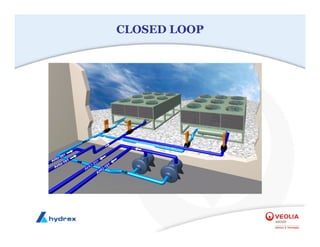
CLOSED LOOP
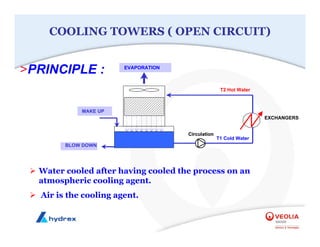
COOLING TOWERS ( OPEN CIRCUIT)
Circulation
EVAPORATION
APPOINT
Circulation
EVAPORATION
MAKE UP
BLOW DOWN
EXCHANGERS
Circulation
¾ Water cooled after having cooled the process on an
atmospheric cooling agent.
¾ Air is the cooling agent.
>PRINCIPLE :
T1 Cold Water
T2 Hot Water
X Definition of a Cooling Tower
•“A device which provides optimum
air/water contact in order to cool that
water by evaporation”.
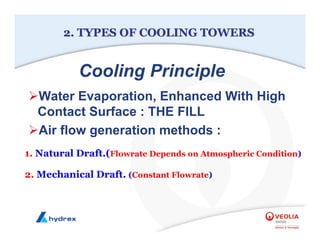
2. TYPES OF COOLING TOWERS
¾Water Evaporation, Enhanced With High
Contact Surface : THE FILL
¾Air flow generation methods :
1. Natural Draft.(Flowrate Depends on Atmospheric Condition)
2. Mechanical Draft. (Constant Flowrate)
Cooling Principle
Rule of Thumb...
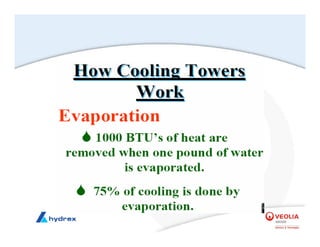
1 BTU will raise the
temperature of 1
pound of water 1
degree Fahrenheit.
TYPES OF COOLING TOWERS
1.
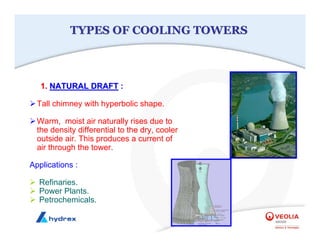
1. NATURAL DRAFT
NATURAL DRAFT :
¾Tall chimney with hyperbolic shape.
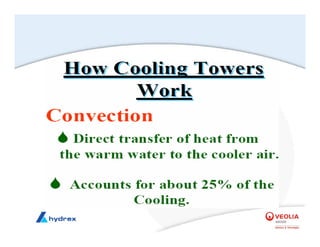
¾Warm, moist air naturally rises due to
the density differential to the dry, cooler
outside air. This produces a current of
air through the tower.
Applications :
¾ Refinaries.
¾ Power Plants.
¾ Petrochemicals.
TYPES OF COOLING TOWERS
2. MECHANICAL DRAFT COOLING TOWERS
which uses power driven fan motors to force or draw air through the tower.
Three types……
A. Forced draft.
B. Induced draft cross flow.
C. Induced draft counter flow.
TYPES OF
TYPES OF
MECHANICAL DRAFT COOLING TOWERS
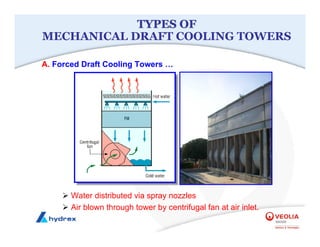
A. Forced Draft Cooling Towers …
¾ Water distributed via spray nozzles
¾ Air blown through tower by centrifugal fan at air inlet.
TYPES OF
TYPES OF
MECHANICAL DRAFT COOLING TOWERS
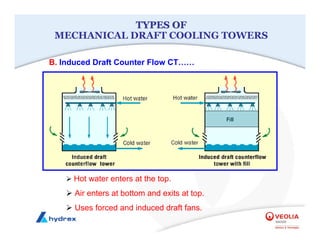
B. Induced Draft Counter Flow CT……
¾ Hot water enters at the top.
¾ Air enters at bottom and exits at top.
¾ Uses forced and induced draft fans.
Module 1.1.0.4
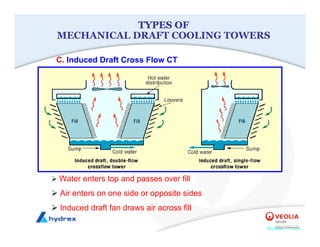
C. Induced Draft Cross Flow CT
¾ Water enters top and passes over fill
¾ Air enters on one side or opposite sides
¾ Induced draft fan draws air across fill
TYPES OF
TYPES OF
MECHANICAL DRAFT COOLING TOWERS
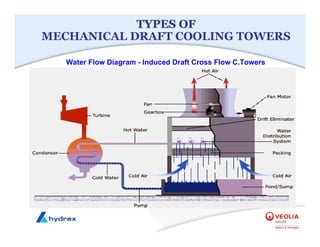
Water Flow Diagram - Induced Draft Cross Flow C.Towers
TYPES OF
TYPES OF
MECHANICAL DRAFT COOLING TOWERS
3. COOLING TOWERS
3. COOLING TOWERS
DEFINITIONS & CALCULATIONS
X Water is recirculated over a cooling tower
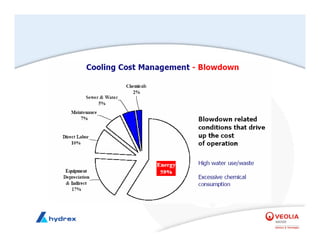
and cooled. Makeup replaces water losses.
X Loss of water occurs from:
•
• Evaporation
Evaporation
•
• Blowdown
Blowdown
•
• Windage
Windage
Cooling Water Mass Balance
9 MAKE UP WATER.
9 RE-CIRCULATION RATE.
9 TEMPERATURE DIFFERENTIAL (∆T)
9 EVAPORATION RATE.
9 BLOW DOWN RATE.
9 WINDAGE RATE
PARAMETERS FOR
WATER CALCULATIONS
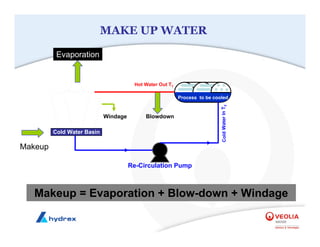
Evaporation
Makeup
Blowdown
Process to be cooled
Re-Circulation Pump
Cold
Water
In
T
2
Hot Water Out T1
Makeup = Evaporation + Blow-down + Windage
Windage
Cold Water Basin
MAKE UP WATER
It is the Flow of cooling water being pumped
through the entire plant cooling loop.
RECIRCULATION RATE (R.R)
Temperature Differential (∆T)
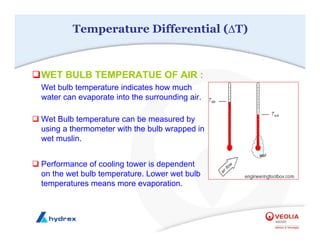
‰WET BULB TEMPERATUE OF AIR :
Wet bulb temperature indicates how much
water can evaporate into the surrounding air.
‰ Wet Bulb temperature can be measured by
using a thermometer with the bulb wrapped in
wet muslin.
‰ Performance of cooling tower is dependent
on the wet bulb temperature. Lower wet bulb
temperatures means more evaporation.
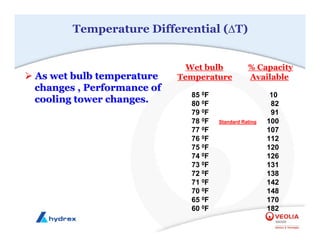
Temperature Differential (∆T)
Wet bulb % Capacity
Temperature Available
85 0F 10
80 0F 82
79 0F 91
78 0F Standard Rating 100
77 0F 107
76 0F 112
75 0F 120
74 0F 126
73 0F 131
72 0F 138
71 0F 142
70 0F 148
65 0F 170
60 0F 182
¾
¾ As wet bulb temperature
As wet bulb temperature
changes , Performance of
cooling tower changes.
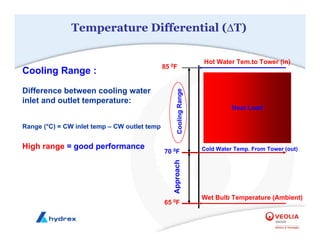
Cooling Range :
Difference between cooling water
inlet and outlet temperature:
Range (°C) = CW inlet temp – CW outlet temp
High range = good performance
Cooling
Range
Approach
Hot Water Tem.to Tower (in)
Wet Bulb Temperature (Ambient)
85 0F
70 0F
65 0F
Temperature Differential (∆T)
Cold Water Temp. From Tower (out)
Heat Load
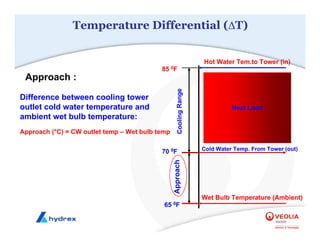
Approach :
Difference between cooling tower
outlet cold water temperature and
ambient wet bulb temperature:
Approach (°C) = CW outlet temp – Wet bulb temp
Temperature Differential (∆T)
Cooling
Range
Approach
Hot Water Tem.to Tower (in)
Wet Bulb Temperature (Ambient)
85 0F
70 0F
65 0F
Cold Water Temp. From Tower (out)
Heat Load
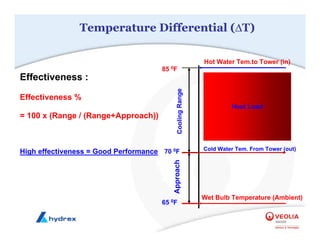
Effectiveness :
Effectiveness %
= 100 x (Range / (Range+Approach))
High effectiveness = Good Performance
Temperature Differential (∆T)
Cooling
Range
Approach
Hot Water Tem.to Tower (in)
Cold Water Tem. From Tower (out)
Wet Bulb Temperature (Ambient)
Heat Load
85 0F
70 0F
65 0F
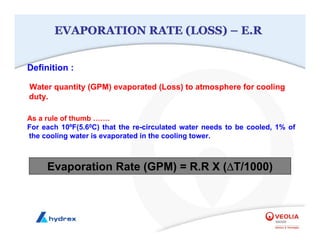
EVAPORATION RATE (LOSS)
EVAPORATION RATE (LOSS) –
– E.R
E.R
Definition :
Water quantity (GPM) evaporated (Loss) to atmosphere for cooling
duty.
As a rule of thumb …….
For each 10ºF(5.60C) that the re-circulated water needs to be cooled, 1% of
the cooling water is evaporated in the cooling tower.
Evaporation Rate (GPM) = R.R X (∆T/1000)
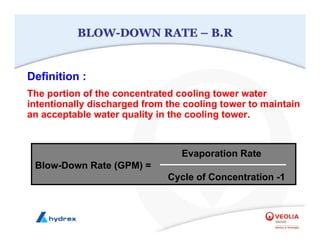
BLOW
BLOW-
-DOWN RATE
DOWN RATE –
– B.R
B.R
Definition :
The portion of the concentrated cooling tower water
intentionally discharged from the cooling tower to maintain
an acceptable water quality in the cooling tower.
Evaporation Rate
Blow-Down Rate (GPM) =
Cycle of Concentration -1
CYCLE OF CONCENTRATON
CYCLE OF CONCENTRATON –
– C.C
C.C
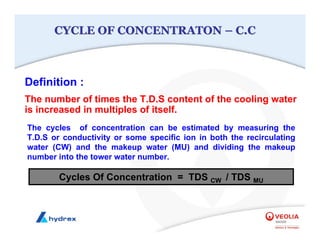
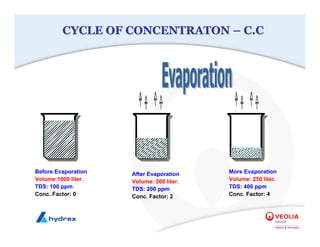
Definition :
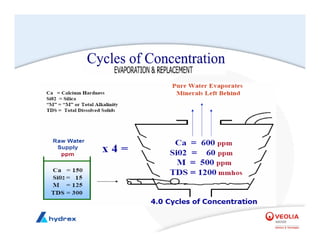
The number of times the T.D.S content of the cooling water
is increased in multiples of itself.
The cycles of concentration can be estimated by measuring the
T.D.S or conductivity or some specific ion in both the recirculating
water (CW) and the makeup water (MU) and dividing the makeup
number into the tower water number.
Cycles Of Concentration = TDS CW / TDS MU
CYCLE OF CONCENTRATON
CYCLE OF CONCENTRATON –
– C.C
C.C
After Evaporation
Volume: 500 liter.
TDS: 200 ppm
Conc. Factor: 2
Before Evaporation
Volume:1000 liter.
TDS: 100 ppm
Conc. Factor: 0
More Evaporation
Volume: 250 liter.
TDS: 400 ppm
Conc. Factor: 4
CYCLE OF CONCENTRATON
CYCLE OF CONCENTRATON –
– C.C
C.C
0
0.5
1
1.5
2
2.5
3
3.5
0 1 2 3 4 5 6 7
Concentration
M
a
k
e
u
p
w
a
t
e
r
(
m
3
/h
)
With E = 1 m3/h
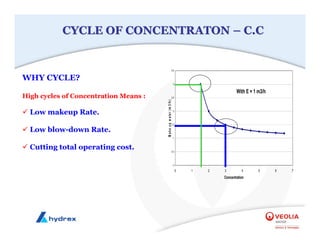
WHY CYCLE?
High cycles of Concentration Means :
9 Low makeup Rate.
9 Low blow-down Rate.
9 Cutting total operating cost.
WINDAGE
WINDAGE
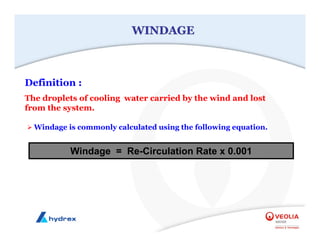
¾ Windage is commonly calculated using the following equation.
Definition :
The droplets of cooling water carried by the wind and lost
from the system.
Windage = Re-Circulation Rate x 0.001
EXAMPLE
EXAMPLE…
…
A cooling tower system currently circulates water at the rate of 10,000 GPM
and the cooling tower needs to cool the warmed water exiting the heat
exchanger from 90ºF to 80ºF degrees (or reduce the temperature of the water
by 10ºF), TDS of make up water is 100 ppm and cooling water 500 ppm.
X Calculate The Following :
• Evaporation Rate
• Cycle Of Concentration
• Blow-down Rate.
• Windage.
• Makeup Rate
4. Basic Cooling Water Treatment principles
Water Treatment is the most important factor
affecting the life and energy efficient operation
of cooling towers equipments
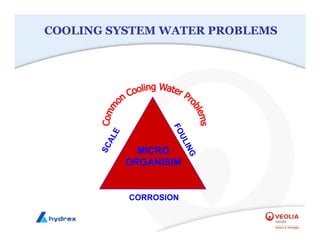
COOLING SYSTEM WATER PROBLEMS
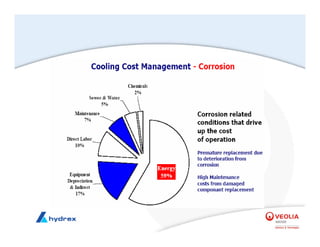
CORROSION
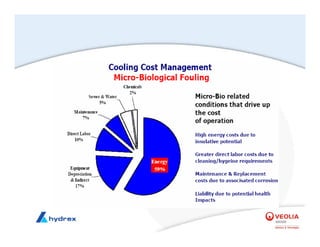
MICRO
ORGANISIM
F
O
U
L
I
N
G
S
C
A
L
E
MINERAL SCALE
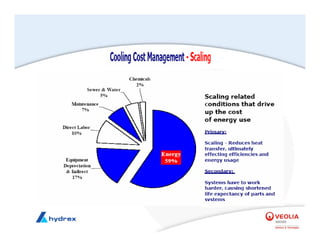
™Cooling Water contains many different minerals -- normally
these minerals are dissolved in the water
™Under certain conditions minerals can come out of solution and
form into hard, dense crystals called SCALE.
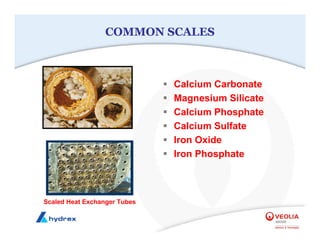
COMMON SCALES
ƒ Calcium Carbonate
ƒ Magnesium Silicate
ƒ Calcium Phosphate
ƒ Calcium Sulfate
ƒ Iron Oxide
ƒ Iron Phosphate
Scaled Heat Exchanger Tubes
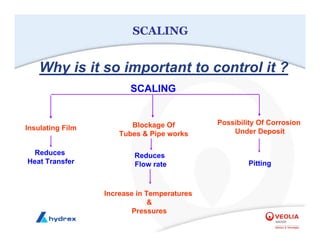
SCALING
Insulating Film
Possibility Of Corrosion
Under Deposit
Blockage Of
Tubes & Pipe works
Pitting
Reduces
Flow rate
SCALING
Reduces
Heat Transfer
Increase in Temperatures
&
Pressures
Why is it so important to control it ?
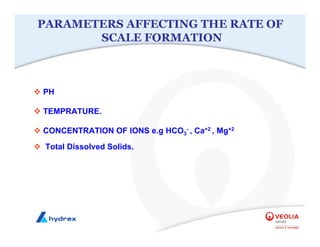
™ PH
™ TEMPRATURE.
™ CONCENTRATION OF IONS e.g HCO3
- , Ca+2 , Mg+2
™ Total Dissolved Solids.
PARAMETERS AFFECTING THE RATE OF
SCALE FORMATION
PARAMETERS AFFECTING THE RATE OF
SCALE FORMATION
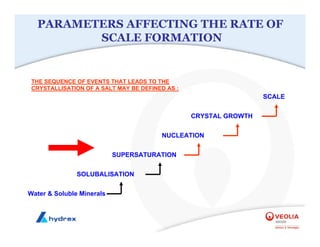
SOLUBALISATION
SUPERSATURATION
NUCLEATION
CRYSTAL GROWTH
Water & Soluble Minerals
THE SEQUENCE OF EVENTS THAT LEADS TO THE
CRYSTALLISATION OF A SALT MAY BE DEFINED AS :
SCALE
PARAMETERS AFFECTING THE RATE OF
SCALE FORMATION
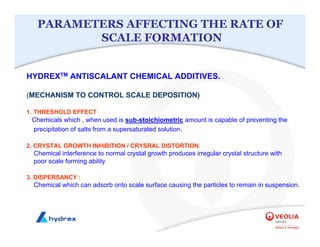
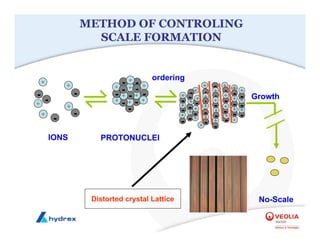
HYDREXTM ANTISCALANT CHEMICAL ADDITIVES.
(MECHANISM TO CONTROL SCALE DEPOSITION)
1. THRESHOLD EFFECT
Chemicals which , when used is sub-stoichiometric amount is capable of preventing the
precipitation of salts from a supersaturated solution.
2. CRYSTAL GROWTH INHIBITION / CRYSRAL DISTORTION.
Chemical interference to normal crystal growth produces irregular crystal structure with
poor scale forming ability
3. DISPERSANCY :
Chemical which can adsorb onto scale surface causing the particles to remain in suspension.
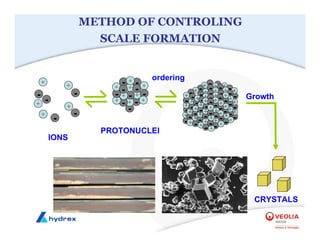
METHOD OF CONTROLING
SCALE FORMATION
- +
- +
-
+
-
-
+
-
+
-
+
-
+
-
+
-
+
-
-+ - +
+- + - +
-+ - + -
+ -+ -
- + -+
+ -
-
+
-
+
+
-
+
-
+
-
+
-
+
-
+
-
+
-
+
-
+
-
-
+
-
+
-
+
-
+
- +
+
+
-
-+
-
+
-
-
+
+
-
+
-
+
-
+
-
+
-
+
-
+
-
+
-
-
+
+
-
+
-
+
-
+
-
+
-
-
+
IONS
PROTONUCLEI
NUCLEI
CRYSTALS
Growth
ordering
METHOD OF CONTROLING
SCALE FORMATION
No-Scale
- +
- +
+
+
-
-
+
+
-
- +
+
- + +
- + - -
+ - +
- + -
+ -
-
+
-
+
-
+
-
+
-
+
-
+
+
-
+
-
+
-
+
-
-
+
-
+
-
+
-
+
- +
+
+
-
-
-
+
-
+
-
+
+
-
+
-
-
+
+
-
+
-
+
-
+
-
+
-
-
+
IONS PROTONUCLEI NUCLEI
Growth
ordering
Distorted crystal Lattice
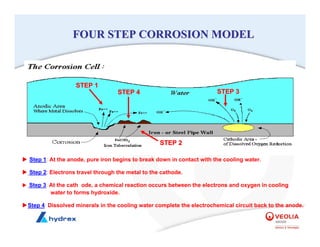
STEP 3
STEP 3
STEP 2
STEP 2
STEP 1
STEP 1
STEP 4
STEP 4
X Step 1: At the anode, pure iron begins to break down in contact with the cooling water.
X Step 2: Electrons travel through the metal to the cathode.
X Step 3: At the cath ode, a chemical reaction occurs between the electrons and oxygen in cooling
water to forms hydroxide.
XStep 4: Dissolved minerals in the cooling water complete the electrochemical circuit back to the anode.
FOUR STEP CORROSION MODEL
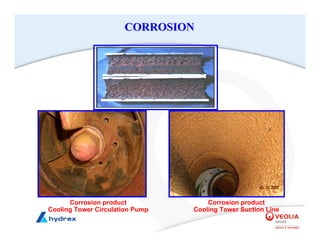
CORROSION
CORROSION
Corrosion product
Cooling Tower Suction Line
Corrosion product
Cooling Tower Circulation Pump
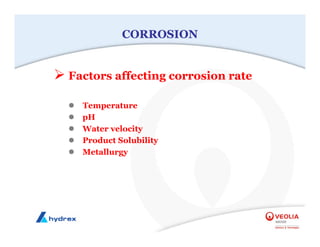
CORROSION
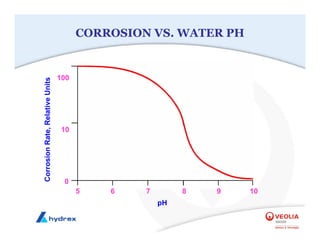
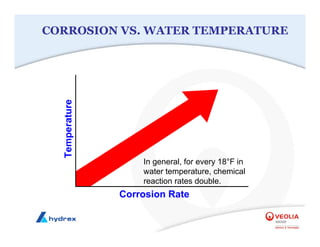
¾ Factors affecting corrosion rate
z Temperature
z pH
z Water velocity
z Product Solubility
z Metallurgy
100
10
0
5 6 7 8 9 10
Corrosion
Rate,
Relative
Units
pH
CORROSION VS. WATER PH
Corrosion Rate
Temperature
In general, for every 18°F in
water temperature, chemical
reaction rates double.
CORROSION VS. WATER TEMPERATURE
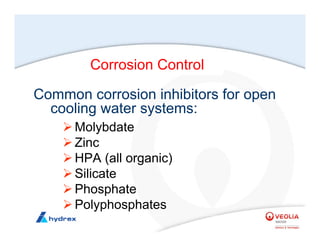
Corrosion Control
Common corrosion inhibitors for open
cooling water systems:
¾Molybdate
¾Zinc
¾HPA (all organic)
¾Silicate
¾Phosphate
¾Polyphosphates
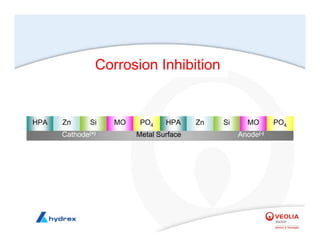
Corrosion Inhibition
Cathode(+) Anode(-)
Metal Surface
HPA Zn Si MO PO4 HPA Zn Si MO PO4
METHODS TO CONTROL CORROSION
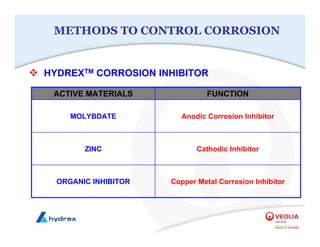
™ HYDREXTM CORROSION INHIBITOR
Copper Metal Corrosion Inhibitor
ORGANIC INHIBITOR
Cathodic Inhibitor
ZINC
Anodic Corrosion Inhibitor
MOLYBDATE
FUNCTION
ACTIVE MATERIALS
METHODS TO CONTROL CORROSION
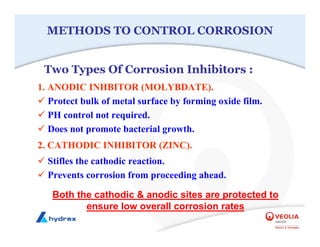
1. ANODIC INHBITOR (MOLYBDATE).
9 Protect bulk of metal surface by forming oxide film.
9 PH control not required.
9 Does not promote bacterial growth.
2. CATHODIC INHIBITOR (ZINC).
9 Stifles the cathodic reaction.
9 Prevents corrosion from proceeding ahead.
Both the cathodic & anodic sites are protected to
ensure low overall corrosion rates
Two Types Of Corrosion Inhibitors :
MONITORING TOOLS TO CONTROL CORROSION
Designed By
Metito/Veolia Water Solutions & Technologies
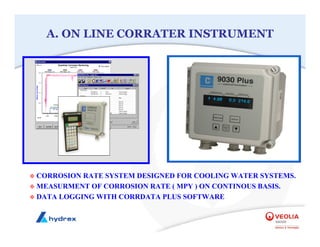
A. ON LINE CORRATER INSTRUMENT
™ CORROSION RATE SYSTEM DESIGNED FOR COOLING WATER SYSTEMS.
™ MEASURMENT OF CORROSION RATE ( MPY ) ON CONTINOUS BASIS.
™ DATA LOGGING WITH CORRDATA PLUS SOFTWARE
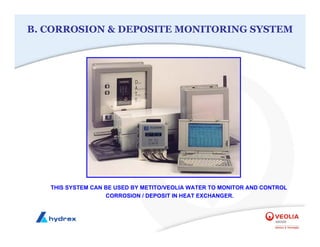
B. CORROSION & DEPOSITE MONITORING SYSTEM
THIS SYSTEM CAN BE USED BY METITO/VEOLIA WATER TO MONITOR AND CONTROL
CORROSION / DEPOSIT IN HEAT EXCHANGER.
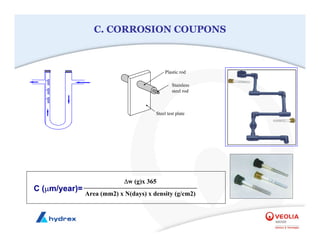
C. CORROSION COUPONS
Steel test plate
Plastic rod
Stainless
steel rod
Area (mm2) x N(days) x density (g/cm2)
∆w (g)x 365
C (µm/year)=
5.0 MICRO-BIOLOGICAL CONTAMINATION
¾ BACTERIA (MICROSCOPIC ANIMALS)
ƒ Aerobic
ƒ Anaerobic
¾ ALGAE (MICROSCOPIC PLANTS)
¾ Fungi/yeast (‘timber-eaters’)
Micro-Organism Contamination caused by…..
ALGAE
ALGAE
¾Large quantities of polysaccharides (slime) can be produced during
algal metabolism.
¾Plug screens, restrict flow and accelerate corrosion.
¾Provide excellent food source.
¾Exist between 5 to 65 C and pH 4 to 9.
¾ Although yeast and some aquatic fungi are normally unicellular, most
fungi are filamentous organisms
¾ Fungi form solid structures which can reach a considerable size.
¾ Fungi require presence of organic energy source.
¾ Exist at between 5 to 38 C and pH 2 to 9 with an optimum of 5 to 6.
FUNGI
FUNGI
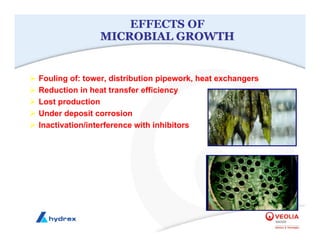
EFFECTS OF
MICROBIAL GROWTH
MICROBIAL GROWTH
¾ Fouling of: tower, distribution pipework, heat exchangers
¾ Reduction in heat transfer efficiency
¾ Lost production
¾ Under deposit corrosion
¾ Inactivation/interference with inhibitors
FACTORS CONTRIBUTING TO MICROBIAL GROWTH
¾Rate of incoming contamination
¾Amount of nutrient present
¾pH
¾Temperature
¾Sunlight
¾Availability of oxygen/carbon dioxide
¾Water velocities
Closed Systems
Closed loop water systems can be used
to cool or heat an area or process.
CLOSED LOOP
Closed Systems
¾ Water loss is usually less than 0.5% of the
system volume in a year.
¾ No water loss – no makeup.
¾ No concentration of solids so scale is
generally of no concern.
¾ Corrosion controlled by establishing a good
film barrier.
Closed Systems
Treatment objectives:
¾ Prevention of deposits from corrosion
by-products
¾ Prevention of microbiological fouling
(glycol can be a nutrient)
Water Treatment
¾ Corrosion Inhibitors
9 Nitrite-Borate-Triazole
9 Nitrite-Polyphosphate
9 Molybdate-Borate-Triazole
¾ Oxygen Scavenging
¾ Side-Stream Filtration
¾ Microbiological Control
¾ Glycol Systems and pH
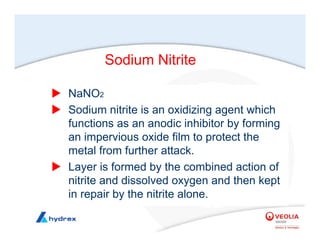
Sodium Nitrite
X NaNO2
X Sodium nitrite is an oxidizing agent which
functions as an anodic inhibitor by forming
an impervious oxide film to protect the
metal from further attack.
X Layer is formed by the combined action of
nitrite and dissolved oxygen and then kept
in repair by the nitrite alone.
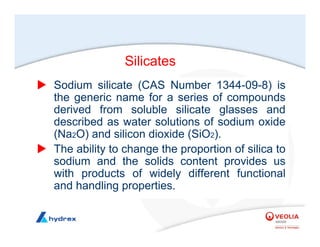
Silicates
X Sodium silicate (CAS Number 1344-09-8) is
the generic name for a series of compounds
derived from soluble silicate glasses and
described as water solutions of sodium oxide
(Na2O) and silicon dioxide (SiO2).
X The ability to change the proportion of silica to
sodium and the solids content provides us
with products of widely different functional
and handling properties.
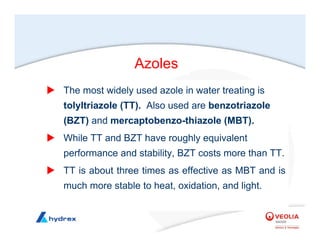
X The most widely used azole in water treating is
tolyltriazole (TT). Also used are benzotriazole
(BZT) and mercaptobenzo-thiazole (MBT).
X While TT and BZT have roughly equivalent
performance and stability, BZT costs more than TT.
X TT is about three times as effective as MBT and is
much more stable to heat, oxidation, and light.
Azoles
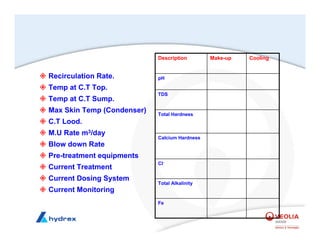
” Recirculation Rate.
” Temp at C.T Top.
” Temp at C.T Sump.
” Max Skin Temp (Condenser)
” C.T Lood.
” M.U Rate m3/day
” Blow down Rate
” Pre-treatment equipments
” Current Treatment
” Current Dosing System
” Current Monitoring
Total Alkalinity
Fe
Cl-
Calcium Hardness
Total Hardness
TDS
pH
Cooling
Make-up
Description
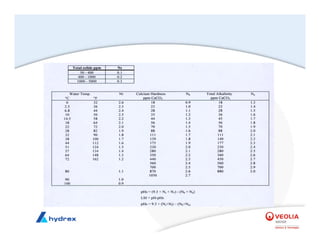
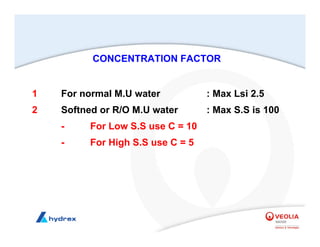
1 For normal M.U water : Max Lsi 2.5
2 Softned or R/O M.U water : Max S.S is 100
- For Low S.S use C = 10
- For High S.S use C = 5
CONCENTRATION FACTOR
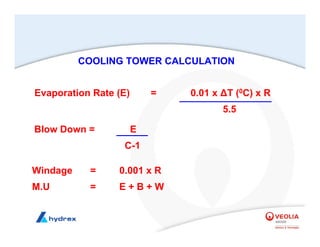
COOLING TOWER CALCULATION
Evaporation Rate (E) = 0.01 x ∆T (0C) x R
5.5
Blow Down = E
C-1
Windage = 0.001 x R
M.U = E + B + W
¡ Corrosion control
¡ Scale control
¡ Suspended Solids Control
¡ Microbological Control
TREATMENT PROGRAMME
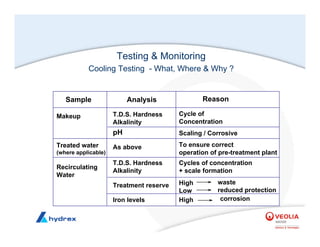
Testing & Monitoring
Cooling Testing - What, Where & Why ?
Sample Reason
Analysis
Makeup T.D.S. Hardness
Alkalinity
Cycle of
Concentration
pH Scaling / Corrosive
Treated water
(where applicable)
As above To ensure correct
operation of pre-treatment plant
Recirculating
Water
T.D.S. Hardness
Alkalinity
Cycles of concentration
+ scale formation
Treatment reserve High
Low
waste
reduced protection
Iron levels High corrosion
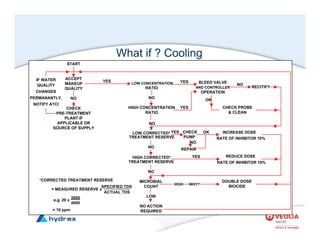
What if ? Cooling
LOW CONCENTRATION
RATIO
NO
HIGH CONCENTRATION
RATIO
NO
LOW CORRECTED*
TREATMENT RESERVE
NO
HIGH CORRECTED*
TREATMENT RESERVE
NO
MICROBIAL
COUNT
LOW
NO ACTION
REQUIRED
START
ACCEPT
MAKEUP
QUALITY
NO
CHECK
PRE-TREATMENT
PLANT IF
BLEED VALVE
AND CONTROLLER
OPERATION
RECITIFY
CHECK PROBE
& CLEAN
INCREASE DOSE
RATE OF INHIBITOR 10%
REDUCE DOSE
RATE OF INHIBITOR 10%
DOUBLE DOSE
BIOCIDE
OK
YES
YES
YES
NO
YES
YES
APPLICABLE OR
SOURCE OF SUPPLY
*CORRECTED TREATMENT RESERVE
= MEASURED RESERVE x
e.g. 20 x
= 10 ppm
SPECIFIED TDS
ACTUAL TDS
2000
4000
IF WATER
QUALITY
CHANGES
PERMANANTLY,
NOTIFY ATCI
REPAIR
CHECK
PUMP
OK
NO
HIGH WHY?

cooling towers system .pdf

  • 1.
  • 2.
    AGENDA AGENDA 1. 1. Types OfCooling Systems. Types Of Cooling Systems. 2. 2. Types Of Cooling Towers Types Of Cooling Towers 3. 3. Cooling Towers Definitions & Calculation. Cooling Towers Definitions & Calculation. 4. 4. Basic Cooling Water Treatment principles. Basic Cooling Water Treatment principles. 5. 5. Microbiological Contamination. Microbiological Contamination. 6. 6. Veolia Water Approach To Control Legionella. Veolia Water Approach To Control Legionella.
  • 3.
    1. TYPES OFCOOLING SYSTEM 1. TYPES OF COOLING SYSTEM X 3 kinds of cooling systems.. 9 Once-Through. 9 Closed Loop. 9 Cooling Towers ( Open Circuit).
  • 4.
    ONCE – THROUGH– BLOCK DIAGRAM Sea Water Cooling IN Sea Water Cooling OUT Drain HOT Process Gas/ Liquid COOL Process Gas/ Liquid Heat Exchanger
  • 5.
  • 6.
    COOLING TOWERS (OPEN CIRCUIT) Circulation EVAPORATION APPOINT Circulation EVAPORATION MAKE UP BLOW DOWN EXCHANGERS Circulation ¾ Water cooled after having cooled the process on an atmospheric cooling agent. ¾ Air is the cooling agent. >PRINCIPLE : T1 Cold Water T2 Hot Water
  • 7.
    X Definition ofa Cooling Tower •“A device which provides optimum air/water contact in order to cool that water by evaporation”.
  • 8.
    2. TYPES OFCOOLING TOWERS 2. TYPES OF COOLING TOWERS ¾Water Evaporation, Enhanced With High Contact Surface : THE FILL ¾Air flow generation methods : 1. Natural Draft.(Flowrate Depends on Atmospheric Condition) 2. Mechanical Draft. (Constant Flowrate) Cooling Principle
  • 9.
    Rule of Thumb... 1BTU will raise the temperature of 1 pound of water 1 degree Fahrenheit.
  • 10.
    TYPES OF COOLINGTOWERS TYPES OF COOLING TOWERS 1. 1. NATURAL DRAFT NATURAL DRAFT : ¾Tall chimney with hyperbolic shape. ¾Warm, moist air naturally rises due to the density differential to the dry, cooler outside air. This produces a current of air through the tower. Applications : ¾ Refinaries. ¾ Power Plants. ¾ Petrochemicals.
  • 11.
    TYPES OF COOLINGTOWERS TYPES OF COOLING TOWERS 2. MECHANICAL DRAFT COOLING TOWERS which uses power driven fan motors to force or draw air through the tower. Three types…… A. Forced draft. B. Induced draft cross flow. C. Induced draft counter flow.
  • 12.
    TYPES OF TYPES OF MECHANICALDRAFT COOLING TOWERS A. Forced Draft Cooling Towers … ¾ Water distributed via spray nozzles ¾ Air blown through tower by centrifugal fan at air inlet.
  • 13.
    TYPES OF TYPES OF MECHANICALDRAFT COOLING TOWERS B. Induced Draft Counter Flow CT…… ¾ Hot water enters at the top. ¾ Air enters at bottom and exits at top. ¾ Uses forced and induced draft fans.
  • 14.
    Module 1.1.0.4 C. InducedDraft Cross Flow CT ¾ Water enters top and passes over fill ¾ Air enters on one side or opposite sides ¾ Induced draft fan draws air across fill TYPES OF TYPES OF MECHANICAL DRAFT COOLING TOWERS
  • 15.
    Water Flow Diagram- Induced Draft Cross Flow C.Towers TYPES OF TYPES OF MECHANICAL DRAFT COOLING TOWERS
  • 16.
    3. COOLING TOWERS 3.COOLING TOWERS DEFINITIONS & CALCULATIONS DEFINITIONS & CALCULATIONS
  • 17.
    X Water isrecirculated over a cooling tower and cooled. Makeup replaces water losses. X Loss of water occurs from: • • Evaporation Evaporation • • Blowdown Blowdown • • Windage Windage Cooling Water Mass Balance
  • 18.
    9 MAKE UPWATER. 9 RE-CIRCULATION RATE. 9 TEMPERATURE DIFFERENTIAL (∆T) 9 EVAPORATION RATE. 9 BLOW DOWN RATE. 9 WINDAGE RATE PARAMETERS FOR WATER CALCULATIONS
  • 19.
    Evaporation Makeup Blowdown Process to becooled Re-Circulation Pump Cold Water In T 2 Hot Water Out T1 Makeup = Evaporation + Blow-down + Windage Windage Cold Water Basin MAKE UP WATER
  • 20.
    It is theFlow of cooling water being pumped through the entire plant cooling loop. RECIRCULATION RATE (R.R)
  • 21.
    Temperature Differential (∆T) ‰WETBULB TEMPERATUE OF AIR : Wet bulb temperature indicates how much water can evaporate into the surrounding air. ‰ Wet Bulb temperature can be measured by using a thermometer with the bulb wrapped in wet muslin. ‰ Performance of cooling tower is dependent on the wet bulb temperature. Lower wet bulb temperatures means more evaporation.
  • 22.
    Temperature Differential (∆T) Wetbulb % Capacity Temperature Available 85 0F 10 80 0F 82 79 0F 91 78 0F Standard Rating 100 77 0F 107 76 0F 112 75 0F 120 74 0F 126 73 0F 131 72 0F 138 71 0F 142 70 0F 148 65 0F 170 60 0F 182 ¾ ¾ As wet bulb temperature As wet bulb temperature changes , Performance of changes , Performance of cooling tower changes. cooling tower changes.
  • 23.
    Cooling Range : Differencebetween cooling water inlet and outlet temperature: Range (°C) = CW inlet temp – CW outlet temp High range = good performance Cooling Range Approach Hot Water Tem.to Tower (in) Wet Bulb Temperature (Ambient) 85 0F 70 0F 65 0F Temperature Differential (∆T) Cold Water Temp. From Tower (out) Heat Load
  • 24.
    Approach : Difference betweencooling tower outlet cold water temperature and ambient wet bulb temperature: Approach (°C) = CW outlet temp – Wet bulb temp Temperature Differential (∆T) Cooling Range Approach Hot Water Tem.to Tower (in) Wet Bulb Temperature (Ambient) 85 0F 70 0F 65 0F Cold Water Temp. From Tower (out) Heat Load
  • 25.
    Effectiveness : Effectiveness % =100 x (Range / (Range+Approach)) High effectiveness = Good Performance Temperature Differential (∆T) Cooling Range Approach Hot Water Tem.to Tower (in) Cold Water Tem. From Tower (out) Wet Bulb Temperature (Ambient) Heat Load 85 0F 70 0F 65 0F
  • 26.
    EVAPORATION RATE (LOSS) EVAPORATIONRATE (LOSS) – – E.R E.R Definition : Water quantity (GPM) evaporated (Loss) to atmosphere for cooling duty. As a rule of thumb ……. For each 10ºF(5.60C) that the re-circulated water needs to be cooled, 1% of the cooling water is evaporated in the cooling tower. Evaporation Rate (GPM) = R.R X (∆T/1000)
  • 27.
    BLOW BLOW- -DOWN RATE DOWN RATE– – B.R B.R Definition : The portion of the concentrated cooling tower water intentionally discharged from the cooling tower to maintain an acceptable water quality in the cooling tower. Evaporation Rate Blow-Down Rate (GPM) = Cycle of Concentration -1
  • 28.
    CYCLE OF CONCENTRATON CYCLEOF CONCENTRATON – – C.C C.C Definition : The number of times the T.D.S content of the cooling water is increased in multiples of itself. The cycles of concentration can be estimated by measuring the T.D.S or conductivity or some specific ion in both the recirculating water (CW) and the makeup water (MU) and dividing the makeup number into the tower water number. Cycles Of Concentration = TDS CW / TDS MU
  • 29.
    CYCLE OF CONCENTRATON CYCLEOF CONCENTRATON – – C.C C.C After Evaporation Volume: 500 liter. TDS: 200 ppm Conc. Factor: 2 Before Evaporation Volume:1000 liter. TDS: 100 ppm Conc. Factor: 0 More Evaporation Volume: 250 liter. TDS: 400 ppm Conc. Factor: 4
  • 30.
    CYCLE OF CONCENTRATON CYCLEOF CONCENTRATON – – C.C C.C 0 0.5 1 1.5 2 2.5 3 3.5 0 1 2 3 4 5 6 7 Concentration M a k e u p w a t e r ( m 3 /h ) With E = 1 m3/h WHY CYCLE? High cycles of Concentration Means : 9 Low makeup Rate. 9 Low blow-down Rate. 9 Cutting total operating cost.
  • 31.
    WINDAGE WINDAGE ¾ Windage iscommonly calculated using the following equation. Definition : The droplets of cooling water carried by the wind and lost from the system. Windage = Re-Circulation Rate x 0.001
  • 32.
    EXAMPLE EXAMPLE… … A cooling towersystem currently circulates water at the rate of 10,000 GPM and the cooling tower needs to cool the warmed water exiting the heat exchanger from 90ºF to 80ºF degrees (or reduce the temperature of the water by 10ºF), TDS of make up water is 100 ppm and cooling water 500 ppm. X Calculate The Following : • Evaporation Rate • Cycle Of Concentration • Blow-down Rate. • Windage. • Makeup Rate
  • 33.
    4. Basic CoolingWater Treatment principles 4. Basic Cooling Water Treatment principles Water Treatment is the most important factor Water Treatment is the most important factor affecting the life and energy efficient operation affecting the life and energy efficient operation of cooling towers equipments of cooling towers equipments
  • 34.
    COOLING SYSTEM WATERPROBLEMS CORROSION MICRO ORGANISIM F O U L I N G S C A L E
  • 35.
    MINERAL SCALE ™Cooling Watercontains many different minerals -- normally these minerals are dissolved in the water ™Under certain conditions minerals can come out of solution and form into hard, dense crystals called SCALE.
  • 36.
    COMMON SCALES ƒ CalciumCarbonate ƒ Magnesium Silicate ƒ Calcium Phosphate ƒ Calcium Sulfate ƒ Iron Oxide ƒ Iron Phosphate Scaled Heat Exchanger Tubes
  • 37.
    SCALING Insulating Film Possibility OfCorrosion Under Deposit Blockage Of Tubes & Pipe works Pitting Reduces Flow rate SCALING Reduces Heat Transfer Increase in Temperatures & Pressures Why is it so important to control it ?
  • 38.
    ™ PH ™ TEMPRATURE. ™CONCENTRATION OF IONS e.g HCO3 - , Ca+2 , Mg+2 ™ Total Dissolved Solids. PARAMETERS AFFECTING THE RATE OF SCALE FORMATION
  • 39.
    PARAMETERS AFFECTING THERATE OF SCALE FORMATION SOLUBALISATION SUPERSATURATION NUCLEATION CRYSTAL GROWTH Water & Soluble Minerals THE SEQUENCE OF EVENTS THAT LEADS TO THE CRYSTALLISATION OF A SALT MAY BE DEFINED AS : SCALE
  • 40.
    PARAMETERS AFFECTING THERATE OF SCALE FORMATION HYDREXTM ANTISCALANT CHEMICAL ADDITIVES. (MECHANISM TO CONTROL SCALE DEPOSITION) 1. THRESHOLD EFFECT Chemicals which , when used is sub-stoichiometric amount is capable of preventing the precipitation of salts from a supersaturated solution. 2. CRYSTAL GROWTH INHIBITION / CRYSRAL DISTORTION. Chemical interference to normal crystal growth produces irregular crystal structure with poor scale forming ability 3. DISPERSANCY : Chemical which can adsorb onto scale surface causing the particles to remain in suspension.
  • 41.
    METHOD OF CONTROLING SCALEFORMATION - + - + - + - - + - + - + - + - + - + - -+ - + +- + - + -+ - + - + -+ - - + -+ + - - + - + + - + - + - + - + - + - + - + - + - - + - + - + - + - + + + - -+ - + - - + + - + - + - + - + - + - + - + - - + + - + - + - + - + - - + IONS PROTONUCLEI NUCLEI CRYSTALS Growth ordering
  • 42.
    METHOD OF CONTROLING SCALEFORMATION No-Scale - + - + + + - - + + - - + + - + + - + - - + - + - + - + - - + - + - + - + - + - + + - + - + - + - - + - + - + - + - + + + - - - + - + - + + - + - - + + - + - + - + - + - - + IONS PROTONUCLEI NUCLEI Growth ordering Distorted crystal Lattice
  • 43.
    STEP 3 STEP 3 STEP2 STEP 2 STEP 1 STEP 1 STEP 4 STEP 4 X Step 1: At the anode, pure iron begins to break down in contact with the cooling water. X Step 2: Electrons travel through the metal to the cathode. X Step 3: At the cath ode, a chemical reaction occurs between the electrons and oxygen in cooling water to forms hydroxide. XStep 4: Dissolved minerals in the cooling water complete the electrochemical circuit back to the anode. FOUR STEP CORROSION MODEL FOUR STEP CORROSION MODEL
  • 44.
    CORROSION CORROSION Corrosion product Cooling TowerSuction Line Corrosion product Cooling Tower Circulation Pump
  • 45.
    CORROSION ¾ Factors affectingcorrosion rate z Temperature z pH z Water velocity z Product Solubility z Metallurgy
  • 46.
    100 10 0 5 6 78 9 10 Corrosion Rate, Relative Units pH CORROSION VS. WATER PH
  • 47.
    Corrosion Rate Temperature In general,for every 18°F in water temperature, chemical reaction rates double. CORROSION VS. WATER TEMPERATURE
  • 48.
    Corrosion Control Common corrosioninhibitors for open cooling water systems: ¾Molybdate ¾Zinc ¾HPA (all organic) ¾Silicate ¾Phosphate ¾Polyphosphates
  • 49.
    Corrosion Inhibition Cathode(+) Anode(-) MetalSurface HPA Zn Si MO PO4 HPA Zn Si MO PO4
  • 50.
    METHODS TO CONTROLCORROSION ™ HYDREXTM CORROSION INHIBITOR Copper Metal Corrosion Inhibitor ORGANIC INHIBITOR Cathodic Inhibitor ZINC Anodic Corrosion Inhibitor MOLYBDATE FUNCTION ACTIVE MATERIALS
  • 51.
    METHODS TO CONTROLCORROSION 1. ANODIC INHBITOR (MOLYBDATE). 9 Protect bulk of metal surface by forming oxide film. 9 PH control not required. 9 Does not promote bacterial growth. 2. CATHODIC INHIBITOR (ZINC). 9 Stifles the cathodic reaction. 9 Prevents corrosion from proceeding ahead. Both the cathodic & anodic sites are protected to ensure low overall corrosion rates Two Types Of Corrosion Inhibitors :
  • 52.
    MONITORING TOOLS TOCONTROL CORROSION Designed By Metito/Veolia Water Solutions & Technologies
  • 53.
    A. ON LINECORRATER INSTRUMENT ™ CORROSION RATE SYSTEM DESIGNED FOR COOLING WATER SYSTEMS. ™ MEASURMENT OF CORROSION RATE ( MPY ) ON CONTINOUS BASIS. ™ DATA LOGGING WITH CORRDATA PLUS SOFTWARE
  • 54.
    B. CORROSION &DEPOSITE MONITORING SYSTEM THIS SYSTEM CAN BE USED BY METITO/VEOLIA WATER TO MONITOR AND CONTROL CORROSION / DEPOSIT IN HEAT EXCHANGER.
  • 55.
    C. CORROSION COUPONS Steeltest plate Plastic rod Stainless steel rod Area (mm2) x N(days) x density (g/cm2) ∆w (g)x 365 C (µm/year)=
  • 56.
    5.0 MICRO-BIOLOGICAL CONTAMINATION ¾BACTERIA (MICROSCOPIC ANIMALS) ƒ Aerobic ƒ Anaerobic ¾ ALGAE (MICROSCOPIC PLANTS) ¾ Fungi/yeast (‘timber-eaters’) Micro-Organism Contamination caused by…..
  • 57.
    ALGAE ALGAE ¾Large quantities ofpolysaccharides (slime) can be produced during algal metabolism. ¾Plug screens, restrict flow and accelerate corrosion. ¾Provide excellent food source. ¾Exist between 5 to 65 C and pH 4 to 9.
  • 58.
    ¾ Although yeastand some aquatic fungi are normally unicellular, most fungi are filamentous organisms ¾ Fungi form solid structures which can reach a considerable size. ¾ Fungi require presence of organic energy source. ¾ Exist at between 5 to 38 C and pH 2 to 9 with an optimum of 5 to 6. FUNGI FUNGI
  • 59.
    EFFECTS OF MICROBIAL GROWTH MICROBIALGROWTH ¾ Fouling of: tower, distribution pipework, heat exchangers ¾ Reduction in heat transfer efficiency ¾ Lost production ¾ Under deposit corrosion ¾ Inactivation/interference with inhibitors
  • 60.
    FACTORS CONTRIBUTING TOMICROBIAL GROWTH FACTORS CONTRIBUTING TO MICROBIAL GROWTH ¾Rate of incoming contamination ¾Amount of nutrient present ¾pH ¾Temperature ¾Sunlight ¾Availability of oxygen/carbon dioxide ¾Water velocities
  • 61.
    Closed Systems Closed loopwater systems can be used to cool or heat an area or process.
  • 62.
  • 63.
    Closed Systems ¾ Waterloss is usually less than 0.5% of the system volume in a year. ¾ No water loss – no makeup. ¾ No concentration of solids so scale is generally of no concern. ¾ Corrosion controlled by establishing a good film barrier.
  • 64.
    Closed Systems Treatment objectives: ¾Prevention of deposits from corrosion by-products ¾ Prevention of microbiological fouling (glycol can be a nutrient)
  • 65.
    Water Treatment ¾ CorrosionInhibitors 9 Nitrite-Borate-Triazole 9 Nitrite-Polyphosphate 9 Molybdate-Borate-Triazole ¾ Oxygen Scavenging ¾ Side-Stream Filtration ¾ Microbiological Control ¾ Glycol Systems and pH
  • 66.
    Sodium Nitrite X NaNO2 XSodium nitrite is an oxidizing agent which functions as an anodic inhibitor by forming an impervious oxide film to protect the metal from further attack. X Layer is formed by the combined action of nitrite and dissolved oxygen and then kept in repair by the nitrite alone.
  • 67.
    Silicates X Sodium silicate(CAS Number 1344-09-8) is the generic name for a series of compounds derived from soluble silicate glasses and described as water solutions of sodium oxide (Na2O) and silicon dioxide (SiO2). X The ability to change the proportion of silica to sodium and the solids content provides us with products of widely different functional and handling properties.
  • 68.
    X The mostwidely used azole in water treating is tolyltriazole (TT). Also used are benzotriazole (BZT) and mercaptobenzo-thiazole (MBT). X While TT and BZT have roughly equivalent performance and stability, BZT costs more than TT. X TT is about three times as effective as MBT and is much more stable to heat, oxidation, and light. Azoles
  • 77.
    ” Recirculation Rate. ”Temp at C.T Top. ” Temp at C.T Sump. ” Max Skin Temp (Condenser) ” C.T Lood. ” M.U Rate m3/day ” Blow down Rate ” Pre-treatment equipments ” Current Treatment ” Current Dosing System ” Current Monitoring Total Alkalinity Fe Cl- Calcium Hardness Total Hardness TDS pH Cooling Make-up Description
  • 80.
    1 For normalM.U water : Max Lsi 2.5 2 Softned or R/O M.U water : Max S.S is 100 - For Low S.S use C = 10 - For High S.S use C = 5 CONCENTRATION FACTOR
  • 81.
    COOLING TOWER CALCULATION EvaporationRate (E) = 0.01 x ∆T (0C) x R 5.5 Blow Down = E C-1 Windage = 0.001 x R M.U = E + B + W
  • 82.
    ¡ Corrosion control ¡Scale control ¡ Suspended Solids Control ¡ Microbological Control TREATMENT PROGRAMME
  • 83.
    Testing & Monitoring CoolingTesting - What, Where & Why ? Sample Reason Analysis Makeup T.D.S. Hardness Alkalinity Cycle of Concentration pH Scaling / Corrosive Treated water (where applicable) As above To ensure correct operation of pre-treatment plant Recirculating Water T.D.S. Hardness Alkalinity Cycles of concentration + scale formation Treatment reserve High Low waste reduced protection Iron levels High corrosion
  • 84.
    What if ?Cooling LOW CONCENTRATION RATIO NO HIGH CONCENTRATION RATIO NO LOW CORRECTED* TREATMENT RESERVE NO HIGH CORRECTED* TREATMENT RESERVE NO MICROBIAL COUNT LOW NO ACTION REQUIRED START ACCEPT MAKEUP QUALITY NO CHECK PRE-TREATMENT PLANT IF BLEED VALVE AND CONTROLLER OPERATION RECITIFY CHECK PROBE & CLEAN INCREASE DOSE RATE OF INHIBITOR 10% REDUCE DOSE RATE OF INHIBITOR 10% DOUBLE DOSE BIOCIDE OK YES YES YES NO YES YES APPLICABLE OR SOURCE OF SUPPLY *CORRECTED TREATMENT RESERVE = MEASURED RESERVE x e.g. 20 x = 10 ppm SPECIFIED TDS ACTUAL TDS 2000 4000 IF WATER QUALITY CHANGES PERMANANTLY, NOTIFY ATCI REPAIR CHECK PUMP OK NO HIGH WHY?