










Stochastic Processes and its Applications
Dr. Rahul Pandya
(IIT-Dh)
Course content - Syllabus
RJEs: Remote job entry points
2
 Introduction to stochastic processes: Definitions and examples,
Bernoulli process and Poisson process. Markov Process, stationary
and ergodic process.
 Markov Chains: Discrete time and continuous time Markov chains,
classification of states, notion of stationary distribution.
 Simulating stochastic processes like Gaussian process, Poisson
process, Markov chains and Brownian motion.
 Introduction to Markov chain monte carlo methods, Hidden Markov
chain and Markov decision process.
 Statistics: MLE, MAP and Bayesian Estimation, sufficient statistics, and
CramerRao lower bound.
Reference books
RJEs: Remote job entry points
 Introduction to Probability by Dimitri P. Bertsekas and John N. Tsitsiklis
 https://www.vfu.bg/en/e-Learning/Math--
Bertsekas_Tsitsiklis_Introduction_to_probability.pdf
 Introduction to probability models by Sheldon Ross
 http://mitran-lab.amath.unc.edu/courses/MATH768/biblio/introduction-
to-prob-models-11th-edition.PDF
 Stochastic process by Sheldon Ross
 Stochastic process and models by David Stirzaker
Stochastic process
RJEs: Remote job entry points
4
Ref. Book - Introduction to Probability by Dimitri P. Bertsekas and John N. Tsitsiklis
 A stochastic process is a mathematical model of a probabilistic experiment that
evolves in time and generates a sequence of numerical values. For example,
a stochastic process can be used to model:
 (a) the sequence of daily prices of a stock;
 (b) the sequence of scores in a football game;
 (c) the sequence of failure times of a machine;
 (d) the sequence of hourly traffic loads at a node of a communication network;
 (e) the sequence of radar measurements of the position of an airplane.
Two major categories of stochastic processes
RJEs: Remote job entry points
5
Ref. Book - Introduction to Probability by Dimitri P. Bertsekas and John N. Tsitsiklis
 Arrival-Type Processes:
 Here, we are interested in occurrences that have the character of an “arrival,”
such as message receptions at a receiver, job completions in a manufacturing
cell, customer purchases at a store, etc.
 Inter-arrival times (the times between successive arrivals) are independent
random variables.
 The inter-arrival times are Geometrically distributed – Bernoulli process.
 The inter-arrival times are Exponentially distributed – Poisson process.
Two major categories of stochastic processes
RJEs: Remote job entry points
6
Ref. Book - Introduction to Probability by Dimitri P. Bertsekas and John N. Tsitsiklis
 Markov Processes
 Experiments that evolve in time and in which the future evolution exhibits a
probabilistic dependence on the past.
 As an example, the future daily prices of a stock are typically dependent on past
prices.
Bernoulli Process
RJEs: Remote job entry points
7
Ref. Book - Introduction to Probability by Dimitri P. Bertsekas and John N. Tsitsiklis
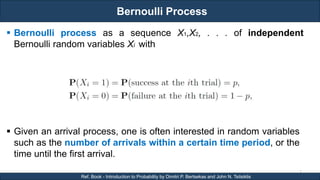
 Bernoulli process as a sequence X1,X2, . . . of independent
Bernoulli random variables Xi with
 Given an arrival process, one is often interested in random variables
such as the number of arrivals within a certain time period, or the
time until the first arrival.
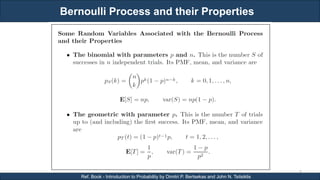
Bernoulli Process and their Properties
RJEs: Remote job entry points
8
Ref. Book - Introduction to Probability by Dimitri P. Bertsekas and John N. Tsitsiklis
Memorylessness or Fresh-start property
RJEs: Remote job entry points
9
Ref. Book - Introduction to Probability by Dimitri P. Bertsekas and John N. Tsitsiklis
 Memorylessness property
 Past trials provides no information on the outcomes of future trials
 A Bernoulli process has been running for n time steps,
 X1, X2, . . . , Xn
 We notice that the sequence of future trials Xn+1,Xn+2, . . . are independent
Bernoulli trials
 In addition, these future trials are independent from the past ones. We
conclude that starting from any given point in time, the future is also modelled by
a Bernoulli process, which is independent of the past. We refer to this as the
fresh-start property of the Bernoulli process
Memorylessness and the Fresh-Start Property of the Bernoulli Process
RJEs: Remote job entry points
10
Ref. Book - Introduction to Probability by Dimitri P. Bertsekas and John N. Tsitsiklis
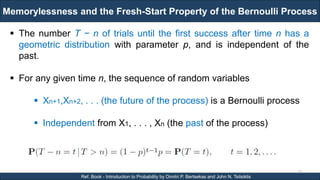
 The number T − n of trials until the first success after time n has a
geometric distribution with parameter p, and is independent of the
past.
 For any given time n, the sequence of random variables
 Xn+1,Xn+2, . . . (the future of the process) is a Bernoulli process
 Independent from X1, . . . , Xn (the past of the process)
Inter-arrival Times
RJEs: Remote job entry points
11
Ref. Book - Introduction to Probability by Dimitri P. Bertsekas and John N. Tsitsiklis
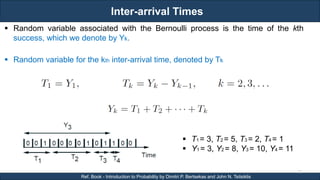
 Random variable associated with the Bernoulli process is the time of the kth
success, which we denote by Yk.
 Random variable for the kth inter-arrival time, denoted by Tk
 T1 = 3, T2 = 5, T3 = 2, T4 = 1
 Y1 = 3, Y2 = 8, Y3 = 10, Y4 = 11
Exercise
RJEs: Remote job entry points
12
Ref. Book - Introduction to Probability by Dimitri P. Bertsekas and John N. Tsitsiklis
 A computer executes two types of tasks, priority and nonpriority, and operates
in discrete time units (slots). A priority task arises with probability p at the
beginning of each slot, independently of other slots, and requires one full slot to
complete. A nonpriority task is executed at a given slot only if no priority task is
available. In this context, it may be important to know the probabilistic properties
of the time intervals available for nonpriority tasks.
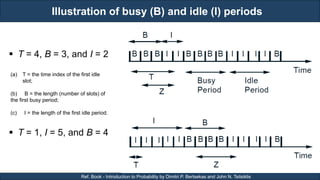
(a) T = the time index of the first idle slot;
(b) B = the length (number of slots) of the
first busy period;
(c) I = the length of the first idle period.
Exercise
RJEs: Remote job entry points
13
Ref. Book - Introduction to Probability by Dimitri P. Bertsekas and John N. Tsitsiklis
 We recognize T as a geometrically distributed random variable with parameter
1 − p. Its PMF is
 Its mean and variance are
 A priority task arises with probability p at the beginning of each slot. We always
handle high priority task first (k-1) and if there is no high priority task, in that case
we will look at the low priority task.
Illustration of busy (B) and idle (I) periods
RJEs: Remote job entry points
14
Ref. Book - Introduction to Probability by Dimitri P. Bertsekas and John N. Tsitsiklis
 T = 4, B = 3, and I = 2
 T = 1, I = 5, and B = 4
(a) T = the time index of the first idle
slot;
(b) B = the length (number of slots) of
the first busy period;
(c) I = the length of the first idle period.
Exercise
RJEs: Remote job entry points
15
Ref. Book - Introduction to Probability by Dimitri P. Bertsekas and John N. Tsitsiklis
 Let us now consider the first busy period. It starts with the first busy slot, call it slot L. (In the top
diagram, L = 1; in the bottom diagram, L = 6.)
 The number Z of subsequent slots until (and including) the first subsequent idle slot has the same
distribution as T, because the Bernoulli process starts fresh at time L + 1. We then notice that Z = B
and conclude that B has the same PMF as T.
 If we reverse the roles of idle and busy slots, and
interchange p with 1−p, we see that the length I
of the first idle period has the same PMF as the
time index of the first busy slot, so that
Bernoulli Process and their Properties
RJEs: Remote job entry points
16
Ref. Book - Introduction to Probability by Dimitri P. Bertsekas and John N. Tsitsiklis
Exercise
RJEs: Remote job entry points
17
Ref. Book - Introduction to Probability by Dimitri P. Bertsekas and John N. Tsitsiklis
 In each minute of basketball play, Alice commits a single foul with probability p and no foul with
probability 1 − p. The number of fouls in different minutes are assumed to be independent. Alice
will foul out of the game once she commits her sixth foul, and will play 30 minutes if she does not
foul out. What is the PMF of Alice’s playing time?
 We model fouls as a Bernoulli process with parameter p. Alice’s playing time Z is equal to Y6, the
time until the sixth foul, except if Y6 is larger than 30, in which case, her playing time is 30, the
duration of the game; that is, Z = min {Y6, 30}. The random variable Y6 has a Pascal PMF of order
6, which is given by
 To determine the PMF pZ(z) of Z, we first consider the case where z is between 6 and 29. For z in this range,
we have
Splitting and Merging of Bernoulli Processes
RJEs: Remote job entry points
18
Ref. Book - Introduction to Probability by Dimitri P. Bertsekas and John N. Tsitsiklis
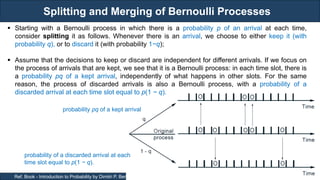
probability pq of a kept arrival
probability of a discarded arrival at each
time slot equal to p(1 − q).
 Starting with a Bernoulli process in which there is a probability p of an arrival at each time,
consider splitting it as follows. Whenever there is an arrival, we choose to either keep it (with
probability q), or to discard it (with probability 1−q);
 Assume that the decisions to keep or discard are independent for different arrivals. If we focus on
the process of arrivals that are kept, we see that it is a Bernoulli process: in each time slot, there is
a probability pq of a kept arrival, independently of what happens in other slots. For the same
reason, the process of discarded arrivals is also a Bernoulli process, with a probability of a
discarded arrival at each time slot equal to p(1 − q).
Merging of independent Bernoulli process
RJEs: Remote job entry points
19
Ref. Book - Introduction to Probability by Dimitri P. Bertsekas and John N. Tsitsiklis
 In a reverse situation, we start with two independent Bernoulli processes (with parameters p and q,
respectively) and merge them into a single process.
 An arrival is recorded in the merged process if and only if there is an arrival in at least one of the
two original processes
 Merged with probability p + q − pq
 Since different time slots in either of the
original processes are independent,
different slots in the merged process
are also independent.
 Thus, the merged process is Bernoulli,
with success probability p+q −pq at
each time step
The Poisson Approximation to the Binomial
RJEs: Remote job entry points
20
Ref. Book - Introduction to Probability by Dimitri P. Bertsekas and John N. Tsitsiklis
Exercise
RJEs: Remote job entry points
21
Ref. Book - Introduction to Probability by Dimitri P. Bertsekas and John N. Tsitsiklis
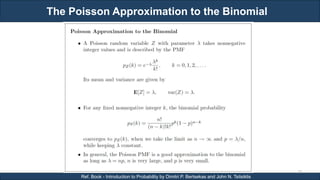
 As a rule of thumb, the Poisson/binomial approximation
 is valid to several decimal places if n ≥ 100, p ≤ 0.01, and λ = np.
 Gary Kasparov, the world chess champion (as of 1999) plays against 100 amateurs in a large
simultaneous exhibition. It has been estimated from past experience that Kasparov wins in such
exhibitions 99% of his games on the average (in precise probabilistic terms, we assume that he
wins each game with probability 0.99, independently of other games). What are the probabilities
that he will win 100 games, 98 games, 95 games, and 90 games?
 We model the number of games X that Kasparov does not win as a binomial random variable with
parameters n = 100 and p = 0.01. Thus the probabilities that he will win 100 games, 98, 95 games,
and 90 games are
Exercise
RJEs: Remote job entry points
22
Ref. Book - Introduction to Probability by Dimitri P. Bertsekas and John N. Tsitsiklis
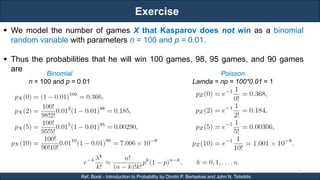
 We model the number of games X that Kasparov does not win as a binomial
random variable with parameters n = 100 and p = 0.01.
 Thus the probabilities that he will win 100 games, 98, 95 games, and 90 games
are
Binomial
n = 100 and p = 0.01
Poisson
Lamda = np = 100*0.01 = 1
Exercise
RJEs: Remote job entry points
23
Ref. Book - Introduction to Probability by Dimitri P. Bertsekas and John N. Tsitsiklis
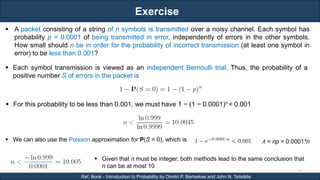
 A packet consisting of a string of n symbols is transmitted over a noisy channel. Each symbol has
probability p = 0.0001 of being transmitted in error, independently of errors in the other symbols.
How small should n be in order for the probability of incorrect transmission (at least one symbol in
error) to be less than 0.001?
 Each symbol transmission is viewed as an independent Bernoulli trial. Thus, the probability of a
positive number S of errors in the packet is
 For this probability to be less than 0.001, we must have 1 − (1 − 0.0001)n < 0.001
 We can also use the Poisson approximation for P(S = 0), which is
 Given that n must be integer, both methods lead to the same conclusion that
n can be at most 10
λ = np = 0.0001*n
THE POISSON PROCESS
RJEs: Remote job entry points
24
Ref. Book - Introduction to Probability by Dimitri P. Bertsekas and John N. Tsitsiklis
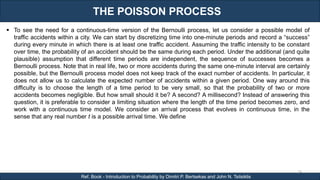
 To see the need for a continuous-time version of the Bernoulli process, let us consider a possible model of
traffic accidents within a city. We can start by discretizing time into one-minute periods and record a “success”
during every minute in which there is at least one traffic accident. Assuming the traffic intensity to be constant
over time, the probability of an accident should be the same during each period. Under the additional (and quite
plausible) assumption that different time periods are independent, the sequence of successes becomes a
Bernoulli process. Note that in real life, two or more accidents during the same one-minute interval are certainly
possible, but the Bernoulli process model does not keep track of the exact number of accidents. In particular, it
does not allow us to calculate the expected number of accidents within a given period. One way around this
difficulty is to choose the length of a time period to be very small, so that the probability of two or more
accidents becomes negligible. But how small should it be? A second? A millisecond? Instead of answering this
question, it is preferable to consider a limiting situation where the length of the time period becomes zero, and
work with a continuous time model. We consider an arrival process that evolves in continuous time, in the
sense that any real number t is a possible arrival time. We define
THE POISSON PROCESS
RJEs: Remote job entry points
25
Ref. Book - Introduction to Probability by Dimitri P. Bertsekas and John N. Tsitsiklis
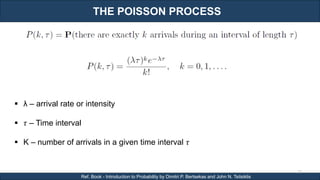
 λ – arrival rate or intensity
 𝜏 – Time interval
 K – number of arrivals in a given time interval 𝜏
Definition of the Poisson Process
RJEs: Remote job entry points
26
Ref. Book - Introduction to Probability by Dimitri P. Bertsekas and John N. Tsitsiklis
 An arrival process is called a Poisson process with rate λ if it has the following properties:
 a) Time-homogeneity: The probability P(k, 𝜏) of k arrivals is the same for all intervals of the same
length 𝜏.
 b) Independence: The number of arrivals during a particular interval is independent of the history
of arrivals outside this interval.
 c) Small interval probabilities: The probabilities P(k, 𝜏) satisfy
Poisson Process and their Properties
RJEs: Remote job entry points
27
Ref. Book - Introduction to Probability by Dimitri P. Bertsekas and John N. Tsitsiklis
 The first property states that arrivals are “equally likely” at all times. The arrivals during any time
interval of length τ are statistically the same, in the sense that they obey the same probability law.
This is a counterpart of the assumption that the success probability p in a Bernoulli process is
constant over time.
 To interpret the second property, consider a particular interval [t, t], of length t − t. The unconditional
probability of k arrivals during that interval is P(k, t − t). Suppose now that we are given complete or
partial information on the arrivals outside this interval. Property (b) states that this information is
irrelevant: the conditional probability of k arrivals during [t, t] remains equal to the unconditional
probability P(k, t − t). This property is analogous to the independence of trials in a Bernoulli process.
 The third property is critical. The o(τ ) and o1(τ ) terms are meant to be negligible in comparison to τ
, when the interval length τ is very small. They can be thought of as the O(τ 2) terms in a Taylor
series expansion of P(k, τ). Thus, for small τ , the probability of a single arrival is roughly λτ, plus a
negligible term. Similarly, for small τ , the probability of zero arrivals is roughly 1 − λτ. Note that the
probability of two or more arrivals is
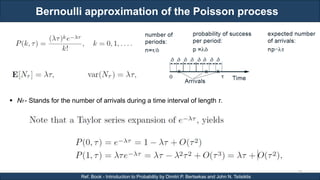
Bernoulli approximation of the Poisson process
RJEs: Remote job entry points
28
Ref. Book - Introduction to Probability by Dimitri P. Bertsekas and John N. Tsitsiklis
 Different periods are independent, by property (b). Furthermore, each period has one arrival with probability
approximately equal to λδ, or zero arrivals with probability approximately equal to 1 − λδ. Therefore, the
process being studied can be approximated by a Bernoulli process, with the approximation becoming more
and more accurate the smaller δ is chosen. Thus the probability P(k, τ) of k arrivals in time τ, is approximately
the same as the (binomial) probability of k successes in n = τ/δ independent Bernoulli trials with success
probability p = λδ at each trial. While keeping the length τ of the interval fixed, we let the period length δ
decrease to zero. We then note that the number n of periods goes to infinity, while the product np remains
constant and equal to λτ. Under these circumstances, we saw in the previous section that the binomial PMF
converges to a Poisson PMF with parameter λτ. We are then led to the important conclusion that
Bernoulli approximation of the Poisson process
RJEs: Remote job entry points
29
Ref. Book - Introduction to Probability by Dimitri P. Bertsekas and John N. Tsitsiklis
 Nτ - Stands for the number of arrivals during a time interval of length τ.
Bernoulli approximation of the Poisson process
RJEs: Remote job entry points
30
Ref. Book - Introduction to Probability by Dimitri P. Bertsekas and John N. Tsitsiklis
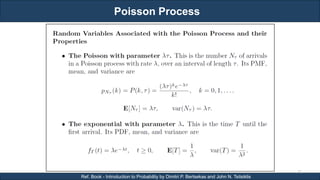
 Let us now derive the probability law for the time T of the first arrival, assuming that the process
starts at time zero.
 Note that we have T > t if and only if there are no arrivals during the interval [0, t]. Therefore
 We then differentiate the CDF FT (t) of T, and obtain the PDF formula
Poisson Process
RJEs: Remote job entry points
31
Ref. Book - Introduction to Probability by Dimitri P. Bertsekas and John N. Tsitsiklis
Bernoulli process as the discrete-time version of the Poisson
RJEs: Remote job entry points
32
Ref. Book - Introduction to Probability by Dimitri P. Bertsekas and John N. Tsitsiklis
Exercise
RJEs: Remote job entry points
33
Ref. Book - Introduction to Probability by Dimitri P. Bertsekas and John N. Tsitsiklis
 We get email according to a Poisson process at a rate of λ = 0.2 messages per
hour. We check your email every hour. What is the probability of finding 0 and 1
new messages?
 These probabilities can be found using the
Bernoulli Process and their Properties
RJEs: Remote job entry points
34
Ref. Book - Introduction to Probability by Dimitri P. Bertsekas and John N. Tsitsiklis
 Suppose that we have not checked your email for a whole day. What is the
probability of finding no new messages? We use again the Poisson PMF and obtain
Home work
RJEs: Remote job entry points
35
Ref. Book - Introduction to Probability by Dimitri P. Bertsekas and John N. Tsitsiklis
Example 5.9. - During rush hour, from 8 am to 9 am, traffic accidents occur according to a Poisson
process with a rate μ of 5 accidents per hour. Between 9 am and 11 am, they occur as an
independent Poisson process with a rate ν of 3 accidents per hour. What is the PMF of the total
number of accidents between 8 am and 11 am?
Alternative Description of the Poisson Process
RJEs: Remote job entry points
36
Ref. Book - Introduction to Probability by Dimitri P. Bertsekas and John N. Tsitsiklis
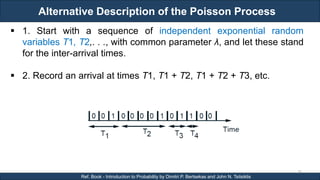
 1. Start with a sequence of independent exponential random
variables T1, T2,. . ., with common parameter λ, and let these stand
for the inter-arrival times.
 2. Record an arrival at times T1, T1 + T2, T1 + T2 + T3, etc.
The kth Arrival Time
RJEs: Remote job entry points
37
Ref. Book - Introduction to Probability by Dimitri P. Bertsekas and John N. Tsitsiklis
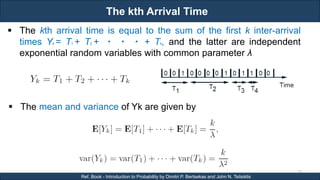
 The kth arrival time is equal to the sum of the first k inter-arrival
times Yk = T1 + T2 + ・ ・ ・ + Tk, and the latter are independent
exponential random variables with common parameter λ
 The mean and variance of Yk are given by
Erlang PDF
RJEs: Remote job entry points
38
Ref. Book - Introduction to Probability by Dimitri P. Bertsekas and John N. Tsitsiklis
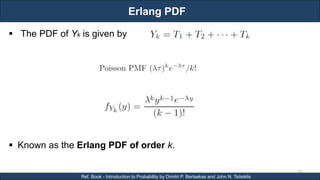
 The PDF of Yk is given by
 Known as the Erlang PDF of order k.
Erlang PDF
RJEs: Remote job entry points
39
Ref. Book - Introduction to Probability by Dimitri P. Bertsekas and John N. Tsitsiklis
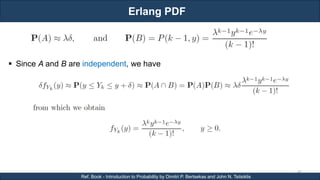
 For a small δ, the product is the probability that the kth arrival occurs between times y
and y+δ.
 When δ is very small, the probability of more than one arrival during the interval [y, y + δ] is
negligible.
 Thus, the kth arrival occurs between y and y + δ if and only if the following two events A and B
occur:
 (a) event A: there is an arrival during the interval [y, y + δ];
 (b) event B: there are exactly k − 1 arrivals before time y.
 The probabilities of these two events are
Erlang PDF
RJEs: Remote job entry points
40
Ref. Book - Introduction to Probability by Dimitri P. Bertsekas and John N. Tsitsiklis
 Since A and B are independent, we have
Exercise
RJEs: Remote job entry points
41
Ref. Book - Introduction to Probability by Dimitri P. Bertsekas and John N. Tsitsiklis
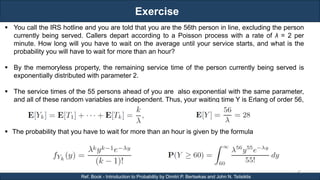
 You call the IRS hotline and you are told that you are the 56th person in line, excluding the person
currently being served. Callers depart according to a Poisson process with a rate of λ = 2 per
minute. How long will you have to wait on the average until your service starts, and what is the
probability you will have to wait for more than an hour?
 By the memoryless property, the remaining service time of the person currently being served is
exponentially distributed with parameter 2.
 The service times of the 55 persons ahead of you are also exponential with the same parameter,
and all of these random variables are independent. Thus, your waiting time Y is Erlang of order 56,
 The probability that you have to wait for more than an hour is given by the formula
Exercise
RJEs: Remote job entry points
42
Ref. Book - Introduction to Probability by Dimitri P. Bertsekas and John N. Tsitsiklis
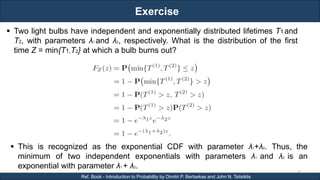
 Two light bulbs have independent and exponentially distributed lifetimes T1and
T2, with parameters λ1 and λ2, respectively. What is the distribution of the first
time Z = min{T1,T2} at which a bulb burns out?
 This is recognized as the exponential CDF with parameter λ1+λ2. Thus, the
minimum of two independent exponentials with parameters λ1 and λ2 is an
exponential with parameter λ1 + λ2.
Home work
RJEs: Remote job entry points
43
Ref. Book - Introduction to Probability by Dimitri P. Bertsekas and John N. Tsitsiklis
Example 5.16. More on Competing Exponentials. Three light bulbs have independent
exponentially distributed lifetimes with a common parameter λ. What is the expectation of the time
until the last bulb burns out?
Markov Chains
Discrete-Time Markov Chains
RJEs: Remote job entry points
45
Ref. Book - Introduction to Probability by Dimitri P. Bertsekas and John N. Tsitsiklis
 The Bernoulli and Poisson processes are memoryless
 If the future depends on and can be predicted to some extent by what has happened in the past.
 We emphasize models where the effect of the past on the future is summarized by a state, which
changes over time according to given probabilities
 Discrete-time Markov chains, in which the state changes at certain discrete time instants, indexed
by an integer variable n.
 At each time step n, the Markov chain has a state, denoted by Xn, which belongs to a finite set S of
possible states, called the state space. Without loss of generality, and unless there is a statement to
the contrary, we will assume that S = {1, . . . , m}, for some positive integer m. The Markov chain is
described in terms of its transition probabilities pij : whenever the state happens to be i, there is
probability pij that the next state is equal to j.
Discrete-Time Markov Chains
RJEs: Remote job entry points
46
Ref. Book - Introduction to Probability by Dimitri P. Bertsekas and John N. Tsitsiklis
 The key assumption underlying Markov processes is that the transition probabilities pij apply
whenever state i is visited, no matter what happened in the past, and no matter how state i was
reached. Mathematically, we assume the Markov property, which requires that
 The transition probabilities pijmust be of course nonnegative, and sum to one:
Specification of Markov Models
RJEs: Remote job entry points
47
Ref. Book - Introduction to Probability by Dimitri P. Bertsekas and John N. Tsitsiklis
Transition Probability Matrix
RJEs: Remote job entry points
48
Ref. Book - Introduction to Probability by Dimitri P. Bertsekas and John N. Tsitsiklis
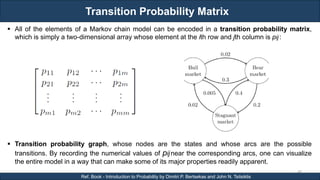
 All of the elements of a Markov chain model can be encoded in a transition probability matrix,
which is simply a two-dimensional array whose element at the ith row and jth column is pij:
 Transition probability graph, whose nodes are the states and whose arcs are the possible
transitions. By recording the numerical values of pijnear the corresponding arcs, one can visualize
the entire model in a way that can make some of its major properties readily apparent.
Transition Probability Matrix
RJEs: Remote job entry points
49
https://www.researchgate.net/publication/330360197_Decision_Support_Models_for_Operations_and_Maintenance_for_Offshore_Wind_Farms_A_Review/figures?lo=1
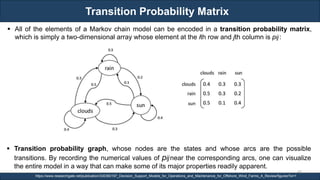
 All of the elements of a Markov chain model can be encoded in a transition probability matrix,
which is simply a two-dimensional array whose element at the ith row and jth column is pij:
 Transition probability graph, whose nodes are the states and whose arcs are the possible
transitions. By recording the numerical values of pijnear the corresponding arcs, one can visualize
the entire model in a way that can make some of its major properties readily apparent.
Exercise
RJEs: Remote job entry points
50
Ref. Book - Introduction to Probability by Dimitri P. Bertsekas and John N. Tsitsiklis
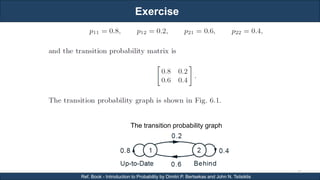
 Alice is taking a probability class and in each week she can be either up-to-date
or she may have fallen behind. If she is up-to-date in a given week, the probability
that she will be up-to-date (or behind) in the next week is 0.8 (or 0.2,
respectively). If she is behind in the given week, the probability that she will be
up-to-date (or behind) in the next week is 0.6 (or 0.4, respectively). We assume
that these probabilities do not depend on whether she was up-to-date or behind
in previous weeks, so the problem has the typical Markov chain character (the
future depends on the past only through the present).
Exercise
RJEs: Remote job entry points
51
Ref. Book - Introduction to Probability by Dimitri P. Bertsekas and John N. Tsitsiklis
The transition probability graph
Exercise
RJEs: Remote job entry points
52
Ref. Book - Introduction to Probability by Dimitri P. Bertsekas and John N. Tsitsiklis
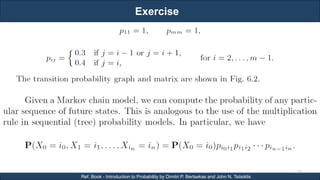
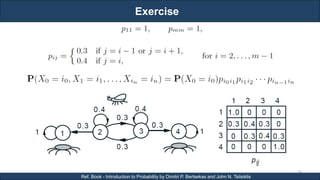
 A fly moves along a straight line in unit increments. At each time period, it moves
one unit to the left with probability 0.3, one unit to the right with probability 0.3, and
stays in place with probability 0.4, independently of the past history of movements.
A spider is lurking at positions 1 and m: if the fly lands there, it is captured by the
spider, and the process terminates. We want to construct a Markov chain model,
assuming that the fly starts in one of the positions 2, . . . , m − 1.
 Let us introduce states 1, 2, . . . , m, and identify them with the corresponding
positions of the fly. The nonzero transition probabilities are
Exercise
RJEs: Remote job entry points
53
Ref. Book - Introduction to Probability by Dimitri P. Bertsekas and John N. Tsitsiklis
Exercise
RJEs: Remote job entry points
54
Ref. Book - Introduction to Probability by Dimitri P. Bertsekas and John N. Tsitsiklis
Markov property
RJEs: Remote job entry points
55
Ref. Book - Introduction to Probability by Dimitri P. Bertsekas and John N. Tsitsiklis
 Where the last equality made use of the Markov property. We then apply the same
argument to the term P(X0 = i0, . . . , Xn−1 = in−1) and continue similarly, until we
eventually obtain the desired expression. If the initial state X0 is given and is known
to be equal to some i0, a similar argument yields
Exercise
RJEs: Remote job entry points
56
Ref. Book - Introduction to Probability by Dimitri P. Bertsekas and John N. Tsitsiklis
 For the spider and fly example, we have
n-Step Transition Probabilities
RJEs: Remote job entry points
57
Ref. Book - Introduction to Probability by Dimitri P. Bertsekas and John N. Tsitsiklis
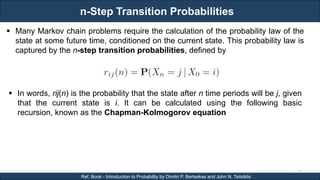
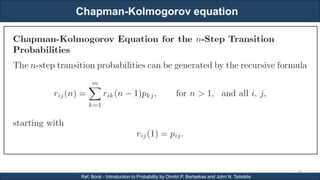
 Many Markov chain problems require the calculation of the probability law of the
state at some future time, conditioned on the current state. This probability law is
captured by the n-step transition probabilities, defined by
 In words, rij(n) is the probability that the state after n time periods will be j, given
that the current state is i. It can be calculated using the following basic
recursion, known as the Chapman-Kolmogorov equation
Chapman-Kolmogorov equation
RJEs: Remote job entry points
58
Ref. Book - Introduction to Probability by Dimitri P. Bertsekas and John N. Tsitsiklis
Chapman-Kolmogorov equation
RJEs: Remote job entry points
59
Ref. Book - Introduction to Probability by Dimitri P. Bertsekas and John N. Tsitsiklis
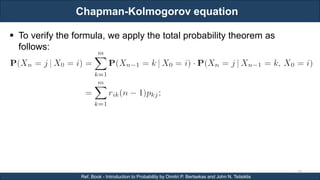
 To verify the formula, we apply the total probability theorem as
follows:
CLASSIFICATION OF STATES
RJEs: Remote job entry points
60
Ref. Book - Introduction to Probability by Dimitri P. Bertsekas and John N. Tsitsiklis
 In particular, some states, after being visited once, are certain to be revisited again, while for
some other states this may not be the case.
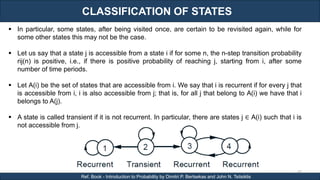
 Let us say that a state j is accessible from a state i if for some n, the n-step transition probability
rij(n) is positive, i.e., if there is positive probability of reaching j, starting from i, after some
number of time periods.
 Let A(i) be the set of states that are accessible from i. We say that i is recurrent if for every j that
is accessible from i, i is also accessible from j; that is, for all j that belong to A(i) we have that i
belongs to A(j).
 A state is called transient if it is not recurrent. In particular, there are states j ∈ A(i) such that i is
not accessible from j.
CLASSIFICATION OF STATES
RJEs: Remote job entry points
61
Ref. Book - Introduction to Probability by Dimitri P. Bertsekas and John N. Tsitsiklis
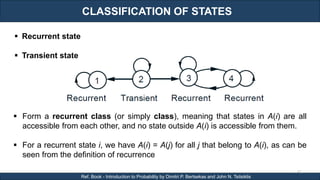
 Form a recurrent class (or simply class), meaning that states in A(i) are all
accessible from each other, and no state outside A(i) is accessible from them.
 For a recurrent state i, we have A(i) = A(j) for all j that belong to A(i), as can be
seen from the definition of recurrence
 Recurrent state
 Transient state
Markov Chain Decomposition
RJEs: Remote job entry points
62
Ref. Book - Introduction to Probability by Dimitri P. Bertsekas and John N. Tsitsiklis
Single class of recurrent states
RJEs: Remote job entry points
63
Ref. Book - Introduction to Probability by Dimitri P. Bertsekas and John N. Tsitsiklis
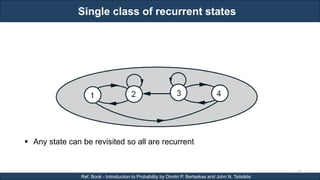
 Any state can be revisited so all are recurrent
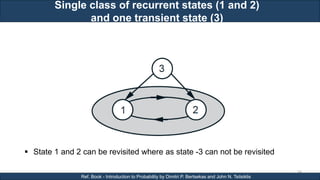
Single class of recurrent states (1 and 2)
and one transient state (3)
RJEs: Remote job entry points
64
Ref. Book - Introduction to Probability by Dimitri P. Bertsekas and John N. Tsitsiklis
 State 1 and 2 can be revisited where as state -3 can not be revisited
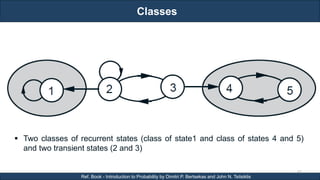
Classes
RJEs: Remote job entry points
65
Ref. Book - Introduction to Probability by Dimitri P. Bertsekas and John N. Tsitsiklis
 Two classes of recurrent states (class of state1 and class of states 4 and 5)
and two transient states (2 and 3)
Periodicity
RJEs: Remote job entry points
66
Ref. Book - Introduction to Probability by Dimitri P. Bertsekas and John N. Tsitsiklis
 To the presence or absence of a
certain periodic pattern in the
times that a state is visited. In
particular, a recurrent class is
said to be periodic if its states
can be grouped in d > 1 disjoint
subsets S1, . . . , Sd so that all
transitions from one subset lead
to the next subset
Periodicity
RJEs: Remote job entry points
67
Ref. Book - Introduction to Probability by Dimitri P. Bertsekas and John N. Tsitsiklis
Steady-State Convergence Theorem
RJEs: Remote job entry points
68
Ref. Book - Introduction to Probability by Dimitri P. Bertsekas and John N. Tsitsiklis
 Consider a Markov chain with a single recurrent class, which is aperiodic. Then, the
states j are associated with steady-state probabilities πj that have the following
properties.
Stationary distribution
RJEs: Remote job entry points
69
Ref. Book - Introduction to Probability by Dimitri P. Bertsekas and John N. Tsitsiklis
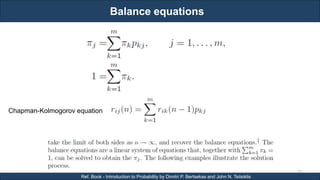
 Since the steady-state probabilities πj sum to 1, they form a probability distribution
on the state space, called the stationary distribution
 Using the total probability theorem, we have
 Thus, if the initial state is chosen according to the stationary distribution, all
subsequent states will have the same distribution.
Balance equations
RJEs: Remote job entry points
70
Ref. Book - Introduction to Probability by Dimitri P. Bertsekas and John N. Tsitsiklis
Chapman-Kolmogorov equation
Exercise
RJEs: Remote job entry points
71
Ref. Book - Introduction to Probability by Dimitri P. Bertsekas and John N. Tsitsiklis
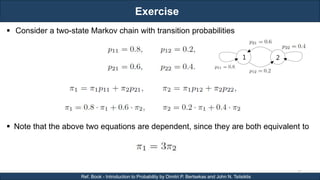
 Consider a two-state Markov chain with transition probabilities
 Note that the above two equations are dependent, since they are both equivalent to
Exercise
RJEs: Remote job entry points
72
Ref. Book - Introduction to Probability by Dimitri P. Bertsekas and John N. Tsitsiklis
Homework-Exercise
RJEs: Remote job entry points
73
Ref. Book - Introduction to Probability by Dimitri P. Bertsekas and John N. Tsitsiklis
 Example 6.5. An absent-minded professor has two umbrellas that she uses when
commuting from home to the office and back. If it rains and an umbrella is
available in her location, she takes it. If it is not raining, she always forgets to take
an umbrella. Suppose that it rains with probability p each time she commutes,
independently of other times. What is the steady-state probability that she gets
wet on a given day?
Birth-Death Processes
RJEs: Remote job entry points
74
Ref. Book - Introduction to Probability by Dimitri P. Bertsekas and John N. Tsitsiklis
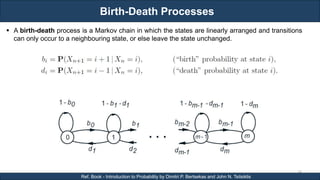
 A birth-death process is a Markov chain in which the states are linearly arranged and transitions
can only occur to a neighbouring state, or else leave the state unchanged.
Transition probability graph for a birth-death process
RJEs: Remote job entry points
75
Ref. Book - Introduction to Probability by Dimitri P. Bertsekas and John N. Tsitsiklis
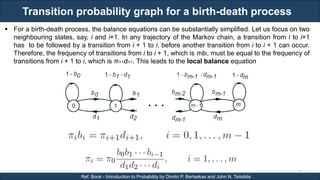
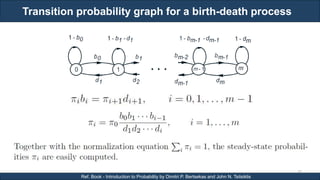
 For a birth-death process, the balance equations can be substantially simplified. Let us focus on two
neighbouring states, say, i and i+1. In any trajectory of the Markov chain, a transition from i to i+1
has to be followed by a transition from i + 1 to i, before another transition from i to i + 1 can occur.
Therefore, the frequency of transitions from i to i + 1, which is πibi, must be equal to the frequency of
transitions from i + 1 to i, which is πi+1di+1. This leads to the local balance equation
Transition probability graph for a birth-death process
RJEs: Remote job entry points
76
Ref. Book - Introduction to Probability by Dimitri P. Bertsekas and John N. Tsitsiklis
Random Walk with Reflecting Barriers
RJEs: Remote job entry points
77
Ref. Book - Introduction to Probability by Dimitri P. Bertsekas and John N. Tsitsiklis
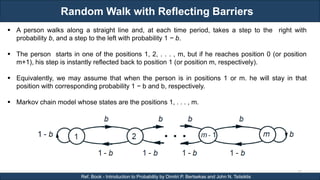
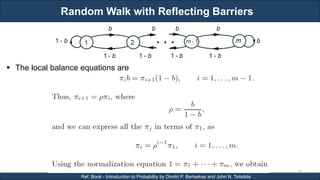
 A person walks along a straight line and, at each time period, takes a step to the right with
probability b, and a step to the left with probability 1 − b.
 The person starts in one of the positions 1, 2, . . . , m, but if he reaches position 0 (or position
m+1), his step is instantly reflected back to position 1 (or position m, respectively).
 Equivalently, we may assume that when the person is in positions 1 or m. he will stay in that
position with corresponding probability 1 − b and b, respectively.
 Markov chain model whose states are the positions 1, . . . , m.
Random Walk with Reflecting Barriers
RJEs: Remote job entry points
78
Ref. Book - Introduction to Probability by Dimitri P. Bertsekas and John N. Tsitsiklis
 The local balance equations are
Random Walk with Reflecting Barriers
RJEs: Remote job entry points
79
Ref. Book - Introduction to Probability by Dimitri P. Bertsekas and John N. Tsitsiklis
 The local balance equations are
Statistical Multiplexing
RJEs: Remote job entry points
• Statistical Multiplexing, the packets of all traffic streams are merged into a single queue and
transmitted or served on a first-come first-serve basis.
Queuing/Buffering
Shared Buffering Pledged Buffering
Ref. Book: Data Networks by Dimitri Bertsekas and Robert Gallager
QUEUEING MODELS - LITTLE’S THEOREM
RJEs: Remote job entry points
• Customers arrive at random times to obtain
service
• Service time
• Problem Statement: Estimate the following
1. The average number of customers in the
system (i.e., the “typical” number of customers
either waiting in queue or undergoing service)
2. The average delay per customer (i.e., the
“typical” time a customer spends waiting in queue
plus the service time).
Ref. Book: Data Networks by Dimitri Bertsekas and Robert Gallager
QUEUEING MODELS - LITTLE’S THEOREM
RJEs: Remote job entry points
• Problem Statement: Estimate the following
1. The average number of customers in the system (i.e., the
“typical” number of customers either waiting in queue or
undergoing service)
2. The average delay per customer (i.e., the “typical” time a
customer spends waiting in queue plus the service time).
• These quantities will be estimated in terms of:
1. The customer arrival rate (i.e., the "typical" number of
customers entering the system per unit time)
2. The customer service rate (i.e., the "typical" number of
customers the system serves per unit time when it is constantly
busy)
Ref. Book: Data Networks by Dimitri Bertsekas and Robert Gallager
LITTLE’S THEOREM
RJEs: Remote job entry points Ref. Book: Data Networks by Dimitri Bertsekas and Robert Gallager
LITTLE’S THEOREM
RJEs: Remote job entry points Ref. Book: Data Networks by Dimitri Bertsekas and Robert Gallager
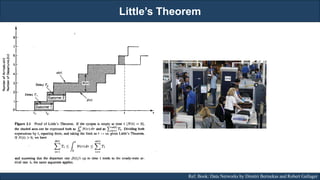
Little’s Theorem
RJEs: Remote job entry points
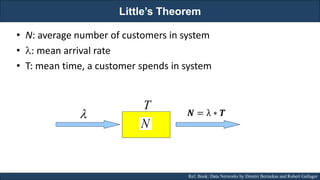
• N: average number of customers in system
• : mean arrival rate
• T: mean time, a customer spends in system
T
 𝑵 = λ ∗ 𝑻
Ref. Book: Data Networks by Dimitri Bertsekas and Robert Gallager
Little’s Theorem
RJEs: Remote job entry points Ref. Book: Data Networks by Dimitri Bertsekas and Robert Gallager
Little’s Theorem
RJEs: Remote job entry points Ref. Book: Data Networks by Dimitri Bertsekas and Robert Gallager
Little’s Theorem
RJEs: Remote job entry points Ref. Book: Data Networks by Dimitri Bertsekas and Robert Gallager
Little’s Theorem
RJEs: Remote job entry points Ref. Book: Data Networks by Dimitri Bertsekas and Robert Gallager
Little’s Theorem
RJEs: Remote job entry points Ref. Book: Data Networks by Dimitri Bertsekas and Robert Gallager
Examples of Little’s Theorem
RJEs: Remote job entry points Ref. Book: Data Networks by Dimitri Bertsekas and Robert Gallager
• λ is the arrival rate in a transmission line
• NQ is the average number of packets waiting in queue (but not under
transmission).
• W is the average time spent by a packet waiting in queue (not including the
transmission time)
• Little's Theorem gives
• if 𝑋 is the average transmission time, then Little's Theorem gives
line's utilization factor
• At most one packet can be under transmission, ρ is also the line's utilization factor.
(i.e. the proportion of time that the line is busy transmitting a packet)
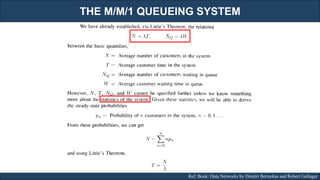
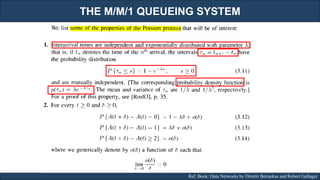
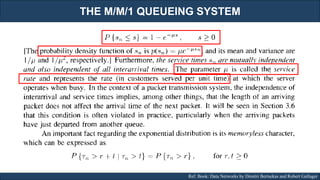
THE M/M/1 QUEUEING SYSTEM
RJEs: Remote job entry points Ref. Book: Data Networks by Dimitri Bertsekas and Robert Gallager
• The M/M/1 queuing system consists of a single queuing station with a single server (in a
communication context, a single transmission line).
• Customers arrive according to a Poisson process with rate λ, and the probability
distribution of the service time is exponential with mean 1/µ sec.
• The first letter indicates the nature of the arrival process
• First, M stands for memory less, which here means a Poisson process (i.e.,
exponentially distributed inter arrival times), G stands for a general distribution of inter-
arrival times, D stands for deterministic inter-arrival times. E.g. M/M/1, G/M/1, D/M/1
• The second letter indicates the nature of the probability distribution of the service times
(e.g., M, G, and D stand for exponential, general, and deterministic distributions,
respectively).
• The last number indicates the number of servers.
THE M/M/1 QUEUEING SYSTEM
RJEs: Remote job entry points Ref. Book: Data Networks by Dimitri Bertsekas and Robert Gallager
THE M/M/1 QUEUEING SYSTEM
RJEs: Remote job entry points Ref. Book: Data Networks by Dimitri Bertsekas and Robert Gallager
THE M/M/1 QUEUEING SYSTEM
RJEs: Remote job entry points Ref. Book: Data Networks by Dimitri Bertsekas and Robert Gallager
THE M/M/1 QUEUEING SYSTEM
RJEs: Remote job entry points Ref. Book: Data Networks by Dimitri Bertsekas and Robert Gallager
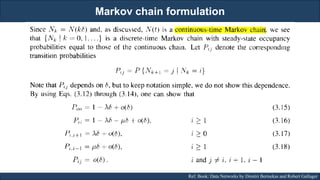
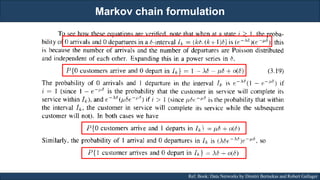
Markov chain formulation
RJEs: Remote job entry points Ref. Book: Data Networks by Dimitri Bertsekas and Robert Gallager
Markov chain formulation
RJEs: Remote job entry points Ref. Book: Data Networks by Dimitri Bertsekas and Robert Gallager
Markov chain formulation
RJEs: Remote job entry points Ref. Book: Data Networks by Dimitri Bertsekas and Robert Gallager
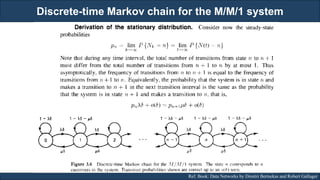
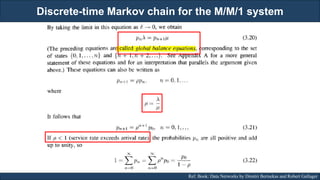
Discrete-time Markov chain for the M/M/1 system
RJEs: Remote job entry points Ref. Book: Data Networks by Dimitri Bertsekas and Robert Gallager
Discrete-time Markov chain for the M/M/1 system
RJEs: Remote job entry points Ref. Book: Data Networks by Dimitri Bertsekas and Robert Gallager
Discrete-time Markov chain for the M/M/1 system
RJEs: Remote job entry points Ref. Book: Data Networks by Dimitri Bertsekas and Robert Gallager
Average Number of Customers in the system vs. Utilization Factor
RJEs: Remote job entry points Ref. Book: Data Networks by Dimitri Bertsekas and Robert Gallager
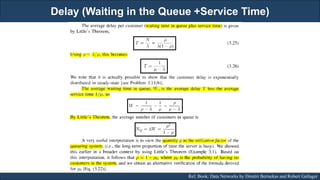
Delay (Waiting in the Queue +Service Time)
RJEs: Remote job entry points Ref. Book: Data Networks by Dimitri Bertsekas and Robert Gallager
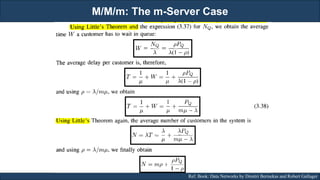
M/M/m: The m-Server Case
RJEs: Remote job entry points Ref. Book: Data Networks by Dimitri Bertsekas and Robert Gallager
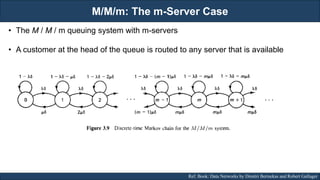
• The M / M / m queuing system with m-servers
• A customer at the head of the queue is routed to any server that is available
M/M/m: The m-Server Case
RJEs: Remote job entry points Ref. Book: Data Networks by Dimitri Bertsekas and Robert Gallager
• Global balance equations for the steady-state probabilities Pn
M/M/m: The m-Server Case
RJEs: Remote job entry points Ref. Book: Data Networks by Dimitri Bertsekas and Robert Gallager
M/M/m: The m-Server Case
RJEs: Remote job entry points Ref. Book: Data Networks by Dimitri Bertsekas and Robert Gallager
M/M/m: The m-Server Case
RJEs: Remote job entry points Ref. Book: Data Networks by Dimitri Bertsekas and Robert Gallager
The m-Server Loss System
RJEs: Remote job entry points Ref. Book: Data Networks by Dimitri Bertsekas and Robert Gallager
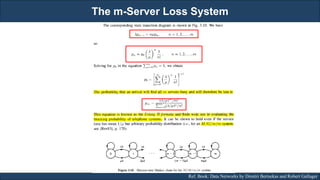
• Consider a system, which is identical to the M/M/m system except that if an arrival finds all m
servers busy, it does not enter the system and is lost instead (not reattempted).
• Last m in the M/M/m/m notation indicates the limit on the number of customers in the system
• Model is used widely in telephony (in circuit switched networks)
• In this context, customers in the system correspond to active telephone conversations and
the m servers represent a single transmission line consisting of m circuits.
• The average service time 1/µ is the average duration of a telephone conversation.
• Objective: Find the blocking probability
Vs.
The m-Server Loss System
RJEs: Remote job entry points Ref. Book: Data Networks by Dimitri Bertsekas and Robert Gallager
The Infinite-Server Case
RJEs: Remote job entry points Ref. Book: Data Networks by Dimitri Bertsekas and Robert Gallager
Continuous-Time Markov Chains
RJEs: Remote job entry points
113
Ref. Book - Introduction to Probability by Dimitri P. Bertsekas and John N. Tsitsiklis
 When the time between transitions takes values from a continuous
range, it is known as Continuous-Time Markov Chain.
Limit Theorems
THE WEAK LAW OF LARGE NUMBERS
RJEs: Remote job entry points
115
Ref. Book - Introduction to Probability by Dimitri P. Bertsekas and John N. Tsitsiklis
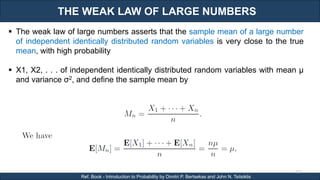
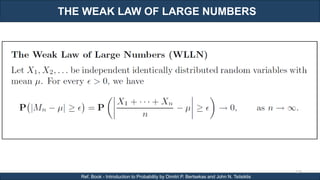
 The weak law of large numbers asserts that the sample mean of a large number
of independent identically distributed random variables is very close to the true
mean, with high probability
 X1, X2, . . . of independent identically distributed random variables with mean μ
and variance σ2, and define the sample mean by
THE WEAK LAW OF LARGE NUMBERS
RJEs: Remote job entry points
116
Ref. Book - Introduction to Probability by Dimitri P. Bertsekas and John N. Tsitsiklis
Chebyshev Inequality
RJEs: Remote job entry points
117
Ref. Book - Introduction to Probability by Dimitri P. Bertsekas and John N. Tsitsiklis
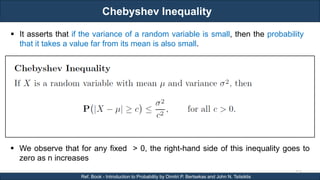
 It asserts that if the variance of a random variable is small, then the probability
that it takes a value far from its mean is also small.
 We observe that for any fixed > 0, the right-hand side of this inequality goes to
zero as n increases
THE WEAK LAW OF LARGE NUMBERS
RJEs: Remote job entry points
118
Ref. Book - Introduction to Probability by Dimitri P. Bertsekas and John N. Tsitsiklis
Convergence of a Deterministic Sequence
RJEs: Remote job entry points
119
Ref. Book - Introduction to Probability by Dimitri P. Bertsekas and John N. Tsitsiklis
Convergence of a Deterministic Sequence
RJEs: Remote job entry points
120
Ref. Book - Introduction to Probability by Dimitri P. Bertsekas and John N. Tsitsiklis
The Central Limit Theorem
RJEs: Remote job entry points
121
Ref. Book - Introduction to Probability by Dimitri P. Bertsekas and John N. Tsitsiklis
The Central Limit Theorem
RJEs: Remote job entry points
122
Ref. Book - Introduction to Probability by Dimitri P. Bertsekas and John N. Tsitsiklis
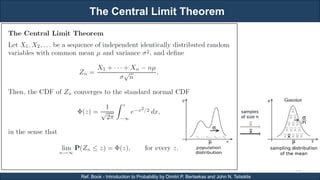
 According to the weak law of large numbers, the distribution of the sample
mean Mn is increasingly concentrated in the near vicinity of the true mean μ.
 In particular, its variance tends to zero.
 On the other hand, the variance of the sum Sn = X1 + ・ ・ ・ + Xn = nMn
increases to infinity, and the distribution of Sn cannot be said to converge to
anything meaningful.
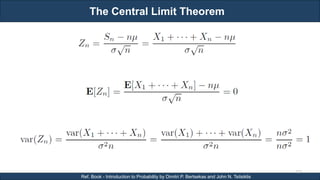
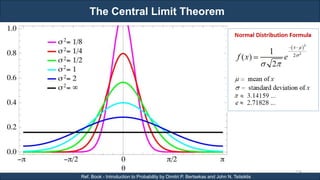
 An intermediate view is obtained by considering the deviation Sn − nμ of Sn
from its mean nμ, and scaling it by a factor proportional to 1/√n. What is special
about this particular scaling is that it keeps the variance at a constant level. The
central limit theorem asserts that the distribution of this scaled random variable
approaches a normal distribution.
 More specifically, let X1,X2, . . . be a sequence of independent identically
distributed random variables with mean μ and variance σ2. We define
The Central Limit Theorem
RJEs: Remote job entry points
123
Ref. Book - Introduction to Probability by Dimitri P. Bertsekas and John N. Tsitsiklis
The Central Limit Theorem
RJEs: Remote job entry points
124
Ref. Book - Introduction to Probability by Dimitri P. Bertsekas and John N. Tsitsiklis
Normal Approximation Based on the Central Limit Theorem
RJEs: Remote job entry points
125
Ref. Book - Introduction to Probability by Dimitri P. Bertsekas and John N. Tsitsiklis
Exercise
RJEs: Remote job entry points
126
Ref. Book - Introduction to Probability by Dimitri P. Bertsekas and John N. Tsitsiklis
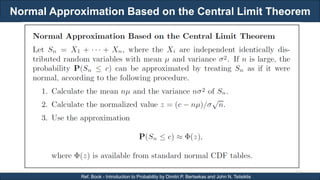
We load on a plane 100 packages whose weights are independent random
variables that are uniformly distributed between 5 and 50 pounds. What is the
probability that the total weight will exceed 3000 pounds? It is not easy to calculate
the CDF of the total weight and the desired probability, but an approximate answer
can be quickly obtained using the central limit theorem. We want to calculate
P(S100 > 3000), where S100 is the sum of the 100 packages. The mean and the
variance of the weight of a single package are
Exercise
RJEs: Remote job entry points
127
Ref. Book - Introduction to Probability by Dimitri P. Bertsekas and John N. Tsitsiklis
 Based on the formulas for the mean and variance of the uniform
PDF. We thus calculate the normalized value
128

Stochastic Process and its Applications.

  • 1.
    Stochastic Processes andits Applications Dr. Rahul Pandya (IIT-Dh)
  • 2.
    Course content -Syllabus RJEs: Remote job entry points 2  Introduction to stochastic processes: Definitions and examples, Bernoulli process and Poisson process. Markov Process, stationary and ergodic process.  Markov Chains: Discrete time and continuous time Markov chains, classification of states, notion of stationary distribution.  Simulating stochastic processes like Gaussian process, Poisson process, Markov chains and Brownian motion.  Introduction to Markov chain monte carlo methods, Hidden Markov chain and Markov decision process.  Statistics: MLE, MAP and Bayesian Estimation, sufficient statistics, and CramerRao lower bound.
  • 3.
    Reference books RJEs: Remotejob entry points  Introduction to Probability by Dimitri P. Bertsekas and John N. Tsitsiklis  https://www.vfu.bg/en/e-Learning/Math-- Bertsekas_Tsitsiklis_Introduction_to_probability.pdf  Introduction to probability models by Sheldon Ross  http://mitran-lab.amath.unc.edu/courses/MATH768/biblio/introduction- to-prob-models-11th-edition.PDF  Stochastic process by Sheldon Ross  Stochastic process and models by David Stirzaker
  • 4.
    Stochastic process RJEs: Remotejob entry points 4 Ref. Book - Introduction to Probability by Dimitri P. Bertsekas and John N. Tsitsiklis  A stochastic process is a mathematical model of a probabilistic experiment that evolves in time and generates a sequence of numerical values. For example, a stochastic process can be used to model:  (a) the sequence of daily prices of a stock;  (b) the sequence of scores in a football game;  (c) the sequence of failure times of a machine;  (d) the sequence of hourly traffic loads at a node of a communication network;  (e) the sequence of radar measurements of the position of an airplane.
  • 5.
    Two major categoriesof stochastic processes RJEs: Remote job entry points 5 Ref. Book - Introduction to Probability by Dimitri P. Bertsekas and John N. Tsitsiklis  Arrival-Type Processes:  Here, we are interested in occurrences that have the character of an “arrival,” such as message receptions at a receiver, job completions in a manufacturing cell, customer purchases at a store, etc.  Inter-arrival times (the times between successive arrivals) are independent random variables.  The inter-arrival times are Geometrically distributed – Bernoulli process.  The inter-arrival times are Exponentially distributed – Poisson process.
  • 6.
    Two major categoriesof stochastic processes RJEs: Remote job entry points 6 Ref. Book - Introduction to Probability by Dimitri P. Bertsekas and John N. Tsitsiklis  Markov Processes  Experiments that evolve in time and in which the future evolution exhibits a probabilistic dependence on the past.  As an example, the future daily prices of a stock are typically dependent on past prices.
  • 7.
    Bernoulli Process RJEs: Remotejob entry points 7 Ref. Book - Introduction to Probability by Dimitri P. Bertsekas and John N. Tsitsiklis  Bernoulli process as a sequence X1,X2, . . . of independent Bernoulli random variables Xi with  Given an arrival process, one is often interested in random variables such as the number of arrivals within a certain time period, or the time until the first arrival.
  • 8.
    Bernoulli Process andtheir Properties RJEs: Remote job entry points 8 Ref. Book - Introduction to Probability by Dimitri P. Bertsekas and John N. Tsitsiklis
  • 9.
    Memorylessness or Fresh-startproperty RJEs: Remote job entry points 9 Ref. Book - Introduction to Probability by Dimitri P. Bertsekas and John N. Tsitsiklis  Memorylessness property  Past trials provides no information on the outcomes of future trials  A Bernoulli process has been running for n time steps,  X1, X2, . . . , Xn  We notice that the sequence of future trials Xn+1,Xn+2, . . . are independent Bernoulli trials  In addition, these future trials are independent from the past ones. We conclude that starting from any given point in time, the future is also modelled by a Bernoulli process, which is independent of the past. We refer to this as the fresh-start property of the Bernoulli process
  • 10.
    Memorylessness and theFresh-Start Property of the Bernoulli Process RJEs: Remote job entry points 10 Ref. Book - Introduction to Probability by Dimitri P. Bertsekas and John N. Tsitsiklis  The number T − n of trials until the first success after time n has a geometric distribution with parameter p, and is independent of the past.  For any given time n, the sequence of random variables  Xn+1,Xn+2, . . . (the future of the process) is a Bernoulli process  Independent from X1, . . . , Xn (the past of the process)
  • 11.
    Inter-arrival Times RJEs: Remotejob entry points 11 Ref. Book - Introduction to Probability by Dimitri P. Bertsekas and John N. Tsitsiklis  Random variable associated with the Bernoulli process is the time of the kth success, which we denote by Yk.  Random variable for the kth inter-arrival time, denoted by Tk  T1 = 3, T2 = 5, T3 = 2, T4 = 1  Y1 = 3, Y2 = 8, Y3 = 10, Y4 = 11
  • 12.
    Exercise RJEs: Remote jobentry points 12 Ref. Book - Introduction to Probability by Dimitri P. Bertsekas and John N. Tsitsiklis  A computer executes two types of tasks, priority and nonpriority, and operates in discrete time units (slots). A priority task arises with probability p at the beginning of each slot, independently of other slots, and requires one full slot to complete. A nonpriority task is executed at a given slot only if no priority task is available. In this context, it may be important to know the probabilistic properties of the time intervals available for nonpriority tasks. (a) T = the time index of the first idle slot; (b) B = the length (number of slots) of the first busy period; (c) I = the length of the first idle period.
  • 13.
    Exercise RJEs: Remote jobentry points 13 Ref. Book - Introduction to Probability by Dimitri P. Bertsekas and John N. Tsitsiklis  We recognize T as a geometrically distributed random variable with parameter 1 − p. Its PMF is  Its mean and variance are  A priority task arises with probability p at the beginning of each slot. We always handle high priority task first (k-1) and if there is no high priority task, in that case we will look at the low priority task.
  • 14.
    Illustration of busy(B) and idle (I) periods RJEs: Remote job entry points 14 Ref. Book - Introduction to Probability by Dimitri P. Bertsekas and John N. Tsitsiklis  T = 4, B = 3, and I = 2  T = 1, I = 5, and B = 4 (a) T = the time index of the first idle slot; (b) B = the length (number of slots) of the first busy period; (c) I = the length of the first idle period.
  • 15.
    Exercise RJEs: Remote jobentry points 15 Ref. Book - Introduction to Probability by Dimitri P. Bertsekas and John N. Tsitsiklis  Let us now consider the first busy period. It starts with the first busy slot, call it slot L. (In the top diagram, L = 1; in the bottom diagram, L = 6.)  The number Z of subsequent slots until (and including) the first subsequent idle slot has the same distribution as T, because the Bernoulli process starts fresh at time L + 1. We then notice that Z = B and conclude that B has the same PMF as T.  If we reverse the roles of idle and busy slots, and interchange p with 1−p, we see that the length I of the first idle period has the same PMF as the time index of the first busy slot, so that
  • 16.
    Bernoulli Process andtheir Properties RJEs: Remote job entry points 16 Ref. Book - Introduction to Probability by Dimitri P. Bertsekas and John N. Tsitsiklis
  • 17.
    Exercise RJEs: Remote jobentry points 17 Ref. Book - Introduction to Probability by Dimitri P. Bertsekas and John N. Tsitsiklis  In each minute of basketball play, Alice commits a single foul with probability p and no foul with probability 1 − p. The number of fouls in different minutes are assumed to be independent. Alice will foul out of the game once she commits her sixth foul, and will play 30 minutes if she does not foul out. What is the PMF of Alice’s playing time?  We model fouls as a Bernoulli process with parameter p. Alice’s playing time Z is equal to Y6, the time until the sixth foul, except if Y6 is larger than 30, in which case, her playing time is 30, the duration of the game; that is, Z = min {Y6, 30}. The random variable Y6 has a Pascal PMF of order 6, which is given by  To determine the PMF pZ(z) of Z, we first consider the case where z is between 6 and 29. For z in this range, we have
  • 18.
    Splitting and Mergingof Bernoulli Processes RJEs: Remote job entry points 18 Ref. Book - Introduction to Probability by Dimitri P. Bertsekas and John N. Tsitsiklis probability pq of a kept arrival probability of a discarded arrival at each time slot equal to p(1 − q).  Starting with a Bernoulli process in which there is a probability p of an arrival at each time, consider splitting it as follows. Whenever there is an arrival, we choose to either keep it (with probability q), or to discard it (with probability 1−q);  Assume that the decisions to keep or discard are independent for different arrivals. If we focus on the process of arrivals that are kept, we see that it is a Bernoulli process: in each time slot, there is a probability pq of a kept arrival, independently of what happens in other slots. For the same reason, the process of discarded arrivals is also a Bernoulli process, with a probability of a discarded arrival at each time slot equal to p(1 − q).
  • 19.
    Merging of independentBernoulli process RJEs: Remote job entry points 19 Ref. Book - Introduction to Probability by Dimitri P. Bertsekas and John N. Tsitsiklis  In a reverse situation, we start with two independent Bernoulli processes (with parameters p and q, respectively) and merge them into a single process.  An arrival is recorded in the merged process if and only if there is an arrival in at least one of the two original processes  Merged with probability p + q − pq  Since different time slots in either of the original processes are independent, different slots in the merged process are also independent.  Thus, the merged process is Bernoulli, with success probability p+q −pq at each time step
  • 20.
    The Poisson Approximationto the Binomial RJEs: Remote job entry points 20 Ref. Book - Introduction to Probability by Dimitri P. Bertsekas and John N. Tsitsiklis
  • 21.
    Exercise RJEs: Remote jobentry points 21 Ref. Book - Introduction to Probability by Dimitri P. Bertsekas and John N. Tsitsiklis  As a rule of thumb, the Poisson/binomial approximation  is valid to several decimal places if n ≥ 100, p ≤ 0.01, and λ = np.  Gary Kasparov, the world chess champion (as of 1999) plays against 100 amateurs in a large simultaneous exhibition. It has been estimated from past experience that Kasparov wins in such exhibitions 99% of his games on the average (in precise probabilistic terms, we assume that he wins each game with probability 0.99, independently of other games). What are the probabilities that he will win 100 games, 98 games, 95 games, and 90 games?  We model the number of games X that Kasparov does not win as a binomial random variable with parameters n = 100 and p = 0.01. Thus the probabilities that he will win 100 games, 98, 95 games, and 90 games are
  • 22.
    Exercise RJEs: Remote jobentry points 22 Ref. Book - Introduction to Probability by Dimitri P. Bertsekas and John N. Tsitsiklis  We model the number of games X that Kasparov does not win as a binomial random variable with parameters n = 100 and p = 0.01.  Thus the probabilities that he will win 100 games, 98, 95 games, and 90 games are Binomial n = 100 and p = 0.01 Poisson Lamda = np = 100*0.01 = 1
  • 23.
    Exercise RJEs: Remote jobentry points 23 Ref. Book - Introduction to Probability by Dimitri P. Bertsekas and John N. Tsitsiklis  A packet consisting of a string of n symbols is transmitted over a noisy channel. Each symbol has probability p = 0.0001 of being transmitted in error, independently of errors in the other symbols. How small should n be in order for the probability of incorrect transmission (at least one symbol in error) to be less than 0.001?  Each symbol transmission is viewed as an independent Bernoulli trial. Thus, the probability of a positive number S of errors in the packet is  For this probability to be less than 0.001, we must have 1 − (1 − 0.0001)n < 0.001  We can also use the Poisson approximation for P(S = 0), which is  Given that n must be integer, both methods lead to the same conclusion that n can be at most 10 λ = np = 0.0001*n
  • 24.
    THE POISSON PROCESS RJEs:Remote job entry points 24 Ref. Book - Introduction to Probability by Dimitri P. Bertsekas and John N. Tsitsiklis  To see the need for a continuous-time version of the Bernoulli process, let us consider a possible model of traffic accidents within a city. We can start by discretizing time into one-minute periods and record a “success” during every minute in which there is at least one traffic accident. Assuming the traffic intensity to be constant over time, the probability of an accident should be the same during each period. Under the additional (and quite plausible) assumption that different time periods are independent, the sequence of successes becomes a Bernoulli process. Note that in real life, two or more accidents during the same one-minute interval are certainly possible, but the Bernoulli process model does not keep track of the exact number of accidents. In particular, it does not allow us to calculate the expected number of accidents within a given period. One way around this difficulty is to choose the length of a time period to be very small, so that the probability of two or more accidents becomes negligible. But how small should it be? A second? A millisecond? Instead of answering this question, it is preferable to consider a limiting situation where the length of the time period becomes zero, and work with a continuous time model. We consider an arrival process that evolves in continuous time, in the sense that any real number t is a possible arrival time. We define
  • 25.
    THE POISSON PROCESS RJEs:Remote job entry points 25 Ref. Book - Introduction to Probability by Dimitri P. Bertsekas and John N. Tsitsiklis  λ – arrival rate or intensity  𝜏 – Time interval  K – number of arrivals in a given time interval 𝜏
  • 26.
    Definition of thePoisson Process RJEs: Remote job entry points 26 Ref. Book - Introduction to Probability by Dimitri P. Bertsekas and John N. Tsitsiklis  An arrival process is called a Poisson process with rate λ if it has the following properties:  a) Time-homogeneity: The probability P(k, 𝜏) of k arrivals is the same for all intervals of the same length 𝜏.  b) Independence: The number of arrivals during a particular interval is independent of the history of arrivals outside this interval.  c) Small interval probabilities: The probabilities P(k, 𝜏) satisfy
  • 27.
    Poisson Process andtheir Properties RJEs: Remote job entry points 27 Ref. Book - Introduction to Probability by Dimitri P. Bertsekas and John N. Tsitsiklis  The first property states that arrivals are “equally likely” at all times. The arrivals during any time interval of length τ are statistically the same, in the sense that they obey the same probability law. This is a counterpart of the assumption that the success probability p in a Bernoulli process is constant over time.  To interpret the second property, consider a particular interval [t, t], of length t − t. The unconditional probability of k arrivals during that interval is P(k, t − t). Suppose now that we are given complete or partial information on the arrivals outside this interval. Property (b) states that this information is irrelevant: the conditional probability of k arrivals during [t, t] remains equal to the unconditional probability P(k, t − t). This property is analogous to the independence of trials in a Bernoulli process.  The third property is critical. The o(τ ) and o1(τ ) terms are meant to be negligible in comparison to τ , when the interval length τ is very small. They can be thought of as the O(τ 2) terms in a Taylor series expansion of P(k, τ). Thus, for small τ , the probability of a single arrival is roughly λτ, plus a negligible term. Similarly, for small τ , the probability of zero arrivals is roughly 1 − λτ. Note that the probability of two or more arrivals is
  • 28.
    Bernoulli approximation ofthe Poisson process RJEs: Remote job entry points 28 Ref. Book - Introduction to Probability by Dimitri P. Bertsekas and John N. Tsitsiklis  Different periods are independent, by property (b). Furthermore, each period has one arrival with probability approximately equal to λδ, or zero arrivals with probability approximately equal to 1 − λδ. Therefore, the process being studied can be approximated by a Bernoulli process, with the approximation becoming more and more accurate the smaller δ is chosen. Thus the probability P(k, τ) of k arrivals in time τ, is approximately the same as the (binomial) probability of k successes in n = τ/δ independent Bernoulli trials with success probability p = λδ at each trial. While keeping the length τ of the interval fixed, we let the period length δ decrease to zero. We then note that the number n of periods goes to infinity, while the product np remains constant and equal to λτ. Under these circumstances, we saw in the previous section that the binomial PMF converges to a Poisson PMF with parameter λτ. We are then led to the important conclusion that
  • 29.
    Bernoulli approximation ofthe Poisson process RJEs: Remote job entry points 29 Ref. Book - Introduction to Probability by Dimitri P. Bertsekas and John N. Tsitsiklis  Nτ - Stands for the number of arrivals during a time interval of length τ.
  • 30.
    Bernoulli approximation ofthe Poisson process RJEs: Remote job entry points 30 Ref. Book - Introduction to Probability by Dimitri P. Bertsekas and John N. Tsitsiklis  Let us now derive the probability law for the time T of the first arrival, assuming that the process starts at time zero.  Note that we have T > t if and only if there are no arrivals during the interval [0, t]. Therefore  We then differentiate the CDF FT (t) of T, and obtain the PDF formula
  • 31.
    Poisson Process RJEs: Remotejob entry points 31 Ref. Book - Introduction to Probability by Dimitri P. Bertsekas and John N. Tsitsiklis
  • 32.
    Bernoulli process asthe discrete-time version of the Poisson RJEs: Remote job entry points 32 Ref. Book - Introduction to Probability by Dimitri P. Bertsekas and John N. Tsitsiklis
  • 33.
    Exercise RJEs: Remote jobentry points 33 Ref. Book - Introduction to Probability by Dimitri P. Bertsekas and John N. Tsitsiklis  We get email according to a Poisson process at a rate of λ = 0.2 messages per hour. We check your email every hour. What is the probability of finding 0 and 1 new messages?  These probabilities can be found using the
  • 34.
    Bernoulli Process andtheir Properties RJEs: Remote job entry points 34 Ref. Book - Introduction to Probability by Dimitri P. Bertsekas and John N. Tsitsiklis  Suppose that we have not checked your email for a whole day. What is the probability of finding no new messages? We use again the Poisson PMF and obtain
  • 35.
    Home work RJEs: Remotejob entry points 35 Ref. Book - Introduction to Probability by Dimitri P. Bertsekas and John N. Tsitsiklis Example 5.9. - During rush hour, from 8 am to 9 am, traffic accidents occur according to a Poisson process with a rate μ of 5 accidents per hour. Between 9 am and 11 am, they occur as an independent Poisson process with a rate ν of 3 accidents per hour. What is the PMF of the total number of accidents between 8 am and 11 am?
  • 36.
    Alternative Description ofthe Poisson Process RJEs: Remote job entry points 36 Ref. Book - Introduction to Probability by Dimitri P. Bertsekas and John N. Tsitsiklis  1. Start with a sequence of independent exponential random variables T1, T2,. . ., with common parameter λ, and let these stand for the inter-arrival times.  2. Record an arrival at times T1, T1 + T2, T1 + T2 + T3, etc.
  • 37.
    The kth ArrivalTime RJEs: Remote job entry points 37 Ref. Book - Introduction to Probability by Dimitri P. Bertsekas and John N. Tsitsiklis  The kth arrival time is equal to the sum of the first k inter-arrival times Yk = T1 + T2 + ・ ・ ・ + Tk, and the latter are independent exponential random variables with common parameter λ  The mean and variance of Yk are given by
  • 38.
    Erlang PDF RJEs: Remotejob entry points 38 Ref. Book - Introduction to Probability by Dimitri P. Bertsekas and John N. Tsitsiklis  The PDF of Yk is given by  Known as the Erlang PDF of order k.
  • 39.
    Erlang PDF RJEs: Remotejob entry points 39 Ref. Book - Introduction to Probability by Dimitri P. Bertsekas and John N. Tsitsiklis  For a small δ, the product is the probability that the kth arrival occurs between times y and y+δ.  When δ is very small, the probability of more than one arrival during the interval [y, y + δ] is negligible.  Thus, the kth arrival occurs between y and y + δ if and only if the following two events A and B occur:  (a) event A: there is an arrival during the interval [y, y + δ];  (b) event B: there are exactly k − 1 arrivals before time y.  The probabilities of these two events are
  • 40.
    Erlang PDF RJEs: Remotejob entry points 40 Ref. Book - Introduction to Probability by Dimitri P. Bertsekas and John N. Tsitsiklis  Since A and B are independent, we have
  • 41.
    Exercise RJEs: Remote jobentry points 41 Ref. Book - Introduction to Probability by Dimitri P. Bertsekas and John N. Tsitsiklis  You call the IRS hotline and you are told that you are the 56th person in line, excluding the person currently being served. Callers depart according to a Poisson process with a rate of λ = 2 per minute. How long will you have to wait on the average until your service starts, and what is the probability you will have to wait for more than an hour?  By the memoryless property, the remaining service time of the person currently being served is exponentially distributed with parameter 2.  The service times of the 55 persons ahead of you are also exponential with the same parameter, and all of these random variables are independent. Thus, your waiting time Y is Erlang of order 56,  The probability that you have to wait for more than an hour is given by the formula
  • 42.
    Exercise RJEs: Remote jobentry points 42 Ref. Book - Introduction to Probability by Dimitri P. Bertsekas and John N. Tsitsiklis  Two light bulbs have independent and exponentially distributed lifetimes T1and T2, with parameters λ1 and λ2, respectively. What is the distribution of the first time Z = min{T1,T2} at which a bulb burns out?  This is recognized as the exponential CDF with parameter λ1+λ2. Thus, the minimum of two independent exponentials with parameters λ1 and λ2 is an exponential with parameter λ1 + λ2.
  • 43.
    Home work RJEs: Remotejob entry points 43 Ref. Book - Introduction to Probability by Dimitri P. Bertsekas and John N. Tsitsiklis Example 5.16. More on Competing Exponentials. Three light bulbs have independent exponentially distributed lifetimes with a common parameter λ. What is the expectation of the time until the last bulb burns out?
  • 44.
  • 45.
    Discrete-Time Markov Chains RJEs:Remote job entry points 45 Ref. Book - Introduction to Probability by Dimitri P. Bertsekas and John N. Tsitsiklis  The Bernoulli and Poisson processes are memoryless  If the future depends on and can be predicted to some extent by what has happened in the past.  We emphasize models where the effect of the past on the future is summarized by a state, which changes over time according to given probabilities  Discrete-time Markov chains, in which the state changes at certain discrete time instants, indexed by an integer variable n.  At each time step n, the Markov chain has a state, denoted by Xn, which belongs to a finite set S of possible states, called the state space. Without loss of generality, and unless there is a statement to the contrary, we will assume that S = {1, . . . , m}, for some positive integer m. The Markov chain is described in terms of its transition probabilities pij : whenever the state happens to be i, there is probability pij that the next state is equal to j.
  • 46.
    Discrete-Time Markov Chains RJEs:Remote job entry points 46 Ref. Book - Introduction to Probability by Dimitri P. Bertsekas and John N. Tsitsiklis  The key assumption underlying Markov processes is that the transition probabilities pij apply whenever state i is visited, no matter what happened in the past, and no matter how state i was reached. Mathematically, we assume the Markov property, which requires that  The transition probabilities pijmust be of course nonnegative, and sum to one:
  • 47.
    Specification of MarkovModels RJEs: Remote job entry points 47 Ref. Book - Introduction to Probability by Dimitri P. Bertsekas and John N. Tsitsiklis
  • 48.
    Transition Probability Matrix RJEs:Remote job entry points 48 Ref. Book - Introduction to Probability by Dimitri P. Bertsekas and John N. Tsitsiklis  All of the elements of a Markov chain model can be encoded in a transition probability matrix, which is simply a two-dimensional array whose element at the ith row and jth column is pij:  Transition probability graph, whose nodes are the states and whose arcs are the possible transitions. By recording the numerical values of pijnear the corresponding arcs, one can visualize the entire model in a way that can make some of its major properties readily apparent.
  • 49.
    Transition Probability Matrix RJEs:Remote job entry points 49 https://www.researchgate.net/publication/330360197_Decision_Support_Models_for_Operations_and_Maintenance_for_Offshore_Wind_Farms_A_Review/figures?lo=1  All of the elements of a Markov chain model can be encoded in a transition probability matrix, which is simply a two-dimensional array whose element at the ith row and jth column is pij:  Transition probability graph, whose nodes are the states and whose arcs are the possible transitions. By recording the numerical values of pijnear the corresponding arcs, one can visualize the entire model in a way that can make some of its major properties readily apparent.
  • 50.
    Exercise RJEs: Remote jobentry points 50 Ref. Book - Introduction to Probability by Dimitri P. Bertsekas and John N. Tsitsiklis  Alice is taking a probability class and in each week she can be either up-to-date or she may have fallen behind. If she is up-to-date in a given week, the probability that she will be up-to-date (or behind) in the next week is 0.8 (or 0.2, respectively). If she is behind in the given week, the probability that she will be up-to-date (or behind) in the next week is 0.6 (or 0.4, respectively). We assume that these probabilities do not depend on whether she was up-to-date or behind in previous weeks, so the problem has the typical Markov chain character (the future depends on the past only through the present).
  • 51.
    Exercise RJEs: Remote jobentry points 51 Ref. Book - Introduction to Probability by Dimitri P. Bertsekas and John N. Tsitsiklis The transition probability graph
  • 52.
    Exercise RJEs: Remote jobentry points 52 Ref. Book - Introduction to Probability by Dimitri P. Bertsekas and John N. Tsitsiklis  A fly moves along a straight line in unit increments. At each time period, it moves one unit to the left with probability 0.3, one unit to the right with probability 0.3, and stays in place with probability 0.4, independently of the past history of movements. A spider is lurking at positions 1 and m: if the fly lands there, it is captured by the spider, and the process terminates. We want to construct a Markov chain model, assuming that the fly starts in one of the positions 2, . . . , m − 1.  Let us introduce states 1, 2, . . . , m, and identify them with the corresponding positions of the fly. The nonzero transition probabilities are
  • 53.
    Exercise RJEs: Remote jobentry points 53 Ref. Book - Introduction to Probability by Dimitri P. Bertsekas and John N. Tsitsiklis
  • 54.
    Exercise RJEs: Remote jobentry points 54 Ref. Book - Introduction to Probability by Dimitri P. Bertsekas and John N. Tsitsiklis
  • 55.
    Markov property RJEs: Remotejob entry points 55 Ref. Book - Introduction to Probability by Dimitri P. Bertsekas and John N. Tsitsiklis  Where the last equality made use of the Markov property. We then apply the same argument to the term P(X0 = i0, . . . , Xn−1 = in−1) and continue similarly, until we eventually obtain the desired expression. If the initial state X0 is given and is known to be equal to some i0, a similar argument yields
  • 56.
    Exercise RJEs: Remote jobentry points 56 Ref. Book - Introduction to Probability by Dimitri P. Bertsekas and John N. Tsitsiklis  For the spider and fly example, we have
  • 57.
    n-Step Transition Probabilities RJEs:Remote job entry points 57 Ref. Book - Introduction to Probability by Dimitri P. Bertsekas and John N. Tsitsiklis  Many Markov chain problems require the calculation of the probability law of the state at some future time, conditioned on the current state. This probability law is captured by the n-step transition probabilities, defined by  In words, rij(n) is the probability that the state after n time periods will be j, given that the current state is i. It can be calculated using the following basic recursion, known as the Chapman-Kolmogorov equation
  • 58.
    Chapman-Kolmogorov equation RJEs: Remotejob entry points 58 Ref. Book - Introduction to Probability by Dimitri P. Bertsekas and John N. Tsitsiklis
  • 59.
    Chapman-Kolmogorov equation RJEs: Remotejob entry points 59 Ref. Book - Introduction to Probability by Dimitri P. Bertsekas and John N. Tsitsiklis  To verify the formula, we apply the total probability theorem as follows:
  • 60.
    CLASSIFICATION OF STATES RJEs:Remote job entry points 60 Ref. Book - Introduction to Probability by Dimitri P. Bertsekas and John N. Tsitsiklis  In particular, some states, after being visited once, are certain to be revisited again, while for some other states this may not be the case.  Let us say that a state j is accessible from a state i if for some n, the n-step transition probability rij(n) is positive, i.e., if there is positive probability of reaching j, starting from i, after some number of time periods.  Let A(i) be the set of states that are accessible from i. We say that i is recurrent if for every j that is accessible from i, i is also accessible from j; that is, for all j that belong to A(i) we have that i belongs to A(j).  A state is called transient if it is not recurrent. In particular, there are states j ∈ A(i) such that i is not accessible from j.
  • 61.
    CLASSIFICATION OF STATES RJEs:Remote job entry points 61 Ref. Book - Introduction to Probability by Dimitri P. Bertsekas and John N. Tsitsiklis  Form a recurrent class (or simply class), meaning that states in A(i) are all accessible from each other, and no state outside A(i) is accessible from them.  For a recurrent state i, we have A(i) = A(j) for all j that belong to A(i), as can be seen from the definition of recurrence  Recurrent state  Transient state
  • 62.
    Markov Chain Decomposition RJEs:Remote job entry points 62 Ref. Book - Introduction to Probability by Dimitri P. Bertsekas and John N. Tsitsiklis
  • 63.
    Single class ofrecurrent states RJEs: Remote job entry points 63 Ref. Book - Introduction to Probability by Dimitri P. Bertsekas and John N. Tsitsiklis  Any state can be revisited so all are recurrent
  • 64.
    Single class ofrecurrent states (1 and 2) and one transient state (3) RJEs: Remote job entry points 64 Ref. Book - Introduction to Probability by Dimitri P. Bertsekas and John N. Tsitsiklis  State 1 and 2 can be revisited where as state -3 can not be revisited
  • 65.
    Classes RJEs: Remote jobentry points 65 Ref. Book - Introduction to Probability by Dimitri P. Bertsekas and John N. Tsitsiklis  Two classes of recurrent states (class of state1 and class of states 4 and 5) and two transient states (2 and 3)
  • 66.
    Periodicity RJEs: Remote jobentry points 66 Ref. Book - Introduction to Probability by Dimitri P. Bertsekas and John N. Tsitsiklis  To the presence or absence of a certain periodic pattern in the times that a state is visited. In particular, a recurrent class is said to be periodic if its states can be grouped in d > 1 disjoint subsets S1, . . . , Sd so that all transitions from one subset lead to the next subset
  • 67.
    Periodicity RJEs: Remote jobentry points 67 Ref. Book - Introduction to Probability by Dimitri P. Bertsekas and John N. Tsitsiklis
  • 68.
    Steady-State Convergence Theorem RJEs:Remote job entry points 68 Ref. Book - Introduction to Probability by Dimitri P. Bertsekas and John N. Tsitsiklis  Consider a Markov chain with a single recurrent class, which is aperiodic. Then, the states j are associated with steady-state probabilities πj that have the following properties.
  • 69.
    Stationary distribution RJEs: Remotejob entry points 69 Ref. Book - Introduction to Probability by Dimitri P. Bertsekas and John N. Tsitsiklis  Since the steady-state probabilities πj sum to 1, they form a probability distribution on the state space, called the stationary distribution  Using the total probability theorem, we have  Thus, if the initial state is chosen according to the stationary distribution, all subsequent states will have the same distribution.
  • 70.
    Balance equations RJEs: Remotejob entry points 70 Ref. Book - Introduction to Probability by Dimitri P. Bertsekas and John N. Tsitsiklis Chapman-Kolmogorov equation
  • 71.
    Exercise RJEs: Remote jobentry points 71 Ref. Book - Introduction to Probability by Dimitri P. Bertsekas and John N. Tsitsiklis  Consider a two-state Markov chain with transition probabilities  Note that the above two equations are dependent, since they are both equivalent to
  • 72.
    Exercise RJEs: Remote jobentry points 72 Ref. Book - Introduction to Probability by Dimitri P. Bertsekas and John N. Tsitsiklis
  • 73.
    Homework-Exercise RJEs: Remote jobentry points 73 Ref. Book - Introduction to Probability by Dimitri P. Bertsekas and John N. Tsitsiklis  Example 6.5. An absent-minded professor has two umbrellas that she uses when commuting from home to the office and back. If it rains and an umbrella is available in her location, she takes it. If it is not raining, she always forgets to take an umbrella. Suppose that it rains with probability p each time she commutes, independently of other times. What is the steady-state probability that she gets wet on a given day?
  • 74.
    Birth-Death Processes RJEs: Remotejob entry points 74 Ref. Book - Introduction to Probability by Dimitri P. Bertsekas and John N. Tsitsiklis  A birth-death process is a Markov chain in which the states are linearly arranged and transitions can only occur to a neighbouring state, or else leave the state unchanged.
  • 75.
    Transition probability graphfor a birth-death process RJEs: Remote job entry points 75 Ref. Book - Introduction to Probability by Dimitri P. Bertsekas and John N. Tsitsiklis  For a birth-death process, the balance equations can be substantially simplified. Let us focus on two neighbouring states, say, i and i+1. In any trajectory of the Markov chain, a transition from i to i+1 has to be followed by a transition from i + 1 to i, before another transition from i to i + 1 can occur. Therefore, the frequency of transitions from i to i + 1, which is πibi, must be equal to the frequency of transitions from i + 1 to i, which is πi+1di+1. This leads to the local balance equation
  • 76.
    Transition probability graphfor a birth-death process RJEs: Remote job entry points 76 Ref. Book - Introduction to Probability by Dimitri P. Bertsekas and John N. Tsitsiklis
  • 77.
    Random Walk withReflecting Barriers RJEs: Remote job entry points 77 Ref. Book - Introduction to Probability by Dimitri P. Bertsekas and John N. Tsitsiklis  A person walks along a straight line and, at each time period, takes a step to the right with probability b, and a step to the left with probability 1 − b.  The person starts in one of the positions 1, 2, . . . , m, but if he reaches position 0 (or position m+1), his step is instantly reflected back to position 1 (or position m, respectively).  Equivalently, we may assume that when the person is in positions 1 or m. he will stay in that position with corresponding probability 1 − b and b, respectively.  Markov chain model whose states are the positions 1, . . . , m.
  • 78.
    Random Walk withReflecting Barriers RJEs: Remote job entry points 78 Ref. Book - Introduction to Probability by Dimitri P. Bertsekas and John N. Tsitsiklis  The local balance equations are
  • 79.
    Random Walk withReflecting Barriers RJEs: Remote job entry points 79 Ref. Book - Introduction to Probability by Dimitri P. Bertsekas and John N. Tsitsiklis  The local balance equations are
  • 80.
    Statistical Multiplexing RJEs: Remotejob entry points • Statistical Multiplexing, the packets of all traffic streams are merged into a single queue and transmitted or served on a first-come first-serve basis. Queuing/Buffering Shared Buffering Pledged Buffering Ref. Book: Data Networks by Dimitri Bertsekas and Robert Gallager
  • 81.
    QUEUEING MODELS -LITTLE’S THEOREM RJEs: Remote job entry points • Customers arrive at random times to obtain service • Service time • Problem Statement: Estimate the following 1. The average number of customers in the system (i.e., the “typical” number of customers either waiting in queue or undergoing service) 2. The average delay per customer (i.e., the “typical” time a customer spends waiting in queue plus the service time). Ref. Book: Data Networks by Dimitri Bertsekas and Robert Gallager
  • 82.
    QUEUEING MODELS -LITTLE’S THEOREM RJEs: Remote job entry points • Problem Statement: Estimate the following 1. The average number of customers in the system (i.e., the “typical” number of customers either waiting in queue or undergoing service) 2. The average delay per customer (i.e., the “typical” time a customer spends waiting in queue plus the service time). • These quantities will be estimated in terms of: 1. The customer arrival rate (i.e., the "typical" number of customers entering the system per unit time) 2. The customer service rate (i.e., the "typical" number of customers the system serves per unit time when it is constantly busy) Ref. Book: Data Networks by Dimitri Bertsekas and Robert Gallager
  • 83.
    LITTLE’S THEOREM RJEs: Remotejob entry points Ref. Book: Data Networks by Dimitri Bertsekas and Robert Gallager
  • 84.
    LITTLE’S THEOREM RJEs: Remotejob entry points Ref. Book: Data Networks by Dimitri Bertsekas and Robert Gallager
  • 85.
    Little’s Theorem RJEs: Remotejob entry points • N: average number of customers in system • : mean arrival rate • T: mean time, a customer spends in system T  𝑵 = λ ∗ 𝑻 Ref. Book: Data Networks by Dimitri Bertsekas and Robert Gallager
  • 86.
    Little’s Theorem RJEs: Remotejob entry points Ref. Book: Data Networks by Dimitri Bertsekas and Robert Gallager
  • 87.
    Little’s Theorem RJEs: Remotejob entry points Ref. Book: Data Networks by Dimitri Bertsekas and Robert Gallager
  • 88.
    Little’s Theorem RJEs: Remotejob entry points Ref. Book: Data Networks by Dimitri Bertsekas and Robert Gallager
  • 89.
    Little’s Theorem RJEs: Remotejob entry points Ref. Book: Data Networks by Dimitri Bertsekas and Robert Gallager
  • 90.
    Little’s Theorem RJEs: Remotejob entry points Ref. Book: Data Networks by Dimitri Bertsekas and Robert Gallager
  • 91.
    Examples of Little’sTheorem RJEs: Remote job entry points Ref. Book: Data Networks by Dimitri Bertsekas and Robert Gallager • λ is the arrival rate in a transmission line • NQ is the average number of packets waiting in queue (but not under transmission). • W is the average time spent by a packet waiting in queue (not including the transmission time) • Little's Theorem gives • if 𝑋 is the average transmission time, then Little's Theorem gives line's utilization factor • At most one packet can be under transmission, ρ is also the line's utilization factor. (i.e. the proportion of time that the line is busy transmitting a packet)
  • 92.
    THE M/M/1 QUEUEINGSYSTEM RJEs: Remote job entry points Ref. Book: Data Networks by Dimitri Bertsekas and Robert Gallager • The M/M/1 queuing system consists of a single queuing station with a single server (in a communication context, a single transmission line). • Customers arrive according to a Poisson process with rate λ, and the probability distribution of the service time is exponential with mean 1/µ sec. • The first letter indicates the nature of the arrival process • First, M stands for memory less, which here means a Poisson process (i.e., exponentially distributed inter arrival times), G stands for a general distribution of inter- arrival times, D stands for deterministic inter-arrival times. E.g. M/M/1, G/M/1, D/M/1 • The second letter indicates the nature of the probability distribution of the service times (e.g., M, G, and D stand for exponential, general, and deterministic distributions, respectively). • The last number indicates the number of servers.
  • 93.
    THE M/M/1 QUEUEINGSYSTEM RJEs: Remote job entry points Ref. Book: Data Networks by Dimitri Bertsekas and Robert Gallager
  • 94.
    THE M/M/1 QUEUEINGSYSTEM RJEs: Remote job entry points Ref. Book: Data Networks by Dimitri Bertsekas and Robert Gallager
  • 95.
    THE M/M/1 QUEUEINGSYSTEM RJEs: Remote job entry points Ref. Book: Data Networks by Dimitri Bertsekas and Robert Gallager
  • 96.
    THE M/M/1 QUEUEINGSYSTEM RJEs: Remote job entry points Ref. Book: Data Networks by Dimitri Bertsekas and Robert Gallager
  • 97.
    Markov chain formulation RJEs:Remote job entry points Ref. Book: Data Networks by Dimitri Bertsekas and Robert Gallager
  • 98.
    Markov chain formulation RJEs:Remote job entry points Ref. Book: Data Networks by Dimitri Bertsekas and Robert Gallager
  • 99.
    Markov chain formulation RJEs:Remote job entry points Ref. Book: Data Networks by Dimitri Bertsekas and Robert Gallager
  • 100.
    Discrete-time Markov chainfor the M/M/1 system RJEs: Remote job entry points Ref. Book: Data Networks by Dimitri Bertsekas and Robert Gallager
  • 101.
    Discrete-time Markov chainfor the M/M/1 system RJEs: Remote job entry points Ref. Book: Data Networks by Dimitri Bertsekas and Robert Gallager
  • 102.
    Discrete-time Markov chainfor the M/M/1 system RJEs: Remote job entry points Ref. Book: Data Networks by Dimitri Bertsekas and Robert Gallager
  • 103.
    Average Number ofCustomers in the system vs. Utilization Factor RJEs: Remote job entry points Ref. Book: Data Networks by Dimitri Bertsekas and Robert Gallager
  • 104.
    Delay (Waiting inthe Queue +Service Time) RJEs: Remote job entry points Ref. Book: Data Networks by Dimitri Bertsekas and Robert Gallager
  • 105.
    M/M/m: The m-ServerCase RJEs: Remote job entry points Ref. Book: Data Networks by Dimitri Bertsekas and Robert Gallager • The M / M / m queuing system with m-servers • A customer at the head of the queue is routed to any server that is available
  • 106.
    M/M/m: The m-ServerCase RJEs: Remote job entry points Ref. Book: Data Networks by Dimitri Bertsekas and Robert Gallager • Global balance equations for the steady-state probabilities Pn
  • 107.
    M/M/m: The m-ServerCase RJEs: Remote job entry points Ref. Book: Data Networks by Dimitri Bertsekas and Robert Gallager
  • 108.
    M/M/m: The m-ServerCase RJEs: Remote job entry points Ref. Book: Data Networks by Dimitri Bertsekas and Robert Gallager
  • 109.
    M/M/m: The m-ServerCase RJEs: Remote job entry points Ref. Book: Data Networks by Dimitri Bertsekas and Robert Gallager
  • 110.
    The m-Server LossSystem RJEs: Remote job entry points Ref. Book: Data Networks by Dimitri Bertsekas and Robert Gallager • Consider a system, which is identical to the M/M/m system except that if an arrival finds all m servers busy, it does not enter the system and is lost instead (not reattempted). • Last m in the M/M/m/m notation indicates the limit on the number of customers in the system • Model is used widely in telephony (in circuit switched networks) • In this context, customers in the system correspond to active telephone conversations and the m servers represent a single transmission line consisting of m circuits. • The average service time 1/µ is the average duration of a telephone conversation. • Objective: Find the blocking probability Vs.
  • 111.
    The m-Server LossSystem RJEs: Remote job entry points Ref. Book: Data Networks by Dimitri Bertsekas and Robert Gallager
  • 112.
    The Infinite-Server Case RJEs:Remote job entry points Ref. Book: Data Networks by Dimitri Bertsekas and Robert Gallager
  • 113.
    Continuous-Time Markov Chains RJEs:Remote job entry points 113 Ref. Book - Introduction to Probability by Dimitri P. Bertsekas and John N. Tsitsiklis  When the time between transitions takes values from a continuous range, it is known as Continuous-Time Markov Chain.
  • 114.
  • 115.
    THE WEAK LAWOF LARGE NUMBERS RJEs: Remote job entry points 115 Ref. Book - Introduction to Probability by Dimitri P. Bertsekas and John N. Tsitsiklis  The weak law of large numbers asserts that the sample mean of a large number of independent identically distributed random variables is very close to the true mean, with high probability  X1, X2, . . . of independent identically distributed random variables with mean μ and variance σ2, and define the sample mean by
  • 116.
    THE WEAK LAWOF LARGE NUMBERS RJEs: Remote job entry points 116 Ref. Book - Introduction to Probability by Dimitri P. Bertsekas and John N. Tsitsiklis
  • 117.
    Chebyshev Inequality RJEs: Remotejob entry points 117 Ref. Book - Introduction to Probability by Dimitri P. Bertsekas and John N. Tsitsiklis  It asserts that if the variance of a random variable is small, then the probability that it takes a value far from its mean is also small.  We observe that for any fixed > 0, the right-hand side of this inequality goes to zero as n increases
  • 118.
    THE WEAK LAWOF LARGE NUMBERS RJEs: Remote job entry points 118 Ref. Book - Introduction to Probability by Dimitri P. Bertsekas and John N. Tsitsiklis
  • 119.
    Convergence of aDeterministic Sequence RJEs: Remote job entry points 119 Ref. Book - Introduction to Probability by Dimitri P. Bertsekas and John N. Tsitsiklis
  • 120.
    Convergence of aDeterministic Sequence RJEs: Remote job entry points 120 Ref. Book - Introduction to Probability by Dimitri P. Bertsekas and John N. Tsitsiklis
  • 121.
    The Central LimitTheorem RJEs: Remote job entry points 121 Ref. Book - Introduction to Probability by Dimitri P. Bertsekas and John N. Tsitsiklis
  • 122.
    The Central LimitTheorem RJEs: Remote job entry points 122 Ref. Book - Introduction to Probability by Dimitri P. Bertsekas and John N. Tsitsiklis  According to the weak law of large numbers, the distribution of the sample mean Mn is increasingly concentrated in the near vicinity of the true mean μ.  In particular, its variance tends to zero.  On the other hand, the variance of the sum Sn = X1 + ・ ・ ・ + Xn = nMn increases to infinity, and the distribution of Sn cannot be said to converge to anything meaningful.  An intermediate view is obtained by considering the deviation Sn − nμ of Sn from its mean nμ, and scaling it by a factor proportional to 1/√n. What is special about this particular scaling is that it keeps the variance at a constant level. The central limit theorem asserts that the distribution of this scaled random variable approaches a normal distribution.  More specifically, let X1,X2, . . . be a sequence of independent identically distributed random variables with mean μ and variance σ2. We define
  • 123.
    The Central LimitTheorem RJEs: Remote job entry points 123 Ref. Book - Introduction to Probability by Dimitri P. Bertsekas and John N. Tsitsiklis
  • 124.
    The Central LimitTheorem RJEs: Remote job entry points 124 Ref. Book - Introduction to Probability by Dimitri P. Bertsekas and John N. Tsitsiklis
  • 125.
    Normal Approximation Basedon the Central Limit Theorem RJEs: Remote job entry points 125 Ref. Book - Introduction to Probability by Dimitri P. Bertsekas and John N. Tsitsiklis
  • 126.
    Exercise RJEs: Remote jobentry points 126 Ref. Book - Introduction to Probability by Dimitri P. Bertsekas and John N. Tsitsiklis We load on a plane 100 packages whose weights are independent random variables that are uniformly distributed between 5 and 50 pounds. What is the probability that the total weight will exceed 3000 pounds? It is not easy to calculate the CDF of the total weight and the desired probability, but an approximate answer can be quickly obtained using the central limit theorem. We want to calculate P(S100 > 3000), where S100 is the sum of the 100 packages. The mean and the variance of the weight of a single package are
  • 127.
    Exercise RJEs: Remote jobentry points 127 Ref. Book - Introduction to Probability by Dimitri P. Bertsekas and John N. Tsitsiklis  Based on the formulas for the mean and variance of the uniform PDF. We thus calculate the normalized value
  • 128.

Editor's Notes

  • #11 Let us now recall that the time T until the first success is a geometric random variable. Suppose that we have been watching the process for n time steps and no success has been recorded. What can we say about the number T−n of remaining trials until the first success? Since the future of the process (after time n) is independent of the past and constitutes a fresh-starting Bernoulli process, the number of future trials until the first success is described by the same geometric PMF.