
Rotating Equipment
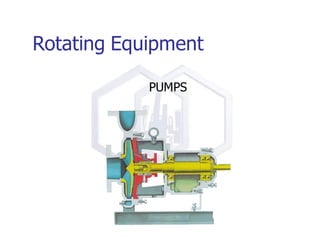
PUMPS
Rotating Equipment
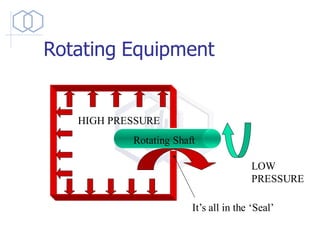
HIGH PRESSURE
It’s all in the ‘Seal’
LOW
PRESSURE
Rotating Shaft
ROTATING EQUIPMENT
◼ PUMPS
◼ COMPRESSORS
◼ AGITATORS
◼ FANS / BLOWERS
◼ TURBINES
◼ VACUUM PUMPS
◼ VALVES
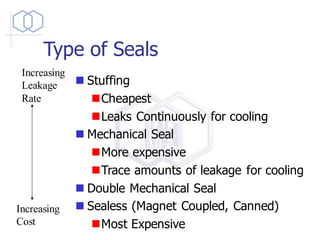
Type of Seals
◼ Stuffing
◼Cheapest
◼Leaks Continuously for cooling
◼ Mechanical Seal
◼More expensive
◼Trace amounts of leakage for cooling
◼ Double Mechanical Seal
◼ Sealess (Magnet Coupled, Canned)
◼Most Expensive
Increasing
Cost
Increasing
Leakage
Rate
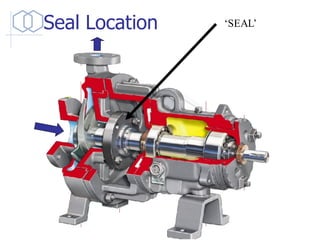
‘SEAL’
Seal Location
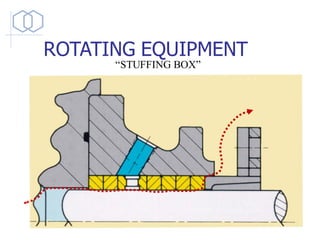
ROTATING EQUIPMENT
“STUFFING BOX”
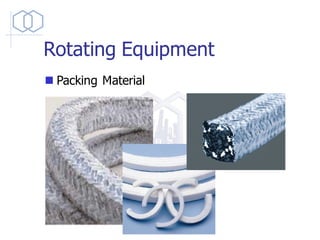
Rotating Equipment
◼ Packing Material
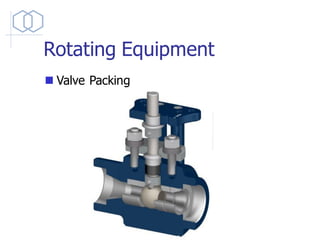
Rotating Equipment
◼ Valve Packing
ROTATING EQUIPMENT
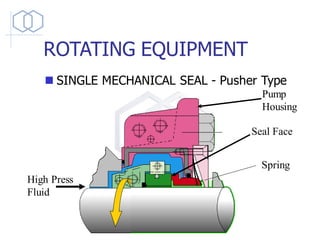
◼ SINGLE MECHANICAL SEAL - Pusher Type
High Press
Fluid
Shaft
Seal Face
Pump
Housing
Spring
ROTATING EQUIPMENT
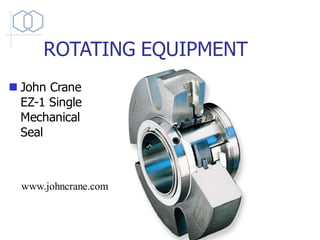
◼ John Crane
EZ-1 Single
Mechanical
Seal
www.johncrane.com
ROTATING EQUIPMENT
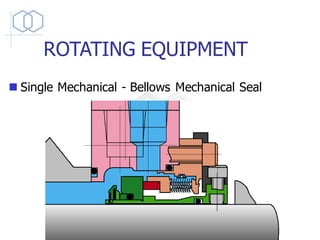
◼ Single Mechanical - Bellows Mechanical Seal
ROTATING EQUIPMENT
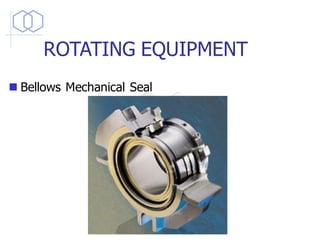
◼ Bellows Mechanical Seal
Rotating Equipment
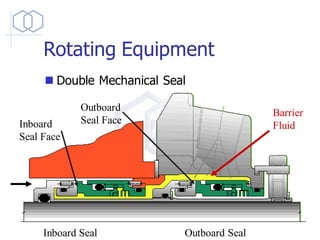
◼ Double Mechanical Seal
Inboard Seal Outboard Seal
Barrier
Fluid
Inboard
Seal Face
Outboard
Seal Face
Rotating Equipment
Rotating Equipment
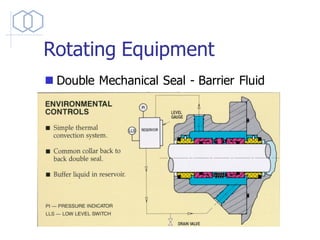
◼ Double Mechanical Seal - Barrier Fluid
Rotating Equipment
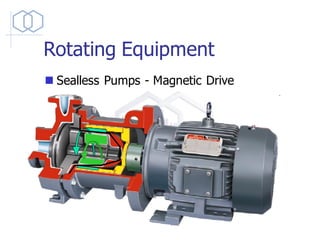
◼ Sealless Pumps - Magnetic Drive
Rotating Equipment
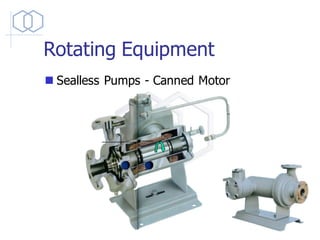
◼ Sealless Pumps - Canned Motor
Rotating Equipment
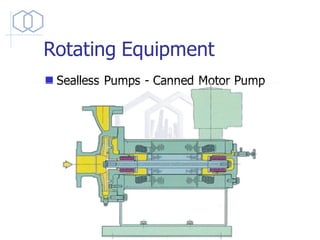
◼ Sealless Pumps - Canned Motor Pump
Rotating Equipment
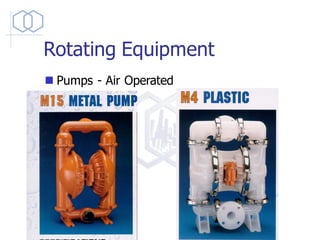
◼ Pumps - Air Operated
Rotating Equipment
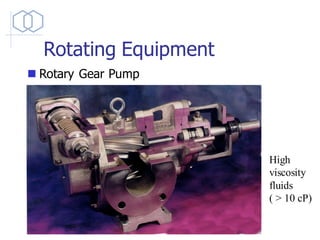
◼ Rotary Gear Pump
High
viscosity
fluids
( > 10 cP)
Rotating Equipment
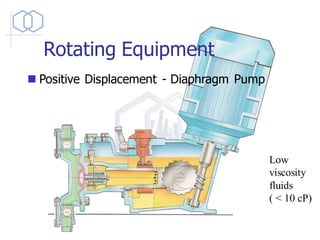
◼ Positive Displacement - Diaphragm Pump
Low
viscosity
fluids
( < 10 cP)
Rotating Equipment
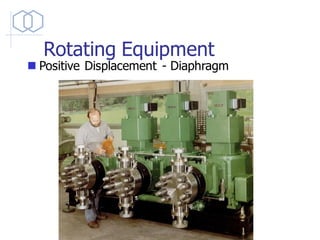
◼ Positive Displacement - Diaphragm
Rotating Equipment
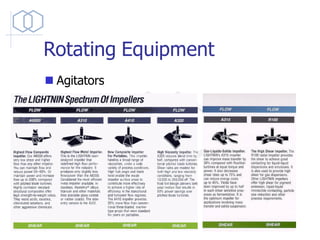
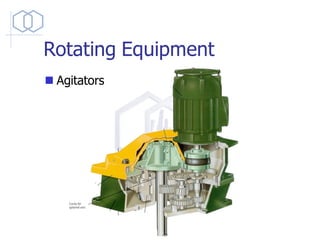
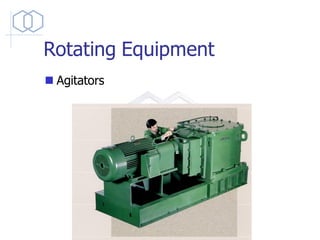
◼ Agitators
Rotating Equipment
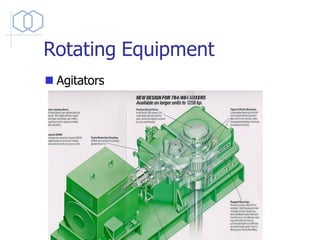
◼ Agitators
Rotating Equipment
◼ Agitators
Rotating Equipment
◼ Agitators
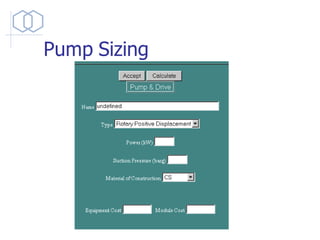
Pump Sizing For CHEE 470
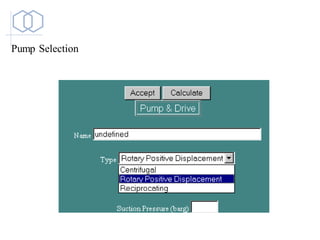
Pump Selection
Pump Selection
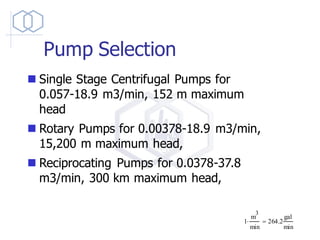
◼ Single Stage Centrifugal Pumps for
0.057-18.9 m3/min, 152 m maximum
head
◼ Rotary Pumps for 0.00378-18.9 m3/min,
15,200 m maximum head,
◼ Reciprocating Pumps for 0.0378-37.8
m3/min, 300 km maximum head,
1
m
3
min
 264.2
gal
min
=
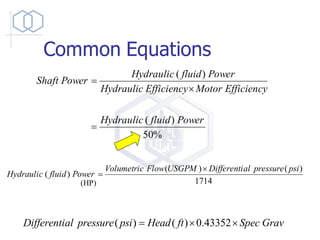
Pump Sizing
%
50
)
(
)
(
Power
fluid
Hydraulic
Efficiency
Motor
Efficiency
Hydraulic
Power
fluid
Hydraulic
Power
Shaft
=

=
1714
)
(
)
(
)
(
psi
pressure
al
Differenti
USGPM
Flow
Volumetric
Power
fluid
Hydraulic

=
Grav
Spec
ft
Head
psi
pressure
al
Differenti 

= 43352
.
0
)
(
)
(
(HP)
Common Equations
Pump Sizing
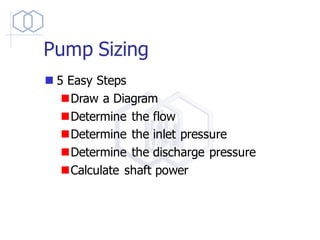
◼ 5 Easy Steps
◼Draw a Diagram
◼Determine the flow
◼Determine the inlet pressure
◼Determine the discharge pressure
◼Calculate shaft power
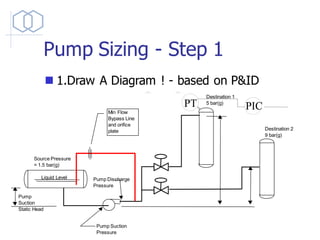
Pump Sizing - Step 1
◼ 1.Draw A Diagram ! - based on P&ID
Source Pressure
= 1.5 bar(g)
Destination 1
5 bar(g)
Liquid Level
Pump Suction
Pressure
Pump Discharge
Pressure
Pump
Suction
Static Head
Destination 2
9 bar(g)
Min Flow
Bypass Line
and orifice
plate
PIC
PT
Pump Sizing - Step 2
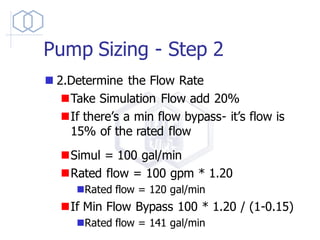
◼ 2.Determine the Flow Rate
◼Take Simulation Flow add 20%
◼If there’s a min flow bypass- it’s flow is
15% of the rated flow
◼Simul = 100 gal/min
◼Rated flow = 100 gpm * 1.20
◼Rated flow = 120 gal/min
◼If Min Flow Bypass 100 * 1.20 / (1-0.15)
◼Rated flow = 141 gal/min
Pump Sizing - Step 3
◼ 3. Determine Pump Inlet Pressure
◼Use Pressure from Simulation
◼ Assume elevation changes offset piping pressure
drops
Pump Sizing - Step 4
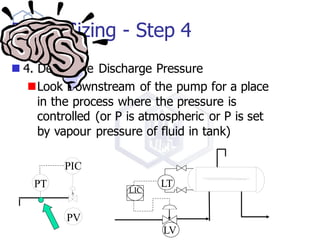
◼ 4. Determine Discharge Pressure
◼Look Downstream of the pump for a place
in the process where the pressure is
controlled (or P is atmospheric or P is set
by vapour pressure of fluid in tank)
PIC
PT
PV
LT
LV
LIC
Pump Sizing - Step 4
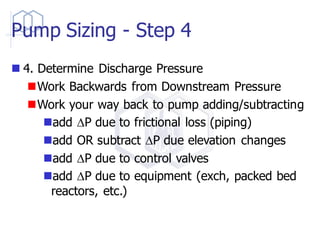
◼ 4. Determine Discharge Pressure
◼Work Backwards from Downstream Pressure
◼Work your way back to pump adding/subtracting
◼add DP due to frictional loss (piping)
◼add OR subtract DP due elevation changes
◼add DP due to control valves
◼add DP due to equipment (exch, packed bed
reactors, etc.)
Pump Sizing - Step 4
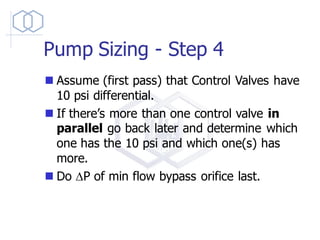
◼ Assume (first pass) that Control Valves have
10 psi differential.
◼ If there’s more than one control valve in
parallel go back later and determine which
one has the 10 psi and which one(s) has
more.
◼ Do DP of min flow bypass orifice last.
Pump Sizing - Step 4
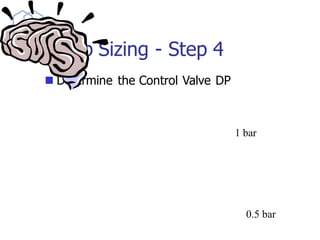
◼ Determine the Control Valve DP
Source Pressure
= 0 bar(g)
Destination 1
5 bar(g)
Liquid Level
Pump Suction
Pressure
Pump Discharge
Pressure
Pump
Suction
Static Head
Destination 2
9 bar(g)
1 bar
0.5 bar
Pump Sizing - Step 4
◼ Determine the Control Valve DP
◼ Control Valve Sizing
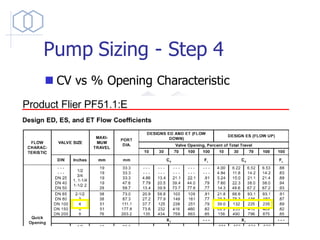
◼CV vs % Opening Characteristic
CV Volumetric_Flow
Spec_Gravity
Pressure_Differential

Volumetric_Flow
gal
min
Pressure_Differential psi
Pump Sizing - Step 4
◼ CV vs % Opening Characteristic
Pump Sizing - Step 4
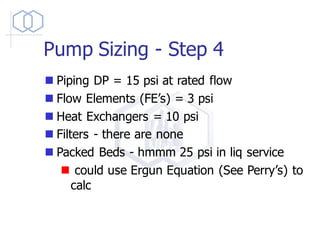
◼ Piping DP = 15 psi at rated flow
◼ Flow Elements (FE’s) = 3 psi
◼ Heat Exchangers = 10 psi
◼ Filters - there are none
◼ Packed Beds - hmmm 25 psi in liq service
◼ could use Ergun Equation (See Perry’s) to
calc
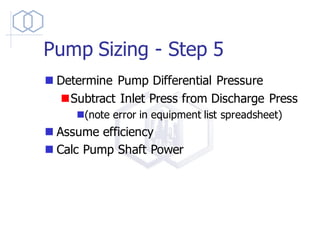
Pump Sizing - Step 5
◼ Determine Pump Differential Pressure
◼Subtract Inlet Press from Discharge Press
◼(note error in equipment list spreadsheet)
◼ Assume efficiency
◼ Calc Pump Shaft Power
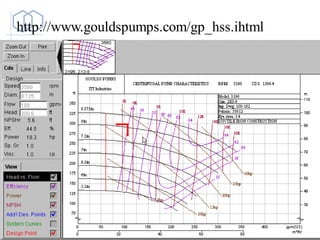
http://www.gouldspumps.com/gp_hss.ihtml
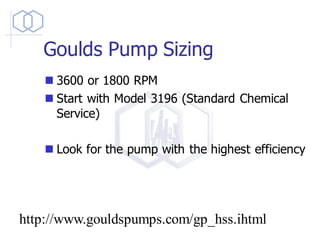
Goulds Pump Sizing
◼ 3600 or 1800 RPM
◼ Start with Model 3196 (Standard Chemical
Service)
◼ Look for the pump with the highest efficiency
http://www.gouldspumps.com/gp_hss.ihtml
Workshop
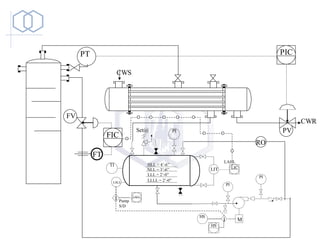
◼ reflux pump on the acetone column (easy
one)
NLL = 3’-6”
LLL = 2’-0”
HLL = 4’-6”
LLLL = 2’-0”
LIT
LSLL
I Pump
S/D
LIC
TI
PI
LAHL
LALL
Set@
M
I
HS
HS
PI
PI
RO
FV
FT
FIC
PV
PT PIC
CWS
CWR
Workshop
◼ Flow: 4372 kg/hr (simulation), SG = 0.75
◼ Diagram!
◼ 23/0.6*1.1= 43 trays
◼ height to reflux nozzle= 43*2ft+6 ft = 90 ft
◼ Find the pump type, hydraulic horsepower, and the Brake HP
FT
275 kPa
275 kPa
Questions
◼ NPSH
◼ compression ratio
◼ driver types
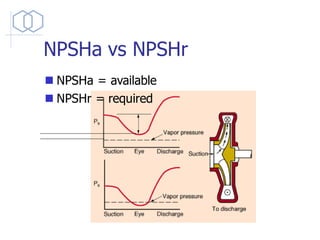
NPSHa vs NPSHr
◼ NPSHa = available
◼ NPSHr = required
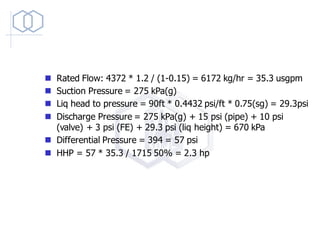
◼ Rated Flow: 4372 * 1.2 / (1-0.15) = 6172 kg/hr = 35.3 usgpm
◼ Suction Pressure = 275 kPa(g)
◼ Liq head to pressure = 90ft * 0.4432 psi/ft * 0.75(sg) = 29.3psi
◼ Discharge Pressure = 275 kPa(g) + 15 psi (pipe) + 10 psi
(valve) + 3 psi (FE) + 29.3 psi (liq height) = 670 kPa
◼ Differential Pressure = 394 = 57 psi
◼ HHP = 57 * 35.3 / 1715 50% = 2.3 hp

Rotating equipment maintenance .pdf