EMERGENCY CONTRACEPTION www.freelivedoctor.com
INTRODUCTION Emergency contraception (EC) is any method of contraception which is used after intercourse and before the potential time of implantation  www.freelivedoctor.com
As these methods work prior to implantation, they are not abortifacients.  Emergency contraception is a backup method for occasional use, and should not be used as a regular method of birth control . INTRODUCTION www.freelivedoctor.com
OPTIONS There are 2 methods of emergency contraception:  Hormonal methods, which involve the use of emergency contraceptive pills (ECPs), and  The post-coital insertion of a copper intrauterine device (IUD).  www.freelivedoctor.com
Two hormonal preparations are :  One contains only the progestin levonorgestrel, while the other is a  Combined preparation containing both ethinyl estradiol and levonorgestrel . OPTIONS www.freelivedoctor.com
The levonorgestrel-only method,  (The regimen consists of  2 doses of 750  µ g levonorgestrel taken orally 12 hours apart).  OPTIONS www.freelivedoctor.com
Yuzpe method in use since the 1970s, it consists of the oral administration of 2 doses of 100  µ g ethinyl estradiol (EE) and 500  µ g levonorgestrel 12 hours apart. Ovral tablets (each containing 50  µ g ethinyl estradiol and 250  µ g levonorgestrel) are most commonly used to provide these doses.  OPTIONS www.freelivedoctor.com
The Yuzpe and levonorgestrel-only methods have been shown in randomized trials to reduce the risk of pregnancy by approximately 75 and 85% respectively. This does not mean that 25% of women using the Yuzpe method will become pregnant.  OPTIONS www.freelivedoctor.com
EFFECTIVENESS It means that, if 100 women had unprotected intercourse once, during the second or third week of menstrual cycle,  8 of them would be likely to become pregnant, but that only 2 would become pregnant (a reduction of 75%) after use of the Yuzpe method.  A single dose of 1.5 mg of levonorgestrel appears to be as effective as the standard 2-dose levonorgestrel regimen. www.freelivedoctor.com
Although they have generally been used only up to 72 hours after intercourse, both hormonal methods of EC are effective when taken between 72 and 120 hours after unprotected intercourse. The effectiveness when used after  72 hours seems to be slightly lower.  EFFECTIVENESS www.freelivedoctor.com
Decline significantly with increasing delay between unprotected intercourse and the initiation of treatment EFFECTIVENESS www.freelivedoctor.com
Levonorgestrel EC prevented  : 95% of pregnancies when used within 24 hours of intercourse,  85% when used 25 to 48 hours after intercourse, and  58% when used 49 to 72 hours after intercourse.  www.freelivedoctor.com
The corresponding figures for the  Yuzpe method  were:  77% when used within 24 hours of intercourse,  36% when used within 25 to 48 hours after intercourse, and  31%when used 49 to 72 hours after intercourse.  EFFECTIVENESS www.freelivedoctor.com
A meta-analysis has demonstrated that the effectiveness of post-coital IUDs approaches 100%, significantly higher than the effectiveness of hormonal EC. EFFECTIVENESS www.freelivedoctor.com
MECHANISM OF ACTION Theoretically, EC could interfere with: Follicle maturation;  The ovulatory process;  Cervical mucus;  Sperm migration;  Corpus luteum sufficiency;  Endometrial receptivity;  Fertilization;  and  Zygote development, transport, and adhesion. www.freelivedoctor.com
The mechanism of action may differ not only with the different EC methods,but also within each method, depending upon  when it is given relative to the time of both intercourse and ovulation. MECHANISM OF ACTION www.freelivedoctor.com
INDICATIONS Hormonal EC should be considered for any woman wishing to avoid pregnancy who presents within 5 days of unprotected or inadequately protected sexual intercourse. A post-coital IUD insertion can be considered up to 7 days after unprotected intercourse. www.freelivedoctor.com
www.freelivedoctor.com
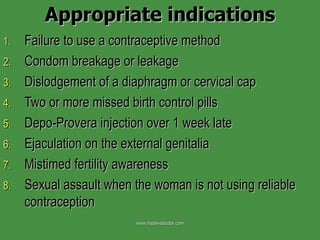
Appropriate indications Failure to use a contraceptive method Condom breakage or leakage Dislodgement of a diaphragm or cervical cap Two or more missed birth control pills Depo-Provera injection over 1 week late Ejaculation on the external genitalia Mistimed fertility awareness Sexual assault when the woman is not using reliable contraception www.freelivedoctor.com
Because it is difficult to determine the  infertile time of the cycle with certainty, EC should be provided to a woman who is concerned about her risk of pregnancy regardless of the cycle day of exposure .  www.freelivedoctor.com
Although ECPs are not recommended as a regular form of contraception, repeat use poses no known health risks  and should not be a reason for denying women access to treatment. www.freelivedoctor.com
C ONTRAINDICATIONS The only absolute contraindication to the use of emergency hormonal contraception is known pregnancy .  www.freelivedoctor.com
The effect of ECP use in women already pregnant on the outcome of pregnancy is unknown, but pregnancies in which the fetus has been exposed to oral contraceptives (OCs) have shown no evidence of teratogenicity . CONTRAINDICATIONS www.freelivedoctor.com
No substantial increased risk for developing venous thromboembolism has been found with combined hormonal EC. CONTRAINDICATIONS www.freelivedoctor.com
Levonorgestrel The only method carries no theoretical risk, it is the preferred option for women with contraindications to   estrogen   such as those with : Known thrombophilia,  A history of stroke or heart attack,  Migraine headache with neurological symptoms, or  Smokers over age  CONTRAINDICATIONS www.freelivedoctor.com
If insertion of an IUD is considered , a preexisting pregnancy must be excluded.  This may require a sensitive urine pregnancy test or assay of serum human chorionic gonadotrophin (hCG). There should be : No history of recent PID Low risk for sexually transmitted infection, and  No evidence on examination of vaginal or cervical infection. CONTRAINDICATIONS www.freelivedoctor.com
SIDE EFFECTS The common side effects of hormonal emergency contraception are gastrointestinal.  The levonorgestrel method has a significantly lower incidence than the Yuzpe method, of:  Nausea (23% versus 50%),  Vomiting (5% versus 18%),  Dizziness, and fatigue .  www.freelivedoctor.com
The antiemetic meclizine has been shown to reduce the risk of nausea when taken orally in a dose of 50 mg 1 hour before the first dose of the Yuzpe method, but its use increases the incidence of drowsiness. SIDE EFFECTS www.freelivedoctor.com
Less common side effects of both methods include: headache, bloating, abdominal cramps, and spotting or bleeding. Most women will have menstrual bleeding within 3 weeks of taking ECPs. SIDE EFFECTS www.freelivedoctor.com
Possible complications of post-coital IUD insertion include: Pelvic pain,  Abnormal bleeding,  Pelvic infection,  Perforation and  Expulsion. SIDE EFFECTS www.freelivedoctor.com
MYTHS AND MISCONCEPTIONS Emergency contraceptive pills cause a  “ mini-abortion. ” Fact:   Emergency contraceptive pills have no effect on an established pregnancy.  They act prior to implantation and therefore are not abortifacients . www.freelivedoctor.com
If emergency contraceptive pills are too easy to obtain, women will  “ abuse ”  them . Fact: Women who are supplied with emergency contraceptive pills in advance of need will use them appropriately and are not more likely to abandon regular forms of birth control. MYTHS AND MISCONCEPTIONS www.freelivedoctor.com
Emergency contraceptive pills have high doses of hormones and are dangerous to use. Fact:   The brief one-time dose of hormone  in emergency contraceptive pills is extremely safe and can be used by virtually any woman who needs it. MYTHS AND MISCONCEPTIONS www.freelivedoctor.com
PROVIDING EMERGENCY CONTRACEPTION To determine whether EC is indicated, the unprotected intercourse should occurred within the time frame when EC is effective.  The risk for having a preexisting pregnancy should be assessed by determining the timing and character of her last menstrual period.  www.freelivedoctor.com
Rarely, a urine pregnancy test may be necessary to rule out pregnancy. A history of previous unprotected intercourse during the current cycle should not preclude the use of EC to lower risk related to unprotected intercourse within the therapeutic window for EC. PROVIDING EMERGENCY CONTRACEPTION www.freelivedoctor.com
Health-care providers should also discuss broader sexual health concerns, such as risks for sexually transmitted infections, and need for ongoing birth control .   PROVIDING EMERGENCY CONTRACEPTION www.freelivedoctor.com
Testing for chlamydia infection at the time of presentation for EC has been shown to detect most cases.  It should be considered for high-risk groups (e.g., women under age 30) when reliable follow-up cannot be guaranteed. PROVIDING EMERGENCY CONTRACEPTION www.freelivedoctor.com
Women should be informed about the potential side effects of EC, and  Should be advised that hormonal EC will not prevent pregnancy resulting from unprotected intercourse in the days or weeks following treatment.  PROVIDING EMERGENCY CONTRACEPTION www.freelivedoctor.com
A barrier method such as the condom can be used for the remainder of the current menstrual cycle, and a  Regular contraceptive method can be initiated at the beginning of the next cycle if the woman desires .  PROVIDING EMERGENCY CONTRACEPTION www.freelivedoctor.com
A woman who wishes to begin using OCs may be provided with a prescription to start with her next period or the next day following the use of ECPs. She should use a condom until she has taken the oral contraceptive pill for 7 consecutive days. PROVIDING EMERGENCY CONTRACEPTION www.freelivedoctor.com
FOLLOW-UP Women should be advised to have a pregnancy test if they do not experience normal menstrual bleeding by 21 days after treatment (28 days if she began using OCs after taking ECPs).  www.freelivedoctor.com
TROUBLESHOOTING Women who experience nausea or vomiting after taking hormonal EC should be advised to take an antiemetic such as meclizine.  Using the levonorgestrel-only method as a single-dose regimen (1.5 mg orally) obviates the need for a second dose if nausea occurs, and may be preferred for this reason . www.freelivedoctor.com
If it is likely that a woman may forget to take her second dose of the 2-dose regimen, the single-dose levonorgestrel regimen should be recommended.  If the second dose is forgotten, it can be taken up to 24 hours after the first without significant change in pharmacokinetics compared to the  12-hour dosing schedule. TROUBLESHOOTING www.freelivedoctor.com
DRUG INTERACTIONS Although theoretically the serum concentrations of the ECP hormones are affected by the use of drugs such as rifampicin and certain anticonvulsants,  the efficacy of ECPs in this situation is uncertain .  www.freelivedoctor.com
A case report of a woman taking warfarin who used the levonorgestrel-only ECP described a subsequent significant increase  in anticoagulant effect. DRUG INTERACTIONS www.freelivedoctor.com
SUMMARY STATEMENTS Women who have had unprotected intercourse and wish to prevent pregnancy can be offered use of hormonal emergency contraception up to 5 days after intercourse, (Level II) or  Insertion of a copper IUD up to 7 days after intercourse, to reduce the risk of pregnancy. (Level II) www.freelivedoctor.com
The levonorgestrel emergency contraception regimen is more effective and causes fewer side effects than the Yuzpe  (ethinyl estradiol – levonorgestrel)  regimen .  SUMMARY STATEMENTS www.freelivedoctor.com
One double dose of levonorgestrel emergency contraception  (1.5 mg) is as effective as the regular 2-dose levonorgestrel regimen (0.75 mg each dose), with no difference in side effects.  SUMMARY STATEMENTS www.freelivedoctor.com
Advance provision of hormonal emergency contraception increases the use of emergency contraception without decreasing the use of regular contraception . SUMMARY STATEMENTS www.freelivedoctor.com
A pelvic examination is not a prerequisite to providing emergency contraception .  SUMMARY STATEMENTS www.freelivedoctor.com
RECOMMENDATIONS Because the efficacy of hormonal emergency contraception may be higher if used sooner,  it should be started as soon as possible after an act of unprotected intercourse.  www.freelivedoctor.com
Hormonal emergency contraception should be available without a prescription in:  Pharmacies,  Family planning clinics,  Emergency rooms, and  School health programs .   RECOMMENDATIONS www.freelivedoctor.com
Users of emergency contraception should be evaluated for pregnancy  if menses have not begun within 21 days following treatment.  RECOMMENDATIONS www.freelivedoctor.com
Women and men of reproductive age should be counselled about emergency contraception.  Women should be offered a prescription in advance of need .  RECOMMENDATIONS www.freelivedoctor.com

Emergency contraception

  • 1.
  • 2.
    INTRODUCTION Emergency contraception(EC) is any method of contraception which is used after intercourse and before the potential time of implantation www.freelivedoctor.com
  • 3.
    As these methodswork prior to implantation, they are not abortifacients. Emergency contraception is a backup method for occasional use, and should not be used as a regular method of birth control . INTRODUCTION www.freelivedoctor.com
  • 4.
    OPTIONS There are2 methods of emergency contraception: Hormonal methods, which involve the use of emergency contraceptive pills (ECPs), and The post-coital insertion of a copper intrauterine device (IUD). www.freelivedoctor.com
  • 5.
    Two hormonal preparationsare : One contains only the progestin levonorgestrel, while the other is a Combined preparation containing both ethinyl estradiol and levonorgestrel . OPTIONS www.freelivedoctor.com
  • 6.
    The levonorgestrel-only method, (The regimen consists of 2 doses of 750 µ g levonorgestrel taken orally 12 hours apart). OPTIONS www.freelivedoctor.com
  • 7.
    Yuzpe method inuse since the 1970s, it consists of the oral administration of 2 doses of 100 µ g ethinyl estradiol (EE) and 500 µ g levonorgestrel 12 hours apart. Ovral tablets (each containing 50 µ g ethinyl estradiol and 250 µ g levonorgestrel) are most commonly used to provide these doses. OPTIONS www.freelivedoctor.com
  • 8.
    The Yuzpe andlevonorgestrel-only methods have been shown in randomized trials to reduce the risk of pregnancy by approximately 75 and 85% respectively. This does not mean that 25% of women using the Yuzpe method will become pregnant. OPTIONS www.freelivedoctor.com
  • 9.
    EFFECTIVENESS It meansthat, if 100 women had unprotected intercourse once, during the second or third week of menstrual cycle, 8 of them would be likely to become pregnant, but that only 2 would become pregnant (a reduction of 75%) after use of the Yuzpe method. A single dose of 1.5 mg of levonorgestrel appears to be as effective as the standard 2-dose levonorgestrel regimen. www.freelivedoctor.com
  • 10.
    Although they havegenerally been used only up to 72 hours after intercourse, both hormonal methods of EC are effective when taken between 72 and 120 hours after unprotected intercourse. The effectiveness when used after 72 hours seems to be slightly lower. EFFECTIVENESS www.freelivedoctor.com
  • 11.
    Decline significantly withincreasing delay between unprotected intercourse and the initiation of treatment EFFECTIVENESS www.freelivedoctor.com
  • 12.
    Levonorgestrel EC prevented : 95% of pregnancies when used within 24 hours of intercourse, 85% when used 25 to 48 hours after intercourse, and 58% when used 49 to 72 hours after intercourse. www.freelivedoctor.com
  • 13.
    The corresponding figuresfor the Yuzpe method were: 77% when used within 24 hours of intercourse, 36% when used within 25 to 48 hours after intercourse, and 31%when used 49 to 72 hours after intercourse. EFFECTIVENESS www.freelivedoctor.com
  • 14.
    A meta-analysis hasdemonstrated that the effectiveness of post-coital IUDs approaches 100%, significantly higher than the effectiveness of hormonal EC. EFFECTIVENESS www.freelivedoctor.com
  • 15.
    MECHANISM OF ACTIONTheoretically, EC could interfere with: Follicle maturation; The ovulatory process; Cervical mucus; Sperm migration; Corpus luteum sufficiency; Endometrial receptivity; Fertilization; and Zygote development, transport, and adhesion. www.freelivedoctor.com
  • 16.
    The mechanism ofaction may differ not only with the different EC methods,but also within each method, depending upon when it is given relative to the time of both intercourse and ovulation. MECHANISM OF ACTION www.freelivedoctor.com
  • 17.
    INDICATIONS Hormonal ECshould be considered for any woman wishing to avoid pregnancy who presents within 5 days of unprotected or inadequately protected sexual intercourse. A post-coital IUD insertion can be considered up to 7 days after unprotected intercourse. www.freelivedoctor.com
  • 18.
  • 19.
    Appropriate indications Failureto use a contraceptive method Condom breakage or leakage Dislodgement of a diaphragm or cervical cap Two or more missed birth control pills Depo-Provera injection over 1 week late Ejaculation on the external genitalia Mistimed fertility awareness Sexual assault when the woman is not using reliable contraception www.freelivedoctor.com
  • 20.
    Because it isdifficult to determine the infertile time of the cycle with certainty, EC should be provided to a woman who is concerned about her risk of pregnancy regardless of the cycle day of exposure . www.freelivedoctor.com
  • 21.
    Although ECPs arenot recommended as a regular form of contraception, repeat use poses no known health risks and should not be a reason for denying women access to treatment. www.freelivedoctor.com
  • 22.
    C ONTRAINDICATIONS Theonly absolute contraindication to the use of emergency hormonal contraception is known pregnancy . www.freelivedoctor.com
  • 23.
    The effect ofECP use in women already pregnant on the outcome of pregnancy is unknown, but pregnancies in which the fetus has been exposed to oral contraceptives (OCs) have shown no evidence of teratogenicity . CONTRAINDICATIONS www.freelivedoctor.com
  • 24.
    No substantial increasedrisk for developing venous thromboembolism has been found with combined hormonal EC. CONTRAINDICATIONS www.freelivedoctor.com
  • 25.
    Levonorgestrel The onlymethod carries no theoretical risk, it is the preferred option for women with contraindications to estrogen such as those with : Known thrombophilia, A history of stroke or heart attack, Migraine headache with neurological symptoms, or Smokers over age CONTRAINDICATIONS www.freelivedoctor.com
  • 26.
    If insertion ofan IUD is considered , a preexisting pregnancy must be excluded. This may require a sensitive urine pregnancy test or assay of serum human chorionic gonadotrophin (hCG). There should be : No history of recent PID Low risk for sexually transmitted infection, and No evidence on examination of vaginal or cervical infection. CONTRAINDICATIONS www.freelivedoctor.com
  • 27.
    SIDE EFFECTS Thecommon side effects of hormonal emergency contraception are gastrointestinal. The levonorgestrel method has a significantly lower incidence than the Yuzpe method, of: Nausea (23% versus 50%), Vomiting (5% versus 18%), Dizziness, and fatigue . www.freelivedoctor.com
  • 28.
    The antiemetic meclizinehas been shown to reduce the risk of nausea when taken orally in a dose of 50 mg 1 hour before the first dose of the Yuzpe method, but its use increases the incidence of drowsiness. SIDE EFFECTS www.freelivedoctor.com
  • 29.
    Less common sideeffects of both methods include: headache, bloating, abdominal cramps, and spotting or bleeding. Most women will have menstrual bleeding within 3 weeks of taking ECPs. SIDE EFFECTS www.freelivedoctor.com
  • 30.
    Possible complications ofpost-coital IUD insertion include: Pelvic pain, Abnormal bleeding, Pelvic infection, Perforation and Expulsion. SIDE EFFECTS www.freelivedoctor.com
  • 31.
    MYTHS AND MISCONCEPTIONSEmergency contraceptive pills cause a “ mini-abortion. ” Fact: Emergency contraceptive pills have no effect on an established pregnancy. They act prior to implantation and therefore are not abortifacients . www.freelivedoctor.com
  • 32.
    If emergency contraceptivepills are too easy to obtain, women will “ abuse ” them . Fact: Women who are supplied with emergency contraceptive pills in advance of need will use them appropriately and are not more likely to abandon regular forms of birth control. MYTHS AND MISCONCEPTIONS www.freelivedoctor.com
  • 33.
    Emergency contraceptive pillshave high doses of hormones and are dangerous to use. Fact: The brief one-time dose of hormone in emergency contraceptive pills is extremely safe and can be used by virtually any woman who needs it. MYTHS AND MISCONCEPTIONS www.freelivedoctor.com
  • 34.
    PROVIDING EMERGENCY CONTRACEPTIONTo determine whether EC is indicated, the unprotected intercourse should occurred within the time frame when EC is effective. The risk for having a preexisting pregnancy should be assessed by determining the timing and character of her last menstrual period. www.freelivedoctor.com
  • 35.
    Rarely, a urinepregnancy test may be necessary to rule out pregnancy. A history of previous unprotected intercourse during the current cycle should not preclude the use of EC to lower risk related to unprotected intercourse within the therapeutic window for EC. PROVIDING EMERGENCY CONTRACEPTION www.freelivedoctor.com
  • 36.
    Health-care providers shouldalso discuss broader sexual health concerns, such as risks for sexually transmitted infections, and need for ongoing birth control . PROVIDING EMERGENCY CONTRACEPTION www.freelivedoctor.com
  • 37.
    Testing for chlamydiainfection at the time of presentation for EC has been shown to detect most cases. It should be considered for high-risk groups (e.g., women under age 30) when reliable follow-up cannot be guaranteed. PROVIDING EMERGENCY CONTRACEPTION www.freelivedoctor.com
  • 38.
    Women should beinformed about the potential side effects of EC, and Should be advised that hormonal EC will not prevent pregnancy resulting from unprotected intercourse in the days or weeks following treatment. PROVIDING EMERGENCY CONTRACEPTION www.freelivedoctor.com
  • 39.
    A barrier methodsuch as the condom can be used for the remainder of the current menstrual cycle, and a Regular contraceptive method can be initiated at the beginning of the next cycle if the woman desires . PROVIDING EMERGENCY CONTRACEPTION www.freelivedoctor.com
  • 40.
    A woman whowishes to begin using OCs may be provided with a prescription to start with her next period or the next day following the use of ECPs. She should use a condom until she has taken the oral contraceptive pill for 7 consecutive days. PROVIDING EMERGENCY CONTRACEPTION www.freelivedoctor.com
  • 41.
    FOLLOW-UP Women shouldbe advised to have a pregnancy test if they do not experience normal menstrual bleeding by 21 days after treatment (28 days if she began using OCs after taking ECPs). www.freelivedoctor.com
  • 42.
    TROUBLESHOOTING Women whoexperience nausea or vomiting after taking hormonal EC should be advised to take an antiemetic such as meclizine. Using the levonorgestrel-only method as a single-dose regimen (1.5 mg orally) obviates the need for a second dose if nausea occurs, and may be preferred for this reason . www.freelivedoctor.com
  • 43.
    If it islikely that a woman may forget to take her second dose of the 2-dose regimen, the single-dose levonorgestrel regimen should be recommended. If the second dose is forgotten, it can be taken up to 24 hours after the first without significant change in pharmacokinetics compared to the 12-hour dosing schedule. TROUBLESHOOTING www.freelivedoctor.com
  • 44.
    DRUG INTERACTIONS Althoughtheoretically the serum concentrations of the ECP hormones are affected by the use of drugs such as rifampicin and certain anticonvulsants, the efficacy of ECPs in this situation is uncertain . www.freelivedoctor.com
  • 45.
    A case reportof a woman taking warfarin who used the levonorgestrel-only ECP described a subsequent significant increase in anticoagulant effect. DRUG INTERACTIONS www.freelivedoctor.com
  • 46.
    SUMMARY STATEMENTS Womenwho have had unprotected intercourse and wish to prevent pregnancy can be offered use of hormonal emergency contraception up to 5 days after intercourse, (Level II) or Insertion of a copper IUD up to 7 days after intercourse, to reduce the risk of pregnancy. (Level II) www.freelivedoctor.com
  • 47.
    The levonorgestrel emergencycontraception regimen is more effective and causes fewer side effects than the Yuzpe (ethinyl estradiol – levonorgestrel) regimen . SUMMARY STATEMENTS www.freelivedoctor.com
  • 48.
    One double doseof levonorgestrel emergency contraception (1.5 mg) is as effective as the regular 2-dose levonorgestrel regimen (0.75 mg each dose), with no difference in side effects. SUMMARY STATEMENTS www.freelivedoctor.com
  • 49.
    Advance provision ofhormonal emergency contraception increases the use of emergency contraception without decreasing the use of regular contraception . SUMMARY STATEMENTS www.freelivedoctor.com
  • 50.
    A pelvic examinationis not a prerequisite to providing emergency contraception . SUMMARY STATEMENTS www.freelivedoctor.com
  • 51.
    RECOMMENDATIONS Because theefficacy of hormonal emergency contraception may be higher if used sooner, it should be started as soon as possible after an act of unprotected intercourse. www.freelivedoctor.com
  • 52.
    Hormonal emergency contraceptionshould be available without a prescription in: Pharmacies, Family planning clinics, Emergency rooms, and School health programs . RECOMMENDATIONS www.freelivedoctor.com
  • 53.
    Users of emergencycontraception should be evaluated for pregnancy if menses have not begun within 21 days following treatment. RECOMMENDATIONS www.freelivedoctor.com
  • 54.
    Women and menof reproductive age should be counselled about emergency contraception. Women should be offered a prescription in advance of need . RECOMMENDATIONS www.freelivedoctor.com