Lactation PhysiologyLactation Physiology
and Managementand Management
Alison Stuebe, MD, MSc
astuebe@med.unc.edu
ObjectivesObjectives
• Review public health impact of
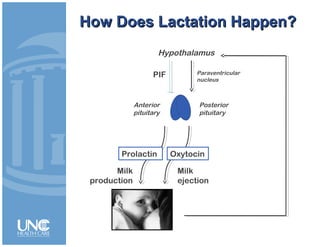
breastfeeding
• Understand physiology of lactation
• Identify the differential diagnosis and
treatment for common breastfeeding
problems
» Low milk supply
» Mastitis
» Breast abscess
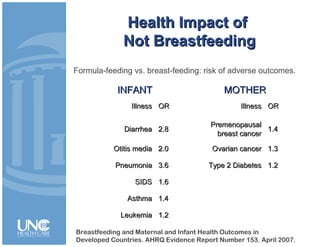
Health Impact ofHealth Impact of
Not BreastfeedingNot Breastfeeding
INFANTINFANT MOTHERMOTHER
IllnessIllness OROR IllnessIllness OROR
DiarrheaDiarrhea 2.82.8
PremenopausalPremenopausal
breast cancerbreast cancer
1.41.4
Otitis mediaOtitis media 2.02.0 Ovarian cancerOvarian cancer 1.31.3
PneumoniaPneumonia 3.63.6 Type 2 DiabetesType 2 Diabetes 1.21.2
SIDSSIDS 1.61.6
AsthmaAsthma 1.41.4
LeukemiaLeukemia 1.21.2
Formula-feeding vs. breast-feeding: risk of adverse outcomes.
Breastfeeding and Maternal and Infant Health Outcomes in
Developed Countries. AHRQ Evidence Report Number 153. April 2007.
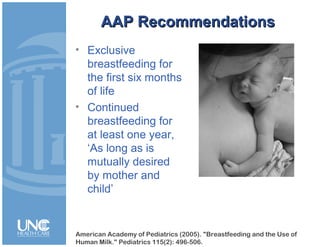
AAP RecommendationsAAP Recommendations
• Exclusive
breastfeeding for
the first six months
of life
• Continued
breastfeeding for
at least one year,
‘As long as is
mutually desired
by mother and
child’
American Academy of Pediatrics (2005). "Breastfeeding and the Use of
Human Milk." Pediatrics 115(2): 496-506.
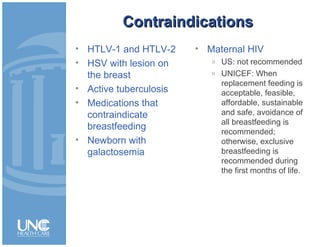
ContraindicationsContraindications
• HTLV-1 and HTLV-2
• HSV with lesion on
the breast
• Active tuberculosis
• Medications that
contraindicate
breastfeeding
• Newborn with
galactosemia
• Maternal HIV
» US: not recommended
» UNICEF: When
replacement feeding is
acceptable, feasible,
affordable, sustainable
and safe, avoidance of
all breastfeeding is
recommended;
otherwise, exclusive
breastfeeding is
recommended during
the first months of life.
Milk
production
Milk
ejection
PIF
How Does Lactation Happen?How Does Lactation Happen?
Prolactin Oxytocin
Anterior
pituitary
Posterior
pituitary
Hypothalamus
Paraventricular
nucleus
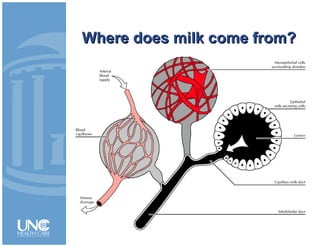
Where does milk come from?Where does milk come from?
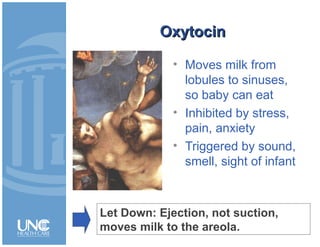
OxytocinOxytocin
• Moves milk from
lobules to sinuses,
so baby can eat
• Inhibited by stress,
pain, anxiety
• Triggered by sound,
smell, sight of infant
Let Down: Ejection, not suction,
moves milk to the areola.
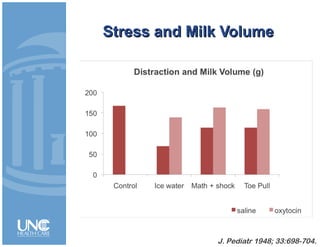
Stress and Milk VolumeStress and Milk Volume
J. Pediatr 1948; 33:698-704.
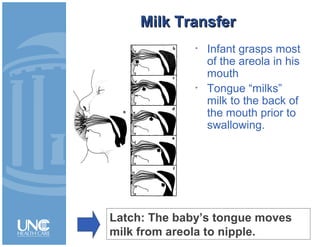
Milk TransferMilk Transfer
• Infant grasps most
of the areola in his
mouth
• Tongue “milks”
milk to the back of
the mouth prior to
swallowing.
Latch: The baby’s tongue moves
milk from areola to nipple.
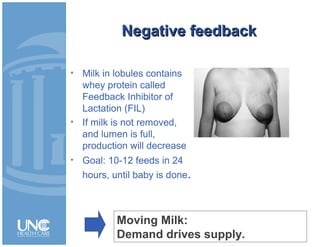
Negative feedbackNegative feedback
• Milk in lobules contains
whey protein called
Feedback Inhibitor of
Lactation (FIL)
• If milk is not removed,
and lumen is full,
production will decrease
• Goal: 10-12 feeds in 24
hours, until baby is done.
Moving Milk:
Demand drives supply.
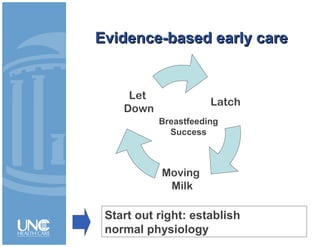
Evidence-based early careEvidence-based early care
Latch
Moving
Milk
Let
Down
Breastfeeding
Success
Start out right: establish
normal physiology
Low Milk SupplyLow Milk Supply
• Primary lactation failure
» Anatomic abnormality
» Sheehan’s syndrome
• Disruption of normal physiology
» Infrequent or inadequate milk removal
» Postpartum depression
• First line therapy:
» Lactation consultation
» Mechanical expression after breastfeeding
• If needed:
» Supplement after breastfeeding as indicated
» Continue pumping during supplementation
» Consider metoclopramide
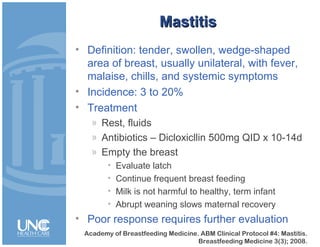
MastitisMastitis
• Definition: tender, swollen, wedge-shaped
area of breast, usually unilateral, with fever,
malaise, chills, and systemic symptoms
• Incidence: 3 to 20%
• Treatment
» Rest, fluids
» Antibiotics – Dicloxicllin 500mg QID x 10-14d
» Empty the breast
• Evaluate latch
• Continue frequent breast feeding
• Milk is not harmful to healthy, term infant
• Abrupt weaning slows maternal recovery
• Poor response requires further evaluation
Academy of Breastfeeding Medicine. ABM Clinical Protocol #4: Mastitis.
Breastfeeding Medicine 3(3); 2008.
Breast abscessBreast abscess
• 3% of women with mastitis
• Diagnosis
» Hard, red, tender mass after appropriate
treatment
» Diagnostic ultrasound
• Treatment
» Needle aspiration for culture / treatment
» Surgical drainage for large or multiple
abscesses
• Follow-up care
» Antibiotics
» Continue breastfeeding
For more informationFor more information
• American Academy of Pediatrics (2005).
Breastfeeding and the Use of Human Milk.
Pediatrics 115(2): 496-506.
• American Academy of Family Physicians.
(2001, 2/26/2007). Breastfeeding (Position
Paper).
• American College of Obstetrics and
Gynecology (2007). Breastfeeding: Maternal
and Infant Aspects. Special Report from
ACOG. ACOG Clinical Review 12(1
(supplement)): 1S-16S.
• Academy of Breastfeeding Medicine
www.bfmed.org

lactation management ppt

  • 1.
    Lactation PhysiologyLactation Physiology andManagementand Management Alison Stuebe, MD, MSc astuebe@med.unc.edu
  • 2.
    ObjectivesObjectives • Review publichealth impact of breastfeeding • Understand physiology of lactation • Identify the differential diagnosis and treatment for common breastfeeding problems » Low milk supply » Mastitis » Breast abscess
  • 3.
    Health Impact ofHealthImpact of Not BreastfeedingNot Breastfeeding INFANTINFANT MOTHERMOTHER IllnessIllness OROR IllnessIllness OROR DiarrheaDiarrhea 2.82.8 PremenopausalPremenopausal breast cancerbreast cancer 1.41.4 Otitis mediaOtitis media 2.02.0 Ovarian cancerOvarian cancer 1.31.3 PneumoniaPneumonia 3.63.6 Type 2 DiabetesType 2 Diabetes 1.21.2 SIDSSIDS 1.61.6 AsthmaAsthma 1.41.4 LeukemiaLeukemia 1.21.2 Formula-feeding vs. breast-feeding: risk of adverse outcomes. Breastfeeding and Maternal and Infant Health Outcomes in Developed Countries. AHRQ Evidence Report Number 153. April 2007.
  • 4.
    AAP RecommendationsAAP Recommendations •Exclusive breastfeeding for the first six months of life • Continued breastfeeding for at least one year, ‘As long as is mutually desired by mother and child’ American Academy of Pediatrics (2005). "Breastfeeding and the Use of Human Milk." Pediatrics 115(2): 496-506.
  • 5.
    ContraindicationsContraindications • HTLV-1 andHTLV-2 • HSV with lesion on the breast • Active tuberculosis • Medications that contraindicate breastfeeding • Newborn with galactosemia • Maternal HIV » US: not recommended » UNICEF: When replacement feeding is acceptable, feasible, affordable, sustainable and safe, avoidance of all breastfeeding is recommended; otherwise, exclusive breastfeeding is recommended during the first months of life.
  • 6.
    Milk production Milk ejection PIF How Does LactationHappen?How Does Lactation Happen? Prolactin Oxytocin Anterior pituitary Posterior pituitary Hypothalamus Paraventricular nucleus
  • 7.
    Where does milkcome from?Where does milk come from?
  • 8.
    OxytocinOxytocin • Moves milkfrom lobules to sinuses, so baby can eat • Inhibited by stress, pain, anxiety • Triggered by sound, smell, sight of infant Let Down: Ejection, not suction, moves milk to the areola.
  • 9.
    Stress and MilkVolumeStress and Milk Volume J. Pediatr 1948; 33:698-704.
  • 10.
    Milk TransferMilk Transfer •Infant grasps most of the areola in his mouth • Tongue “milks” milk to the back of the mouth prior to swallowing. Latch: The baby’s tongue moves milk from areola to nipple.
  • 11.
    Negative feedbackNegative feedback •Milk in lobules contains whey protein called Feedback Inhibitor of Lactation (FIL) • If milk is not removed, and lumen is full, production will decrease • Goal: 10-12 feeds in 24 hours, until baby is done. Moving Milk: Demand drives supply.
  • 12.
    Evidence-based early careEvidence-basedearly care Latch Moving Milk Let Down Breastfeeding Success Start out right: establish normal physiology
  • 13.
    Low Milk SupplyLowMilk Supply • Primary lactation failure » Anatomic abnormality » Sheehan’s syndrome • Disruption of normal physiology » Infrequent or inadequate milk removal » Postpartum depression • First line therapy: » Lactation consultation » Mechanical expression after breastfeeding • If needed: » Supplement after breastfeeding as indicated » Continue pumping during supplementation » Consider metoclopramide
  • 14.
    MastitisMastitis • Definition: tender,swollen, wedge-shaped area of breast, usually unilateral, with fever, malaise, chills, and systemic symptoms • Incidence: 3 to 20% • Treatment » Rest, fluids » Antibiotics – Dicloxicllin 500mg QID x 10-14d » Empty the breast • Evaluate latch • Continue frequent breast feeding • Milk is not harmful to healthy, term infant • Abrupt weaning slows maternal recovery • Poor response requires further evaluation Academy of Breastfeeding Medicine. ABM Clinical Protocol #4: Mastitis. Breastfeeding Medicine 3(3); 2008.
  • 15.
    Breast abscessBreast abscess •3% of women with mastitis • Diagnosis » Hard, red, tender mass after appropriate treatment » Diagnostic ultrasound • Treatment » Needle aspiration for culture / treatment » Surgical drainage for large or multiple abscesses • Follow-up care » Antibiotics » Continue breastfeeding
  • 16.
    For more informationFormore information • American Academy of Pediatrics (2005). Breastfeeding and the Use of Human Milk. Pediatrics 115(2): 496-506. • American Academy of Family Physicians. (2001, 2/26/2007). Breastfeeding (Position Paper). • American College of Obstetrics and Gynecology (2007). Breastfeeding: Maternal and Infant Aspects. Special Report from ACOG. ACOG Clinical Review 12(1 (supplement)): 1S-16S. • Academy of Breastfeeding Medicine www.bfmed.org

Editor's Notes

  • #7 Breast tissue differentiates during gestation At delivery, loss of placental hormones allows milk production to begin Infant suckling at the breast causes contraction of myoepithelial cells and release of milk
  • #8 Milk produced in mammary epithelium within lobules With nursing, oxytocin triggers contraction of myoepithelial cells and transfer to sinuses
  • #10 Study: 1 woman, monitored during morning feed at 7 months. 8 control days, 12 distraction days; given saline or pitocin injection prior to nursing. Pitocin returned milk supply to near-normal. Ice water - immersed feet for 10 of 30 sec; math - difficult verbal problems w/ shock if incorrect answer; toe pull - interemittent pulling of big toe, causing pain
  • #11 A shallow latch, or sucking on the nipple, stimulates let down but doesn’t empty the breast. It also leads to sore, cracked nipples, engorged breasts, and hungry, frustrated babies.
  • #13 Don’t distribute formula company materials in your office or hospital Ensure pediatric follow-up in the first 3-5 days Skin-to-skin at birth, nurse in the first hour Room in Feed on demand No pacifiers or formula, unless medically necessary