Placental Blood Barrier
Barrier Function
• Fetal membrane has long been considered as a
  protective barrier to the fetus against noxious agents
  circulating in maternal blood.
• In general , substances of higher molecular weight of >
  500 daltons can not cross it, but there are some
  exceptions. Antibodies and antigens can cross the
  placental barrier in both direction by process of endo &
  exo cytosis. It is facilitated by pinocytosis . The race of
  drug transfer is increased in late pregnancy . Maternal
  viral, bacterial / protozoa infections can reach to fetus
  by crossing placental barrier . Similarly Any drug taken
  by women during pregnancy can cross the placental
  barrier in variable concentration and may have
  deleterious effect on fetus
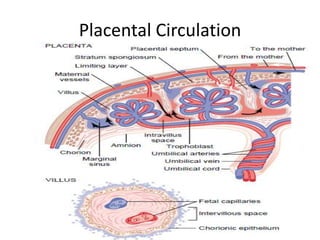
Placental Circulation
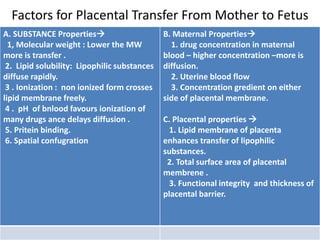
Factors for Placental Transfer From Mother to Fetus
A. SUBSTANCE Properties                      B. Maternal Properties
  1, Molecular weight : Lower the MW            1. drug concentration in maternal
more is transfer .                            blood – higher concentration –more is
 2. Lipid solubility: Lipophilic substances   diffusion.
diffuse rapidly.                                2. Uterine blood flow
 3 . Ionization : non ionized form crosses      3. Concentration gredient on either
lipid membrane freely.                        side of placental membrane.
 4 . pH of bnlood favours ionization of
many drugs ance delays diffusion .            C. Placental properties 
 5. Pritein binding.                            1. Lipid membrane of placenta
 6. Spatial confugration                      enhances transfer of lipophilic
                                              substances.
                                               2. Total surface area of placental
                                              membrene .
                                                3. Functional integrity and thickness of
                                              placental barrier.
Mechanism Involved in placental
              Transfer
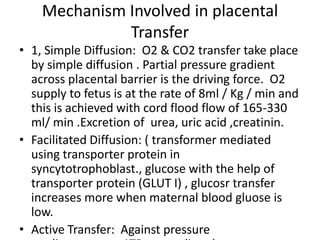
• 1, Simple Diffusion: O2 & CO2 transfer take place
  by simple diffusion . Partial pressure gradient
  across placental barrier is the driving force. O2
  supply to fetus is at the rate of 8ml / Kg / min and
  this is achieved with cord flood flow of 165-330
  ml/ min .Excretion of urea, uric acid ,creatinin.
• Facilitated Diffusion: ( transformer mediated
  using transporter protein in
  syncytotrophoblast., glucose with the help of
  transporter protein (GLUT I) , glucosr transfer
  increases more when maternal blood gluose is
  low.
• Active Transfer: Against pressure
Mechanism involved in placental
           transfer --------
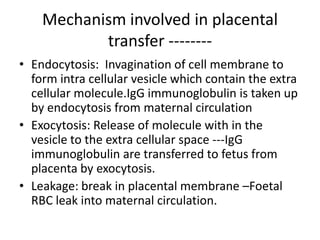
• Endocytosis: Invagination of cell membrane to
  form intra cellular vesicle which contain the extra
  cellular molecule.IgG immunoglobulin is taken up
  by endocytosis from maternal circulation
• Exocytosis: Release of molecule with in the
  vesicle to the extra cellular space ---IgG
  immunoglobulin are transferred to fetus from
  placenta by exocytosis.
• Leakage: break in placental membrane –Foetal
  RBC leak into maternal circulation.
Other functions of Placenta
• Transfer of nutrients and waste priducts
  between mother and fetus ; Hence it atributes
  to –1. respiration, 2.excretion 3. nutrition.
• Endocrine function-- placenta is an endocrine
  gland ., secrets –HCG , Steroids and peptide
  hormones.
• Immunological function.
• Blood Barrier.
Nutritive Function
• Fetus obtains its nutrients from mother., when
  mother’s diet is inadequate , then only depletion
  of maternal tissue storage occur.
 Glucose  The principle source of energy is
  transferred by Facilitated diffusion . There are
  transporter proteins (GLUT I) for this mode of
  diffusion. Glucose transfer to fetus is not linear .,
  it decreases when mother glucose concentration
  increases. Fetal blood glucose level is lower than
  that of mother indicating rapid utilization by
  fetus.
Nutritive function--
• Lipids Triglycerides and fatty acids are directly
  transferred to fetus in early pregnancy but probably
  synthesised by fetus itself in late pregnancy Essential
  fatty acids are transferred more then non essential
  fatty acids. Cholesterol is able to trtansfer directly. Thus
  lipids have dual origin.
• Amino acids  They are transferred by active transfer
  , energy requiring mechanism( ATPS Enzyme ). Amino
  acid concentration in fetal blood is more then
  maternal. IgG cross by endocytosis. Fetal proteins are
  synthesised from transferred amino acids ., their
  concentration is lower than mother.
  A
Nutritive Function----
• Water and Electrolytes  Na ,K, Cl
  transferred by simple diffusion., Ca, P and Fe
  are transferred by active transfer with the
  help of transporter proteins against a
  concentration gradient. There concentration is
  higher than maternal. Water soluble vitamins
  are transferred rapidlyby active transport
  while fat soluble vitamins are transferred
  slowly.
Nutritive function---
• Hormones Insulin, steroids from adrenals
  ,thyroid, HCG, placental Lactogen, cross the
  placenta very slowly . Neither paratharmone
  nor calcitonin cross the placenta. Placenta also
  produce TSH and Growth Hormone.
Enzymatic Function
• Numerous enzymes are mentioned in placenta
  ., few othem are---
• 1. Diamine oxidase which inactivates
  circulatory pressure amines.
• 2. Oxytocinase --- neutralises the oxytocin .
• Phospholipase A2-- synthesises archadonic
  acid precursor of PGs.
Immunological function
• Fetus and placenta have partial pareantral antigens foreign to
  mother inspite of this , fetus is not rejected.Placenta offers
  immunological protection,
• Placental hormones , protiens( SP1) early prgnancy factor (EPF)
  PAPP-A , Steroid , HCG have got some immuno suppressive effect.
• Villous trophoblast do not express HLA Class 1or class 2 molecules .
• There is shift of maternal response from cell mediated (T helper I )
  to hormonal (T helper 2 ) immunity.
• Decidual Natural Killer (NK) cells and extravascular trophoblast HLA
  class I molecules inter act ., the cytokinines just derived will
  regulate the invasion of extracellular trophoblast in spiral arteies
  , which are converted into low resistance, high conductance utero
  placental vessels.

Placental blood barrier

  • 1.
  • 2.
    Barrier Function • Fetalmembrane has long been considered as a protective barrier to the fetus against noxious agents circulating in maternal blood. • In general , substances of higher molecular weight of > 500 daltons can not cross it, but there are some exceptions. Antibodies and antigens can cross the placental barrier in both direction by process of endo & exo cytosis. It is facilitated by pinocytosis . The race of drug transfer is increased in late pregnancy . Maternal viral, bacterial / protozoa infections can reach to fetus by crossing placental barrier . Similarly Any drug taken by women during pregnancy can cross the placental barrier in variable concentration and may have deleterious effect on fetus
  • 3.
  • 5.
    Factors for PlacentalTransfer From Mother to Fetus A. SUBSTANCE Properties B. Maternal Properties 1, Molecular weight : Lower the MW 1. drug concentration in maternal more is transfer . blood – higher concentration –more is 2. Lipid solubility: Lipophilic substances diffusion. diffuse rapidly. 2. Uterine blood flow 3 . Ionization : non ionized form crosses 3. Concentration gredient on either lipid membrane freely. side of placental membrane. 4 . pH of bnlood favours ionization of many drugs ance delays diffusion . C. Placental properties  5. Pritein binding. 1. Lipid membrane of placenta 6. Spatial confugration enhances transfer of lipophilic substances. 2. Total surface area of placental membrene . 3. Functional integrity and thickness of placental barrier.
  • 6.
    Mechanism Involved inplacental Transfer • 1, Simple Diffusion: O2 & CO2 transfer take place by simple diffusion . Partial pressure gradient across placental barrier is the driving force. O2 supply to fetus is at the rate of 8ml / Kg / min and this is achieved with cord flood flow of 165-330 ml/ min .Excretion of urea, uric acid ,creatinin. • Facilitated Diffusion: ( transformer mediated using transporter protein in syncytotrophoblast., glucose with the help of transporter protein (GLUT I) , glucosr transfer increases more when maternal blood gluose is low. • Active Transfer: Against pressure
  • 7.
    Mechanism involved inplacental transfer -------- • Endocytosis: Invagination of cell membrane to form intra cellular vesicle which contain the extra cellular molecule.IgG immunoglobulin is taken up by endocytosis from maternal circulation • Exocytosis: Release of molecule with in the vesicle to the extra cellular space ---IgG immunoglobulin are transferred to fetus from placenta by exocytosis. • Leakage: break in placental membrane –Foetal RBC leak into maternal circulation.
  • 8.
    Other functions ofPlacenta • Transfer of nutrients and waste priducts between mother and fetus ; Hence it atributes to –1. respiration, 2.excretion 3. nutrition. • Endocrine function-- placenta is an endocrine gland ., secrets –HCG , Steroids and peptide hormones. • Immunological function. • Blood Barrier.
  • 9.
    Nutritive Function • Fetusobtains its nutrients from mother., when mother’s diet is inadequate , then only depletion of maternal tissue storage occur. Glucose  The principle source of energy is transferred by Facilitated diffusion . There are transporter proteins (GLUT I) for this mode of diffusion. Glucose transfer to fetus is not linear ., it decreases when mother glucose concentration increases. Fetal blood glucose level is lower than that of mother indicating rapid utilization by fetus.
  • 10.
    Nutritive function-- • LipidsTriglycerides and fatty acids are directly transferred to fetus in early pregnancy but probably synthesised by fetus itself in late pregnancy Essential fatty acids are transferred more then non essential fatty acids. Cholesterol is able to trtansfer directly. Thus lipids have dual origin. • Amino acids  They are transferred by active transfer , energy requiring mechanism( ATPS Enzyme ). Amino acid concentration in fetal blood is more then maternal. IgG cross by endocytosis. Fetal proteins are synthesised from transferred amino acids ., their concentration is lower than mother. A
  • 11.
    Nutritive Function---- • Waterand Electrolytes  Na ,K, Cl transferred by simple diffusion., Ca, P and Fe are transferred by active transfer with the help of transporter proteins against a concentration gradient. There concentration is higher than maternal. Water soluble vitamins are transferred rapidlyby active transport while fat soluble vitamins are transferred slowly.
  • 12.
    Nutritive function--- • HormonesInsulin, steroids from adrenals ,thyroid, HCG, placental Lactogen, cross the placenta very slowly . Neither paratharmone nor calcitonin cross the placenta. Placenta also produce TSH and Growth Hormone.
  • 13.
    Enzymatic Function • Numerousenzymes are mentioned in placenta ., few othem are--- • 1. Diamine oxidase which inactivates circulatory pressure amines. • 2. Oxytocinase --- neutralises the oxytocin . • Phospholipase A2-- synthesises archadonic acid precursor of PGs.
  • 14.
    Immunological function • Fetusand placenta have partial pareantral antigens foreign to mother inspite of this , fetus is not rejected.Placenta offers immunological protection, • Placental hormones , protiens( SP1) early prgnancy factor (EPF) PAPP-A , Steroid , HCG have got some immuno suppressive effect. • Villous trophoblast do not express HLA Class 1or class 2 molecules . • There is shift of maternal response from cell mediated (T helper I ) to hormonal (T helper 2 ) immunity. • Decidual Natural Killer (NK) cells and extravascular trophoblast HLA class I molecules inter act ., the cytokinines just derived will regulate the invasion of extracellular trophoblast in spiral arteies , which are converted into low resistance, high conductance utero placental vessels.