Lactose operon
Dr. Manikandan Kathirvel
Assistant Professor
Department of Life Sciences
Kristu Jayanti College
Bangalore
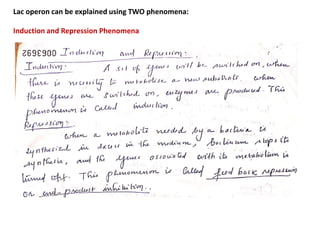
Lac operon can be explained using TWO phenomena:
Induction and Repression Phenomena
Structure of an Operon:
The genes composing operon are classified into 2 categories;
I. Structural genes – Lac Z,Y,A
II. Control genes or Regulatory genes
I. Structural Genes:
The structural genes are segments of DNA that are associated with the synthesis
of enzymes,
Lactose Operon:
Lac operon is a set of genes responsible for the metabolism of
lactose in E. coli.
The lac operon was discovered by Jacob and Monad in 1961.
of enzymes,
needed for the catabolism of lactose. It includes,
 Lac Z gene – Codes for β – Galactosidase enzyme
 Lac Y gene – Codes for galactose permease enzyme
 Lac A gene – Codes for thiogalactoside transacetylase
These gene product are produced from a single polycistronic mRNA molecule.
The structural genes are responsible for the synthesis of three enzymes, namely β –
galactosidase by the gene Z, galactoside permease by the gene Y and thiogalactoside
transacetylase by the gene X.
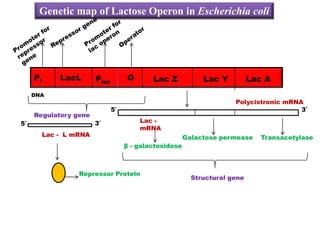
Genetic map of Lactose Operon in Escherichia coli
Pl LacL O
DNA
Regulatory gene
5′ 3′
Lac -
Polycistronic mRNA
5′ 3′
Plac Lac Z Lac Y Lac A
Lac -
mRNA
β - galactosidose
Galactose permease Transacetylase
5′ 3′
Lac - L mRNA
Repressor Protein
Structural gene
II. Control genes or regulatory genes:
These gene control the activity of structural genes either by induction or
suppression. They are present immediately adjacent to the structure genes. There are
three control genes namely,
 Operator Gene (O)
It is the segment of DNA, overlaps with the promoter sequence. It controls the
transcription of mRNA from structure genes. The repressor protein produce by lac L
gene, binds with the operator gene.
 Promoter gene (Plac)
It is the segment of DNA, present immediately adjacent to the operator gene.
RNA polymerase binds specifically to the promoter region and initiates the transcription
of the structure genes. It controls the rate of mRNA synthesis.
 Repressor or Regulator gene (L)
Lac repressor is a tetrameric regulatory protein. It lies outside the operon and
produces a repressor molecule. Repressor gene has it own promoter. This repressor
protein molecule binds to the operator gene and suppresses the transcription of three
structural genes.
Regulation of Lac Operon in Escherichia Coli
I). Negative regulation: (Lac operon is switched OFF)
Conditions:
 When Lactose is absent; When Glucose is more in the cell;
When lactose is present in the medium and glucose level is also
more in the cell.
Events:
Events:
 Repressor is active
 Repressor bound to the operator/Promoter region
 Operon is repressed
 Transcription is blocked and
 No mRNA is synthesized
 No gene product is produced
 Lac operon is switched off
This repressor molecule acts as a negative regulator of gene expression.
Pl
DNA
O
Plac Lac Z Lac Y Lac A gene
No mRNA synthesis
Lac L
(R)
RNA polymerase
unable to bind to
promoter
I). Negative regulation: (Lac operon is switched OFF)
5′ 3′
Lac - L mRNA
Active form of
Repressor
No mRNA synthesis
R
(R)
Events:
 When Lactose is absent or when high
glucose in the cell
 Repressor is active
 Repressor bound to the operator
 Operon is repressed
 Transcription is blocked and
 No mRNA is synthesized
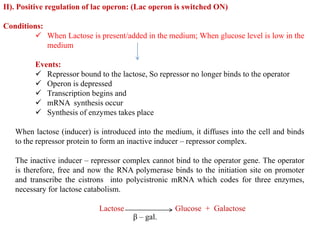
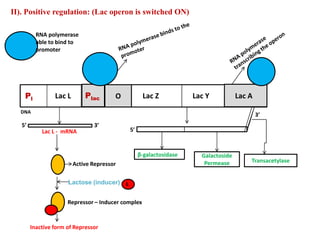
II). Positive regulation of lac operon: (Lac operon is switched ON)
Conditions:
 When Lactose is present/added in the medium; When glucose level is low in the
medium
Events:
 Repressor bound to the lactose, So repressor no longer binds to the operator
 Operon is depressed
 Transcription begins and
 mRNA synthesis occur
 Synthesis of enzymes takes place
When lactose (inducer) is introduced into the medium, it diffuses into the cell and binds
to the repressor protein to form an inactive inducer – repressor complex.
The inactive inducer – repressor complex cannot bind to the operator gene. The operator
is therefore, free and now the RNA polymerase binds to the initiation site on promoter
and transcribe the cistrons into polycistronic mRNA which codes for three enzymes,
necessary for lactose catabolism.
Lactose Glucose + Galactose
β – gal.
Pl
DNA
O Lac Z Lac Y
Lac L Plac Lac A
3′
II). Positive regulation: (Lac operon is switched ON)
RNA polymerase
able to bind to
promoter
5′ 3′
Lac L - mRNA
Active Repressor
Inactive form of Repressor
5′
β-galactosidase Galactoside
Permease Transacetylase
Repressor – Inducer complex
Lactose (inducer) L
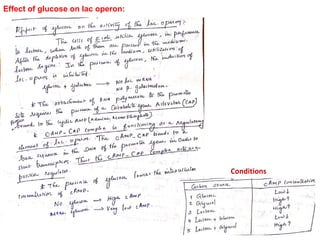
Effect of glucose on lac operon:
Conditions

Lactose Operon

  • 1.
    Lactose operon Dr. ManikandanKathirvel Assistant Professor Department of Life Sciences Kristu Jayanti College Bangalore
  • 3.
    Lac operon canbe explained using TWO phenomena: Induction and Repression Phenomena
  • 4.
    Structure of anOperon: The genes composing operon are classified into 2 categories; I. Structural genes – Lac Z,Y,A II. Control genes or Regulatory genes I. Structural Genes: The structural genes are segments of DNA that are associated with the synthesis of enzymes, Lactose Operon: Lac operon is a set of genes responsible for the metabolism of lactose in E. coli. The lac operon was discovered by Jacob and Monad in 1961. of enzymes, needed for the catabolism of lactose. It includes,  Lac Z gene – Codes for β – Galactosidase enzyme  Lac Y gene – Codes for galactose permease enzyme  Lac A gene – Codes for thiogalactoside transacetylase These gene product are produced from a single polycistronic mRNA molecule. The structural genes are responsible for the synthesis of three enzymes, namely β – galactosidase by the gene Z, galactoside permease by the gene Y and thiogalactoside transacetylase by the gene X.
  • 5.
    Genetic map ofLactose Operon in Escherichia coli Pl LacL O DNA Regulatory gene 5′ 3′ Lac - Polycistronic mRNA 5′ 3′ Plac Lac Z Lac Y Lac A Lac - mRNA β - galactosidose Galactose permease Transacetylase 5′ 3′ Lac - L mRNA Repressor Protein Structural gene
  • 6.
    II. Control genesor regulatory genes: These gene control the activity of structural genes either by induction or suppression. They are present immediately adjacent to the structure genes. There are three control genes namely,  Operator Gene (O) It is the segment of DNA, overlaps with the promoter sequence. It controls the transcription of mRNA from structure genes. The repressor protein produce by lac L gene, binds with the operator gene.  Promoter gene (Plac) It is the segment of DNA, present immediately adjacent to the operator gene. RNA polymerase binds specifically to the promoter region and initiates the transcription of the structure genes. It controls the rate of mRNA synthesis.  Repressor or Regulator gene (L) Lac repressor is a tetrameric regulatory protein. It lies outside the operon and produces a repressor molecule. Repressor gene has it own promoter. This repressor protein molecule binds to the operator gene and suppresses the transcription of three structural genes.
  • 7.
    Regulation of LacOperon in Escherichia Coli I). Negative regulation: (Lac operon is switched OFF) Conditions:  When Lactose is absent; When Glucose is more in the cell; When lactose is present in the medium and glucose level is also more in the cell. Events: Events:  Repressor is active  Repressor bound to the operator/Promoter region  Operon is repressed  Transcription is blocked and  No mRNA is synthesized  No gene product is produced  Lac operon is switched off This repressor molecule acts as a negative regulator of gene expression.
  • 8.
    Pl DNA O Plac Lac ZLac Y Lac A gene No mRNA synthesis Lac L (R) RNA polymerase unable to bind to promoter I). Negative regulation: (Lac operon is switched OFF) 5′ 3′ Lac - L mRNA Active form of Repressor No mRNA synthesis R (R) Events:  When Lactose is absent or when high glucose in the cell  Repressor is active  Repressor bound to the operator  Operon is repressed  Transcription is blocked and  No mRNA is synthesized
  • 9.
    II). Positive regulationof lac operon: (Lac operon is switched ON) Conditions:  When Lactose is present/added in the medium; When glucose level is low in the medium Events:  Repressor bound to the lactose, So repressor no longer binds to the operator  Operon is depressed  Transcription begins and  mRNA synthesis occur  Synthesis of enzymes takes place When lactose (inducer) is introduced into the medium, it diffuses into the cell and binds to the repressor protein to form an inactive inducer – repressor complex. The inactive inducer – repressor complex cannot bind to the operator gene. The operator is therefore, free and now the RNA polymerase binds to the initiation site on promoter and transcribe the cistrons into polycistronic mRNA which codes for three enzymes, necessary for lactose catabolism. Lactose Glucose + Galactose β – gal.
  • 10.
    Pl DNA O Lac ZLac Y Lac L Plac Lac A 3′ II). Positive regulation: (Lac operon is switched ON) RNA polymerase able to bind to promoter 5′ 3′ Lac L - mRNA Active Repressor Inactive form of Repressor 5′ β-galactosidase Galactoside Permease Transacetylase Repressor – Inducer complex Lactose (inducer) L
  • 11.
    Effect of glucoseon lac operon: Conditions