THE lac OPERON
© 2007 Paul Billiet ODWS
Operons
 An operon is a group
of genes that are
transcribed at the
same time.
 They usually control
an important
biochemical process.
 They are only found
in prokaryotes.
© NobelPrize.org
Jacob, Monod & Lwoff
© 2007 Paul Billiet ODWS
The control of gene expression
 Each cell in the human contains all the genetic
material for the growth and development of a
human
 Some of these genes will be need to be
expressed all the time
 These are the genes that are involved in of vital
biochemical processes such as respiration
 Other genes are not expressed all the time
 They are switched on an off at need
© 2007 Paul Billiet ODWS
Lac Operon
 The Lac Operon is an example of an operon
that is able to regulate itself depending on the
environmental conditions it is subjected to.
 It codes for 3 genes: Beta-galactosidase,
lactose permease and Thiogalactosidase
transacetylase. These genes are involved in
lactose metabolism.
 If lactose is absent, the system is turned off; if
lactose is present, the operon is switched on.
 The bacteria’s favoured source of food is
glucose and if that is present the operon does
not need to be switched on, as there is no
need to metabolise lactose.
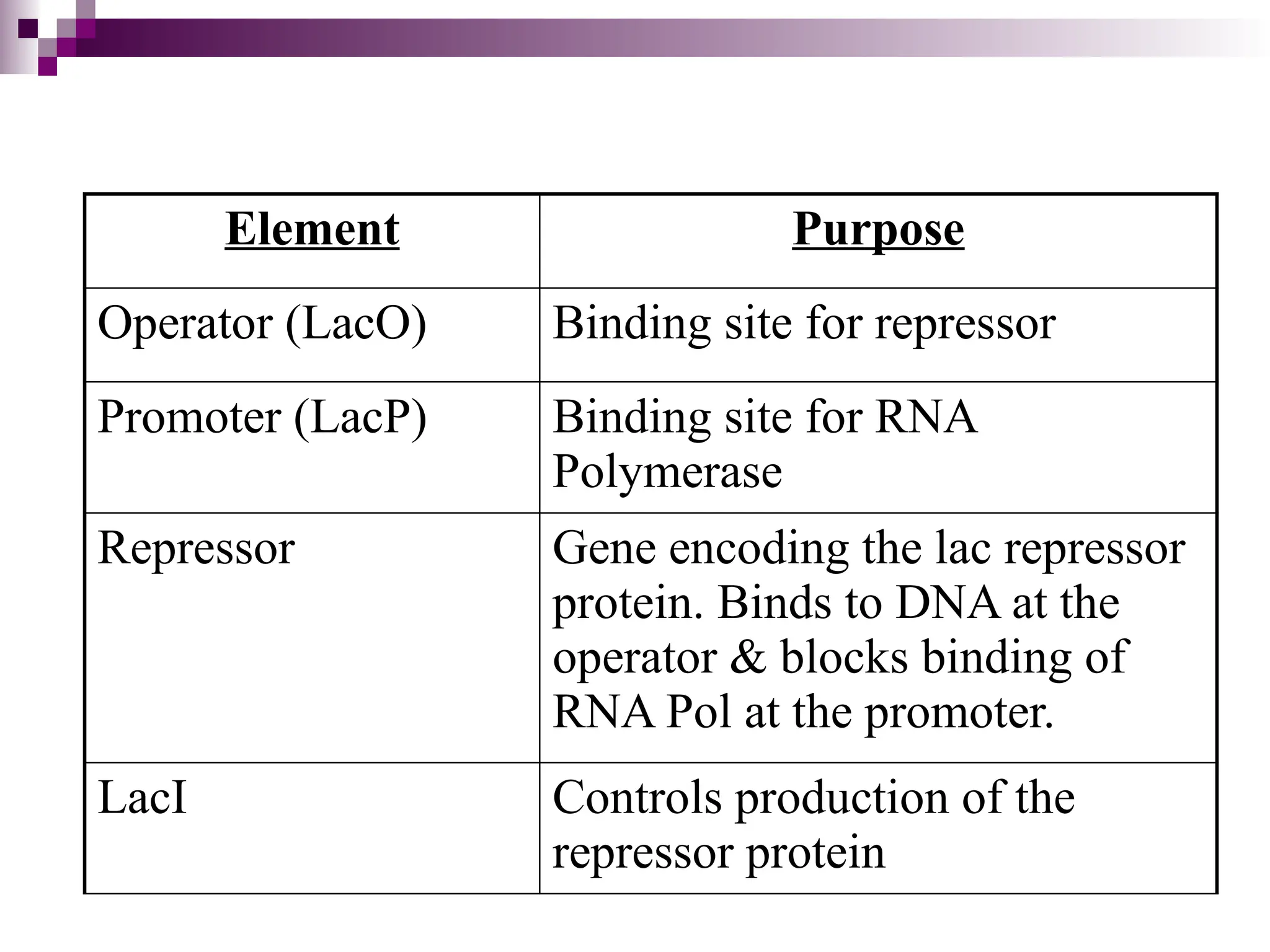
Element Purpose
Operator (LacO) Binding site for repressor
Promoter (LacP) Binding site for RNA
Polymerase
Repressor Gene encoding the lac repressor
protein. Binds to DNA at the
operator & blocks binding of
RNA Pol at the promoter.
LacI Controls production of the
repressor protein
Enzyme Function
Beta galactosidase This enzyme hydrolyzes the bond
between the two sugars, glucose and
galactose. It is coded for by the gene
LacZ.
Lactose Permease This enzyme spans the cell membrane
and brings lactose into the cell from
the outside environment. The
membrane is otherwise essentially
impermeable to lactose. It is coded for
by the gene LacY
Thiogalactosidase
transacetylase
The function of this enzyme is not
known. It is coded for by the gene
LacA.
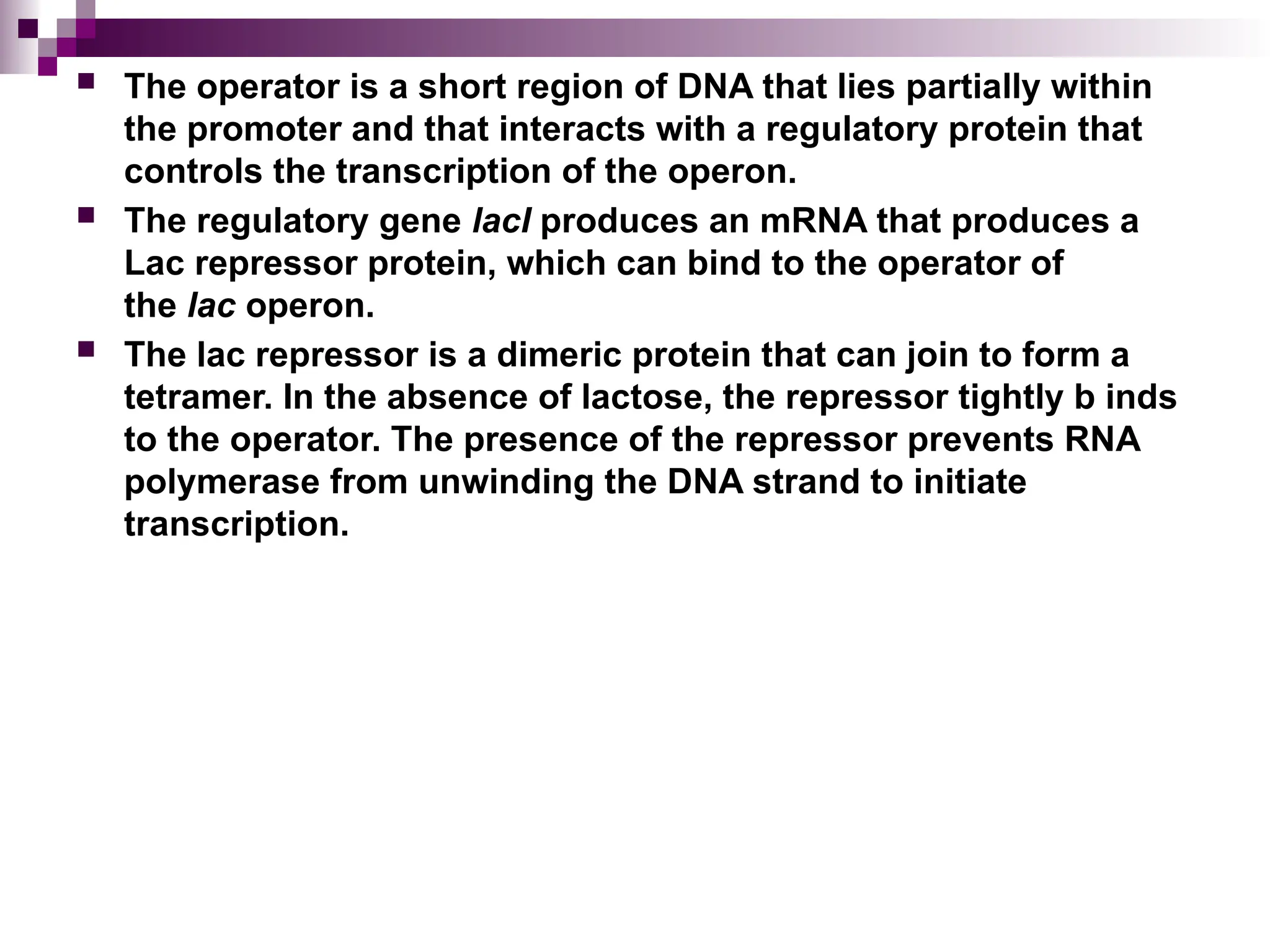
 The operator is a short region of DNA that lies partially within
the promoter and that interacts with a regulatory protein that
controls the transcription of the operon.
 The regulatory gene lacI produces an mRNA that produces a
Lac repressor protein, which can bind to the operator of
the lac operon.
 The lac repressor is a dimeric protein that can join to form a
tetramer. In the absence of lactose, the repressor tightly b inds
to the operator. The presence of the repressor prevents RNA
polymerase from unwinding the DNA strand to initiate
transcription.
The lac Operon
 The lac operon consists of three genes
each involved in processing the sugar
lactose
 One of them is the gene for the enzyme β-
galactosidase
 This enzyme hydrolyses lactose into
glucose and galactose
© 2007 Paul Billiet ODWS
The metabolism of lactose in E. coli & the lactose operon
•To use lactose as an energy source, cells
must contain the enzyme b-galactosidase.
•Utilization of lactose also requires the
enzyme lactose permease to transport
lactose into the cell.
•Expression of these enzymes is rapidly
induced ~1000-fold when cells are grown in
lactose compared to glucose.
QuickTime™ and a
GIF decompressor
are needed to see thispicture.
IPTG: non-
metabolizable
artificial
inducer (can’t
be cleaved)
Trans-
glycosylation
LacZ: -galactosidase; Y: galactoside permease;
A: transacetylase (function unknown).
P: promoter; O: operator.
LacI: repressor; PI and LacI are not part of the
operon.
The Lactose Operon
lacZ : b-galactosidase
lacY : lactose (galactoside) permease
lacA : galactoside transacetylase
Adapting to the environment
 E. coli can use either glucose, which is a
monosaccharide, or lactose, which is a
disaccharide
 However, lactose needs to be hydrolysed
(digested) first
 So the bacterium prefers to use glucose
when it can
© 2007 Paul Billiet ODWS
Lac operon
Phenomenon:
1. On glucose- Bacteria grow fine
2. On lactose- bacteria don’t grow, then grow because they induce an enzyme that
breaks lactose down into glucose
b-galactosidase
3. ON lactose AND glucose- No b-galactosidase !
How the Lac operon works….
The Genes and Regulatory elements
Four situations are possible
1. When glucose is present and lactose is absent the E.
coli does not produce β-galactosidase.
2. When glucose is present and lactose is present the E.
coli does not produce β-galactosidase.
3. When glucose is absent and lactose is absent the E.
coli does not produce β-galactosidase.
4. When glucose is absent and lactose is present the E.
coli does produce β-galactosidase
© 2007 Paul Billiet ODWS
The control of the lac operon
© 2007 Paul Billiet ODWS
1. When lactose is absent
 A repressor protein is continuously synthesised. It sits on
a sequence of DNA just in front of the lac operon, the
Operator site
 The repressor protein blocks the Promoter site where
the RNA polymerase settles before it starts transcribing
Regulator
gene
lac operon
Operator
site
z y a
DNA
I
O
Repressor
protein
RNA
polymerase
Blocke
d
© 2007 Paul Billiet ODWS
2. When lactose is present
 A small amount of a sugar allolactose is formed within
the bacterial cell. This fits onto the repressor protein at
another active site (allosteric site)
 This causes the repressor protein to change its shape (a
conformational change). It can no longer sit on the
operator site. RNA polymerase can now reach its
promoter site
z y a
DNA
I O
© 2007 Paul Billiet ODWS
2. When lactose is present
 A small amount of a sugar allolactose is formed within
the bacterial cell. This fits onto the repressor protein at
another active site (allosteric site)
 This causes the repressor protein to change its shape (a
conformational change). It can no longer sit on the
operator site. RNA polymerase can now reach its
promoter site
Promotor site
z y a
DNA
I O
© 2007 Paul Billiet ODWS
3. When both glucose and
lactose are present
 This explains how the lac operon is
transcribed only when lactose is present.
 BUT….. this does not explain why the
operon is not transcribed when both
glucose and lactose are present.
© 2007 Paul Billiet ODWS
 When glucose and lactose are present RNA
polymerase can sit on the promoter site but it is
unstable and it keeps falling off
Promotor site
z y a
DNA
I O
Repressor
protein removed
RNA polymerase
4. When glucose is absent and
lactose is present
 Another protein is needed, an activator protein. This
stabilises RNA polymerase.
 The activator protein only works when glucose is absent
 In this way E. coli only makes enzymes to metabolise
other sugars in the absence of glucose
Promotor site
z y a
DNA
I O
Transcription
Activator
protein steadies
the RNA
polymerase
© 2007 Paul Billiet ODWS
Summary
Carbohydrates Activator
protein
Repressor
protein
RNA
polymerase
lac Operon
+ GLUCOSE
+ LACTOSE
Not bound
to DNA
Lifted off
operator site
Keeps falling
off promoter
site
No
transcription
+ GLUCOSE
- LACTOSE
Not bound
to DNA
Bound to
operator site
Blocked by
the repressor
No
transcription
- GLUCOSE
- LACTOSE
Bound to
DNA
Bound to
operator site
Blocked by
the repressor
No
transcription
- GLUCOSE
+ LACTOSE
Bound to
DNA
Lifted off
operator site
Sits on the
promoter site
Transcription
© 2007 Paul Billiet ODWS
Catabolite Repression
Why doesn’t beta-galactosidase get induced in medi
containing Glucose?
When cAMP is present:
When cAMP is absent:
RNA polymerase bound
tightly to promoter (blue DNA)
RNA polymerase bound
loosely to promoter (blue DNA)
FREQUENT TRANSCRIPTION
INFREQUENT TRANSCRIPTION
cAMP CAP
CAP site
CAP
CAP site
Operator
Operator
lacZ lacY
lacZ lacY
lacA
lacA
cAMP binds to CAP and the
cAMP-CAP complex binds
to DNA at the CAP site.
RNA polymerase binds
the promoter efficiently.
Transcription occurs frequently.
CAP does not bind to DNA.
RNA polymerase binds
the promoter inefficiently.
Transcription occurs rarely.
CAP regulates lac operon positively
and requires cAMP for DNA binding
Glucose inhibits the activity of the enzyme adenylyl cyclase, which catalyzes production of cAMP from ATP.
The amount of cAMP and the rate of transcription of the lac operon are inversely related to the concentration
of glucose.
ATP Adenylyl cyclase
Glucose inhibits
this enzyme
cAMP
Two phosphate
groups
Infrequent transcription
of lac operon
(Cell continues to use
glucose as energy source.)
CAP does not
bind to DNA
CAP
LOW
cAMP
INACTIVE
adenylyl cyclase
HIGH
glucose
concentration
LOW
glucose
concentration
ACTIVE
adenylyl cyclase
HIGH
cAMP
cAMP
CAP
CAP-cAMP complex
binds to DNA
Frequent transcription
of lac operon
(Cell uses lactose
if lactose is present.)
Cyclic AMP (cAMP) is synthesized when glucose levels are low
Dual Regulation of lac operon
 Negative control by lac repressor >> needs the
inducer (lactose) to inactivate the lac repressor
 Positive control by CAP (activated by high [cAMP]
resulting from low [glucose]) >> determines rate of
transcription if the operator is NOT blocked by the
repressor
Figure 17-15
lac operon
Promoter Repressor
INFREQUENT TRANSCRIPTION
CAP
site
CAP
site
CAP
site
FREQUENT TRANSCRIPTION
Operator
Operator
Operator
RNA polymerase bound
loosely to promoter
RNA polymerase bound
loosely to promoter
RNA polymerase bound
tightly to promoter
Glucose HIGH
Glucose HIGH
Glucose LOW
Lactose LOW
Lactose HIGH
Lactose HIGH
lacZ
lacZ
lacZ
lacY
lacY
lacY
lacA
lacA
lacA
Inducer-repressor complex
Catabolite Repression of lac Operon
(Positive regulation)
• When excess glucose is present, the lac operon is
repressed even in the presence of lactose.
• In the absence of glucose, the lac operon is induced.
• Absence of glucose results in the increase synthesis of
cAMP
• cAMP binds to cAMP regulatory protein (CRP) (AKA CAP).
• When activated by cAMP, CRP binds to lac promoter and
stimulates transcription.
Molecular Cell Biology, 4th
Edition, Lodish et. al. (2000)
Why does the Lac Operon
need an activator?
Lac promoter has lousy promoter!!!
Lac Z Lac Y Lac A
P O
Pi I
Pcrp crp
Regulation of the Lac Operon: Low lactose,
High glucose
Transcription from Pcrp and Pi is constitutive:
always expressed in an unregulated fashion.
Active repressor binds to operator and prevents
RNA polymerase from reaching structural genes.
Active
repressor
crp mRNA I mRNA
Inactive
CAP protein
No mRNA produced
No Z, Y, A proteins produced
Pol
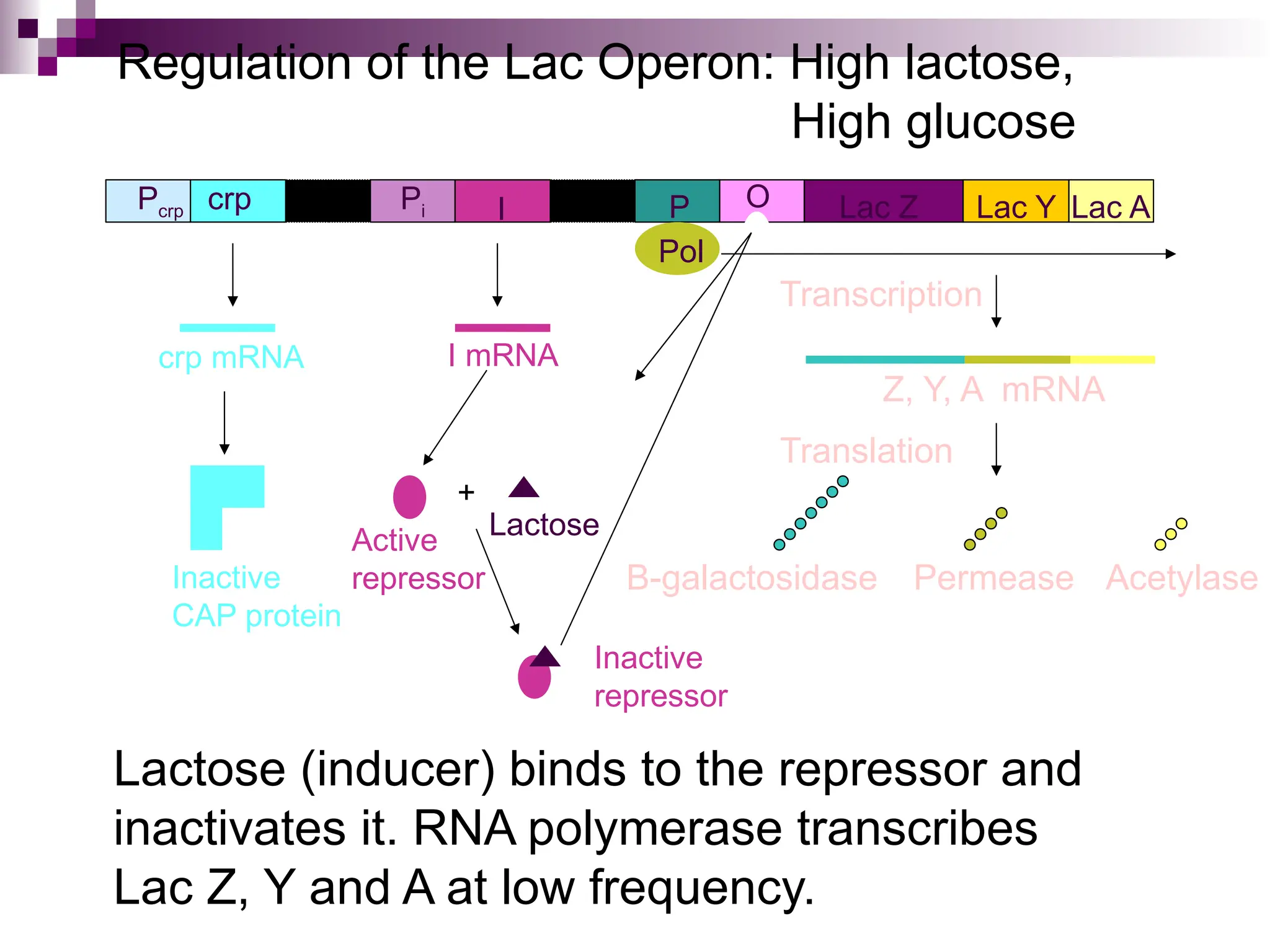
Regulation of the Lac Operon: High lactose,
High glucose
Lac Z Lac Y Lac A
P O
Pi I
Pcrp crp
Active
repressor
crp mRNA I mRNA
Inactive
CAP protein
Lactose
Lactose (inducer) binds to the repressor and
inactivates it. RNA polymerase transcribes
Lac Z, Y and A at low frequency.
+
Inactive
repressor
Pol
Z, Y, A mRNA
Transcription
Translation
B-galactosidase Permease Acetylase
Regulation of the Lac Operon: High lactose,
Low glucose
Translation
B-galactosidase Permease Acetylase
Lac Z Lac Y Lac A
P O
Pi I
Pcrp crp
Active
repressor
crp mRNA I mRNA
Inactive
CAP protein
Lactose
+
Inactive
repressor
+
cAMP is produced when glucose levels are low. cAMP activates CAP. Active
CAP binds to the promoter to increase RNA polymerase binding. RNA
polymerase transcribes Lac Z, Y and A at HIGH frequency.
cAMP
Active
CAP protein
Pol
Z, Y, A mRNA
Transcription
Regulation of the Lac Operon: Low lactose,
Low glucose
Active
repressor
Lac Z Lac Y Lac A
P O
Pi I
Pcrp crp
crp mRNA I mRNA
Inactive
CAP protein
cAMP
+
Active
CAP protein
Although RNA polymerase binding is enhanced by
Active CAP, the operator is blocked by active repressor.
RNA polymerase cannot transcribe Z, Y and A.
No mRNA produced
No Z, Y, A proteins produced
Pol
Trp Operon
08-lac-lactose operon molecular OPERON-3.pptx

08-lac-lactose operon molecular OPERON-3.pptx

  • 1.
    THE lac OPERON ©2007 Paul Billiet ODWS
  • 2.
    Operons  An operonis a group of genes that are transcribed at the same time.  They usually control an important biochemical process.  They are only found in prokaryotes. © NobelPrize.org Jacob, Monod & Lwoff © 2007 Paul Billiet ODWS
  • 3.
    The control ofgene expression  Each cell in the human contains all the genetic material for the growth and development of a human  Some of these genes will be need to be expressed all the time  These are the genes that are involved in of vital biochemical processes such as respiration  Other genes are not expressed all the time  They are switched on an off at need © 2007 Paul Billiet ODWS
  • 4.
    Lac Operon  TheLac Operon is an example of an operon that is able to regulate itself depending on the environmental conditions it is subjected to.  It codes for 3 genes: Beta-galactosidase, lactose permease and Thiogalactosidase transacetylase. These genes are involved in lactose metabolism.  If lactose is absent, the system is turned off; if lactose is present, the operon is switched on.  The bacteria’s favoured source of food is glucose and if that is present the operon does not need to be switched on, as there is no need to metabolise lactose.
  • 7.
    Element Purpose Operator (LacO)Binding site for repressor Promoter (LacP) Binding site for RNA Polymerase Repressor Gene encoding the lac repressor protein. Binds to DNA at the operator & blocks binding of RNA Pol at the promoter. LacI Controls production of the repressor protein
  • 8.
    Enzyme Function Beta galactosidaseThis enzyme hydrolyzes the bond between the two sugars, glucose and galactose. It is coded for by the gene LacZ. Lactose Permease This enzyme spans the cell membrane and brings lactose into the cell from the outside environment. The membrane is otherwise essentially impermeable to lactose. It is coded for by the gene LacY Thiogalactosidase transacetylase The function of this enzyme is not known. It is coded for by the gene LacA.
  • 11.
     The operatoris a short region of DNA that lies partially within the promoter and that interacts with a regulatory protein that controls the transcription of the operon.  The regulatory gene lacI produces an mRNA that produces a Lac repressor protein, which can bind to the operator of the lac operon.  The lac repressor is a dimeric protein that can join to form a tetramer. In the absence of lactose, the repressor tightly b inds to the operator. The presence of the repressor prevents RNA polymerase from unwinding the DNA strand to initiate transcription.
  • 12.
    The lac Operon The lac operon consists of three genes each involved in processing the sugar lactose  One of them is the gene for the enzyme β- galactosidase  This enzyme hydrolyses lactose into glucose and galactose © 2007 Paul Billiet ODWS
  • 13.
    The metabolism oflactose in E. coli & the lactose operon •To use lactose as an energy source, cells must contain the enzyme b-galactosidase. •Utilization of lactose also requires the enzyme lactose permease to transport lactose into the cell. •Expression of these enzymes is rapidly induced ~1000-fold when cells are grown in lactose compared to glucose. QuickTime™ and a GIF decompressor are needed to see thispicture. IPTG: non- metabolizable artificial inducer (can’t be cleaved) Trans- glycosylation LacZ: -galactosidase; Y: galactoside permease; A: transacetylase (function unknown). P: promoter; O: operator. LacI: repressor; PI and LacI are not part of the operon.
  • 14.
    The Lactose Operon lacZ: b-galactosidase lacY : lactose (galactoside) permease lacA : galactoside transacetylase
  • 15.
    Adapting to theenvironment  E. coli can use either glucose, which is a monosaccharide, or lactose, which is a disaccharide  However, lactose needs to be hydrolysed (digested) first  So the bacterium prefers to use glucose when it can © 2007 Paul Billiet ODWS
  • 16.
    Lac operon Phenomenon: 1. Onglucose- Bacteria grow fine 2. On lactose- bacteria don’t grow, then grow because they induce an enzyme that breaks lactose down into glucose b-galactosidase 3. ON lactose AND glucose- No b-galactosidase !
  • 17.
    How the Lacoperon works…. The Genes and Regulatory elements
  • 19.
    Four situations arepossible 1. When glucose is present and lactose is absent the E. coli does not produce β-galactosidase. 2. When glucose is present and lactose is present the E. coli does not produce β-galactosidase. 3. When glucose is absent and lactose is absent the E. coli does not produce β-galactosidase. 4. When glucose is absent and lactose is present the E. coli does produce β-galactosidase © 2007 Paul Billiet ODWS
  • 20.
    The control ofthe lac operon © 2007 Paul Billiet ODWS
  • 21.
    1. When lactoseis absent  A repressor protein is continuously synthesised. It sits on a sequence of DNA just in front of the lac operon, the Operator site  The repressor protein blocks the Promoter site where the RNA polymerase settles before it starts transcribing Regulator gene lac operon Operator site z y a DNA I O Repressor protein RNA polymerase Blocke d © 2007 Paul Billiet ODWS
  • 22.
    2. When lactoseis present  A small amount of a sugar allolactose is formed within the bacterial cell. This fits onto the repressor protein at another active site (allosteric site)  This causes the repressor protein to change its shape (a conformational change). It can no longer sit on the operator site. RNA polymerase can now reach its promoter site z y a DNA I O © 2007 Paul Billiet ODWS
  • 23.
    2. When lactoseis present  A small amount of a sugar allolactose is formed within the bacterial cell. This fits onto the repressor protein at another active site (allosteric site)  This causes the repressor protein to change its shape (a conformational change). It can no longer sit on the operator site. RNA polymerase can now reach its promoter site Promotor site z y a DNA I O © 2007 Paul Billiet ODWS
  • 24.
    3. When bothglucose and lactose are present  This explains how the lac operon is transcribed only when lactose is present.  BUT….. this does not explain why the operon is not transcribed when both glucose and lactose are present. © 2007 Paul Billiet ODWS
  • 25.
     When glucoseand lactose are present RNA polymerase can sit on the promoter site but it is unstable and it keeps falling off Promotor site z y a DNA I O Repressor protein removed RNA polymerase
  • 26.
    4. When glucoseis absent and lactose is present  Another protein is needed, an activator protein. This stabilises RNA polymerase.  The activator protein only works when glucose is absent  In this way E. coli only makes enzymes to metabolise other sugars in the absence of glucose Promotor site z y a DNA I O Transcription Activator protein steadies the RNA polymerase © 2007 Paul Billiet ODWS
  • 27.
    Summary Carbohydrates Activator protein Repressor protein RNA polymerase lac Operon +GLUCOSE + LACTOSE Not bound to DNA Lifted off operator site Keeps falling off promoter site No transcription + GLUCOSE - LACTOSE Not bound to DNA Bound to operator site Blocked by the repressor No transcription - GLUCOSE - LACTOSE Bound to DNA Bound to operator site Blocked by the repressor No transcription - GLUCOSE + LACTOSE Bound to DNA Lifted off operator site Sits on the promoter site Transcription © 2007 Paul Billiet ODWS
  • 28.
    Catabolite Repression Why doesn’tbeta-galactosidase get induced in medi containing Glucose?
  • 29.
    When cAMP ispresent: When cAMP is absent: RNA polymerase bound tightly to promoter (blue DNA) RNA polymerase bound loosely to promoter (blue DNA) FREQUENT TRANSCRIPTION INFREQUENT TRANSCRIPTION cAMP CAP CAP site CAP CAP site Operator Operator lacZ lacY lacZ lacY lacA lacA cAMP binds to CAP and the cAMP-CAP complex binds to DNA at the CAP site. RNA polymerase binds the promoter efficiently. Transcription occurs frequently. CAP does not bind to DNA. RNA polymerase binds the promoter inefficiently. Transcription occurs rarely. CAP regulates lac operon positively and requires cAMP for DNA binding
  • 30.
    Glucose inhibits theactivity of the enzyme adenylyl cyclase, which catalyzes production of cAMP from ATP. The amount of cAMP and the rate of transcription of the lac operon are inversely related to the concentration of glucose. ATP Adenylyl cyclase Glucose inhibits this enzyme cAMP Two phosphate groups Infrequent transcription of lac operon (Cell continues to use glucose as energy source.) CAP does not bind to DNA CAP LOW cAMP INACTIVE adenylyl cyclase HIGH glucose concentration LOW glucose concentration ACTIVE adenylyl cyclase HIGH cAMP cAMP CAP CAP-cAMP complex binds to DNA Frequent transcription of lac operon (Cell uses lactose if lactose is present.) Cyclic AMP (cAMP) is synthesized when glucose levels are low
  • 31.
    Dual Regulation oflac operon  Negative control by lac repressor >> needs the inducer (lactose) to inactivate the lac repressor  Positive control by CAP (activated by high [cAMP] resulting from low [glucose]) >> determines rate of transcription if the operator is NOT blocked by the repressor
  • 32.
    Figure 17-15 lac operon PromoterRepressor INFREQUENT TRANSCRIPTION INFREQUENT TRANSCRIPTION CAP site CAP site CAP site FREQUENT TRANSCRIPTION Operator Operator Operator RNA polymerase bound loosely to promoter RNA polymerase bound loosely to promoter RNA polymerase bound tightly to promoter Glucose HIGH Glucose HIGH Glucose LOW Lactose LOW Lactose HIGH Lactose HIGH lacZ lacZ lacZ lacY lacY lacY lacA lacA lacA Inducer-repressor complex
  • 33.
    Catabolite Repression oflac Operon (Positive regulation) • When excess glucose is present, the lac operon is repressed even in the presence of lactose. • In the absence of glucose, the lac operon is induced. • Absence of glucose results in the increase synthesis of cAMP • cAMP binds to cAMP regulatory protein (CRP) (AKA CAP). • When activated by cAMP, CRP binds to lac promoter and stimulates transcription.
  • 34.
    Molecular Cell Biology,4th Edition, Lodish et. al. (2000)
  • 36.
    Why does theLac Operon need an activator? Lac promoter has lousy promoter!!!
  • 37.
    Lac Z LacY Lac A P O Pi I Pcrp crp Regulation of the Lac Operon: Low lactose, High glucose Transcription from Pcrp and Pi is constitutive: always expressed in an unregulated fashion. Active repressor binds to operator and prevents RNA polymerase from reaching structural genes. Active repressor crp mRNA I mRNA Inactive CAP protein No mRNA produced No Z, Y, A proteins produced Pol
  • 38.
    Regulation of theLac Operon: High lactose, High glucose Lac Z Lac Y Lac A P O Pi I Pcrp crp Active repressor crp mRNA I mRNA Inactive CAP protein Lactose Lactose (inducer) binds to the repressor and inactivates it. RNA polymerase transcribes Lac Z, Y and A at low frequency. + Inactive repressor Pol Z, Y, A mRNA Transcription Translation B-galactosidase Permease Acetylase
  • 39.
    Regulation of theLac Operon: High lactose, Low glucose Translation B-galactosidase Permease Acetylase Lac Z Lac Y Lac A P O Pi I Pcrp crp Active repressor crp mRNA I mRNA Inactive CAP protein Lactose + Inactive repressor + cAMP is produced when glucose levels are low. cAMP activates CAP. Active CAP binds to the promoter to increase RNA polymerase binding. RNA polymerase transcribes Lac Z, Y and A at HIGH frequency. cAMP Active CAP protein Pol Z, Y, A mRNA Transcription
  • 40.
    Regulation of theLac Operon: Low lactose, Low glucose Active repressor Lac Z Lac Y Lac A P O Pi I Pcrp crp crp mRNA I mRNA Inactive CAP protein cAMP + Active CAP protein Although RNA polymerase binding is enhanced by Active CAP, the operator is blocked by active repressor. RNA polymerase cannot transcribe Z, Y and A. No mRNA produced No Z, Y, A proteins produced Pol
  • 41.

Editor's Notes

  • #28 Glucose can block the production of b-galac.
  • #29 High levels of glucose---NO CAMP OR CAP! If lactose, the repressor releases and binds to lactose. CAP allows RNA pol. To bind really good to the DNA and then, if glucose is present—no cap. And not good binding to DNA and not very often transcription. cAMP and CAP make transcription more efficient and this can only happen if NO glucose. Makes sense cuz you really need the transcription of lacZ and lacY because then you have Adenyl cyclase is the molecule that lets glucose in and if no glucose, it changes the structure of ATP and dephosphorylates ATP into cyclic-AMP.
  • #30 Remember what the cell wants! In the presence of high glucose, you have low cAMP. Which is what you want. If glucose level is low, you get high cAMP. And cyclic AMP is needed for CAP. And CAP pushes the synthesis of the lac operon.