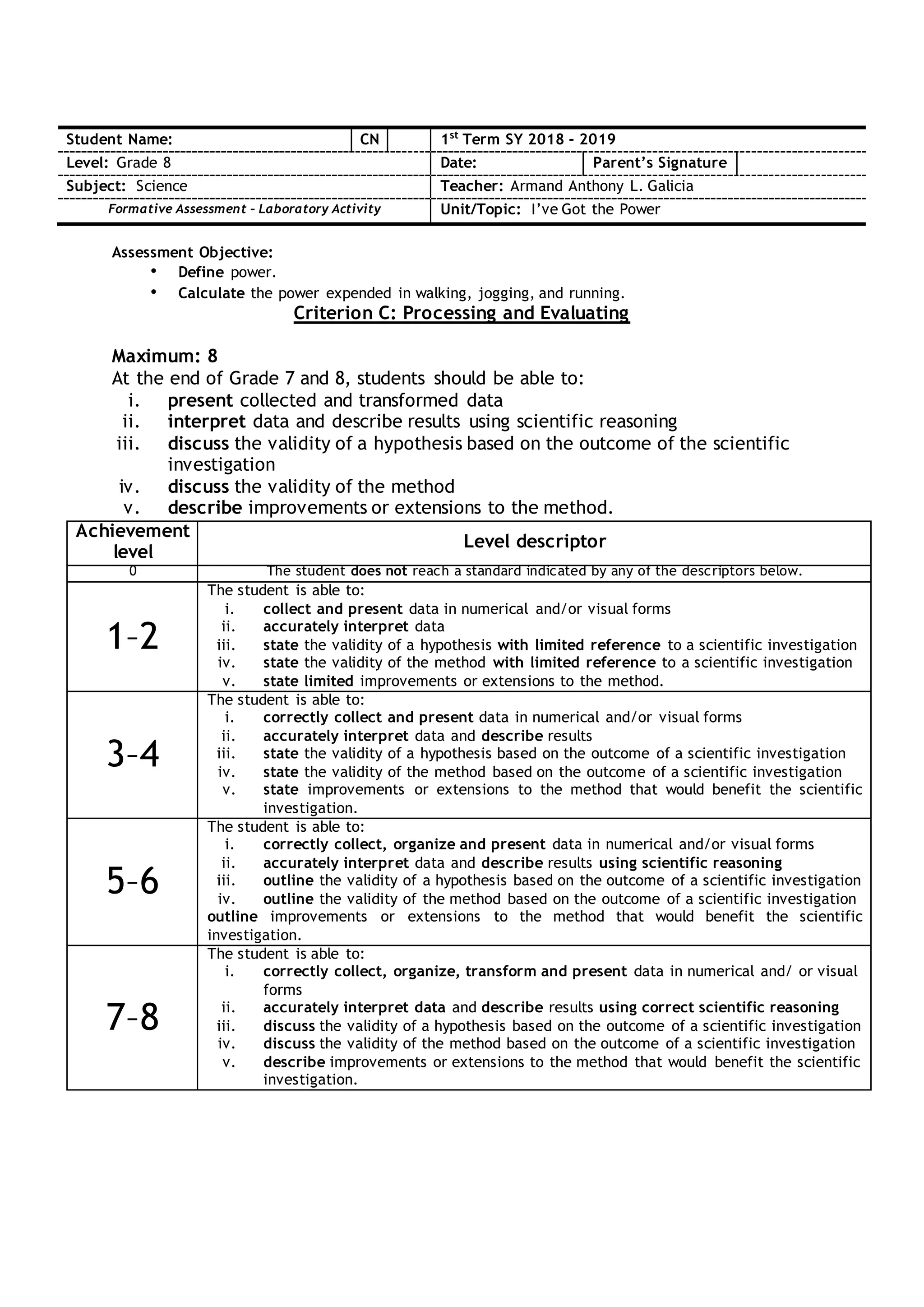
Assessment Objective:
• Define power.
• Calculate the power expended in walking, jogging, and running.
Criterion C: Processing and Evaluating
Maximum: 8
At the end of Grade 7 and 8, students should be able to:
i. present collected and transformed data
ii. interpret data and describe results using scientific reasoning
iii. discuss the validity of a hypothesis based on the outcome of the scientific
investigation
iv. discuss the validity of the method
v. describe improvements or extensions to the method.
Student Name: CN 1st
Term SY 2018 - 2019
Level: Grade 8 Date: Parent’s Signature
Subject: Science Teacher: Armand Anthony L. Galicia
Formative Assessment – Laboratory Activity Unit/Topic: I’ve Got the Power
Achievement
level
Level descriptor
0 The student does not reach a standard indicated by any of the descriptors below.
1–2
The student is able to:
i. collect and present data in numerical and/or visual forms
ii. accurately interpret data
iii. state the validity of a hypothesis with limited reference to a scientific investigation
iv. state the validity of the method with limited reference to a scientific investigation
v. state limited improvements or extensions to the method.
3–4
The student is able to:
i. correctly collect and present data in numerical and/or visual forms
ii. accurately interpret data and describe results
iii. state the validity of a hypothesis based on the outcome of a scientific investigation
iv. state the validity of the method based on the outcome of a scientific investigation
v. state improvements or extensions to the method that would benefit the scientific
investigation.
5–6
The student is able to:
i. correctly collect, organize and present data in numerical and/or visual forms
ii. accurately interpret data and describe results using scientific reasoning
iii. outline the validity of a hypothesis based on the outcome of a scientific investigation
iv. outline the validity of the method based on the outcome of a scientific investigation
outline improvements or extensions to the method that would benefit the scientific
investigation.
7–8
The student is able to:
i. correctly collect, organize, transform and present data in numerical and/ or visual
forms
ii. accurately interpret data and describe results using correct scientific reasoning
iii. discuss the validity of a hypothesis based on the outcome of a scientific investigation
iv. discuss the validity of the method based on the outcome of a scientific investigation
v. describe improvements or extensions to the method that would benefit the scientific
investigation.
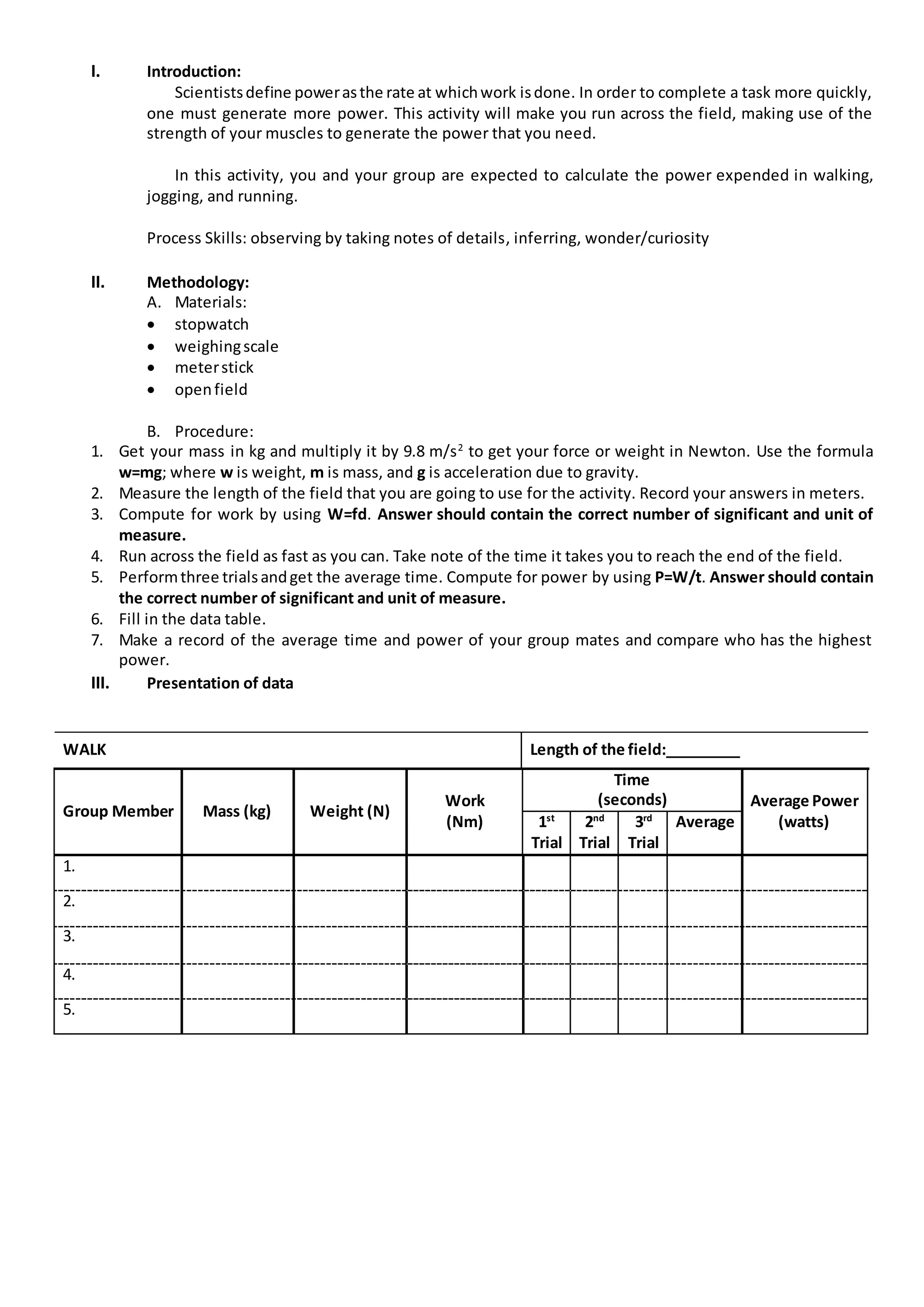
I. Introduction:
Scientistsdefine powerasthe rate at whichwork isdone. In order to complete a task more quickly,
one must generate more power. This activity will make you run across the field, making use of the
strength of your muscles to generate the power that you need.
In this activity, you and your group are expected to calculate the power expended in walking,
jogging, and running.
Process Skills: observing by taking notes of details, inferring, wonder/curiosity
II. Methodology:
A. Materials:
 stopwatch
 weighingscale
 meterstick
 openfield
B. Procedure:
1. Get your mass in kg and multiply it by 9.8 m/s2
to get your force or weight in Newton. Use the formula
w=mg; where w is weight, m is mass, and g is acceleration due to gravity.
2. Measure the length of the field that you are going to use for the activity. Record your answers in meters.
3. Compute for work by using W=fd. Answer should contain the correct number of significant and unit of
measure.
4. Run across the field as fast as you can. Take note of the time it takes you to reach the end of the field.
5. Performthree trialsandget the average time. Compute for power by using P=W/t. Answer should contain
the correct number of significant and unit of measure.
6. Fill in the data table.
7. Make a record of the average time and power of your group mates and compare who has the highest
power.
III. Presentation of data
WALK Length of the field:_________
Group Member Mass (kg) Weight (N)
Work
(Nm)
Time
(seconds) Average Power
(watts)1st
Trial
2nd
Trial
3rd
Trial
Average
1.
2.
3.
4.
5.
IV. Guide Questions:
1. Who is the most powerful in your group? Why do you consider her as the most powerful? (3 pts)
2. Who is the least powerful in your group? Why? (3 pts)
3. How can power be increased? (3 pts)
JOG Length of the field:_________
Group Member Mass (kg) Weight (w)
Work
(Nm)
Time
(seconds) Average Power
(watts)1st
Trial
2nd
Trial
3rd
Trial
Average
1.
2.
3.
4.
5.
RUN Length of the field:_________
Group Member Mass (kg) Weight (w)
Work
(Nm)
Time
(seconds) Average Power
(watts)1st
Trial
2nd
Trial
3rd
Trial
Average
1.
2.
3.
4.
5.
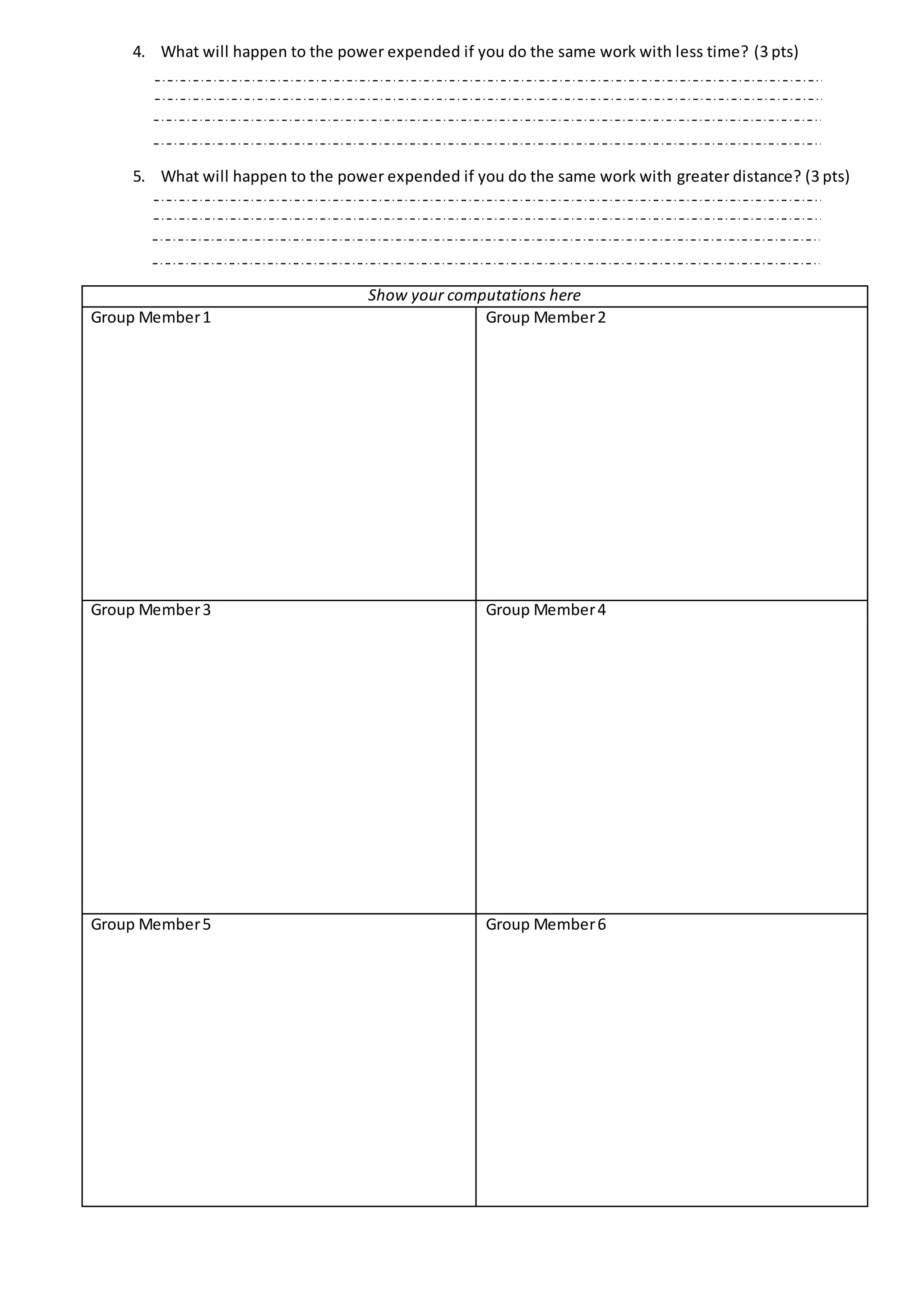
4. What will happen to the power expended if you do the same work with less time? (3 pts)
5. What will happen to the power expended if you do the same work with greater distance? (3 pts)
Show your computations here
Group Member1 Group Member2
Group Member3 Group Member4
Group Member5 Group Member6

Laboratory activity i've got the power

  • 1.
    Assessment Objective: • Definepower. • Calculate the power expended in walking, jogging, and running. Criterion C: Processing and Evaluating Maximum: 8 At the end of Grade 7 and 8, students should be able to: i. present collected and transformed data ii. interpret data and describe results using scientific reasoning iii. discuss the validity of a hypothesis based on the outcome of the scientific investigation iv. discuss the validity of the method v. describe improvements or extensions to the method. Student Name: CN 1st Term SY 2018 - 2019 Level: Grade 8 Date: Parent’s Signature Subject: Science Teacher: Armand Anthony L. Galicia Formative Assessment – Laboratory Activity Unit/Topic: I’ve Got the Power Achievement level Level descriptor 0 The student does not reach a standard indicated by any of the descriptors below. 1–2 The student is able to: i. collect and present data in numerical and/or visual forms ii. accurately interpret data iii. state the validity of a hypothesis with limited reference to a scientific investigation iv. state the validity of the method with limited reference to a scientific investigation v. state limited improvements or extensions to the method. 3–4 The student is able to: i. correctly collect and present data in numerical and/or visual forms ii. accurately interpret data and describe results iii. state the validity of a hypothesis based on the outcome of a scientific investigation iv. state the validity of the method based on the outcome of a scientific investigation v. state improvements or extensions to the method that would benefit the scientific investigation. 5–6 The student is able to: i. correctly collect, organize and present data in numerical and/or visual forms ii. accurately interpret data and describe results using scientific reasoning iii. outline the validity of a hypothesis based on the outcome of a scientific investigation iv. outline the validity of the method based on the outcome of a scientific investigation outline improvements or extensions to the method that would benefit the scientific investigation. 7–8 The student is able to: i. correctly collect, organize, transform and present data in numerical and/ or visual forms ii. accurately interpret data and describe results using correct scientific reasoning iii. discuss the validity of a hypothesis based on the outcome of a scientific investigation iv. discuss the validity of the method based on the outcome of a scientific investigation v. describe improvements or extensions to the method that would benefit the scientific investigation.
  • 2.
    I. Introduction: Scientistsdefine powerastherate at whichwork isdone. In order to complete a task more quickly, one must generate more power. This activity will make you run across the field, making use of the strength of your muscles to generate the power that you need. In this activity, you and your group are expected to calculate the power expended in walking, jogging, and running. Process Skills: observing by taking notes of details, inferring, wonder/curiosity II. Methodology: A. Materials:  stopwatch  weighingscale  meterstick  openfield B. Procedure: 1. Get your mass in kg and multiply it by 9.8 m/s2 to get your force or weight in Newton. Use the formula w=mg; where w is weight, m is mass, and g is acceleration due to gravity. 2. Measure the length of the field that you are going to use for the activity. Record your answers in meters. 3. Compute for work by using W=fd. Answer should contain the correct number of significant and unit of measure. 4. Run across the field as fast as you can. Take note of the time it takes you to reach the end of the field. 5. Performthree trialsandget the average time. Compute for power by using P=W/t. Answer should contain the correct number of significant and unit of measure. 6. Fill in the data table. 7. Make a record of the average time and power of your group mates and compare who has the highest power. III. Presentation of data WALK Length of the field:_________ Group Member Mass (kg) Weight (N) Work (Nm) Time (seconds) Average Power (watts)1st Trial 2nd Trial 3rd Trial Average 1. 2. 3. 4. 5.
  • 3.
    IV. Guide Questions: 1.Who is the most powerful in your group? Why do you consider her as the most powerful? (3 pts) 2. Who is the least powerful in your group? Why? (3 pts) 3. How can power be increased? (3 pts) JOG Length of the field:_________ Group Member Mass (kg) Weight (w) Work (Nm) Time (seconds) Average Power (watts)1st Trial 2nd Trial 3rd Trial Average 1. 2. 3. 4. 5. RUN Length of the field:_________ Group Member Mass (kg) Weight (w) Work (Nm) Time (seconds) Average Power (watts)1st Trial 2nd Trial 3rd Trial Average 1. 2. 3. 4. 5.
  • 4.
    4. What willhappen to the power expended if you do the same work with less time? (3 pts) 5. What will happen to the power expended if you do the same work with greater distance? (3 pts) Show your computations here Group Member1 Group Member2 Group Member3 Group Member4 Group Member5 Group Member6