7 
Learner’s Material 
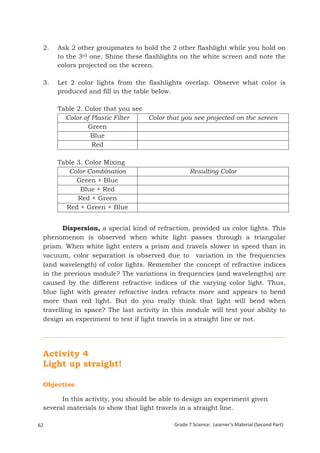
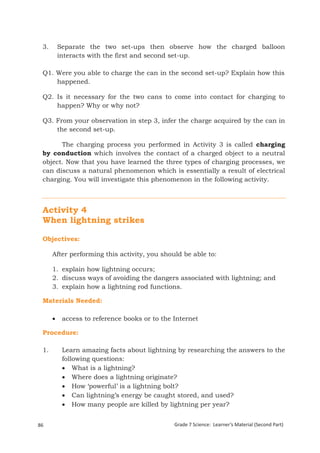
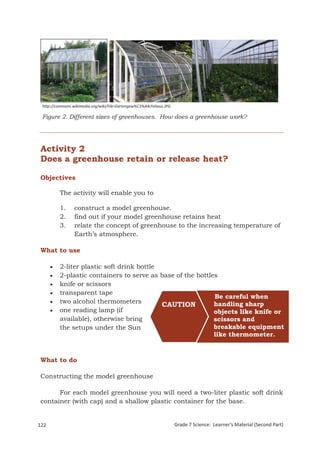
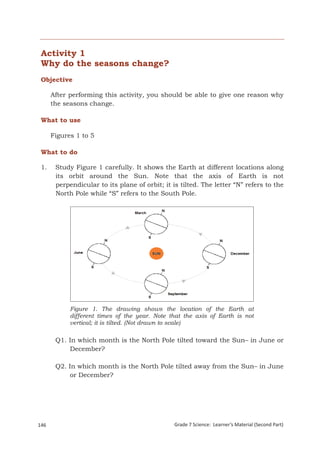
(Second Part) 
Grade 7 Science: Learner’s Material (Second Part) 1
2 Grade 7 Science: Learner’s Material (Second Part)
7 
Learner’s Material 
(Second Part) 
GOVERNMENT PROPERTY 
NOT FOR SALE 
ALLOTTED TO 
District/ School: _________________________________________ 
Division _________________________________________________ 
First Year of Use:_________________________________________ 
Source of Fund (Year included):__________________________ 
Kagawaran ng Edukasyon 
Republika ng Pilipinas 
i 
Grade 7 Science: Learner’s Material (Second Part) 3
Science- Grade 7 
Learner’s Material: Second Part 
First Edition, 2012 
ISBN: ___________ 
Republic Act 8293, section 176 indicates that: No copyright shall subsist in any 
work of the Government of the Philippines. However, prior approval of the government 
agency or office wherein the work is created shall be necessary for exploitation of such work 
for profit. Such agency or office may among other things, impose as a condition the payment 
of royalties. 
Published by the Department of Education 
Secretary: Br. Armin Luistro FSC 
Undersecretary: Dr. Yolanda S. Quijano 
Development Team of the Learner’s Material 
Unit 3: Energy in Motion 
Reviewer: Josefina Ll. Pabellon 
Coordinator: Merle C. Tan 
Authors: Alvie J. Asuncion, Leticia V. Catris, Cerilina M. Maramag, 
and Marie Paz E. Morales 
Unit 4: Earth and Space 
Reviewers: Eligio C. Obille Jr., Risa L. Reyes, and Merle C. Tan 
Coordinator: Merle C. Tan 
Authors: Ivy P. Mejia, Eligio C. Obille Jr., and Merle C. Tan 
Illustrators: Alvin J. Encarnacion, Rizaldo Ramoncito S. Saliva 
Layout Artist: Cecile N. Sales 
Inilimbag sa Pilipinas ng ____________ 
Department of Education-Instructional Materials Council Secretariat (DepEd-IMCS) 
Office Address: 2nd Floor Dorm G, PSC Complex, Meralco Avenue. Pasig 
City, Philippines 1600 
Telefax: (02) 634-1054 or 634-1072 
E-mail Address: imcsetd@yahoo.com 
4 Grade 7 Science: Learner’s Material (Second Part)
TABLE OF CONTENTS 
(2nd Part) 
Unit 3: Energy in Motion 
Page 
Module 1. Describing Motion . . . . . . . . . . . . . . . . . . . . . . . . . . . . . . . . . . . . . . . . . . 3 
Activity 1: Where is it? . . . . . . . . . . . . . . . . . . . . . . . . . . . . . . . . . . . . . . . . . . . . 4 
Activity 2: My home to school roadmap . . . . . . . . . . . . . . . . . . . . . . . . . . . . . . 9 
Activity 3: Fun walk . . . . . . . . . . . . . . . . . . . . . . . . . . . . . . . . . . . . . . . . . . . . . . . 11 
Activity 4: Doing detective work . . . . . . . . . . . . . . . . . . . . . . . . . . . . . . . . . . . . 14 
Module 2. Waves Around You . . . . . . . . . . . . . . . . . . . . . . . . . . . . . . . . . . . . . . . . . 17 
Activity 1: Let’s Make Waves! What happens when waves pass by?. . . . . . . . 18 
Activity 2: Anatomy of a Wave: How do you describe waves? . . . . . . . . . . . . 23 
Activity 3: Mechanical vs. Electromagnetic Waves: How do waves 
propagate? . . . . . . . . . . . . . . . . . . . . . . . . . . . . . . . . . . . . . . . . . . . . . 27 
Module 3. Sound . . . . . . . . . . . . . . . . . . . . . . . . . . . . . . . . . . . . . . . . . . . . . . . . . . . . 35 
Activity 1: My own sounding box . . . . . . . . . . . . . . . . . . . . . . . . . . . . . . . . . . . . 36 
Activity 2: Properties and characteristics of sound . . . . . . . . . . . . . . . . . . . . . 40 
Activity 3: Big time gig! . . . . . . . . . . . . . . . . . . . . . . . . . . . . . . . . . . . . . . . . . . . . 46 
Module 4. Light . . . . . . . . . . . . . . . . . . . . . . . . . . . . . . . . . . . . . . . . . . . . . . . . . . . . . 49 
Activity 1: Light sources: Langis kandila or lampara . . . . . . . . . . . . . . . . . . . 50 
Activity 2: My spectrum wheel . . . . . . . . . . . . . . . . . . . . . . . . . . . . . . . . . . . . . 53 
Activity 3: Colors of light – color of life! . . . . . . . . . . . . . . . . . . . . . . . . . . . . . 57 
Activity 4: Light up straight! . . . . . . . . . . . . . . . . . . . . . . . . . . . . . . . . . . . . . . . 62 
Module 5. Heat . . . . . . . . . . . . . . . . . . . . . . . . . . . . . . . . . . . . . . . . . . . . . . . . . . . . . 65 
Activity 1: Warm me up, cool me down . . . . . . . . . . . . . . . . . . . . . . . . . . . . . . 66 
Activity 2: Which feels colder? . . . . . . . . . . . . . . . . . . . . . . . . . . . . . . . . . . . . . . 69 
Activity 3: Move me up . . . . . . . . . . . . . . . . . . . . . . . . . . . . . . . . . . . . . . . . . . . . 72 
Activity 4: Keep it cold . . . . . . . . . . . . . . . . . . . . . . . . . . . . . . . . . . . . . . . . . . . . 74 
Activity 5: All at once . . . . . . . . . . . . . . . . . . . . . . . . . . . . . . . . . . . . . . . . . . . . . 76 
Module 6. Electricity . . . . . . . . . . . . . . . . . . . . . . . . . . . . . . . . . . . . . . . . . . . . . . . . . 79 
Activity 1: Charged interactions . . . . . . . . . . . . . . . . . . . . . . . . . . . . . . . . . . . . . 80 
Activity 2: To charge or not to charge . . . . . . . . . . . . . . . . . . . . . . . . . . . . . . . . 83 
Activity 3: Pass the charge . . . . . . . . . . . . . . . . . . . . . . . . . . . . . . . . . . . . . . . . . 85 
Activity 4: When lightning strikes . . . . . . . . . . . . . . . . . . . . . . . . . . . . . . . . . . . 86 
Activity 5: Let there be light! . . . . . . . . . . . . . . . . . . . . . . . . . . . . . . . . . . . . . . . 87 
Grade 7 Science: Learner’s Material (Second Part) 5
Unit 4: Earth and Space 
Page 
Module 1. The Philippine Environment . . . . . . . . . . . . . . . . . . . . . . . . . . . . . . . . . . 91 
Activity 1: Where in the world is the Philippines (Part I) . . . . . . . . . . . . . . . . . 91 
Activity 2: Where in the world is the Philippines (Part II) . . . . . . . . . . . . . . . . . 95 
Activity 3: What are some factors that will affect the amount 
of water in the watersheds?. . . . . . . . . . . . . . . . . . . . . . . . . . . . . . . . 100 
Activity 4: How is soil formed from rocks? . . . . . . . . . . . . . . . . . . . . . . . . . . . . . 102 
Activity 5: Where are the mineral deposits in the Philippines? . . . . . . . . . . . . 105 
Activity 6: How do people destroy natural resources? . . . . . . . . . . . . . . . . . . . 116 
Activity 7: Are you ready for “Make-a-Difference” Day? . . . . . . . . . . . . . . . . . 117 
Module 2. Solar Energy and the Atmosphere . . . . . . . . . . . . . . . . . . . . . . . . . . . . 119 
Activity 1: What is the basis for dividing Earth’s atmosphere into layers? . . . 119 
Activity 2: Does a greenhouse retain or release heat? . . . . . . . . . . . . . . . . . . . 122 
Activity 3: What happens when air is heated? . . . . . . . . . . . . . . . . . . . . . . . . . 128 
Activity 4: What happens to the air in the surroundings as warm air rises? . . 130 
Activity 5: Which warms up faster? . . . . . . . . . . . . . . . . . . . . . . . . . . . . . . . . . . 132 
Activity 6: In what direction do winds blow–from high to low pressure 
area or vice versa? . . . . . . . . . . . . . . . . . . . . . . . . . . . . . . . . . . . . . . . 136 
Module 3. Seasons and Eclipses . . . . . . . . . . . . . . . . . . . . . . . . . . . . . . . . . . . . . . . . 145 
Activity 1: Why do the seasons change? . . . . . . . . . . . . . . . . . . . . . . . . . . . . . . 146 
Activity 2: How does the length of daytime and nighttime affect 
the season? . . . . . . . . . . . . . . . . . . . . . . . . . . . . . . . . . . . . . . . . . . . . . 150 
Activity 3: Are there shadows in space . . . . . . . . . . . . . . . . . . . . . . . . . . . . . . 154 
Activity 4: Does a Bakunawa causes eclipses? . . . . . . . . . . . . . . . . . . . . . . . . . . 159 
6 Grade 7 Science: Learner’s Material (Second Part)
Grade 7 Science: Learner’s Material (Second Part) 1
2 Grade 7 Science: Learner’s Material (Second Part)
Suggested time allotment: 8 to 10 hours 
DESCRIBING MOTION 
MODULE 
1 
Many of the things around us move. Some move slowly like the turtles 
and clouds, others move much more quickly like the satellites. Because 
motion is so common, it seems to be very simple. But in science, describing 
motion actually entails careful use of some definitions. 
This module provides you with scientific knowledge and skills 
necessary to describe motion along a straight path. You will learn to 
describe the motion of objects in terms of position, distance travelled, and 
speed. You will also learn to analyze or represent motion of objects using 
charts, diagrams, and graphs. While these all provide the same information 
about the motion of objects, you will find out that one may be more helpful 
than the other depending on your particular objective. 
At the end of this module, you are expected to answer the following 
questions: 
Where? 
 When can we say that an object is in motion? 
 How do we describe the motion of an object? 
Before you will be able to describe the motion of an object, you must 
first be able to tell exactly where it is positioned. Describing exact position 
entails two ideas: describing how far the object is from the point of reference 
and describing its direction relative to that point of reference. You will learn 
about the importance of point of reference and direction when you perform 
Activity 1. 
Grade 7 Science: Learner’s Material (Second Part) 3 
Grade 7 Science: Energy In Motion 85
Activity 1 
Where is it? 
Objective 
In this activity, you should be able to describe in words the position of 
an object within the room or the school ground. 
Procedure 
1. Obtain from your teacher the piece of paper that describes where you 
will find the object. 
Q1. Were you able to find the object? Was it easy or difficult? 
Q2. Is the instruction clear and easy to follow? What made it so? 
2. Put back the object to its place, if you found it. Otherwise, ask your 
teacher first where it is located before you move on to the next step. 
3. Revise the instruction to make it more helpful. Write it on a separate 
sheet of paper and let another group use it to find the object. 
Q3. Were they successful in finding the object? Was it easy for them or 
difficult? 
Q4. What other details or information included in your instruction that 
made it clearer and easier to follow? 
Q5. In your own words, what is point of reference and how important it 
is? 
Describing through visuals 
The position of an object can be described in many ways. You can use 
words, like what you did in Activity 1. You can also use visuals, like 
diagrams or graphs. Use the examples to explore how these help in 
providing accurate descriptions of positions of objects. 
Using diagrams 
Consider the diagram in Figure 1. The positions of the objects are 
described in the diagram by their coordinates along the number line. 
4 Grade 7 Science: Learner’s Material (Second Part) 
Grade 7 Science: Energy In Motion 86
-15m -10m - 5m 0m 5m 10m 15m 
Figure 1 
Q6. What is the position of the dog? 
Q7. What is the position of the tree? 
Q8. What is the position of the dog with respect to the house? 
Q9. What is the position of the tree with respect to the dog? 
Here is another example. In this diagram, the positions of the ball 
rolling are shown at equal intervals of time. You can use the diagram to 
describe the position of the ball at any given time. 
00 : 00 
min sec 
00 : 05 
min sec 
00 : 10 
min sec 
00 : 15 
min sec 
0m 5m 10m 15m 
Figure 2 
(Timer) 
Q10. What is the initial position of the ball? What is its final position? 
Q11. What is the position of the ball at 10 seconds? 
Q12. At what time is the position of the ball equal to 5 meters? 
Using graphs 
Another way to describe the motion of the ball is by the use of motion 
graphs. Convert the diagram in Figure 2 to graph by following the guide 
below. 
I. Fill up Table 1 using the data in Figure 2. Note that the positions of the 
ball are shown every 5 seconds. 
GGrraaddee 7 7 S Sccieiennccee: : L eEanrenregry’ sI nM Matoetriioanl (Second Part) 857
Table 1: Position of the ball vs time 
Time (s) Position of the ball 
(m) 
0 0 
II. Plot the values in Table 1 as points on the graph in Figure 3. Note that 
time is plotted on the X-axis while position is plotted on the Y-axis. An 
example is given below. 
0 5 10 
15 20 
Figure 3 
15 
10 
5 
Position (m) 
(20s, 5m) 
Time (s) 
III. Lastly, draw a straight diagonal line through the points in the graph. 
The graph that you have just drawn in Figure 3 is called position-time 
graph. You can also use this graph to describe the position of the ball at any 
given time. For example, if you are asked to find the position of the ball at 
10 seconds, all you need to do is to find the point along the diagonal line 
where the vertical line at the 10 second-mark intersects (Figure 4). Then find 
where the horizontal line from that point of intersection will cross the Y axis, 
which is the position axis. This will give you the position of the ball at 10 
seconds. 
6 Grade 7 Science: Learner’s Material (Second Part) 
Grade 7 Science: Energy In Motion 88
Point of 
intersection 
10 
Figure 4 
Position (m) 
Time (s) 
0 
Now try answering the following questions using your own position-time 
graph. 
Q13. What is the position of the ball at 7.5 seconds? 
Q14. At what time is the position of the ball equal to 12.5 meters? 
How Far? 
In science, motion is 
N 
defined as the change in position 
for a particular time interval. You 
10m 
can then start describing motion 
5m 
with the question, “How far did 
10m 
the object travel?” There are 
actually two ways to answer this 
question. First is by getting the 
Figure 5 
total length of the path travelled 
by the object. In Figure 5 for 
example, the dog ran 10m to the east, then 5m to the south, and another 
10m to the west. So it has travelled a total of 25 meters. The other way is by 
measuring the distance between the initial position and final position of the 
object. Based again on Figure 5, the dog has travelled 5 meters to the south. 
E 
W 
S 
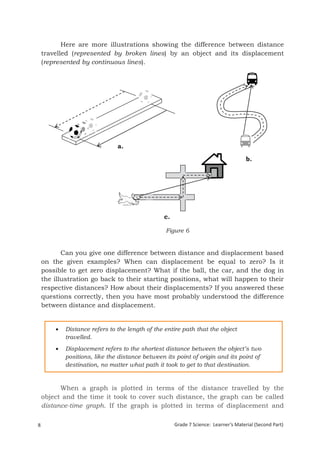
In science, the first measurement gives the distance travelled by the 
object (represented by broken lines) while the second measurement gives its 
displacement (represented by continuous line). 
Grade 7 Science: Learner’s Material (Second Part) 7 
Grade 7 Science: Energy In Motion 89
Here are more illustrations showing the difference between distance 
travelled (represented by broken lines) by an object and its displacement 
(represented by continuous lines). 
c. 
Figure 6 
b. 
a. 
Can you give one difference between distance and displacement based 
on the given examples? When can displacement be equal to zero? Is it 
possible to get zero displacement? What if the ball, the car, and the dog in 
the illustration go back to their starting positions, what will happen to their 
respective distances? How about their displacements? If you answered these 
questions correctly, then you have most probably understood the difference 
between distance and displacement. 
 Distance refers to the length of the entire path that the object 
travelled. 
 Displacement refers to the shortest distance between the object’s two 
positions, like the distance between its point of origin and its point of 
destination, no matter what path it took to get to that destination. 
When a graph is plotted in terms of the distance travelled by the 
object and the time it took to cover such distance, the graph can be called 
distance-time graph. If the graph is plotted in terms of displacement and 
8 Grade 7 Science: Learner’s Material (Second Part) 
Grade 7 Science: Energy In Motion 90
time, it is called displacement-time graph. Refer to the graph in Figure 7. 
What is the displacement of the object after 2 seconds? What is its 
displacement after 6 seconds? How will you describe the motion of the object 
between 0s and 2s, between 2s and 4s, and between 4s and 6s? 
Displacement (m) 
4 
3 
2 
1 
0 
1 2 3 4 5 
Figure 7 
Activity 2 
My home to school roadmap 
Objective 
Time (s) 
6 
In this activity you should be able to make a roadmap that shows how 
you get to school from your house. 
Procedure 
1. Devise a way to easily measure distance. Let your teacher check your 
non-standard measurement for precision. 
2. Using your measuring device, gather the data that you will need for 
your roadmap. Make sure that you take down notes of all names of the 
roads, landmarks, corners, posts, and establishments you pass by. 
Record your data properly. 
3. Using your gathered data, draw your house-school roadmap on a short 
bond paper. Decide on the most convenient scale to use when you 
draw your roadmap. An example is shown below. 
Grade 7 Science: Learner’s Material (Second Part) 9 
Grade 7 Science: Energy In Motion 91
Scale: 1 cm = 1 km 
5 km 
2 km 
3 km 
1 cm 
Figure 8 
4. Label your roadmap properly, including names of the roads, 
establishments, etc. Specify also the length of road. 
5. Finally, let your teacher check again your work. 
Q1. What is the total length of your travel from your house to your 
school? 
Q2. What is the total displacement of your travel? 
How fast? 
After determining how far the object moves, the next question will be 
“How fast did the object move?” This information can be provided by the 
object’s speed or velocity. 
Are you familiar with the traffic signs below? These signs tell us the 
maximum or minimum speed limits allowed by law for road vehicles. In 
general, the minimum speed limit in the Philippines is 60 km/h and the 
maximum speed limit is 100 km/h. 
What are the units used in the above examples of speed limits? What 
quantities do these units represent that are related to speed? 
10Grade 7 Science: Energy In Motion Grade 7 Science: Learner’s Material (Second Par9t)2
Activity 3 
Fun walk 
Objective 
In this activity you should be able to gather data to determine who 
walks fastest. 
Procedure 
1. Start by choosing a spacious place to walk straight. 
2. Half of the group will walk while the other half will observe and record 
data. 
3. Mark on the ground the starting line. All participants must start from 
the starting line at the same time. 
4. Upon receiving the go signal, all participants must start to walk as fast 
as they could. The other members should observe closely as the 
participants walk and determine who walks fastest. 
5. Repeat #4 but this time, collect data to support your conclusion. 
Discuss within your group how you are going to do this. 
Q1. What quantities did you measure for your data? 
Q2. How did you combine these quantities to determine how fast each 
participant was walking? 
Q3. How did you use the result to determine who walked fastest? 
Speed 
The questions in the above activity are actually referring to speed. If 
you know the speed of each participant, you can tell who is the fastest. 
Speed is defined as distance travelled divided by the time of travel. 
speed  distan ce travelled 
time of travel 
The units of speed can be miles per hour (mi/h), kilometres per hour 
(km/h), or meters per second (m/s). 
Q4. At constant distance, how is speed related to the time of travel? 
Grade 7 Science: Learner’s Material (Second Part) 11 
Grade 7 Science: Energy In Motion 93
Q5. At constant time to travel, how is speed related to the distance 
travelled? 
Q6. Who was travelling faster than the other, a person who covered 10 
meters in 5 seconds or the one who took 10 seconds to cover 20 
meters? 
Speed and direction 
In describing the motion of an object, we do not just describe how fast 
the object moves. We also consider the direction to where it is going. Speed 
with direction is referred to as velocity. The sample weather bulletin below 
will show you the importance of knowing not just the speed of the storm but 
also its direction. 
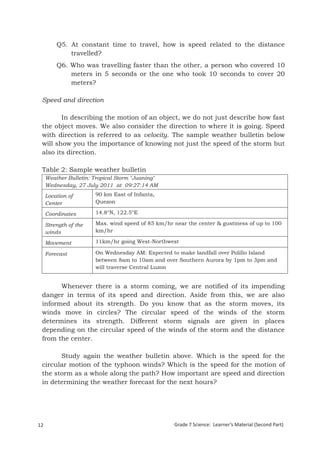
Table 2: Sample weather bulletin 
Weather Bulletin: Tropical Storm "Juaning" 
Wednesday, 27 July 2011 at 09:27:14 AM 
Location of 
90 km East of Infanta, 
Center 
Quezon 
Coordinates 14.8°N, 122.5°E 
Strength of the 
winds 
Max. wind speed of 85 km/hr near the center & gustiness of up to 100 
km/hr 
Movement 11km/hr going West-Northwest 
Forecast On Wednesday AM: Expected to make landfall over Polillo Island 
between 8am to 10am and over Southern Aurora by 1pm to 3pm and 
will traverse Central Luzon 
Whenever there is a storm coming, we are notified of its impending 
danger in terms of its speed and direction. Aside from this, we are also 
informed about its strength. Do you know that as the storm moves, its 
winds move in circles? The circular speed of the winds of the storm 
determines its strength. Different storm signals are given in places 
depending on the circular speed of the winds of the storm and the distance 
from the center. 
Study again the weather bulletin above. Which is the speed for the 
circular motion of the typhoon winds? Which is the speed for the motion of 
the storm as a whole along the path? How important are speed and direction 
in determining the weather forecast for the next hours? 
12 Grade 7 Science: Learner’s Material (Second Part) 
Grade 7 Science: Energy In Motion 94
Constant speed vs instantaneous speed 
If you solved for the distance travelled by each participant over the 
time he took to cover such distance, then you have computed for his 
average speed. But why average speed and not just speed? It is considered 
average speed because it represents the speed of the participant throughout 
his travel. During his travel, there were instants that his speed would vary. 
His speed at an instant is called instantaneous speed. Similarly, the velocity 
of a moving body at an instant is called instantaneous velocity. The 
instantaneous speed may be equal, greater than, or less than the average 
speed. 
When an object’s instantaneous speed values are always the same, then 
it means that the object is moving with constant speed. We refer to this as 
constant motion. Where you will be and what time you will reach your 
destination is easily predicted when you move at constant speed or velocity. 
Are you familiar with the speedometer? Speedometer is a device used to 
measure the instantaneous speed of a vehicle. Speedometers are important 
to the drivers because they need to know how fast they are going so they 
know if they are already driving beyond the speed limit or not. 
How fast is the velocity changing? 
In reality, objects do not 
always move at constant velocity. 
Storms like “Juaning” also do 
change their speeds, directions, or 
both. The next activity will help 
you analyze examples of motion 
with changing velocities (or with 
changing speed, since we are only 
trying to analyze examples of 
motion in only one direction) using 
tape charts and motion graphs. 
Source: http://drrm.region4a.dost.gov.ph/ 
Figure 9. Track of tropical storm “Juaning” 
Grade 7 Science: Learner’s Material (Second Part) 13 
Grade 7 Science: Energy In Motion 95
Activity 4 
Doing detective work 
Consider this situation below: 
Supposed you were having your on-the-job training in a private 
investigating company. You were asked to join a team assigned to 
investigate a ‘hit and run’ case. The alleged suspect was captured by 
the CCTV camera driving down a road leading to the place of incident. 
The suspect denied the allegation, saying that he was then driving 
very slowly with a constant speed. Because of the short time 
difference when he was caught by the camera and when the accident 
happened, he insisted that it was impossible that he would already be 
at the place when the crime happened. But when you were viewing 
the scene again on the camera, you noticed that his car was leaving 
oil spots on the road. When you checked these spots on site, you 
found out that they are still evident. So you began to wonder if the 
spots can be used to investigate the motion of the car of the suspect 
and check whether he was telling the truth or not. 
Here is an activity that you can do to help you with your investigation. 
You will analyze the motion using strips of papers with dots. For this 
activity, assume that the dots represent the ‘oil drops’ left by the car down 
the road. 
Materials 
 ruler 
 paper strips with dots 
 cutter or pair of scissors 
Procedure 
A. Using tape chart 
1. Obtain from your teacher paper strips with dots. 
2. Label each dot. Start from 0, then 1, 2, 3, and so on. In this example, 
each dot occurred every 1 second. 
1 sec 
0 1 2 3 
Figure 10 
14Grade 7 Science: Energy In Motion Grade 7 Science: Learner’s Material (Second Par9t)6
3. Examine the distances between successive dots. 
Q1. How will you compare the distances between successive dots? 
4. Cut the strip at each drop, starting 
from the first to the last drop, and 
paste them side by side on a graph 
paper to form a tape chart as 
shown in Figure 11. 
Q2. How do the lengths of the tapes 
compare? 
1 
2 
3 
4 
Figure 11. Sample tape chart 
Q3. If each tape represents the distance travelled by the object for 
1 second, then what ‘quantity’ does each piece of tape provide? 
Q4. What does the chart tell you about the speed of the car? 
The difference in length between two successive tapes provides the object’s 
acceleration or its change in speed or velocity for a time interval of 
1 second. 
Q5. How will you compare the changes in the lengths of two successive 
tapes? 
Q6. What then can you say about the acceleration of the moving car? 
B. Using motion graphs 
5. Measure the distance travelled 
by the car after 1 second, 2 
seconds, and so on by 
measuring the distance between 
drops 0 and 1, 0 and 2, and so 
on. Enter your measurements in 
Table 3 on the right. 
6. Plot the values in Table 3 
as points on the graph in 
Figure 12 on the right. 
Q7. How does your 
distance-time graph 
look like? 
Table 3 
Time of travel (s) Distance travelled (m) 
1 
2 
3 
4 
5 
Figure 12 
Distance (cm) 
Time (sec) 
0 
Grade 7 Science: Learner’s Material (Second Part) 15 
Grade 7 Science: Energy In Motion 97
7. Join the mid-points of the tops 
of the tapes with a line. You 
have now converted your tape 
chart to a speed-time graph. 
Q8. How does you graph look 
like? How is this different 
from your graph in Figure 
12? 
Q9. How will you interpret this 
graph in terms of the speed 
and acceleration of the 
moving car? 
2 
3 
1 2 3 4 Time (s) 
Figure 13 
Speed (cm/s) 
1 
4 
Q10. If you found out in your investigation that the arrangement of oil 
drops left by the car is similar to what you used in this activity, was 
the suspect telling the truth when he said that he was driving with 
constant speed? 
In this module, you have learned how to describe the motion of objects 
in terms of position, distance and displacement, speed and velocity, and 
acceleration. You have also learned how to represent motion of objects using 
diagrams, charts, and graphs. 
Let us summarize what you have learned by relating distance, 
displacement, speed, velocity, and acceleration. 
 If an object does not change its position at a given time interval, 
then it is at rest or its speed is zero or not accelerating. 
 If an object covers equal distance at equal intervals of time, then it 
is moving at constant speed and still not accelerating. 
 If an object covers varying distances at equal intervals of time, then 
it is moving with changing speed or velocity. It means that the 
object is accelerating. 
Links and References 
Chapter 2: Representing Motion. Retrieved March 14, 2012 from 
http://igcse-physics--41-p2-yrh.brentsvillehs.schools.pwcs.edu/modules 
Chapter 3: Accelerated Motion. Retrieved March 14, 2012 from http://igcse-physics-- 
41-p2-yrh.brentsvillehs.schools.pwcs.edu/modules 
HS Science IV: Physics in your environment. Teacher’s Edition. 1981. Science 
Education Center. Quezon City 
16 Grade 7 Science: Learner’s Material (Second Part) 
Grade 7 Science: Energy In Motion 98
Suggested time allotment: 4 to 5 hours 
WAVES AROUND YOU 
MODULE 
2 
Waves occur all around you in the physical world. When you throw a 
stone into a lake, water waves spread out from the splash. When you strum 
the strings of a guitar, sound waves carry the noise all around you. When 
you switch on a lamp, light waves flood the room. Water, sound, and light 
waves differ in important ways but they all share the basic properties of 
wave motion. For instance, you can see water waves and surfers would say 
that they enjoy riding the waves. On the other hand, you don’t see sound 
waves and light waves but you experience them in other ways. Your ears can 
detect sound waves and your skin can get burned by ultraviolet waves if you 
stay under the sun for too long. 
A wave is a periodic disturbance that moves away from a source and 
carries energy with it. For example, earthquake waves show us that the 
amount of energy carried by a wave can do work on objects by exerting 
forces that move objects from their original positions. Have you personally 
experience an earthquake? How did it feel? Did you know that you can 
understand earthquakes by studying waves? 
In this module, you would be doing three activities that would 
demonstrate the properties of wave motion. After performing these activities, 
you should be able to: 
1. explain how waves carry energy from one place to 
another; 
2. distinguish between transverse and longitudinal waves; 
3. distinguish between mechanical and electromagnetic 
waves; and 
4. create a model to demonstrate the relationship among 
frequency, amplitude, wavelength, and wave velocity. 
Grade 7 Science: Learner’s Material (Second Part) 17 
Grade 7 Science: Energy In Motion 99
Warm up. What are Waves? 
Activity 1 will introduce you to different types of waves distinguished 
according to the direction of vibrations of particles with respect to the 
direction in which the waves travel. Activity 2 will give you a background of 
the terms and quantities used in describing periodic waves. Finally, Activity 
3 will strengthen your understanding of the properties 
of waves and how they propagate. 
Try to wave at your seatmate and observe the 
motion of your hand. Do you make a side-to-side 
motion with the palm of your hand? Do you do an up-and- 
down motion with your hand? 
1. Describe your personal hand wave. 
The repetitive motion that you do with your 
hand while waving is called a vibration. A vibration 
causes wave motion. When you observe a wave, the 
source is always a vibration. 
2. Think of a still lake. How would you generate 
water waves on the lake? 
Activity 1. Let’s Make Waves! 
What happens when waves pass by? 
Objective 
In this activity, you will observe and draw 
different types of waves and describe how they 
are produced. You will also describe the different 
types of waves. 
Time Allotment: 30 minutes 
Waving is a common 
gesture that people do 
to catch someone’s 
attention or to convey 
a farewell. 
18 Grade 7 Science: Learner’s Material (Second Part) 
Grade 7 Science: Energy In Motion 100
Materials 
 A rope (at least five meters long) 
 A colored ribbon 
 A coil spring (Slinky™) 
 A basin filled with water 
 A paper boat 
Procedure 
A. What are transverse waves? 
1. Straighten the rope and place it above a long table. Hold one end of 
the rope and vibrate it up and down. You would be able to observe 
a pulse. Draw three sketches of the rope showing the motion of the 
pulse at three subsequent instances (snapshots at three different 
times). Draw an arrow to represent the direction of the pulse’s 
motion. 
Time 1 
Time 2 
Time 3 
a. What is the source of the wave pulse? 
b. Describe the motion of your hand as you create the pulse. 
c. Describe the motion of the pulse with respect to the source. 
Gr ade 7 Science: Learner’s Material (Second Part) 19 
Grade 7 Science: Energy In Motion 101
You will now tag a specific part of the rope while making a 
series of pulses. A periodic wave can be regarded as a series 
of pulses. One pulse follows another in regular succession. 
Figure 1. Periodic wave 
Tie one end of the rope on a rigid and fixed object (e.g heavy table, 
door knob, etc). 
Figure 2. Rope tied to a rigid object 
Attach a colored ribbon on one part of the rope. You may use 
adhesive tape to fix the ribbon. Make a wave by continuously 
vibrating the end of the rope with quick up-and-down movements 
of your hand. Draw the waveform or the shape of the wave that 
you have created. 
Ask a friend to vibrate the rope while you observe the motion of 
the colored ribbon. Remember that the colored ribbon serves as a 
marker of a chosen segment of the rope. 
a. Does the wave transport the colored ribbon from its original 
position to the end of the rope? 
20 Grade 7 Science: Learner’s Material (Second Part) 
Grade 7 Science: Energy In Motion 102
b. Describe the vibration of the colored ribbon. How does it move 
as waves pass by? Does it move in the same direction as the 
wave? 
B. What are longitudinal waves? 
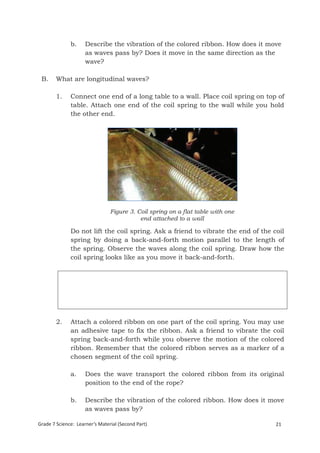
1. Connect one end of a long table to a wall. Place coil spring on top of 
table. Attach one end of the coil spring to the wall while you hold 
the other end. 
Figure 3. Coil spring on a flat table with one 
end attached to a wall 
Do not lift the coil spring. Ask a friend to vibrate the end of the coil 
spring by doing a back-and-forth motion parallel to the length of 
the spring. Observe the waves along the coil spring. Draw how the 
coil spring looks like as you move it back-and-forth. 
2. Attach a colored ribbon on one part of the coil spring. You may use 
an adhesive tape to fix the ribbon. Ask a friend to vibrate the coil 
spring back-and-forth while you observe the motion of the colored 
ribbon. Remember that the colored ribbon serves as a marker of a 
chosen segment of the coil spring. 
a. Does the wave transport the colored ribbon from its original 
position to the end of the rope? 
b. Describe the vibration of the colored ribbon. How does it move 
as waves pass by? 
Gr ade 7 Science: Learner’s Material (Second Part) 21 
Grade 7 Science: Energy In Motion 103
C. What are surface waves? 
1. Place a basin filled with water on top of a level table. Wait until the 
water becomes still or motionless. Create a wave pulse by tapping 
the surface of the water with your index finger and observe the 
direction of travel of the wave pulse. Tap the surface of the water at 
regular intervals to create periodic waves. View the waves from 
above and draw the pattern that you see. In your drawing, mark 
the source of the disturbance. 
2. Wait for the water to become still before you place your paper boat 
on the surface. Create periodic waves and observe what happens to 
your paper boat. 
a. Do the waves set the paper boat into motion? What is required 
to set an object into motion? 
b. If you exert more energy in creating periodic waves by tapping 
the surface with greater strength, how does this affect the 
movement of the paper boat? 
3. If you were somehow able to mark individual water molecules (you 
used a colored ribbon to do this earlier) and follow them as waves 
pass by, you would find that their paths are like those shown in 
the figure below. 
Figure 4. Surface waves 
22 Grade 7 Science: Learner’s Material (Second Part) 
Grade 7 Science: Energy In Motion 104
a. As shown in the figure, the passage of a wave across a surface 
of a body of water involves the motion of particles following a 
___________ pattern about their original positions. 
b. Does the wave transport water molecules from the source of 
the vibration? Support your answer using the shown figure. 
D. Summary 
1. Waves can be typified according to the direction of motion of the 
vibrating particles with respect to the direction in which the waves 
travel. 
a. Waves in a rope are called ____________ waves because the 
individual segments of the rope vibrate ____________ to the 
direction in which the waves travel. 
b. When each portion of a coil spring is alternatively compressed 
and extended, ____________ waves are produced. 
c. Waves on the surface of a body of water are a combination of 
transverse and longitudinal waves. Each water molecule 
moves in a _______________ pattern as the waves pass by. 
2. How do we know that waves carry energy? 
3. What happens when waves pass by? 
Activity 2. Anatomy of a Wave 
How do you describe waves? 
Background 
You had the experience of creating periodic waves in Activity 1. In a 
periodic wave, one pulse follows another in regular succession; a certain 
waveform – the shape of individual waves – is repeated at regular intervals. 
Most periodic waves have sinusoidal waveforms as shown below. The 
highest point and lowest point of a wave are called the crest and the trough 
respectively. The amplitude is the maximum displacement of a vibrating 
particle on either side of its normal position when the wave passes. 
G rade 7 Science: Learner’s Material (Second Part) 23 
Grade 7 Science: Energy In Motion 105
Figure 5. Sinusoidal wave 
Objective 
In this activity, you will identify the quantities used in describing 
periodic waves. 
Time Allotment: 40 minutes 
Materials 
 A ruler 
 A basin filled with water 
 A rope (at least five meters long) 
 A colored ribbon 
 A watch or digital timer 
Procedure 
A. How can you measure the wavelength of a 
wave? 
1. The wavelength of a wave refers to the distance between any 
successive identical parts of the wave. For instance, the distance 
from one crest to the next is equal to one full wavelength. In the 
following illustration, this is given by the interval B to F. Identify 
the other intervals that represent one full wavelength. 
_____________________________________________________________ 
_____________________________________________________________ 
24 Grade 7 Science: Learner’s Material (Second Part) 
Grade 7 Science: Energy In Motion 106
2. Place a basin filled with water on top of a level table. Wait for the 
water to become still. Create a vibration by regularly tapping the 
surface of the water with your index finger. You would be able to 
see the subsequent crest of the water waves. 
Figure 6. Crest and trough on a water wave 
Draw the water waves as you see them from the top of the basin. 
Label one wavelength in your drawing. 
3. Increase the rate of the vibrations you create by tapping the 
surface of the water rapidly. What happens to the wavelength of 
the waves? _______________________________________________ 
Draw the water waves as you see them from the top of the basin. 
Compare it with your drawing in number 2. 
B. How do you measure the frequency of a wave? 
1. The frequency of a series of periodic waves is the number of waves 
that pass a particular point every one second. Just like what you 
have done in Activity 1, attach a colored ribbon on a rope to serve 
G rade 7 Science: Learner’s Material (Second Part) 25 
Grade 7 Science: Energy In Motion 107
as a tag. Tie one end of the rope on a fixed object and ask a friend 
to create periodic waves by regularly vibrating the other end of the 
rope. 
2. You will count how many times the colored ribbon reached the 
crest in 10 seconds. You will start counting once the ribbon 
reaches the crest a second time. It means that one wave has 
passed by the ribbon’s position. Ask another friend with a watch or 
a digital timer to alert you to start counting and to stop counting 
after 10 seconds. Record the results in Table 1. 
3. It is also useful to consider the period of a wave, which is the time 
required for one complete wave to pass a given point. The period of 
each wave is 
푝푒푟푖표푑 = 
1 
푓푟푒푞푢푒푛푐푦 
From the identified frequency of the observed periodic waves, the 
period can be calculated. For example, if two waves per second are 
passing by, each wave has a period of ½ seconds. 
Table 1. Frequency and period of the wave 
Number of waves 
(N cycles) that passed by 
the ribbon in 10 seconds 
Frequency 
of the waves 
(N cycles/10 seconds) 
Period 
of the waves (seconds) 
The unit of frequency is the hertz (Hz); 1 Hz = 1 cycle/second. 
4. If you increase the frequency of vibration by jerking the end of the 
rope at a faster rate, what happens to the wavelength? 
__________________________________________________________________ 
C. How do you measure the speed of a wave? 
1. Using the rope with ribbon. Create periodic waves and estimate 
their wavelength. Count the number of waves that pass by the 
ribbon in ten seconds. Compute the frequency of the waves. Record 
the results in Table 2. 
26 Grade 7 Science: Learner’s Material (Second Part) 
Grade 7 Science: Energy In Motion 108
2. The wave speed is the distance traveled by the wave per second. 
푤푎푣푒 푠푝푒푒푑 = 푑푖푠푡푎푛푐푒 푡푟푎푣푒푙푒푑 푝푒푟 푠푒푐표푛푑 = 푓푟푒푞푢푒푛푐푦 푥 푤푎푣푒푙푒푛푔푡ℎ 
From the basic formula that applies to all periodic waves, you can 
see that wave speed, frequency and wavelength are independent of 
the wave’s amplitude. 
a. Using the data from number 1, calculate the wave speed of the 
observed periodic waves. Record the result in Table 2. 
Table 2. The speed of a wave 
Estimated 
wavelength 
(meters) 
Number of waves 
(N cycles) that 
passed by the 
ribbon in 10 
seconds 
Frequency 
of the waves 
(N cycles/10 
seconds) 
Wave speed 
(meter/second) 
Summary 
1. What is the relationship between wave speed, wavelength and 
frequency? 
2. Suppose you observed an anchored boat to rise and fall once every 
4.0 seconds as waves whose crests are 25 meters apart pass by it. 
a. What is the frequency of the observed waves? 
b. What is the speed of the waves? 
Activity 3. Mechanical vs. Electromagnetic Waves 
How do waves propagate? 
Objective 
In this activity, you will differentiate between mechanical waves and 
electromagnetic waves. 
Time Allotment: 30 minutes 
Gr ade 7 Science: Learner’s Material (Second Part) 27 
Grade 7 Science: Energy In Motion 109
Materials 
 Findings from Activity 1 
 Chart of the electromagnetic spectrum 
A. What are mechanical waves? 
1. When you created waves using a rope in Activity 1 Part A, you were 
able to observe a moving pattern. In this case, the medium of wave 
propagation is the rope. 
a. In Activity 1 Part B, what is the medium of wave propagation? 
b. In Activity 1 Part C, what is the medium of wave propagation? 
2. The waves that you have created in 
Activity 1 all require a medium for 
wave propagation. They are called 
mechanical waves. 
a. How can you generate 
mechanical waves? 
3. All three kinds of waves – 
The medium of propagation for the wave 
shown above is the rope. 
transverse, longitudinal, and surface – are sent out by an 
earthquake and can be detected many thousands of kilometers 
away if the quake is a major one. 
a. What do you think is the source of earthquake waves? 
b. What is the medium of propagation of earthquake waves? 
B. What are electromagnetic waves? 
1. Energy from the sun reaches the earth through electromagnetic 
waves. As opposed to mechanical waves, electromagnetic waves 
require no material medium for their passage. Thus, they can pass 
through empty space. Locate the electromagnetic spectrum chart 
in your classroom. A smaller image of the chart is shown below. 
Identify the common name of each wave shown in the chart. 
28 Grade 7 Science: Learner’s Material (Second Part) 
Grade 7 Science: Energy In Motion 110
1. ______________________ 
2. ______________________ 
3. ______________________ 
4. ______________________ 
5. _______________________ 
6. _______________________ 
7. _______________________ 
2. The electromagnetic spectrum shows the various types of 
electromagnetic waves, the range of their frequencies and 
wavelength. The wave speed of all electromagnetic waves is the 
same and equal to the speed of light which is approximately equal 
to 300 000 000 m/s. 
Figure 7. The electromagnetic spectrum 
a. Examine the electromagnetic spectrum. 
1. Describe the relationship between frequency and 
wavelength of each electromagnetic wave. 
2. Draw waves to represent each electromagnetic wave. 
Your illustrations must represent the wavelength of a 
wave relative to the others. For instance, gamma rays 
have a very small wavelength compared to the other 
waves in the spectrum. 
Gr ade 7 Science: Learner’s Material (Second Part) 29 
Grade 7 Science: Energy In Motion 111
1. Gamma Rays 
2. __________ 
3. __________ 
4. __________ 
5. __________ 
6. __________ 
7. __________ 
b. The Sun is an important source of ultraviolet (UV) waves, 
which is the main cause of sunburn. Sunscreen lotions are 
transparent to visible light but absorb most UV light. The 
higher a sunscreen’s solar protection factor (SPF), the greater 
the percentage of UV light absorbed. Why are UV rays 
harmful to the skin compared to visible light? 
Compare the frequency and energy carried by UV waves to 
that of visible light. 
C. Summary 
1. Mechanical waves like sound, water waves, earthquake waves, 
and waves in a stretched string propagate through a 
_______________ while __________________ waves such as radio 
waves, visible light, and gamma rays, do not require a material 
medium for their passage. 
Review. Waves Around You 
The activities that you have performed are all about wave motion or 
the propagation of a pattern caused by a vibration. Waves transport energy 
from one place to another thus they can set objects into motion. 
30 Grade 7 Science: Learner’s Material (Second Part) 
Grade 7 Science: Energy In Motion 112
What happens when waves pass by? 
Activity 1 introduced you to transverse waves, longitudinal waves, and 
surface waves. You observed the motion of a segment of the material 
through which the wave travels. 
1. Transverse waves occur when the individual particles or 
segments of a medium vibrate from side to side perpendicular to 
the direction in which the waves travel. 
2. Longitudinal waves occur when the individual particles of a 
medium vibrate back and forth in the direction in which the 
waves travel. 
3. The motion of water molecules on the surface of deep water in 
which a wave is propagating is a combination of transverse and 
longitudinal displacements, with the result that molecules at the 
surface move in nearly circular paths. Each molecule is displaced 
both horizontally and vertically from its normal position. 
4. While energy is transported by virtue of the moving pattern, it is 
important to remember that there is not net transport of matter 
in wave motion. The particles vibrate about a normal position and 
do not undergo a net motion. 
How can you describe waves? 
In Activity 2, you have encountered the important terms and 
quantities used to describe periodic waves. 
1. The crest and trough refer to the highest point and lowest point of 
a wave pattern, respectively. 
2. The amplitude of a wave is the maximum displacement of a 
particle of the medium on either side of its normal position when 
the wave passes. 
3. The frequency of periodic waves is the number of waves that pass 
a particular point for every one second while the wavelength is 
the distance between adjacent crests or troughs. 
4. The period is the time required for one complete wave to pass a 
particular point. 
G rade 7 Science: Learner’s Material (Second Part) 31 
Grade 7 Science: Energy In Motion 113
5. The speed of the wave refers to the distance the wave travels per 
unit time. It is related to the frequency of the wave and 
wavelength through the following equation: 
푤푎푣푒 푠푝푒푒푑 = 푓푟푒푞푢푒푛푐푦 푥 푤푎푣푒푙푒푛푔푡ℎ 
How do waves propagate? 
Finally, Activity 3 prompted you to distinguish between mechanical 
and electromagnetic waves. 
1. In mechanical waves, some physical medium is being disturbed 
for the wave to propagate. A wave traveling on a string would not 
exist without the string. Sound waves could not travel through air 
if there were no air molecules. With mechanical waves, what we 
interpret as a wave corresponds to the propagation of a 
disturbance through a medium. 
2. On the other hand, electromagnetic waves do not require a 
medium to propagate; some examples of electromagnetic waves 
are visible light, radio waves, television signals, and x-rays. 
Up Next. Light 
In the next module, you would learn about visible light, the most 
familiar form of electromagnetic waves, since it is the part of the 
electromagnetic spectrum that the human eye can detect. Through some 
interesting activities, you would come across the characteristics of light, how 
it is produced and how it propagates. You would need the concepts that you 
learned from this module to fully understand and appreciate the occurrence 
of light. 
32 Grade 7 Science: Learner’s Material (Second Part) 
Grade 7 Science: Energy In Motion 114
Pre/Post Test 
Consider the diagram below to answer questions 1 and 2. 
1. The wavelength of the wave in the diagram above is given by letter 
______. 
2. The amplitude of the wave in the diagram above is given by letter _____. 
3. Indicate the interval that represents a half wavelength. 
a. A to E 
b. B to F 
c. A to B 
d. C to E 
4. A pulse sent down a long string eventually dies away and disappears. 
What happens to its energy? 
a. The energy disappears with the wave. 
b. The energy is remains along the length of the string. 
c. The energy is transferred from the wave to the environment. 
d. The pulse does not carry energy. 
5. Mechanical waves transport energy from one place to another through 
a. Alternately vibrating particles of the medium 
b. Particles traveling with the wave 
c. Vibrating particles and traveling particles 
d. None of the above 
6. In a transverse wave, the individual particles of the medium 
a. move in circles 
b. move in ellipses 
c. move parallel to the direction of travel 
d. move perpendicular to the direction of travel 
Gr ade 7 Science: Learner’s Material (Second Part) 33 
Grade 7 Science: Energy In Motion 115
7. The higher the frequency of a wave, 
a. the lower its speed 
b. the shorter its wavelength 
c. the greater its amplitude 
d. the longer its period 
8. Of the following properties of a wave, the one that is independent of the 
others is its 
a. amplitude 
b. wave speed 
c. wavelength 
d. frequency 
9. Waves in a lake are 5.00 m in length and pass an anchored boat 1.25 s 
apart. The speed of the waves is 
a. 0.25 m/s 
b. 4.00 m/s 
c. 6.25 m/s 
d. impossible to find from the information given 
10. Energy from the sun reaches the earth through 
a. ultraviolet waves 
b. infrared waves 
c. mechanical waves 
d. electromagnetic waves 
References and Web Links 
Anatomy of an electromagnetic wave. Available at: 
http://missionscience.nasa.gov/ems/02_anatomy.html 
Electromagnetic waves. Available at: 
http://www.colorado.edu/physics/2000/waves_particles/ 
[3] Hewitt, P. (2006). Conceptual Physics 10th Ed. USA: Pearson Addison- 
Wesley. 
The anatomy of a wave. Available at: 
http://www.physicsclassroom.com/class/waves/u10l2a.cfm 
The nature of a wave. Available at: 
http://www.physicsclassroom.com/class/waves/u10l1c.cfm 
34 Grade 7 Science: Learner’s Material (Second Part) 
Grade 7 Science: Energy In Motion 116
SOUND 
Suggested time allotment: 8 to 10 hours 
MODULE 
3 
Would you like to try placing your palm on your throat while saying – 
“What you doin?” What did your palm feel? Were there vibrations in the 
throat? Try it again and this time, say – “Mom! Phineas and Ferb are making 
a title sequence!” 
In the previous module you learned 
about wave properties and common 
characteristics like pitch and loudness. You 
will also learn the 2 kinds of waves according 
to propagation. These are the longitudinal and 
transverse waves. Sound is an example of a 
longitudinal wave. It is also classified as a 
mechanical wave. Thus there has to be matter 
for which sound should travel and propagate. 
This matter is better known as medium. 
Terms to Remember 
Longitudinal Wave 
- Wave whose motion is parallel 
Mechanical wave 
- Wave that need a medium in 
Figure 1. Longitudinal wave 
How does sound propagate? 
to the motion of the particles of 
the medium 
order to propagate 
In Activity 1, you will try to explore how sound is produced. You are 
going to use local materials available in your community to do this activity. 
You can do “Art Attack” and be very creative with your project. 
Grade 7 Science: Learner’s Material (Second Part) 35 
Grade 7 Science: Energy In Motion 117
Activity 1 
My own sounding box 
Objectives 
In this activity, you should be able to construct a sounding box to 
1. demonstrate how sound is produced; and 
2. identify factors that affect the pitch and loudness of the sound 
produced. 
Materials Needed 
 shoe box 
 variety of elastic or rubber bands (thin and thick) 
 extra cardboard – optional 
 pair of scissors or cutter 
 ruler 
Procedure 
1. Cut and design your shoe 
box as shown in Figure 2. 
2. Put the rubber bands 
around the box. Make sure 
that the rubber bands are 
almost equally spaced and 
that the rubber bands are 
arranged according to 
increasing thickness from 
the lower end to the other 
end of the box. 
Handle all sharp 
TAKE tools with care. 
CARE! 
Figure 2. My sounding box 
36 Grade 7 Science: Learner’s Material (Second Part) 
Grade 7 Science: Energy In Motion 118
3. Use your finger to pluck each rubber band. Listen to the sound 
produced. 
Q1. What physical signs did you observe when you plucked each 
band. Did you hear any sound? What produced the sound? 
Q2. How different are the sounds produced by each band with 
different thickness? 
4. This time use the fingers of one hand to stretch one of the elastics. 
Pluck the elastic with the fingers of the other hand and observe. 
Q3. Are there changes in the note when you plucked the stretched 
band? 
5. Repeat step 4 with the other elastic bands. 
Q4. Arrange the elastics in sequence from the highest note to the 
lowest note produced. 
When we talk or make any sound, our vocal cords vibrate. When there 
are no vibrations felt, no sound is produced. This means that sounds are 
caused by vibrations. Vibrations of molecules are to the to-and-fro or back-and- 
forth movement of molecules. Vibrations are considered as a 
disturbance that travels through a medium. This vibratory motion causes 
energy to transfer to our ears and is interpreted by our brain. Sound waves 
are examples of longitudinal waves. They are also known as mechanical 
waves since sound waves need medium in order to propagate. 
In Activity 1, vibrations produced by the elastic band produced sound. 
The sounding box amplified (increase in amplitude) this sound. 
Sound waves can travel in air. When they come in contact with our 
eardrums, the vibrations of the air force our eardrums to vibrate which is 
sensed and interpreted by our brain. 
Can sound waves also travel in other media like solids 
and liquids? 
Gr ade 7 Science: Learner’s Material (Second Part) 37 
Grade 7 Science: Energy In Motion 119
You can try this one. Place your ear against one end of a tabletop. Ask 
a friend to gently tap the other end of the table with a pencil or a ruler. What 
happens? Then ask your friend to again gently tap the other end of the table 
but this time, make sure that your ear is not touching the table. What 
happens? In which situation did you encounter louder and more 
pronounced sound? In which situation did you encounter the sound clearly? 
Sound is produced by the slight tapping of the table with a pencil or a 
ruler. This can be heard clearly at the other end of the table. This shows 
that sound waves can also travel through wood or solid. Sound is more 
distinct in solids than in air. This also means that sound is heard much 
louder when it travels in solids than in air. 
What about in liquids? 
Can sound travel in liquids 
too? Liquids are better 
transmitters of sound than 
gases. If two bodies are 
struck together underwater, 
the sound heard by a person 
who is underwater is louder 
than when heard in air, but 
softer than in solids. 
Figure 3: Molecules of different media 
As you can see in Figure 3, particles of solids are more closely packed 
than particles of liquid and gas. This is why sound produced in solids is 
much more distinct and loud than when it is propagated or produced in 
liquids and gas. Between liquids and gases, on the other hand, liquid 
particles appear more closely spaced than gases. This means that louder 
sound will be produced in liquids than in gases. 
Spacing of particles of the medium like solid, liquid and gas is an 
important factor on how would is transmitted. Take a look at Figure 3, 
liquid particles are closer to each other than the particles in the gas. Sound 
waves are transmitted easier in liquids. Between liquids and solids, the 
particles of solids are even closer together than the liquid molecules; 
therefore, sound travels even faster in solids than in liquids. Since different 
media transmit sound differently, sound travels at different speeds in 
38 Grade 7 Science: Learner’s Material (Second Part) 
Grade 7 Science: Energy In Motion 120
different materials. Since solid is the best transmitter of sound, sound 
travels fastest in solids and slowest in gases. 
The table below shows the speed of sound in different materials. 
Table 1: Speed of sound in different materials 
Materials Speed of Sound 
V (m/s) 
Air (0oC) 
He (0oC) 
H (20oC) 
Water 
Seawater 
Iron and Steel 
Aluminum 
Hard wood 
331 
1005 
1300 
1440 
1560 
5000 
5100 
4000 
Sound speed is dependent on several factors such as (1) atmospheric 
pressure, (2) relative humidity, and (3) atmospheric temperature. Remember 
these weather elements you studied in your earlier grades? High values of 
these elements lead to faster moving sound. When you are in the low lands 
and the surrounding is hot, sound travels fast. Do you want to know why 
sound travels faster in hot air? There are more molecular interactions that 
happen in hot air. This is because the hot particles of air gain more kinetic 
energy and so there is also an increase in the mean velocity of the 
molecules. Since sound is a consequence of energy transfer through 
collisions, more collisions and faster collisions means faster sound. 
Going a little deeper on this, speed of sound basically depends on the 
elastic property and the inertial property of the medium on which it 
propagates. The elastic property is concerned with the ability of the material 
to retain or maintain its shape and not to deform when a force is applied on 
it. Solids as compared to liquids and gases have the highest elastic property. 
Consequently, solid is the medium on which sound travels fastest. This 
means that the greater the elastic property, the faster the sound waves 
travel. The iniertial property, on the other hand, is the tendency of the 
material to maintain its state of motion. More inertial property means the 
more inert (more massive or greater mass density) the individual particles of 
the medium, the less responsive they will be to the interactions between 
neighbouring particles and the slower that the wave will be. Within a single 
phase medium, like air for example, humid air is more inert than humid air. 
This is because water that has changed to vapor is mixed with the air. This 
phenomenon increases the mass density of air and so increases the inertial 
Gr ade 7 Science: Learner’s Material (Second Part) 39 
Grade 7 Science: Energy In Motion 121
property of the medium. This will eventually decrease the speed of sound on 
that medium. 
Sound cannot travel in a vacuum. Remember that sound is a 
mechanical wave which needs medium in order to propagate. If no matter 
exists, there will be no sound. In the outer space, sound would not be 
transmitted. 
Sound waves possess characteristics common to all types of waves. 
These are frequency, wavelength, amplitude, speed or velocity, period and 
phase. Just like other waves, sound also exhibits wave properties just like 
reflection, refraction, diffraction, and interference. More than these 
properties are pitch and loudness of sound. Pitch refers to the highness or 
lowness of sound. Loudness is how soft or how intense the sound is as 
perceived by the ear and interpreted by the brain. Do you want to find out 
more characteristics and properties of sound? Activity No. 2 will let your 
discover some of these properties using your sounding box. 
Activity 2 
Properties and characteristics of sound 
Objective 
In this activity, you will use your sounding box to describe the 
characteristics of sound and compare them with those of sound produced by 
a guitar. 
Materials Needed 
 Sounding Box 
 Wooden rod 
 Ruler 
 Guitar 
Procedure 
Part 1: Sounding the Box... 
1. Label the rubber bands of 
your sounding box as S1, S2 
and so on. Labeling should start with the thinnest rubber band. 
40 Grade 7 Science: Learner’s Material (Second Part) 
Grade 7 Science: Energy In Motion 122
2. Pluck each rubber band. Listen to the sounds produced. 
Q1. What did you observed when you plucked each of the rubber bands 
and sound is produced? How then is sound produced? 
Q2. Is there a difference in the sound produced by each of the rubber 
Q3. Which band produced a higher sound? Which band produced a 
Q4. How can you make a softer sound? How can you make a louder 
Q5. What factors affect the pitch and loudness of the sound produced 
3. Stretch one of the rubber bands and while doing so, pluck it again. 
Q6. Is there a change in the sound produced when you pluck the 
rubber band while stretching it? How does stretching the rubber 
band affect the pitch of the sound produced? 
ruler ruler 
Figure 3: With stretch rubber 
bands 
Figure 4: Diagonal 
Stretching of the bands 
bands? How do they differ? 
lower sound? 
sound? 
by the rubber bands? 
4. Place a ruler (on its edge) across 
the sounding box as shown in 
Figure 3. Pluck each rubber band 
and observe. 
Q7. Is there a difference in the 
sound produced when the 
ruler is placed across the 
box? 
5. Move the ruler off center to the left or to a 
diagonal position so that one side of each 
rubber band is shorter than the other side 
(Figure 4). Pluck again each rubber band on 
each side of the ruler and observe. 
Gr ade 7 Science: Learner’s Material (Second Part) 41 
Grade 7 Science: Energy In Motion 123
Q8. Which part of the rubber band (shorter side or longer side) provides 
higher pitch? Which part provides lower pitch? 
Q9. Again, what factors affect the pitch of the sound produced by the 
rubber bands? 
Part 2: The Guitar... 
6. Strum each guitar string without holding the frets. (String #0 is the 
lower most string while string #6 is the uppermost string.) 
7. Record all you observations in the table provided. 
String # Pitch (High or Low) 
0 
1 
2 
3 
4 
5 
6 
Q10. Which string vibrates fastest when strummed? 
Q11. Which string vibrates slowest when strummed? 
Q12. Which string has the highest frequency? 
Q13. Which string has the highest pitch? 
Q14. Which has the lowest frequency? 
Q15. Which string has the lowest pitch? 
Q16. How would you relate pitch and frequency? 
The highness or lowness of sound is known as the pitch of a sound or 
a musical note. In Activity No. 2 you were able to relate vibrations, frequency 
and pitch using your improvised sounding box and a guitar. The pitch of a 
high frequency sound is also high and a low frequency sound is also; lower 
in pitch. 
42 Grade 7 Science: Learner’s Material (Second Part) 
Grade 7 Science: Energy In Motion 124
When you were in your 
earlier grades you studied about 
the human ear. Our ear and that 
of animals are the very sensitive 
sound detectors. The ear is a part 
of the peripheral auditory system. 
It is divided into three major parts: 
the outer ear, the middle ear and 
the inner ear. 
The outer ear called the 
pinna collects the sound waves 
and focuses them into the ear 
canal. This canal transmits the 
sound waves to the eardrum. 
Figure 4: The human ear 
The ear canal is the eardrum membrane or the tympanum. It 
separates the outer and the middle ears physically. Air vibrations set the 
eardrum membrane in motion that causes the three smallest bones 
(hammer, anvil and stirrup) to move. These three bones convert the small-amplitude 
vibration of the eardrum into large-amplitude oscillations. These 
oscillations are transferred to the inner ear through the oval window. 
Behind the oval window is a snail-shell shaped liquid –filled organ 
called the cochlea. The large-amplitude oscillations create waves that travel 
in liquid. These sounds are converted into electrical impulses, which are 
sent to the brain by the auditory nerve. The brain, interprets these signals 
as words, music or noise. 
Did you know that we can only sense within the frequency range of 
about 20 Hz to about 20000 Hz? Vibrational frequencies beyond 20 000 Hz 
is called ultrasonic frequencies while extremely low frequencies are known 
as infrasonic frequencies. Our ear cannot detect ultrasonic or infrasonic 
waves. But some animals like dogs can hear sounds as high as 50 000 Hz 
while bats can detect sounds as high as 100 000 Hz. 
Gr ade 7 Science: Learner’s Material (Second Part) 43 
Grade 7 Science: Energy In Motion 125
We can see images of your baby 
brother or sister when the OB-Gyne 
asks your mommy or nanay to 
undergo ultrasound. Ultrasonic 
waves are used to help physicians see 
our internal organs. Nowadays, 
ultrasonic technology is of three kinds: 
2-dimensional, 3-dimensional, and 4- 
dimensional categories. In the 3- and 
4-dimensional ultrasonic technologies, 
the features of the fetus are very 
clearly captured. 
Figure 5: Ultrasound 
It has also been found that ultrasonic waves can be used as rodent 
and insect exterminators. The very loud ultrasonic sources in a building will 
usually drive the rodents away or disorient cockroaches causing them to die 
from the induced erratic behavior. What other applications of sound do you 
have in mind? Do you want to share them too? 
Loudness and Intensity 
Do you still remember intensity 
of light in the previous module? In 
sound, intensity refers to the amount 
of energy a sound wave. Figure 6 
shows varying intensity of sound. High 
amplitude sounds usually carry large 
energy and have higher intensity while 
low amplitude sound carry lesser 
amount of energy and have lower 
intensity. 
Figure 6: Varying sounds 
Sound intensity is measured by various instruments like the 
oscilloscope. Loudness is a psychological sensation that differs for different 
people. Loudness is subjective but is still related to the intensity of sound. 
In fact, despite the subjective variations, loudness varies nearly 
logarithmically with intensity. A logarithmic scale is used to describe sound 
intensity, which roughly corresponds to loudness. The unit of intensity level 
for sound is the decibel (dB), which was named after Alexander Graham Bell 
44 Grade 7 Science: Learner’s Material (Second Part) 
Grade 7 Science: Energy In Motion 126
who invented the telephone. On the decibel scale, an increase of 1 dB means 
that sound intensity is increased by a factor of 10. 
Father and son duo 
interprets the loudness of a 
sound differently. The son 
considers the rock music a 
soft music while the father 
considers it a loud sound. The 
father may even interpret the 
sound as a distorted sound, 
which is known as noise. 
Noise is wave that is not 
pleasing to the senses. 
Figure 7: Father and Son Duo 
Table 2. Sound Levels of different sound sources 
Source of sound Level (dB) 
Jet engine, 30 m away 
Threshold of pain 
Amplified rock music 
Old subway train 
Average factory 
Busy street traffic 
Normal conversation 
Library 
Close whisper 
Normal breathing 
Threshold of hearing 
140 
120 
115 
100 
90 
70 
60 
40 
20 
10 
0 
Let’s see how you interpret sound yourselves. Look for 3 more 
classmates and try Activity 3. This will test your ability to design and at the 
same time show your talents! 
Gr ade 7 Science: Learner’s Material (Second Part) 45 
Grade 7 Science: Energy In Motion 127
Activity 3 
Big time gig! 
Objectives 
In this activity, you should be able to: 
1. create musical instruments using indigenous products and 
2. use these instruments to compose tunes and present in a Gig. 
Students may also utilize other indigenous musical instruments. 
Materials Needed 
 Indigenous materials such as sticks, bottles or glassware available in 
your locality to be used as musical instrument 
 Localized or improvised stringed instruments 
 Localized or improvised drum set 
Procedure 
1. Form a group of four (4). One can play a stringed instrument, while the 
other can play the drum and the 3rd member can use the other 
instrument that your group will design or create. The last member will 
be your group’s solo performer. 
2. Look for local materials which you can use to create different musical 
instruments. 
3. Try to come up with your own composition using the instruments you 
have created. 
4. In the class GIG you are to play and sing at least 2 songs (any song of 
your choice and your original composition). 
5. Check the Rubric included to become familiar with the criteria for 
which you will be rated. 
4 6 Grade 7 Science: Learner’s Material (Second Part) 
Grade 7 Science: Energy In Motion 128
Big Time Gig! 
Rubric Scoring 
Task/ 
Criteria 4 3 2 1 Score 
Improvised/ 
Localized 
musical 
instruments 
 Makes use of 
local or 
indigenous 
materials 
 The improvised 
instruments 
produce good 
quality sound 
comparable to 
standard 
musical 
instruments. 
 Makes use 
of local 
materials 
only. 
 The 
improvised 
instruments 
produce 
good quality 
sound. 
 Makes use 
of local 
materials 
only. 
 The 
improvised 
instruments 
produce fair 
quality 
sound. 
 Makes use 
of local 
materials 
only. 
 The sound 
produced by 
the 
improvised 
instruments 
is not clear 
and 
distinct. 
Composition 
The group’s original 
composition has 
good melody. 
The lyrics provided 
are thematic and 
meaningful 
The group’s 
original 
composition 
has fair melody 
and the lyrics 
provided are 
thematic and 
meaningful 
The group’s 
original 
composition 
has fair melody 
and the lyrics 
provided are 
NOT thematic 
but meaningful 
The group’s 
original 
composition 
has fair melody 
and the lyrics 
provided are 
NEITHER 
thematic nor 
meaningful 
Performance 
 The group was 
able to 
successfully use 
the improvised 
musical 
instruments in 
their GIG. 
 The group was 
able to provide 
good quality 
rendition or 
performance. 
 The group 
was able to 
successfully 
use the 
improvised 
musical 
instruments 
in their 
GIG. 
 The group 
was able to 
provide fair 
rendition. 
 The group 
was able to 
use the 
improvised 
musical 
instruments 
but some 
were out of 
tune 
 The group 
was able to 
provide fair 
rendition. 
 The group 
was able to 
use the 
improvised 
musical 
instruments 
but MOST 
were out of 
tune 
 The group 
was able to 
provide fair 
rendition 
Cooperation 
and Team 
Work 
Each one of them 
completed their task 
so as to come up 
with the expected 
output - GIG 
3 out of 4 
members 
completed their 
task so as to 
come up with 
the expected 
output - GIG 
2 out of 4 
completed their 
task so as to 
come up with 
the expected 
output - GIG 
Only 1 out of 
the 4 members 
did his/her job 
TOTAL 
Gra de 7 Science: Learner’s Material (Second Part) 47 
Grade 7 Science: Energy In Motion 129
How was your GIG? Did you enjoy this activity? Aside from the 
concepts and principles in sound you learned and applied for a perfect 
performance what other insights can you identify? Can you extend your 
designs to come up with quality instruments using indigenous materials? 
You can be famous with your artworks... 
Sound waves are mechanical waves than need for a medium for sound 
to propagate. Vibrations of the medium create a series of compression and 
rarefaction which results to longitudinal waves. Sound can travel in all 
media but not in vacuum. Sound is fastest in matter that is closely packed 
like solid and slowest in gas. Speed of sound is dependent on factors like 
temperature, humidity and air pressure. High temperature brings much 
faster sound. Increased humidity, on the other hand makes sound travel 
slower. As pressure is increased, speed is also increased. Inertial and elastic 
properties of the medium also play an important part in the speed of sound. 
Solids tend to be highly elastic than gases and thus sound travel fastest in 
solids. In a single phase matter however, the inertial property which is the 
tendency of the material to maintain its motion also affect speed of sound. 
Humid air is more massive and is more inert than dry air. This condition 
brings lesser molecular interactions and eventually slower sound. Sound, 
just like other waves do have characteristics such as speed, frequency, 
wavelength, amplitude, phase and period. Like any other wave, sound 
exhibit properties like reflection, refraction, interference and diffraction. 
Other properties are loudness and pitch. Pitch is dependent on the 
frequency of sound wave. The higher frequency the higher the pitch of the 
sound produced. 
Organisms like us are capable of sensing sound through our ears. 
Just like other organism, our ears do have parts that perform special tasks 
until the auditory signals reach and are interpreted by our brain. 
Frequencies beyond the audible to human are known as ultrasonic (beyond 
the upper limit) and infrasonic (below the lower limit). Intensity and 
loudness are quantitative and qualitative descriptions of the energy carried 
by the wave. High amplitude waves are intense and are sensed as loud 
sound. Low amplitude sound waves are soft sound. Music is a special sound 
that forms patterns and are appealing to our sense of hearing. 
Reading Materials/Links/Websites 
http://www.physicsclassroom.com/Class/sound/u11l2c.cfm 
http://en.wikipedia.org/wiki/Sound#Sound_wave_properties_and_characteristics 
http://personal.cityu.edu.hk/~bsapplec/characte.htm 
http://www.slideshare.net/agatonlydelle/physics-sounds 
48 Grade 7 Science: Learner’s Material (Second Part) 
Grade 7 Science: Energy In Motion 130
LIGHT 
Suggested time allotment: 5 to 6 hours 
MODULE 
4 
Do you still remember Sir Isaac Newton? What about Christian 
Huygens? Did you meet them in your earlier grades? These people were the 
first to study about light. 
In this module, you will learn about light. You will also find out that 
there are different sources of light and that light exhibits different 
characteristics and properties. Finally, you will design a simple activity to 
test whether light travels in a straight light or not. 
What are the common sources of light? 
How do these common sources produce light? 
What are the common properties and 
characteristics of light? 
Sir Isaac Newton believed that light behaves like a particle while 
Christian Huygens believed that light behaves like a wave. A 3rd scientist, 
Max Planck came up with what is now known as the Dual-Nature of Light. 
He explained that light can be a particle and can also be a wave. To 
complete our knowledge about the nature of light, James Clark Maxwell 
proposed the Electromagnetic Theory of Light. 
While these scientists dig deep into the nature of light and how light 
are propagated, let us be more familiar with ordinary materials we use as 
common sources of light. The Sun for example is known as a natural source 
of light. Sun is also considered as a luminous body (an object capable of 
producing its own light). Other sources are the lamps, bulbs, and candles. 
These are the artificial sources. 
In your earlier grades you learned about energy transformation. 
Energy transformation is needed to convert or transform forms of energy to 
light or other forms. In bulbs, electric potential is converted to light. In 
lamps, chemical energy is transformed to light. 
Grade 7 Science: Learner’s Material (Second Part) 49 
Grade 7 Science: Energy In Motion 131
In Activity 1, you will try to observe transformation of chemical energy 
from chemical substances such as oil to light. Further, you will also gather 
data which chemical substance is best by relating it to the brightness of the 
light produced. In this activity, you will use the langis kandila or lampara as 
we call it in the Philippines or the Diwali lights as it is known in other 
countries like India. 
Activity 1 
Light sources: Langis kandila or lampara 
Objectives 
In this activity, you should be able to: 
1. construct a simple photometer; 
2. determine which chemical substance produce the brightest light; and 
3. infer that brightness of light is dependent on the distance of the 
source. 
Materials Needed 
 an electric glow lamp (Small lamp is needed) 
 candle - weighing 75 grams 
 wedge with sloping surfaces (sharp angle about 60° to 70° that serve 
as the photometer (made of white wood or paper) 
 langis kandila or lampara 
 variety of vegetable oil (about 5) 
 aluminum pie containers or small clay pots 
 cotton string for wick 
 set of books or tripod that will serve as platform for Diwali lights 
Procedure 
Part 1: Improvised Photometer 
Arrange the 
electric glow lamp, 
the candle and the 
wedge as shown on 
the right. Make 
sure that you do 
this activity in a 
dark room for good 
results. 
1 2 
Figure 1. Improvised photometer set up 
50 Grade 7 Science: Learner’s Material (Second Part) 
Grade 7 Science: Energy In Motion 132
Illuminate the side “A” of the wedge by the lamp and side “B” by the 
candle. In general the lamp side will look brighter than the other. 
Move the wedge nearer to the candle to a spot at which you as an 
observer, looking down on the two surfaces of the wedge (from “C”) cannot 
see any difference between them in respect of brightness. (They are then 
equally illuminated; that is to say the candle light falling on “B” is equal in 
intensity to the electric light falling on “A.”) 
Calculate the power of the lamp relative to the candle. (E.g. If both side 
of the wedge showed equal illumination when it is about 200 cm from 1, and 
50 cm from 2, the distances are as 4 to 1. But as light falls off according to 
the square of the distance: (200)2 = 40 000 and (50)2 = 2 500 or 16 to 1.). 
Thus the candle-power of the lamp is 16. 
Q1. What is the candle power of your set up? (Include your computations.) 
Part 2: Langis Kandila or Lampara 
1. Make 5 langis kandila or lampara 
using aluminium pie containers 
or small clay pots as shown. 
Label your langis kandila as DL-KL1, 
DL-KL2 and so on. 
Figure 2: Langis kandila or lampara 
2. Pour different variety of vegetable oil in each of the pot. 
3. Use the improvised photometer to determine the brightness of each of 
the candle. 
4. Replace the candle you used in the 1st part with the langis kandila. 
5. Compute the candle power of the lamp with respect to the langis 
kandila. You may refer to step 4 for the step by step process of 
determining the candle power using the improvised photometer. Record 
your data on the provided table: 
Table 1. Brightness of Vegetable Oil Variety 
Diwali Lights/Langis 
Kandila 
Vegetable Oil 
Variety 
Brightness/Luminous 
Intensity (Candela) 
DL-LK 1 Canola Oil 
DL-LK 2 Butter 
DL-LK 3 Margarine 
DL-LK 4 Corn Oil 
DL-LK 5 Olive Oil 
G rade 7 Science: Learner’s Material (Second Part) 51 
Grade 7 Science: Energy In Motion 133
Q2. Which among the langis kandila or lampara is the brightest? 
Part 3: Intensity vs Distance from light source 
1. Position your brightest Diwali light or langis kandila 20 inches or about 
50 cm from the wedge. Compute the brightness of the Diwali light. 
2. Move the langis kandila or Diwali light 10 cm closer then compute the 
brightness. 
3. Repeat step 2 and each time move the langis kandila or Diwali light 10 
cm closer to the wedge. Compute the corresponding brightness and 
record your data on the table below. 
Distance from the 
Wedge (cm) Observation Brightness 
(Candela) 
50 
40 
30 
20 
10 
Q3. How would you relate the brightness or intensity of light with the 
distance from the source? 
Brightness of light depends on the source and the distance from the 
source. Brightness however, is qualitative and is dependent of the person’s 
perception. Quantitatively, brightness can be expressed as luminous 
intensity with a unit known as candela. The unit expression came from the 
fact that one candle can approximately represent the amount of visible 
radiation emitted by a candle flame. However, this decades-ago assumption 
is inaccurate. But we still used this concept in Activity 1 as we are limited to 
an improvised photometer. If you are using a real photometer on the other 
hand, luminous intensity refers to the amount of light power emanating from a 
point source within a solid angle of one steradian. 
Further, in Activity 1, varied chemical sources produced different light 
intensity. Likewise, different distances from the light source provided varied 
intensity. 
As mentioned earlier, James Clark Maxwell discovered the 
Electromagnetic Theory of Light. He combined the concepts of light, 
electricity and magnetism to come up with his theory forming 
electromagnetic waves. Since these are waves they also exhibit different 
52 Grade 7 Science: Learner’s Material (Second Part) 
Grade 7 Science: Energy In Motion 134
characteristics of waves such as wavelength, frequency and wave speed 
which you have studied in the previous module. There are different forms of 
electromagnetic waves arranged according to frequency. This arrangement of 
the electromagnetic waves is known as Electromagnetic spectrum. The 
visible part of which is known as white light or visible light. The next activity 
will lead you to explore the characteristics of the electromagnetic spectrum. 
Activity 2 
My spectrum wheel 
Objectives 
In this activity, you should be able to 
1. construct a spectrum wheel and 
2. explore the characteristics of light such as energy, frequency and 
wavelength. 
Materials Needed 
 Spectrum Wheel Pattern 
 Cardboard or illustration board 
 Button fastener 
 Glue or paste 
Procedure 
Part 1: Spectrum Wheel 
Handle all sharp 
objects with care. TAKE 
CARE! 
Cut the two art files that make up the wheel on the next pages. 
Cut along the lines drawn on the top wheel. The small window near the 
center of the wheel should be completely cut out and removed. 
Punch a whole into the center of the two wheels together. You may use a 
button fastener to hold the two wheels securely in place, one on top of the 
other, but they should be free to rotate relative to each other. 
When you see a region of the EM spectrum show up in the open window and 
the "W,F,E" that correspond to that region showing up under the flaps then 
you know that you have done it right. 
Gr ade 7 Science: Learner’s Material (Second Part) 53 
Grade 7 Science: Energy In Motion 135
Source: Sonoma State University (http://www.swift.sonoma.edu 
54 Grade 7 Science: Learner’s Material (Second Part) 
Grade 7 Science: Energy In Motion 136
Grade 7 Science: Learner’s Material (Second Part) 55 
Grade 7 Science: Energy In Motion 137
Part 2: Characteristics of Light 
Try out your Spectrum Wheel by positioning the inner most of the flaps on 
EM SPECTRUM. This will simultaneously position the other flaps to 
ENERGY, WAVELENGTH & FREQUENCY. 
Turn the upper wheel and observe the combinations. 
Fill in the table below with the corresponding combinations you have 
observed using your Spectrum Wheel. 
Table 1. Characteristics of Light 
EM Spectrum Energy Frequency Wavelength Frequency x 
wavelength 
Radio 
Microwave 
Infrared 
Visible Light 
Ultraviolet 
X-Ray 
Gamma Ray 
Q1. How are frequency and wavelength related for a specific region of the 
spectrum? 
Q2. What can you observe with the values of the product of frequency and 
wavelength in the different spectra? 
Q3. How is ENERGY related to FREQUENCY? 
Now that we are familiar with the electromagnetic spectrum and the 
corresponding energies, frequencies and wavelength probably we can see 
some applications of these in everyday living. UV rays are highly energetic 
than other spectral regions on its left. This could be a possible reason why 
we are not advised to stay under the sun after 9:00 in the morning. Prolong 
use of mobile phones may cause ear infection. This may be due to a higher 
energy emitted by microwaves used in cellular phones than radio waves 
commonly used in other communication devices. What about the visible 
spectrum? Do you want to know more about this spectral region? 
56 Grade 7 Science: Learner’s Material (Second Part) 
Grade 7 Science: Energy In Motion 138
What are the frequencies and 
energies of the visible spectrum? This is 
the visible light. Sir Isaac Newton used a 
prism to show that light which we 
ordinarily see as white consists of 
different colors. Dispersion is a 
phenomenon in which a prism separates 
white light into its component colors. 
Activity 3 will provide you more 
information about visible light. In this 
activity, you will be able to detect 
relationships between colors, energy, 
frequency, wavelength and intensity. 
Activity 3 
Colors of light – color of life! 
Objectives 
In this activity, you should be able to 
Figure 3. Color spectrum 
1. make a color spectrum wheel; 
2. explore the characteristics of color lights; and 
3. observe how primary colors combine to form other colors. 
Materials Needed 
 Color Spectrum Wheel Pattern Cardboard or illustration board 
 white screen 
 plastic filters (green, blue and red) 
 3 pieces of high intensity flashlights 
 button fastener 
 glue or paste 
Handle all sharp 
objects with care TAKE 
CARE! 
Gr ade 7 Science: Learner’s Material (Second Part) 57 
Grade 7 Science: Energy In Motion 139
Procedure 
Part 1: Color Wheel 
1. Cut the two art files that make up the wheel on the next pages. 
2. Cut along the lines drawn on the top wheel. Cut the 2 sides as shown. 
The small window near the center of the wheel should be completely cut 
out and removed. 
3. Punch a hole at the center of the two wheels. You may use a button 
fastener to secure the two wheels together one on top of the other, but 
they should be free to rotate relative to each other. 
4. When you see a region of the Color spectrum show up in the open 
window and the "W,F,E" that correspond to that region showing up 
under the flaps then you know that you have done it right. 
58 Grade 7 Science: Learner’s Material (Second Part) 
Grade 7 Science: Energy In Motion 140
Grade 7 Science: Learner’s Material (Second Part) 59 
Grade 7 Science: Energy In Motion 141
60 Grade 7 Science: Learner’s Material (Second Part) 
Grade 7 Science: Energy In Motion 142
Part 2: Characteristics of Light 
1. Try out your Color Spectrum Wheel by positioning the inner most of the 
flaps on COLOR SPECTRUM. This will simultaneously position the 
other flaps to ENERGY, WAVELENGTH & FREQUENCY. 
2. Turn the upper wheel and observe the combinations. 
3. Fill in the table below with the corresponding combinations you have 
observed using your Spectrum Wheel. 
Table 1. Characteristics of Color Lights 
Color 
Spectrum 
Energy 
(eV) 
Frequency 
(THz) 
Wavelength 
(nm) 
Frequency x wavelength 
(m/s) 
Red 
Orange 
Yellow 
Green 
Blue 
Violet 
4. You will need to convert the equivalents of frequencies to Hz and the 
equivalent wavelengths to meters. Note that terra (T) is a prefix for 1014 
while nano (n) is a prefix equivalent to 10-9. 
Q1. Which color registers the highest frequency? shortest wavelength? 
Q2. Which color registers the lowest frequency? longest wavelength? 
Q3. What do you observe with the wavelength and frequency of the different 
colors? 
Q4. What did you observe with the product of wavelength and frequency for 
each color? What is the significance of this value? 
Q5. What can you say about the speed of the different colors of light in air? 
Q6. Give a plausible explanation as to why white light separate into 
different colors. 
Part 3: Combining Colors 
1. Cover the lens of the flashlight with blue plastic filter. Do the same with 
the 2 other flashlights. The 2nd flashlight with green plastic filter and 
the 3rd with red plastic filter. 
Grade 7 Science: Learner’s Material (Second Part) 61 
Grade 7 Science: Energy In Motion 143
2. Ask 2 other groupmates to hold the 2 other flashlight while you hold on 
to the 3rd one. Shine these flashlights on the white screen and note the 
colors projected on the screen. 
3. Let 2 color lights from the flashlights overlap. Observe what color is 
produced and fill in the table below. 
Table 2. Color that you see 
Color of Plastic Filter Color that you see projected on the screen 
Green 
Blue 
Red 
Table 3. Color Mixing 
Color Combination Resulting Color 
Green + Blue 
Blue + Red 
Red + Green 
Red + Green + Blue 
Dispersion, a special kind of refraction, provided us color lights. This 
phenomenon is observed when white light passes through a triangular 
prism. When white light enters a prism and travels slower in speed than in 
vacuum, color separation is observed due to variation in the frequencies 
(and wavelength) of color lights. Remember the concept of refractive indices 
in the previous module? The variations in frequencies (and wavelengths) are 
caused by the different refractive indices of the varying color light. Thus, 
blue light with greater refractive index refracts more and appears to bend 
more than red light. But do you really think that light will bend when 
travelling in space? The last activity in this module will test your ability to 
design an experiment to test if light travels in a straight line or not. 
Activity 4 
Light up straight! 
Objective 
In this activity, you should be able to design an experiment given 
several materials to show that light travels in a straight line. 
62 Grade 7 Science: Learner’s Material (Second Part) 
Grade 7 Science: Energy In Motion 144
Materials Needed 
 2 pieces of cardboard 
 cutting tool 
 bright room 
 ruler or meter stick 
 permanent marker 
 pencil 
 any object (e.g. medium size Johnson’s face powder box) 
Handle all sharp 
objects with care. 
Handle all lighting 
tools with care to 
avoid being burnt. 
TAKE 
CARE! 
General Instructions 
1. Given the materials design a 5-6 step procedure to test that light 
follows a straight line or not. 
2. Remember that you are only allowed to use the materials specified in 
this particular activity. 
3. Check the rubric scoring for your guide. 
Lighting Up Straight! 
Rubric Scoring 
Task/ 
Criteria 4 3 2 1 Score 
Experiment 
Procedure 
 Steps are 
logically 
presented. 
 The procedure 
included about 
5-6 steps. 
 All materials 
given to the 
group are 
utilized in the 
procedure 
 Steps are 
logically 
presented. 
 The 
procedure 
included 
about 3-4 
steps. 
 75% of the 
materials 
given to the 
group are 
utilized in the 
procedure 
 Steps are 
logically 
presented. 
 The 
procedure 
included 
about 3-4 
steps. 
 50% of the 
materials 
given to the 
group are 
utilized in 
the 
procedure 
 Steps are 
logically 
presented. 
 The 
procedure 
included 
about 2-3 
steps. 
 25% of the 
materials 
given to the 
group are 
utilized in 
the 
procedure 
Grade 7 Science: Learner’s Material (Second Part) 63 
Grade 7 Science: Energy In Motion 145
Result of 
Experiment 
Try-out/ 
Feasibility 
The group has 
successfully 
attained the object 
to prove that light 
travels in a 
straight line using 
their designed 
procedure. 
The group has 
attained the 
object to prove 
that light travels 
in a straight line 
using their 
designed 
procedure but 
there are some 
steps that are not 
very clear. 
The group has 
partially 
attained the 
object to prove 
that light 
travels in a 
straight line 
using their 
designed 
procedure. 
The group had 
some effort but 
was not able to 
attained the 
object to prove 
that light 
travels in a 
straight line 
using their 
designed. 
Cooperation 
and Team 
Work 
Each one of them 
completed their 
task so as to come 
up with the 
expected output. 
About 75% of the 
members 
completed their 
task so as to 
come up with the 
expected output. 
About 50% of 
the members 
completed their 
task so as to 
come up with 
the expected 
output. 
About 25% of 
the members 
did his/her job 
TOTAL 
Light, accordingly has wavelike nature and particle-like nature. As a 
wave, it is part of the electromagnetic waves as the visible spectrum. This 
visible spectrum is also known as white light. White light undergoes 
dispersion when it passes through a prism. The variations of refractive 
indices result to variations in the refraction of color lights dependent on the 
frequencies (and wavelength) of the color lights. This brings about blue light 
being refracted more than the other color lights and thus appears to be 
bent. However, light travels in a straight line path in a particular medium. 
Brightness or intensity and colors are special properties of light. These 
can be observed in different phenomena such as rainbows, red sunset, and 
blue sky. You can identify many other applications of light and colors as you 
become keen observers of natural phenomena. 
Reading Materials/Links/Websites 
http://amazing-space.stsci.edu/resources/explorations/groundup/ 
lesson/glossary/term-full.php?t=dispersion 
http://www.physicsclassroom.com/class/refrn/u14l4a.cfm 
64 Grade 7 Science: Learner’s Material (Second Part) 
Grade 7 Science: Energy In Motion 146
HEAT 
Suggested time allotment: 5 to 6 hours 
MODULE 
5 
For sure, you have used the word ‘heat’ many times in your life. You 
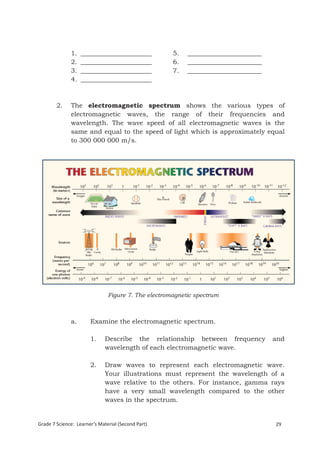
have experienced it; you have observed its effects. But have you ever 
wondered what heat really is? 
In your earlier grades, you learned that heat moves from the source to 
other objects or places. Example is the kettle with water placed on top of 
burning stove. The water gets hot because heat from the burning stove is 
transferred to it. 
This module aims to reinforce your understanding of heat as an 
energy that transfers from one object or place to another. You will determine 
the conditions necessary for heat to transfer and the direction by which heat 
transfers by examining the changes in the temperature of the objects 
involved. You will observe the different methods of heat transfer and 
investigate some factors that affect these methods. The results will help you 
explain why objects get hot or cold and why some objects are seemingly 
colder or warmer than the others even if they are exposed to the same 
temperature. 
 How is heat transferred between objects or places? 
 Do all objects equally conduct, absorb, or emit heat? 
What is Heat? 
Have you ever heard of the term “thermal energy” before? Any object is 
said to possess thermal energy due to the movement of its particles. How is 
heat related to thermal energy? Like any other forms of energy, thermal 
energy can be transformed into other forms or transferred to other objects or 
places. Heat is a form of energy that refers to the thermal energy that is ‘in 
Gr ade 7 Science: Learner’s Material (Second Part) 65 
Grade 7 Science: Energy In Motion 147
transit’ or in the process of being transferred. It stops to become heat when 
the transfer stops. After the energy is transferred, say to another object, it 
may again become thermal energy or may be transformed to other forms. 
Thermometer 
Heat transfer is related to 
change in temperature or change in 
the relative hotness or coldness of an 
object. Most of the activities found in 
Figure 1. Thermometer 
this module will ask you to collect and 
analyze temperature readings to arrive at the desired concepts. To achieve 
this, you have to use the laboratory thermometer, which is different from 
the clinical thermometer we use to determine our body temperature. The 
kind that you most probably have in your school is the glass tube with fluid 
inside, usually mercury or alcohol. Always handle the thermometer with 
care to avoid breaking the glass. Also, be sure that you know how to read 
and use the device properly to get good and accurate results. Inform your 
teacher if you are not sure of this so that you will be guided accordingly. 
Activity 1 
Warm me up, cool me down 
Objective 
In this activity, you should be able to describe the condition necessary 
for heat transfer to take place and trace the direction in which heat is 
transferred. 
Materials Needed 
 2 small containers (drinking cups or glasses) 
 2 big containers (enough to accommodate the small containers) 
 tap water 
 hot water 
 food coloring 
 laboratory thermometers (with reading up to 100oC) 
Procedure 
1. Label the small and big containers as shown 
in Figure 2. 
Figure 2 
66 Grade 7 Science: Learner’s Material (Second Part) 
Grade 7 Science: Energy In Motion 148
2. Half fill containers 1, 2, and A with tap water. Half fill also container B 
with hot water. Be careful when you pour hot water into the container. 
3. Add few drops of food coloring on the larger containers. 
4. Measure the initial temperature of 
water in each of the 4 containers, in 
degree Celsius (°C). Record your 
measurements in Table 1. 
5. Carefully place container 1 inside 
container A (Figure 3). This will be 
your Setup 1. 
Setup 1 Setup 2 
Figure 3 
6. Place also container 2 inside container B. This will be your Setup 2. 
7. Measure the temperature of water in all containers 2 minutes after 
arranging the setups. Record again your measurements in the table 
(after 2 minutes). 
8. Continue to measure and record the temperature of water after 4, 6, 8, 
and 10 minutes. Write all your measurements in the table below. 
Table 1. Temperature readings for Setup 1 and Setup 2 
Container 
Temperature (°C) of Water After 
0 min 
(initial) 
2 
mins 
4 
mins 
6 
mins 
8 
mins 
10 
mins 
Setup 
1 
1-Tap water 
A-Tap water 
Setup 
2 
2-Tap water 
B-Hot water 
Q1. In which setup did you find changes in the temperature of water inside 
the containers? In which setup did you NOT find changes in the 
temperature of water inside the containers? 
Q2. In which setup is heat transfer taking place between the containers? 
Q3. What then is the condition necessary for heat transfer to take place 
between objects? 
9. Refer to the changes in the temperature of water in the setup where 
heat transfer is taking place. 
Gr ade 7 Science: Learner’s Material (Second Part) 67 
Grade 7 Science: Energy In Motion 149
Q4. Which container contains water with higher initial temperature? What 
happens to its temperature after 2 minutes? 
Q5. Which container contains water with lower initial temperature? What 
happens to its temperature after 2 minutes? 
Q6. If heat is related to temperature, what then is the direction of heat that 
transfers between the containers? 
Q7. What happens to the temperature of water in each container after 4, 6, 
8, and 10 minutes? What does this tell us about the heat transfer 
taking place between the containers? 
Q8. Until when do you think will heat transfer continue to take place 
between the containers? 
If your teacher allows it, you may continue to measure the temperature 
of the water in both containers for your basis in answering Q8. And if you 
plot the temperature vs. time graph of the water in both containers, you will 
obtain a graph similar to Figure 4. 
Time (s) 
Figure 4 
Temperature (°C) 
10. Analyze the graph and answer the following questions: 
Q9. What does the blue curved line on the graph show? Which container 
does this represent? 
Q10. What does the red curved line on the graph show? Which container 
does this represent? 
Q11. What does the orange broken line in the graph show? Is heat transfer 
still taking place during this time? If yes, where is heat transfer now 
taking place? 
68 Grade 7 Science: Learner’s Material (Second Part) 
Grade 7 Science: Energy In Motion 150
If you do not have laboratory thermometers in your school, you may 
still perform the activity above using your sense of touch. You can use your 
fingers or hands to feel the objects being observed. But be very careful with 
this especially if you are dealing with hot water. You have to take note also 
that touching is not always reliable. Try out this simple activity below. 
Prepare three containers. Half fill one container with hot water, but not 
hot enough to burn your hand. Pour very cold water into the second 
container and lukewarm water in the third container. First, 
simultaneously place your left hand in the hot water and your right 
hand in the cold water. Keep them in for a few minutes. Then take 
them out, and place both of them together into the container with 
lukewarm water. How do your hands feel? Do they feel equally cold? 
If you try out this activity, you will observe that your left hand feels 
the water cold while your right hand feels it warm. This is due to the initial 
conditions of the hands before they were placed into the container with 
lukewarm water. So if you use sensation to determine the relative hotness or 
coldness of the objects, make sure to feel the objects with different hands or 
fingers. 
How Does Heat Transfer? 
In the previous activity, you explored the idea that heat transfers 
under certain conditions. But how exactly is heat transferred? The next 
activities will allow you to explore these different methods by which heat 
can be transferred from one object or place to another. 
Activity 2 
Which feels colder? 
Objective 
In this activity, you should be able to describe heat transfer by 
conduction and compare the heat conductivities of materials based on 
their relative coldness. 
Materials Needed 
 small pieces of different objects (copper/silver coin, paper, aluminum 
foil, iron nail, etc.) 
 laboratory thermometer 
G rade 7 Science: Learner’s Material (Second Part) 69 
Grade 7 Science: Energy In Motion 151
Procedure 
Part A: To be performed one day ahead. 
1. Place a laboratory thermometer inside the freezer of the refrigerator. 
2. Place also your sample objects inside the freezer at the same time. 
Leave them inside the freezer overnight. 
Part B: To be performed the next day. 
3. Take the temperature reading from the thermometer inside the freezer. 
Q1. What is the temperature reading inside the freezer? 
Q2. If ever there is a way to measure also the temperature of the objects 
placed inside the freezer, how do you think will their temperature 
compare with each other and with the temperature reading from the 
thermometer? 
4. Touch one object lightly with your finger and feel it. 
Q3. Did heat transfer take place between your finger and the object? If yes, 
how and in what direction did heat transfer between them? 
Q4. Did you feel the object cold? What made it so? (Relate this to your 
answer in Q3.) 
5. Touch the rest of the objects inside the freezer using different fingers, 
then observe. 
Q5. Did the objects feel equally cold? What does this tell us about the 
amount of heat transferred when you touch each object? 
Q6. Which among the objects feels ‘coldest’? Which feels ‘warmest’? 
Q7. Which among the objects is the best conductor of heat? Which object is 
the poorest conductor of heat? 
Activity 2 demonstrates heat transfer by conduction, one of the 
methods by which heat is transferred. Conduction takes place between 
objects that are in contact with each other. The energy from the object of 
higher temperature is transferred to the other object through their particles 
that are close or in contact with each other. Then the particles receiving the 
energy will also transfer the energy to other places within the object through 
their neighboring particles. During this process, only the energy moves, not 
the matter itself. This can be observed in Activity 1. You have observed that 
the hot colored water stayed inside container B and did not mix with the 
70 Grade 7 Science: Learner’s Material (Second Part) 
Grade 7 Science: Energy In Motion 152
water inside container 2. So this shows that only the energy transferred 
between the containers. 
Here is another example of heat transfer by conduction. Think of a 
metal spoon put in a bowl of a hot champorado that you were about to eat 
when you suddenly remembered that you had to do first a very important 
task. When you came back, you noticed that the handle of the spoon 
became really hot! How do you think this happened? The heat from the 
champorado is transferred to the part of the spoon that is in direct contact 
with the food by conduction. Then it is transferred to the cooler regions of 
the spoon through its particles. Why did you feel the spoon hot? When you 
touched the spoon, heat is also transferred to your hand by conduction. So 
your hand gained heat or thermal energy, and this makes you feel the object 
hot. 
Can you now explain why your hand that was previously dipped into 
hot water felt the lukewarm water cold while the other hand that was 
previously dipped into very cold water felt it hot? 
Heat Conductivities 
In the previous activity, you found out that some objects conduct heat 
faster than the others. This explains why we feel some objects colder or 
warmer than the others even if they are of the same temperature. Which 
usually feels warmer to our feet – the tiled floor or the rug? 
More accurate and thorough experiments had been carried out long 
before to determine the heat or thermal conductivity of every material. The 
approximate values of thermal conductivity for some common materials are 
shown below: 
Table 2: List of thermal conductivities of common materials 
Material 
Conductivity 
W/(m·K) 
Material 
Conductivity 
W/(m·K) 
Silver 429 Concrete 1.1 
Copper 401 Water at 20°C 0.6 
Gold 318 Rubber 0.16 
Aluminum 237 
Polypropylene 
plastic 
0.25 
Ice 2 Wood 0.04 - 0.4 
Glass, ordinary 1.7 Air at 0°C 0.025 
Solids that conduct heat better are considered good conductors of 
heat while those which conduct heat poorly are generally called insulators. 
G rade 7 Science: Learner’s Material (Second Part) 71 
Grade 7 Science: Energy In Motion 153
Metals are mostly good conductors of heat. When we use a pot or pan to 
cook our food over a stove, we usually use a pot holder made of fabrics to 
grasp the metal handle. In the process, we are using an insulator to prevent 
our hand from being burned by the conductor, which is the metal pan or 
pot. Why are woven fabrics that are full of trapped air considered good 
insulators? 
Activity 3 
Move me up 
You have previously learned that water is a poor conductor of heat, as 
shown in Table 2. But why is it that when you heat the bottom of the pan 
containing water, the entire water evenly gets hot quickly? Think of the 
answer to this question while performing this next activity. 
Objective 
In this activity, you should be able to observe and describe convection 
of heat through liquids. 
Materials Needed 
 2 transparent containers (drinking glass, beaker, bottle) 
 dropper 
 hot water 
 cold water 
 piece of cardboard 
Be careful not to bump the table or shake the container at any time during the 
experiment. 
Procedure 
1. Fill one of the glass containers with tap water. 
2. While waiting for the water to become still, mix in a separate container 
a few drops of food coloring with a small amount of very cold water. 
(You may also make the food coloring cold by placing the bottle inside the 
refrigerator for at least an hour before you perform the activity.) 
3. Suck a few drops of cold food coloring using the dropper and slowly dip 
the end of the medicine dropper into the container with tap water, down 
72 Grade 7 Science: Learner’s Material (Second Part) 
Grade 7 Science: Energy In Motion 154
to the bottom. See to it that the colored water does not come out of the 
dropper yet until its end reaches the bottom of the container. 
4. Slowly press the dropper to release a small amount of the liquid at the 
bottom of the container. Then slowly remove the dropper from the 
container, making sure not to disturb the water. Observe for few 
minutes. 
Q1. Does the food coloring stay at the bottom of the container or does it mix 
with the liquid above it? 
5. Fill the other container with hot water. 
6. Place the cardboard over the top of the 
container with hot water. Then carefully place 
the container with tap water on top of it. The 
cardboard must support the container on top 
as shown in Figure 5. 
Q2. What happens to the food coloring after 
placing the container above the other 
container? Why does this happen? 
Q3. How is heat transfer taking place in the setup? 
Where is heat coming from and where is it going? 
Figure 5 
Q4. Is there a transfer of matter, the food coloring, involved during the 
transfer of heat? 
Q5. You have just observed another method of heat transfer, called 
convection. In your own words, how does convection take place? How 
is this process different from conduction? 
Q6. Do you think convection only occurs when the source of heat is at the 
bottom of the container? What if the source of heat is near the top of 
the container? You may try it by interchanging the containers in your 
previous experiment. 
What you found out in this experiment is generally true with fluids, 
which include liquids and gases. In the next quarter, you will learn about 
convection of heat in air when you study about winds. 
So what happens in your experiment? When you placed the glass on 
top of another glass with hot water, heat transfer takes place from the hot 
water to the tap water including the colored water. This makes these liquids 
expand and become lighter and float atop the cooler water at the top of the 
container. This will then be replaced by the cooler water descending from 
above. 
Gr ade 7 Science: Learner’s Material (Second Part) 73 
Grade 7 Science: Energy In Motion 155
Activity 4 
Keep it cold 
So far you have learned that heat can be transferred by conduction 
and convection. In each method, a material, either a solid or a liquid or gas, 
is required. But can heat also transfer even without the material? If we stay 
under the sun for a while, do we not feel warm? But how does the heat from 
this very distant object reach the surface of the earth? The transfer of energy 
from the sun across nearly empty space is made possible by radiation. 
Radiation takes place even in the absence of material. 
Do you know that all objects, even ordinary ones, give off heat into the 
surrounding by radiation? Yes, and that includes us! But why don't we feel 
it? We do not feel this radiation because we are normally surrounded by 
other objects of the same temperature. We can only feel it if we happen to 
stand between objects that have different temperature, for example, if we 
stand near a lighted bulb, a burning object, or stay under the Sun. 
All objects emit and absorb radiation although some objects are better 
at emitting or absorbing radiation than others. Try out this next activity for 
you to find out. In this activity, you will determine how different surfaces of 
the object affect its ability to absorb heat. 
Introduction 
One hot sunny day, Cobi and Mumble walked into a tea shop and 
each asked for an order of iced milk tea for takeout. The crew told them as 
part of their promo, their customers can choose the color of the tumbler 
they want to use, pointing to the array of containers made of the same 
material but are of different colors and textures. Cobi favored the container 
with a dull black surface, saying that the milk tea will stay cooler if it is 
placed in a black container. Mumble remarked that the tea would stay even 
cooler if it is in a container with bright shiny surface. 
Prediction 
1. If you were in their situation, which container do you think will keep 
the iced milk tea cooler longer? Explain your choice. 
2. Assuming an initial temperature of 5°C, predict the possible 
temperatures of the milk tea in each container after 5, 10, 15, and 20 
minutes. Assume that the containers are covered. 
7 4 Grade 7 Science: Learner’s Material (Second Part) 
Grade 7 Science: Energy In Motion 156
Cup Temperature (°C) 
0 min 5 min 10 min 15 min 20 min 
Dull black 
container 5°C 
Bright shiny 
container 5°C 
Task: 
Design a laboratory activity that will enable you to test your prediction. See 
to it that you will conduct a fair investigation. Start by answering the 
questions below: 
 What problem are you going to solve? (Testable Question) 
_____________________________________________________________________ 
 What are you going to vary? (Independent variable) 
_____________________________________________________________________ 
 What are you not going to vary? (Controlled Variables) 
_____________________________________________________________________ 
 What are you going to measure? (Dependent variables) 
_____________________________________________________________________ 
1. Write down your step by step procedure. Note that you may use the 
light from the sun or from the lighted bulb as your source of energy. 
2. Collect your data according to your procedure. Present your data in 
tabulated form. 
3. Analyze your data and answer the following questions: 
Q1. Which container warmed up faster? 
Q2. Which container absorbs heat faster? 
Q3. Which container will keep the milk tea cooler longer? Is your prediction 
correct? 
Q4. Will the same container also keep a hot coffee warmer longer that the 
other? 
Gr ade 7 Science: Learner’s Material (Second Part) 75 
Grade 7 Science: Energy In Motion 157
Activity 5 
All at once 
So far, you have learned that heat can be transferred in various ways. 
You have also learned that different objects absorb, reflect, and transmit 
heat differently. In the next activities, you will not perform laboratory 
experiments anymore. All you have to do is to use your understanding so far 
of the basic concepts of heat transfer to accomplish the given tasks or 
answer the questions being asked. 
Task 1 
Heat transfer is evident everywhere around us. Look at the illustration 
below. This illustration depicts several situations that involve heat transfer. 
Your task is to identify examples of situations found in the illustration that 
involve the different methods of heat transfer. 
Figure 6 
1. Encircle three situations in the drawing that involve any method of heat 
transfer. Label them 1, 2, and 3. 
2. Note that in your chosen situations, there could be more than one heat 
transfer taking place at the same time. Make your choices more specific 
by filling up Table 3. 
7 6 Grade 7 Science: Learner’s Material (Second Part) 
Grade 7 Science: Energy In Motion 158
Table 3: Examples of heat transfer 
Description 
Which object 
gives off heat? 
Which object 
receives heat? 
What is the method of 
heat transfer? 
1 
2 
3 
Task 2 
Below is a diagram showing the basic parts of the thermos bottle. 
Examine the parts and the different materials used. Explain how these help 
to keep the liquid inside either hot or cold for a longer period of time. 
Explain also how the methods of heat transfer are affected by each material. 
Figure 7: Basic parts of 
Stopper made of plastic 
or cork 
Silvered inner and outer 
glass wall 
Vacuum between inner and 
outer wall 
Outer casing made of 
plastic or metal 
Ceramic base a thermos bottle 
Hot 
liquid 
Grade 7 Science: Learner’s Material (Second Part) 77 
Grade 7 Science: Energy In Motion 159
In the next module, you will learn about another form of energy which 
you also encounter in everyday life, electricity. Specifically, you will learn 
about the different types of charges and perform activities that will 
demonstrate how objects can be charged in different ways. You will also 
build simple electric circuits and discuss how energy is transferred and 
transformed in the circuit. 
Links and References 
Sootin, H. (1964). Experiments with heat. W.W. Norton and Company, Inc. 
Where is Heat coming from and where is it going? Retrieved March 10, 2012 
from http://www.powersleuth.org/docs/EHM%20Lesson%204%20FT.pdf 
Conduction, Convection, Radiation: Investigating Heat Transfers. Retrieved 
March 10, 2012 from 
http://www.powersleuth.org/docs/EHM%20Lesson%205%20FT.pdf 
78 Grade 7 Science: Learner’s Material (Second Part) 
Grade 7 Science: Energy In Motion 160
Suggested time allotment: 5 to 6 hours 
ELECTRICITY 
MODULE 
6 
In Module 5, you learned about heat as a form of energy that can be 
transferred through conduction, convection and radiation. You identified the 
conditions that are necessary for these processes to occur and performed 
activities that allowed you to investigate the different modes of heat transfer. 
Finally, you learned to distinguish between insulators and conductors of 
heat and were able to identify the uses of each. 
Now you will learn about another form of energy which you encounter 
in everyday life, electricity. You must be familiar with this energy since it is 
the energy required to operate appliances, gadgets, and machines, to name 
a few. Aside from these manmade devices, the ever-present nature of 
electricity is demonstrated by lightning and the motion of living organisms 
which is made possible by electrical signals sent between cells. However, in 
spite of the familiar existence of electricity, many people do not know that it 
actually originates from the motion of charges. 
In this module, you will learn about the different types of charges and 
perform activities that will demonstrate how objects can be charged in 
different ways. You will also learn the importance of grounding and the use 
of lightning rods. At the end of the module you will do an activity that will 
introduce you to simple electric circuits. The key questions that will be 
answered in this module are the following: 
What are the different types of charges? 
How can objects be charged? 
What is the purpose of grounding? 
How do lighting rods work? 
What constitutes a complete electrical circuit? 
Grade 7 Science: Learner’s Material (Second Part) 79 
Grade 7 Science: Energy In Motion 161
Activity 1 
Charged interactions 
Objectives 
After performing this activity, you should be able to: 
1. charge a material by friction; 
2. observe the behavior of charged objects; 
3. distinguish between the two types of charges; and 
4. demonstrate how objects can be discharged. 
Materials Needed: 
 Strong adhesive tape (transparent) 
 Smooth wooden table 
 Meter stick 
 Piece of wood (~1 meter long) to hold tape strips 
 Moistened sponge 
Procedure: 
1. Using a meter stick, pull off a 40- to 60- cm piece of adhesive tape and 
fold a short section of it (~1 cm) to make a nonsticky "handle" at that 
end of the tape. 
2. Lay the tape adhesive side down and slide your finger along the tape to 
firmly attach it to a smooth, dry surface of a table. 
3. Peel the tape from the surface vigorously pulling up on the handle you 
have made on one end. See figure below. Make sure that the tape does 
not curl up around itself or your fingers. 
Figure 1. How to peel the tape off the surface 
4. While holding the tape up by the handle and away from other objects, 
attach the tape to the horizontal wooden piece or the edge of your table. 
8 0 Grade 7 Science: Learner’s Material (Second Part) 
Grade 7 Science: Energy In Motion 162
Make sure that the sticky side does not come in contact with other 
objects. 
Figure 2. Attaching the tape to a holder 
5. Bring your finger near, but not touching, the nonsticky side of the tape. 
Is there any sign of interaction between the tape and the finger? 
6. Try this with another object. Is there any sign of interaction between 
the tape and this object? 
7. Prepare another tape as described in steps 1 to 3. 
8. Bring the nonsticky side of the two charged tapes you prepared near 
each other. Do you observe any interaction? 
9. Drag a moistened sponge across the nonsticky side of the tapes and 
repeat steps 5, 6 and 8. Do you still observe any interaction? 
10. Record your observations. 
Types of Charges 
You have learned in previous modules that all matter are made up of 
atoms or combinations of atoms called compounds. The varying atomic 
composition of different materials gives them different electrical properties. 
One of which is the ability of a material to lose or gain electrons when they 
come into contact with a different material through friction. 
In activity 1, when you pulled the tape vigorously from the table, some 
of the electrons from the table’s surface were transferred to the tape. This 
means that the table has lost some electrons so it has become positively 
charged while the tape has gained electrons which made it negatively 
charged. The process involved is usually referred to as charging up the 
material, and in this particular activity the process used is charging by 
friction. 
Gr ade 7 Science: Learner’s Material (Second Part) 81 
Grade 7 Science: Energy In Motion 163
It is important to remember that during the charging process, ideally, 
the amount of charge lost by the table is equal to the amount of charge 
gained by the tape. This is generally true in any charging process. The idea 
is known as: 
Charges cannot be created nor destroyed, but can be 
The total charge in a system must remain constant. 
Electric Force 
The Law of Conservation of Charge 
transferred from one material to another. 
When you brought your finger (and the other object) near the charged 
tape, you must have observed that the tape was drawn towards your finger 
as if being pulled by an invisible force. This force is called electric force 
which acts on charges. An uncharged or neutral object that has balanced 
positive and negative charges cannot experience this force. 
We learned from the previous section that the tape is negatively 
charged. The excess negative charge in the tape allowed it to interact with 
your finger and the other object. Recall also that when you placed the two 
charged tapes near each other they seem to push each other away. These 
observations tell us that there are two kinds of electric force which arises 
from the fact that there also two kinds of electrical charges. The interactions 
between the charges are summarized in the following law: 
Electrostatic Law 
Like charges repel and unlike charges attract. 
But your finger and the other object are neutral, so how did they 
interact with the charged tape? Generally, a charged object and an 
uncharged object tend to attract each other due to the phenomenon of 
electrostatic polarization which can be explained by the electrostatic law. 
When a neutral object is placed near a charged object, the charges within 
the neutral object are rearranged such that the charged object attracts the 
opposite charges within the neutral object. This phenomenon is illustrated 
in Figure 3. 
82 Grade 7 Science: Learner’s Material (Second Part) 
Grade 7 Science: Energy In Motion 164
Figure 3. Polarization of a neutral object 
Discharging 
In Activity 1, after dragging a moistened sponge on the surface of the 
tape, you must have noticed that the previous interactions you observed has 
ceased to occur. What happened? The lack of interaction indicates that the 
electrical force is gone which can only happen when there are no more 
excess charges in the tape, that is, it has become neutral. 
The process of removing excess charges on an object is called 
discharging. When discharging is done by means of providing a path 
between the charged object and a ground, the process may be referred to as 
grounding. A ground can be any object that can serve as an “unlimited” 
source of electrons so that it will be capable of removing or transferring 
electrons from or to a charged object in order to neutralize that object. 
Grounding is necessary in electrical devices and equipment since it 
can prevent the build-up of excess charges where it is not needed. In the 
next activity, you will use the idea of grounding to discover another way of 
charging a material. 
Activity 2 
To charge or not to charge 
Objective 
After performing this activity, you should be able to apply the 
phenomenon of polarization and grounding to charge a material by 
induction. 
Gr ade 7 Science: Learner’s Material (Second Part) 83 
Grade 7 Science: Energy In Motion 165
Materials Needed: 
 Styrofoam cup 
 soft drink can 
 balloon 
Procedure: 
1. Mount the soft drink can on the Styrofoam cup as 
seen in Figure 4. 
Figure 4. Mounting of 
soft drink can 
2. Charge the balloon by rubbing it off your hair 
or your classmate’s hair. Note: This will work 
only if the hair is completely dry. 
3. Place the charged balloon as near as possible 
to the soft drink can without the two objects 
touching. 
4. Touch the can with your finger at 
the end opposite the balloon. 
5. Remove your hand and observe 
how the balloon and the can will 
interact. 
Figure 6. Touching the can 
Q1. What do you think is the charge acquired by the 
balloon after rubbing it against your hair? 
Figure 5. Balloon placed 
near the can 
Q2. In which part of the activity did polarization occur? Explain. 
Q3. What is the purpose of touching the can in step #4? 
Q4. Were you able to charge the soft drink can? Explain how this happened. 
Q5. Based on your answer in Q1, what do you think is the charge of the soft 
drink can? 
84 Grade 7 Science: Learner’s Material (Second Part) 
Grade 7 Science: Energy In Motion 166
Conductors vs. Insulators 
The behavior of a charged material depends on its ability to allow 
charges to flow through it. A material that permits charges to flow freely 
within it, is a good electrical conductor. A good conducting material will 
allow charges to be distributed evenly on its surface. Metals are usually 
good conductors of electricity. 
In contrast to conductors, insulators are materials that hinder the 
free flow charges within it. If charge is transferred to an insulator, the 
excess charge will remain at the original location of charging. This means 
that charge is seldom distributed evenly across the surface of an insulator. 
Some examples of insulators are glass, porcelain, plastic and rubber. 
The observations you made had in Activity 2 depended on the fact 
that the balloon and the Styrofoam are good insulators while the soft drink 
can and you are good conductors. You have observed that the soft drink can 
has become charged after you touched one of its ends. The charging process 
used in this activity is called induction charging, where an object can be 
charged without actual contact to any other charged object. 
In the next activity you will investigate another method of charging 
which depends on the conductivity of the materials 
Activity 3 
Pass the charge 
Objective 
After performing this activity, you should be able to charge a material 
by conduction. 
Materials Needed: 
 2 styrofoam cups 
 2 softdrink cans 
 balloon 
Procedure: 
1. Repeat all steps of Activity 2. 
2. Let the charged can-cup set-up from 
Activity 2 touch a neutral can-cup set-up 
as shown in Figure 7. 
Figure 7. Putting the two set-ups 
into contact. 
Gr ade 7 Science: Learner’s Material (Second Part) 85 
Grade 7 Science: Energy In Motion 167
3. Separate the two set-ups then observe how the charged balloon 
interacts with the first and second set-up. 
Q1. Were you able to charge the can in the second set-up? Explain how this 
happened. 
Q2. Is it necessary for the two cans to come into contact for charging to 
happen? Why or why not? 
Q3. From your observation in step 3, infer the charge acquired by the can in 
the second set-up. 
The charging process you performed in Activity 3 is called charging 
by conduction which involves the contact of a charged object to a neutral 
object. Now that you have learned the three types of charging processes, we 
can discuss a natural phenomenon which is essentially a result of electrical 
charging. You will investigate this phenomenon in the following activity. 
Activity 4 
When lightning strikes 
Objectives: 
After performing this activity, you should be able to: 
1. explain how lightning occurs; 
2. discuss ways of avoiding the dangers associated with lightning; and 
3. explain how a lightning rod functions. 
Materials Needed: 
 access to reference books or to the Internet 
Procedure: 
1. Learn amazing facts about lightning by researching the answers to the 
following questions: 
 What is a lightning? 
 Where does a lightning originate? 
 How ‘powerful’ is a lightning bolt? 
 Can lightning’s energy be caught stored, and used? 
 How many people are killed by lightning per year? 
86 Grade 7 Science: Learner’s Material (Second Part) 
Grade 7 Science: Energy In Motion 168
 What can you do to prevent yourself from being struck by 
lightning? 
 Some people have been hit by lightning many times. Why have they 
survived? 
 How many bushfires are started by lightning strikes? 
 ‘Lightning never strikes twice in the same place.’ Is this a myth or a 
fact? 
 What are lightning rods? How do they function? 
As introduced at the beginning of this module, electrical energy has 
numerous applications. However many of this applications will not be 
possible unless we know how to control electrical energy or electricity. How 
do we control electricity? It starts by providing a path through which 
charges can flow. This path is provided by an electric circuit. You will 
investigate the necessary conditions for an electric circuit to function in the 
following activity. 
Activity 5 
Let there be light! 
Objectives: 
After performing this activity, you should be able to: 
1. identify the appropriate arrangements of wire, bulb and 
battery which successfully light a bulb; and 
2. describe the two requirements for an electric circuit to function. 
Materials Needed: 
 3- or 1.5-volt battery 
 2-meter copper wires/ wires with alligator clips 
 pliers/ wire cutter 
 1.5- watt bulb/ LED 
Procedure: 
1. Work with a partner and discover the appropriate arrangements of 
wires, a battery and a bulb that will make the bulb light. 
2. Once you are successful in the arrangement, draw a diagram 
representing your circuit. 
Gr ade 7 Science: Learner’s Material (Second Part) 87 
Grade 7 Science: Energy In Motion 169
3. Compare your output with other pairs that are successful in their 
arrangement. 
Q1. What difficulties did you encounter in performing this activity? 
Q2. How does your work compare with other pair’s work? 
Q3. What was necessary to make the bulb light? 
Energy Transfer in the Circuit 
In Activity 5, you have seen that with appropriate materials and 
connections, it is possible for the bulb to light. We know that light is one 
form of energy. Where did this energy come from? The law of conservation of 
energy tells us that energy can neither be created nor destroyed but can be 
transformed from one form to another. This tells us that the light energy 
observed in the bulb must have come from the electrical energy or electricity 
in the circuit. In fact, all electrical equipment and devices are based on this 
process of transformation of electrical energy into other forms of energy. 
Some examples are: 
1. Flat iron – Electrical energy to thermal energy or heat 
2. Electric fan – Electrical energy to mechanical energy 
3. Washing machine – electrical energy to mechanical energy. 
Can you identify other examples? 
References 
“Instructor Materials: Electricity” by American Association of Physics 
Teachers © 2001. Retrieved June 11, 2012 from 
https://aapt.org/Publications/pips_samples/2_ELECTRICITY/INSTRUCTO 
R/099_e4.pdf 
http://www.physicsclassroom.com/class/estatics/U8L2a.cfm (Date 
accessed: June 11, 2012) 
http://museumvictoria.com.au/pages/7567/lightning-room-classroom-activities. 
pdf (Date accessed: June 12, 2012) 
http://hyperphysics.phy-astr.gsu.edu/hbase/hframe.html (Date accessed: 
June 12, 2012) 
88 Grade 7 Science: Learner’s Material (Second Part) 
Grade 7 Science: Energy In Motion 170
Grade 7 Science: Learner’s Material (Second Part) 89
90 Grade 7 Science: Learner’s Material (Second Part)
Suggested time allotment: 14 hours 
THE 
PHILIPPINE ENVIRONMENT 
MODULE 
1 
Overview 
Everything that we see around us makes up our environment. The 
landforms and bodies of water that make up the landscape, the mountains and 
valleys, rivers and seas; the climate, the rains brought by the monsoons, the 
warm, humid weather that we frequently experience; the natural resources that 
we make use of; every plant and animal that live around us. Truly, the 
environment is made up of a lot of things. 
All these things that we find in our surroundings and all the natural 
phenomena that we observe are not due to some random luck or accident. 
What makes up our environment is very much related to where our country is 
on the globe. Or, to say it in a different way, the characteristics of our 
environment are determined by the location of the Philippines on the planet. 
Latitude and Longitude 
Before we learn about the characteristics of our environment, let us first 
talk about the location of the Philippines. Where is the Philippines? The 
Philippines is on Earth, of course, but where exactly is it located? To answer 
this question, you have to learn a new skill: locating places using latitude and 
longitude. 
Activity 1 
Where in the world is the Philippines? (Part I) 
Grade 7 Science: Earth and Space 175 
Grade 7 Science: Learner’s Material (Second Part) 91
Objective 
After performing this activity, you should be able to describe the location 
of the Philippines using latitude and longitude. 
What to use 
globes 
What to do 
1. Study the image of a globe on the right. 
Then get a real globe and identify the parts 
that are labelled in the image. Be ready to 
point them out when your teachers asks 
you. 
2. After studying the globe and the image on 
the right, try to define “equator” in your own 
words. Give your own definition when your 
teacher asks you. 
Figure 1. What does the globe 
represent? 
3. The “northern hemisphere” is that part of the world between the North Pole 
and the equator. Show the northern hemisphere on the globe when your 
teacher asks you. 
4. Where is the “southern hemisphere”? Show 
the southern hemisphere on the globe when 
your teacher asks you. 
5. Study the drawing on the right. It shows the 
lines of latitude. 
Q1. Describe the lines of latitude. 
Q2. Show the lines of latitude on the globe 
when your teacher asks you. 
Figure 2. What is the reference 
line when determining the 
latitude? 
Grade 7 Science: Earth and Space 176 
92 Grade 7 Science: Learner’s Material (Second Part)
Q3. The starting point for latitude is the equator. The equator is at latitude 
0° (0 degree). At the North Pole, the latitude is 90°N (90 degrees north). 
At the South Pole, the latitude is 90°S (90 degrees south). Show the 
following latitudes when your teacher calls on you: 15°N; 60°N; 30°S; 
45°S. 
Q4. The globe does not show all lines of latitude. If you wish to find 
50°N, where should you look? 
6. Study the drawing on the right. It shows the 
lines of longitude. 
Q5. Describe the lines of longitude. 
Q6. Show the lines of longitude on the globe 
when your teacher asks you. 
Q7. The starting point for longitude is the 
Prime Meridian. The Prime Meridian is 
at longitude 0°. Show the Prime 
Meridian on the globe when your 
teacher asks you. 
Figure 3. What is the 
reference line when 
determining the longitude? 
Q8. To the right of the Prime Meridian, the longitude is written this way: 
15°E (15 degrees east), 30°E (30 degrees east), and so on. To the left of 
the Prime Meridian, the longitude is written as 15°W (15 degrees west), 
30°W (30 degrees west), and so on. On your globe, find longitude 180°. 
What does this longitude represent? 
Q9. Not all lines of longitude are shown on a globe. If you want to find 
20°W, where should you look? 
Q10. The location of a place may be described by using latitude and 
longitude. To the nearest degree, what is the latitude and longitude of 
Manila? 
Q11. Compared to the size of the world, Manila is just a tiny spot, and its 
location may be described using a pair of latitude and longitude. But 
how would you describe the location of an “area” such as the whole 
Philippines? 
Grade 7 Science: Earth and Space 177 
Grade 7 Science: Learner’s Material (Second Part) 93
Now you know how to describe the location of a certain place using 
latitude and longitude. The lines of latitude are also known as parallels of 
latitude. That is because the lines of latitude are parallel to the equator and to 
each other. Five lines of latitude have special names. They are listed in the 
table below. The latitude values have been rounded off to the nearest half-degree. 
Latitude Name 
0° Equator 
23.5°N Tropic of Cancer 
23.5°S Tropic of Capricorn 
66.5°N Arctic Circle 
66.5°S Antarctic Circle 
Get a globe and find the Tropic of Cancer and the Tropic of Capricorn. 
Trace the two lines of latitude with a red chalk. The part of the world between 
the two chalk lines is called the tropics. Countries that are located in this zone 
experience a tropical climate where the annual average temperature is above 
18°C. 
Now, find the Arctic Circle and the Antarctic Circle on the globe. Trace 
them with blue chalk. Between the Tropic of Cancer and the Arctic Circle is the 
northern temperate zone; between the Tropic of Capricorn and the Antarctic 
Circle is the southern temperate zone. Countries in these zones go through 
four seasons – winter, spring summer, and autumn. 
Finally, the areas within the Arctic Circle and Antarctic Circle are called 
the polar regions or frigid zones. People who choose to live in these areas have 
to deal with temperatures that never go above 10°C. It is cold all year round 
and even during the summer months, it does not feel like summer at all. 
To sum up, the closer the latitude is to the equator, the warmer the 
climate. The closer it is to the poles, the colder. Thus, it is clear that there is a 
relationship between the latitude of a place and the climate it experiences, and 
you will find out why in the next module. 
Grade 7 Science: Earth and Space 178 
94 Grade 7 Science: Learner’s Material (Second Part)
Landmasses and Bodies of Water 
Using latitude and longitude is not the only way that you can describe 
the location of a certain area. Another way is by identifying the landmasses and 
bodies of water that are found in that area. So, what are the landmasses and 
bodies of water that surround the Philippines? Do the following activity and get 
to know the surrounding geography. 
Activity 2 
Where in the world is the Philippines? (Part II) 
Objective 
After performing this activity, you should be able to describe the location 
of the Philippines with respect to the surrounding landmasses and 
bodies of water. 
What to use 
globe or world map 
What to do 
1. Using a globe or a world map as reference, label the blank map below. 
2. Your labelled map should include the following: 
A. Landmasses B. Bodies of water 
Philippine archipelago Philippine Sea 
Asian continent South China Sea 
Malay peninsula Indian Ocean 
Isthmus of Kra Pacific Ocean 
Indonesian archipelago 
Australian continent 
Q1. Which bodies of water in the list are found to the west of the 
Philippines? 
Grade 7 Science: Earth and Space 179 
Grade 7 Science: Learner’s Material (Second Part) 95
Q2. Which body of water in the list is located to the east of the 
Philippines? 
Q3. Which large landmass is found to the north of the Philippines? 
3. Be ready to show the map with your labels when your teachers asks you. 
Figure 4. Where is the Philippines in the map? Why is the Philippines called an 
archipelago? 
Grade 7 Science: Earth and Space 180 
96 Grade 7 Science: Learner’s Material (Second Part)
By now you can say that you really know where the Philippines is. You 
can now describe its location in two ways: by using latitude and longitude, and 
by identifying the landmasses and bodies of water that surround it. What then 
is the use of knowing where the Philippines is located? You will find out in the 
next section and also in the following module. 
Are We Lucky in the Philippines? 
Planet Earth is made up of different things - air, water, plants, animals, 
soil, rocks, minerals, crude oil, and other fossil fuels. These things are called 
natural resources because they are not made by people; rather they are 
gathered from nature. Sunlight and wind are also natural resources. We use all 
these things to survive or satisfy our needs. 
The Philippines is considered rich in natural resources. We have fertile, 
arable lands, high diversity of plant and animals, extensive coastlines, and rich 
mineral deposits. We have natural gas, coal, and geothermal energy. Wind and 
water are also harnessed for electricity generation. 
Photo: Courtesy of Cecile N. Sales Photo: Courtesy of Kit Stephen S. Agad http://en.wikipedia.org/wiki/File:POTW_ 
MichelleELLA01.jpg 
Figure 5: What kind of natural resources are shown in the pictures? Do you have 
similar resources in your area? 
Why do we have rich natural resources? What geologic structures in the 
country account for these bounty? Is our location near the equator related to 
the presence of these natural resources? 
The next lessons will help you find answers to some questions about 
natural resources in the country namely, rocks and minerals, water, soil, 
varied life forms, and energy. 
Grade 7 Science: Earth and Space 181 
Grade 7 Science: Learner’s Material (Second Part) 97
 How does our latitude position affect the water, soil resources, and 
biodiversity in the country? 
 What mineral deposits do we have in the country? Where are they 
located and why only in those places? 
 Given our location, what energy resources are available? 
 Which of our practices in using natural resources are sustainable? 
Which are not sustainable? 
 How can we help conserve natural resources so that future 
generations can also enjoy them? 
Hopefully, the knowledge and skills acquired in the lessons will help you 
value your responsibility as a productive citizen so that you can help prevent 
protected and vulnerable places from being mined, forests from being overcut, 
and natural resources like metals from ending up in a dumpsite. 
Water Resources and Biodiversity 
The Philippines boasts of many different kinds of natural water forms, 
such as bays, rivers, lakes, falls, gulfs, straits, and swamps. Because it is made 
up of islands, the country's coastline (seashore) if laid end-to-end, would 
measure around 17.5 thousand kilometers. And you know how we are proud of 
our coastlines! The bodies of water and its surrounding environment not only 
support the survival of diverse organisms for food but are also used for other 
economic activities. All these you learned in Araling Panlipunan. 
In the previous activity you identified two big bodies of water on the west 
and east side of the country: the Pacific Ocean in the east and south China Sea 
in the west (sometimes referred to as the West Philippine Sea). These bodies of 
water are the origin of typhoons which on the average, according to Philippine 
Atmospheric, Geophysical and Astronomical Services Administration (PAGASA), 
is about 20 a year. Typhoons and the monsoons (amihan and habagat) bring 
lots of rain to the Philippines. 
What is your association with too much rainfall? For some, rain and 
typhoons result in flooding, landslides, and health related-problems. But water 
is one of nature’s gifts to us. People need fresh water for many purposes. We 
use water for domestic purposes, for irrigation, and for industries. We need 
water to generate electricity. We use water for recreation or its aesthetic value. 
Many resorts are located near springs, waterfalls or lakes. 
Grade 7 Science: Earth and Space 182 
98 Grade 7 Science: Learner’s Material (Second Part)
Where does water in your community come from? You collect them when 
the rain falls or get them from the river, deep well, or spring. But where does 
water from rivers, lakes, and springs originate? 
They come from a watershed – an area of land on a slope which drains its 
water into a stream and its tributaries (small streams that supply water to a 
main stream). This is the reason why a watershed is sometimes called a 
catchment area or drainage basin. It includes the surface of the land and the 
underground rock formation drained by the stream. 
From an aerial view, drainage patterns in a watershed resemble a 
network similar to the branching pattern of a tree. Tributaries, similar to twigs 
and small branches, flow into streams, the main branch of the tree. Streams 
eventually empty into a large river comparable to the trunk. 
http://en.wikipedia.org/wiki/File:Maria1637jf.JPG 
Figure 6. The network of streams in a watershed area is illustrated on the left and a 
photo of a watershed area is on the right. How does the concept “water runs downhill” 
apply to a watershed? 
Watersheds come in all shapes and sizes. They cross towns and 
provinces. In other parts of the world, they may cross national boundaries. 
There are many watersheds in the Philippines basically because we have 
abundant rainfall. Do you know that Mt. Apo in Davao-Cotabato, Makiling- 
Banahaw in Laguna and Quezon, and Tiwi in Albay are watersheds? You must 
have heard about La Mesa Dam in Metro Manila, Pantabangan Dam in 
Pampanga, and Angat Dam in Bulacan. These watersheds are sources of water 
of many communities in the area. The Maria Cristina Falls in Iligan City is in a 
watershed; it is used to generate electricity. Locate these places in your map. 
Ask elders where the watershed is in or near your area? Observe it is used in 
your community. 
Grade 7 Science: Earth and Space 183 
Grade 7 Science: Learner’s Material (Second Part) 99
But watersheds are not just about water. A single watershed may include 
combination of forest, grassland, marshes, and other habitats. Diverse 
organisms in the Philippines are found in these areas! Being a tropical country, 
the Philippines has abundant rainfall, many bodies of water, and lots of 
sunshine. The right temperature and abundant rainfall explain partly why our 
country is considered to be a mega-diverse country. This means that we have 
high diversity of plants and animals, both on land and in water (Philippine 
Clearing House Mechanism Website, 2012). 
Reports show that in many islands of the Philippine archipelago, there is 
a high number of endemic plants and animals (endemic means found only in 
the Philippines). The country hosts more than 52,177 described species of 
which more than half is found nowhere else in the world. They say that on a 
per unit area basis, the Philippines shelters more diversity of life than any 
other country on the planet. 
For now remember that the main function of a watershed is the 
production of a continuous water supply that would maintain the lifeforms 
within it and in the area fed by its stream. Later you will learn that besides 
supporting the survival of varied life forms, abundant water in the country is 
important in moderating temperature. This topic will be discussed later. 
Have you ever asked yourself the following questions? If we have 
abundant rainfall to feed watersheds, why do we experience drought some 
parts of the year? What factors affect the health of a watershed? Is there a way 
of regulating the flow of water in watershed so that there will be enough for all 
throughout the year? What can people do to keep watersheds ‘healthy’? Find 
out about these in the next activity. 
Activity 3 
What are some factors that will affect the amount of 
water in watersheds? 
Objective 
You will design a procedure to show how a certain factor affects the 
amount of water that can be stored underground or released by a 
watershed to rivers, lakes and other bodies of water. 
Grade 7 Science: Earth and Space 184 
100 Grade 7 Science: Learner’s Material (Second Part)
What to do 
1. In your group, choose one factor that you want to investigate. 
a. Vegetation cover 
b. Slope of the area 
c. Kind of soil 
d. Amount of rainfall 
2. Identify the variables that you need to control and the variable that you 
will change. 
3. Design a procedure to determine the effect of the factor you chose on 
watersheds. 
4. Be ready to present your design in the class and to defend why you 
designed it that way. 
Soil Resources, Rainfall and Temperature 
Recall in elementary school science that soil is formed when rocks and 
other materials near the Earth’s surface are broken down by a number of 
processes collectively called weathering. You learned two types of weathering: 
the mechanical breaking of rocks or physical weathering, and the chemical 
decay of rocks or chemical weathering. 
Let us review what happens to a piece of rock when left under the Sun 
and rain for a long time. Do the next activity. 
Grade 7 Science: Earth and Space 185 
Grade 7 Science: Learner’s Material (Second Part) 101
Activity 4 
How are soils formed from rocks? 
Objectives 
1. Using the information in the table, trace the formation of soil from 
rocks. 
2. Identify the factors acting together on rocks to form soil. 
What to use 
Drawing pens 
What to do 
1. Processes involved in soil formation are listed in the table below. Read the 
descriptions of the processes and make your own illustrations of the 
different processes. Draw in the designated spaces. 
2. Use the descriptions and your drawings to answer the following questions. 
Q1. What are the factors that act together on rocks to form soil? 
Q2. What does the following sentence mean, “Soils were once rocks”? 
Processes of soil formation Illustrations of processes 
When a piece of rock is exposed to the Sun, 
its outer part expands (becomes bigger) 
because it heats up faster than the inner part 
(Drawing A). 
Drawing A 
On cooling, at night time, the outer part of 
the rock contracts or shrinks because the 
outer part of the rock cools faster than the 
inner portion (Drawing B). The process of 
expansion and contraction are repeated over 
the years and produce cracks in the rock 
causing the outer surface to break off. 
Drawing B 
Grade 7 Science: Earth and Space 186 
102 Grade 7 Science: Learner’s Material (Second Part)
Processes of soil formation Illustrations of processes 
Once broken, water enters the cracks causing 
some minerals to dissolve. The rock breaks 
apart further. (Drawing C). 
Drawing C 
Air also enters the cracks, and oxygen in the 
air combines with some elements such as 
iron to produce iron oxide (rust or kalawang) 
which is brittle and will easily peel off. In a 
similar way, carbon dioxide from the air 
reacts with water to form an acid causing the 
rock to soften further. Once soft and broken, 
bacteria and small plants start to grow in the 
cracks of the rock (Drawing D). 
After some time, the dead plants and 
animals die and decay causing the formation 
of more acidic substances which further 
breaks the rocks. The dead bodies of plants 
and animals are acted upon by 
microorganism and breakdown into smaller 
compounds while the minerals from the rock 
return to the soil. 
Drawing D 
Soil covers the entire Earth. Temperature, rainfall, chemical changes, 
and biological action act together to continuously form soil. Climate, expressed 
as both temperature and rainfall effects, is often considered the most powerful 
soil-forming factor. 
Temperature controls how fast chemical reactions occur. Many reactions 
proceed more quickly as temperature increases. Warm-region soils are 
normally more developed or more mature than cold-region soils. Mature soils 
have more silt and clay on or near the surface. Thus, soils in the tropical areas 
are observed to sustain various farming activities and account for why the 
primary source of livelihood in the Philippines and other countries in the 
Grade 7 Science: Earth and Space 187 
Grade 7 Science: Learner’s Material (Second Part) 103
tropical region is their fertile land. What is the effect of very little rainfall on 
food production? 
Climate (temperature and rainfall) is a significant factor not only in soil 
formation but also in sustaining diversity of plants and animals in the country. 
On the other hand, water also directly affects the movement of soluble soil 
nutrients from the top soil to deep under the ground (leaching). These 
nutrients may no longer be available to shallow rooted plants. Acidic rainwater 
may also contribute to the loss of minerals in soil resulting in low yield. So 
rainfall determines the kind of vegetation in an area. In turn, the degree of 
vegetation cover, especially in sloping areas, determines how much soil is 
removed. Are there ways to protect soil resources? 
Rocks and Mineral Resources 
History tells us that rocks have been used by humans for more than two 
million years. Our ancestors lived in caves; they carved rocks and stones to 
make tools for hunting animals, cultivating crops, or weapons for protection. 
Rocks, stones, gravel, and sand were and are still used to make roads, 
buildings, monuments, and art objects. 
http://commons.wikimedia.org/wiki/File:DirkvdM_rocks.jpg 
Figure 7. What are the features of the 
rocks? What environmental factors 
may have caused such features? 
http://en.wikipedia.org/wiki/File:Pana_Banaue_Rice_Terraces.jpg 
Figure 8. What kind of tools do you think 
were used to build the Rice Terraces? 
Why are terraces useful? 
The mining of rocks for their metal content has been considered one of 
the most important factors of human progress. The mining industry has raised 
levels of economy in some regions, in part because of the kind of metals 
available from the rocks in those areas. 
Grade 7 Science: Earth and Space 188 
104 Grade 7 Science: Learner’s Material (Second Part)
Activity 5 
Where are the minerals deposits in the Philippines? 
Mineral deposits can be classified into two types: metallic and non-metalllic. 
You have already learned the symbols of some metals and nonmetals. 
Review them before you do the activity. 
Objectives 
After performing this activity, you will be able to 
1. locate the metallic mineral deposits across the country; 
2. find out what geologic features are common in areas where the deposits 
are found; 
3. give a possible reason/s for the association between metallic mineral 
deposits and geologic features in the country; and 
4. infer why your area or region is rich or not rich in metallic mineral 
deposits. 
What to use 
Figure 9: Metallic Deposits Map of the Philippines 
Figure 10: Map of Trenches and Faults in the Philippines 
Figure 11: Map of Volcanoes in the Philippines 
2 pieces of plastic sheet used for book cover, same size as a book page 
Marking pens (two colors, if possible) 
What to do 
Part I 
1. Familiarize yourself with the physical map of the Philippines. Identify 
specific places of interest to you in the different regions. 
2. In your notebook, make a four-column table with headings similar to 
Table 1. 
Grade 7 Science: Earth and Space 189 
Grade 7 Science: Learner’s Material (Second Part) 105
Table 1: Metallic Minerals in the Philippines and Their Location 
Metal, in 
Symbols 
(Example: 
Au) 
(1) 
Metal, in 
Words 
(2) 
Province/Region 
Where the Metals are 
Found 
(3) 
Geologic Structure 
Near the Location 
of the Metallic 
Deposits 
(4) 
3. As a group, study the Metallic Deposits Map of the Philippines. See Figure 
9. In the map you will see symbols of metals. Fill in the information 
needed in Columns 1 and 2 of your own table. 
4. Check with each other if you have correctly written the correct words for 
the symbol of the metals. Add as many rows as there are kinds of metals 
in the map. 
5. Analyze the data in Table 1. 
Q1. Identify five metals which are most abundant across the country. Put 
a number on this metal (1 for most abundant, 2 next abundant, and 
so on). 
Q2. Record in Column 3 where the five most abundant metals are located. 
Grade 7 Science: Earth and Space 190 
106 Grade 7 Science: Learner’s Material (Second Part)
Figure 9. Metallic Deposits in the Philippines 
Grade 7 Science: Earth and Space 191 
Grade 7 Science: Learner’s Material (Second Part) 107
Figure 10. Trenches and Faults in the Philippines 
Grade 7 Science: Earth and Space 192 
108 Grade 7 Science: Learner’s Material (Second Part)
Figure 11. Volcanoes in the Philippines 
Grade 7 Science: Earth and Space 193 
Grade 7 Science: Learner’s Material (Second Part) 109
Part II 
1. Get two plastic sheets. On one sheet, trace the outlines of the trenches 
and faults from Figure 10. On the other sheet, trace the location of 
volcanoes from Figure 11. 
2. Place the Trench and Fault plastic sheet over the Metallic Deposits map. 
3. Place the Volcanoes plastic sheet over the two maps. 
Q3. What geologic structures are found near the location of the metallic 
deposits? Write trenches, faults or volcanoes in column 4 of Table 1. 
Q4. Write a statement to connect the presence of metallic deposits with 
trenches or volcanic areas. 
Q5. Why do you think are metallic deposits abundant in places where 
there are trenches or volcanoes? 
4. Look for your province in the map. 
Q6. Are there metallic deposits in your area? 
Q7. What could be reason for the presence or absence of metallic deposits 
in your area? You can download the detailed map of Trenches, Faults 
and volcanoes in the Philippines from the website of Phivolcs. 
Q8. If there are metallic deposits, what activities tell you that there are 
indeed deposits in or near your area/province? 
The important metallic minerals found in various parts of the Philippines 
include gold, copper, iron, chromite (made up of chromium, iron, and other 
metals), nickel, cobalt, and platinum. The most productive copper and gold 
producers in the Philippines are found in Baguio, the province of Benguet, and 
in Surigao-Davao areas. Major producers of nickel are in Palawan and Surigao 
(DENR Website, 2012). 
Metals are important. The properties of metals make them useful for 
specific purposes. You learned these in Quarter 1. Iron is the main material for 
steel bars used in buildings and road construction. Copper is used in making 
electrical wires. Tin is the material for milk cans and other preserved food 
products. Nickel is mixed with copper or other metals to form stainless cooking 
wares. Gold is important in making jewelry. 
Grade 7 Science: Earth and Space 194 
110 Grade 7 Science: Learner’s Material (Second Part)
What other metals are you familiar with? What are the uses of 
aluminum? What metal is used to make GI sheets for roofing? What metals are 
used to make artificial arms or legs? Are metals used in chairs and other 
furniture? Do you know that some dentists use gold for filling teeth cavities? 
Look around and find how versatile metals are. 
The Philippines has also varied nonmetallic resources including sand 
and gravel, limestone, marble, clay, and other quarry materials. Your teacher 
will show you a map of the nometallic deposits in the Philippines. Locate your 
area and determine what nonmetallic deposits are found there. How are these 
deposits recovered? How are they used in your community? For example: What 
are the uses of sand, gravel, or clay? How are marble stones used? Think of 
other nonmetals and their uses! 
Copper –iron ore Iron filings Quartz Copper ore 
Figure 12. From the drawing, what are ores? Have you noticed that a piece of ore can 
have more than one kind of mineral in it? 
Do you know that the Philippines is listed as the 5th mineral country in 
the world, 3rd in gold reserves, 4th in copper, and 5th in nickel! The ores 
(mineral-bearing rocks) are processed out of the country to recover the pure 
metal. We buy the pure metal. Is this practice advantageous to the Philippines? 
Why or why not? 
The richness of the Philippines 
in terms of mineral resources is being 
attributed to its location in the so-called 
Pacific Ring of Fire. See Figure 
13. This area is associated with over 
450 volcanoes (small triangles in the 
map) and is home to approximately 
75% of the world's active volcanoes. 
Why are there minerals where there 
are volcanoes? 
Figure 13. Besides the Philippines, what 
other countries are in the Ring of Fire? Do 
you think they are also rich in mineral 
resources? 
Grade 7 Science: Earth and Space 195 
Grade 7 Science: Learner’s Material (Second Part) 111
Geologists (scientists who study the Earth and the processes that occur 
in and on it) explain that there is a continuous source of heat deep under the 
Earth; this melts rocks and other materials (link to usgs website) The mixture 
of molten or semi-molten materials is called magma. Because magma is hotter 
and lighter than the surrounding rocks, it rises, melting some of the rocks it 
passes on the way. If the magma finds a way to the surface, it will erupt as 
lava. Lava flow is observed in erupting volcanoes. 
But the rising magma does not always reach the surface to erupt. 
Instead, it may slowly cool and harden beneath the volcano and form different 
kinds of igneous rocks. Under favourable temperature and pressure conditions, 
the metal-containing rocks continuously melt and redeposit, eventually forming 
rich-mineral veins. 
Though originally scattered in very small amounts in magma, the metals 
are concentrated when magma convectively moves and circulates ore-bearing 
liquids and gases. This is the reason why metallic minerals deposits such as 
copper, gold, silver, lead, and zinc are associated with magmas found deep 
within the roots of extinct volcanoes. And as you saw in the maps, volcanoes 
are always near trenches and faults! You will learn more of this later. 
For now you must have realized that the presence of mineral deposits in 
the Philippines is not by accident. It is nature’s gift. If before, your association 
with volcanoes and trenches is danger and risk to life and property, now you 
know that the presence of volcanoes, trenches and other geological structures 
is the reason for the rich mineral deposits in the country. 
The existence of volcanoes also explains why the Philippines is rich in 
geothermal energy (heat from the Earth). Energy resources will be discussed in 
the next section. 
Energy Resources 
The abundance of some metal resources in the Philippines is related to 
geologic structures, specifically the presence of volcanoes and trenches in the 
country. The year-round warm temperature and availability of water are effects 
of our geographic location. 
The tropical climate and the geological conditions also provide several 
possibilities to get clean and cheap energy. Do you know which energy 
Grade 7 Science: Earth and Space 196 
112 Grade 7 Science: Learner’s Material (Second Part)
resources are due to these factors? Were the following included in your list-solar 
energy, heat from the ground (geothermal energy), hydrothermal energy 
from falling water), wind energy, and natural gas? 
Solar energy is free and inexhaustible. 
This energy source will be discussed in a later 
science subject. 
Geothermal energy was briefly introduced 
in the lesson on mineral resources and their 
location. The Philippines ranked second to the 
United States in terms of geothermal energy 
deposits. Geothermal power plants are located 
in Banahaw-Makiling, Laguna, Tiwi in Albay, 
Bacman in Sorsogon, Palimpinon in Negros 
Occidental, Tongonan in Leyte, and Mt. Apo 
side of Cotabato. 
http://commons.wikimedia.org/wiki/File:Hot_Spring.jpg 
Figure 14. Do you know that heat 
from the Earth may escape as 
steam in a hot spring? 
Try to locate places with geothermal power plants in your map? Does 
your area have geothermal energy deposits? How do you know? 
Hydrothermal or hydroelectric 
power plants use water to generate 
electricity. They provide for 27% of 
total electricity production in the 
country. Ambuklao in Benguet, Mt 
Province, Agus in Lanao del Sur and 
Agus in Lanao del Norte are large 
hydrothermal power plants. Small 
hydroelectric power plants are in 
Caliraya, Laguna, Magat in Isabela, 
Loboc in Bohol, and other places. Used 
water from hydropower plants flows 
through irrigation systems. Many of the 
reservoir areas are used for sport 
activities. 
Photograph courtesy of National Power Corporation, retrieved 
from http://www.industcards.com/hydro-philippines.htm 
Figure 15. How is water used to 
generate electricity? 
Grade 7 Science: Earth and Space 197 
Grade 7 Science: Learner’s Material (Second Part) 113
Again, locate places with hydroelectric power plants in your map? Does 
your area have hydroelectric power plants? What other uses do you have for 
water in these areas? 
Natural gas is a form of fossil fuel, so are coal and crude oil (sometimes 
called petroleum). Fossil fuels were formed from plants and animals that lived 
on Earth millions of years ago. They are buried deep in the Earth. Natural gas 
and oil are taken from the deep through oil rigs while coal is extracted through 
mining. Fossil fuels are used to produce electricity and run vehicles and factory 
machines. Did you know that petroleum is the raw material for making 
plastics? 
In the Philippines, we have coal 
and natural gas deposits. Coal is a 
black or brownish black, solid rock 
that can be burned. It contains about 
40% non-combustible components, 
thus a source of air pollution when 
used as fuel. Coal deposits are 
scattered over the Philippines but the 
largest deposit is located in Semirara 
Island, Antique. Coal mines are also 
located in Cebu, Zamboanga 
Sibuguey, Albay, Surigao, and 
Negros Provinces. 
Figure 16. The black bands in the picture 
are coal deposits. Coal is not like the 
charcoal you use for broiling fish or 
barbecue. What do you think is the 
difference? 
Our natural gas deposits are found offshore of Palawan. Do you know 
where this place is? The Malampaya Deepwater Gas-to-Power Project employs 
‘state-of-the-art deepwater technology’ to draw natural gas from deep beneath 
Philippine waters. The gas fuels three natural gas-fired power stations to 
provide 40-45% of Luzon's power generation requirements. The Department of 
Energy reports that since October 2001, the Philippines has been importing 
less petroleum for electricity generation, providing the country foreign-exchange 
savings and energy security from this clean fuel. 
Natural gas is considered clean fuel because when burned, it produces 
the least carbon dioxide, among fossil fuels. CO2 is naturally present in air in 
small amounts. However, studies show that increase in carbon dioxide in the 
atmosphere results in increase in atmospheric temperature, globally. You will 
learn about global warming in the next module. 
Grade 7 Science: Earth and Space 198 
114 Grade 7 Science: Learner’s Material (Second Part)
Did you know that in Ilocos Province, giant wind mills as shown in 
Figure 5 of this module are used to generate electricity. In Quirino, Ilocos Sur 
the electricity generated from wind mills runs a motorized sugarcane press for 
the community's muscovado sugar production? This project is a joint effort 
between the local farmers and local organizations with support from Japan. In 
Bangui, Ilocos Norte, the windmills as high as 50 meters not only help 
improve the tourism in Ilocos but it also provides 40% of the energy 
requirements for electricity in the entire province. This proves that we do not 
have to be dependent on fossil fuel in our country. 
What do you think are the environmental conditions in Ilocos Sur and 
Ilocos Norte that allow them to use wind power for electricity? Do you think 
there are places that have these conditions? Support your answers. 
Conserving and Protecting Natural Resources 
There are two types of natural resources on Earth - renewable and 
nonrenewable. What is the difference between these two kinds of resources? 
The food people eat comes from plants and animals. Plants are replaced 
by new ones after each harvest. People also eat animals. Animals have the 
capacity to reproduce and are replaced when young animals are born. Water in 
a river or in a well may dry up. But when the rain comes the water is replaced. 
Plants, animals, and water are resources that can be replaced. They are 
renewable resources. 
Most plants grow in top soil. Rain and floods wash away top soil. Can top 
soil be replaced easily? Soil comes from rocks and materials from dead plants 
and animals. It takes thousands of years for soil to form. Soil cannot be 
replaced easily, or it takes a very long time to replace. It is a nonrenewable 
resource. 
Metals like copper, iron, and aluminum are abundant on Earth. But 
people are using them up fast. They have to dig deeper into the ground to get 
what they need. Coal, oil and natural gas (fossil fuels) were formed from plants 
and animals that lived on Earth millions of years ago. It takes millions of years 
for dead plants and animals to turn into fossil fuels. Soil, coal, oil and natural 
gas are nonrenewable resources. 
Grade 7 Science: Earth and Space 199 
Grade 7 Science: Learner’s Material (Second Part) 115
Before you do Activity 6, think of these sentences: “Too much is taken 
from Earth!" and "Too much is put into Earth." You may write up a short essay 
about your understanding of the sentences. 
Activity 6 
How do people destroy natural resources? 
Objectives 
1. Identify the effects of some human activities on natural resources. 
2. Suggest ways to reduce the effects. 
What to Do 
1. Study Table 2 and tell if you have observed the activities listed in your 
locality. 
Table 2. Ways People Destroy Natural Resources 
Activities 
(1) 
Effects on Natural Resources 
(2) 
When roads are built, mountains are 
blown off using dynamite. 
Damage natural habitats and/or kill 
plants and animals. 
Rice fields are turned into residential or 
commercial centers. 
People cut too many trees for lumber or 
paper or building houses. 
More factories are being built to keep up 
with the demands of a fast growing 
population and industrialization. 
Too much mining and quarrying for the 
purpose of getting precious metals and 
stones and gravel. 
Some farmers use too much chemical 
fertilizers to replenish soil fertility. 
Too much fertilizer destroys the quality of 
the soil and is harmful to both human 
and animals. 
Plastics and other garbage are burned. 
Cars, trucks, and tricycles that emit dark 
smoke (smoke belchers) are allowed to 
travel. 
Other activities 
Grade 7 Science: Earth and Space 200 
116 Grade 7 Science: Learner’s Material (Second Part)
2. Discuss the effects of these activities on natural resources. 
3. Write the effects on the column opposite the activities. An activity may 
have more than one effect. Some of the effects have already been listed in 
the table. 
4. Do you know of other activities that destroy or cause the depletion of 
natural resources? Add them to the list and fill the corresponding effect in 
column 2. 
5. What can you do to conserve resources? 
Protecting Resources in Your Own Way 
All resources used by humans, including fuels, metals, and building 
materials, come from the Earth. Many of these resources are not in endless 
supply. It has taken many thousands and millions of years to develop and 
accumulate these resources. 
To conserve natural resources is to protect or use them wisely without 
wasting them or using them up completely. Conserving natural resources can 
make them last and be available for future generations. This is what 
sustainability of natural resources means. Each one of us should think about 
how to make things sustainable. Remember: The lives of future generations 
depend on how we use natural resources today. 
Activity 7 
Are you ready for “Make-a-Difference” Day? 
This activity involves you in hands-on activities that help you learn more 
about reducing waste, reusing materials instead of throwing them away, 
recycling, composting, and conserving natural resources and energy. There are 
many activities that you can include: conducting a "waste-free lunch" or 
building art materials out of cans, bottles, and other recyclable trash. 
Depending on the location and nature of your school, you might want to 
include river cleanup, trail maintenance, or tree planting. Or, you can mix 
these activities with a poster making contest for use in the campaign on non-use 
of plastic bags for shopping and/or marketing. 
Grade 7 Science: Earth and Space 201 
Grade 7 Science: Learner’s Material (Second Part) 117
What to do 
1. In your group, make a list of what is done in your school that help 
conserve natural resources. Discuss your list before finalizing the report. 
2. Make another list of what is done in your school that do not help conserve 
natural resources. For example, do you still have lots of things in the trash 
can or on the ground? What are they? What is being done with them? 
3. Come up with a one-day plan on what else can be done in school to 
conserve natural resources. Present your plan to the class. 
4. Based on the group presentation, decide which part in the plans will be 
adopted or adapted to make a class plan. The plan should consider the 
following: 
 Easy to follow 
 Who will be responsible for making the plan happen 
 What should be done if the people responsible for making the plan 
happen will not or cannot do it 
 What natural resources will be conserved 
 Schedule of activities to include monitoring 
 Why you think this plan is the best idea 
5. With your teacher’s permission, make an appointment with your principal 
to present your plan and to solicit support. Maybe she might recommend 
the “Make-a-Difference” Day for the whole school! 
Hopefully, the “Make-a-Difference” Day will engage you in a variety of 
environmental activities that help foster not only an appreciation for the 
environment and the resources it provides but also develop a life-long 
environmental stewardship among your age group. 
Links and Other Reading Materials 
gdis.denr.gov.ph (Geohazard Map) 
http://www.phivolcs.dost.gov.ph 
http://www.jcmiras.net/surge/p124.htm (Geothermal power plants in the 
Philippines) 
http://www.industcards.com/hydro-philippines.htm (Hydroelectric power 
plants in the Philippines) 
Grade 7 Science: Earth and Space 202 
118 Grade 7 Science: Learner’s Material (Second Part)
Suggested time allotment: 12 hours 
SOLAR ENERGY AND THE 
ATMOSPHERE 
MODULE 
2 
In the previous module, you learned that the presence of different 
natural resources in the Philippines is related to the country’s location. It 
was also mentioned that the climate in a certain area depends on its 
latitude. In this module, you are going to learn more about how the location 
of the Philippines influences its climate and weather. To prepare you for this 
lesson, you must first learn about the envelope of air that surrounds the 
Earth where all weather events happen – the atmosphere. 
Activity 1 
What is the basis for dividing 
Earth’s atmosphere into 
layers? 
Earth’s atmosphere is divided into five 
layers. What is the basis for subdividing the 
atmosphere? 
Objectives 
You will be able to gather information 
about Earth’s atmosphere based on a graph. 
Specifically, you will: 
1. describe the features of each of the five 
layers; 
2. compare the features of the five layers; 
and 
3. explain the basis for the division of the 
layers of the atmosphere. 
Figure 1. What are the layers of the 
atmosphere? 
Grade 7 Science: Earth and Space 203 
Grade 7 Science: Learner’s Material (Second Part) 119
What to use 
 Graph in Figure 1 
 A ruler, if available 
What to do 
1. Study the graph. 
Q1. What are the five layers? Estimate the height of each layer. 
Q2. Describe the graph for each layer. 
Q3. In which layer is temperature increasing with increasing altitude? 
Q4. In which layer is temperature decreasing with increasing altitude? 
Q5. What is the relationship between temperature and height in the 
- troposphere? 
- stratosphere? 
- mesosphere? 
- thermosphere? 
- exosphere? 
Q6. Observe the whole graph. What is the basis for the division of 
Earth’s atmosphere? 
Q7. From the graph, can you generalize that the higher the layer of the 
atmosphere (that is closer to the Sun), the hotter the temperature? 
Why or why not? 
Q8. What other information about Earth’s atmosphere can you derive 
from the graph? 
2. Read the succeeding paragraphs and think of a way to organize and 
summarize the data about the atmosphere from the graph and the 
information in the discussion that follows. 
The troposphere is the layer closest to Earth’s surface. The 
temperature just above the ground is hotter than the temperature high 
above. Weather occurs in the troposphere because this layer contains most 
of the water vapor. Remember the water cycle? Without water, there would 
be no clouds, rain, snow or other weather features. Air in the troposphere is 
constantly moving. As a result, aircraft flying through the troposphere may 
have a very bumpy ride – what we know as turbulence. People who have 
used the airplane for travelling have experienced this especially when there 
is a typhoon in areas where the plane passes through. 
120 Grade 7 Science: Learner’s Material (Second Part) 
Grade 7 Science: Earth and Space 204
The stratosphere is the layer of air that extends to about 50 km from 
Earth’s surface. Many jet aircraft fly in the stratosphere because it is very 
stable. It is in the stratosphere that we find the ozone layer. The ozone layer 
absorbs much of the Sun’s harmful radiation that would otherwise be 
dangerous to plant and animal life. 
The layer between 50 km and 80 km above the Earth’s surface is 
called the mesosphere. Air in this layer is very thin and cold. Meteors or rock 
fragments burn up in the mesosphere. 
The thermosphere is between 80 km and 110 km above the Earth. 
Space shuttles fly in this area and it is also where the auroras are found. 
Auroras are caused when the solar wind strikes gases in the atmosphere 
above the Poles. Why can we not see auroras in the Philippines? 
The upper limit of our atmosphere is the exosphere. This layer of the 
atmosphere merges into space. Satellites are stationed in this area, 500 km 
to 1000 km from Earth. 
To summarize what has been discussed: More than three quarters of 
Earth’s atmosphere is made up of nitrogen while one fifth is oxygen. The 
remaining 1% is a mixture of carbon dioxide, water vapour, and ozone. 
These gases not only produce important weather features such as cloud and 
rain, but also have considerable influence on the overall climate of the 
Earth, through the greenhouse effect and global warming. 
What is the Greenhouse Effect? 
In order to understand the greenhouse effect, you need to first 
understand how a real greenhouse works. 
In temperate countries, a greenhouse is used to grow seedlings in the 
late winter and early spring and later, planted in the open field when the 
weather is warmer. Greenhouses also protect plants from weather 
phenomena such snowstorm or dust storms. In tropical countries, 
greenhouses are used by commercial plant growers to protect flowering and 
ornamental plants from harsh weather conditions and insect attack. 
Greenhouses range in size from small sheds to very large buildings. 
They also vary in terms of types of covering materials. Some are made of 
glass while others are made of plastic. 
Grade 7 Science: Learner’s Material (Second Part) 121 
Grade 7 Science: Earth and Space 205
http://commons.wikimedia.org/wiki/File:Gartengew%C3%A4chshaus.JPG 
Figure 2. Different sizes of greenhouses. How does a greenhouse work? 
Activity 2 
Does a greenhouse retain or release heat? 
Objectives 
The activity will enable you to 
1. construct a model greenhouse. 
2. find out if your model greenhouse retains heat 
3. relate the concept of greenhouse to the increasing temperature of 
Earth’s atmosphere. 
What to use 
 2-liter plastic soft drink bottle 
 2-plastic containers to serve as base of the bottles 
 knife or scissors 
 transparent tape 
 two alcohol thermometers 
 one reading lamp (if 
available), otherwise bring 
the setups under the Sun 
What to do 
Constructing the model greenhouse 
Be careful when 
handling sharp 
objects like knife or 
scissors and 
breakable equipment 
like thermometer. 
CAUTION 
For each model greenhouse you will need a two-liter plastic soft drink 
container (with cap) and a shallow plastic container for the base. 
122 Grade 7 Science: Learner’s Material (Second Part) 
Grade 7 Science: Earth and Space 206
1. Remove the label of the soft drink bottle but keep the cap attached. 
2. Cut off carefully, the end of the bottle approximately 5-6 cm from the 
bottom. Dispose of the bottom piece. 
3. Place the bottle with cap in the plastic base. This is your model 
greenhouse. Label it Bottle A. 
4. Use scissors or knife to cut several elongated openings or vents (1.5 x 
5.0 cm) on the sides of Bottle B. Leave Bottle A intact. 
5. Tape a thermometer onto a piece of cardboard. Make sure that the 
cardboard is longer than the thermometer so that the bulb will not 
touch the plastic base. Make two thermometer setups, one for Bottle A 
and another for Bottle B. Place one thermometer setup in each bottle. 
Figure 3. How to construct a model greenhouse 
6. Place both bottles approximately 10 cm away 
from the lamp. DO NOT turn on the lamp yet. 
Q1. Predict which bottle will get hotter when 
you turn on the light or when they are 
exposed to the Sun. How will you know 
that one bottle is hotter than the other? 
Q2. Write down your prediction and the 
reason why you predicted that way. 
NOTE: 
If you have no lamp, 
bring the setups 
outside the classroom 
under the Sun where 
they will not be 
disturbed. 
Grade 7 Science: Learner’s Material (Second Part) 123 
Grade 7 Science: Earth and Space 207
7. Turn on the light and begin collecting data every five minutes for 25 
minutes. (Note: But if you have no lamp, place the setups under the 
Sun. Read the temperature every 20 minutes for over two hours.) 
8. Record the temperature readings of Bottle A and Bottle B in your 
notebook. 
9. Graph your data separately for Bottles A and B. 
Q3. What variable did you put in the x-axis? In the y-axis? 
Q4. Why did you put these data in the x and y axes, respectively? 
Q5. Describe the graph resulting from observations in Bottle A. 
Q6. Describe the graph resulting from observations in Bottle B. 
Q7. Explain the similarities in the graphs of Bottles A and B. 
Q8. Explain the differences in the graphs of Bottles A and B. 
Q9. Does this activity help you answer the question in the activity 
title: Do greenhouses retain heat? What is the evidence? 
Greenhouses allow sunlight to enter but prevent heat from escaping. 
The transparent covering of the greenhouse allows visible light to enter 
without obstruction. It warms the inside of the greenhouse as energy is 
absorbed by the plants, soil, and other things inside the building. Air 
warmed by the heat inside is retained in the building by the roof and wall. 
The transparent covering also prevents the heat from leaving by reflecting 
the energy back into the walls and preventing outside winds from carrying it 
away. 
The Earth’s atmosphere is compared to a greenhouse. You know that 
besides nitrogen and oxygen, Earth’s atmosphere contains trace gases such 
as carbon dioxide, water vapor, methane, and ozone. Like the glass in a 
greenhouse, the trace gases have a similar effect on the Sun’s rays. They 
allow sunlight to pass through, resulting in the warming up of the Earth’s 
surface. But they absorb the energy coming from the Earth’s surface, 
keeping the Earth’s temperature suitable for life on Earth. The process by 
which the Earth’s atmosphere warms up is called ‘greenhouse effect,’ and 
the trace gases are referred to as ‘greenhouse gases.’ 
124 Grade 7 Science: Learner’s Material (Second Part) 
Grade 7 Science: Earth and Space 208
https://sites.google.com/site/glowar88/all-about-global-warming/1-what-is-global-warming 
Figure 4. Why are greenhouse gases like the glass in 
the greenhouse? 
The ‘greenhouse effect’ is a natural process and it warms the Earth. 
Without the greenhouse effect, Earth would be very cold, too cold for living 
things, such as plants and animals. 
To further understand the 
effect of greenhouse gases look at 
Figure 5. It contains some data 
about Venus and Earth, planets 
that are almost of the same size 
and if you remember from 
elementary school science, are near 
each other, so they are called twin 
planets. The composition of 
atmosphere and the average 
surface temperature of the two 
planets are also given. Why is the 
average temperature of Venus very 
much higher than that of Earth? 
What could have caused this 
phenomenon? 
Figure 5. What gas is present in the 
atmosphere of Venus that explains its 
high surface temperature? 
Both Earth and Venus have carbon dioxide, a greenhouse gas, in their 
atmospheres. The small amount of carbon dioxide on Earth’s gives the right 
temperature for living things to survive. With the high surface temperature 
Grade 7 Science: Learner’s Material (Second Part) 125 
Grade 7 Science: Earth and Space 209
of Venus due to its high carbon dioxide concentration, do you think life 
forms like those we know of could exist there? Why or why not? 
Is Earth Getting Warmer? What is the Evidence? 
Studies have shown that before 1750 (called the pre-industrialization 
years), carbon dioxide concentration was about 0.028 percent or 280 parts 
per million (ppm) by volume. The graph below shows the concentration of 
carbon dioxide from 1958 to 
2003. What information can you 
derive from the graph? 
Recent studies report that 
in 2000-2009, carbon dioxide 
rose by 2.0 ppm per year. In 
2011, the level is higher than at 
any time during the last 800 
thousand years. Local 
temperatures fluctuate 
naturally, over the past 50 years 
but the average global 
temperature has increased at 
the fastest rate in recorded 
history. 
http://en.wikipedia.org/wiki/File:Mauna_Loa_Carbon_Dioxi 
de-en.svg#file 
Figure 6. Carbon dioxide measurements in 
Mauna Loa Observatory, Hawaii 
So what if there is increasing emission of greenhouse gases like 
carbon dioxide into the atmosphere? What is the problem with a small 
increase in carbon dioxide concentration in the atmosphere? 
More carbon dioxide means that more heat is trapped in Earth’s 
atmosphere. More heat cannot return back into space. More heat trapped by 
the carbon dioxide means a warmer Earth. 
The increasing temperature phenomenon is known as ‘global 
warming’. Global means that all countries and people around the world are 
affected even if that country is not a major contributor of greenhouse gases. 
Many scientists now agree that many human activities emit more 
greenhouses gases into the atmosphere, making the natural greenhouse 
effect stronger. Scientists are also saying that if we carry on polluting the 
atmosphere with greenhouse gases, it will have a dangerous effect on the 
Earth. 
126 Grade 7 Science: Learner’s Material (Second Part) 
Grade 7 Science: Earth and Space 210
Sources of Greenhouse Gases 
Carbon dioxide is naturally produced when people and animals 
breathe. Plants and trees take in and use carbon dioxide to produce their 
own food. Volcanoes also produce carbon dioxide. Methane comes from 
grazing animals as they digest their food and from decaying matter in wet 
rice fields. Ozone is also naturally present in the stratosphere. 
But human activities emit a lot of greenhouse gases into the 
atmosphere. 
Study Figure 7. 
http://en.wikipedia.org/wiki/File:Global_Carbon_Emission_by_Type 
.png 
Figure 7. Does burning of fossil fuels raise the 
carbon dioxide concentration in the atmosphere? 
Which fossil fuel has the highest contribution to carbon dioxide 
concentration in the atmosphere? 
What human activities use this fuel? List at least three. 
Recall Module 1. What kind of fossil fuels are used in the Philippines? 
Are we also contributing to the increase in carbon dioxide 
concentration in the atmosphere? Why or why not? 
Carbon dioxide comes from the burning of fossil fuel such as coal, 
crude oil and natural gas. Cutting down and burning of trees releases 
carbon dioxide. Methane can also be released from buried waste. For 
example, the left-over food, garden wastes, and animal wastes collected from 
our homes are thrown into dumpsites. When lots of wastes are compressed 
Grade 7 Science: Learner’s Material (Second Part) 127 
Grade 7 Science: Earth and Space 211
and packed together, they produce methane. Coal mining also produces 
methane. 
Another group of greenhouse gases includes the chlorofluorocarbons 
or CFCs for short. CFCs have been used in spray cans as propellants, in 
refrigerators as refrigerants, and in making foam plastics as foaming agents. 
They become dangerous when released into the atmosphere, depleting the 
ozone layer. For this reason, their use has been banned around the world. 
What have you learned about the atmosphere? There are natural 
processes in the atmosphere that protect and sustain life on Earth. For 
example, the greenhouse effect keeps temperature on Earth just right for 
living things. For as long as the concentration of greenhouse gases are 
controlled, we will have no problem. 
But human beings activities have emitted greenhouse gases into the 
atmosphere, increasing their levels to quantities that have adverse effects on 
people, plants, animals and the physical environment. Burning of fossil 
fuels, for example, has increased levels of carbon dioxide thus trapping more 
heat, increasing air temperature, and causing global warming. Such global 
phenomenon is feared to melt polar ice caps and cause flooding to low-lying 
areas that will result to reduction in biodiversity. It is even feared that global 
warming is already changing climates around the globe, causing stronger 
typhoons, and creating many health-related problems. You will learn more 
about climate change later. 
Common Atmospheric Phenomena 
In the next section, you will learn two concepts that will help you 
understand common atmospheric phenomena: why the wind blows, why 
monsoons occur, and what is the so-called intertropical convergence zone. 
All of these are driven by the same thing: the heat of the Sun or solar 
energy. Thus, we begin by asking, what happens when air is heated? 
Activity 3 
What happens when air is heated? 
Objective 
After this activity, you should be able to explain what happens when air 
is heated. 
128 Grade 7 Science: Learner’s Material (Second Part) 
Grade 7 Science: Earth and Space 212
What to use 
two paper bags 
candle 
long straight stick 
match 
masking tape 
chair 
Figure 8. Setup for Activity 3 
What to do 
1. Attach a paper bag to each end of the stick (see drawing above). The 
open end of each bag should be facing down. 
2. Balance the stick with the paper bags on the chair (see drawing below.) 
3. Make a prediction: what do you 
think will happen if you place a 
lighted candle under the open end 
of one of the bags? 
4. Now, light the candle and place it 
below one of the bags. Caution: Do 
not place the candle too close to 
the paper bag. It may catch fire. Be 
ready with a pail of water or wet 
rag just in case. 
Figure 9. Balance the stick with paper 
bags on a chair. 
Q1. Was your prediction accurate? 
Describe what happened. 
Q2. Can you explain why? 
Figure 10. What will happen when a 
lighted candle is placed under one of 
the bags? 
Grade 7 Science: Learner’s Material (Second Part) 129 
Grade 7 Science: Earth and Space 213
This is the first concept that you need to know: Warm air rises. Now, 
try to answer the following question. When warm air is rising, what is its 
effect on the air in the surroundings? Will the air in the surroundings stay 
in place? Or will it be affected in some way by the rising air? Do the 
following activity and find out. 
Activity 4 
What happens to the air in the surroundings as warm 
air rises? 
Objective 
After performing this activity, you should be 
able to explain what happens to the air in the 
surroundings as warm air rises. 
What to use 
box candle 
scissors match 
cardboard tube smoke source 
clear plastic (ex. mosquito coil) 
Figure 11. 
Setup for Activity 4 
What to do 
Pre-activity 
Make two holes in the box: one hole on one side and another hole on 
top (see drawing). Place the cardboard tube over the hole on top and tape it 
in place. Make a window at the front side of the box so you can see inside. 
Cover the window with clear plastic to make the box airtight. 
Activity proper 
1. Open the box and place the candle directly below the hole on top. Light 
up the candle and close the box. 
2. Make a prediction: What do you think will happen if you place a smoke 
source near the hole? 
13G0rade 7 Science: Earth and Space Grade 7 Science: Learner’s Material (Second P2a1rt4)
3. Now, place the smoke source near 
the hole. 
Q1. Was your prediction accurate? 
Q2. What happened? 
Q3. Can you explain why? 
What Makes the Air Move? 
Figure 12. What happens to the 
smoke when the source is 
placed near the hole? 
As you have seen in the activity, air in the surroundings can be 
affected by rising warm air. The drawing below shows how this happens. 
First, the air above the candle becomes warm because of the flame. What 
happens to this warm air? It rises. As warm air rises, what happens to the 
air in the surroundings? It will move toward the place where warm air is 
rising. But you cannot see air, how can you tell that it is moving? Did you 
see smoke from the mosquito coil? The movement of the smoke shows the 
movement of the air. 
Figure 13. Air in the surroundings move 
toward the place where warm air is rising. 
Let us now relate what happened in the activity to what happens in 
nature. During the day, the surface of the Earth becomes warm because of 
the Sun. Some parts of the Earth will warm up more quickly than others. 
Naturally, the air above the warmer surfaces will also become warm. What 
happens to the warm air? Just like in the activity, it will rise. How is the air 
in the surroundings affected? It will move toward the place where warm air 
Grade 7 Science: Learner’s Material (Second Part) 131 
Grade 7 Science: Earth and Space 215
is rising. This is the other concept that you need to know: Air moves toward 
the place where warm air is rising. 
Whenever we feel the air moving, that means that somewhere, warm 
air is rising. And the air around us moves toward the place where warm air 
is rising. Do you remember that ‘moving air’ is called wind? Every time you 
feel the wind, it means that air is moving toward the place where warm air is 
rising. Strictly speaking, wind is air that is moving horizontally. 
Let us use now the two concepts you have learned to explain other 
things. You know that the surface of the Earth is made basically of two 
things: land and water. When the Sun’s rays strike land and water, do they 
heat up as fast as each other? Do land and water absorb heat from the Sun 
in the same way? Or is there a difference? Perform the next activity and find 
out. 
Activity 5 
Which warms up faster? 
Objectives 
After performing this activity, you should be able to 
1. compare which warms up faster: sand or water 
2. compare which cools faster: sand or water 
3. use the results of the activity to explain sea breeze and land breeze 
What to use 
2 identical plastic containers string 
2 thermometers water 
2 iron stands with clamps sand 
What to do 
1. In the shade, set up everything as shown below. The bulbs of the 
thermometer should be 2 cm below the surface of the water and sand. 
132 Grade 7 Science: Learner’s Material (Second Part) 
Grade 7 Science: Earth and Space 216
Figure 14. Setup for Activity 5 
2. Wait for 5 minutes, then read the initial temperature of the water and 
sand. Record the temperature readings below. 
Initial temperature reading for water: __________ 
Initial temperature reading for sand: __________ 
3. Now, place the setup under the Sun. Read the thermometers again and 
record the temperature readings in Table 1. Read every 5 minutes for 
25 minutes. 
Table 1. In the Sun 
Observation 
time (minutes) 
Water Sand 
0 
5 
10 
15 
20 
25 
4. After 25 minutes, bring the setup back to the shade. Read the 
thermometers and record the temperature readings in Table 2. Read 
every 5 minutes for 25 minutes. 
Grade 7 Science: Learner’s Material (Second Part) 133 
Grade 7 Science: Earth and Space 217
Table 2. In the shade 
Observation 
time (minutes) 
Water Sand 
0 
5 
10 
15 
20 
25 
5. Study the data in the tables and answer the following questions. 
Q1. Which has a higher temperature after 25 minutes in the Sun, 
water or sand? 
Q2. After 25 minutes, how many Celsius degrees was the increase in 
the temperature of the water? Of the sand? 
6. Make a line graph using the temperature readings taken while the 
setup was in the Sun. 
Q3. Based on the graph, which became hot faster, water or sand? 
Q4. What happened to the temperature of the water and sand when 
brought to the shade? 
Q5. How many Celsius degrees was the decrease in temperature of the 
water after 25 minutes? Of the sand? 
7. Make a line graph using the temperature readings taken when the 
setup was in the shade. 
Q6. Based on the graph, which cooled down faster, water or sand? 
Sea Breeze and Land Breeze 
The sand and water in the previous activity stand for land and water 
in real life. From the activity, you have learned that sand heats up faster 
than water, and that sand cools down faster than water. In the same way, 
when land surfaces are exposed to the Sun during the day, they heat up 
faster than bodies of water. At night, when the Sun has set, the land loses 
heat faster than bodies of water. How does this affect the air in the 
surroundings? 
134 Grade 7 Science: Learner’s Material (Second Part) 
Grade 7 Science: Earth and Space 218
Imagine that you are standing by the sea, along the shore. During the 
day, the land heats up faster than the water in the sea. The air above land 
will then become warm ahead of the air above the sea. You know what 
happens to warm air: it rises. So the warmer air above the land will rise. The 
air above the sea will then move in to replace the rising warm air. (See 
drawing below.) You will then feel this moving air as a light wind—a sea 
breeze. 
Figure 15. When does sea breeze occur? 
What will happen at night, when the Sun is gone? The land and sea 
will both cool down. But the land will lose heat faster than the water in the 
sea. In other words, the sea will stay warm longer. This time the air above 
the sea will be warmer than that above land. The warm air above the sea will 
then rise. Air from land will move out to replace the rising warm air. (See 
drawing below.) This moving air or wind from land is called a land breeze. 
Figure 16. When does land breeze occur? 
Grade 7 Science: Learner’s Material (Second Part) 135 
Grade 7 Science: Earth and Space 219
In the illustration above, you can see an arrow pointing upward. This 
represents rising warm air. The place where warm air rises is a place where 
air pressure is low. In other words, the place where warm air is rising is a 
low-pressure area. In contrast, cold air is dense and tends to sink. The place 
where cold air is sinking is a high-pressure area. Based on what you learned 
so far, in what direction does air move, from a low-pressure area to a high-pressure 
area or the other way around? You probably know the answer 
already. But the next section will make it clearer for you. 
Monsoons 
Do you know what monsoons are? Many people think that monsoons 
are rains. They are not. Monsoons are wind systems. But these winds 
usually bring abundant rainfall to the country and this is probably the 
reason why they have been mistaken for rains. In Filipino, the monsoons are 
called amihan or habagat, depending on where the winds come from. Find 
out which is which in the following activity. 
Activity 6 
In what direction do winds blow–from high to low 
pressure area or vice versa? 
Objectives 
After performing this activity, you should be able to 
1. Interpret a map to determine direction of wind movement 
2. Explain why it is cold around in December to February and warm 
around July. 
3. Illustrate why habagat brings lots of rain 
4. Give examples how the monsoons (amihan and habagat) affect 
people. 
What to use 
Figure 17: Pressure and Winds in January 
Figure 18: Pressure and Winds in July 
pencil 
136 Grade 7 Science: Learner’s Material (Second Part) 
Grade 7 Science: Earth and Space 220
What to do 
Part I. 
Study Figure 17. It shows the air pressure and direction of winds in different 
parts of the world in January. Low-pressure areas are marked by L and 
high-pressure areas are marked by H. Broken lines with arrowheads show 
the direction of the wind. 
Q1. Choose a low-pressure area and study the direction of the winds 
around it. Do the winds move toward the low-pressure area or away 
from it? 
Q2. Choose a high-pressure area and study the direction of the winds 
around it. Do the winds move toward the high-pressure area or away 
from it? 
Q3. In what direction do winds blow? Do winds blow from high-pressure 
areas to low-pressure areas? Or, from low-pressure areas to high-pressure 
areas? 
Q4. Where is North in the map? South? West? East? Write the directions on 
the map. 
Q5. Where is the Philippines on the map? Encircle it. 
Q6. Study the wind direction near the Philippine area. From what direction 
does the wind blow near the Philippines in January? 
Grade 7 Science: Learner’s Material (Second Part) 137 
Grade 7 Science: Earth and Space 221
138 Grade 7 Science: Learner’s Material (Second Part) 
Figure 17. Pressure and Winds in January 
Grade 7 Science: Earth and Space 222
Grade 7 Science: Learner’s Material (Second Part) 139 
Figure 18. Pressure and Winds in July 
Grade 7 Science: Earth and Space 223
Part II. 
Study Figure 18. It shows the air pressure and direction of winds in different 
parts of the world in July. 
Q7. Study the wind direction near the Philippine area. From what direction 
does the wind blow in the vicinity of the Philippines in July? 
Figure 17 shows what happens during the colder months. The wind 
blows from the high-pressure area in the Asian continent toward the low-pressure 
area south of the Philippines. The cold air that we experience from 
December to February is part of this wind system. This monsoon wind is locally 
known as amihan. As you can see from Figure 17, the wind passes over some 
bodies of water before it reaches the Philippines. The wind picks up moisture 
along the way and brings rain to the eastern part of the Philippines. 
Now, what happens during the warmer months? Study Figure 18 
carefully. What do you observe about the low-pressure area and high-pressure 
area near the Philippines? They have changed places. (You will learn why in the 
next module.) As a result, the direction of the wind also changes. This time the 
wind will move from the high-pressure area in Australia to the low-pressure 
area in the Asian continent. This monsoon wind is locally called habagat. Trace 
the path of the habagat before it reaches the Philippines. Can you explain why 
the habagat brings so much rain? Which part of the Philippines does the 
habagat affect the most? 
The monsoons, habagat and amihan, affect people in different ways. Try 
to explain the following. Why do farmers welcome the monsoons? Why are 
fisherfolk not so happy about the monsoons? Why do energy providers 
appreciate the monsoons? Why are fishpen owners worried about the 
monsoons? How do the monsoons affect your own town? 
In the next section, you will apply the two concepts once more to explain 
another weather event. 
Grade 7 Science: Earth and Space 224 
140 Grade 7 Science: Learner’s Material (Second Part)
The Intertropical Convergence Zone (ITCZ) 
Many people who listen to weather forecasts are confused about the 
intertropical convergence zone. But it is easy to understand it once you know 
that warm air rises, and air moves toward the place where warm air is rising. 
Take a look at the drawing below. 
Figure 19. Sun’s rays at the equator and 
at a higher latitude 
Figure 19 shows the rays of the Sun at two different places at noon. 
Study the drawing carefully. Where would you observe the Sun directly above 
you? When you are at the equator? Or when you are at a higher latitude? 
As you can see, the position of the Sun at midday depends on where you 
are. At the equator, the Sun will be directly overhead and the rays of the Sun 
will hit the ground directly. At a higher latitude, the Sun will be lower in the 
sky and the Sun’s rays will strike the ground at a lower angle. Where do you 
think will it be warmer? 
It is clear that it is warmer at the equator than anywhere else. Because of 
that, the air over the equator will be warmer than the air over other parts of the 
Earth. And you already know what happens to warm air. It rises. And when 
warm air rises, air in the surroundings will then move as a result. 
Grade 7 Science: Earth and Space 225 
Grade 7 Science: Learner’s Material (Second Part) 141
Figure 20. How does the air move at the equator? 
As you can see from Figure 20, air from north of the equator and air from 
south of the equator will move toward the place where warm air is rising. Thus, 
the intertropical convergence zone is the place where winds in the tropics meet 
or converge. (Recall that the area near the equator is called the tropics.) In time 
the rising warm air will form clouds, which may lead to thunderstorms. Now 
you know why weather forecasters often blame the ITCZ for some heavy 
afternoon rains. The band of white clouds in the following picture shows the 
location of the ITCZ. 
Figure 21. Satellite photo showing the location of ITCZ 
Grade 7 Science: Earth and Space 226 
142 Grade 7 Science: Learner’s Material (Second Part)
Summary 
This module discussed global atmospheric phenomena like the 
greenhouse effect and global warming (including ozone depletion) that affect 
people, plants, animals and the physical environment around the world. And 
though the greenhouse effect is a natural phenomenon, there is a growing 
concern that human activities have emitted substances into the atmosphere 
that are causing changes in weather patterns at the local level. 
Highlighted in this module are concepts used to explain common 
atmospheric phenomena: why the wind blows, why monsoons occur, and what 
is the so-called inter tropical convergence zone. 
It is important for everyone to understand the varied atmospheric 
phenomena so that we can all prepare for whatever changes that occur in the 
environment and cope with these changes. 
There are still many things to learn about the atmosphere, specifically on 
weather and climate. You have just been provided with the basic concepts. You 
will learn more as you move to Grade 8 and onwards. 
Grade 7 Science: Earth and Space 227 
Grade 7 Science: Learner’s Material (Second Part) 143
144 Grade 7 Science: Learner’s Material (Second Part)
Suggested time allotment: 10 hours 
SEASONS AND ECLIPSES 
MODULE 
3 
Overview 
In Grade 6, you have learned about the major members of our solar 
system. Like the other planets, the Earth moves mainly in two ways: it spins 
on its axis and it goes around the Sun. And as the Earth revolves around 
the Sun, the Moon is also revolving around the Earth. Can you imagine all 
these “motions” happening at the same time? The amazing thing is we do 
not feel that the Earth is moving. In reality, the planet is speeding around 
the Sun at 30 kilometers each second. (The solar system is also moving 
around the center of the Milky Way!) 
But even if we do not actually see the Earth or Moon moving, we can 
observe the effects of their motion. For example, because the Earth rotates, 
we experience day and night. As the Moon goes around the Earth, we see 
changes in the Moon‘s appearance. 
In this module you will learn that the motions of the Earth and Moon 
have other effects. Read on and find out why. 
Seasons 
In Grade 6, you tracked the weather for the whole school year. You 
found out that there are two seasons in the Philippines: rainy and dry. You 
might have noticed too that there are months of the year when it is cold and 
months when it is hot. The seasons follow each other regularly and you can 
tell in advance when it is going to be warm or cold and when it is going to be 
rainy or not. But can you explain why there are seasons at all? Do you know 
why the seasons change? The following activity will help you understand 
why. 
Grade 7 Science: Earth and Space 228 
Grade 7 Science: Learner’s Material (Second Part) 145
Activity 1 
Why do the seasons change? 
Objective 
After performing this activity, you should be able to give one reason why 
the seasons change. 
What to use 
Figures 1 to 5 
What to do 
1. Study Figure 1 carefully. It shows the Earth at different locations along 
its orbit around the Sun. Note that the axis of Earth is not 
perpendicular to its plane of orbit; it is tilted. The letter “N” refers to the 
North Pole while “S” refers to the South Pole. 
Figure 1. The drawing shows the location of the Earth at 
different times of the year. Note that the axis of Earth is not 
vertical; it is tilted. (Not drawn to scale) 
Q1. In which month is the North Pole tilted toward the Sun– in June or 
December? 
Q2. In which month is the North Pole tilted away from the Sun– in June 
or December? 
146 Grade 7 Science: Learner’s Material (Second Part) 
Grade 7 Science: Earth and Space 229
2. Study Figure 2 carefully. The drawing shows how the Earth is oriented 
with respect to the Sun during the month of June. 
Figure 2. Where do direct rays from the Sun fall in June? 
Q3. In June, which hemisphere receives direct rays from the Sun– the 
Northern Hemisphere or Southern Hemisphere? 
3. Study Figure 3 carefully. The drawing shows how the Earth is oriented 
with respect to the Sun during the month of December. 
Grade 7 Science: Learner’s Material (Second Part) 147 
Grade 7 Science: Earth and Space 230
Figure 3. Where do direct rays from the Sun fall in December? 
Q4. In December, which hemisphere receives direct rays from the Sun-the 
Northern Hemisphere or Southern Hemisphere? 
Look at Figure 1 again. Note that the axis of the Earth is not 
perpendicular to the plane of its orbit; it is tilted from the vertical by 23.5 
degrees. What is the effect of this tilt? 
In June, the North Pole is tilted toward the Sun. Naturally, the 
Northern Hemisphere will also be tilted toward the Sun. The Northern 
Hemisphere will then receive direct rays from the Sun (Fig. 2). When the 
Sun’s rays hit the ground directly, the place will become warmer than when 
the rays are oblique (Figures 4 and 5). This is why it is summer in the 
Northern Hemisphere at this time. 
But the Earth is not stationary. The Earth goes around the Sun. What 
happens when the Earth has moved to the other side of the Sun? 
After six months, in December, the North Pole will be pointing away 
from the Sun (Figure 1). The Northern Hemisphere will no longer receive 
direct rays from the Sun. The Northern Hemisphere will then experience a 
time of cold. For temperate countries in the Northern Hemisphere, it will be 
winter. In tropical Philippines, it is simply the cold season. 
148 Grade 7 Science: Learner’s Material (Second Part) 
Grade 7 Science: Earth and Space 231
Figure 4. In the tropics, the warm season is due 
to the Sun’s rays hitting the ground directly. To 
an observer, the position of the Sun at noon will 
be exactly overhead. 
Which part of the Earth receives the 
direct rays of the Sun in December? As you 
can see in Figure 3, it is the South Pole that 
is tilted toward the Sun. This time the Sun’s 
direct rays will fall on the Southern 
Hemisphere. It will then be summer in the 
Southern Hemisphere. Thus, when it is cold 
in the Northern Hemisphere, it is warm in the 
Southern Hemisphere. 
What’s the angle got to do 
with it? 
“Direct rays” means that the 
rays of the Sun hit the 
ground at 90°. The rays are 
vertical or perpendicular to 
the ground. When the Sun’s 
rays strike the ground at a 
high angle, each square 
meter of the ground receives 
a greater amount of solar 
energy than when the rays 
are inclined. The result is 
greater warming. (See 
Figure 4.) 
On the other hand, when the 
Sun’s rays come in at an 
oblique angle, each square 
meter of the ground will 
receive a lesser amount of 
solar energy. That’s because 
at lower angles, solar energy 
will be distributed over a 
wider area. The place will 
then experience less heating 
up. (See Figure 5.) 
After another six months, in June of the following year, the Earth will 
have made one full trip around the Sun. The Sun’s direct rays will fall on the 
Northern Hemisphere once more. It will be warm in the Northern 
Hemisphere and cold in the Southern Hemisphere all over again. Thus, the 
seasons change because the direct rays of the Sun shift from one 
hemisphere to the other as the Earth goes around the Sun. 
Grade 7 Science: Learner’s Material (Second Part) 149 
Grade 7 Science: Earth and Space 232
Figure 5. The cold season is the result of the 
Sun’s rays striking the ground at a lower angle. 
To an observer, the Sun at midday will not be 
directly above; it will be lower in the sky. 
Now you know one of the reasons why the seasons change. Sometimes 
the Sun’s direct rays fall on the Northern Hemisphere and sometimes they 
fall on the Southern Hemisphere. And that is because the Earth is tilted and 
it goes around the Sun. There is another reason why the seasons change. 
Find out in the next activity. 
Activity 2 
How does the length of daytime and nighttime affect 
the season? 
Objectives 
After performing this activity, you should be able to 
1. Interpret data about sunrise and sunset to tell when daytime is long 
and when daytime is short; 
2. Infer the effect of length of daytime and nighttime on seasons; 
150 Grade 7 Science: Learner’s Material (Second Part) 
Grade 7 Science: Earth and Space 233
3. Summarize the reasons why seasons change based on Activity 1 and 
Activity 2. 
What to use 
Table 1 
What to do 
1. Study the table below. It shows the times of sunrise and sunset on one 
day of each month. 
Table 1: Sunrise and sunset in Manila on selected days of 2011 
Day Sunrise Sunset Length of daytime 
Jan 22, 2011 6:25 AM 5:50 PM 11h 25m 
Feb 22, 2011 6:17 AM 6:02 PM 11h 45m 
Mar 22, 2011 5:59 AM 6:07 PM 12h 08m 
Apr 22, 2011 5:38 AM 6:11 PM 12h 33m 
May 22, 2011 5:27 AM 6:19 PM 12h 52m 
Jun 22, 2011 5:28 AM 6:28 PM 13h 00m 
Jul 22, 2011 5:36 AM 6:28 PM 12h 52m 
Aug 22, 2011 5:43 AM 6:15 PM 12h 32m 
Sep 22, 2011 5:45 AM 5:53 PM 12h 08m 
Oct 22, 2011 5:49 AM 5:33 PM 11h 44m 
Nov 22, 2011 6:00 AM 5:24 PM 11h 24m 
Dec 22, 2011 6:16 AM 5:32 PM 11h 16m 
Q1. Compare the times of sunrise from January, 2011 to December, 
2011. What do you notice? 
Q2. Compare the times of sunset during the same period. What do you 
notice? 
Q3. Compare the time of sunrise on June 22, 2011 with that on 
December 22, 2011. On which day did the Sun rise earlier? 
Grade 7 Science: Learner’s Material (Second Part) 151 
Grade 7 Science: Earth and Space 234
Q4. Compare the time of sunset on June 22, 2011 with that on 
December 22, 2011. On which day did the Sun set later? 
Q5. When was daytime the longest? 
Q6. When was daytime the shortest? 
You know that there are 24 hours in a day. You probably think that 
daytime and nighttime are always equal. But you can infer from the activity 
that the length of daytime changes from month to month. When the North 
Pole is tilted toward the Sun, daytime will be longer than nighttime in the 
Northern Hemisphere. 
What happens when daytime is longer than nighttime? The time of 
heating up during the day will be longer than the time of cooling down at 
night. The Northern Hemisphere steadily warms up and the result is 
summer. At the same time, in the Southern Hemisphere, the opposite is 
happening. Nights are longer than daytime. It is winter there. 
But when the Earth has moved farther along its orbit, the North Pole 
will then be tilted away from the Sun. Nighttime will then be longer than 
daytime in the Northern Hemisphere. There would be a shorter time for 
heating up and longer time to cool down. The result is winter in the 
Northern Hemisphere. In tropical Philippines, it is the cold season. 
Meanwhile, it will be summer in the Southern Hemisphere. 
At this point, you should now be able to explain why the seasons 
change. Your explanation should include the following things: the tilt of the 
Earth; its revolution around the Sun; the direct rays of the Sun, and the 
length of daytime. There are other factors that affect the seasons but these 
are the most important. 
After discussing the motions of the Earth, let us now focus on the 
motions of another celestial object, the Moon. You have seen that the shape 
of the Moon appears to change from night to night. You have learned in 
Grade 5 that the changing phases of the Moon are due to the revolution of 
the Moon. The movement of the Moon also produces other phenomena 
which you will learn in the next section. 
152 Grade 7 Science: Learner’s Material (Second Part) 
Grade 7 Science: Earth and Space 235
Shadows and Eclipses 
Do you know how shadows are formed? How 
about eclipses? Do you know why they occur? Do 
you think that shadows and eclipses are related in 
any way? 
In this section, you will review what you know 
about shadows and later on perform an activity on 
eclipses. Afterwards, you will look at some common 
beliefs about eclipses and figure out if they have any 
scientific bases at all. 
Using a shadow-play activity, your teacher will demonstrate how 
shadows are formed and how shadows affect the surroundings. The 
demonstrations should lead you to the following ideas: 
 When a light source is blocked by an object, a shadow of that 
object is cast. The shadow will darken the object on which it falls. 
 The distance of the object from the light source affects the size of 
its shadow. When an object is closer to the light source, its shadow 
will appear big. But when it is farther from the light source, its 
shadow is smaller. 
 The occurrence of shadows is an ordinary phenomenon that you 
experience every day. Shadows can be seen anywhere. Sometimes, 
the shadow appears bigger than the original object, other times 
smaller. 
How about in outer space? Are shadows formed there, too? How can 
you tell when you are here on Earth? 
The next activity will help you answer these questions. The materials 
that you will use in the activity represent some astronomical objects in 
space. You will need to simulate space by making the activity area dark. 
Cover the windows with dark materials such as black garbage bag or dark 
cloth. 
Grade 7 Science: Learner’s Material (Second Part) 153 
Grade 7 Science: Earth and Space 236
Activity 3 
Are there shadows in space? 
Objective 
After performing this activity, you should be able to explain how 
shadows are formed in space. 
What to use 
 1 big ball (plastic or Styrofoam ball) 
 1 small ball (diameter must be about ¼ of the big ball) 
 flashlight or other light source 
 2 pieces barbecue stick (about one ruler long) 
 any white paper or cardboard larger than the big ball 
 Styrofoam block or block of wood as a base 
What to do 
Note: All throughout the activity, stay at the back or at the side of the 
flashlight as much as possible. None of your members should stay at 
the back of the big ball, unless specified. 
1. Pierce the small ball in the middle with the barbecue 
stick. Then push the stick into a Styrofoam block to make 
it stand (see drawing on the right). The small ball 
represents the Moon. Do the same to the big ball. The big 
ball represents the Earth. 
2. Hold the flashlight and shine it on the small ball (see drawing below). 
The distance between the flashlight and the ball is one footstep. 
Observe the small ball as you shine light on it. The flashlight represents 
the Sun. 
Sun Moon 
1 footstep 
Q1. What is formed on the other side of the Moon? 
154 Grade 7 Science: Learner’s Material (Second Part) 
Grade 7 Science: Earth and Space 237
3. Place the Earth one footstep away from the Moon (see drawing below). 
Make sure that the Sun, Moon, and Earth are along a straight line. 
Turn on the flashlight and observe. 
Sun Moon Earth 
1 footstep 1 footstep 
Q2. What is formed on the surface of the Earth? 
4. Place the white paper one footstep away from the Earth (see drawing 
below). The white paper must be facing the Earth. Observe what is 
formed on the white paper. 
Sun Moon Earth 
1 footstep 1 footstep 1 footstep 
Q3. What is formed on the white paper? 
5. Ask a group mate to move the Moon along a circular path as shown 
Circular path 
below. 
X 
Q4. What happens to the shadow of the Moon as you move the Moon 
around the Earth? 
Q5. Observe the appearance of the Moon. What is the effect of the 
shadow of the Earth on the Moon as the Moon reaches position X 
(see drawing above)? 
GGraraddee 7 7 S cSiceienncece: : L eEaarrnthe ra’sn dM Sapteacriea l (Second P art) 125358
You have just simulated the formation of shadows of astronomical 
objects in space. The formation and darkening is exactly the same as the 
formation of shadows commonly seen around you. When shadows are 
formed on astronomical objects, a darkening effect is observed. This 
phenomenon is called an eclipse. 
How Do Eclipses Happen? 
In the earlier grades, you learned about the members of the solar 
system. You know that the Sun gives off light. As the different members of 
the solar system move around the Sun, they block the light from the Sun 
and form shadows. What this means is that planets have shadows, and even 
their moons have shadows, too. But we cannot see the shadows that they 
form because we are far from them. The only shadows that we can observe 
are the shadows of the Moon and Earth. 
Figure 6. Look at the shadows of the Moon and Earth. Where does the shadow 
of the Moon fall? Where does the shadow of the Earth fall? 
Look at Figure 6. (Note that the objects are not drawn to scale.) In the 
drawing, there are two Moons. Of course, you know that we only have one 
Moon. The figure is just showing you the Moon at two different locations as 
it goes around the Earth. 
The figure shows where the shadows of the Moon and Earth are as 
viewed in space. But here on Earth, you cannot observe these shadows. 
Why? Look at the shadow of the Moon in positions A and B. In position A, 
the Moon is too high; its shadow does not fall on Earth. In position B, the 
Moon is too low; the shadow of the Earth does not fall on the Moon. The 
shadows of the Earth and Moon are cast in space. So, when can we observe 
these shadows? In what positions can we see these shadows? Let us look at 
another arrangement. 
156 Grade 7 Science: Learner’s Material (Second Part) 
Grade 7 Science: Earth and Space 239
Figure 7. When does the shadow of the Moon fall on Earth? When does Earth 
cast a shadow on the Moon? 
In Figure 7, the Earth has moved along its orbit, taking the Moon 
along. The Moon is shown in two different locations once more. Note that at 
these positions, the Moon is neither too high nor too low. In fact, the Moon 
is in a straight line between the Sun and the Earth. You can say that the 
three objects are perfectly aligned. 
At position A, where does the shadow of the Moon fall? As you can 
see, the shadow of the Moon now falls on the Earth. When you are within 
this shadow, you will experience a solar eclipse. A solar eclipse occurs 
when the Moon comes directly between the Sun and Earth (Figure 7, 
position A). You have simulated this solar eclipse in Activity 3. 
Figure 8. Where is the Moon in relation to the Sun and Earth during a solar 
eclipse? 
Let us look at the Sun, Moon, and Earth in Figure 8. Look at the tip of 
the shadow of the Moon as it falls on Earth. Is the entire shadow of the 
Moon completely dark? Do you notice the unequal shading of the shadow? 
Actually this unequal shading is comparable to what you have observed in 
your simulation activity. 
Grade 7 Science: Learner’s Material (Second Part) 157 
Grade 7 Science: Earth and Space 240
Remember the shadow of the 
small ball (Moon) on the big ball 
(Earth) in your activity? It has a gray 
outer part and a darker inner part 
(Figure 9). In the case of the Moon’s 
shadow, this gray outer region is the 
penumbra while the darker inner 
region is the umbra. 
If you are standing within the 
umbra of the Moon’s shadow, you will 
see the Sun disappear from your view. 
The surroundings appear like it is 
early evening. In this case, you are 
Figure 9. Is the shadow of the small 
ball uniformly dark? 
witnessing a total solar eclipse. In comparison, if you are in the penumbra, 
you will see the Sun partially covered by the Moon. There are no dramatic 
changes in the surroundings; there is no noticeable dimming of sunlight. In 
this case, you are observing a partial solar eclipse. 
Let us go back to Figure 7. Look at the Moon in position B. Do you 
notice that at this position the Moon is also aligned with the Sun and Earth? 
At this position, a different type of eclipse occurs. This time, the Moon is in 
the shadow of the Earth. In this case, you will observe a lunar eclipse. A 
lunar eclipse occurs when the Moon is directly on the opposite side of the 
Earth as the Sun. 
The occurrence of a lunar eclipse was simulated in the activity. Do 
you remember the small ball (Moon) in position X? You noticed that the 
shadow of the big ball (Earth) darkened the whole surface of the small ball. 
In a lunar eclipse, the shadow of the Earth also darkens the Moon (Figure 
10). 
Figure 10. Where is the Earth in relation to the Sun and Moon during a 
lunar eclipse? 
158 Grade 7 Science: Learner’s Material (Second Part) 
Grade 7 Science: Earth and Space 241
Focus your attention on the shadow of the Earth in Figure 10. The 
shadow is wider than that of the Moon. It also has an umbra and a 
penumbra. Which part of the Earth’s shadow falls on the Moon? Is the Moon 
always found within the umbra? 
The appearance of the Moon is dependent on its location in the 
Earth’s shadow. When the entire Moon is within the umbra, it will look 
totally dark. At this time you will observe a total lunar eclipse. But when the 
Moon passes only through a part of the umbra, a partial lunar eclipse will 
be observed. A part of the Moon will look dark while the rest will be lighter. 
In earlier grades, you learned that it takes about one month for the 
Moon to complete its trip around the Earth. If that is the case, then we 
should be observing monthly eclipses. In reality, eclipses do not occur every 
month. There are only about three solar eclipses and three lunar eclipses in 
a year. What could be the reason for this? 
The answer lies in the orbit of the Moon. Look at the orbit of the Earth 
and the Moon in Figures 6 and 7. Do their orbits have the same 
orientations? As you can see the Moon’s orbit is slightly inclined. The orbit 
is tilted by 50 from the plane of the orbit of the Earth. As the moon moves 
around the Earth, it is sometimes higher or lower than the Earth. In these 
situations, the shadow of the Moon does not hit the surface of the Earth. 
Thus, no eclipses will occur. Eclipses only happen when the Moon aligns 
with the Sun and Earth. 
Facts, Myths, and Superstitions 
Some people believe that a sudden darkening during the day (solar 
eclipse) brings bad luck. Others say that it is also bad luck when the Moon 
turns dark during a Full Moon (lunar eclipse). 
Do you think these beliefs regarding eclipses are true? Let us find that 
out in the next activity. 
Activity 4 
Does a Bakunawa cause eclipses? 
Objective 
When you finish this activity, you should be able to evaluate some 
beliefs about eclipses. 
Grade 7 Science: Learner’s Material (Second Part) 159 
Grade 7 Science: Earth and Space 242
What to do 
1. Collect some beliefs about eclipses. You 
may ask older people in your family or in 
the community Or, you may read on some 
of these beliefs. 
Table 2. Beliefs related to eclipses and its 
scientific bases 
Beliefs Scientific explanations 
Q1. Which beliefs and practices have 
scientific bases? Why do you say so? 
Ancient Tagalogs call eclipses as 
laho. Others call it as eklepse 
(pronounced as written). Old 
people would tell you that 
during laho or eklepse, the Sun 
and the Moon are eaten by a big 
snake called Bakunawa. The 
only way to bring them back is 
to create a very loud noise. The 
Bakunawa gets irritated with 
the noise and spews out the Sun 
and the Moon back to the 
people. 
Q2. Which beliefs and practices have no scientific bases? Support your 
answer. 
Which among the beliefs you have collected do you consider true? Do 
all the beliefs you have collected have scientific bases? Are the explanations 
of the occurrences of eclipses related to these beliefs? Are there any proofs 
that tell you they are true? 
In science, explanations are supported with evidence. Beliefs related 
to eclipses, such as the Sun being swallowed by Bakunawa (a large animal), 
or the increase of harmful microorganisms during an eclipse, are passed on 
by adults to young children. But until now, no proof has been offered to 
show that they are true. 
However, there are beliefs that have scientific bases. For example, it is 
bad to look directly at the Sun during a solar eclipse. Doing so will damage 
your eyes. This is true. Even if only a thin crescent of the Sun is left 
uncovered by the Moon, it will still be too bright for you to observe. In fact, it 
is 10,000 times brighter than the Full Moon and it will certainly harm your 
retina. So if you ever observe a solar eclipse, be ready with a solar filter or 
welder’s goggles to protect your eyes. 
160 Grade 7 Science: Learner’s Material (Second Part) 
Grade 7 Science: Earth and Space 243
Now you are an informed student on the occurrence of eclipses. The 
next time an eclipse occurs, your task is to explain to your family or the 
community the factors that cause eclipse. 
Summary 
You may still be wondering why the topics Seasons and Eclipses were 
discussed together in a single module. The reason is that these phenomena 
are mainly the result of the motions of the Earth and Moon through space. 
As the Earth goes around the Sun, the northern and southern hemispheres 
are alternately exposed to the direct rays of the Sun, leading to the annual 
changes in seasons. And as the Moon goes around the Earth, it sometimes 
forms a straight line with the Sun and Earth, leading to the occurrence of 
eclipses. We do not directly see nor observe the motions of the Earth and 
Moon, but we can observe the phenomena that arise because of them. 
Grade 7 Science: Learner’s Material (Second Part) 161 
Grade 7 Science: Earth and Space 244
For inquiries or feedback, please write or call: 
DepEd-Bureau of Secondary Education, Curriculum 
Development Division 
3/F Bonifacio Bldg., DepEd Complex 
Meralco Avenue, Pasig City, Philippines 1600 
Telefax: (632) 632-7746 or 633-7242 
E-mail Address: lolitaandrada@yahoo.com 
ISBN: ___________ 
162 Grade 7 Science: Learner’s Material (Second Part)

Integrated Science Module for Grade 7 --Quarter 3-4

  • 1.
    7 Learner’s Material (Second Part) Grade 7 Science: Learner’s Material (Second Part) 1
  • 2.
    2 Grade 7Science: Learner’s Material (Second Part)
  • 3.
    7 Learner’s Material (Second Part) GOVERNMENT PROPERTY NOT FOR SALE ALLOTTED TO District/ School: _________________________________________ Division _________________________________________________ First Year of Use:_________________________________________ Source of Fund (Year included):__________________________ Kagawaran ng Edukasyon Republika ng Pilipinas i Grade 7 Science: Learner’s Material (Second Part) 3
  • 4.
    Science- Grade 7 Learner’s Material: Second Part First Edition, 2012 ISBN: ___________ Republic Act 8293, section 176 indicates that: No copyright shall subsist in any work of the Government of the Philippines. However, prior approval of the government agency or office wherein the work is created shall be necessary for exploitation of such work for profit. Such agency or office may among other things, impose as a condition the payment of royalties. Published by the Department of Education Secretary: Br. Armin Luistro FSC Undersecretary: Dr. Yolanda S. Quijano Development Team of the Learner’s Material Unit 3: Energy in Motion Reviewer: Josefina Ll. Pabellon Coordinator: Merle C. Tan Authors: Alvie J. Asuncion, Leticia V. Catris, Cerilina M. Maramag, and Marie Paz E. Morales Unit 4: Earth and Space Reviewers: Eligio C. Obille Jr., Risa L. Reyes, and Merle C. Tan Coordinator: Merle C. Tan Authors: Ivy P. Mejia, Eligio C. Obille Jr., and Merle C. Tan Illustrators: Alvin J. Encarnacion, Rizaldo Ramoncito S. Saliva Layout Artist: Cecile N. Sales Inilimbag sa Pilipinas ng ____________ Department of Education-Instructional Materials Council Secretariat (DepEd-IMCS) Office Address: 2nd Floor Dorm G, PSC Complex, Meralco Avenue. Pasig City, Philippines 1600 Telefax: (02) 634-1054 or 634-1072 E-mail Address: imcsetd@yahoo.com 4 Grade 7 Science: Learner’s Material (Second Part)
  • 5.
    TABLE OF CONTENTS (2nd Part) Unit 3: Energy in Motion Page Module 1. Describing Motion . . . . . . . . . . . . . . . . . . . . . . . . . . . . . . . . . . . . . . . . . . 3 Activity 1: Where is it? . . . . . . . . . . . . . . . . . . . . . . . . . . . . . . . . . . . . . . . . . . . . 4 Activity 2: My home to school roadmap . . . . . . . . . . . . . . . . . . . . . . . . . . . . . . 9 Activity 3: Fun walk . . . . . . . . . . . . . . . . . . . . . . . . . . . . . . . . . . . . . . . . . . . . . . . 11 Activity 4: Doing detective work . . . . . . . . . . . . . . . . . . . . . . . . . . . . . . . . . . . . 14 Module 2. Waves Around You . . . . . . . . . . . . . . . . . . . . . . . . . . . . . . . . . . . . . . . . . 17 Activity 1: Let’s Make Waves! What happens when waves pass by?. . . . . . . . 18 Activity 2: Anatomy of a Wave: How do you describe waves? . . . . . . . . . . . . 23 Activity 3: Mechanical vs. Electromagnetic Waves: How do waves propagate? . . . . . . . . . . . . . . . . . . . . . . . . . . . . . . . . . . . . . . . . . . . . . 27 Module 3. Sound . . . . . . . . . . . . . . . . . . . . . . . . . . . . . . . . . . . . . . . . . . . . . . . . . . . . 35 Activity 1: My own sounding box . . . . . . . . . . . . . . . . . . . . . . . . . . . . . . . . . . . . 36 Activity 2: Properties and characteristics of sound . . . . . . . . . . . . . . . . . . . . . 40 Activity 3: Big time gig! . . . . . . . . . . . . . . . . . . . . . . . . . . . . . . . . . . . . . . . . . . . . 46 Module 4. Light . . . . . . . . . . . . . . . . . . . . . . . . . . . . . . . . . . . . . . . . . . . . . . . . . . . . . 49 Activity 1: Light sources: Langis kandila or lampara . . . . . . . . . . . . . . . . . . . 50 Activity 2: My spectrum wheel . . . . . . . . . . . . . . . . . . . . . . . . . . . . . . . . . . . . . 53 Activity 3: Colors of light – color of life! . . . . . . . . . . . . . . . . . . . . . . . . . . . . . 57 Activity 4: Light up straight! . . . . . . . . . . . . . . . . . . . . . . . . . . . . . . . . . . . . . . . 62 Module 5. Heat . . . . . . . . . . . . . . . . . . . . . . . . . . . . . . . . . . . . . . . . . . . . . . . . . . . . . 65 Activity 1: Warm me up, cool me down . . . . . . . . . . . . . . . . . . . . . . . . . . . . . . 66 Activity 2: Which feels colder? . . . . . . . . . . . . . . . . . . . . . . . . . . . . . . . . . . . . . . 69 Activity 3: Move me up . . . . . . . . . . . . . . . . . . . . . . . . . . . . . . . . . . . . . . . . . . . . 72 Activity 4: Keep it cold . . . . . . . . . . . . . . . . . . . . . . . . . . . . . . . . . . . . . . . . . . . . 74 Activity 5: All at once . . . . . . . . . . . . . . . . . . . . . . . . . . . . . . . . . . . . . . . . . . . . . 76 Module 6. Electricity . . . . . . . . . . . . . . . . . . . . . . . . . . . . . . . . . . . . . . . . . . . . . . . . . 79 Activity 1: Charged interactions . . . . . . . . . . . . . . . . . . . . . . . . . . . . . . . . . . . . . 80 Activity 2: To charge or not to charge . . . . . . . . . . . . . . . . . . . . . . . . . . . . . . . . 83 Activity 3: Pass the charge . . . . . . . . . . . . . . . . . . . . . . . . . . . . . . . . . . . . . . . . . 85 Activity 4: When lightning strikes . . . . . . . . . . . . . . . . . . . . . . . . . . . . . . . . . . . 86 Activity 5: Let there be light! . . . . . . . . . . . . . . . . . . . . . . . . . . . . . . . . . . . . . . . 87 Grade 7 Science: Learner’s Material (Second Part) 5
  • 6.
    Unit 4: Earthand Space Page Module 1. The Philippine Environment . . . . . . . . . . . . . . . . . . . . . . . . . . . . . . . . . . 91 Activity 1: Where in the world is the Philippines (Part I) . . . . . . . . . . . . . . . . . 91 Activity 2: Where in the world is the Philippines (Part II) . . . . . . . . . . . . . . . . . 95 Activity 3: What are some factors that will affect the amount of water in the watersheds?. . . . . . . . . . . . . . . . . . . . . . . . . . . . . . . . 100 Activity 4: How is soil formed from rocks? . . . . . . . . . . . . . . . . . . . . . . . . . . . . . 102 Activity 5: Where are the mineral deposits in the Philippines? . . . . . . . . . . . . 105 Activity 6: How do people destroy natural resources? . . . . . . . . . . . . . . . . . . . 116 Activity 7: Are you ready for “Make-a-Difference” Day? . . . . . . . . . . . . . . . . . 117 Module 2. Solar Energy and the Atmosphere . . . . . . . . . . . . . . . . . . . . . . . . . . . . 119 Activity 1: What is the basis for dividing Earth’s atmosphere into layers? . . . 119 Activity 2: Does a greenhouse retain or release heat? . . . . . . . . . . . . . . . . . . . 122 Activity 3: What happens when air is heated? . . . . . . . . . . . . . . . . . . . . . . . . . 128 Activity 4: What happens to the air in the surroundings as warm air rises? . . 130 Activity 5: Which warms up faster? . . . . . . . . . . . . . . . . . . . . . . . . . . . . . . . . . . 132 Activity 6: In what direction do winds blow–from high to low pressure area or vice versa? . . . . . . . . . . . . . . . . . . . . . . . . . . . . . . . . . . . . . . . 136 Module 3. Seasons and Eclipses . . . . . . . . . . . . . . . . . . . . . . . . . . . . . . . . . . . . . . . . 145 Activity 1: Why do the seasons change? . . . . . . . . . . . . . . . . . . . . . . . . . . . . . . 146 Activity 2: How does the length of daytime and nighttime affect the season? . . . . . . . . . . . . . . . . . . . . . . . . . . . . . . . . . . . . . . . . . . . . . 150 Activity 3: Are there shadows in space . . . . . . . . . . . . . . . . . . . . . . . . . . . . . . 154 Activity 4: Does a Bakunawa causes eclipses? . . . . . . . . . . . . . . . . . . . . . . . . . . 159 6 Grade 7 Science: Learner’s Material (Second Part)
  • 7.
    Grade 7 Science:Learner’s Material (Second Part) 1
  • 8.
    2 Grade 7Science: Learner’s Material (Second Part)
  • 9.
    Suggested time allotment:8 to 10 hours DESCRIBING MOTION MODULE 1 Many of the things around us move. Some move slowly like the turtles and clouds, others move much more quickly like the satellites. Because motion is so common, it seems to be very simple. But in science, describing motion actually entails careful use of some definitions. This module provides you with scientific knowledge and skills necessary to describe motion along a straight path. You will learn to describe the motion of objects in terms of position, distance travelled, and speed. You will also learn to analyze or represent motion of objects using charts, diagrams, and graphs. While these all provide the same information about the motion of objects, you will find out that one may be more helpful than the other depending on your particular objective. At the end of this module, you are expected to answer the following questions: Where?  When can we say that an object is in motion?  How do we describe the motion of an object? Before you will be able to describe the motion of an object, you must first be able to tell exactly where it is positioned. Describing exact position entails two ideas: describing how far the object is from the point of reference and describing its direction relative to that point of reference. You will learn about the importance of point of reference and direction when you perform Activity 1. Grade 7 Science: Learner’s Material (Second Part) 3 Grade 7 Science: Energy In Motion 85
  • 10.
    Activity 1 Whereis it? Objective In this activity, you should be able to describe in words the position of an object within the room or the school ground. Procedure 1. Obtain from your teacher the piece of paper that describes where you will find the object. Q1. Were you able to find the object? Was it easy or difficult? Q2. Is the instruction clear and easy to follow? What made it so? 2. Put back the object to its place, if you found it. Otherwise, ask your teacher first where it is located before you move on to the next step. 3. Revise the instruction to make it more helpful. Write it on a separate sheet of paper and let another group use it to find the object. Q3. Were they successful in finding the object? Was it easy for them or difficult? Q4. What other details or information included in your instruction that made it clearer and easier to follow? Q5. In your own words, what is point of reference and how important it is? Describing through visuals The position of an object can be described in many ways. You can use words, like what you did in Activity 1. You can also use visuals, like diagrams or graphs. Use the examples to explore how these help in providing accurate descriptions of positions of objects. Using diagrams Consider the diagram in Figure 1. The positions of the objects are described in the diagram by their coordinates along the number line. 4 Grade 7 Science: Learner’s Material (Second Part) Grade 7 Science: Energy In Motion 86
  • 11.
    -15m -10m -5m 0m 5m 10m 15m Figure 1 Q6. What is the position of the dog? Q7. What is the position of the tree? Q8. What is the position of the dog with respect to the house? Q9. What is the position of the tree with respect to the dog? Here is another example. In this diagram, the positions of the ball rolling are shown at equal intervals of time. You can use the diagram to describe the position of the ball at any given time. 00 : 00 min sec 00 : 05 min sec 00 : 10 min sec 00 : 15 min sec 0m 5m 10m 15m Figure 2 (Timer) Q10. What is the initial position of the ball? What is its final position? Q11. What is the position of the ball at 10 seconds? Q12. At what time is the position of the ball equal to 5 meters? Using graphs Another way to describe the motion of the ball is by the use of motion graphs. Convert the diagram in Figure 2 to graph by following the guide below. I. Fill up Table 1 using the data in Figure 2. Note that the positions of the ball are shown every 5 seconds. GGrraaddee 7 7 S Sccieiennccee: : L eEanrenregry’ sI nM Matoetriioanl (Second Part) 857
  • 12.
    Table 1: Positionof the ball vs time Time (s) Position of the ball (m) 0 0 II. Plot the values in Table 1 as points on the graph in Figure 3. Note that time is plotted on the X-axis while position is plotted on the Y-axis. An example is given below. 0 5 10 15 20 Figure 3 15 10 5 Position (m) (20s, 5m) Time (s) III. Lastly, draw a straight diagonal line through the points in the graph. The graph that you have just drawn in Figure 3 is called position-time graph. You can also use this graph to describe the position of the ball at any given time. For example, if you are asked to find the position of the ball at 10 seconds, all you need to do is to find the point along the diagonal line where the vertical line at the 10 second-mark intersects (Figure 4). Then find where the horizontal line from that point of intersection will cross the Y axis, which is the position axis. This will give you the position of the ball at 10 seconds. 6 Grade 7 Science: Learner’s Material (Second Part) Grade 7 Science: Energy In Motion 88
  • 13.
    Point of intersection 10 Figure 4 Position (m) Time (s) 0 Now try answering the following questions using your own position-time graph. Q13. What is the position of the ball at 7.5 seconds? Q14. At what time is the position of the ball equal to 12.5 meters? How Far? In science, motion is N defined as the change in position for a particular time interval. You 10m can then start describing motion 5m with the question, “How far did 10m the object travel?” There are actually two ways to answer this question. First is by getting the Figure 5 total length of the path travelled by the object. In Figure 5 for example, the dog ran 10m to the east, then 5m to the south, and another 10m to the west. So it has travelled a total of 25 meters. The other way is by measuring the distance between the initial position and final position of the object. Based again on Figure 5, the dog has travelled 5 meters to the south. E W S In science, the first measurement gives the distance travelled by the object (represented by broken lines) while the second measurement gives its displacement (represented by continuous line). Grade 7 Science: Learner’s Material (Second Part) 7 Grade 7 Science: Energy In Motion 89
  • 14.
    Here are moreillustrations showing the difference between distance travelled (represented by broken lines) by an object and its displacement (represented by continuous lines). c. Figure 6 b. a. Can you give one difference between distance and displacement based on the given examples? When can displacement be equal to zero? Is it possible to get zero displacement? What if the ball, the car, and the dog in the illustration go back to their starting positions, what will happen to their respective distances? How about their displacements? If you answered these questions correctly, then you have most probably understood the difference between distance and displacement.  Distance refers to the length of the entire path that the object travelled.  Displacement refers to the shortest distance between the object’s two positions, like the distance between its point of origin and its point of destination, no matter what path it took to get to that destination. When a graph is plotted in terms of the distance travelled by the object and the time it took to cover such distance, the graph can be called distance-time graph. If the graph is plotted in terms of displacement and 8 Grade 7 Science: Learner’s Material (Second Part) Grade 7 Science: Energy In Motion 90
  • 15.
    time, it iscalled displacement-time graph. Refer to the graph in Figure 7. What is the displacement of the object after 2 seconds? What is its displacement after 6 seconds? How will you describe the motion of the object between 0s and 2s, between 2s and 4s, and between 4s and 6s? Displacement (m) 4 3 2 1 0 1 2 3 4 5 Figure 7 Activity 2 My home to school roadmap Objective Time (s) 6 In this activity you should be able to make a roadmap that shows how you get to school from your house. Procedure 1. Devise a way to easily measure distance. Let your teacher check your non-standard measurement for precision. 2. Using your measuring device, gather the data that you will need for your roadmap. Make sure that you take down notes of all names of the roads, landmarks, corners, posts, and establishments you pass by. Record your data properly. 3. Using your gathered data, draw your house-school roadmap on a short bond paper. Decide on the most convenient scale to use when you draw your roadmap. An example is shown below. Grade 7 Science: Learner’s Material (Second Part) 9 Grade 7 Science: Energy In Motion 91
  • 16.
    Scale: 1 cm= 1 km 5 km 2 km 3 km 1 cm Figure 8 4. Label your roadmap properly, including names of the roads, establishments, etc. Specify also the length of road. 5. Finally, let your teacher check again your work. Q1. What is the total length of your travel from your house to your school? Q2. What is the total displacement of your travel? How fast? After determining how far the object moves, the next question will be “How fast did the object move?” This information can be provided by the object’s speed or velocity. Are you familiar with the traffic signs below? These signs tell us the maximum or minimum speed limits allowed by law for road vehicles. In general, the minimum speed limit in the Philippines is 60 km/h and the maximum speed limit is 100 km/h. What are the units used in the above examples of speed limits? What quantities do these units represent that are related to speed? 10Grade 7 Science: Energy In Motion Grade 7 Science: Learner’s Material (Second Par9t)2
  • 17.
    Activity 3 Funwalk Objective In this activity you should be able to gather data to determine who walks fastest. Procedure 1. Start by choosing a spacious place to walk straight. 2. Half of the group will walk while the other half will observe and record data. 3. Mark on the ground the starting line. All participants must start from the starting line at the same time. 4. Upon receiving the go signal, all participants must start to walk as fast as they could. The other members should observe closely as the participants walk and determine who walks fastest. 5. Repeat #4 but this time, collect data to support your conclusion. Discuss within your group how you are going to do this. Q1. What quantities did you measure for your data? Q2. How did you combine these quantities to determine how fast each participant was walking? Q3. How did you use the result to determine who walked fastest? Speed The questions in the above activity are actually referring to speed. If you know the speed of each participant, you can tell who is the fastest. Speed is defined as distance travelled divided by the time of travel. speed  distan ce travelled time of travel The units of speed can be miles per hour (mi/h), kilometres per hour (km/h), or meters per second (m/s). Q4. At constant distance, how is speed related to the time of travel? Grade 7 Science: Learner’s Material (Second Part) 11 Grade 7 Science: Energy In Motion 93
  • 18.
    Q5. At constanttime to travel, how is speed related to the distance travelled? Q6. Who was travelling faster than the other, a person who covered 10 meters in 5 seconds or the one who took 10 seconds to cover 20 meters? Speed and direction In describing the motion of an object, we do not just describe how fast the object moves. We also consider the direction to where it is going. Speed with direction is referred to as velocity. The sample weather bulletin below will show you the importance of knowing not just the speed of the storm but also its direction. Table 2: Sample weather bulletin Weather Bulletin: Tropical Storm "Juaning" Wednesday, 27 July 2011 at 09:27:14 AM Location of 90 km East of Infanta, Center Quezon Coordinates 14.8°N, 122.5°E Strength of the winds Max. wind speed of 85 km/hr near the center & gustiness of up to 100 km/hr Movement 11km/hr going West-Northwest Forecast On Wednesday AM: Expected to make landfall over Polillo Island between 8am to 10am and over Southern Aurora by 1pm to 3pm and will traverse Central Luzon Whenever there is a storm coming, we are notified of its impending danger in terms of its speed and direction. Aside from this, we are also informed about its strength. Do you know that as the storm moves, its winds move in circles? The circular speed of the winds of the storm determines its strength. Different storm signals are given in places depending on the circular speed of the winds of the storm and the distance from the center. Study again the weather bulletin above. Which is the speed for the circular motion of the typhoon winds? Which is the speed for the motion of the storm as a whole along the path? How important are speed and direction in determining the weather forecast for the next hours? 12 Grade 7 Science: Learner’s Material (Second Part) Grade 7 Science: Energy In Motion 94
  • 19.
    Constant speed vsinstantaneous speed If you solved for the distance travelled by each participant over the time he took to cover such distance, then you have computed for his average speed. But why average speed and not just speed? It is considered average speed because it represents the speed of the participant throughout his travel. During his travel, there were instants that his speed would vary. His speed at an instant is called instantaneous speed. Similarly, the velocity of a moving body at an instant is called instantaneous velocity. The instantaneous speed may be equal, greater than, or less than the average speed. When an object’s instantaneous speed values are always the same, then it means that the object is moving with constant speed. We refer to this as constant motion. Where you will be and what time you will reach your destination is easily predicted when you move at constant speed or velocity. Are you familiar with the speedometer? Speedometer is a device used to measure the instantaneous speed of a vehicle. Speedometers are important to the drivers because they need to know how fast they are going so they know if they are already driving beyond the speed limit or not. How fast is the velocity changing? In reality, objects do not always move at constant velocity. Storms like “Juaning” also do change their speeds, directions, or both. The next activity will help you analyze examples of motion with changing velocities (or with changing speed, since we are only trying to analyze examples of motion in only one direction) using tape charts and motion graphs. Source: http://drrm.region4a.dost.gov.ph/ Figure 9. Track of tropical storm “Juaning” Grade 7 Science: Learner’s Material (Second Part) 13 Grade 7 Science: Energy In Motion 95
  • 20.
    Activity 4 Doingdetective work Consider this situation below: Supposed you were having your on-the-job training in a private investigating company. You were asked to join a team assigned to investigate a ‘hit and run’ case. The alleged suspect was captured by the CCTV camera driving down a road leading to the place of incident. The suspect denied the allegation, saying that he was then driving very slowly with a constant speed. Because of the short time difference when he was caught by the camera and when the accident happened, he insisted that it was impossible that he would already be at the place when the crime happened. But when you were viewing the scene again on the camera, you noticed that his car was leaving oil spots on the road. When you checked these spots on site, you found out that they are still evident. So you began to wonder if the spots can be used to investigate the motion of the car of the suspect and check whether he was telling the truth or not. Here is an activity that you can do to help you with your investigation. You will analyze the motion using strips of papers with dots. For this activity, assume that the dots represent the ‘oil drops’ left by the car down the road. Materials  ruler  paper strips with dots  cutter or pair of scissors Procedure A. Using tape chart 1. Obtain from your teacher paper strips with dots. 2. Label each dot. Start from 0, then 1, 2, 3, and so on. In this example, each dot occurred every 1 second. 1 sec 0 1 2 3 Figure 10 14Grade 7 Science: Energy In Motion Grade 7 Science: Learner’s Material (Second Par9t)6
  • 21.
    3. Examine thedistances between successive dots. Q1. How will you compare the distances between successive dots? 4. Cut the strip at each drop, starting from the first to the last drop, and paste them side by side on a graph paper to form a tape chart as shown in Figure 11. Q2. How do the lengths of the tapes compare? 1 2 3 4 Figure 11. Sample tape chart Q3. If each tape represents the distance travelled by the object for 1 second, then what ‘quantity’ does each piece of tape provide? Q4. What does the chart tell you about the speed of the car? The difference in length between two successive tapes provides the object’s acceleration or its change in speed or velocity for a time interval of 1 second. Q5. How will you compare the changes in the lengths of two successive tapes? Q6. What then can you say about the acceleration of the moving car? B. Using motion graphs 5. Measure the distance travelled by the car after 1 second, 2 seconds, and so on by measuring the distance between drops 0 and 1, 0 and 2, and so on. Enter your measurements in Table 3 on the right. 6. Plot the values in Table 3 as points on the graph in Figure 12 on the right. Q7. How does your distance-time graph look like? Table 3 Time of travel (s) Distance travelled (m) 1 2 3 4 5 Figure 12 Distance (cm) Time (sec) 0 Grade 7 Science: Learner’s Material (Second Part) 15 Grade 7 Science: Energy In Motion 97
  • 22.
    7. Join themid-points of the tops of the tapes with a line. You have now converted your tape chart to a speed-time graph. Q8. How does you graph look like? How is this different from your graph in Figure 12? Q9. How will you interpret this graph in terms of the speed and acceleration of the moving car? 2 3 1 2 3 4 Time (s) Figure 13 Speed (cm/s) 1 4 Q10. If you found out in your investigation that the arrangement of oil drops left by the car is similar to what you used in this activity, was the suspect telling the truth when he said that he was driving with constant speed? In this module, you have learned how to describe the motion of objects in terms of position, distance and displacement, speed and velocity, and acceleration. You have also learned how to represent motion of objects using diagrams, charts, and graphs. Let us summarize what you have learned by relating distance, displacement, speed, velocity, and acceleration.  If an object does not change its position at a given time interval, then it is at rest or its speed is zero or not accelerating.  If an object covers equal distance at equal intervals of time, then it is moving at constant speed and still not accelerating.  If an object covers varying distances at equal intervals of time, then it is moving with changing speed or velocity. It means that the object is accelerating. Links and References Chapter 2: Representing Motion. Retrieved March 14, 2012 from http://igcse-physics--41-p2-yrh.brentsvillehs.schools.pwcs.edu/modules Chapter 3: Accelerated Motion. Retrieved March 14, 2012 from http://igcse-physics-- 41-p2-yrh.brentsvillehs.schools.pwcs.edu/modules HS Science IV: Physics in your environment. Teacher’s Edition. 1981. Science Education Center. Quezon City 16 Grade 7 Science: Learner’s Material (Second Part) Grade 7 Science: Energy In Motion 98
  • 23.
    Suggested time allotment:4 to 5 hours WAVES AROUND YOU MODULE 2 Waves occur all around you in the physical world. When you throw a stone into a lake, water waves spread out from the splash. When you strum the strings of a guitar, sound waves carry the noise all around you. When you switch on a lamp, light waves flood the room. Water, sound, and light waves differ in important ways but they all share the basic properties of wave motion. For instance, you can see water waves and surfers would say that they enjoy riding the waves. On the other hand, you don’t see sound waves and light waves but you experience them in other ways. Your ears can detect sound waves and your skin can get burned by ultraviolet waves if you stay under the sun for too long. A wave is a periodic disturbance that moves away from a source and carries energy with it. For example, earthquake waves show us that the amount of energy carried by a wave can do work on objects by exerting forces that move objects from their original positions. Have you personally experience an earthquake? How did it feel? Did you know that you can understand earthquakes by studying waves? In this module, you would be doing three activities that would demonstrate the properties of wave motion. After performing these activities, you should be able to: 1. explain how waves carry energy from one place to another; 2. distinguish between transverse and longitudinal waves; 3. distinguish between mechanical and electromagnetic waves; and 4. create a model to demonstrate the relationship among frequency, amplitude, wavelength, and wave velocity. Grade 7 Science: Learner’s Material (Second Part) 17 Grade 7 Science: Energy In Motion 99
  • 24.
    Warm up. Whatare Waves? Activity 1 will introduce you to different types of waves distinguished according to the direction of vibrations of particles with respect to the direction in which the waves travel. Activity 2 will give you a background of the terms and quantities used in describing periodic waves. Finally, Activity 3 will strengthen your understanding of the properties of waves and how they propagate. Try to wave at your seatmate and observe the motion of your hand. Do you make a side-to-side motion with the palm of your hand? Do you do an up-and- down motion with your hand? 1. Describe your personal hand wave. The repetitive motion that you do with your hand while waving is called a vibration. A vibration causes wave motion. When you observe a wave, the source is always a vibration. 2. Think of a still lake. How would you generate water waves on the lake? Activity 1. Let’s Make Waves! What happens when waves pass by? Objective In this activity, you will observe and draw different types of waves and describe how they are produced. You will also describe the different types of waves. Time Allotment: 30 minutes Waving is a common gesture that people do to catch someone’s attention or to convey a farewell. 18 Grade 7 Science: Learner’s Material (Second Part) Grade 7 Science: Energy In Motion 100
  • 25.
    Materials  Arope (at least five meters long)  A colored ribbon  A coil spring (Slinky™)  A basin filled with water  A paper boat Procedure A. What are transverse waves? 1. Straighten the rope and place it above a long table. Hold one end of the rope and vibrate it up and down. You would be able to observe a pulse. Draw three sketches of the rope showing the motion of the pulse at three subsequent instances (snapshots at three different times). Draw an arrow to represent the direction of the pulse’s motion. Time 1 Time 2 Time 3 a. What is the source of the wave pulse? b. Describe the motion of your hand as you create the pulse. c. Describe the motion of the pulse with respect to the source. Gr ade 7 Science: Learner’s Material (Second Part) 19 Grade 7 Science: Energy In Motion 101
  • 26.
    You will nowtag a specific part of the rope while making a series of pulses. A periodic wave can be regarded as a series of pulses. One pulse follows another in regular succession. Figure 1. Periodic wave Tie one end of the rope on a rigid and fixed object (e.g heavy table, door knob, etc). Figure 2. Rope tied to a rigid object Attach a colored ribbon on one part of the rope. You may use adhesive tape to fix the ribbon. Make a wave by continuously vibrating the end of the rope with quick up-and-down movements of your hand. Draw the waveform or the shape of the wave that you have created. Ask a friend to vibrate the rope while you observe the motion of the colored ribbon. Remember that the colored ribbon serves as a marker of a chosen segment of the rope. a. Does the wave transport the colored ribbon from its original position to the end of the rope? 20 Grade 7 Science: Learner’s Material (Second Part) Grade 7 Science: Energy In Motion 102
  • 27.
    b. Describe thevibration of the colored ribbon. How does it move as waves pass by? Does it move in the same direction as the wave? B. What are longitudinal waves? 1. Connect one end of a long table to a wall. Place coil spring on top of table. Attach one end of the coil spring to the wall while you hold the other end. Figure 3. Coil spring on a flat table with one end attached to a wall Do not lift the coil spring. Ask a friend to vibrate the end of the coil spring by doing a back-and-forth motion parallel to the length of the spring. Observe the waves along the coil spring. Draw how the coil spring looks like as you move it back-and-forth. 2. Attach a colored ribbon on one part of the coil spring. You may use an adhesive tape to fix the ribbon. Ask a friend to vibrate the coil spring back-and-forth while you observe the motion of the colored ribbon. Remember that the colored ribbon serves as a marker of a chosen segment of the coil spring. a. Does the wave transport the colored ribbon from its original position to the end of the rope? b. Describe the vibration of the colored ribbon. How does it move as waves pass by? Gr ade 7 Science: Learner’s Material (Second Part) 21 Grade 7 Science: Energy In Motion 103
  • 28.
    C. What aresurface waves? 1. Place a basin filled with water on top of a level table. Wait until the water becomes still or motionless. Create a wave pulse by tapping the surface of the water with your index finger and observe the direction of travel of the wave pulse. Tap the surface of the water at regular intervals to create periodic waves. View the waves from above and draw the pattern that you see. In your drawing, mark the source of the disturbance. 2. Wait for the water to become still before you place your paper boat on the surface. Create periodic waves and observe what happens to your paper boat. a. Do the waves set the paper boat into motion? What is required to set an object into motion? b. If you exert more energy in creating periodic waves by tapping the surface with greater strength, how does this affect the movement of the paper boat? 3. If you were somehow able to mark individual water molecules (you used a colored ribbon to do this earlier) and follow them as waves pass by, you would find that their paths are like those shown in the figure below. Figure 4. Surface waves 22 Grade 7 Science: Learner’s Material (Second Part) Grade 7 Science: Energy In Motion 104
  • 29.
    a. As shownin the figure, the passage of a wave across a surface of a body of water involves the motion of particles following a ___________ pattern about their original positions. b. Does the wave transport water molecules from the source of the vibration? Support your answer using the shown figure. D. Summary 1. Waves can be typified according to the direction of motion of the vibrating particles with respect to the direction in which the waves travel. a. Waves in a rope are called ____________ waves because the individual segments of the rope vibrate ____________ to the direction in which the waves travel. b. When each portion of a coil spring is alternatively compressed and extended, ____________ waves are produced. c. Waves on the surface of a body of water are a combination of transverse and longitudinal waves. Each water molecule moves in a _______________ pattern as the waves pass by. 2. How do we know that waves carry energy? 3. What happens when waves pass by? Activity 2. Anatomy of a Wave How do you describe waves? Background You had the experience of creating periodic waves in Activity 1. In a periodic wave, one pulse follows another in regular succession; a certain waveform – the shape of individual waves – is repeated at regular intervals. Most periodic waves have sinusoidal waveforms as shown below. The highest point and lowest point of a wave are called the crest and the trough respectively. The amplitude is the maximum displacement of a vibrating particle on either side of its normal position when the wave passes. G rade 7 Science: Learner’s Material (Second Part) 23 Grade 7 Science: Energy In Motion 105
  • 30.
    Figure 5. Sinusoidalwave Objective In this activity, you will identify the quantities used in describing periodic waves. Time Allotment: 40 minutes Materials  A ruler  A basin filled with water  A rope (at least five meters long)  A colored ribbon  A watch or digital timer Procedure A. How can you measure the wavelength of a wave? 1. The wavelength of a wave refers to the distance between any successive identical parts of the wave. For instance, the distance from one crest to the next is equal to one full wavelength. In the following illustration, this is given by the interval B to F. Identify the other intervals that represent one full wavelength. _____________________________________________________________ _____________________________________________________________ 24 Grade 7 Science: Learner’s Material (Second Part) Grade 7 Science: Energy In Motion 106
  • 31.
    2. Place abasin filled with water on top of a level table. Wait for the water to become still. Create a vibration by regularly tapping the surface of the water with your index finger. You would be able to see the subsequent crest of the water waves. Figure 6. Crest and trough on a water wave Draw the water waves as you see them from the top of the basin. Label one wavelength in your drawing. 3. Increase the rate of the vibrations you create by tapping the surface of the water rapidly. What happens to the wavelength of the waves? _______________________________________________ Draw the water waves as you see them from the top of the basin. Compare it with your drawing in number 2. B. How do you measure the frequency of a wave? 1. The frequency of a series of periodic waves is the number of waves that pass a particular point every one second. Just like what you have done in Activity 1, attach a colored ribbon on a rope to serve G rade 7 Science: Learner’s Material (Second Part) 25 Grade 7 Science: Energy In Motion 107
  • 32.
    as a tag.Tie one end of the rope on a fixed object and ask a friend to create periodic waves by regularly vibrating the other end of the rope. 2. You will count how many times the colored ribbon reached the crest in 10 seconds. You will start counting once the ribbon reaches the crest a second time. It means that one wave has passed by the ribbon’s position. Ask another friend with a watch or a digital timer to alert you to start counting and to stop counting after 10 seconds. Record the results in Table 1. 3. It is also useful to consider the period of a wave, which is the time required for one complete wave to pass a given point. The period of each wave is 푝푒푟푖표푑 = 1 푓푟푒푞푢푒푛푐푦 From the identified frequency of the observed periodic waves, the period can be calculated. For example, if two waves per second are passing by, each wave has a period of ½ seconds. Table 1. Frequency and period of the wave Number of waves (N cycles) that passed by the ribbon in 10 seconds Frequency of the waves (N cycles/10 seconds) Period of the waves (seconds) The unit of frequency is the hertz (Hz); 1 Hz = 1 cycle/second. 4. If you increase the frequency of vibration by jerking the end of the rope at a faster rate, what happens to the wavelength? __________________________________________________________________ C. How do you measure the speed of a wave? 1. Using the rope with ribbon. Create periodic waves and estimate their wavelength. Count the number of waves that pass by the ribbon in ten seconds. Compute the frequency of the waves. Record the results in Table 2. 26 Grade 7 Science: Learner’s Material (Second Part) Grade 7 Science: Energy In Motion 108
  • 33.
    2. The wavespeed is the distance traveled by the wave per second. 푤푎푣푒 푠푝푒푒푑 = 푑푖푠푡푎푛푐푒 푡푟푎푣푒푙푒푑 푝푒푟 푠푒푐표푛푑 = 푓푟푒푞푢푒푛푐푦 푥 푤푎푣푒푙푒푛푔푡ℎ From the basic formula that applies to all periodic waves, you can see that wave speed, frequency and wavelength are independent of the wave’s amplitude. a. Using the data from number 1, calculate the wave speed of the observed periodic waves. Record the result in Table 2. Table 2. The speed of a wave Estimated wavelength (meters) Number of waves (N cycles) that passed by the ribbon in 10 seconds Frequency of the waves (N cycles/10 seconds) Wave speed (meter/second) Summary 1. What is the relationship between wave speed, wavelength and frequency? 2. Suppose you observed an anchored boat to rise and fall once every 4.0 seconds as waves whose crests are 25 meters apart pass by it. a. What is the frequency of the observed waves? b. What is the speed of the waves? Activity 3. Mechanical vs. Electromagnetic Waves How do waves propagate? Objective In this activity, you will differentiate between mechanical waves and electromagnetic waves. Time Allotment: 30 minutes Gr ade 7 Science: Learner’s Material (Second Part) 27 Grade 7 Science: Energy In Motion 109
  • 34.
    Materials  Findingsfrom Activity 1  Chart of the electromagnetic spectrum A. What are mechanical waves? 1. When you created waves using a rope in Activity 1 Part A, you were able to observe a moving pattern. In this case, the medium of wave propagation is the rope. a. In Activity 1 Part B, what is the medium of wave propagation? b. In Activity 1 Part C, what is the medium of wave propagation? 2. The waves that you have created in Activity 1 all require a medium for wave propagation. They are called mechanical waves. a. How can you generate mechanical waves? 3. All three kinds of waves – The medium of propagation for the wave shown above is the rope. transverse, longitudinal, and surface – are sent out by an earthquake and can be detected many thousands of kilometers away if the quake is a major one. a. What do you think is the source of earthquake waves? b. What is the medium of propagation of earthquake waves? B. What are electromagnetic waves? 1. Energy from the sun reaches the earth through electromagnetic waves. As opposed to mechanical waves, electromagnetic waves require no material medium for their passage. Thus, they can pass through empty space. Locate the electromagnetic spectrum chart in your classroom. A smaller image of the chart is shown below. Identify the common name of each wave shown in the chart. 28 Grade 7 Science: Learner’s Material (Second Part) Grade 7 Science: Energy In Motion 110
  • 35.
    1. ______________________ 2.______________________ 3. ______________________ 4. ______________________ 5. _______________________ 6. _______________________ 7. _______________________ 2. The electromagnetic spectrum shows the various types of electromagnetic waves, the range of their frequencies and wavelength. The wave speed of all electromagnetic waves is the same and equal to the speed of light which is approximately equal to 300 000 000 m/s. Figure 7. The electromagnetic spectrum a. Examine the electromagnetic spectrum. 1. Describe the relationship between frequency and wavelength of each electromagnetic wave. 2. Draw waves to represent each electromagnetic wave. Your illustrations must represent the wavelength of a wave relative to the others. For instance, gamma rays have a very small wavelength compared to the other waves in the spectrum. Gr ade 7 Science: Learner’s Material (Second Part) 29 Grade 7 Science: Energy In Motion 111
  • 36.
    1. Gamma Rays 2. __________ 3. __________ 4. __________ 5. __________ 6. __________ 7. __________ b. The Sun is an important source of ultraviolet (UV) waves, which is the main cause of sunburn. Sunscreen lotions are transparent to visible light but absorb most UV light. The higher a sunscreen’s solar protection factor (SPF), the greater the percentage of UV light absorbed. Why are UV rays harmful to the skin compared to visible light? Compare the frequency and energy carried by UV waves to that of visible light. C. Summary 1. Mechanical waves like sound, water waves, earthquake waves, and waves in a stretched string propagate through a _______________ while __________________ waves such as radio waves, visible light, and gamma rays, do not require a material medium for their passage. Review. Waves Around You The activities that you have performed are all about wave motion or the propagation of a pattern caused by a vibration. Waves transport energy from one place to another thus they can set objects into motion. 30 Grade 7 Science: Learner’s Material (Second Part) Grade 7 Science: Energy In Motion 112
  • 37.
    What happens whenwaves pass by? Activity 1 introduced you to transverse waves, longitudinal waves, and surface waves. You observed the motion of a segment of the material through which the wave travels. 1. Transverse waves occur when the individual particles or segments of a medium vibrate from side to side perpendicular to the direction in which the waves travel. 2. Longitudinal waves occur when the individual particles of a medium vibrate back and forth in the direction in which the waves travel. 3. The motion of water molecules on the surface of deep water in which a wave is propagating is a combination of transverse and longitudinal displacements, with the result that molecules at the surface move in nearly circular paths. Each molecule is displaced both horizontally and vertically from its normal position. 4. While energy is transported by virtue of the moving pattern, it is important to remember that there is not net transport of matter in wave motion. The particles vibrate about a normal position and do not undergo a net motion. How can you describe waves? In Activity 2, you have encountered the important terms and quantities used to describe periodic waves. 1. The crest and trough refer to the highest point and lowest point of a wave pattern, respectively. 2. The amplitude of a wave is the maximum displacement of a particle of the medium on either side of its normal position when the wave passes. 3. The frequency of periodic waves is the number of waves that pass a particular point for every one second while the wavelength is the distance between adjacent crests or troughs. 4. The period is the time required for one complete wave to pass a particular point. G rade 7 Science: Learner’s Material (Second Part) 31 Grade 7 Science: Energy In Motion 113
  • 38.
    5. The speedof the wave refers to the distance the wave travels per unit time. It is related to the frequency of the wave and wavelength through the following equation: 푤푎푣푒 푠푝푒푒푑 = 푓푟푒푞푢푒푛푐푦 푥 푤푎푣푒푙푒푛푔푡ℎ How do waves propagate? Finally, Activity 3 prompted you to distinguish between mechanical and electromagnetic waves. 1. In mechanical waves, some physical medium is being disturbed for the wave to propagate. A wave traveling on a string would not exist without the string. Sound waves could not travel through air if there were no air molecules. With mechanical waves, what we interpret as a wave corresponds to the propagation of a disturbance through a medium. 2. On the other hand, electromagnetic waves do not require a medium to propagate; some examples of electromagnetic waves are visible light, radio waves, television signals, and x-rays. Up Next. Light In the next module, you would learn about visible light, the most familiar form of electromagnetic waves, since it is the part of the electromagnetic spectrum that the human eye can detect. Through some interesting activities, you would come across the characteristics of light, how it is produced and how it propagates. You would need the concepts that you learned from this module to fully understand and appreciate the occurrence of light. 32 Grade 7 Science: Learner’s Material (Second Part) Grade 7 Science: Energy In Motion 114
  • 39.
    Pre/Post Test Considerthe diagram below to answer questions 1 and 2. 1. The wavelength of the wave in the diagram above is given by letter ______. 2. The amplitude of the wave in the diagram above is given by letter _____. 3. Indicate the interval that represents a half wavelength. a. A to E b. B to F c. A to B d. C to E 4. A pulse sent down a long string eventually dies away and disappears. What happens to its energy? a. The energy disappears with the wave. b. The energy is remains along the length of the string. c. The energy is transferred from the wave to the environment. d. The pulse does not carry energy. 5. Mechanical waves transport energy from one place to another through a. Alternately vibrating particles of the medium b. Particles traveling with the wave c. Vibrating particles and traveling particles d. None of the above 6. In a transverse wave, the individual particles of the medium a. move in circles b. move in ellipses c. move parallel to the direction of travel d. move perpendicular to the direction of travel Gr ade 7 Science: Learner’s Material (Second Part) 33 Grade 7 Science: Energy In Motion 115
  • 40.
    7. The higherthe frequency of a wave, a. the lower its speed b. the shorter its wavelength c. the greater its amplitude d. the longer its period 8. Of the following properties of a wave, the one that is independent of the others is its a. amplitude b. wave speed c. wavelength d. frequency 9. Waves in a lake are 5.00 m in length and pass an anchored boat 1.25 s apart. The speed of the waves is a. 0.25 m/s b. 4.00 m/s c. 6.25 m/s d. impossible to find from the information given 10. Energy from the sun reaches the earth through a. ultraviolet waves b. infrared waves c. mechanical waves d. electromagnetic waves References and Web Links Anatomy of an electromagnetic wave. Available at: http://missionscience.nasa.gov/ems/02_anatomy.html Electromagnetic waves. Available at: http://www.colorado.edu/physics/2000/waves_particles/ [3] Hewitt, P. (2006). Conceptual Physics 10th Ed. USA: Pearson Addison- Wesley. The anatomy of a wave. Available at: http://www.physicsclassroom.com/class/waves/u10l2a.cfm The nature of a wave. Available at: http://www.physicsclassroom.com/class/waves/u10l1c.cfm 34 Grade 7 Science: Learner’s Material (Second Part) Grade 7 Science: Energy In Motion 116
  • 41.
    SOUND Suggested timeallotment: 8 to 10 hours MODULE 3 Would you like to try placing your palm on your throat while saying – “What you doin?” What did your palm feel? Were there vibrations in the throat? Try it again and this time, say – “Mom! Phineas and Ferb are making a title sequence!” In the previous module you learned about wave properties and common characteristics like pitch and loudness. You will also learn the 2 kinds of waves according to propagation. These are the longitudinal and transverse waves. Sound is an example of a longitudinal wave. It is also classified as a mechanical wave. Thus there has to be matter for which sound should travel and propagate. This matter is better known as medium. Terms to Remember Longitudinal Wave - Wave whose motion is parallel Mechanical wave - Wave that need a medium in Figure 1. Longitudinal wave How does sound propagate? to the motion of the particles of the medium order to propagate In Activity 1, you will try to explore how sound is produced. You are going to use local materials available in your community to do this activity. You can do “Art Attack” and be very creative with your project. Grade 7 Science: Learner’s Material (Second Part) 35 Grade 7 Science: Energy In Motion 117
  • 42.
    Activity 1 Myown sounding box Objectives In this activity, you should be able to construct a sounding box to 1. demonstrate how sound is produced; and 2. identify factors that affect the pitch and loudness of the sound produced. Materials Needed  shoe box  variety of elastic or rubber bands (thin and thick)  extra cardboard – optional  pair of scissors or cutter  ruler Procedure 1. Cut and design your shoe box as shown in Figure 2. 2. Put the rubber bands around the box. Make sure that the rubber bands are almost equally spaced and that the rubber bands are arranged according to increasing thickness from the lower end to the other end of the box. Handle all sharp TAKE tools with care. CARE! Figure 2. My sounding box 36 Grade 7 Science: Learner’s Material (Second Part) Grade 7 Science: Energy In Motion 118
  • 43.
    3. Use yourfinger to pluck each rubber band. Listen to the sound produced. Q1. What physical signs did you observe when you plucked each band. Did you hear any sound? What produced the sound? Q2. How different are the sounds produced by each band with different thickness? 4. This time use the fingers of one hand to stretch one of the elastics. Pluck the elastic with the fingers of the other hand and observe. Q3. Are there changes in the note when you plucked the stretched band? 5. Repeat step 4 with the other elastic bands. Q4. Arrange the elastics in sequence from the highest note to the lowest note produced. When we talk or make any sound, our vocal cords vibrate. When there are no vibrations felt, no sound is produced. This means that sounds are caused by vibrations. Vibrations of molecules are to the to-and-fro or back-and- forth movement of molecules. Vibrations are considered as a disturbance that travels through a medium. This vibratory motion causes energy to transfer to our ears and is interpreted by our brain. Sound waves are examples of longitudinal waves. They are also known as mechanical waves since sound waves need medium in order to propagate. In Activity 1, vibrations produced by the elastic band produced sound. The sounding box amplified (increase in amplitude) this sound. Sound waves can travel in air. When they come in contact with our eardrums, the vibrations of the air force our eardrums to vibrate which is sensed and interpreted by our brain. Can sound waves also travel in other media like solids and liquids? Gr ade 7 Science: Learner’s Material (Second Part) 37 Grade 7 Science: Energy In Motion 119
  • 44.
    You can trythis one. Place your ear against one end of a tabletop. Ask a friend to gently tap the other end of the table with a pencil or a ruler. What happens? Then ask your friend to again gently tap the other end of the table but this time, make sure that your ear is not touching the table. What happens? In which situation did you encounter louder and more pronounced sound? In which situation did you encounter the sound clearly? Sound is produced by the slight tapping of the table with a pencil or a ruler. This can be heard clearly at the other end of the table. This shows that sound waves can also travel through wood or solid. Sound is more distinct in solids than in air. This also means that sound is heard much louder when it travels in solids than in air. What about in liquids? Can sound travel in liquids too? Liquids are better transmitters of sound than gases. If two bodies are struck together underwater, the sound heard by a person who is underwater is louder than when heard in air, but softer than in solids. Figure 3: Molecules of different media As you can see in Figure 3, particles of solids are more closely packed than particles of liquid and gas. This is why sound produced in solids is much more distinct and loud than when it is propagated or produced in liquids and gas. Between liquids and gases, on the other hand, liquid particles appear more closely spaced than gases. This means that louder sound will be produced in liquids than in gases. Spacing of particles of the medium like solid, liquid and gas is an important factor on how would is transmitted. Take a look at Figure 3, liquid particles are closer to each other than the particles in the gas. Sound waves are transmitted easier in liquids. Between liquids and solids, the particles of solids are even closer together than the liquid molecules; therefore, sound travels even faster in solids than in liquids. Since different media transmit sound differently, sound travels at different speeds in 38 Grade 7 Science: Learner’s Material (Second Part) Grade 7 Science: Energy In Motion 120
  • 45.
    different materials. Sincesolid is the best transmitter of sound, sound travels fastest in solids and slowest in gases. The table below shows the speed of sound in different materials. Table 1: Speed of sound in different materials Materials Speed of Sound V (m/s) Air (0oC) He (0oC) H (20oC) Water Seawater Iron and Steel Aluminum Hard wood 331 1005 1300 1440 1560 5000 5100 4000 Sound speed is dependent on several factors such as (1) atmospheric pressure, (2) relative humidity, and (3) atmospheric temperature. Remember these weather elements you studied in your earlier grades? High values of these elements lead to faster moving sound. When you are in the low lands and the surrounding is hot, sound travels fast. Do you want to know why sound travels faster in hot air? There are more molecular interactions that happen in hot air. This is because the hot particles of air gain more kinetic energy and so there is also an increase in the mean velocity of the molecules. Since sound is a consequence of energy transfer through collisions, more collisions and faster collisions means faster sound. Going a little deeper on this, speed of sound basically depends on the elastic property and the inertial property of the medium on which it propagates. The elastic property is concerned with the ability of the material to retain or maintain its shape and not to deform when a force is applied on it. Solids as compared to liquids and gases have the highest elastic property. Consequently, solid is the medium on which sound travels fastest. This means that the greater the elastic property, the faster the sound waves travel. The iniertial property, on the other hand, is the tendency of the material to maintain its state of motion. More inertial property means the more inert (more massive or greater mass density) the individual particles of the medium, the less responsive they will be to the interactions between neighbouring particles and the slower that the wave will be. Within a single phase medium, like air for example, humid air is more inert than humid air. This is because water that has changed to vapor is mixed with the air. This phenomenon increases the mass density of air and so increases the inertial Gr ade 7 Science: Learner’s Material (Second Part) 39 Grade 7 Science: Energy In Motion 121
  • 46.
    property of themedium. This will eventually decrease the speed of sound on that medium. Sound cannot travel in a vacuum. Remember that sound is a mechanical wave which needs medium in order to propagate. If no matter exists, there will be no sound. In the outer space, sound would not be transmitted. Sound waves possess characteristics common to all types of waves. These are frequency, wavelength, amplitude, speed or velocity, period and phase. Just like other waves, sound also exhibits wave properties just like reflection, refraction, diffraction, and interference. More than these properties are pitch and loudness of sound. Pitch refers to the highness or lowness of sound. Loudness is how soft or how intense the sound is as perceived by the ear and interpreted by the brain. Do you want to find out more characteristics and properties of sound? Activity No. 2 will let your discover some of these properties using your sounding box. Activity 2 Properties and characteristics of sound Objective In this activity, you will use your sounding box to describe the characteristics of sound and compare them with those of sound produced by a guitar. Materials Needed  Sounding Box  Wooden rod  Ruler  Guitar Procedure Part 1: Sounding the Box... 1. Label the rubber bands of your sounding box as S1, S2 and so on. Labeling should start with the thinnest rubber band. 40 Grade 7 Science: Learner’s Material (Second Part) Grade 7 Science: Energy In Motion 122
  • 47.
    2. Pluck eachrubber band. Listen to the sounds produced. Q1. What did you observed when you plucked each of the rubber bands and sound is produced? How then is sound produced? Q2. Is there a difference in the sound produced by each of the rubber Q3. Which band produced a higher sound? Which band produced a Q4. How can you make a softer sound? How can you make a louder Q5. What factors affect the pitch and loudness of the sound produced 3. Stretch one of the rubber bands and while doing so, pluck it again. Q6. Is there a change in the sound produced when you pluck the rubber band while stretching it? How does stretching the rubber band affect the pitch of the sound produced? ruler ruler Figure 3: With stretch rubber bands Figure 4: Diagonal Stretching of the bands bands? How do they differ? lower sound? sound? by the rubber bands? 4. Place a ruler (on its edge) across the sounding box as shown in Figure 3. Pluck each rubber band and observe. Q7. Is there a difference in the sound produced when the ruler is placed across the box? 5. Move the ruler off center to the left or to a diagonal position so that one side of each rubber band is shorter than the other side (Figure 4). Pluck again each rubber band on each side of the ruler and observe. Gr ade 7 Science: Learner’s Material (Second Part) 41 Grade 7 Science: Energy In Motion 123
  • 48.
    Q8. Which partof the rubber band (shorter side or longer side) provides higher pitch? Which part provides lower pitch? Q9. Again, what factors affect the pitch of the sound produced by the rubber bands? Part 2: The Guitar... 6. Strum each guitar string without holding the frets. (String #0 is the lower most string while string #6 is the uppermost string.) 7. Record all you observations in the table provided. String # Pitch (High or Low) 0 1 2 3 4 5 6 Q10. Which string vibrates fastest when strummed? Q11. Which string vibrates slowest when strummed? Q12. Which string has the highest frequency? Q13. Which string has the highest pitch? Q14. Which has the lowest frequency? Q15. Which string has the lowest pitch? Q16. How would you relate pitch and frequency? The highness or lowness of sound is known as the pitch of a sound or a musical note. In Activity No. 2 you were able to relate vibrations, frequency and pitch using your improvised sounding box and a guitar. The pitch of a high frequency sound is also high and a low frequency sound is also; lower in pitch. 42 Grade 7 Science: Learner’s Material (Second Part) Grade 7 Science: Energy In Motion 124
  • 49.
    When you werein your earlier grades you studied about the human ear. Our ear and that of animals are the very sensitive sound detectors. The ear is a part of the peripheral auditory system. It is divided into three major parts: the outer ear, the middle ear and the inner ear. The outer ear called the pinna collects the sound waves and focuses them into the ear canal. This canal transmits the sound waves to the eardrum. Figure 4: The human ear The ear canal is the eardrum membrane or the tympanum. It separates the outer and the middle ears physically. Air vibrations set the eardrum membrane in motion that causes the three smallest bones (hammer, anvil and stirrup) to move. These three bones convert the small-amplitude vibration of the eardrum into large-amplitude oscillations. These oscillations are transferred to the inner ear through the oval window. Behind the oval window is a snail-shell shaped liquid –filled organ called the cochlea. The large-amplitude oscillations create waves that travel in liquid. These sounds are converted into electrical impulses, which are sent to the brain by the auditory nerve. The brain, interprets these signals as words, music or noise. Did you know that we can only sense within the frequency range of about 20 Hz to about 20000 Hz? Vibrational frequencies beyond 20 000 Hz is called ultrasonic frequencies while extremely low frequencies are known as infrasonic frequencies. Our ear cannot detect ultrasonic or infrasonic waves. But some animals like dogs can hear sounds as high as 50 000 Hz while bats can detect sounds as high as 100 000 Hz. Gr ade 7 Science: Learner’s Material (Second Part) 43 Grade 7 Science: Energy In Motion 125
  • 50.
    We can seeimages of your baby brother or sister when the OB-Gyne asks your mommy or nanay to undergo ultrasound. Ultrasonic waves are used to help physicians see our internal organs. Nowadays, ultrasonic technology is of three kinds: 2-dimensional, 3-dimensional, and 4- dimensional categories. In the 3- and 4-dimensional ultrasonic technologies, the features of the fetus are very clearly captured. Figure 5: Ultrasound It has also been found that ultrasonic waves can be used as rodent and insect exterminators. The very loud ultrasonic sources in a building will usually drive the rodents away or disorient cockroaches causing them to die from the induced erratic behavior. What other applications of sound do you have in mind? Do you want to share them too? Loudness and Intensity Do you still remember intensity of light in the previous module? In sound, intensity refers to the amount of energy a sound wave. Figure 6 shows varying intensity of sound. High amplitude sounds usually carry large energy and have higher intensity while low amplitude sound carry lesser amount of energy and have lower intensity. Figure 6: Varying sounds Sound intensity is measured by various instruments like the oscilloscope. Loudness is a psychological sensation that differs for different people. Loudness is subjective but is still related to the intensity of sound. In fact, despite the subjective variations, loudness varies nearly logarithmically with intensity. A logarithmic scale is used to describe sound intensity, which roughly corresponds to loudness. The unit of intensity level for sound is the decibel (dB), which was named after Alexander Graham Bell 44 Grade 7 Science: Learner’s Material (Second Part) Grade 7 Science: Energy In Motion 126
  • 51.
    who invented thetelephone. On the decibel scale, an increase of 1 dB means that sound intensity is increased by a factor of 10. Father and son duo interprets the loudness of a sound differently. The son considers the rock music a soft music while the father considers it a loud sound. The father may even interpret the sound as a distorted sound, which is known as noise. Noise is wave that is not pleasing to the senses. Figure 7: Father and Son Duo Table 2. Sound Levels of different sound sources Source of sound Level (dB) Jet engine, 30 m away Threshold of pain Amplified rock music Old subway train Average factory Busy street traffic Normal conversation Library Close whisper Normal breathing Threshold of hearing 140 120 115 100 90 70 60 40 20 10 0 Let’s see how you interpret sound yourselves. Look for 3 more classmates and try Activity 3. This will test your ability to design and at the same time show your talents! Gr ade 7 Science: Learner’s Material (Second Part) 45 Grade 7 Science: Energy In Motion 127
  • 52.
    Activity 3 Bigtime gig! Objectives In this activity, you should be able to: 1. create musical instruments using indigenous products and 2. use these instruments to compose tunes and present in a Gig. Students may also utilize other indigenous musical instruments. Materials Needed  Indigenous materials such as sticks, bottles or glassware available in your locality to be used as musical instrument  Localized or improvised stringed instruments  Localized or improvised drum set Procedure 1. Form a group of four (4). One can play a stringed instrument, while the other can play the drum and the 3rd member can use the other instrument that your group will design or create. The last member will be your group’s solo performer. 2. Look for local materials which you can use to create different musical instruments. 3. Try to come up with your own composition using the instruments you have created. 4. In the class GIG you are to play and sing at least 2 songs (any song of your choice and your original composition). 5. Check the Rubric included to become familiar with the criteria for which you will be rated. 4 6 Grade 7 Science: Learner’s Material (Second Part) Grade 7 Science: Energy In Motion 128
  • 53.
    Big Time Gig! Rubric Scoring Task/ Criteria 4 3 2 1 Score Improvised/ Localized musical instruments  Makes use of local or indigenous materials  The improvised instruments produce good quality sound comparable to standard musical instruments.  Makes use of local materials only.  The improvised instruments produce good quality sound.  Makes use of local materials only.  The improvised instruments produce fair quality sound.  Makes use of local materials only.  The sound produced by the improvised instruments is not clear and distinct. Composition The group’s original composition has good melody. The lyrics provided are thematic and meaningful The group’s original composition has fair melody and the lyrics provided are thematic and meaningful The group’s original composition has fair melody and the lyrics provided are NOT thematic but meaningful The group’s original composition has fair melody and the lyrics provided are NEITHER thematic nor meaningful Performance  The group was able to successfully use the improvised musical instruments in their GIG.  The group was able to provide good quality rendition or performance.  The group was able to successfully use the improvised musical instruments in their GIG.  The group was able to provide fair rendition.  The group was able to use the improvised musical instruments but some were out of tune  The group was able to provide fair rendition.  The group was able to use the improvised musical instruments but MOST were out of tune  The group was able to provide fair rendition Cooperation and Team Work Each one of them completed their task so as to come up with the expected output - GIG 3 out of 4 members completed their task so as to come up with the expected output - GIG 2 out of 4 completed their task so as to come up with the expected output - GIG Only 1 out of the 4 members did his/her job TOTAL Gra de 7 Science: Learner’s Material (Second Part) 47 Grade 7 Science: Energy In Motion 129
  • 54.
    How was yourGIG? Did you enjoy this activity? Aside from the concepts and principles in sound you learned and applied for a perfect performance what other insights can you identify? Can you extend your designs to come up with quality instruments using indigenous materials? You can be famous with your artworks... Sound waves are mechanical waves than need for a medium for sound to propagate. Vibrations of the medium create a series of compression and rarefaction which results to longitudinal waves. Sound can travel in all media but not in vacuum. Sound is fastest in matter that is closely packed like solid and slowest in gas. Speed of sound is dependent on factors like temperature, humidity and air pressure. High temperature brings much faster sound. Increased humidity, on the other hand makes sound travel slower. As pressure is increased, speed is also increased. Inertial and elastic properties of the medium also play an important part in the speed of sound. Solids tend to be highly elastic than gases and thus sound travel fastest in solids. In a single phase matter however, the inertial property which is the tendency of the material to maintain its motion also affect speed of sound. Humid air is more massive and is more inert than dry air. This condition brings lesser molecular interactions and eventually slower sound. Sound, just like other waves do have characteristics such as speed, frequency, wavelength, amplitude, phase and period. Like any other wave, sound exhibit properties like reflection, refraction, interference and diffraction. Other properties are loudness and pitch. Pitch is dependent on the frequency of sound wave. The higher frequency the higher the pitch of the sound produced. Organisms like us are capable of sensing sound through our ears. Just like other organism, our ears do have parts that perform special tasks until the auditory signals reach and are interpreted by our brain. Frequencies beyond the audible to human are known as ultrasonic (beyond the upper limit) and infrasonic (below the lower limit). Intensity and loudness are quantitative and qualitative descriptions of the energy carried by the wave. High amplitude waves are intense and are sensed as loud sound. Low amplitude sound waves are soft sound. Music is a special sound that forms patterns and are appealing to our sense of hearing. Reading Materials/Links/Websites http://www.physicsclassroom.com/Class/sound/u11l2c.cfm http://en.wikipedia.org/wiki/Sound#Sound_wave_properties_and_characteristics http://personal.cityu.edu.hk/~bsapplec/characte.htm http://www.slideshare.net/agatonlydelle/physics-sounds 48 Grade 7 Science: Learner’s Material (Second Part) Grade 7 Science: Energy In Motion 130
  • 55.
    LIGHT Suggested timeallotment: 5 to 6 hours MODULE 4 Do you still remember Sir Isaac Newton? What about Christian Huygens? Did you meet them in your earlier grades? These people were the first to study about light. In this module, you will learn about light. You will also find out that there are different sources of light and that light exhibits different characteristics and properties. Finally, you will design a simple activity to test whether light travels in a straight light or not. What are the common sources of light? How do these common sources produce light? What are the common properties and characteristics of light? Sir Isaac Newton believed that light behaves like a particle while Christian Huygens believed that light behaves like a wave. A 3rd scientist, Max Planck came up with what is now known as the Dual-Nature of Light. He explained that light can be a particle and can also be a wave. To complete our knowledge about the nature of light, James Clark Maxwell proposed the Electromagnetic Theory of Light. While these scientists dig deep into the nature of light and how light are propagated, let us be more familiar with ordinary materials we use as common sources of light. The Sun for example is known as a natural source of light. Sun is also considered as a luminous body (an object capable of producing its own light). Other sources are the lamps, bulbs, and candles. These are the artificial sources. In your earlier grades you learned about energy transformation. Energy transformation is needed to convert or transform forms of energy to light or other forms. In bulbs, electric potential is converted to light. In lamps, chemical energy is transformed to light. Grade 7 Science: Learner’s Material (Second Part) 49 Grade 7 Science: Energy In Motion 131
  • 56.
    In Activity 1,you will try to observe transformation of chemical energy from chemical substances such as oil to light. Further, you will also gather data which chemical substance is best by relating it to the brightness of the light produced. In this activity, you will use the langis kandila or lampara as we call it in the Philippines or the Diwali lights as it is known in other countries like India. Activity 1 Light sources: Langis kandila or lampara Objectives In this activity, you should be able to: 1. construct a simple photometer; 2. determine which chemical substance produce the brightest light; and 3. infer that brightness of light is dependent on the distance of the source. Materials Needed  an electric glow lamp (Small lamp is needed)  candle - weighing 75 grams  wedge with sloping surfaces (sharp angle about 60° to 70° that serve as the photometer (made of white wood or paper)  langis kandila or lampara  variety of vegetable oil (about 5)  aluminum pie containers or small clay pots  cotton string for wick  set of books or tripod that will serve as platform for Diwali lights Procedure Part 1: Improvised Photometer Arrange the electric glow lamp, the candle and the wedge as shown on the right. Make sure that you do this activity in a dark room for good results. 1 2 Figure 1. Improvised photometer set up 50 Grade 7 Science: Learner’s Material (Second Part) Grade 7 Science: Energy In Motion 132
  • 57.
    Illuminate the side“A” of the wedge by the lamp and side “B” by the candle. In general the lamp side will look brighter than the other. Move the wedge nearer to the candle to a spot at which you as an observer, looking down on the two surfaces of the wedge (from “C”) cannot see any difference between them in respect of brightness. (They are then equally illuminated; that is to say the candle light falling on “B” is equal in intensity to the electric light falling on “A.”) Calculate the power of the lamp relative to the candle. (E.g. If both side of the wedge showed equal illumination when it is about 200 cm from 1, and 50 cm from 2, the distances are as 4 to 1. But as light falls off according to the square of the distance: (200)2 = 40 000 and (50)2 = 2 500 or 16 to 1.). Thus the candle-power of the lamp is 16. Q1. What is the candle power of your set up? (Include your computations.) Part 2: Langis Kandila or Lampara 1. Make 5 langis kandila or lampara using aluminium pie containers or small clay pots as shown. Label your langis kandila as DL-KL1, DL-KL2 and so on. Figure 2: Langis kandila or lampara 2. Pour different variety of vegetable oil in each of the pot. 3. Use the improvised photometer to determine the brightness of each of the candle. 4. Replace the candle you used in the 1st part with the langis kandila. 5. Compute the candle power of the lamp with respect to the langis kandila. You may refer to step 4 for the step by step process of determining the candle power using the improvised photometer. Record your data on the provided table: Table 1. Brightness of Vegetable Oil Variety Diwali Lights/Langis Kandila Vegetable Oil Variety Brightness/Luminous Intensity (Candela) DL-LK 1 Canola Oil DL-LK 2 Butter DL-LK 3 Margarine DL-LK 4 Corn Oil DL-LK 5 Olive Oil G rade 7 Science: Learner’s Material (Second Part) 51 Grade 7 Science: Energy In Motion 133
  • 58.
    Q2. Which amongthe langis kandila or lampara is the brightest? Part 3: Intensity vs Distance from light source 1. Position your brightest Diwali light or langis kandila 20 inches or about 50 cm from the wedge. Compute the brightness of the Diwali light. 2. Move the langis kandila or Diwali light 10 cm closer then compute the brightness. 3. Repeat step 2 and each time move the langis kandila or Diwali light 10 cm closer to the wedge. Compute the corresponding brightness and record your data on the table below. Distance from the Wedge (cm) Observation Brightness (Candela) 50 40 30 20 10 Q3. How would you relate the brightness or intensity of light with the distance from the source? Brightness of light depends on the source and the distance from the source. Brightness however, is qualitative and is dependent of the person’s perception. Quantitatively, brightness can be expressed as luminous intensity with a unit known as candela. The unit expression came from the fact that one candle can approximately represent the amount of visible radiation emitted by a candle flame. However, this decades-ago assumption is inaccurate. But we still used this concept in Activity 1 as we are limited to an improvised photometer. If you are using a real photometer on the other hand, luminous intensity refers to the amount of light power emanating from a point source within a solid angle of one steradian. Further, in Activity 1, varied chemical sources produced different light intensity. Likewise, different distances from the light source provided varied intensity. As mentioned earlier, James Clark Maxwell discovered the Electromagnetic Theory of Light. He combined the concepts of light, electricity and magnetism to come up with his theory forming electromagnetic waves. Since these are waves they also exhibit different 52 Grade 7 Science: Learner’s Material (Second Part) Grade 7 Science: Energy In Motion 134
  • 59.
    characteristics of wavessuch as wavelength, frequency and wave speed which you have studied in the previous module. There are different forms of electromagnetic waves arranged according to frequency. This arrangement of the electromagnetic waves is known as Electromagnetic spectrum. The visible part of which is known as white light or visible light. The next activity will lead you to explore the characteristics of the electromagnetic spectrum. Activity 2 My spectrum wheel Objectives In this activity, you should be able to 1. construct a spectrum wheel and 2. explore the characteristics of light such as energy, frequency and wavelength. Materials Needed  Spectrum Wheel Pattern  Cardboard or illustration board  Button fastener  Glue or paste Procedure Part 1: Spectrum Wheel Handle all sharp objects with care. TAKE CARE! Cut the two art files that make up the wheel on the next pages. Cut along the lines drawn on the top wheel. The small window near the center of the wheel should be completely cut out and removed. Punch a whole into the center of the two wheels together. You may use a button fastener to hold the two wheels securely in place, one on top of the other, but they should be free to rotate relative to each other. When you see a region of the EM spectrum show up in the open window and the "W,F,E" that correspond to that region showing up under the flaps then you know that you have done it right. Gr ade 7 Science: Learner’s Material (Second Part) 53 Grade 7 Science: Energy In Motion 135
  • 60.
    Source: Sonoma StateUniversity (http://www.swift.sonoma.edu 54 Grade 7 Science: Learner’s Material (Second Part) Grade 7 Science: Energy In Motion 136
  • 61.
    Grade 7 Science:Learner’s Material (Second Part) 55 Grade 7 Science: Energy In Motion 137
  • 62.
    Part 2: Characteristicsof Light Try out your Spectrum Wheel by positioning the inner most of the flaps on EM SPECTRUM. This will simultaneously position the other flaps to ENERGY, WAVELENGTH & FREQUENCY. Turn the upper wheel and observe the combinations. Fill in the table below with the corresponding combinations you have observed using your Spectrum Wheel. Table 1. Characteristics of Light EM Spectrum Energy Frequency Wavelength Frequency x wavelength Radio Microwave Infrared Visible Light Ultraviolet X-Ray Gamma Ray Q1. How are frequency and wavelength related for a specific region of the spectrum? Q2. What can you observe with the values of the product of frequency and wavelength in the different spectra? Q3. How is ENERGY related to FREQUENCY? Now that we are familiar with the electromagnetic spectrum and the corresponding energies, frequencies and wavelength probably we can see some applications of these in everyday living. UV rays are highly energetic than other spectral regions on its left. This could be a possible reason why we are not advised to stay under the sun after 9:00 in the morning. Prolong use of mobile phones may cause ear infection. This may be due to a higher energy emitted by microwaves used in cellular phones than radio waves commonly used in other communication devices. What about the visible spectrum? Do you want to know more about this spectral region? 56 Grade 7 Science: Learner’s Material (Second Part) Grade 7 Science: Energy In Motion 138
  • 63.
    What are thefrequencies and energies of the visible spectrum? This is the visible light. Sir Isaac Newton used a prism to show that light which we ordinarily see as white consists of different colors. Dispersion is a phenomenon in which a prism separates white light into its component colors. Activity 3 will provide you more information about visible light. In this activity, you will be able to detect relationships between colors, energy, frequency, wavelength and intensity. Activity 3 Colors of light – color of life! Objectives In this activity, you should be able to Figure 3. Color spectrum 1. make a color spectrum wheel; 2. explore the characteristics of color lights; and 3. observe how primary colors combine to form other colors. Materials Needed  Color Spectrum Wheel Pattern Cardboard or illustration board  white screen  plastic filters (green, blue and red)  3 pieces of high intensity flashlights  button fastener  glue or paste Handle all sharp objects with care TAKE CARE! Gr ade 7 Science: Learner’s Material (Second Part) 57 Grade 7 Science: Energy In Motion 139
  • 64.
    Procedure Part 1:Color Wheel 1. Cut the two art files that make up the wheel on the next pages. 2. Cut along the lines drawn on the top wheel. Cut the 2 sides as shown. The small window near the center of the wheel should be completely cut out and removed. 3. Punch a hole at the center of the two wheels. You may use a button fastener to secure the two wheels together one on top of the other, but they should be free to rotate relative to each other. 4. When you see a region of the Color spectrum show up in the open window and the "W,F,E" that correspond to that region showing up under the flaps then you know that you have done it right. 58 Grade 7 Science: Learner’s Material (Second Part) Grade 7 Science: Energy In Motion 140
  • 65.
    Grade 7 Science:Learner’s Material (Second Part) 59 Grade 7 Science: Energy In Motion 141
  • 66.
    60 Grade 7Science: Learner’s Material (Second Part) Grade 7 Science: Energy In Motion 142
  • 67.
    Part 2: Characteristicsof Light 1. Try out your Color Spectrum Wheel by positioning the inner most of the flaps on COLOR SPECTRUM. This will simultaneously position the other flaps to ENERGY, WAVELENGTH & FREQUENCY. 2. Turn the upper wheel and observe the combinations. 3. Fill in the table below with the corresponding combinations you have observed using your Spectrum Wheel. Table 1. Characteristics of Color Lights Color Spectrum Energy (eV) Frequency (THz) Wavelength (nm) Frequency x wavelength (m/s) Red Orange Yellow Green Blue Violet 4. You will need to convert the equivalents of frequencies to Hz and the equivalent wavelengths to meters. Note that terra (T) is a prefix for 1014 while nano (n) is a prefix equivalent to 10-9. Q1. Which color registers the highest frequency? shortest wavelength? Q2. Which color registers the lowest frequency? longest wavelength? Q3. What do you observe with the wavelength and frequency of the different colors? Q4. What did you observe with the product of wavelength and frequency for each color? What is the significance of this value? Q5. What can you say about the speed of the different colors of light in air? Q6. Give a plausible explanation as to why white light separate into different colors. Part 3: Combining Colors 1. Cover the lens of the flashlight with blue plastic filter. Do the same with the 2 other flashlights. The 2nd flashlight with green plastic filter and the 3rd with red plastic filter. Grade 7 Science: Learner’s Material (Second Part) 61 Grade 7 Science: Energy In Motion 143
  • 68.
    2. Ask 2other groupmates to hold the 2 other flashlight while you hold on to the 3rd one. Shine these flashlights on the white screen and note the colors projected on the screen. 3. Let 2 color lights from the flashlights overlap. Observe what color is produced and fill in the table below. Table 2. Color that you see Color of Plastic Filter Color that you see projected on the screen Green Blue Red Table 3. Color Mixing Color Combination Resulting Color Green + Blue Blue + Red Red + Green Red + Green + Blue Dispersion, a special kind of refraction, provided us color lights. This phenomenon is observed when white light passes through a triangular prism. When white light enters a prism and travels slower in speed than in vacuum, color separation is observed due to variation in the frequencies (and wavelength) of color lights. Remember the concept of refractive indices in the previous module? The variations in frequencies (and wavelengths) are caused by the different refractive indices of the varying color light. Thus, blue light with greater refractive index refracts more and appears to bend more than red light. But do you really think that light will bend when travelling in space? The last activity in this module will test your ability to design an experiment to test if light travels in a straight line or not. Activity 4 Light up straight! Objective In this activity, you should be able to design an experiment given several materials to show that light travels in a straight line. 62 Grade 7 Science: Learner’s Material (Second Part) Grade 7 Science: Energy In Motion 144
  • 69.
    Materials Needed 2 pieces of cardboard  cutting tool  bright room  ruler or meter stick  permanent marker  pencil  any object (e.g. medium size Johnson’s face powder box) Handle all sharp objects with care. Handle all lighting tools with care to avoid being burnt. TAKE CARE! General Instructions 1. Given the materials design a 5-6 step procedure to test that light follows a straight line or not. 2. Remember that you are only allowed to use the materials specified in this particular activity. 3. Check the rubric scoring for your guide. Lighting Up Straight! Rubric Scoring Task/ Criteria 4 3 2 1 Score Experiment Procedure  Steps are logically presented.  The procedure included about 5-6 steps.  All materials given to the group are utilized in the procedure  Steps are logically presented.  The procedure included about 3-4 steps.  75% of the materials given to the group are utilized in the procedure  Steps are logically presented.  The procedure included about 3-4 steps.  50% of the materials given to the group are utilized in the procedure  Steps are logically presented.  The procedure included about 2-3 steps.  25% of the materials given to the group are utilized in the procedure Grade 7 Science: Learner’s Material (Second Part) 63 Grade 7 Science: Energy In Motion 145
  • 70.
    Result of Experiment Try-out/ Feasibility The group has successfully attained the object to prove that light travels in a straight line using their designed procedure. The group has attained the object to prove that light travels in a straight line using their designed procedure but there are some steps that are not very clear. The group has partially attained the object to prove that light travels in a straight line using their designed procedure. The group had some effort but was not able to attained the object to prove that light travels in a straight line using their designed. Cooperation and Team Work Each one of them completed their task so as to come up with the expected output. About 75% of the members completed their task so as to come up with the expected output. About 50% of the members completed their task so as to come up with the expected output. About 25% of the members did his/her job TOTAL Light, accordingly has wavelike nature and particle-like nature. As a wave, it is part of the electromagnetic waves as the visible spectrum. This visible spectrum is also known as white light. White light undergoes dispersion when it passes through a prism. The variations of refractive indices result to variations in the refraction of color lights dependent on the frequencies (and wavelength) of the color lights. This brings about blue light being refracted more than the other color lights and thus appears to be bent. However, light travels in a straight line path in a particular medium. Brightness or intensity and colors are special properties of light. These can be observed in different phenomena such as rainbows, red sunset, and blue sky. You can identify many other applications of light and colors as you become keen observers of natural phenomena. Reading Materials/Links/Websites http://amazing-space.stsci.edu/resources/explorations/groundup/ lesson/glossary/term-full.php?t=dispersion http://www.physicsclassroom.com/class/refrn/u14l4a.cfm 64 Grade 7 Science: Learner’s Material (Second Part) Grade 7 Science: Energy In Motion 146
  • 71.
    HEAT Suggested timeallotment: 5 to 6 hours MODULE 5 For sure, you have used the word ‘heat’ many times in your life. You have experienced it; you have observed its effects. But have you ever wondered what heat really is? In your earlier grades, you learned that heat moves from the source to other objects or places. Example is the kettle with water placed on top of burning stove. The water gets hot because heat from the burning stove is transferred to it. This module aims to reinforce your understanding of heat as an energy that transfers from one object or place to another. You will determine the conditions necessary for heat to transfer and the direction by which heat transfers by examining the changes in the temperature of the objects involved. You will observe the different methods of heat transfer and investigate some factors that affect these methods. The results will help you explain why objects get hot or cold and why some objects are seemingly colder or warmer than the others even if they are exposed to the same temperature.  How is heat transferred between objects or places?  Do all objects equally conduct, absorb, or emit heat? What is Heat? Have you ever heard of the term “thermal energy” before? Any object is said to possess thermal energy due to the movement of its particles. How is heat related to thermal energy? Like any other forms of energy, thermal energy can be transformed into other forms or transferred to other objects or places. Heat is a form of energy that refers to the thermal energy that is ‘in Gr ade 7 Science: Learner’s Material (Second Part) 65 Grade 7 Science: Energy In Motion 147
  • 72.
    transit’ or inthe process of being transferred. It stops to become heat when the transfer stops. After the energy is transferred, say to another object, it may again become thermal energy or may be transformed to other forms. Thermometer Heat transfer is related to change in temperature or change in the relative hotness or coldness of an object. Most of the activities found in Figure 1. Thermometer this module will ask you to collect and analyze temperature readings to arrive at the desired concepts. To achieve this, you have to use the laboratory thermometer, which is different from the clinical thermometer we use to determine our body temperature. The kind that you most probably have in your school is the glass tube with fluid inside, usually mercury or alcohol. Always handle the thermometer with care to avoid breaking the glass. Also, be sure that you know how to read and use the device properly to get good and accurate results. Inform your teacher if you are not sure of this so that you will be guided accordingly. Activity 1 Warm me up, cool me down Objective In this activity, you should be able to describe the condition necessary for heat transfer to take place and trace the direction in which heat is transferred. Materials Needed  2 small containers (drinking cups or glasses)  2 big containers (enough to accommodate the small containers)  tap water  hot water  food coloring  laboratory thermometers (with reading up to 100oC) Procedure 1. Label the small and big containers as shown in Figure 2. Figure 2 66 Grade 7 Science: Learner’s Material (Second Part) Grade 7 Science: Energy In Motion 148
  • 73.
    2. Half fillcontainers 1, 2, and A with tap water. Half fill also container B with hot water. Be careful when you pour hot water into the container. 3. Add few drops of food coloring on the larger containers. 4. Measure the initial temperature of water in each of the 4 containers, in degree Celsius (°C). Record your measurements in Table 1. 5. Carefully place container 1 inside container A (Figure 3). This will be your Setup 1. Setup 1 Setup 2 Figure 3 6. Place also container 2 inside container B. This will be your Setup 2. 7. Measure the temperature of water in all containers 2 minutes after arranging the setups. Record again your measurements in the table (after 2 minutes). 8. Continue to measure and record the temperature of water after 4, 6, 8, and 10 minutes. Write all your measurements in the table below. Table 1. Temperature readings for Setup 1 and Setup 2 Container Temperature (°C) of Water After 0 min (initial) 2 mins 4 mins 6 mins 8 mins 10 mins Setup 1 1-Tap water A-Tap water Setup 2 2-Tap water B-Hot water Q1. In which setup did you find changes in the temperature of water inside the containers? In which setup did you NOT find changes in the temperature of water inside the containers? Q2. In which setup is heat transfer taking place between the containers? Q3. What then is the condition necessary for heat transfer to take place between objects? 9. Refer to the changes in the temperature of water in the setup where heat transfer is taking place. Gr ade 7 Science: Learner’s Material (Second Part) 67 Grade 7 Science: Energy In Motion 149
  • 74.
    Q4. Which containercontains water with higher initial temperature? What happens to its temperature after 2 minutes? Q5. Which container contains water with lower initial temperature? What happens to its temperature after 2 minutes? Q6. If heat is related to temperature, what then is the direction of heat that transfers between the containers? Q7. What happens to the temperature of water in each container after 4, 6, 8, and 10 minutes? What does this tell us about the heat transfer taking place between the containers? Q8. Until when do you think will heat transfer continue to take place between the containers? If your teacher allows it, you may continue to measure the temperature of the water in both containers for your basis in answering Q8. And if you plot the temperature vs. time graph of the water in both containers, you will obtain a graph similar to Figure 4. Time (s) Figure 4 Temperature (°C) 10. Analyze the graph and answer the following questions: Q9. What does the blue curved line on the graph show? Which container does this represent? Q10. What does the red curved line on the graph show? Which container does this represent? Q11. What does the orange broken line in the graph show? Is heat transfer still taking place during this time? If yes, where is heat transfer now taking place? 68 Grade 7 Science: Learner’s Material (Second Part) Grade 7 Science: Energy In Motion 150
  • 75.
    If you donot have laboratory thermometers in your school, you may still perform the activity above using your sense of touch. You can use your fingers or hands to feel the objects being observed. But be very careful with this especially if you are dealing with hot water. You have to take note also that touching is not always reliable. Try out this simple activity below. Prepare three containers. Half fill one container with hot water, but not hot enough to burn your hand. Pour very cold water into the second container and lukewarm water in the third container. First, simultaneously place your left hand in the hot water and your right hand in the cold water. Keep them in for a few minutes. Then take them out, and place both of them together into the container with lukewarm water. How do your hands feel? Do they feel equally cold? If you try out this activity, you will observe that your left hand feels the water cold while your right hand feels it warm. This is due to the initial conditions of the hands before they were placed into the container with lukewarm water. So if you use sensation to determine the relative hotness or coldness of the objects, make sure to feel the objects with different hands or fingers. How Does Heat Transfer? In the previous activity, you explored the idea that heat transfers under certain conditions. But how exactly is heat transferred? The next activities will allow you to explore these different methods by which heat can be transferred from one object or place to another. Activity 2 Which feels colder? Objective In this activity, you should be able to describe heat transfer by conduction and compare the heat conductivities of materials based on their relative coldness. Materials Needed  small pieces of different objects (copper/silver coin, paper, aluminum foil, iron nail, etc.)  laboratory thermometer G rade 7 Science: Learner’s Material (Second Part) 69 Grade 7 Science: Energy In Motion 151
  • 76.
    Procedure Part A:To be performed one day ahead. 1. Place a laboratory thermometer inside the freezer of the refrigerator. 2. Place also your sample objects inside the freezer at the same time. Leave them inside the freezer overnight. Part B: To be performed the next day. 3. Take the temperature reading from the thermometer inside the freezer. Q1. What is the temperature reading inside the freezer? Q2. If ever there is a way to measure also the temperature of the objects placed inside the freezer, how do you think will their temperature compare with each other and with the temperature reading from the thermometer? 4. Touch one object lightly with your finger and feel it. Q3. Did heat transfer take place between your finger and the object? If yes, how and in what direction did heat transfer between them? Q4. Did you feel the object cold? What made it so? (Relate this to your answer in Q3.) 5. Touch the rest of the objects inside the freezer using different fingers, then observe. Q5. Did the objects feel equally cold? What does this tell us about the amount of heat transferred when you touch each object? Q6. Which among the objects feels ‘coldest’? Which feels ‘warmest’? Q7. Which among the objects is the best conductor of heat? Which object is the poorest conductor of heat? Activity 2 demonstrates heat transfer by conduction, one of the methods by which heat is transferred. Conduction takes place between objects that are in contact with each other. The energy from the object of higher temperature is transferred to the other object through their particles that are close or in contact with each other. Then the particles receiving the energy will also transfer the energy to other places within the object through their neighboring particles. During this process, only the energy moves, not the matter itself. This can be observed in Activity 1. You have observed that the hot colored water stayed inside container B and did not mix with the 70 Grade 7 Science: Learner’s Material (Second Part) Grade 7 Science: Energy In Motion 152
  • 77.
    water inside container2. So this shows that only the energy transferred between the containers. Here is another example of heat transfer by conduction. Think of a metal spoon put in a bowl of a hot champorado that you were about to eat when you suddenly remembered that you had to do first a very important task. When you came back, you noticed that the handle of the spoon became really hot! How do you think this happened? The heat from the champorado is transferred to the part of the spoon that is in direct contact with the food by conduction. Then it is transferred to the cooler regions of the spoon through its particles. Why did you feel the spoon hot? When you touched the spoon, heat is also transferred to your hand by conduction. So your hand gained heat or thermal energy, and this makes you feel the object hot. Can you now explain why your hand that was previously dipped into hot water felt the lukewarm water cold while the other hand that was previously dipped into very cold water felt it hot? Heat Conductivities In the previous activity, you found out that some objects conduct heat faster than the others. This explains why we feel some objects colder or warmer than the others even if they are of the same temperature. Which usually feels warmer to our feet – the tiled floor or the rug? More accurate and thorough experiments had been carried out long before to determine the heat or thermal conductivity of every material. The approximate values of thermal conductivity for some common materials are shown below: Table 2: List of thermal conductivities of common materials Material Conductivity W/(m·K) Material Conductivity W/(m·K) Silver 429 Concrete 1.1 Copper 401 Water at 20°C 0.6 Gold 318 Rubber 0.16 Aluminum 237 Polypropylene plastic 0.25 Ice 2 Wood 0.04 - 0.4 Glass, ordinary 1.7 Air at 0°C 0.025 Solids that conduct heat better are considered good conductors of heat while those which conduct heat poorly are generally called insulators. G rade 7 Science: Learner’s Material (Second Part) 71 Grade 7 Science: Energy In Motion 153
  • 78.
    Metals are mostlygood conductors of heat. When we use a pot or pan to cook our food over a stove, we usually use a pot holder made of fabrics to grasp the metal handle. In the process, we are using an insulator to prevent our hand from being burned by the conductor, which is the metal pan or pot. Why are woven fabrics that are full of trapped air considered good insulators? Activity 3 Move me up You have previously learned that water is a poor conductor of heat, as shown in Table 2. But why is it that when you heat the bottom of the pan containing water, the entire water evenly gets hot quickly? Think of the answer to this question while performing this next activity. Objective In this activity, you should be able to observe and describe convection of heat through liquids. Materials Needed  2 transparent containers (drinking glass, beaker, bottle)  dropper  hot water  cold water  piece of cardboard Be careful not to bump the table or shake the container at any time during the experiment. Procedure 1. Fill one of the glass containers with tap water. 2. While waiting for the water to become still, mix in a separate container a few drops of food coloring with a small amount of very cold water. (You may also make the food coloring cold by placing the bottle inside the refrigerator for at least an hour before you perform the activity.) 3. Suck a few drops of cold food coloring using the dropper and slowly dip the end of the medicine dropper into the container with tap water, down 72 Grade 7 Science: Learner’s Material (Second Part) Grade 7 Science: Energy In Motion 154
  • 79.
    to the bottom.See to it that the colored water does not come out of the dropper yet until its end reaches the bottom of the container. 4. Slowly press the dropper to release a small amount of the liquid at the bottom of the container. Then slowly remove the dropper from the container, making sure not to disturb the water. Observe for few minutes. Q1. Does the food coloring stay at the bottom of the container or does it mix with the liquid above it? 5. Fill the other container with hot water. 6. Place the cardboard over the top of the container with hot water. Then carefully place the container with tap water on top of it. The cardboard must support the container on top as shown in Figure 5. Q2. What happens to the food coloring after placing the container above the other container? Why does this happen? Q3. How is heat transfer taking place in the setup? Where is heat coming from and where is it going? Figure 5 Q4. Is there a transfer of matter, the food coloring, involved during the transfer of heat? Q5. You have just observed another method of heat transfer, called convection. In your own words, how does convection take place? How is this process different from conduction? Q6. Do you think convection only occurs when the source of heat is at the bottom of the container? What if the source of heat is near the top of the container? You may try it by interchanging the containers in your previous experiment. What you found out in this experiment is generally true with fluids, which include liquids and gases. In the next quarter, you will learn about convection of heat in air when you study about winds. So what happens in your experiment? When you placed the glass on top of another glass with hot water, heat transfer takes place from the hot water to the tap water including the colored water. This makes these liquids expand and become lighter and float atop the cooler water at the top of the container. This will then be replaced by the cooler water descending from above. Gr ade 7 Science: Learner’s Material (Second Part) 73 Grade 7 Science: Energy In Motion 155
  • 80.
    Activity 4 Keepit cold So far you have learned that heat can be transferred by conduction and convection. In each method, a material, either a solid or a liquid or gas, is required. But can heat also transfer even without the material? If we stay under the sun for a while, do we not feel warm? But how does the heat from this very distant object reach the surface of the earth? The transfer of energy from the sun across nearly empty space is made possible by radiation. Radiation takes place even in the absence of material. Do you know that all objects, even ordinary ones, give off heat into the surrounding by radiation? Yes, and that includes us! But why don't we feel it? We do not feel this radiation because we are normally surrounded by other objects of the same temperature. We can only feel it if we happen to stand between objects that have different temperature, for example, if we stand near a lighted bulb, a burning object, or stay under the Sun. All objects emit and absorb radiation although some objects are better at emitting or absorbing radiation than others. Try out this next activity for you to find out. In this activity, you will determine how different surfaces of the object affect its ability to absorb heat. Introduction One hot sunny day, Cobi and Mumble walked into a tea shop and each asked for an order of iced milk tea for takeout. The crew told them as part of their promo, their customers can choose the color of the tumbler they want to use, pointing to the array of containers made of the same material but are of different colors and textures. Cobi favored the container with a dull black surface, saying that the milk tea will stay cooler if it is placed in a black container. Mumble remarked that the tea would stay even cooler if it is in a container with bright shiny surface. Prediction 1. If you were in their situation, which container do you think will keep the iced milk tea cooler longer? Explain your choice. 2. Assuming an initial temperature of 5°C, predict the possible temperatures of the milk tea in each container after 5, 10, 15, and 20 minutes. Assume that the containers are covered. 7 4 Grade 7 Science: Learner’s Material (Second Part) Grade 7 Science: Energy In Motion 156
  • 81.
    Cup Temperature (°C) 0 min 5 min 10 min 15 min 20 min Dull black container 5°C Bright shiny container 5°C Task: Design a laboratory activity that will enable you to test your prediction. See to it that you will conduct a fair investigation. Start by answering the questions below:  What problem are you going to solve? (Testable Question) _____________________________________________________________________  What are you going to vary? (Independent variable) _____________________________________________________________________  What are you not going to vary? (Controlled Variables) _____________________________________________________________________  What are you going to measure? (Dependent variables) _____________________________________________________________________ 1. Write down your step by step procedure. Note that you may use the light from the sun or from the lighted bulb as your source of energy. 2. Collect your data according to your procedure. Present your data in tabulated form. 3. Analyze your data and answer the following questions: Q1. Which container warmed up faster? Q2. Which container absorbs heat faster? Q3. Which container will keep the milk tea cooler longer? Is your prediction correct? Q4. Will the same container also keep a hot coffee warmer longer that the other? Gr ade 7 Science: Learner’s Material (Second Part) 75 Grade 7 Science: Energy In Motion 157
  • 82.
    Activity 5 Allat once So far, you have learned that heat can be transferred in various ways. You have also learned that different objects absorb, reflect, and transmit heat differently. In the next activities, you will not perform laboratory experiments anymore. All you have to do is to use your understanding so far of the basic concepts of heat transfer to accomplish the given tasks or answer the questions being asked. Task 1 Heat transfer is evident everywhere around us. Look at the illustration below. This illustration depicts several situations that involve heat transfer. Your task is to identify examples of situations found in the illustration that involve the different methods of heat transfer. Figure 6 1. Encircle three situations in the drawing that involve any method of heat transfer. Label them 1, 2, and 3. 2. Note that in your chosen situations, there could be more than one heat transfer taking place at the same time. Make your choices more specific by filling up Table 3. 7 6 Grade 7 Science: Learner’s Material (Second Part) Grade 7 Science: Energy In Motion 158
  • 83.
    Table 3: Examplesof heat transfer Description Which object gives off heat? Which object receives heat? What is the method of heat transfer? 1 2 3 Task 2 Below is a diagram showing the basic parts of the thermos bottle. Examine the parts and the different materials used. Explain how these help to keep the liquid inside either hot or cold for a longer period of time. Explain also how the methods of heat transfer are affected by each material. Figure 7: Basic parts of Stopper made of plastic or cork Silvered inner and outer glass wall Vacuum between inner and outer wall Outer casing made of plastic or metal Ceramic base a thermos bottle Hot liquid Grade 7 Science: Learner’s Material (Second Part) 77 Grade 7 Science: Energy In Motion 159
  • 84.
    In the nextmodule, you will learn about another form of energy which you also encounter in everyday life, electricity. Specifically, you will learn about the different types of charges and perform activities that will demonstrate how objects can be charged in different ways. You will also build simple electric circuits and discuss how energy is transferred and transformed in the circuit. Links and References Sootin, H. (1964). Experiments with heat. W.W. Norton and Company, Inc. Where is Heat coming from and where is it going? Retrieved March 10, 2012 from http://www.powersleuth.org/docs/EHM%20Lesson%204%20FT.pdf Conduction, Convection, Radiation: Investigating Heat Transfers. Retrieved March 10, 2012 from http://www.powersleuth.org/docs/EHM%20Lesson%205%20FT.pdf 78 Grade 7 Science: Learner’s Material (Second Part) Grade 7 Science: Energy In Motion 160
  • 85.
    Suggested time allotment:5 to 6 hours ELECTRICITY MODULE 6 In Module 5, you learned about heat as a form of energy that can be transferred through conduction, convection and radiation. You identified the conditions that are necessary for these processes to occur and performed activities that allowed you to investigate the different modes of heat transfer. Finally, you learned to distinguish between insulators and conductors of heat and were able to identify the uses of each. Now you will learn about another form of energy which you encounter in everyday life, electricity. You must be familiar with this energy since it is the energy required to operate appliances, gadgets, and machines, to name a few. Aside from these manmade devices, the ever-present nature of electricity is demonstrated by lightning and the motion of living organisms which is made possible by electrical signals sent between cells. However, in spite of the familiar existence of electricity, many people do not know that it actually originates from the motion of charges. In this module, you will learn about the different types of charges and perform activities that will demonstrate how objects can be charged in different ways. You will also learn the importance of grounding and the use of lightning rods. At the end of the module you will do an activity that will introduce you to simple electric circuits. The key questions that will be answered in this module are the following: What are the different types of charges? How can objects be charged? What is the purpose of grounding? How do lighting rods work? What constitutes a complete electrical circuit? Grade 7 Science: Learner’s Material (Second Part) 79 Grade 7 Science: Energy In Motion 161
  • 86.
    Activity 1 Chargedinteractions Objectives After performing this activity, you should be able to: 1. charge a material by friction; 2. observe the behavior of charged objects; 3. distinguish between the two types of charges; and 4. demonstrate how objects can be discharged. Materials Needed:  Strong adhesive tape (transparent)  Smooth wooden table  Meter stick  Piece of wood (~1 meter long) to hold tape strips  Moistened sponge Procedure: 1. Using a meter stick, pull off a 40- to 60- cm piece of adhesive tape and fold a short section of it (~1 cm) to make a nonsticky "handle" at that end of the tape. 2. Lay the tape adhesive side down and slide your finger along the tape to firmly attach it to a smooth, dry surface of a table. 3. Peel the tape from the surface vigorously pulling up on the handle you have made on one end. See figure below. Make sure that the tape does not curl up around itself or your fingers. Figure 1. How to peel the tape off the surface 4. While holding the tape up by the handle and away from other objects, attach the tape to the horizontal wooden piece or the edge of your table. 8 0 Grade 7 Science: Learner’s Material (Second Part) Grade 7 Science: Energy In Motion 162
  • 87.
    Make sure thatthe sticky side does not come in contact with other objects. Figure 2. Attaching the tape to a holder 5. Bring your finger near, but not touching, the nonsticky side of the tape. Is there any sign of interaction between the tape and the finger? 6. Try this with another object. Is there any sign of interaction between the tape and this object? 7. Prepare another tape as described in steps 1 to 3. 8. Bring the nonsticky side of the two charged tapes you prepared near each other. Do you observe any interaction? 9. Drag a moistened sponge across the nonsticky side of the tapes and repeat steps 5, 6 and 8. Do you still observe any interaction? 10. Record your observations. Types of Charges You have learned in previous modules that all matter are made up of atoms or combinations of atoms called compounds. The varying atomic composition of different materials gives them different electrical properties. One of which is the ability of a material to lose or gain electrons when they come into contact with a different material through friction. In activity 1, when you pulled the tape vigorously from the table, some of the electrons from the table’s surface were transferred to the tape. This means that the table has lost some electrons so it has become positively charged while the tape has gained electrons which made it negatively charged. The process involved is usually referred to as charging up the material, and in this particular activity the process used is charging by friction. Gr ade 7 Science: Learner’s Material (Second Part) 81 Grade 7 Science: Energy In Motion 163
  • 88.
    It is importantto remember that during the charging process, ideally, the amount of charge lost by the table is equal to the amount of charge gained by the tape. This is generally true in any charging process. The idea is known as: Charges cannot be created nor destroyed, but can be The total charge in a system must remain constant. Electric Force The Law of Conservation of Charge transferred from one material to another. When you brought your finger (and the other object) near the charged tape, you must have observed that the tape was drawn towards your finger as if being pulled by an invisible force. This force is called electric force which acts on charges. An uncharged or neutral object that has balanced positive and negative charges cannot experience this force. We learned from the previous section that the tape is negatively charged. The excess negative charge in the tape allowed it to interact with your finger and the other object. Recall also that when you placed the two charged tapes near each other they seem to push each other away. These observations tell us that there are two kinds of electric force which arises from the fact that there also two kinds of electrical charges. The interactions between the charges are summarized in the following law: Electrostatic Law Like charges repel and unlike charges attract. But your finger and the other object are neutral, so how did they interact with the charged tape? Generally, a charged object and an uncharged object tend to attract each other due to the phenomenon of electrostatic polarization which can be explained by the electrostatic law. When a neutral object is placed near a charged object, the charges within the neutral object are rearranged such that the charged object attracts the opposite charges within the neutral object. This phenomenon is illustrated in Figure 3. 82 Grade 7 Science: Learner’s Material (Second Part) Grade 7 Science: Energy In Motion 164
  • 89.
    Figure 3. Polarizationof a neutral object Discharging In Activity 1, after dragging a moistened sponge on the surface of the tape, you must have noticed that the previous interactions you observed has ceased to occur. What happened? The lack of interaction indicates that the electrical force is gone which can only happen when there are no more excess charges in the tape, that is, it has become neutral. The process of removing excess charges on an object is called discharging. When discharging is done by means of providing a path between the charged object and a ground, the process may be referred to as grounding. A ground can be any object that can serve as an “unlimited” source of electrons so that it will be capable of removing or transferring electrons from or to a charged object in order to neutralize that object. Grounding is necessary in electrical devices and equipment since it can prevent the build-up of excess charges where it is not needed. In the next activity, you will use the idea of grounding to discover another way of charging a material. Activity 2 To charge or not to charge Objective After performing this activity, you should be able to apply the phenomenon of polarization and grounding to charge a material by induction. Gr ade 7 Science: Learner’s Material (Second Part) 83 Grade 7 Science: Energy In Motion 165
  • 90.
    Materials Needed: Styrofoam cup  soft drink can  balloon Procedure: 1. Mount the soft drink can on the Styrofoam cup as seen in Figure 4. Figure 4. Mounting of soft drink can 2. Charge the balloon by rubbing it off your hair or your classmate’s hair. Note: This will work only if the hair is completely dry. 3. Place the charged balloon as near as possible to the soft drink can without the two objects touching. 4. Touch the can with your finger at the end opposite the balloon. 5. Remove your hand and observe how the balloon and the can will interact. Figure 6. Touching the can Q1. What do you think is the charge acquired by the balloon after rubbing it against your hair? Figure 5. Balloon placed near the can Q2. In which part of the activity did polarization occur? Explain. Q3. What is the purpose of touching the can in step #4? Q4. Were you able to charge the soft drink can? Explain how this happened. Q5. Based on your answer in Q1, what do you think is the charge of the soft drink can? 84 Grade 7 Science: Learner’s Material (Second Part) Grade 7 Science: Energy In Motion 166
  • 91.
    Conductors vs. Insulators The behavior of a charged material depends on its ability to allow charges to flow through it. A material that permits charges to flow freely within it, is a good electrical conductor. A good conducting material will allow charges to be distributed evenly on its surface. Metals are usually good conductors of electricity. In contrast to conductors, insulators are materials that hinder the free flow charges within it. If charge is transferred to an insulator, the excess charge will remain at the original location of charging. This means that charge is seldom distributed evenly across the surface of an insulator. Some examples of insulators are glass, porcelain, plastic and rubber. The observations you made had in Activity 2 depended on the fact that the balloon and the Styrofoam are good insulators while the soft drink can and you are good conductors. You have observed that the soft drink can has become charged after you touched one of its ends. The charging process used in this activity is called induction charging, where an object can be charged without actual contact to any other charged object. In the next activity you will investigate another method of charging which depends on the conductivity of the materials Activity 3 Pass the charge Objective After performing this activity, you should be able to charge a material by conduction. Materials Needed:  2 styrofoam cups  2 softdrink cans  balloon Procedure: 1. Repeat all steps of Activity 2. 2. Let the charged can-cup set-up from Activity 2 touch a neutral can-cup set-up as shown in Figure 7. Figure 7. Putting the two set-ups into contact. Gr ade 7 Science: Learner’s Material (Second Part) 85 Grade 7 Science: Energy In Motion 167
  • 92.
    3. Separate thetwo set-ups then observe how the charged balloon interacts with the first and second set-up. Q1. Were you able to charge the can in the second set-up? Explain how this happened. Q2. Is it necessary for the two cans to come into contact for charging to happen? Why or why not? Q3. From your observation in step 3, infer the charge acquired by the can in the second set-up. The charging process you performed in Activity 3 is called charging by conduction which involves the contact of a charged object to a neutral object. Now that you have learned the three types of charging processes, we can discuss a natural phenomenon which is essentially a result of electrical charging. You will investigate this phenomenon in the following activity. Activity 4 When lightning strikes Objectives: After performing this activity, you should be able to: 1. explain how lightning occurs; 2. discuss ways of avoiding the dangers associated with lightning; and 3. explain how a lightning rod functions. Materials Needed:  access to reference books or to the Internet Procedure: 1. Learn amazing facts about lightning by researching the answers to the following questions:  What is a lightning?  Where does a lightning originate?  How ‘powerful’ is a lightning bolt?  Can lightning’s energy be caught stored, and used?  How many people are killed by lightning per year? 86 Grade 7 Science: Learner’s Material (Second Part) Grade 7 Science: Energy In Motion 168
  • 93.
     What canyou do to prevent yourself from being struck by lightning?  Some people have been hit by lightning many times. Why have they survived?  How many bushfires are started by lightning strikes?  ‘Lightning never strikes twice in the same place.’ Is this a myth or a fact?  What are lightning rods? How do they function? As introduced at the beginning of this module, electrical energy has numerous applications. However many of this applications will not be possible unless we know how to control electrical energy or electricity. How do we control electricity? It starts by providing a path through which charges can flow. This path is provided by an electric circuit. You will investigate the necessary conditions for an electric circuit to function in the following activity. Activity 5 Let there be light! Objectives: After performing this activity, you should be able to: 1. identify the appropriate arrangements of wire, bulb and battery which successfully light a bulb; and 2. describe the two requirements for an electric circuit to function. Materials Needed:  3- or 1.5-volt battery  2-meter copper wires/ wires with alligator clips  pliers/ wire cutter  1.5- watt bulb/ LED Procedure: 1. Work with a partner and discover the appropriate arrangements of wires, a battery and a bulb that will make the bulb light. 2. Once you are successful in the arrangement, draw a diagram representing your circuit. Gr ade 7 Science: Learner’s Material (Second Part) 87 Grade 7 Science: Energy In Motion 169
  • 94.
    3. Compare youroutput with other pairs that are successful in their arrangement. Q1. What difficulties did you encounter in performing this activity? Q2. How does your work compare with other pair’s work? Q3. What was necessary to make the bulb light? Energy Transfer in the Circuit In Activity 5, you have seen that with appropriate materials and connections, it is possible for the bulb to light. We know that light is one form of energy. Where did this energy come from? The law of conservation of energy tells us that energy can neither be created nor destroyed but can be transformed from one form to another. This tells us that the light energy observed in the bulb must have come from the electrical energy or electricity in the circuit. In fact, all electrical equipment and devices are based on this process of transformation of electrical energy into other forms of energy. Some examples are: 1. Flat iron – Electrical energy to thermal energy or heat 2. Electric fan – Electrical energy to mechanical energy 3. Washing machine – electrical energy to mechanical energy. Can you identify other examples? References “Instructor Materials: Electricity” by American Association of Physics Teachers © 2001. Retrieved June 11, 2012 from https://aapt.org/Publications/pips_samples/2_ELECTRICITY/INSTRUCTO R/099_e4.pdf http://www.physicsclassroom.com/class/estatics/U8L2a.cfm (Date accessed: June 11, 2012) http://museumvictoria.com.au/pages/7567/lightning-room-classroom-activities. pdf (Date accessed: June 12, 2012) http://hyperphysics.phy-astr.gsu.edu/hbase/hframe.html (Date accessed: June 12, 2012) 88 Grade 7 Science: Learner’s Material (Second Part) Grade 7 Science: Energy In Motion 170
  • 95.
    Grade 7 Science:Learner’s Material (Second Part) 89
  • 96.
    90 Grade 7Science: Learner’s Material (Second Part)
  • 97.
    Suggested time allotment:14 hours THE PHILIPPINE ENVIRONMENT MODULE 1 Overview Everything that we see around us makes up our environment. The landforms and bodies of water that make up the landscape, the mountains and valleys, rivers and seas; the climate, the rains brought by the monsoons, the warm, humid weather that we frequently experience; the natural resources that we make use of; every plant and animal that live around us. Truly, the environment is made up of a lot of things. All these things that we find in our surroundings and all the natural phenomena that we observe are not due to some random luck or accident. What makes up our environment is very much related to where our country is on the globe. Or, to say it in a different way, the characteristics of our environment are determined by the location of the Philippines on the planet. Latitude and Longitude Before we learn about the characteristics of our environment, let us first talk about the location of the Philippines. Where is the Philippines? The Philippines is on Earth, of course, but where exactly is it located? To answer this question, you have to learn a new skill: locating places using latitude and longitude. Activity 1 Where in the world is the Philippines? (Part I) Grade 7 Science: Earth and Space 175 Grade 7 Science: Learner’s Material (Second Part) 91
  • 98.
    Objective After performingthis activity, you should be able to describe the location of the Philippines using latitude and longitude. What to use globes What to do 1. Study the image of a globe on the right. Then get a real globe and identify the parts that are labelled in the image. Be ready to point them out when your teachers asks you. 2. After studying the globe and the image on the right, try to define “equator” in your own words. Give your own definition when your teacher asks you. Figure 1. What does the globe represent? 3. The “northern hemisphere” is that part of the world between the North Pole and the equator. Show the northern hemisphere on the globe when your teacher asks you. 4. Where is the “southern hemisphere”? Show the southern hemisphere on the globe when your teacher asks you. 5. Study the drawing on the right. It shows the lines of latitude. Q1. Describe the lines of latitude. Q2. Show the lines of latitude on the globe when your teacher asks you. Figure 2. What is the reference line when determining the latitude? Grade 7 Science: Earth and Space 176 92 Grade 7 Science: Learner’s Material (Second Part)
  • 99.
    Q3. The startingpoint for latitude is the equator. The equator is at latitude 0° (0 degree). At the North Pole, the latitude is 90°N (90 degrees north). At the South Pole, the latitude is 90°S (90 degrees south). Show the following latitudes when your teacher calls on you: 15°N; 60°N; 30°S; 45°S. Q4. The globe does not show all lines of latitude. If you wish to find 50°N, where should you look? 6. Study the drawing on the right. It shows the lines of longitude. Q5. Describe the lines of longitude. Q6. Show the lines of longitude on the globe when your teacher asks you. Q7. The starting point for longitude is the Prime Meridian. The Prime Meridian is at longitude 0°. Show the Prime Meridian on the globe when your teacher asks you. Figure 3. What is the reference line when determining the longitude? Q8. To the right of the Prime Meridian, the longitude is written this way: 15°E (15 degrees east), 30°E (30 degrees east), and so on. To the left of the Prime Meridian, the longitude is written as 15°W (15 degrees west), 30°W (30 degrees west), and so on. On your globe, find longitude 180°. What does this longitude represent? Q9. Not all lines of longitude are shown on a globe. If you want to find 20°W, where should you look? Q10. The location of a place may be described by using latitude and longitude. To the nearest degree, what is the latitude and longitude of Manila? Q11. Compared to the size of the world, Manila is just a tiny spot, and its location may be described using a pair of latitude and longitude. But how would you describe the location of an “area” such as the whole Philippines? Grade 7 Science: Earth and Space 177 Grade 7 Science: Learner’s Material (Second Part) 93
  • 100.
    Now you knowhow to describe the location of a certain place using latitude and longitude. The lines of latitude are also known as parallels of latitude. That is because the lines of latitude are parallel to the equator and to each other. Five lines of latitude have special names. They are listed in the table below. The latitude values have been rounded off to the nearest half-degree. Latitude Name 0° Equator 23.5°N Tropic of Cancer 23.5°S Tropic of Capricorn 66.5°N Arctic Circle 66.5°S Antarctic Circle Get a globe and find the Tropic of Cancer and the Tropic of Capricorn. Trace the two lines of latitude with a red chalk. The part of the world between the two chalk lines is called the tropics. Countries that are located in this zone experience a tropical climate where the annual average temperature is above 18°C. Now, find the Arctic Circle and the Antarctic Circle on the globe. Trace them with blue chalk. Between the Tropic of Cancer and the Arctic Circle is the northern temperate zone; between the Tropic of Capricorn and the Antarctic Circle is the southern temperate zone. Countries in these zones go through four seasons – winter, spring summer, and autumn. Finally, the areas within the Arctic Circle and Antarctic Circle are called the polar regions or frigid zones. People who choose to live in these areas have to deal with temperatures that never go above 10°C. It is cold all year round and even during the summer months, it does not feel like summer at all. To sum up, the closer the latitude is to the equator, the warmer the climate. The closer it is to the poles, the colder. Thus, it is clear that there is a relationship between the latitude of a place and the climate it experiences, and you will find out why in the next module. Grade 7 Science: Earth and Space 178 94 Grade 7 Science: Learner’s Material (Second Part)
  • 101.
    Landmasses and Bodiesof Water Using latitude and longitude is not the only way that you can describe the location of a certain area. Another way is by identifying the landmasses and bodies of water that are found in that area. So, what are the landmasses and bodies of water that surround the Philippines? Do the following activity and get to know the surrounding geography. Activity 2 Where in the world is the Philippines? (Part II) Objective After performing this activity, you should be able to describe the location of the Philippines with respect to the surrounding landmasses and bodies of water. What to use globe or world map What to do 1. Using a globe or a world map as reference, label the blank map below. 2. Your labelled map should include the following: A. Landmasses B. Bodies of water Philippine archipelago Philippine Sea Asian continent South China Sea Malay peninsula Indian Ocean Isthmus of Kra Pacific Ocean Indonesian archipelago Australian continent Q1. Which bodies of water in the list are found to the west of the Philippines? Grade 7 Science: Earth and Space 179 Grade 7 Science: Learner’s Material (Second Part) 95
  • 102.
    Q2. Which bodyof water in the list is located to the east of the Philippines? Q3. Which large landmass is found to the north of the Philippines? 3. Be ready to show the map with your labels when your teachers asks you. Figure 4. Where is the Philippines in the map? Why is the Philippines called an archipelago? Grade 7 Science: Earth and Space 180 96 Grade 7 Science: Learner’s Material (Second Part)
  • 103.
    By now youcan say that you really know where the Philippines is. You can now describe its location in two ways: by using latitude and longitude, and by identifying the landmasses and bodies of water that surround it. What then is the use of knowing where the Philippines is located? You will find out in the next section and also in the following module. Are We Lucky in the Philippines? Planet Earth is made up of different things - air, water, plants, animals, soil, rocks, minerals, crude oil, and other fossil fuels. These things are called natural resources because they are not made by people; rather they are gathered from nature. Sunlight and wind are also natural resources. We use all these things to survive or satisfy our needs. The Philippines is considered rich in natural resources. We have fertile, arable lands, high diversity of plant and animals, extensive coastlines, and rich mineral deposits. We have natural gas, coal, and geothermal energy. Wind and water are also harnessed for electricity generation. Photo: Courtesy of Cecile N. Sales Photo: Courtesy of Kit Stephen S. Agad http://en.wikipedia.org/wiki/File:POTW_ MichelleELLA01.jpg Figure 5: What kind of natural resources are shown in the pictures? Do you have similar resources in your area? Why do we have rich natural resources? What geologic structures in the country account for these bounty? Is our location near the equator related to the presence of these natural resources? The next lessons will help you find answers to some questions about natural resources in the country namely, rocks and minerals, water, soil, varied life forms, and energy. Grade 7 Science: Earth and Space 181 Grade 7 Science: Learner’s Material (Second Part) 97
  • 104.
     How doesour latitude position affect the water, soil resources, and biodiversity in the country?  What mineral deposits do we have in the country? Where are they located and why only in those places?  Given our location, what energy resources are available?  Which of our practices in using natural resources are sustainable? Which are not sustainable?  How can we help conserve natural resources so that future generations can also enjoy them? Hopefully, the knowledge and skills acquired in the lessons will help you value your responsibility as a productive citizen so that you can help prevent protected and vulnerable places from being mined, forests from being overcut, and natural resources like metals from ending up in a dumpsite. Water Resources and Biodiversity The Philippines boasts of many different kinds of natural water forms, such as bays, rivers, lakes, falls, gulfs, straits, and swamps. Because it is made up of islands, the country's coastline (seashore) if laid end-to-end, would measure around 17.5 thousand kilometers. And you know how we are proud of our coastlines! The bodies of water and its surrounding environment not only support the survival of diverse organisms for food but are also used for other economic activities. All these you learned in Araling Panlipunan. In the previous activity you identified two big bodies of water on the west and east side of the country: the Pacific Ocean in the east and south China Sea in the west (sometimes referred to as the West Philippine Sea). These bodies of water are the origin of typhoons which on the average, according to Philippine Atmospheric, Geophysical and Astronomical Services Administration (PAGASA), is about 20 a year. Typhoons and the monsoons (amihan and habagat) bring lots of rain to the Philippines. What is your association with too much rainfall? For some, rain and typhoons result in flooding, landslides, and health related-problems. But water is one of nature’s gifts to us. People need fresh water for many purposes. We use water for domestic purposes, for irrigation, and for industries. We need water to generate electricity. We use water for recreation or its aesthetic value. Many resorts are located near springs, waterfalls or lakes. Grade 7 Science: Earth and Space 182 98 Grade 7 Science: Learner’s Material (Second Part)
  • 105.
    Where does waterin your community come from? You collect them when the rain falls or get them from the river, deep well, or spring. But where does water from rivers, lakes, and springs originate? They come from a watershed – an area of land on a slope which drains its water into a stream and its tributaries (small streams that supply water to a main stream). This is the reason why a watershed is sometimes called a catchment area or drainage basin. It includes the surface of the land and the underground rock formation drained by the stream. From an aerial view, drainage patterns in a watershed resemble a network similar to the branching pattern of a tree. Tributaries, similar to twigs and small branches, flow into streams, the main branch of the tree. Streams eventually empty into a large river comparable to the trunk. http://en.wikipedia.org/wiki/File:Maria1637jf.JPG Figure 6. The network of streams in a watershed area is illustrated on the left and a photo of a watershed area is on the right. How does the concept “water runs downhill” apply to a watershed? Watersheds come in all shapes and sizes. They cross towns and provinces. In other parts of the world, they may cross national boundaries. There are many watersheds in the Philippines basically because we have abundant rainfall. Do you know that Mt. Apo in Davao-Cotabato, Makiling- Banahaw in Laguna and Quezon, and Tiwi in Albay are watersheds? You must have heard about La Mesa Dam in Metro Manila, Pantabangan Dam in Pampanga, and Angat Dam in Bulacan. These watersheds are sources of water of many communities in the area. The Maria Cristina Falls in Iligan City is in a watershed; it is used to generate electricity. Locate these places in your map. Ask elders where the watershed is in or near your area? Observe it is used in your community. Grade 7 Science: Earth and Space 183 Grade 7 Science: Learner’s Material (Second Part) 99
  • 106.
    But watersheds arenot just about water. A single watershed may include combination of forest, grassland, marshes, and other habitats. Diverse organisms in the Philippines are found in these areas! Being a tropical country, the Philippines has abundant rainfall, many bodies of water, and lots of sunshine. The right temperature and abundant rainfall explain partly why our country is considered to be a mega-diverse country. This means that we have high diversity of plants and animals, both on land and in water (Philippine Clearing House Mechanism Website, 2012). Reports show that in many islands of the Philippine archipelago, there is a high number of endemic plants and animals (endemic means found only in the Philippines). The country hosts more than 52,177 described species of which more than half is found nowhere else in the world. They say that on a per unit area basis, the Philippines shelters more diversity of life than any other country on the planet. For now remember that the main function of a watershed is the production of a continuous water supply that would maintain the lifeforms within it and in the area fed by its stream. Later you will learn that besides supporting the survival of varied life forms, abundant water in the country is important in moderating temperature. This topic will be discussed later. Have you ever asked yourself the following questions? If we have abundant rainfall to feed watersheds, why do we experience drought some parts of the year? What factors affect the health of a watershed? Is there a way of regulating the flow of water in watershed so that there will be enough for all throughout the year? What can people do to keep watersheds ‘healthy’? Find out about these in the next activity. Activity 3 What are some factors that will affect the amount of water in watersheds? Objective You will design a procedure to show how a certain factor affects the amount of water that can be stored underground or released by a watershed to rivers, lakes and other bodies of water. Grade 7 Science: Earth and Space 184 100 Grade 7 Science: Learner’s Material (Second Part)
  • 107.
    What to do 1. In your group, choose one factor that you want to investigate. a. Vegetation cover b. Slope of the area c. Kind of soil d. Amount of rainfall 2. Identify the variables that you need to control and the variable that you will change. 3. Design a procedure to determine the effect of the factor you chose on watersheds. 4. Be ready to present your design in the class and to defend why you designed it that way. Soil Resources, Rainfall and Temperature Recall in elementary school science that soil is formed when rocks and other materials near the Earth’s surface are broken down by a number of processes collectively called weathering. You learned two types of weathering: the mechanical breaking of rocks or physical weathering, and the chemical decay of rocks or chemical weathering. Let us review what happens to a piece of rock when left under the Sun and rain for a long time. Do the next activity. Grade 7 Science: Earth and Space 185 Grade 7 Science: Learner’s Material (Second Part) 101
  • 108.
    Activity 4 Howare soils formed from rocks? Objectives 1. Using the information in the table, trace the formation of soil from rocks. 2. Identify the factors acting together on rocks to form soil. What to use Drawing pens What to do 1. Processes involved in soil formation are listed in the table below. Read the descriptions of the processes and make your own illustrations of the different processes. Draw in the designated spaces. 2. Use the descriptions and your drawings to answer the following questions. Q1. What are the factors that act together on rocks to form soil? Q2. What does the following sentence mean, “Soils were once rocks”? Processes of soil formation Illustrations of processes When a piece of rock is exposed to the Sun, its outer part expands (becomes bigger) because it heats up faster than the inner part (Drawing A). Drawing A On cooling, at night time, the outer part of the rock contracts or shrinks because the outer part of the rock cools faster than the inner portion (Drawing B). The process of expansion and contraction are repeated over the years and produce cracks in the rock causing the outer surface to break off. Drawing B Grade 7 Science: Earth and Space 186 102 Grade 7 Science: Learner’s Material (Second Part)
  • 109.
    Processes of soilformation Illustrations of processes Once broken, water enters the cracks causing some minerals to dissolve. The rock breaks apart further. (Drawing C). Drawing C Air also enters the cracks, and oxygen in the air combines with some elements such as iron to produce iron oxide (rust or kalawang) which is brittle and will easily peel off. In a similar way, carbon dioxide from the air reacts with water to form an acid causing the rock to soften further. Once soft and broken, bacteria and small plants start to grow in the cracks of the rock (Drawing D). After some time, the dead plants and animals die and decay causing the formation of more acidic substances which further breaks the rocks. The dead bodies of plants and animals are acted upon by microorganism and breakdown into smaller compounds while the minerals from the rock return to the soil. Drawing D Soil covers the entire Earth. Temperature, rainfall, chemical changes, and biological action act together to continuously form soil. Climate, expressed as both temperature and rainfall effects, is often considered the most powerful soil-forming factor. Temperature controls how fast chemical reactions occur. Many reactions proceed more quickly as temperature increases. Warm-region soils are normally more developed or more mature than cold-region soils. Mature soils have more silt and clay on or near the surface. Thus, soils in the tropical areas are observed to sustain various farming activities and account for why the primary source of livelihood in the Philippines and other countries in the Grade 7 Science: Earth and Space 187 Grade 7 Science: Learner’s Material (Second Part) 103
  • 110.
    tropical region istheir fertile land. What is the effect of very little rainfall on food production? Climate (temperature and rainfall) is a significant factor not only in soil formation but also in sustaining diversity of plants and animals in the country. On the other hand, water also directly affects the movement of soluble soil nutrients from the top soil to deep under the ground (leaching). These nutrients may no longer be available to shallow rooted plants. Acidic rainwater may also contribute to the loss of minerals in soil resulting in low yield. So rainfall determines the kind of vegetation in an area. In turn, the degree of vegetation cover, especially in sloping areas, determines how much soil is removed. Are there ways to protect soil resources? Rocks and Mineral Resources History tells us that rocks have been used by humans for more than two million years. Our ancestors lived in caves; they carved rocks and stones to make tools for hunting animals, cultivating crops, or weapons for protection. Rocks, stones, gravel, and sand were and are still used to make roads, buildings, monuments, and art objects. http://commons.wikimedia.org/wiki/File:DirkvdM_rocks.jpg Figure 7. What are the features of the rocks? What environmental factors may have caused such features? http://en.wikipedia.org/wiki/File:Pana_Banaue_Rice_Terraces.jpg Figure 8. What kind of tools do you think were used to build the Rice Terraces? Why are terraces useful? The mining of rocks for their metal content has been considered one of the most important factors of human progress. The mining industry has raised levels of economy in some regions, in part because of the kind of metals available from the rocks in those areas. Grade 7 Science: Earth and Space 188 104 Grade 7 Science: Learner’s Material (Second Part)
  • 111.
    Activity 5 Whereare the minerals deposits in the Philippines? Mineral deposits can be classified into two types: metallic and non-metalllic. You have already learned the symbols of some metals and nonmetals. Review them before you do the activity. Objectives After performing this activity, you will be able to 1. locate the metallic mineral deposits across the country; 2. find out what geologic features are common in areas where the deposits are found; 3. give a possible reason/s for the association between metallic mineral deposits and geologic features in the country; and 4. infer why your area or region is rich or not rich in metallic mineral deposits. What to use Figure 9: Metallic Deposits Map of the Philippines Figure 10: Map of Trenches and Faults in the Philippines Figure 11: Map of Volcanoes in the Philippines 2 pieces of plastic sheet used for book cover, same size as a book page Marking pens (two colors, if possible) What to do Part I 1. Familiarize yourself with the physical map of the Philippines. Identify specific places of interest to you in the different regions. 2. In your notebook, make a four-column table with headings similar to Table 1. Grade 7 Science: Earth and Space 189 Grade 7 Science: Learner’s Material (Second Part) 105
  • 112.
    Table 1: MetallicMinerals in the Philippines and Their Location Metal, in Symbols (Example: Au) (1) Metal, in Words (2) Province/Region Where the Metals are Found (3) Geologic Structure Near the Location of the Metallic Deposits (4) 3. As a group, study the Metallic Deposits Map of the Philippines. See Figure 9. In the map you will see symbols of metals. Fill in the information needed in Columns 1 and 2 of your own table. 4. Check with each other if you have correctly written the correct words for the symbol of the metals. Add as many rows as there are kinds of metals in the map. 5. Analyze the data in Table 1. Q1. Identify five metals which are most abundant across the country. Put a number on this metal (1 for most abundant, 2 next abundant, and so on). Q2. Record in Column 3 where the five most abundant metals are located. Grade 7 Science: Earth and Space 190 106 Grade 7 Science: Learner’s Material (Second Part)
  • 113.
    Figure 9. MetallicDeposits in the Philippines Grade 7 Science: Earth and Space 191 Grade 7 Science: Learner’s Material (Second Part) 107
  • 114.
    Figure 10. Trenchesand Faults in the Philippines Grade 7 Science: Earth and Space 192 108 Grade 7 Science: Learner’s Material (Second Part)
  • 115.
    Figure 11. Volcanoesin the Philippines Grade 7 Science: Earth and Space 193 Grade 7 Science: Learner’s Material (Second Part) 109
  • 116.
    Part II 1.Get two plastic sheets. On one sheet, trace the outlines of the trenches and faults from Figure 10. On the other sheet, trace the location of volcanoes from Figure 11. 2. Place the Trench and Fault plastic sheet over the Metallic Deposits map. 3. Place the Volcanoes plastic sheet over the two maps. Q3. What geologic structures are found near the location of the metallic deposits? Write trenches, faults or volcanoes in column 4 of Table 1. Q4. Write a statement to connect the presence of metallic deposits with trenches or volcanic areas. Q5. Why do you think are metallic deposits abundant in places where there are trenches or volcanoes? 4. Look for your province in the map. Q6. Are there metallic deposits in your area? Q7. What could be reason for the presence or absence of metallic deposits in your area? You can download the detailed map of Trenches, Faults and volcanoes in the Philippines from the website of Phivolcs. Q8. If there are metallic deposits, what activities tell you that there are indeed deposits in or near your area/province? The important metallic minerals found in various parts of the Philippines include gold, copper, iron, chromite (made up of chromium, iron, and other metals), nickel, cobalt, and platinum. The most productive copper and gold producers in the Philippines are found in Baguio, the province of Benguet, and in Surigao-Davao areas. Major producers of nickel are in Palawan and Surigao (DENR Website, 2012). Metals are important. The properties of metals make them useful for specific purposes. You learned these in Quarter 1. Iron is the main material for steel bars used in buildings and road construction. Copper is used in making electrical wires. Tin is the material for milk cans and other preserved food products. Nickel is mixed with copper or other metals to form stainless cooking wares. Gold is important in making jewelry. Grade 7 Science: Earth and Space 194 110 Grade 7 Science: Learner’s Material (Second Part)
  • 117.
    What other metalsare you familiar with? What are the uses of aluminum? What metal is used to make GI sheets for roofing? What metals are used to make artificial arms or legs? Are metals used in chairs and other furniture? Do you know that some dentists use gold for filling teeth cavities? Look around and find how versatile metals are. The Philippines has also varied nonmetallic resources including sand and gravel, limestone, marble, clay, and other quarry materials. Your teacher will show you a map of the nometallic deposits in the Philippines. Locate your area and determine what nonmetallic deposits are found there. How are these deposits recovered? How are they used in your community? For example: What are the uses of sand, gravel, or clay? How are marble stones used? Think of other nonmetals and their uses! Copper –iron ore Iron filings Quartz Copper ore Figure 12. From the drawing, what are ores? Have you noticed that a piece of ore can have more than one kind of mineral in it? Do you know that the Philippines is listed as the 5th mineral country in the world, 3rd in gold reserves, 4th in copper, and 5th in nickel! The ores (mineral-bearing rocks) are processed out of the country to recover the pure metal. We buy the pure metal. Is this practice advantageous to the Philippines? Why or why not? The richness of the Philippines in terms of mineral resources is being attributed to its location in the so-called Pacific Ring of Fire. See Figure 13. This area is associated with over 450 volcanoes (small triangles in the map) and is home to approximately 75% of the world's active volcanoes. Why are there minerals where there are volcanoes? Figure 13. Besides the Philippines, what other countries are in the Ring of Fire? Do you think they are also rich in mineral resources? Grade 7 Science: Earth and Space 195 Grade 7 Science: Learner’s Material (Second Part) 111
  • 118.
    Geologists (scientists whostudy the Earth and the processes that occur in and on it) explain that there is a continuous source of heat deep under the Earth; this melts rocks and other materials (link to usgs website) The mixture of molten or semi-molten materials is called magma. Because magma is hotter and lighter than the surrounding rocks, it rises, melting some of the rocks it passes on the way. If the magma finds a way to the surface, it will erupt as lava. Lava flow is observed in erupting volcanoes. But the rising magma does not always reach the surface to erupt. Instead, it may slowly cool and harden beneath the volcano and form different kinds of igneous rocks. Under favourable temperature and pressure conditions, the metal-containing rocks continuously melt and redeposit, eventually forming rich-mineral veins. Though originally scattered in very small amounts in magma, the metals are concentrated when magma convectively moves and circulates ore-bearing liquids and gases. This is the reason why metallic minerals deposits such as copper, gold, silver, lead, and zinc are associated with magmas found deep within the roots of extinct volcanoes. And as you saw in the maps, volcanoes are always near trenches and faults! You will learn more of this later. For now you must have realized that the presence of mineral deposits in the Philippines is not by accident. It is nature’s gift. If before, your association with volcanoes and trenches is danger and risk to life and property, now you know that the presence of volcanoes, trenches and other geological structures is the reason for the rich mineral deposits in the country. The existence of volcanoes also explains why the Philippines is rich in geothermal energy (heat from the Earth). Energy resources will be discussed in the next section. Energy Resources The abundance of some metal resources in the Philippines is related to geologic structures, specifically the presence of volcanoes and trenches in the country. The year-round warm temperature and availability of water are effects of our geographic location. The tropical climate and the geological conditions also provide several possibilities to get clean and cheap energy. Do you know which energy Grade 7 Science: Earth and Space 196 112 Grade 7 Science: Learner’s Material (Second Part)
  • 119.
    resources are dueto these factors? Were the following included in your list-solar energy, heat from the ground (geothermal energy), hydrothermal energy from falling water), wind energy, and natural gas? Solar energy is free and inexhaustible. This energy source will be discussed in a later science subject. Geothermal energy was briefly introduced in the lesson on mineral resources and their location. The Philippines ranked second to the United States in terms of geothermal energy deposits. Geothermal power plants are located in Banahaw-Makiling, Laguna, Tiwi in Albay, Bacman in Sorsogon, Palimpinon in Negros Occidental, Tongonan in Leyte, and Mt. Apo side of Cotabato. http://commons.wikimedia.org/wiki/File:Hot_Spring.jpg Figure 14. Do you know that heat from the Earth may escape as steam in a hot spring? Try to locate places with geothermal power plants in your map? Does your area have geothermal energy deposits? How do you know? Hydrothermal or hydroelectric power plants use water to generate electricity. They provide for 27% of total electricity production in the country. Ambuklao in Benguet, Mt Province, Agus in Lanao del Sur and Agus in Lanao del Norte are large hydrothermal power plants. Small hydroelectric power plants are in Caliraya, Laguna, Magat in Isabela, Loboc in Bohol, and other places. Used water from hydropower plants flows through irrigation systems. Many of the reservoir areas are used for sport activities. Photograph courtesy of National Power Corporation, retrieved from http://www.industcards.com/hydro-philippines.htm Figure 15. How is water used to generate electricity? Grade 7 Science: Earth and Space 197 Grade 7 Science: Learner’s Material (Second Part) 113
  • 120.
    Again, locate placeswith hydroelectric power plants in your map? Does your area have hydroelectric power plants? What other uses do you have for water in these areas? Natural gas is a form of fossil fuel, so are coal and crude oil (sometimes called petroleum). Fossil fuels were formed from plants and animals that lived on Earth millions of years ago. They are buried deep in the Earth. Natural gas and oil are taken from the deep through oil rigs while coal is extracted through mining. Fossil fuels are used to produce electricity and run vehicles and factory machines. Did you know that petroleum is the raw material for making plastics? In the Philippines, we have coal and natural gas deposits. Coal is a black or brownish black, solid rock that can be burned. It contains about 40% non-combustible components, thus a source of air pollution when used as fuel. Coal deposits are scattered over the Philippines but the largest deposit is located in Semirara Island, Antique. Coal mines are also located in Cebu, Zamboanga Sibuguey, Albay, Surigao, and Negros Provinces. Figure 16. The black bands in the picture are coal deposits. Coal is not like the charcoal you use for broiling fish or barbecue. What do you think is the difference? Our natural gas deposits are found offshore of Palawan. Do you know where this place is? The Malampaya Deepwater Gas-to-Power Project employs ‘state-of-the-art deepwater technology’ to draw natural gas from deep beneath Philippine waters. The gas fuels three natural gas-fired power stations to provide 40-45% of Luzon's power generation requirements. The Department of Energy reports that since October 2001, the Philippines has been importing less petroleum for electricity generation, providing the country foreign-exchange savings and energy security from this clean fuel. Natural gas is considered clean fuel because when burned, it produces the least carbon dioxide, among fossil fuels. CO2 is naturally present in air in small amounts. However, studies show that increase in carbon dioxide in the atmosphere results in increase in atmospheric temperature, globally. You will learn about global warming in the next module. Grade 7 Science: Earth and Space 198 114 Grade 7 Science: Learner’s Material (Second Part)
  • 121.
    Did you knowthat in Ilocos Province, giant wind mills as shown in Figure 5 of this module are used to generate electricity. In Quirino, Ilocos Sur the electricity generated from wind mills runs a motorized sugarcane press for the community's muscovado sugar production? This project is a joint effort between the local farmers and local organizations with support from Japan. In Bangui, Ilocos Norte, the windmills as high as 50 meters not only help improve the tourism in Ilocos but it also provides 40% of the energy requirements for electricity in the entire province. This proves that we do not have to be dependent on fossil fuel in our country. What do you think are the environmental conditions in Ilocos Sur and Ilocos Norte that allow them to use wind power for electricity? Do you think there are places that have these conditions? Support your answers. Conserving and Protecting Natural Resources There are two types of natural resources on Earth - renewable and nonrenewable. What is the difference between these two kinds of resources? The food people eat comes from plants and animals. Plants are replaced by new ones after each harvest. People also eat animals. Animals have the capacity to reproduce and are replaced when young animals are born. Water in a river or in a well may dry up. But when the rain comes the water is replaced. Plants, animals, and water are resources that can be replaced. They are renewable resources. Most plants grow in top soil. Rain and floods wash away top soil. Can top soil be replaced easily? Soil comes from rocks and materials from dead plants and animals. It takes thousands of years for soil to form. Soil cannot be replaced easily, or it takes a very long time to replace. It is a nonrenewable resource. Metals like copper, iron, and aluminum are abundant on Earth. But people are using them up fast. They have to dig deeper into the ground to get what they need. Coal, oil and natural gas (fossil fuels) were formed from plants and animals that lived on Earth millions of years ago. It takes millions of years for dead plants and animals to turn into fossil fuels. Soil, coal, oil and natural gas are nonrenewable resources. Grade 7 Science: Earth and Space 199 Grade 7 Science: Learner’s Material (Second Part) 115
  • 122.
    Before you doActivity 6, think of these sentences: “Too much is taken from Earth!" and "Too much is put into Earth." You may write up a short essay about your understanding of the sentences. Activity 6 How do people destroy natural resources? Objectives 1. Identify the effects of some human activities on natural resources. 2. Suggest ways to reduce the effects. What to Do 1. Study Table 2 and tell if you have observed the activities listed in your locality. Table 2. Ways People Destroy Natural Resources Activities (1) Effects on Natural Resources (2) When roads are built, mountains are blown off using dynamite. Damage natural habitats and/or kill plants and animals. Rice fields are turned into residential or commercial centers. People cut too many trees for lumber or paper or building houses. More factories are being built to keep up with the demands of a fast growing population and industrialization. Too much mining and quarrying for the purpose of getting precious metals and stones and gravel. Some farmers use too much chemical fertilizers to replenish soil fertility. Too much fertilizer destroys the quality of the soil and is harmful to both human and animals. Plastics and other garbage are burned. Cars, trucks, and tricycles that emit dark smoke (smoke belchers) are allowed to travel. Other activities Grade 7 Science: Earth and Space 200 116 Grade 7 Science: Learner’s Material (Second Part)
  • 123.
    2. Discuss theeffects of these activities on natural resources. 3. Write the effects on the column opposite the activities. An activity may have more than one effect. Some of the effects have already been listed in the table. 4. Do you know of other activities that destroy or cause the depletion of natural resources? Add them to the list and fill the corresponding effect in column 2. 5. What can you do to conserve resources? Protecting Resources in Your Own Way All resources used by humans, including fuels, metals, and building materials, come from the Earth. Many of these resources are not in endless supply. It has taken many thousands and millions of years to develop and accumulate these resources. To conserve natural resources is to protect or use them wisely without wasting them or using them up completely. Conserving natural resources can make them last and be available for future generations. This is what sustainability of natural resources means. Each one of us should think about how to make things sustainable. Remember: The lives of future generations depend on how we use natural resources today. Activity 7 Are you ready for “Make-a-Difference” Day? This activity involves you in hands-on activities that help you learn more about reducing waste, reusing materials instead of throwing them away, recycling, composting, and conserving natural resources and energy. There are many activities that you can include: conducting a "waste-free lunch" or building art materials out of cans, bottles, and other recyclable trash. Depending on the location and nature of your school, you might want to include river cleanup, trail maintenance, or tree planting. Or, you can mix these activities with a poster making contest for use in the campaign on non-use of plastic bags for shopping and/or marketing. Grade 7 Science: Earth and Space 201 Grade 7 Science: Learner’s Material (Second Part) 117
  • 124.
    What to do 1. In your group, make a list of what is done in your school that help conserve natural resources. Discuss your list before finalizing the report. 2. Make another list of what is done in your school that do not help conserve natural resources. For example, do you still have lots of things in the trash can or on the ground? What are they? What is being done with them? 3. Come up with a one-day plan on what else can be done in school to conserve natural resources. Present your plan to the class. 4. Based on the group presentation, decide which part in the plans will be adopted or adapted to make a class plan. The plan should consider the following:  Easy to follow  Who will be responsible for making the plan happen  What should be done if the people responsible for making the plan happen will not or cannot do it  What natural resources will be conserved  Schedule of activities to include monitoring  Why you think this plan is the best idea 5. With your teacher’s permission, make an appointment with your principal to present your plan and to solicit support. Maybe she might recommend the “Make-a-Difference” Day for the whole school! Hopefully, the “Make-a-Difference” Day will engage you in a variety of environmental activities that help foster not only an appreciation for the environment and the resources it provides but also develop a life-long environmental stewardship among your age group. Links and Other Reading Materials gdis.denr.gov.ph (Geohazard Map) http://www.phivolcs.dost.gov.ph http://www.jcmiras.net/surge/p124.htm (Geothermal power plants in the Philippines) http://www.industcards.com/hydro-philippines.htm (Hydroelectric power plants in the Philippines) Grade 7 Science: Earth and Space 202 118 Grade 7 Science: Learner’s Material (Second Part)
  • 125.
    Suggested time allotment:12 hours SOLAR ENERGY AND THE ATMOSPHERE MODULE 2 In the previous module, you learned that the presence of different natural resources in the Philippines is related to the country’s location. It was also mentioned that the climate in a certain area depends on its latitude. In this module, you are going to learn more about how the location of the Philippines influences its climate and weather. To prepare you for this lesson, you must first learn about the envelope of air that surrounds the Earth where all weather events happen – the atmosphere. Activity 1 What is the basis for dividing Earth’s atmosphere into layers? Earth’s atmosphere is divided into five layers. What is the basis for subdividing the atmosphere? Objectives You will be able to gather information about Earth’s atmosphere based on a graph. Specifically, you will: 1. describe the features of each of the five layers; 2. compare the features of the five layers; and 3. explain the basis for the division of the layers of the atmosphere. Figure 1. What are the layers of the atmosphere? Grade 7 Science: Earth and Space 203 Grade 7 Science: Learner’s Material (Second Part) 119
  • 126.
    What to use  Graph in Figure 1  A ruler, if available What to do 1. Study the graph. Q1. What are the five layers? Estimate the height of each layer. Q2. Describe the graph for each layer. Q3. In which layer is temperature increasing with increasing altitude? Q4. In which layer is temperature decreasing with increasing altitude? Q5. What is the relationship between temperature and height in the - troposphere? - stratosphere? - mesosphere? - thermosphere? - exosphere? Q6. Observe the whole graph. What is the basis for the division of Earth’s atmosphere? Q7. From the graph, can you generalize that the higher the layer of the atmosphere (that is closer to the Sun), the hotter the temperature? Why or why not? Q8. What other information about Earth’s atmosphere can you derive from the graph? 2. Read the succeeding paragraphs and think of a way to organize and summarize the data about the atmosphere from the graph and the information in the discussion that follows. The troposphere is the layer closest to Earth’s surface. The temperature just above the ground is hotter than the temperature high above. Weather occurs in the troposphere because this layer contains most of the water vapor. Remember the water cycle? Without water, there would be no clouds, rain, snow or other weather features. Air in the troposphere is constantly moving. As a result, aircraft flying through the troposphere may have a very bumpy ride – what we know as turbulence. People who have used the airplane for travelling have experienced this especially when there is a typhoon in areas where the plane passes through. 120 Grade 7 Science: Learner’s Material (Second Part) Grade 7 Science: Earth and Space 204
  • 127.
    The stratosphere isthe layer of air that extends to about 50 km from Earth’s surface. Many jet aircraft fly in the stratosphere because it is very stable. It is in the stratosphere that we find the ozone layer. The ozone layer absorbs much of the Sun’s harmful radiation that would otherwise be dangerous to plant and animal life. The layer between 50 km and 80 km above the Earth’s surface is called the mesosphere. Air in this layer is very thin and cold. Meteors or rock fragments burn up in the mesosphere. The thermosphere is between 80 km and 110 km above the Earth. Space shuttles fly in this area and it is also where the auroras are found. Auroras are caused when the solar wind strikes gases in the atmosphere above the Poles. Why can we not see auroras in the Philippines? The upper limit of our atmosphere is the exosphere. This layer of the atmosphere merges into space. Satellites are stationed in this area, 500 km to 1000 km from Earth. To summarize what has been discussed: More than three quarters of Earth’s atmosphere is made up of nitrogen while one fifth is oxygen. The remaining 1% is a mixture of carbon dioxide, water vapour, and ozone. These gases not only produce important weather features such as cloud and rain, but also have considerable influence on the overall climate of the Earth, through the greenhouse effect and global warming. What is the Greenhouse Effect? In order to understand the greenhouse effect, you need to first understand how a real greenhouse works. In temperate countries, a greenhouse is used to grow seedlings in the late winter and early spring and later, planted in the open field when the weather is warmer. Greenhouses also protect plants from weather phenomena such snowstorm or dust storms. In tropical countries, greenhouses are used by commercial plant growers to protect flowering and ornamental plants from harsh weather conditions and insect attack. Greenhouses range in size from small sheds to very large buildings. They also vary in terms of types of covering materials. Some are made of glass while others are made of plastic. Grade 7 Science: Learner’s Material (Second Part) 121 Grade 7 Science: Earth and Space 205
  • 128.
    http://commons.wikimedia.org/wiki/File:Gartengew%C3%A4chshaus.JPG Figure 2.Different sizes of greenhouses. How does a greenhouse work? Activity 2 Does a greenhouse retain or release heat? Objectives The activity will enable you to 1. construct a model greenhouse. 2. find out if your model greenhouse retains heat 3. relate the concept of greenhouse to the increasing temperature of Earth’s atmosphere. What to use  2-liter plastic soft drink bottle  2-plastic containers to serve as base of the bottles  knife or scissors  transparent tape  two alcohol thermometers  one reading lamp (if available), otherwise bring the setups under the Sun What to do Constructing the model greenhouse Be careful when handling sharp objects like knife or scissors and breakable equipment like thermometer. CAUTION For each model greenhouse you will need a two-liter plastic soft drink container (with cap) and a shallow plastic container for the base. 122 Grade 7 Science: Learner’s Material (Second Part) Grade 7 Science: Earth and Space 206
  • 129.
    1. Remove thelabel of the soft drink bottle but keep the cap attached. 2. Cut off carefully, the end of the bottle approximately 5-6 cm from the bottom. Dispose of the bottom piece. 3. Place the bottle with cap in the plastic base. This is your model greenhouse. Label it Bottle A. 4. Use scissors or knife to cut several elongated openings or vents (1.5 x 5.0 cm) on the sides of Bottle B. Leave Bottle A intact. 5. Tape a thermometer onto a piece of cardboard. Make sure that the cardboard is longer than the thermometer so that the bulb will not touch the plastic base. Make two thermometer setups, one for Bottle A and another for Bottle B. Place one thermometer setup in each bottle. Figure 3. How to construct a model greenhouse 6. Place both bottles approximately 10 cm away from the lamp. DO NOT turn on the lamp yet. Q1. Predict which bottle will get hotter when you turn on the light or when they are exposed to the Sun. How will you know that one bottle is hotter than the other? Q2. Write down your prediction and the reason why you predicted that way. NOTE: If you have no lamp, bring the setups outside the classroom under the Sun where they will not be disturbed. Grade 7 Science: Learner’s Material (Second Part) 123 Grade 7 Science: Earth and Space 207
  • 130.
    7. Turn onthe light and begin collecting data every five minutes for 25 minutes. (Note: But if you have no lamp, place the setups under the Sun. Read the temperature every 20 minutes for over two hours.) 8. Record the temperature readings of Bottle A and Bottle B in your notebook. 9. Graph your data separately for Bottles A and B. Q3. What variable did you put in the x-axis? In the y-axis? Q4. Why did you put these data in the x and y axes, respectively? Q5. Describe the graph resulting from observations in Bottle A. Q6. Describe the graph resulting from observations in Bottle B. Q7. Explain the similarities in the graphs of Bottles A and B. Q8. Explain the differences in the graphs of Bottles A and B. Q9. Does this activity help you answer the question in the activity title: Do greenhouses retain heat? What is the evidence? Greenhouses allow sunlight to enter but prevent heat from escaping. The transparent covering of the greenhouse allows visible light to enter without obstruction. It warms the inside of the greenhouse as energy is absorbed by the plants, soil, and other things inside the building. Air warmed by the heat inside is retained in the building by the roof and wall. The transparent covering also prevents the heat from leaving by reflecting the energy back into the walls and preventing outside winds from carrying it away. The Earth’s atmosphere is compared to a greenhouse. You know that besides nitrogen and oxygen, Earth’s atmosphere contains trace gases such as carbon dioxide, water vapor, methane, and ozone. Like the glass in a greenhouse, the trace gases have a similar effect on the Sun’s rays. They allow sunlight to pass through, resulting in the warming up of the Earth’s surface. But they absorb the energy coming from the Earth’s surface, keeping the Earth’s temperature suitable for life on Earth. The process by which the Earth’s atmosphere warms up is called ‘greenhouse effect,’ and the trace gases are referred to as ‘greenhouse gases.’ 124 Grade 7 Science: Learner’s Material (Second Part) Grade 7 Science: Earth and Space 208
  • 131.
    https://sites.google.com/site/glowar88/all-about-global-warming/1-what-is-global-warming Figure 4.Why are greenhouse gases like the glass in the greenhouse? The ‘greenhouse effect’ is a natural process and it warms the Earth. Without the greenhouse effect, Earth would be very cold, too cold for living things, such as plants and animals. To further understand the effect of greenhouse gases look at Figure 5. It contains some data about Venus and Earth, planets that are almost of the same size and if you remember from elementary school science, are near each other, so they are called twin planets. The composition of atmosphere and the average surface temperature of the two planets are also given. Why is the average temperature of Venus very much higher than that of Earth? What could have caused this phenomenon? Figure 5. What gas is present in the atmosphere of Venus that explains its high surface temperature? Both Earth and Venus have carbon dioxide, a greenhouse gas, in their atmospheres. The small amount of carbon dioxide on Earth’s gives the right temperature for living things to survive. With the high surface temperature Grade 7 Science: Learner’s Material (Second Part) 125 Grade 7 Science: Earth and Space 209
  • 132.
    of Venus dueto its high carbon dioxide concentration, do you think life forms like those we know of could exist there? Why or why not? Is Earth Getting Warmer? What is the Evidence? Studies have shown that before 1750 (called the pre-industrialization years), carbon dioxide concentration was about 0.028 percent or 280 parts per million (ppm) by volume. The graph below shows the concentration of carbon dioxide from 1958 to 2003. What information can you derive from the graph? Recent studies report that in 2000-2009, carbon dioxide rose by 2.0 ppm per year. In 2011, the level is higher than at any time during the last 800 thousand years. Local temperatures fluctuate naturally, over the past 50 years but the average global temperature has increased at the fastest rate in recorded history. http://en.wikipedia.org/wiki/File:Mauna_Loa_Carbon_Dioxi de-en.svg#file Figure 6. Carbon dioxide measurements in Mauna Loa Observatory, Hawaii So what if there is increasing emission of greenhouse gases like carbon dioxide into the atmosphere? What is the problem with a small increase in carbon dioxide concentration in the atmosphere? More carbon dioxide means that more heat is trapped in Earth’s atmosphere. More heat cannot return back into space. More heat trapped by the carbon dioxide means a warmer Earth. The increasing temperature phenomenon is known as ‘global warming’. Global means that all countries and people around the world are affected even if that country is not a major contributor of greenhouse gases. Many scientists now agree that many human activities emit more greenhouses gases into the atmosphere, making the natural greenhouse effect stronger. Scientists are also saying that if we carry on polluting the atmosphere with greenhouse gases, it will have a dangerous effect on the Earth. 126 Grade 7 Science: Learner’s Material (Second Part) Grade 7 Science: Earth and Space 210
  • 133.
    Sources of GreenhouseGases Carbon dioxide is naturally produced when people and animals breathe. Plants and trees take in and use carbon dioxide to produce their own food. Volcanoes also produce carbon dioxide. Methane comes from grazing animals as they digest their food and from decaying matter in wet rice fields. Ozone is also naturally present in the stratosphere. But human activities emit a lot of greenhouse gases into the atmosphere. Study Figure 7. http://en.wikipedia.org/wiki/File:Global_Carbon_Emission_by_Type .png Figure 7. Does burning of fossil fuels raise the carbon dioxide concentration in the atmosphere? Which fossil fuel has the highest contribution to carbon dioxide concentration in the atmosphere? What human activities use this fuel? List at least three. Recall Module 1. What kind of fossil fuels are used in the Philippines? Are we also contributing to the increase in carbon dioxide concentration in the atmosphere? Why or why not? Carbon dioxide comes from the burning of fossil fuel such as coal, crude oil and natural gas. Cutting down and burning of trees releases carbon dioxide. Methane can also be released from buried waste. For example, the left-over food, garden wastes, and animal wastes collected from our homes are thrown into dumpsites. When lots of wastes are compressed Grade 7 Science: Learner’s Material (Second Part) 127 Grade 7 Science: Earth and Space 211
  • 134.
    and packed together,they produce methane. Coal mining also produces methane. Another group of greenhouse gases includes the chlorofluorocarbons or CFCs for short. CFCs have been used in spray cans as propellants, in refrigerators as refrigerants, and in making foam plastics as foaming agents. They become dangerous when released into the atmosphere, depleting the ozone layer. For this reason, their use has been banned around the world. What have you learned about the atmosphere? There are natural processes in the atmosphere that protect and sustain life on Earth. For example, the greenhouse effect keeps temperature on Earth just right for living things. For as long as the concentration of greenhouse gases are controlled, we will have no problem. But human beings activities have emitted greenhouse gases into the atmosphere, increasing their levels to quantities that have adverse effects on people, plants, animals and the physical environment. Burning of fossil fuels, for example, has increased levels of carbon dioxide thus trapping more heat, increasing air temperature, and causing global warming. Such global phenomenon is feared to melt polar ice caps and cause flooding to low-lying areas that will result to reduction in biodiversity. It is even feared that global warming is already changing climates around the globe, causing stronger typhoons, and creating many health-related problems. You will learn more about climate change later. Common Atmospheric Phenomena In the next section, you will learn two concepts that will help you understand common atmospheric phenomena: why the wind blows, why monsoons occur, and what is the so-called intertropical convergence zone. All of these are driven by the same thing: the heat of the Sun or solar energy. Thus, we begin by asking, what happens when air is heated? Activity 3 What happens when air is heated? Objective After this activity, you should be able to explain what happens when air is heated. 128 Grade 7 Science: Learner’s Material (Second Part) Grade 7 Science: Earth and Space 212
  • 135.
    What to use two paper bags candle long straight stick match masking tape chair Figure 8. Setup for Activity 3 What to do 1. Attach a paper bag to each end of the stick (see drawing above). The open end of each bag should be facing down. 2. Balance the stick with the paper bags on the chair (see drawing below.) 3. Make a prediction: what do you think will happen if you place a lighted candle under the open end of one of the bags? 4. Now, light the candle and place it below one of the bags. Caution: Do not place the candle too close to the paper bag. It may catch fire. Be ready with a pail of water or wet rag just in case. Figure 9. Balance the stick with paper bags on a chair. Q1. Was your prediction accurate? Describe what happened. Q2. Can you explain why? Figure 10. What will happen when a lighted candle is placed under one of the bags? Grade 7 Science: Learner’s Material (Second Part) 129 Grade 7 Science: Earth and Space 213
  • 136.
    This is thefirst concept that you need to know: Warm air rises. Now, try to answer the following question. When warm air is rising, what is its effect on the air in the surroundings? Will the air in the surroundings stay in place? Or will it be affected in some way by the rising air? Do the following activity and find out. Activity 4 What happens to the air in the surroundings as warm air rises? Objective After performing this activity, you should be able to explain what happens to the air in the surroundings as warm air rises. What to use box candle scissors match cardboard tube smoke source clear plastic (ex. mosquito coil) Figure 11. Setup for Activity 4 What to do Pre-activity Make two holes in the box: one hole on one side and another hole on top (see drawing). Place the cardboard tube over the hole on top and tape it in place. Make a window at the front side of the box so you can see inside. Cover the window with clear plastic to make the box airtight. Activity proper 1. Open the box and place the candle directly below the hole on top. Light up the candle and close the box. 2. Make a prediction: What do you think will happen if you place a smoke source near the hole? 13G0rade 7 Science: Earth and Space Grade 7 Science: Learner’s Material (Second P2a1rt4)
  • 137.
    3. Now, placethe smoke source near the hole. Q1. Was your prediction accurate? Q2. What happened? Q3. Can you explain why? What Makes the Air Move? Figure 12. What happens to the smoke when the source is placed near the hole? As you have seen in the activity, air in the surroundings can be affected by rising warm air. The drawing below shows how this happens. First, the air above the candle becomes warm because of the flame. What happens to this warm air? It rises. As warm air rises, what happens to the air in the surroundings? It will move toward the place where warm air is rising. But you cannot see air, how can you tell that it is moving? Did you see smoke from the mosquito coil? The movement of the smoke shows the movement of the air. Figure 13. Air in the surroundings move toward the place where warm air is rising. Let us now relate what happened in the activity to what happens in nature. During the day, the surface of the Earth becomes warm because of the Sun. Some parts of the Earth will warm up more quickly than others. Naturally, the air above the warmer surfaces will also become warm. What happens to the warm air? Just like in the activity, it will rise. How is the air in the surroundings affected? It will move toward the place where warm air Grade 7 Science: Learner’s Material (Second Part) 131 Grade 7 Science: Earth and Space 215
  • 138.
    is rising. Thisis the other concept that you need to know: Air moves toward the place where warm air is rising. Whenever we feel the air moving, that means that somewhere, warm air is rising. And the air around us moves toward the place where warm air is rising. Do you remember that ‘moving air’ is called wind? Every time you feel the wind, it means that air is moving toward the place where warm air is rising. Strictly speaking, wind is air that is moving horizontally. Let us use now the two concepts you have learned to explain other things. You know that the surface of the Earth is made basically of two things: land and water. When the Sun’s rays strike land and water, do they heat up as fast as each other? Do land and water absorb heat from the Sun in the same way? Or is there a difference? Perform the next activity and find out. Activity 5 Which warms up faster? Objectives After performing this activity, you should be able to 1. compare which warms up faster: sand or water 2. compare which cools faster: sand or water 3. use the results of the activity to explain sea breeze and land breeze What to use 2 identical plastic containers string 2 thermometers water 2 iron stands with clamps sand What to do 1. In the shade, set up everything as shown below. The bulbs of the thermometer should be 2 cm below the surface of the water and sand. 132 Grade 7 Science: Learner’s Material (Second Part) Grade 7 Science: Earth and Space 216
  • 139.
    Figure 14. Setupfor Activity 5 2. Wait for 5 minutes, then read the initial temperature of the water and sand. Record the temperature readings below. Initial temperature reading for water: __________ Initial temperature reading for sand: __________ 3. Now, place the setup under the Sun. Read the thermometers again and record the temperature readings in Table 1. Read every 5 minutes for 25 minutes. Table 1. In the Sun Observation time (minutes) Water Sand 0 5 10 15 20 25 4. After 25 minutes, bring the setup back to the shade. Read the thermometers and record the temperature readings in Table 2. Read every 5 minutes for 25 minutes. Grade 7 Science: Learner’s Material (Second Part) 133 Grade 7 Science: Earth and Space 217
  • 140.
    Table 2. Inthe shade Observation time (minutes) Water Sand 0 5 10 15 20 25 5. Study the data in the tables and answer the following questions. Q1. Which has a higher temperature after 25 minutes in the Sun, water or sand? Q2. After 25 minutes, how many Celsius degrees was the increase in the temperature of the water? Of the sand? 6. Make a line graph using the temperature readings taken while the setup was in the Sun. Q3. Based on the graph, which became hot faster, water or sand? Q4. What happened to the temperature of the water and sand when brought to the shade? Q5. How many Celsius degrees was the decrease in temperature of the water after 25 minutes? Of the sand? 7. Make a line graph using the temperature readings taken when the setup was in the shade. Q6. Based on the graph, which cooled down faster, water or sand? Sea Breeze and Land Breeze The sand and water in the previous activity stand for land and water in real life. From the activity, you have learned that sand heats up faster than water, and that sand cools down faster than water. In the same way, when land surfaces are exposed to the Sun during the day, they heat up faster than bodies of water. At night, when the Sun has set, the land loses heat faster than bodies of water. How does this affect the air in the surroundings? 134 Grade 7 Science: Learner’s Material (Second Part) Grade 7 Science: Earth and Space 218
  • 141.
    Imagine that youare standing by the sea, along the shore. During the day, the land heats up faster than the water in the sea. The air above land will then become warm ahead of the air above the sea. You know what happens to warm air: it rises. So the warmer air above the land will rise. The air above the sea will then move in to replace the rising warm air. (See drawing below.) You will then feel this moving air as a light wind—a sea breeze. Figure 15. When does sea breeze occur? What will happen at night, when the Sun is gone? The land and sea will both cool down. But the land will lose heat faster than the water in the sea. In other words, the sea will stay warm longer. This time the air above the sea will be warmer than that above land. The warm air above the sea will then rise. Air from land will move out to replace the rising warm air. (See drawing below.) This moving air or wind from land is called a land breeze. Figure 16. When does land breeze occur? Grade 7 Science: Learner’s Material (Second Part) 135 Grade 7 Science: Earth and Space 219
  • 142.
    In the illustrationabove, you can see an arrow pointing upward. This represents rising warm air. The place where warm air rises is a place where air pressure is low. In other words, the place where warm air is rising is a low-pressure area. In contrast, cold air is dense and tends to sink. The place where cold air is sinking is a high-pressure area. Based on what you learned so far, in what direction does air move, from a low-pressure area to a high-pressure area or the other way around? You probably know the answer already. But the next section will make it clearer for you. Monsoons Do you know what monsoons are? Many people think that monsoons are rains. They are not. Monsoons are wind systems. But these winds usually bring abundant rainfall to the country and this is probably the reason why they have been mistaken for rains. In Filipino, the monsoons are called amihan or habagat, depending on where the winds come from. Find out which is which in the following activity. Activity 6 In what direction do winds blow–from high to low pressure area or vice versa? Objectives After performing this activity, you should be able to 1. Interpret a map to determine direction of wind movement 2. Explain why it is cold around in December to February and warm around July. 3. Illustrate why habagat brings lots of rain 4. Give examples how the monsoons (amihan and habagat) affect people. What to use Figure 17: Pressure and Winds in January Figure 18: Pressure and Winds in July pencil 136 Grade 7 Science: Learner’s Material (Second Part) Grade 7 Science: Earth and Space 220
  • 143.
    What to do Part I. Study Figure 17. It shows the air pressure and direction of winds in different parts of the world in January. Low-pressure areas are marked by L and high-pressure areas are marked by H. Broken lines with arrowheads show the direction of the wind. Q1. Choose a low-pressure area and study the direction of the winds around it. Do the winds move toward the low-pressure area or away from it? Q2. Choose a high-pressure area and study the direction of the winds around it. Do the winds move toward the high-pressure area or away from it? Q3. In what direction do winds blow? Do winds blow from high-pressure areas to low-pressure areas? Or, from low-pressure areas to high-pressure areas? Q4. Where is North in the map? South? West? East? Write the directions on the map. Q5. Where is the Philippines on the map? Encircle it. Q6. Study the wind direction near the Philippine area. From what direction does the wind blow near the Philippines in January? Grade 7 Science: Learner’s Material (Second Part) 137 Grade 7 Science: Earth and Space 221
  • 144.
    138 Grade 7Science: Learner’s Material (Second Part) Figure 17. Pressure and Winds in January Grade 7 Science: Earth and Space 222
  • 145.
    Grade 7 Science:Learner’s Material (Second Part) 139 Figure 18. Pressure and Winds in July Grade 7 Science: Earth and Space 223
  • 146.
    Part II. StudyFigure 18. It shows the air pressure and direction of winds in different parts of the world in July. Q7. Study the wind direction near the Philippine area. From what direction does the wind blow in the vicinity of the Philippines in July? Figure 17 shows what happens during the colder months. The wind blows from the high-pressure area in the Asian continent toward the low-pressure area south of the Philippines. The cold air that we experience from December to February is part of this wind system. This monsoon wind is locally known as amihan. As you can see from Figure 17, the wind passes over some bodies of water before it reaches the Philippines. The wind picks up moisture along the way and brings rain to the eastern part of the Philippines. Now, what happens during the warmer months? Study Figure 18 carefully. What do you observe about the low-pressure area and high-pressure area near the Philippines? They have changed places. (You will learn why in the next module.) As a result, the direction of the wind also changes. This time the wind will move from the high-pressure area in Australia to the low-pressure area in the Asian continent. This monsoon wind is locally called habagat. Trace the path of the habagat before it reaches the Philippines. Can you explain why the habagat brings so much rain? Which part of the Philippines does the habagat affect the most? The monsoons, habagat and amihan, affect people in different ways. Try to explain the following. Why do farmers welcome the monsoons? Why are fisherfolk not so happy about the monsoons? Why do energy providers appreciate the monsoons? Why are fishpen owners worried about the monsoons? How do the monsoons affect your own town? In the next section, you will apply the two concepts once more to explain another weather event. Grade 7 Science: Earth and Space 224 140 Grade 7 Science: Learner’s Material (Second Part)
  • 147.
    The Intertropical ConvergenceZone (ITCZ) Many people who listen to weather forecasts are confused about the intertropical convergence zone. But it is easy to understand it once you know that warm air rises, and air moves toward the place where warm air is rising. Take a look at the drawing below. Figure 19. Sun’s rays at the equator and at a higher latitude Figure 19 shows the rays of the Sun at two different places at noon. Study the drawing carefully. Where would you observe the Sun directly above you? When you are at the equator? Or when you are at a higher latitude? As you can see, the position of the Sun at midday depends on where you are. At the equator, the Sun will be directly overhead and the rays of the Sun will hit the ground directly. At a higher latitude, the Sun will be lower in the sky and the Sun’s rays will strike the ground at a lower angle. Where do you think will it be warmer? It is clear that it is warmer at the equator than anywhere else. Because of that, the air over the equator will be warmer than the air over other parts of the Earth. And you already know what happens to warm air. It rises. And when warm air rises, air in the surroundings will then move as a result. Grade 7 Science: Earth and Space 225 Grade 7 Science: Learner’s Material (Second Part) 141
  • 148.
    Figure 20. Howdoes the air move at the equator? As you can see from Figure 20, air from north of the equator and air from south of the equator will move toward the place where warm air is rising. Thus, the intertropical convergence zone is the place where winds in the tropics meet or converge. (Recall that the area near the equator is called the tropics.) In time the rising warm air will form clouds, which may lead to thunderstorms. Now you know why weather forecasters often blame the ITCZ for some heavy afternoon rains. The band of white clouds in the following picture shows the location of the ITCZ. Figure 21. Satellite photo showing the location of ITCZ Grade 7 Science: Earth and Space 226 142 Grade 7 Science: Learner’s Material (Second Part)
  • 149.
    Summary This modulediscussed global atmospheric phenomena like the greenhouse effect and global warming (including ozone depletion) that affect people, plants, animals and the physical environment around the world. And though the greenhouse effect is a natural phenomenon, there is a growing concern that human activities have emitted substances into the atmosphere that are causing changes in weather patterns at the local level. Highlighted in this module are concepts used to explain common atmospheric phenomena: why the wind blows, why monsoons occur, and what is the so-called inter tropical convergence zone. It is important for everyone to understand the varied atmospheric phenomena so that we can all prepare for whatever changes that occur in the environment and cope with these changes. There are still many things to learn about the atmosphere, specifically on weather and climate. You have just been provided with the basic concepts. You will learn more as you move to Grade 8 and onwards. Grade 7 Science: Earth and Space 227 Grade 7 Science: Learner’s Material (Second Part) 143
  • 150.
    144 Grade 7Science: Learner’s Material (Second Part)
  • 151.
    Suggested time allotment:10 hours SEASONS AND ECLIPSES MODULE 3 Overview In Grade 6, you have learned about the major members of our solar system. Like the other planets, the Earth moves mainly in two ways: it spins on its axis and it goes around the Sun. And as the Earth revolves around the Sun, the Moon is also revolving around the Earth. Can you imagine all these “motions” happening at the same time? The amazing thing is we do not feel that the Earth is moving. In reality, the planet is speeding around the Sun at 30 kilometers each second. (The solar system is also moving around the center of the Milky Way!) But even if we do not actually see the Earth or Moon moving, we can observe the effects of their motion. For example, because the Earth rotates, we experience day and night. As the Moon goes around the Earth, we see changes in the Moon‘s appearance. In this module you will learn that the motions of the Earth and Moon have other effects. Read on and find out why. Seasons In Grade 6, you tracked the weather for the whole school year. You found out that there are two seasons in the Philippines: rainy and dry. You might have noticed too that there are months of the year when it is cold and months when it is hot. The seasons follow each other regularly and you can tell in advance when it is going to be warm or cold and when it is going to be rainy or not. But can you explain why there are seasons at all? Do you know why the seasons change? The following activity will help you understand why. Grade 7 Science: Earth and Space 228 Grade 7 Science: Learner’s Material (Second Part) 145
  • 152.
    Activity 1 Whydo the seasons change? Objective After performing this activity, you should be able to give one reason why the seasons change. What to use Figures 1 to 5 What to do 1. Study Figure 1 carefully. It shows the Earth at different locations along its orbit around the Sun. Note that the axis of Earth is not perpendicular to its plane of orbit; it is tilted. The letter “N” refers to the North Pole while “S” refers to the South Pole. Figure 1. The drawing shows the location of the Earth at different times of the year. Note that the axis of Earth is not vertical; it is tilted. (Not drawn to scale) Q1. In which month is the North Pole tilted toward the Sun– in June or December? Q2. In which month is the North Pole tilted away from the Sun– in June or December? 146 Grade 7 Science: Learner’s Material (Second Part) Grade 7 Science: Earth and Space 229
  • 153.
    2. Study Figure2 carefully. The drawing shows how the Earth is oriented with respect to the Sun during the month of June. Figure 2. Where do direct rays from the Sun fall in June? Q3. In June, which hemisphere receives direct rays from the Sun– the Northern Hemisphere or Southern Hemisphere? 3. Study Figure 3 carefully. The drawing shows how the Earth is oriented with respect to the Sun during the month of December. Grade 7 Science: Learner’s Material (Second Part) 147 Grade 7 Science: Earth and Space 230
  • 154.
    Figure 3. Wheredo direct rays from the Sun fall in December? Q4. In December, which hemisphere receives direct rays from the Sun-the Northern Hemisphere or Southern Hemisphere? Look at Figure 1 again. Note that the axis of the Earth is not perpendicular to the plane of its orbit; it is tilted from the vertical by 23.5 degrees. What is the effect of this tilt? In June, the North Pole is tilted toward the Sun. Naturally, the Northern Hemisphere will also be tilted toward the Sun. The Northern Hemisphere will then receive direct rays from the Sun (Fig. 2). When the Sun’s rays hit the ground directly, the place will become warmer than when the rays are oblique (Figures 4 and 5). This is why it is summer in the Northern Hemisphere at this time. But the Earth is not stationary. The Earth goes around the Sun. What happens when the Earth has moved to the other side of the Sun? After six months, in December, the North Pole will be pointing away from the Sun (Figure 1). The Northern Hemisphere will no longer receive direct rays from the Sun. The Northern Hemisphere will then experience a time of cold. For temperate countries in the Northern Hemisphere, it will be winter. In tropical Philippines, it is simply the cold season. 148 Grade 7 Science: Learner’s Material (Second Part) Grade 7 Science: Earth and Space 231
  • 155.
    Figure 4. Inthe tropics, the warm season is due to the Sun’s rays hitting the ground directly. To an observer, the position of the Sun at noon will be exactly overhead. Which part of the Earth receives the direct rays of the Sun in December? As you can see in Figure 3, it is the South Pole that is tilted toward the Sun. This time the Sun’s direct rays will fall on the Southern Hemisphere. It will then be summer in the Southern Hemisphere. Thus, when it is cold in the Northern Hemisphere, it is warm in the Southern Hemisphere. What’s the angle got to do with it? “Direct rays” means that the rays of the Sun hit the ground at 90°. The rays are vertical or perpendicular to the ground. When the Sun’s rays strike the ground at a high angle, each square meter of the ground receives a greater amount of solar energy than when the rays are inclined. The result is greater warming. (See Figure 4.) On the other hand, when the Sun’s rays come in at an oblique angle, each square meter of the ground will receive a lesser amount of solar energy. That’s because at lower angles, solar energy will be distributed over a wider area. The place will then experience less heating up. (See Figure 5.) After another six months, in June of the following year, the Earth will have made one full trip around the Sun. The Sun’s direct rays will fall on the Northern Hemisphere once more. It will be warm in the Northern Hemisphere and cold in the Southern Hemisphere all over again. Thus, the seasons change because the direct rays of the Sun shift from one hemisphere to the other as the Earth goes around the Sun. Grade 7 Science: Learner’s Material (Second Part) 149 Grade 7 Science: Earth and Space 232
  • 156.
    Figure 5. Thecold season is the result of the Sun’s rays striking the ground at a lower angle. To an observer, the Sun at midday will not be directly above; it will be lower in the sky. Now you know one of the reasons why the seasons change. Sometimes the Sun’s direct rays fall on the Northern Hemisphere and sometimes they fall on the Southern Hemisphere. And that is because the Earth is tilted and it goes around the Sun. There is another reason why the seasons change. Find out in the next activity. Activity 2 How does the length of daytime and nighttime affect the season? Objectives After performing this activity, you should be able to 1. Interpret data about sunrise and sunset to tell when daytime is long and when daytime is short; 2. Infer the effect of length of daytime and nighttime on seasons; 150 Grade 7 Science: Learner’s Material (Second Part) Grade 7 Science: Earth and Space 233
  • 157.
    3. Summarize thereasons why seasons change based on Activity 1 and Activity 2. What to use Table 1 What to do 1. Study the table below. It shows the times of sunrise and sunset on one day of each month. Table 1: Sunrise and sunset in Manila on selected days of 2011 Day Sunrise Sunset Length of daytime Jan 22, 2011 6:25 AM 5:50 PM 11h 25m Feb 22, 2011 6:17 AM 6:02 PM 11h 45m Mar 22, 2011 5:59 AM 6:07 PM 12h 08m Apr 22, 2011 5:38 AM 6:11 PM 12h 33m May 22, 2011 5:27 AM 6:19 PM 12h 52m Jun 22, 2011 5:28 AM 6:28 PM 13h 00m Jul 22, 2011 5:36 AM 6:28 PM 12h 52m Aug 22, 2011 5:43 AM 6:15 PM 12h 32m Sep 22, 2011 5:45 AM 5:53 PM 12h 08m Oct 22, 2011 5:49 AM 5:33 PM 11h 44m Nov 22, 2011 6:00 AM 5:24 PM 11h 24m Dec 22, 2011 6:16 AM 5:32 PM 11h 16m Q1. Compare the times of sunrise from January, 2011 to December, 2011. What do you notice? Q2. Compare the times of sunset during the same period. What do you notice? Q3. Compare the time of sunrise on June 22, 2011 with that on December 22, 2011. On which day did the Sun rise earlier? Grade 7 Science: Learner’s Material (Second Part) 151 Grade 7 Science: Earth and Space 234
  • 158.
    Q4. Compare thetime of sunset on June 22, 2011 with that on December 22, 2011. On which day did the Sun set later? Q5. When was daytime the longest? Q6. When was daytime the shortest? You know that there are 24 hours in a day. You probably think that daytime and nighttime are always equal. But you can infer from the activity that the length of daytime changes from month to month. When the North Pole is tilted toward the Sun, daytime will be longer than nighttime in the Northern Hemisphere. What happens when daytime is longer than nighttime? The time of heating up during the day will be longer than the time of cooling down at night. The Northern Hemisphere steadily warms up and the result is summer. At the same time, in the Southern Hemisphere, the opposite is happening. Nights are longer than daytime. It is winter there. But when the Earth has moved farther along its orbit, the North Pole will then be tilted away from the Sun. Nighttime will then be longer than daytime in the Northern Hemisphere. There would be a shorter time for heating up and longer time to cool down. The result is winter in the Northern Hemisphere. In tropical Philippines, it is the cold season. Meanwhile, it will be summer in the Southern Hemisphere. At this point, you should now be able to explain why the seasons change. Your explanation should include the following things: the tilt of the Earth; its revolution around the Sun; the direct rays of the Sun, and the length of daytime. There are other factors that affect the seasons but these are the most important. After discussing the motions of the Earth, let us now focus on the motions of another celestial object, the Moon. You have seen that the shape of the Moon appears to change from night to night. You have learned in Grade 5 that the changing phases of the Moon are due to the revolution of the Moon. The movement of the Moon also produces other phenomena which you will learn in the next section. 152 Grade 7 Science: Learner’s Material (Second Part) Grade 7 Science: Earth and Space 235
  • 159.
    Shadows and Eclipses Do you know how shadows are formed? How about eclipses? Do you know why they occur? Do you think that shadows and eclipses are related in any way? In this section, you will review what you know about shadows and later on perform an activity on eclipses. Afterwards, you will look at some common beliefs about eclipses and figure out if they have any scientific bases at all. Using a shadow-play activity, your teacher will demonstrate how shadows are formed and how shadows affect the surroundings. The demonstrations should lead you to the following ideas:  When a light source is blocked by an object, a shadow of that object is cast. The shadow will darken the object on which it falls.  The distance of the object from the light source affects the size of its shadow. When an object is closer to the light source, its shadow will appear big. But when it is farther from the light source, its shadow is smaller.  The occurrence of shadows is an ordinary phenomenon that you experience every day. Shadows can be seen anywhere. Sometimes, the shadow appears bigger than the original object, other times smaller. How about in outer space? Are shadows formed there, too? How can you tell when you are here on Earth? The next activity will help you answer these questions. The materials that you will use in the activity represent some astronomical objects in space. You will need to simulate space by making the activity area dark. Cover the windows with dark materials such as black garbage bag or dark cloth. Grade 7 Science: Learner’s Material (Second Part) 153 Grade 7 Science: Earth and Space 236
  • 160.
    Activity 3 Arethere shadows in space? Objective After performing this activity, you should be able to explain how shadows are formed in space. What to use  1 big ball (plastic or Styrofoam ball)  1 small ball (diameter must be about ¼ of the big ball)  flashlight or other light source  2 pieces barbecue stick (about one ruler long)  any white paper or cardboard larger than the big ball  Styrofoam block or block of wood as a base What to do Note: All throughout the activity, stay at the back or at the side of the flashlight as much as possible. None of your members should stay at the back of the big ball, unless specified. 1. Pierce the small ball in the middle with the barbecue stick. Then push the stick into a Styrofoam block to make it stand (see drawing on the right). The small ball represents the Moon. Do the same to the big ball. The big ball represents the Earth. 2. Hold the flashlight and shine it on the small ball (see drawing below). The distance between the flashlight and the ball is one footstep. Observe the small ball as you shine light on it. The flashlight represents the Sun. Sun Moon 1 footstep Q1. What is formed on the other side of the Moon? 154 Grade 7 Science: Learner’s Material (Second Part) Grade 7 Science: Earth and Space 237
  • 161.
    3. Place theEarth one footstep away from the Moon (see drawing below). Make sure that the Sun, Moon, and Earth are along a straight line. Turn on the flashlight and observe. Sun Moon Earth 1 footstep 1 footstep Q2. What is formed on the surface of the Earth? 4. Place the white paper one footstep away from the Earth (see drawing below). The white paper must be facing the Earth. Observe what is formed on the white paper. Sun Moon Earth 1 footstep 1 footstep 1 footstep Q3. What is formed on the white paper? 5. Ask a group mate to move the Moon along a circular path as shown Circular path below. X Q4. What happens to the shadow of the Moon as you move the Moon around the Earth? Q5. Observe the appearance of the Moon. What is the effect of the shadow of the Earth on the Moon as the Moon reaches position X (see drawing above)? GGraraddee 7 7 S cSiceienncece: : L eEaarrnthe ra’sn dM Sapteacriea l (Second P art) 125358
  • 162.
    You have justsimulated the formation of shadows of astronomical objects in space. The formation and darkening is exactly the same as the formation of shadows commonly seen around you. When shadows are formed on astronomical objects, a darkening effect is observed. This phenomenon is called an eclipse. How Do Eclipses Happen? In the earlier grades, you learned about the members of the solar system. You know that the Sun gives off light. As the different members of the solar system move around the Sun, they block the light from the Sun and form shadows. What this means is that planets have shadows, and even their moons have shadows, too. But we cannot see the shadows that they form because we are far from them. The only shadows that we can observe are the shadows of the Moon and Earth. Figure 6. Look at the shadows of the Moon and Earth. Where does the shadow of the Moon fall? Where does the shadow of the Earth fall? Look at Figure 6. (Note that the objects are not drawn to scale.) In the drawing, there are two Moons. Of course, you know that we only have one Moon. The figure is just showing you the Moon at two different locations as it goes around the Earth. The figure shows where the shadows of the Moon and Earth are as viewed in space. But here on Earth, you cannot observe these shadows. Why? Look at the shadow of the Moon in positions A and B. In position A, the Moon is too high; its shadow does not fall on Earth. In position B, the Moon is too low; the shadow of the Earth does not fall on the Moon. The shadows of the Earth and Moon are cast in space. So, when can we observe these shadows? In what positions can we see these shadows? Let us look at another arrangement. 156 Grade 7 Science: Learner’s Material (Second Part) Grade 7 Science: Earth and Space 239
  • 163.
    Figure 7. Whendoes the shadow of the Moon fall on Earth? When does Earth cast a shadow on the Moon? In Figure 7, the Earth has moved along its orbit, taking the Moon along. The Moon is shown in two different locations once more. Note that at these positions, the Moon is neither too high nor too low. In fact, the Moon is in a straight line between the Sun and the Earth. You can say that the three objects are perfectly aligned. At position A, where does the shadow of the Moon fall? As you can see, the shadow of the Moon now falls on the Earth. When you are within this shadow, you will experience a solar eclipse. A solar eclipse occurs when the Moon comes directly between the Sun and Earth (Figure 7, position A). You have simulated this solar eclipse in Activity 3. Figure 8. Where is the Moon in relation to the Sun and Earth during a solar eclipse? Let us look at the Sun, Moon, and Earth in Figure 8. Look at the tip of the shadow of the Moon as it falls on Earth. Is the entire shadow of the Moon completely dark? Do you notice the unequal shading of the shadow? Actually this unequal shading is comparable to what you have observed in your simulation activity. Grade 7 Science: Learner’s Material (Second Part) 157 Grade 7 Science: Earth and Space 240
  • 164.
    Remember the shadowof the small ball (Moon) on the big ball (Earth) in your activity? It has a gray outer part and a darker inner part (Figure 9). In the case of the Moon’s shadow, this gray outer region is the penumbra while the darker inner region is the umbra. If you are standing within the umbra of the Moon’s shadow, you will see the Sun disappear from your view. The surroundings appear like it is early evening. In this case, you are Figure 9. Is the shadow of the small ball uniformly dark? witnessing a total solar eclipse. In comparison, if you are in the penumbra, you will see the Sun partially covered by the Moon. There are no dramatic changes in the surroundings; there is no noticeable dimming of sunlight. In this case, you are observing a partial solar eclipse. Let us go back to Figure 7. Look at the Moon in position B. Do you notice that at this position the Moon is also aligned with the Sun and Earth? At this position, a different type of eclipse occurs. This time, the Moon is in the shadow of the Earth. In this case, you will observe a lunar eclipse. A lunar eclipse occurs when the Moon is directly on the opposite side of the Earth as the Sun. The occurrence of a lunar eclipse was simulated in the activity. Do you remember the small ball (Moon) in position X? You noticed that the shadow of the big ball (Earth) darkened the whole surface of the small ball. In a lunar eclipse, the shadow of the Earth also darkens the Moon (Figure 10). Figure 10. Where is the Earth in relation to the Sun and Moon during a lunar eclipse? 158 Grade 7 Science: Learner’s Material (Second Part) Grade 7 Science: Earth and Space 241
  • 165.
    Focus your attentionon the shadow of the Earth in Figure 10. The shadow is wider than that of the Moon. It also has an umbra and a penumbra. Which part of the Earth’s shadow falls on the Moon? Is the Moon always found within the umbra? The appearance of the Moon is dependent on its location in the Earth’s shadow. When the entire Moon is within the umbra, it will look totally dark. At this time you will observe a total lunar eclipse. But when the Moon passes only through a part of the umbra, a partial lunar eclipse will be observed. A part of the Moon will look dark while the rest will be lighter. In earlier grades, you learned that it takes about one month for the Moon to complete its trip around the Earth. If that is the case, then we should be observing monthly eclipses. In reality, eclipses do not occur every month. There are only about three solar eclipses and three lunar eclipses in a year. What could be the reason for this? The answer lies in the orbit of the Moon. Look at the orbit of the Earth and the Moon in Figures 6 and 7. Do their orbits have the same orientations? As you can see the Moon’s orbit is slightly inclined. The orbit is tilted by 50 from the plane of the orbit of the Earth. As the moon moves around the Earth, it is sometimes higher or lower than the Earth. In these situations, the shadow of the Moon does not hit the surface of the Earth. Thus, no eclipses will occur. Eclipses only happen when the Moon aligns with the Sun and Earth. Facts, Myths, and Superstitions Some people believe that a sudden darkening during the day (solar eclipse) brings bad luck. Others say that it is also bad luck when the Moon turns dark during a Full Moon (lunar eclipse). Do you think these beliefs regarding eclipses are true? Let us find that out in the next activity. Activity 4 Does a Bakunawa cause eclipses? Objective When you finish this activity, you should be able to evaluate some beliefs about eclipses. Grade 7 Science: Learner’s Material (Second Part) 159 Grade 7 Science: Earth and Space 242
  • 166.
    What to do 1. Collect some beliefs about eclipses. You may ask older people in your family or in the community Or, you may read on some of these beliefs. Table 2. Beliefs related to eclipses and its scientific bases Beliefs Scientific explanations Q1. Which beliefs and practices have scientific bases? Why do you say so? Ancient Tagalogs call eclipses as laho. Others call it as eklepse (pronounced as written). Old people would tell you that during laho or eklepse, the Sun and the Moon are eaten by a big snake called Bakunawa. The only way to bring them back is to create a very loud noise. The Bakunawa gets irritated with the noise and spews out the Sun and the Moon back to the people. Q2. Which beliefs and practices have no scientific bases? Support your answer. Which among the beliefs you have collected do you consider true? Do all the beliefs you have collected have scientific bases? Are the explanations of the occurrences of eclipses related to these beliefs? Are there any proofs that tell you they are true? In science, explanations are supported with evidence. Beliefs related to eclipses, such as the Sun being swallowed by Bakunawa (a large animal), or the increase of harmful microorganisms during an eclipse, are passed on by adults to young children. But until now, no proof has been offered to show that they are true. However, there are beliefs that have scientific bases. For example, it is bad to look directly at the Sun during a solar eclipse. Doing so will damage your eyes. This is true. Even if only a thin crescent of the Sun is left uncovered by the Moon, it will still be too bright for you to observe. In fact, it is 10,000 times brighter than the Full Moon and it will certainly harm your retina. So if you ever observe a solar eclipse, be ready with a solar filter or welder’s goggles to protect your eyes. 160 Grade 7 Science: Learner’s Material (Second Part) Grade 7 Science: Earth and Space 243
  • 167.
    Now you arean informed student on the occurrence of eclipses. The next time an eclipse occurs, your task is to explain to your family or the community the factors that cause eclipse. Summary You may still be wondering why the topics Seasons and Eclipses were discussed together in a single module. The reason is that these phenomena are mainly the result of the motions of the Earth and Moon through space. As the Earth goes around the Sun, the northern and southern hemispheres are alternately exposed to the direct rays of the Sun, leading to the annual changes in seasons. And as the Moon goes around the Earth, it sometimes forms a straight line with the Sun and Earth, leading to the occurrence of eclipses. We do not directly see nor observe the motions of the Earth and Moon, but we can observe the phenomena that arise because of them. Grade 7 Science: Learner’s Material (Second Part) 161 Grade 7 Science: Earth and Space 244
  • 168.
    For inquiries orfeedback, please write or call: DepEd-Bureau of Secondary Education, Curriculum Development Division 3/F Bonifacio Bldg., DepEd Complex Meralco Avenue, Pasig City, Philippines 1600 Telefax: (632) 632-7746 or 633-7242 E-mail Address: lolitaandrada@yahoo.com ISBN: ___________ 162 Grade 7 Science: Learner’s Material (Second Part)