MENTARI INTERCULTURAL SCHOOL
IB MIDDLE YEARS PROGRAM
Assessment Objectives:
Describe one’s pulse rate when walking and running.
Construct a data table and graphs.
Interpret data table and graphs.
Criterion C: Processing and Evaluating
STOPWATCH
I. Procedures
1. Stand in a place where you feel comfortable.
2. Hold your hand in front of you and locate the pulse in your left wrist using your right
index and middle fingers.
3. Using a stopwatch, count the pulsating beats for 15 seconds.
4. Multiply the pulses you counted in 15 seconds by 4 to get the pulse rate.
5. Jog in place for 2 minutes.
6. Afterwards, repeat the instructions in 2-4 and record it in the data table.
7. Walk around for 3 minutes. Then, repeat the instructions in numbers 2-4 and record it
in the data table.
8. Check your pulse rate in the Normal Pulse Rate chart below. Answer the questions that
follow.
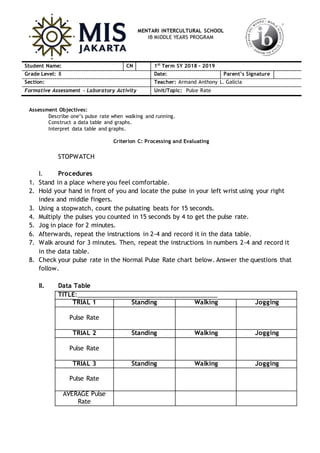
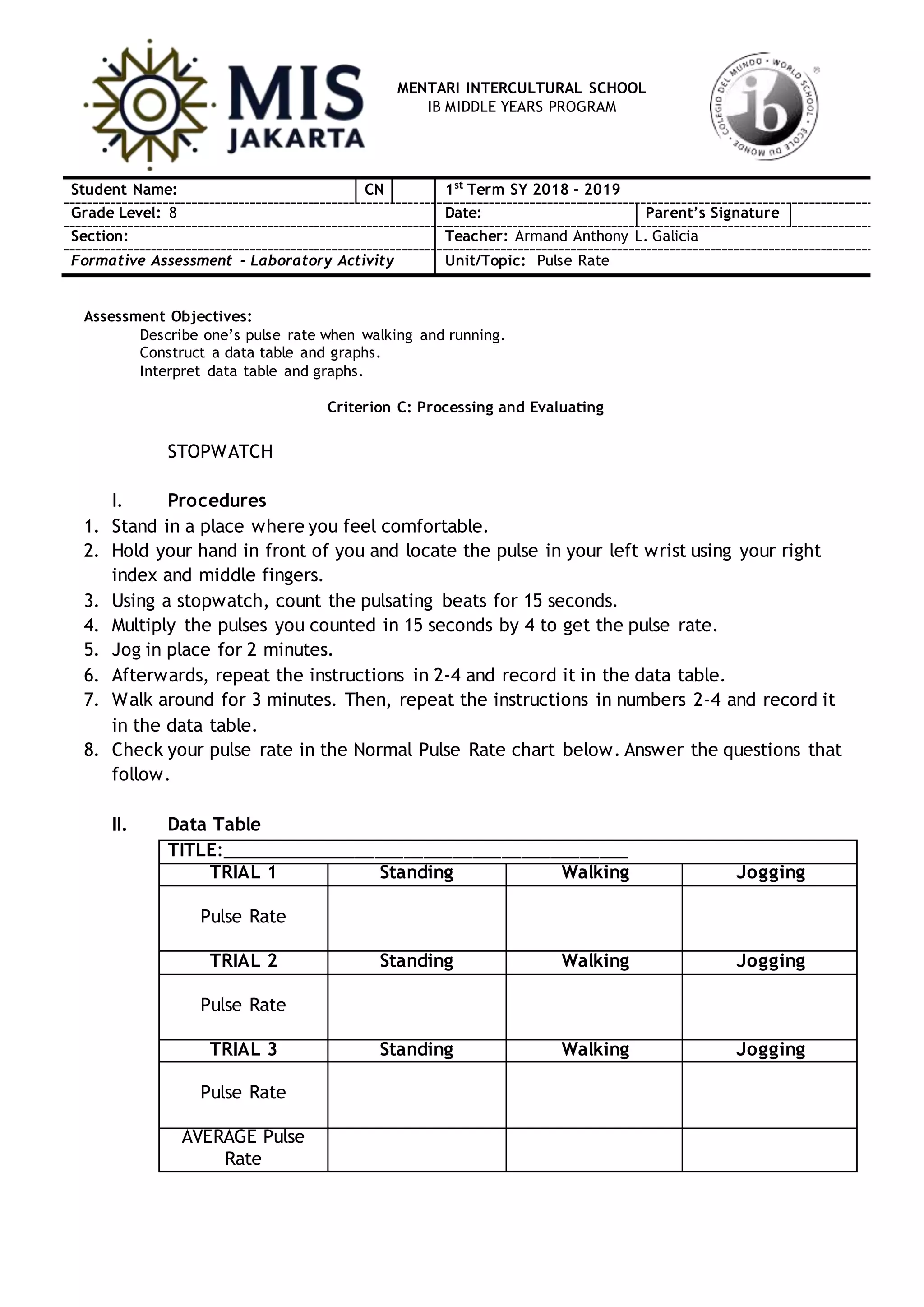
II. Data Table
TITLE:__________________________________________
TRIAL 1 Standing Walking Jogging
Pulse Rate
TRIAL 2 Standing Walking Jogging
Pulse Rate
TRIAL 3 Standing Walking Jogging
Pulse Rate
AVERAGE Pulse
Rate
Student Name: CN 1st
Term SY 2018 - 2019
Grade Level: 8 Date: Parent’s Signature
Section: Teacher: Armand Anthony L. Galicia
Formative Assessment - Laboratory Activity Unit/Topic: Pulse Rate
Normal Pulse Rate Chart
Age Pulse Rate
Babies up to age 1 100-160
Children age 1 to 10 60-140
Children over 10 and adults 60-100
Fit athletes 40-60
Target Heart Rate: You gain the most benefits and lessen the risks when you exercise in
your target heart rate zone. Usually this is when you exercise heart rate (pulse) is 60
percent to 80 percent of your maximum heart rate.
Maximum Heart Rate: The maximum heart rate is the highest pulse rate you can get. To
calculate your predicted maximum heart rate, use the formula: 220 – Your Age = Predicted
Maximum Heart Rate.
III. Graph [Level 5-6]
Construct a graph for your data table.
IV. Guide Questions
1. Do you have a normal heart rate? Why?
___________________________________________________________________________
___________________________________________________________________________
___________________________________________________________________________
___________________________________________________________________________
___________________________________________________________________________
__________________________________________________________________[Level 5-6]
2. If you found out that you have an abnormal pulse rate, what is the best thing that you
must do?
___________________________________________________________________________
__________________________________________________________________[Level 1-2]
3. What is the possible cause of having an abnormal pulse rate? [2 points]
___________________________________________________________________________
___________________________________________________________________________
___________________________________________________________________________
___________________________________________________________________________
__________________________________________________________________[Level 3-4]
4. When does your pulse rate increase and when does it decrease?
___________________________________________________________________________
__________________________________________________________________[Level 1-2]
5. Why is exercise beneficial to you?
___________________________________________________________________________
___________________________________________________________________________
___________________________________________________________________________
___________________________________________________________________________
__________________________________________________________________[Level 3-4]
6. How often do you exercise?
___________________________________________________________________________
__________________________________________________________________[Level 1-2]
7. Aside from exercise, how do you keep your heart healthy?
___________________________________________________________________________
___________________________________________________________________________
___________________________________________________________________________
___________________________________________________________________________
__________________________________________________________________[Level 3-4]
8. While you are doing the exercise, what do you notice in your breathing?
___________________________________________________________________________
__________________________________________________________________[Level 1-2]
9. Why is it hard for you to breathe when you run and do heavy activities?
___________________________________________________________________________
___________________________________________________________________________
___________________________________________________________________________
___________________________________________________________________________
__________________________________________________________________[Level 3-4]
10.Is breathing relevant to the pulse rate? Justify your answer.
___________________________________________________________________________
___________________________________________________________________________
___________________________________________________________________________
___________________________________________________________________________
___________________________________________________________________________
___________________________________________________________________________
__________________________________________________________________[Level 7-8]
REFERENCE:
Rabago, L. M. (2014). Science and Technology 9. Quezon City:VibalPublishingHouse, Inc.
Santos, G. N., Abistado, J. M., Valdoz, M. P., Aquino, M. D., & Bascara, M. A. (2014). RBSScience and Technology Series Science Links 9
Teacher's Resource Manual. Manila:REXBookstore, Inc.
Laboratory activity   pulse rate

Laboratory activity pulse rate

  • 1.
    MENTARI INTERCULTURAL SCHOOL IBMIDDLE YEARS PROGRAM Assessment Objectives: Describe one’s pulse rate when walking and running. Construct a data table and graphs. Interpret data table and graphs. Criterion C: Processing and Evaluating STOPWATCH I. Procedures 1. Stand in a place where you feel comfortable. 2. Hold your hand in front of you and locate the pulse in your left wrist using your right index and middle fingers. 3. Using a stopwatch, count the pulsating beats for 15 seconds. 4. Multiply the pulses you counted in 15 seconds by 4 to get the pulse rate. 5. Jog in place for 2 minutes. 6. Afterwards, repeat the instructions in 2-4 and record it in the data table. 7. Walk around for 3 minutes. Then, repeat the instructions in numbers 2-4 and record it in the data table. 8. Check your pulse rate in the Normal Pulse Rate chart below. Answer the questions that follow. II. Data Table TITLE:__________________________________________ TRIAL 1 Standing Walking Jogging Pulse Rate TRIAL 2 Standing Walking Jogging Pulse Rate TRIAL 3 Standing Walking Jogging Pulse Rate AVERAGE Pulse Rate Student Name: CN 1st Term SY 2018 - 2019 Grade Level: 8 Date: Parent’s Signature Section: Teacher: Armand Anthony L. Galicia Formative Assessment - Laboratory Activity Unit/Topic: Pulse Rate
  • 2.
    Normal Pulse RateChart Age Pulse Rate Babies up to age 1 100-160 Children age 1 to 10 60-140 Children over 10 and adults 60-100 Fit athletes 40-60 Target Heart Rate: You gain the most benefits and lessen the risks when you exercise in your target heart rate zone. Usually this is when you exercise heart rate (pulse) is 60 percent to 80 percent of your maximum heart rate. Maximum Heart Rate: The maximum heart rate is the highest pulse rate you can get. To calculate your predicted maximum heart rate, use the formula: 220 – Your Age = Predicted Maximum Heart Rate. III. Graph [Level 5-6] Construct a graph for your data table. IV. Guide Questions 1. Do you have a normal heart rate? Why? ___________________________________________________________________________ ___________________________________________________________________________ ___________________________________________________________________________ ___________________________________________________________________________ ___________________________________________________________________________ __________________________________________________________________[Level 5-6]
  • 3.
    2. If youfound out that you have an abnormal pulse rate, what is the best thing that you must do? ___________________________________________________________________________ __________________________________________________________________[Level 1-2] 3. What is the possible cause of having an abnormal pulse rate? [2 points] ___________________________________________________________________________ ___________________________________________________________________________ ___________________________________________________________________________ ___________________________________________________________________________ __________________________________________________________________[Level 3-4] 4. When does your pulse rate increase and when does it decrease? ___________________________________________________________________________ __________________________________________________________________[Level 1-2] 5. Why is exercise beneficial to you? ___________________________________________________________________________ ___________________________________________________________________________ ___________________________________________________________________________ ___________________________________________________________________________ __________________________________________________________________[Level 3-4] 6. How often do you exercise? ___________________________________________________________________________ __________________________________________________________________[Level 1-2] 7. Aside from exercise, how do you keep your heart healthy? ___________________________________________________________________________ ___________________________________________________________________________ ___________________________________________________________________________ ___________________________________________________________________________ __________________________________________________________________[Level 3-4] 8. While you are doing the exercise, what do you notice in your breathing? ___________________________________________________________________________ __________________________________________________________________[Level 1-2] 9. Why is it hard for you to breathe when you run and do heavy activities? ___________________________________________________________________________ ___________________________________________________________________________ ___________________________________________________________________________ ___________________________________________________________________________ __________________________________________________________________[Level 3-4] 10.Is breathing relevant to the pulse rate? Justify your answer. ___________________________________________________________________________ ___________________________________________________________________________ ___________________________________________________________________________ ___________________________________________________________________________ ___________________________________________________________________________ ___________________________________________________________________________ __________________________________________________________________[Level 7-8] REFERENCE: Rabago, L. M. (2014). Science and Technology 9. Quezon City:VibalPublishingHouse, Inc. Santos, G. N., Abistado, J. M., Valdoz, M. P., Aquino, M. D., & Bascara, M. A. (2014). RBSScience and Technology Series Science Links 9 Teacher's Resource Manual. Manila:REXBookstore, Inc.