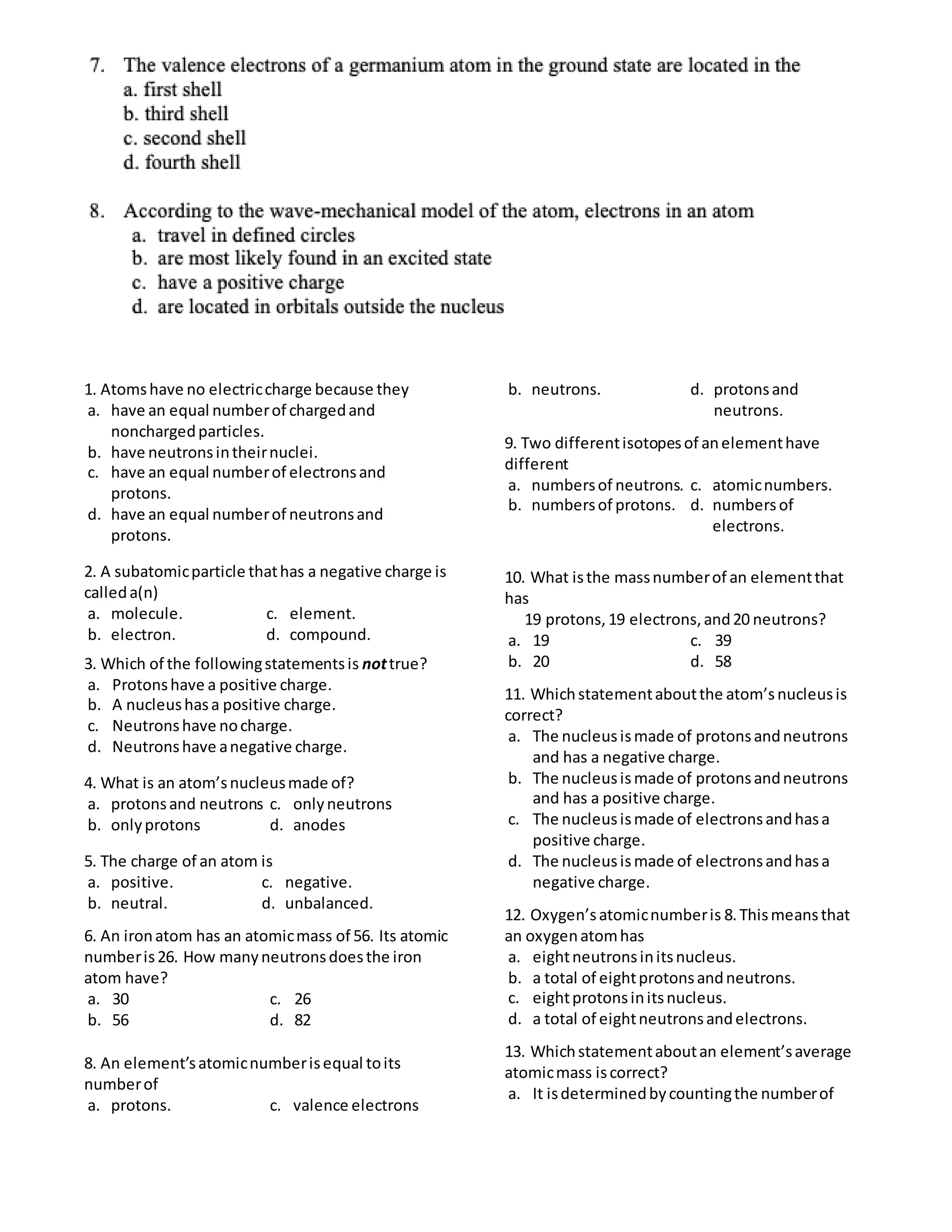
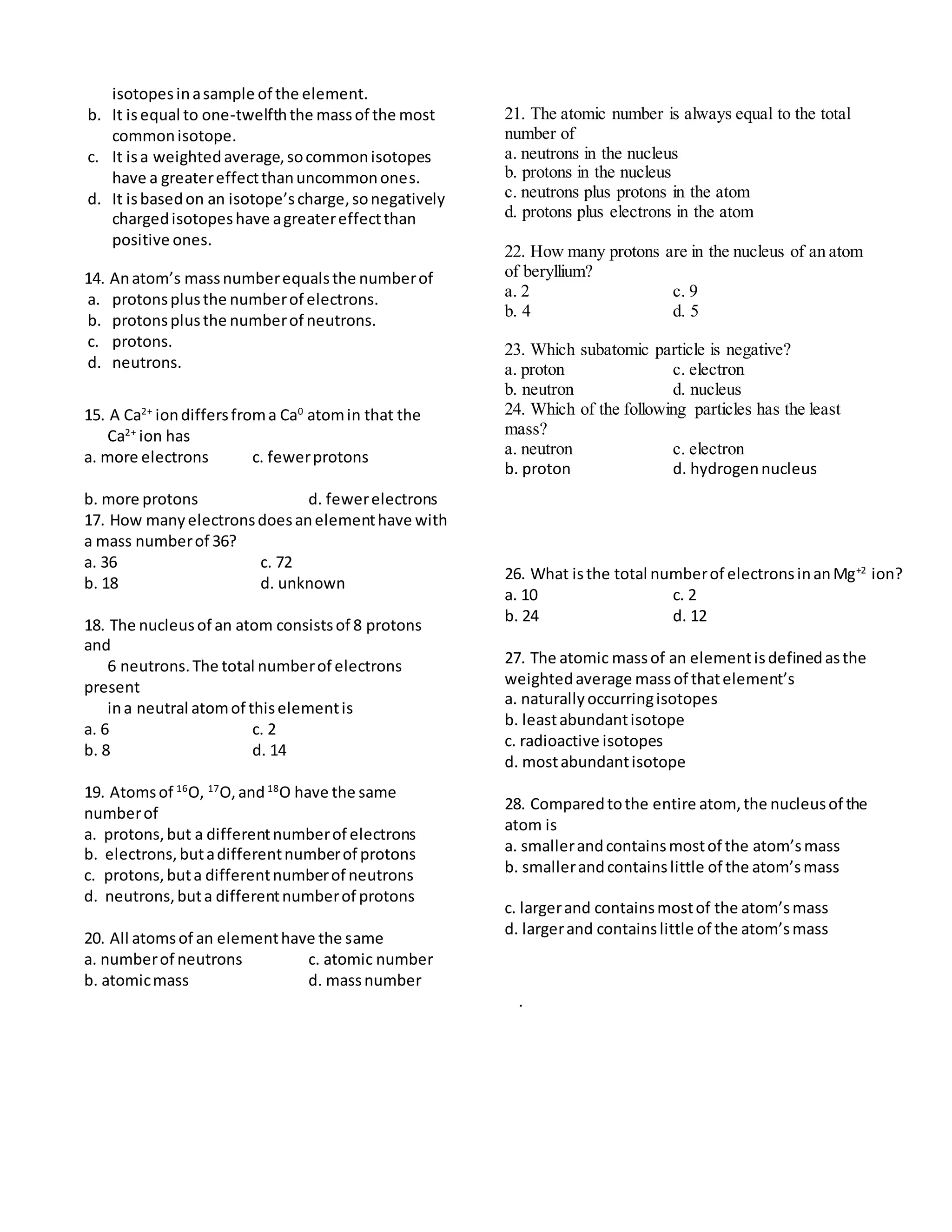
1. Atomshave no electriccharge because they
a. have an equal numberof chargedand
nonchargedparticles.
b. have neutronsintheirnuclei.
c. have an equal numberof electronsand
protons.
d. have an equal numberof neutronsand
protons.
2. A subatomicparticle thathas a negative charge is
calleda(n)
a. molecule. c. element.
b. electron. d. compound.
3. Which of the followingstatementsis nottrue?
a. Protonshave a positive charge.
b. A nucleushasa positive charge.
c. Neutronshave nocharge.
d. Neutronshave anegative charge.
4. What is an atom’snucleusmade of?
a. protonsand neutrons c. onlyneutrons
b. onlyprotons d. anodes
5. The charge of an atom is
a. positive. c. negative.
b. neutral. d. unbalanced.
6. An ironatom has an atomicmass of 56. Its atomic
numberis26. How manyneutronsdoesthe iron
atom have?
a. 30 c. 26
b. 56 d. 82
8. An element’satomicnumberisequal toits
numberof
a. protons. c. valence electrons
b. neutrons. d. protonsand
neutrons.
9. Two differentisotopesof anelementhave
different
a. numbersof neutrons. c. atomicnumbers.
b. numbersof protons. d. numbersof
electrons.
10. What isthe massnumberof an elementthat
has
19 protons,19 electrons,and20 neutrons?
a. 19 c. 39
b. 20 d. 58
11. Whichstatementaboutthe atom’snucleusis
correct?
a. The nucleusismade of protonsandneutrons
and has a negative charge.
b. The nucleusismade of protonsandneutrons
and has a positive charge.
c. The nucleusismade of electronsandhasa
positive charge.
d. The nucleusismade of electronsandhasa
negative charge.
12. Oxygen’satomicnumberis 8.Thismeansthat
an oxygenatomhas
a. eightneutronsinitsnucleus.
b. a total of eightprotonsandneutrons.
c. eightprotonsinitsnucleus.
d. a total of eightneutronsandelectrons.
13. Whichstatementaboutan element’saverage
atomicmass iscorrect?
a. It isdeterminedbycountingthe numberof
isotopesinasample of the element.
b. It isequal to one-twelfththe massof the most
commonisotope.
c. It isa weightedaverage,socommonisotopes
have a greatereffectthanuncommonones.
d. It isbasedon an isotope’scharge,sonegatively
chargedisotopeshave agreatereffectthan
positive ones.
14. Anatom’s massnumberequalsthe numberof
a. protonsplusthe numberof electrons.
b. protonsplusthe numberof neutrons.
c. protons.
d. neutrons.
15. A Ca2+
iondiffersfroma Ca0
atomin that the
Ca2+
ion has
a. more electrons c. fewerprotons
b. more protons d. fewerelectrons
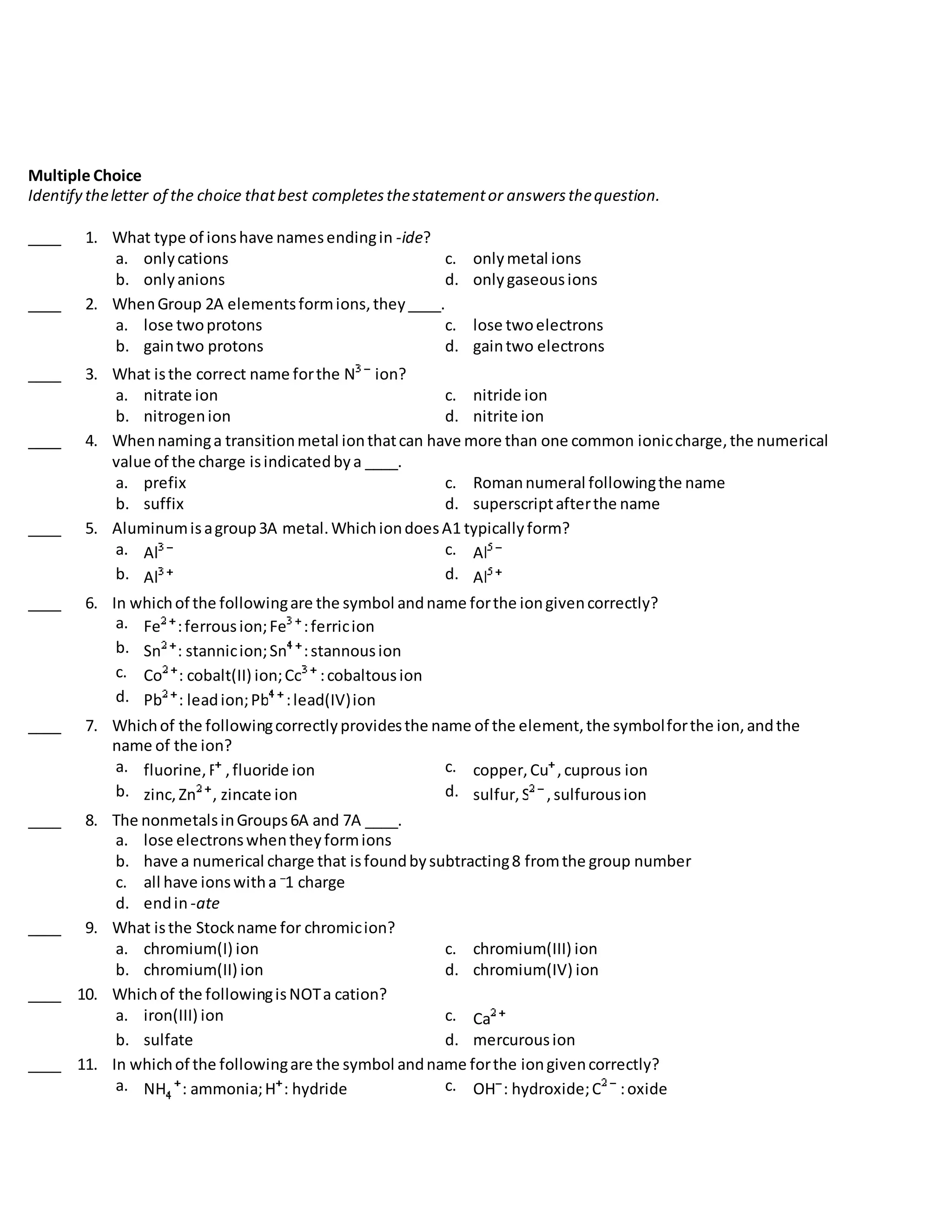
17. How manyelectronsdoesanelementhave with
a mass numberof 36?
a. 36 c. 72
b. 18 d. unknown
18. The nucleusof an atom consistsof 8 protons
and
6 neutrons.The total numberof electrons
present
ina neutral atomof thiselementis
a. 6 c. 2
b. 8 d. 14
19. Atomsof 16
O, 17
O,and18
O have the same
numberof
a. protons,but a differentnumberof electrons
b. electrons,butadifferentnumberof protons
c. protons,buta differentnumberof neutrons
d. neutrons,buta differentnumberof protons
20. All atomsof an elementhave the same
a. numberof neutrons c. atomic number
b. atomicmass d. massnumber
21. The atomic number is always equal to the total
number of
a. neutrons in the nucleus
b. protons in the nucleus
c. neutrons plus protons in the atom
d. protons plus electrons in the atom
22. How many protons are in the nucleus of an atom
of beryllium?
a. 2 c. 9
b. 4 d. 5
23. Which subatomic particle is negative?
a. proton c. electron
b. neutron d. nucleus
24. Which of the following particles has the least
mass?
a. neutron c. electron
b. proton d. hydrogennucleus
26. What isthe total numberof electronsinanMg+2
ion?
a. 10 c. 2
b. 24 d. 12
27. The atomic massof an elementisdefinedasthe
weightedaverage massof thatelement’s
a. naturallyoccurringisotopes
b. leastabundantisotope
c. radioactive isotopes
d. mostabundantisotope
28. Comparedtothe entire atom, the nucleusof the
atom is
a. smallerandcontainsmostof the atom’smass
b. smallerandcontainslittle of the atom’smass
c. largerand containsmostof the atom’smass
d. largerand containslittle of the atom’smass
.
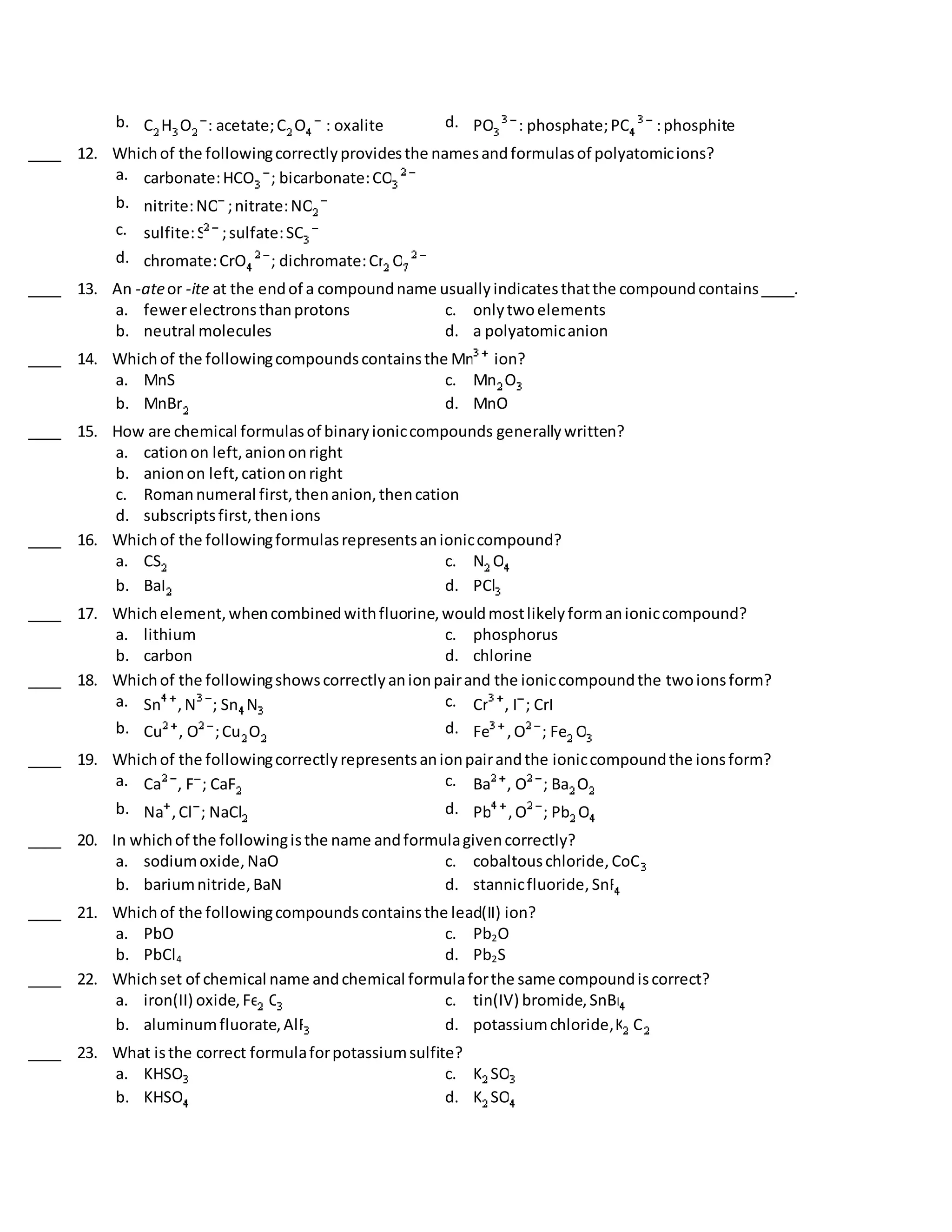
Multiple Choice
Identify theletter of the choice thatbest completesthestatementor answersthequestion.
____ 1. What type of ionshave namesendingin -ide?
a. onlycations c. onlymetal ions
b. onlyanions d. onlygaseousions
____ 2. WhenGroup 2A elementsformions,they____.
a. lose twoprotons c. lose twoelectrons
b. gaintwo protons d. gaintwo electrons
____ 3. What isthe correct name forthe N ion?
a. nitrate ion c. nitride ion
b. nitrogenion d. nitrite ion
____ 4. Whennaminga transitionmetal ionthatcan have more than one common ioniccharge,the numerical
value of the charge isindicatedbya ____.
a. prefix c. Romannumeral followingthe name
b. suffix d. superscriptafterthe name
____ 5. Aluminumisagroup3A metal.WhichiondoesA1 typicallyform?
a. Al c. Al
b. Al d. Al
____ 6. In whichof the followingare the symbol andname forthe iongivencorrectly?
a. Fe :ferrousion;Fe :ferricion
b. Sn : stannicion;Sn :stannousion
c. Co : cobalt(II) ion;Co :cobaltousion
d. Pb : leadion;Pb :lead(IV)ion
____ 7. Whichof the followingcorrectlyprovidesthe name of the element,the symbolforthe ion,andthe
name of the ion?
a. fluorine,F ,fluoride ion c. copper,Cu ,cuprous ion
b. zinc,Zn , zincate ion d. sulfur,S ,sulfurousion
____ 8. The nonmetalsinGroups6A and 7A ____.
a. lose electronswhentheyformions
b. have a numerical charge that isfoundbysubtracting8 fromthe group number
c. all have ionswitha –
1 charge
d. endin -ate
____ 9. What isthe Stockname for chromicion?
a. chromium(I) ion c. chromium(III) ion
b. chromium(II) ion d. chromium(IV) ion
____ 10. Whichof the followingisNOTa cation?
a. iron(III) ion c. Ca
b. sulfate d. mercurousion
____ 11. In whichof the followingare the symbol andname forthe iongivencorrectly?
a. NH : ammonia;H : hydride c. OH : hydroxide;O :oxide
b. C H O : acetate;C O : oxalite d. PO : phosphate;PO :phosphite
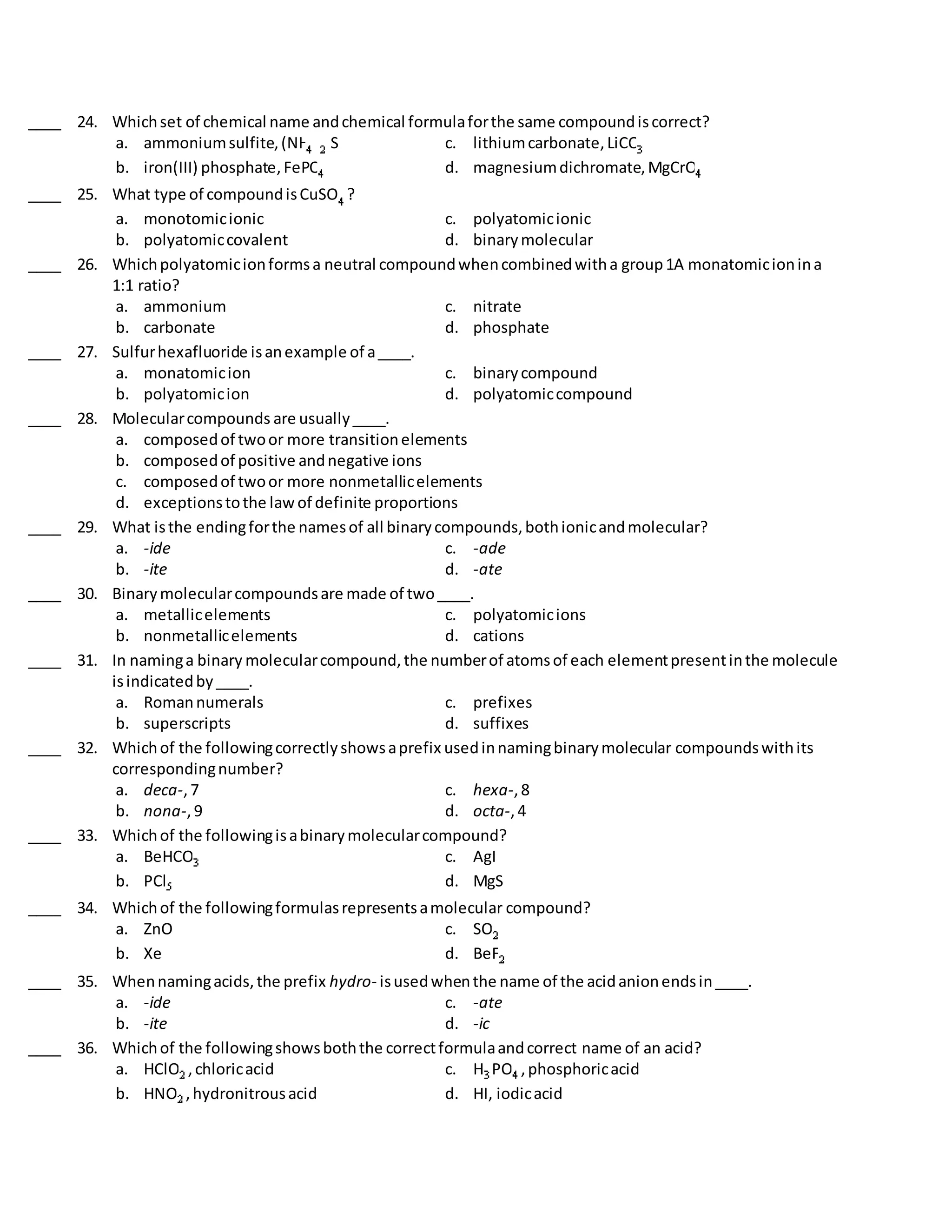
____ 12. Whichof the followingcorrectlyprovidesthe namesandformulasof polyatomicions?
a. carbonate:HCO ; bicarbonate:CO
b. nitrite:NO ;nitrate:NO
c. sulfite:S ;sulfate:SO
d. chromate:CrO ; dichromate:Cr O
____ 13. An -ateor -ite at the endof a compoundname usuallyindicatesthatthe compoundcontains____.
a. fewerelectronsthanprotons c. onlytwoelements
b. neutral molecules d. a polyatomicanion
____ 14. Whichof the followingcompoundscontainsthe Mn ion?
a. MnS c. Mn O
b. MnBr d. MnO
____ 15. How are chemical formulasof binaryioniccompounds generallywritten?
a. cationon left,aniononright
b. anionon left,cationonright
c. Romannumeral first,thenanion,thencation
d. subscriptsfirst,thenions
____ 16. Whichof the followingformulasrepresentsanioniccompound?
a. CS c. N O
b. BaI d. PCl
____ 17. Whichelement,whencombinedwithfluorine,wouldmostlikelyformanioniccompound?
a. lithium c. phosphorus
b. carbon d. chlorine
____ 18. Whichof the followingshowscorrectlyanionpairand the ioniccompoundthe twoionsform?
a. Sn ,N ; Sn N c. Cr , I ; CrI
b. Cu , O ;Cu O d. Fe ,O ; Fe O
____ 19. Whichof the followingcorrectlyrepresentsanionpairandthe ioniccompoundthe ionsform?
a. Ca , F ; CaF c. Ba , O ; Ba O
b. Na ,Cl ; NaCl d. Pb ,O ; Pb O
____ 20. In whichof the followingisthe name andformulagivencorrectly?
a. sodiumoxide,NaO c. cobaltouschloride,CoCl
b. bariumnitride,BaN d. stannicfluoride,SnF
____ 21. Whichof the followingcompoundscontainsthe lead(II) ion?
a. PbO c. Pb2O
b. PbCl4 d. Pb2S
____ 22. Whichset of chemical name andchemical formulaforthe same compoundiscorrect?
a. iron(II) oxide,Fe O c. tin(IV) bromide,SnBr
b. aluminumfluorate,AlF d. potassiumchloride,K Cl
____ 23. What isthe correct formulaforpotassiumsulfite?
a. KHSO c. K SO
b. KHSO d. K SO
____ 24. Whichset of chemical name andchemical formulaforthe same compoundiscorrect?
a. ammoniumsulfite,(NH ) S c. lithiumcarbonate,LiCO
b. iron(III) phosphate,FePO d. magnesiumdichromate,MgCrO
____ 25. What type of compoundisCuSO ?
a. monotomicionic c. polyatomicionic
b. polyatomiccovalent d. binarymolecular
____ 26. Whichpolyatomicionformsa neutral compoundwhencombinedwitha group1A monatomicionina
1:1 ratio?
a. ammonium c. nitrate
b. carbonate d. phosphate
____ 27. Sulfurhexafluoride isanexample of a____.
a. monatomicion c. binarycompound
b. polyatomicion d. polyatomiccompound
____ 28. Molecularcompounds are usually____.
a. composedof twoor more transitionelements
b. composedof positive andnegative ions
c. composedof twoor more nonmetallicelements
d. exceptionstothe lawof definite proportions
____ 29. What isthe endingforthe namesof all binarycompounds,bothionicandmolecular?
a. -ide c. -ade
b. -ite d. -ate
____ 30. Binarymolecularcompoundsare made of two____.
a. metallicelements c. polyatomicions
b. nonmetallicelements d. cations
____ 31. In naminga binary molecularcompound,the numberof atomsof each elementpresentinthe molecule
isindicatedby____.
a. Romannumerals c. prefixes
b. superscripts d. suffixes
____ 32. Whichof the followingcorrectlyshowsaprefix usedinnamingbinarymolecular compoundswithits
correspondingnumber?
a. deca-,7 c. hexa-,8
b. nona-,9 d. octa-,4
____ 33. Whichof the followingisabinarymolecularcompound?
a. BeHCO c. AgI
b. PCl d. MgS
____ 34. Whichof the followingformulasrepresentsamolecular compound?
a. ZnO c. SO
b. Xe d. BeF
____ 35. Whennamingacids,the prefix hydro- isusedwhenthe name of the acidanionendsin____.
a. -ide c. -ate
b. -ite d. -ic
____ 36. Whichof the followingshowsboththe correctformulaandcorrect name of an acid?
a. HClO ,chloricacid c. H PO ,phosphoricacid
b. HNO ,hydronitrousacid d. HI, iodicacid
____ 37. What isthe name of H SO ?
a. hyposulfuricacid c. sulfuricacid
b. hydrosulfuricacid d. sulfurousacid
____ 38. Whenthe name of an anionthat ispart of an acidendsin -ite,the acidname includesthe suffix____.
a. -ous c. -ate
b. -ic d. -ite
____ 39. What isthe formulaforsulfurousacid?
a. H SO c. H SO
b. H SO d. H S
____ 40. What isthe formulaforphosphoricacid?
a. H PO c. HPO
b. H PO d. HPO
____ 41. What isthe formulaforhydrosulfuricacid?
a. H S c. HSO
b. H SO d. H S
____ 42. Selectthe correctformulaforsulfurhexafluoride.
a. S F c. F S
b. F SO d. SF
____ 43. What isthe correct name forthe compoundCoCl ?
a. cobalt(I) chlorate c. cobalt(II) chlorate
b. cobalt(I) chloride d. cobalt(II) chloride
____ 44. What isthe correct formulaforbariumchlorate?
a. Ba(ClO) c. Ba(ClO )
b. Ba(ClO ) d. BaCl
____ 45. What isthe correct formulaforcalciumdihydrogenphosphate?
a. CaH PO c. Ca(H PO )
b. Ca H PO d. Ca(H HPO )
____ 46. What doesan -ite or -ateendingina polyatomicionmean?
a. Oxygenisinthe formula. c. Nitrogenisinthe formula.
b. Sulfurisinthe formula. d. Bromine isinthe formula.
____ 47. Whichof the followingisthe correctname for N O ?
a. nitrousoxide c. nitrogendioxide
b. dinitrogenpentoxide d. nitrate oxide
____ 48. What isthe correct name forSn (PO ) ?
a. tritindiphosphate c. tin(III) phosphate
b. tin(II) phosphate d. tin(IV) phosphate
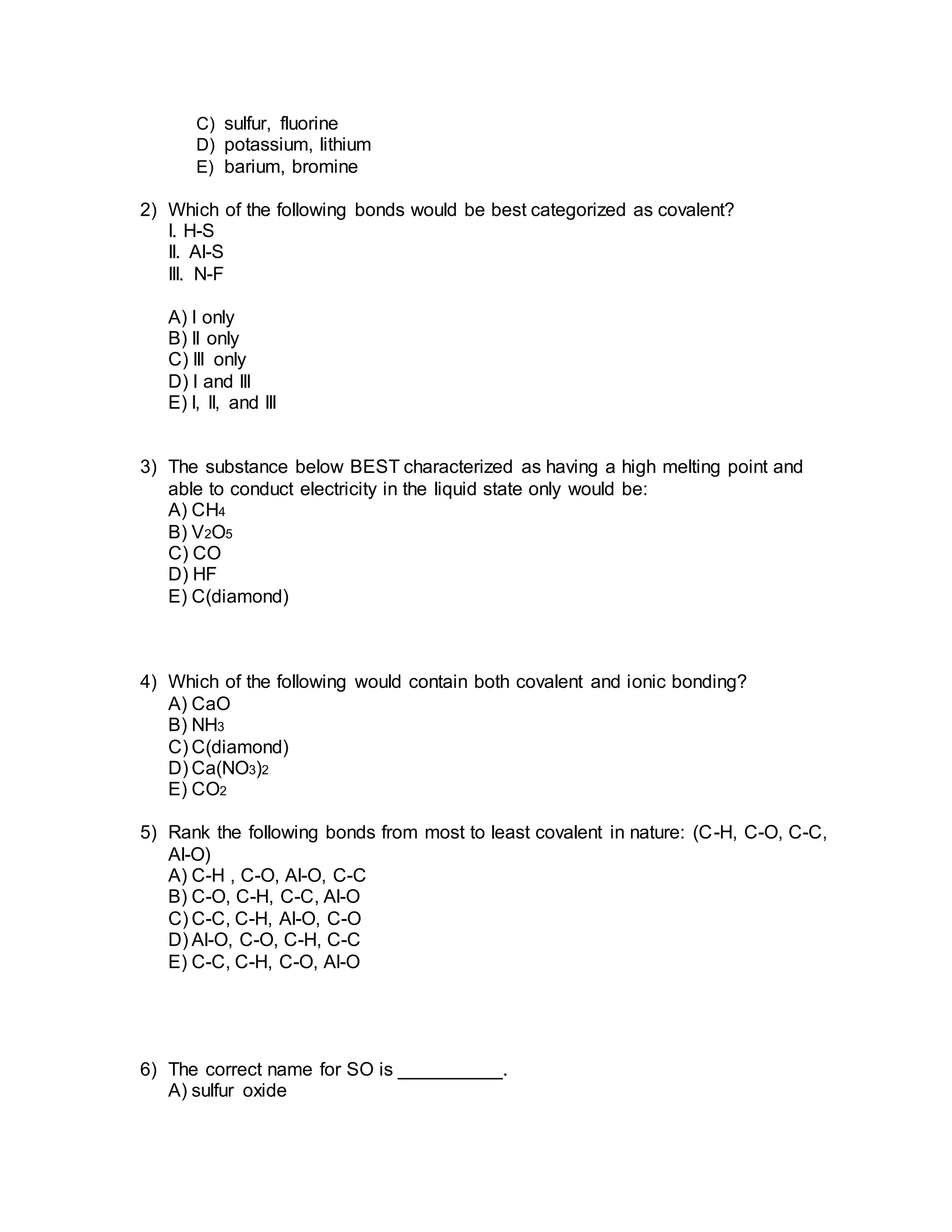
1) Which pair of elements is most apt to form a molecular compound with each
other?
A) aluminum, oxygen
B) magnesium, iodine
C) sulfur, fluorine
D) potassium, lithium
E) barium, bromine
2) Which of the following bonds would be best categorized as covalent?
I. H-S
II. Al-S
III. N-F
A) I only
B) II only
C) III only
D) I and III
E) I, II, and III
3) The substance below BEST characterized as having a high melting point and
able to conduct electricity in the liquid state only would be:
A) CH4
B) V2O5
C) CO
D) HF
E) C(diamond)
4) Which of the following would contain both covalent and ionic bonding?
A) CaO
B) NH3
C) C(diamond)
D) Ca(NO3)2
E) CO2
5) Rank the following bonds from most to least covalent in nature: (C-H, C-O, C-C,
Al-O)
A) C-H , C-O, Al-O, C-C
B) C-O, C-H, C-C, Al-O
C) C-C, C-H, Al-O, C-O
D) Al-O, C-O, C-H, C-C
E) C-C, C-H, C-O, Al-O
6) The correct name for SO is __________.
A) sulfur oxide
B) sulfur monoxide
C) sulfoxide
D) sulfate
E) sulfite
7) The correct name for CCl4 is __________.
A) carbon chloride
B) carbon tetrachlorate
C) carbon perchlorate
D) carbon tetrachloride
E) carbon chlorate
8) The correct name for N2O5 is __________.
A) nitrous oxide
B) nitrogen pentoxide
C) dinitrogen pentoxide
D) nitric oxide
E) nitrogen oxide
9) The name of PCl3 is __________.
A) potassium chloride
B) phosphorus trichloride
C) phosphorous(III) chloride
D) monophosphorous trichloride
E) trichloro potassium
10)The name of the binary compound N2O4 is __________.
A) nitrogen oxide
B) nitrous oxide
C) nitrogen(IV) oxide
D) dinitrogen tetroxide
E) oxygen nitride
11)Which of the following would be nitrogen monoxide?
A) NO
B) NO2
C) N2O
D) N2O3
E) N3O2
12)Which of the following is named INCORRECTLY?
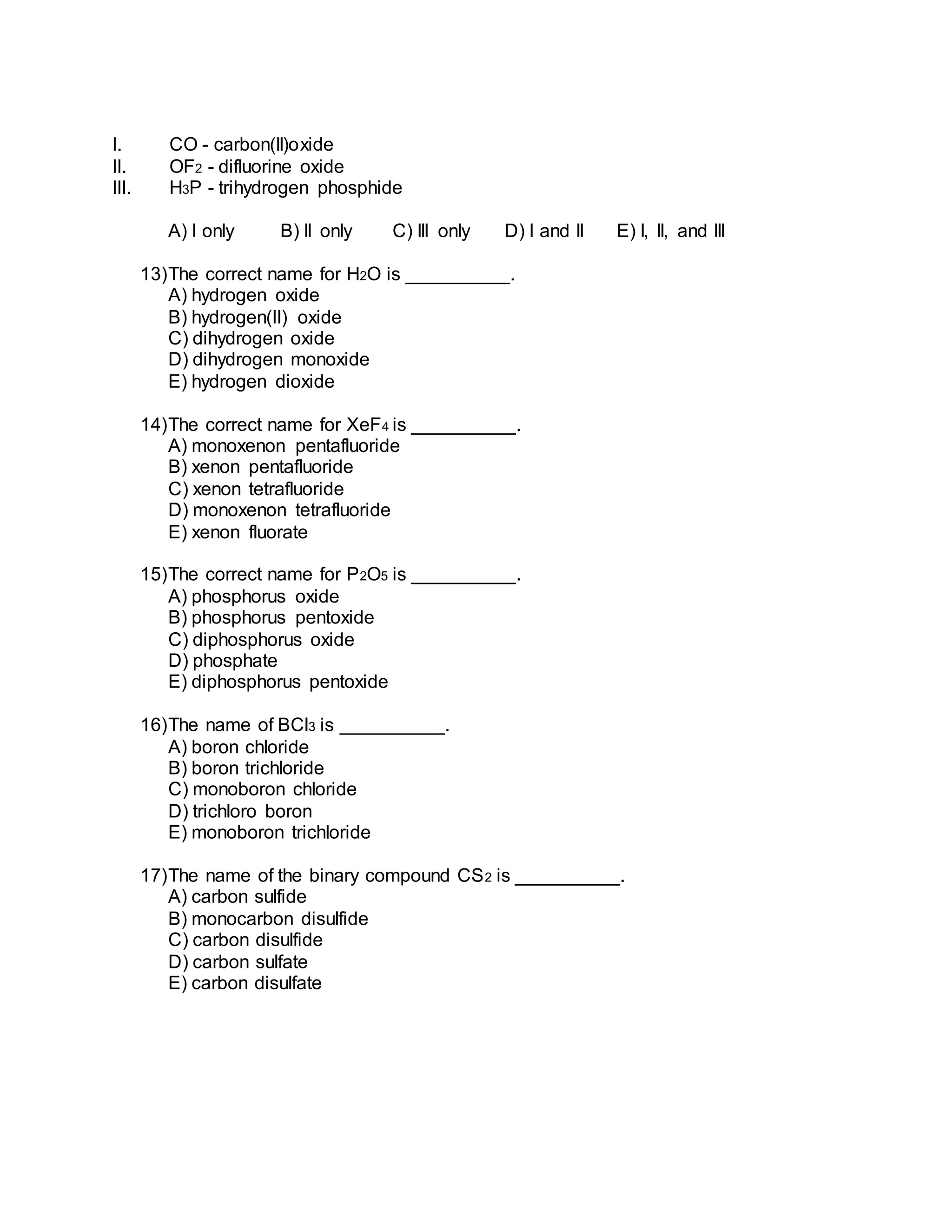
I. CO - carbon(II)oxide
II. OF2 - difluorine oxide
III. H3P - trihydrogen phosphide
A) I only B) II only C) III only D) I and II E) I, II, and III
13)The correct name for H2O is __________.
A) hydrogen oxide
B) hydrogen(II) oxide
C) dihydrogen oxide
D) dihydrogen monoxide
E) hydrogen dioxide
14)The correct name for XeF4 is __________.
A) monoxenon pentafluoride
B) xenon pentafluoride
C) xenon tetrafluoride
D) monoxenon tetrafluoride
E) xenon fluorate
15)The correct name for P2O5 is __________.
A) phosphorus oxide
B) phosphorus pentoxide
C) diphosphorus oxide
D) phosphate
E) diphosphorus pentoxide
16)The name of BCl3 is __________.
A) boron chloride
B) boron trichloride
C) monoboron chloride
D) trichloro boron
E) monoboron trichloride
17)The name of the binary compound CS2 is __________.
A) carbon sulfide
B) monocarbon disulfide
C) carbon disulfide
D) carbon sulfate
E) carbon disulfate
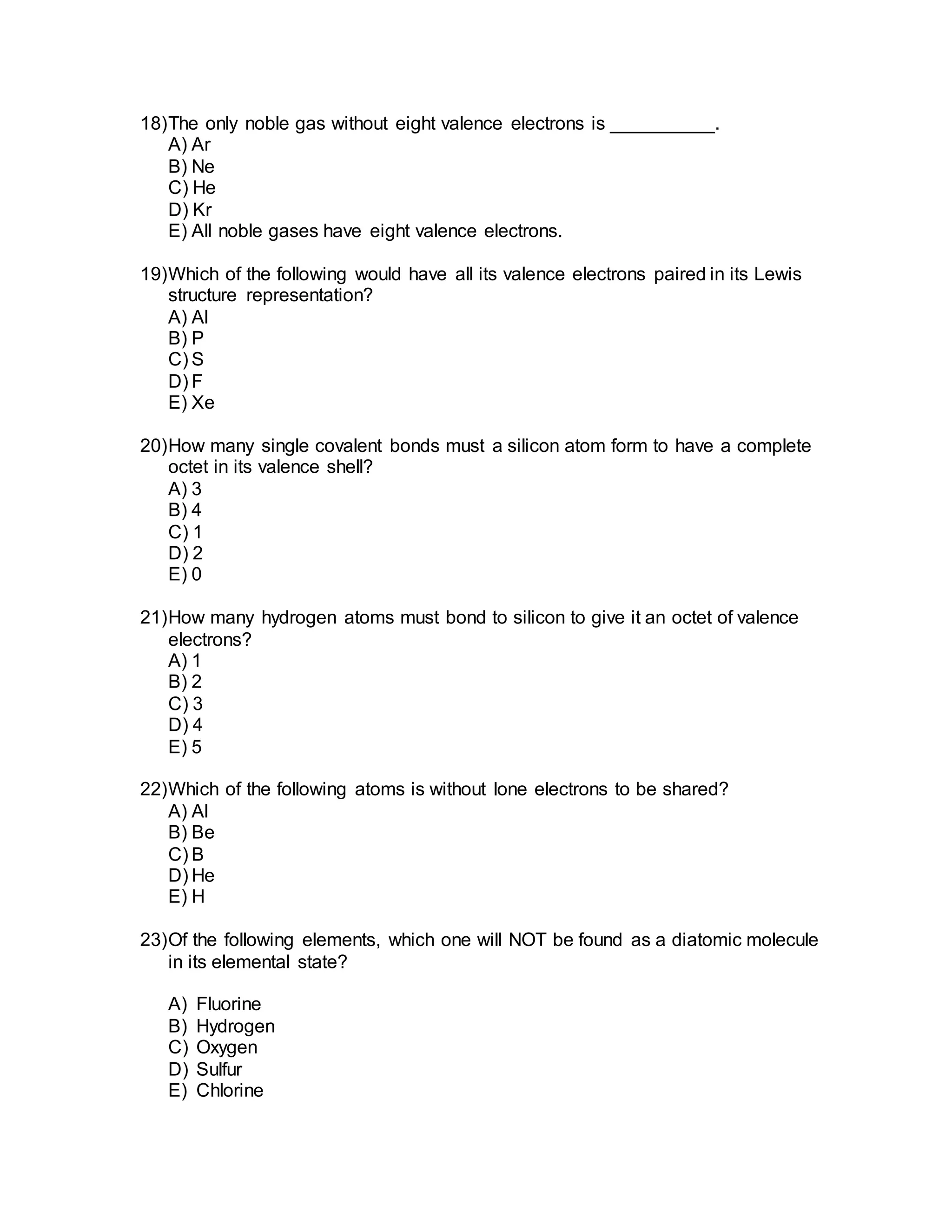
18)The only noble gas without eight valence electrons is __________.
A) Ar
B) Ne
C) He
D) Kr
E) All noble gases have eight valence electrons.
19)Which of the following would have all its valence electrons paired in its Lewis
structure representation?
A) Al
B) P
C) S
D) F
E) Xe
20)How many single covalent bonds must a silicon atom form to have a complete
octet in its valence shell?
A) 3
B) 4
C) 1
D) 2
E) 0
21)How many hydrogen atoms must bond to silicon to give it an octet of valence
electrons?
A) 1
B) 2
C) 3
D) 4
E) 5
22)Which of the following atoms is without lone electrons to be shared?
A) Al
B) Be
C) B
D) He
E) H
23)Of the following elements, which one will NOT be found as a diatomic molecule
in its elemental state?
A) Fluorine
B) Hydrogen
C) Oxygen
D) Sulfur
E) Chlorine
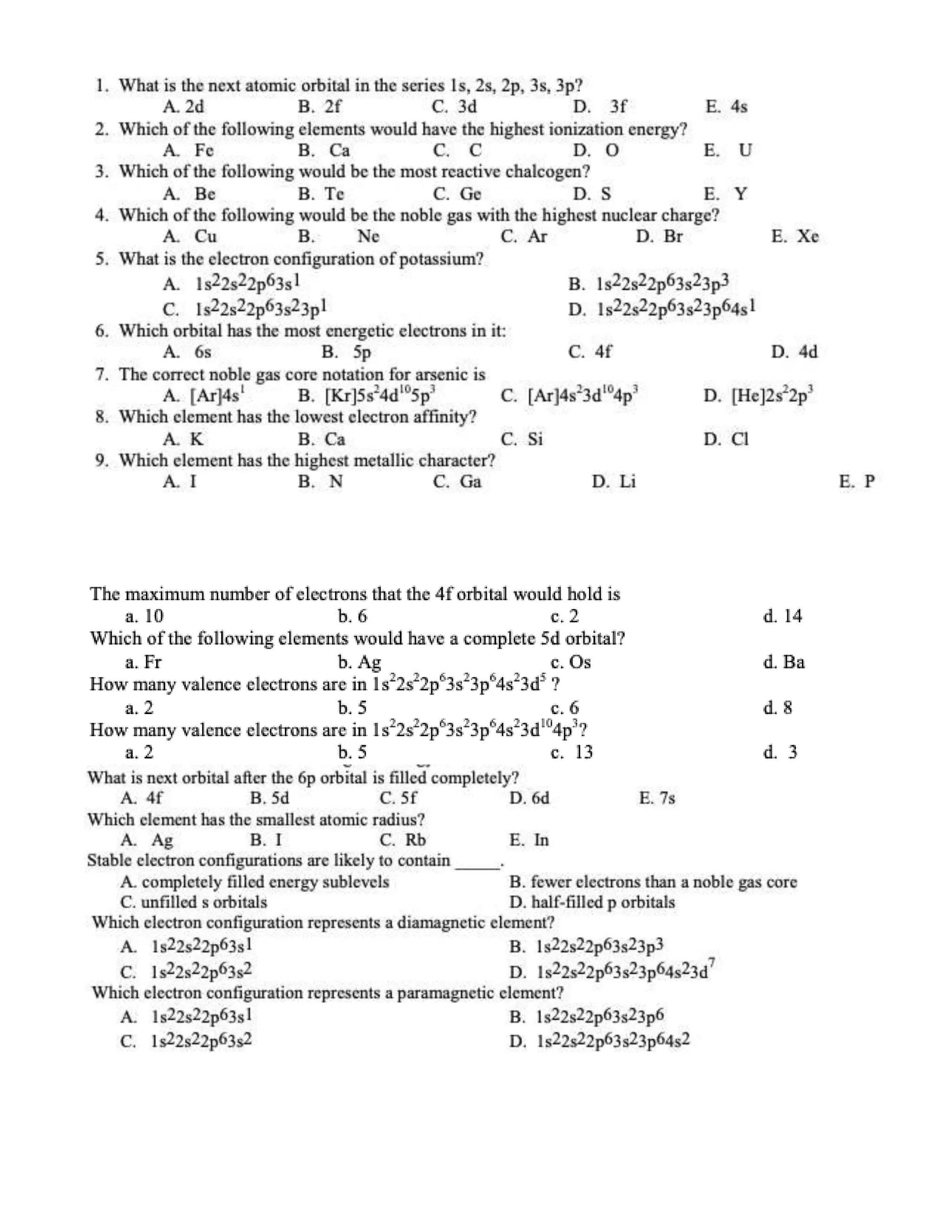
Drills   periodi trends, periodic table of elements, sub atomic particles

Drills periodi trends, periodic table of elements, sub atomic particles

  • 20.
    1. Atomshave noelectriccharge because they a. have an equal numberof chargedand nonchargedparticles. b. have neutronsintheirnuclei. c. have an equal numberof electronsand protons. d. have an equal numberof neutronsand protons. 2. A subatomicparticle thathas a negative charge is calleda(n) a. molecule. c. element. b. electron. d. compound. 3. Which of the followingstatementsis nottrue? a. Protonshave a positive charge. b. A nucleushasa positive charge. c. Neutronshave nocharge. d. Neutronshave anegative charge. 4. What is an atom’snucleusmade of? a. protonsand neutrons c. onlyneutrons b. onlyprotons d. anodes 5. The charge of an atom is a. positive. c. negative. b. neutral. d. unbalanced. 6. An ironatom has an atomicmass of 56. Its atomic numberis26. How manyneutronsdoesthe iron atom have? a. 30 c. 26 b. 56 d. 82 8. An element’satomicnumberisequal toits numberof a. protons. c. valence electrons b. neutrons. d. protonsand neutrons. 9. Two differentisotopesof anelementhave different a. numbersof neutrons. c. atomicnumbers. b. numbersof protons. d. numbersof electrons. 10. What isthe massnumberof an elementthat has 19 protons,19 electrons,and20 neutrons? a. 19 c. 39 b. 20 d. 58 11. Whichstatementaboutthe atom’snucleusis correct? a. The nucleusismade of protonsandneutrons and has a negative charge. b. The nucleusismade of protonsandneutrons and has a positive charge. c. The nucleusismade of electronsandhasa positive charge. d. The nucleusismade of electronsandhasa negative charge. 12. Oxygen’satomicnumberis 8.Thismeansthat an oxygenatomhas a. eightneutronsinitsnucleus. b. a total of eightprotonsandneutrons. c. eightprotonsinitsnucleus. d. a total of eightneutronsandelectrons. 13. Whichstatementaboutan element’saverage atomicmass iscorrect? a. It isdeterminedbycountingthe numberof
  • 21.
    isotopesinasample of theelement. b. It isequal to one-twelfththe massof the most commonisotope. c. It isa weightedaverage,socommonisotopes have a greatereffectthanuncommonones. d. It isbasedon an isotope’scharge,sonegatively chargedisotopeshave agreatereffectthan positive ones. 14. Anatom’s massnumberequalsthe numberof a. protonsplusthe numberof electrons. b. protonsplusthe numberof neutrons. c. protons. d. neutrons. 15. A Ca2+ iondiffersfroma Ca0 atomin that the Ca2+ ion has a. more electrons c. fewerprotons b. more protons d. fewerelectrons 17. How manyelectronsdoesanelementhave with a mass numberof 36? a. 36 c. 72 b. 18 d. unknown 18. The nucleusof an atom consistsof 8 protons and 6 neutrons.The total numberof electrons present ina neutral atomof thiselementis a. 6 c. 2 b. 8 d. 14 19. Atomsof 16 O, 17 O,and18 O have the same numberof a. protons,but a differentnumberof electrons b. electrons,butadifferentnumberof protons c. protons,buta differentnumberof neutrons d. neutrons,buta differentnumberof protons 20. All atomsof an elementhave the same a. numberof neutrons c. atomic number b. atomicmass d. massnumber 21. The atomic number is always equal to the total number of a. neutrons in the nucleus b. protons in the nucleus c. neutrons plus protons in the atom d. protons plus electrons in the atom 22. How many protons are in the nucleus of an atom of beryllium? a. 2 c. 9 b. 4 d. 5 23. Which subatomic particle is negative? a. proton c. electron b. neutron d. nucleus 24. Which of the following particles has the least mass? a. neutron c. electron b. proton d. hydrogennucleus 26. What isthe total numberof electronsinanMg+2 ion? a. 10 c. 2 b. 24 d. 12 27. The atomic massof an elementisdefinedasthe weightedaverage massof thatelement’s a. naturallyoccurringisotopes b. leastabundantisotope c. radioactive isotopes d. mostabundantisotope 28. Comparedtothe entire atom, the nucleusof the atom is a. smallerandcontainsmostof the atom’smass b. smallerandcontainslittle of the atom’smass c. largerand containsmostof the atom’smass d. largerand containslittle of the atom’smass .
  • 22.
    Multiple Choice Identify theletterof the choice thatbest completesthestatementor answersthequestion. ____ 1. What type of ionshave namesendingin -ide? a. onlycations c. onlymetal ions b. onlyanions d. onlygaseousions ____ 2. WhenGroup 2A elementsformions,they____. a. lose twoprotons c. lose twoelectrons b. gaintwo protons d. gaintwo electrons ____ 3. What isthe correct name forthe N ion? a. nitrate ion c. nitride ion b. nitrogenion d. nitrite ion ____ 4. Whennaminga transitionmetal ionthatcan have more than one common ioniccharge,the numerical value of the charge isindicatedbya ____. a. prefix c. Romannumeral followingthe name b. suffix d. superscriptafterthe name ____ 5. Aluminumisagroup3A metal.WhichiondoesA1 typicallyform? a. Al c. Al b. Al d. Al ____ 6. In whichof the followingare the symbol andname forthe iongivencorrectly? a. Fe :ferrousion;Fe :ferricion b. Sn : stannicion;Sn :stannousion c. Co : cobalt(II) ion;Co :cobaltousion d. Pb : leadion;Pb :lead(IV)ion ____ 7. Whichof the followingcorrectlyprovidesthe name of the element,the symbolforthe ion,andthe name of the ion? a. fluorine,F ,fluoride ion c. copper,Cu ,cuprous ion b. zinc,Zn , zincate ion d. sulfur,S ,sulfurousion ____ 8. The nonmetalsinGroups6A and 7A ____. a. lose electronswhentheyformions b. have a numerical charge that isfoundbysubtracting8 fromthe group number c. all have ionswitha – 1 charge d. endin -ate ____ 9. What isthe Stockname for chromicion? a. chromium(I) ion c. chromium(III) ion b. chromium(II) ion d. chromium(IV) ion ____ 10. Whichof the followingisNOTa cation? a. iron(III) ion c. Ca b. sulfate d. mercurousion ____ 11. In whichof the followingare the symbol andname forthe iongivencorrectly? a. NH : ammonia;H : hydride c. OH : hydroxide;O :oxide
  • 23.
    b. C HO : acetate;C O : oxalite d. PO : phosphate;PO :phosphite ____ 12. Whichof the followingcorrectlyprovidesthe namesandformulasof polyatomicions? a. carbonate:HCO ; bicarbonate:CO b. nitrite:NO ;nitrate:NO c. sulfite:S ;sulfate:SO d. chromate:CrO ; dichromate:Cr O ____ 13. An -ateor -ite at the endof a compoundname usuallyindicatesthatthe compoundcontains____. a. fewerelectronsthanprotons c. onlytwoelements b. neutral molecules d. a polyatomicanion ____ 14. Whichof the followingcompoundscontainsthe Mn ion? a. MnS c. Mn O b. MnBr d. MnO ____ 15. How are chemical formulasof binaryioniccompounds generallywritten? a. cationon left,aniononright b. anionon left,cationonright c. Romannumeral first,thenanion,thencation d. subscriptsfirst,thenions ____ 16. Whichof the followingformulasrepresentsanioniccompound? a. CS c. N O b. BaI d. PCl ____ 17. Whichelement,whencombinedwithfluorine,wouldmostlikelyformanioniccompound? a. lithium c. phosphorus b. carbon d. chlorine ____ 18. Whichof the followingshowscorrectlyanionpairand the ioniccompoundthe twoionsform? a. Sn ,N ; Sn N c. Cr , I ; CrI b. Cu , O ;Cu O d. Fe ,O ; Fe O ____ 19. Whichof the followingcorrectlyrepresentsanionpairandthe ioniccompoundthe ionsform? a. Ca , F ; CaF c. Ba , O ; Ba O b. Na ,Cl ; NaCl d. Pb ,O ; Pb O ____ 20. In whichof the followingisthe name andformulagivencorrectly? a. sodiumoxide,NaO c. cobaltouschloride,CoCl b. bariumnitride,BaN d. stannicfluoride,SnF ____ 21. Whichof the followingcompoundscontainsthe lead(II) ion? a. PbO c. Pb2O b. PbCl4 d. Pb2S ____ 22. Whichset of chemical name andchemical formulaforthe same compoundiscorrect? a. iron(II) oxide,Fe O c. tin(IV) bromide,SnBr b. aluminumfluorate,AlF d. potassiumchloride,K Cl ____ 23. What isthe correct formulaforpotassiumsulfite? a. KHSO c. K SO b. KHSO d. K SO
  • 24.
    ____ 24. Whichsetof chemical name andchemical formulaforthe same compoundiscorrect? a. ammoniumsulfite,(NH ) S c. lithiumcarbonate,LiCO b. iron(III) phosphate,FePO d. magnesiumdichromate,MgCrO ____ 25. What type of compoundisCuSO ? a. monotomicionic c. polyatomicionic b. polyatomiccovalent d. binarymolecular ____ 26. Whichpolyatomicionformsa neutral compoundwhencombinedwitha group1A monatomicionina 1:1 ratio? a. ammonium c. nitrate b. carbonate d. phosphate ____ 27. Sulfurhexafluoride isanexample of a____. a. monatomicion c. binarycompound b. polyatomicion d. polyatomiccompound ____ 28. Molecularcompounds are usually____. a. composedof twoor more transitionelements b. composedof positive andnegative ions c. composedof twoor more nonmetallicelements d. exceptionstothe lawof definite proportions ____ 29. What isthe endingforthe namesof all binarycompounds,bothionicandmolecular? a. -ide c. -ade b. -ite d. -ate ____ 30. Binarymolecularcompoundsare made of two____. a. metallicelements c. polyatomicions b. nonmetallicelements d. cations ____ 31. In naminga binary molecularcompound,the numberof atomsof each elementpresentinthe molecule isindicatedby____. a. Romannumerals c. prefixes b. superscripts d. suffixes ____ 32. Whichof the followingcorrectlyshowsaprefix usedinnamingbinarymolecular compoundswithits correspondingnumber? a. deca-,7 c. hexa-,8 b. nona-,9 d. octa-,4 ____ 33. Whichof the followingisabinarymolecularcompound? a. BeHCO c. AgI b. PCl d. MgS ____ 34. Whichof the followingformulasrepresentsamolecular compound? a. ZnO c. SO b. Xe d. BeF ____ 35. Whennamingacids,the prefix hydro- isusedwhenthe name of the acidanionendsin____. a. -ide c. -ate b. -ite d. -ic ____ 36. Whichof the followingshowsboththe correctformulaandcorrect name of an acid? a. HClO ,chloricacid c. H PO ,phosphoricacid b. HNO ,hydronitrousacid d. HI, iodicacid
  • 25.
    ____ 37. Whatisthe name of H SO ? a. hyposulfuricacid c. sulfuricacid b. hydrosulfuricacid d. sulfurousacid ____ 38. Whenthe name of an anionthat ispart of an acidendsin -ite,the acidname includesthe suffix____. a. -ous c. -ate b. -ic d. -ite ____ 39. What isthe formulaforsulfurousacid? a. H SO c. H SO b. H SO d. H S ____ 40. What isthe formulaforphosphoricacid? a. H PO c. HPO b. H PO d. HPO ____ 41. What isthe formulaforhydrosulfuricacid? a. H S c. HSO b. H SO d. H S ____ 42. Selectthe correctformulaforsulfurhexafluoride. a. S F c. F S b. F SO d. SF ____ 43. What isthe correct name forthe compoundCoCl ? a. cobalt(I) chlorate c. cobalt(II) chlorate b. cobalt(I) chloride d. cobalt(II) chloride ____ 44. What isthe correct formulaforbariumchlorate? a. Ba(ClO) c. Ba(ClO ) b. Ba(ClO ) d. BaCl ____ 45. What isthe correct formulaforcalciumdihydrogenphosphate? a. CaH PO c. Ca(H PO ) b. Ca H PO d. Ca(H HPO ) ____ 46. What doesan -ite or -ateendingina polyatomicionmean? a. Oxygenisinthe formula. c. Nitrogenisinthe formula. b. Sulfurisinthe formula. d. Bromine isinthe formula. ____ 47. Whichof the followingisthe correctname for N O ? a. nitrousoxide c. nitrogendioxide b. dinitrogenpentoxide d. nitrate oxide ____ 48. What isthe correct name forSn (PO ) ? a. tritindiphosphate c. tin(III) phosphate b. tin(II) phosphate d. tin(IV) phosphate 1) Which pair of elements is most apt to form a molecular compound with each other? A) aluminum, oxygen B) magnesium, iodine
  • 26.
    C) sulfur, fluorine D)potassium, lithium E) barium, bromine 2) Which of the following bonds would be best categorized as covalent? I. H-S II. Al-S III. N-F A) I only B) II only C) III only D) I and III E) I, II, and III 3) The substance below BEST characterized as having a high melting point and able to conduct electricity in the liquid state only would be: A) CH4 B) V2O5 C) CO D) HF E) C(diamond) 4) Which of the following would contain both covalent and ionic bonding? A) CaO B) NH3 C) C(diamond) D) Ca(NO3)2 E) CO2 5) Rank the following bonds from most to least covalent in nature: (C-H, C-O, C-C, Al-O) A) C-H , C-O, Al-O, C-C B) C-O, C-H, C-C, Al-O C) C-C, C-H, Al-O, C-O D) Al-O, C-O, C-H, C-C E) C-C, C-H, C-O, Al-O 6) The correct name for SO is __________. A) sulfur oxide
  • 27.
    B) sulfur monoxide C)sulfoxide D) sulfate E) sulfite 7) The correct name for CCl4 is __________. A) carbon chloride B) carbon tetrachlorate C) carbon perchlorate D) carbon tetrachloride E) carbon chlorate 8) The correct name for N2O5 is __________. A) nitrous oxide B) nitrogen pentoxide C) dinitrogen pentoxide D) nitric oxide E) nitrogen oxide 9) The name of PCl3 is __________. A) potassium chloride B) phosphorus trichloride C) phosphorous(III) chloride D) monophosphorous trichloride E) trichloro potassium 10)The name of the binary compound N2O4 is __________. A) nitrogen oxide B) nitrous oxide C) nitrogen(IV) oxide D) dinitrogen tetroxide E) oxygen nitride 11)Which of the following would be nitrogen monoxide? A) NO B) NO2 C) N2O D) N2O3 E) N3O2 12)Which of the following is named INCORRECTLY?
  • 28.
    I. CO -carbon(II)oxide II. OF2 - difluorine oxide III. H3P - trihydrogen phosphide A) I only B) II only C) III only D) I and II E) I, II, and III 13)The correct name for H2O is __________. A) hydrogen oxide B) hydrogen(II) oxide C) dihydrogen oxide D) dihydrogen monoxide E) hydrogen dioxide 14)The correct name for XeF4 is __________. A) monoxenon pentafluoride B) xenon pentafluoride C) xenon tetrafluoride D) monoxenon tetrafluoride E) xenon fluorate 15)The correct name for P2O5 is __________. A) phosphorus oxide B) phosphorus pentoxide C) diphosphorus oxide D) phosphate E) diphosphorus pentoxide 16)The name of BCl3 is __________. A) boron chloride B) boron trichloride C) monoboron chloride D) trichloro boron E) monoboron trichloride 17)The name of the binary compound CS2 is __________. A) carbon sulfide B) monocarbon disulfide C) carbon disulfide D) carbon sulfate E) carbon disulfate
  • 29.
    18)The only noblegas without eight valence electrons is __________. A) Ar B) Ne C) He D) Kr E) All noble gases have eight valence electrons. 19)Which of the following would have all its valence electrons paired in its Lewis structure representation? A) Al B) P C) S D) F E) Xe 20)How many single covalent bonds must a silicon atom form to have a complete octet in its valence shell? A) 3 B) 4 C) 1 D) 2 E) 0 21)How many hydrogen atoms must bond to silicon to give it an octet of valence electrons? A) 1 B) 2 C) 3 D) 4 E) 5 22)Which of the following atoms is without lone electrons to be shared? A) Al B) Be C) B D) He E) H 23)Of the following elements, which one will NOT be found as a diatomic molecule in its elemental state? A) Fluorine B) Hydrogen C) Oxygen D) Sulfur E) Chlorine