Short run production theory
Factors of Production
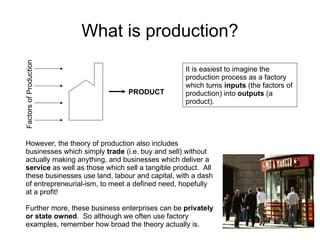
                        What is production?
                                                   It is easiest to imagine the
                                                   production process as a factory
                                                   which turns inputs (the factors of
                                 PRODUCT           production) into outputs (a
                                                   product).


 However, the theory of production also includes
 businesses which simply trade (i.e. buy and sell) without
 actually making anything, and businesses which deliver a
 service as well as those which sell a tangible product. All
 these businesses use land, labour and capital, with a dash
 of entrepreneurial-ism, to meet a defined need, hopefully
 at a profit!

 Further more, these business enterprises can be privately
 or state owned. So although we often use factory
 examples, remember how broad the theory actually is.
The importance of time
                                                And...
7. Short-run                                    8. Long-run
Revenue and costs in the short                  Revenue and costs are not
  run are influenced by the                       restricted by factors of
  factors of production available.                production in the long run.
  'Short-run' is defined as a                     'Long run' is defined as a period
  period within which at least one                over which all the factors of
  factor of production is fixed.                  production can change.

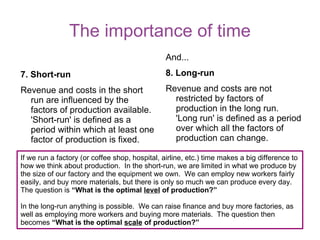
If we run a factory (or coffee shop, hospital, airline, etc.) time makes a big difference to
how we think about production. In the short-run, we are limited in what we produce by
the size of our factory and the equipment we own. We can employ new workers fairly
easily, and buy more materials, but there is only so much we can produce every day.
The question is “What is the optimal level of production?”

In the long-run anything is possible. We can raise finance and buy more factories, as
well as employing more workers and buying more materials. The question then
becomes “What is the optimal scale of production?”
The optimal level of production
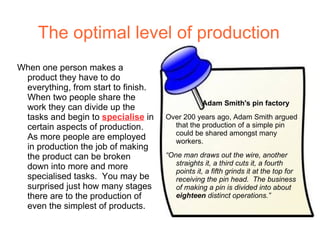
When one person makes a
 product they have to do
 everything, from start to finish.
 When two people share the
                                                 Adam Smith's pin factory
 work they can divide up the
 tasks and begin to specialise in    Over 200 years ago, Adam Smith argued
 certain aspects of production.        that the production of a simple pin
                                       could be shared amongst many
 As more people are employed           workers.
 in production the job of making
 the product can be broken           “One man draws out the wire, another
                                        straights it, a third cuts it, a fourth
 down into more and more                points it, a fifth grinds it at the top for
 specialised tasks. You may be          receiving the pin head. The business
 surprised just how many stages         of making a pin is divided into about
 there are to the production of         eighteen distinct operations.”
 even the simplest of products.
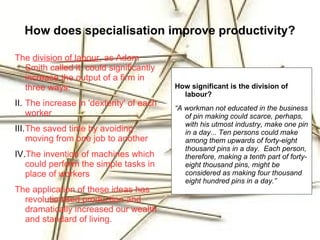
How does specialisation improve productivity?

The division of labour, as Adam
  Smith called it, could significantly
  increase the output of a firm in
  three ways:                             How significant is the division of
                                            labour?
II. The increase in 'dexterity' of each
                                          “A workman not educated in the business
    worker                                   of pin making could scarce, perhaps,
                                             with his utmost industry, make one pin
III.The saved time by avoiding               in a day... Ten persons could make
    moving from one job to another           among them upwards of forty-eight
                                             thousand pins in a day. Each person,
IV.The invention of machines which           therefore, making a tenth part of forty-
   could perform the simple tasks in         eight thousand pins, might be
   place of workers                          considered as making four thousand
                                             eight hundred pins in a day.”
The application of these ideas has
  revolutionised production and
  dramatically increased our wealth
  and standard of living.
Toasters and the modern economy
              How far has the concept of division
                of labour taken us? Thomas
                Thwaites has the answer.

                  Thomas asked himself, how
                  hard could it be for one man to
                  build a toaster, from scratch?
                  One factory can turn out
                  hundreds, if not thousands, of
                  toasters every day. How much
                  greater is this than what one
                  man could do alone, without the
                  benefit of the division of labour?

              http://www.ted.com/talks/thomas_thwaites_how_i_built_a_toaster_from_scrat
Strawberry’s and specialisation
If you have ever been strawberry picking you will know that you need
    one field of strawberries, one basket and a lot of effort.
How many 'distinct operations' can the process of picking strawberries
  be divided into?

    Include everything from finding the ripe strawberries through to
    weighing and packing them

    Think about what equipment you could use
Handling production data
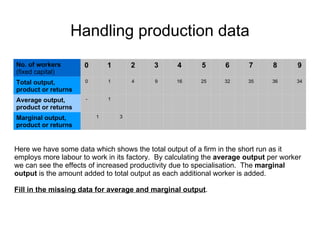
No. of workers       0       1       2    3       4      5      6       7      8      9
(fixed capital)
Total output,        0       1       4     9     16      25     32     35      36     34
product or returns
Average output,      -       1
product or returns
Marginal output,         1       3
product or returns


Here we have some data which shows the total output of a firm in the short run as it
employs more labour to work in its factory. By calculating the average output per worker
we can see the effects of increased productivity due to specialisation. The marginal
output is the amount added to total output as each additional worker is added.

Fill in the missing data for average and marginal output.
Short-run production theory
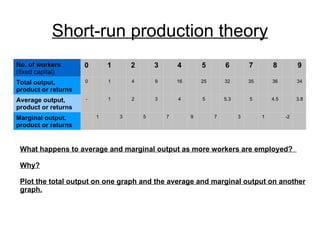
No. of workers       0       1       2       3       4        5        6         7        8          9
(fixed capital)
Total output,        0       1       4       9       16       25       32        35       36         34
product or returns
Average output,      -       1       2       3       4        5        5.3       5        4.5        3.8
product or returns
Marginal output,         1       3       5       7        9        7         3        1         -2
product or returns


 What happens to average and marginal output as more workers are employed?

 Why?

 Plot the total output on one graph and the average and marginal output on another
 graph.
Product curves
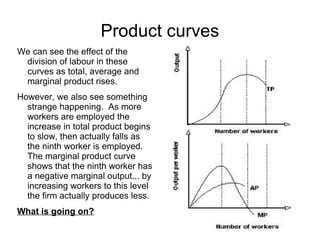
We can see the effect of the
 division of labour in these
 curves as total, average and
 marginal product rises.
However, we also see something
  strange happening. As more
  workers are employed the
  increase in total product begins
  to slow, then actually falls as
  the ninth worker is employed.
  The marginal product curve
  shows that the ninth worker has
  a negative marginal output... by
  increasing workers to this level
  the firm actually produces less.
What is going on?
The law of diminishing marginal returns

This law states that as a variable
  factor of production is added to
  fixed factors, eventually the
  marginal returns (or marginal
  product) of the variable factor
  will begin to fall.

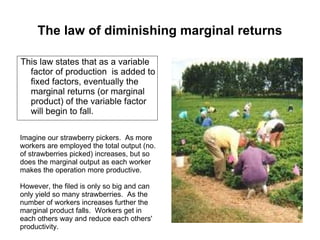
Imagine our strawberry pickers. As more
workers are employed the total output (no.
of strawberries picked) increases, but so
does the marginal output as each worker
makes the operation more productive.

However, the filed is only so big and can
only yield so many strawberries. As the
number of workers increases further the
marginal product falls. Workers get in
each others way and reduce each others'
productivity.
Drawing the marginal and average product curves

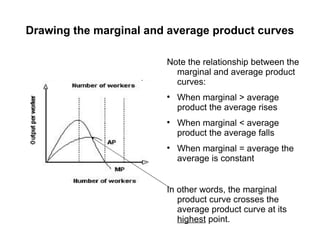
                        Note the relationship between the
                          marginal and average product
                          curves:
                        
                            When marginal > average
                            product the average rises
                        
                            When marginal < average
                            product the average falls
                        
                            When marginal = average the
                            average is constant


                        In other words, the marginal
                           product curve crosses the
                           average product curve at its
                           highest point.
Summary

    Short-run production theory attempts to explain
    what happens to output as a variable factor is
    added to fixed factor/s of production

    As a variable factor of production is added to
    fixed factor/s the marginal output increases at
    first due to the effects of specialisation and the
    division of labour

    As the variable factor continues to be added the
    marginal product eventually falls due to
    diminishing marginal returns

Short run production theory

  • 1.
  • 2.
    Factors of Production What is production? It is easiest to imagine the production process as a factory which turns inputs (the factors of PRODUCT production) into outputs (a product). However, the theory of production also includes businesses which simply trade (i.e. buy and sell) without actually making anything, and businesses which deliver a service as well as those which sell a tangible product. All these businesses use land, labour and capital, with a dash of entrepreneurial-ism, to meet a defined need, hopefully at a profit! Further more, these business enterprises can be privately or state owned. So although we often use factory examples, remember how broad the theory actually is.
  • 3.
    The importance oftime And... 7. Short-run 8. Long-run Revenue and costs in the short Revenue and costs are not run are influenced by the restricted by factors of factors of production available. production in the long run. 'Short-run' is defined as a 'Long run' is defined as a period period within which at least one over which all the factors of factor of production is fixed. production can change. If we run a factory (or coffee shop, hospital, airline, etc.) time makes a big difference to how we think about production. In the short-run, we are limited in what we produce by the size of our factory and the equipment we own. We can employ new workers fairly easily, and buy more materials, but there is only so much we can produce every day. The question is “What is the optimal level of production?” In the long-run anything is possible. We can raise finance and buy more factories, as well as employing more workers and buying more materials. The question then becomes “What is the optimal scale of production?”
  • 4.
    The optimal levelof production When one person makes a product they have to do everything, from start to finish. When two people share the Adam Smith's pin factory work they can divide up the tasks and begin to specialise in Over 200 years ago, Adam Smith argued certain aspects of production. that the production of a simple pin could be shared amongst many As more people are employed workers. in production the job of making the product can be broken “One man draws out the wire, another straights it, a third cuts it, a fourth down into more and more points it, a fifth grinds it at the top for specialised tasks. You may be receiving the pin head. The business surprised just how many stages of making a pin is divided into about there are to the production of eighteen distinct operations.” even the simplest of products.
  • 5.
    How does specialisationimprove productivity? The division of labour, as Adam Smith called it, could significantly increase the output of a firm in three ways: How significant is the division of labour? II. The increase in 'dexterity' of each “A workman not educated in the business worker of pin making could scarce, perhaps, with his utmost industry, make one pin III.The saved time by avoiding in a day... Ten persons could make moving from one job to another among them upwards of forty-eight thousand pins in a day. Each person, IV.The invention of machines which therefore, making a tenth part of forty- could perform the simple tasks in eight thousand pins, might be place of workers considered as making four thousand eight hundred pins in a day.” The application of these ideas has revolutionised production and dramatically increased our wealth and standard of living.
  • 6.
    Toasters and themodern economy How far has the concept of division of labour taken us? Thomas Thwaites has the answer. Thomas asked himself, how hard could it be for one man to build a toaster, from scratch? One factory can turn out hundreds, if not thousands, of toasters every day. How much greater is this than what one man could do alone, without the benefit of the division of labour? http://www.ted.com/talks/thomas_thwaites_how_i_built_a_toaster_from_scrat
  • 7.
    Strawberry’s and specialisation Ifyou have ever been strawberry picking you will know that you need one field of strawberries, one basket and a lot of effort. How many 'distinct operations' can the process of picking strawberries be divided into?  Include everything from finding the ripe strawberries through to weighing and packing them  Think about what equipment you could use
  • 8.
    Handling production data No.of workers 0 1 2 3 4 5 6 7 8 9 (fixed capital) Total output, 0 1 4 9 16 25 32 35 36 34 product or returns Average output, - 1 product or returns Marginal output, 1 3 product or returns Here we have some data which shows the total output of a firm in the short run as it employs more labour to work in its factory. By calculating the average output per worker we can see the effects of increased productivity due to specialisation. The marginal output is the amount added to total output as each additional worker is added. Fill in the missing data for average and marginal output.
  • 9.
    Short-run production theory No.of workers 0 1 2 3 4 5 6 7 8 9 (fixed capital) Total output, 0 1 4 9 16 25 32 35 36 34 product or returns Average output, - 1 2 3 4 5 5.3 5 4.5 3.8 product or returns Marginal output, 1 3 5 7 9 7 3 1 -2 product or returns What happens to average and marginal output as more workers are employed? Why? Plot the total output on one graph and the average and marginal output on another graph.
  • 10.
    Product curves We cansee the effect of the division of labour in these curves as total, average and marginal product rises. However, we also see something strange happening. As more workers are employed the increase in total product begins to slow, then actually falls as the ninth worker is employed. The marginal product curve shows that the ninth worker has a negative marginal output... by increasing workers to this level the firm actually produces less. What is going on?
  • 11.
    The law ofdiminishing marginal returns This law states that as a variable factor of production is added to fixed factors, eventually the marginal returns (or marginal product) of the variable factor will begin to fall. Imagine our strawberry pickers. As more workers are employed the total output (no. of strawberries picked) increases, but so does the marginal output as each worker makes the operation more productive. However, the filed is only so big and can only yield so many strawberries. As the number of workers increases further the marginal product falls. Workers get in each others way and reduce each others' productivity.
  • 12.
    Drawing the marginaland average product curves Note the relationship between the marginal and average product curves:  When marginal > average product the average rises  When marginal < average product the average falls  When marginal = average the average is constant In other words, the marginal product curve crosses the average product curve at its highest point.
  • 13.
    Summary  Short-run production theory attempts to explain what happens to output as a variable factor is added to fixed factor/s of production  As a variable factor of production is added to fixed factor/s the marginal output increases at first due to the effects of specialisation and the division of labour  As the variable factor continues to be added the marginal product eventually falls due to diminishing marginal returns