Infectious diseases
They are clinically evident diseases with the potential of
transmission from one person or species to another.
They result from the presence of pathogenic
microorganisms (very small organisms that are
invisible to the naked eye) that are able to cause disease
in human beings.
Pathogenic micro-organisms include bacteria, viruses,
fungi, protozoa, and multicellular parasites.
Practical microbiology sessions focus on the diagnosis of
these infectious agents.
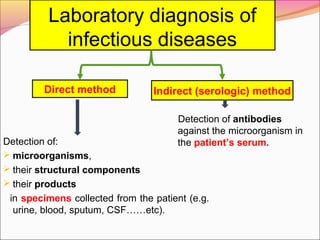
Laboratory diagnosis of
infectious diseases
Direct method

Indirect (serologic) method
Detection of antibodies
against the microorganism in
the patient’s serum.

Detection of:
 microorganisms,
 their structural components
 their products
in specimens collected from the patient (e.g.
urine, blood, sputum, CSF……etc).
I) DIRECT METHOD
1)Specimen Collection
A ’good quality’ clinical specimen.

2) Microscopic Examination:
usually before further processing of specimens

3) Microbial Detection:
a) Culture technique:
b) Non-culture technique
I) DIRECT METHOD
1) Specimen Collection
A ’good quality’ clinical specimen
 Collecting specimens before the start of antibiotics.
 Choosing the appropriate specimen (representing the infection

site).

 Using sterile containers and avoiding contaminating the

specimen.

 Transporting the specimen properly to the lab. as early as

possible.
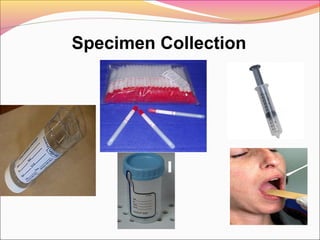
Specimen Collection
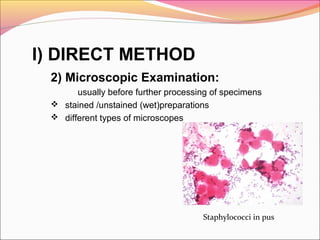
I) DIRECT METHOD
2) Microscopic Examination:
usually before further processing of specimens
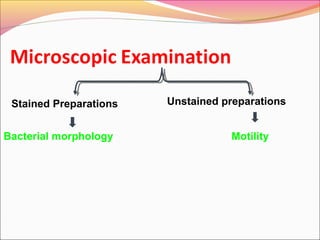
 stained /unstained (wet)preparations
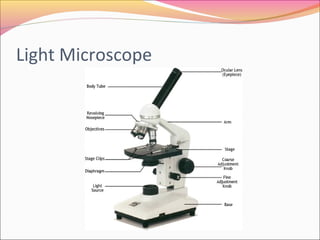
 different types of microscopes

Staphylococci in pus
I) DIRECT METHOD
3) Microbial Detection:
a) Culture Technique:
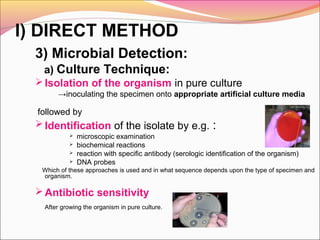
 Isolation of the organism in pure culture
→inoculating the specimen onto appropriate artificial culture media

followed by

 Identification of the isolate by e.g.





:

microscopic examination
biochemical reactions
reaction with specific antibody (serologic identification of the organism)
DNA probes

Which of these approaches is used and in what sequence depends upon the type of specimen and
organism.

 Antibiotic sensitivity
After growing the organism in pure culture.
I) DIRECT METHOD
3) Microbial Detection:
b) Non-Culture Technique:
I.

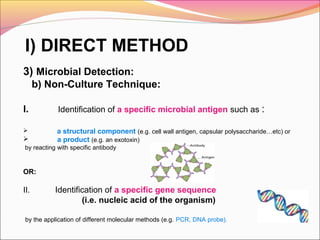
Identification of a specific microbial antigen such as :



a structural component (e.g. cell wall antigen, capsular polysaccharide…etc) or
a product (e.g. an exotoxin)



by reacting with specific antibody

OR:

II.

Identification of a specific gene sequence
(i.e. nucleic acid of the organism)

by the application of different molecular methods (e.g. PCR, DNA probe).
I) DIRECT METHOD


yield more rapid results (minutes or hours)
(do not depend on growth and multiplication of the organism)
However, antimicrobial susceptibility cannot be determined
(although the presence of resistance genes can be determined by
molecular methods).



Non-culture techniques are mainly applied if:




a rapid diagnosis is needed
The microorganism cannot be cultured on artificial
media



A slowly growing micro-organism
II) INDIRECT (SEROLOGIC)
METHOD
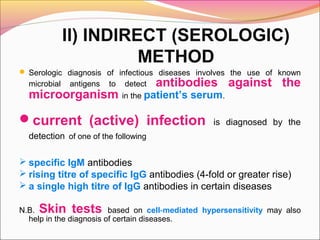
 Serologic diagnosis of infectious diseases involves the use of known

microbial

antigens

to

microorganism

detect antibodies
in the patient’s serum.

current (active) infection

against the

is diagnosed by the

detection of one of the following

 specific IgM antibodies
 rising titre of specific IgG antibodies (4-fold or greater rise)
 a single high titre of IgG antibodies in certain diseases

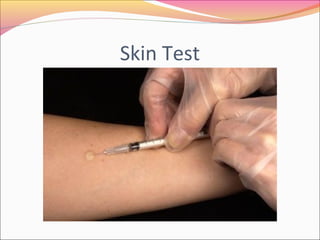
Skin tests

N.B.
based on cell-mediated hypersensitivity may also
help in the diagnosis of certain diseases.
Skin Test
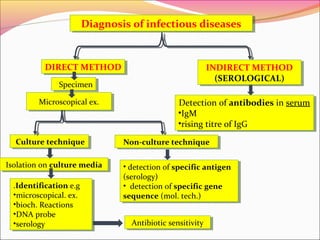
Diagnosis of infectious diseases

DIRECT METHOD
DIRECT METHOD
Specimen
Specimen
Microscopical ex.
Microscopical ex.

Culture technique
Culture technique
Isolation on culture media
.Identification e.g
.Identification e.g
••microscopical.ex.
microscopical. ex.
••bioch.Reactions
bioch. Reactions
••DNAprobe
DNA probe
••serology
serology

INDIRECT METHOD
INDIRECT METHOD
(SEROLOGICAL)
(SEROLOGICAL)
Detection of antibodies in serum
••IgM
IgM
••risingtitre of IgG
rising titre of IgG

Non-culture technique
••detection of specific antigen
detection of specific antigen
(serology)
(serology)
•• detection of specific gene
detection of specific gene
sequence (mol. tech.)
Antibiotic sensitivity
Microscopy
Light Microscope
Stained Preparations
Bacterial morphology

Unstained preparations
Motility
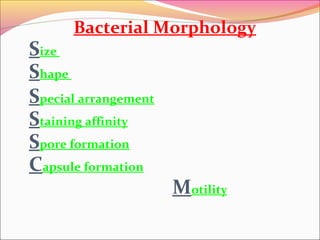
Bacterial Morphology

Size
Shape
Special arrangement
Staining affinity
Spore formation
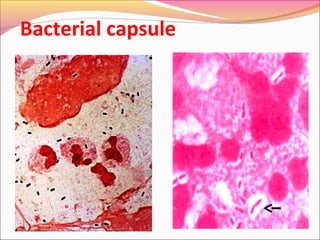
Capsule formation

Motility
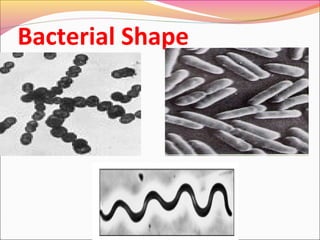
Bacterial Shape
Bacterial arrangement
Chains.
Pairs (diploids).
Clusters (group).
No special arrangement.
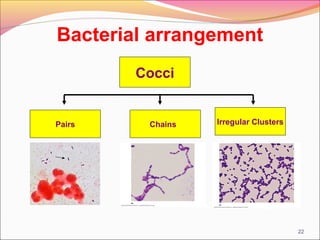
Bacterial arrangement
Cocci

Pairs

Chains

Irregular Clusters

22
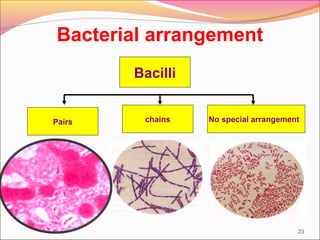
Bacterial arrangement
Bacilli

Pairs

chains

No special arrangement

23
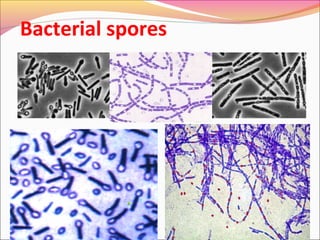
Spore formation
 Morphological characters of bacterial spores:

* Shape.
* Position.
* Staining.
Bacterial spores
Bacterial capsule
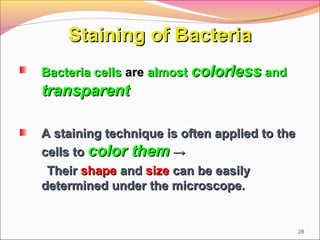
Staining of Bacteria
Bacteria cells are almost colorless and

transparent
A staining technique is often applied to the
cells to color them →
Their shape and size can be easily
determined under the microscope.

28
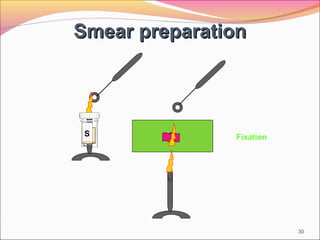
Smear preparation

S

Fixation

30
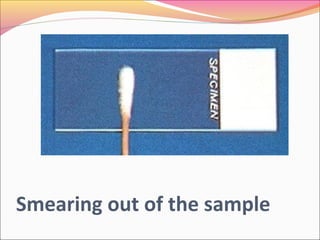
Smearing out of the sample
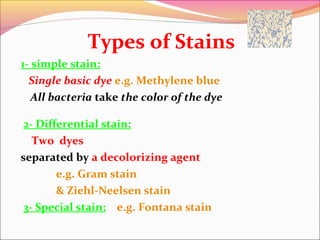
Types of Stains
1- simple stain:
Single basic dye e.g. Methylene blue
All bacteria take the color of the dye
2- Differential stain:
Two dyes
separated by a decolorizing agent
e.g. Gram stain
& Ziehl-Neelsen stain
3- Special stain: e.g. Fontana stain
Differential staining
Principles of differential stain
* Application of the main stain.
• Decolourization.
*Application of the counter-stain.
e.g. Gram stain & Ziehl-Neelsen
stain
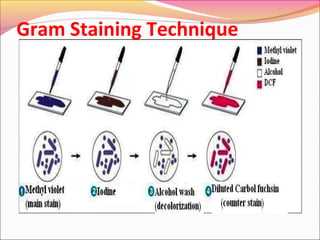
1. Gram Stain
Components
Primary Stain: Methyl violet + Gram’s iodine
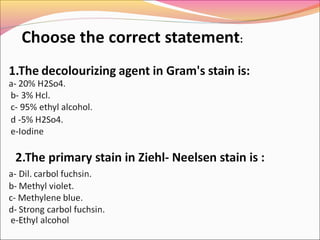
Decolourizing agent: 95% ethyl alcohol
Counter stain: dil. Carbol fuchsin
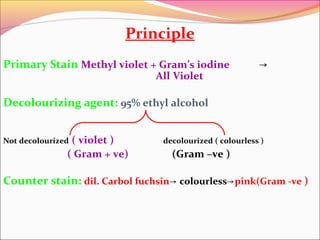
Principle
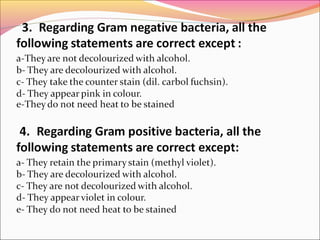
Primary Stain Methyl violet + Gram’s iodine
All Violet

→

Decolourizing agent: 95% ethyl alcohol
( violet )
( Gram + ve)

Not decolourized

decolourized ( colourless )

(Gram –ve )

Counter stain: dil. Carbol fuchsin→ colourless→pink(Gram -ve )
Gram Staining Technique
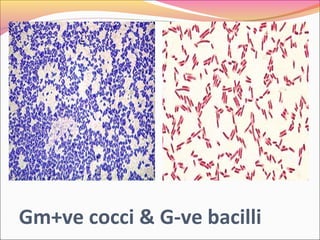
Gm+ve cocci & G-ve bacilli
2. Ziehl-Neelsen
Stain
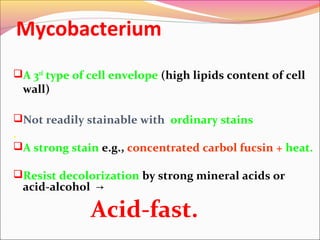
Mycobacterium
A 3rd type of cell envelope (high lipids content of cell

wall)

Not readily stainable with ordinary stains

.

A strong stain e.g., concentrated carbol fucsin + heat.
Resist decolorization by strong mineral acids or

acid-alcohol →

Acid-fast.
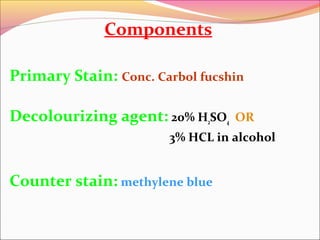
Components
Primary Stain: Conc. Carbol fucshin
Decolourizing agent: 20% H2SO4

OR

3% HCL in alcohol

Counter stain: methylene blue
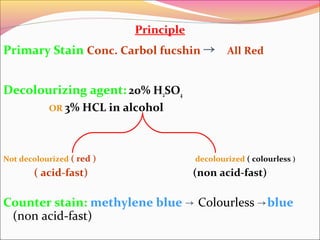
Principle

Primary Stain Conc. Carbol fucshin → All Red
Decolourizing agent: 20% H2SO4
OR 3%

HCL in alcohol

Not decolourized ( red )

( acid-fast)

decolourized ( colourless )

(non acid-fast)

Counter stain: methylene blue → Colourless →blue
(non acid-fast)
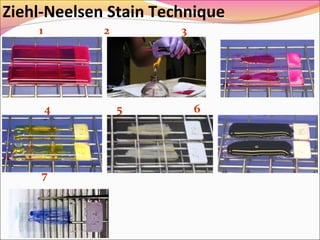
Ziehl-Neelsen Stain Technique
1

2

4

7

3

5

6
Questions
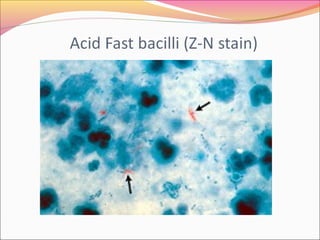
5.Acid fast bacilli stained by Z-N stain appear:
a) Violet
b) Blue
c) Red
d) Colourless
e) brown

6.The steps of Gram’s stain is as follows:
a) methyl violet / ethyl alcohol / dil. carbol fuchsin / iodine
b) methyl violet / ethyl alcohol / iodine / dil. carbol fuchsin
c) dil. carbol fuchsin / methyl violet / ethyl alcohol / iodine
d)dil. carbol fuchsin / iodine / methyl violet / ethyl alcohol
e)methyl violet / iodine /alcohol / dil. carbol fuchsin
Lab Diagnosis - Prac. Microbiology

Lab Diagnosis - Prac. Microbiology

  • 2.
    Infectious diseases They areclinically evident diseases with the potential of transmission from one person or species to another. They result from the presence of pathogenic microorganisms (very small organisms that are invisible to the naked eye) that are able to cause disease in human beings. Pathogenic micro-organisms include bacteria, viruses, fungi, protozoa, and multicellular parasites. Practical microbiology sessions focus on the diagnosis of these infectious agents.
  • 3.
    Laboratory diagnosis of infectiousdiseases Direct method Indirect (serologic) method Detection of antibodies against the microorganism in the patient’s serum. Detection of:  microorganisms,  their structural components  their products in specimens collected from the patient (e.g. urine, blood, sputum, CSF……etc).
  • 5.
    I) DIRECT METHOD 1)SpecimenCollection A ’good quality’ clinical specimen. 2) Microscopic Examination: usually before further processing of specimens 3) Microbial Detection: a) Culture technique: b) Non-culture technique
  • 6.
    I) DIRECT METHOD 1)Specimen Collection A ’good quality’ clinical specimen  Collecting specimens before the start of antibiotics.  Choosing the appropriate specimen (representing the infection site).  Using sterile containers and avoiding contaminating the specimen.  Transporting the specimen properly to the lab. as early as possible.
  • 7.
  • 8.
    I) DIRECT METHOD 2)Microscopic Examination: usually before further processing of specimens  stained /unstained (wet)preparations  different types of microscopes Staphylococci in pus
  • 9.
    I) DIRECT METHOD 3)Microbial Detection: a) Culture Technique:  Isolation of the organism in pure culture →inoculating the specimen onto appropriate artificial culture media followed by  Identification of the isolate by e.g.     : microscopic examination biochemical reactions reaction with specific antibody (serologic identification of the organism) DNA probes Which of these approaches is used and in what sequence depends upon the type of specimen and organism.  Antibiotic sensitivity After growing the organism in pure culture.
  • 10.
    I) DIRECT METHOD 3)Microbial Detection: b) Non-Culture Technique: I. Identification of a specific microbial antigen such as :  a structural component (e.g. cell wall antigen, capsular polysaccharide…etc) or a product (e.g. an exotoxin)  by reacting with specific antibody OR: II. Identification of a specific gene sequence (i.e. nucleic acid of the organism) by the application of different molecular methods (e.g. PCR, DNA probe).
  • 11.
    I) DIRECT METHOD  yieldmore rapid results (minutes or hours) (do not depend on growth and multiplication of the organism) However, antimicrobial susceptibility cannot be determined (although the presence of resistance genes can be determined by molecular methods).  Non-culture techniques are mainly applied if:   a rapid diagnosis is needed The microorganism cannot be cultured on artificial media  A slowly growing micro-organism
  • 13.
    II) INDIRECT (SEROLOGIC) METHOD Serologic diagnosis of infectious diseases involves the use of known microbial antigens to microorganism detect antibodies in the patient’s serum. current (active) infection against the is diagnosed by the detection of one of the following  specific IgM antibodies  rising titre of specific IgG antibodies (4-fold or greater rise)  a single high titre of IgG antibodies in certain diseases Skin tests N.B. based on cell-mediated hypersensitivity may also help in the diagnosis of certain diseases.
  • 14.
  • 15.
    Diagnosis of infectiousdiseases Diagnosis of infectious diseases DIRECT METHOD DIRECT METHOD Specimen Specimen Microscopical ex. Microscopical ex. Culture technique Culture technique Isolation on culture media Isolation on culture media .Identification e.g .Identification e.g ••microscopical.ex. microscopical. ex. ••bioch.Reactions bioch. Reactions ••DNAprobe DNA probe ••serology serology INDIRECT METHOD INDIRECT METHOD (SEROLOGICAL) (SEROLOGICAL) Detection of antibodies in serum Detection of antibodies in serum ••IgM IgM ••risingtitre of IgG rising titre of IgG Non-culture technique Non-culture technique ••detection of specific antigen detection of specific antigen (serology) (serology) •• detection of specific gene detection of specific gene sequence (mol. tech.) sequence (mol. tech.) Antibiotic sensitivity Antibiotic sensitivity
  • 16.
  • 17.
  • 18.
  • 19.
    Bacterial Morphology Size Shape Special arrangement Stainingaffinity Spore formation Capsule formation Motility
  • 20.
  • 21.
  • 22.
  • 23.
  • 24.
    Spore formation  Morphologicalcharacters of bacterial spores: * Shape. * Position. * Staining.
  • 25.
  • 26.
  • 28.
    Staining of Bacteria Bacteriacells are almost colorless and transparent A staining technique is often applied to the cells to color them → Their shape and size can be easily determined under the microscope. 28
  • 30.
  • 31.
    Smearing out ofthe sample
  • 32.
    Types of Stains 1-simple stain: Single basic dye e.g. Methylene blue All bacteria take the color of the dye 2- Differential stain: Two dyes separated by a decolorizing agent e.g. Gram stain & Ziehl-Neelsen stain 3- Special stain: e.g. Fontana stain
  • 33.
    Differential staining Principles ofdifferential stain * Application of the main stain. • Decolourization. *Application of the counter-stain. e.g. Gram stain & Ziehl-Neelsen stain
  • 34.
  • 35.
    Components Primary Stain: Methylviolet + Gram’s iodine Decolourizing agent: 95% ethyl alcohol Counter stain: dil. Carbol fuchsin
  • 36.
    Principle Primary Stain Methylviolet + Gram’s iodine All Violet → Decolourizing agent: 95% ethyl alcohol ( violet ) ( Gram + ve) Not decolourized decolourized ( colourless ) (Gram –ve ) Counter stain: dil. Carbol fuchsin→ colourless→pink(Gram -ve )
  • 37.
  • 38.
    Gm+ve cocci &G-ve bacilli
  • 39.
  • 40.
    Mycobacterium A 3rd typeof cell envelope (high lipids content of cell wall) Not readily stainable with ordinary stains . A strong stain e.g., concentrated carbol fucsin + heat. Resist decolorization by strong mineral acids or acid-alcohol → Acid-fast.
  • 41.
    Components Primary Stain: Conc.Carbol fucshin Decolourizing agent: 20% H2SO4 OR 3% HCL in alcohol Counter stain: methylene blue
  • 42.
    Principle Primary Stain Conc.Carbol fucshin → All Red Decolourizing agent: 20% H2SO4 OR 3% HCL in alcohol Not decolourized ( red ) ( acid-fast) decolourized ( colourless ) (non acid-fast) Counter stain: methylene blue → Colourless →blue (non acid-fast)
  • 43.
  • 45.
  • 48.
    5.Acid fast bacillistained by Z-N stain appear: a) Violet b) Blue c) Red d) Colourless e) brown 6.The steps of Gram’s stain is as follows: a) methyl violet / ethyl alcohol / dil. carbol fuchsin / iodine b) methyl violet / ethyl alcohol / iodine / dil. carbol fuchsin c) dil. carbol fuchsin / methyl violet / ethyl alcohol / iodine d)dil. carbol fuchsin / iodine / methyl violet / ethyl alcohol e)methyl violet / iodine /alcohol / dil. carbol fuchsin