Spirometry and Breathing 
f) outline the mechanism of breathing (inspiration and 
expiration) in mammals, with reference to the 
function of the rib cage, intercostal muscles and 
diaphragm; 
(g) explain the meanings of the terms tidal volume and 
vital capacity; 
(h) describe how a spirometer can be used to measure 
vital capacity, tidal volume, breathing rate and 
oxygen uptake; 
(i) analyse and interpret data from a spirometer.
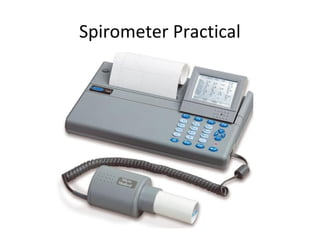
Spirometer Practical
Volume 
Average value (litres) 
Derivation 
In men In women 
Vital capacity 4.6 3.1 
IRV plus TV plus 
ERV 
Inspiratory 
capacity 
3.8 2.4 IRV plus TV 
Functional 
residual 
capacity 
2.2 1.8 ERV plus RV 
Total lung 
capacity 
6.0 4.2 
IRV plus TV plus 
ERV plus RV
Answers: 
A - a normal healthy adult (very large vital capacity and small residual volume) 
B - a small child (a small vital capacity and residual volume) 
C - An elderly person with weak intercostal and abdominal muscles, or a heavy 
smoker (a small vital capacity and very large residual volume)
Spirometry and Breathing 
f) outline the mechanism of breathing (inspiration and 
expiration) in mammals, with reference to the 
function of the rib cage, intercostal muscles and 
diaphragm; 
(g) explain the meanings of the terms tidal volume and 
vital capacity; 
(h) describe how a spirometer can be used to measure 
vital capacity, tidal volume, breathing rate and 
oxygen uptake; 
(i) analyse and interpret data from a spirometer.

L4 spirometer

  • 1.
    Spirometry and Breathing f) outline the mechanism of breathing (inspiration and expiration) in mammals, with reference to the function of the rib cage, intercostal muscles and diaphragm; (g) explain the meanings of the terms tidal volume and vital capacity; (h) describe how a spirometer can be used to measure vital capacity, tidal volume, breathing rate and oxygen uptake; (i) analyse and interpret data from a spirometer.
  • 2.
  • 6.
    Volume Average value(litres) Derivation In men In women Vital capacity 4.6 3.1 IRV plus TV plus ERV Inspiratory capacity 3.8 2.4 IRV plus TV Functional residual capacity 2.2 1.8 ERV plus RV Total lung capacity 6.0 4.2 IRV plus TV plus ERV plus RV
  • 7.
    Answers: A -a normal healthy adult (very large vital capacity and small residual volume) B - a small child (a small vital capacity and residual volume) C - An elderly person with weak intercostal and abdominal muscles, or a heavy smoker (a small vital capacity and very large residual volume)
  • 8.
    Spirometry and Breathing f) outline the mechanism of breathing (inspiration and expiration) in mammals, with reference to the function of the rib cage, intercostal muscles and diaphragm; (g) explain the meanings of the terms tidal volume and vital capacity; (h) describe how a spirometer can be used to measure vital capacity, tidal volume, breathing rate and oxygen uptake; (i) analyse and interpret data from a spirometer.