Last lesson
• The variety of life, both past and present, is extensive, but the biochemical
basis of life is similar for all living things.
• Monomers are the smaller units from which larger molecules are made.
• Polymers are molecules made from a large number of monomers joined
together.
• Monosaccharides, amino acids and nucleotides are examples of
monomers.
• A condensation reaction joins two molecules together with the formation
of a chemical bond and involves the elimination of a molecule of water.
• A hydrolysis reaction breaks a chemical bond between two molecules and
involves the use of a water molecule.
Biological molecules Carbohydrates 1
Learning objectives…
•Describe and compare the structure of mono-, di- and polysaccharides
•Describe how disaccharides and polysaccharides are formed from
monosaccharides
•To know the structures of glucose
polysaccharides
What biological molecules are we
made from?
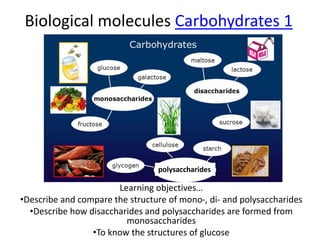
Carbohydrates
Carbohydrates are made from CARBON,
HYDROGEN and OXYGEN
Plant cell walls depend on the structural role
of some carbohydrates
They STORE ENERGY in plants and animals
MONOSACCHARIDES
CARBOHYDRATES
POLYSACCHARIDESDISACCHARIDES
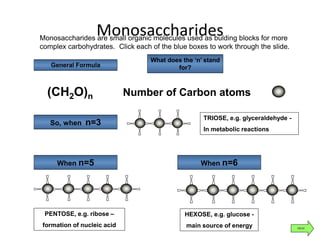
(CH2O)n
MonosaccharidesMonosaccharides are small organic molecules used as bulding blocks for more
complex carbohydrates. Click each of the blue boxes to work through the slide.
General Formula
What does the ‘n’ stand
for?
Number of Carbon atoms
So, when n=3
TRIOSE, e.g. glyceraldehyde -
In metabolic reactions
When n=5 When n=6
HEXOSE, e.g. glucose -
main source of energy
PENTOSE, e.g. ribose –
formation of nucleic acid next
Examples of carbohydrates…
Disaccharides…
GLUCOSE
MALTOSESUCROSE
GLUCOSE
GLUCOSE
Disaccharides
A disaccharide can be made
from two of the same
monosaccharide molecule or
from two different ones.
Disaccharides form when two monosaccharide units join forming a
glycosidic bond, by a condensation reaction.
The combination of
monosaccharides determines
which disaccharide is formed.
MONOSACCHARIDES DISACCHARIDE
FRUCTOSEGALACTOSE
WATERWATERWATER
LACTOSE
GLUCOSE
OOHOH
Forming Disaccharides
C C
C
C O
C
H
OH
OHOH
OH
H
H
CH2OH
H
H
CH2OH
C C
C
C O
C
H
OH
OHOH
OH
H
H
CH2OH
H
H
C C
C
C O
C
H
OH
OH
OH
H
H
CH2OH
H
H
C C
C
C O
C
H
OH
OH
OH
H
H
CH2OH
H
H
H H
Glycosidic
Bond
This is a CONDENSATIONreaction,
wherea watermolecule is lost.
Glucose
Maltose
Disaccharides…
Draw the formation of maltose and
the hydrolysis of maltose
Summary Questions
1. Identify which one, or more, monomer units make up
each of the following carbohydrates:
• Lactose
• Sucrose
• Starch
2. Glucose (C6H12O6) combines with fructose (C6H12O6) to
form the disaccharide sucrose. Deduce the formula for
sucrose.
3. To hydrolyse a disaccharide it can be boiled with
Hydrochloric Acid, but if it is hydrolysed by an enzyme a
much lower temperature (40C) is required. Explain why.
Test next lesson…
• Be able to draw both glucose isomers
• Be able to show a glycosidic bond
• Be able to show hydrolysis and condensation
reactions
Polysaccharides…
Relating Structure to Function
1. Glucose – OH groups make it water soluble,
easily coverted to pyruvate in glycolysis
2. Starch (amylose) – easily broken down into
glucose, linear structure allows for close
packing, hence good energy store
3. Glycogen – several branches of the carbohydrate
can be cut off at once to supply energy quickly
4. Cellulose – hydroxyl groups form hydrogen
bonds with neighbouring chains, holding the
chains firmly together forming macrofibrils with
high tensile strength
Summary
Carbohydrate Type of
molecule
Component
monomers
Structure Function
and
location
Glucose Monomer α or ß glucose Linear or ring Aerobic
respiration,
bloodstream

Lesson 2 carbohydrates

  • 1.
    Last lesson • Thevariety of life, both past and present, is extensive, but the biochemical basis of life is similar for all living things. • Monomers are the smaller units from which larger molecules are made. • Polymers are molecules made from a large number of monomers joined together. • Monosaccharides, amino acids and nucleotides are examples of monomers. • A condensation reaction joins two molecules together with the formation of a chemical bond and involves the elimination of a molecule of water. • A hydrolysis reaction breaks a chemical bond between two molecules and involves the use of a water molecule.
  • 2.
    Biological molecules Carbohydrates1 Learning objectives… •Describe and compare the structure of mono-, di- and polysaccharides •Describe how disaccharides and polysaccharides are formed from monosaccharides •To know the structures of glucose polysaccharides
  • 3.
    What biological moleculesare we made from?
  • 4.
    Carbohydrates Carbohydrates are madefrom CARBON, HYDROGEN and OXYGEN Plant cell walls depend on the structural role of some carbohydrates They STORE ENERGY in plants and animals MONOSACCHARIDES CARBOHYDRATES POLYSACCHARIDESDISACCHARIDES
  • 5.
    (CH2O)n MonosaccharidesMonosaccharides are smallorganic molecules used as bulding blocks for more complex carbohydrates. Click each of the blue boxes to work through the slide. General Formula What does the ‘n’ stand for? Number of Carbon atoms So, when n=3 TRIOSE, e.g. glyceraldehyde - In metabolic reactions When n=5 When n=6 HEXOSE, e.g. glucose - main source of energy PENTOSE, e.g. ribose – formation of nucleic acid next
  • 6.
  • 8.
  • 10.
    GLUCOSE MALTOSESUCROSE GLUCOSE GLUCOSE Disaccharides A disaccharide canbe made from two of the same monosaccharide molecule or from two different ones. Disaccharides form when two monosaccharide units join forming a glycosidic bond, by a condensation reaction. The combination of monosaccharides determines which disaccharide is formed. MONOSACCHARIDES DISACCHARIDE FRUCTOSEGALACTOSE WATERWATERWATER LACTOSE GLUCOSE
  • 11.
    OOHOH Forming Disaccharides C C C CO C H OH OHOH OH H H CH2OH H H CH2OH C C C C O C H OH OHOH OH H H CH2OH H H C C C C O C H OH OH OH H H CH2OH H H C C C C O C H OH OH OH H H CH2OH H H H H Glycosidic Bond This is a CONDENSATIONreaction, wherea watermolecule is lost. Glucose Maltose
  • 12.
  • 13.
    Draw the formationof maltose and the hydrolysis of maltose
  • 14.
    Summary Questions 1. Identifywhich one, or more, monomer units make up each of the following carbohydrates: • Lactose • Sucrose • Starch 2. Glucose (C6H12O6) combines with fructose (C6H12O6) to form the disaccharide sucrose. Deduce the formula for sucrose. 3. To hydrolyse a disaccharide it can be boiled with Hydrochloric Acid, but if it is hydrolysed by an enzyme a much lower temperature (40C) is required. Explain why.
  • 15.
    Test next lesson… •Be able to draw both glucose isomers • Be able to show a glycosidic bond • Be able to show hydrolysis and condensation reactions
  • 17.
  • 18.
    Relating Structure toFunction 1. Glucose – OH groups make it water soluble, easily coverted to pyruvate in glycolysis 2. Starch (amylose) – easily broken down into glucose, linear structure allows for close packing, hence good energy store 3. Glycogen – several branches of the carbohydrate can be cut off at once to supply energy quickly 4. Cellulose – hydroxyl groups form hydrogen bonds with neighbouring chains, holding the chains firmly together forming macrofibrils with high tensile strength
  • 19.
    Summary Carbohydrate Type of molecule Component monomers StructureFunction and location Glucose Monomer α or ß glucose Linear or ring Aerobic respiration, bloodstream