LUNG VOLUME AND
CAPACITIES
 Introduction
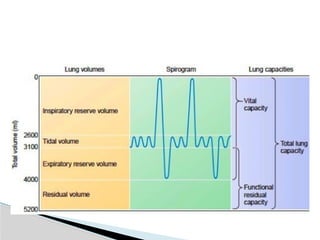
 Lung volumes
 Lung Capacities
 Measurement of lung volume and capacities
Outline
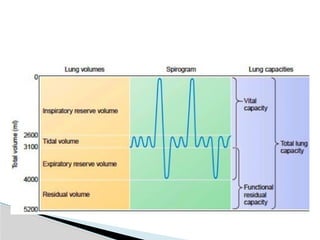
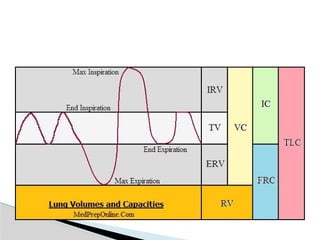
 Lung volumes and lung capacities refer to
the volume of air associated with different
phases of the respiratory cycle.
 Lung volumes are directly measured; Lung
capacities are inferred from lung volumes
 Instrument is spirometry
Introduction
 Four types
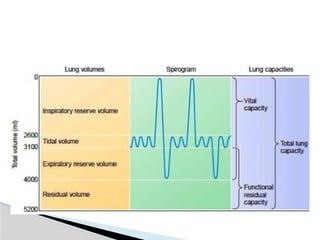
1. Tidal volume
2. Inspiratory reserve volume
3. Expiratory persevere volume
4. Residual volume
Lung Volumes
 Volume of air inspired or expired in a single
quiet respiration.
 TV = 500 ml
Tidal volume
 It is an additional volume of air that can be
inspired forcefully after end of normal
inspiration.
 Normal volume : 3-3.5L
Inspiratory reserve volume
 It is an additional volume of air that can be
expired out forcefully after a normal expiration.
 Normal Value: 1.5L
Expiratory Reserve Volume
 It is the volume of air remaining in the lungs
after a maximal expiration.
 Normal values – 1- 1.5L
Residual Volume
 These are combinations of two or more lung
volumes
1. Inspiratory capacity
2. Expiratory capacity
3. Functional residual capacity
4. Vital capacity
5. Total lung capacity
Lung capacities
 It is the maximum volume of air that is inspired
after normal expiration.
 IC = TV+IRV
3.5- 4 L
Inspiratory capacity
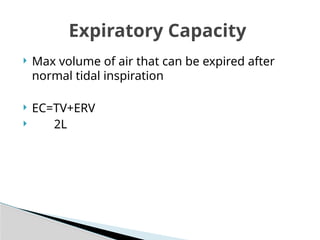
 Max volume of air that can be expired after
normal tidal inspiration
 EC=TV+ERV
 2L
Expiratory Capacity
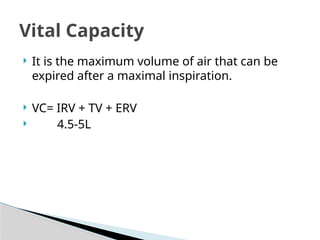
 It is the maximum volume of air that can be
expired after a maximal inspiration.
 VC= IRV + TV + ERV
 4.5-5L
Vital Capacity
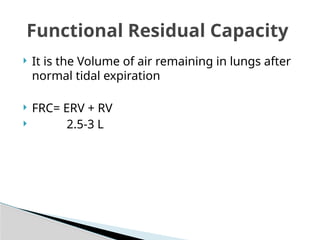
 It is the Volume of air remaining in lungs after
normal tidal expiration
 FRC= ERV + RV
 2.5-3 L
Functional Residual Capacity
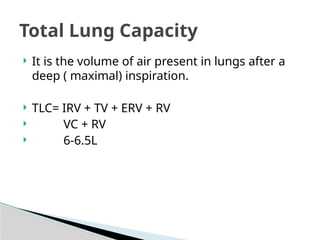
 It is the volume of air present in lungs after a
deep ( maximal) inspiration.
 TLC= IRV + TV + ERV + RV
 VC + RV
 6-6.5L
Total Lung Capacity
 Spirometery is the method to measure lung
volumes and capacities.
 Simple instrument used for this purpose is
called Spirometer.
 It is the most readily available pulmonary
function test.
 It measures the volume of air exhaled at
specific time points during a forceful and
complete exhalation after a maximal inhalation.
Spirometery
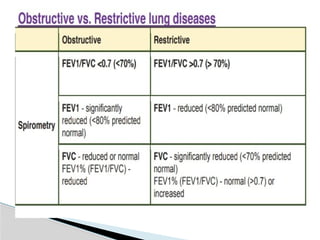
 The forced vital capacity (FVC) (also known as
the forced expiratory volume) is the maximal
volume of air exhaled with a maximally forced
effort from a position of full inspiration and is
expressed in liters.
 The highest FVC from the three acceptable
forced expiratory maneuvers is used for
interpretation
 The FVC may be reduced by suboptimal patient
effort, airflow limitation, restriction (eg, from
lung parenchymal, pleural, or thoracic cage
disease), or a combination of these
 The slow vital capacity (SVC) is the maximal
volume of air exhaled after a maximal
inspiration, but without a forced effort.
 For normal subjects, the slow and forced vital
capacities are very close, whereas patients with
airflow limitation tend to have a lower FVC than
SVC
 The forced expiratory volume in one second
(FEV1) is the maximal volume of air exhaled in
the first second of a forced exhalation that
follows a full inspiration, expressed in liters.
 The highest FEV1 from the three acceptable
forced expiratory maneuvers is used for
interpretation
 The FEV1/FVC ratio is the fraction of the forced
vital capacity that can be exhaled in the first
second. It is the most important parameter for
detecting airflow obstruction in diseases like
asthma and COPD
THANK YOU

lungvolumeandcapacities-150310123004-conversion-gate01 (1).pptx

  • 1.
  • 2.
     Introduction  Lungvolumes  Lung Capacities  Measurement of lung volume and capacities Outline
  • 3.
     Lung volumesand lung capacities refer to the volume of air associated with different phases of the respiratory cycle.  Lung volumes are directly measured; Lung capacities are inferred from lung volumes  Instrument is spirometry Introduction
  • 4.
     Four types 1.Tidal volume 2. Inspiratory reserve volume 3. Expiratory persevere volume 4. Residual volume Lung Volumes
  • 5.
     Volume ofair inspired or expired in a single quiet respiration.  TV = 500 ml Tidal volume
  • 7.
     It isan additional volume of air that can be inspired forcefully after end of normal inspiration.  Normal volume : 3-3.5L Inspiratory reserve volume
  • 8.
     It isan additional volume of air that can be expired out forcefully after a normal expiration.  Normal Value: 1.5L Expiratory Reserve Volume
  • 9.
     It isthe volume of air remaining in the lungs after a maximal expiration.  Normal values – 1- 1.5L Residual Volume
  • 11.
     These arecombinations of two or more lung volumes 1. Inspiratory capacity 2. Expiratory capacity 3. Functional residual capacity 4. Vital capacity 5. Total lung capacity Lung capacities
  • 12.
     It isthe maximum volume of air that is inspired after normal expiration.  IC = TV+IRV 3.5- 4 L Inspiratory capacity
  • 13.
     Max volumeof air that can be expired after normal tidal inspiration  EC=TV+ERV  2L Expiratory Capacity
  • 14.
     It isthe maximum volume of air that can be expired after a maximal inspiration.  VC= IRV + TV + ERV  4.5-5L Vital Capacity
  • 15.
     It isthe Volume of air remaining in lungs after normal tidal expiration  FRC= ERV + RV  2.5-3 L Functional Residual Capacity
  • 16.
     It isthe volume of air present in lungs after a deep ( maximal) inspiration.  TLC= IRV + TV + ERV + RV  VC + RV  6-6.5L Total Lung Capacity
  • 19.
     Spirometery isthe method to measure lung volumes and capacities.  Simple instrument used for this purpose is called Spirometer.  It is the most readily available pulmonary function test.  It measures the volume of air exhaled at specific time points during a forceful and complete exhalation after a maximal inhalation. Spirometery
  • 20.
     The forcedvital capacity (FVC) (also known as the forced expiratory volume) is the maximal volume of air exhaled with a maximally forced effort from a position of full inspiration and is expressed in liters.  The highest FVC from the three acceptable forced expiratory maneuvers is used for interpretation
  • 21.
     The FVCmay be reduced by suboptimal patient effort, airflow limitation, restriction (eg, from lung parenchymal, pleural, or thoracic cage disease), or a combination of these
  • 22.
     The slowvital capacity (SVC) is the maximal volume of air exhaled after a maximal inspiration, but without a forced effort.  For normal subjects, the slow and forced vital capacities are very close, whereas patients with airflow limitation tend to have a lower FVC than SVC
  • 23.
     The forcedexpiratory volume in one second (FEV1) is the maximal volume of air exhaled in the first second of a forced exhalation that follows a full inspiration, expressed in liters.  The highest FEV1 from the three acceptable forced expiratory maneuvers is used for interpretation
  • 24.
     The FEV1/FVCratio is the fraction of the forced vital capacity that can be exhaled in the first second. It is the most important parameter for detecting airflow obstruction in diseases like asthma and COPD
  • 27.