Project Cost Management 
Dr. Panos FITSILIS 
(fitsilis@teilar.gr)
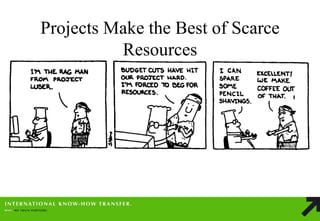
Projects Make the Best of Scarce Resources
Developing a Project Budget 
•Three major elements 
–Forecast what will be needed 
•Labor and material 
–How much will it cost? 
–When will it be needed? 
•Thus, the budget reflects the project plan, time-phased, in dollars
Financial Project Management 
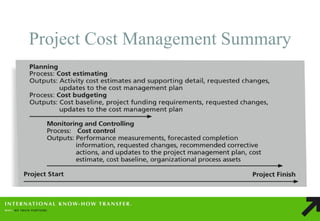
•According to PMBOK 
–Resource planning 
–Cost estimating 
–Cost Budgeting 
–Cost Control
Project Cost Management Summary
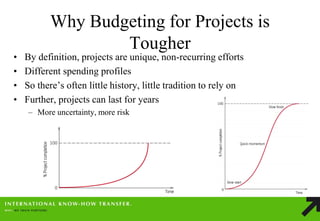
Why Budgeting for Projects is Tougher 
•By definition, projects are unique, non-recurring efforts 
•Different spending profiles 
•So there’s often little history, little tradition to rely on 
•Further, projects can last for years 
–More uncertainty, more risk
Two Major Approaches to Budgeting 
•Top-Down 
•Bottom-Up 
•Each has advantages . . . And disadvantages as well
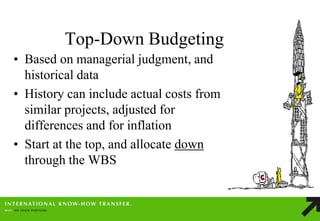
Top-Down Budgeting 
•Based on managerial judgment, and historical data 
•History can include actual costs from similar projects, adjusted for differences and for inflation 
•Start at the top, and allocate down through the WBS
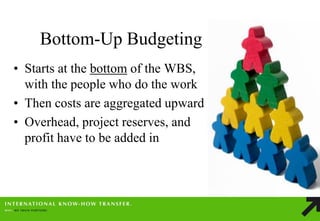
Bottom-Up Budgeting 
•Starts at the bottom of the WBS, with the people who do the work 
•Then costs are aggregated upward 
•Overhead, project reserves, and profit have to be added in
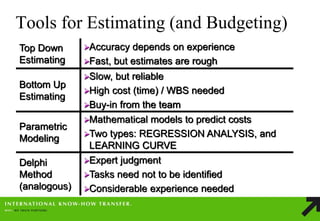
Tools for Estimating (and Budgeting) 
Top Down Estimating 
Accuracy depends on experience 
Fast, but estimates are rough 
Bottom Up Estimating 
Slow, but reliable 
High cost (time) / WBS needed 
Buy-in from the team 
Parametric Modeling 
Mathematical models to predict costs 
Two types: REGRESSION ANALYSIS, and LEARNING CURVE 
Delphi Method (analogous) 
Expert judgment 
Tasks need not to be identified 
Considerable experience needed
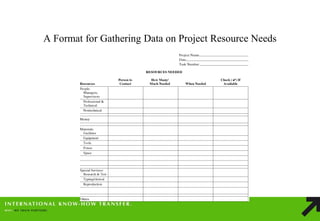
A Format for Gathering Data on Project Resource Needs
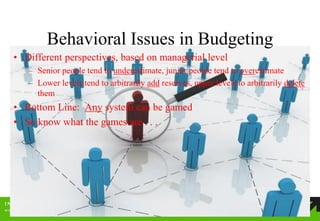
Behavioral Issues in Budgeting 
•Different perspectives, based on managerial level 
–Senior people tend to underestimate, junior people tend to overestimate 
–Lower levels tend to arbitrarily add reserves, upper levels to arbitrarily delete them 
•Bottom Line: Any system can be gamed 
•So know what the games are . . .
Financial Issues Worth Considering: Inflation 
•Inflation can distort estimates in different ways 
–Actual costs from the past will be less than comparables for today – the older the data, the greater the disparity 
–Long-duration projects can create special problems 
•Six percent inflation doubles cost in just 12 years . . . 
•. . . And 6% is low in much of the world
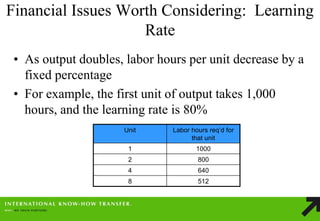
Financial Issues Worth Considering: Learning Rate 
•As output doubles, labor hours per unit decrease by a fixed percentage 
•For example, the first unit of output takes 1,000 hours, and the learning rate is 80% 
Unit 
Labor hours req’d for that unit 
1 
1000 
2 
800 
4 
640 
8 
512
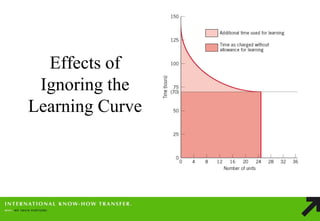
Effects of Ignoring the Learning Curve
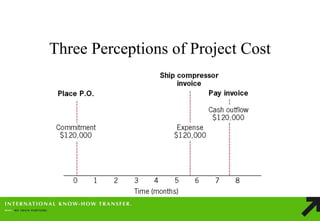
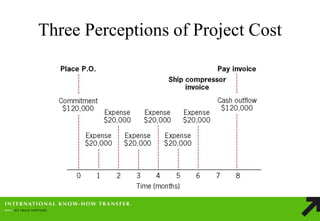
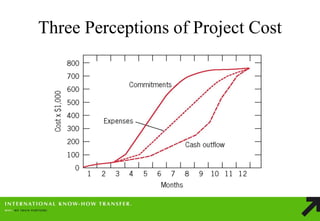
Three Perceptions of Project Cost
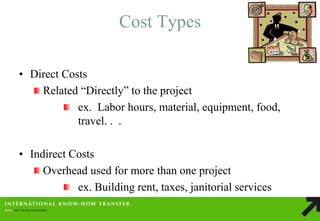
Cost Types 
•Direct Costs Related “Directly” to the project ex. Labor hours, material, equipment, food, travel. . . 
•Indirect Costs Overhead used for more than one project ex. Building rent, taxes, janitorial services
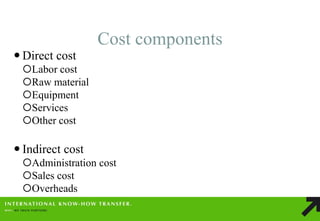
Cost components 
Direct cost 
Labor cost 
Raw material 
Equipment 
Services 
Other cost 
Indirect cost 
Administration cost 
Sales cost 
Overheads
Cost Types 
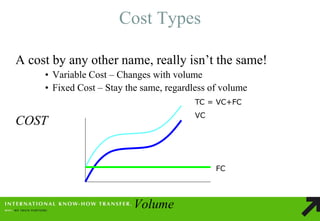
A cost by any other name, really isn’t the same! 
•Variable Cost – Changes with volume 
•Fixed Cost – Stay the same, regardless of volume 
COST 
Volume 
TC = VC+FC 
VC 
FC
Cost Types 
Project Costs 
Are incurred while the project is being fulfilled. 
Life Cycle Costs 
Includes the costs after project completion. 
There may be temptation to lower project costs at the expense of long term costs. Life Cycle Costing gives the PM a way to consider costs outside of the scope of project fulfillment
Earned Value Analysis (EVA)
Earned Value Analysis (EVA) 
•Needed: An objective way to measure overall project performance 
•The problem comparing actual expenditures to baseline plan is that it ignores the amount of work actually completed 
•Thus, Earned Value Analysis 
–A sort of cost accounting for projects
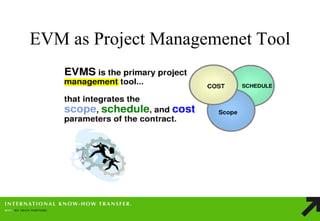
EVM as Project Managemenet Tool
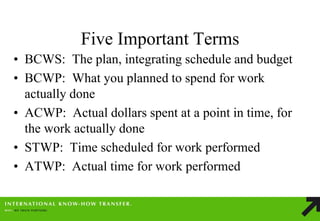
Five Important Terms 
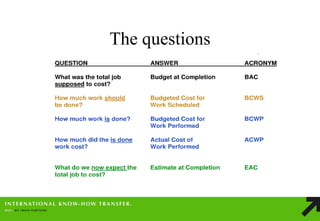
•BCWS: The plan, integrating schedule and budget 
•BCWP: What you planned to spend for work actually done 
•ACWP: Actual dollars spent at a point in time, for the work actually done 
•STWP: Time scheduled for work performed 
•ATWP: Actual time for work performed
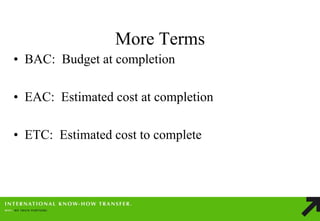
More Terms 
•BAC: Budget at completion 
•EAC: Estimated cost at completion 
•ETC: Estimated cost to complete
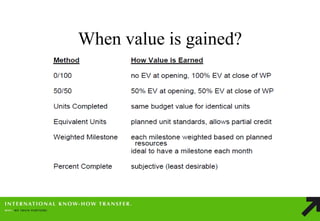
When value is gained?
The questions
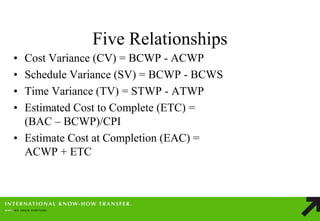
Five Relationships 
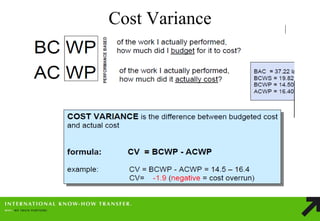
•Cost Variance (CV) = BCWP - ACWP 
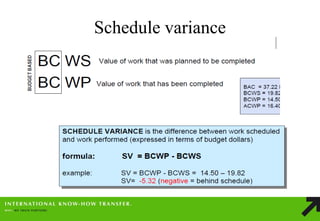
•Schedule Variance (SV) = BCWP - BCWS 
•Time Variance (TV) = STWP - ATWP 
•Estimated Cost to Complete (ETC) = (BAC – BCWP)/CPI 
•Estimate Cost at Completion (EAC) = ACWP + ETC
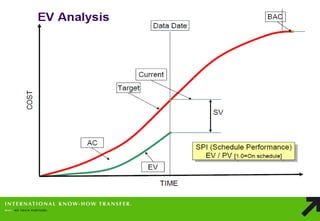
Schedule variance
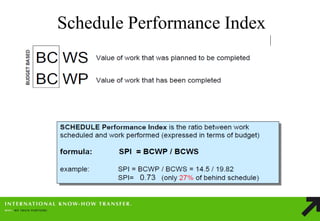
Schedule Performance Index
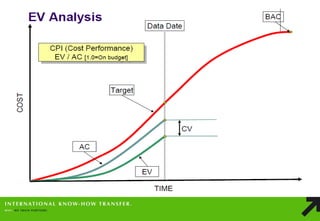
Cost Variance
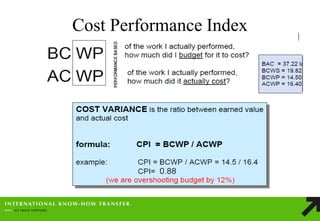
Cost Performance Index
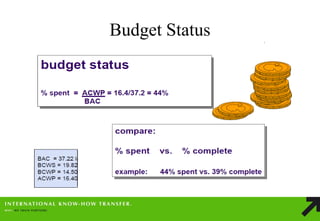
Budget Status
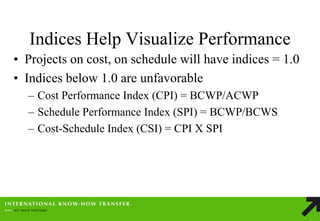
Indices Help Visualize Performance 
•Projects on cost, on schedule will have indices = 1.0 
•Indices below 1.0 are unfavorable 
–Cost Performance Index (CPI) = BCWP/ACWP 
–Schedule Performance Index (SPI) = BCWP/BCWS 
–Cost-Schedule Index (CSI) = CPI X SPI
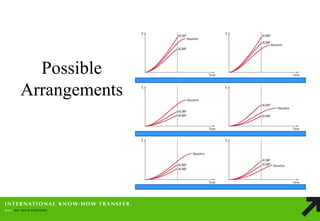
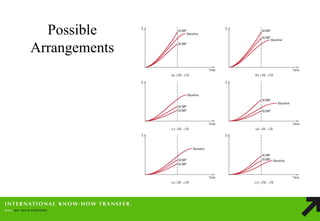
Possible Arrangements
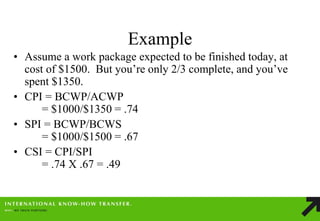
Example 
•Assume a work package expected to be finished today, at cost of $1500. But you’re only 2/3 complete, and you’ve spent $1350. 
•CPI = BCWP/ACWP = $1000/$1350 = .74 
•SPI = BCWP/BCWS = $1000/$1500 = .67 
•CSI = CPI/SPI = .74 X .67 = .49
Example (cont’d) 
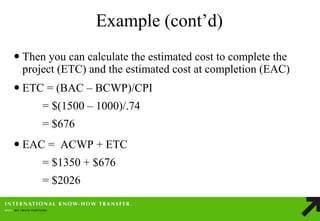
Then you can calculate the estimated cost to complete the project (ETC) and the estimated cost at completion (EAC) 
ETC = (BAC – BCWP)/CPI = $(1500 – 1000)/.74 = $676 
EAC = ACWP + ETC = $1350 + $676 = $2026
Thank you!

4.Cost management

  • 1.
    Project Cost Management Dr. Panos FITSILIS (fitsilis@teilar.gr)
  • 2.
    Projects Make theBest of Scarce Resources
  • 3.
    Developing a ProjectBudget •Three major elements –Forecast what will be needed •Labor and material –How much will it cost? –When will it be needed? •Thus, the budget reflects the project plan, time-phased, in dollars
  • 4.
    Financial Project Management •According to PMBOK –Resource planning –Cost estimating –Cost Budgeting –Cost Control
  • 5.
  • 6.
    Why Budgeting forProjects is Tougher •By definition, projects are unique, non-recurring efforts •Different spending profiles •So there’s often little history, little tradition to rely on •Further, projects can last for years –More uncertainty, more risk
  • 7.
    Two Major Approachesto Budgeting •Top-Down •Bottom-Up •Each has advantages . . . And disadvantages as well
  • 8.
    Top-Down Budgeting •Basedon managerial judgment, and historical data •History can include actual costs from similar projects, adjusted for differences and for inflation •Start at the top, and allocate down through the WBS
  • 9.
    Bottom-Up Budgeting •Startsat the bottom of the WBS, with the people who do the work •Then costs are aggregated upward •Overhead, project reserves, and profit have to be added in
  • 10.
    Tools for Estimating(and Budgeting) Top Down Estimating Accuracy depends on experience Fast, but estimates are rough Bottom Up Estimating Slow, but reliable High cost (time) / WBS needed Buy-in from the team Parametric Modeling Mathematical models to predict costs Two types: REGRESSION ANALYSIS, and LEARNING CURVE Delphi Method (analogous) Expert judgment Tasks need not to be identified Considerable experience needed
  • 11.
    A Format forGathering Data on Project Resource Needs
  • 12.
    Behavioral Issues inBudgeting •Different perspectives, based on managerial level –Senior people tend to underestimate, junior people tend to overestimate –Lower levels tend to arbitrarily add reserves, upper levels to arbitrarily delete them •Bottom Line: Any system can be gamed •So know what the games are . . .
  • 13.
    Financial Issues WorthConsidering: Inflation •Inflation can distort estimates in different ways –Actual costs from the past will be less than comparables for today – the older the data, the greater the disparity –Long-duration projects can create special problems •Six percent inflation doubles cost in just 12 years . . . •. . . And 6% is low in much of the world
  • 14.
    Financial Issues WorthConsidering: Learning Rate •As output doubles, labor hours per unit decrease by a fixed percentage •For example, the first unit of output takes 1,000 hours, and the learning rate is 80% Unit Labor hours req’d for that unit 1 1000 2 800 4 640 8 512
  • 15.
    Effects of Ignoringthe Learning Curve
  • 16.
  • 17.
  • 18.
  • 19.
    Cost Types •DirectCosts Related “Directly” to the project ex. Labor hours, material, equipment, food, travel. . . •Indirect Costs Overhead used for more than one project ex. Building rent, taxes, janitorial services
  • 20.
    Cost components Directcost Labor cost Raw material Equipment Services Other cost Indirect cost Administration cost Sales cost Overheads
  • 21.
    Cost Types Acost by any other name, really isn’t the same! •Variable Cost – Changes with volume •Fixed Cost – Stay the same, regardless of volume COST Volume TC = VC+FC VC FC
  • 22.
    Cost Types ProjectCosts Are incurred while the project is being fulfilled. Life Cycle Costs Includes the costs after project completion. There may be temptation to lower project costs at the expense of long term costs. Life Cycle Costing gives the PM a way to consider costs outside of the scope of project fulfillment
  • 23.
  • 24.
    Earned Value Analysis(EVA) •Needed: An objective way to measure overall project performance •The problem comparing actual expenditures to baseline plan is that it ignores the amount of work actually completed •Thus, Earned Value Analysis –A sort of cost accounting for projects
  • 25.
    EVM as ProjectManagemenet Tool
  • 26.
    Five Important Terms •BCWS: The plan, integrating schedule and budget •BCWP: What you planned to spend for work actually done •ACWP: Actual dollars spent at a point in time, for the work actually done •STWP: Time scheduled for work performed •ATWP: Actual time for work performed
  • 27.
    More Terms •BAC:Budget at completion •EAC: Estimated cost at completion •ETC: Estimated cost to complete
  • 28.
  • 29.
  • 30.
    Five Relationships •CostVariance (CV) = BCWP - ACWP •Schedule Variance (SV) = BCWP - BCWS •Time Variance (TV) = STWP - ATWP •Estimated Cost to Complete (ETC) = (BAC – BCWP)/CPI •Estimate Cost at Completion (EAC) = ACWP + ETC
  • 31.
  • 32.
  • 34.
  • 35.
  • 37.
  • 38.
    Indices Help VisualizePerformance •Projects on cost, on schedule will have indices = 1.0 •Indices below 1.0 are unfavorable –Cost Performance Index (CPI) = BCWP/ACWP –Schedule Performance Index (SPI) = BCWP/BCWS –Cost-Schedule Index (CSI) = CPI X SPI
  • 39.
  • 40.
  • 41.
    Example •Assume awork package expected to be finished today, at cost of $1500. But you’re only 2/3 complete, and you’ve spent $1350. •CPI = BCWP/ACWP = $1000/$1350 = .74 •SPI = BCWP/BCWS = $1000/$1500 = .67 •CSI = CPI/SPI = .74 X .67 = .49
  • 42.
    Example (cont’d) Thenyou can calculate the estimated cost to complete the project (ETC) and the estimated cost at completion (EAC) ETC = (BAC – BCWP)/CPI = $(1500 – 1000)/.74 = $676 EAC = ACWP + ETC = $1350 + $676 = $2026
  • 43.