L-9L-9
Sewage Pumping
Environmental Engineering-II
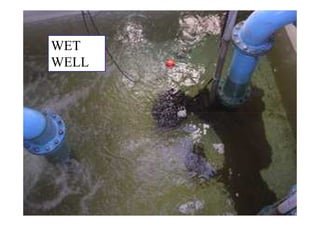
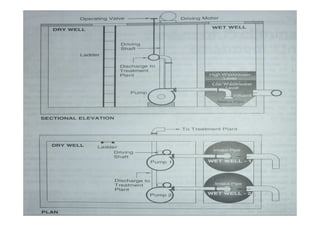
WET
WELL
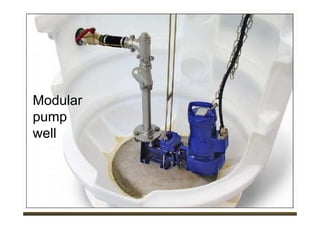
Modular
pumppump
well
RISING MAIN
The need for sewer pumping stations
arises when
• The existing topography and required
minimum sewer grades create deep
sewers that have high construction costs.
The sewage is raised and then conveyedThe sewage is raised and then conveyed
by gravity.
• Basements are too low to discharge
sewage to the main sewer.
• Sewage must be conveyed over a ridge.
• The sewage must be raised to get head
for gravity flow through a treatment
plant.
• Discharge outlets are below the level
of the receiving body of water.
Problems is sewage pumping
1. Sewage has foul characteristics
2. Sewage has lot of suspended solids and
floating matter. Which may make running of
pumps difficult and may cause frequentpumps difficult and may cause frequent
clogging of pumps.
3. Sewage may contain organic and inorganic
waste, which may cause corrosion and
errosion of parts of the pumps and reduce life
of pumps.
4. Sewage contains pathogens which may cause
health problems to working persons at sewage
pumping station.
5. The rate sewage flow varies hourly hence rate
of pumping has to be adjusted accordingly
6.Size of sump is limited since large size of6.Size of sump is limited since large size of
sump results in settlement of solids and
organic matter at its bottom.
7. Pumps should be of high order reliability
since failure of pumps will lead to flooding of
adjoining areas.
Pumping station
• Dry well :- For housing the pumps
• Wet well: - For incoming sewage.
• Rising main:- To led the pumped sewageto• Rising main:- To led the pumped sewageto
high leveled gravity sewer.
• Pumps used:- Centrifugal, Reciprocating,
Propeller of axial flow, Air pressure pumps
or ejectors
Design criteria
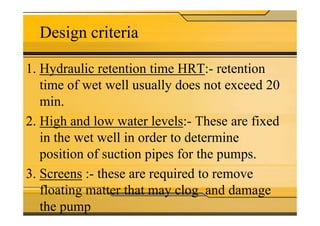
1. Hydraulic retention time HRT:- retention
time of wet well usually does not exceed 20
min.
2. High and low water levels:- These are fixed
in the wet well in order to determine
position of suction pipes for the pumps.
3. Screens :- these are required to remove
floating matter that may clog and damage
the pump
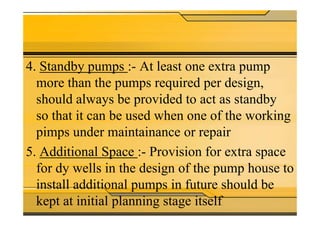
4. Standby pumps :- At least one extra pump
more than the pumps required per design,
should always be provided to act as standby
so that it can be used when one of the workingso that it can be used when one of the working
pimps under maintainance or repair
5. Additional Space :- Provision for extra space
for dy wells in the design of the pump house to
install additional pumps in future should be
kept at initial planning stage itself
Formulae used
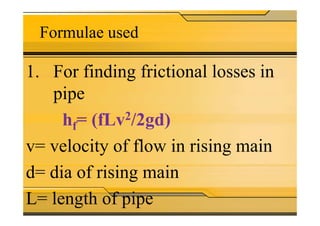
1. For finding frictional losses in
pipe
h = (fLv2/2gd)hf= (fLv2/2gd)
v= velocity of flow in rising main
d= dia of rising main
L= length of pipe
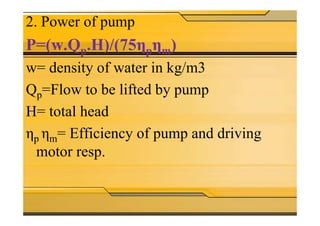
2. Power of pump
P=(w.Qp.H)/(75ηpηm)
w= density of water in kg/m3
Qp=Flow to be lifted by pump
H= total headH= total head
ηp ηm= Efficiency of pump and driving
motor resp.
Objective Questions
1. _____________________ matter may clog
the pump.
2.________ and_____________ wells are
provided in pumping stations.provided in pumping stations.
3. Dry well is required for
___________________________.
4. Wet well is required for _________________.
Theory questions
Q1. Write short note on
1. Sewage pumping
2. Difficulties in sewage pumping2. Difficulties in sewage pumping
3. Design of sewage pumping station

L 9 pumping stations

  • 1.
  • 2.
  • 3.
  • 4.
  • 5.
    The need forsewer pumping stations arises when • The existing topography and required minimum sewer grades create deep sewers that have high construction costs. The sewage is raised and then conveyedThe sewage is raised and then conveyed by gravity. • Basements are too low to discharge sewage to the main sewer. • Sewage must be conveyed over a ridge.
  • 6.
    • The sewagemust be raised to get head for gravity flow through a treatment plant. • Discharge outlets are below the level of the receiving body of water.
  • 7.
    Problems is sewagepumping 1. Sewage has foul characteristics 2. Sewage has lot of suspended solids and floating matter. Which may make running of pumps difficult and may cause frequentpumps difficult and may cause frequent clogging of pumps. 3. Sewage may contain organic and inorganic waste, which may cause corrosion and errosion of parts of the pumps and reduce life of pumps.
  • 8.
    4. Sewage containspathogens which may cause health problems to working persons at sewage pumping station. 5. The rate sewage flow varies hourly hence rate of pumping has to be adjusted accordingly 6.Size of sump is limited since large size of6.Size of sump is limited since large size of sump results in settlement of solids and organic matter at its bottom. 7. Pumps should be of high order reliability since failure of pumps will lead to flooding of adjoining areas.
  • 10.
    Pumping station • Drywell :- For housing the pumps • Wet well: - For incoming sewage. • Rising main:- To led the pumped sewageto• Rising main:- To led the pumped sewageto high leveled gravity sewer. • Pumps used:- Centrifugal, Reciprocating, Propeller of axial flow, Air pressure pumps or ejectors
  • 11.
    Design criteria 1. Hydraulicretention time HRT:- retention time of wet well usually does not exceed 20 min. 2. High and low water levels:- These are fixed in the wet well in order to determine position of suction pipes for the pumps. 3. Screens :- these are required to remove floating matter that may clog and damage the pump
  • 12.
    4. Standby pumps:- At least one extra pump more than the pumps required per design, should always be provided to act as standby so that it can be used when one of the workingso that it can be used when one of the working pimps under maintainance or repair 5. Additional Space :- Provision for extra space for dy wells in the design of the pump house to install additional pumps in future should be kept at initial planning stage itself
  • 13.
    Formulae used 1. Forfinding frictional losses in pipe h = (fLv2/2gd)hf= (fLv2/2gd) v= velocity of flow in rising main d= dia of rising main L= length of pipe
  • 14.
    2. Power ofpump P=(w.Qp.H)/(75ηpηm) w= density of water in kg/m3 Qp=Flow to be lifted by pump H= total headH= total head ηp ηm= Efficiency of pump and driving motor resp.
  • 15.
    Objective Questions 1. _____________________matter may clog the pump. 2.________ and_____________ wells are provided in pumping stations.provided in pumping stations. 3. Dry well is required for ___________________________. 4. Wet well is required for _________________.
  • 16.
    Theory questions Q1. Writeshort note on 1. Sewage pumping 2. Difficulties in sewage pumping2. Difficulties in sewage pumping 3. Design of sewage pumping station