Presentation On 
SEWAGE TREATMENT 
PLANT,LUCKNOW 
SHASWAT MISHRA 
B.TECH (CIVIL) 
111000138 
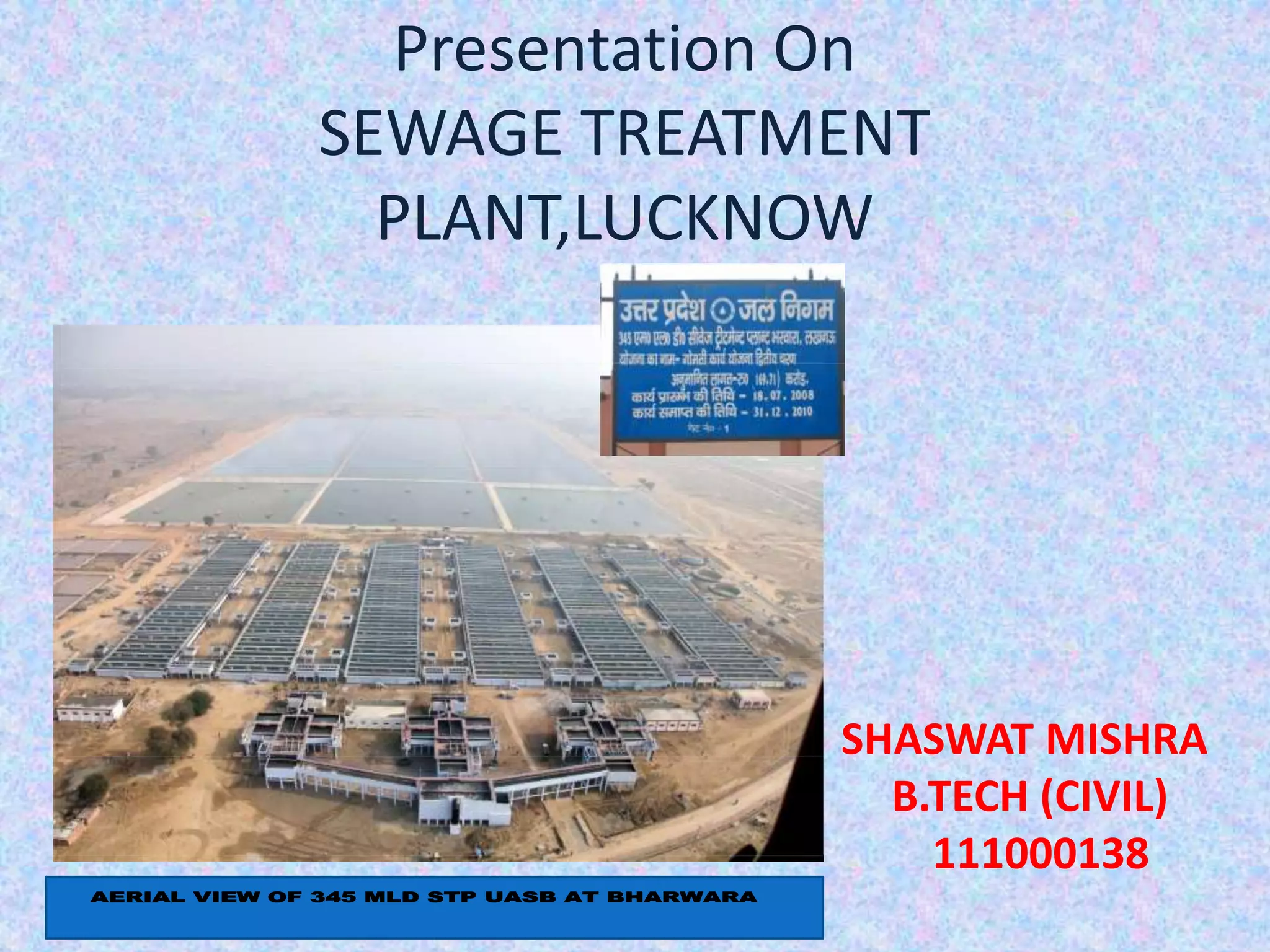
AERIAL VIEW OF 345 MLD STP UASB AT BHARWARA
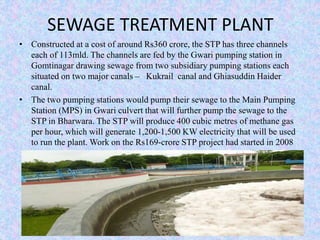
SEWAGE TREATMENT PLANT 
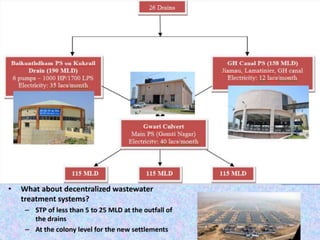
• Constructed at a cost of around Rs360 crore, the STP has three channels 
each of 113mld. The channels are fed by the Gwari pumping station in 
Gomtinagar drawing sewage from two subsidiary pumping stations each 
situated on two major canals – Kukrail canal and Ghiasuddin Haider 
canal. 
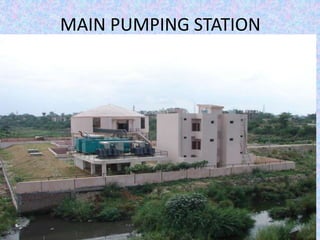
• The two pumping stations would pump their sewage to the Main Pumping 
Station (MPS) in Gwari culvert that will further pump the sewage to the 
STP in Bharwara. The STP will produce 400 cubic metres of methane gas 
per hour, which will generate 1,200-1,500 KW electricity that will be used 
to run the plant. Work on the Rs169-crore STP project had started in 2008
GENERAL OUTLINES OF SEWAGE 
TREATMENT 
Sewage treatment, or domestic 
wastewater treatment, is the process of 
removing contaminants from wastewater, 
both runoff(effluents)and domestic. It 
includes physical, chemical and 
biological processes to remove physical, 
chemical and biological contaminants. Its 
objective is to produce a waste stream (or 
treated )and a solid waste or sludge 
suitable for discharge or reuse back into 
the environment. 
Industrial sources of wastewater often require 
specialized treatment processes the sewage 
treatment involves three stages, 
called primary, secondary and tertiary 
treatment .First, the solids are separated from 
the wastewater stream. Then dissolved 
biological matter is progressively converted 
into a solid mass by using indigenous, water-borne 
microorganisms. Finally, the biological 
solids are neutralized then disposed of or re-used, 
and the treated water may be disinfected 
chemically or physically (for example by 
lagoons and micro-filtration).The final 
effluent can be discharged into a 
stream, river , bay, lagoon or wetland, or it can 
be used for the irrigation of a golf course, 
green way or park.
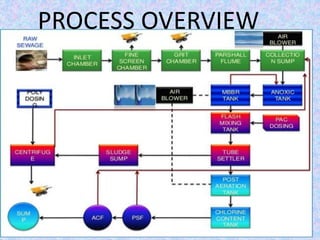
PROCESS OVERVIEW
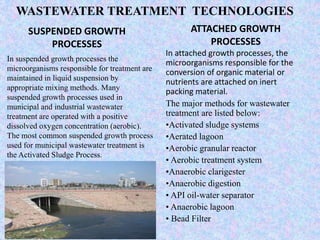
WASTEWATER TREATMENT TECHNOLOGIES 
SUSPENDED GROWTH 
PROCESSES 
In suspended growth processes the 
microorganisms responsible for treatment are 
maintained in liquid suspension by 
appropriate mixing methods. Many 
suspended growth processes used in 
municipal and industrial wastewater 
treatment are operated with a positive 
dissolved oxygen concentration (aerobic). 
The most common suspended growth process 
used for municipal wastewater treatment is 
the Activated Sludge Process. 
ATTACHED GROWTH 
PROCESSES 
In attached growth processes, the 
microorganisms responsible for the 
conversion of organic material or 
nutrients are attached on inert 
packing material. 
The major methods for wastewater 
treatment are listed below: 
•Activated sludge systems 
•Aerated lagoon 
•Aerobic granular reactor 
• Aerobic treatment system 
•Anaerobic clarigester 
•Anaerobic digestion 
• API oil-water separator 
• Anaerobic lagoon 
• Bead Filter
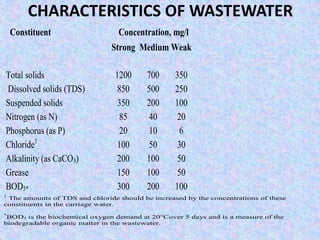
CHARACTERISTICS OF WASTEWATER 
Constituent Concentration, mg/l 
Strong Medium Weak 
Total solids 1200 700 350 
Dissolved solids (TDS) 850 500 250 
Suspended solids 350 200 100 
Nitrogen (as N) 85 40 20 
Phosphorus (as P) 20 10 6 
Chloride1 100 50 30 
Alkalinity (as CaCO3) 200 100 50 
Grease 150 100 50 
BOD5* 300 200 100 
1 The amounts of TDS and chloride should be increased by the concentrations of these 
constituents in the carriage water. 
*BOD5 is the biochemical oxygen demand at 20°Cover 5 days and is a measure of the 
biodegradable organic matter in the wastewater.
IMPORTANT FACTS OF SEWAGE 
TREATMENT PLANT 
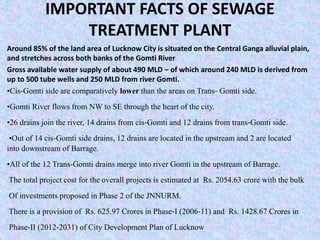
Around 85% of the land area of Lucknow City is situated on the Central Ganga alluvial plain, 
and stretches across both banks of the Gomti River 
Gross available water supply of about 490 MLD – of which around 240 MLD is derived from 
up to 500 tube wells and 250 MLD from river Gomti. 
•Cis‐Gomti side are comparatively lower than the areas on Trans‐ Gomti side. 
•Gomti River flows from NW to SE through the heart of the city. 
•26 drains join the river, 14 drains from cis‐Gomti and 12 drains from trans‐Gomti side. 
•Out of 14 cis‐Gomti side drains, 12 drains are located in the upstream and 2 are located 
into downstream of Barrage. 
•All of the 12 Trans‐Gomti drains merge into river Gomti in the upstream of Barrage. 
The total project cost for the overall projects is estimated at Rs. 2054.63 crore with the bulk 
Of investments proposed in Phase 2 of the JNNURM. 
There is a provision of Rs. 625.97 Crores in Phase‐I (2006‐11) and Rs. 1428.67 Crores in 
Phase‐II (2012‐2031) of City Development Plan of Lucknow
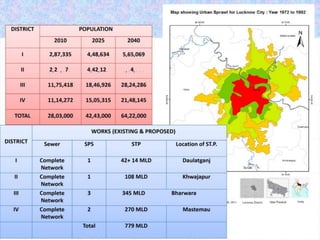
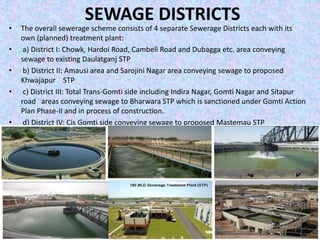
SEWAGE DISTRICTS 
• The overall sewerage scheme consists of 4 separate Sewerage Districts each with its 
own (planned) treatment plant: 
• a) District I: Chowk, Hardoi Road, Cambell Road and Dubagga etc. area conveying 
sewage to existing Daulatganj STP 
• b) District II: Amausi area and Sarojini Nagar area conveying sewage to proposed 
Khwajapur STP 
• c) District III: Total Trans‐Gomti side including Indira Nagar, Gomti Nagar and Sitapur 
road areas conveying sewage to Bharwara STP which is sanctioned under Gomti Action 
Plan Phase‐II and in process of construction. 
• d) District IV: Cis Gomti side conveying sewage to proposed Mastemau STP
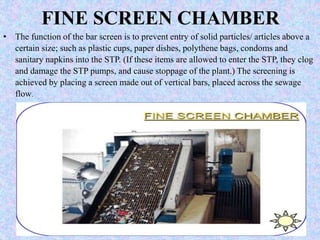
FINE SCREEN CHAMBER 
• The function of the bar screen is to prevent entry of solid particles/ articles above a 
certain size; such as plastic cups, paper dishes, polythene bags, condoms and 
sanitary napkins into the STP. (If these items are allowed to enter the STP, they clog 
and damage the STP pumps, and cause stoppage of the plant.) The screening is 
achieved by placing a screen made out of vertical bars, placed across the sewage 
flow.
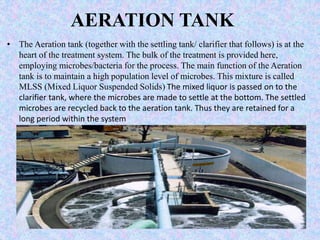
AERATION TANK 
• The Aeration tank (together with the settling tank/ clarifier that follows) is at the 
heart of the treatment system. The bulk of the treatment is provided here, 
employing microbes/bacteria for the process. The main function of the Aeration 
tank is to maintain a high population level of microbes. This mixture is called 
MLSS (Mixed Liquor Suspended Solids) The mixed liquor is passed on to the 
clarifier tank, where the microbes are made to settle at the bottom. The settled 
microbes are recycled back to the aeration tank. Thus they are retained for a 
long period within the system
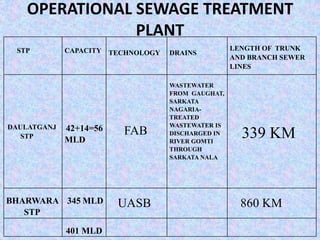
OPERATIONAL SEWAGE TREATMENT 
PLANT 
STP CAPACITY TECHNOLOGY DRAINS 
LENGTH OF TRUNK 
AND BRANCH SEWER 
LINES 
DAULATGANJ 
STP 
42+14=56 
MLD 
FAB 
WASTEWATER 
FROM GAUGHAT, 
SARKATA 
NAGARIA-TREATED 
WASTEWATER IS 
DISCHARGED IN 
RIVER GOMTI 
THROUGH 
SARKATA NALA 
339 KM 
BHARWARA 
STP 
345 MLD UASB 860 KM 
401 MLD
TERTIARY TREATMENT 
Tertiary treatment provides a final stage to raise the effluent quality before it is 
discharged to the receiving environment (sea, river, lake, ground, etc.). More than 
one tertiary treatment process may be used at any treatment plant. If disinfection is 
practiced, it is always the final process. It is also called "effluent polishing" 
Filtration- 
Sand filtration removes much of the residual suspended matter. Filtration over activated 
carbon, also called carbon adsorption, removes residual toxins. 
Lagooning- 
Lagooning provides settlement and further biological improvement through storage in large 
man-made ponds or lagoons. These lagoons are highly aerobic and colonization by native 
macrophytes. 
Disinfection- 
The purpose of disinfection in the treatment of waste water is to substantially reduce the 
number of microorganisms in the water to be discharged back into the environment for the later 
use of drinking, bathing, irrigation, etc.
MAIN PUMPING STATION
CONCLUSION 
1. Both of the existing sewage treatment plants are working properly and the results of treated water are 
observed as per the central pollution control board norms. It has been observed that 100 % of the waste 
water generated is not treated; thus more plants are required. 
2. More foam was observed at site during the visit in the final polishing ponds of the UASB reactor. 
Antifoaming agents are available in the market to remove the foam, and should be used. 
3. Due to the inefficient sewerage network, highly diluted sewage is received at the Bharwara plant due to 
which there is insignificant biogas generation which could otherwise be used for power generation; hence, 
cost recovery. 
4. All treated water is disposed into the Gomti River. The treated water may be used for industrial and 
irrigation purposes. 
5. Several important Water Quality Parameters like Faecal Coliform, Sulphate, Oil and Grease are not 
measured on a regular basis. 
6. For a particular location i.e. fixed land cost, the LCC of the FAB and UASB reactors increases with the 
capacity of the STP but the LCC is lower for the UASB reactor up to a particular value of the STP’s 
capacity; however, the rate of increase is greater for the UASB reactor. 
7. Due to the low LCC of the UASB based Bharwara STP, it is better for a city like Lucknow.
SEWAGE TREATMENT PLANT,LUCKNOW

SEWAGE TREATMENT PLANT,LUCKNOW

  • 1.
    Presentation On SEWAGETREATMENT PLANT,LUCKNOW SHASWAT MISHRA B.TECH (CIVIL) 111000138 AERIAL VIEW OF 345 MLD STP UASB AT BHARWARA
  • 2.
    SEWAGE TREATMENT PLANT • Constructed at a cost of around Rs360 crore, the STP has three channels each of 113mld. The channels are fed by the Gwari pumping station in Gomtinagar drawing sewage from two subsidiary pumping stations each situated on two major canals – Kukrail canal and Ghiasuddin Haider canal. • The two pumping stations would pump their sewage to the Main Pumping Station (MPS) in Gwari culvert that will further pump the sewage to the STP in Bharwara. The STP will produce 400 cubic metres of methane gas per hour, which will generate 1,200-1,500 KW electricity that will be used to run the plant. Work on the Rs169-crore STP project had started in 2008
  • 3.
    GENERAL OUTLINES OFSEWAGE TREATMENT Sewage treatment, or domestic wastewater treatment, is the process of removing contaminants from wastewater, both runoff(effluents)and domestic. It includes physical, chemical and biological processes to remove physical, chemical and biological contaminants. Its objective is to produce a waste stream (or treated )and a solid waste or sludge suitable for discharge or reuse back into the environment. Industrial sources of wastewater often require specialized treatment processes the sewage treatment involves three stages, called primary, secondary and tertiary treatment .First, the solids are separated from the wastewater stream. Then dissolved biological matter is progressively converted into a solid mass by using indigenous, water-borne microorganisms. Finally, the biological solids are neutralized then disposed of or re-used, and the treated water may be disinfected chemically or physically (for example by lagoons and micro-filtration).The final effluent can be discharged into a stream, river , bay, lagoon or wetland, or it can be used for the irrigation of a golf course, green way or park.
  • 4.
  • 5.
    WASTEWATER TREATMENT TECHNOLOGIES SUSPENDED GROWTH PROCESSES In suspended growth processes the microorganisms responsible for treatment are maintained in liquid suspension by appropriate mixing methods. Many suspended growth processes used in municipal and industrial wastewater treatment are operated with a positive dissolved oxygen concentration (aerobic). The most common suspended growth process used for municipal wastewater treatment is the Activated Sludge Process. ATTACHED GROWTH PROCESSES In attached growth processes, the microorganisms responsible for the conversion of organic material or nutrients are attached on inert packing material. The major methods for wastewater treatment are listed below: •Activated sludge systems •Aerated lagoon •Aerobic granular reactor • Aerobic treatment system •Anaerobic clarigester •Anaerobic digestion • API oil-water separator • Anaerobic lagoon • Bead Filter
  • 6.
    CHARACTERISTICS OF WASTEWATER Constituent Concentration, mg/l Strong Medium Weak Total solids 1200 700 350 Dissolved solids (TDS) 850 500 250 Suspended solids 350 200 100 Nitrogen (as N) 85 40 20 Phosphorus (as P) 20 10 6 Chloride1 100 50 30 Alkalinity (as CaCO3) 200 100 50 Grease 150 100 50 BOD5* 300 200 100 1 The amounts of TDS and chloride should be increased by the concentrations of these constituents in the carriage water. *BOD5 is the biochemical oxygen demand at 20°Cover 5 days and is a measure of the biodegradable organic matter in the wastewater.
  • 7.
    IMPORTANT FACTS OFSEWAGE TREATMENT PLANT Around 85% of the land area of Lucknow City is situated on the Central Ganga alluvial plain, and stretches across both banks of the Gomti River Gross available water supply of about 490 MLD – of which around 240 MLD is derived from up to 500 tube wells and 250 MLD from river Gomti. •Cis‐Gomti side are comparatively lower than the areas on Trans‐ Gomti side. •Gomti River flows from NW to SE through the heart of the city. •26 drains join the river, 14 drains from cis‐Gomti and 12 drains from trans‐Gomti side. •Out of 14 cis‐Gomti side drains, 12 drains are located in the upstream and 2 are located into downstream of Barrage. •All of the 12 Trans‐Gomti drains merge into river Gomti in the upstream of Barrage. The total project cost for the overall projects is estimated at Rs. 2054.63 crore with the bulk Of investments proposed in Phase 2 of the JNNURM. There is a provision of Rs. 625.97 Crores in Phase‐I (2006‐11) and Rs. 1428.67 Crores in Phase‐II (2012‐2031) of City Development Plan of Lucknow
  • 9.
    SEWAGE DISTRICTS •The overall sewerage scheme consists of 4 separate Sewerage Districts each with its own (planned) treatment plant: • a) District I: Chowk, Hardoi Road, Cambell Road and Dubagga etc. area conveying sewage to existing Daulatganj STP • b) District II: Amausi area and Sarojini Nagar area conveying sewage to proposed Khwajapur STP • c) District III: Total Trans‐Gomti side including Indira Nagar, Gomti Nagar and Sitapur road areas conveying sewage to Bharwara STP which is sanctioned under Gomti Action Plan Phase‐II and in process of construction. • d) District IV: Cis Gomti side conveying sewage to proposed Mastemau STP
  • 10.
    FINE SCREEN CHAMBER • The function of the bar screen is to prevent entry of solid particles/ articles above a certain size; such as plastic cups, paper dishes, polythene bags, condoms and sanitary napkins into the STP. (If these items are allowed to enter the STP, they clog and damage the STP pumps, and cause stoppage of the plant.) The screening is achieved by placing a screen made out of vertical bars, placed across the sewage flow.
  • 11.
    AERATION TANK •The Aeration tank (together with the settling tank/ clarifier that follows) is at the heart of the treatment system. The bulk of the treatment is provided here, employing microbes/bacteria for the process. The main function of the Aeration tank is to maintain a high population level of microbes. This mixture is called MLSS (Mixed Liquor Suspended Solids) The mixed liquor is passed on to the clarifier tank, where the microbes are made to settle at the bottom. The settled microbes are recycled back to the aeration tank. Thus they are retained for a long period within the system
  • 12.
    OPERATIONAL SEWAGE TREATMENT PLANT STP CAPACITY TECHNOLOGY DRAINS LENGTH OF TRUNK AND BRANCH SEWER LINES DAULATGANJ STP 42+14=56 MLD FAB WASTEWATER FROM GAUGHAT, SARKATA NAGARIA-TREATED WASTEWATER IS DISCHARGED IN RIVER GOMTI THROUGH SARKATA NALA 339 KM BHARWARA STP 345 MLD UASB 860 KM 401 MLD
  • 13.
    TERTIARY TREATMENT Tertiarytreatment provides a final stage to raise the effluent quality before it is discharged to the receiving environment (sea, river, lake, ground, etc.). More than one tertiary treatment process may be used at any treatment plant. If disinfection is practiced, it is always the final process. It is also called "effluent polishing" Filtration- Sand filtration removes much of the residual suspended matter. Filtration over activated carbon, also called carbon adsorption, removes residual toxins. Lagooning- Lagooning provides settlement and further biological improvement through storage in large man-made ponds or lagoons. These lagoons are highly aerobic and colonization by native macrophytes. Disinfection- The purpose of disinfection in the treatment of waste water is to substantially reduce the number of microorganisms in the water to be discharged back into the environment for the later use of drinking, bathing, irrigation, etc.
  • 15.
  • 16.
    CONCLUSION 1. Bothof the existing sewage treatment plants are working properly and the results of treated water are observed as per the central pollution control board norms. It has been observed that 100 % of the waste water generated is not treated; thus more plants are required. 2. More foam was observed at site during the visit in the final polishing ponds of the UASB reactor. Antifoaming agents are available in the market to remove the foam, and should be used. 3. Due to the inefficient sewerage network, highly diluted sewage is received at the Bharwara plant due to which there is insignificant biogas generation which could otherwise be used for power generation; hence, cost recovery. 4. All treated water is disposed into the Gomti River. The treated water may be used for industrial and irrigation purposes. 5. Several important Water Quality Parameters like Faecal Coliform, Sulphate, Oil and Grease are not measured on a regular basis. 6. For a particular location i.e. fixed land cost, the LCC of the FAB and UASB reactors increases with the capacity of the STP but the LCC is lower for the UASB reactor up to a particular value of the STP’s capacity; however, the rate of increase is greater for the UASB reactor. 7. Due to the low LCC of the UASB based Bharwara STP, it is better for a city like Lucknow.