Module for CEE, CGE, CCE, CSE, CWE students
College of Science and Technology
School of Engineering
Department of Civil, Environmental and Geomatic Engineering
TRE 2161:
Design of Drainage Structures
Unit V. Wastewater collection and
disposal
3
6.0 Basic terms about wastewater
6.1 Sources of Wastewater
6.2 Components of Wastewater Engineering
6.3. Types of Sewers
6.4. Sewage Pumps and their use
6.4. Wastewater collection
Contents of this Unit V
Basic terms about
wastewater
Objectives
1. To Learn Basic Concepts of wastewater
engineering (Origin , Quantities ,
Characteristics and Carriage etc.)
2. To design Wastewater Collection system
3. To Design various Wastewater treatment
processes
• Text Book
Water supply & Sewerage by E.W Steel and Mcghee
• Reference Books
1. Wastewater Engineering, Treatment , Disposal,
Reuse by Metcalf and Eddy , 3rd Edition
2. Water and Wastewater Engineering by Fair and
Geyer
3. Water and Wastewater Technology by Masle
J.Hammer
Basic Terms
• Sewage: It is the Liquid Waste or Wastewater
produced as a result of water use.
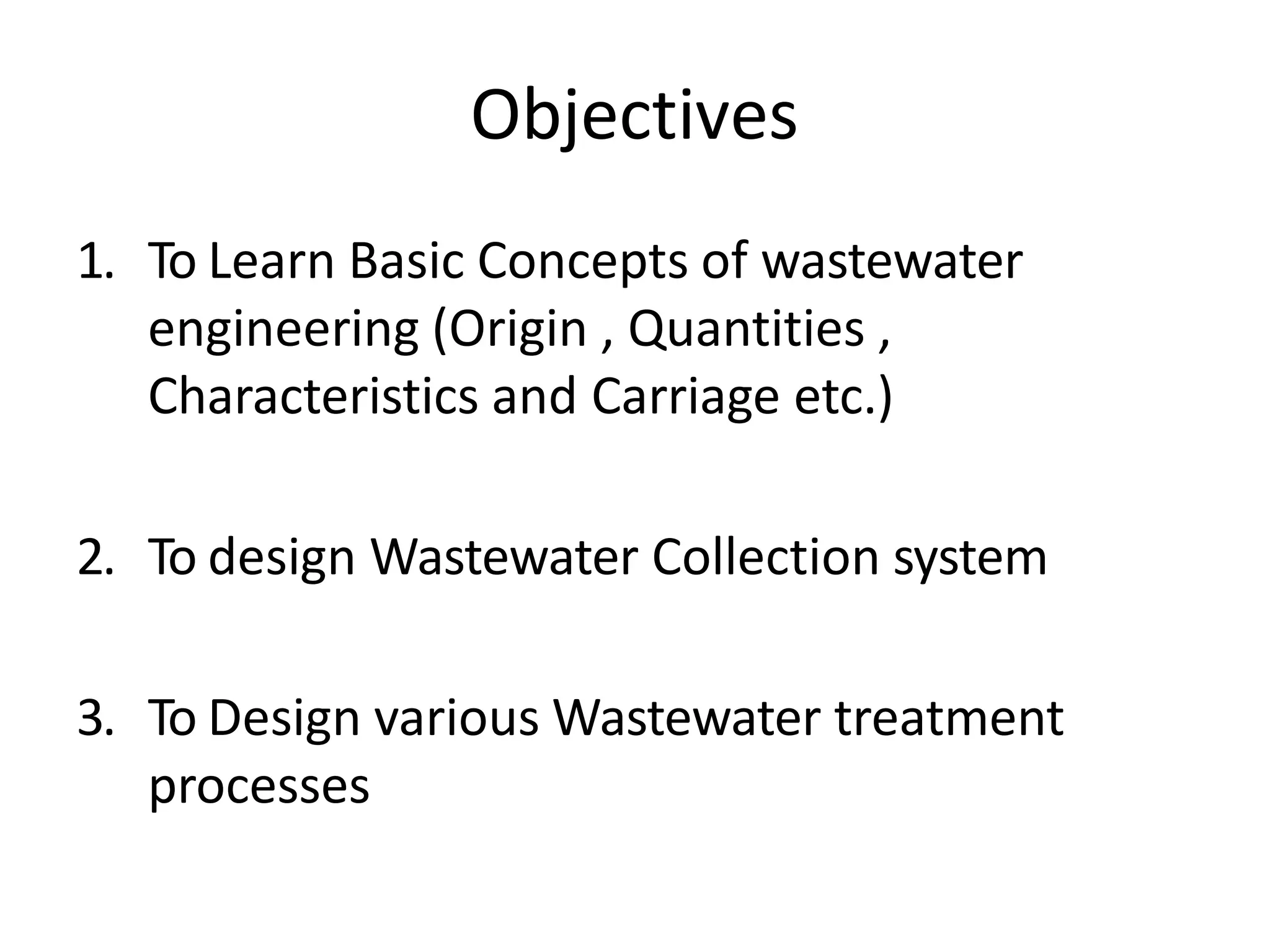
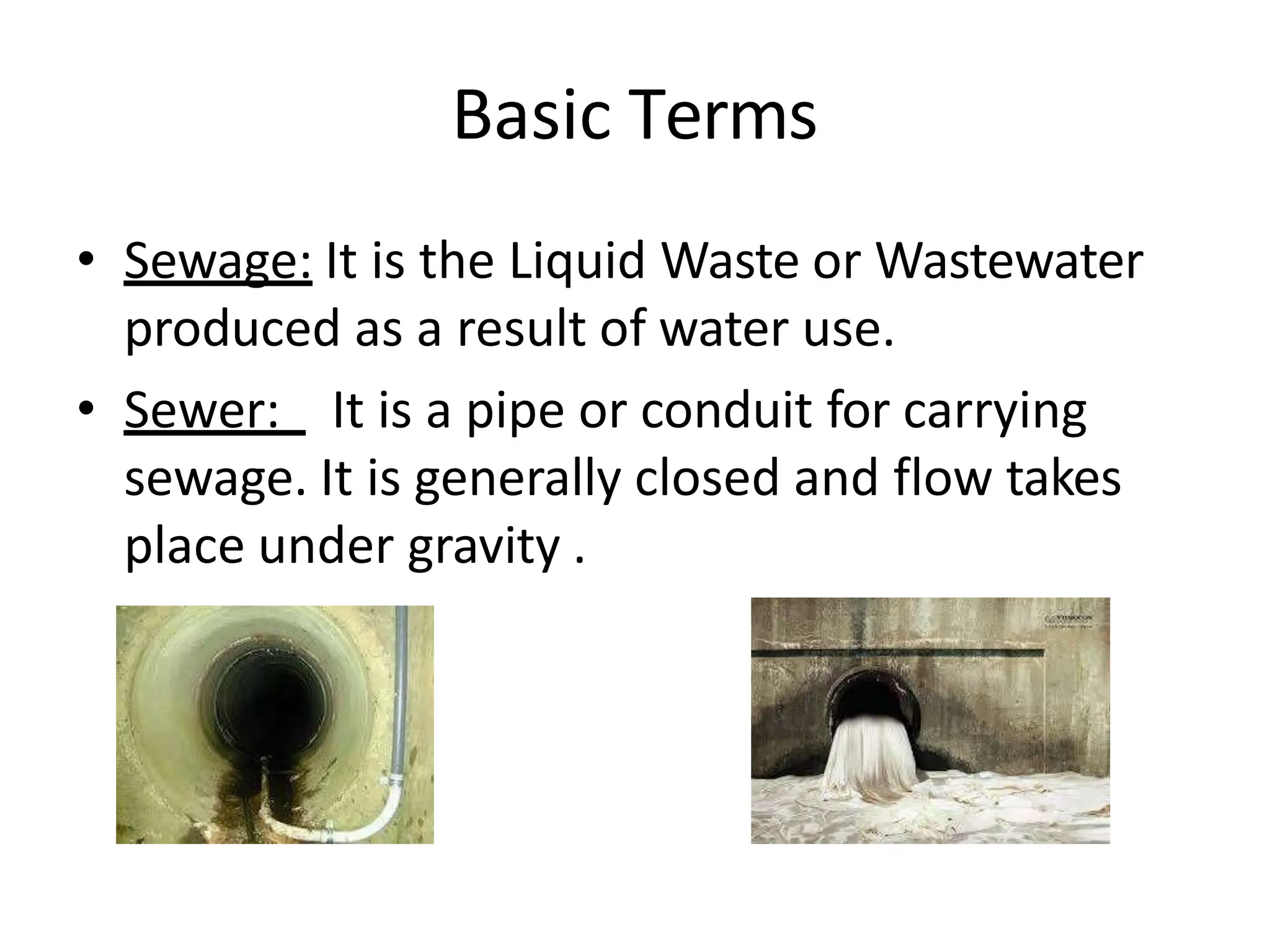
• Sewer: It is a pipe or conduit for carrying
sewage. It is generally closed and flow takes
place under gravity .
• Sewerage: Sewerage is the system of collection of
wastewater and conveying it to the point of disposal
with or without treatment.
Sources of Wastewater
1.Dometic: It is wastewater from houses offices,
other buildings, hotels and institutions
2.Industrial: It is the liquid waste from industrial
process
3.Storm-water: It includes surface run-off
generated by rainfall and the street wash
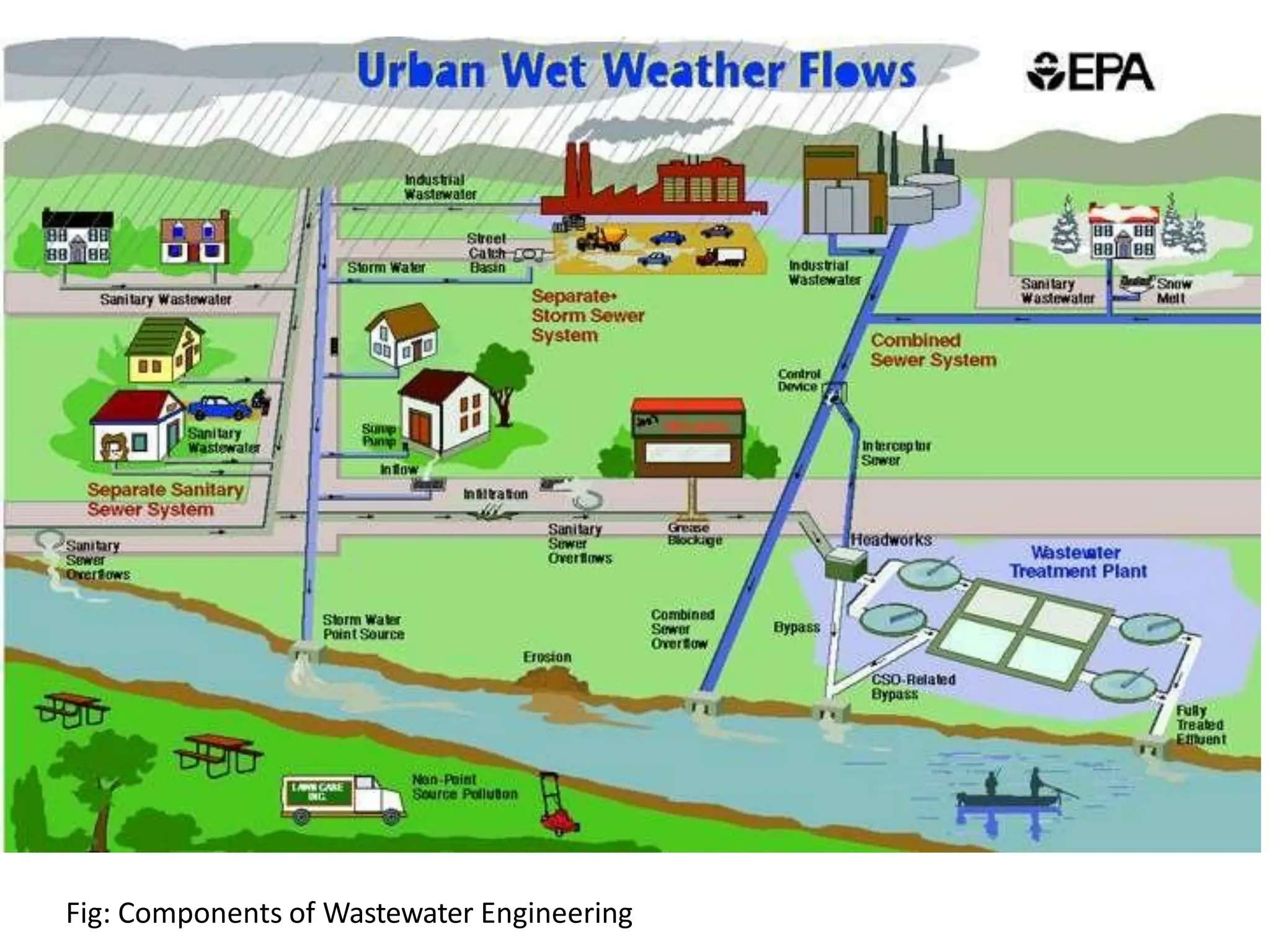
Components of Wastewater
Engineering
1. Collection System  Network of Sewer pipes
2. Disposal  Sewage Pumping Stations and
Outfalls
3.Treatment Works  Wastewater treatment
Plants
Fig: Components of Wastewater Engineering
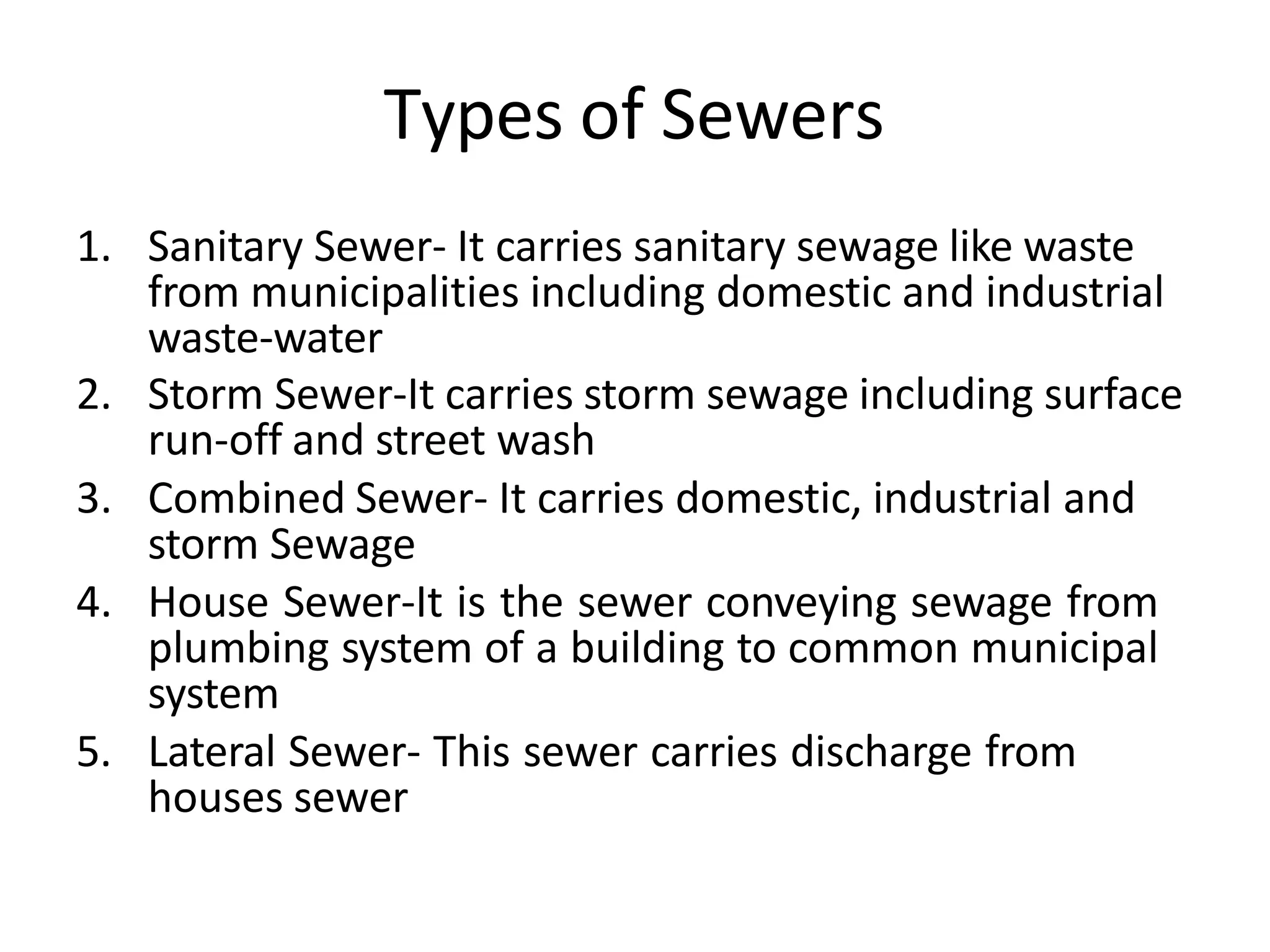
Types of Sewers
1. Sanitary Sewer- It carries sanitary sewage like waste
from municipalities including domestic and industrial
waste-water
2. Storm Sewer-It carries storm sewage including surface
run-off and street wash
3. Combined Sewer- It carries domestic, industrial and
storm Sewage
4. House Sewer-It is the sewer conveying sewage from
plumbing system of a building to common municipal
system
5. Lateral Sewer- This sewer carries discharge from
houses sewer
Types of Sewers
6.Sub-main-This sewer receives discharge from two or
more laterals
7.Main/Trunk Sewer- Receives discharge from two or
more sub-mains
8.Outfall Sewer- It receives discharge from all
collecting system and conveys it to the point of final
disposal
Lateral
Main/Trunk
Sewer
Sub-main
sewer
Outfall sewer
House
Sewer
Fig: Types of Sewers
Types of Sewer Systems
• 1. Separate System
If storm water is carried separately from domestic
and industrial wastewater the system is called as
separate system.
Separate systems are favored when
(i) There is an immediate need for collection of the
sanitary sewage but not for storm water.
(ii) When sanitary sewage needs treatment but the
storm water does not.
Types of Sewer Systems
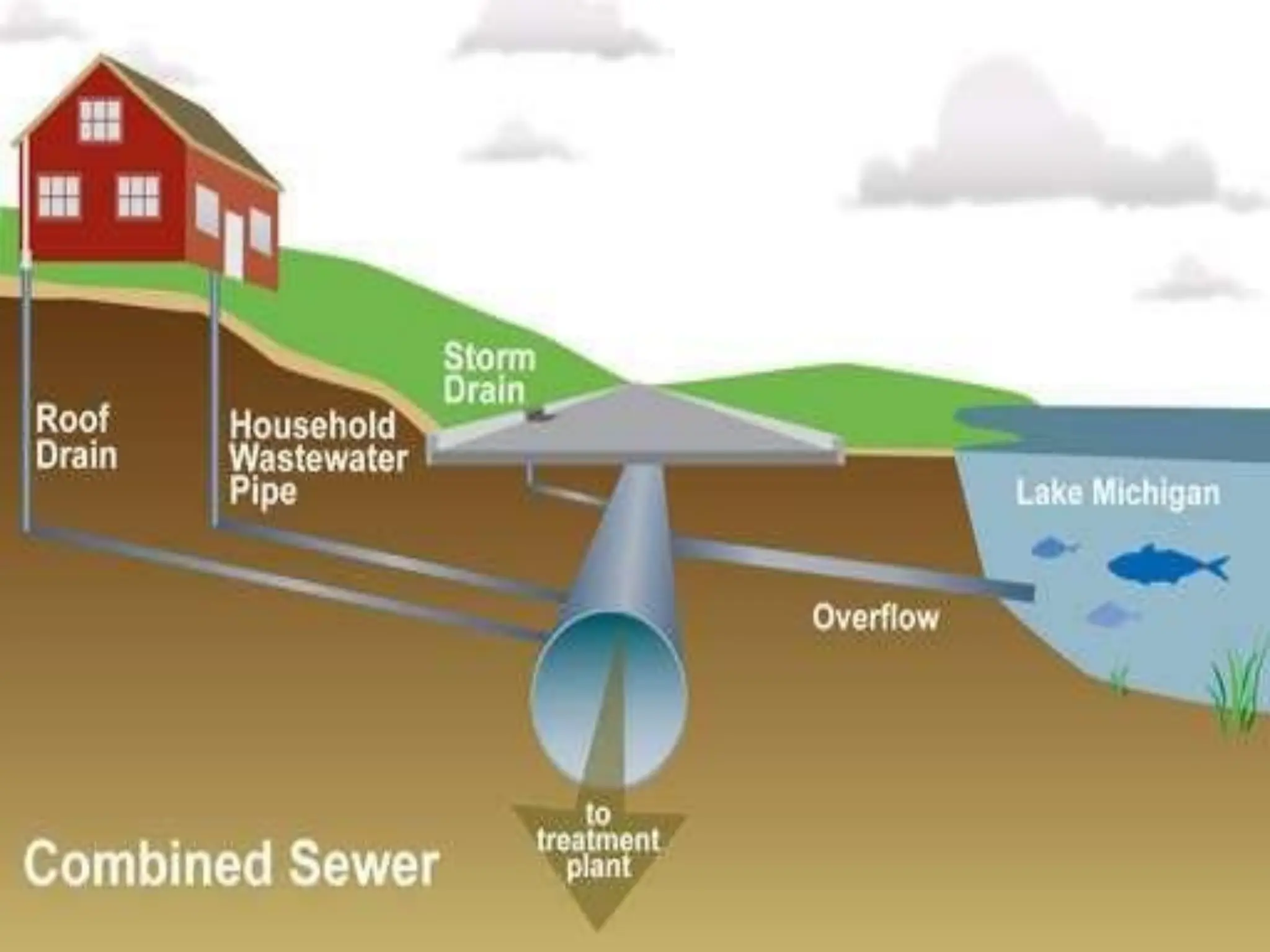
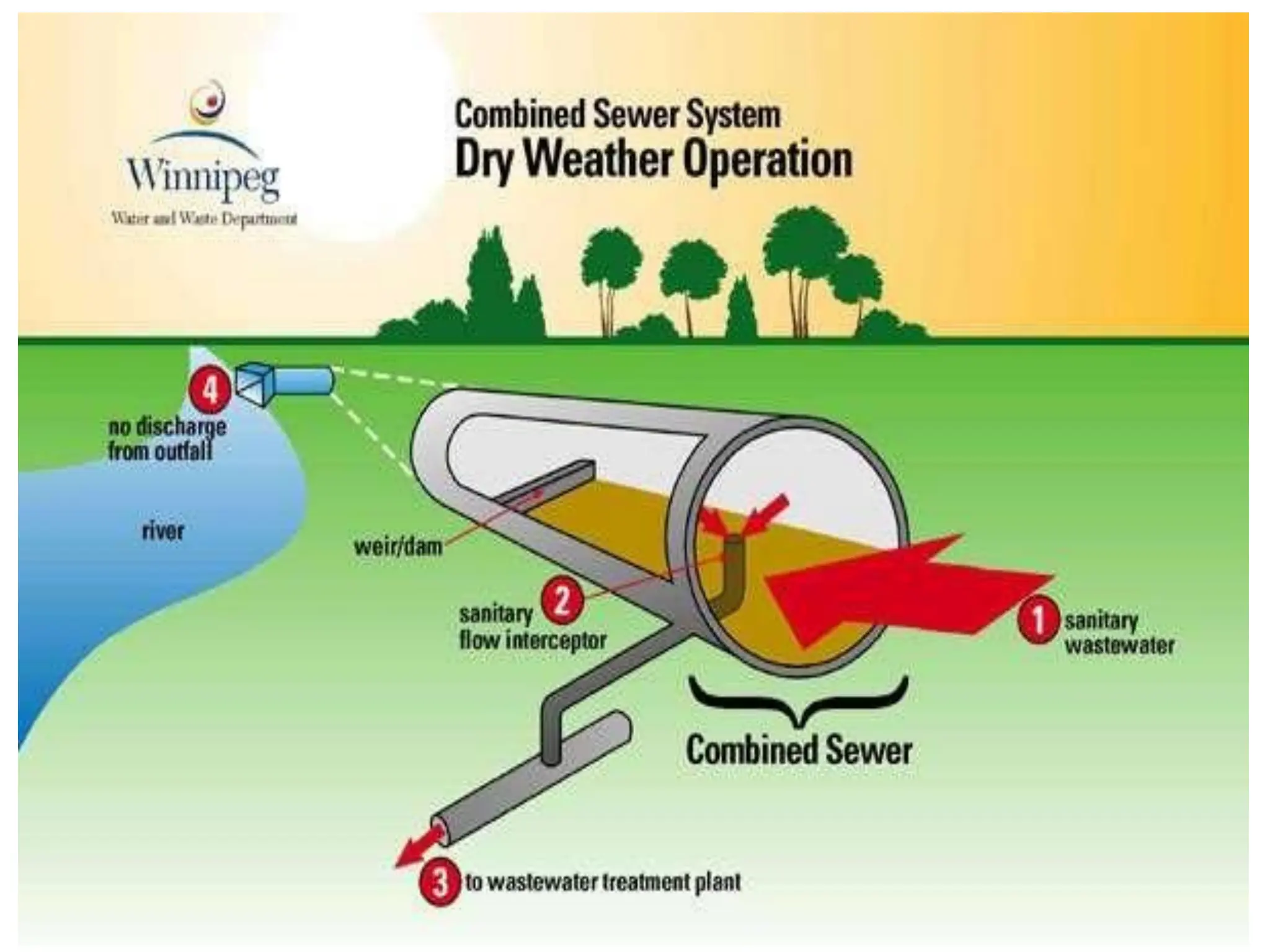
2. Combined System
It is the system in which the sewers carry both
sanitary and storm water, combined system is
favored when;
(i) Combined sewage can be disposed off without
treatment
(ii) Both sanitary and storm water need treatment
(iii) Streets are narrow and two separate sewer
cannot be laid
Types of Sewer Systems
3. Partially Combined System
If some portion of storm or surface run-off is
allowed to be carried along with sanitary
sewage the system is known as partially
combined system.
(In Urban area of developing countries, mostly
partially combined system is employed as it is
economical)
In Pakistan we use this system
Note
• Sanitary wastewater is not allowed to
discharge in any stream
• When there is storm water inside the sewer
some portion of sanitary sewer might go as its
effects would be less since due to dilution
• Sanitary wastewater remains at the bottom
usually because of high density than storm
water
Infiltration
• It is the wastewater that enters sewers through
joints, cracked pipes, walls and covers of the
wholes
• Infiltration is almost non-existent in dry weather
but increases during rainy season
• Water and Sanitation Agency (WASA) Lahore uses
the following infiltration rates for the design of
sewer system.
Pipe dia. Up to 600mm  5% avg. sewage flow
for greater than 600mm 10% avg. sewage flow
Sewage Generation & Water
Consumption
• Around 70-130% of water consumed gets into
sewers
1. Industries with private point of discharge
2. Poor Sewer joints
General Range 70-90% of water consumption
when infiltration is taken into consideration
then
Avg. sewage flow equals the avg. rate of water
consumption
Variation in Sewage Flow
• Like Water Supply the sewage flow varies from
time to time since the sewers must be able to
accommodate the max. rate of flow the
variation in sewage flow need to studied
(1). HERMAN FORMULA: is used to estimate the
ratio of max. to avg. flow
M=
𝑄𝑚𝑎𝑥
.𝑄𝑎𝑣𝑔
.
= 1 +
14
4+ 𝑃
P = Pop. In 1000
M = Peak Factor
Variation in Sewage Flow
Water Supply & Sanitation Agency(WASA), Lahore consider the
following relationship for sewer design
Average Flow (m3/day) Peak Factor
< 2500 4
2500-5000 3.4
5000-10000 3.1
10000-25000 2.7
25000-50000 2.5
50000-100000 2.3
100000-250000 2.15
>500000 2
Variation in Sewage Flow
• Minimum rate of Sewage Flow
Generally taken as 50% of avg. sewage
- It is used in the design of sewage pumping
station
- To investigate the velocities in sewer during
Low Flow periods
Numerical
• The residential area of a city has a population
density of 15000 per/ Km2 and an area of
120,000 m2. If the average water consumption
in 400 lpcd. Find the average sewage flow and
the maximum sewage flow that can be
excepted in m3/day.
Design Period and Use of Sewage Flow
Data
1. Design of Sewer System.
Period of design is indefinite as the system is
designed to care for the maximum development
of area
-Use of Qmax (maximum flow) for sewer design
-Use of Qmin (minimum flow) to check velocities
during low flow
Design Period and Use of Sewage Flow
Data
2. Design of sewage pumping station
-Design period is usually 10 years
-We consider average daily flow , peak and
minimum flow including infiltration
3. Design of sewage treatment Plants
-Design period is usually 15-20years,
-Require data of average flow , infiltration , peak
flow
Sewage Pumps
&
Their Uses
Submitted by www.pumpkart.com
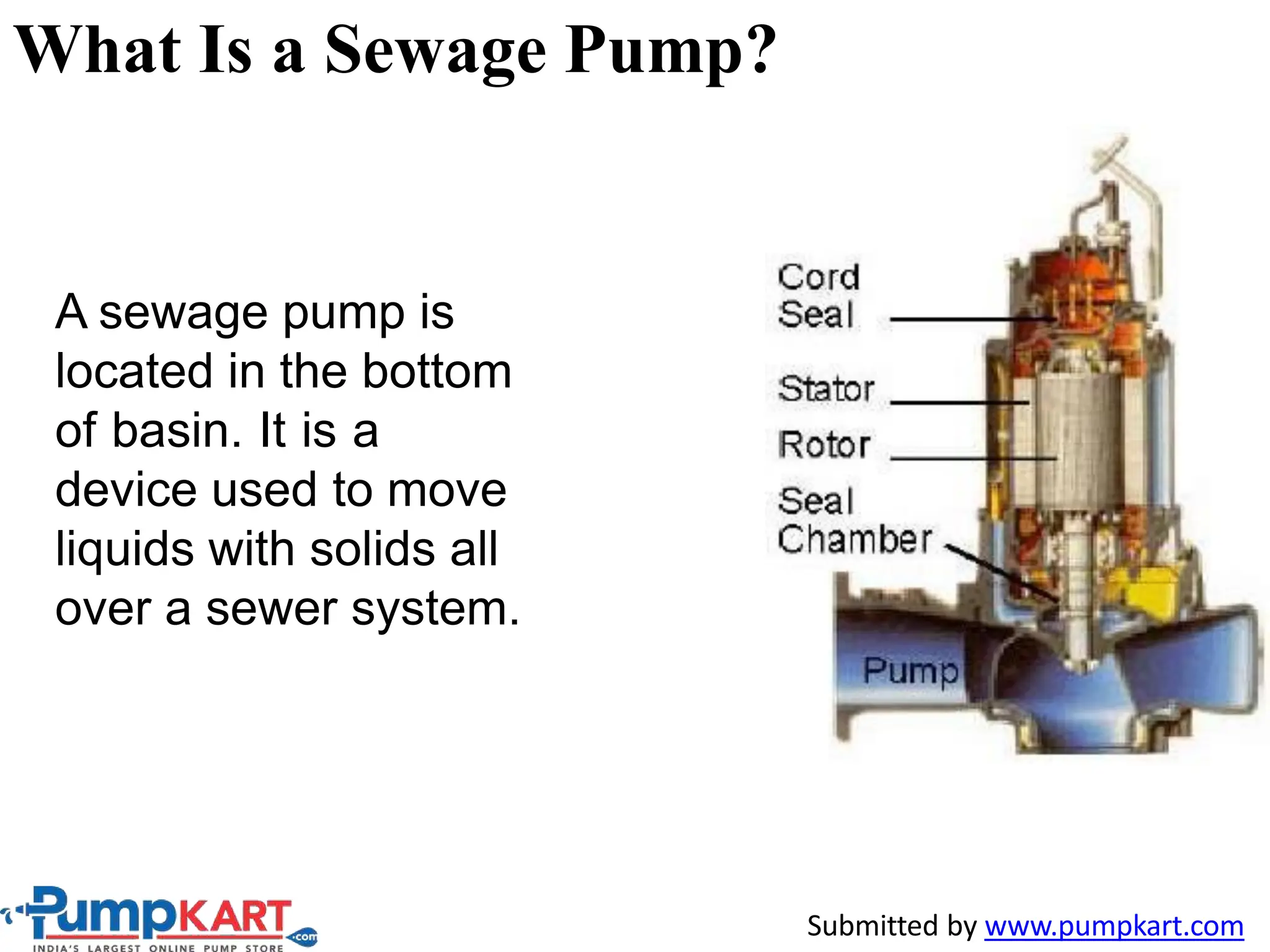
What Is a Sewage Pump?
A sewage pump is
located in the bottom
of basin. It is a
device used to move
liquids with solids all
over a sewer system.
Submitted by www.pumpkart.com
Sewage Pumps designed to drain out wasted
liquids and semi-solids that contaminated in the
home basements and other secluded areas
Submitted by www.pumpkart.com
They Work Automatically
The pump switch is activated automatically as the liquid reachesa specific
point
The pump switchesoff when the liquid goes down to a certain point
Users Safefor functioning
Submitted by www.pumpkart.com
These pumps
can be
submersed into
the liquid
Submitted by www.pumpkart.com
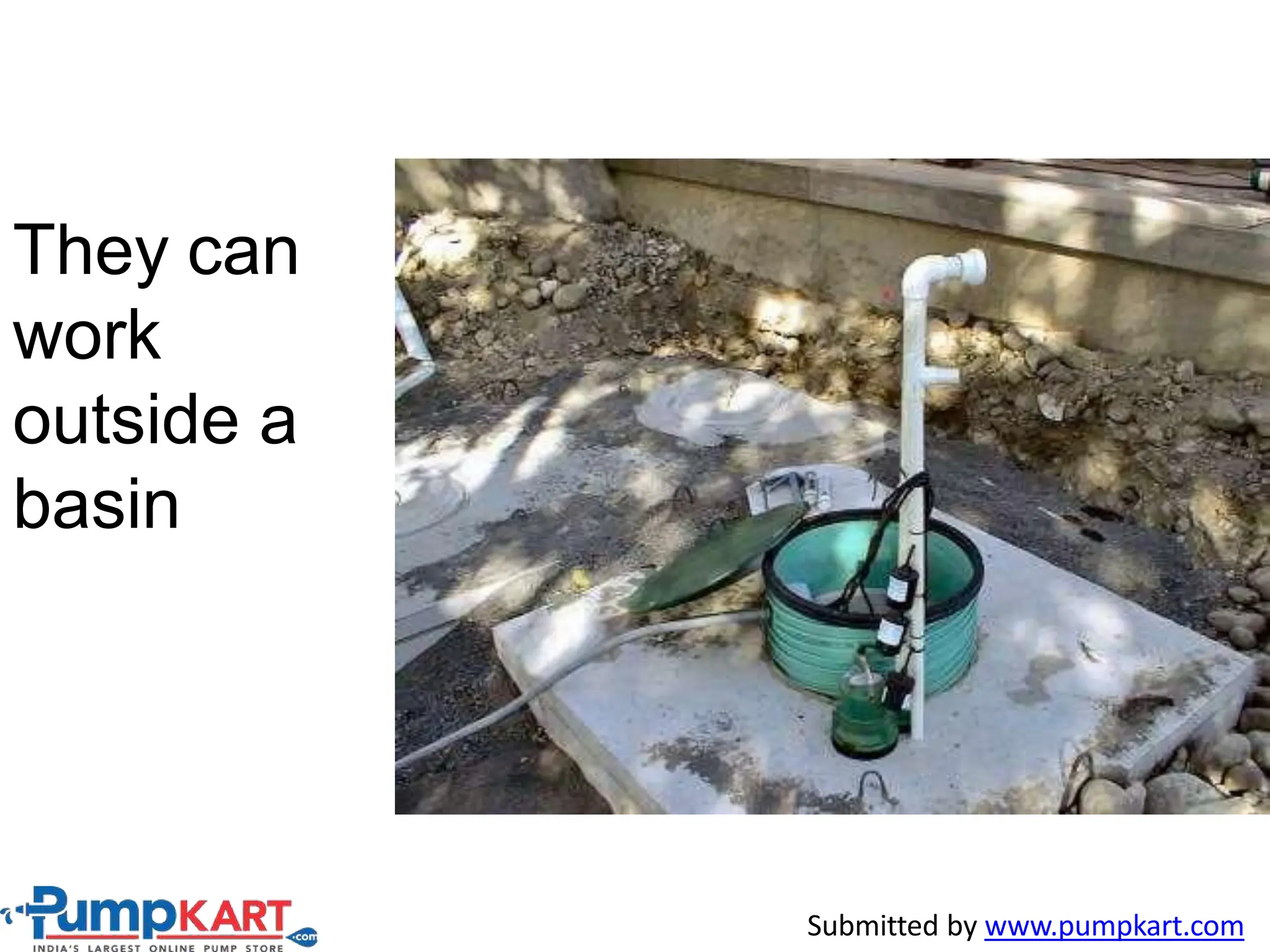
They can
work
outside a
basin
Submitted by www.pumpkart.com
Most of them are efficient
to handle up to 2” solids
Submitted by www.pumpkart.com
More powerful
pumps need to be
used for a higher
and longer lifting of
the waste
Submitted by www.pumpkart.com
When thinking of
buying a pump,
don’t forget to
take advice from a
plumber to select
the right
horsepower
sewage pump!
Submitted by www.pumpkart.com
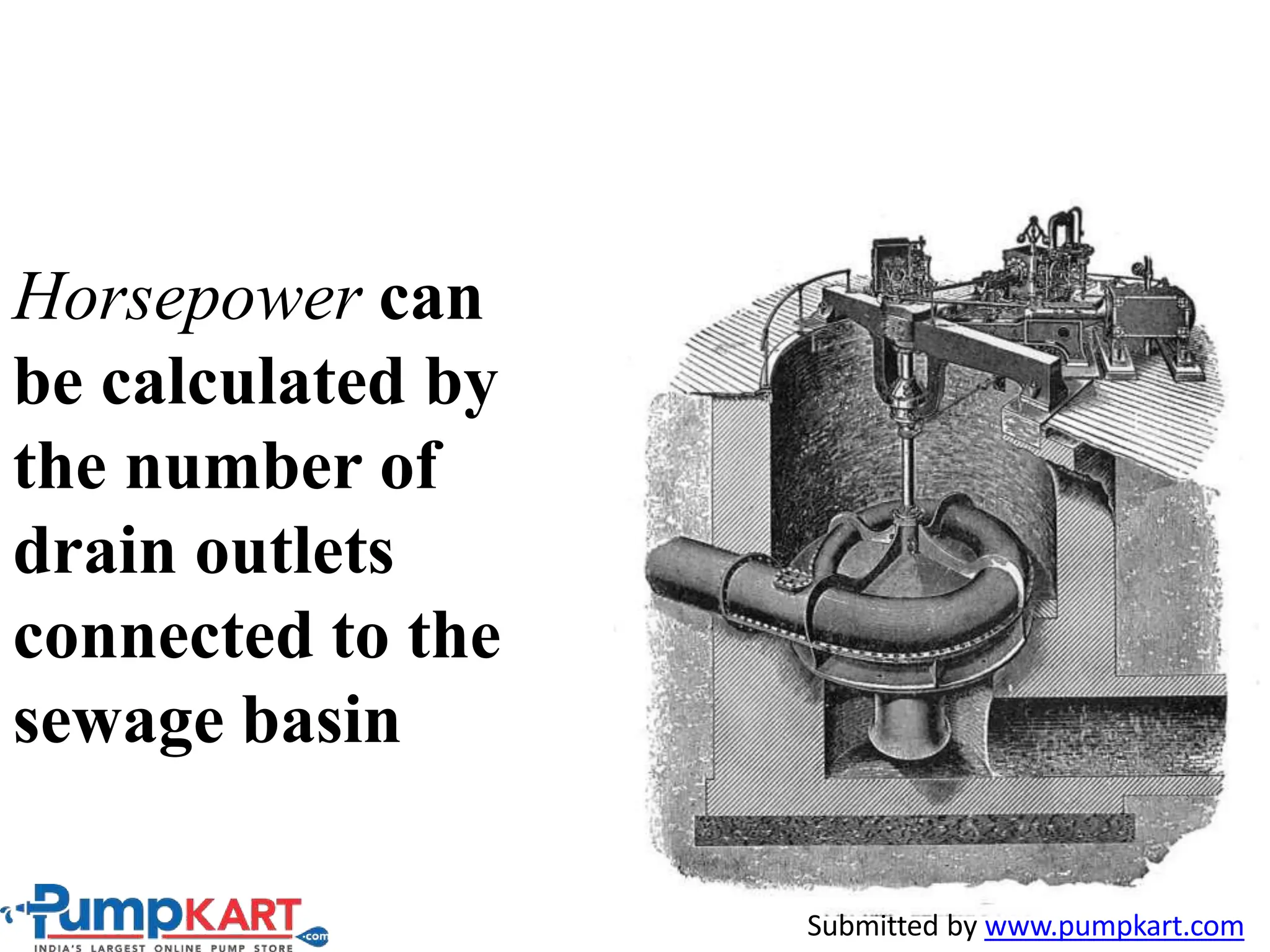
Horsepower can
be calculated by
the number of
drain outlets
connected to the
sewage basin
Submitted by www.pumpkart.com
Must Visit at
www.pumpkart.com to Buy
a Long Lasting Sewage
Pump
Submitted by www.pumpkart.com
L-9
Sewage Pumping
Environmental Engineering-
II
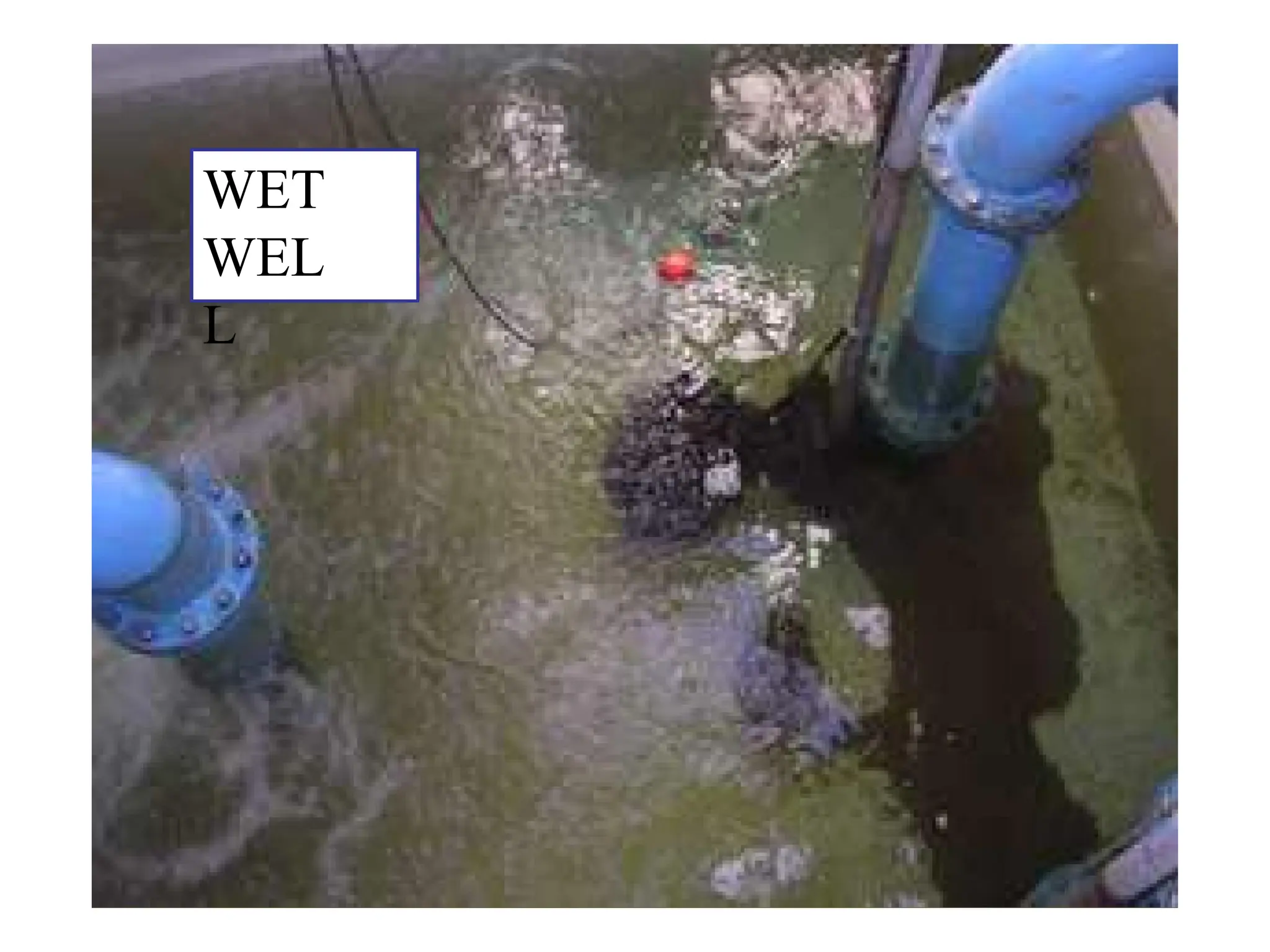
WET
WEL
L
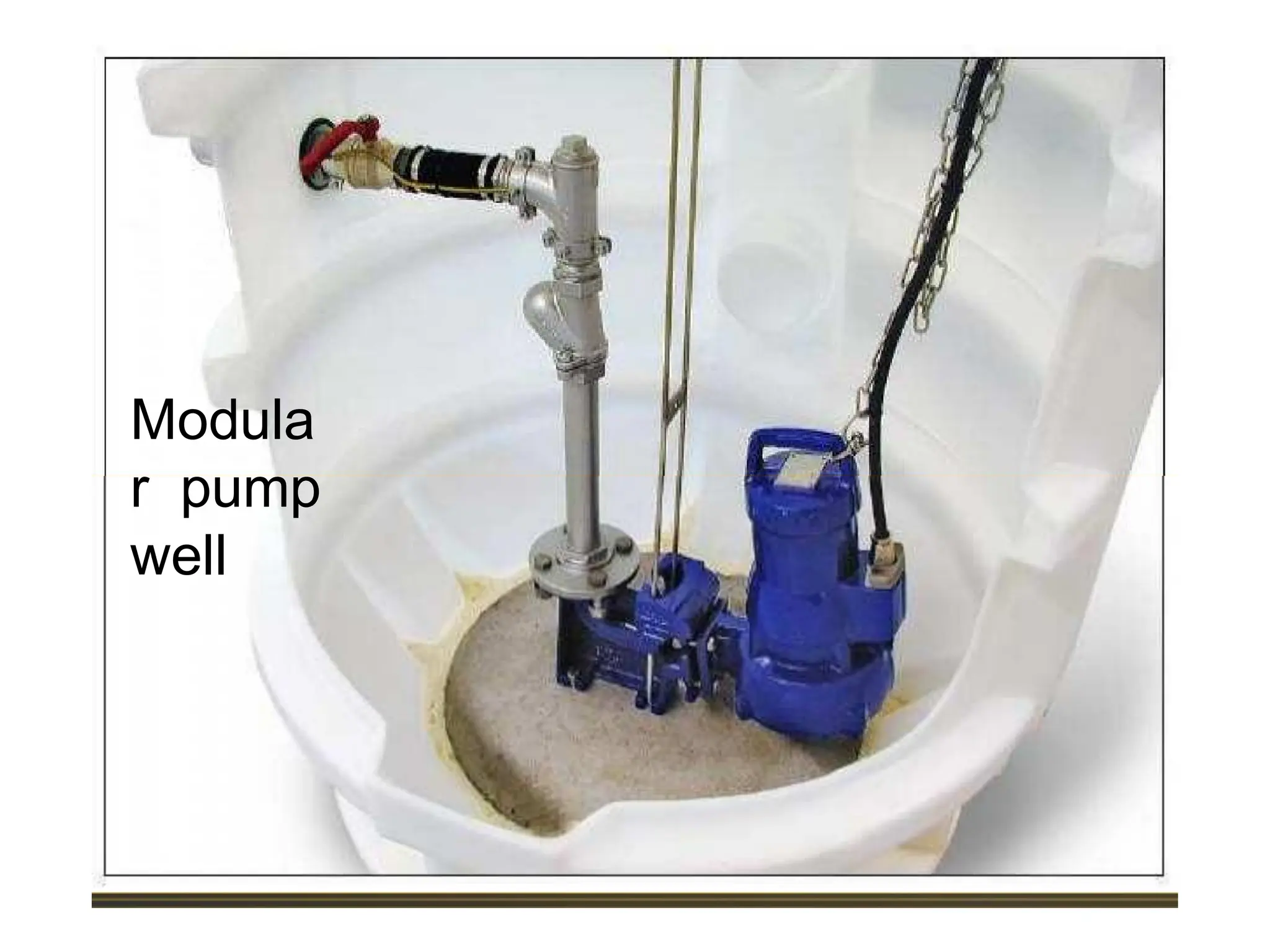
Modula
r pump
well
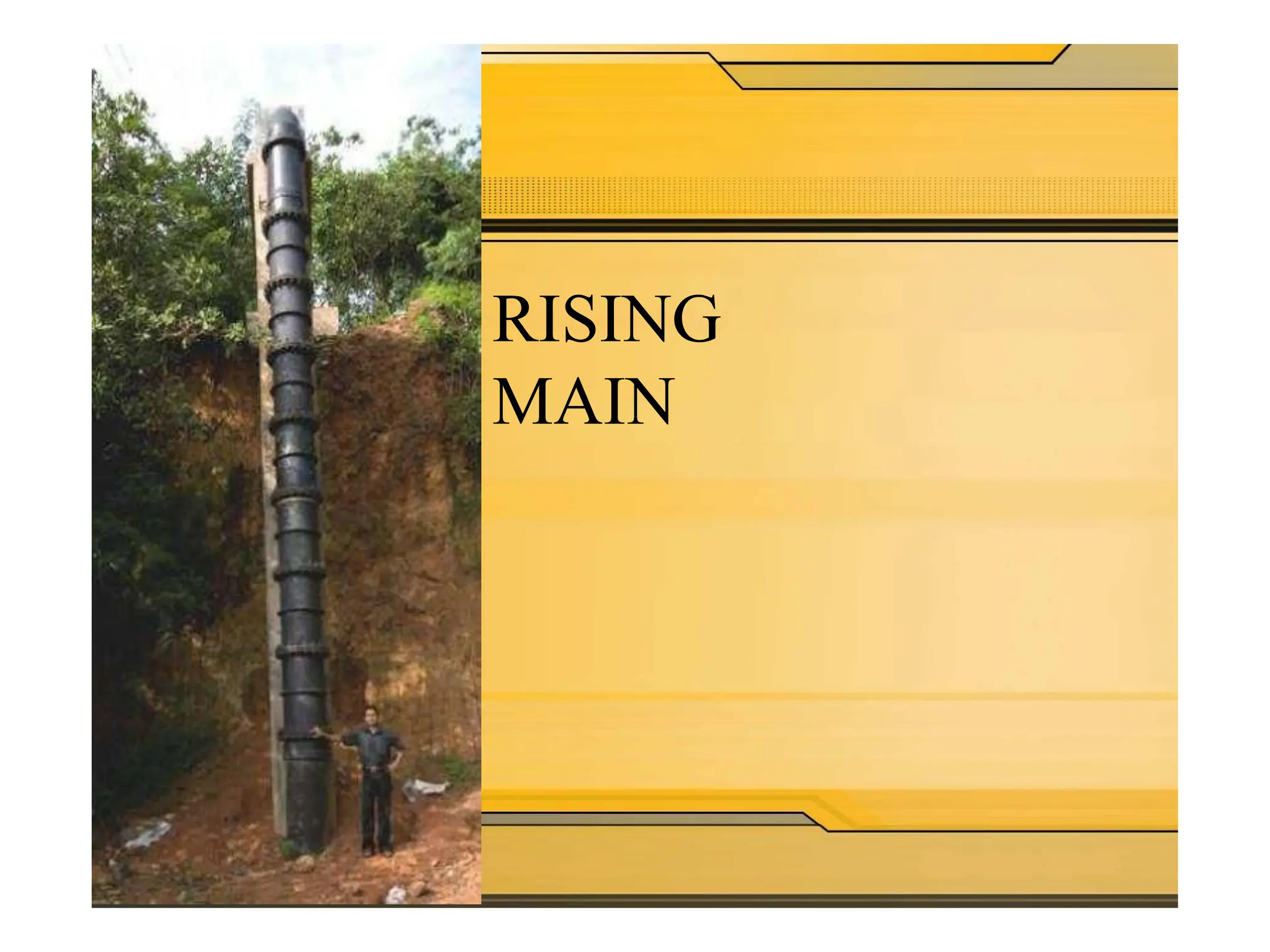
RISING
MAIN
The need for sewer pumping
stations
arises when
• The existing topography and required
minimum sewer grades create deep
sewers that have high construction
costs. The sewage is raised and then
conveyed by gravity.
• Basements are too low to discharge
sewage to the main sewer.
• Sewage must be conveyed over a ridge.
• The sewage must be raised to get
head for gravity flow through a
treatment plant.
• Discharge outlets are below the
level of the receiving body of
water.
Problems is sewage
pumping
1. Sewage has foul characteristics
2. Sewage has lot of suspended solids and
floating matter. Which may make running
of pumps difficult and may cause frequent
clogging of pumps.
3. Sewage may contain organic and inorganic
waste, which may cause corrosion and
errosion of parts of the pumps and reduce
life of pumps.
4.Sewage contains pathogens which may
cause health problems to working persons
at sewage pumping station.
5.The rate sewage flow varies hourly hence
rate of pumping has to be adjusted
accordingly
6.Size of sump is limited since large size
of sump results in settlement of solids
and organic matter at its bottom.
7.Pumps should be of high order reliability
since failure of pumps will lead to flooding
of adjoining areas.
Pumping
station
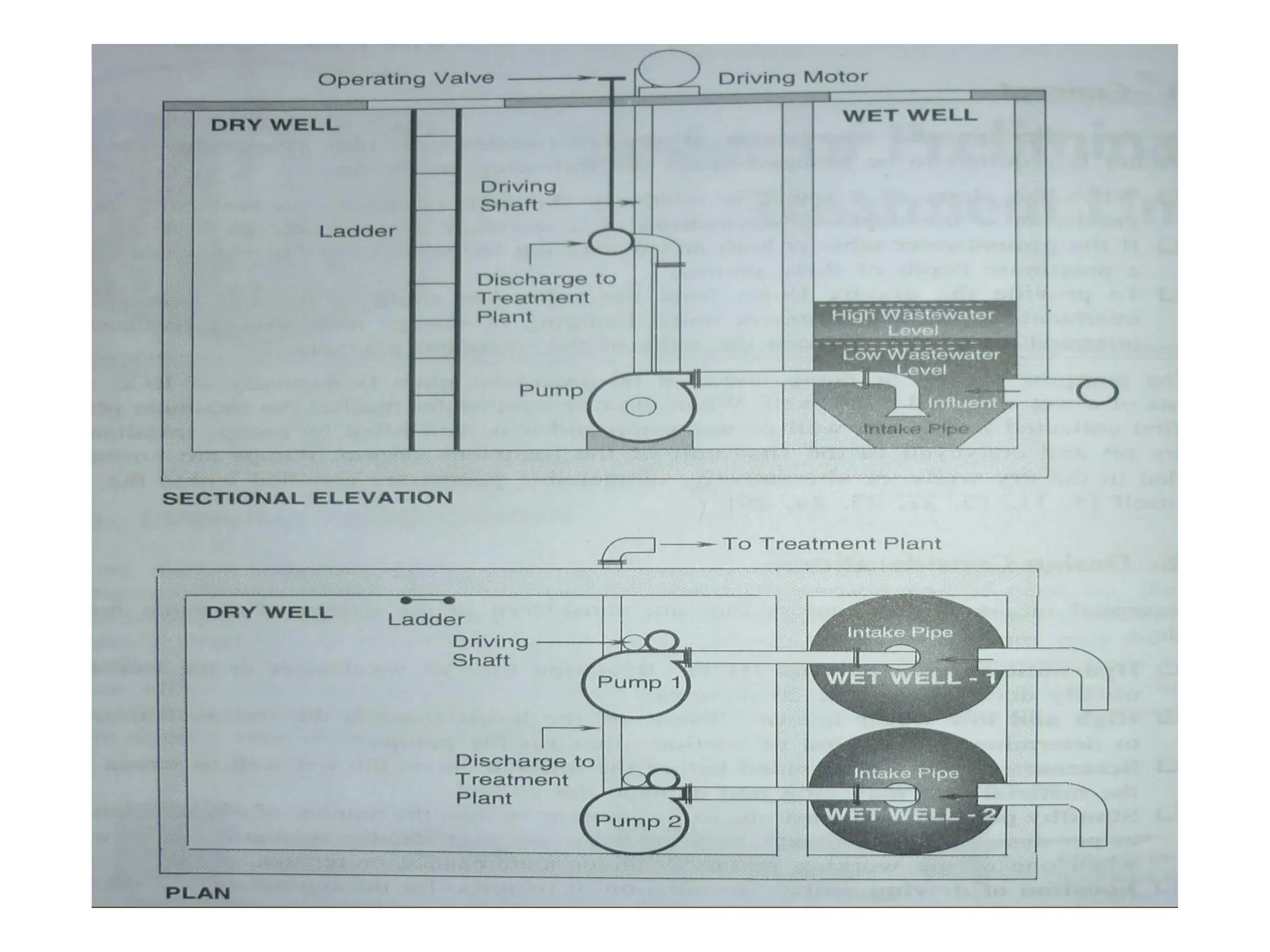
• Dry well :- For housing the pumps
• Wet well: - For incoming sewage.
• Rising main:- To led the pumped
sewageto high leveled gravity sewer.
• Pumps used:- Centrifugal, Reciprocating,
Propeller of axial flow, Air pressure
pumps or ejectors
Design
criteria
1. Hydraulic retention time HRT:- retention
time of wet well usually does not exceed
20 min.
2. High and low water levels:- These are
fixed in the wet well in order to
determine position of suction pipes for
the pumps.
3. Screens :- these are required to remove
floating matter that may clog and
damage the pump
4.Standby pumps :- At least one extra pump
more than the pumps required per design,
should always be provided to act as standby
so that it can be used when one of the
working pimps under maintainance or
repair
5.Additional Space :- Provision for extra space
for dy wells in the design of the pump house
to install additional pumps in future should
be kept at initial planning stage itself
Formulae
used
1. For finding frictional losses
in pipe
hf= (fLv2/2gd)
v= velocity of flow in rising
main d= dia of
rising main
L= length of pipe
2. Power of pump
P=(w.Qp.H)/(75ηpηm
)
w= density of water in
kg/m3 Qp=Flow to be lifted
by pump H= total head
ηp ηm= Efficiency of pump and
driving motor resp.
Objective
Questions
1. matter may
clog the pump.
2. and wells
are provided in pumping stations.
3.Dry well is required for
.
4.Wet well is required for
.
Theory
questions
Q1. Write short note on
1. Sewage pumping
2. Difficulties in sewage pumping
3. Design of sewage pumping
station
Wastewater Collection
Types of Sewer Systems
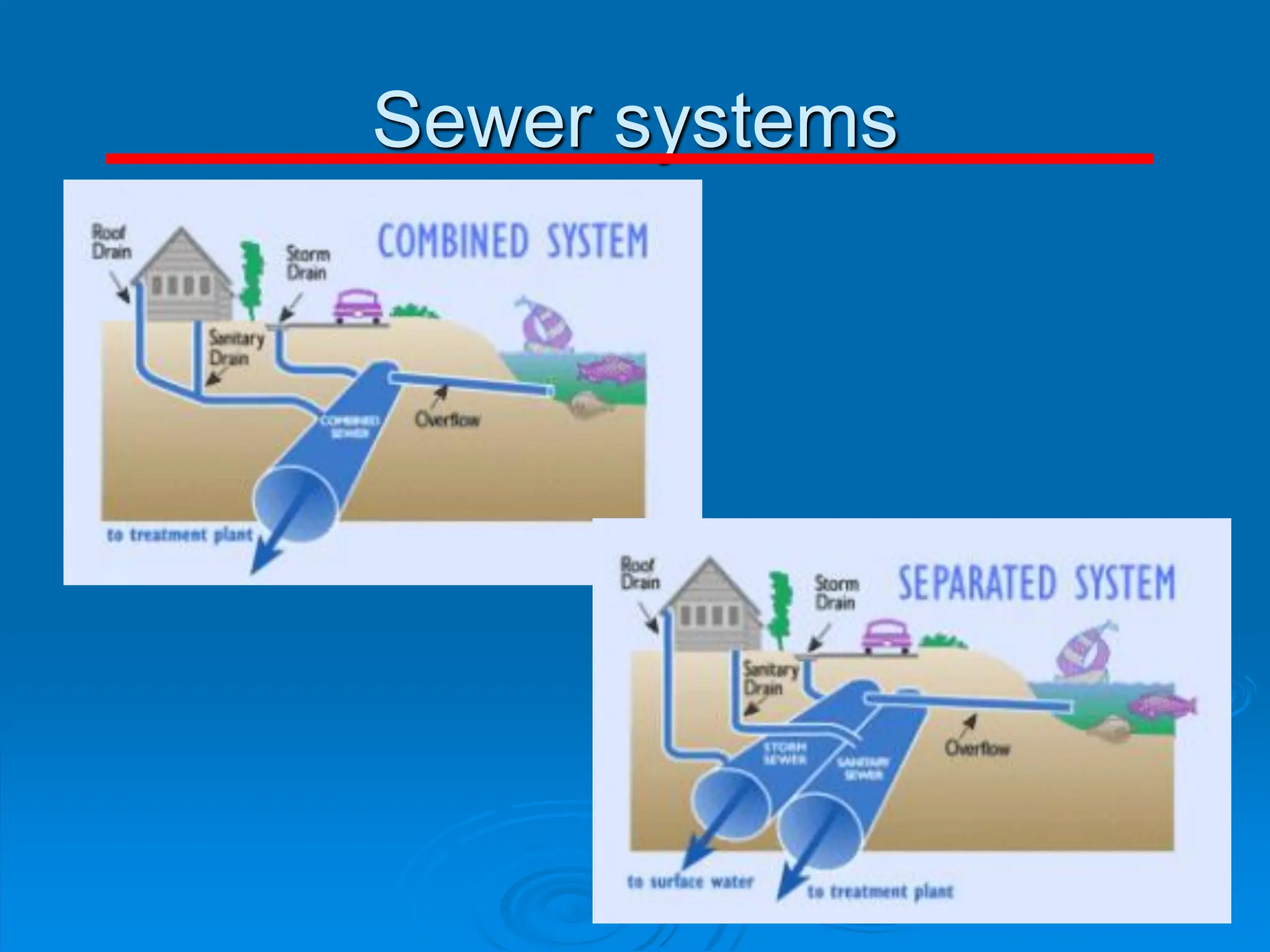
 Combined
• In wet weather, both wastewater and stormwater
flow in same system
• If flow is too high, untreated water is discharged
into river (or channels in tehran)
 Separate
• Wastewater and stormwater flow in separate
sewer systems
Sewer systems
Sewer Basics
 Collection and transport of wastewater from each
home/building to the point where treatment occurs.
 Wastewater Characterization
 Solids
 Liquids
 Pipe System
 Plastic
 Ductile iron
 Concrete/lined
 Bricks
Satellite Wastewater Management
 Also called “decentralized” or “distributed”
 Undertaken by utilities for a variety of reasons:
 Economics
 To reuse water locally
 To avoid expanding “centralized facilities
 As communities expand, the distances from the new
developments to existing wastewater treatment facilities
becomes so great as to not be economically feasible
 Sustainable
 Cost Effective, good for the public and the environment
Collection System Alternatives
1. Conventional Gravity sewers
2. Septic Tank Effluent Gravity (STEG)
3. Septic Tank Effluent Pump (STEP)
4. Pressure Sewers with Grinder Pumps
5. Vacuum Sewers
Gravity Flow
 Least expensive
method of operation
 Gravity sewers are
never full
 More vulnerable to
H2S corrosion
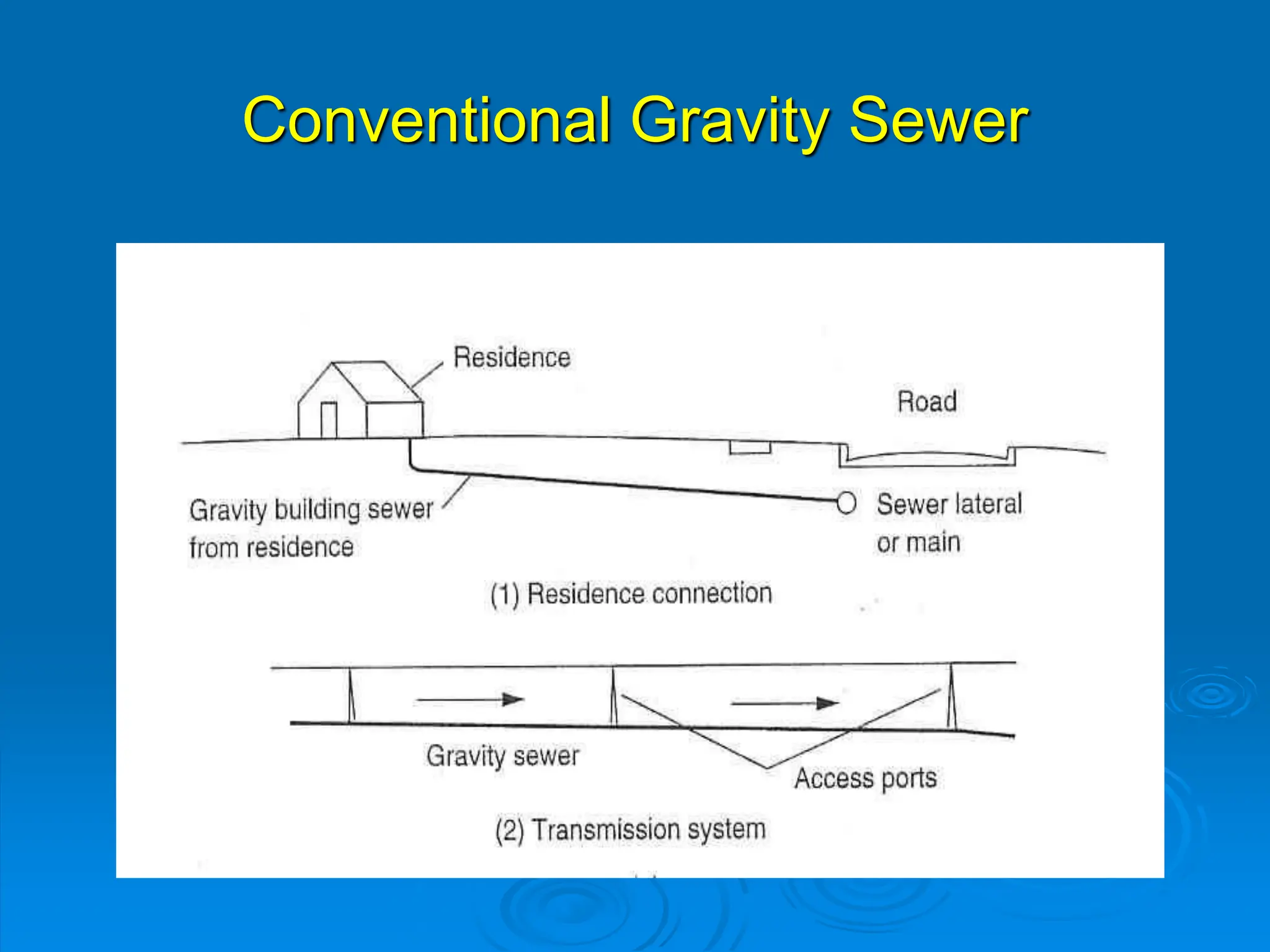
Conventional Gravity Sewer
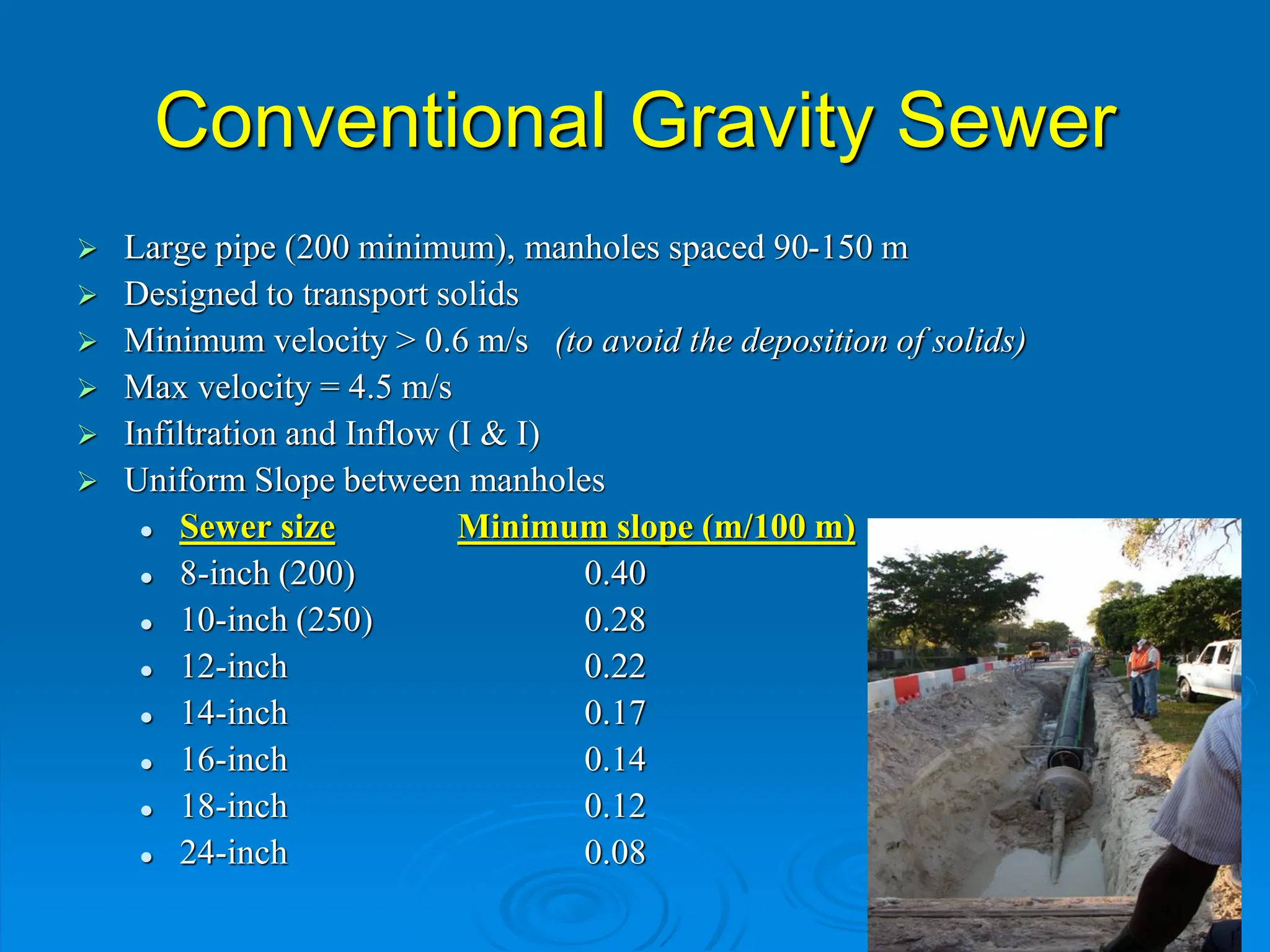
 Large pipe (200 minimum), manholes spaced 90-150 m
 Designed to transport solids
 Minimum velocity > 0.6 m/s (to avoid the deposition of solids)
 Max velocity = 4.5 m/s
 Infiltration and Inflow (I & I)
 Uniform Slope between manholes
 Sewer size Minimum slope (m/100 m)
 8-inch (200) 0.40
 10-inch (250) 0.28
 12-inch 0.22
 14-inch 0.17
 16-inch 0.14
 18-inch 0.12
 24-inch 0.08
Conventional Gravity Sewer
Alignment: 24-inch sewers -600 (or smaller) should be laid
with straight alignment between manholes.
Changes in pipe size: When a smaller sewer joins a larger
one (at a manhole), the invert (bottom) of the larger sewer
should be lowered sufficiently to overcome head losses. An
approximate method is to place the 0.8 depth point of both
sewers at the same elevation.
Sewer Materials: many types, materials and bedding shall
prevent damage from external loads, and joints shall prevent
leakage
0.8 depths are aligned
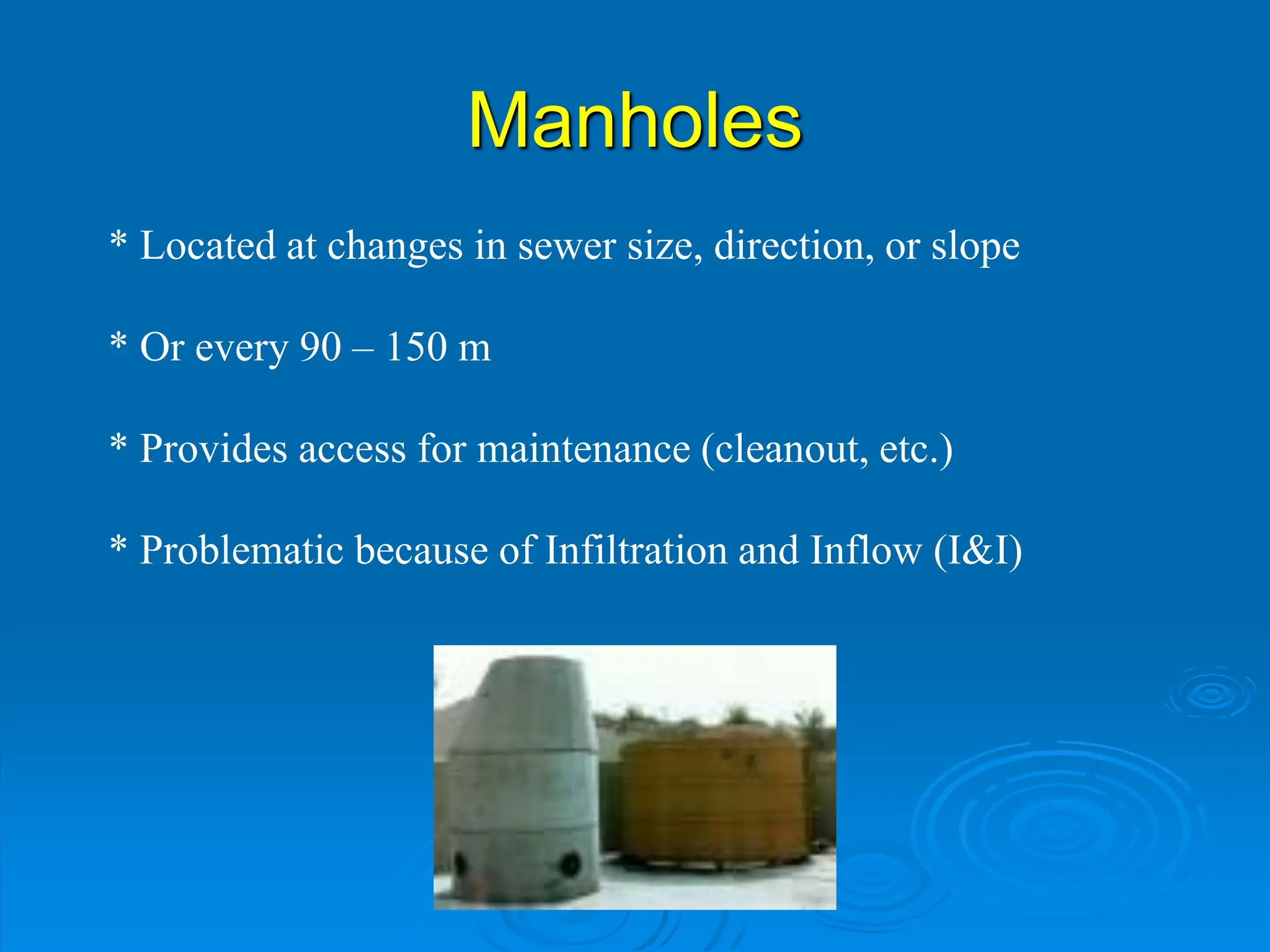
Manholes
* Located at changes in sewer size, direction, or slope
* Or every 90 – 150 m
* Provides access for maintenance (cleanout, etc.)
* Problematic because of Infiltration and Inflow (I&I)
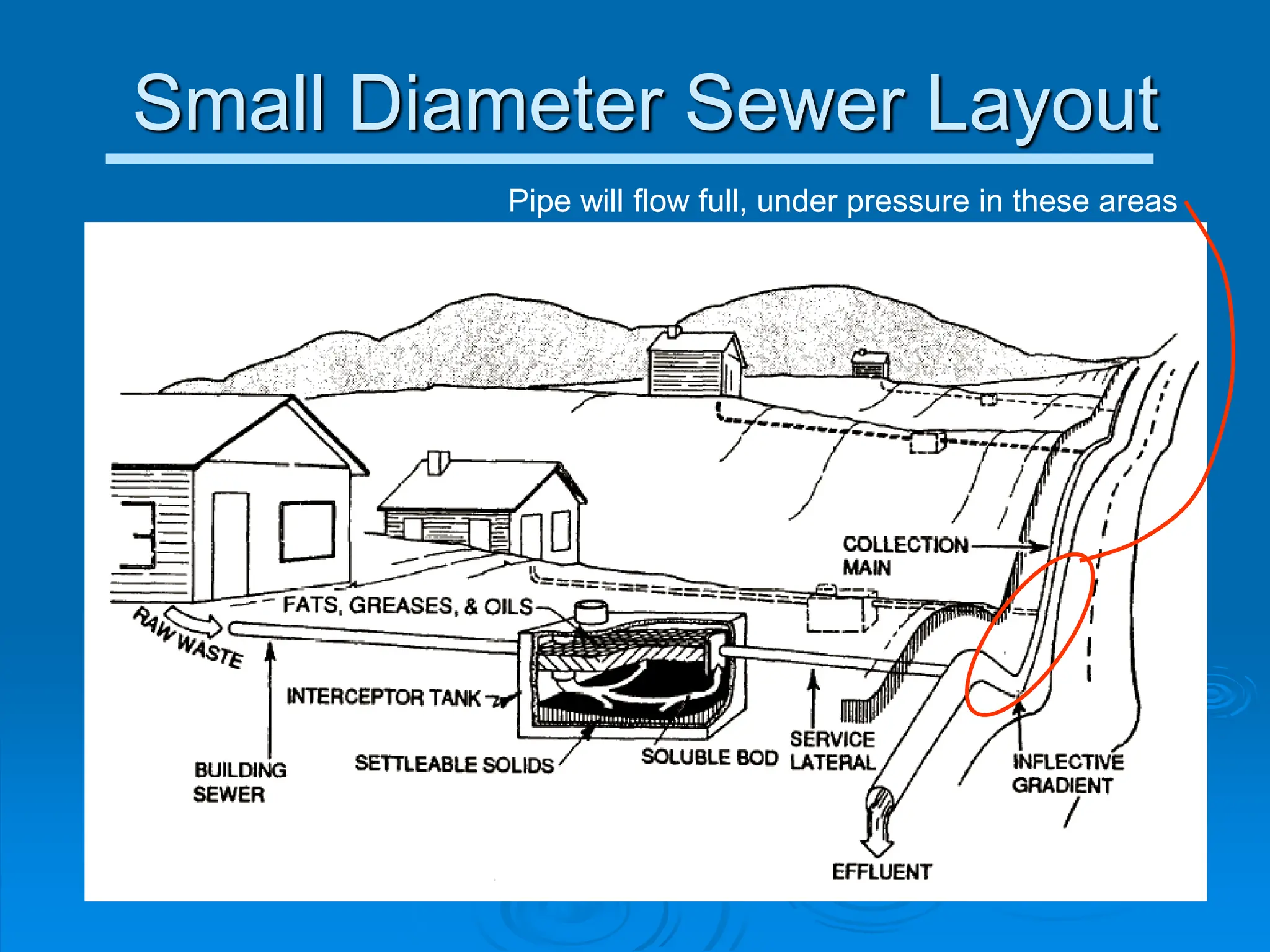
Small Diameter Gravity Sewer Systems
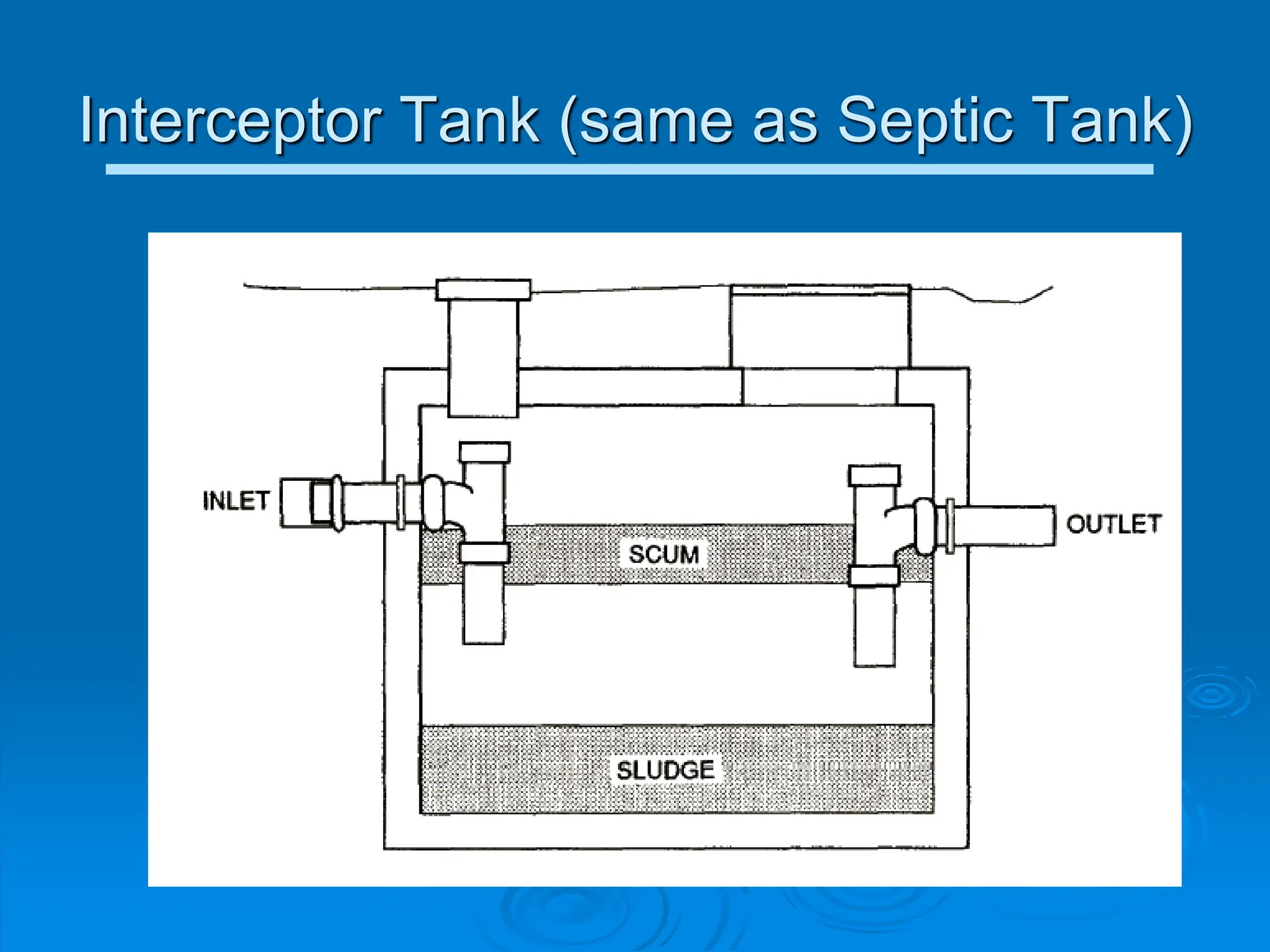
 Wastewater flows from home to
interceptor (septic) tank where settleable
solids and grease are removed
 Wastewater flows by gravity to central
collector pipe
 Central collector pipe can flow full in
certain areas
 Pipe sizes are typically 4 and 6-inch
diameter (100 – 150 mm)
Small Diameter Sewer Layout
Pipe will flow full, under pressure in these areas
Interceptor Tank (same as Septic Tank)
Most Sewers Rely on Gravity Flow
 Most sewers are designed to flow by gravity
(water flows down-hill)
 Includes sewer pipe from home to septic tank or
to a municipal collector pipe
 Gravity sewers must follow the topography of
the land
 Where gravity flow is not possible, pumps are
used
• Individual unit pump
• Large municipal lift (pump) station
Hydraulics of Sewers
 Most sewers designed to flow at a velocity
of 0.6 m/sec when flowing half-full
 Do not want pipe to flow full at peak flows
 Do not want pipe flow velocity too low—can’t
transport solids
 Most designs are complex, but use basic
hydraulic equations for computing
necessary size and slope
Manning Equation for Pipe Flow
 Manning Equation
V = velocity (m/sec)
n = coefficient of roughness (dependent upon pipe
material/condition)
R = hydraulic radius = area/wetted perimeter (m)
S = hydraulic slope (assumed to be slope of pipe)
(m/m)
2
/
1
3
/
2
1
S
R
n
V 
Basic Sewer Design
 Collector pipes (pipe in street) is minimum 8
inches (200) diameter (to allow cleaning)
 Service pipes (home or building to collector
is 4 to 6 inches (100-150 mm)diameter
 Gravity sewer pipes have no bends,
manholes used to make transitions in
direction and pipe size
 Pipe sections between manholes are at a
constant grade or slope (S)
Proportional velocity and discharge
Proportional geometry elements
2
8
sin
D
Ad 




 



2
D
Pd 

0.015 0.4911 28 5.48648E-05 0.0368 0.1164 0.00036
0.016 0.5073 29 6.04235E-05 0.0380 0.1215 0.00042
0.017 0.5230 30 6.61557E-05 0.0392 0.1265 0.00047
d/D  radian  Ad Pd v/V q/Q
Conventional Gravity Sewer
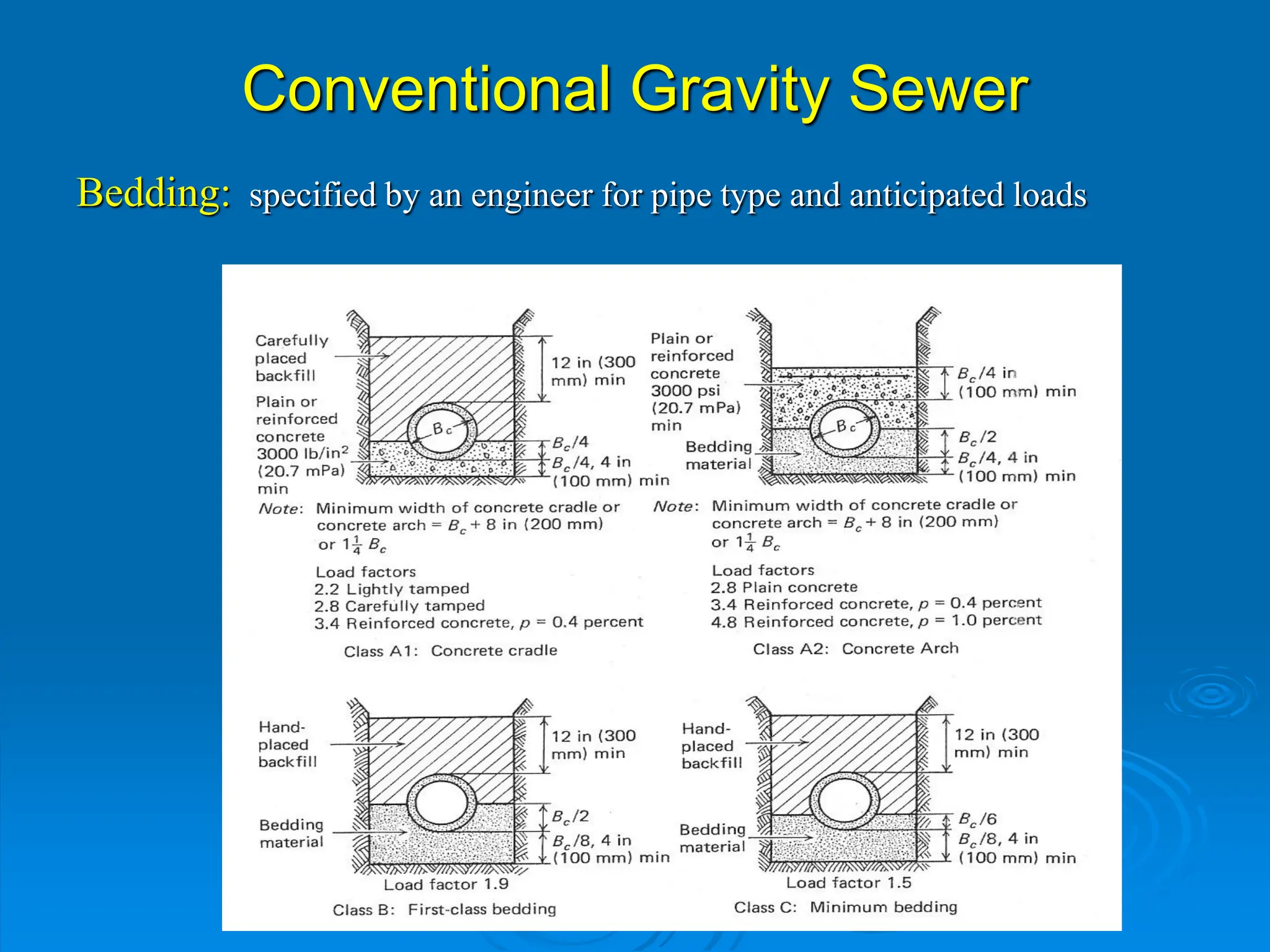
Bedding: specified by an engineer for pipe type and anticipated loads
Conventional Gravity Sewer
Backfill: suitable material, free of debris, stones, etc.
DO NOT DISTURB SEWER ALIGNMENT
Separation from Water Lines:
 3 m horizontal
 Water line 0.5 m above sewer
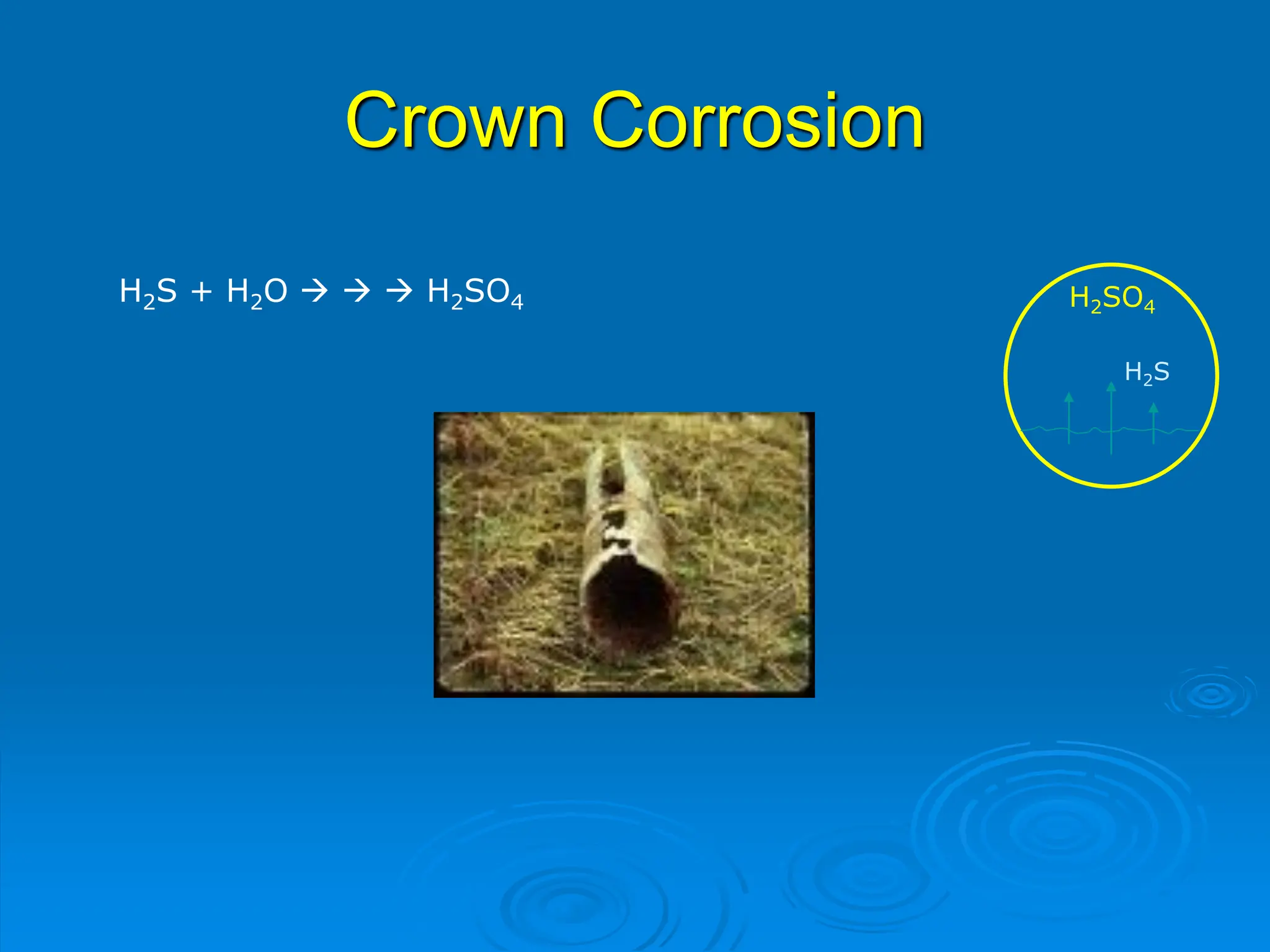
Crown Corrosion
H2S + H2O    H2SO4
H2S
H2SO4
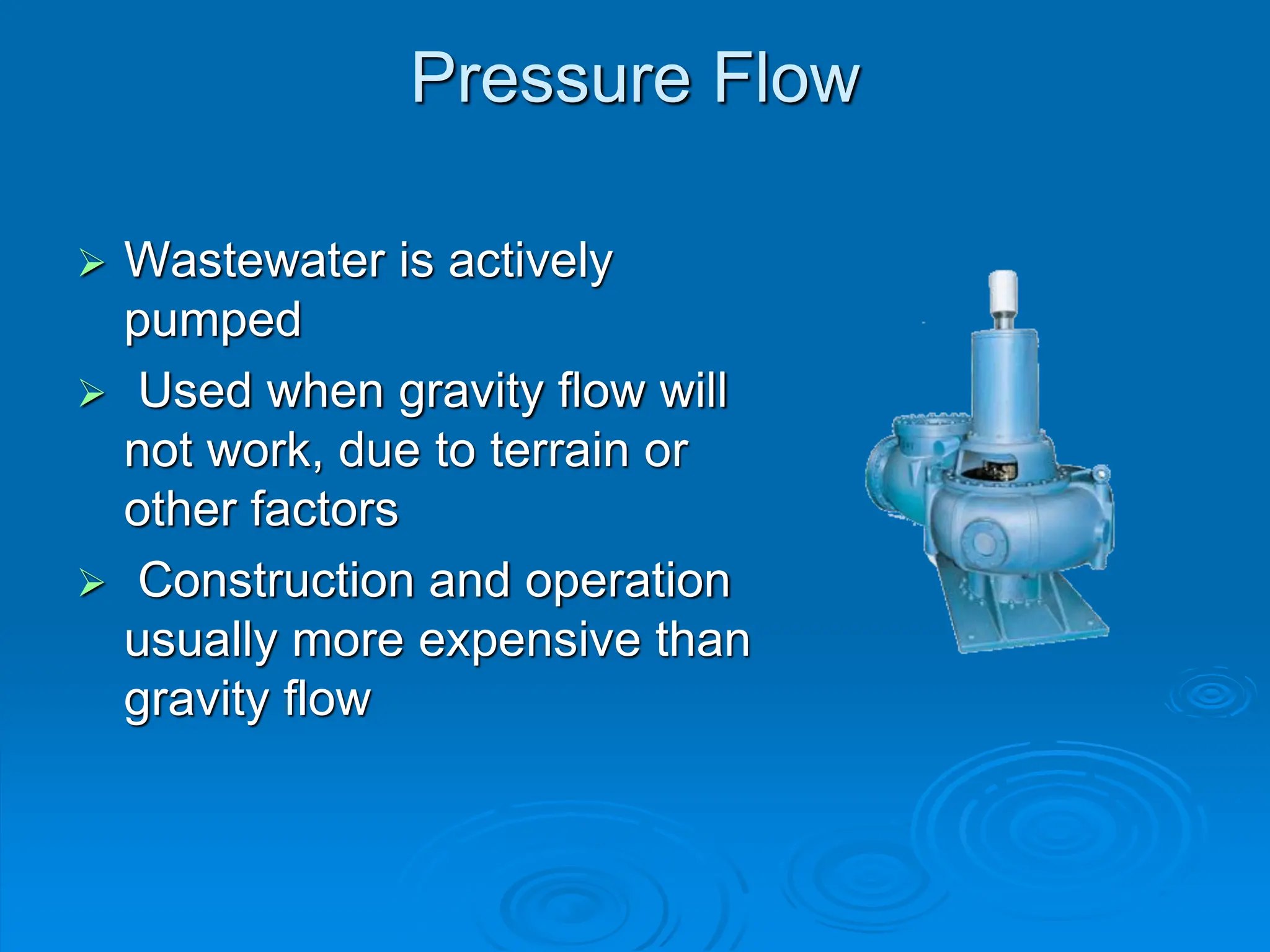
Pressure Flow
 Wastewater is actively
pumped
 Used when gravity flow will
not work, due to terrain or
other factors
 Construction and operation
usually more expensive than
gravity flow
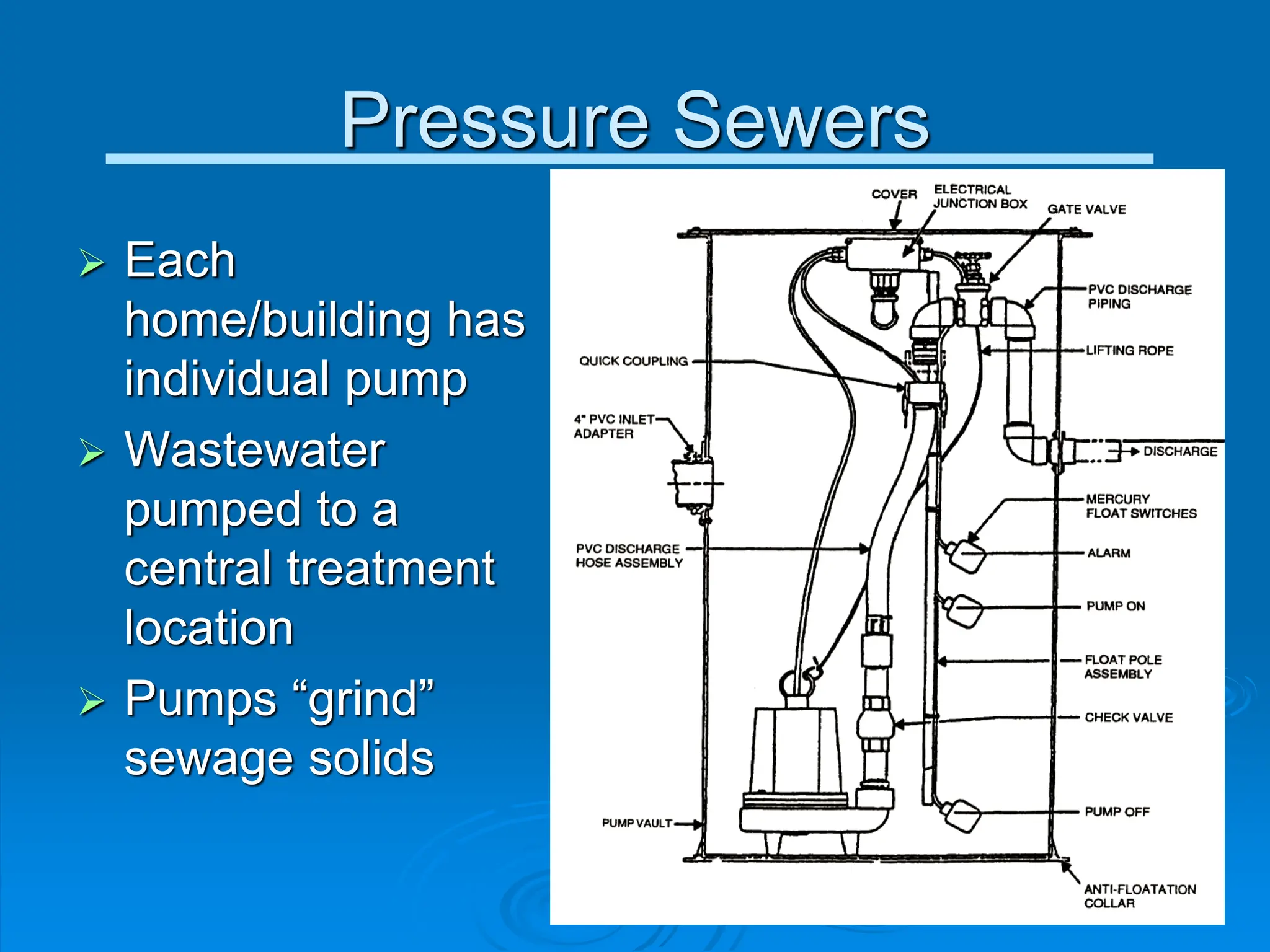
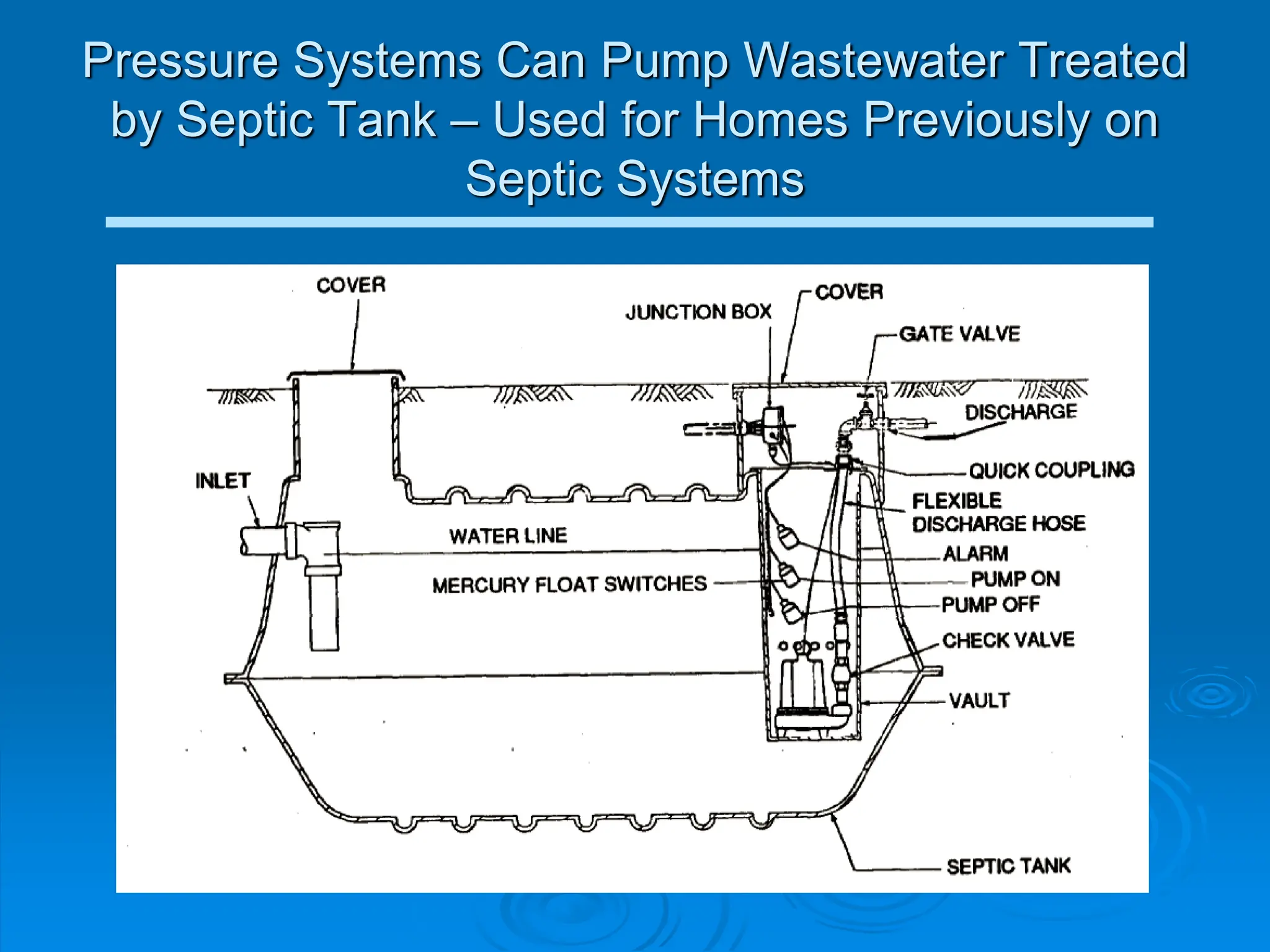
Pressure Sewers
 Each
home/building has
individual pump
 Wastewater
pumped to a
central treatment
location
 Pumps “grind”
sewage solids
Pressure Systems Can Pump Wastewater Treated
by Septic Tank – Used for Homes Previously on
Septic Systems
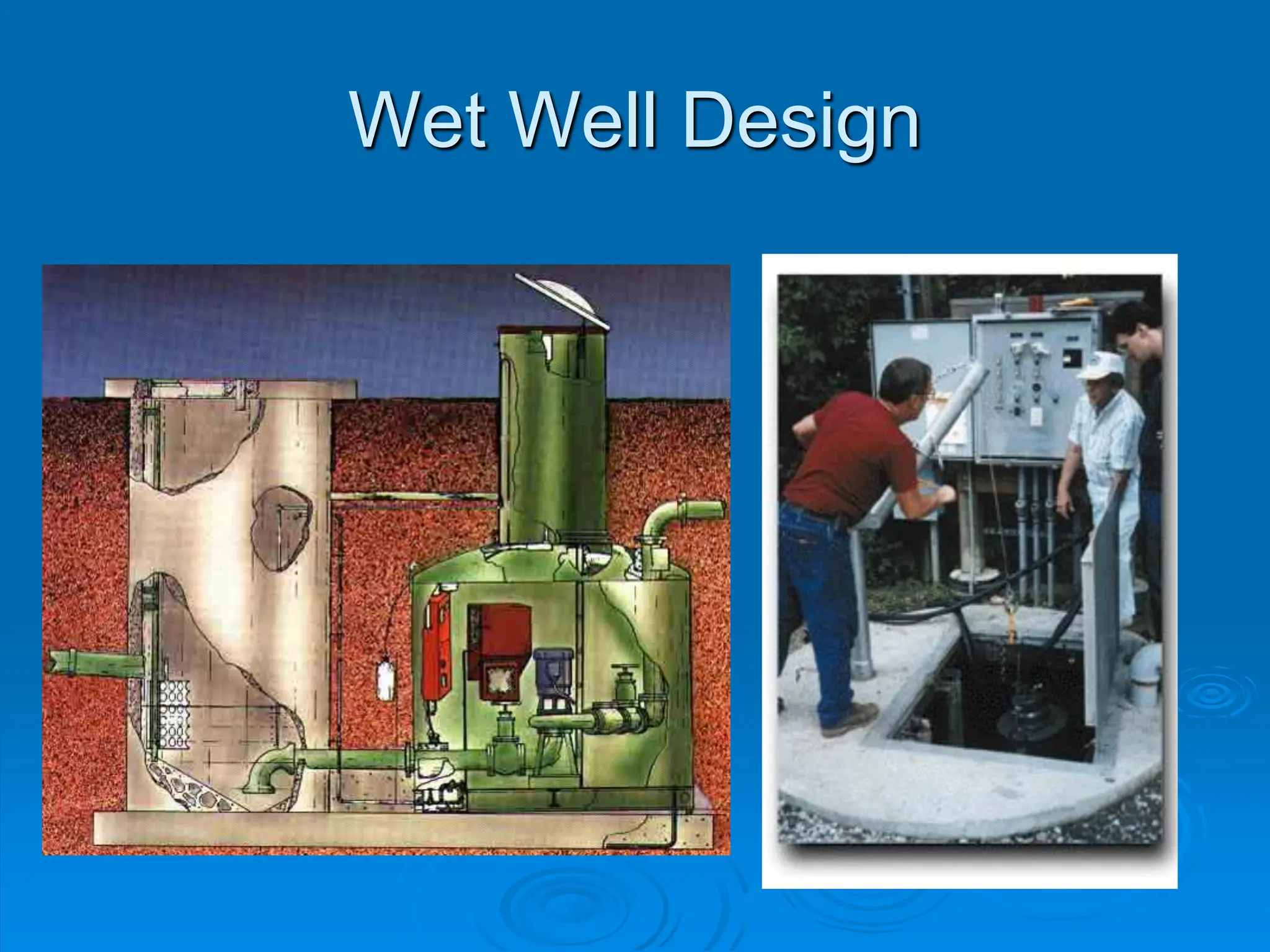
Wet Well Design
Conventional Gravity vs. Pressure Sewers
Sewer Alternatives and Characteristics
Septic Tank Effluent Gravity
STEG
 Small diameter plastic pipe
 Conveys effluent from a septic tank
 with an effluent filter
 No solids to transport (no minimum velocity required)
 Can be installed at variable (flat) grades
 No manholes
 Air-release valves needed at high points
Septic Tank Effluent Gravity
STEG
STEG Sewer Components
Pipe Size and Velocity
Septic Tank Effluent Pump
STEP
 High-head turbine pump used to pump screened septic tank
effluent into a pressurized collection system.
 Small diameter, plastic pipe (50 mm)
 No Solids transport (no minimum velocities required)
 Installed shallow
 Can follow terrain
 Air-release valves incorporated
STEP Components
 Building sewer (from house to septic tank)
 Septic Tank (or interceptor tank)
 Vaults/pump basins (effluent filter and pump)
 Pumps (submersible, high-head, turbine)
 Service lateral (1.25-inch typical)
 Check Valves (at pump outlet and at edge of property)
Septic Tank Effluent Pump
STEP
STEP System Design Data
STEP System Interceptor Tank
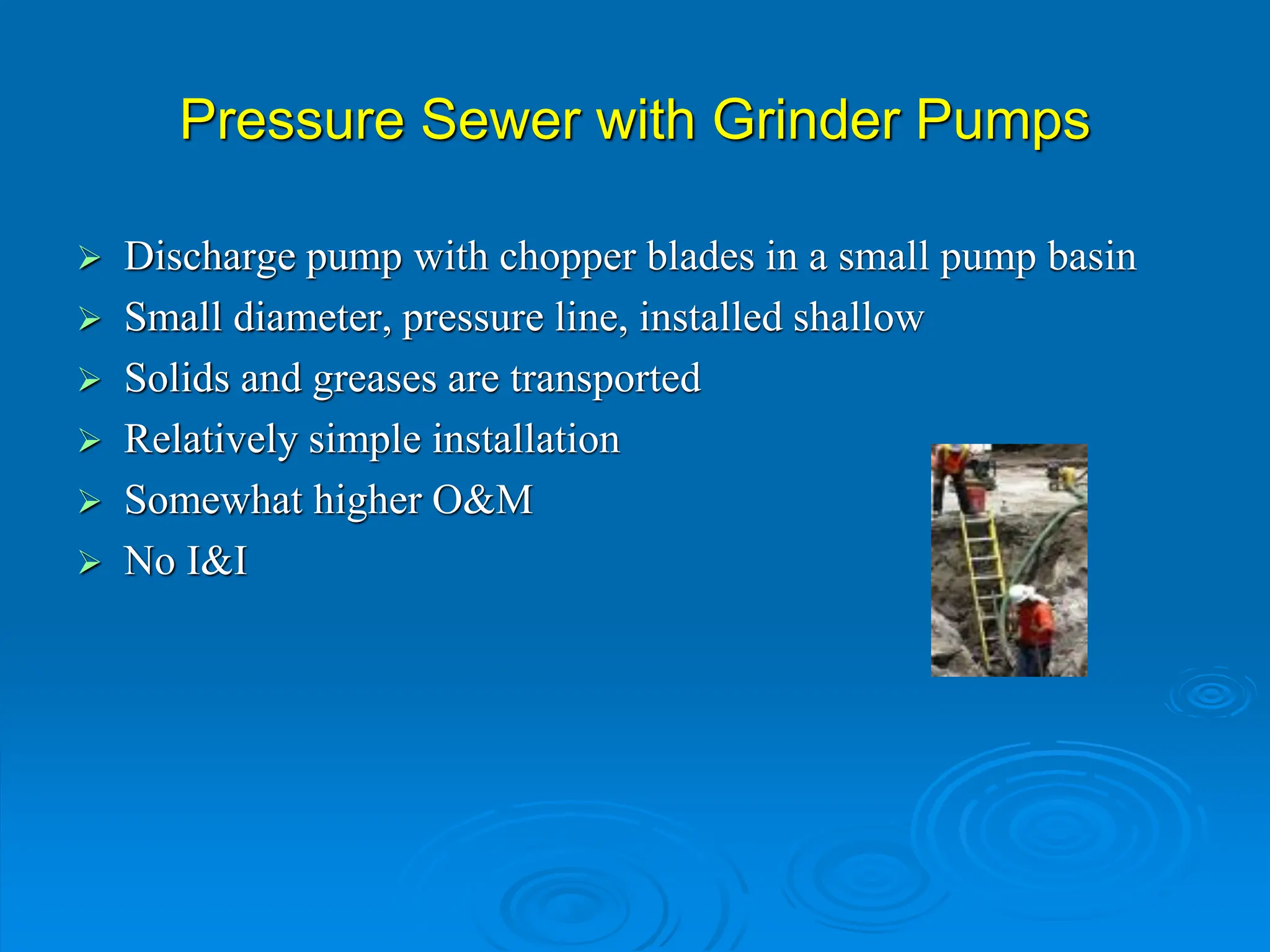
Pressure Sewer with Grinder Pumps
 Discharge pump with chopper blades in a small pump basin
 Small diameter, pressure line, installed shallow
 Solids and greases are transported
 Relatively simple installation
 Somewhat higher O&M
 No I&I
Pressure Sewer
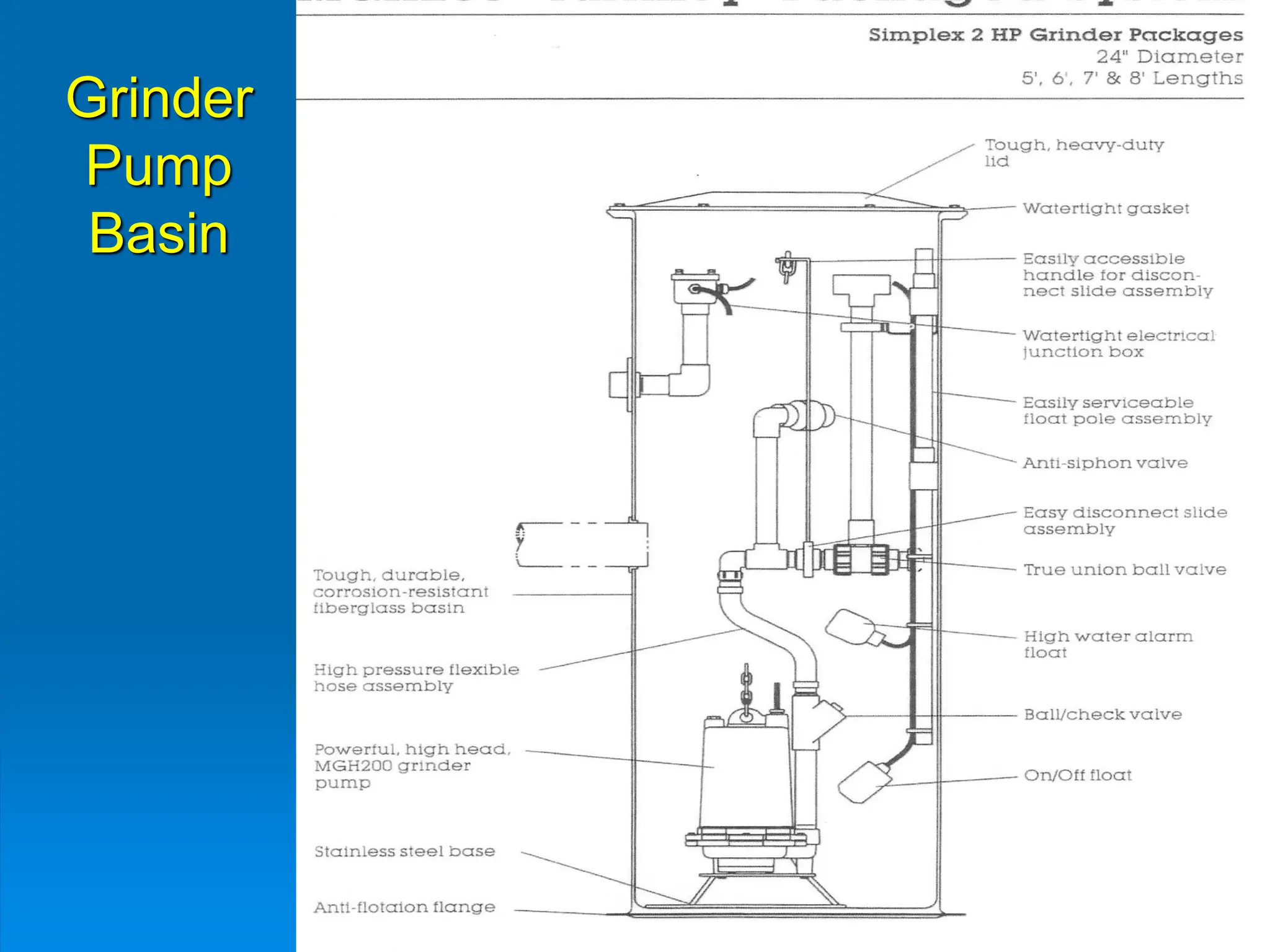
Grinder Pump basin
Grinder
Pump
Basin
Vacuum Flow
 Not very common, but use is gradually
increasing
 Vacuum pumps used to move waste
through sewer
 Same advantages and disadvantages as
pressure sewers
 Less water needed to transport waste
Vacuum Sewers
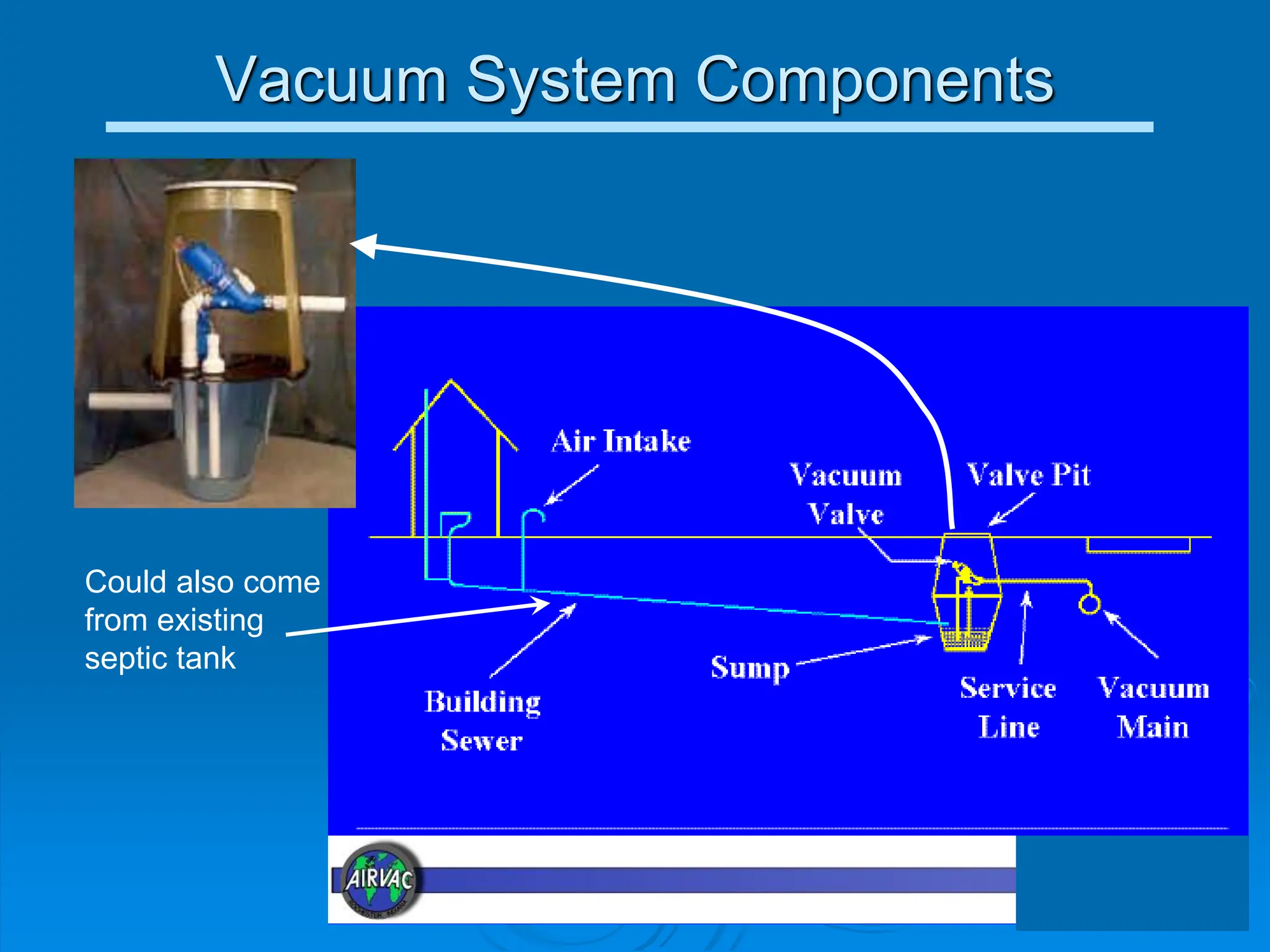
 Wastewater flows by gravity to a central
collector well (up to four homes per well)
 When well fills a vacuum lines pulls
wastewater to a central vacuum tank
 Wastewater pumped from central vacuum
tank to treatment or a gravity sewer
Vacuum System Components
Could also come
from existing
septic tank
Vacuum Sewer
 Central vacuum source maintains a
vacuum on a small diameter sewer
 Pulls wastewater to a central location
 Ideal application:
 Flat terrain
 High water table
 70-100 connections to be economical
Vacuum Sewer
Vacuum Sewer Components
Vacuum Station
Estimating Flow rate
 Equivalent Dwelling Unit (EDU)
• A residence with a given number of people (say 4)
• Represents the average household flowrate
 Design Peak Flowrate (DPF)
• Flowrate expected in the collection system, assuming a given number of
EDUs are discharging at the same time
• Typical values for systems with >50 EDUs is 1.3 to 1.9 L/min-EDU
• Total DPF QDP = 0.5 N
How to Obtain Quantity (lpd) numbers
 Estimated design numbers in codes
 These are generally higher than actual use
 They provide a factor of safety
 Metered flow
 Add a factor of safety
 Average flows from similar facilities
 Add a factor of safety
 Peak flows
 Design
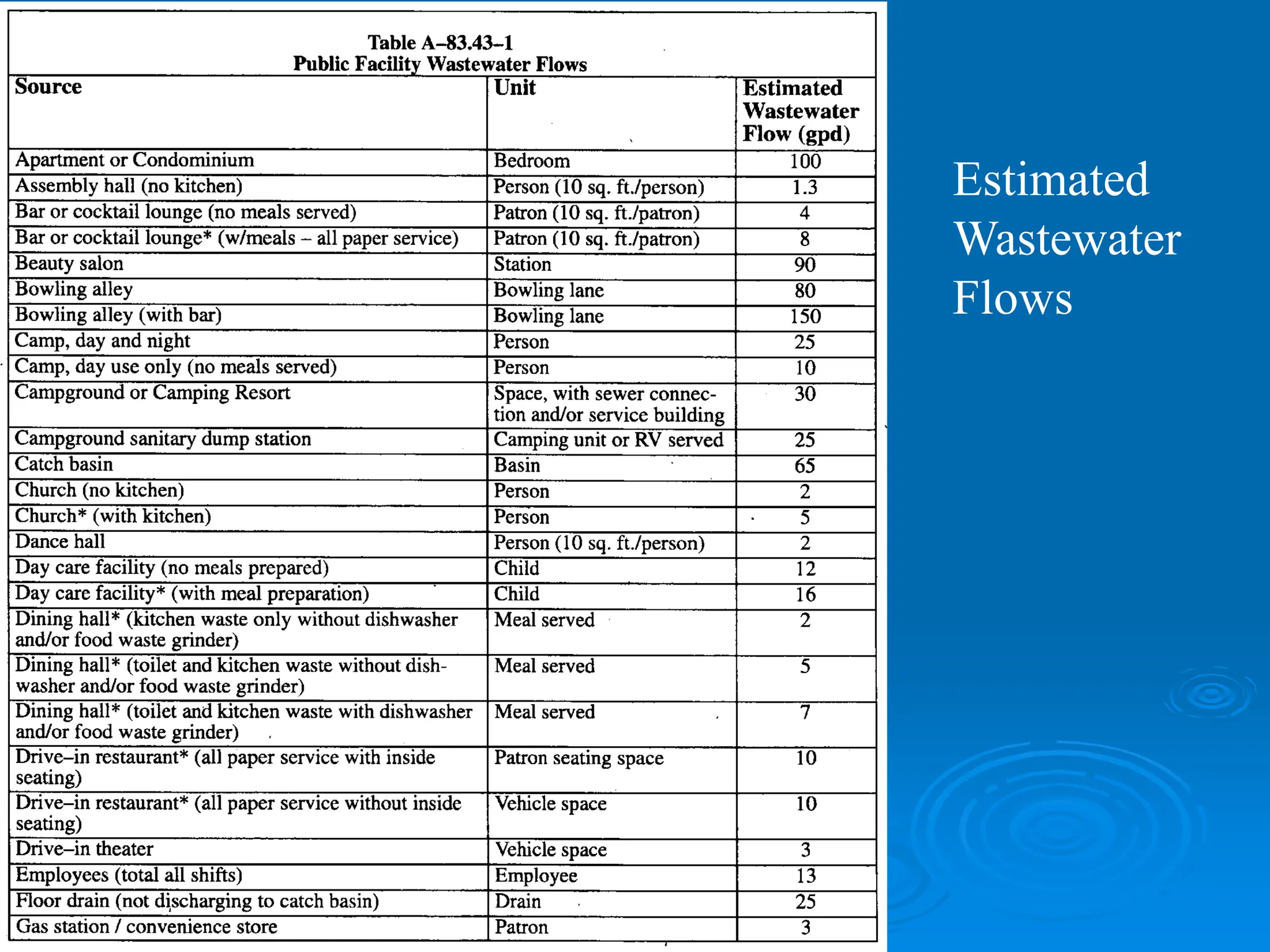
Estimated
Wastewater
Flows
How much wastewater do we
produce each day?
Wastewater Characteristics
Source Average Daily Flow
Domestic sewage 60-120 gal/capita
Shopping centers 60-120 gal/1000 ft2
total floor
area
Hospitals 240-480 gal/bed
Schools 18-36 gal/student
Travel trailer parks
Without individual
hookups
90 gal/site
With individual
hookups
210 gal/site
Campgrounds 60-150 gal/campsite
Mobile home parks 265 gal/unit
Motels 40-53 gal/bed
Hotels 60 gal/bed
Industrial areas
Light industrial area 3750 gal/acre
Heavy industrial 5350 gal/acre
Source: Droste, R.L., 1997. Theory and Practice of
Water and Wastewater Treatment
These values are
rough estimates only
and vary greatly by
locale.
Typical data on unit loading factor and expected
wastewater contaminant loads for individual
residences. (Taken from Wisc. Comm. 83 code)
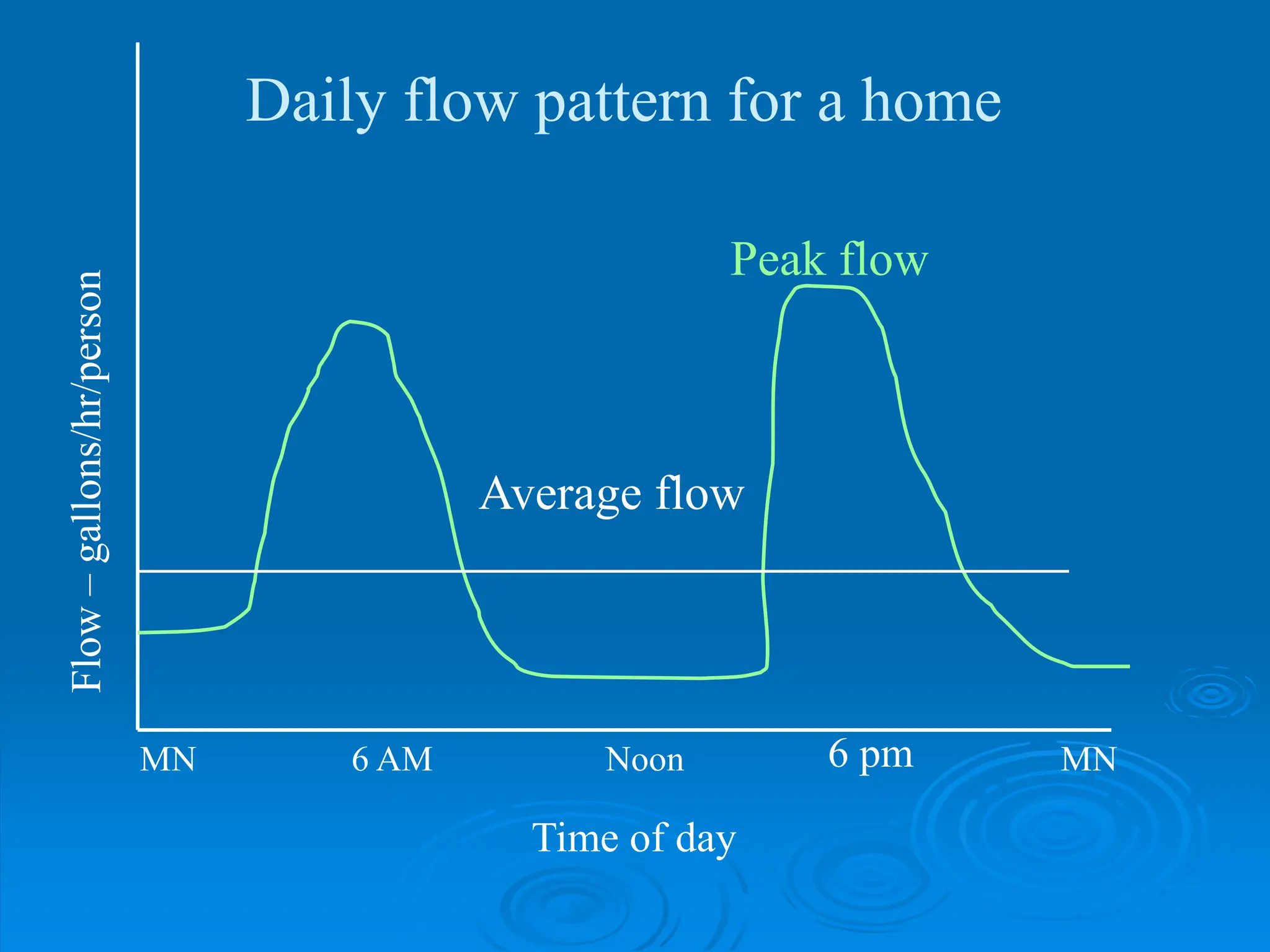
Time of day
MN Noon MN
Flow
–
gallons/hr/person
6 AM 6 pm
Daily flow pattern for a home
Average flow
Peak flow
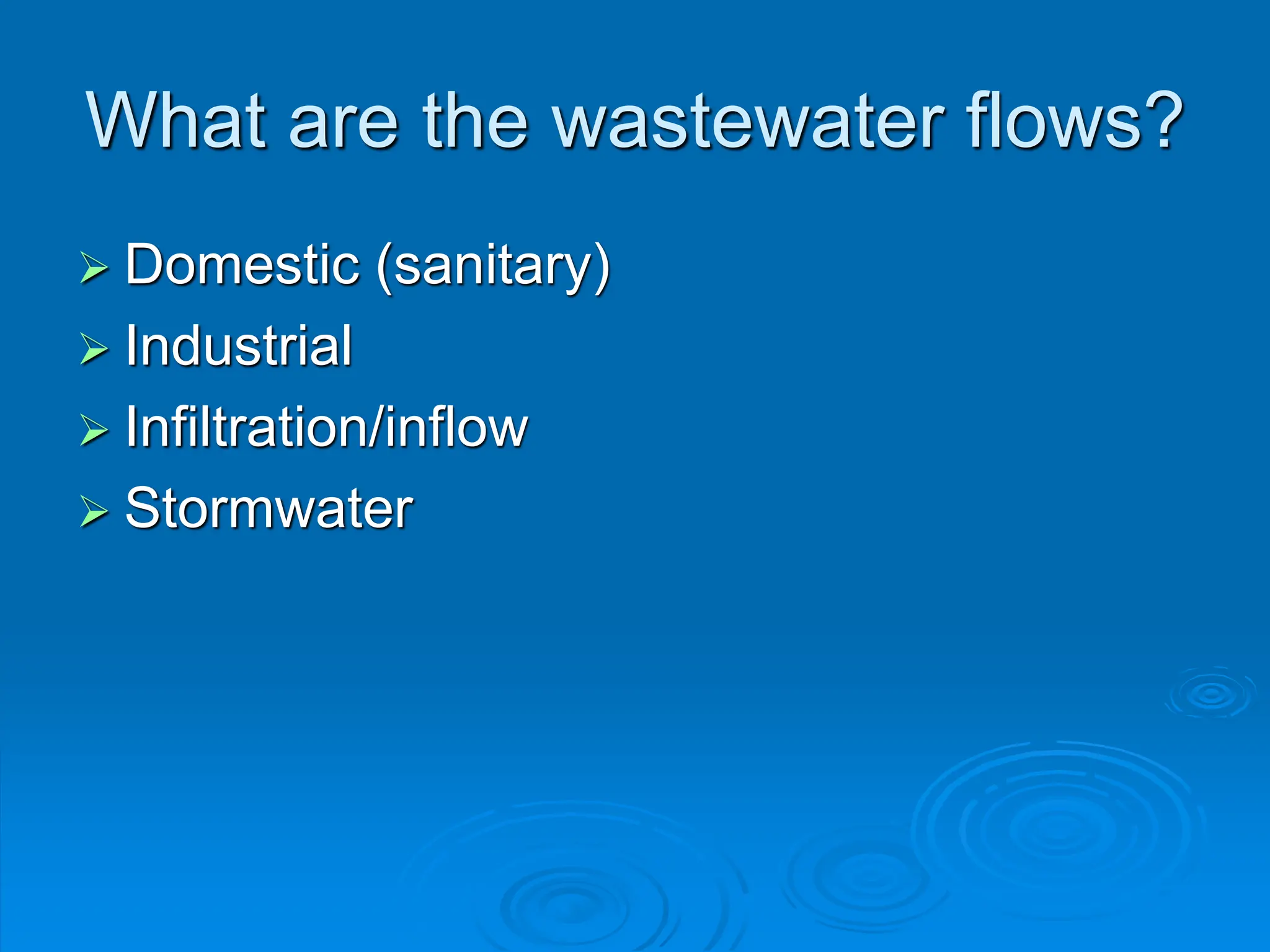
What are the wastewater flows?
 Domestic (sanitary)
 Industrial
 Infiltration/inflow
 Stormwater
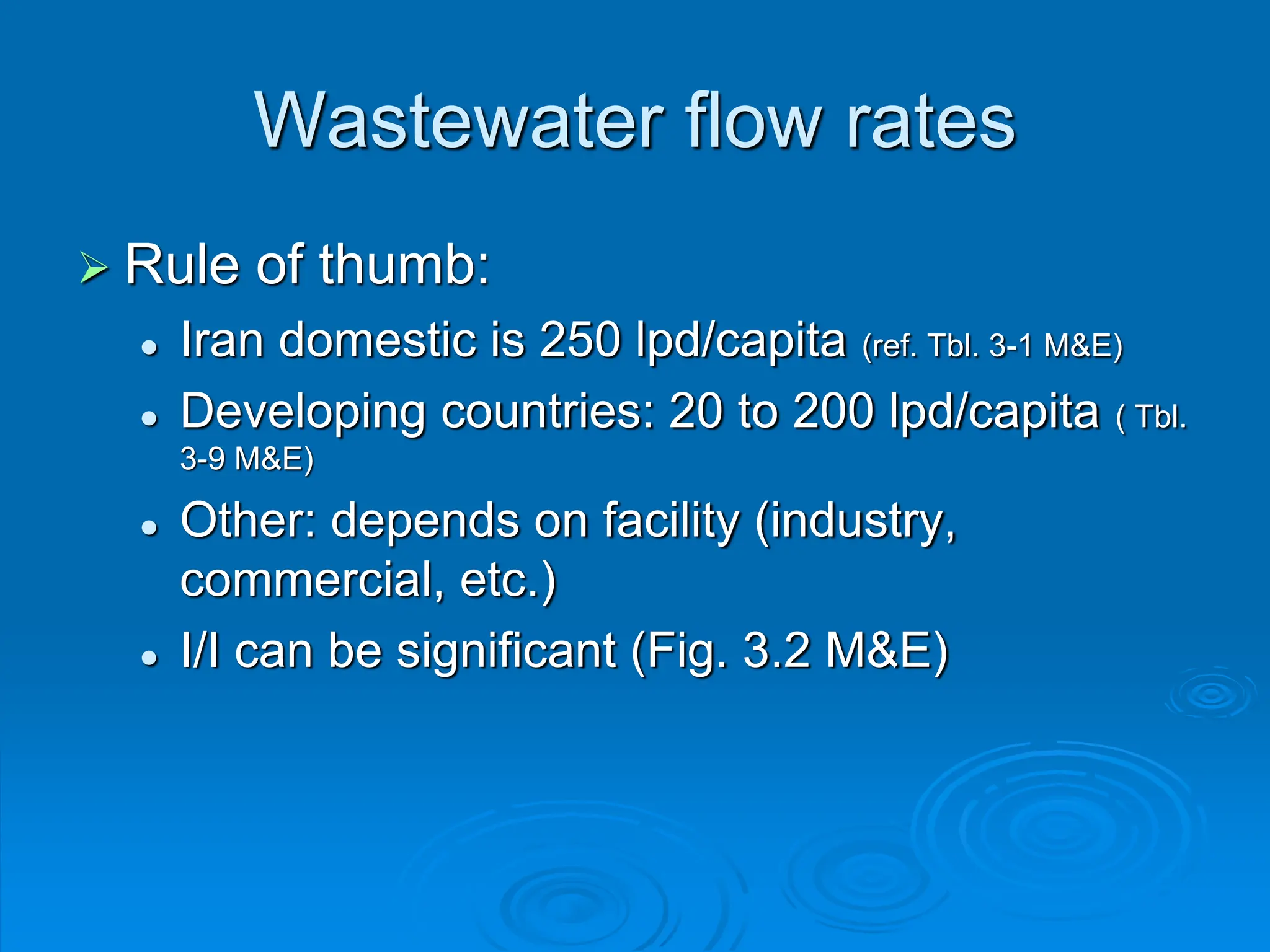
Wastewater flow rates
 Rule of thumb:
 Iran domestic is 250 lpd/capita (ref. Tbl. 3-1 M&E)
 Developing countries: 20 to 200 lpd/capita ( Tbl.
3-9 M&E)
 Other: depends on facility (industry,
commercial, etc.)
 I/I can be significant (Fig. 3.2 M&E)
Factors affecting flow rates
 Geographical location & socioeconomic
conditions
 Type of development
 Season
 Time of Day
 Climate (rain or dry)
“Diurnal variations” in domestic
wastewater flows
Wastewater flows
 Flows are either normally distributed or
log-normal (log of flows are normally
distributed)
 Statistical procedures based on flow
history used to determine average (dry
weather, wet weather, annual daily), peak
(instantaneous, hour), maximum (day,
month), minimum (hour, day, month)
(Table 3-11 M&E)
Wastewater loads
 Treatment is to decrease chemical
constituents, but quantity to be treated
depends on:
 Concentration (typ. mg/L)
 Flow rate (typ. lpd or MLD)
 Mass loading:
Concentration x Flow = mass /time
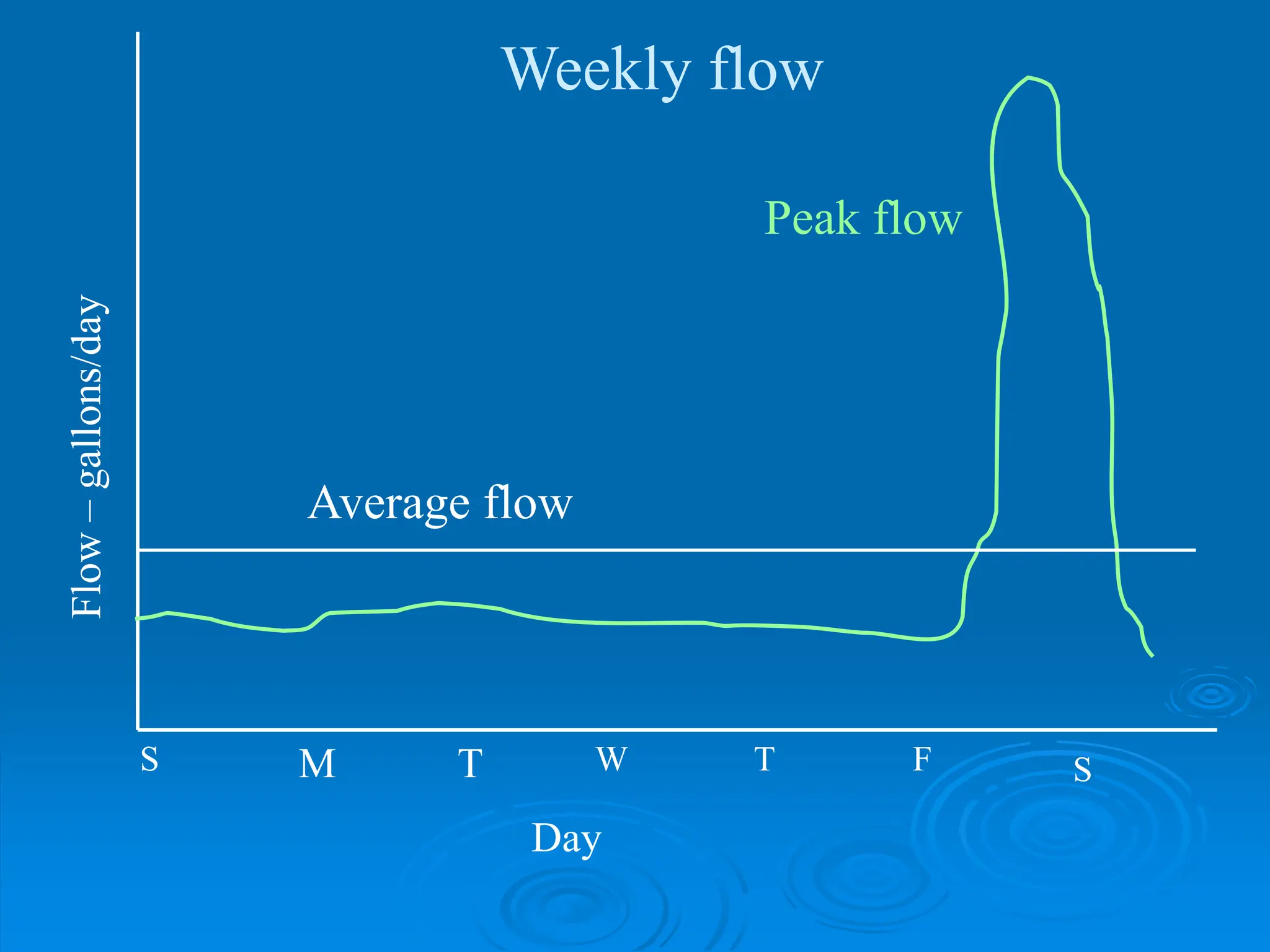
Day
S S
Flow
–
gallons/day
W
M T T F
Weekly flow
Average flow
Peak flow
Commercial Sources
 Many sources
 Variable from site to site
 High organic matter
 High fat, oil and grease
 Nitrogen
 Phosphorus
 Cleaning agents
 Heat (high water temperature)
Influences on Wastewater Characteristics
 Organic matter
 BOD and TSS
 Nitrogen
 Organic nitrogen, ammonia, nitrate
 Pathogens
 Bacterial –use fecal coliform as indicator organism
 Viral – coliphage as indicator organisms
 Fats, oils and greases
 Phosphorus
 Cleaning agents/antibacterial/VOC
 Excessive laundry wastes
 Medications
 What else????
Many styles of low
Flow toilets today.
All toilets sold today
has 1.6 gal./flush.
Manholes
 Needed for:
• Change in direction
• Change in pipe size
• To route sewer under roads, rivers, etc.
• Clean-out and inspection
 Spaced every 100 to 120 m along the sewer
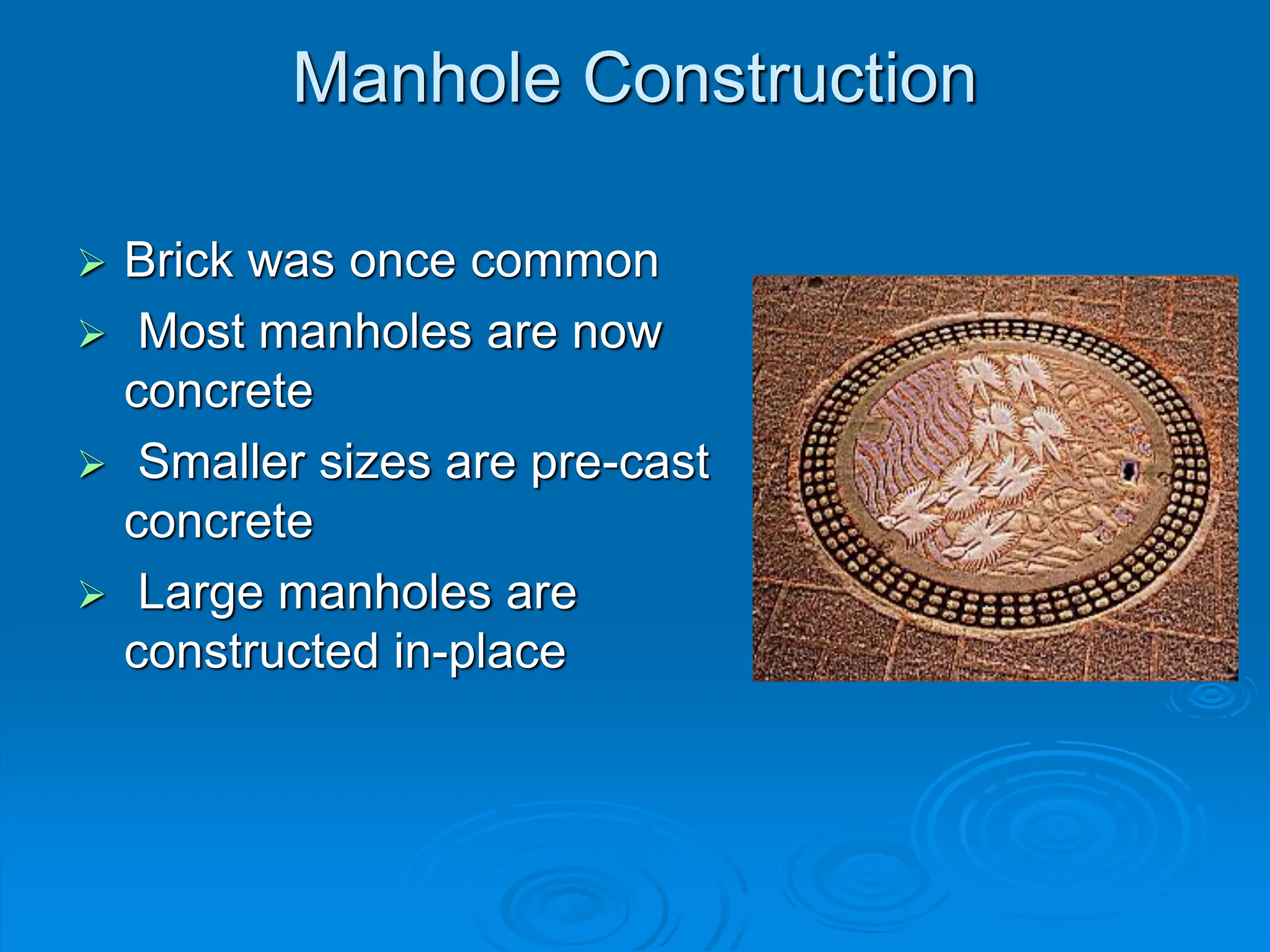
Manhole Construction
 Brick was once common
 Most manholes are now
concrete
 Smaller sizes are pre-cast
concrete
 Large manholes are
constructed in-place
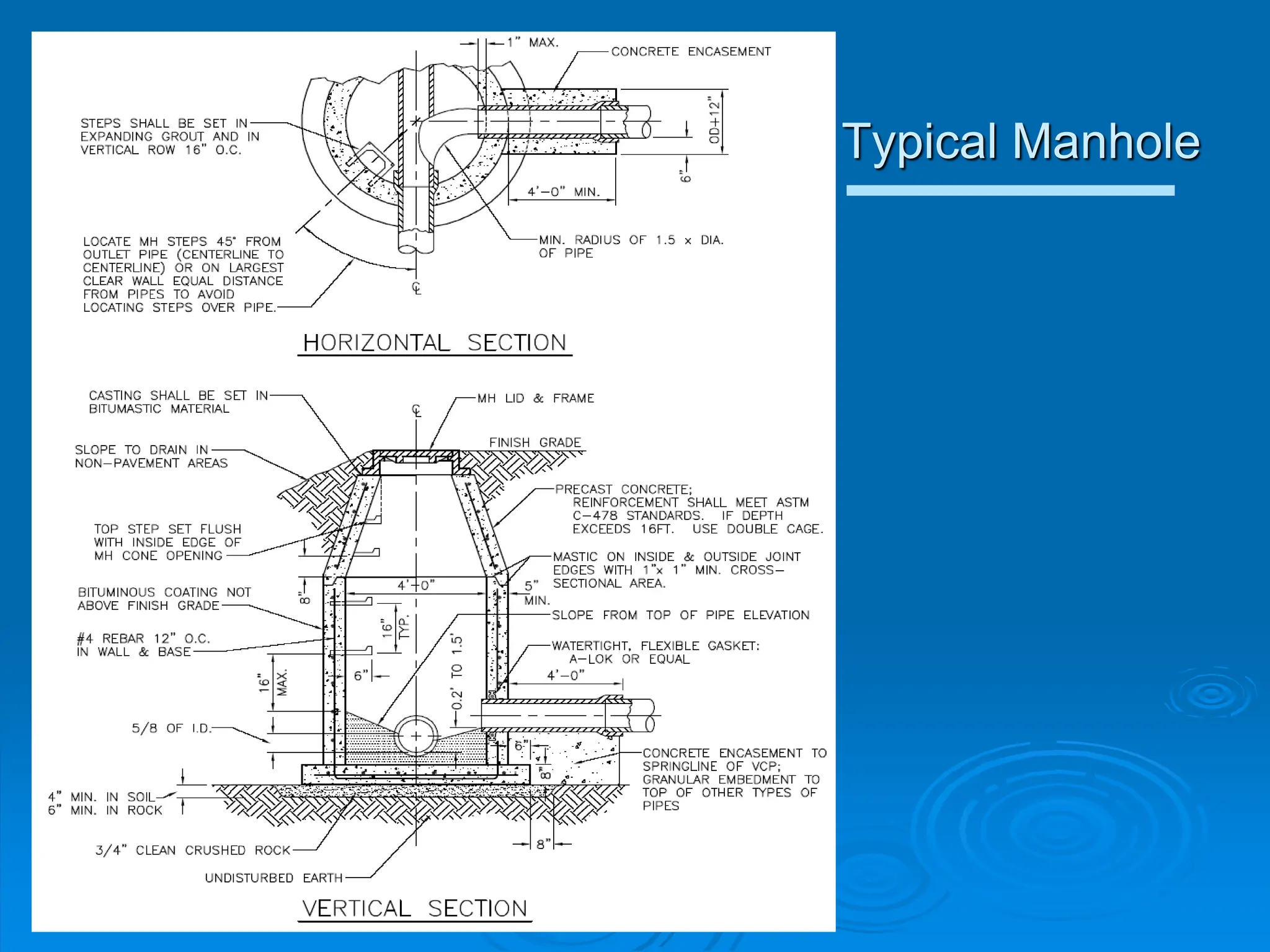
Typical Manhole
Fig 5.1, p 134
Problems in Sewers
 Blockage
 Corrosion in sewers made of
• Concrete
• Iron
 Inflow
 Infiltration
 Leakage
Blockage in Sewers
 Caused by sand, rocks, tree roots, various
wastes
 Can cause flooding
• In streets
• In basements
Corrosion in Sewers
 Concrete is made of cement, which is basic
 H2S gas formed by anaerobic bacteria
 H2S converted to sulfuric acid (H2SO4),
chemically or by bacteria
 Sulfuric acid reacts with cement
(neutralization)
 Result: cement is dissolved by sulfuric acid
Effects of long detention times
Sources of Inflow
 Water from roof and cellar drains
 Water leaking around manhole covers
 Cause excess hydraulic load on treatment
plant
Sources of Infiltration
 Seepage of groundwater into pipe joints
and manholes
 Controlled by
• Good construction materials and practices
• Avoiding construction in saturated soil, if possible
Leakage from Sewers
 Caused by
• Cracked, broken, or corroded pipe
• Bad connections at joints
 Can cause groundwater contamination,
and damage street and building
foundations
Pump Stations
 Pump (lift) sewage from low to higher
elevation, generally from end of one
gravity sewer section to another, higher
section
 Consist of a wet well and pumps
 Wet well forms a place for wastewater to
collect and be pumped from
Source: Metcalf & Eddy, Inc. Wastewater Engineering: Collection, Treatment and Disposal. McGraw-Hill:New
York, 1972.
Large Pump Station
Small Pump Station
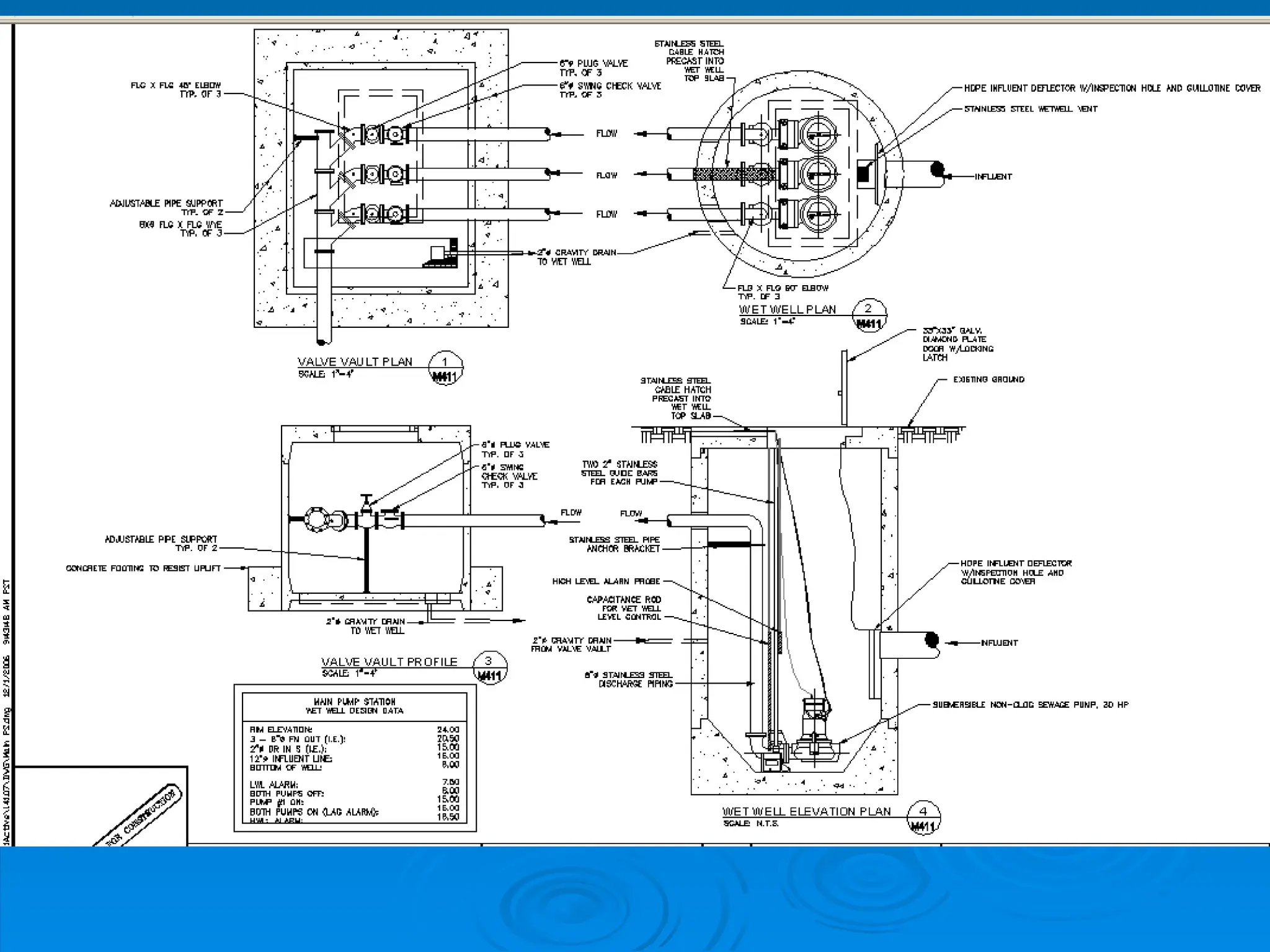
Pump Station
Pump Station
Details
Main Pump Station
Design of W.W. Collection System
Design criteria:
Waste water flow: Flow varies according to:
The season (monthly variations)
Weather conditions
Week of the month , day of the week, time of the day.
Estimation of the design flow Qdes: Data needed:
Average daily water consumption per capita for domestic areas (L/c/d), (Qavg).
Average daily water consumption per capita for institution ( school, offices, ….etc. ), (Qavg).
Average daily water consumption for commercial and industrial areas.
Infiltration, inflow:
Qinfil is taken as [24-95 m3/day/km] or [0.5 m3/day/diamwter (cm)], take the bigger value of
the two.
Qinflo is taken as 0.2-30 [m3/ha/day]. ( hectare = 10,000 m2 )
Qdes = Qmax + QI/I ( if found)
QI/I = Qinfil + Qinflo
Qmax = [0.80* Qavg] * Pƒ ( 0.8 > 80% return from water supply).
This equation is for domestic users only. Qmax for institutions, commercial activities, and
industries are calculated according to the type of industry, and cannot be calculated from
this equation. Each industry has its specific average wastewater production and peaking
factor that can be taken from published references or from the records of these industries
or institutions.
149
86
43
0 2 4 6 8 10 12 14 16 18 20 22 24
hour
1.8
1.5
1.0
0.5
0.0
Flow
coefficient
Flow
(L/s)
Peak coefficient
Average day flow
Average 24 hr flow
Average night flow
Sewage flow diagram for a small town
- Pƒ : peak factor for domestic wastewater can be calculated
from one of the following formulas :
P
f
P



4
14
1 , ( P: population in thousands)
Or 167
.
0
5
P
f
P 
 The minimum domestic wastewater flow (Qmin) is necessary to check
for the minimum velocity in the sanitary sewers, it is estimated from
the following formula:
W
avg
Q
P
Q 





 *
6
1
2
.
0
min
A typical value of
W
avg
Q
Q 







3
1
min
Note: [Qavg]w = 0.8 Qavg , which is
the average domestic wastewater
production , while Qavg is the
average water consumption.
Example
A gravity pipe serving a community of 50,000 inh. The length of the pipe
is 200 m, and the average water consumption is 120 L/c/d. Use an
infiltration rate of 30 m3
/day.km, and a wastewater production rate of
80% of the water supply. Neglect the inflow for this example. Calculate
Qdes and Qmin.
a. Calculate the average domestic WW flow:
[Qavg]w = 0.8 Qavg = 0.80 * 120 L/c/d * 50,000 capita* 10-3
= 4800 m3
/d
b. Calculate the peak factor:
P
f
P



4
14
1 = 26
.
2
50
4
14
1 


Solution
a. Calculate the maximum wastewater flow:
Qmax = [Qavg]w * Pƒ = 2.26 * 4800 = 10848 m3
/d
b. Calculate the minimum wastewater flow:
W
avg
Q
P
Q 





 *
6
1
2
.
0
min 1845
4800
*
6
1
)
50
(
2
.
0 

m3
/d
c. Calculate the infiltration flow:
Qinfil = 30 *0.20 = 6 m3
/d
d. Calculate the design flow:
Qdes = Qmax + QI/I = 10848 + 6 = 10854 m3
/d
Maximum and minimum velocities:
Minimum velocity of 0.6 m/s should be maintained to prevent solids settling, it
is called self cleansing velocity.
Maximum velocity should not be lighter than 3 m/s to prevent erosion of pipes
and manholes.
Minimum size of pipes:
Minimum diameter is 8 inches (20 cm).
Minimum Slope and maximum slope of sanitary sewers:
Minimum slope is a function of the minimum velocity of 0.60 m/s (See the
table). The maximum slope is related to the maximum velocity (3 m/s or any
other velocity selected by the designer) according to the pipe material and the
expected amount of sand carried with the wastewater.
Depth of excavation:
Minimum cover on the top of sewers
Depth of excavation depends on:
water table
topography
lowest point to be served
other factors
Depth below
design level (m)
D (inch)
0.7
4
0.8
6
1.0
8
1.0
10
1.0
12
1.2
14
1.3
16
Manholes: Manholes are constructed in the following cases:
• when pipes change in diameter
• change of direction
• change of slope
• intersection of pipes
• at interval, ( 20-100 m)
Lay-out plan
1. Find the intermediate points of collection from topographic maps.
2. Assign the final points of collection.
3. Draw lines indicating the flow of sewage by gravity (different alternatives).
4. The pipes can be considered as :
• Building sewers.
• Lateral sewers.
• Sub main sewers.
• Main sewers.
• Trunk sewers.
• Intercepting sewers.
5. The contributory area for each pipe is defined by drawing lines depending
on topography and points of connection to manholes.
6. Manholes and pipes are given numbers to facilitate the design of each pipe.
Building sewer
Main sewer
Sub main sewer
Lateral sewer
Trunk sewer
Intercepting sewer
Outlet sewer
Manholes
Alternative Lay-outs for main sewer
Lay-out of sewer Scheme
Solving the Network by Table
Sanitary Sewers Appurtenances
Manholes
The following table gives the allowable intervals of manholes relative to the
diameter:
Pipe diameter ( inch ) Max. distance between manholes
(m)
8 30
8-10 40
10-12 50
12-16 60
16-36 100
≥ 36 150
Note: The distance depends on the maintenance equipments available.
Manhole dimensions
The diameter of the manhole or its side's dimensions depends on the depth of excavation.
The following table gives their relation.
Depth of manhole Manhole dimensions
0.60 x 0.60 m [Square]
Depth ≤ 0.90 m
Φ 0.60 m [ Circular]
1 . 0 0 x 1 . 0 0 [ S q u a r e ]
Φ 1 . 0 0 m [ C i r c u l a r ]
1 . 5 0 - 2 . 0 0 m
0 . 8 0 x 1 . 2 0 m [ R e c t a n g u l a r ]
≥ 2 . 0 0 m Φ 1 . 5 0 m [ C i r c u l a r ]
• The cover of the manhole should be strong enough to withstand the loads of traffic.
• It is usually made of cast iron to carry a minimum concentrated load of 25 ton.
• The manhole should be supplied with steps to allow for maintenance access.
• The floor of the manhole should be lined with cement mortar which is called
benching.
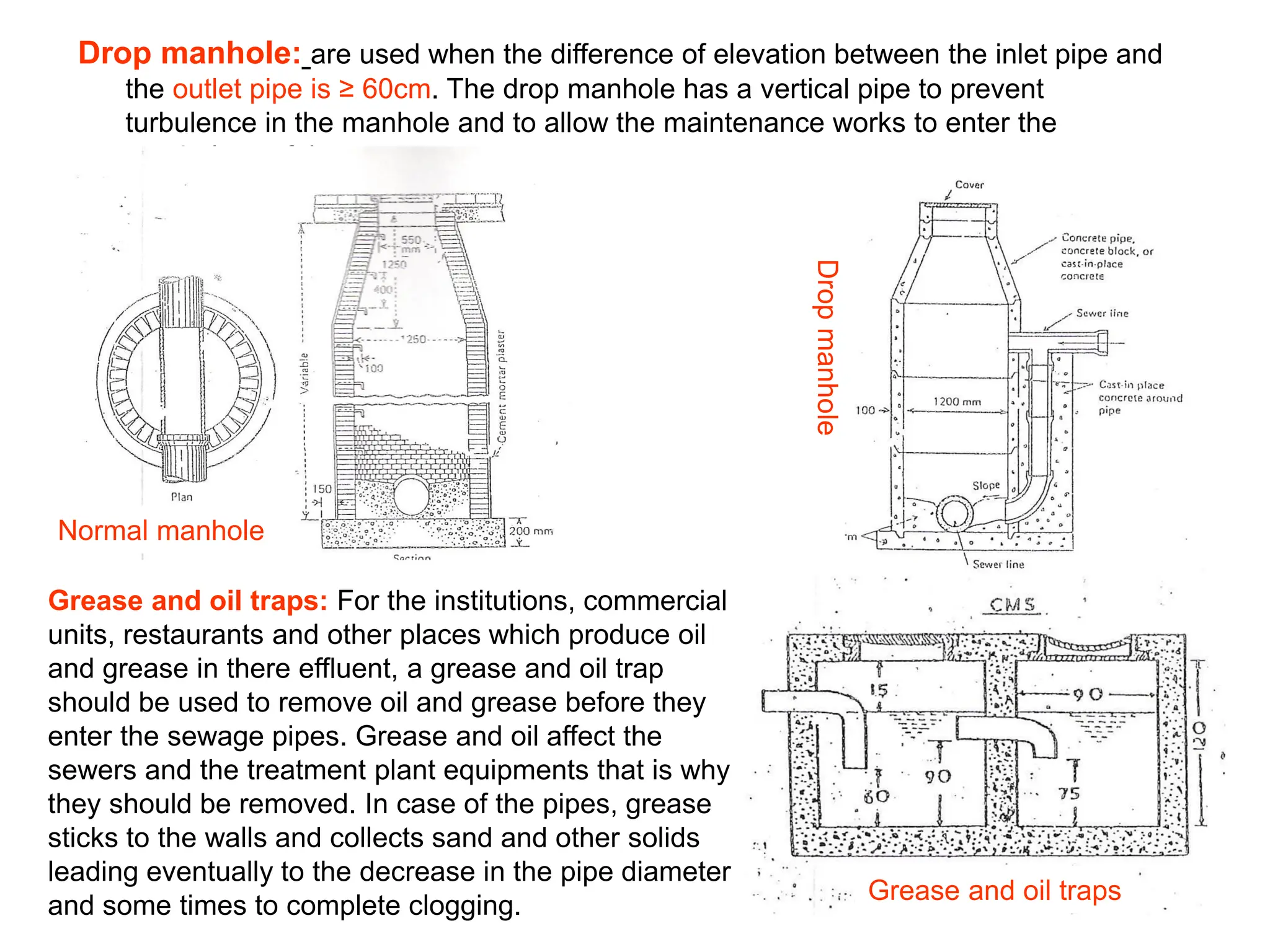
Drop manhole: are used when the difference of elevation between the inlet pipe and
the outlet pipe is ≥ 60cm. The drop manhole has a vertical pipe to prevent
turbulence in the manhole and to allow the maintenance works to enter the
manholes safely.
Normal manhole
Drop
manhole
Grease and oil traps
Grease and oil traps: For the institutions, commercial
units, restaurants and other places which produce oil
and grease in there effluent, a grease and oil trap
should be used to remove oil and grease before they
enter the sewage pipes. Grease and oil affect the
sewers and the treatment plant equipments that is why
they should be removed. In case of the pipes, grease
sticks to the walls and collects sand and other solids
leading eventually to the decrease in the pipe diameter
and some times to complete clogging.
Inverted siphon: When an obstacle such as railway or a river obstructs the sewer line the
sewers can be lowered below these obstacles.
• For the inverted siphon: Minimum velocity = 0.9 m/s
• Pipes flow full (under pressure).
More than one pipe is used to overcome these variations. Usually Three pipes are used.
• The first pipe is used to carry the minimum wastewater flow (Qmin),
• The second carry the difference between the average flow and the minimum flow (Qavg-Qmin)
• The third carries the difference between the average and the maximum flow (Qmax – Qavg) .
END OF Unit V

TRE Slides Unit V_Wastewater collection and disposal systems.pdf

  • 1.
    Module for CEE,CGE, CCE, CSE, CWE students College of Science and Technology School of Engineering Department of Civil, Environmental and Geomatic Engineering TRE 2161: Design of Drainage Structures
  • 2.
    Unit V. Wastewatercollection and disposal 3
  • 3.
    6.0 Basic termsabout wastewater 6.1 Sources of Wastewater 6.2 Components of Wastewater Engineering 6.3. Types of Sewers 6.4. Sewage Pumps and their use 6.4. Wastewater collection Contents of this Unit V
  • 4.
  • 5.
    Objectives 1. To LearnBasic Concepts of wastewater engineering (Origin , Quantities , Characteristics and Carriage etc.) 2. To design Wastewater Collection system 3. To Design various Wastewater treatment processes
  • 6.
    • Text Book Watersupply & Sewerage by E.W Steel and Mcghee • Reference Books 1. Wastewater Engineering, Treatment , Disposal, Reuse by Metcalf and Eddy , 3rd Edition 2. Water and Wastewater Engineering by Fair and Geyer 3. Water and Wastewater Technology by Masle J.Hammer
  • 7.
    Basic Terms • Sewage:It is the Liquid Waste or Wastewater produced as a result of water use. • Sewer: It is a pipe or conduit for carrying sewage. It is generally closed and flow takes place under gravity .
  • 8.
    • Sewerage: Sewerageis the system of collection of wastewater and conveying it to the point of disposal with or without treatment. Sources of Wastewater 1.Dometic: It is wastewater from houses offices, other buildings, hotels and institutions 2.Industrial: It is the liquid waste from industrial process 3.Storm-water: It includes surface run-off generated by rainfall and the street wash
  • 9.
    Components of Wastewater Engineering 1.Collection System  Network of Sewer pipes 2. Disposal  Sewage Pumping Stations and Outfalls 3.Treatment Works  Wastewater treatment Plants
  • 10.
    Fig: Components ofWastewater Engineering
  • 11.
    Types of Sewers 1.Sanitary Sewer- It carries sanitary sewage like waste from municipalities including domestic and industrial waste-water 2. Storm Sewer-It carries storm sewage including surface run-off and street wash 3. Combined Sewer- It carries domestic, industrial and storm Sewage 4. House Sewer-It is the sewer conveying sewage from plumbing system of a building to common municipal system 5. Lateral Sewer- This sewer carries discharge from houses sewer
  • 12.
    Types of Sewers 6.Sub-main-Thissewer receives discharge from two or more laterals 7.Main/Trunk Sewer- Receives discharge from two or more sub-mains 8.Outfall Sewer- It receives discharge from all collecting system and conveys it to the point of final disposal
  • 13.
  • 14.
    Types of SewerSystems • 1. Separate System If storm water is carried separately from domestic and industrial wastewater the system is called as separate system. Separate systems are favored when (i) There is an immediate need for collection of the sanitary sewage but not for storm water. (ii) When sanitary sewage needs treatment but the storm water does not.
  • 17.
    Types of SewerSystems 2. Combined System It is the system in which the sewers carry both sanitary and storm water, combined system is favored when; (i) Combined sewage can be disposed off without treatment (ii) Both sanitary and storm water need treatment (iii) Streets are narrow and two separate sewer cannot be laid
  • 19.
    Types of SewerSystems 3. Partially Combined System If some portion of storm or surface run-off is allowed to be carried along with sanitary sewage the system is known as partially combined system. (In Urban area of developing countries, mostly partially combined system is employed as it is economical) In Pakistan we use this system
  • 21.
    Note • Sanitary wastewateris not allowed to discharge in any stream • When there is storm water inside the sewer some portion of sanitary sewer might go as its effects would be less since due to dilution • Sanitary wastewater remains at the bottom usually because of high density than storm water
  • 22.
    Infiltration • It isthe wastewater that enters sewers through joints, cracked pipes, walls and covers of the wholes • Infiltration is almost non-existent in dry weather but increases during rainy season • Water and Sanitation Agency (WASA) Lahore uses the following infiltration rates for the design of sewer system. Pipe dia. Up to 600mm  5% avg. sewage flow for greater than 600mm 10% avg. sewage flow
  • 25.
    Sewage Generation &Water Consumption • Around 70-130% of water consumed gets into sewers 1. Industries with private point of discharge 2. Poor Sewer joints General Range 70-90% of water consumption when infiltration is taken into consideration then Avg. sewage flow equals the avg. rate of water consumption
  • 26.
    Variation in SewageFlow • Like Water Supply the sewage flow varies from time to time since the sewers must be able to accommodate the max. rate of flow the variation in sewage flow need to studied (1). HERMAN FORMULA: is used to estimate the ratio of max. to avg. flow M= 𝑄𝑚𝑎𝑥 .𝑄𝑎𝑣𝑔 . = 1 + 14 4+ 𝑃 P = Pop. In 1000 M = Peak Factor
  • 27.
    Variation in SewageFlow Water Supply & Sanitation Agency(WASA), Lahore consider the following relationship for sewer design Average Flow (m3/day) Peak Factor < 2500 4 2500-5000 3.4 5000-10000 3.1 10000-25000 2.7 25000-50000 2.5 50000-100000 2.3 100000-250000 2.15 >500000 2
  • 28.
    Variation in SewageFlow • Minimum rate of Sewage Flow Generally taken as 50% of avg. sewage - It is used in the design of sewage pumping station - To investigate the velocities in sewer during Low Flow periods
  • 29.
    Numerical • The residentialarea of a city has a population density of 15000 per/ Km2 and an area of 120,000 m2. If the average water consumption in 400 lpcd. Find the average sewage flow and the maximum sewage flow that can be excepted in m3/day.
  • 30.
    Design Period andUse of Sewage Flow Data 1. Design of Sewer System. Period of design is indefinite as the system is designed to care for the maximum development of area -Use of Qmax (maximum flow) for sewer design -Use of Qmin (minimum flow) to check velocities during low flow
  • 31.
    Design Period andUse of Sewage Flow Data 2. Design of sewage pumping station -Design period is usually 10 years -We consider average daily flow , peak and minimum flow including infiltration 3. Design of sewage treatment Plants -Design period is usually 15-20years, -Require data of average flow , infiltration , peak flow
  • 32.
  • 33.
    What Is aSewage Pump? A sewage pump is located in the bottom of basin. It is a device used to move liquids with solids all over a sewer system. Submitted by www.pumpkart.com
  • 34.
    Sewage Pumps designedto drain out wasted liquids and semi-solids that contaminated in the home basements and other secluded areas Submitted by www.pumpkart.com
  • 35.
    They Work Automatically Thepump switch is activated automatically as the liquid reachesa specific point The pump switchesoff when the liquid goes down to a certain point Users Safefor functioning Submitted by www.pumpkart.com
  • 36.
    These pumps can be submersedinto the liquid Submitted by www.pumpkart.com
  • 37.
  • 38.
    Most of themare efficient to handle up to 2” solids Submitted by www.pumpkart.com
  • 39.
    More powerful pumps needto be used for a higher and longer lifting of the waste Submitted by www.pumpkart.com
  • 40.
    When thinking of buyinga pump, don’t forget to take advice from a plumber to select the right horsepower sewage pump! Submitted by www.pumpkart.com
  • 41.
    Horsepower can be calculatedby the number of drain outlets connected to the sewage basin Submitted by www.pumpkart.com
  • 42.
    Must Visit at www.pumpkart.comto Buy a Long Lasting Sewage Pump Submitted by www.pumpkart.com
  • 43.
  • 44.
  • 45.
  • 46.
  • 47.
    The need forsewer pumping stations arises when • The existing topography and required minimum sewer grades create deep sewers that have high construction costs. The sewage is raised and then conveyed by gravity. • Basements are too low to discharge sewage to the main sewer. • Sewage must be conveyed over a ridge.
  • 48.
    • The sewagemust be raised to get head for gravity flow through a treatment plant. • Discharge outlets are below the level of the receiving body of water.
  • 49.
    Problems is sewage pumping 1.Sewage has foul characteristics 2. Sewage has lot of suspended solids and floating matter. Which may make running of pumps difficult and may cause frequent clogging of pumps. 3. Sewage may contain organic and inorganic waste, which may cause corrosion and errosion of parts of the pumps and reduce life of pumps.
  • 50.
    4.Sewage contains pathogenswhich may cause health problems to working persons at sewage pumping station. 5.The rate sewage flow varies hourly hence rate of pumping has to be adjusted accordingly 6.Size of sump is limited since large size of sump results in settlement of solids and organic matter at its bottom. 7.Pumps should be of high order reliability since failure of pumps will lead to flooding of adjoining areas.
  • 52.
    Pumping station • Dry well:- For housing the pumps • Wet well: - For incoming sewage. • Rising main:- To led the pumped sewageto high leveled gravity sewer. • Pumps used:- Centrifugal, Reciprocating, Propeller of axial flow, Air pressure pumps or ejectors
  • 53.
    Design criteria 1. Hydraulic retentiontime HRT:- retention time of wet well usually does not exceed 20 min. 2. High and low water levels:- These are fixed in the wet well in order to determine position of suction pipes for the pumps. 3. Screens :- these are required to remove floating matter that may clog and damage the pump
  • 54.
    4.Standby pumps :-At least one extra pump more than the pumps required per design, should always be provided to act as standby so that it can be used when one of the working pimps under maintainance or repair 5.Additional Space :- Provision for extra space for dy wells in the design of the pump house to install additional pumps in future should be kept at initial planning stage itself
  • 55.
    Formulae used 1. For findingfrictional losses in pipe hf= (fLv2/2gd) v= velocity of flow in rising main d= dia of rising main L= length of pipe
  • 56.
    2. Power ofpump P=(w.Qp.H)/(75ηpηm ) w= density of water in kg/m3 Qp=Flow to be lifted by pump H= total head ηp ηm= Efficiency of pump and driving motor resp.
  • 57.
    Objective Questions 1. matter may clogthe pump. 2. and wells are provided in pumping stations. 3.Dry well is required for . 4.Wet well is required for .
  • 58.
    Theory questions Q1. Write shortnote on 1. Sewage pumping 2. Difficulties in sewage pumping 3. Design of sewage pumping station
  • 59.
  • 60.
    Types of SewerSystems  Combined • In wet weather, both wastewater and stormwater flow in same system • If flow is too high, untreated water is discharged into river (or channels in tehran)  Separate • Wastewater and stormwater flow in separate sewer systems
  • 61.
  • 62.
    Sewer Basics  Collectionand transport of wastewater from each home/building to the point where treatment occurs.  Wastewater Characterization  Solids  Liquids  Pipe System  Plastic  Ductile iron  Concrete/lined  Bricks
  • 63.
    Satellite Wastewater Management Also called “decentralized” or “distributed”  Undertaken by utilities for a variety of reasons:  Economics  To reuse water locally  To avoid expanding “centralized facilities  As communities expand, the distances from the new developments to existing wastewater treatment facilities becomes so great as to not be economically feasible  Sustainable  Cost Effective, good for the public and the environment
  • 64.
    Collection System Alternatives 1.Conventional Gravity sewers 2. Septic Tank Effluent Gravity (STEG) 3. Septic Tank Effluent Pump (STEP) 4. Pressure Sewers with Grinder Pumps 5. Vacuum Sewers
  • 65.
    Gravity Flow  Leastexpensive method of operation  Gravity sewers are never full  More vulnerable to H2S corrosion
  • 66.
    Conventional Gravity Sewer Large pipe (200 minimum), manholes spaced 90-150 m  Designed to transport solids  Minimum velocity > 0.6 m/s (to avoid the deposition of solids)  Max velocity = 4.5 m/s  Infiltration and Inflow (I & I)  Uniform Slope between manholes  Sewer size Minimum slope (m/100 m)  8-inch (200) 0.40  10-inch (250) 0.28  12-inch 0.22  14-inch 0.17  16-inch 0.14  18-inch 0.12  24-inch 0.08
  • 67.
  • 68.
    Conventional Gravity Sewer Alignment:24-inch sewers -600 (or smaller) should be laid with straight alignment between manholes. Changes in pipe size: When a smaller sewer joins a larger one (at a manhole), the invert (bottom) of the larger sewer should be lowered sufficiently to overcome head losses. An approximate method is to place the 0.8 depth point of both sewers at the same elevation. Sewer Materials: many types, materials and bedding shall prevent damage from external loads, and joints shall prevent leakage 0.8 depths are aligned
  • 69.
    Manholes * Located atchanges in sewer size, direction, or slope * Or every 90 – 150 m * Provides access for maintenance (cleanout, etc.) * Problematic because of Infiltration and Inflow (I&I)
  • 70.
    Small Diameter GravitySewer Systems  Wastewater flows from home to interceptor (septic) tank where settleable solids and grease are removed  Wastewater flows by gravity to central collector pipe  Central collector pipe can flow full in certain areas  Pipe sizes are typically 4 and 6-inch diameter (100 – 150 mm)
  • 71.
    Small Diameter SewerLayout Pipe will flow full, under pressure in these areas
  • 72.
    Interceptor Tank (sameas Septic Tank)
  • 73.
    Most Sewers Relyon Gravity Flow  Most sewers are designed to flow by gravity (water flows down-hill)  Includes sewer pipe from home to septic tank or to a municipal collector pipe  Gravity sewers must follow the topography of the land  Where gravity flow is not possible, pumps are used • Individual unit pump • Large municipal lift (pump) station
  • 74.
    Hydraulics of Sewers Most sewers designed to flow at a velocity of 0.6 m/sec when flowing half-full  Do not want pipe to flow full at peak flows  Do not want pipe flow velocity too low—can’t transport solids  Most designs are complex, but use basic hydraulic equations for computing necessary size and slope
  • 75.
    Manning Equation forPipe Flow  Manning Equation V = velocity (m/sec) n = coefficient of roughness (dependent upon pipe material/condition) R = hydraulic radius = area/wetted perimeter (m) S = hydraulic slope (assumed to be slope of pipe) (m/m) 2 / 1 3 / 2 1 S R n V 
  • 76.
    Basic Sewer Design Collector pipes (pipe in street) is minimum 8 inches (200) diameter (to allow cleaning)  Service pipes (home or building to collector is 4 to 6 inches (100-150 mm)diameter  Gravity sewer pipes have no bends, manholes used to make transitions in direction and pipe size  Pipe sections between manholes are at a constant grade or slope (S)
  • 77.
  • 78.
    Proportional geometry elements 2 8 sin D Ad          2 D Pd   0.015 0.4911 28 5.48648E-05 0.0368 0.1164 0.00036 0.016 0.5073 29 6.04235E-05 0.0380 0.1215 0.00042 0.017 0.5230 30 6.61557E-05 0.0392 0.1265 0.00047 d/D  radian  Ad Pd v/V q/Q
  • 79.
    Conventional Gravity Sewer Bedding:specified by an engineer for pipe type and anticipated loads
  • 80.
    Conventional Gravity Sewer Backfill:suitable material, free of debris, stones, etc. DO NOT DISTURB SEWER ALIGNMENT Separation from Water Lines:  3 m horizontal  Water line 0.5 m above sewer
  • 81.
    Crown Corrosion H2S +H2O    H2SO4 H2S H2SO4
  • 82.
    Pressure Flow  Wastewateris actively pumped  Used when gravity flow will not work, due to terrain or other factors  Construction and operation usually more expensive than gravity flow
  • 83.
    Pressure Sewers  Each home/buildinghas individual pump  Wastewater pumped to a central treatment location  Pumps “grind” sewage solids
  • 84.
    Pressure Systems CanPump Wastewater Treated by Septic Tank – Used for Homes Previously on Septic Systems
  • 85.
  • 86.
    Conventional Gravity vs.Pressure Sewers
  • 87.
    Sewer Alternatives andCharacteristics
  • 88.
    Septic Tank EffluentGravity STEG  Small diameter plastic pipe  Conveys effluent from a septic tank  with an effluent filter  No solids to transport (no minimum velocity required)  Can be installed at variable (flat) grades  No manholes  Air-release valves needed at high points
  • 89.
  • 90.
  • 91.
    Pipe Size andVelocity
  • 93.
    Septic Tank EffluentPump STEP  High-head turbine pump used to pump screened septic tank effluent into a pressurized collection system.  Small diameter, plastic pipe (50 mm)  No Solids transport (no minimum velocities required)  Installed shallow  Can follow terrain  Air-release valves incorporated
  • 94.
    STEP Components  Buildingsewer (from house to septic tank)  Septic Tank (or interceptor tank)  Vaults/pump basins (effluent filter and pump)  Pumps (submersible, high-head, turbine)  Service lateral (1.25-inch typical)  Check Valves (at pump outlet and at edge of property)
  • 95.
  • 96.
  • 97.
  • 98.
    Pressure Sewer withGrinder Pumps  Discharge pump with chopper blades in a small pump basin  Small diameter, pressure line, installed shallow  Solids and greases are transported  Relatively simple installation  Somewhat higher O&M  No I&I
  • 99.
  • 100.
  • 101.
    Vacuum Flow  Notvery common, but use is gradually increasing  Vacuum pumps used to move waste through sewer  Same advantages and disadvantages as pressure sewers  Less water needed to transport waste
  • 102.
    Vacuum Sewers  Wastewaterflows by gravity to a central collector well (up to four homes per well)  When well fills a vacuum lines pulls wastewater to a central vacuum tank  Wastewater pumped from central vacuum tank to treatment or a gravity sewer
  • 103.
    Vacuum System Components Couldalso come from existing septic tank
  • 104.
    Vacuum Sewer  Centralvacuum source maintains a vacuum on a small diameter sewer  Pulls wastewater to a central location  Ideal application:  Flat terrain  High water table  70-100 connections to be economical
  • 105.
  • 106.
  • 107.
  • 108.
    Estimating Flow rate Equivalent Dwelling Unit (EDU) • A residence with a given number of people (say 4) • Represents the average household flowrate  Design Peak Flowrate (DPF) • Flowrate expected in the collection system, assuming a given number of EDUs are discharging at the same time • Typical values for systems with >50 EDUs is 1.3 to 1.9 L/min-EDU • Total DPF QDP = 0.5 N
  • 109.
    How to ObtainQuantity (lpd) numbers  Estimated design numbers in codes  These are generally higher than actual use  They provide a factor of safety  Metered flow  Add a factor of safety  Average flows from similar facilities  Add a factor of safety  Peak flows  Design
  • 110.
  • 111.
    How much wastewaterdo we produce each day? Wastewater Characteristics Source Average Daily Flow Domestic sewage 60-120 gal/capita Shopping centers 60-120 gal/1000 ft2 total floor area Hospitals 240-480 gal/bed Schools 18-36 gal/student Travel trailer parks Without individual hookups 90 gal/site With individual hookups 210 gal/site Campgrounds 60-150 gal/campsite Mobile home parks 265 gal/unit Motels 40-53 gal/bed Hotels 60 gal/bed Industrial areas Light industrial area 3750 gal/acre Heavy industrial 5350 gal/acre Source: Droste, R.L., 1997. Theory and Practice of Water and Wastewater Treatment These values are rough estimates only and vary greatly by locale.
  • 112.
    Typical data onunit loading factor and expected wastewater contaminant loads for individual residences. (Taken from Wisc. Comm. 83 code)
  • 113.
    Time of day MNNoon MN Flow – gallons/hr/person 6 AM 6 pm Daily flow pattern for a home Average flow Peak flow
  • 114.
    What are thewastewater flows?  Domestic (sanitary)  Industrial  Infiltration/inflow  Stormwater
  • 115.
    Wastewater flow rates Rule of thumb:  Iran domestic is 250 lpd/capita (ref. Tbl. 3-1 M&E)  Developing countries: 20 to 200 lpd/capita ( Tbl. 3-9 M&E)  Other: depends on facility (industry, commercial, etc.)  I/I can be significant (Fig. 3.2 M&E)
  • 116.
    Factors affecting flowrates  Geographical location & socioeconomic conditions  Type of development  Season  Time of Day  Climate (rain or dry)
  • 117.
    “Diurnal variations” indomestic wastewater flows
  • 118.
    Wastewater flows  Flowsare either normally distributed or log-normal (log of flows are normally distributed)  Statistical procedures based on flow history used to determine average (dry weather, wet weather, annual daily), peak (instantaneous, hour), maximum (day, month), minimum (hour, day, month) (Table 3-11 M&E)
  • 119.
    Wastewater loads  Treatmentis to decrease chemical constituents, but quantity to be treated depends on:  Concentration (typ. mg/L)  Flow rate (typ. lpd or MLD)  Mass loading: Concentration x Flow = mass /time
  • 120.
    Day S S Flow – gallons/day W M TT F Weekly flow Average flow Peak flow
  • 121.
    Commercial Sources  Manysources  Variable from site to site  High organic matter  High fat, oil and grease  Nitrogen  Phosphorus  Cleaning agents  Heat (high water temperature)
  • 122.
    Influences on WastewaterCharacteristics  Organic matter  BOD and TSS  Nitrogen  Organic nitrogen, ammonia, nitrate  Pathogens  Bacterial –use fecal coliform as indicator organism  Viral – coliphage as indicator organisms  Fats, oils and greases  Phosphorus  Cleaning agents/antibacterial/VOC  Excessive laundry wastes  Medications  What else????
  • 123.
    Many styles oflow Flow toilets today. All toilets sold today has 1.6 gal./flush.
  • 125.
    Manholes  Needed for: •Change in direction • Change in pipe size • To route sewer under roads, rivers, etc. • Clean-out and inspection  Spaced every 100 to 120 m along the sewer
  • 126.
    Manhole Construction  Brickwas once common  Most manholes are now concrete  Smaller sizes are pre-cast concrete  Large manholes are constructed in-place
  • 127.
  • 128.
    Problems in Sewers Blockage  Corrosion in sewers made of • Concrete • Iron  Inflow  Infiltration  Leakage
  • 129.
    Blockage in Sewers Caused by sand, rocks, tree roots, various wastes  Can cause flooding • In streets • In basements
  • 130.
    Corrosion in Sewers Concrete is made of cement, which is basic  H2S gas formed by anaerobic bacteria  H2S converted to sulfuric acid (H2SO4), chemically or by bacteria  Sulfuric acid reacts with cement (neutralization)  Result: cement is dissolved by sulfuric acid
  • 131.
    Effects of longdetention times
  • 132.
    Sources of Inflow Water from roof and cellar drains  Water leaking around manhole covers  Cause excess hydraulic load on treatment plant
  • 133.
    Sources of Infiltration Seepage of groundwater into pipe joints and manholes  Controlled by • Good construction materials and practices • Avoiding construction in saturated soil, if possible
  • 134.
    Leakage from Sewers Caused by • Cracked, broken, or corroded pipe • Bad connections at joints  Can cause groundwater contamination, and damage street and building foundations
  • 135.
    Pump Stations  Pump(lift) sewage from low to higher elevation, generally from end of one gravity sewer section to another, higher section  Consist of a wet well and pumps  Wet well forms a place for wastewater to collect and be pumped from
  • 136.
    Source: Metcalf &Eddy, Inc. Wastewater Engineering: Collection, Treatment and Disposal. McGraw-Hill:New York, 1972. Large Pump Station
  • 137.
  • 138.
  • 139.
  • 140.
  • 142.
    Design of W.W.Collection System Design criteria: Waste water flow: Flow varies according to: The season (monthly variations) Weather conditions Week of the month , day of the week, time of the day. Estimation of the design flow Qdes: Data needed: Average daily water consumption per capita for domestic areas (L/c/d), (Qavg). Average daily water consumption per capita for institution ( school, offices, ….etc. ), (Qavg). Average daily water consumption for commercial and industrial areas. Infiltration, inflow: Qinfil is taken as [24-95 m3/day/km] or [0.5 m3/day/diamwter (cm)], take the bigger value of the two. Qinflo is taken as 0.2-30 [m3/ha/day]. ( hectare = 10,000 m2 ) Qdes = Qmax + QI/I ( if found) QI/I = Qinfil + Qinflo Qmax = [0.80* Qavg] * Pƒ ( 0.8 > 80% return from water supply). This equation is for domestic users only. Qmax for institutions, commercial activities, and industries are calculated according to the type of industry, and cannot be calculated from this equation. Each industry has its specific average wastewater production and peaking factor that can be taken from published references or from the records of these industries or institutions.
  • 143.
    149 86 43 0 2 46 8 10 12 14 16 18 20 22 24 hour 1.8 1.5 1.0 0.5 0.0 Flow coefficient Flow (L/s) Peak coefficient Average day flow Average 24 hr flow Average night flow Sewage flow diagram for a small town
  • 144.
    - Pƒ :peak factor for domestic wastewater can be calculated from one of the following formulas : P f P    4 14 1 , ( P: population in thousands) Or 167 . 0 5 P f P   The minimum domestic wastewater flow (Qmin) is necessary to check for the minimum velocity in the sanitary sewers, it is estimated from the following formula: W avg Q P Q        * 6 1 2 . 0 min A typical value of W avg Q Q         3 1 min Note: [Qavg]w = 0.8 Qavg , which is the average domestic wastewater production , while Qavg is the average water consumption.
  • 145.
    Example A gravity pipeserving a community of 50,000 inh. The length of the pipe is 200 m, and the average water consumption is 120 L/c/d. Use an infiltration rate of 30 m3 /day.km, and a wastewater production rate of 80% of the water supply. Neglect the inflow for this example. Calculate Qdes and Qmin. a. Calculate the average domestic WW flow: [Qavg]w = 0.8 Qavg = 0.80 * 120 L/c/d * 50,000 capita* 10-3 = 4800 m3 /d b. Calculate the peak factor: P f P    4 14 1 = 26 . 2 50 4 14 1    Solution
  • 146.
    a. Calculate themaximum wastewater flow: Qmax = [Qavg]w * Pƒ = 2.26 * 4800 = 10848 m3 /d b. Calculate the minimum wastewater flow: W avg Q P Q        * 6 1 2 . 0 min 1845 4800 * 6 1 ) 50 ( 2 . 0   m3 /d c. Calculate the infiltration flow: Qinfil = 30 *0.20 = 6 m3 /d d. Calculate the design flow: Qdes = Qmax + QI/I = 10848 + 6 = 10854 m3 /d
  • 147.
    Maximum and minimumvelocities: Minimum velocity of 0.6 m/s should be maintained to prevent solids settling, it is called self cleansing velocity. Maximum velocity should not be lighter than 3 m/s to prevent erosion of pipes and manholes. Minimum size of pipes: Minimum diameter is 8 inches (20 cm). Minimum Slope and maximum slope of sanitary sewers: Minimum slope is a function of the minimum velocity of 0.60 m/s (See the table). The maximum slope is related to the maximum velocity (3 m/s or any other velocity selected by the designer) according to the pipe material and the expected amount of sand carried with the wastewater. Depth of excavation: Minimum cover on the top of sewers Depth of excavation depends on: water table topography lowest point to be served other factors Depth below design level (m) D (inch) 0.7 4 0.8 6 1.0 8 1.0 10 1.0 12 1.2 14 1.3 16
  • 148.
    Manholes: Manholes areconstructed in the following cases: • when pipes change in diameter • change of direction • change of slope • intersection of pipes • at interval, ( 20-100 m) Lay-out plan 1. Find the intermediate points of collection from topographic maps. 2. Assign the final points of collection. 3. Draw lines indicating the flow of sewage by gravity (different alternatives). 4. The pipes can be considered as : • Building sewers. • Lateral sewers. • Sub main sewers. • Main sewers. • Trunk sewers. • Intercepting sewers. 5. The contributory area for each pipe is defined by drawing lines depending on topography and points of connection to manholes. 6. Manholes and pipes are given numbers to facilitate the design of each pipe.
  • 149.
    Building sewer Main sewer Submain sewer Lateral sewer Trunk sewer Intercepting sewer Outlet sewer Manholes
  • 150.
  • 151.
  • 152.
  • 153.
    Sanitary Sewers Appurtenances Manholes Thefollowing table gives the allowable intervals of manholes relative to the diameter: Pipe diameter ( inch ) Max. distance between manholes (m) 8 30 8-10 40 10-12 50 12-16 60 16-36 100 ≥ 36 150 Note: The distance depends on the maintenance equipments available.
  • 154.
    Manhole dimensions The diameterof the manhole or its side's dimensions depends on the depth of excavation. The following table gives their relation. Depth of manhole Manhole dimensions 0.60 x 0.60 m [Square] Depth ≤ 0.90 m Φ 0.60 m [ Circular] 1 . 0 0 x 1 . 0 0 [ S q u a r e ] Φ 1 . 0 0 m [ C i r c u l a r ] 1 . 5 0 - 2 . 0 0 m 0 . 8 0 x 1 . 2 0 m [ R e c t a n g u l a r ] ≥ 2 . 0 0 m Φ 1 . 5 0 m [ C i r c u l a r ] • The cover of the manhole should be strong enough to withstand the loads of traffic. • It is usually made of cast iron to carry a minimum concentrated load of 25 ton. • The manhole should be supplied with steps to allow for maintenance access. • The floor of the manhole should be lined with cement mortar which is called benching.
  • 155.
    Drop manhole: areused when the difference of elevation between the inlet pipe and the outlet pipe is ≥ 60cm. The drop manhole has a vertical pipe to prevent turbulence in the manhole and to allow the maintenance works to enter the manholes safely. Normal manhole Drop manhole Grease and oil traps Grease and oil traps: For the institutions, commercial units, restaurants and other places which produce oil and grease in there effluent, a grease and oil trap should be used to remove oil and grease before they enter the sewage pipes. Grease and oil affect the sewers and the treatment plant equipments that is why they should be removed. In case of the pipes, grease sticks to the walls and collects sand and other solids leading eventually to the decrease in the pipe diameter and some times to complete clogging.
  • 156.
    Inverted siphon: Whenan obstacle such as railway or a river obstructs the sewer line the sewers can be lowered below these obstacles. • For the inverted siphon: Minimum velocity = 0.9 m/s • Pipes flow full (under pressure). More than one pipe is used to overcome these variations. Usually Three pipes are used. • The first pipe is used to carry the minimum wastewater flow (Qmin), • The second carry the difference between the average flow and the minimum flow (Qavg-Qmin) • The third carries the difference between the average and the maximum flow (Qmax – Qavg) .
  • 157.